


Abstract
For the Temperley–Lieb algebras of type with , we construct their Gröbner–Shirshov bases. Explicitly, the corresponding finite sets consisting of the standard monomials of type , which are exactly the fully commutative elements of , are enumerated when n = 4, 5, and 6.
MSC:
Primary 16Z10; Secondary 05E16; 20F55; 68W30
1. Introduction
The Temperley–Lieb algebra stems from the context of statistical mechanics in the 1970s [1]. Later, its structure was studied in connection with knot theory, where it is known to be a quotient of the Hecke algebra of type A in [2].
Our main tool for understanding the structure of the Temperley–Lieb algebra is from the Gröbner–Shirshov basis theory, that is, the noncommutative Gröbner basis theory, which provides a powerful method for finding the structure of (non-)associative algebras and their representations, especially in computational aspects. The central interest in the notion of Gröbner–Shirshov bases originates from Buchberger’s algorithm for computing Gröbner bases for commutative algebras [3] and independently from Shirshov’s Composition Lemma and his algorithm for Lie algebras [4,5]. After a decade, Bokut applied Shirshov’s method to associative algebras [6], and Bergman mentioned the diamond lemma for ring theory [7]. The main strategy of the composition–diamond lemma is to establish an algorithm for constructing standard monomials of a quotient algebra by a two-sided ideal generated by a set of relations called a Gröbner–Shirshov basis.
One of the applications of Gröbner–Shirshov bases in group theory is the word problem [8]. We see that it is solvable in a finite Coxeter group since any element has a unique normal form with respect to a Gröbner–Shirshov basis. It is worthwhile to mention that a Coxeter group is the group of symmetries of a regular or semiregular polytope in the Euclidean space. Some computational results on Coxeter groups appeared in a series of papers [9,10,11,12,13,14,15]. In addition, Gröbner–Shirshov bases for various structures were investigated by the Bokut school in Guangzhou [16]. It is notable to mention that there are algebras with finite Gröbner–Shirshov bases and unsolvable zero divisors problems [17], and there are also some examples from different algebraic structures [18].
For any Temperley–Lieb algebra, its basis consisting of standard monomials coming from a Gröbner–Shirshov basis is indexed by a subset of fully commutative elements [19,20]. The fully commutative element of a Coxeter group is an element with no braid relation in its reduced expression. Motivated by the bijective correspondence of the homogeneous representations of KLR algebras (or quiver Hecke algebras) with fully commutative elements of the corresponding Coxeter group (for simply laced cases only) [21], Feinberg and Lee studied the packet decomposition of fully commutative elements for the Coxeter groups of types A and D [22]. It is known that the finite sets of fully commutative elements for the Coxeter groups are classified into seven families: [19,23].
For Temperley–Lieb algebras of types A, B, and D (moreover, of imprimitive complex reflection groups), their explicit basis elements are enumerated in the papers [9,24,25]. In this article, we focus on the algebras of type F.
2. Gröbner–Shirshov Bases
Let X be a set and let be the free monoid of associative words on X. We denote the empty word by 1 and the length (or degree) of a word u by . We also define a monomial order < on to be a well ordered such that implies for all .
We fix a monomial order < on and let be the free associative algebra generated by X over a field . Given a nonzero element , we denote by the maximal monomial (called the leading monomial) appearing in p under the ordering <. Thus
with , , , and . If , p is said to be monic.
Let S be a subset of monic elements in , and let I be the two-sided ideal of generated by S. Then, we say that the algebra is defined by S.
Definition 1.
Given a subset S of monic elements in , a monomial is said to be S-standard (or S-reduced) if for any and . Otherwise, the monomial u is said to be S-reducible.
Lemma 1
([6,7]). Every can be expressed as
where , , , , , and are S-standard.
Remark 1.
The term in the expression (1) is called a normal form (or a remainder) of p with respect to the subset S (and with respect to the monomial order <). We note that a normal form is not unique in general.
As a corollary of Lemma 1, we obtain the following:
Proposition 1.
The set of S-standard monomials spans the algebra defined by the subset S as a vector space over .
Let p and q be monic polynomials in with leading monomials and . We define the composition of p and q as follows:
Definition 2.
(a) If there are a and b in such that with , then the composition of intersection is defined as .
(b) If there are a and b in such that , , then the composition of inclusion is defined to be .
Let and . We define the congruence relation on as follows: if and only if , where , , , .
Definition 3.
A subset S of monic elements in is said to be closed under composition if and for all , whenever the compositions and are defined.
The following theorem is the main tool for our results in the next two sections:
Theorem 1 ([6,7]).
Let S be a subset of monic elements in . Then, the following conditions are equivalent:
- (a)
- S is closed under composition;
- (b)
- For each , a normal form of p with respect to S is unique;
- (c)
- The set of S-standard monomials forms the -linear basis of the algebra defined by S.
Definition 4.
A subset S of monic elements in is a Gröbner–Shirshov basis if S satisfies one of the equivalent conditions in Theorem 1. In this case, we say that S is a Gröbner–Shirshov basis for the algebra A defined by S.
Remark 2.
The first condition (a) in Theorem 1 gives an analogue of Buchberger’s algorithm or Shirshov’s algorithm. Let be any subset of monic elements in . For , set
Then, clearly, set is closed under composition.
3. Temperley–Lieb Algebras of Types and
3.1. Type
First, we review the results ofn the Temperley–Lieb algebra . We define as the associative algebra over the complex field , generated by with the following defining relations:
where is a parameter. Our monomial order < is taken to be the degree-lexicographic order with
We write for (hence, ). By convention, for .
Proposition 2
([9], p. 287). The Temperley–Lieb algebra has a Gröbner–Shirshov basis as follows:
The corresponding -standard monomials are of the form
where
(the case of is the monomial 1). We denote the set of -standard monomials by . Note that the number of -standard monomials is
representing the Catalan number.
Example 1
(). Note that and . Explicitly, the -standard monomials are as follows:
Remark 3.
(1) Considering the standard monomials in the Temperley–Lieb algebra, we see that the product of two standard monomials becomes a standard monomial up to a scalar multiple. For example, if we multiply by in the previous example, then we obtain
which is a multiple of another standard monomial . For another one, the multiplication of by leads us to have
based on the Gröbner–Shirshov basis (2).
(2) Note that the collection of sets of pairs in (3) is in 1-1 correspondence to the family of paths going to the east and north from to in the lattice of integer points, not going above the line of the diagonal points. The cardinality is known as the Catalan number, arising in many counting problems in combinatorics (See [26] for details).
(3) Also, we note that the number of standard monomials is equal to the number of fully commutative elements [19,20].
3.2. Type
Instead of defining the Temperley–Lieb algebra with
we just define the algebra of type in this paper.
Consider the Coxeter diagram for type as follows:
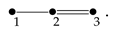
The algebra is the associative algebra over , generated by with the following defining relations:
where is a parameter. We then take our monomial order < to be the degree-lexicographic order with
Proposition 3
([24]). The algebra has a Gröbner–Shirshov basis with respect to our monomial order < as follows:
The cardinality of the set , i.e., the set of -standard monomials, is
Explicitly, the -standard monomials that are not -standard are as follows:
4. Temperley–Lieb Algebras of Type
Now, we consider the Coxeter diagram for type :

Let be the Temperley–Lieb algebra of type , that is, the associative algebra over , generated by with defining relations as follows:
where is a parameter. We then ix our monomial order < to be the degree-lexicographic order with
4.1. Type
From the relations given in , we calculate the Gröbner–Shirshov basis for the algebra .
Theorem 2.
The algebra has a Gröbner–Shirshov basis with respect to our monomial order < as follows:
The set of -standard monomials is denoted by . Note that the number is (See [27], p. 319).
Explicitly, the -standard monomials that are not -standard are as follows:
Proof.
First, it can be easily proved that the relations in hold. Counting the number of -standard monomials, we see that the number is exactly the dimension of the Temperley–Lieb algebra , which is the same as the number of fully commutative elements of type , as given in [27]. Hence, by Theorem 1 (c), the set is the Gröbner–Shirshov basis for the algebra defined by . □
Example 2.
We have the multiplication table between the standard monomials. For example, we multiply the monomial by from the right to obtain
from the relations in .
4.2. Type
Adding one more generator, we compute the Gröbner–Shirshov and the corresponding finite set of standard monomials.
Theorem 3.
The algebra has a Gröbner–Shirshov basis with respect to our monomial order < as follows:
We denote the set of -standard monomials based on . Note that the number is (See [27], p. 319).
Explicitly, the -standard monomials that are not -standard are as follows:
4.3. Type
Theorem 4.
The algebra has a Gröbner–Shirshov basis with respect to our monomial order < as follows:
We denote the set of -standard monomials by . Note that the number is (See [27], p. 319).
Explicitly, the -standard monomials that are not -standard are as follows:
4.4. Type
In general, we obtain a Gröbner–Shirshov for the Temperley–Lieb algebra of type as follows:
Theorem 5.
The algebra has a Gröbner–Shirshov basis with respect to our monomial order < as follows:
We denote the set of -standard monomials with . Note that the number is
where is the Fibonacci sequence (See [27], p. 306).
Proof.
We use the algorithm following part (a) of Theorem 1. Taking all possible compositions from the relations in the previous step, we obtain new relations that cannot be reducible with respect to the prior relations. It is clearly shown that all the relations in hold and that any composition between the polynomials in reduces to 0 with respect to , which means that is closed under composition. □
Remark 4.
For the Temperley–Lieb algebras of types and , we are working on their Gröbner–Shirshov bases and the corresponding standard monomials, which will be a new interpretation for the fully commutative elements of the associated types.
Author Contributions
Conceptualization, J.-Y.L. and D.-i.L.; methodology, J.-Y.L. and D.-i.L.; formal analysis, J.-Y.L. and D.-i.L.; investigation, J.-Y.L. and D.-i.L.; writing—original draft preparation, J.-Y.L. and D.-i.L.; writing—review and editing, J.-Y.L. and D.-i.L.; project administration, J.-Y.L. and D.-i.L.; funding acquisition, J.-Y.L. and D.-i.L. All authors have read and agreed to the published version of the manuscript.
Funding
The work of the first author was supported by a National Research Foundation of Korea (NRF) grant funded by the Korean government (MSIT) (No. RS-2023-00251466), and the corresponding author’s research was supported by NRF Grant # 2018R1D1A1B07044111 and a research grant from Seoul Women’s University (2024-0254).
Data Availability Statement
Data are contained within the article.
Conflicts of Interest
The authors declare no conflicts of interest.
References
- Temperley, H.N.V.; Lieb, E.H. Relations between percolation and colouring problems and other graph theoretical problems associated with regular planar lattices: Some exact results for the percolation problem. Proc. R. Soc. Lond. Ser. A 1971, 322, 251–280. [Google Scholar]
- Jones, V.F.R. Hecke algebra representations of braid groups and link polynomials. Ann. Math. 1987, 126, 335–388. [Google Scholar] [CrossRef]
- Buchberger, B. An Algorithm for Finding the Basis Elements of the Residue Class Ring of a Zero Dimensional Polynomial Ideal. Ph.D. Thesis, University of Innsbruck, Innsbruck, Austria, 1965. (In German) Translated in J. Symbolic Comput. 2006, 41, 475–511. [Google Scholar]
- Shirshov, A.I. Some algorithmic problems for Lie algebras. Sibirk. Math. Z. 1962, 3, 292–296. (In Russian) Translated in ACM SIGSAM Bull. Commun. Comput. Algebra 1999, 33, 3–6 [Google Scholar]
- Shirshov, A.I. Selected Works of AI Shirshov; Bokut, L.A., Latyshev, V., Shestakov, I., Zelmanov, E., Eds.; Birkhäuser: Basel, Switzerland, 2009. [Google Scholar]
- Bokut, L.A. Imbedding into simple associative algebras. Algebra Logic 1976, 15, 117–142. [Google Scholar] [CrossRef]
- Bergman, G.M. The diamond lemma for ring theory. Adv. Math. 1978, 29, 178–218. [Google Scholar] [CrossRef]
- Miller, C.F. Decision problems for groups—Survey and reflections. In Algorithms and Classification in Combinatorial Group Theory; Baumslag, G., Miller, C.F., Eds.; Springer: Berlin/Heidelberg, Germany, 1992; Volume 23, pp. 1–59. [Google Scholar]
- Kang, S.-J.; Lee, I.-S.; Lee, K.-H.; Oh, H. Hecke algebras, Specht modules and Gröbner-Shirshov bases. J. Algebra 2002, 252, 258–292. [Google Scholar] [CrossRef]
- Bokut, L.A.; Shiao, L.-S. Gröbner-Shirshov bases for Coxeter groups. Comm. Algebra 2001, 29, 4305–4319. [Google Scholar] [CrossRef]
- Borges-Trenard, M.A.; Pérez-Rosés, H. Complete presentations of direct products of groups. Cien. Mat. 2001, 19, 3–11. [Google Scholar]
- Lee, D.-I. Standard monomials for the Weyl group F4. J. Algebra Appl. 2016, 15, 1650146. [Google Scholar] [CrossRef]
- Lee, D. Gröbner-Shirshov bases and normal forms for the Coxeter groups E6 and E7. In Advances in Algebra and Combinatorics; Shum, K.P., Zelmanov, E., Zhang, Z., Shangzhi, L., Eds.; World Scientific Publications: Singapore, 2008; pp. 243–255. [Google Scholar]
- Svechkarenko, O. Gröbner-Shirshov Bases for the Coxeter Group E8. Master’s Thesis, Novosibirsk State University, Novosibirsk, Russia, 2007. [Google Scholar]
- Lee, J.-Y.; Lee, D.-I. Gröbner-Shirshov bases for non-crystallographic Coxeter groups. Acta Cryst. 2019, A75, 584–592. [Google Scholar] [CrossRef] [PubMed]
- Bokut, L.A.; Chen, Y. Gröbner-Shirshov bases and PBW theorems. J. Sib. Fed. Univ. Math. Phys. 2013, 6, 417–427. [Google Scholar]
- Ivanov-Pogodaev, I.; Malcev, S. Finite Gröbner basis algebras with unsolvable nilpotency problem and zero divisors problem. J. Algebra 2018, 508, 575–588. [Google Scholar] [CrossRef]
- Oner, T.; Senturk, I.; Oner, G. An independent set of axioms of MV-algebras and solutions of the set-theoretical Yang–Baxter equation. Axioms 2017, 6, 17. [Google Scholar] [CrossRef]
- Graham, J.J. Modular Representations of Hecke Algebras and Related Algebras. Ph.D. Thesis, University of Sydney, Sydney, Australia, 1995. [Google Scholar]
- Fan, C.K. Structure of a Hecke algebra quotient. J. Am. Math. Soc. 1997, 10, 139–167. [Google Scholar] [CrossRef]
- Kleshchev, A.; Ram, A. Homogeneous representations of Khovanov-Lauda algebras. J. Eur. Math. Soc. 2010, 12, 1293–1306. [Google Scholar] [CrossRef]
- Feinberg, G.; Lee, K.-H. Fully commutative elements of type D and homogeneous representations of KLR-algebras. J. Comb. 2015, 6, 535–557. [Google Scholar] [CrossRef]
- Stembridge, J.R. On the fully commutative elements of Coxeter groups. J. Algebr. Comb. 1996, 5, 353–385. [Google Scholar] [CrossRef]
- Kim, S.; Lee, D.-I. Gröbner-Shirshov bases for Temperley-Lieb algebras of types B and D. J. Algebra Appl. 2020, 19, 2050002. [Google Scholar] [CrossRef]
- Lee, J.-Y.; Lee, D.-I.; Kim, S. Gröbner-Shirshov bases for Temperley-Lieb algebras of complex reflection groups. Symmetry 2018, 10, 438. [Google Scholar] [CrossRef]
- Stanley, R.P. Catalan Numbers; Cambridge University Press: Cambridge, UK, 2015. [Google Scholar]
- Stembridge, J.R. The enumeration of fully commutative elements of Coxeter groups. J. Algebr. Comb. 1998, 7, 291–320. [Google Scholar] [CrossRef]
Disclaimer/Publisher’s Note: The statements, opinions and data contained in all publications are solely those of the individual author(s) and contributor(s) and not of MDPI and/or the editor(s). MDPI and/or the editor(s) disclaim responsibility for any injury to people or property resulting from any ideas, methods, instructions or products referred to in the content. |
© 2024 by the authors. Licensee MDPI, Basel, Switzerland. This article is an open access article distributed under the terms and conditions of the Creative Commons Attribution (CC BY) license (https://creativecommons.org/licenses/by/4.0/).