


Abstract
In this paper, the authors generalize the fractional curvature of plane curves introduced by Rubio et al. in 2023, to regular curves in the Euclidean space , and study the geometric properties of the curve using Caputo’s fractional derivative. Furthermore, we introduce a new definition of fractional curvature and fractional mean curvature of a regular surface, using fractional principal curvatures; and prove that such concepts are invariant under isometries; i.e., they belong to the intrinsic geometry of the regular surface. Also, a geometric interpretation is given to Caputo’s fractional derivative of algebraic polynomials.
Keywords:
curvature and torsion; Gaussian curvature; fractional curvature; Caputo’s fractional derivative; fractional principal direction MSC:
26A33; 53B20
1. Introduction
The fractional calculus is a branch of mathematics that studies the properties of derivatives and integrals of non-integer order; actually, it has different applications such as in the theory of viscoelasticity [1,2,3,4], dynamical systems [5,6,7], medicine [8], mechanics [9], economics [10], Newtonian dynamics [11], etc.
In 1967, Caputo [12], working on problems of differential equations related to the theory of viscoelasticity, formulated a new definition of fractional derivative, which had the advantage that the fractional initial conditions of fractional differential equations behaved like the initial conditions in the integer case of differential equations; another advantage of this fractional derivative, called Caputo’s fractional derivative, is that when applied to constants it cancels; which allows its use in other areas of knowledge, such as differential geometry.
In geometry, the fractional derivative is used in the study of geometric properties of curves [13,14,15,16,17], surfaces [18] and Riemannian manifolds [19,20].
In [16], Yajima et al., were forced to make a simplification of the fractional derivative of the composite function; since the formula for the fractional derivative of the composite function involves a series, which made it difficult to apply fractional calculus to the study of geometry.
In 2023, Rubio et al. [15] gave a new definition of fractional curvature of plane curves, different from that given by Yajima et al. [16], who makes use of integration in their approximations, which in practice is complicated.
In this paper, we generalize the definition of Rubio et al. [15], to curves in the 3-dimensional Euclidian space; and a new definition of fractional torsion of a regular curves is given; furthermore, a new definition of fractional curvature and fractional mean curvature of regular surfaces is given, using fractional principal curvatures, which differs from the approach given by Yajima et al. [18]; and it is shown that these curvatures are invariant under local isometries; i.e., they belong to the intrinsic geometry of regular curves and surfaces. 1,2-dimensional Euclidian space is characterized as that space whose fractional curvature is zero at all points.
This paper is organized as follow: Section 2 we provide some results on differential geometry of curves and surfaces [21,22] and the Caputo fractional derivative [12]. In Section 3 we define the curvature and fractional torsion and develops theory. Section 4 defines curvature and fractional mean curvature of surfaces and develops theory. In Section 5, we provide some examples of the fractional curvature of curves and surfaces and of the fractional torsion of a curve. In Example 1, we obtain a result that allows us to give a geometric interpretation of the Caputo fractional derivative in the case of polynomial functions.
2. Preliminaries
Definition 1
([15,21]). A parametrized curve differentiable in is a mapping differentiable of class , on an open interval . The variable t is called a parameter, and the subset of formed by the points , is called the trace of the curve.
Definition 2
([15,21]). Let a differentiable parametrized curve. The vector
is called the Tangent vector of α at t.
The curve is called regular [15,21,22] if . Furthermore, if is a regular curve, it can be reparametrized by the arc length parameter s, where
If is parametrized by are length, then , [15,21,22].
2.1. Space Curves
Definition 3
([15,21]). Let be a regular curve parametrized by arc length, then the curvature of α at is the real number
Definition 4
([15,21,22]). Let be a regular curve parametrized by arc length, such that . The vector
is called the normal vector to α in
Definition 5
([15,21,22]). Let be a regular curve parametrized by arc length, such that . The Binormal vector de α in s is:
The Frenet-Serret frame [15,21,22] of the curve is given by the orthonormal basis , and the Frenet-Serret formulas are given by
where is the torsion function of the curve α in s.
2.2. Regular Surface
Definition 6
([22]). A subset is a regular surface if, for each , there exists a neighborhood V in and a map of an open set onto such that
- 1.
- X is differentiable.
- 2.
- X is homeomorphism.
- 3.
- (The regularity condition). For each , the differential is one-to-one.
Let S be a regular orientable surface, the normal map of Gauss, the differential of normal map of Gauss.
Definition 7
([22]). The quadratic form , defined in by is called the second fundamental form of S at p.
Definition 8
([22]). Let C be a regular curve in S passing through , k the curvature of C at p, and , where n is the normal vector to C and N is the normal vector to S at p. The number is then called the normal curvature of at p.
Let , , then:
Definition 9
([22]). Let and let be the differential of the Gauss map. The determinant of is the Gaussian curvature K of S at p. The negative of half of the trace of is called the mean curvature H of S at p.
In terms of the principal curvatures we can write
where the functions and are the principal curvatures of S at p.
2.3. Caputo Fractional Derivative
In this work we will use the Caputo fractional derivative, since this fractional derivative has certain properties that allow the study of Differential Geometry [7,23] on regular curves and surfaces. Properties such as the derivative of a constant is zero, and in the field of the theory of fractional differential equations, fractional initial conditions behave like integer initial conditions [7,24,25], make this fractional derivative a fundamental tool.
Let be a function of class . The Caputo fractional derivative of order is defined by [12,15,23].
where , , and is Euler’s gamma function. Furthermore, as in [15], our analysis is based on this property
Therefore [15], for close to 1, the properties of the integer derivative can be approximated by the Caputo’s fractional derivative.
3. Fractional Curvature of Curves in Space
In this section we generalize the fractional curvature of plane curves given by Rubio et al. [15], to curves in space; and we give a new definition of fractional torsion.
Definition 10.
Let be a regular curve parametrized by arc length. The fractional derivative vector of order λ, , of α in , is given by
Let , , the Frenet-Serret trihedron, then [15]:
Figure 1a shows the vector tangent to the curve at s, as well as the fractional derivative vector , which is not necessarily tangent to at s. Figure 1b expresses the vector as a linear combination of the basis given by the Frenet–Serret trihedron.
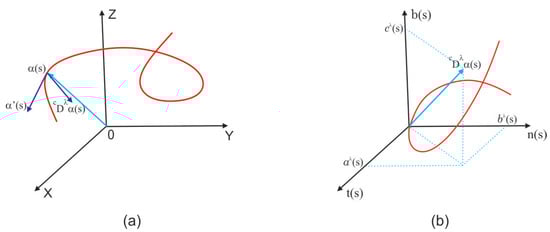
Figure 1.
Figure (a), shows the vectors and . Figure (b), shows the vector as a linear conbination of the basis .
Theorem 1.
Let be a regular curve parametrized by arc length. Then:
Proof.
By Definition 10 we have
and using the base given by the Frenet-Serret frame, we have:
Then
Since the decomposition in the base is unique, we have
□
Theorem 2.
Let be a regular curve parametrized by arc length, , and derivative vector
Then:
Proof.
Since is an orthonormal basis, we have:
from which we have the result. □
By (13) we have then:
Using the Frenet-Serret Equations (5)–(7), we have:
By (20), we have the next definition.
Definition 11.
Let be a regular curve parametrized by arc length, the fractional derivative vector of order λ of α in s, The fractional curvature of order λ, of α in s, is defined by:
where and are the integer curvature and torsion of α in s, respectively.
Theorem 3.
Let be a regular curve parametrized by arc length,
- If α is a plane curve, then
Proof.
1. If is a plane curve, then
2. It is inmediately. □
Definition 12.
Let be a regular curve parametrized by arc length, the fractional torsion of order λ, of α in s is given by
where and are the integer curvature and torsion of α in s, respectively.
Theorem 4.
Let be a regular curve parametrized by arc length, then:
Theorem 5.
Let be a regular curve parametrized by arc length, , . Then
Using (20), we define the following functions:
Then:
Theorem 6.
Let be a regular curve parametrized by arc length. Then
Proof.
From (28) and (29) following the result. □
Theorem 7.
Let be a regular plane curve parametrized by arc length. Then
Proof.
Since is plane curve, then there exists a plane that contains it with parametric equation:
where and are orthonormals vectors. Therefore, the curve is written as
Then
In addition, the binormal vector is paralell to , .
Therefore: ; and since , we have □
Theorem 8.
Let be a regular curve parametrized by arc length, , .
Proof.
We have
Now, if , we have
We assume that it exists , such that . Without loss of generality assume that , and let , and the orthogonal plane to .
From (34):
In addition, from (14) we have , which is absurd.
Therefore: , □
Theorem 9.
Let be a regular curve parametrized by arc length. Then, exists functions , suhc that
Proof.
We have: then is paralell to , and is paralell to ,
Then, there is a function , such that:
Similarly, there is a function , such that: □
Corollary 1.
Let , be a regular curve parametrized by arc length. Then, there is functios such that:
Proof.
From (35) and (36) the result is obtained. □
Theorem 10.
Let be a regular curve parametrized by arc length. Then
Proof.
We assume that , then from (35):
Reciprocally, we assume that . Then, by the Frenet-Serret Equations (5)–(7), we have: , where , .
Then:
Then:
Therefore
Consequently
□
Note that straight lines or line segments are the only curves whose classical curvature or integer curvature at all points, which characterizes Euclidean spaces. In this sense, if there exists an such that , then ; therefore, the curve moves away from its tangent line at s; that is, the fractional curvature indicates how the curve moves away from being a Euclidean space. Figure 2.
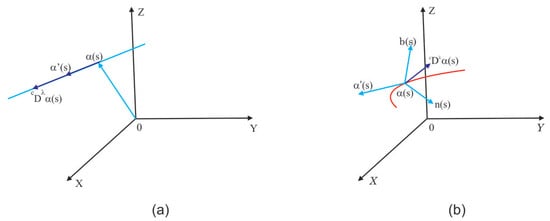
Figure 2.
In figure (a), a straight line segment with is shown, and is parallel to . In figure (b) we have a curve with .
Theorem 11.
Let be a regular curve parametrized by arc length, a isometric, . Then
where , are the fractional curvatures of the curves α and β respectively, , are the fractional torsions of the curves α and β respectively.
Proof.
Let , be Frenet-Serret frames of the curves and respectively. Since F is an isometry, we have:
Moreover, let:
Since F is an isometry, then:
where is a traslation and C is orthogonal transformation.
Now , following
We assume that F preserves orientation. Furthermore, from (42)–(46)
Then
Therefore
In addition
We assume that F reverses orientation, then:
then
therefore □
4. Fractional Curvature of Regular Surfaces
4.1. Fractional Normal Curvature
Let be a regular orientable surface, a regular curve, a parameterization of by arc length, .
Then, the normal curvature of S at p, with respect to v, is given by:
where
- is the second fundamental form of S at p,
- is the curvature of the curve at ,
- is the vector normal to at ,
- is the vector normal to S at p,
- .
Definition 13.
Let S be a regular orientable surface, , , . The fractional normal curvature of order λ, , of S in p with respect to v, is given by:
where is the fractional curvature of the curve , .
Theorem 12.
Let S be a regular orientable surface, , , . Then
Proof.
By (49), then
□
Theorem 13.
Let S be a regular orientable surface, , , . Then
Proof.
By (35), we have
Therefore □
Remark 1.
Throughout the paper we use the notation
Now, let , and the principal curvatures of S in p. Then
Let be given by
Then is a coninuous function defined by
Since is a compact set, then attains its maximum and minimum over , that is, there exist such that
and are called the fractional principal curvatures of order , , of S at p; and the following is true:
By (49), we have
Moreover:
Therefore
then:
Similarly
Theorem 14.
Let S be a regular orientable surface, . Then
Proof.
The proof is in the lines above. □
4.2. Fractional Curvature of a Regular Surface
In this section we introduce a new definition of fractional curvature and fractional mean curvature of regular surfaces, different from the one introduced by Yajima et al. [18], and show that they are invariant under isometries.
Definition 14.
Let S be a regular orientable surface. The fractional curvature of order λ, , of S at p is given by:
where and are the fractional principal curvatures of order λ, , of S at p.
Consider the plane . See Figure 3.
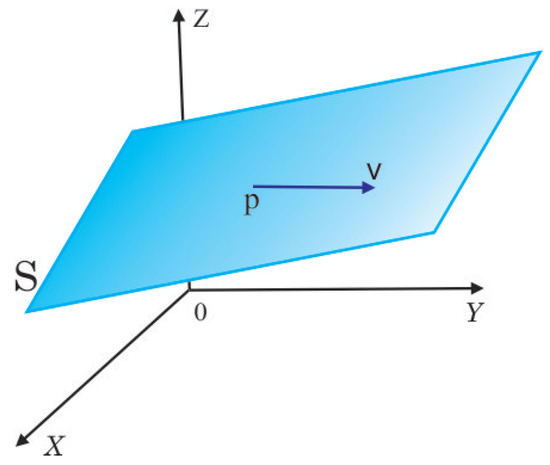
Figure 3.
Plot of a plane with null Gaussian curvature.
In the plane S the Gaussian curvature , and at any point , all directions , are principal directions, and it is verified
where and are the principal curvatures of S at p and is the normal curvature of S at p.
Then, by (60) and (61), we have:
Therefore, if there exists a point , and a , such that , then the surface would not be a plane; i.e., it curved.
Definition 15.
Let S be a regular orientable surface. The fractional mean curvature of order λ, , of S at p is given by:
where and are the fractional principal curvatures of order λ, , of S at p.
Theorem 15.
Let S be a regular orientable surface, . Then:
Proof.
.
(65) is inmediately.
(66),
Finally the Equation (67),
□
Theorem 16.
Let S and be regular orientable surfaces, a local isometry. Then
where and are the fractional curvatures of S and respectively, and and are the mean curvatures of S and respectively.
Proof.
Let , and , be the principal curvatures of S and respectively. Since is a local isometry, then
Furthermore, the principal curvatures of S and , are roots of the equation
and it is fulfilled that
Let , and , be the principal directions of S and at p and , respectively.
Then
Let , be the normal sections determined by and respectively. Then, using theorem 11 of curves in , we have:
Therefore
In Addition, if preserves orientation, we have
in case reverses orientation, we have
□
Theorem 17.
Let S be a regular orientable surface. If S is a minimal surface, then
Proof.
Let , then we have .
Let be the orthonormal basis of formed by the principal directions of S at ; the normal section determined by , , , the normal section determined by .
Then
Since the rotation is an isometry, we perform 2 rotations:
First rotation: We rotate the curve by an angle of around the N axis, so that the curve is located in the rectifying plane.
Second rotation: We rotate the curve by an angle of , around the axis, so that its normal vector coincides with .
Now using the fundamental theorem of curves in , we have that , and by Theorem 11, we have that
then
Therefore
Consequently
Since, is arbitrary, we have , , . □
5. Numerical Examples
Now, we give some examples of fractional curvature, fractional torsion of a regular curves and fractional curvature of regular surfaces. The examples were coded and run in MATLAB R2015a, with Windows operating system, using a Core 4C+8G 2.70 GHz computer and 12 GB RAM.
Example 1.
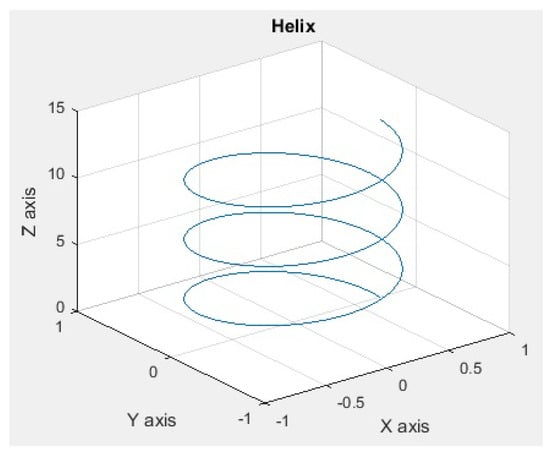

Consider the Helix defined by . See Figure 4.
Figure 4.
Plot of the Helix curve.
The Frenet-Serret trihedron is given by
The classical curvature and torsion of α are given by
and the derivative vector of of fractional order is:
Further, we have
Then
Therefore
Table 1 shows the first 20 results of evaluation of the and curvatures, for differents values of and , over the interval , with for the Interval partition. As can be observed, as λ approaches 1, the values of the fractional curvature approach the classic curvature
Table 1.
Values of and , for different values of and .
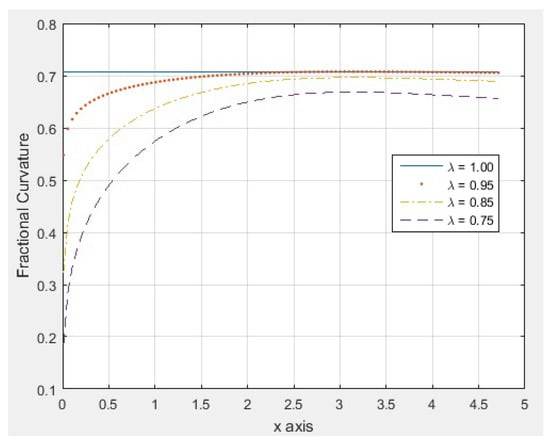
Figure 5 indicates the behavior of plot of the function for different values of and From Figure 5 we can observed that if λ approaches to 1, the plot of the function approaches the plot of the classic curvature .
Figure 5.
Plot of for different values of .
The fractional torsion of is given by
Table 2 shows the first 20 results of evaluation of the and torsion, for various values of and , over the interval , with for the Interval partition. As can observed, as λ approaches 1, the values of the fractional torsion approach the classic torsion .
Table 2.
Values of and , for different values of and .
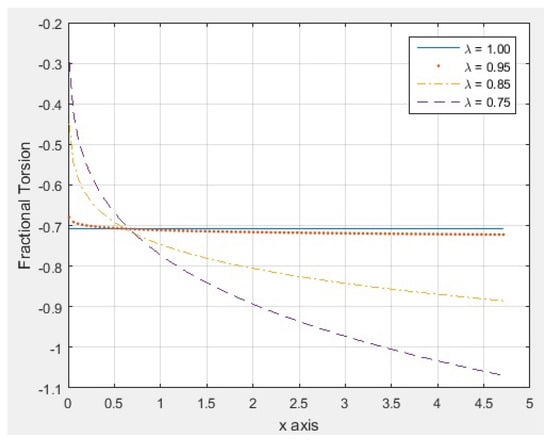
Figure 6 indicates the behavior of plot of the function for different values of and . From Figure 6, we can observed that if λ approaches to 1, the plot of the function approaches the graph of the classic torsion .
Figure 6.
Plot of the torsion for different values of .
Next, we obtain a geometric interpretation of the Caputo fractional derivative of algebraic polynomials.
From Equation (83), the fractional torsion of is given by
Therefore, we have
From (84), we observe that the Caputo fractional derivative of the identity function is a multiple of the fractional torsion of the Helix. Therefore, for values of λ close to 1, the Caputo fractional derivative of the identity function is a measure of how rapidly the curve pulls away from the tangent line and osculating plane at s, in a neighborhood of s.
Now, we get other relations
- 1.
- 2.
- 3.
- 4.
- In general
Consider the algebraic polynomial of degree n
Then
Therefore, the Caputo fractional derivative of the polynomial , is a multiple of the fractional torsion of the helix .
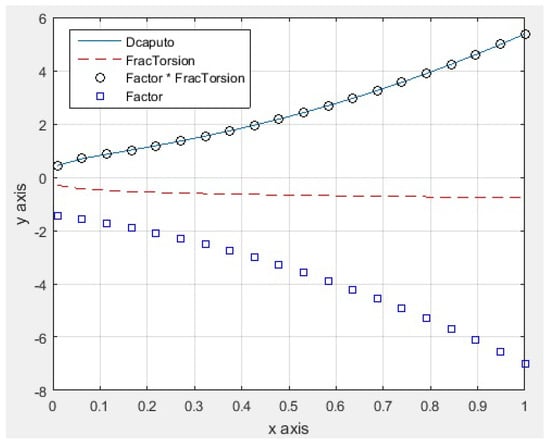
Now, consider the polynomial . In the Figure 7, we show the plots of with blue color (Dcaputo), the fractional torsion with red color (FracTorsion), the fractional factor with blue colored squares (Factor), and the product with black colored circles (Factor*FracTorsion). It is observed that Caputo’s fractional derivative of the third degree polynomial, is a multiple of the fractional torsion of the Helix.
Figure 7.
Plots of the functions , and .
Example 2.
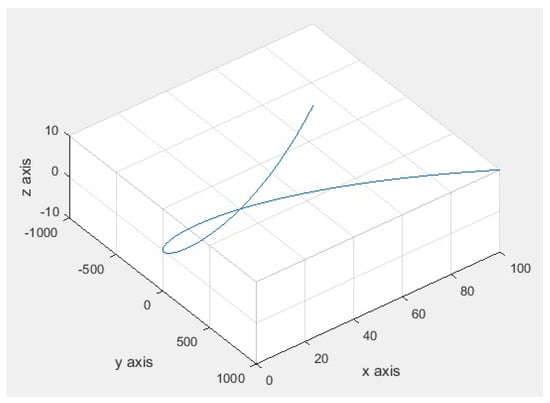
Consider the regular curve defined by . See Figure 8.
Figure 8.
Curve with arbitrary parameter.
Observe that the curve α is not parameterized by arc length, so following Rubio et al. [15], we express our results in arbitrary parameter.
The Frenet-Serret trihedron is given by , where
where , . Furthermore, the integer curvature and torsion of α are given by:
The fractional derivative vector of is:
Furthermore, we have
where
In arbitrary parameter, the fractional curvature is given by
where
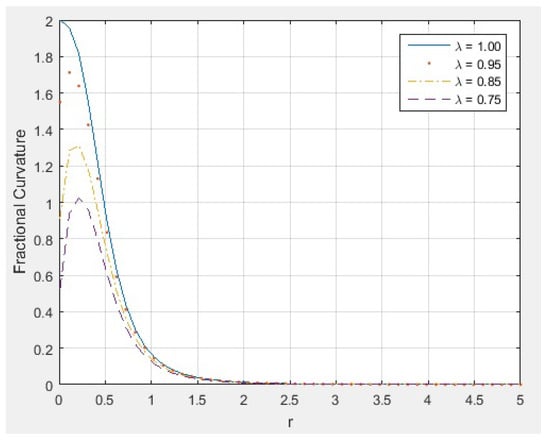
Table 3 shows the first 20 results of evaluation of the and curvatures, for differents values of and , over the interval , with for the interval partition. As can be observed, as λ approaches 1 , the values of the fractional curvature approach the values of the classic curvature .
Table 3.
Values of and , for different values of and .
Figure 9 indicates the behavior of plot of the function for different values of and . From Figure 9, we can observed that if λ approaches 1, the plot of the function approaches the plot of the classic curvature .
Figure 9.
Plot of for different values of .
The fractional torsion in arbitrary parameter, is given by
where
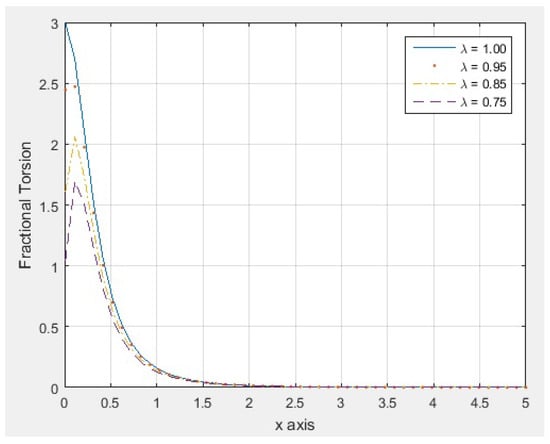
Table 4 shows the first 20 results of evaluation of the and torsions, for different values of and , over the interval , with for the interval partition. As can be observed, as λ approaches 1, the values of the fractional torsion approach the values of the classical torsion .
Table 4.
Values of and , for different vaulues of and .
Figure 10 indicates the behavior of plot of the function for different values of and . From Figure 10, we can observed that if λ approaches 1, the plot of the function approaches the plot of the classic torsion .
Figure 10.
Plot of for different values of .
Now, considering the fractional curvature , we obtain the fractional curvature surface . Figure 11 shows the plot of the fractional curvature surface over the region ; and Figure 12 shows the evolution of the fractional curvature of the curve , for values of the parameter from 0 to 1. If , we obtain the classical curvature or integer curvature of the curve . If is close to 1, we obtain curves close to the integer curvature .
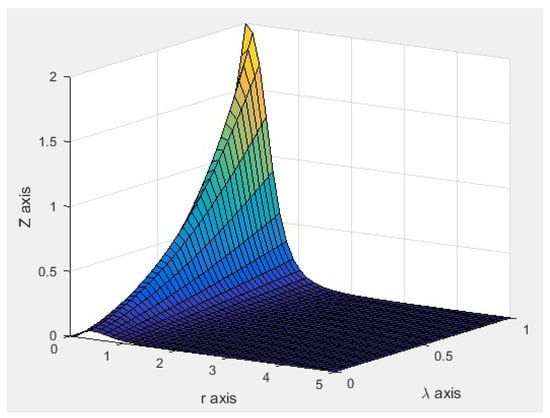
Figure 11.
Plot of the fractional curvature surface .
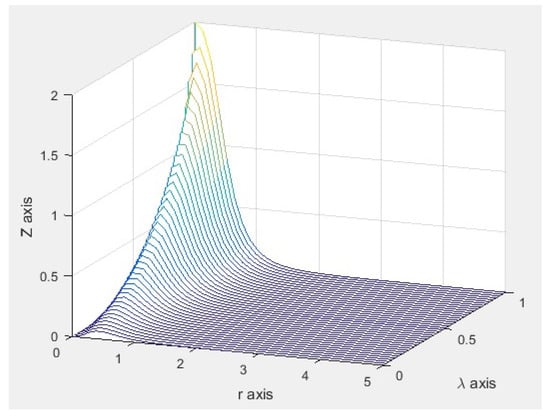
Figure 12.
Evolution of the fractional curvature of the curve, for values of the parameter from 0 to 1.
Example 3.
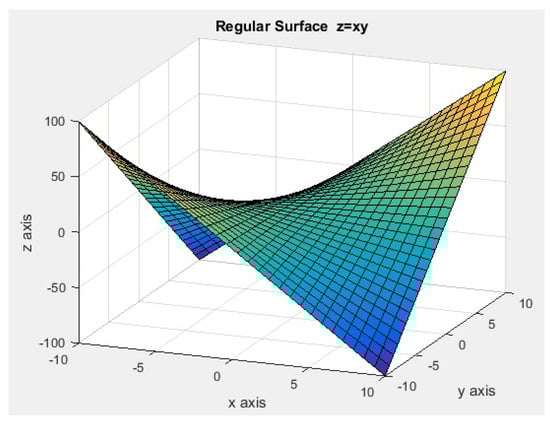
Let us consider the regular surface
See Figure 13
Figure 13.
The plot of the hyperbolic paraboloid.
A parametrization of S is given by the map defined by
The Gaussian curvature is given by
and the mean curvature is given by
The principal directions of the surface S at point , are given by
Now, let , then the tangent curves to and respectively, are the plane curves given by:
The Frenet-Serret trihedron of the curve is given by
where
In addition
Further, ,
where .
Then, the integer or classic curvature in arbitrary parameter of the curve is given by
Analogously, with respect to the curve , we have
The Frenet-Serret trihedron of the curve is given by
where .
In Addition
where
Then, the integer or classic curvature in arbitrary parameter of the curve is given by
In the computational implementation, we show approximations to the fractional curvature surface, for different values of the parameter λ. We worked on the square region , and considered a partition with , for the interval on the x and y axis respectively; and we chose the vertical section corresponding to . In addition, we used in Caputo’s fractional derivative.
The numerical results show symmetry with respect to the z axis; in this sense, Table 5 shows a part of the results corresponding to the vertical sections, for different values of the parameter and .
Table 5.
Vertical section data for different values of .
In Table 5, the symmetry of the data by column is observed, with respect to the data in row 10; moreover, if the parameter λ tends to 1, the values of the vertical sections tend to the integer case corresponding to column .
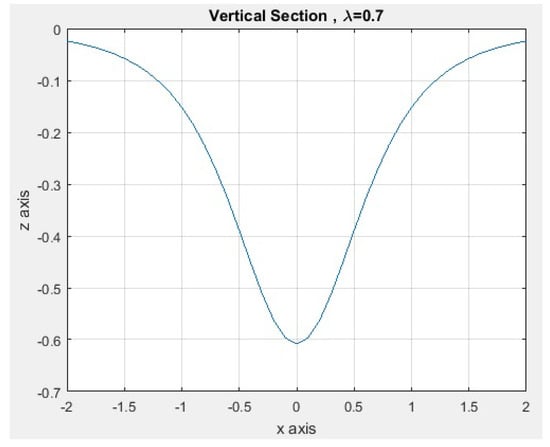
Figure 14.
Vertical section for .
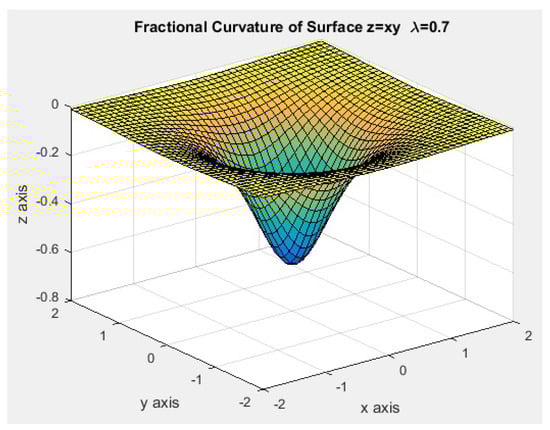
Figure 15.
Fractional curvature surface for .
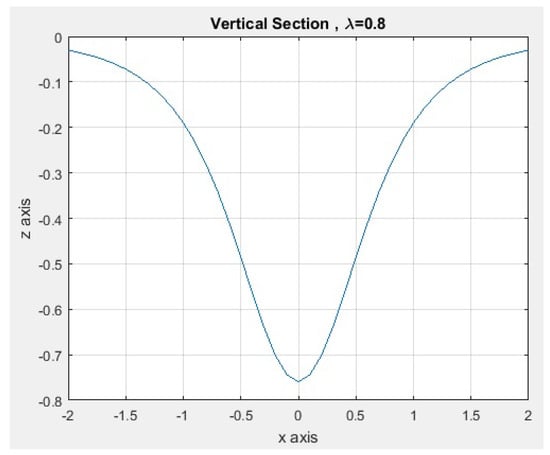
Figure 16.
Vertical section for .
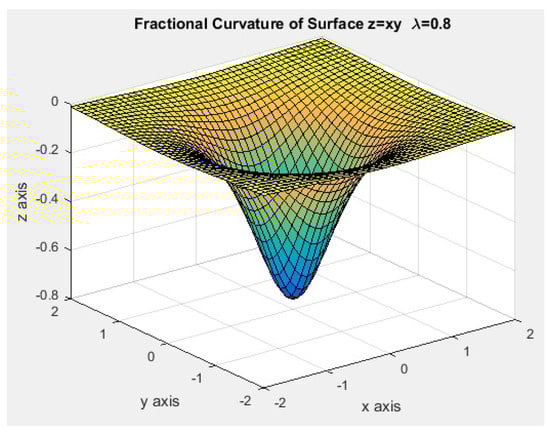
Figure 17.
Fractional curvature surface for .
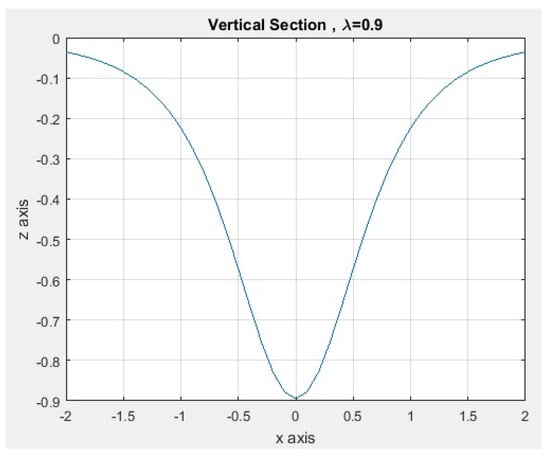
Figure 18.
Vertical section for .
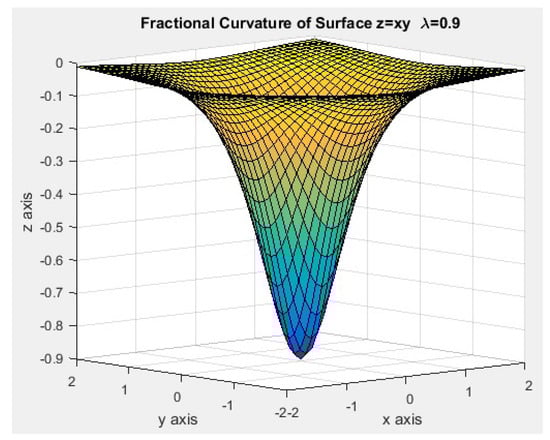
Figure 19.
Fractional curvature surface for .
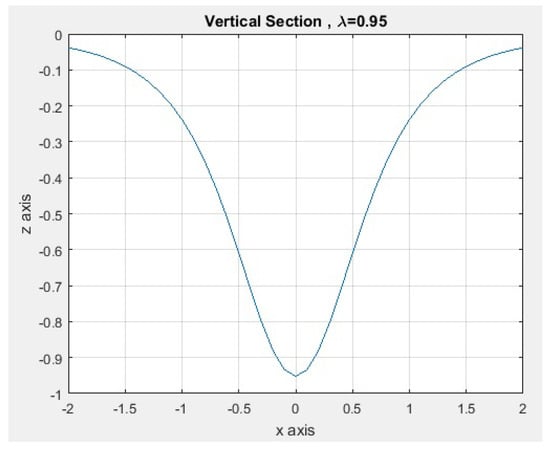
Figure 20.
Vertical section for .
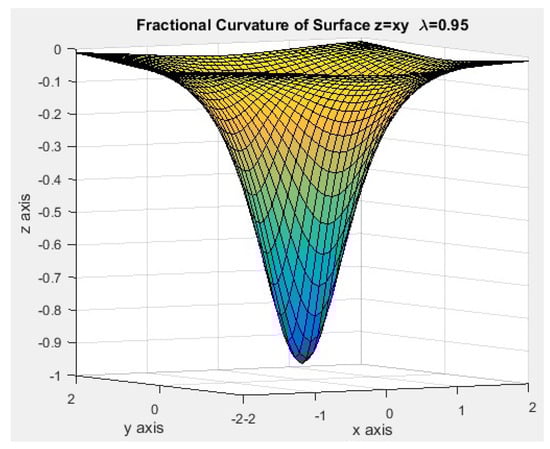
Figure 21.
Fractional curvature surface for .
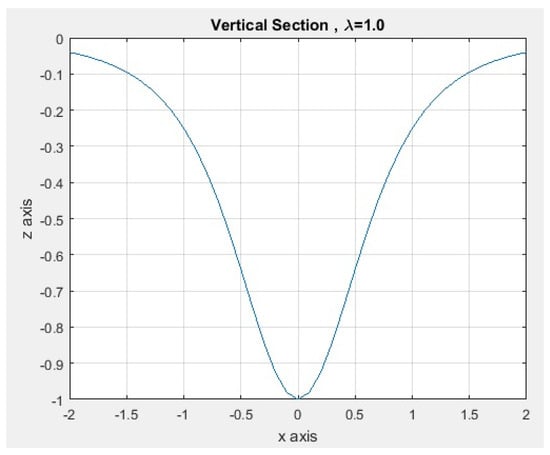
Figure 22.
Vertical section for .
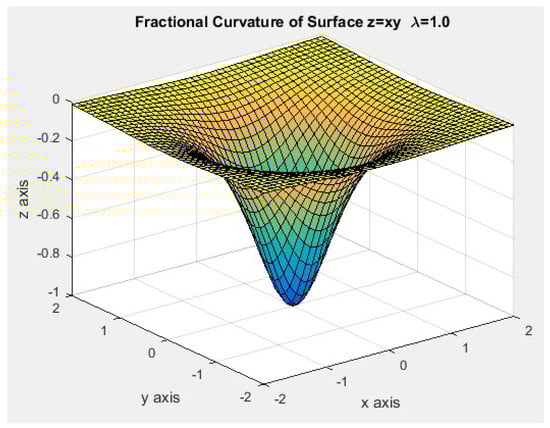
Figure 23.
Fractional curvature surface for .
6. Conclusions
In this paper, we generalize the fractional curvature of plane curves introduced by Rubio et al. [15] to regular curves in 3-dimensional Euclidean space, and give a new definition of fractional torsion of curves; furthermore, we prove that these concepts belong to intrinsic geometry.
From our study, we obtain a geometric interpretation of the Caputo fractional de-rivative of algebraic polynomials.
A new definition of fractional curvature and fractional mean curvature of regular surfaces is given using fractional principal directions, and it is proved that these cur-vatures are invariant under local isometries; that is, they belong to intrinsic geometry. The importance of our study lies in the analysis of the geometric properties of curves and surfaces from the point of view of fractional calculus. One-dimensional Euclidean spaces are characterized as those curves whose fractional curvature of order is zero at all points for all .
Author Contributions
Conceptualization, F.R.-L., O.R. and R.L.; methodology, F.R.-L., O.R., R.L. and A.R.; software, vis-ualization, A.R. and D.C., writing—original draft preparation, F.R.-L., O.R. and R.L.; writing—review and editing, F.R.-L., O.R., R.L., A.R. and D.C. All authors have read and agreed to the published version of the manuscript.
Funding
This work was funded by CONCYTEC through the PROCIENCIA program, according to contract No. 041-2021-FONDECYT.
Data Availability Statement
Data are contained within the article.
Conflicts of Interest
The authors declare no conflict of interest.
References
- Bagley, R.L.; Calico, R.A. Fractional order state equations for the control of viscoelastically damped structures. J. Guid. Control Dynam. 1991, 14, 304–311. [Google Scholar] [CrossRef]
- Bagley, R.L.; Torvik, P.J. A theoretical basis for the application of fractional calculus to viscoelasticity. J. Rheol. 1983, 27, 201–210. [Google Scholar] [CrossRef]
- Caputo, M.; Mainardi, F. A new dissipation model based on memory mechanism. Pure Appl. Geophys. 1971, 91, 134–147. [Google Scholar] [CrossRef]
- Koeller, R.C. Applications of fractional calculus to the theory of viscoelasticity. J. Appl. Mech. 1984, 51, 299–307. [Google Scholar] [CrossRef]
- Grigorenko, I.; Grigorenko, E. Chaotic dynamics of the fractional Lorenz system. Phys. Rev. Lett. 2003, 91, 034101. [Google Scholar] [CrossRef]
- Tarasov, V.E. Fractional generalization of gradient and Hamiltonian systems. J. Phys. A Math. Gen. 2005, 38, 5929–5943. [Google Scholar] [CrossRef]
- Tarasov, V.E. Fractional generalization of gradient systems. Lett. Math. Phys. 2005, 73, 49–58. [Google Scholar] [CrossRef]
- Dokuyucu, M.A.; Celik, E.; Bulut, H.; Baskonus, H.M. Cancer treatment model with the Caputo-Fabrizio fractional derivative. Eur. Phys. J. Plus. 2018, 133, 92. [Google Scholar] [CrossRef]
- Drapaca, C.S.; Sivaloganathan, S. A fractional model of continuum mechanics. J. Elast. 2012, 107, 107–123. [Google Scholar] [CrossRef]
- Baillie, R. Long memory processes and fractional integration in econometrics. J. Econometr. 1996, 73, 5–59. [Google Scholar] [CrossRef]
- Párraga, P.; Vivas-Cortez, M.; Larreal, O. Conformable fractional derivatives and applications to Newtonian dynamics and coolong body law. Sel. Matemáticas 2022, 9, 34–43. [Google Scholar] [CrossRef]
- Caputo, M. Linear Models of Dissipation whose Q is almost Frequency Independent-II. Geophys. J. R. Astr. Soc. 1967, 13, 529–539. [Google Scholar] [CrossRef]
- Has, A.; Yilmaz, B. Effect of fractional analysis on magnetic curves. Rev. Mex. Fis. 2022, 68, 041401. [Google Scholar] [CrossRef]
- Has, A.; Yilmaz, B. Cα-Helices and Cα-slant helices in fractional differential geometry. Arab. J. Math. 2024, 13, 291–301. [Google Scholar] [CrossRef]
- Rubio-López, F.; Rubio, O. A New fractional Curvature of curves using the Caputo´s fractional derivative. Adv. Math. Models Appl. 2023, 8, 157–175. [Google Scholar]
- Yajima, T.; Oiwa, S.; Yamasaki, K. Geometry of curves with fractional-order tangent vector and Frenet-Serret formulas. Fract. Calc. Appl. Anal. 2018, 21, 1493–1505. [Google Scholar] [CrossRef]
- Aydın, M.E.; Bektaş, M.; Öğrenmiş, A.O.; Yokuş, A. Differential Geometry of Curves in Euclidean 3-Space with Fractional Order. Int. Electron. J. Geom. 2021, 14, 132–144. [Google Scholar]
- Yajima, T.; Yamasaki, K. Geometry of surfaces with Caputo fractional derivatives and applications to incompressible two-dimensional flows. J. Phys. A Math. Theor. 2012, 45, 065201. [Google Scholar] [CrossRef]
- Jumarie, G. Riemann-Christoffel Tensor in Differential Geometry of Fractional Order Application to Fractal Space-Time. Fractals 2013, 21, 1350004. [Google Scholar] [CrossRef]
- Calcagni, G. Geometry of Fractional Spaces. Adv. Theor. Math. Phys. 2012, 16, 549–644. [Google Scholar] [CrossRef]
- Tenenblat, K. Introdução à Geometria Diferencial, 2nd ed.; Editora Edgar Blucher Ltda: Sao Paulo, Brazil, 2008. [Google Scholar]
- Do Carmo, M. Differential Geometry of Curves and Surfaces; Prentice-Hall: Englewood Cliffs, NJ, USA, 1976. [Google Scholar]
- Bonilla, B.; Kilbas, A.A.; Trujillo, J.J. Cálculo fraccionario y Ecuaciones Diferenciales Fraccionarias; UNED Ediciones: Madrid, Spain, 2008. [Google Scholar]
- Baleanu, D.; Vacaru, S.I. Constant curvature coefficients and exact solutions in fractional gravity and geometric mechanics. Cent. Eur. J. Phys. 2011, 9, 1267–1279. [Google Scholar] [CrossRef]
- Podlubny, I. Fractional Differential Equations; Academic Press: Cambridge, MA, USA, 1999. [Google Scholar]
Disclaimer/Publisher’s Note: The statements, opinions and data contained in all publications are solely those of the individual author(s) and contributor(s) and not of MDPI and/or the editor(s). MDPI and/or the editor(s) disclaim responsibility for any injury to people or property resulting from any ideas, methods, instructions or products referred to in the content. |
© 2024 by the authors. Licensee MDPI, Basel, Switzerland. This article is an open access article distributed under the terms and conditions of the Creative Commons Attribution (CC BY) license (https://creativecommons.org/licenses/by/4.0/).