Abstract
Population balance equations may be employed to handle a wide variety of particle processes has certainly received unprecedented attention, but the absence of explicit exact solutions necessitates the use of numerical approaches. In this paper, a (2 + 1) dimensional population balance equation with aggregation, nucleation, growth and breakage processes is solved analytically by use of the methods of scaling transformation group, observation and trial function. Symmetries, reduced equations, invariant solutions, exact solutions, existence of solutions, evolution analysis of dynamic behavior for solutions are presented. The exact solutions obtained can be compared with the numerical scheme. The obtained results also show that the method of scaling transformation group can be applied to study integro-partial differential equations.
Keywords:
integro-partial differential equation; population balance equation; scaling group; exact solution MSC:
45K05; 22E70; 76M60
1. Introduction
The areas of applications of population balance equations (PBEs) [1,2,3,4,5,6] and the references therein are more and more extensive, including gene regulatory processes, cell growth, division, differentiation, death processes, biochemistry and molecular biology, agriculture engineering, astrophysics and astronomy and so on. A general (2 + 1)-dimensional PBE [4] is given by
where x is the internal coordinate, it denotes the size of particles. t represents the time. is an average number density. is the growth rate of particle size x. The source denotes the contribution to of the change in the number of particles, owing to particle aggregation, nucleation, growth and breakage [1,2,3,4]. A (2 + 1)-dimensional homogeneous PBE is presented by (1) if the source term
In the following paragraph, it is of interest to consider the particulate processes for the particle population distributed according to their mass are frequently encountered in applications [1,2,3,4,5,6,7,8] and the references therein. A (2 + 1)-dimensional PBE [4] with particle aggregation, nucleation, growth and breakage processes is written
where denotes an average number of particles on breakage of a particle of size x. is the breakage rate or breakage frequency of particles at time t. In general, the breakage rate coefficient function is increasing with respect to the size of the fragmenting particle. is the probability of the particles of size y breaking into the particles of size x, which satisfies the normalization conditions
All of which are assumed to be time independent, but size dependent.
is the aggregation frequency for particle pairs of mass x and y [4]. The choice of kernel can dramatically affect the rate of coalescence and thereby the shape of the predicted granule size distribution. has a nonnegative symmetry property, that is,
Various intriguing and significant aggregation kernels originating from in industrial applications are homogeneous [4,5,6,7,8,9,10], that is, one can find an exponent satisfies
where every , denotes the degree of homogeneity. For instance:
where the kinetic coefficients are positive real constants. Using the property (4), one has
Hence, the general solution to Equation (6) is presented by
where is an arbitrary function of one variable.
Suppose that the average number of particle breakage is an arbitrary positive constant. The growth rate and breakage rate are both homogeneous with respect to particle size x, that is, which satisfy
where and are constants. In particular, the following kinetic functions
are considered in this work, where and n are positive constants, the probability density function satisfies the normalization conditions (3). In addition, assuming that , and using (4) or (7), Equation (2) under the constrain (8) can be simplified to the following form
If is any solution of Equation (9), then it has a property that population density vanishes for infinite-sized particles, which means the values of approach 0 as x approaches ∞, that is, . The regularity condition can be defined as
Equation (10) does not insist that the number density function itself vanishes at infinite mass if the growth rate function vanishes for large particles. The boundary conditions and initial condition for Equation (9) are
Moments [11] are mathematical formulations that allow us to calculate various properties of the particle size distribution function . The jth moment of the particle size distribution is defined as
where is the average total number of particles per unit volume of physical space in the system. is the total volume fraction of all particles.
It is relatively easy to establish the model (2), but it is typically difficult to search for exact solutions, except for using numerical methods, for instance, see the literature [2,3,4,7], whereas we would prefer to have explicit exact solutions that can describe phenomena in chemical engineering and other fields of nonlinear science. Analytical solutions of PBE (2) with zero growth rate (that is, ) and simultaneous breakage and coalescence for a special case were presented in [12,13,14,15]. Exact solutions of PBE (2) with aggregation, nucleation, growth and breakup for the particular cases were considered by using the method of adomian decomposition in [16]. However, at present, the explicit exact solution of Equation (9) has not been reported in the modern literature.
The developed Lie group theory [17,18] presents an approach for computing operators of integro-partial differential equations. In recent years, the developed Lie group analysis was applied to search for explicit exact solutions of PBEs [19,20,21,22] and solve integro-partial differential equations, stochastic equations and delay equations [23,24,25,26,27,28,29,30,31,32]. The essential obstacle of this approach is in searching for the general solutions of the determining equations, the approaches of solving determining equations of integro-partial differential equations depend on the studied equations, there is no general approach for solving determining equations of integro-partial differential equations [19,20,21,22,23,24,25,26,27,28,29,30,31].
The purpose of this work is to present an analytical technique for PBE (9) and to search for explicit exact solutions, in particular, physical explicit exact solutions. The methods of Lie group analysis [17,18] have already been developed to solve PBEs [19,20,21], and the references therein. However, it seems that none of the literature makes use of the method of scaling transformation group to find explicit exact solutions of PBE (9), except that which has been used in [19] for the simple homogeneous PBEs. Therefore, in the current work, explicit exact solutions of PBE (9) are investigated analytically by the method of scaling transformation group. Firstly, the admitted scaling group of PBE (9) will be obtained. Finally, explicit exact solutions, invariant solutions, and reduced equations of PBE (9) will be constructed.
The paper is structured as follows. In Section 2, a search for symmetries of PBE (9) is investigated using a scaling transformation group. In Section 3, explicit exact solutions, invariant solutions and reduced equations of PBE (9) are considered. At the same time, explicit exact unphysical solutions are presented. Dynamic behavior evolution analysis of particle size distribution for solutions is also given. In the Section 4, some conclusions are made.
2. Admitted Scaling Group
The complete symmetries of Equation (9) are typically laborious to be found with the approach of developed Lie group theory [17,18]. Conversely, the admitted groups of Equation (9) are considered with scaling group [17,18,19] in this section. Let us consider the following scaling group
and equation
where a is an arbitrary real group parameter, and are constants. If the transformation group (12) is admitted by Equation (9), then the admitted operator of Equation (9) is written
Using the transformations (12), one has
Substituting (12) and (15) into Equation (13), using the property of kernel (4), one obtains
Equation (16) gives
Similar to the previous case, it is not difficult to demonstrate that Equation (9) admits the following translation group with a real parameter
Furthermore, the translation group corresponding generator is admitted by Equation (9). In addition, after substituting the invariance conditions (17) into (14), it contains an arbitrary constant . Therefore, it follows from (14), (17) and (18) that the incomplete admitted operators of Equation (9) with (4) are provided by
Remark 1.
The investigation of symmetries of a new integro-partial differential equation is usually started by using the method of scaling transformation group. On one hand, the found symmetries can be applied to verify determining equations when we study complete group analysis of integro-partial differential equations by use of the method of developed Lie group analysis [17,18]. On the other hand, the obtained symmetries can also be used to construct exact and self-similar solutions, such as the literature [19,20,21,22].
3. Results: Explicit Exact Solutions
In this section, explicit exact solutions of Equation (9) with the kernel (5) are studied by using generators (19) and group transformations of solutions. By means of translation group (18) with , explicit exact solutions to Equation (9) can be shifted with respect to time t, that is,
3.1. Case
For the case of constant aggregation kernel , in terms of (4) one derives that . The invariants corresponding to generator are given by Thus, an invariant solution of Equation (9) is presented by
where satisfies the equation
Since Equation (20) involving three different type of integrals and , by use of the methods of trial function and observation [19,20,21,22], one can suppose that trial exponential function
is a solution to Equation (20) with , where and are constants, calculations of parameters and are performed on Matlab, which leads to Hence, an explicit exact solution of Equation (9) with is given by
where recalling (11), the zeroth moment and the first moment are provided by
The results of (22) demonstrate the average total number of particles and total volume of particles are conserved. The values of approach 0 as particle size x becomes large, which implies that solution (21) satisfies the property that population density vanishes for infinite-sized particles. Hence, the corresponding boundary conditions and initial condition of the Cauchy problem of solution (21) are, respectively, given by
Using the same methods which were used in the previous case, one can obtain explicit exact solutions to Equation (9) with that are presented by
where is a constant, analytical calculations of parameters and are performed on Matlab and the calculated values are, respectively, given by
The zeroth moment and the first moment for solution (23) are presented by
Remark 2.
Explicit exact solutions to Equation (9) with and constant aggregation kernel are provided by (23). Whereas, in the field of practical industrial application of PBE, the population density and kinetic parameters g and k are required to satisfy the constraints For such , the obtained solution (23) contradict the requirements that .
If , the invariants corresponding to generator are presented by Thus, the invariant solution is presented by , substituting this expression into Equation (9), which leads to the improper integral is divergent. Thus, the invariant solution for generator in this case can not be obtained.
If , the invariants corresponding to generator are provided by Therefore, an invariant solution of Equation (9) is given by
where satisfies the equation
If , the invariants corresponding to generator are given by , where Thus, an invariant solution to Equation (9) is presented by
Substituting (24) into Equation (9), one can obtain that the reduced equation is given by
Using the methods of observation and trial function [19,20,21,22], assuming that trial exponential function
is a solution to Equation (25) with , one can derive that Therefore, an explicit exact solution of Equation (9) with is presented by
The values of are close to 0 as x is close to ∞, which implies solution (26) has a property that population density vanishes for infinite-sized particles. In addition, the values approach 0 as t approaches ∞, which shows solution (26) is asymptotically stable. The boundary conditions and initial condition for solution (26) are, respectively, provided by
Recalling that (11) and using (26), by calculations, the zeroth moment and the first moment are presented by
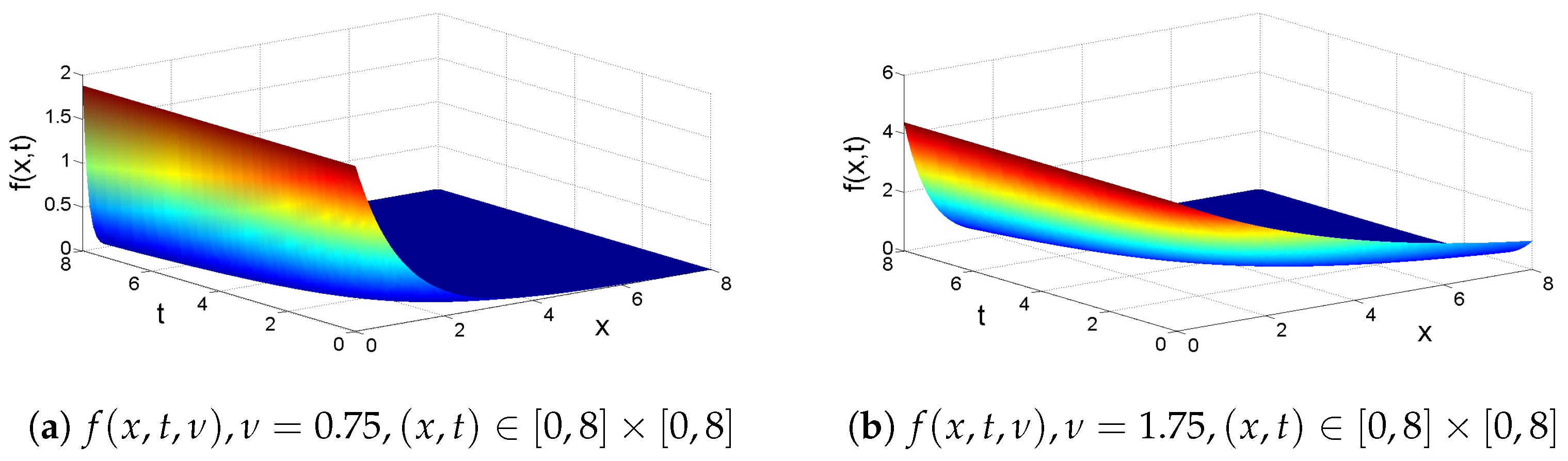
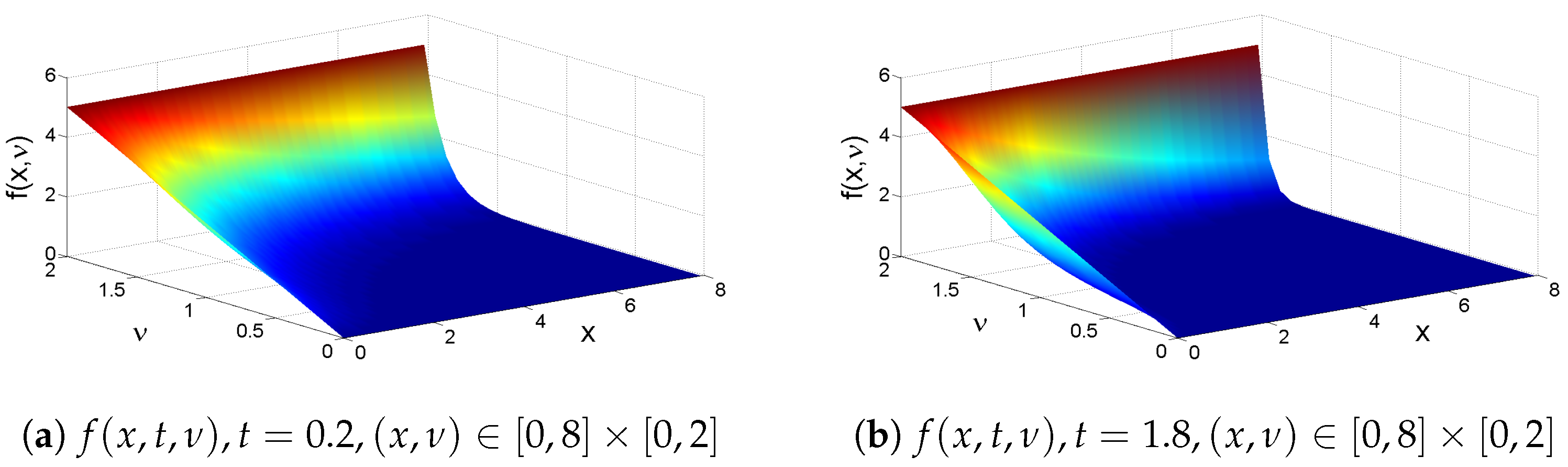
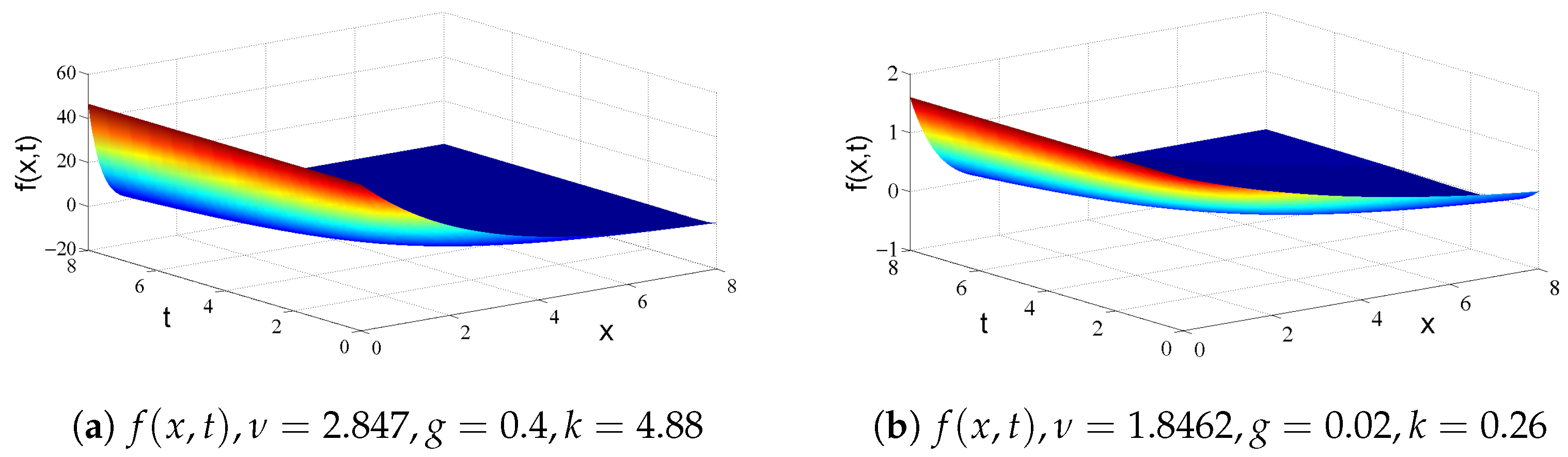
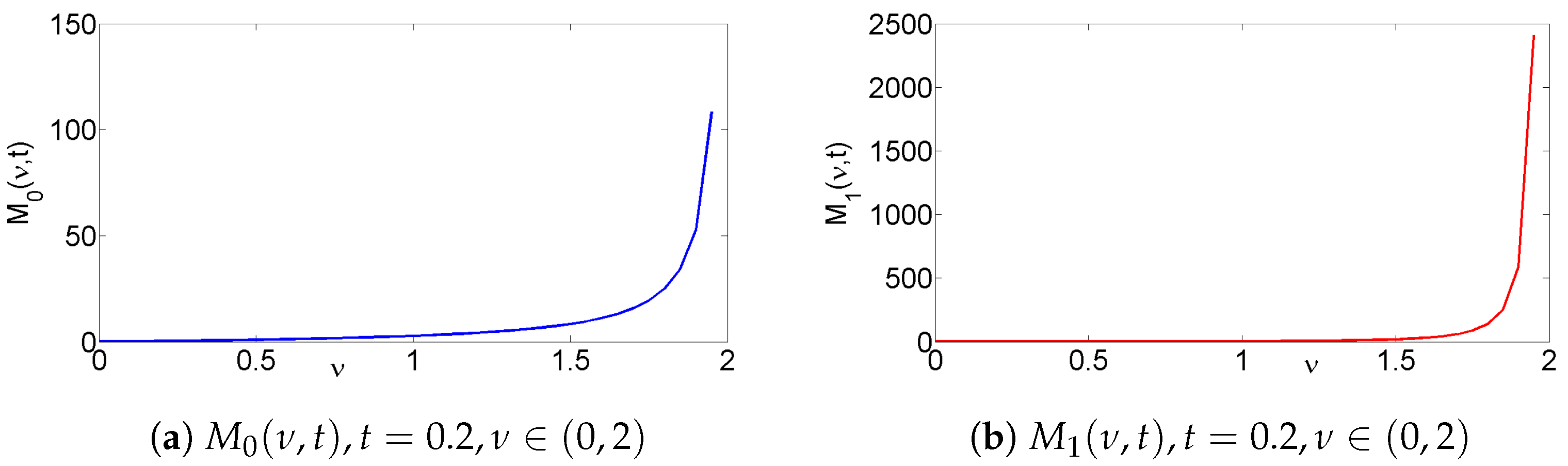
The zeroth moment depends on t, , and , but the first moment depends on t, , , and k. The moment functions and are both decreasing as time t increases, moreover the values of approach 0 as t approaches ∞, which demonstrates the average total number and total volume of particles are decreasing as t increases. Figure 1 interprets the moments and are both increasing for case , as changes from 0 to 2 at time . Figure 2 shows the evolution of dynamic behavior for solution (26) with and for case . Figure 3 interprets the evolution of dynamic behavior for solution (26) with and for case , when changes from 0 to 2.
Figure 1.
Evolution of dynamic behavior of moments and for solution (26) with .
Figure 2.
Evolution of dynamic behavior for solution (26) with .
Figure 3.
Evolution of dynamic behavior for solution (26) with .
Remark 3.
Applying the methods of observation and trial function [19,20,21,22] to Equation (25), in a similar way, one can obtain explicit exact solutions to Equation (9) with , the corresponding boundary conditions and initial condition, the zeroth moment and the first moment are, respectively, presented by
where parameters , and are given by (28), (29) and (30), respectively.
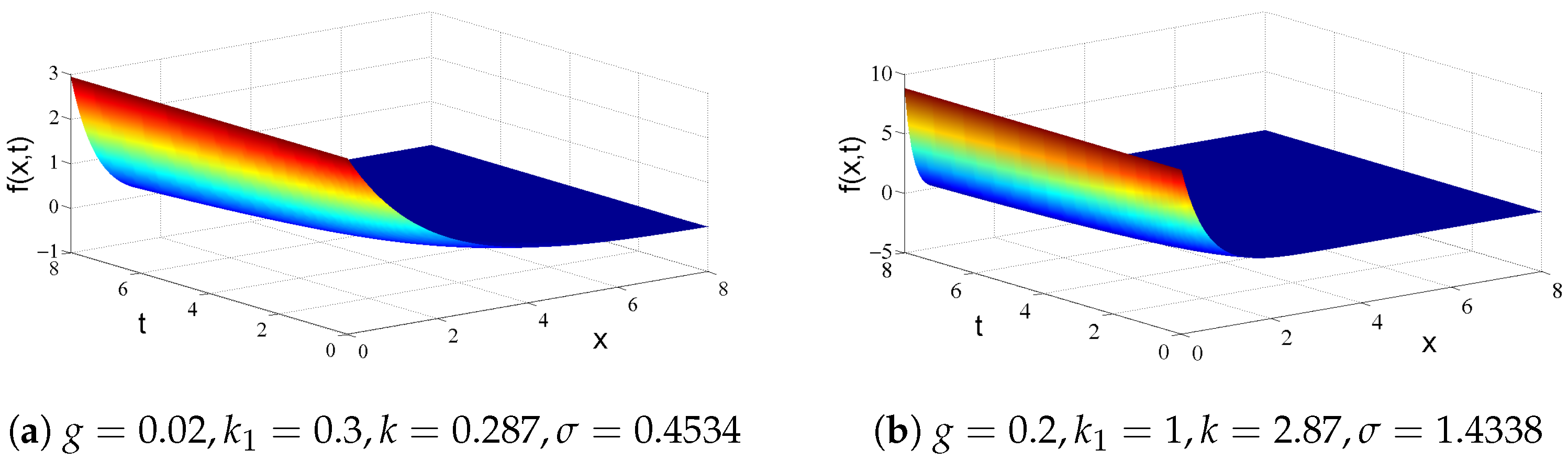
Evolution of dynamic behavior for explicit exact solutions (27) are considered as follows. Since parameters and can be positive or negative, if the values of are positive, which is a physical solution, if the values of are negative, which is an unphysical solution. In terms of , the values of tend to get closer and closer to 0 as t or x get closer and closer to ∞, which shows solutions (27) are asymptotically stable and have a property that population density vanishes for infinite sized particles. If , then the moments and decrease as t increases, which demonstrates the average total number and total volume of particles become less and less as t becomes more and more. Finally, they approach 0 as time t sufficiently approaches ∞. Figure 4 shows evolution of dynamic behavior of solution (27) with kinetic parameters (30) and for and .
3.2. Case
Applying the property (4) to the kernel , one finds that . The invariants for generator are given by Hence, an invariant solution to Equation (9) is presented by
where the reduced equation is
Using the methods of observation and trial function [19,20,21,22], by (31) one can derive that a solution of Equation (9) with is given by
where the values of population density are close to 0 as particle size x approaches ∞, the boundary conditions and initial condition, the zeroth moment and the first moment are, respectively, presented by
Equation (32) demonstrates the average total number and total volume of particles are conserved.
If , the invariant solutions to Equation (9) corresponding to generator can not be obtained.
If , the invariants for generator are given by Therefore, an invariant solution to Equation (9) with is presented by
where satisfies the equation
If , the invariants for generator are presented by Hence, an invariant solution to Equation (9) can be presented by
where satisfies the equation
Noticing that (33) and (34), with the help of the approaches of observation and trial function [19,20,21,22], exact solutions of Equation (9) with , the boundary conditions and initial condition, the moments and are, respectively, provided by
A real root of cubic Equation (37) is given by
an approximate value of is 3.0689825. The values of approach 0 as t or x sufficiently approaches ∞, which shows the obtained solutions (35) and (36) to Equation (9) with are asymptotically stable, and have a property that population density vanishes for infinite-sized particles. The computed results of the moments and for solutions (35) and (36), demonstrate the average total number and total volume of particles are decreasing as t increases. Figure 5 shows evolution of dynamic behavior of solution (36) with and for and .
Figure 5.
Evolution of dynamic behavior for solution (36) with and .
3.3. Case
For the case of product aggregation kernel , according to (4) one finds that . The invariants for generator are given by Hence, an invariant solution to Equation (9) can be written as
where function has to satisfy the equation
If , the invariant solution to Equation (9) corresponding to generator cannot be obtained. However, the invariants corresponding to generator are presented by Thus, an invariant solution of Equation (9) with is provided by
where the reduced equation is
If , the invariants for generator are presented by Thus, an invariant solution to Equation (9) can be given by
where satisfies the equation
3.4. Case
For the case of aggregation kernel , the property of kernel (4) leads to . The invariants for generator are . An invariant solution to Equation (9) has the representation
where the reduced equation is
If , in an analogous way, the invariant solution for generator cannot be obtained. However, the invariants corresponding to generatorthe invariants corresponding to generator are . An invariant solution to Equation (9) is given by
where the reduced equation is
Using the methods of observation and trial function [19,20,21,22], by solving Equation (38), an explicit unphysical exact solution to Equation (9) is provided by
If , the invariants corresponding to generator are . Thus, an invariant solution of Equation (9) is presented by
where the reduced equation is
3.5. Case
Applying the property (4) to kernel , one can obtain . The invariants for generator are . An invariant solution to Equation (9) has the representation
where the reduced equation is
If , similarly the invariant solution for generator cannot be found. However, the invariants corresponding to generator are . So an invariant solution of Equation (9) is presented by
where the reduced equation is
If , the invariants corresponding to generator are . Hence, an invariant solution of Equation (9) is presented by
where satisfies the equation
Remark 4.
In the analysis of microbial or bacterial populations property of binary division by cells causes ν to be identically 2. It attains a minimum value of 2 during the uniform binary breakage process, but being an average number is not restricted to being an integer. However, in a multiple-splitting process, detailed modeling of the breakage process is indispensable for obtaining the value of ν. Its determination from experiments also implies a potential alternative.
4. Conclusions and Discussion
The scale transformation group method is a useful technique for finding symmetries of the PBE (9). By analyzing the scaling properties of the PBE (9), this method discovers the symmetries that keep the equation unchanged. These symmetries are then used to simplify the form of the PBE (9) and reduce the number of independent variables. The simplified equations are analytically solved by using standard techniques, which lead to rich results in this work. More importantly, the admitted scaling group, incomplete symmetries, exact solutions, invariant solutions, unphysical solutions and reduced equations have been derived by scaling transformation group for the PBE (9) with the kernel (5), aggregation, nucleation, breakage and growth processes. The existence of solutions is also demonstrated. The analysis of the dynamic behavior of some solutions for the PBE (9) is provided. The exact solutions can be employed to verify the accuracy of numerical solutions and discretization. In the future, this method would be expected to be an effective tool in various fields including physics, chemistry, biology, engineering, finance, and economics.
Author Contributions
Conceptualization, Y.Y. and X.Y.; software, F.L.;methodology, F.L.; writing—original draft preparation, X.Y.; writing—review and editing, F.L. All authors have read and agreed to the published version of the manuscript.
Funding
This work of Fubiao Lin is supported by Science and Technology Program Fund Project of Guizhou Province, China (Qian Ke He Ji Chu-ZK[2022]021); This work of Yang Yang is supported by 2023 undergraduate scientific research project of Guizhou University of Finance and Economics, China (2022BZXS143).
Data Availability Statement
The data used to support the findings of this study are included within the article.
Acknowledgments
The authors would like to thank the referees and the editor for their help.
Conflicts of Interest
The authors declare no conflicts of interest.
References
- Podgórska, W. Population Balance Equation. In Multiphase Particulate Systems in Turbulent Flows-Fluid-Liquid and Solid-Liquid Dispersions; CRC Press: New York, NY, USA, 2020; pp. 7–64. [Google Scholar]
- Yeoh, G.H.; Cheung, C.P.; Tu, J.Y. Multiphase Flow Analysis Using Population Balance Modeling: Bubbles, Drops and Particles; Butterworth Heinemann: Amsterdam, The Netherlands, 2014. [Google Scholar]
- Ramkrishna, D.; Singh, M.R. Population balance modeling: Current status and future prospects. Annu. Rev. Chem. Biomol. 2014, 5, 123–146. [Google Scholar] [CrossRef] [PubMed]
- Ramkrishna, D. Population Balances: Theory and Applications to Particulate Systems in Engineering; Academic Press: San Diego, CA, USA, 2000. [Google Scholar]
- Wang, K.; Yu, S.; Peng, W. Extended log-normal method of moments for solving the population balance equation for Brownian coagulation. Aerosol Sci. Technol. 2019, 53, 332–343. [Google Scholar] [CrossRef]
- Wang, K.; Peng, W.; Yu, S. A new approximation approach for analytically solving the population balance equation due to thermophoretic coagulation. J. Aerosol Sci. 2019, 128, 125–137. [Google Scholar] [CrossRef]
- Cameron, I.T.; Wang, F.Y.; Immanuel, C.D.; Stepanek, F. Process systems modelling and applications in granulation: A review. Chem. Eng. Sci. 2005, 60, 3723–3750. [Google Scholar] [CrossRef]
- Shafiet, Y.; Ghazanfari, M.H.; Seyyedsar, S.M. A study of liquid drainage rate from foam with population balance equation: Impact of bubble evolution. Colloid Polym. Sci. 2018, 296, 1097–1108. [Google Scholar] [CrossRef]
- Kapur, P.C. Kinetics of granulation by non-random coalescence mechanism. Chem. Eng. Sci. 1972, 27, 1863–1869. [Google Scholar] [CrossRef]
- Adetayo, A.A.; Ennis, B.J. Unifying approach to modeling granule coalescence mechanisms. Aiche J. 1997, 43, 927–934. [Google Scholar] [CrossRef]
- Hulburt, H.M.; Katz, S. Some problems in particle technology: A statistical mechanical formulation. Chem. Eng. Sci. 1964, 19, 555–574. [Google Scholar] [CrossRef]
- Patil, D.P.; Andrews, J.R.G. An analytical solution to continuous population balance model describing floc coalescence and breakage—A special case. Chem. Eng. Sci. 1998, 53, 599–601. [Google Scholar] [CrossRef]
- Lage, P.L.C. Comments on the analytical solution to continuous population balance equation with coalescence and breakage–the special case with constant number of particles. Chem. Eng. Sci. 2002, 57, 4253–4254. [Google Scholar] [CrossRef]
- Mccoy, B.J.; Madras, G. Analytical solution for a population balance equation with aggregation and fragmentation. Chem. Eng. Sci. 2003, 58, 3049–3051. [Google Scholar] [CrossRef]
- Pinar, Z.; Dutta, A.; Bény, G.; Öziş, T. Analytical solution of population balance equation involving aggregation and breakage in terms of auxiliary equation method. Pramana J. Phys. 2015, 84, 9–21. [Google Scholar] [CrossRef][Green Version]
- Hasseine, A.; Bart, H.J. Adomian decomposition method solution of population balance equations for aggregation, nucleation, growth and breakup processes. Appl. Math. Model. 2015, 39, 1975–1984. [Google Scholar] [CrossRef]
- Meleshko, S.V. Methods for Constructing Exact Solutions of Partial Differential Equations: Mathematical and Analytical Techniques with Applications to Engineering; Springer: New York, NY, USA, 2005. [Google Scholar]
- Grigoriev, Y.N.; Ibragimov, N.H.; Kovalev, V.F.; Meleshko, S.V. Symmetries of Integro-Differential Equations: With Applications in Mechanics and Plasma Physics; Springer: New York, NY, USA, 2010. [Google Scholar]
- Lin, F.; Flood, A.E.; Meleshko, S.V. Exact solutions of population balance equation. Commun. Nonlinear Sci. Numer. Simul. 2016, 36, 378–390. [Google Scholar] [CrossRef]
- Lin, F.; Meleshko, S.V.; Flood, A.E. Symmetries of population balance equations for aggregation, breakage and growth processes. Appl. Math. Comput. 2017, 307, 193–203. [Google Scholar] [CrossRef]
- Lin, F.; Meleshko, S.V.; Flood, A.E. Exact solutions of the population balance equation including particle transport, using group analysis. Commun. Nonlinear Sci. Numer. Simul. 2018, 59, 255–271. [Google Scholar] [CrossRef]
- Lin, F.; Zhang, Q. Exact solutions of population balance equations for breakage and growth processes, using group analysis. Appl. Math. Comput. 2020, 368, 1–14. [Google Scholar] [CrossRef]
- Zhou, L.; Meleshko, S.V. Group analysis of integro-differential equations describing stress relaxation behavior of one-dimensional viscoelastic materials. Int. J. Non Linear Mech. 2015, 77, 223–231. [Google Scholar] [CrossRef]
- Zhou, L.; Meleshko, S.V. Invariant and partially invariant solutions of integro-differential equations for linear thermoviscoelastic aging materials with memory. Contin. Mech. Thermodyn. 2017, 29, 207–224. [Google Scholar] [CrossRef]
- Zhou, L.; Meleshko, S.V. Symmetry groups of integro-differential equations for linear thermoviscoelastic materials with memory. J. Appl. Mech. Tech. Phys. 2017, 58, 587–609. [Google Scholar] [CrossRef]
- Mkhize, T.G.; Govinder, K.; Moyo, S.; Meleshko, S.V. Linearization criteria for systems of two second-order stochastic ordinary differential equations. Appl. Math. Comput. 2017, 301, 25–35. [Google Scholar] [CrossRef]
- Long, F.; Karnbanjong, A.; Suriyawichitseranee, A.; Grigoriev, Y.N.; Meleshko, S.V. Application of a Lie group admitted by a homogeneous equation for group classification of a corresponding inhomogeneous equation. Commun. Nonlinear Sci. Numer. Simul. 2017, 48, 350–360. [Google Scholar] [CrossRef]
- Grigoriev, Y.N.; Meleshko, S.V.; Suriyawichitseranee, A. Exact solutions of the Boltzmann equations with a source. J. Appl. Mech. Tech. Phys. 2018, 59, 189–196. [Google Scholar] [CrossRef]
- Ibragimov, N.H.; Meleshko, S.V.; Rudenko, O.V. Group analysis of evolutionary integro-differential equations describing nonlinear waves: The general model. J. Phys. A Math. Theor. 2011, 44, 1–21. [Google Scholar] [CrossRef][Green Version]
- Suriyawichitseranee, A.; Grigoriev, Y.N.; Meleshko, S.V. Group analysis of the Fourier transform of the spatially homogeneous and isotropic Boltzmann equation with a source term. Commun. Nonlinear Sci. Numer. Simul. 2015, 20, 719–730. [Google Scholar] [CrossRef]
- Ibragimov, N.H.; Kovalev, V.F.; Pustovalov, V.V. Symmetries of integro-differential equations: A survey of methods illustrated by the Benny equations. Nonlinear Dyn. 2002, 28, 135–153. [Google Scholar] [CrossRef]
- Temimi, H.; Ansari, A.R.; Siddiqui, A.M. An approximate solution for the static beam problem and nonlinear integro-differential equations. Comput. Math. Appl. 2011, 62, 3132–3139. [Google Scholar] [CrossRef]
Disclaimer/Publisher’s Note: The statements, opinions and data contained in all publications are solely those of the individual author(s) and contributor(s) and not of MDPI and/or the editor(s). MDPI and/or the editor(s) disclaim responsibility for any injury to people or property resulting from any ideas, methods, instructions or products referred to in the content. |
© 2024 by the authors. Licensee MDPI, Basel, Switzerland. This article is an open access article distributed under the terms and conditions of the Creative Commons Attribution (CC BY) license (https://creativecommons.org/licenses/by/4.0/).