Cycle Embedding in Enhanced Hypercubes with Faulty Vertices

Abstract
1. Introduction
2. Preliminaries
3. Even Cycles Embedding in with
4. Odd Cycles Embedding in with
- (i)
- For , . We can denote the two vertices in by the binary strings as and . By the definition and connection of the binary strings of two vertices, we have ... and . Accordingly, by the calculating of the numbers of the different bits in the binary bits of the two selected vertices, we can conclude that . As an immediate result, we have .
- (ii)
- For , . We can denote the two vertices in by the binary strings as and . By the definition and connection of the binary strings of two vertices, we have and . Similarly as above, it follows that and .
- For , we can select distinct w’s in such that and are both the jth dimensional edges in , i.e., , and . For clarity, let and be two vertices in . Thus is an ith dimensional edge. We can select a vertex , and . It implies that and . It follows that the vertices can be denoted as , , , and . As an immediate result, we have and .
- For , we can select distinct w’s in such that and are both the jth dimensional edges in , i.e., . For clarity, let and be two vertices in . Thus, is an ith dimensional edge. We can select a vertex , . It implies that and . Subsequently, we have and .
- For , we can select distinct w’s in such that and are both the jth dimensional edges in , i.e., . For clarity, let and be two vertices in . Thus is an ith dimensional edge. We can select a vertex , . It implies that and . It is easy to see that and .
- For , we can select distinct w’s in such that and are both the jth dimensional edges in , i.e., , and . For clarity, let and be two vertices in . Thus, is an ith dimensional edge. We can select a vertex in , . Accordingly, we have and . As a consequence, we have and .
- First, . By the symmetric structure of and , and the distribution of faulty vertices, without loss of generality, we can assume that . On one hand, in , , by induction hypothesis, the edge e lies on a fault-free cycle of every possible odd length from to in . Let be a cycle of length in containing the edge e. Let denote that . Note that we can select an edge such that , and . (If not, it implies that . Thus, we have for , a contradiction. Specially, for , Lemma 9 implies that contains a cycle of length 7 when and . Thus, it is easy to select the desired edge on the cycle.) For clarity, we set , and . On the other hand, we can construct the desired cycle as , whose length is , i.e., .
- Now, . , and . Recall that , Theorem 1 implies that the fault-free edge lies on a fault-free cycle of every even length from 4 to in . Assume that and . Thus, . Note that u have n neighbors in , i.e., , , where , and , . We can observe that there exist n cycles of length four containing the edge in common, i.e., , . Recall that . Thus, there exists at least one fault-free pair , such that the cycle of length 4 is fault-free. Assume forms such a fault-free cycle of length 4 containing the edge . Obviously, . On one hand, by induction hypothesis, lies on a fault-free cycle of every odd length from to . For clarity, . Therefore the desired cycle of every odd length from to can be constructed as . On the other hand, we can construct the desired cycle of every odd length from to . Let be a fault-free cycle of length in , which contains the edge . Denote . Applying Theorem 1, lies on a cycle of every even length from 4 to . For clarity, , and . Subsequently, merging the two paths and as well as the two fault-free edges and , the desired cycle can be constructed as , and the cycle is of every odd length from to .
- First, . Without loss of generality, we can assume that .
- (i)
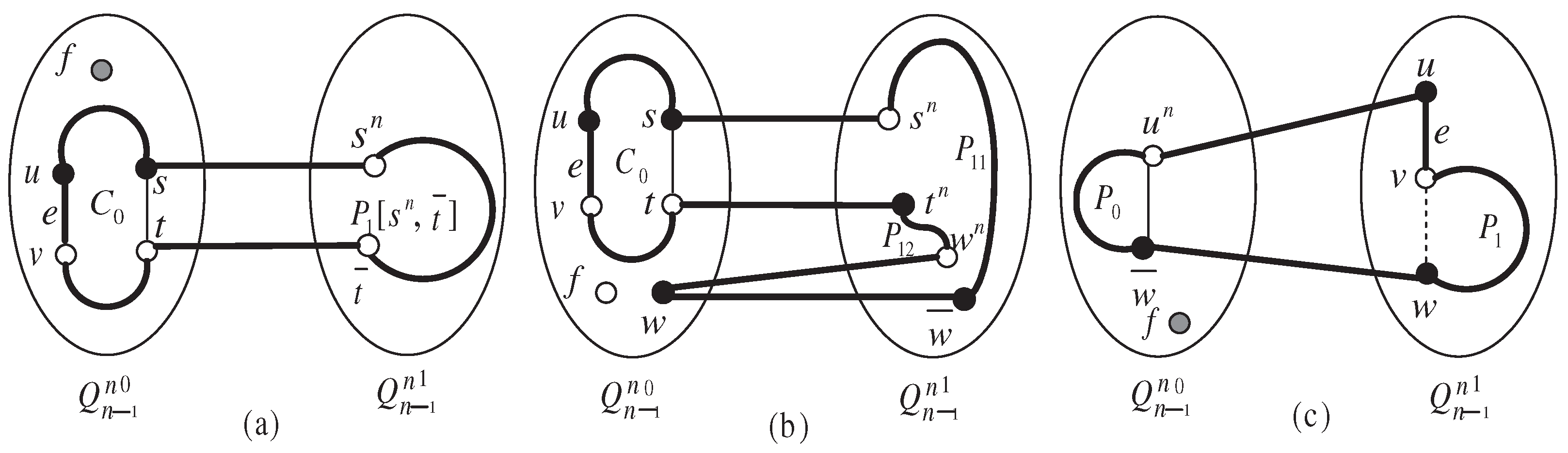
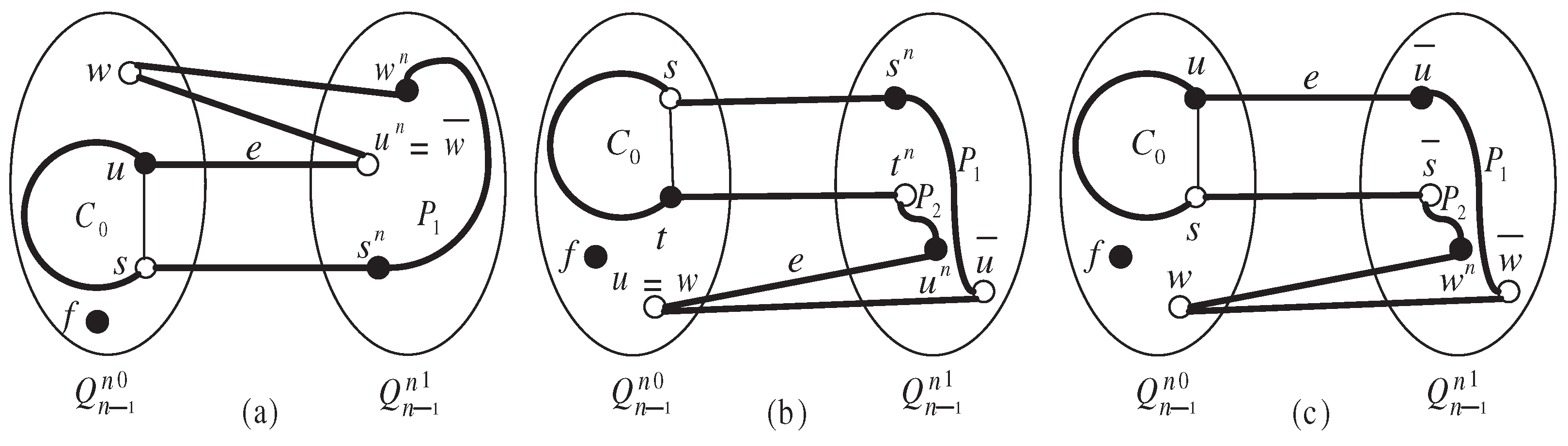
- and . Lemma 8 ensures that there exist distinct vertices ’s such that , and or . Assuming the vertex u as a faulty vertex temporarily, since , we obtain for . Lemma 4 implies that contains a fault-free path joining v and . Merging the path and the edges , and (respectively, , and ), there exist cycles ’s containing the edge , i.e., , or . Obviously, the cycles ’s have the common vertices in the path . We can observe that there are at most cycles ’s with faulty vertices in . Since , we have . It implies there are at least cycles ’s with fault-free vertices in . Since , there exist at least fault-free cycles ’s in . Without loss of generality, we can assume that is such a fault-free cycle and . Lemma 8 indicates that . Obviously, . In , and , applying Lemma 4, there exists a fault-free path of every odd length joining and , where . As an immediate result, forms the desired cycle of every possible odd length in . Since and , we can obtain (see Figure 2a). (In Figure 2, Figure 3, Figure 4 and Figure 5, we use white vertices and black vertices to distinguish the different parity of the vertices, and we use gray vertices to denote the vertices with unknown parity.)
- (ii)
- and . Specially, Lemmas 3 and 7 imply that we can construct the cycles and , whose length is or . Since , it follows that there exists at least one of the above fault-free cycle of odd length or containing the edge . Generally, we construct the desired cycle of every odd length from to . Since , applying Lemma 2, lies on a fault-free cycle of length in , where . Assume that is an edge on , . For clarity, , . Since , we have or . It implies that we can assume and are both fault-free vertices in . Note that or . Lemma 4 ensures that contains a fault-free path of every even length , where . Accordingly, merging the two paths and as well as the two edges and , we can construct the desired cycle as , whose length is .
- Next, . Obviously, . Applying Lemma 7, we can select distinct vertices adjacent to u in such that or , and for . Since , Lemma 4 implies that contains a path joining and . Subsequently, there exist cycles ’s denoted as , where . Note that . It implies that there exists at least one fault-free cycle . Assume is such a fault-free cycle. For clarity, , it follows that . Recall that , Lemma 4 ensures that contains a fault-free path of every odd length joining u and v, where . Accordingly, the desired cycle containing the edge e can be constructed as , whose length is . As a result, (see Figure 2b).
- Finally, . Note that is the set of complementary edges between and . It follows that . Lemma 7 implies that contains distinct vertices ’s, which are adjacent to u and satisfy or , and for . As mentioned above, there exist cycles ’s denoted as , where . Since , there exists at least one fault-free cycle . Assume is such a fault-free cycle in . Lemma 4 indicates that there exists a fault-free path of every even length in , and there also exists a fault-free path of every odd length in , where and . It is easy to see that forms the desired odd cycle, whose length is . It follows that (see Figure 2c).
5. Concluding Remarks
Funding
Data Availability Statement
Conflicts of Interest
Appendix A. The proof of Lemma 9

| Case | The Distribution of e | The Length l of the Desired Cycle |
|---|---|---|
| Case 1 | ||
| Case 2 | ||
| Case 3 | ||
| Case 4 |
- Subcase 1.1:
- (respectively, ), for the ith dimensional edge , where (respectively, ).
- Since , it follows that . When and , we have . Thus, forms the desired cycle of length . Lemma 2 implies that lies on a fault-free cycle in of every even length from 4 to . Select in . For clarity, , where satisfies . Since , we have . Thus, forms the desired cycle of length , i.e., . Let be a cycle of length . We can select three distinct edges , and which satisfies that and , where and . Since , we have , . Thus, forms the desired cycle of length .
- Now we consider the case . Specially, Lemmas 3 and 7 ensure that contains a fault-free path of length with (respectively, ) when is an ith dimensional edge, where (respectively, ). Then forms the desired cycle containing the edge of length with (respectively, ) when is the ith dimensional edge, where and (respectively, ).
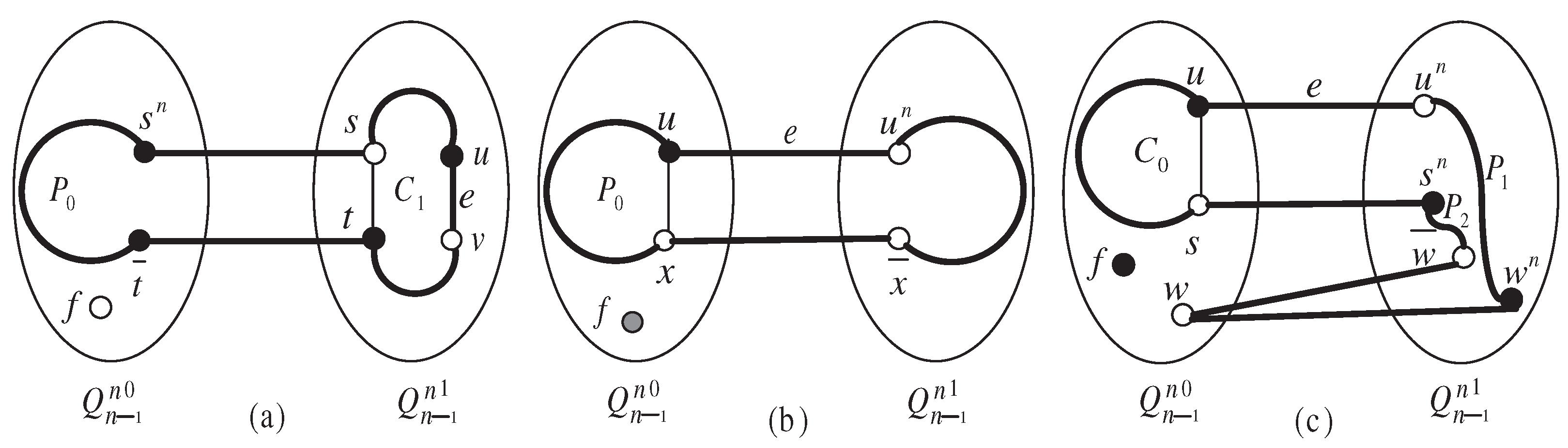
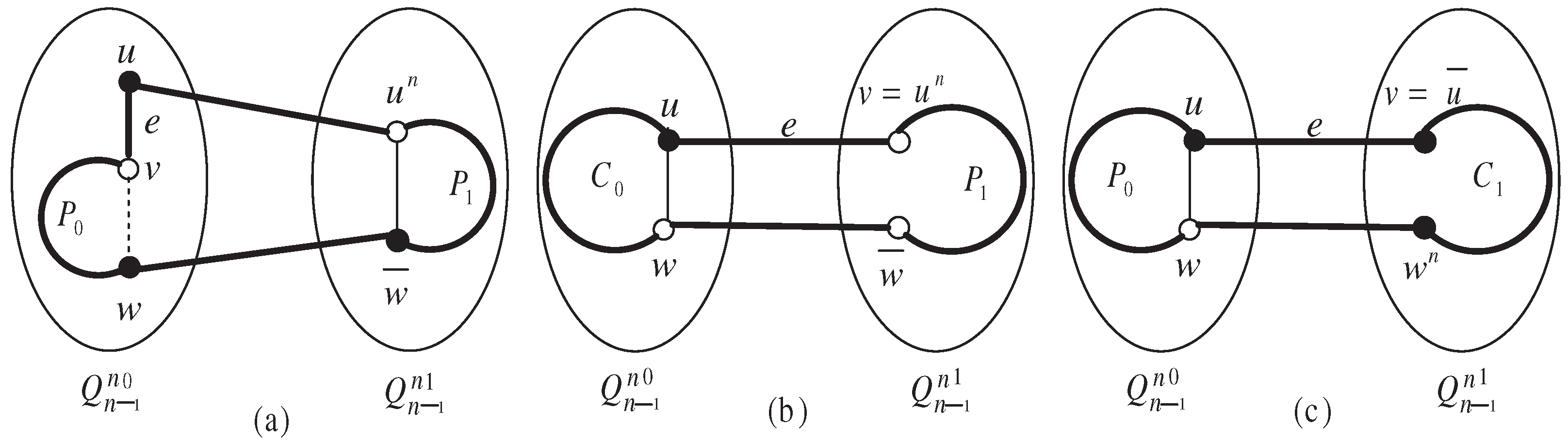
- Generally, applying Lemma 2, contains a fault-free cycle of every even length from 4 to containing the edge . Select an edge in . For clarity, , where satisfies . Lemma 3 indicates that contains a fault-free path of even length with . Consequently, forms the desired fault-free cycle of length , i.e., (see Figure 3a).
- Subcase 1.2:
- .Applying Lemma 2, the edge lies on a fault-free cycle of length . Note that and . It implies that there must exist a fault-free vertex . Note that w and f have different parity. Since for , we can select an edge on the cycle , such that and (or we can select an edge on the cycle , such that and ). Without loss of generality, we can assume the first situation holds. For clarity, and . Without loss of generality, we can assume is even. Since is odd, it follows that is odd, and is odd. Lemma 5 indicates that there exist two vertex-disjoint paths and spanning , that is, . For clarity, . So the desired cycle containing the edge e can be constructed as , whose length is in (see Figure 3b).
- Subcase 2.1:
- . (respectively, ), for the ith dimensional edge, where (respectively, ).
- First, we consider the case . Lemma 7 indicates that . Since , with out loss of generality, we can assume . Obviously, we have (respectively, ) when (respectively, ). For clarity, (respectively, ) forms the desired cycle of length (respectively, ) when (respectively, ). Lemma 2 indicates that lies on a fault-free cycle of length , where . We can select an edge on such that is an jth dimensional edge, where . Note that and (respectively, ) when (respectively, ). Thus, (respectively, ) forms the desired cycle, whose length is , i.e., (respectively, , i.e., ).
- Now we construct the desired cycle of every odd length from to . Let be a cycle of length and contains the edge . If every edge on the cycle are the ith dimensional edge, , then we can replace the edge by the path . Thus, the desired cycle is of length . If there exists an edge is an ith dimensional edge, , then we have and is even. Lemma 2 implies that lies on a cycle of length . Thus, forms the desired cycle of length , i.e., .
- Finally, we consider , since n and k have different parity, we have . Note that and is fault-free. Let be an ith dimensional edge in , where (respectively, ). Lemma 8 implies that there exist distinct vertices ’s in such that , is a fault-free jth dimensional edge in , where . Note that (respectively, ) when (respectively, ). Since , for the ith dimensional edge , (respectively, ), we can choose such a vertex satisfies and . It follows thatthe edge is a jth dimensional edge in , where . Obviously, Lemma 3 ensures that contains a fault-free path joining v and w, whose length is (respectively, ) when (respectively, ). Specially, by Lemma 8, if the fault-free path is of length (respectively, ), then it does not contain the vertex u. Assuming u as a faulty vertex temporarily, we can conclude that . Lemma 4 implies that there exists a fault-free path of every possible odd length joining v and w in , where (respectively, ). Consequently, (respectively, ). Since , by Lemma 4, there exists a fault-free path of every odd length joining and in , where . Note that is a fault-free edge in . Thus, . As a result, for the ith dimensional edge , (respectively, ), forms the desired cycle of every possible odd length in , i.e., (respectively, ) (see Figure 3c).
- Subcase 2.2:
- .Lemma 2 ensures that there exists a cycle containing e of length in . Since for , we can select an edge such that , . For clarity, , . Note that is even, is even and is odd. Without loss of generality, we can assume is odd and is odd. Lemma 6 indicates that contains a fault-free Hamiltonian path joining and with length . As a consequence, forms the desired cycle containing the edge e of odd length in (see Figure 4a).
- Subcase 3.1:
- .Note that is a nth dimensional edge between and . Specially, if , we can find that . Lemma 3 indicates that there exists a fault-free path of length in . Thus, forms the desired cycle of length . Lemma 7 ensures that there exist distinct vertices ’s adjacent to u in for , such that or . Generally, since , we can select a fault-free vertex such that is a jth dimensional edge in , where and . Lemma 7 indicates that . Lemma 4 indicates that contains a fault-free path of every odd length from 3 to . For convenience, we denote , . In , Lemma 3 ensures that contains a path of every even length joining and , where . Accordingly, the desired cycle can be constructed as with every possible odd length in , (see Figure 4b).
- Subcase 3.2:
- .By Lemma 2, contains a fault-free cycle of length . Note that and . It implies that there must exist a fault-free vertex . According to the distribution of the node , we consider the following subcases:
- Subcase 3.2.1
- , i.e., .Since the number of vertices that adjacent to the vertex u in is 2, there must exist such a vertex adjacent to the vertex u such that . Hence, the cycle can be represented as . Therefore, . Considering the relationship between and , we distinguish the following subcases:
- First, we consider the case that . One can observe that we may assume is odd and is even. It implies that is odd and is odd. Applying Lemma 5, there exist two vertex-disjoint paths and spanning , whose length totally is . For clarity, . Consequently, forms the desired cycle with length . Since , , it follows that (see Figure 4c).
- Now, we consider the case that . Note that is even. Applying Lemma 6, contains a fault-free Hamiltonian path joining and with length . As a result, forms the desired cycle containing the edge e, whose length is (see Figure 5a).
- Subcase 3.2.2:
- , i.e., .Recall that for . It follows that we can select an edge such that . For convenience, we may assume that is even and is odd. It implies that is odd and is odd. Lemma 5 indicates that contain two vertex-disjoint paths and with total length , that is, . For clarity, . As an immediate result, forms the desired cycle of length l with (see Figure 5b).
- Subcase 4.1:
- .Specially, when , one can observe that . Lemma 3 indicates that contains a fault-free path of length . Thus, forms the desired cycle of length . In , Lemma 7 ensures that there exists distinct vertices ’s adjacent to the vertex u in such that or . Generally, since , we can select a fault-free vertex such that is a jth dimensional edge in when and . Lemma 7 indicates that . Applying Lemma 4, contains a fault-free cycle of every odd length from 3 to joining u and w. For clarity, , . In , Lemma 3 indicates that there exists a fault-free path of every even length joining and , where . Consequently, forms the desired cycle of length l with in . Since , , it follows that .
- Subcase 4.2:
- .Applying Lemma 2, contains a fault-free cycle of length . Note that . It implies that there must exist a fault-free vertex . Considering the distribution of the vertex , we distinguish the following subcases:
- Subcase 4.2.1:
- , i.e., .Since the number of vertices that adjacent to the vertex u in is 2, there must exist such a vertex adjacent to the vertex u such that . For clarity, , . According to the relationship between and , we distinguish the following subcases:
- First, we consider the case that . Note that we can assume is odd and is odd. Lemma 5 ensures that there exist two vertex-disjoint paths and spanning , that is, . Accordingly, forms the desired cycle of length in (see Figure 5c).
- Now, we consider the case that . Note that is even, is odd and . Lemma 6 indicates that contains a fault-free Hamiltonian path joining and with length . As a result, forms the desired cycle with length is .
- Subcase 4.2.2:
- , i.e., .This proof is similar to that in Case 3.2.2.
References
- Leighton, F.T. Introduction to Parallel Algorithms and Architecture: Arrays. Trees. Hypercubes; Morgan Kaufmann: San Mateo, CA, USA, 1992. [Google Scholar]
- Tzeng, N.F.; Wei, S. Enhanced hypercube. IEEE Trans. Comput. 1991, 40, 284–294. [Google Scholar] [CrossRef]
- Yang, J.S.; Chang, J.M.; Pai, K.J.; Chan, H.C. Parallel construction of independent spanning trees on enhanced hypercubes. IEEE Trans. Parallel Distrib. Syst. 2015, 26, 3090–3098. [Google Scholar] [CrossRef] [Scilit]
- Cheng, E.; Qiu, K.; Shen, Z.Z. On the g-extra diagnosability of enhanced hypercubes. Theor. Comput. Sci. 2022, 921, 6–19. [Google Scholar] [CrossRef] [Scilit]
- Choudum, S.A.; Nandini, R.U. Complete binary trees in folded and enhanced cube. Networks 2004, 43, 266–272. [Google Scholar] [CrossRef] [Scilit]
- Liu, H.M. The structural features of enhanced hypercube networks. In Proceedings of the 5th International Conference on Natural Computation, Tianjian, China, 14–16 August 2009; pp. 345–348. [Google Scholar]
- Liu, M.; Liu, H.M. Cycles in conditional faulty enhanced hypercube networks. J. Commun. Netw. 2012, 14, 213–221. [Google Scholar] [CrossRef] [Scilit]
- Liu, M.; Liu, H.M. Paths and cycles embedding on faulty enhanced hypercube networks. Acta Math. Sci. 2013, 32B, 227–246. [Google Scholar] [CrossRef] [Scilit]
- Ma, M.J.; West, D.B.; Xu, J.M. The vulnerability of the diameter of the enhanced hypercubes. Theor. Comput. Sci. 2017, 694, 60–65. [Google Scholar] [CrossRef] [Scilit]
- Xu, L.Q. Symmetric property and the bijection between perfect matchings and sub-hypercubes of enhanced hypercubes. Discret. Appl. Math. 2023, 324, 41–45. [Google Scholar] [CrossRef] [Scilit]
- Yang, Z.C.; Xu, L.Q.; Yin, S.S.; Guo, L.T. Super vertex (edge)-connectivity of varietal hypercube. Symmetry 2022, 14, 1–8. [Google Scholar]
- I-Amawy, A.E.; Latifi, S. Propertice and performance of folded hypercubes. IEEE Trans. Parallel Distrib. Syst. 1991, 2, 31–42. [Google Scholar] [CrossRef] [Scilit]
- Cheng, D.Q.; Hao, R.X.; Feng, Y.Q. Cycles embedding on folded hypercubes with faulty nodes. Discret. Appl. Math. 2013, 161, 2894–2900. [Google Scholar] [CrossRef] [Scilit]
- Hsieh, S.Y.; Kuo, C.N.; Huang, H.L. 1-vertex-fault-tolerant cycles embedding on folded hypercubes. Discret. Appl. Math. 2009, 157, 3110–3115. [Google Scholar] [CrossRef] [Scilit]
- Kuo, C.N. Pancyclicity and bipancyclicity of folded hypercubes with both vertex and edge faults. Theor. Comput. Sci. 2015, 602, 125–131. [Google Scholar] [CrossRef] [Scilit]
- Kuo, C.N.; Stewart, I.A. Edge-pancyclicity and edge-bipancyclicity of faulty folded hypercubes. Theor. Comput. Sci. 2016, 627, 102–106. [Google Scholar] [CrossRef] [Scilit]
- Kuo, C.N.; Cheng, Y.H. Cycles in folded hypercubes with two adjacent faulty vertices. Theor. Comput. Sci. 2019, 795, 115–118. [Google Scholar] [CrossRef] [Scilit]
- Kuo, C.N.; Cheng, Y.H. Every edge lies on cycles of folded hypercubes with a pair of faulty adjacent vertices. Discret. Appl. Math. 2021, 294, 1–9. [Google Scholar] [CrossRef] [Scilit]
- Kuo, C.N.; Cheng, Y.H. Hamiltonian cycle in folded hypercubes with highly conditional edge faults. IEEE Access 2020, 8, 80908–80913. [Google Scholar] [CrossRef] [Scilit]
- Xu, J.M.; Ma, M.J. Cycles in folded hypercubes. Appl. Math. Lett. 2006, 19, 140–145. [Google Scholar] [CrossRef] [Scilit]
- Xu, J.M.; Ma, M.J.; Du, Z.Z. Edge-fault-tolerant properties of hypercubes and folded hypercubes. Australas. J. Comb. 2006, 35, 7–16. [Google Scholar]
- Itai, A.; Rodeh, M. The multi-tree approach to reliability in distributed networks. Inf. Comput. 1988, 79, 43–59. [Google Scholar] [CrossRef] [Scilit]
- Hsieh, S.Y.; Chang, N.W. Extended fault-tolerant cycle embedding in faulty hypercubes. IEEE Trans. Reliab. 2009, 58, 702–710. [Google Scholar] [CrossRef] [Scilit]
- Sengupta, A. On ring embedding in hypercubes with faulty nodes and links. Inf. Process. Lett. 1998, 68, 207–214. [Google Scholar] [CrossRef] [Scilit]
- Tsai, C.H. Cycles embedding in hypercubes with node failures. Inf. Process. Lett. 2007, 102, 242–246. [Google Scholar] [CrossRef] [Scilit]
- Hsieh, S.Y.; Shen, T.H. Edge-bipancyclicity of a hypercube with faulty vertices and edges. Discret. Appl. Math. 2008, 156, 1802–1808. [Google Scholar] [CrossRef] [Scilit]
- Bondy, J.A.; Murty, U.S.R. Graph Theory with Applications; Zuse Institute Berlin: Berlin, Germany, 1980. [Google Scholar]
- Li, T.K.; Tsai, C.H.; Tan, J.J.M.; Hsu, L.H. Bipanconnectivity and edge-fault tolerant bipancyclility of hypercubes. Inf. Process. Lett. 2003, 87, 107–110. [Google Scholar] [CrossRef] [Scilit]
- Ma, M.J.; Liu, G.Z.; Pan, X.F. Path embedding in faulty hypercubes. Appl. Math. Comput. 2007, 192, 233–238. [Google Scholar] [CrossRef] [Scilit]
- Tsai, C.H. Linear array and ring embedding in conditional faulty hypercubes. Theor. Comput. Sci. 2004, 314, 431–443. [Google Scholar] [CrossRef] [Scilit]
- Tsai, C.H.; Tan, J.J.M.; Liang, T.; Hsu, L.H. Fault-tolerant Hamiltonian laceability of hypercubes. Inf. Process. Lett. 2002, 83, 301–306. [Google Scholar] [CrossRef] [Scilit]


| Case | The Distribution of e | The Desired Cycle of Length l |
|---|---|---|
| Case 1.1 | ||
| Case 1.2 | ||
| Case 2.1 | ||
| Case 2.2 | ||
| Case 2.3 |
Disclaimer/Publisher’s Note: The statements, opinions and data contained in all publications are solely those of the individual author(s) and contributor(s) and not of MDPI and/or the editor(s). MDPI and/or the editor(s) disclaim responsibility for any injury to people or property resulting from any ideas, methods, instructions or products referred to in the content. |
© 2023 by the author. Licensee MDPI, Basel, Switzerland. This article is an open access article distributed under the terms and conditions of the Creative Commons Attribution (CC BY) license (https://creativecommons.org/licenses/by/4.0/).
Share and Cite
Liu, M. Cycle Embedding in Enhanced Hypercubes with Faulty Vertices. Symmetry 2024, 16, 44. https://doi.org/10.3390/sym16010044
Liu M. Cycle Embedding in Enhanced Hypercubes with Faulty Vertices. Symmetry. 2024; 16(1):44. https://doi.org/10.3390/sym16010044
Chicago/Turabian StyleLiu, Min. 2024. "Cycle Embedding in Enhanced Hypercubes with Faulty Vertices" Symmetry 16, no. 1: 44. https://doi.org/10.3390/sym16010044
APA StyleLiu, M. (2024). Cycle Embedding in Enhanced Hypercubes with Faulty Vertices. Symmetry, 16(1), 44. https://doi.org/10.3390/sym16010044