


Abstract
The time–energy uncertainty relation in nonrelativistic quantum mechanics has been intensely debated with regard to its formal derivation, validity, and physical meaning. Here, we analyze two formal relations proposed by Mandelstam and Tamm and by Margolus and Levitin and evaluate their validity using a minimal quantum toy model composed of a single qubit inside an external magnetic field. We show that the norm of energy coherence is invariant with respect to the unitary evolution of the quantum state. Thus, the norm of energy coherence of an initial quantum state is useful for the classification of the ability of quantum observables to change in time or the ability of the quantum state to evolve into an orthogonal state. In the single-qubit toy model, for quantum states with the submaximal norm of energy coherence, , the Mandelstam–Tamm and Margolus–Levitin relations generate instances of infinite “time uncertainty” that is devoid of physical meaning. Only for quantum states with the maximal norm of energy coherence, , the Mandelstam–Tamm and Margolus–Levitin relations avoid infinite “time uncertainty”, but they both reduce to a strict equality that expresses the Einstein–Planck relation between energy and frequency. The presented results elucidate the fact that the time in the Schrödinger equation is a scalar variable that commutes with the quantum Hamiltonian and is not subject to statistical variance.
1. Introduction
In the early days of the study of quantum mechanics, Werner Heisenberg [1,2], Niels Bohr [3], Albert Einstein [4], Max Born, and Pascual Jordan [5] considered time and energy as physical quantities, which do not commute. The derivation of the time–energy uncertainty relation was based on thought experiments, such as Heisenberg’s microscope [1,2] or Einstein’s photon box [6,7], where the goal was to employ physical intuition in order to arrive at the desired final inequality. Despite the lack of mathematical rigor, one still had to confront the fact that time t is a real-valued scalar in the Schrödinger equation [8,9,10]
and commutes with the quantum Hamiltonian operator , namely
To highlight the problem, Wolfgang Pauli [11,12] proved as a theorem in 1933 that in nonrelativistic quantum mechanics, there cannot exist a time operator such that
Following the discovery of the generalized Ehrenfest theorem [13] and the Robertson–Schrödinger uncertainty relation [14,15], different authors have attempted to use the quantum dynamics of quantum observables in order to construct time–energy uncertainty relations based on the statistical standard deviations of some dynamic quantum observable and the total energy (for comprehensive reviews, see Refs. [16,17]). The motivation behind such efforts is the practical consideration that time can only be measured by observing some physical quantity that is dynamically changing. In this work, we will investigate the validity and physical interpretation of two alternative uncertainty relations proposed in 1945 by Mandelstam and Tamm [18] and in 1998 by Margolus and Levitin [19]. We will show that the claimed time–energy uncertainty relations do not really pertain to physical time in the nonrelativistic setting, and whenever they faithfully represent time, the relations reduce to the strict Einstein–Planck relation between energy and frequency [20].
The presentation is organized as follows: In Section 2, we introduce the Mandelstam–Tamm uncertainty relation. In Section 3, we derive the conservation of total energy and its quantum statistics, including the energy variance , energy standard deviation , and the norm of energy coherence . In Section 4, we illustrate the dynamics of a minimal quantum toy model and plot the Mandelstam–Tamm quantity purported to measure “time uncertainty”. In Section 5, we introduce and analyze the Margolus–Levitin uncertainty relation based on the minimal time taken by the quantum state vector to evolve into an orthogonal state. Finally, in Section 6, we summarize our results on the performance of the two alternative time–energy uncertainty relations and show that their meaningful physical interpretation is just a manifestation of the Einstein–Planck relation between energy and frequency. To make this work self-contained, we also provide a comprehensive summary of quantum statistics in Appendix A, derive the generalized Ehrenfest theorem in Appendix B, and prove the Robertson–Schrödinger uncertainty relations in Appendix C.
2. Mandelstam–Tamm Uncertainty Relation
Mandelstam and Tamm [18] derived the so-called time–energy uncertainty relation based on the Robertson uncertainty relation (A12) for two Hermitian operators and , in which they have set
where indicates the standard deviation of the given quantum observable (cf. (A6)) and the quantum Hamiltonian is related to the total energy of the quantum system. After the substitution of for the expectation of the commutator based on the generalized Ehrenfest theorem (A7), we obtain
Now, the identification of and
results in
The Mandelstam–Tamm uncertainty relation has been also generalized for mixed states [21,22,23]; however, the physical interpretation of has not been scrutinized in detail.
Before we focus on the physical interpretation of , it would be useful to recall several fundamental theorems on the quantum statistics of the total energy and its expectation value , variance , and standard deviation .
3. Conservation of Total Energy and Its Quantum Statistics
Theorem 1.
For a closed quantum system, the expectation value of the total energy does not change in time
Furthermore, the expectation values for individual energy eigenvectors do not change in time, which implies that the variance and standard deviation of energy also do not change in time.
Proof.
The application of the generalized Ehrenfest theorem (A7) immediately gives
Alternatively, one can start from the general basis-independent solution of the Schrödinger equation
and express it in the energy basis as
where is the complete set of energy eigenvectors that span the Hilbert space of the quantum system, is the set of corresponding energy eigenvalues, and the initial energy quantum probability amplitudes are .
Since the spectral decomposition of the Hamiltonian is
for any time t, we have
Each quantum probability amplitude for the corresponding energy eigenstate
oscillates in the Hilbert space with angular frequency , whereas the quantum probability remains constant, . □
Theorem 1 shows that for a closed quantum system, characterized by quantum Hamiltonian and initial quantum state , the quantum statistical quantities of energy are stable system properties that do not change in time.
Definition 1.
For a quantum state vector that is expressed in some given basis of n-dimensional Hilbert space , the basis-dependent norm of coherence and predictability are defined [24,25,26,27] as
where is the quantum probability amplitude corresponding to each unit vector in the complete basis set resolving the unit operator , namely
Theorem 2.
For a closed quantum system, the norm of energy coherence and energy predictability are constant in time.
Proof.
Theorem 2 suggests that because the norm of energy coherence is a time-invariant physical property, it can be used as a convenient classification of quantum systems with a given quantum Hamiltonian and initial quantum state .
4. Minimal Quantum Toy Model
Consider a spin- quantum particle (qubit) in a uniform static magnetic field that is aligned in the z-direction [28]. The quantum Hamiltonian of the system is
where is the Pauli spin matrix aligned in the z-direction.
4.1. Quantum Dynamics of Energy States
The energy eigenstates of the quantum system are the eigenstates of the Hamiltonian (20), namely, , with corresponding eigenvalues .
The matrix exponential of the Hamiltonian is transformed into an ordinary exponential of the corresponding energy eigenvalues when acting on the energy eigenstates
Therefore, it is useful to express the initial state in the energy eigenbasis
with normalization condition
The general solution of the Schrödinger Equation (10) in the energy basis becomes
The expectation value of the energy is independent of time (Figure 1)
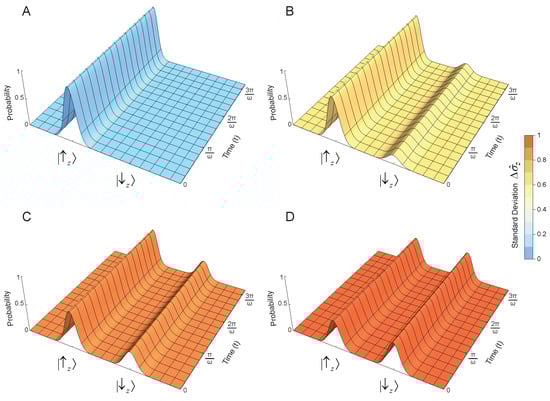
Figure 1.
The quantum dynamics of energy eigenstates is trivial; that is, the expectation value for each energy eigenvector does not change in time. This implies that the standard deviation of energy is constant and fixed by the choice of initial quantum state. Based on the quantum Hamiltonian (20), the eigenvectors of play the role of energy eigenvectors. The quantum superposition of the energy quantum probability amplitudes of the initial state given in (23) is varied as follows: (A) , , , (B) , , , (C) , , , (D) , , .
Similarly, the variance of the energy is independent of time
and the standard deviation of the energy is independent of time
The norm of energy coherence and predictability [25,26,27] are related to the standard deviation and expectation value of , respectively
and satisfy the complementarity relation
4.2. Quantum Dynamics of Eigenstates of the Clock Observable
From the generalized Ehrenfest theorem (A7), it is clear that any quantum observable that commutes with the Hamiltonian will be static and cannot be used to measure time. Consequently, to construct a clock, one needs to consider a quantum observable that does not commute with . Since in the minimal quantum toy model the Hamiltonian is a scaled version of , it is interesting to check the behavior of a mutually unbiased quantum observable, i.e., or . Without loss of generality, here, we choose as a clock observable.
The expectation values of eigenvectors of change in time because the eigenvectors of are quantum superpositions of eigenvectors of as follows
To change the basis from to , we can add or subtract (34) and (35) in order to obtain
The substitution in (25) gives
The expectation values of the projectors and are
The quantum dynamics of the quantum observables given by the projectors and onto the eigenvectors of exhibits oscillations with an angular frequency whenever the initial state of the quantum system is not an energy eigenstate (Figure 2).
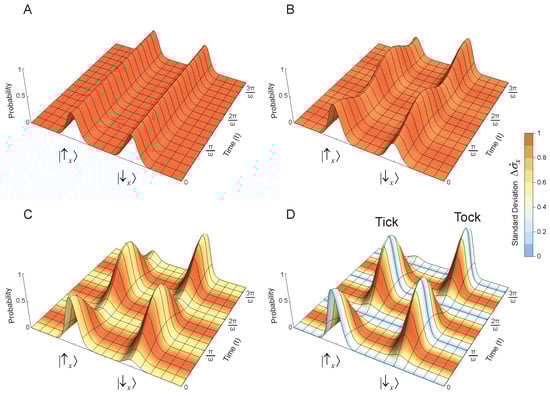
Figure 2.
Quantum dynamics of the eigenvectors of is not trivial as long as the initial state of the quantum system is not an energy eigenstate. Each eigenvector of is a quantum superposition of energy eigenvectors according to (34) and (35). The quantum superposition of the energy quantum probability amplitudes of the initial state given in (23) is varied as follows: (A) , , , (B) , , , (C) , , , (D) , , . The labels “Tick” and “Tock” indicate how the maxima or minima of the dynamic expectation value can be used for the engineering of a physical clock.
4.3. Physical Meaning of Mandelstam–Tamm “Time Uncertainty”
Mandelstam and Tamm [18] defined “time uncertainty” to be
The substitution of (42) and (44) in (45) gives
After combining (29) and (46), the time–energy uncertainty relation (7) becomes
In general, the Mandelstam–Tamm quantity (46) exhibits a dynamic dependence on time t. Because the standard deviation of energy is constant, the Mandelstam–Tamm product also exhibits a dynamic dependence on time t inherited from . From the dynamic plots shown in Figure 3, it can be observed that does not meaningfully correspond either to physical time t or to the angular frequency of oscillation of the expectation value . In particular, at the instances of local maxima or minima of at which . It can be stated that the angular frequency of oscillation of the expectation value is independent of the initial state ; however, the observable amplitude of oscillation measured by the difference tends to zero as (Figure 2A,B).
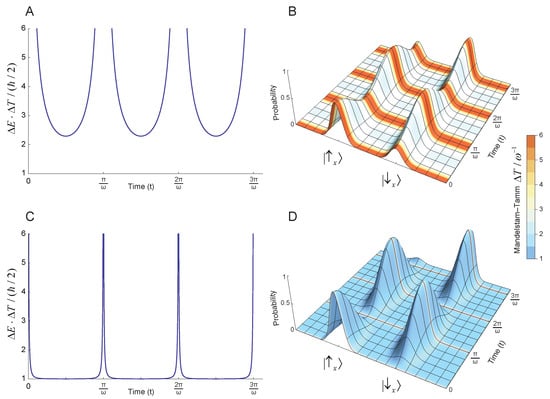
Figure 3.
Time dynamics of the product (measured in units of ) or (measured in units of ) for the initial state given in (23) with (A,B) , , , or (C,D) , , .
Only for the very special case with shown in Figure 2D, we arrive at Mandelstam–Tamm quantity that is independent of time due to the precise cancellation of the numerator and the denominator
which results in minimal Mandelstam–Tamm uncertainty:
Mandelstam and Tamm [18] have claimed that represents the amount of time it takes the expectation value of any quantum observableto change by one standard deviation . This claim is incorrectly justified in textbooks [29] by rewriting (6) in the form
and then interpreting as distance, as speed, and as time. Here, we have shown that in general, is a dynamic function of time t and can become arbitrarily large in the vicinity of local maxima or minima of the dynamic expectation value , where the instantaneous rate of change vanishes (Figure 3). In fact, by correctly considering that all three quantities in (6) are time-dependent, namely
the correct description of is an instantaneous “hypothetical time duration” that would have been taken by the quantum observable moving with a constant speed equal to the instantaneous rate of change until a distance equal to the instantaneous standard deviation would have been traversed. Because the rate of change accelerates or decelerates, is an instantaneous quantity that does not in itself disclose how good the quantum system is in measuring the physical passage of time. This is to be contrasted with , which is a constant quantity that discloses how good the quantum system is at measuring the physical passage of time.
4.4. Clock Engineering with the Einstein–Planck Relation
The engineering of a physical clock based on the time dynamics of requires a coherent quantum superposition of at least two energy eigenvectors with distinct energy eigenvalues, , in the initial state . Then, oscillations of can be observed with an angular frequency determined by the Einstein–Planck relation
Although the time t is a parameter and does not have an associated quantum operator in nonrelativistic quantum mechanics, it is possible to measure time using the time dynamics of the expectation value of some quantum observable, such as , whose eigenvectors form a mutually unbiased basis with regard to the energy eigenbasis, which is given by the eigenvectors of in the minimal quantum toy model. For the overwhelming majority of initial states of the quantum system, the Mandelstam–Tamm quantity will dynamically change in time t and will be poorly suited to act as a measure of time. For example, let us define that at the local maxima of , the physical clock has generated a “tick”, whereas at the local minima of , the physical clock has generated a “tock”. The time that passes between the consecutive “tick” at time and “tock” at time (Figure 2D) is exactly the time period
At the maxima or minima of the expectation value of the clock observable , we could say that we know exactly what time it is measured in units of , i.e., In between the maxima or minima of , we may not know how much time has passed since the last “tick” or “tock” of the clock because the dynamic quantum state is in a coherent quantum superposition of the eigenvectors of . If we set , we can rewrite the Einstein–Planck relation (52) as
Equation (54) is a strict relationship between scalars, denotes difference instead of standard deviation, and the expression contains h instead of ℏ when compared to (7). This shows that the time–energy relationship in nonrelativistic quantum mechanics is due to the Einstein–Planck relation (52) and not due to the Heisenberg uncertainty principle generalized through the Robertson–Schrödinger inequality (A13). This is further corroborated by the fact that, at the minima or maxima of , the Mandelstam–Tamm quantity will tend to infinity and would wrongly predict that the standard deviation of time is infinite, while in fact we know exactly how much time has passed in units of . This is why the Mandelstam–Tamm quantity is not a meaningful representation of time, and the Mandelstam–Tamm uncertainty is misleadingly labeled as “time–energy uncertainty” relationship.
In essence, the generalized Ehrenfest theorem (A7) correctly predicts that the time dynamics of quantum observables is only possible if the initial quantum state is not an energy eigenstate. The construction of physical clocks that are capable of measuring time, however, is aided by the Einstein–Planck relation (52) regardless of divergent Mandelstam–Tamm quantity near the local maxima of the measured quantum observable at which the physical clock “ticks”.
5. Margolus–Levitin Quantum Speed Limit
Margolus and Levitin [19] have recognized that time t indeed has no variance in nonrelativistic quantum mechanics, and they have proposed measuring , which is the time it takes for to evolve into an orthogonal state. Furthermore, they have stated not only an inequality based on the standard deviation of the energy
but also, in their own words, they have formulated an alternative “somewhat surprizing” result based on the expectation value of the energy
We will first show that in fact (56) is incorrect as stated in nonrelativistic quantum mechanics because adding a constant energy offset to the Hamiltonian will change the expectation value of the Hamiltonian without changing the quantum dynamics.
Theorem 3.
(Constant offset to the Hamiltonian) Adding a constant offset in the Hamiltonian of a closed system has no observable effect on the quantum dynamics.
Proof.
Because the identity operator commutes with every operator, the application of the Baker–Campbell–Hausdorff formula [30,31,32,33] gives the following result for the general basis-independent solution to the Schrödinger equation
which means that the energy offset simply adds a global time-evolving pure phase to every state. This global pure phase has no observable effects on measured quantum probabilities since it has a unit modulus, . Thus, the freedom to add a constant energy offset to the Hamiltonian of a closed system is granted by the symmetry of the global (overall) phase of the quantum mechanical wavefunction , according to which the global (overall) phase of can never be measured, whereas only relative phases of can be measured experimentally. □
Theorem 3 always makes it possible to offset the Hamiltonian so that it has an expectation value of zero, , which forces (56) to produce incorrect . In fact, for the quantum toy model shown in Figure 2D, it is exactly the case that with computed from (56), instead of the correct seen on the plot. This shows that the Margolus–Levitin formulation (56) based on the expectation value of energy is only meaningful in the context of their particular choice to set the zero energy level to be the minimal energy eigenvalue, . In our single-qubit toy example, the zero energy level is set to be the arithmetic mean (average) of the two energy eigenvalues, , so that the quantum Hamiltonian has a symmetric matrix representation. To use (56), one needs to properly offset the Hamiltonian (20) with the addition of .
Theorem 3 explains why the most general studies of quantum dynamics use statistical properties such as variance or standard deviation that are invariant with respect to offset shifts in the expectation value of energy. In fact, (55) always holds regardless of the energy expectation value. For the case shown in Figure 2D, plugging in (55) results in the formally correct inequality . However, we will show that for all cases in which , and hence , the quantum system never evolves into an orthogonal state, meaning that and (55) reduces to the trivial inequality , which is always true.
To compute for the minimal quantum toy model, we need the minimal value of t at which . The inner product formed by (23) and (25) is
From (58), it follows that for , i.e., , the predictability of the energy eigenstate is strictly non-negative , implying that the quantum system starting from an initial quantum state never evolves into an orthogonal state, i.e., . Thus, the Margolus–Levitin formulation (55) is trivially satisfied and has no physical content for almost all initial quantum states (for which ), while the only special case when (55) actually works is for , i.e., , leading to the strict equality . Taking into consideration that is the time period from maximum to minimum, rather than between two maxima of the oscillation of , we conclude that (55) is just the Einstein–Planck relation in disguise.
It is noteworthy that the calculation in (58) can be straightforwardly generalized for the quantum state vector in n-dimensional Hilbert space. If we arrange the initial energy amplitudes of in decreasing order , we obtain
which, when combined with the normalization condition , gives for all cases with . The minimal is obtained when the initial energy amplitudes of the energy eigenvectors and , with maximal and minimal eigenvalues, respectively, have a modulus of .
Several authors [17,34,35] have previously discussed a unified quantum speed limit (QSL) given by the maximum of the Mandelstam–Tamm and Margolus–Levitin lower bounds on the “time uncertainty”
where the energy expectation value is computed with the particular offset to the Hamiltonian for which . Here, we have shown that is generally neither Mandelstam–Tamm nor Margolus–Levitin , since for the submaximal positive norm of energy coherence, , in the single-qubit toy model, both and could be infinite, whereas given by (60) is always finite.
6. Conclusions
In this work, we have investigated the purported role of Heisenberg’s uncertainty principle [1] in establishing time–energy uncertainty relations in nonrelativistic quantum mechanics. Using a single qubit inside an external magnetic field as a minimal quantum toy model, we have investigated two different time–energy inequalities formulated by Mandelstam and Tamm [18] and by Margolus and Levitin [19]. We have shown that both of these time–energy inequalities are plagued by infinities and do not meaningfully represent the concept of time for general initial states with the submaximal norm of energy coherence . Importantly, for the special case of initial quantum state with the maximal norm of energy coherence , both Mandelstam–Tamm and Margolus–Levitin inequalities reduce to the Einstein–Planck relation , thereby acquiring concrete physical meaning. Thus, the shortest duration of time measurable using some quantum observable acting as a clock is not due to Heisenberg’s uncertainty principle but follows directly from the Einstein–Planck relation. This explains why for probing physical processes at shorter timescales, particle physicists need to use larger particle accelerators generating higher particle energies.
We have also elaborated on the fact that adding a constant energy offset to the Hamiltonian does not affect the quantum dynamics of closed systems. This explains why statistical properties such as variance , standard deviation , and the norm of energy coherence , all of which are invariant with respect to shifts in the energy expectation value , are well suited for the classification of quantum systems wih regard to the magnitude of observed quantum dynamical changes, namely, when , , and approach zero, the observed amplitude of oscillation of dynamic quantum observables also approaches zero.
Funding
This research was funded by Cosmogenics Inc., Los Angeles, CA, USA.
Data Availability Statement
Data sharing is not applicable to this theoretical research article as no datasets were generated or analyzed during the current study.
Acknowledgments
The author wishes to acknowledge helpful discussions with Mani L. Bhaumik (University of California, Los Angeles).
Conflicts of Interest
The author declares no conflicts of interest.
Appendix A. Quantum Statistics
Definition A1.
(Expectation value) The expectation value of any quantum observable represented by a Hermitian operator is a real number written in angle brackets as . For a discrete spectrum of eigenvalues of , we have
where is the probability of obtaining the measurement outcome .
For a continuous probability density distribution , we use the integration
The expectation value is functionally dependent on the quantum state vector , namely
To emphasize the dependence on the quantum state , the expectation value could be written as [36]. However, if it is clear from the context which we perform the calculation for, it is notationally simpler to write just .
Definition A2.
(Variance) The variance of a quantum observable is a real non-negative number denoted as . For a discrete spectrum of eigenvalues of , we have
For a continuous probability density distribution , we use integration
Definition A3.
(Standard deviation) The standard deviation is the square root of the variance
Appendix B. Generalized Ehrenfest Theorem
Theorem A1.
(Generalized Ehrenfest theorem) The time dynamics of the expectation value of any time-independent quantum observable (for which ) is given by
where the commutator is with respect to the quantum Hamiltonian .
Appendix C. Robertson–Schrödinger Uncertainty Relation
Theorem A2.
(Robertson uncertainty relation) For any two quantum observables given by Hermitian operators and , for which is in the domain of and is in the domain of [38], the following inequality holds [14]
Proof.
The Robertson uncertainty relation is a special case of the more general Schrödinger uncertainty relation (A13) proven below. □
Theorem A3.
(Schrödinger uncertainty relation) For any two quantum observables given by Hermitian operators and , for which is in the domain of and is in the domain of [38], the following inequality holds [15,39,40]
Proof.
The quantum observables are represented by Hermitian operators and . Therefore, the variances can be written as inner products of vectors
Now, we can apply the Cauchy–Schwarz inequality
with
to obtain
Since is a complex number, we have and
We also have
The substitution of (A21) and (A22) into (A20) gives
which, after introducing the commutator and taking the square root on both sides, leads to (A13). □
References
- Heisenberg, W. Über den anschaulichen Inhalt der quantentheoretischen Kinematik und Mechanik. Z. Phys. 1927, 43, 172–198. [Google Scholar] [CrossRef]
- Heisenberg, W. The physical content of quantum kinematics and mechanics. In Quantum Theory and Measurement; Wheeler, J.A., Zurek, W.H., Eds.; Princeton University Press: Princeton, NJ, USA, 1983; pp. 62–84. [Google Scholar]
- Bohr, N. The quantum postulate and the recent development of atomic theory. Nature 1928, 121, 580–590. [Google Scholar] [CrossRef]
- Einstein, A.; Tolman, R.C.; Podolsky, B. Knowledge of past and future in quantum mechanics. Phys. Rev. 1931, 37, 780–781. [Google Scholar] [CrossRef]
- Born, M.; Jordan, P. Elementare Quantenmechanik: Zweiter Band der Vorlesungen über Atommechanik; Springer: Berlin/Heidelberg, Germany, 1930. [Google Scholar] [CrossRef]
- Bohr, N. Discussion with Einstein on epistemological problems in atomic physics. In Quantum Theory and Measurement; Wheeler, J.A., Zurek, W.H., Eds.; Princeton Series in Physics; Princeton University Press: Princeton, NJ, USA, 1983; pp. 9–49. [Google Scholar]
- Bohr, N. Discussion with Einstein on epistemological problems in atomic physics. In Niels Bohr Collected Works; Kalckar, J., Ed.; Elsevier: Amsterdam, The Netherlands, 1996; Volume 7, pp. 339–381. [Google Scholar] [CrossRef]
- Schrödinger, E. An undulatory theory of the mechanics of atoms and molecules. Phys. Rev. 1926, 28, 1049–1070. [Google Scholar] [CrossRef]
- Schrödinger, E. Collected Papers on Wave Mechanics; Blackie & Son: London, UK, 1928. [Google Scholar]
- Dirac, P.A.M. The Principles of Quantum Mechanics, 4th ed.; Oxford University Press: Oxford, UK, 1967. [Google Scholar]
- Pauli, W. Die allgemeinen Prinzipien der Wellenmechanik. In Quantentheorie; Bethe, H., Hund, F., Mott, N.F., Pauli, W., Rubinowicz, A., Wentzel, G., Smekal, A., Eds.; Handbuch der Physik; Springer: Berlin/Heidelberg, Germany, 1933; pp. 83–272. [Google Scholar] [CrossRef]
- Pauli, W. General Principles of Quantum Mechanics; Springer: Berlin/Heidelberg, Germany, 1980. [Google Scholar] [CrossRef]
- Ehrenfest, P. Bemerkung über die angenäherte Gültigkeit der klassischen Mechanik innerhalb der Quantenmechanik. Z. Phys. 1927, 45, 455–457. [Google Scholar] [CrossRef]
- Robertson, H.P. The uncertainty principle. Phys. Rev. 1929, 34, 163–164. [Google Scholar] [CrossRef]
- Schrödinger, E. Zum Heisenbergschen Unschärfeprinzip. Sitzungsberichte Preuss. Akad. Wiss. Phys. Math. Kl. 1930, 14, 296–303. [Google Scholar]
- Busch, P. The time–energy uncertainty relation. In Time in Quantum Mechanics; Muga, J.G., Mayato, R.S., Egusquiza, I.L., Eds.; Lecture Notes in Physics; Springer: Berlin/Heidelberg, Germany, 2002; Volume 72, pp. 69–98. [Google Scholar] [CrossRef]
- Deffner, S.; Campbell, S. Quantum speed limits: From Heisenberg’s uncertainty principle to optimal quantum control. J. Phys. A Math. Theor. 2017, 50, 453001. [Google Scholar] [CrossRef]
- Mandelstam, L.I.; Tamm, I.Y. The uncertainty relation between energy and time in non-relativistic quantum mechanics. J. Phys. 1945, 9, 249–254. [Google Scholar] [CrossRef]
- Margolus, N.; Levitin, L.B. The maximum speed of dynamical evolution. Phys. D Nonlinear Phenom. 1998, 120, 188–195. [Google Scholar] [CrossRef]
- Bhaumik, M.L. The enigmas of fluctuations of the universal quantum fields. Quanta 2023, 12, 190–201. [Google Scholar] [CrossRef]
- Uhlmann, A. An energy dispersion estimate. Phys. Lett. A 1992, 161, 329–331. [Google Scholar] [CrossRef]
- Hörnedal, N.; Allan, D.; Sönnerborn, O. Extensions of the Mandelstam–Tamm quantum speed limit to systems in mixed states. New J. Phys. 2022, 24, 055004. [Google Scholar] [CrossRef]
- Bagchi, S.; Thakuria, D.; Pati, A.K. Stronger quantum speed limit for mixed quantum states. Entropy 2023, 25, 1046. [Google Scholar] [CrossRef]
- Baumgratz, T.; Cramer, M.; Plenio, M.B. Quantifying coherence. Phys. Rev. Lett. 2014, 113, 140401. [Google Scholar] [CrossRef] [PubMed]
- Qureshi, T. Coherence, interference and visibility. Quanta 2019, 8, 24–35. [Google Scholar] [CrossRef]
- Qureshi, T. Predictability, distinguishability and entanglement. Opt. Lett. 2021, 46, 492–495. [Google Scholar] [CrossRef] [PubMed]
- Peled, B.Y.; Te’eni, A.; Georgiev, D.; Cohen, E.; Carmi, A. Double slit with an Einstein–Podolsky–Rosen pair. Appl. Sci. 2020, 10, 792. [Google Scholar] [CrossRef]
- Georgiev, D.D. Quantum information in neural systems. Symmetry 2021, 13, 773. [Google Scholar] [CrossRef]
- Griffiths, D.J.; Schroeter, D.F. Introduction to Quantum Mechanics, 3rd ed.; Cambridge University Press: Cambridge, UK, 2018. [Google Scholar] [CrossRef]
- Campbell, J.E. On a law of combination of operators (second paper). Proc. Lond. Math. Soc. 1897, 29, 14–32. [Google Scholar] [CrossRef]
- Baker, H.F. Alternants and continuous groups. Proc. Lond. Math. Soc. 1905, 2, 24–47. [Google Scholar] [CrossRef]
- Hausdorff, F. Die symbolische Exponentialformel in der Gruppentheorie. Berichte Über Die Verhandlungen Königlich Sächsischen Ges. Wiss. Leipz. Math. Phys. Kl. 1906, 58, 19–48. [Google Scholar]
- Dynkin, E.B. Calculation of the coefficients in the Campbell–Hausdorff formula. Dokl. Akad. Nauk SSSR 1947, 57, 323–326. [Google Scholar]
- Giovannetti, V.; Lloyd, S.; Maccone, L. Quantum limits to dynamical evolution. Phys. Rev. A 2003, 67, 052109. [Google Scholar] [CrossRef]
- Levitin, L.B.; Toffoli, T. Fundamental limit on the rate of quantum dynamics: The unified bound is tight. Phys. Rev. Lett. 2009, 103, 160502. [Google Scholar] [CrossRef]
- Georgiev, D.D.; Gudder, S.P. Sensitivity of entanglement measures in bipartite pure quantum states. Mod. Phys. Lett. B 2022, 36, 2250101. [Google Scholar] [CrossRef]
- Georgiev, D.D.; Glazebrook, J.F. On the quantum dynamics of Davydov solitons in protein α-helices. Phys. A Stat. Mech. Its Appl. 2019, 517, 257–269. [Google Scholar] [CrossRef]
- Davidson, E.R. On derivations of the uncertainty principle. J. Chem. Phys. 1965, 42, 1461–1462. [Google Scholar] [CrossRef]
- Nityananda, R. Schrödinger’s uncertainty principle? Resonance 1999, 4, 24–26. [Google Scholar] [CrossRef]
- Luo, S.; Zhang, Z. An informational characterization of Schrödinger’s uncertainty relations. J. Stat. Phys. 2004, 114, 1557–1576. [Google Scholar] [CrossRef]
Disclaimer/Publisher’s Note: The statements, opinions and data contained in all publications are solely those of the individual author(s) and contributor(s) and not of MDPI and/or the editor(s). MDPI and/or the editor(s) disclaim responsibility for any injury to people or property resulting from any ideas, methods, instructions or products referred to in the content. |
© 2024 by the author. Licensee MDPI, Basel, Switzerland. This article is an open access article distributed under the terms and conditions of the Creative Commons Attribution (CC BY) license (https://creativecommons.org/licenses/by/4.0/).