1. Introduction
Many complex structures resembling a network in real life are modeled as hypergraphs, which is a generalization of graphs, see [
1,
2,
3].
Symmetry is a significant feature in hypergraph theory, especially in uniform hypergraph theory. Recent research on the open support of hypergraphs [
4], the symmetric Lagrangian function of linear three-uniform hypergraphs [
5], the embeddability of hypertrees and unicyclic hypergraphs [
6], and the Laplacian energy of
r-uniform hypergraphs [
7] have been extensively studied. These results of hypergraphs are deeply dependent on the symmetric structure.
For a hypergraph , is a set of elements called vertices, and is a set of nonempty subsets of V called edges. A hypergraph with only one vertex is called a trivial hypergraph. If for , then H is called a k-uniform hypergraph. Clearly, ordinary graphs are referred to as two-uniform hypergraphs. A vertex is said to be incident to an edge if . Two vertices are said to be adjacent if they are contained in one edge, and two edges are said to be adjacent if their intersection is not empty. For a vertex , its degree is defined as . An edge is called a pendant edge of a k-uniform hypergraph if contains exactly vertices of degree one. Otherwise, it is called a nonpendant edge. A hypergraph is called a sub-hypergraph of , denoted as , if and . For , we use to denote the hypergraph induced by X, where and . is the hypergraph induced by . For , we use to denote the sub-hypergraph of H which is obtained by deleting all edges in A and keeping vertices. Given a hypergraph H, a walk W in H is a finite alternating sequence of vertices and edges of H such that: for ; for ; and for . If and , then W is called a circuit. A walk of H is called a path if no vertices and edges are repeated. A circuit W is called a cycle if no vertices and edges are repeated except . A hypergraph H is connected if for any pair of vertices , there is a path connecting u and v, otherwise H is disconnected. A component of hypergraph H is a maximal connected sub-hypergraph of H. A subset is called a cut set of H if is disconnected. A hypergraph H is a hypertree if H is connected and acyclic. A k-uniform hypergraph H is call a k-uniform linear hypergraph if every two edges have at most one common vertex in H. Clearly, a k-uniform hypertree is a k-uniform linear hypergraph. Let be an ordinary graph and be an integer. For any edge , by adding new vertices into edge e, we obtain a hypergraph in which each edge possesses k vertices, which is called a k-uniform hypergraph that underlies graph G (k-power of graph G) and denoted by . Clearly, and edge set . Clearly, is a k-uniform linear hypergraph.
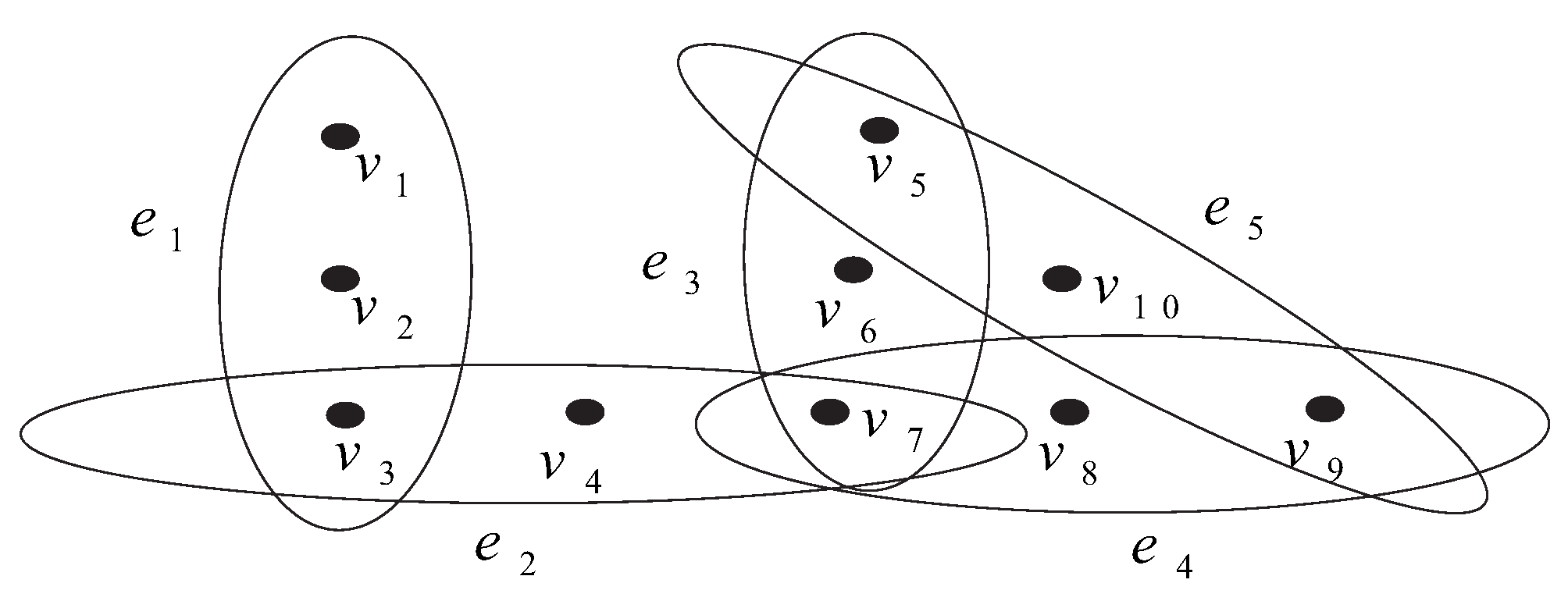
In real life, we are becoming more and more dependent on networks, which makes it easy for us to fall into a crisis caused by a vulnerability of the network. For example, assume we have ten electronic components as vertices. If several electronic components work together to form an electronic module, then this electronic module is considered as a hyperedge with these electronic components as vertices. Based on their structural relationships, an integrated module network has been formed. The integrated module network can be seen as a hypergraph
with vertex set
V and hyperedge set
E. Let
be a set of electronic components,
be a set of electronic modules; see
Figure 1. Obviously, if one of electronic components
is damaged, the electronic modules which contain
would be damaged and thus affect the overall function of the whole integrated module network
H. In addition, we also find that if there are different electronic components or different numbers of electronic components damaged, the damage to network
H is different. For example, if only one electronic component (vertex)
is damaged, it will cause damage to electronic module (hyperedge)
, but the other electronic modules
remain normal. If electronic component (vertex)
is damaged, then electronic modules (hyperedges)
and
are damaged and electronic modules
are normal. In order to make all the electronic modules
damaged, it is easiest to understand that all the electronic components
are damaged. In fact, for network
H, as long as the electronic components
, and
are damaged, then all the electronic modules
are damaged. That is, the whole network
H is completely paralyzed in this case. Therefore, how and at which cost can one restructure the network such that it becomes more robust against malicious attacks? For this purpose, many network vulnerability parameters have been proposed and studied, such as toughness [
8], integrity [
9], tenacity [
10,
11,
12], scattering number [
13], rupture degree, etc. These parameters are composed of some or all of the following three quantities: the number of elements that are not functioning, the number of remaining connected subnetworks, and the size of the largest remaining group within which mutual communication can still occur. Indeed, the above quantities play a key role in the robustness of networks. Although a large number of significant research works have been carried out on these parameters, all of them focus on the networks modeled by ordinary graphs, and there is still a gap in the research on the vulnerability of hypernetworks.
The concept of the rupture degree of a graph was introduced in [
14], which has been well used to measure the vulnerability of networks (see [
15,
16,
17,
18,
19]). In this paper, we employ this parameter to measure the vulnerability of hypergraph.
Let
be a connected hypergraph, the rupture degree of hypergraph
H is defined as
where
is a cut set of
H, and
and
denote the number of components and the order of the largest component in
, respectively. The score of
X is defined as
. A set
is called an
r-set of
H if
.
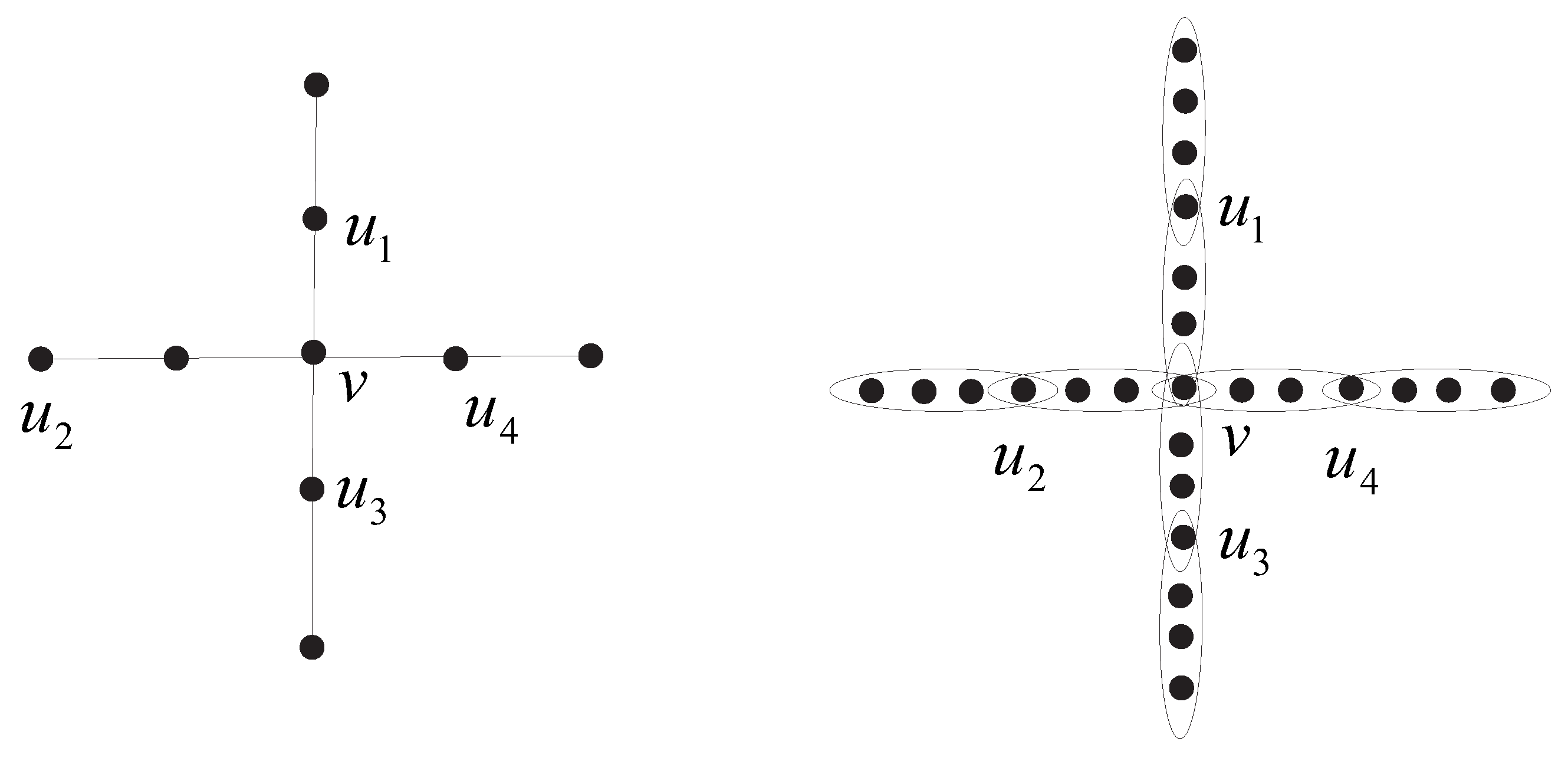
By the definition of the rupture degree, we focus on a graph
G and its four-uniform hypergraph
, which is obtained by adding two vertices to each edge of
G. A example is shown in
Figure 2. Obviously,
is an
r-set of
G, but not an
r-set of
, which has an
r-set that is
. This means that it is interesting and meaningful to discuss the vulnerability by determining the rupture degree of a hypergraph.
In this paper, we first give the bounds of the rupture degree of
k-uniform linear hypergraph
that underlies graph
G in
Section 2. In
Section 3, we discuss the problem for computing the rupture degree of
k-uniform hypertree
H. In
Section 4, we propose a recursive algorithm for computing the
r-set of
k-uniform hypertree
H.
Throughout this paper, by
we denote the largest integer not larger than
x and by
, the smallest integer not smaller than
x. Any undefined terminology and notations can be found in [
20,
21].
2. The Rupture Degree of k-Uniform Linear Hypergraphs
In this section, we bound the rupture degree of k-uniform linear hypergraph that underlies graph G with n vertices and m edges.
Lemma 1. Let X be an r-set of k-uniform linear hypergraph that underlies a connected graph G. Then, .
Proof. Let
X be an
r-set of
, we show that
. If not, by the structure of
, then
. Suppose
are components of
such that
. Now, let
and
for
. Clearly,
and
. Consider
and
; then,
This contradicts the choice of X. Thus, . □
Given a graph , an independent set of G is a subset of vertices which contains no pair of neighbors. The independence number of graph G is the size of the largest independent set in G. A set of vertices is a vertex cover of G if every edge has at least one vertex in S. The vertex cover number of G is the minimum cardinality of a vertex cover set of G, denote by .
Lemma 2. Let X be an r-set of k-uniform linear hypergraph that underlies connected graph G. Then, .
Proof. Let X be an r-set of k-uniform linear hypergraph that underlies a connected graph G. By Lemma 1, we obtain . This means X is a vertex cover set of graph G, and thus . Vice versa, if X is a vertex cover set of graph G, then each edge of G has at least one end vertex belonging to X. Thus, . By the definition of , consider . It follows that X is an r-set of . □
By Lemmas 1 and 2, considering , we directly obtain the rupture degree of in terms of the vertex cover number of G.
Theorem 1. Let be a k-uniform linear hypergraph that underlies connected graph G with n vertices and m edges. Then, Unfortunately, the problem of computing the minimum vertex cover (MVC) is NPC [
22]. In [
23,
24], the authors gave some exact algorithms for the MVC. However, all of them took an exponential time and so were not suited for practical use in large graphs. Therefore, it is interesting to discuss the bound of the
of
k-uniform linear hypergraph
.
In [
25], Harant bounded the independence number
of
G with
n vertices and
m edges.
Proposition 1. Let G be a connected graph on n vertices with m edges [25]. Then, Combine the famous formula for a connected graph G with order n, we obtain the following corollary.
Corollary 1. Let G be a connected graph on n vertices with m edges. Then, By Theorem 1 and Corollary 1, we directly give a bound for the rupture degree of as follows.
Theorem 2. Let be a k-uniform linear hypergraph that underlies connected graph G with n vertices and m edges. Then, Remark 1. The bounds in Theorem 2 are the best possible ones. The upper bound can meet at k-uniform linear hypergraph that underlies star graph . The lower bound can meet at k-uniform linear hypergraph that underlies complete graph .
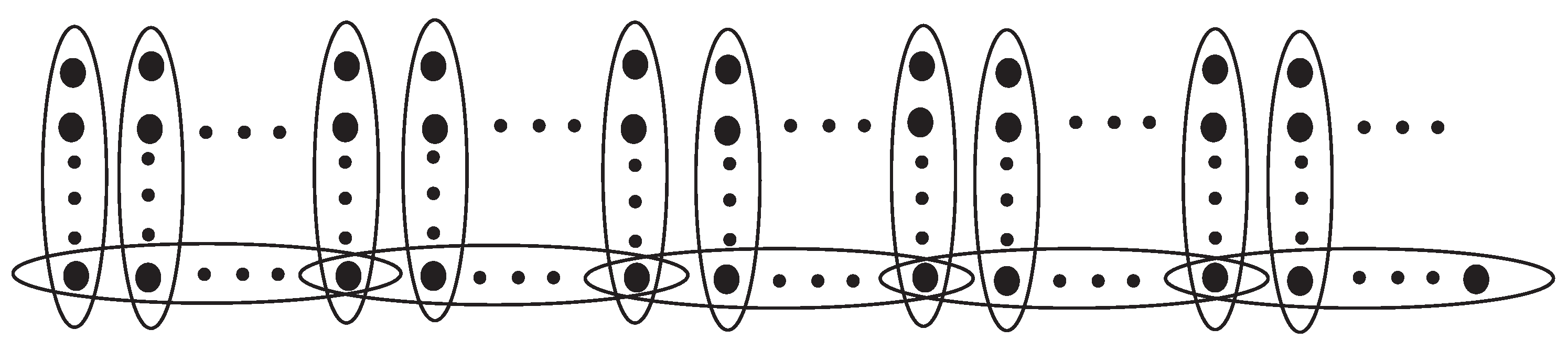
Clearly, if we let in Theorem 2, then we can obtain the bounds for the rupture degree of k-uniform hypertree .
Corollary 2. Let be a k-uniform hypertree that underlies a tree T with order n. Then, Remark 2. The bounds in Corollary 2 are also best possible. The upper bound can meet at k-uniform linear hypergraph that underlies star graph . The lower bound can meet at k-uniform linear hypergraph that underlies .
Notice that for any connected graph G, we also obtain the following result.
Corollary 3. Let be a k-uniform linear hypergraph that underlies connected graph G with order n. Then, 4. A Recursive Algorithm for Computing the r-Set of k-Uniform Hypertrees
Lemma 3 and Theorem 3 show that we can determine the rupture degree of k-uniform hypertree H by finding minimal cut set X to let . Here, we provide a method to obtain such vertex cut set X.
Let H be a k-uniform hypertree and be an arbitrary edge of H. By , we denote the nondecreasing degree sequence of edge e with . For convenience, is often simplified as for .
A contraction of an edge is an operation that identifies that vertices are merged into the vertex and the edges incident to these vertices are transformed into the edges incident to the vertex in H. The resulting graph is denoted as . Clearly, is also a k-uniform hypertree. Similarly, by we denote the graph obtained by contracting edges in H.
Lemma 7. Let be pendant edges of k-uniform hypertree H such that for . Let e be an edge with such that with . Let be integer number great than 1. If X and are an r-set of k-uniform hypertree H and , respectively, then .
Proof. Let be an r-set of and . It follows that is an r-set of H. In fact, note that is also a k-uniform hypertree. Thus, by Lemma 1, we know that . It is not difficult to check that is an r-set of H. Thus, we have . □
Lemma 8. Let be pendant edges of k-uniform hypertree H such that for . Let e be an edge with such that with . Let be an integer number for and at least two of are great than one. If X and are r-sets of k-uniform hypertree H and , respectively, then .
Proof. Let be an r-set of . Similar to Lemma 7, we know that is an r-set of H. Thus, we have . □
Based on Lemmas 7 and 8, we provide a recursive algorithm for computing the cardinality of an r-set of k-uniform hypertree H. Let be integer numbers for .
Recursive algorithm:
Step 1: Set .
Step 2: If H is a trivial hyperraph, go to step 10. Otherwise, go to step 3.
Step 3: For
k-uniform hypertree
and set
Step 4: If , then let , go to step 10. Otherwise, go to step 5.
Step 5: If , go to step 6. Otherwise, go to step 8.
Step 6: For each edge , if there exist such that and , go to step 7. Otherwise, go to step 8.
Step 7: Let and set , where denote the edge set of all edges which are incident to vertex in H; go to step 2.
Step 8: If , go to step 9. Otherwise, let , and go to step 10.
Step 9: For each edge , if there exists such that and , then let and , where denote the edge set of all edges which incident to vertex in H; go to step 2.
Step 10: Output the value of .
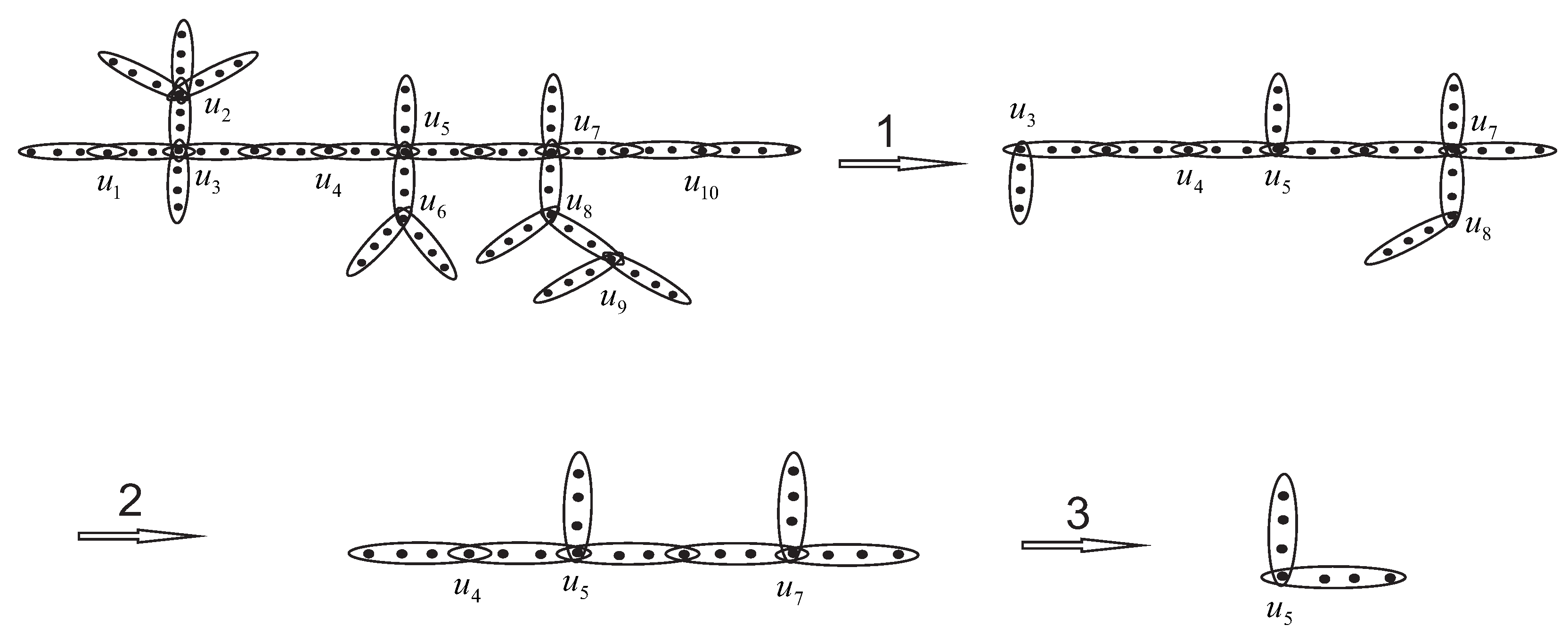
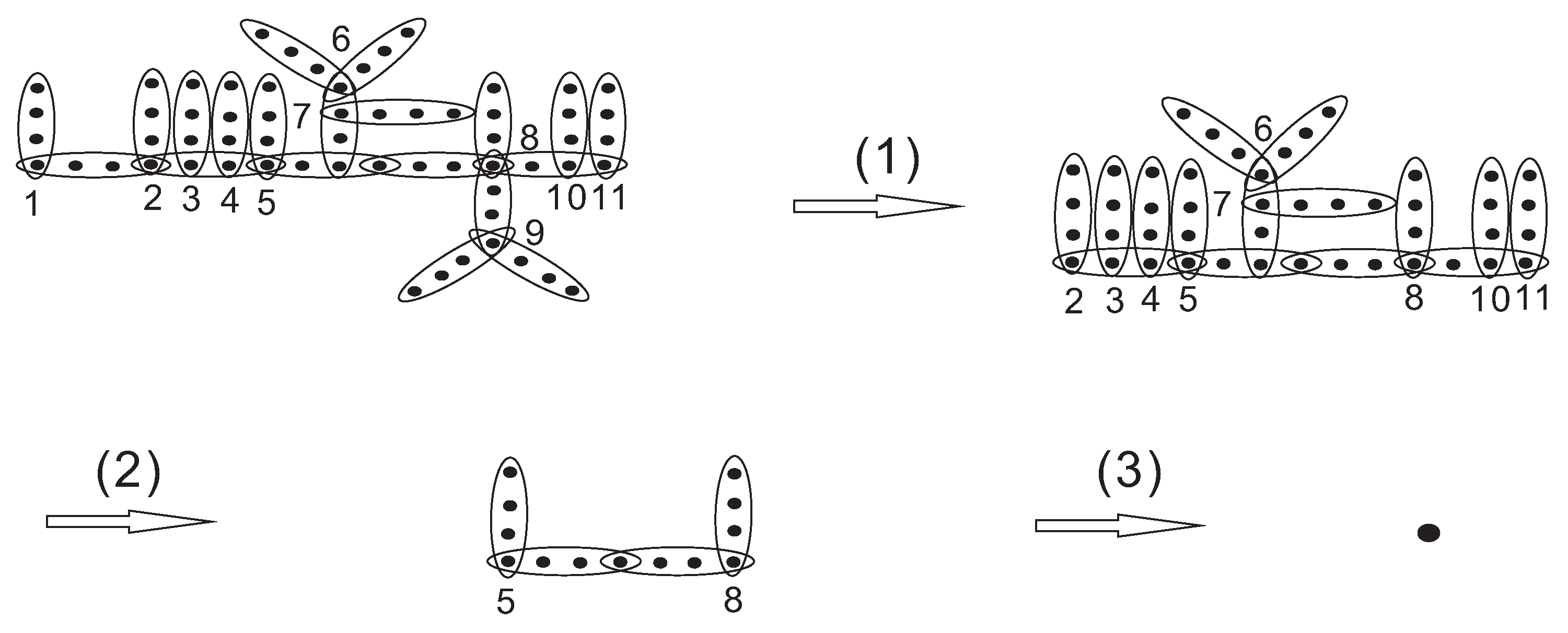
Example 1. Let be a four-uniform hypertree with that underlies tree T. Using the above algorithm, we get the cardinality of the r-set X of . The details of the algorithm execution are shown in Figure 4. - 1.
- 2.
- 3.
- 4.
Thus, . By Lemma 4 and Theorem 3, we obtain that the rupture degree of four-uniform hypertree is
Example 2. Let H be a four-uniform hypertree with . Using the above algorithm, we obtain that the cardinality of the r-set X of H. The details of the algorithm execution are shown in Figure 5. - (1)
- (2)
- (3)
Thus, we have . By Lemma 4 and Theorem 3, we obtain that the rupture degree of four-uniform hypertree H is