1. Introduction
There have been recent advances in the application of conservation laws and Lie symmetry methods to one-fluid jet and far wake flows. The aim of this paper is to apply these new methods to the two-fluid far wake downstream of a fixed and a self-propelled slender body aligned with the flow and generate new invariant solutions. Two-phase fluid flow has many applications in science, engineering, and industry, for example, in oil and gas flow and in the flow of air on water.
When the body is fixed, the wake is referred to as a classical wake. The wake behind a self-propelled body is referred to as a momentumless wake. Both wakes are free shear flows with a region of sharp change along the centre line and are formulated mathematically using boundary layer theory. For the far wake, terms of second order in smallness are neglected. Seminal research on the two-fluid classical and momentumless far wakes has been done by Herczynski, Weidman, and Burde [
1], who generalised the coordinate expansion made by Goldstein [
2] to include an expansion of the displacement of the interface between the two fluids.
A conserved quantity is required to complete the mathematical formulation of problems of jet and wake flows. The conserved quantity is needed to determine fully the form of the similarity solution, as well as the boundary of a turbulent jet or wake. These physical quantities cannot be determined from the boundary conditions which are homogeneous. Naz, Mason, and Mahomed [
3] showed how the conserved quantities in laminar jet flows can be derived in a systematic way by first finding the conservation laws for the boundary layer partial differential equation describing the jet. The method was extended to two-dimensional laminar for wakes by Kokela, Mason, and Hutchinson [
4]. A conserved quantity was obtained by integrating a conservation law across the jet or wake and by imposing the boundary conditions for that wake or jet. For the classical wake, it gives, in a systematic way, the drag on the body. For the momentumless wake, the conserved quantity was derived by Birkhoff and Zorantello [
5]. A comparison of the different methods for deriving conservation laws was given by Naz, Mohamed, and Mason [
6]. The most fundamental is the direct method in which the definition of a conservation law is expanded for assumed forms of the conserved vector. In this paper, the multiplier method introduced by Steudel [
7] will be used to derive conservation laws.
Kara and Mahomed [
8,
9] showed how a Lie point symmetry can be associated with a conserved vector. The components of a conserved vector are the density and flux terms of a conservation law. The Lie point symmetry associated with a conserved vector is easier to calculate than the Lie point symmetry of the corresponding partial differential equation because the order of the derivative in the conserved vector is one less than the order of the partial differential equation. The prolongation formulae are therefore simpler and the calculations can be done manually. The associated Lie point symmetry was used to reduce the partial differential equation to an ordinary differential equation. By the Double Reduction Theorem of Sjöberg [
10], the ordinary differential equation can be integrated at least one time because the conserved quantity was used to calculate the Lie point symmetry.
The approach of calculating conservation laws and associated Lie point symmetries has been taken recently to solve jet and far wake problems. In jet flow, the Lie point symmetry associated with the elementary conserved vector was used in [
11] to obtain the numerical solution of an axisymmetric turbulent free jet using a shooting method with the conserved quantity as target and in [
12,
13] to obtain analytical solutions in parametric form for the two-dimensional free and liquid jets of a power law fluid. In [
14], the conservation laws of a two-dimensional turbulent thermal free jet were calculated by the multiplier method and the associated Lie point symmetries were used to generate invariant analytical and numerical solutions. In [
15], a two-dimensional turbulent classical far wake was considered and the Lie point symmetry associated with the elementary conserved vector was obtained and used to generate analytical solutions. In [
16], the two-dimensional turbulent far wake downstream of a self-propelled body was considered. The conserved vector was calculated by the direct method, and analytical solutions generated by the associated Lie point symmetries were obtained.
In this paper, new solutions will be investigated for the two-dimensional two-fluid classical and momentumless far wakes of a symmetrical slender body aligned with the flow. Both fluids are incompressible. This problem was first considered by Herczynski et al. [
1]. A thorough investigation will be made of the conditions at the interface between the two fluids. Conservation laws for the system of partial differential equations for each fluid will be derived using the multiplier method. Conserved quantities for the two-fluid classical and momentumless far wakes will be derived. The Lie point symmetries associated with the conserved vectors for each fluid will be obtained in terms of stream functions using the theory of Kara and Mahomed [
8,
9]. The general form of the invariant solution for each fluid generated by the associated Lie point symmetry will be calculated and with the aid of the interface conditions the invariant solution for the two-fluid classical and momentumless far wakes will be investigated.
Two-fluid free shear flows generally depend on the dimensionless parameter
where
and
are the density and shear viscosity in each fluid [
1]. Examples include the two-fluid planar jet, the two-fluid classical wake, and the two-fluid planar mixing layer [
1,
17]. An exception is the two-fluid momentumless wake derived by Herczynski et al. [
1]. In this paper, a new conserved quantity for the two-fluid momentumless far wake, based on the requirement that the total drag on the symmetrical self-propelled body vanishes, is derived, and new solutions for the two-fluid momentumless far wake are obtained. It was found that these new solutions depend on the parameter
.
In
Section 2, the boundary layer equations for the two-fluid planar far wake are formulated and the boundary and interface conditions are stated. In
Section 3, the multiplier method is used to derive conservation laws for the system of PDEs for each fluid and the conserved quantities for the classical and momentumless two-fluid far wakes are derived. In
Section 4, the classical two-fluid wake is considered. The Lie point symmetry associated with the conserved vector for each fluid is derived and the invariant solution for each fluid is obtained. Using the boundary and interface conditions, the invariant solution for the classical two-fluid far wake is calculated. Similarly, in
Section 5, three invariant solutions for the two-fluid far wake, being a self-propelled body, are derived. Finally, the conclusions are summarised in
Section 6.
2. Mathematical Model
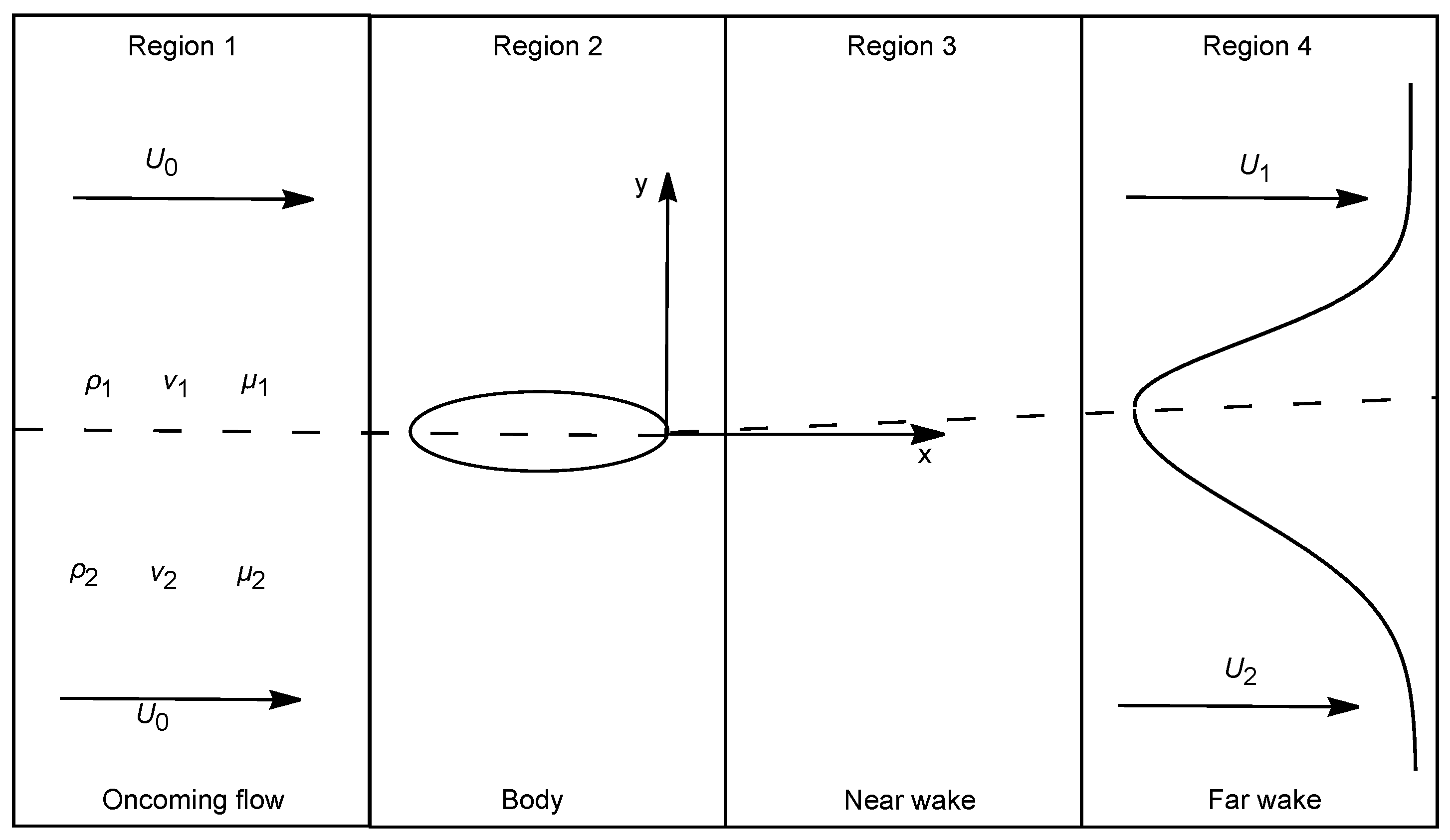
Consider the two-fluid laminar far wake behind a symmetric slender planar body of finite length at the interface between the two fluids and aligned with the flow. The fluids are immiscible and incompressible and the flow is laminar. A Cartesian coordinate system is introduced with origin at the trailing edge of the body. The mainstream velocity
is the same for both fluids. The index
corresponds to the upper fluid and index
to the lower fluid. The
x- and
y-components of the fluid velocities, pressures, densities, kinematic viscosities, and shear viscosities are denoted by
, and
, where
and for stability,
. The unknown interface between the two fluids is
and the total drag on the body due to the two fluids is
D. The two-fluid wake flow is illustrated in
Figure 1.
The two-fluid flow is steady and therefore
The
x- and
y-components of the steady-state Navier–Stokes equation and the conservation of mass equation are
where
and
g is the body force due to gravity per unit mass, which is in the
direction. Equations (
3) to (
5) are rewritten in dimensionless variables defined in terms of the upper fluid,
where
L is the characteristic length of the two-fluid boundary layer and the Reynolds number is
We also introduce the Froude number
Equations (
3) to (
5) become
We consider flows such that
that is, provided
which will be satisfied provided
is sufficiantly large.
Neglecting terms of order
, Equations (
9) and (
10) reduce to
Thus,
, and since the mainstream velocity
is constant, from Euler’s equation in the mainstream,
Therefore, the boundary layer equations for the two-fluid wake are
and the conservation of mass Equation (
11). The boundary conditions are
Finally, we derive the matching conditions at the interface
. In dimensionless variables the interface is
The tangential velocity components must match at the interface because the two fluids are viscous. The normal velocity components must also match. Hence
The tangential components of the stress vector,
, and the normal components of the stress vector,
, must match at the interface. Hence
Now from Cauchy’s formula and the Navier–Poisson law for a viscous incompressible fluid
Expressed in dimensionless variables, (
24) and (
25) become
Terms of order
are neglected in (
26). Substituting (
26) and (
27) gives the matching conditions
The problem is now formulated in terms of the velocity deficit
, defined by
Expressed in dimensionless variables
For the far wake,
, and
are small and their squares and products can be neglected. The PDEs (
11) and (
16), the boundary conditions (
17) and (
18), and the interface conditions (
20), (
21), (
28) and (
29) are expressed in terms of the velocity deficit. The problem can be stated as follows.
Partial differential equations:
Equation (
41) gives the pressure difference across the interface once the problem has been solved. By applying the Principle of Archimedes, Herczynski et al. [
1] derived a further condition for the pressure difference,
Expressed in dimensionless variables, (
42) is
The formulations (
34) to (
41) in dimensionless variables agrees with the formulation of Herczynski et al. [
1] in physical variables. It applies for both the classical wake and the wake behind a self-propelled body. The two problems differ in their conservation laws and conserved quantity.
In the remainder of the paper, the star will be suppressed to simplify the notation, with it being understood that dimensionless quantities are being used.
4. Invariant Solution for the Two-Fluid Classical Wake
The Lie point symmetry associated with the conserved vector for the upper wake and the Lie point symmetry associated with the conserved vector for the lower wake will be derived. The two associated Lie point symmetries will then be used to generate the invariant solution for the two-fluid classical wake. The problem will be formulated in terms of the stream function for each wake.
Since the conservation of mass equation, (
35), is satisfied for each wake, a stream function
can be introduced for each wake defined by
Equation (
35) is identically satisfied. Expressed in terms of the stream function, Equations (
34) to (
41) become:
Partial differential equation
The conserved vectors, (
74), for the upper wake and the lower wake for the classical two-fluid wake, expressed in terms of the stream function, are
In order to simplify the notation, in the following calculations the index i will be suppressed in all quantities except in the ratio and in the interface conditions. The results apply to both the upper and lower wakes.
4.1. Associated Lie Point Symmetries
The Lie point symmetry
is associated with the conserved vector
provided
where
Equation (
104) consists of the two components
The Lie point symmetry X is prolongated to sufficiently high order to operate on the partial derivatives in the conserved vector.
Consider first the component (
107). Now, from (
102)
where
When expanded fully, Equation (
107) becomes
Separating (
111) according to the partial derivatives of
and their products gives
and therefore
Consider next the second component (
108) with (
113) for
X. Now
where the prolongation
is defined by [
19]
and
is given by (
110). When expanded in full, (
108) becomes
Separating (
116) by
gives
and therefore
. By separating the remaining terms in (
116) we obtain
Differentiating (
118) with respect to
y yields
and therefore from (
119),
. Equation (
118) is now separable in the variables
x and
y and therefore
We consider the general case in which
. We can divide
X by
or equivalently set
. Hence
where
is an arbitrary function.
Equation (
122) is the Lie point symmetry associated with the conserved vector in the upper wake and in the lower wake. The constants
and
and the function
are different in each part of the two-fluid classical wake.
4.2. General Form of the Invariant Solution
Now,
is an invariant solution of the PDE (
95) generated by the Lie point symmetry (
122) provided
that is provided
The differential equations of the characteristic curves of (
124) are
Two independent solutions are
where
and
are constants and
The general solution of the first order PDE (
124) is
where
F is an arbitrary function. Hence
where
We chose the origin of the coordinate
in the upper and lower wakes to be at
. Hence
. Additionally, a singularity, if it exists, will be at the obstacle
. Hence,
and
The coordinate
and the Lie point symmetry (
122) are the same in the upper and lower wakes.
The conserved quantity (
82) for the two-fluid classical wake when expressed in terms of the invariant solution (
128) and (
130) is
For
to be a constant independent of
x, it is sufficient that
where
k is a constant. The equation of the interface is
and on the interface,
. The conserved quantity becomes
We now rewrite the velocity components (
94) and Equations (
95) to (
101) in terms of the invariant solution (
128) and (
130):
Ordinary differential equation (ODE)
Equation (
143) was simplified with the aid of (
140) and (
142).
From (
127) with
,
and therefore from the interface condition (
141),
. The Lie point symmetry (
122) is therefore the same in the upper wake and lower wake,
Additionally, from the interface condition (
141),
where
is a constant. Since an arbitrary constant in the stream function (
128) does not contribute to the velocity components, we can take
and therefore
4.3. Invariant Solution for the Two-Fluid Classical Wake
Clearly, the ODE (
137) can be integrated at least once. This is an example of the Double Reduction Theorem [
10], which states that if the form of the invariant solution is determined by a conserved vector of the PDE then the reduced ODE can be integrated at least once.
We integrated the ODE (
137) once with respect to
and imposed the boundary conditions (
138) and (
139). It is necessary to assume the stronger boundary conditions
This gives
which is a first order ODE in
. Hence
where
is a constant. The assumption (
148) is clearly satisfied by (
150). Since
and
, given by (
135) and (
136), depend on
and are independent of
it is not necessary to integrate (
150) further.
The interface conditions (
140) and (
142) become
We consider two fluids with
. Additionally,
because if
then from (
151),
and
and
. Hence
and from (
151)
Since
, it follows from (
133) that
The interface is therefore the
x-axis. In the derivation of the conserved quantity (
82),
was neglected. However,
since
. The total drag
is therefore independent of
x without approximation.
The constant
B cannot be obtained from the boundary conditions (
138) and (
139) which are identically satisfied. It is obtained from the conserved quantity (
134). Substituting (
150) into (
134) gives
where
and we used
where
is the Gamma function [
18]. Hence
which may be expressed in terms of the parameter [
1]
as
The velocity deficit is, from (
135) and (
150),
and
The turning point of the velocity deficit is therefore on the interface. Additionally, from (
136) and (
150),
However, on the interface between two fluids, the normal component of velocity vanishes. Hence
and therefore
where
is a constant. However, a constant in the stream function (
147) does not contribute to the velocity. We therefore set
. Additionally, from definition (
127)
and therefore
. The Lie point symmetry (
135) generates the solution reduces to
4.4. Results for the Two-Fluid Classical Wake
The
x-component of the fluid velocity is
The density ratio
affects only the amplitude of the velocity deficit and not the effective width of the two-fluid wake. Since
the effective width
of each part of the two-fluid wake is
and therefore
In
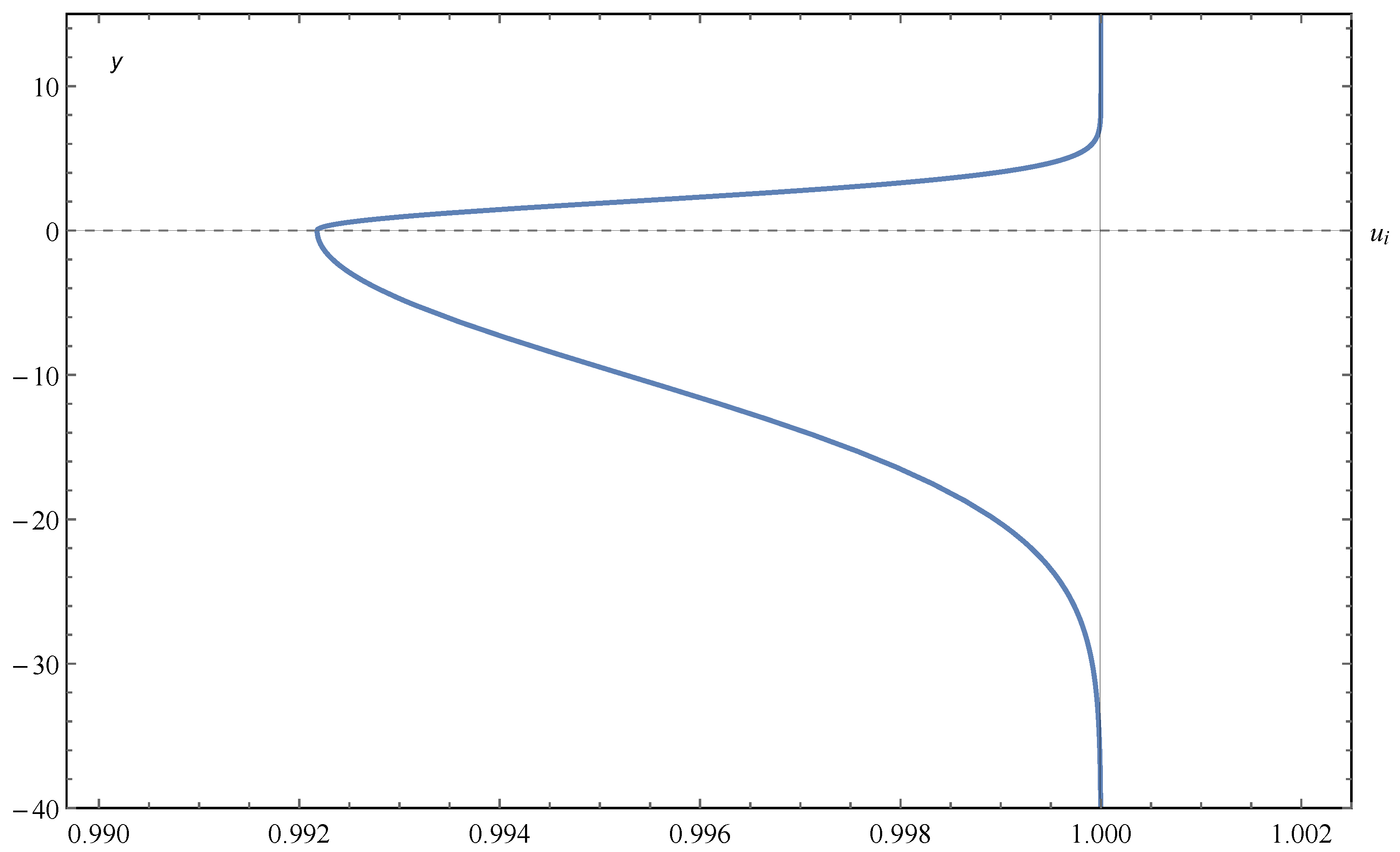
Figure 2, the velocity
is plotted against
y at
for
and
. We see that the effective width of the lower wake is approximately five times greater than that of the upper wake, in agreement with the ratio (
173).
The condition (
143) for the pressure difference across the interface becomes using (
150), (
161), and
,
Since terms of order
are neglected, it follows that
and that the pressure is continuous across the interface. This agrees with (
43), derived by Herczynski et al. [
1], since
.
6. Conclusions
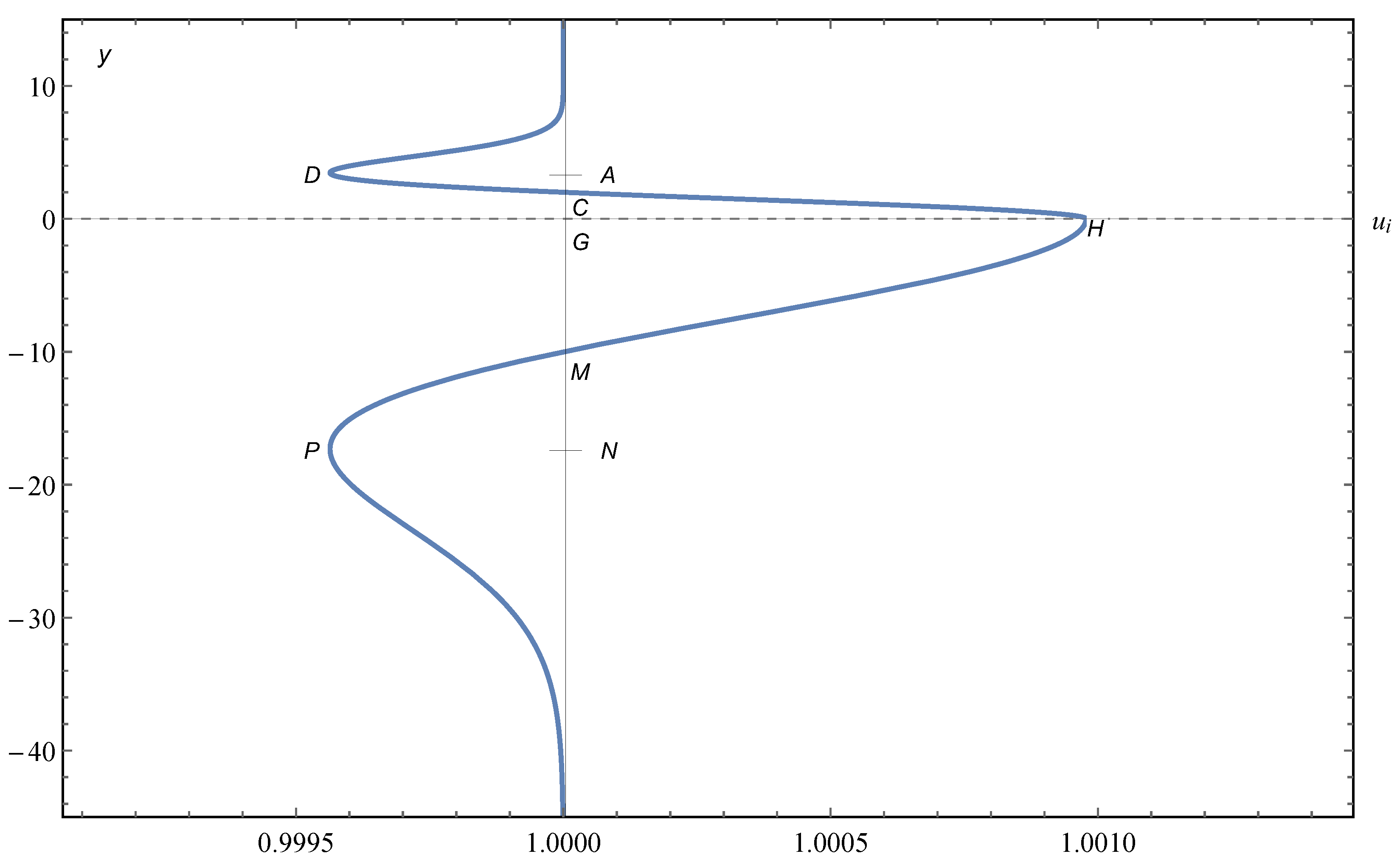
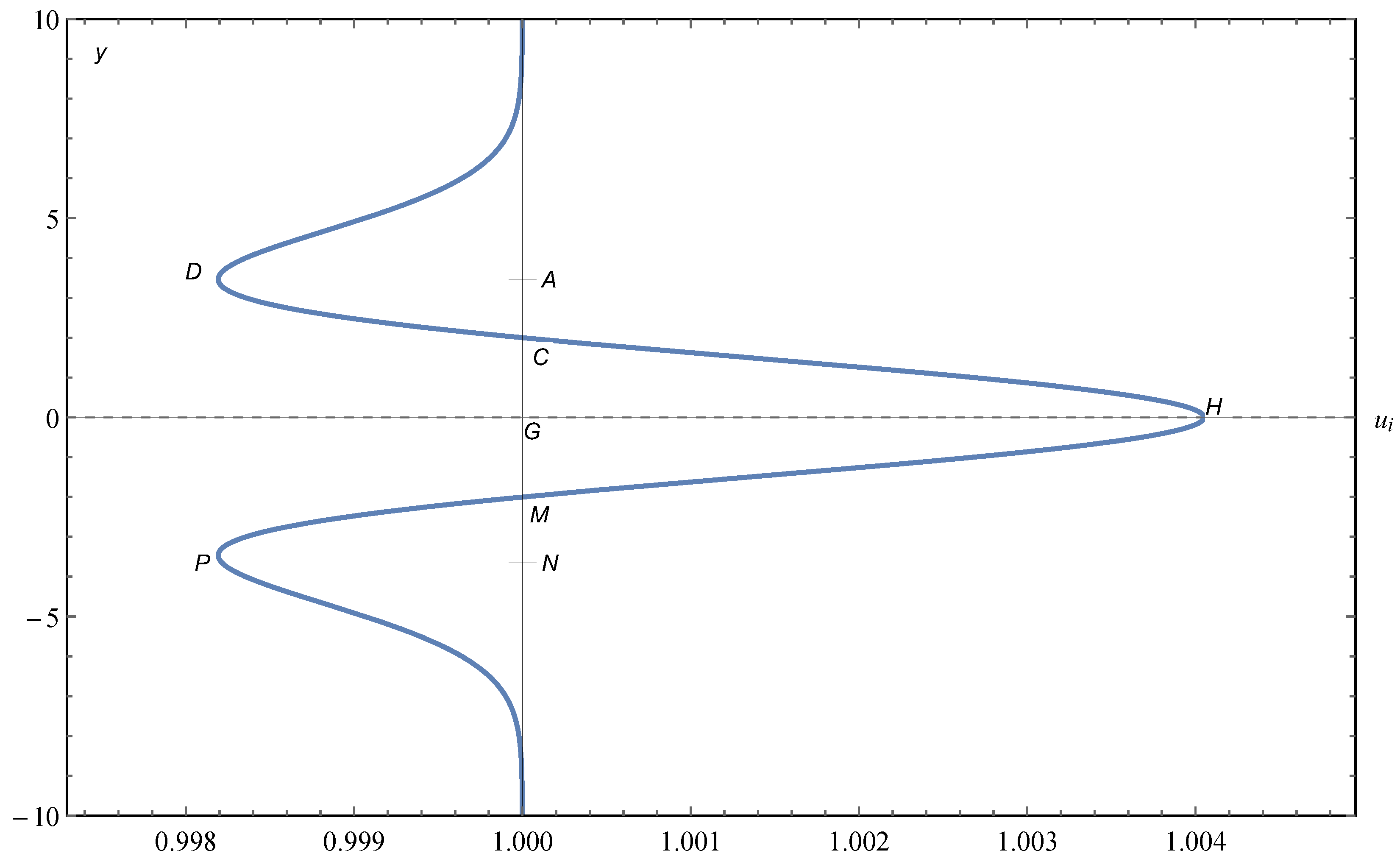
Four new solutions for the two-fluid two-dimensional wake were found. For the two-fluid classical wake and one of the two-fluid momentumless wakes there was no deflection of the interface which was along the positive x-axis. The four new solutions are subject to conditions. For the two-fluid classical wake, the solution exists provided which is satisfied because for stability. For the three two-fluid momentumless wakes, the condition of no entrainment of fluid at was imposed while the wakes with interface exist provided .
The conservation laws for the system of partial differential equations in the upper and lower wakes played a significant part in the solution. The derivation of the conserved vectors for the classical and momentumless wakes as a linear combination of four conserved vectors unified the theory. There is not a conserved quantity for the upper and lower wakes separately because of non-zero interface terms which are eliminated by an additional condition. The conserved quantity for the two-fluid classical wake was derived from the conservation laws and the interface condition for the shear stress while the conserved quantity for the two-fluid momentumless wake was derived from the conservation laws and the condition that the total drag on the obstacle is zero. From the conserved quantity, the general form of the equation of the interface and the constant of integration B were derived.
The four interface conditions also played a significant part in the solution. The interface conditions on the tangential and normal components of the fluid velocity and on the tangential component of the stress determined the value of k in the equation of the interface, while the fourth interface condition on the normal stress determined the pressure difference across the interface.
The derivation of the associated Lie point symmetry required a prolongation only to second order. Since the partial differential equation for the stream function is third order, a prolongation to third order would be required to derive the Lie point symmetry from the invariance condition. It was therefore easier to derive the associated Lie point symmetry which could be done manually. Since the partial differential equation for the stream function was reduced to an ordinary differential equation by an associated Lie point symmetry the resulting ordinary differential equation could be integrated at least once by the Double Reduction Theorem [
10]. We saw that the differential equations could be integrated completely and analytical solutions could be derived.
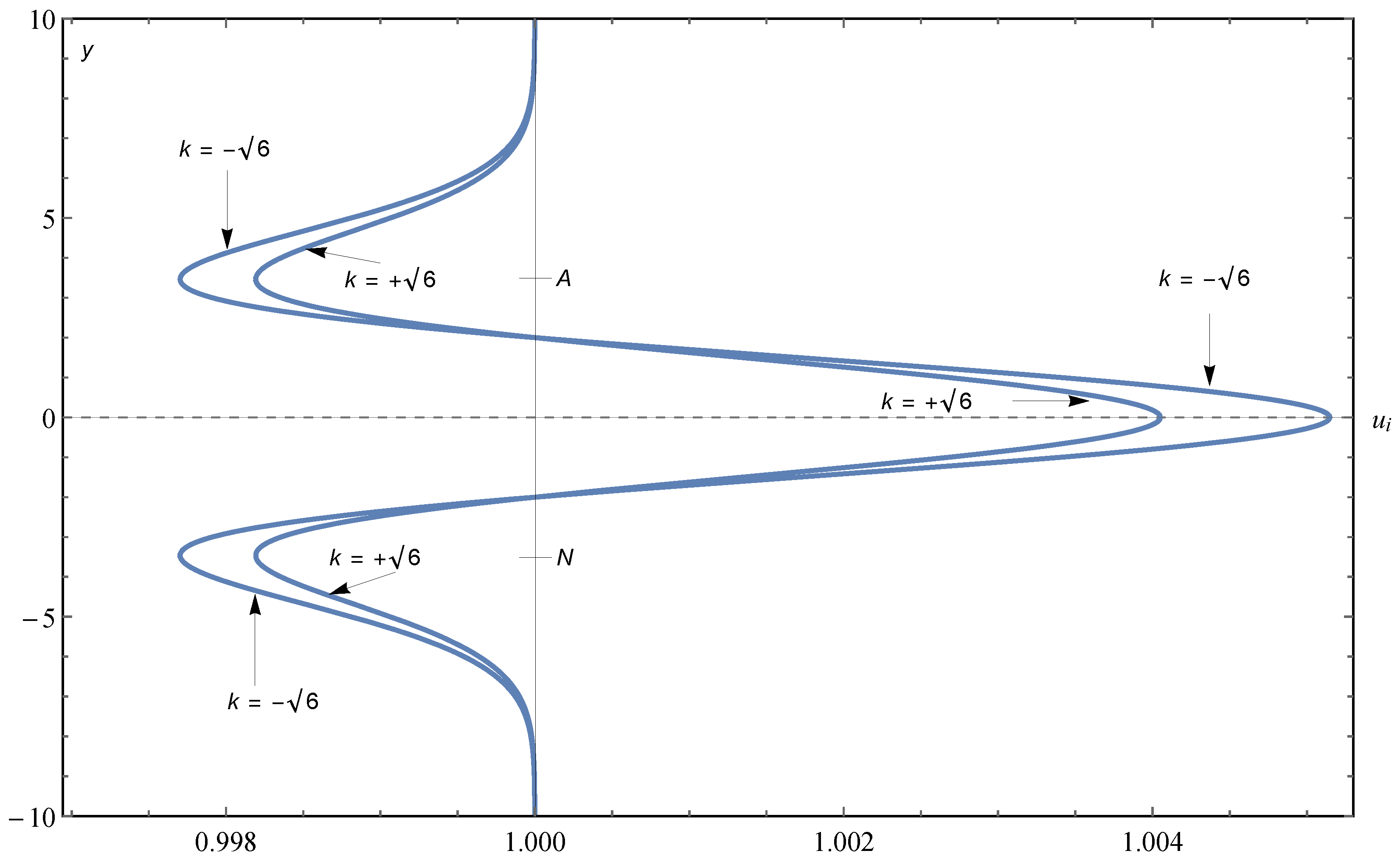
We found that the effective width of the two-fluid wakes depends on the viscosity ratio and is independent of the density ratio . The maximum and minimum magnitudes of the velocity deficit depend on both and through the constant B. When the classical and momentumless two-fluid wakes are not symmetrical about the interface, , but the magnitude of the maximum velocity deficit in the upper and lower halves of the momentumless wake are equal. For all three two-fluid momentumless wakes, the ratio of the magnitude of the velocity deficit at to the magnitude at the two local turning points is independent of and and is approximately . The two-fluid classical and momentumless wake for both depend on the parameter .
The advantages of the methods used can be summarised as follows:
The boundary layer and far wake approximations lead to an analytical solution.
The multiplier method was a systematic way to derive the conservation laws and unified the theory of the classical and momentumless wakes.
The conserved quantities for the two-fluid classical and momentumless wakes could be derived from the conservation laws for the upper and lower parts of the wake and the interface and boudary conditions.
The associated Lie point symmetry, which is all that is required to derive the general form of the invariant solution, was easier to calculate than the Lie point symmetry of the partial differential equation and could be obtained manually.
The double reduction theorem ensured that the ordinary differential equation obtained by the first reduction could be integrated at least one time.
The equation of the interface was obtained from the conserved quantity.
There is scope for future work on the two-fluid wake, which is a relatively new area of investigation. Research has been done on the far wake and on the laminar wake. Two-fluid classical and momentumless near wakes and two-fluid turbulent near and far wakes could be investigated.