Article

The Reliability of Stored Water behind Dams Using the Multi-Component Stress-Strength System

by
Hanan Haj Ahmad
1,*,
Dina A. Ramadan
2,
Mahmoud M. M. Mansour
3 and
Mohamed S. Aboshady
3
1
Department of Basic Science, Preparatory Year Deanship, King Faisal University, Hofuf 31982, Al Ahsa, Saudi Arabia
2
Department of Mathematics, Faculty of Science, Mansoura University, Mansoura 35516, Egypt
3
Department of Basic Science, Faculty of Engineering, The British University in Egypt, El-Sherouk City P.O. Box 43, Egypt
*
Author to whom correspondence should be addressed.
Symmetry 2023, 15(3), 766; https://doi.org/10.3390/sym15030766
Submission received: 16 February 2023 / Revised: 13 March 2023 / Accepted: 17 March 2023 / Published: 21 March 2023

Abstract

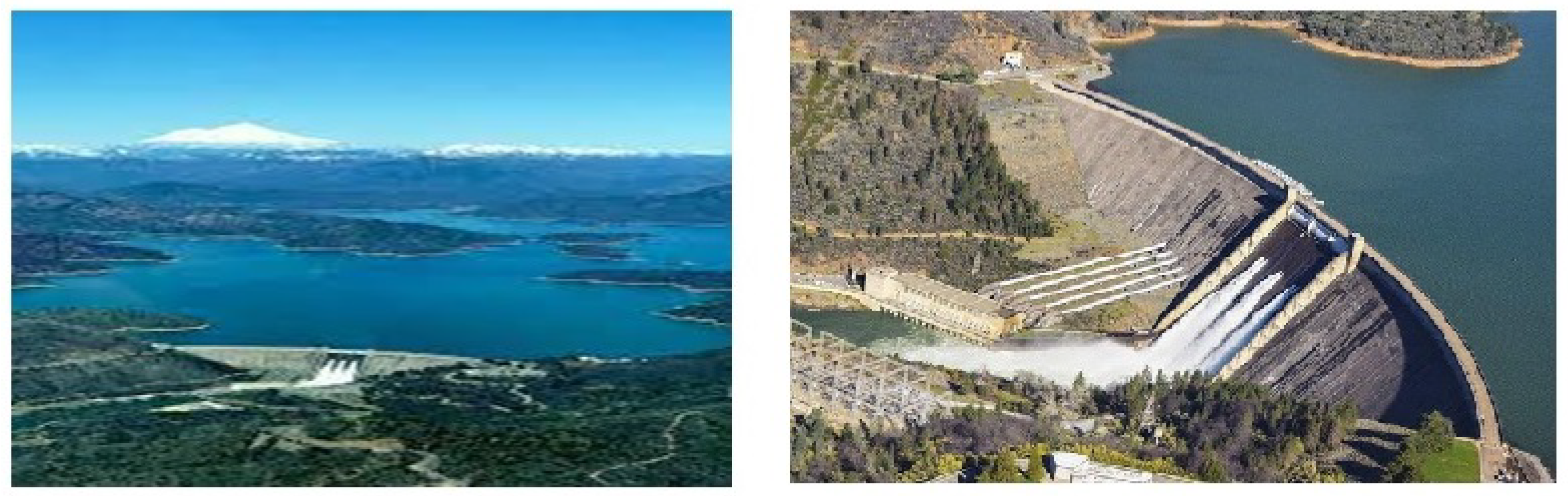
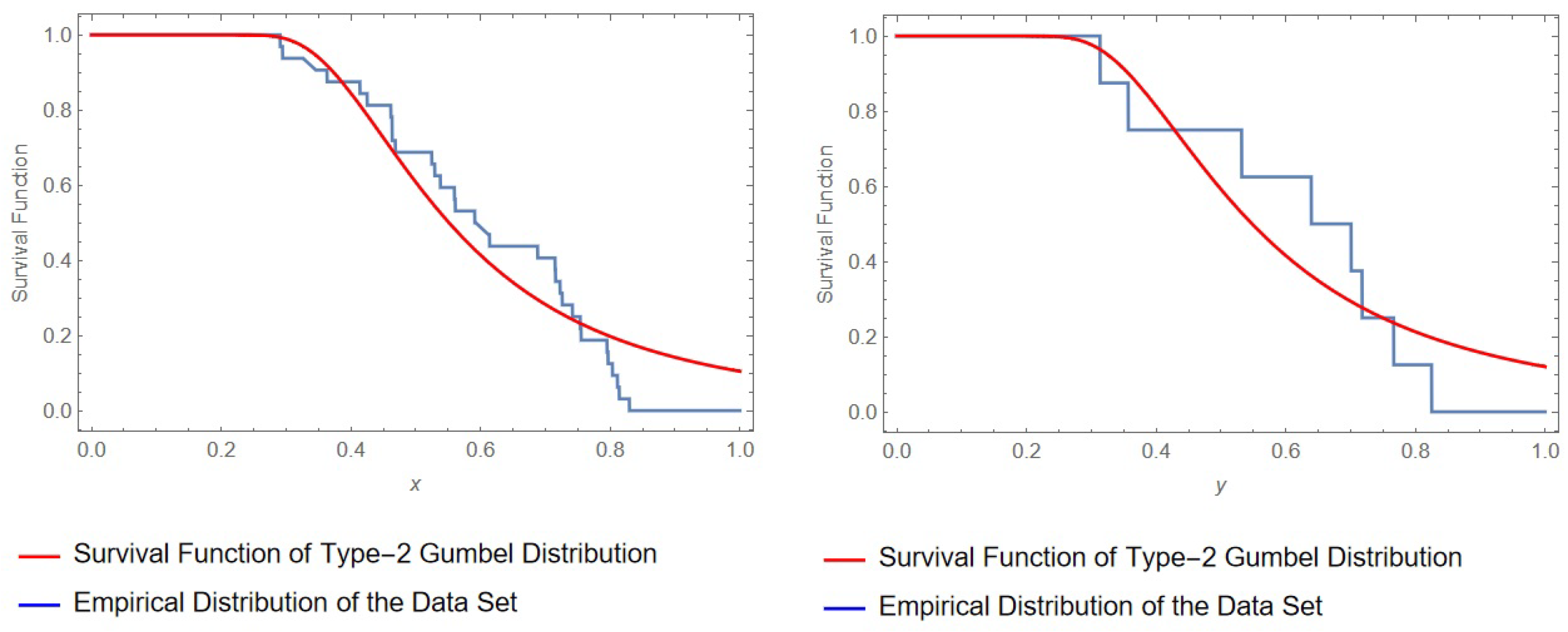
Dams are essential infrastructure for managing water resources and providing entry to clean water for human needs. However, the construction and maintenance of dams require careful consideration of their reliability and safety, specifically in the event of extreme weather conditions such as heavy rainfall or flooding. In this study, the stress-strength model provides a useful framework for evaluating the reliability of dams and their ability to cope with external stresses such as water pressure, earthquake activity, and erosion. The Shasta reservoir in the United States is a prime example of a dam that requires regular assessment of its reliability to guarantee the safety of communities and infrastructure. The Gumbel Type II distribution has been suggested as a suitable model for fitting the collected data on the stress and strength of the reservoir behind the Shasta dam. Both classical and Bayesian approaches have been used to estimate the reliability function under the multi-component stress-strength model, and Monte Carlo simulation has been employed for parameter estimation. In addition, some measures of goodness-of-fit are employed to examine the suitability of the suggested model.
Keywords: Gumbel Type II distribution; multi-component stress-strength model; maximum likelihood estimation; Bayesian estimation; Monte Carlo simulation; reliability analysis Gumbel Type II distribution; multi-component stress-strength model; maximum likelihood estimation; Bayesian estimation; Monte Carlo simulation; reliability analysis