Abstract
The class of symmetric function interacts extensively with other types of functions. One of these is the class of convex functions, which is closely related to the theory of symmetry. In this paper, we obtain some new fractional Hermite–Hadamard inequalities with an exponential kernel for subadditive functions and for their product, and some known results are recaptured. Moreover, using a new identity as an auxiliary result, we deduce several inequalities for subadditive functions pertaining to the new fractional integrals involving an exponential kernel. To validate the accuracy of our results, we offer some examples for suitable choices of subadditive functions and their graphical representations.
Keywords:
Hermite-Hadamard inequalities; subadditive functions; convex functions; fractional integral operators with an exponential kernel; Hölder’s inequality; power-mean inequality; numerical analysis MSC:
26A51; 26A33; 26D07; 26D10; 26D15
1. Introduction
Hille and Phillips’ work [1] is the key contribution to the general theory of subadditive functions. In addition, a portion of Rosenbaum’s [2] research on subadditive functions involving many variables is included. Measure theory, a number of mathematical disciplines, and mathematical inequalities all make use of the ideas of additivity, subadditivity, and superadditivity. Numerous examples of additive, subadditive, and superadditive functions, including error functions, norms, growth rates, differential equations, square roots, and integral means, can be found in a variety of mathematical contexts. One of the most developed areas in theoretical and practical mathematics, physics, and other applied disciplines is inequality theory, specifically subadditive function theory. Here, we highlight the findings of [3,4,5,6,7,8,9].
Definition 1.
A function is said to be subadditive on if for all such that we have
If the equality holds, Υ is called additive; if the Inequality (1) is reversed, Υ is called superadditive.
Theory of convexity played a significant role in the development of theory of inequalities. Symmetric convex sets have a variety of significant characteristics. The fact that we can work on one and then apply it to the other is an important aspect of the relationship between symmetry and convexity.
Definition 2 ([10]).
A function is said to be convex, if
holds for all and
The following Hermite-Hadamard’s inequality (H-H) is one of the well-known studied results involving convex functions.
Theorem 1
([11,12]). Let be a convex function on for and then
The convexity property of the functions can be used to obtain many well-known inequalities. Some improvements to the H-H inequality on convex functions have been thoroughly studied since then; for more information, see the articles [13,14,15,16,17,18,19], as well as the references therein.
Recently, Sarikaya and Ali [20] proved the following interesting integral inequalities of H-H type for continuous subadditive functions.
Theorem 2.
Let be a continuous subadditive function with and then the following inequality holds true:
Theorem 3.
Let be two continuous subadditive functions with and then the following inequalities hold true:
and
Finally, let us recall the following definition regarding fractional integral operators with exponential kernels that will be used in the sequel.
Definition 3
([21,22]). Let where Then the fractional integrals with exponential kernel and of order are defined as
and
respectively.
It is crucial to stress that Leibniz and L’Hospital are responsible for developing the concept of fractional calculus (1695). Other mathematicians have significantly contributed to the topic of fractional calculus and its many applications, including Riemann, Liouville, Erdéli, Grünwald, Letnikov, and Kober. Due to its behaviour and ability to deal with real-world problems, fractional calculus is of interest to many physical and engineering professionals. The study of so-called fractional order integral and derivative functions over real and complex domains, as well as its applications, are currently the focus of fractional calculus. Since fractional mathematical models are specific instances of fractional order mathematical models, they produce more conclusive and accurate conclusions than classical mathematical models. Different mathematical models are used to explain the endemics’ distinctive transmission dynamics and gain understanding of how infection affects a new population. In order to increase the precision and accuracy of real phenomenons, non-integer order fractional differential equations (FDEs) are used (see [23,24,25,26,27]). Furthermore, Refs. [28,29,30] contains other intriguing results for fractional calculus. However, fractional calculation allows us to take any number of orders and create far more measurable goals. Mathematicians have grown increasingly interested in employing a range of novel theories of fractional integral operators to illustrate well-known inequalities in recent years.
There are many published articles regarding inequalities but in our paper we have done the numerical analysis and their graphical representations for suitable choices of subadditive functions. For the correctness of the presented results, we discussed some examples and validate those via numerical estimations and graphs with the change of the parameter . The results presented in this study are substantial generalizations of previous findings given by Sarikaya et al. [20]. Additivity, subadditivity and superadditivity functions play an important role both in measure theory and in different fields of mathematics. Here, we have obtained some new fractional Hermite–Hadamard inequalities with an exponential kernel for subadditive functions and for the product of two such functions. Our results obtained here deviate moderately from the recent research directions.
Motivated from above results and literature, this work includes the following sections: In Section 2, we will obtain some new fractional H-H inequalities with an exponential kernel for subadditive functions and for their product, and some known results will be recaptured. In Section 3, using a new identity as an auxiliary result, we will deduce several inequalities for subadditive functions pertaining to fractional integrals with an exponential kernel. To validate the accuracy of our results, we will offer some examples for suitable choices of subadditive functions and their graphical representations. The conclusion and future research will be given in Section 4.
2. Main Results
For the simplicity of notations, let
Additionally, we mark as the interior of and as the set of all Lebesgues integrable functions on . The fractional H-H type inequalities with an exponential kernel for subadditive functions are given as follows:
Theorem 4.
Let be a continuous subadditive function with and Then for
holds true.
Proof.
Since is a subadditive function on we have
After multiplying both sides of the Equation (10) by integrating the resulting inequality with respect to over and altering the integration’s variables, we get
hence,
with this, the left side inequality of Equation (9) has been fully demonstrated. Next, we observe that is a subadditive function on , and for we have
and
Corollary 1.
Under the assumptions of Theorem 4, taking then we get ([20], Theorem 2).
Example 1.
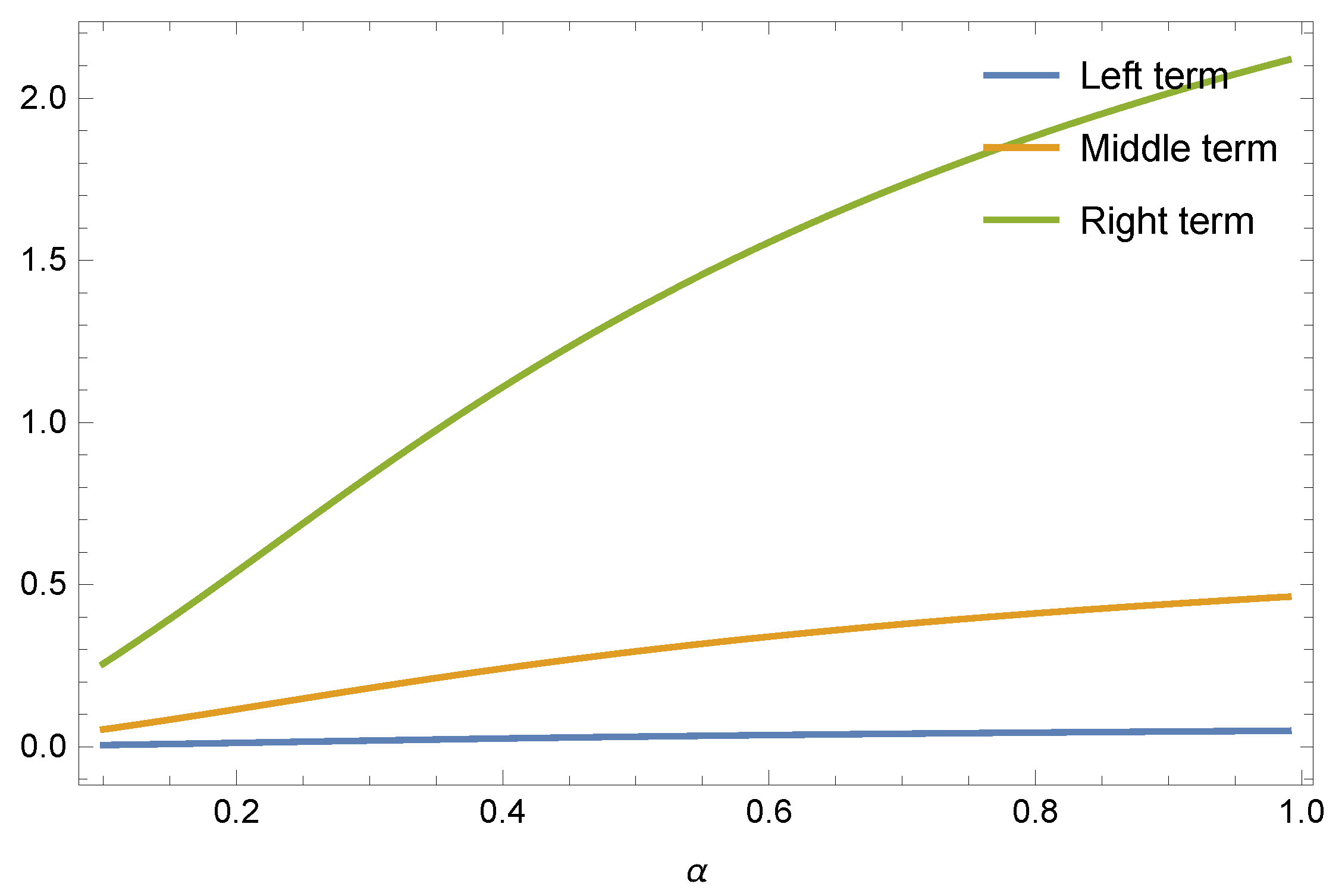
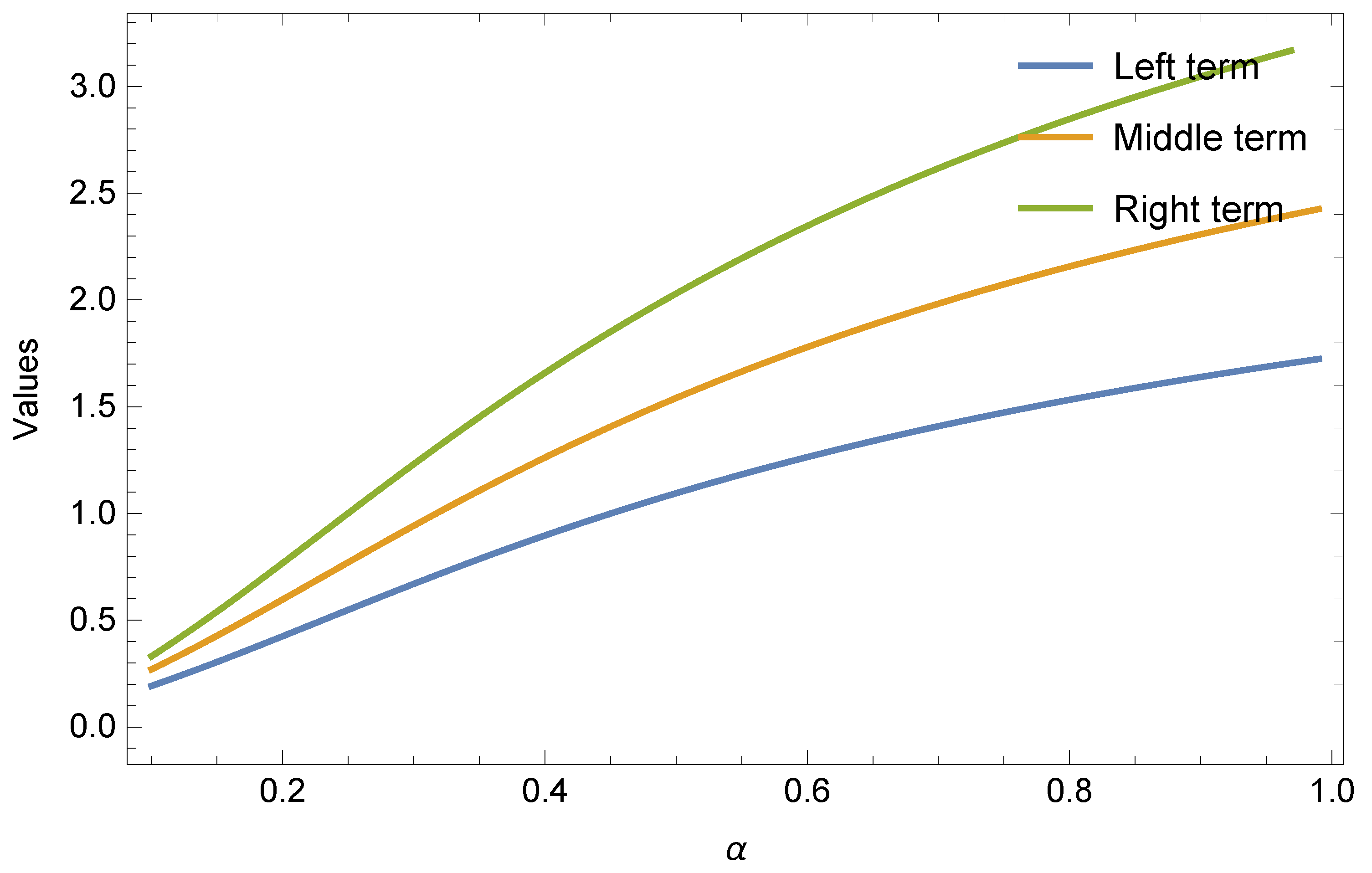
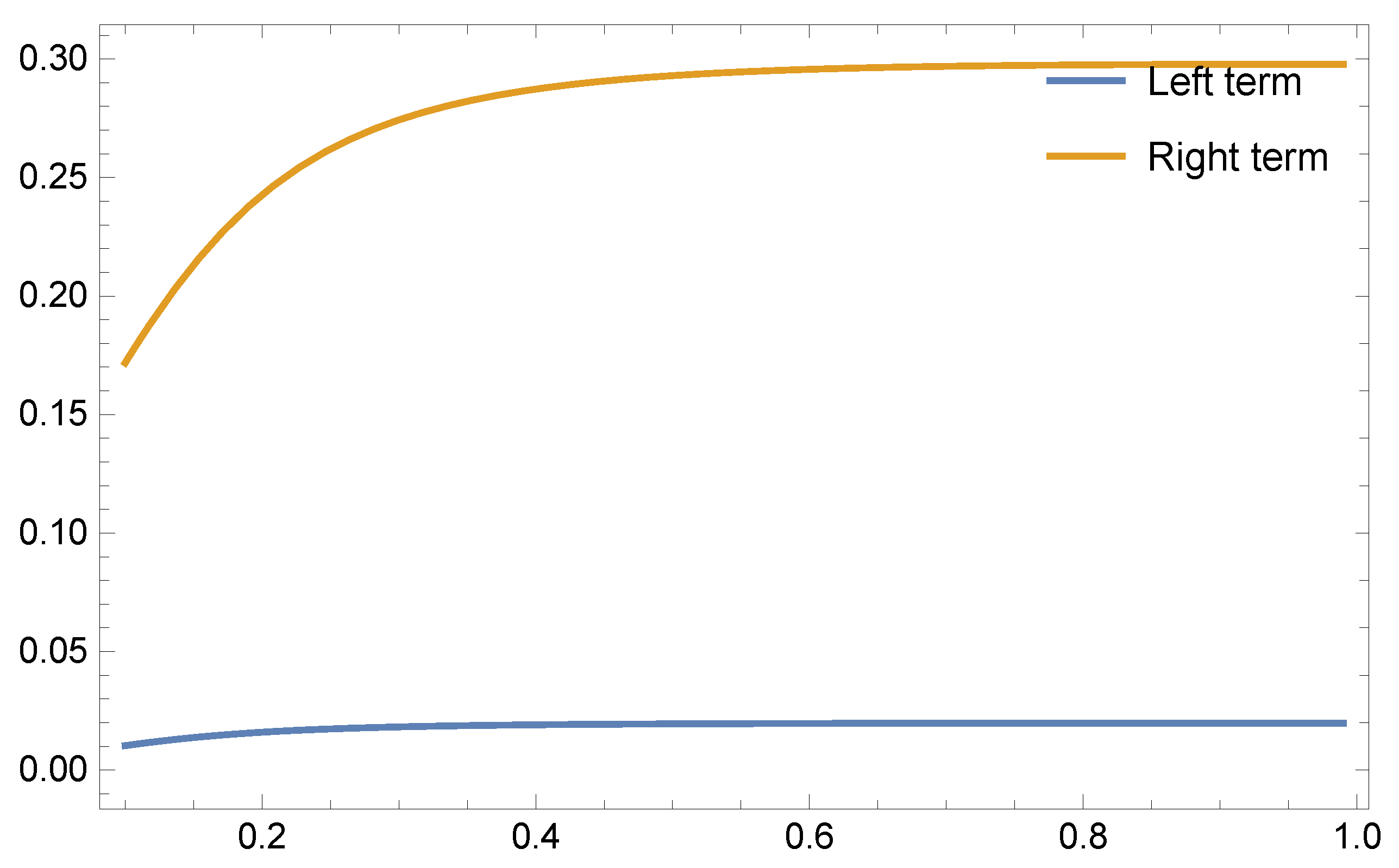
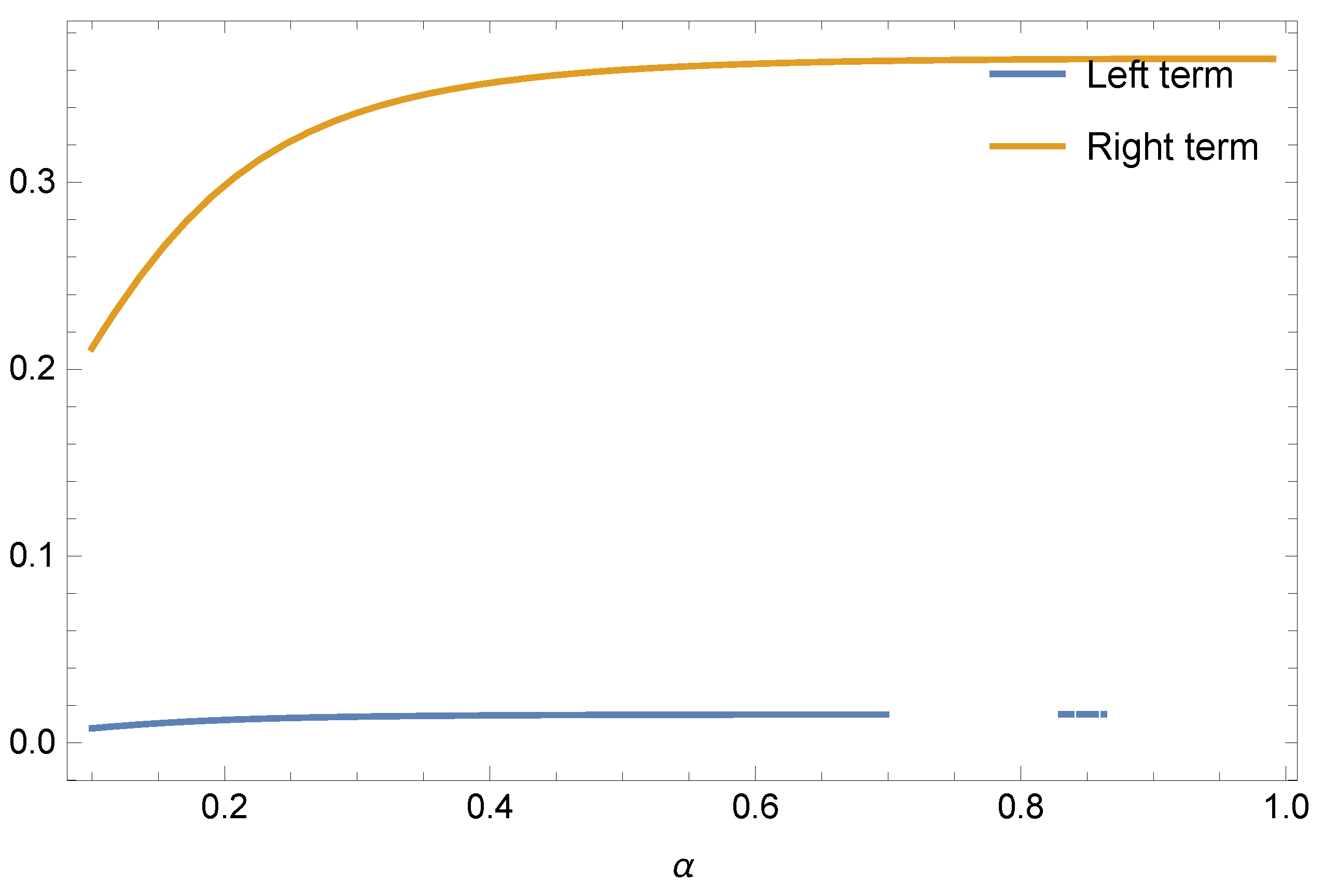
If we take subadditive functions and respectively, in Theorem 4 for all , and , then we have the following results given in Table 1 and Table 2 and Figure 1 and Figure 2.
Table 1.
Numerical validation of Theorem 4 for .
Table 2.
Numerical validation of Theorem 4 for .
Figure 1.
Graphical behaviour of Theorem 4 for and .
Figure 2.
Graphical behaviour of Theorem 4 for and .
Theorem 5.
Let be two continuous subadditive functions with and Then for
and
hold true.
Proof.
Since and are subadditive functions on we have
and
We generate Inequality (14) by multiplying both sides of Equation (18) by integrating the resulting inequality with respect to over and using the change in variables.
Since and are subadditive functions on we have
and
Similarly,
Corollary 2.
Under the assumptions of Theorem 5, letting then we obtain ([20], Theorem 3).
Example 2.
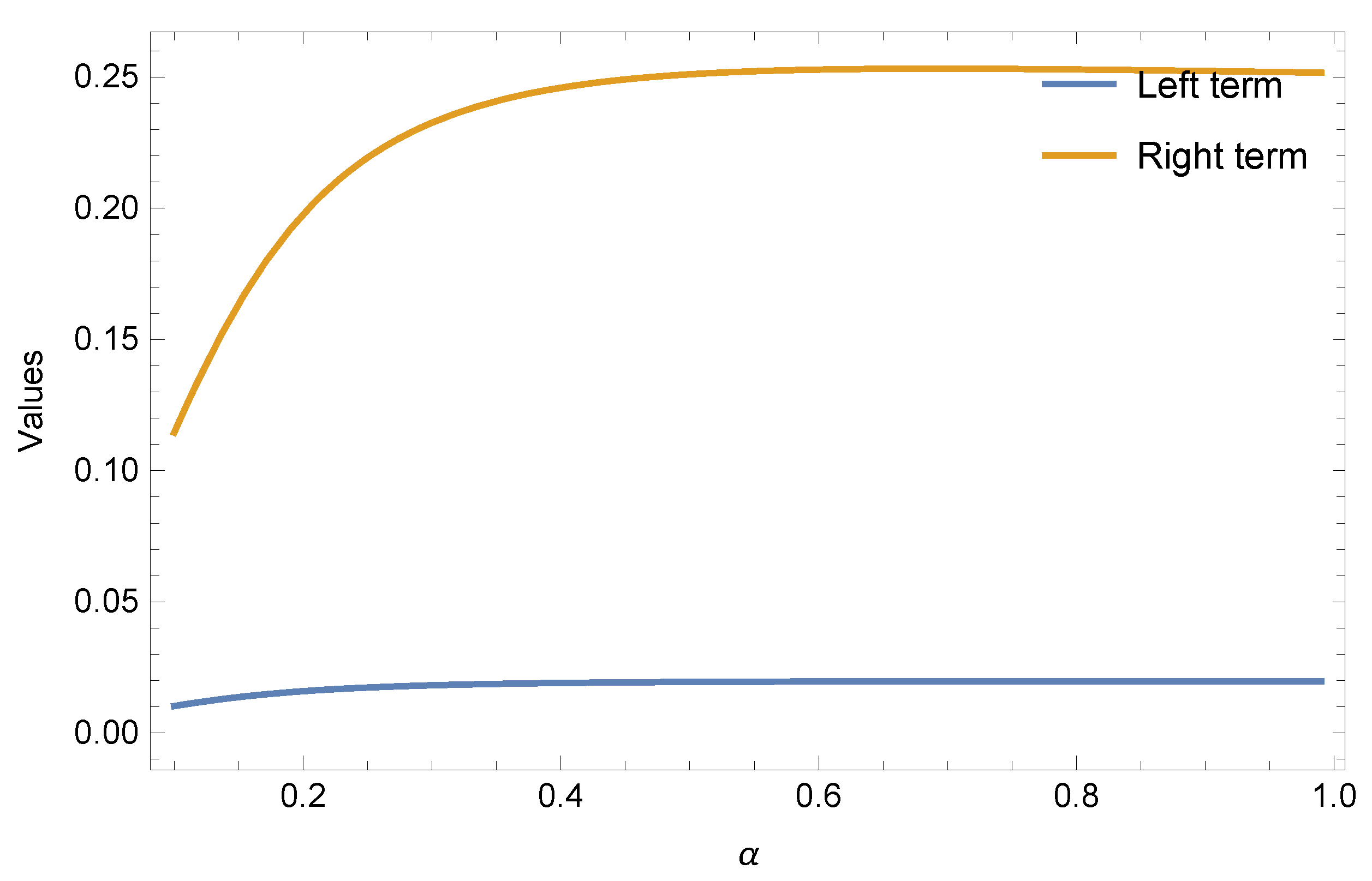
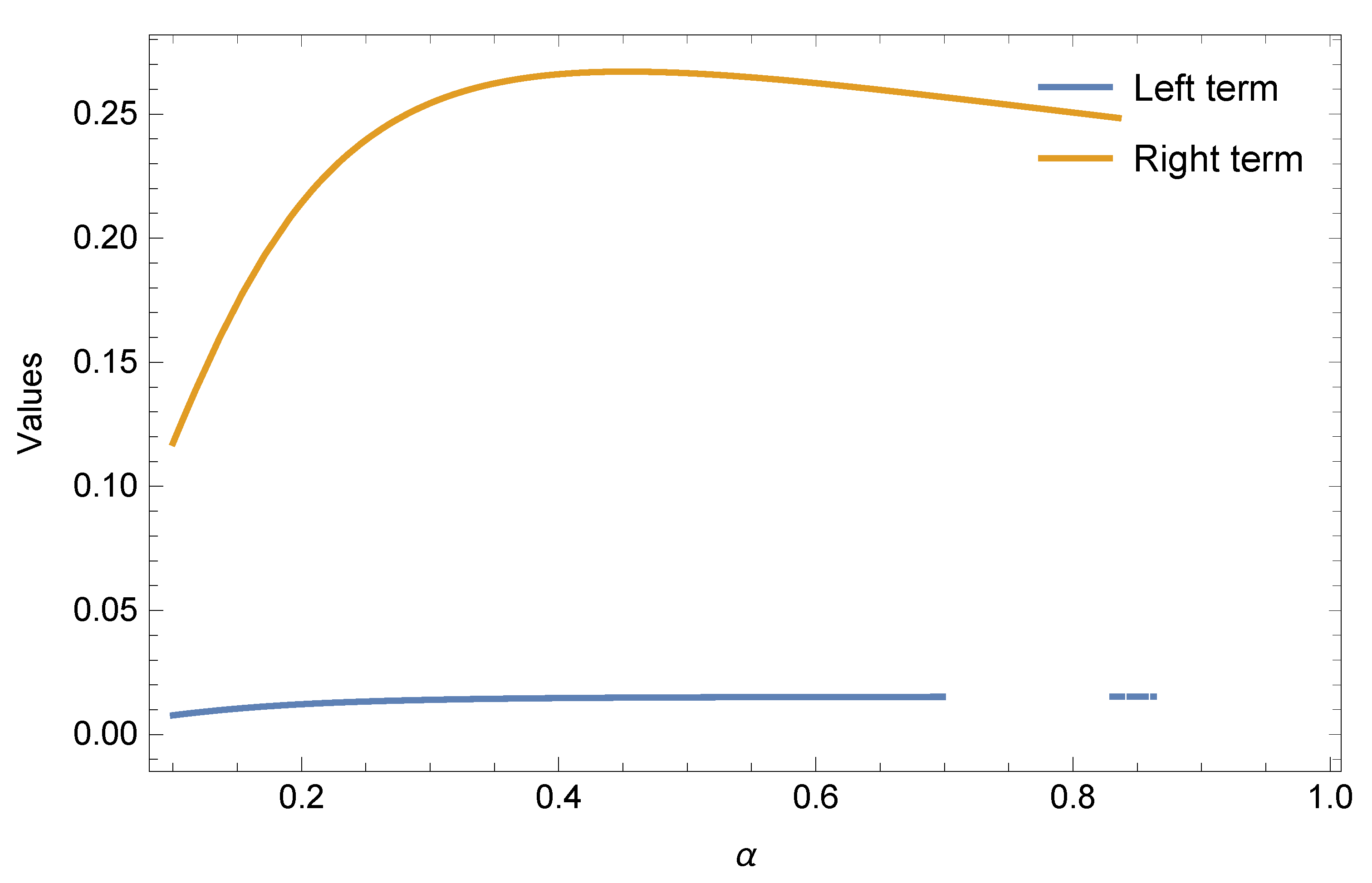
If we choose subadditive functions and respectively, in Theorem 5 for all , and , then we get the following results given in Table 3 and Table 4 and Figure 3 and Figure 4 for Inequalities (14) and (15), separately.
Table 3.
Numerical validation of Theorem 5 for .
Table 4.
Numerical validation of Theorem 5 for .
Figure 3.
Graphical behaviour of Theorem 5 for and .
Figure 4.
Graphical behaviour of Theorem 5 for and .
3. Further Results
Lemma 1.
Let be a differentiable function with and If then for
holds true.
Proof.
Let
Similarly,
Theorem 6.
Let be a differentiable function with and If and is subadditive function with and then for
holds true, where
Proof.
Employing Lemma 1, Hölder’s inequality, subadditivity of on changing the variables of integration and properties of modulus, we have
This concludes the proof of Theorem 6. □
Example 3.
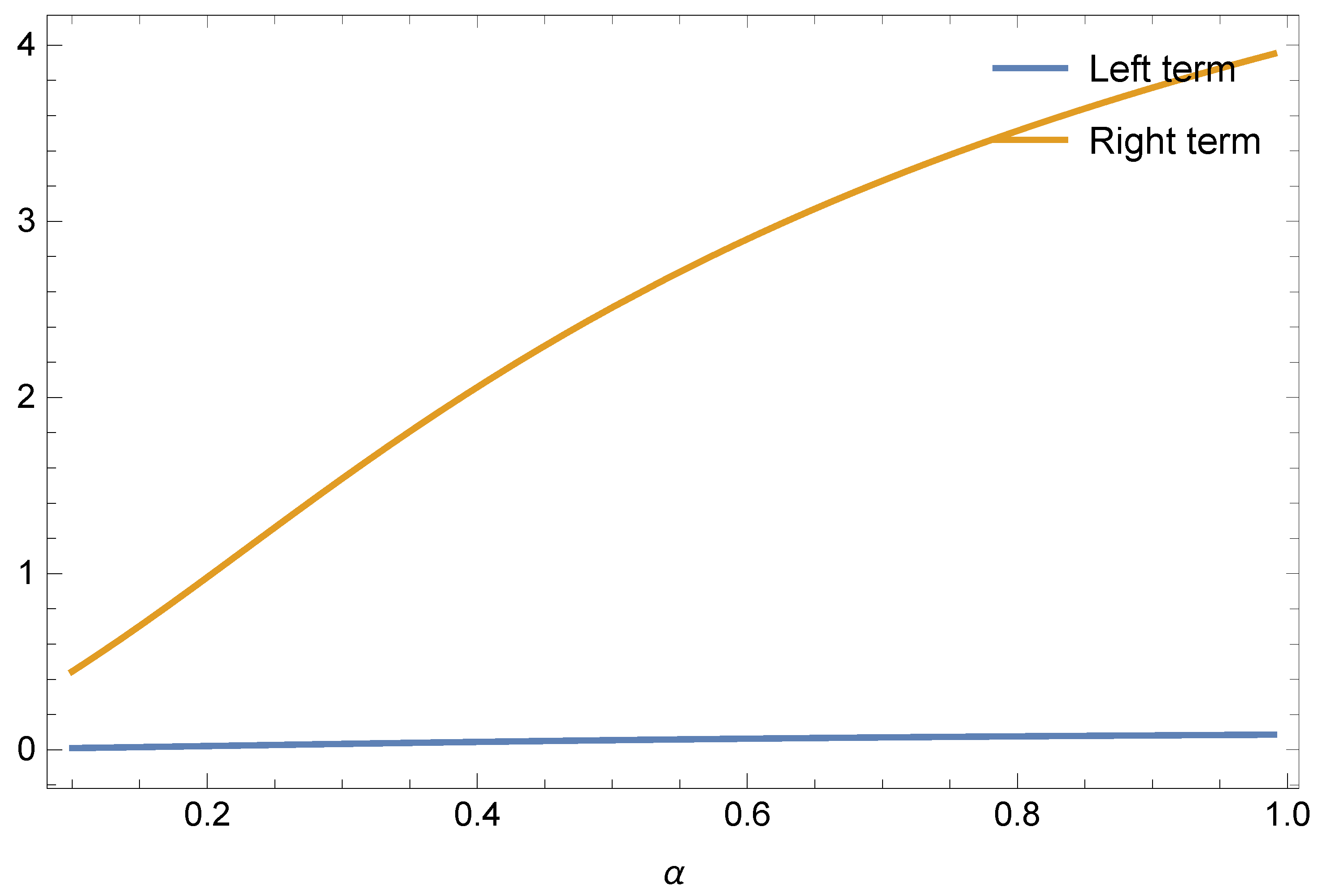
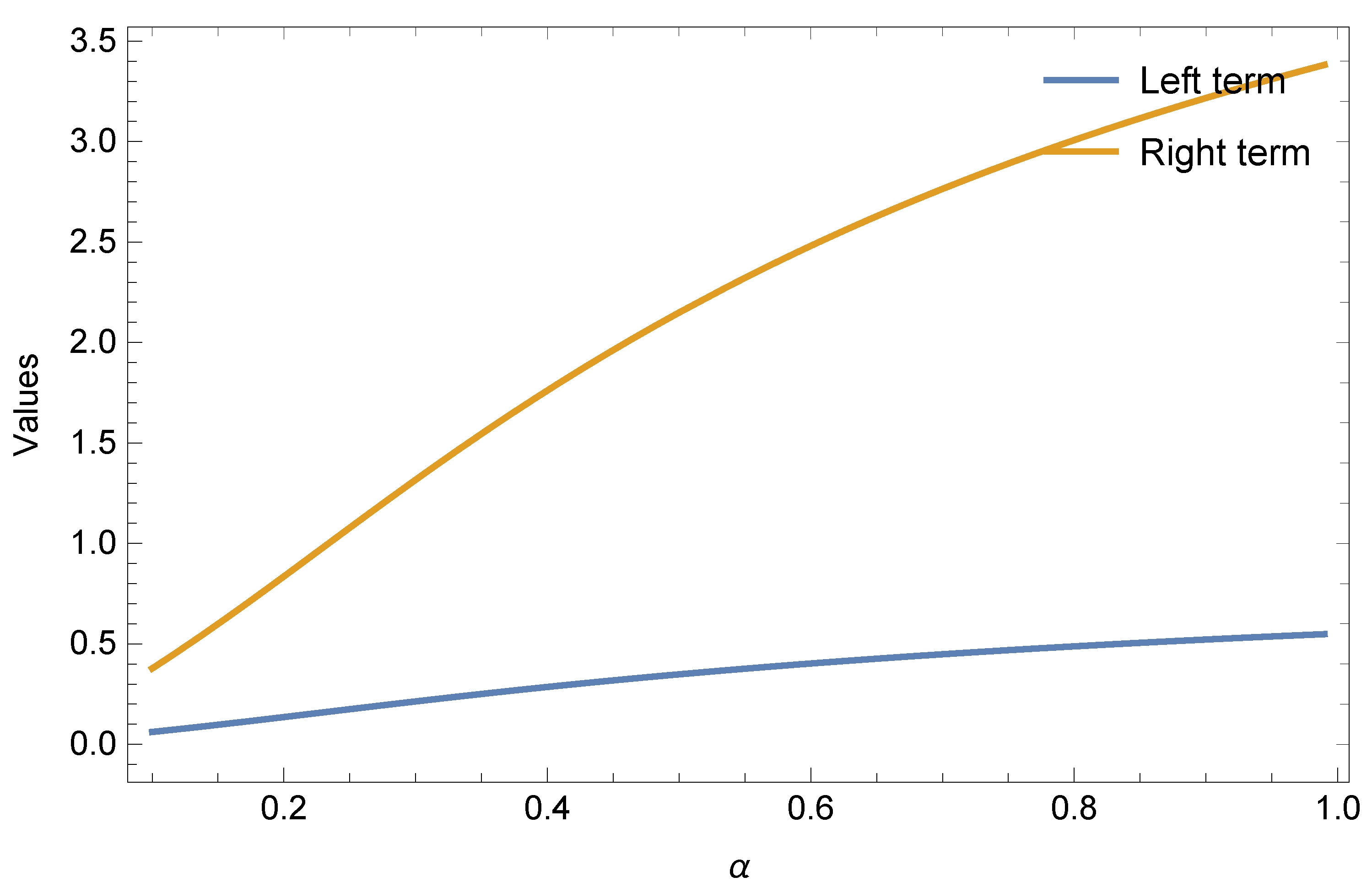
If we take functions and for fixed and respectively, then are both subadditive functions for all Applying Theorem 6 for , and , we have the following results given in Table 5 and Table 6 and Figure 5 and Figure 6.
Table 5.
Numerical validation of Theorem 6 for .
Table 6.
Numerical validation of Theorem 6 for , .
Figure 5.
Graphical behaviour of Theorem 6 for and .
Figure 6.
Graphical behaviour of Theorem 6 for , and .
Theorem 7.
Let be a differentiable function with and If and is subadditive function with then for
holds true, where
Proof.
Employing Lemma 1, power-mean inequality, subadditivity of on changing the variables of integration and properties of modulus, we have
which completes the proof of Theorem 7. □
Example 4.
If we choose functions and for fixed and respectively, then are both subadditive functions for all Applying Theorem 7 for and we get the following results given in Table 7 and Table 8 and Figure 7 and Figure 8.
Table 7.
Numerical validation of Theorem 7 for .
Table 8.
Numerical validation of Theorem 7 for , .
Figure 7.
Graphical behaviour of Theorem 7 for and .
Figure 8.
Graphical behaviour of Theorem 7 for , and .
4. Conclusions
In this paper, we established some new fractional H-H inequalities with an exponential kernel for subadditive functions, for product of two such functions and some known results are recaptured as well. Moreover, we proved a new identity, that acts as an auxiliary result for the derivation of further inequalities involving subadditive functions via fractional integrals. To validate the accuracy of our results, we give some examples for suitable choices of subadditive functions and their graphical representations with . We believe that our results using fractional integral operators with exponential kernels open many avenues for interested researchers working in this field and they can discover further approximations for different kinds of fractional integral operators and functions as well. Moreover, we can apply the obtained results in special functions, quantum calculus, applied mathematics, etc, in related future research works.

Author Contributions
Conceptualization, A.K.; S.K.S. and E.A.-S.; Data curation, S.K.S.; Funding acquisition, E.A.-S.; Investigation, A.K., S.K.S., P.O.M., E.A.-S. and Y.S.H.; Methodology, S.K.S., P.O.M. and Y.S.H.; Project administration, E.A.-S.; Resources, P.O.M. and Y.S.H.; Software, A.K. and S.K.S.; Supervision, Y.S.H.; Validation, P.O.M.; Visualization, A.K.; Writing – original draft, A.K.; S.K.S. and P.O.M.; Writing – review & editing, S.K.S., E.A.-S. and Y.S.H. All authors have read and agreed to the published version of the manuscript.
Funding
This research received no external funding.
Data Availability Statement
Not applicable.
Acknowledgments
This research was supported by Taif University Researchers Supporting Project (No. TURSP-2020/155), Taif University, Taif, Saudi Arabia.
Conflicts of Interest
The authors declare no conflict of interest.
References
- Hille, E.; Phillips, R.S. Functional Analysis and Semigroups; American Mathematical Society: Providence, RI, USA, 1996; Volume 31. [Google Scholar]
- Rosenbaum, R.A. Subadditive functions. Duke Math. J. 1950, 17, 227–247. [Google Scholar] [CrossRef]
- Dannan, F.M. Submultiplicative and subadditive functions and integral inequalities of Bellman–Bihari type. J. Math. Anal. Appl. 1986, 120, 631–646. [Google Scholar] [CrossRef]
- Laatsch, R.G. Subadditive Functions of One Real Variable. Ph.D. Thesis, Oklahoma State University, Stillwater, OK, USA, 1962. [Google Scholar]
- Matkowski, J. On subadditive functions and Φ-additive mappings. Open Math. 2003, 1, 435–440. [Google Scholar]
- Matkowski, J. Subadditive periodic functions. Opusc. Math. 2011, 31, 75–96. [Google Scholar] [CrossRef]
- Matkowski, J.; Swiatkowski, T. On subadditive functions. Proc. Am. Math. Soc. 1993, 119, 187–197. [Google Scholar] [CrossRef]
- Ali, M.A.; Sarikaya, M.Z.; Budak, H. Fractional Hermite–Hadamard type inequalities for subadditive functions. Filomat 2022, 36, 3715–3729. [Google Scholar] [CrossRef]
- Botmart, T.; Sahoo, S.K.; Kodamasingh, B.; Latif, M.A.; Jarad, F.; Kashuri, A. Certain midpoint-type Fejér and Hermite–Hadamard inclusions involving fractional integrals with an exponential function in kernel. AIMS Math. 2023, 8, 5616–5638. [Google Scholar] [CrossRef]
- Kadakal, M.; İşcan, İ. Exponential type convexity and some related inequalities. J. Inequal. Appl. 2020, 1, 82. [Google Scholar] [CrossRef]
- Alomari, M.; Darus, M.; Kirmaci, U.S. Refinements of Hadamard–type inequalities for quasi-convex functions with applications to trapezoidal formula and to special means. Comput. Math. Appl. 2010, 59, 225–232. [Google Scholar] [CrossRef]
- Zhang, X.M.; Chu, Y.M.; Zhang, X.H. The Hermite-Hadamard type inequality of GA-convex functions and its applications. J. Inequal. Appl. 2010, 2010, 507560. [Google Scholar] [CrossRef]
- Dragomir, S.S.; Pećarič, J.; Persson, L.E. Some inequalities of Hadamard type. Soochow J. Math. 2001, 21, 335–341. [Google Scholar]
- Guessab, A.; Schmeisser, G. Sharp integral inequalities of the Hermite–-Hadamard type. J. Approx. Theory 2002, 115, 260–288. [Google Scholar] [CrossRef]
- İşcan, İ.; Kunt, M. Hermite-–Hadamard–-Fejér type inequalities for quasi-geometrically convex functions via fractional integrals. J. Math. 2016, 2016, 6523041. [Google Scholar] [CrossRef]
- Kashuri, A.; Liko, R. Some new Hermite–Hadamard type inequalities and their applications. Stud. Sci. Math. Hung. 2019, 56, 103–142. [Google Scholar] [CrossRef]
- Xi, B.Y.; Qi, F. Some Hermite–Hadamard type inequalities for differentiable convex functions and applications. Hacet. J. Math. Stat. 2013, 42, 243–257. [Google Scholar]
- Sarikaya, M.Z.; Saglam, A.; Yildirim, H. On some Hadamard-type inequalities for h-convex functions. J. Math. Inequal. 2008, 2, 335–341. [Google Scholar] [CrossRef]
- Mohammed, P.O.; Abdeljawad, T.; Zeng, S.; Kashuri, A. Fractional Hermite–Hadamard integral inequalities for a new class of convex functions. Symmetry 2020, 12, 1485. [Google Scholar] [CrossRef]
- Sarikaya, M.Z.; Ali, M.A. Hermite–Hadamard type inequalities and related inequalities for subadditive functions. Miskolc Math. Notes 2022, 21, 929–937. [Google Scholar] [CrossRef]
- Ahmad, B.; Alsaedi, A.; Kirane, M.; Torebek, B.T. Hermite–Hadamard, Hermite–Hadamard–Fejér, Dragomir–Agarwal and Pachpatte type inequalities for convex functions via new fractional integrals. J. Comput. Appl. Math. 2019, 353, 120–129. [Google Scholar] [CrossRef]
- Sahoo, S.K.; Agarwal, R.P.; Mohammed, P.O.; Kodamasingh, B.; Nonlaopon, K.; Abualnaja, K.M. Hadamard–Mercer, Dragomir–Agarwal–Mercer, and Pachpatte–Mercer type fractional inclusions for convex functions with an exponential kernel and their applications. Symmetry 2022, 14, 836. [Google Scholar] [CrossRef]
- Ullah, I.; Ahmad, S.; Al-Mdallal, Q.; Khan, Z.A.; Khan, H.; Khan, A. Stability analysis of a dynamical model of tuberculosis with incomplete treatment. Adv. Differ. Equ. 2020, 2020, 499. [Google Scholar] [CrossRef]
- Khan, K.; Zarin, R.; Khan, A.; Yusuf, A.; Al-Shomrani, M.; Ullah, A. Stability analysis of five-grade Leishmania epidemic model with harmonic mean-type incidence rate. Adv. Differ. Equ. 2021, 2021, 86. [Google Scholar] [CrossRef]
- Khan, Z.A.; Khan, A.; Abdeljawad, T.; Khan, H. Computational analysis of fractional order imperfect testing infection disease model. Fractals 2022, 2022, 1–7. [Google Scholar] [CrossRef]
- Shah, K.; Khan, Z.A.; Ali, A.; Amin, R.; Khan, H.; Khan, A. Haar wavelet collocation approach for the solution of fractional order COVID-19 model using Caputo derivative. Alex. Eng. J. 2020, 59, 3221–3231. [Google Scholar] [CrossRef]
- Khan, A.; Alshehri, H.M.; Abdeljawad, T.; Al-Mdallal, Q.M.; Khan, H. Stability analysis of fractional nabla difference COVID-19 model. Results Phys. 2021, 22, 103888. [Google Scholar] [CrossRef] [PubMed]
- Qiao, L.; Xu, D.; Qiu, W. The formally second-order BDF ADI difference/compact difference scheme for the nonlocal evolution problem in three-dimensional space. Appl. Num. Math. 2022, 172, 359–381. [Google Scholar] [CrossRef]
- Qiao, L.; Tang, B.; Xu, D.; Qiu, W. High-order orthogonal spline collocation method with graded meshes for two-dimensional fractional evolution integro-differential equation. Int. J. Comput. Math. 2022, 99, 1305–1324. [Google Scholar] [CrossRef]
- Qiao, L.; Qiu, W.; Xu, D. Error analysis of fast L1 ADI finite difference/compact difference schemes for the fractional telegraph equation in three dimensions. Math. Comput. Simul. 2023, 205, 205–231. [Google Scholar] [CrossRef]
Disclaimer/Publisher’s Note: The statements, opinions and data contained in all publications are solely those of the individual author(s) and contributor(s) and not of MDPI and/or the editor(s). MDPI and/or the editor(s) disclaim responsibility for any injury to people or property resulting from any ideas, methods, instructions or products referred to in the content. |
© 2023 by the authors. Licensee MDPI, Basel, Switzerland. This article is an open access article distributed under the terms and conditions of the Creative Commons Attribution (CC BY) license (https://creativecommons.org/licenses/by/4.0/).