You are currently viewing a new version of our website. To view the old version click .
Symmetry
  • Article
  • Open Access

22 February 2023

Nonlinear T-symmetry Quartic, Sextic, Octic Oscillator Models under Real Spectra

,
,
,
and
1
Department of Physics, Maharaja Sriram Chandra Bhanj Deo University, Takatpur, Baripada 757003, India
2
Department of Physics, Faculty of Applied Sciences, Palestine Technical University-Kadoorie, Tulkarm P-305, Palestine
3
Department of Applied Mathematics, Faculty of Applied Sciences, Palestine Technical University-Kadoorie, Tulkram P-305, Palestine
*
Authors to whom correspondence should be addressed.
This article belongs to the Special Issue Asymmetric and Symmetric Study on Quantum Optics

Abstract

We propose nonlinear model T-symmetry operators having quartic, sextic, octic anharmonicity and inverse quadratics under real spectra. In fact, the model operator is non-Hermitian but real in nature. A comparison with the corresponding hermitian counterpart shows higher energy levels (ETEhermitian).
PACS:
Jno-03.65.Ge; 11.30.Pb

1. Introduction

Since the discovery of P T -symmetry, real spectra of quantum operators are now confined to hermiticity, the space–time invariance property [1,2]. However, complex quantum systems can be P T symmetry ( [ P T , H ] = 0 ) or T-symmetry ( [ T , H ] = 0 ). In the above, P stands for the parity operator having the behavior: P x P 1 = x and a time reversal operator (T) transformation nature, i.e., T i T 1 = i . The real spectra study under T-symmetry is very limited [3,4], unlike in PT-symmetry [2,5]. In fact, Hatano and Nelson [3] proposed a model theoretical analysis on localization transition in superconductors relating to Meissner’s transverse effect using imaginary vector potential. Later on, T-symmetry analysis involving a mod operator ( | x | ) and a harmonic oscillator was considered in the literature, e.g., [4].
Till now, all the discussions are pertaining to linear models only. In fact, nonlinear quantum systems are not exactly solvable, so spectral studies are not yet an industry [6]. In this paper, we propose a model of a nonlinear T-symmetry operator using the mean field models reported earlier by Ciosloski [6] and study its spectral nature as follows.

2. Non-Hermitian Models Having Real Eigenvalues

2.1. Operator Model

Here, we present a simple non-hermitian Hamiltonian using a simultaneous coordinate ( x ) and momentum ( p ) transformation in real and complex space as
x = x = x + 1
and
p = p = p + i
Now applying the same to Harmonic oscillator, we have
H = ( p + i ) 2 + ( x + 1 ) 2
In a simplified form, this is written as
H = p 2 + x 2 + 2 ( x + i p )
In fact, energy levels of this operator H are
E n = 2 n + 1
which remains the same as a simple harmonic oscillator. In fact, the above operator is linear, and the corresponding nonlinear operator can be written as [6]
H N | ψ > = [ p 2 + ψ * ( x ) x 2 ψ ( x ) d x + 2 ( x + i p ) ] | ψ >
In short, this is expressed as [6]
H N = p 2 + < x 2 > + 2 ( x + i p )
here, we use < x 2 > as ψ * ( x ) x 2 ψ ( x ) d x . It should be kept in mind that the energy levels of H N are complex, and it is a case of broken T-symmetry. However, energy levels of
H N = p 2 + x 2 + < x 2 > + 2 ( x + i p )
are real. Below, we cite the first four energy levels in Table 1.
Table 1. First four energy levels of the T-symmetry operator (Equation (8)).
In this context, we would like to compare the present ground state energy with that of Cioslowski [6] on Hamiltonian
H C i o s l o w s k i = p 2 + x 2 + α < x 2 > x 2
in Table 2.
Table 2. Ground state energy comparison.
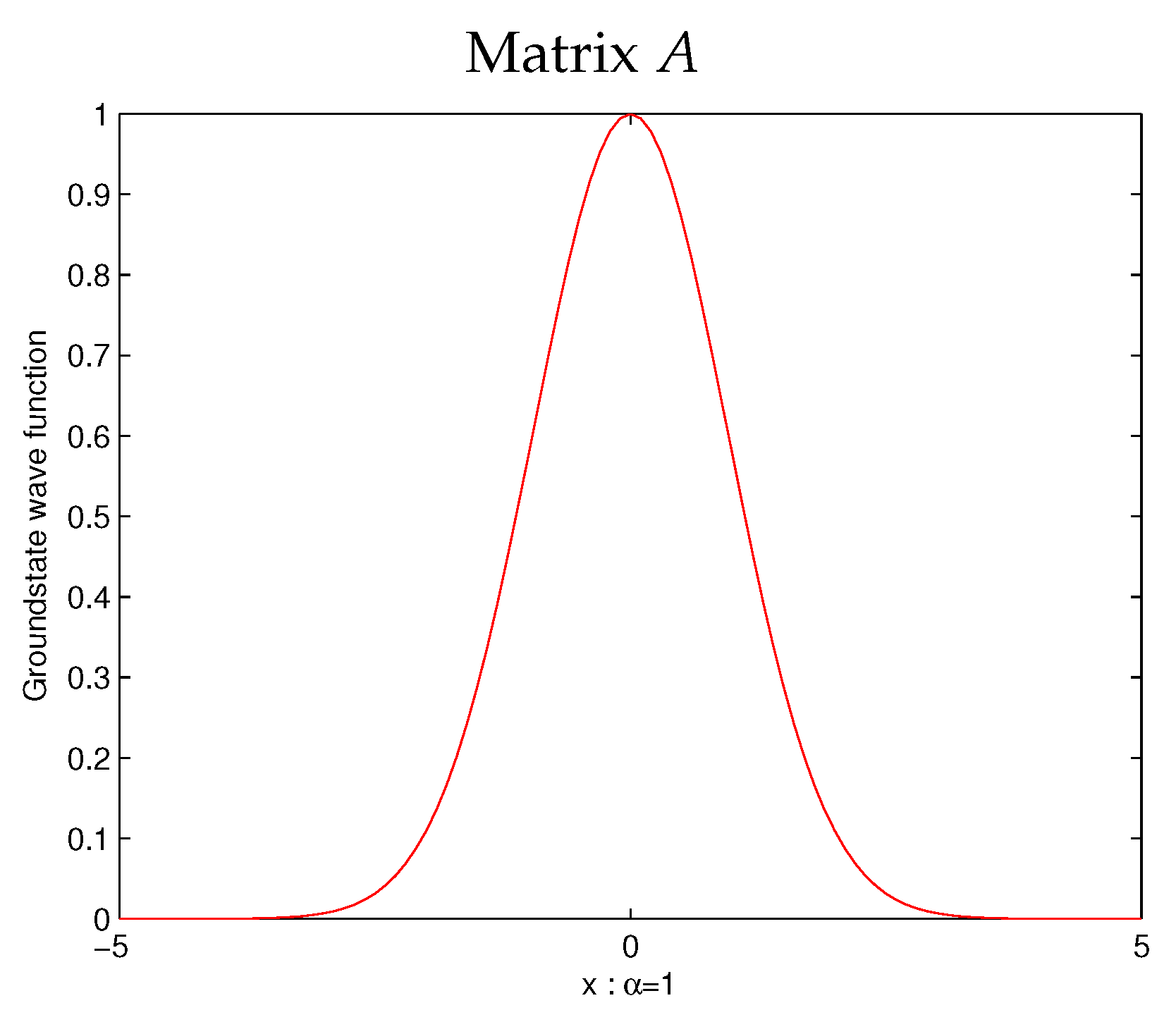
For the interested reader, we present the ground state wave function for α = 1 in Figure 1.
Figure 1. Ground state wave function for α = 1 (Equation (9)).
In the above, we present a simple model of a T-symmetry operator using the coordinate space. However, in terms of a matrix, the above analysis can be reflected as follows.

2.2. Real Non-Hermitian Matrix Having Real Eigenvalues

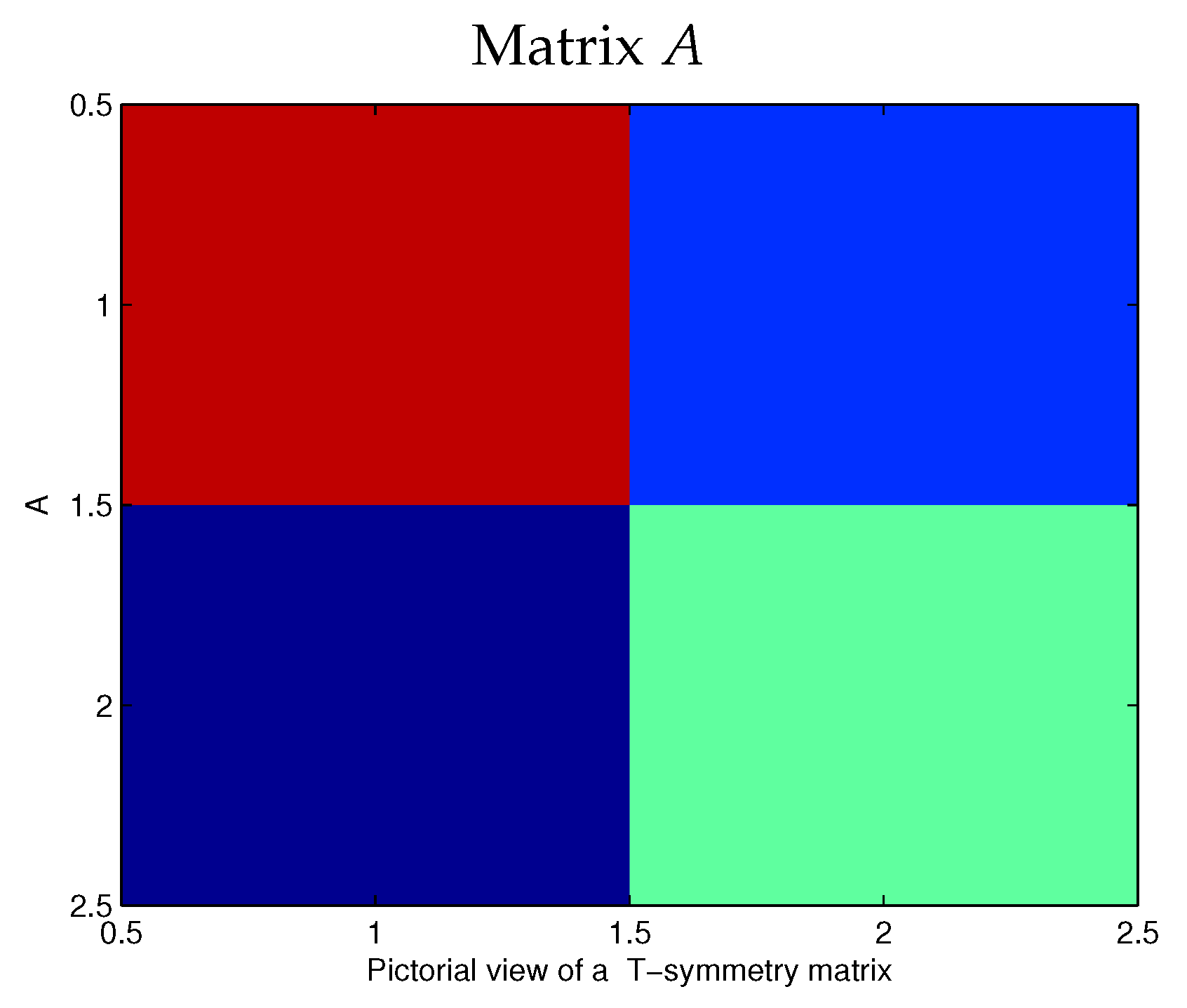
Here, we present a model (2 × 2) matrix reflecting the non-hermiticity character satisfying the condition as H H . It should be kept in mind that the present non-Hermitian matrix is nothing but a T-symmetry Hamiltonian in a matrix representation [4]. Here, we present a (2 × 2) matrix as
A = 60 11 11 30
with eigenvalues λ 1 = 55.1980 and λ 2 = 34.8020 . The above-suggested matrix can also be presented pictorially, as in Figure 2.
Figure 2. Pictorial view of the T-symmetry matrix.

3. Momentum Transformation in Complex Space: Quartic Operator

Consider the transformation,
e f ( x ) p e f ( x ) = p + i d f ( x ) d x
If f ( x ) is an odd function of x, then the said Hamiltonian is T-symmetry. However, for an even function, the Hamiltonian is generally P T -symmetry in nature [5].

3.1. Invariance in Commutation Relation

Under the above transformation, the commutation relation between the coordinate and momentum remains invariant. Mathematically,
[ x , p ] = i
[ x , p + i d f d x ] = [ x , p ] + [ x , d f d x ] = [ x , p ] = i
Let us consider that f ( x ) = λ x 3 and λ = 1 / 3 . Now, we consider the quartic anharmonic oscillator Hamiltonian as
H = p 2 + β x 4

3.2. Hamiltonian on Momentum Transformation

Here, we transform the momentum as p p + i x 2 and use the same in hamiltonian H. After transformation, the resulting Hamiltonian is written as
H = p 2 + i x 2 p + i p x 2 + ( β 1 ) x 4
On selecting β = 2 , we have
H = p 2 + i x 2 p + i p x 2 + x 4
It is seen that in the above equation, i p and x 2 are in a mixed form. The term x 2 can be separated from i p using the mean field approximation [6] as
H = p 2 + i < x 2 > p + i p < x 2 > + x 4
After the mean field approximation, the equation becomes nonlinear in nature [6]. Here, < x 2 > means ψ * x 2 ψ d x .
Instead of a complex space transformation, one can have a real space transformation as p p + x 2
H = p 2 + x 2 p + p x 2 + 3 x 4
However, considering the T-symmetry operator, we present the first 10 energy levels of
H = p 2 + < x 2 > p + p < x 2 > + x 4
and make a possible comparison. Interestingly, we find that the energy levels of the T-symmetry operator are higher compared to its Hermitian counterpart. In fact, both of the two are strongly nonlinear. Using the matrix diagonalization method [2], we present the first ten energy levels in Table 3, as given below.
Table 3. First ten energy levels of T-symmetry and Hermiticity operators.

4. Nonlinear Sextic Hamiltonian with Quadratic Nonlinearity

Now, we consider the Hamiltonian as
H = p 2 + i < x 2 > p + i p < x 2 > + x 6 x 4
Using the matrix diagonalization method [2], we present the first ten energy levels in Table 4, as given below.
Table 4. First, the ten energy levels of the T-symmetry sextic nonlinear operator (Equation (19)).

5. Nonlinear Octic Hamiltonian with Quadratic Nonlinearity

Now, we consider the Hamiltonian as
H = p 2 + i < x 2 > p + i p < x 2 > + x 8 x 4
Using the matrix diagonalization method [2], we present the first ten energy levels in Table 5 as given below.
Table 5. First ten energy levels of the T-symmetry octic nonlinear operator (Equation (20)).

6. Nonlinear Quartic, Octic Hamiltonian with Quartic Nonlinearity

Now, we consider the Hamiltonian as
H = p 2 + i < x 4 > p + i p < x 4 > + x 8
Using the matrix diagonalization method [6], we present the first ten energy levels in Table 6, as given below.
Table 6. Energy levels of T-symmetry octic with a quartic nonlinear operator (Equation (21)).

7. Nonlinear Singular Model Nonlinearity in Quartic Operator

In the above models, we have considered non-singular models. Here, we focus our attention on a singular model quartic operator as
H = p 2 + i < 1 x 2 > p + i p < 1 x 2 > + x 4
Using the matrix diagonalization method [2], we present the first ten energy levels in Table 7, as given below.
Table 7. Energy levels of T-symmetry singular model quartic operator (Equation (22)).

8. Method of Calculation

Here, we use the matrix diagonalization method to solve the eigenvalue relation
H | Φ > = E | Φ >
where
| Φ > = A m | m >
in which | m > satisfies the eigenvalue relation [2]
[ p 2 + x 2 ] | m > = ( 2 m + 1 ) | m >
with m = 0 , 1 , 2 , 3 , 4
Below, we present matrix elements using the above method. The numerical matrix element of (4 × 4) matrix is given below (Equation (17))
H ( 4 × 4 ) = 5 / 4 1694 / 1977 1393 / 985 0 1694 / 1977 21 / 4 1482 / 1223 4801 / 980 1393 / 985 1482 / 1223 49 / 4 981 / 661 0 4801 / 980 981 / 661 69 / 4
Interested readers can check the diagonal element from the relation
H n , n = 1.25 + 3.5 n + 1.5 n 2

9. Conclusions

In this paper, we present a model of a nonlinear quartic, sextic and oscillator with singular as well as non-singular models satisfying a T-symmetry condition under a mean field approximation [6]. The models are unbroken in nature. However, if T-symmetry is incorrectly selected, it may give complex spectra (see Equation (7)). In other words, real spectra in quantum operators are not only confined to Hermiticity, PT-symmetry but also to T-symmetry. It should be kept in mind that the suggested models can be extended to fractional operators also. As the topic of T-symmetry is not yet an industry, we found minimal literature on it. We believe one can propose hybrid models as
H = p 2 + x 2 + i < x 2 > p + i p < x 2 > + x 2 < x 2 > + x 2 < x 4 >
and many more.

Author Contributions

B.R.: conceptualization, computation, writing, finalization. J.A.: analysis, computation, writing, finance. H.S.: analysis, computation, writing, finance. R.J.: analysis, computation, writing, finance. R.W.: computation, writing, finance. All authors have read and agreed to the published version of the manuscript.

Funding

This research receives Fund from the Palestine Technical University, Kadoorie, Scientific Research 2023.

Data Availability Statement

Authors declare no additional data are required.

Acknowledgments

The authors gratefully thank all three referees for their comments in improving the manuscript to its present form. Authors Jihad Asad, Hussein Shanak, Rabab Jarrar and Rania Wannan generously thank Palestine Technical University-Kadoorie for financial support.

Conflicts of Interest

The authors declare no conflict of interest.

References

  1. Bender, C.M.; Boettecher, S. Real spectra in non-Hermitian Hamiltonians having PT-symmetry. Phys. Rev. Lett. 1997, 24, 5243–5256. [Google Scholar]
  2. Rath, B. Real spectra in some negative potentials:linear and non-linear one-dimensional PT-invariant quantum systems. Eur. J. Phys. Plus 2021, 136, 493. [Google Scholar] [CrossRef]
  3. Hatano, N.; Nelson, D.R. Localization Transition in non-Hermitian Quantum Mechanics. Phys. Rev. Lett. 1996, 96, 570–572. [Google Scholar] [CrossRef]
  4. Rath, B.; Mallick, P.; Mohapatra, P. A new non-Hermitian quadratic operator having exact solution. Acta Phys. Pol. B 2020, 51, 2189–2194. [Google Scholar] [CrossRef]
  5. Ahmed, Z. Pseudo-Hermiticity of Hamiltonians under imaginary shift of the coordinate real spectrum of complex potentials. Phys. Lett. 2001, A290, 19–22. [Google Scholar] [CrossRef]
  6. Cioslowski, J. Connected moments expansions for the ground-state energy of systems described by nonlinear Hamiltonians. Phys. Rev. 1987, A36, 374–376. [Google Scholar] [CrossRef]
Disclaimer/Publisher’s Note: The statements, opinions and data contained in all publications are solely those of the individual author(s) and contributor(s) and not of MDPI and/or the editor(s). MDPI and/or the editor(s) disclaim responsibility for any injury to people or property resulting from any ideas, methods, instructions or products referred to in the content.

Article Metrics

Citations

Article Access Statistics

Multiple requests from the same IP address are counted as one view.