Abstract
Let G be a graph with a given red-blue coloring c of the edges of G. An ascending Ramsey sequence in G with respect to c is a sequence , , …, of pairwise edge-disjoint subgraphs of G such that each subgraph () is monochromatic and is isomorphic to a proper subgraph of (). The ascending Ramsey index of G with respect to c is the maximum length of an ascending Ramsey sequence in G with respect to c. The ascending Ramsey index of G is the minimum value of among all red-blue colorings c of G. It is shown that there is a connection between this concept and set partitions. The ascending Ramsey index is investigated for some classes of highly symmetric graphs such as complete graphs, matchings, stars, graphs consisting of a matching and a star, and certain double stars.
Keywords:
(red-blue) edge coloring; Ramsey number; ascending Ramsey sequence; ascending Ramsey index MSC:
05C15; 05C35; 05C55; 05C70
1. Introduction
One of the major topics in graph theory involving edge colorings takes place in Ramsey theory where typically for each red-blue edge coloring of a given graph, one of two prescribed monochromatic subgraphs occur. Here, our goal is to determine, for each red-blue edge coloring of certain graphs, the existence of a maximum number of monochromatic pairwise edge-disjoint subgraphs satisfying conditions that were initially specified in what is now a well-known conjecture addressing graph decompositions. In order to present a solution to this problem for two particular classes of graphs, we first consider a question involving sets and then apply the symmetry of the resulting concepts.
Let S be a set such that for some integer . Since , the set S can be partitioned into k subsets such that for . Now, suppose that we are given a partition of S into two subsets. A question here is the following:
Is there also a partition of S into k subsets such that for with the added property that either or for each integer i with ?
We show that this question has an affirmative answer. This is obvious if , in which case . Let us assume such is the case for every set T with elements and every partition of T. Let S be a set such that and let be an arbitrary partition of S into two subsets. Since , it follows that and so . Consequently, in any partition of S into two subsets and , at least one of these two sets contains at least elements. We may assume that contains a subset of elements. Let . Thus, .
We now partition the set into two subsets and . By the induction hypothesis, contains k pairwise disjoint subsets such that for and either or for each integer i with . Therefore, for the partition of S into two subsets, there are pairwise disjoint subsets of S such that for where either or for each integer i with .
If S is a set such that for some integer , then there is an integer such that . By the discussion above, the following observation can now be made.
Let S be a set with such that for some integer and let be a partition of S into two subsets. Then, there exist k pairwise disjoint subsets of S such that for and either or for each integer i with .
From this, a more general question arises.
Let S be a set with where for some integer such that there is some prescribed structure among the elements of S. If is a partition of S into two subsets, do there exist k pairwise disjoint subsets of S such that (1) for , (2) either or for each integer i with , and (3) for each integer i with , there is a substructure of elements of identical with that of ? If there exists no such k subsets of S with these properties, then what is the maximum number of pairwise disjoint subsets of S having all three properties?
In order to investigate this problem, we turn to the area of graph theory.
2. Ascending Subgraph Sequences
A popular area of study in graph theory is graph decompositions. One problem in this area involves determining graphs that can be decomposed into subgraphs, every two of which are isomorphic, referred to as isomorphic decompositions. For example, it is well known that every complete graph of odd order 3 or more can be decomposed into Hamiltonian cycles and every complete graph of even order as well as every regular bipartite graph can be decomposed into perfect matchings.
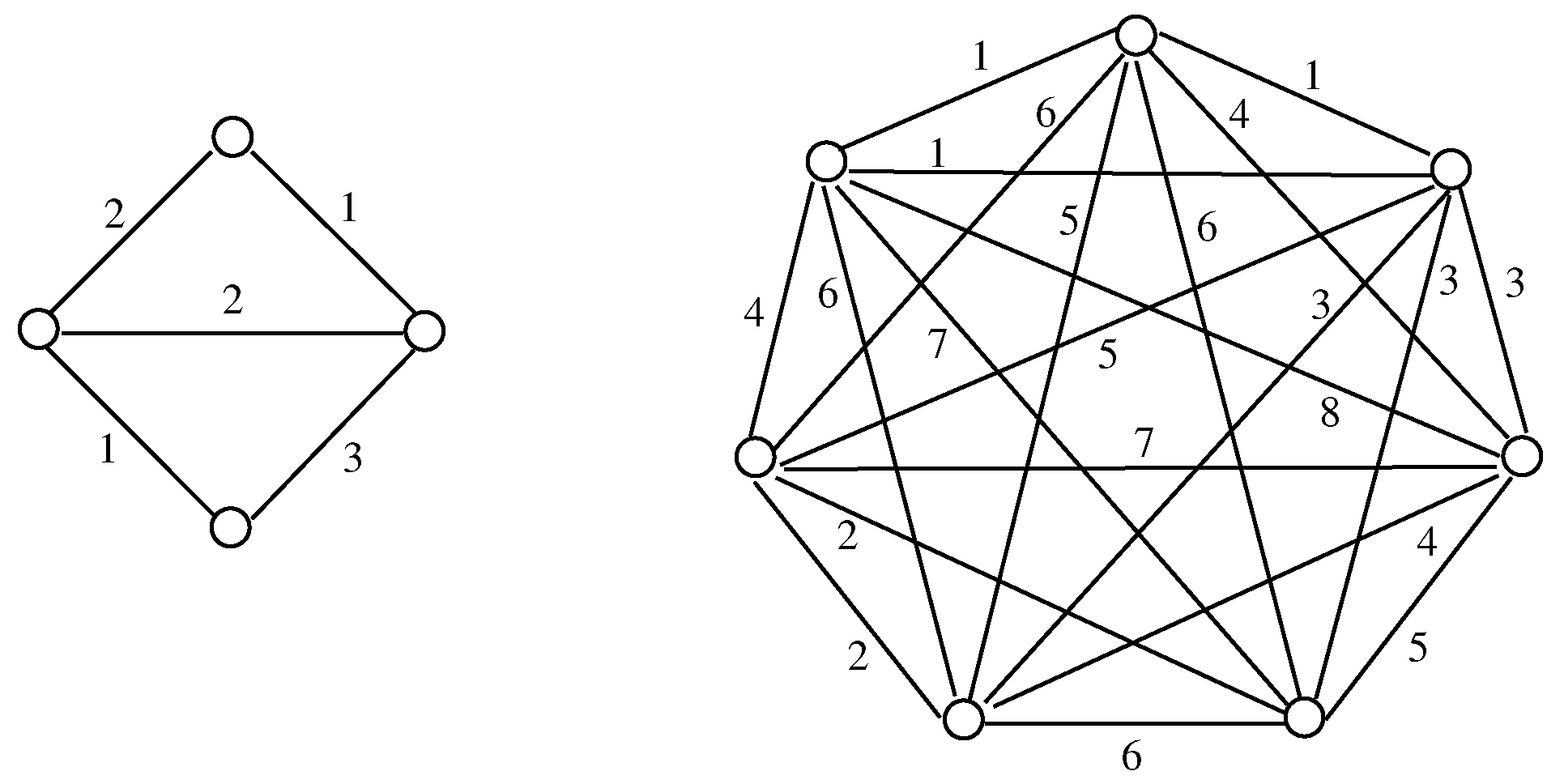
In [1], the question was posed for a graph G of determining the maximum number of subgraphs (without isolated vertices) of G into which G can be decomposed where no two subgraphs are isomorphic. One way to look at this problem is the following. For a positive integer k, let be a labeling of the edges of G such that each label in is assigned to at least one edge of G. For , let be the subgraph of G induced by the edges labeled i. What is the maximum positive integer k of such a labeling for which for every pair of integers? The maximum such positive integer k is referred to as the irregular decomposition index of the graph G. For example, the irregular decomposition indices of the graphs and in Figure 1 are 3 and 8, respectively. The three subgraphs in the decomposition of G are , , and , while the eight subgraphs in the decomposition of H are , , , , , , , and . In fact, G and H are the unique graphs of smallest order and smallest size having irregular decomposition indices of 3 and 8, respectively.
Figure 1.
Irregular decompositions of and .
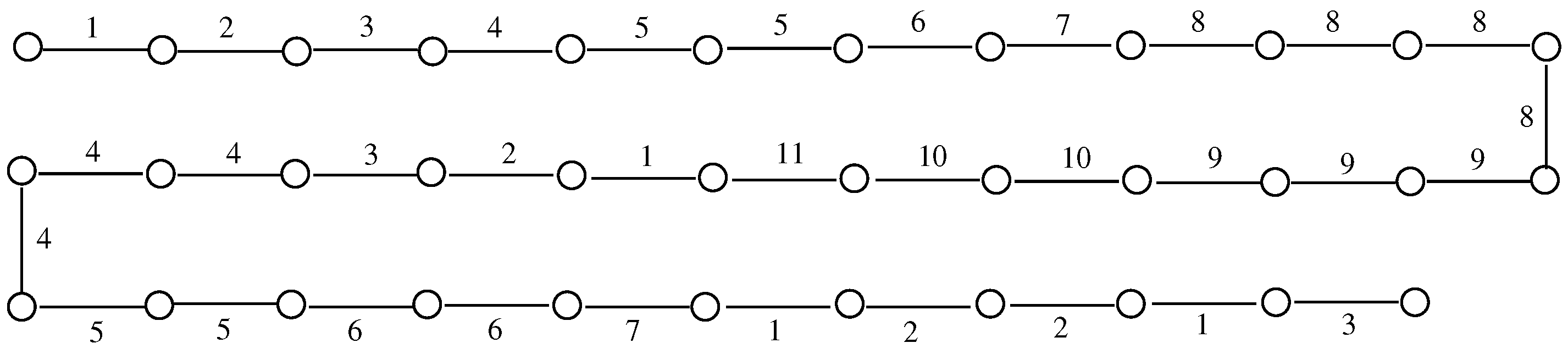
The path of order 35 and size 34 has an irregular decomposition index of 11, as does the cycle . No path or cycle of smaller order has an irregular decomposition index of 11. The eleven subgraphs in the decomposition of are , , , , , , , , , , and . An irregular decomposition of , where for , can be obtained from the decomposition of by identifying the two end-vertices of in Figure 2.
Figure 2.
An irregular decomposition of .
The question posed in [1] led to another concept introduced in [1]. A sequence , , …, of subgraphs (all without isolated vertices) of a graph G (without isolated vertices) is an ascending subgraph sequence in G if is isomorphic to a proper subgraph of for . If {, , …, } is also a decomposition of G, then this is an ascending subgraph decomposition of G. If G has size m, then for some positive integer k and k is the maximum possible length of an ascending subgraph sequence in G. Furthermore, if G has an ascending subgraph sequence of length k, then there is such a sequence , , …, where has size i for . The following conjecture was stated in [2].
Conjecture 1
(The Ascending Subgraph Decomposition Conjecture). Every graph has an ascending subgraph decomposition.
Upon learning the statement of this conjecture, the famous mathematician Paul Erdős doubted its truth and immediately offered USD 5 for a counterexample. He then participated in a study of the conjecture (see [2]). This conjecture remains unresolved today. Information on this conjecture is presented in [3,4].
3. Ascending Ramsey Sequences
We now change the topic briefly. A well-known area in graph theory is Ramsey theory and one of the most familiar concepts in this theory is Ramsey numbers. In a red-blue coloring of a graph G, every edge of G is colored red or blue. For two graphs F and H (without isolated vertices), the Ramsey number is the minimum positive integer n such that for every red-blue coloring of the complete graph of order n, there is either a subgraph of isomorphic to F all edges of which are colored red (a red F) or a subgraph of isomorphic to H all edges of which are colored blue (a blue H). It is a consequence of a theorem of Ramsey [5] that the number exists for every two graphs F and H. If , then is the minimum positive integer n such that every red-blue coloring of results in a monochromatic F. If F and H are both complete graphs, then is called a classical Ramsey number. For example, it is well known that , , and are unknown. Not only does every red-blue coloring of produce a monochromatic , every red-blue coloring of produces at least two monochromatic subgraphs . Additional information involving edge colorings and Ramsey numbers is presented in [6,7,8,9], for example.
In [1], a concept was introduced that deals with both ascending subgraph sequences and monochromatic subgraphs resulting from red-blue colorings of the edges of a graph. Let G be a graph (without isolated vertices) of size m with a red-blue coloring c of G. An ascending subgraph sequence , , …, of subgraphs of G is an ascending Ramsey sequence (with respect to c) in G if each subgraph () in the sequence is monochromatic. The ascending Ramsey index of G with respect to c is the maximum length of an ascending Ramsey sequence of G. The ascending Ramsey index of G itself is
This number exists for every graph without isolated vertices. Since for a unique positive integer k, it follows that . It was shown in [1] that . The ascending Ramsey index of certain matchings and stars were determined in [1] as well.
Theorem 1.
For each positive integer n, .
The goal here is to investigate the ascending Ramsey index in more detail for some classes of highly symmetric graphs such as complete graphs, matchings, stars, and graphs consisting of a matching and a star. In order to illustrate a technique used to determine the value of the ascending Ramsey index of a graph, we also present results on double stars (trees of diameter 3) in which only one vertex has degree greater than 3. To prove for a graph G without isolated vertices that the ascending Ramsey index of G has the value ℓ, say, it is required to show that (1) every red-blue coloring of G results in an ascending Ramsey sequence of ℓ subgraphs of G where has size i for and (2) there exists some red-blue coloring of G such that no such sequence of subgraphs exists.
4. Complete Graphs
If G is a graph of size for some positive integer k, then, as we mentioned, . In fact, if , then G not only has an ascending sequence of length k, it has an ascending Ramsey sequence of length k for every red-blue coloring of G. Perhaps the best known class of graphs possessing such a size is that of complete graphs which have a size . Since can be decomposed into stars for , these graphs have an ascending sequence of length . This brings up the problem of determining the value of . Clearly, . We mentioned that it was shown in [1] that . We show that when as well.
Theorem 2.
.
Proof.
Since the size of is 10, it suffices to show that every red-blue coloring of results in an ascending Ramsey sequence of length 4 in G. If the edges of G are assigned the same color, then the statement is immediate since the decomposition of G into the stars () form an ascending Ramsey sequence of G. Hence, we may assume that there is at least one edge of each color. We may further assume that the number of red edges in a red-blue coloring of G is at most the number of blue edges. Let r be the number of red edges in a red-blue coloring of G. Thus, . Let be the red subgraph in a red-blue coloring of G. Again, since G can be decomposed into stars, as described above, it follows that if is a star, then there is an ascending Ramsey sequence of size 4 in G. Hence, we only need to address the situation where in any red-blue coloring of G, the subgraph is not a star and . We consider these four possibilities. Let .
Case 1. . Then, , say . Let , , where and , and let . Then, is an ascending Ramsey sequence of G.
Case 2. . Then . We construct an ascending Ramsey sequence of G by considering three subcases.
Subcase . , say . Let , , , and let (a graph obtained by adding a pendant edge at a vertex of ) with = {, , , }.
Subcase . , say . Let , , , and let .
Case 3. . Then, , where is the double star whose central vertices have degrees of 2 and 3. We construct an ascending Ramsey sequence of G by considering five subcases.
Subcase . . The result follows from Subcase 2.1 by letting . That is, let , , , and let with = {, , , }.
Subcase . . The result follows from Subcase 2.3 by letting . That is, , , , and let .
Subcase . , say . Let , , , and let .
Subcase . , say . Let , , with , and let .
Case 4. . Then , where is the graph obtained by adding a pendant edge at two vertices of , is the graph obtained adding a pendant path at a vertex of , and is the graph obtained adding two pendant edges at a vertex of . We construct an ascending Ramsey sequence of G by considering six subcases.
Subcase . , say . Let , , , and let .
Subcase . , say and . Let , , with , and let with .
Subcase . , say . Let , , , and let .
Subcase . , say . Let , , , and let with . □
While it can be shown that using an extensive a case-by-case analysis, whether when is not known.
5. Matchings and Stars
Next, we determine the value of the ascending Ramsey index for the matching for every positive integer m. First, we make an observation.
Observation 1.
If H and G are graphs without isolated vertices such that , then .
Theorem 3.
Let m be a positive integer. If n is the integer such that , then .
Proof.
Let . Since , there exists no ascending subgraph sequence of length in G. Thus, there is no red-blue coloring of G that produces an ascending Ramsey sequence of length . So, . Let there be given a red-blue coloring of G.
- 🟉
- If , then let .
- 🟉
- If , then let .
Since , it follows by Theorem 1 and Observation 1 that . □
The following is a consequence of Theorem 3.
Corollary 1.
If for some positive integer m, then
Proof.
Let where n is the largest integer for which . By Theorem 3, it follows that . Thus, and so □
We mentioned that it was shown in [1] that . We now determine the ascending Ramsey index of a graph consisting of a matching of any size and a star of any size, namely the graph where . Since , we may assume that .
Theorem 4.
For integers and ,
Proof.
Let . We consider three cases, according to whether (1) , (2) or (3) .
Case 1. . Let ℓ be the largest integer such that . Then, by Theorem 3. We show that . Since , it follows that . Next, we show that there is a red-blue coloring of G for which there is no ascending Ramsey sequence of length . Let c be the red-blue coloring of G such that and . We show that . Let us assume, to the contrary, that there is an ascending Ramsey sequence of length in G. Then, and . If , then each () is a red matching; while if , then each () is a blue star. Hence,
and so , which contradicts the choice of ℓ. Thus, and so . Therefore, if .
Case 2. . Let ℓ be the largest integer such that . Then, by Theorem 3. We show that . Since , it follows that . Next, we show that there is a red-blue coloring of G for which there is no ascending Ramsey sequence of length . Let c be the red-blue coloring of G such that and . We show that . Let us assume, to the contrary, that there is an ascending Ramsey sequence of length in G. Then, and . If , then each () is a red matching. Since
it follows that , which contradicts the choice of ℓ. Thus, and so each () is a blue star. Hence,
and so , which contradicts the choice of ℓ. Thus, and so . Therefore, if .
Case 3. . Let ℓ be the largest integer such that . Then, by Theorem 3. We show that . First, we show that . Let c be the red-blue coloring of G such that and . We show that . Let with , where and where the edges of H are colored the same as in G. Since , there is an ascending Ramsey sequence of length ℓ in H, where for . If the edge e belongs to some subgraph in this sequence, then since e is the only red edge in this red-blue coloring of H. In any case, this sequence is also an ascending Ramsey sequence of length ℓ in G. Thus, . It remains to show that . Let us assume, to the contrary, that there is an ascending Ramsey sequence of length in G. Then, . If , then each () is a red matching in . Thus,
and so . On the other hand, if , then each () is a blue star in . Thus,
Hence, the maximum possible length of an ascending Ramsey sequence in G with the red-blue coloring c is the largest integer ℓ such that , which contradicts the defining property of ℓ. Therefore, and so . This implies that .
To show that , it is required to show that for every red-blue coloring distinct from c, there is an ascending Ramsey sequence of length ℓ in G. Thus, let be a red-blue coloring of G distinct from c. In this coloring, there are edges and that are colored the same, say red. Let be another edge in , where then . The edge may be colored red or blue. Let where and where the edges of F are colored the same as in G. Since by Theorem 3, there is an ascending Ramsey sequence of length ℓ in F, where for . If f and do not belong to the same subgraph in the sequence, then this sequence is also an ascending Ramsey sequence in G.
Thus, we may assume that f and belong to the same subgraph in the sequence where then . Since f is red and is monochromatic, the edge is also red. If the edge e belongs to no subgraph in this sequence, then we can replace by e, obtaining a new red matching of size j. Then, is an ascending Ramsey sequence of length ℓ in G. Therefore, we may assume that e belongs to a subgraph in the sequence, where . If , then we may interchange the edges e and in and , obtaining new red matchings and , where the resulting sequence is an ascending Ramsey sequence of length ℓ in G.
Therefore, we may assume that where then . Therefore, and are two distinct matchings in the sequence. If either of and is red, then we may interchange a red edge in one of them with the edge in to produce an ascending Ramsey sequence of length ℓ in G, where no matching contains both f and . Hence, we may assume that and are both blue matchings. Let be the blue matching where . Let be a red matching where and let be a red matching where . Then, is an ascending Ramsey sequence of length ℓ in G. Therefore, and so . Thus, . □
6. Double Stars
We saw in Theorem 3 that for the positive integer n with . The stars are those trees of diameter 2 (where only one vertex has degree greater than 1). We now turn to another well-known class of trees, namely the double stars. A double star is a tree of diameter 3. For integers a and b with , let denote the double star of order and size whose central vertices u and v have degrees a and b, respectively. In order to illustrate a technique that can be used to determine the value of the ascending Ramsey index of graphs, we present results giving the values of for all and for all . We begin with a general result on for all integers a and b with .
Proposition 1.
For integers a and b with , let be the double star of size . If k is the integer such that , then .
Proof.
Let where . Since , there exists no ascending subgraph sequence of length in G. Thus, there is no red-blue coloring of G that produces an ascending Ramsey sequence of length . Hence, . On the other hand, since and for each integer , it follows by Observation 1 and Theorem 3 that . Therefore, . □
For the double star of size , it is evident that for . Thus, we may assume that . If k is the integer such that
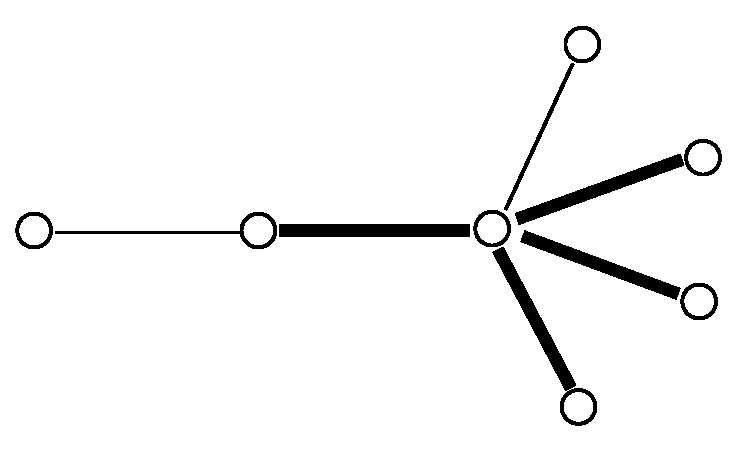
Figure 3.
A red-blue coloring of .
Proposition 2.
If for some integer k, then .
Proof.
Let where . Thus, the size of G is . Since and , it follows by Observation 1 and Theorem 3 that . It remains to show that . That is, it is necessary to show that there is a red-blue coloring of G for which there is no ascending Ramsey sequence of length k. Let u and v be the central vertices of G where u is adjacent to the end-vertex w as well as v, and v is adjacent to the end-vertices . Define the red-blue coloring c of G that assigns the color blue to and and the color red to the remaining edges of G. This coloring is shown in Figure 3 for where a solid edge indicates a red edge and a thin edge indicates a blue edge. Thus, and . Let us assume, to the contrary, that there exists an ascending Ramsey sequence of length k with respect to the red-blue coloring c of G. Since the size of G is , it follows that is a decomposition of G. Thus, , and for . However, then, , which is impossible. Therefore, and so . □
Next, we consider the situation where and so .
Proposition 3.
If for some integer k, then .
Proof.
Let where . Since the size of G is , it follows that . Next, we show that there is an ascending Ramsey sequence of length k for every red-blue coloring of G. Let u and v be the central vertices of G where w is the end-vertex of G that is adjacent to u and are the end-vertices of G adjacent to v. Let c be a red-blue coloring of G and let . Since , it follows by Observation 1 and Theorem 3 that there is an ascending Ramsey sequence of length k in , which is also an ascending Ramsey sequence of length k in G. Thus, and so . □
With the aid of Propositions 1–3, we are now able to present necessary and sufficient conditions on the values of b for which for each integer .
Corollary 2.
Let . Then if and only if
We now turn our attention to the double stars of size . It can be shown that and . Thus, we assume that . If k is the integer such that
Proposition 4.
If for some integer k, then .
Proof.
Let u and v be the central vertices of where u is adjacent to the two end-vertices and and v is adjacent to the end-vertices . Let us define the red-blue coloring c of G that assigns the color blue to and and the color red to the remaining edges of G. Thus, and . We claim that there is no ascending Ramsey sequence of length k with respect to this red-blue coloring c of G. Let us assume, to the contrary, that there exists such a sequence. Since the size of G is , it follows that is a decomposition of G, where and . Then, and .
- 🟉
- If , then and so is a star. Thus, is star. Since , this is a contradiction.
- 🟉
- If , then and so is a star. Thus, is a star. Since , this is a contradiction.
Therefore, . Next, we show that . Since and , it follows by Observation 1 and Theorem 3 that . Thus, . □
Next, we consider the situation where and so for some integer k. Since , it follows that and so .
Theorem 5.
If for some integer k, then .
Proof.
Let where . The size of is . Since and , it follows by Observation 1 and Proposition 2 that . Let with central vertices u and v, where u is adjacent to the two end-vertices and and v is adjacent to the end-vertices . Let , , , and for . We show that . Thus, it is necessary to show that for every red-blue coloring of G, there is an ascending Ramsey sequence of length k in G. Let c be a red-blue coloring of G. We may assume that g is colored red.
Let be the star whose central vertex v is adjacent to the end-vertices u, , , , , …, , where the edges of F are denoted by , , , and for . Let the edges of F be colored the same as these edges of G, producing a red-blue coloring c of F. Since , it follows by Theorem 3 that . Thus, there is an ascending Ramsey sequence of length k in F. Let and . If there is no subgraph in this sequence that contains both an edge in X and an edge in Y, then this sequence is also an ascending Ramsey sequence in G. Thus, we may assume that there is at least one subgraph in this sequence that contains at least one edge in X and at least one edge in Y. There are two possibilities, namely
- (1)
- Both and appear in every ascending Ramsey sequence of length k in F;
- (2)
- One of and does not appear in some ascending Ramsey sequences of length k in F.
We consider these two cases.
Case 1. Both and appear in every ascending Ramsey sequence of length k in F. Let be an ascending Ramsey sequence of length k in F. Let denote the color of for . Necessarily, for . Then, (i) both and appear in this sequence and (ii) there is an edge e in that does not appear in this sequence. We refer to this edge e as the missing edge of the sequence. Our goal here is to replace each in G by a new subgraph in G (where possibly in such a way to produce an ascending Ramsey sequence of length k in G. We now make three observations.
- (A)
- If or , say the former, then we can interchange e and to produce a new ascending Ramsey sequence of length k in F that does not contain , which is impossible in this case. Thus, for and so .
- (B)
- If , or , or , then this sequence is also an ascending Ramsey sequence in G. Therefore, we can assume that
- (C)
- If where and , then we can interchange and to produce and in G. Therefore, we can assume that .
We consider two subcases, according to whether and belong to the same subgraph in the sequence or and belong to two different subgraphs in the sequence.
Subcase . where . Thus, by (A) and (C). We consider two possibilities here according to whether or .
Subcase . . We may assume that by (B), where .
- 🟉
- First, suppose that the missing edge . Since g is red, it follows by (A) that is red and is blue. We construct in G with and in G with .
- 🟉
- Next, suppose that the missing edge . First, let us suppose that is red. Since the red edge g appears in this sequence, say where , we can interchange g and to produce , , and an ascending Ramsey sequence of length k in G. Next, suppose that is blue. Therefore, and are red. Then, we construct in G with , in G with , and in G with . Thus, in this situation as well, there is an ascending Ramsey sequence of length k in G.
Subcase . for some . Thus, where with . Let be the missing edge. Then, by (A) and (B). We may now assume that is blue and is red (since the proof for the situation when is red and is blue is the same by interchanging red and blue).
- 🟉
- First, suppose that is red. Let q be the largest integer in such that is blue. Since is red, it follows that is red. Let . We define in G with , in G with , in G with , and in G with .
- 🟉
- Next, suppose that is blue.
- ⚬
- If is blue, then we define in G with , in G with , in G with . Thus, we may assume that is red. Thus, .
- ⚬
- If is blue, then we define in G with , in G with where , in G with . Here, z is the missing edge. Thus, we may assume that is red. Thus, .
Let q be the largest integer in such that is blue. Since is red, it follows that is red. Let . We define in G with , in G with , in G with , and in G with . The edge e remains the missing edge.
Thus, there is an ascending Ramsey sequence of length k in G where for .
Subcase . and where . Thus, . If , say , then we can interchange and to produce in G with and in G with . Thus, we can assume that and so or . We consider these two subcases.
Subcase . . Then, . If , then where . Since , we can interchange h and to produce in G with and in G with . Thus, we may assume that where . Since , we may further assume that e is red and is blue (since the proof for the situation where e is blue and is red is the same by interchanging red and blue).
- 🟉
- First, suppose that is blue with . Define with , in G with , and in G with .
- 🟉
- Next, let us suppose that is red. Let q be the largest integer in such that is red. If , then we define in G with and in G with . If , then is blue. Let us define in G with , in G with where , and in G with .
Subcase . . First, we make an observation.
- (D)
- If , say , then we can define in G with , in G with , and in G with . Thus, we can assume that and so .
- 🟉
- If , say or , then we define in G with and in G with , producing an ascending Ramsey sequence of length k in G.
- 🟉
- If where , then we construct a new ascending Ramsey sequence , , …, of length k in F by defining with where , with , and if and . Thus, where . The argument used in Subcase 1.1.2 shows that there is an ascending Ramsey sequence of length k in G.
Case 2. One of and does not appear in some ascending Ramsey sequence of length k in F. Let be an ascending Ramsey sequence of length k in F where for such that one of and does not appear in this sequence, say is the missing edge and where . First, we make two observations.
- (E)
- If or , then this sequence is also an ascending Ramsey sequence of length k in G. Thus, we may assume that and .
- (F)
- If where and , then we can interchange z and to produce an ascending Ramsey sequence of length k in G. Thus, we may assume that .
We consider two cases, according to whether or .
Subcase . . Since where , there is . We interchange z and to define in G such that and z is the missing edge. We now consider the ascending Ramsey sequence in F where for and . We may assume that , , and (for otherwise, is also an ascending Ramsey sequence in G). Thus, . If , then we can interchange and to produce an ascending Ramsey sequence of length k in G. Thus, we may assume that . Hence, by (F).
- 🟉
- First, let us suppose that . Let where . Since , we can define with , with , and with , producing an ascending Ramsey sequence of length k in G where for .
- 🟉
- Next, let us suppose that . Let us recall that where z is the missing edge. Let . We now interchange e and z such that and e is the missing edge in the new ascending Ramsey sequence of length k in G where for . Hence, where and (which are the conditions in the proof of Subcase 1.1.2). Therefore, the argument used in Subcase 1.1.2 shows that there is an ascending Ramsey sequence of length k in G.
Subcase . . Since where and by (E) and (F), it follows that .
- 🟉
- First, let us suppose that . Then, where by (E). Let where . If , then we can define and in G with . Thus, we may assume that and so . If , then we can define with , , and is the missing edge. If where , then we can define , , , and is the missing edge.
- 🟉
- Next, suppose that . We may assume that is blue and is red (since the proof for the situation when is red and is blue is the same by interchanging red and blue). Let us recall that is blue and is red. Let be the maximum integer such that is blue. Thus, is red where possibly . Let . We now define with , with , with , and with .
□
Therefore, there is an an ascending Ramsey sequence of length k in G in Subcase .
The following is a consequence of Propositions 1 and 4 and Theorem 5.
Corollary 3.
Let be an integer such that for some integer k.
- 🟉
- If , then .
- 🟉
- If , then .
Author Contributions
These authors contributed equally. All authors have read and agreed to the published version of the manuscript.
Funding
This research received no external funding.
Data Availability Statement
Not applicable.
Acknowledgments
We thank the anonymous referees whose valuable suggestions resulted in an improved paper.
Conflicts of Interest
The authors declare no conflict of interest.
References
- Ali, A.; Chartrand, G.; Zhang, P. Irregularity in Graphs; Springer: New York, NY, USA, 2021. [Google Scholar]
- Alavi, Y.; Boals, A.J.; Chartrand, G.; Erdos, P.; Oellermann, O.R. The ascending subgraph decomposition problem. Congr. Numer. 1987, 58, 7–14. [Google Scholar]
- Cao, Y.; Chen, G.; Jing, G.; Stiebitz, M.; Toft, B. Graph edge coloring: A survey. Graphs Combin. 2019, 35, 33–66. [Google Scholar] [CrossRef]
- Liang, Z.; Fu, H.L. On ascending subgraph decomposition of graphs. J. Discrete Math. Sci. Cryptogr. 2017, 20, 1135–1149. [Google Scholar] [CrossRef]
- Ramsey, F.P. On a problem of formal logic. Proc. Lond. Math. Soc. 1930, 30, 264–286. [Google Scholar] [CrossRef]
- Beineke, L.W.; Wilson, R.L. (Eds.) Topics in Chromatic Graph Theory; Encyclopedia of Mathematics and Its Applications; Cambridge University Press: Cambridge, UK, 2015. [Google Scholar]
- Chartrand, G.; Zhang, P. New directions in Ramsey theory. Discrete Math. Lett. 2021, 6, 84–96. [Google Scholar]
- Gallian, J.A. A dynamic survey of graph labeling. Electron. J. Combin. 2014, 17, DS6. [Google Scholar] [CrossRef] [PubMed]
- Haryeni, D.O.; Awanis, Z.Y.; Bača, M.; Semaničová-Feňciková, A. Modular version of edge irregularity strength for fans and wheels graphs. Symmetry 2022, 14, 2671. [Google Scholar] [CrossRef]
Disclaimer/Publisher’s Note: The statements, opinions and data contained in all publications are solely those of the individual author(s) and contributor(s) and not of MDPI and/or the editor(s). MDPI and/or the editor(s) disclaim responsibility for any injury to people or property resulting from any ideas, methods, instructions or products referred to in the content. |
© 2023 by the authors. Licensee MDPI, Basel, Switzerland. This article is an open access article distributed under the terms and conditions of the Creative Commons Attribution (CC BY) license (https://creativecommons.org/licenses/by/4.0/).