Abstract
This paper is concerned with the existence of positive solutions to the fourth-order boundary value problem on the interval [0, 1] with the boundary condition which models a statically bending elastic beam whose two ends are simply supported. Without assuming that the nonlinearity f(x, u, v) is nonnegative, an existence result of positive solutions is obtained under the inequality conditions that |(u, v)| is small or large enough. The discussion is based on the method of lower and upper solutions.
MSC:
34B18; 47H10
1. Introduction
In this paper, we discuss the existence of a positive solution for the fourth-order boundary value problem (BVP)
where , is continuous. BVP(1) models the deformations of an elastic beam whose two ends are simply supported in an equilibrium state, and u represents the deformation of the beam, in f is the bending moment term which represents bending effect, see [1,2,3,4,5].
Since 1986, many researchers have studied the existence of solutions to this problem, see [1,2,3,4,5,6,7,8,9,10,11,12] and reference therein. Firstly, Aftabizadeh [1] showed the existence of solutions that f is a bounded function. Yang [2] extended Aftabizadeh’s result and showed BVP(1) has a solution under f that satisfies a linear growth condition. Del Pino and Manasevich [5] further extended Yang’s result, and they obtained existence and uniqueness theorems under a non-resonance condition involving a two-parameter linear eigenvalue problem and a linear growth condition on f. Later, De Coster et al. [6] and Li [9] extended the two-parameter non-resonance conditions in [5]. Agarwal [3] and Kaufmann [12] obtained the existence results by using the Schauder fixed point theorem under f satisfies certain growth conditions. Korman [4], Ma et al. [7], Cabada [8] and Li [10] discussed the existence of solutions by using monotone iterative technique assumed that BVP(1) has a pair of ordered lower and upper solutions and f satisfies certain monotone conditions between the lower and upper solutions. Recently, Li and Gao [11] obtained existence and uniqueness results under certain inequality conditions of f, and the inequality conditions allow f to grow superlinearly on u and .
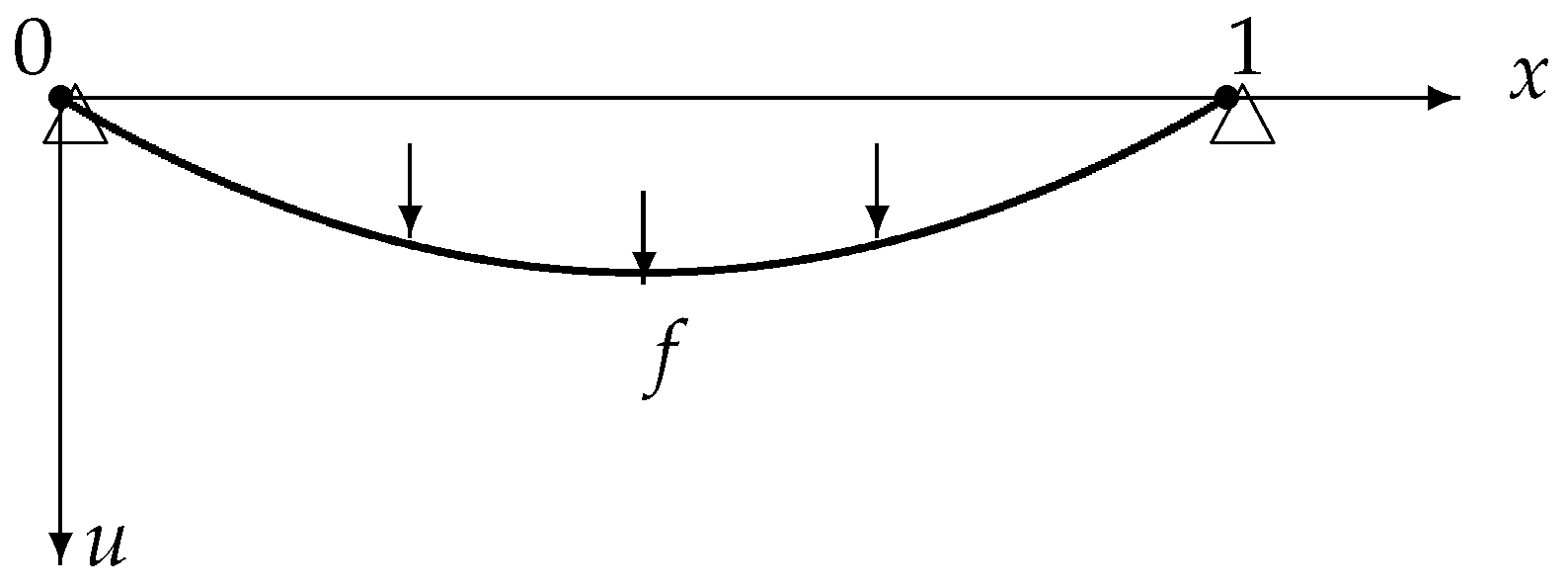
Generally, for BVP(1) in statically elastic beams, only its positive solution is practical significance, see Figure 1.
Figure 1.
Simply Supported Beam.
Under the acting of the load f, the bean is deformed down, and the displacement of the beam at x is positive for . Hence, the solutions of the simply supported beam equations are usually positive. For the case that f is nonnegative, some authors have researched the existence of positive solutions, see [13,14,15,16,17,18,19]. Early, Ma and Wang [13] considered the special case of BVP(1) that f does not contain : the simple fourth-order boundary value problem
They using the fixed point theorems of cone mapping obtained the existence of positive solutions of BVP(2) under f is nonnegative and is superlinear or sublinear growth on u at 0 and . Later, Bai and Wang [15], Li [16], Liu [18] and Yao [19] improved and extended these results by choosing a cone in and using the fixed-point index theory in cones. For general BVP(1), Li [17] obtained the existence and no existence results of positive solutions under f that are nonnegative and satisfy some inequality conditions involving the first eigenvalue-line of the corresponding two-parameter linear eigenvalue problem by counting the fixed-point index of the corresponding integral operator in a cone of . Ma and Xu [14] obtained the existence of positive solutions under f is nonnegative and satisfies asymptotically linear conditions as and by using Krein–Rutman theorem and the global bifurcation theory of positive operators obtained the existence of positive solutions.
The above authors who studied the existence of positive solutions of BVP(1.1) all required that the nonlinear term f is nonnegative. When f is not nonnegative, the corresponding integral operator of BVP(1) is not a positive operator and the method in references [13,14,15,16,17,18,19] is not applicable. The purpose of this paper is to obtain the existence of positive solutions for general BVP(1) without assuming that f is nonnegative. Under the inequality conditions of f when is small or large enough, we obtained an existence result of positive. Our main result is as follows:
Theorem 1.
Let be continuous and satisfy the following conditions
- (F1)
- For every and , is increasing on u in ;
- (F2)
- there exist constant satisfying and such that
- (F3)
- there exist constant satisfying and such that
Then BVP(1) has at least one positive solution.
Note that the straight line
on and is the first eigenvalue-line of the two-parameter linear eigenvalue problem corresponding to BVP(1)
(see [5], Proposition 2.1), the coefficient conditions of the inequalities in (F2) and (F3) are optimal.
The proofs of Theorem 1 are based on the method of lower and upper solutions. A lower solution v of BVP(1.1) means that and satisfies
and an upper solution w of BVP(1.1) means that and satisfies
The method of lower and upper solutions for BVP(1) is, by finding a pair of lower solution and upper with and , to obtain a solution satisfied and , see [7,10]. The advantages of this method are that it is no any restriction for the growth of with respect to u and v, and that ones can find the solution with monotone iteration technique starting from and under some monotonicity conditions of f. The disadvantage is that it is not easy to find the required pair of upper and lower solutions. In Theorem 1, we give the concrete conditions (F2) and (F3) for finding the lower solution and the upper solution .
In [20], Minhós, Gyulov and Santos established a theorem of upper and lower solutions for the more general fourth-order boundary value problem
provided a pair of lower and upper solutions, see [20] (Theorem 1). However, the definition of upper and lower solutions in [20] is different from ours, and our upper and lower solutions do not meet the conditions of the pair of upper and lower solutions in [20]. Hence, Theorem 1 is not covered by [20] (Theorem 1).
2. Preliminaries
As usual, we use to denote the Banach space of all continuous function u on I with maximum norm . For , we use to denote the Banach space of all nth-order continuous differentiable function u with the norm .
To prove Theorem 1, we first consider the linear fourth-order boundary value problem (LBVP)
where and are given.
Lemma 1.
Let and . Then for every , LBVP(5) has a unique solution . Moreover, when , the solution u satisfies: , .
Proof.
Let be the roots of the polynomial , that is
By the assumption we easy to obtain that: . Let be the Green’s function of the linear boundary value problem
By Lemma 2.1 of [16], for every . Since
setting , then LBVP(5) becomes to the second-order boundary value problem
Obviously, BVP(6) has a unique solution given by
Hence, solving the the second-order boundary value problem
it follows that LBVP(5) has a unique solution give by
When , by (9) and the nonnegativity of the Green functions and , . By (7), . Since and , we obtain that . □
Let be continuous and bounded. Then there exists a constant such that
We consider the nonlinear boundary value problem
Lemma 2.
Let and and be continuous and bounded. Then BVP(11) has at least one solution .
Proof.
For every , by Lemma 1, LBVP(5) has a unique solution given by (9). This defines a linear bounded operator , and it is called the solution operator of LBVP(5). By the compactness of the embedding , is a linear completely continuous operator. We denote the norm of the linear by . Define a nonlinear mapping by
Clearly, is continuous and bounded. By (10), F satisfies
Hence, the composite mapping is completely continuous. Let and set . Clearly, is bounded convex closed set of . For every , by (12) we have
Hence, . This means that . By the Schauder fixed-point theorem [21], A has a fixed-point . Since , by the definition of S, is the unique solution of LBVP(5) for . Hence, satisfies Equation (11), and it is a solution of BVP(11). □
3. Proofs of the Main Result
Proof of Theorem 1.
We use the method of lower and upper solutions and a truncation function technique to prove Theorem 1.
Firstly, we construct a pair of positive lower solution and upper solution of BVP(1), such that and .
Let be the constant in Condition (F3). Set
then by Condition (F3),
By Lemma 1, the boundary value problem
has a unique solution , and it satisfies and . By (13) and Equation (14), we easily see that is an upper solution of BVP(1).
Let be the constant in Condition (F2). Choose a constant by
and define a function by . We show that is a lower solution of BVP(1). For every , since
form (F2) it follows that,
Hence is a lower solution of BVP(1). We show that
Consider the function . Noting is a solution of BVP(14), we have
This means that and is a solution of LBVP(5). By Lemma 2, and . Hence (16) holds.
Secondly, we make a bounded truncation function of f through the lower solution and upper solution .
Define functions by
Then are continuous and satisfy
Define a truncating function of f by
By (17) and (18), is continuous and bounded.
Next, we consider the boundary value problem
and prove its solution is also the solution of BVP(1).
By Lemma 2, BVP(20) has a solution . We show that
In fact, if , then for the function
. Since , there exists such that . By the properties of at minimum points, we have
from this and (22) it follows that
Hence by definition (17), we have
By Equations (20) and (18), (24), Condition (F1) and the definition of the upper solution , we have
Namely, , this contradict the second inequality of (23). Hence, .
With a similar argument, we can show that . Thus, (21) holds. Furthermore, from (21) we show that
Consider the function . Since
by the maximum principle of second-order differential operators, . That is, . Similarly, . Hence, (25) holds.
Now, from (21), (25) and definition (17), it follows that
Hence by Equation (20), we have
That is, is a solution of BVP(1) and it is positive.
The proof of Theorem 1 is completed. □
Example 1.
Consider the following fourth-order boundary value problem
Clearly, this problem has a trivial solution . In addition, we can easily verify that the nonlinearity of BVP(26)
satisfies the conditions (F1)–(F3). By Theorem 1, BVP(26) has at least one positive solution. Since the nonlinearity f defined by (27) is not nonnegative, this conclusion cannot be obtained from the known results in [13,14,15,16,17,18,19].
4. Conclusions
In this paper, we obtained the existing result of positive solutions for the bending elastic beam equation BVP(1) by applying the method of lower and upper solutions. The method of lower and upper solutions is an important technique to solve BVP(1). The key to applying this method is to find a pair of lower solution and upper satisfied and . Some authors mentioned in Section 1 discussed the existence of solutions under the assumption that the equation has such a pair of lower and upper solutions, and they did not provide the search method or existence conditions for such a pair of lower and upper solutions. In Theorem 1, we give the concrete conditions to obtain such a pair of lower and upper solutions, these are (F2) and (F3). Condition (F2) implies that
is a lower solution of BVP(1), where is the constant in (F2); and (F3) implies that the unique positive solution of LBVP(14) is a upper solution of BVP(1). By Lemma 1, we showed that when is small enough, and satisfy
Hence, in Section 3 we proved that when f also satisfies the condition (F1), BVP(1) has a positive solution satisfied
This conclusion allows f with negative values, and the previous works on the existence of positive solutions only discussed the case that f is nonnegative. Our conclusion develops the study on the existence of positive solutions of the static simply supported beam equations.
Author Contributions
Y.L. and D.W. carried out the first draft of this manuscript, Y.L. prepared the final version of the manuscript. All authors have read and agreed to the published version of the manuscript.
Funding
This research was funded by National Natural Science Foundations of China under grant numbers 12061062 and 11661071.
Institutional Review Board Statement
Not applicable.
Informed Consent Statement
Not applicable.
Data Availability Statement
Not applicable.
Conflicts of Interest
The authors declare that they have no conflict of interest.
References
- Aftabizadeh, A.R. Existence and uniqueness theorems for fourth-order boundary value problems. J. Math. Anal. Appl. 1986, 116, 415–426. [Google Scholar] [CrossRef]
- Yang, Y. Fourth-order two-point boundary value problems. Proc. Am. Math. Soc. 1988, 104, 175–180. [Google Scholar] [CrossRef]
- Agarwal, R. On fourth-order boundary value problems arising in beam analysis. Differ. Integral Equ. 1989, 2, 91–110. [Google Scholar] [CrossRef]
- Korman, P. A maximum principle for fourth-order ordinary differential equations. Appl. Anal. 1989, 33, 267–373. [Google Scholar] [CrossRef]
- Pino, M.A.D.; Manasevich, R.F. Existence for a fourth-order boundary value problem under a two-parameter nonresonance condition. Proc. Am. Math. Soc. 1991, 112, 81–86. [Google Scholar] [CrossRef]
- Coster, C.D.; Fabry, C.; Munyamarere, F. Nonresonance conditions for fourth-order nonlinear boundary value problems. Internat. J. Math. Math. Sci. 1994, 17, 725–740. [Google Scholar] [CrossRef]
- Ma, R.; Zhang, J.; Fu, S. The method of lower and upper solutions for fourth-order two-point boundary value problems. J. Math. Anal. Appl. 1997, 215, 415–422. [Google Scholar]
- Cabada, A.; Cid, J.A.; Sanchez, L. Positivity and lower and upper solutions for fourth order boundary value problems. Nonlinear Anal. 2007, 67, 1599–1612. [Google Scholar] [CrossRef]
- Li, Y. Two-parameter nonresonance condition for the existence of fourth-order boundary value problems. J. Math. Anal. Appl. 2005, 308, 121–128. [Google Scholar] [CrossRef]
- Li, Y. A monotone iterative technique for solving the bending elastic beam equations. Appl. Math. Comput. 2010, 217, 2200–2208. [Google Scholar] [CrossRef]
- Li, Y.; Gao, Y. Existence and uniqueness results for the bending elastic beam equations. Appl. Math. Lett. 2019, 95, 72–77. [Google Scholar] [CrossRef]
- Kaufmann, E.R.; Kosmatov, N. Elastic beam problem with higher order derivatives. Nonlinear Anal. Real World Appl. 2007, 8, 811–821. [Google Scholar] [CrossRef]
- Ma, R.; Wang, H. On the existence of positive solutions of fourth-order ordinary differential equations. Appl. Anal. 1995, 59, 225–231. [Google Scholar]
- Ma, R.; Xu, L. Existence of positive solutions of a nonlinear fourth-order boundary value problem. Appl. Math. Lett. 2010, 23, 537–543. [Google Scholar] [CrossRef]
- Bai, Z.; Wang, H. On positive solutions of some nonlinear fourth-order bean equations. J. Math. Anal. Appl. 2002, 270, 357–368. [Google Scholar] [CrossRef]
- Li, Y. Positive solutions of fourth-order boundary value problems with two parameters. J. Math. Anal. Appl. 2003, 281, 477–484. [Google Scholar] [CrossRef]
- Li, Y. On the existence of positive solutions for the bending elastic beam equations. Appl. Math. Comput. 2007, 189, 821–827. [Google Scholar] [CrossRef]
- Liu, B. Positive solutions of fourth-order two point boundary value problems. Appl. Math. Comput. 2004, 148, 407–420. [Google Scholar] [CrossRef]
- Yao, Q. Positive solutions of nonlinear beam equations with time and space singularities. J. Math. Anal. Appl. 2011, 374, 681–692. [Google Scholar] [CrossRef]
- Minhós, F.; Gyulov, T.; Santos, A.I. Existence and location result for a fourth order boundary value problem. Conf. Publ. 2005, 2005, 662–671. [Google Scholar] [CrossRef]
- Deimling, K. Nonlinear Functional Analysis; Springer: New York, NY, USA, 1985. [Google Scholar]
Disclaimer/Publisher’s Note: The statements, opinions and data contained in all publications are solely those of the individual author(s) and contributor(s) and not of MDPI and/or the editor(s). MDPI and/or the editor(s) disclaim responsibility for any injury to people or property resulting from any ideas, methods, instructions or products referred to in the content. |
© 2023 by the authors. Licensee MDPI, Basel, Switzerland. This article is an open access article distributed under the terms and conditions of the Creative Commons Attribution (CC BY) license (https://creativecommons.org/licenses/by/4.0/).