


Abstract
It is well known that there are two important classes of analytic functions of Ma-Minda type (MMT): Ma-Minda starlike and Ma-Minda convex functions. In this work, we suggest a new class of analytic functions, which is normalized in the open unit disk. The suggested class is generated by a roulette curve formula, which satisfies the symmetric behavior in the open unit disk. A roulette curve is shaped as the path outlined by the sum of two complex numbers, each affecting at a uniform rapidity in a circle. Special cases are illustrated involving special functions. Graphics of the curve are illustrated by using Mathematica 13.3.
1. Introduction
In mathematics, a roulette curve is a curve that is traced by a point on a curve as it moves along another curve. Generally, the location of this moving point in relation to the curve being rolled upon is fixed. The shape of the resulting curve, known as a roulette curve, is determined by the particular curves involved and the separation between them. A special case is one in which the center of the revolving circle always lies on the line. The curve that is produced as a result has intriguing mathematical characteristics and uses. Trigonometric functions and parametric equations are used in the equations which explain roulette curve structures, and they can be rather complex [1,2,3]. They are often utilized to mimic a variety of mechanical and geometric phenomena, including the actions of pendulums, the contours of the orbits of the planets, and the rotation of the gears. A special curve of the roulette curve structures is the centered trochoid curve. In mathematics, a curve is referred to as a “centered trochoid curve” when it is produced by a point rolling down a different curve, usually a straight line. The moving point’s subsequent curve is known as the roulette curve. There are many different kinds of roulette curves, and they can take on a variety of designs according to the individual curves and rolling action. A few usual instances are the trochoid, which is produced by a point on the circumference of a revolving circle, and the epitrochoid, which is produced by a point on a smaller circle rolling around the outside of a bigger stationary circle. We shall formulate the class of analytic functions based on the definition of the roulette curve between two analytic normalized functions.
Two significant classes of starlike and convex normalized functions, which are characterized by idea subordination, were introduced by Ma and Minda [4] in the open unit disk. Numerous studies have generalized and expanded on these groupings. Additionally, these classes were constructed by the researchers utilizing different types of operators, such as convoluted operators with derivatives and integration [4].
Define the class of normalized analytic functions as follows: having the structure
Then, the MMT starlike class symbolizing by is formulated by the formula
where F designates an analytic function with an optimistic real measure on , and F maps onto a starlike domain conforming to that is symmetric through deference to the real axis. And the representation ≺ designates the description of the subordination (see [5]). The MMT convex class symbolized by is framed by the subordination discrimination
Moreover, the linear combination of these two classes is defined in what is called an MMT convex class achieving the formula [6]
Many researchers defined special cases by suggesting a specific formula of F such as Janowski function [7], integral operator [8], function [9], close to convex [10], quasi-subordination classes [11], -class [12], Quantum classes (see [13,14]), Nephroid domain with parametric function [15], exponential function [16], lemniscate of Bernoulli [17], MMT starlike and convex of complex order [18], bi-pseudo-starlike functions [19,20], fractional calculus [21], linear operator [22], conformable fractional operator [23] and other combination and convolution classes which can be located in [24,25,26,27,28].
2. Preliminaries
We request the following result, which can be located in [5] (p. 132).
Lemma 1.
Suppose that is a univalent function in and and are analytic in a domain Δ involving such that where By consuming
and
- is starlike, or
- is convex, and
If ℘ is analytic in such that and
then and is the best dominant.
Definition 1.
A function where
is called a strongly Caratheodory function of order ν if it achieves
Moreover, a function is called a strongly starlike function of order ν if it satisfies
Note that when then f is starlike. We have the following result, which can be found in [29]
Lemma 2.
Let the function be analytic in with
If is satisfying the inequality
then ♭ is a strongly starlike function of order ν.
3. Ma-Minda Type (MMT) Generated by Roulette Curve
In this section, we present the definition of a new class of analytic functions using the formula of the roulette curve function.
Definition 2.
The function is grouped in the class if and only if there occur a normalized analytic function and analytic function ς with satisfying the inequality
where σ is rolled on ρ such that
and
The left side of (5) is known as the roulette curve. The numerous roulette curve types and their potential shapes rely on the individual curves and rolling motions. The cycloid, which is produced by a point on a rotating circle, the trochoid, which is produced by a point on a rotating circle’s circumference, and the epitrochoid, which is produced by a point on a smaller circle rotating around a bigger fixed circle, are a few forms that are frequently used. These curves have intriguing qualities and can be applied to a variety of tasks in physics, mathematics, and the performing arts.
The physical meaning of the roulette curve is understood when a body moves in a curve under two forces: the centripetal force and the centrifugal. The force that pushes inward and maintains an object moving along a curving route is known as centripetal force. It serves to stop an object traveling in a straight line tangent to the curve and is aimed at the curve’s center. Centrifugal force is a projected force that appears to be pushing outward on an object traveling in a curve but is actually not a real force. It is a result of a thing’s propensity to move in straight lines and gravity. The object would actually prefer to proceed straight ahead, but the curved path prevents it from doing so. In some situations, it can be suggested as circular motion, in which an item moves in a circle around a center as the result of a constant force, which can be compared to roulette curves. Angular velocity, centripetal acceleration, and other kinematic variables can be used to describe this motion, satisfying the map
For example, for the convex univalent function and the rolled function is While for the starlike univalent function and the rolled function is
On this point, we proceed to investigate some geometric properties of the suggested class.
Theorem 1.
If the analytic normalized function
then for
the difference of connection bounds are
and
Proof.
Since , then there occurs an analytic function with the following properties:
and
Define a function
Obviously, and has a positive real part in A calculation implies that
Thus, we have
By letting then we obtain
Equating the coefficients of (6) and (7), we have
Since (the class of functions with a positive real part), then implies that For the second difference, we have
This ends the proof. □
Definition 3.
A function (the Caratheodory function), which sings the boundary of the unit disk univalently onto a 2D curve, is called nephroid achieving
where The function is called in the class if and only if there occurs a normalized rolling function and analytic function ς with satisfying the inequality
In terms of geometry, a nephroid is the location of a stationary point on the perimeter of a moving ring of radius r that is fixed at one end. When the light basis is at infinity, the behavior of the nephroid curve which Huygens and Tschirnhausen first proposed in 1697 is revealed to be the envelope of rays emanating from a specified point in a ring. The nephroid is a cardioid’s cat-caustic for a bright cusp, according to Jakob Bernoulli’s 1692 observation. But Richard A. Proctor used the term “nephroid” for the first time in 1878 in his book The Geometry of Cycloids. To learn more information about the nephroid curve, one can see [30]. Finding the constraints on analytic function that are required to be in is the issue. We work with the Deltoid domain, which is maximized by the function, by merging a segment line with a length bigger than the deltoid arch (see Figure 1)
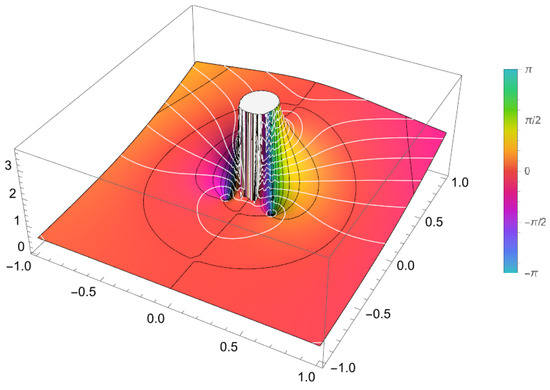
Figure 1.
(the graph is given by Mathematica 13.3).
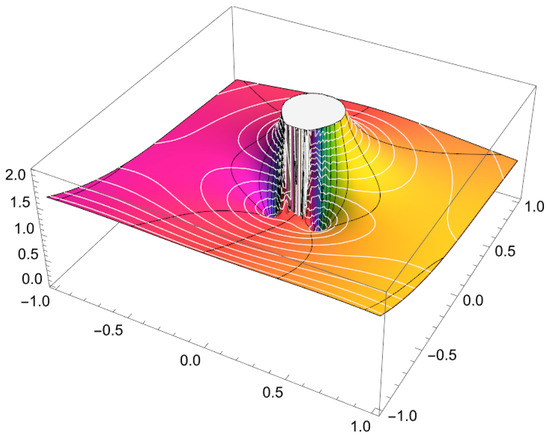
Figure 2.
(the graph is given by Mathematica 13.3).
Theorem 2.
Define the functional
and suppose that is a complex constant. If one of the following subordination relations is satisfied
where then
Proof.
Consider the differential equation
where and defining by
where and is the Euler–Mascheroni number. Now, by assuming
in Lemma 1, then we obtain
Subsequently, the appearance of via the function is a convex province; this infers that the function is convex in . Then again, every convex function is starlike; therefore, the function is starlike in . Thus, in virtue of the analytic description of starlike functions, it leads to
such that But
then Lemma 1 indicates that Now, by the majoran of the subordination, we obtain under the necessary condition Since is univalent in ∪ and then we have the subordination inequality
We conclude that
For the second case, we define a function by
and
where and achieves the equation By selecting in Lemma 1, we have
The convexity of indicates the convexity of and In view of Lemma 1, we have
gives But ; then, by solving the equation
we obtain the condition , which implies that
For the last case, we define a function by
and
where and achieves the equation
under the condition By letting in Lemma 1, we have
The convexity of indicates the convexity of and
Moreover, the subordination
implies that Since under the condition on which can be calculated form the equation
to obtain Then, we have, , and consequently, we attain that is □
In the similar manner of Theorem 2, we have the following result involving
Theorem 3.
Let and a complex constant If one of the following subordination relations is satisfied
then
The next result shows the upper bound of by using a starlike function.
Theorem 4.
Consider Θ and Ξ in Theorem 2. Then
- and ℓ is the best dominant.
- and ℏ is the best dominant.
Proof.
Let
where Since is a Caratheodory function, then we obtain
Moreover, we have
This leads to . Then, in view of Lemma 2, we conclude that is starlike. Consequently, the subordination
and Theorem 3.1d [5] implies that
and ℓ is the best dominant.
For the second part, in view of Corollary 3.1d.1, P76 [5], we indicate that
and ℏ is the best dominant. □
Similarly, we have the following result:
Theorem 5.
Consider Θ and Υ in Theorem 3. Then
- and ϑ is the best dominant.
- and h is the best dominant.
3.1. Examples
In this place, we introduce the roulette curve formula by suggesting a well-known normalized analytic function and its rolled function (see Figure 3).
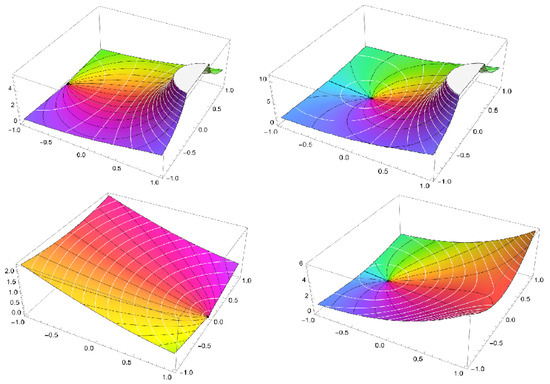
Figure 3.
The 3D complex graphs of the roulette curve functional in Section 3.1, respectively (the graph is given by Mathematica 13.3).
- Assume the convex function and its rolled function Then, the roulette curve is the Janowski function
- If and its rolled function , then the roulette curve is given by the function
- Let and Then, we have
- Suppose the analytic function and its rolled function Then, the roulette curve takes the formula
3.2. Application of the Rolled Function
The selecting of the rolled function will reduce the roulette functional formula into the polarized derivative of order one for the corresponding polynomial, say of of degree m, to be
This formula has many applications (see [31,32]). In the open unit disk, Aziz showed that [31] in Corollary 3, for any self-inversive polynomial:
of degree m admitting the connection inequality
with a maximum value equal to one at the boundary of the open unit disk, the upper bound of the polynomial satisfies the inequality
Meanwhile, achieves the inequality at the origin (see [31] (p. 4))
Moreover, if q is a self-inversive polynomial, then [31] in Corollary 2, the upper bound of the coefficient is as follows:
4. Conclusions
As a conclusion, we presented a new class of analytic functions in of MMT in a symmetric domain that takes a centered trochoid shape. The formula is suggested in terms of the roulette curve formula in the open unit disk. This formula involved two analytic normalized functions: the first one is the geometric function and the second is its rolled function. Several geometric studies are indicated by using the subordination concept to obtain the upper bound for formulas involving these functions. Examples are illustrated at the end of this study, and an application considering the polynomial that is generated by the partial sum of the formula is investigated. This application yielded the upper bound of the coefficients of
For the future works, one can extend this type of analytic function to classes of harmonic and meromorphic functions. They also can be generalized by using the differential and difference operators given in [33,34].
Author Contributions
I.A.: Conceptualization, Methodology, Writing. R.W.I.: Visualization, Investigation, Software, Writing. All authors have read and agreed to the published version of the manuscript.
Funding
This work was supported and funded by the Deanship of Scientific Research at Imam Mohammad Ibn Saud Islamic University (IMSIU) (grant number IMSIU-RP23001).
Data Availability Statement
Data sharing is unrelated to the current study because no data sets were generated or looked at.
Acknowledgments
The researchers are grateful to Imam Mohammad Ibn Saud Islamic University (IMSIU)’s Deanship of Scientific Research for funding and overseeing this project.
Conflicts of Interest
The authors declare that they have no known competing financial interests or personal relationships that could have appeared to influence the work reported in this paper.
References
- Guiot, E.E. Guiot Trajectories of Two-Dimensional Harmonic Oscillators in Rotating Frame: Application to Foucault Pendulum Problem and Centered Trochoid Trajectories. 2023. Available online: https://hal.science/hal-04086006 (accessed on 20 September 2023).
- Bo, P.; Fan, H.; Barton, M. Efficient 5-axis CNC trochoidal flank milling of 3D cavities using custom-shaped cutting tools. Comput.-Aided Des. 2022, 151, 103334. [Google Scholar]
- Guiot, E. Two-dimensional harmonic oscillator and centered trochoid curves: Trajectories under constant magnetic field. Can. J. Phys. 2022, 100, 526–534. [Google Scholar] [CrossRef]
- Ma, W.; Minda, D. A unified treatment of some special classes of univalent functions. In Proceeding of the Conference on Complex Analysis; Li, Z., Ren, F., Yang, L., Zhang, S., Eds.; International Press: Boston, MA, USA, 1994; pp. 157–169. [Google Scholar]
- Miller, S.S.; Mocanu, P.T. Differential Subordinations: Theory and Applications; CRC Press: Boca Raton, FL, USA, 2000. [Google Scholar]
- Lee, S.K.; Ravichandran, V.; Supramaniam, S. Initial coefficients of biunivalent functions. In Abstract and Applied Analysis; Hindawi: London, UK, 2014; Volume 2014. [Google Scholar]
- Ali, R.M.; Chandrashekar, R.; Ravichandran, V. Janowski starlikeness for a class of analytic functions. Appl. Math. Lett. 2011, 24, 501–505. [Google Scholar] [CrossRef]
- Ali, R.M.; Ravichandran, V. Integral operators on Ma-Minda type starlike and convex functions. Math. Comput. Model. 2011, 53, 581–586. [Google Scholar]
- Cho, N.E.; Kumar, V.; Kumar, S.S.; Ravichandran, V. Radius problems for starlike functions associated with the sine function. Bull. Iran. Math. Soc. 2019, 45, 213–232. [Google Scholar]
- Analouei Adegani, E.; Bulboaca, T.; Motamednezhad, A. Simple sufficient subordination conditions for close-to-convexity. Mathematics 2019, 7, 241. [Google Scholar] [CrossRef]
- Haji Mohd, M.; Darus, M. Fekete-Szego problems for quasi-subordination classes. In Abstract and Applied Analysis; Hindawi: London, UK, 2012; Volume 2012. [Google Scholar]
- Bansal, D. Fekete-Szego problem for a new class of analytic functions. Int. J. Math. Math. Sci. 2011, 2011, 143096. [Google Scholar]
- Raducanu, D. Second Hankel determinant for a class of analytic functions defined by q-derivative operator. Analele Univ. “Ovidius"-Constanta-Ser. Mat. 2019, 27, 167–177. [Google Scholar]
- Ibrahim, R.W. Geometric process solving a class of analytic functions using q-convolution differential operator. J. Taibah Univ. Sci. 2020, 14, 670–677. [Google Scholar] [CrossRef]
- Wani, L.A.; Swaminathan, A. Differential Subordinations for Starlike Functions Associated With A Nephroid Domain. arXiv 2019, arXiv:1912.06326. [Google Scholar]
- Shi, L.; Wang, Z.; Su, R.; Arif, M. Initial successive coefficients for certain classes of univalent functions involving the exponential function. arXiv 2020, arXiv:2003.09771. [Google Scholar] [CrossRef]
- Shi, L.; Khan, M.G.; Ahmad, B. Some Geometric Properties of a Family of Analytic Functions Involving a Generalized q-Operator. Symmetry 2020, 12, 291. [Google Scholar] [CrossRef]
- Ramachandran, C.; Prabhu, R.A.; Magesh, N. Initial coefficient estimates for certain subclasses of bi-univalent functions of Ma-Minda type. Appl. Math. Sci. 2015, 9, 2299–2308. [Google Scholar] [CrossRef][Green Version]
- Murugusundaramoorthy, G.; Sokol, J. ON λ-Pseudo bi-starlike functions related to some domains. Bulletin of the Transilvania University of Brasov. Physics Series III. Math. Comput. Sci. 2019, 12, 381–392. [Google Scholar]
- Raina, R.K.; Sokol, J. On a class of analytic functions governed by subordination. Acta Universitatis Sapientiae. Mathematica 2019, 11, 144–155. [Google Scholar]
- Ibrahim, R.W.; Darus, M. Subordination and superordination for univalent solutions for fractional differential equations. J. Math. Anal. Appl. 2008, 345, 871–879. [Google Scholar] [CrossRef]
- Srivastava, H.M.; Darus, M.; Ibrahim, R.W. Classes of analytic functions with fractional powers defined by means of a certain linear operator. Integral Transform. Spec. Funct. 2011, 22, 17–28. [Google Scholar] [CrossRef]
- Ibrahim, R.W.; Jahangiri, J.M.; Cloud Computing Center. Conformable differential operator generalizes the Briot-Bouquet differential equation in a complex domain. AIMS Math. 2019, 4, 1582–1595. [Google Scholar] [CrossRef]
- Tang, H.; Deng, G.; Li, S. Coefficient estimates for new subclasses of Ma-Minda bi-univalent functions. J. Inequalities Appl. 2013, 25, 317. [Google Scholar] [CrossRef]
- Xiong, L.; Liu, X. Some extensions of coefficient problems for bi-univalent Ma-Minda starlike and convex functions. Filomat 2015, 29, 1645–1650. [Google Scholar] [CrossRef]
- Xiong, L. Properties of Certain Nonlinear Integral Operator Associated with Janowski Starlike and Convex Functions. J. Math. Res. Appl. 2016, 4, 5. [Google Scholar]
- Sokol, J.; Murugusundaramoorthy, G.; Vijaya, K. On λ-pseudo starlike functions associated with vertical strip domain. Asian-Eur. J. Math. 2023, 16, 2350135. [Google Scholar] [CrossRef]
- Murugusundaramoorthy, G.; Vijaya, K. Certain subclasses of analytic functions associated with generalized telephone numbers. Symmetry 2022, 14, 1053. [Google Scholar] [CrossRef]
- Shiraishi, H.; Owa, S.; Srivastava, H.M. Sufficient conditions for strongly Caratheodory functions. Comput. Math. Appl. 2011, 62, 2978–2987. [Google Scholar] [CrossRef]
- Press, W.H.; Teukolsky, S.A.; Vetterling, W.T.; Flannery, B.P. Numerical Recipes 3rd Edition: The Art of Scientific Computing; Cambridge University Press: Cambridge, UK, 2007. [Google Scholar]
- Aziz, A. Inequalities for the polar derivative of a polynomial. J. Approx. Theory 1988, 55, 183–193. [Google Scholar] [CrossRef]
- Dewan, K.K.; Singh, N.; Mir, A. Extensions of some polynomial inequalities to the polar derivative. J. Math. Anal. Appl. 2009, 352, 807–815. [Google Scholar] [CrossRef]
- Andrei, L. Differential subordinations using the Ruscheweyh derivative and the generalized Salagean operator. Adv. Differ. Equ. 2013, 2013, 252. [Google Scholar] [CrossRef]
- Ibrahim, R.W.; Darus, M. On a class of analytic functions associated to a complex domain concerning q-differential-difference operator. Adv. Differ. Equ. 2019, 2019, 515. [Google Scholar] [CrossRef]
Disclaimer/Publisher’s Note: The statements, opinions and data contained in all publications are solely those of the individual author(s) and contributor(s) and not of MDPI and/or the editor(s). MDPI and/or the editor(s) disclaim responsibility for any injury to people or property resulting from any ideas, methods, instructions or products referred to in the content. |
© 2023 by the authors. Licensee MDPI, Basel, Switzerland. This article is an open access article distributed under the terms and conditions of the Creative Commons Attribution (CC BY) license (https://creativecommons.org/licenses/by/4.0/).