


Abstract
In this paper, we aim to study the neutral-type delayed Caputo fractional differential equations of the form with order , which can be used to describe the growth processes in real-life sciences at which the present growth depends on not only the past state but also the past growth rate. Our ultimate goal in this study is to concentrate on the convergence of the solutions to a predetermined constant by establishing a linkage between the delayed fractional differential equation and an integral equation. In our analysis, the sufficient conditions for the asymptotic results are obtained due to fixed point theory. The utilization of the contraction mapping principle is a convenient approach in obtaining technical conditions that guarantee the asymptotic constancy of the solutions.
MSC:
34A08; 34K37; 34D05; 34K25
1. Introduction
One of the current hot issues in applied mathematics is fractional calculus and fractional dynamic equations, which have a 300-year history. Researchers have learned that well-known mathematicians Liouville, Riemann, and Leibniz undertook research on fractional calculus in the past. For more information, see [1,2,3,4]. Researchers have focused on studying and developing the theory of fractional differential equations since the invention of the fractional derivative.
It came out that there are several unique and intriguing situations where fractional differential equations are favored over conventional differential equations. The applications of fractional differential equations are what make them a daunting and fundamental topic in the applied sciences, despite the fact that the theoretical solutions derived for them are intriguing and communicate profound implications. Applications of fractional differential equations have particularly found success in the fields of physics, biology, economics, and the medical and biological sciences (see [5,6,7,8,9]). Similar to the theory of ordinary differential equations, the theory of fractional differential equations has been separated into qualitative and quantitative categories. Stability analysis is one of the key areas in the qualitative examination of these equations. Numerous academics have thoroughly investigated the stability of the solutions to fractional differential equations. As a result, the stability theory of these equations has only recently been formed and still needs further refinement. We cite [10,11,12,13,14] for more readings on these two categories.
Studies concentrating on the existence of particular solutions, such as positive, periodic, nearly periodic, and affine periodic solutions, as well as oscillation of solutions, have gained a prominent place in the extant literature in the qualitative study of ordinary differential equations. Even if the idea of symmetry can be seen as a crucial component of the mathematical motivation for these studies, it is still unspoken in the field. It should be underlined that there is a vast amount of literature on the asymptotic behavior of the solutions of ordinary differential equations. There is also a substantial body of literature and comparable investigations for both discrete and hybrid temporal domains. In [15], Burton examined an ordinary differential equation with a delay which is used in biology and showed the asymptotic constancy and periodicity of the solutions with the help of fixed point theory. The authors of [16,17] were inspired by [15] and analyzed such equations, which are crucial in population dynamics, with constant and functional delays on discrete and hybrid time domains, respectively. To the best of our knowledge, the asymptotic constancy of fractional equations’ solutions has not yet been studied, despite the fact that stability analysis of fractional equations has grown rather quickly. Proposing sufficient conditions that assure that solutions converge to a preset constant, namely the asymptotic constancy of solutions, is an important topic from a mathematics perspective. By examining the asymptotic constancy of solutions to fractional equations, this study aims to close this gap. Furthermore, in our opinion, this study will launch a new line of inquiry based on symmetry-based asymptotic analysis of fractional differential equations. Functional differential equations containing the highest-order derivative in more than one term are called neutral differential equations. There are few results regarding the theory of fractional neutral equations, and we refer to the papers [18,19,20,21,22], which focus on the analysis of fractional neutral differential equations. We highlight that fractional neutral differential equations are challenging to study due to their complicated dynamics. However, their applications in various disciplines have intrinsically compelled and imposed on us to give them the deserved attention. Inspired by [23], we consider a neutral equation of order with constant delay
and study the asymptotic constancy of its solutions. This approach enables us to adapt the possible outcomes of this study to biological models with a constant life span that are widely studied in biomathematics. By a quick literature review, it is possible to find significant biological models with a delay, such as the hematopoiesis model
and red blood cell production model
(see [24,25], and references therein). The fractional analogues of the aforementioned equations have already gained importance in mathematics, because fractional differential equations are typically used to model real-world issues and are best suited for doing so. It is obvious that a connection between the equation we focus on and potential fractional analogs of neutral biological models may be made with ease. As a result, the major findings of our research have excellent application potential and will therefore advance the qualitative theory of fractional differential equations.
The next section is devoted to the presentation of the main results and illustrative examples. Also, a precise summary about fractional derivatives and integrals is provided in the Appendix A for the readers who are not familiar with fractional calculus.
2. Main Results
2.1. Setup
We consider the following neutral Caputo fractional differential equation with delay
with order where and if for We set as a continuous function, and the solution x of (1) is presented by with on
Lemma 1.
The function x is a solution of (1) if and only if it satisfies the integral equation
Proof.
This result can be obtained by applying the Caputo derivative on both sides of (2). For more on the details of its proof, we refer to ([23], Lemma 3.1). □
For the rest of this paper, we make the following assumptions:
- A1
- For a constant
- A2
- The function g is Lipschitz in its second argument, i.e.,
- A3
- There exists a continuous function , so that the inequalityholds for all
- A4
- There exists a constant , so that for whereand
Lemma 2.
For a constant
is a constant.
Proof.
We apply Caputo derivative on h
and use the identity
to obtain
by A1. This indicates that is a constant, and the proof is complete. □
2.2. Asymptotic Results
Proof.
Thus, h is a contraction.
Next, we define the mapping
which is a contraction due to the mapping Therefore, it has a unique fixed point Subsequently, we construct the following set
which is a Banach space endowed by the supremum norm.
For we define the mapping as follows:
We need to prove that To achieve this task, we show that
whenever as Consider
since for sufficiently large Then, we conclude that as and consequentially, Finally, we show that is a contraction. To see this, we suppose and write
Thus, has a unique fixed point in As a result, the solution of (1) satisfies the asymptotic property as □
Theorem 2.
Every initial function ξ corresponding to of (2) is stable; that is, for every , there exists a , such that
for Moreover, if and as then
Proof.
Let and be the mappings defined as in (7) corresponding to and respectively. By Theorem 1, they have unique fixed points and i.e.,
with the limit results and as Then, we consider
This yields to
and
If we set then the first part of the proof is complete.
Next, to prove the second assertion, we employ the limit results and as . We write
when The proof is complete. □
Next, we give the following examples as an implementation of our asymptotic result.
Example 1.
We set and consider the neutral fractional differential equation with delay
where the solution of (8) is represented by on with If we compare (1) with (8), then we deduce that
and
We fix and this results in (4) to hold true. Moreover, which meansA1is satisfied. Next, we observe that the conditionsA2andA3are fulfilled, since
and
with and It remains to show thatA4holds. To achieve this task, we introduce
and obtain
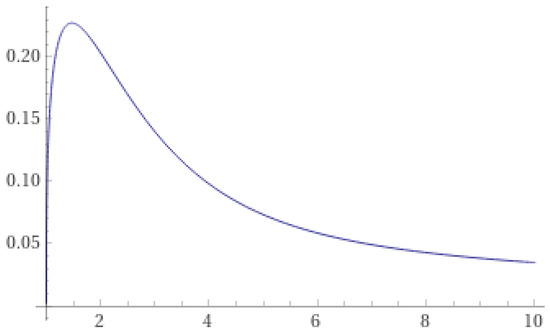
where stands for the incomplete gamma function. We obtain for all (see Figure 1). Thus, one may set , and this yields to Consequentially, Theorem 1 implies the solution of (8) has the asymptotic property
Figure 1.
Plot of the function .
Example 2.
Fix and consider the following neutral equation with delay
where we define the solution of (10) as on A direct comparison of (1) with (10) results in
and
We set and consequentially, Then, one may easily verify that the Equation (4) holds. Additionally, the conditionA1is satisfied since
and the conditionsA2andA3hold with and respectively. Next, we define
and direct computation gives the result
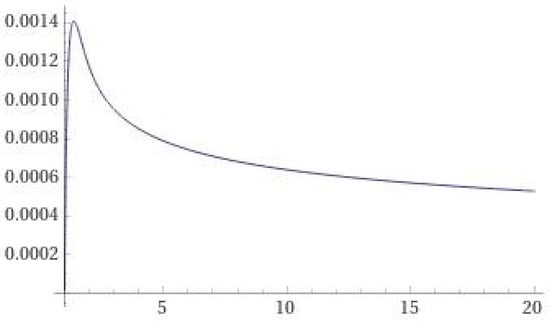
Here, we obtain for (see Figure 2); therefore, we can take Thus, the conditionA4is also satisfied. Subsequently, Theorem 1 implies that the solution of (10) has the long-term behavior
Figure 2.
Plot of the function .
3. Conclusions
In the present work, we concentrate on nonlinear neutral-type Caputo fractional differential equations with delay and study their asymptotic behavior under certain conditions. In our analysis, we rewrite the neutral fractional equation as an integral equation and then employ the contraction mapping principle to prove that the solution of the equation converges to a constant known in advance under sufficient conditions. To the best of our knowledge, our manuscript is the first one that focuses on the asymptotic constancy of solutions for fractional differential equations; thus, we believe our outcomes contribute to the ongoing theory of fractional differential equations. It should be pointed out that there are numerous promising research directions with symmetry background to accomplish a concrete survey on the qualitative analysis of fractional equations.
Author Contributions
Conceptualization, H.C.K., Y.R. and N.T.; methodology, H.C.K., Y.R. and N.T.; software, H.C.K., Y.R. and N.T.; writing—original draft preparation, H.C.K., Y.R. and N.T. All authors have read and agreed to the published version of the manuscript.
Funding
This research received no external funding.
Data Availability Statement
Not applicable.
Acknowledgments
We would like to thank the reviewers for their valuable comments and suggestions which substantially improved the paper.
Conflicts of Interest
The authors declare no conflict of interest.
Appendix A
In this part, we provide the essential definitions and concepts regarding fractional calculus for the sake of readership. For an elaborative reading on fractional calculus and fractional differential equations, we suggest the pioneering books [26,27,28,29]. The provided content in this part can be found in cited monographs.
Definition A1.
For a function f, the fractional integral of order with the lower limit is given by
where Γ is the conventional gamma function.
Definition A2.
The Riemann–Liouville fractional derivative of a continuous function f with order is defined as
where
Remark A1.
It is evident that the Riemann–Liouville fractional derivative has a singularity at the point which requires defining the initial condition of the fractional differential equation at a point different than Caputo proposed an alternative fractional derivative to solve the issue, mentioned above.
Definition A3.
Let with The Caputo fractional derivative of a function f is introduced as
where stands for the -order derivative of Subsequently, if then (A2) reduces to
It should be emphasized that if Moreover, the Riemann–Liouville fractional derivative and the Caputo fractional derivative are the left-inverses of the fractional integral operator given in (A1), that is
and
for and
References
- Liouville, J. Mémoire sur quelques questions de géométrie et de mécanique, et sur un nouveau genre de calcul pour résoudre ces questions. J. L’éCole Polytech. 1832, 13, 1–69. [Google Scholar]
- Liouville, J. Mémoire sur le calcul des différentielles à indices quelconques. J. L’éCole Polytech. 1832, 13, 71–162. [Google Scholar]
- Riemann, B. Versuch einer allgemeinen Auffassung der Integration und Differentiation. (1847); Chapter XIX. In Bernard Riemann’s Gesammelte Mathematische Werke Und Wissenschaftlicher Nachlass; Dedekind, R., Weber, H.M., Eds.; Cambridge Library Collection-Mathematics; Cambridge University Press: Cambridge, UK, 2013; pp. 331–344. [Google Scholar] [CrossRef]
- Ross, B. The development of fractional calculus 1695–1900. Hist. Math. 1977, 4, 75–89. [Google Scholar] [CrossRef]
- Zhang, J.; Fu, X.; Morris, H. Construction of indicator system of regional economic system impact factors based on fractional differential equations. Chaos Solitons Fractals 2019, 128, 25–33. [Google Scholar] [CrossRef]
- Akgül, A.; Khoshnaw, S. Application of fractional derivative on non-linear biochemical reaction models. Int. J. Intell. Netw. 2020, 1, 52–58. [Google Scholar] [CrossRef]
- Baleanu, D.; Mohammadi, H.; Rezapour, S. A fractional differential equation model for the COVID-19 transmission by using the Caputo–Fabrizio derivative. Adv. Differ. Equ. 2020, 2020, 299. [Google Scholar] [CrossRef] [PubMed]
- Yazgaç, B.G.; Kırcı, M. Fractional Differential Equation-Based Instantaneous Frequency Estimation for Signal Reconstruction. Fractal Fract. 2021, 5, 83. [Google Scholar] [CrossRef]
- Hilfer, R. Applications of Fractional Calculus in Physics; World Scientific: Singapore, 2000. [Google Scholar] [CrossRef]
- Agarwal, R.P.; Hristova, S.; O’Reagan, D. Practical stability of Caputo fractional differential equations by Lyapunov functions. Differ. Equ. Appl. 2016, 8, 53–68. [Google Scholar] [CrossRef]
- Baleanu, D.; Wu, G.C.; Zheng, S.D. Chaos analysis and asymptotic stability of generalized Caputo fractional differential equations. Chaos Solit. Fractals 2017, 102, 99–105. [Google Scholar] [CrossRef]
- Choi, S.K.; Kang, B.; Koo, N. Stability for Caputo fractional differential systems. Abstr. Appl. Anal. 2014, 2014, 631419. [Google Scholar] [CrossRef]
- Liu, K.; Jiang, W. Stability of nonlinear Caputo fractional differential equations. Appl. Math. Model. 2016, 40, 3919–3924. [Google Scholar] [CrossRef]
- Sene, N. Global asymptotic stability of the fractional differential equations. J. Nonlinear Sci. Appl. 2020, 13, 171–175. [Google Scholar] [CrossRef]
- Burton, T. Fixed points and differential equations with asymptotically constant or periodic solutions. Electron. J. Qual. Theory Differ. Equ. 2004, 2004, 1–31. [Google Scholar] [CrossRef]
- Raffoul, Y. Discrete population models with asymptotically constant or periodic solutions. Int. J. Differ. Equ. 2011, 6, 143–152. [Google Scholar]
- Koyuncuoğlu, H.C.; Turhan, N.; Adivar, M. An asymptotic result for a certain type of delay dynamic equation with biological background. Math. Methods Appl. Sci. 2020, 43, 7303–7310. [Google Scholar] [CrossRef]
- Ahmad, B.; Ntouyas, S.K.; Alsaedi, A.; Alnahdi, M. Existence theory for fractional-order neutral boundary value problems. Fract. Differ. Calc. 2018, 8, 111–126. [Google Scholar] [CrossRef]
- Dassios, I.; Bazighifan, O. Oscillation conditions for certain fourth-order non-linear neutral differential equation. Symmetry 2020, 12, 1096. [Google Scholar] [CrossRef]
- Niazi, A.U.K.; Wei, J.; Rehman, M.U.; Jun, D. Ulam-Hyers-Stability for nonlinear fractional neutral differential equations. Hacet. J. Math. Stat. 2019, 48, 157–169. [Google Scholar] [CrossRef][Green Version]
- Wang, G.; Liu, S.; Zhang, L. Neutral fractional integro-differential equation with nonlinear term depending on lower order derivative. J. Comput. Appl. Math. 2014, 260, 167–172. [Google Scholar] [CrossRef]
- Zhou, X.F.; Yang, F.; Jiang, W. Analytic study on linear neutral fractional differential equations. Appl. Math. Comput. 2015, 257, 295–307. [Google Scholar] [CrossRef]
- Agarwal, R.P.; Zhou, Y.; He, Y. Existence of fractional neutral functional differential equations. Comput. Math. Appl. 2010, 59, 1095–1100. [Google Scholar] [CrossRef]
- Li, Z.; X, W. Existence of positive periodic solutions for neutral functional differential equations. Electron. J. Differ. Equ. 2006, 2006, 1–8. [Google Scholar] [CrossRef]
- Gopalsamy, K. Stability and Oscillations in Delay Differential Equations of Population Dynamics; Kluwer Academic Press: Boston, MA, USA, 1992. [Google Scholar]
- Diethelm, K. The Analysis of Fractional Differential Equations; Springer: Berlin/Heidelberg, Germany, 2010. [Google Scholar]
- Kilbas, A.A.; Srivastava, H.M.; Trujillo, J.J. Theory and Applications of Fractional Differential Equations; Elsevier Science B. V.: Amsterdam, The Netherlands, 2006. [Google Scholar]
- Lakshmikantham, V.; Leela, S.; Devi, J.V. Theory of Fractional Dynamic Systems; Cambridge Scientific Publishers: Cambridge, MA, USA, 2009. [Google Scholar]
- Podlubny, I. Fractional Differential Equations; Academic Press: New York, NY, USA, 1999. [Google Scholar]
Disclaimer/Publisher’s Note: The statements, opinions and data contained in all publications are solely those of the individual author(s) and contributor(s) and not of MDPI and/or the editor(s). MDPI and/or the editor(s) disclaim responsibility for any injury to people or property resulting from any ideas, methods, instructions or products referred to in the content. |
© 2022 by the authors. Licensee MDPI, Basel, Switzerland. This article is an open access article distributed under the terms and conditions of the Creative Commons Attribution (CC BY) license (https://creativecommons.org/licenses/by/4.0/).