


Abstract
In this article, we present a novel framework for edge domination in vague incidence graphs (VIG). We introduce the notion of certain types of vague incidence graphs and extend the concepts of dominations into edge and incidence domination in VIG. In particular, we propose the idea of order, size in VIG, isolated vertex, and cardinalities related to a dominating set. Additionally, the strong and weak domination for VIG were obtained and discussed with some theorems to support the context. We also initiate some definitions of edge domination and incidence domination on VIG and propose a model for the application of edge and incidence domination on VIG.
1. Introduction
Atanassov [1] proposed the concept of an intuitionistic fuzzy graph. He also added a fuzzy graph component that determines the degree of non-membership. In IFG, Parvathi and Karunambigai [2] defined a unique instance. Then, in [3,4], Dinesh developed fuzzy incidence graphs, a crucial new approach to fuzzy graphs. Moderson [5,6,7,8,9,10] went on to research fuzzy incidence graphs, end nodes, and connectedness notions later on. Somasundaram [11] first proposed domination in a fuzzy graph. Later, Ramakrishna [12] proposed the vague graph, which is a generalized version of the fuzzy graph. Domination number was described in a VG by Parvathi and Thamizhendi [13].
References [14,15,16,17] discussed several sorts of domination, including edge domination and double domination, on IFG.
In IFG, Gani et al. [18] described several fuzzy dominant set features.
Borzooei and Rashmanlou [19,20,21,22,23] studied VG principles. Akram [24] explored the concept of a strong IFG. Talebi, in [25], introduced the concepts of domination sets in vague graphs.According to Bustince [26], Vague sets are intuitionistic fuzzy sets. Thus, we developed the novel concept and definitions of vague incidence graphs by combining the traits and concepts of an intuitionistic fuzzy graph with a fuzzy incidence graph. Some elementary theorems were also proven.
The goal of this work is to present the novel notion of edge domination in VIG and to discuss the concepts of valid degree and cardinalities as they relate to the degree order and size of domination. The strong and weak dominations for VIG were also determined and presented using several theorems. We suggested a model for using edge and incidence domination on VIG to reduce the frequency of traffic accidents on the road transportation network. We represent domination and edge domination, including membership and non-membership functions of VIG, which produce accurate outcomes of the desirable parameters.
2. Preliminaries
In this section, we set some basic definitions for analysis from [7,13,19].
Graph G = (V, E, I), an incidence graph, holds V and I , where V is the set of vertices and E is the set of edges in G.
Definition 1.
G = (V, E) is said to be an IFG where the mapping
- (i)
- where
- (ii)
- werewhere andsuch thatwhere ; also, denotes the degree of membership and denotes the degree of non-membership.
Definition 2.
Let be a fuzzy incidence of , where and are fuzzy subsets of respectively. Then is said to be FIG if for all
Definition 3.
For , If and if then and are said to be incidence pairs.
Definition 4.
is connected if any two vertices and edges are joined by a path.
Definition 5.
G = (V, E, I) is said to be VIG if for a 3-tuple of the form , where
- (i)
- where
- (ii)
- wherewhere and
Such that
- (iii)
- wherewhere and
Such that, 0 ≤ μ(a,ab) + γ(a,ab) ≤ 1, for every , where denotes the degree of membership and denotes the degree of non-membership.
Definition 6.
The cardinality of a VIG is defined as
- (i)
- The vertex cardinality of
- (ii)
- The edge cardinality of is
- (iii)
- The incidence cardinality of
Definition 7.
An edge is said to be strong if and
Definition 8.
In G, let , we say that a dominates b in G if there exists a strong edge between them.
Definition 9.
Let be a fuzzy incidence subgraph of
Definition 10.
is called a cycle if is a cycle and fuzzy incidence cycle, if there is no unique such that .
Definition 11.
is complete if . Then an incidence cut pair is for some x, y ∈ V, where elsewhere; also, if
3. Main Results
In this section, we extend the fuzzy incidence graph and intuitionistic fuzzy graph to the concept of a vague incidence graph, (VIG).
Definition 12.
A vague incidence relation is a subset then the expression is given by
where ; , ;
Satisfying the conditions and .
Definition 13.
The vertices a and b are neighbors in VIG if any of the following conditions hold.
- (i)
- (ii)
- (iii)
- (iv)
- For some
Definition 14.
For an incidence graph G = (V, E, I) and , if VIG has distinct vertices, then it is said to be incidence paths in .
Definition 15.
An edge is strong if and where
= sup and
= inf .
Definition 16.
An incidence is strong if
where
= sup and
= inf .
Definition 17.
The strength of the incidence whose vertices a, b are connected is defined as where is the γ-strength of the weakest incidence and the γ-strength of the strongest incidence.
Definition 18.
Let , where a, b are the vertices. Then is said to be the neighborhood of a.
Definition 19.
is isolated if . That is .
Definition 20.
If , there exists that dominates B, then a subset is a dominating set.
Definition 21.
The lower the number of indicated by , the smaller the cardinality of all minimal dominating sets.
The higher the number of indicated by , the greater the cardinality of all maximal dominating sets.
Definition 22.
Let be a VIG. A set is a total dominating set if for all such that a dominates b.
Definition 23.
The Minimum cardinality of is called the minimal total domination number of denoted by .
The Maximum cardinality of is called the maximal domination number of denoted by
Definition 24.
The complement of a VIG is represented as = ( and is defined as
- (i)
- = =
- (ii)
- = min = max
- (iii)
- = min= max .
Definition 25.
The number of vertices in is called the order of a VIG, denoted by for all, .
The number of edges in is called the size of a VIG, denoted by .
Theorem 1.
A dominating set of a VIG is minimal if and only if for all , one of the following conditions holds:
- (i)
- is a weak neighbor of any vertex in
- (ii)
- such that
Proof.
Let be a minimal dominating set; then, for all, , is not a dominating set. There exists which is not dominated by any vertex in . If
then is a week neighbor of any vertex in
If then is dominated by .
Then is strong only to .
That is, .
Conversely, assume is the dominating set for and one of the conditions holds. Suppose is not minimal then is a dominating set. Hence, is strong to at least one neighbor in . If is also the dominating set, then every vertex is . So, both the conditions do not hold, which is contradictory. So, is a minimal dominating set. □
Theorem 2.
Let a VIG has no isolated vertices and be a minimal dominating set. Then is dominating set.
Proof.
The vertex of the minimal dominating set must be dominated by at least a vertex because G has no isolated vertex and also . By Theorem 3, Thus is a dominating set because every vertex in is dominated by at least a vertex in . □
Theorem 3.
In an IFII, where it holds if and only if for all .
Proof.
The result is trivial when . Also iff and for all, iff and for all gives .
Hence, . □
Corollary 1.
If a VII has no isolated vertex, then .
4. Strong and Weak Domination in VIG
In this section, we discuss strong and weak domination in VIG.
Definition 26.
Let a VIG and let a, b be the vertices of . Then a strongly dominates b or b weakly dominates a, If
- (i)
- ,
- (ii)
Definition 27.
A set is a strongly dominated set in VIG if every vertex in is strongly dominated by at least one vertex in .
Definition 28.
The lowest cardinality of a strong and weak dominating set is the strong and weak domination number of an IFIG respectively and is denoted by and respectively.
Definition 29.
If then a is in supp If then ab is in supp If then is in supp
Definition 30.
A VIG is said to be complete if for each ; also, for each and is denoted by .
Theorem 4.
For a complete VIG with for all the inequality holds .
Proof.
Let be a VIG with . Assume and are all the same. Since VIG is complete, for all . Thus, for all, is both a strong and weak vague incidence dominating set. Thus,
(i)
Now, let and be not the same. Then, in a complete VIG with , one of them strongly dominates the other. If it is small, then it is weak. That is, with for all and for all It means a strong dominant set has other node sets. That is,
(ii)
From Equations (i) and (ii), we get, □
5. Edge Domination and Incidence Domination
Definition 31.
Let be a VIG. Let a, b be two edges. Then, a dominates b if a is strong in and adjacent to b.
Definition 32.
Let be a minimal dominating set of VIG. For , it is such that a dominates b. Then is an edge dominating set. The minimum intuitionistic fuzzy cardinality of all is the edge domination number and denoted by
For example, consider Figure 1.
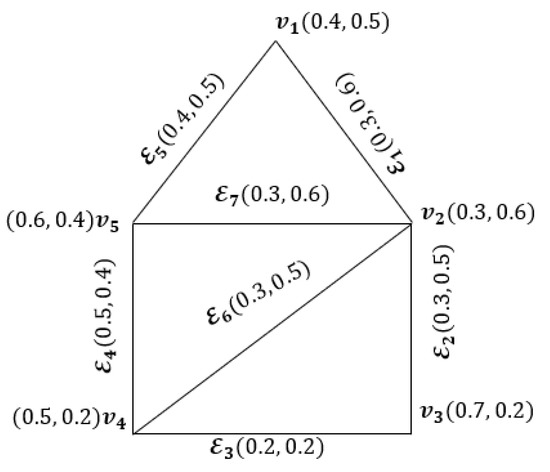
Figure 1.
Edge domination in a vague graph.
Here, is an edge dominating set and .
The edge domination number
Definition 33.
The strong neighborhood of an incidence in VIG is
.
Definition 34.
Let be a VIG. Let and be the two incidences of . We say that dominates if is the strong incidence in ℑ and adjacent to .
Definition 35.
Let be a VIG and be an edge dominating set. Then the incidence cover of in is defined as the set of all incidence to each edge in .
6. Application of Edge Domination of VIG in Road Transport Network
In this section, we consider a VIG model to illustrate a road transportation network. Since there are labeling data for vertices such as location, importance, and so on, and edges such as length, traffic, quality, etc., the best way to depict the road transportation network is to use VIG, with vertices and edges representing locations and routes.
Consider the traffic systems of various cities to determine the most common cause of accidents. To reduce the number of road accidents, several substantial measures should be done. We provide a model to solve the problem here.
Roads with a large flow of vehicles become a source of the most serious traffic accidents. Government can take measures by speed breakers, speed bumps, and deploying more traffic police to minimize road accidents. Here we apply VIG to the traffic systems of different cities.
Consider the network of VIG in Figure 2.
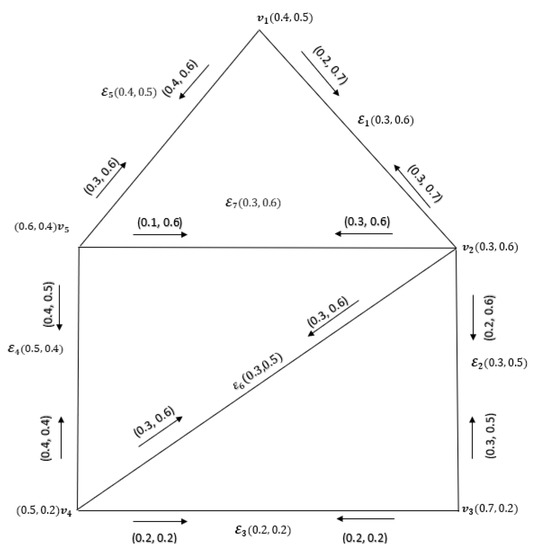
Figure 2.
Representation of edge domination in VIG.
Consider the network of VIG consisting of 5 vertices indicating different cities and the edges are the roads connecting the cities.
The flow of traffic from one city to another indicates the incidence pairs. For example, is the flow of traffic from is from . The membership value of the edges shows light motor vehicles (LMV). Non-membership values of the edges show other vehicles flowing through the roads among the different cities.
The edge dominating sets for Figure 2 are as follows:
The edge cardinalities of the dominating edge sets are
The dominating edge set has the smallest cardinality and has the largest cardinality among other dominating sets. Therefore, we conclude more LMV flows through the roads , which corresponds to the dominating set , which gives the highest percentage of road accidents.
Furthermore, the edge cardinalities are
The highest edge cardinality So, we can take measures like strictly avoiding the following:
- (i)
- Over speeding;
- (ii)
- Drunken drive;
- (iii)
- Driving in the wrong lane.
The above are the major causes of the accidents. Moreover, if these measures were taken particularly for the membership LMV, it will play a major role in minimizing road accidents.
We arrived at a similar result for non-membership also. We can apply this to a large number of inputs. Only in VIG we can get the desired values of both incidences, membership and non-membership.
7. Conclusions
The concept of IFG has a large variety of applications in computational intelligence and computer science domains. In this study, as an extension of IFG and FIG, we introduced some concepts of edge domination and incidence domination of VIG and illustrated them with some definitions and theorems. The strong and weak domination of VIG also were examined, illustrating a model for the application of edge domination and incidence domination of VIG to minimize road accidents. In the future we intend to extend our research to the energy of VIG, double domination, the strength of domination, and the coloring of VIG that can be found using domination of VIG.
Author Contributions
Conceptualization, B.A.P. and D.G.; methodology, B.A.P.; writing—original draft preparation, B.A.P.; writing—review and editing, D.G.; supervision, D.G. All authors have read and agreed to the published version of the manuscript.
Funding
The research work is supported by Vellore Institute of Technology, Vellore.
Institutional Review Board Statement
Not applicable.
Informed Consent Statement
Not applicable.
Data Availability Statement
Not applicable.
Acknowledgments
The authors wish to thank the management of Vellore Institute of Technology, Vellore-632014, for their continuous support and encouragement to carry out this research work.
Conflicts of Interest
The authors declare no conflict of interest.
References
- Atanassov, K.T.; Shannon, A. On a generalization of intuitionistic fuzzy graphs. Notes Intuit. Fuzzy Sets 2006, 12, 24–29. [Google Scholar]
- Parvathi, R.; Karunambigai, M.G. Intuitionistic fuzzy graphs. Adv. Soft Comput. 2006, 38, 139–159. [Google Scholar]
- Dinesh, T. A Study on Graph Structures. Incidence Algebras and Their Fuzzy Analogous. Ph.D. Thesis, Kannur University, Kerala, India, 2012. [Google Scholar]
- Dinesh, T. Fuzzy incidence graph—An introduction. Adv. Fuzzy Sets Syst. 2016, 21, 33–48. [Google Scholar] [CrossRef]
- Mathew, S.; Mordeson, J.N. Connectivity concepts in fuzzy incidence graphs. Inf. Sci. 2017, 382–383, 326–333. [Google Scholar] [CrossRef]
- Mathew, S.; Mordeson, J.N. Fuzzy incidence blocks and their applications in illegal migration problems. New Math. Nat. Comput. 2017, 13, 245–260. [Google Scholar] [CrossRef]
- Mordeson, J.N. Fuzzy incidence graphs. Adv. Fuzzy Sets Syst. 2016, 22, 121–133. [Google Scholar] [CrossRef]
- Mordeson, J.N.; Nair, P.S. Fuzzy Graphs and Fuzzy Hypergraphs; Physica-Verlag: Heidelberg, Germany, 2000; Volume 46. [Google Scholar]
- Mordeson, J.N.; Mathew, S. Fuzzy end nodes in fuzzy incidence graphs. New Math. Nat. Comput. 2017, 13, 13–20. [Google Scholar] [CrossRef]
- Mordeson, J.N.; Mathew, S. Fuzzy Incidence Graphs. New Math. Nat.Comput. 2017, 13, 97–106. [Google Scholar] [CrossRef]
- Somasundaram, A.; Somasundaram, S. Domination in fuzzy graph—I. Patter Recognit. Lett. 1998, 19, 787–791. [Google Scholar] [CrossRef]
- Ramakrishna, N. Vague graphs. Int. J. Comput. Cogn. 2009, 7, 51–58. [Google Scholar]
- Parvathi, R.; Thamizhendhi, G. Domination in intuitionistic fuzzy graph. In Proceedings of the 14th International Conference on Intuitionistic Fuzzy Graphs. Notes Intuit. Fuzzy Sets 2010, 16, 39–49. [Google Scholar]
- Karunambigai, M.G.; Sivasankar, S.; Palanivel, K. Different types of domination in intuitionistic fuzzy graph. Ann. Pure Appl. Math. 2017, 14, 87–101. [Google Scholar] [CrossRef]
- Nagoorgani, A.; Kavikumar, J.; Anupriya, S. Edge domination on intuitionistic fuzzy graphs. Int. J. Appl. Eng. Res. 2017, 12, 6452–6461. [Google Scholar]
- Velammal, S. Edge domination in intuitionistic fuzzy graphs. Int. J. Comput. Sci. Math. 2012, 4, 159–165. [Google Scholar]
- Nagoorgani, A.; Akram, M.; Anupriya, S. Double domination on intuitionistic fuzzy graphs. Appl. Math. Comput. 2016, 52, 515–528. [Google Scholar] [CrossRef]
- Nagoorgani, A.; Mohamed, S.Y.; Hussain, R.J. Point set domination of intuitionistic fuzzy graphs. Int. J. Fuzzy Math. Arch. 2018, 7, 43–49. [Google Scholar]
- Borzooei, R.A.; Rashmanlou, H. Domination in vague graphs and its applications. J. Intell. Fuzzy Syst. 2015, 29, 1933–1940. [Google Scholar] [CrossRef]
- Borzooei, R.A.; Rashmanlou, H. Degree of vertices in vague graphs. J. Appl. Math. Inform. 2015, 33, 545–557. [Google Scholar] [CrossRef]
- Borzooei, R.A.; Rashmanlou, H. New concepts of vague graphs. Int. J. Mach. Learn. Cybern. 2017, 8, 1081–1092. [Google Scholar] [CrossRef]
- Borzooei, R.A.; Rashmanlou, H. More results on vague graphs. UPB Sci. Bull. Series A 2016, 78, 109–122. [Google Scholar]
- Sahoo, S.; Pal, M.; Rashmanlou, H.; Borzooei, R.A. Covering and paired domination in intuitionistic fuzzy graphs. Intell. Fuzzy Syst. 2017, 33, 4007–4015. [Google Scholar] [CrossRef]
- Akram, M.; Davvaz, B. Strong intuitionistic fuzzy graphs. Filomat 2012, 26, 177–195. [Google Scholar] [CrossRef]
- Talebi, Y.; Rashmanlou, H. New concepts of domination sets in vague graphs with applications. Int. J. Comput. Sci. Math. 2019, 10, 375–389. [Google Scholar] [CrossRef]
- Bustince, H.; Burillo, P. Vague sets are intuitionistic fuzzy sets. Fuzzy Sets Syst. 1996, 79, 403–405. [Google Scholar] [CrossRef]
Publisher’s Note: MDPI stays neutral with regard to jurisdictional claims in published maps and institutional affiliations. |
© 2022 by the authors. Licensee MDPI, Basel, Switzerland. This article is an open access article distributed under the terms and conditions of the Creative Commons Attribution (CC BY) license (https://creativecommons.org/licenses/by/4.0/).