


Abstract
The main purpose of this research is to concentrate on the development of new definitions for the weighted geometric fractional integrals of the left-hand side and right-hand side of the function ℵ with regard to an increasing function used as an integral kernel. Moreover, the newly developed class of left-hand side and right-hand side weighted geometric fractional integrals of a function ℵ, by applying an additional increasing function, identifies a variety of novel classes as special cases. This is a development of the previously established fractional integrals by making use of the class of geometrically convex functions. Geometrically convex functions in weighted fractional integrals of a function ℵ in the form of another rising function yield the Hermite–Hadamard inequality type. We also establish a novel midpoint identity and the associated inequalities for a class of weighted fractional integral functions known as geometrically convex with respect to an increasing function and symmetric with respect to the geometric mean of the endpoints of the interval. In order to demonstrate the validity of our research, we present examples. Moreover, fractional inequalities and their solutions are applied in many symmetrical domains.
1. Introduction and Preliminaries
The role of simple mathematical inequalities has been rediscovered over the last several decades as a result of their application to various branches of mathematics and applied research. In reality, the evolution of mathematical inequalities is extremely closely tied to the advancements in the theory of convex function. As is well known, the origins of the theory of convex functions may be traced back to the writings of several prominent mathematicians, including Jensen, Hardy, and Hadamard. In recent decades, researchers have been engaged in stimulating arguments over the convex function.
For simplicity, let us define the real function ℵ on a non-empty interval I of the real line If the inequality holds, then the function ℵ is said to be convex on I:
holds for all and .
On the subject of convex functions, the Hermite–Hadamard integral inequality (also known as the Hadamard-type integral inequality) is perhaps one of the most celebrated conclusions ever presented.
The following inequality is well known in the literature as the Hermite–Hadamard inequality.
Theorem 1.
Let be a convex function defined on the interval I of real numbers and with The following double inequality holds:
The theory of convex sets and convex functions has received a lot of attention in recent years, and these concepts have been refined and extended in a range of fields. Thus, a wide range of Hermite–Hadamard-type inequalities and their applications have been discovered by a wide range of researchers across a wide range of fields, including mathematics, physics, biology, and chemistry. For important details about how the Hermite–Hadamard uniqueness theorem and basic convex function definitions have been improved, extended, and used, please see [1,2,3,4,5] and references therein.
Fractional calculus originated with a letter from L’Hospital to Leibniz inquiring about the notation that he was employing for the nth derivative of a linear function , . L’Hospital posed the question of what would happen if . Leibniz said, “A seeming paradox from which practical ramifications will be deduced one day.” Mathematicians are increasingly turning to fractional calculus as a strong tool. According to Sarikaya and colleagues [6], the definitions of Riemannn–Liouville integrals were used to produce a novel version of the Hermite–Hadamard inequality. This finding piqued the interest of numerous researchers, who began investigating the subject further. For further information, as well as recent results and newly discovered properties pertaining to this operator, please see [7,8,9,10,11,12,13,14,15,16].
Definition 1
([17]). A function is said to be geometrically convex (geometric arithmetically convex) if
for all and
Theorem 2.
A function is geometrically convex on I and with If then
In [18], the authors introduced the notion of geometrically symmetric functions as follows.
Definition 2.
A function , , is said to be geometrically symmetric with respect to if
The authors in [18] also proved the following Fejér-type integral inequalities, which provide a weighted generalization of (4).
Theorem 3.
A function is geometrically convex on I and with If is continuous, positive, and geometrically symmetric to , then
In [19], İşcan, İ. proved that Hermite–Hadamard inequalities can be represented for geometrically convex functions in fractional integral form as follows:
Theorem 4.
A function is geometrically convex on I and with If ℵ is a geometrically convex function on , then the following inequalities for fractional integrals hold:
In [20], Kunt, proved fractional Hermite–Hadamard–Fejér-type inequalities for geometrically convex functions:
Theorem 5.
A function is geometrically convex on I and with If is continuous, positive, and geometrically symmetric to , then
In this paper, we will prove the left-hand side and right-hand side weighted fractional and fractional Hermite-Hadamard-Fejér-type inequalities for geometrically convex functions. Moreover, we will obtain the identity for differentiable functions. Using this identity, we will establish some midpoint-type error estimations for geometrically convex functions with respect to an increasing function containing positive weighted geometrically symmetric function forms. Furthermore, we observe the validity of Theorems 6–9 in Figure 1, Figure 2, Figure 3 and Figure 4 respectively.
2. Weighted Fractional Integral
Definition 3.
Let , Let be positive, integrable, and symmetric weighted functions. If ℘ is an increasing and positive function from onto itself such that its derivative is continuous on then the left-hand side and right-hand side weighted fractional integrals of order , respectively, are given as
and
for
Remark 1.
This work shows how to assess a variety of Hermite–Hadamard–Fejér inequalities using weighted fractional operators with a positive geometrically symmetric weight function in the kernel.
3. Main Results
Throughout this paper, the functions , being a differentiable function on , the interior of I, are defined as:
and
Lemma 1.
The following results hold.
- (i)
- Let be an integrable function and geometrically symmetric weighted function with respect to with , and then we havefor every
- (ii)
- For order and ℘ is an increasing and positive function from onto itself
Proof.
Suppose that with and and then we have
Using the geometrically symmetric of with respect to , we have
Using the geometrically symmetric of we have
Hence, from the above and setting , it follows that
which brings the needed equality (12). □
4. Weighted Fractional Hermite–Hadamard-Type Inequalities for Geometrically Convex Functions
It is our goal in this section to develop some novel weighted fractional Hermite–Hadamard-type inequalities for geometrically convex functions with regard to an increasing function that has a positive weighted geometrically symmetric function form that are not previously known.
Theorem 6.
Let be a geometrically convex function such that with and Let be a positive, integrable, and geometrically symmetric weight function with respect to . If ℘ is an increasing and positive function from onto itself such that its derivative is continuous on , then the following inequalities for fractional integrals hold:
Proof.
Using the geometric convexity of the function ℵ on , we write
Choosing and , it follows that
Multiplying both sides of (14) by and integrating the resulting inequality with respect to over , we obtain
It follows that
It is possible to prove this by computing the weighted fractional operators,
Setting and , one can deduce that
By using the geometrically symmetric weighted function of Equation (11), we obtain the required calculation
As a consequence,
Finally, it has been established that the left inequality of (13) has been demonstrated. We can show the second inequality of (13) using the geometrically convex function of ℵ, which yields
Multiplying both sides of (22) by , we obtain the following by integrating the resulting inequality in terms of on .
This ends our proof. □
Remark 2.
From Theorem 6, we can obtain some special cases as follows:
- (i)
- If , then inequality (13) becomeswhere and are defined in Remark 1 part(ii).
- (ii)
- (iii)
- (iv)
Example 1.
Let , , and then and ; hence, and .
We also observe that
and
We observe the validity of Theorem 6.
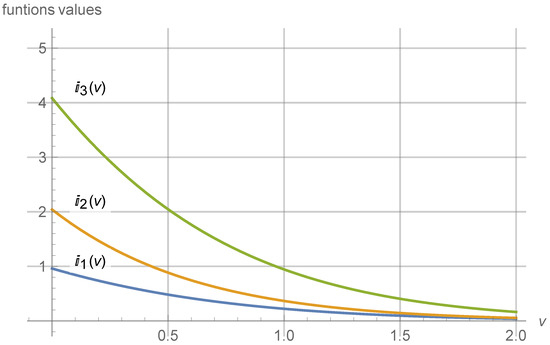
Figure 1.
Plot of the values of the functions obtained from the left-most, middle, and right-most terms in the inequality of Theorem 6.
Consider
Lemma 2.
Let and let be continuous with derivative . If is a positive, integrable, and geometrically symmetric weight function with respect to , and if ℘ is an increasing and positive function from onto itself such that its derivative is continuous on , for then
Proof.
Let
By integration by parts, applying Lemma 1 and Definition 3, we obtain
Similarly, we obtain
As a result, we can conclude,
and we achieve the intended result. □
Remark 3.
If then equality (26) becomes
We will use the following notations for the rest of this section:
Theorem 7.
Consider a scenario in which all of the Lemma 2 criteria are satisfied and is geometrically convex on and for , we have
where and have the following meanings:
Proof.
We obtain the following result by applying Lemma 2 as well as the characteristics of the modulus and the geometrically convex function of
Since is a geometrically convex function on we have
Consequently, we obtain
where
and
Using the computations shown above, we can derive the following integral:
We can derive the required result (27) by performing fundamental integral computations based on the inequality (28). □
Example 2.
Let , , and then and ; hence, and .
We also show that
and
where
We observe the validity of Theorem 7 by using all the above calculations in (29).
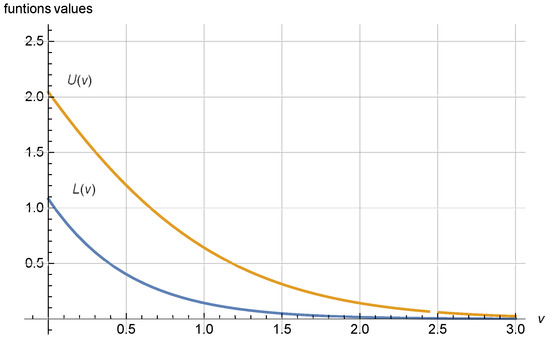
Figure 2.
A graph of the error and error bound in the inequality of Theorem 7.
Theorem 8.
Consider a scenario in which all of the Lemma 2 criteria are fulfilled and is geometrically convex on with , and the following inequality holds for :
where
and and are defined in Theorem 7.
Proof.
Using Lemma 2 as well as the properties of power mean inequality and the geometrically convex function of , we obtain
Since is a geometrically convex function on , we have
As a result, we have
where it is obvious that
By using calculations, we obtain the following inequality:
Example 3.
Let , , then and ; hence and .
We observe the validity of Theorem 8.
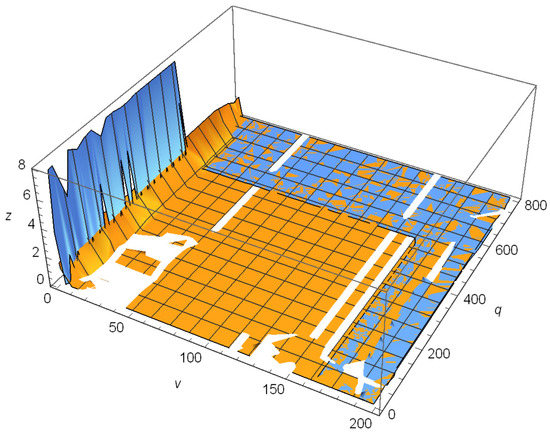
Figure 3.
A graph of the error and error bound in the inequality of Theorem 8.
Theorem 9.
Consider a scenario in which all of the Lemma 2 criteria are met and is geometrically convex on with , and then we obtain the following inequality for :
where and are defined as follows:
Proof.
Using Lemma 2 as well as the properties of Hölder inequality and the geometrically convex function of , we obtain
Since is a geometrically convex function on , we have
As a result, we obtain
where it is obvious that
and
By using calculations, we obtain the following inequality:
Example 4.
Let , , and then and ; hence, and .
We observe the validity of Theorem 9.
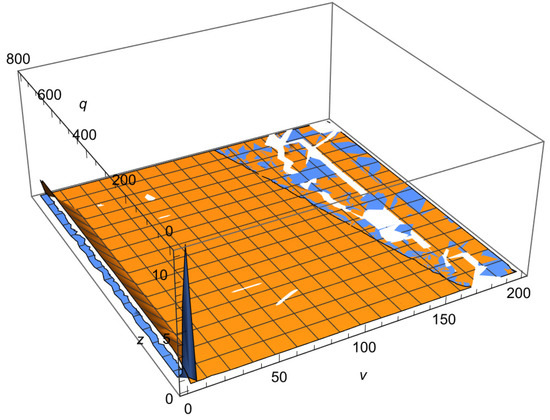
Figure 4.
A graph of the error and error bound in the inequality of Theorem 9.
5. Conclusions
In this study, we show highly important and intriguing weighted-type inequalities for a very interesting generalized class of functions, namely geometrically convex functions, using a basic weighted fractional integral operator that depends on an expanding function. Our findings not only generalize a number of findings presented in [17,18,19], but they also enable the production of a number of new results by altering the rising function involved. As a result, both young researchers and those currently working in the field of fractional integral inequality can benefit from the findings, which will open up new areas of investigation in the mathematical sciences.
Author Contributions
Writing-original, software, M.A.L. and H.K.; Writing-review and editing, Methodology, Z.A.K.; Validation, Visualization, A.A.A.-M. and H.K. All authors have read and agreed to the published version of the manuscript.
Funding
This research received no external funding.
Institutional Review Board Statement
Not Applicable.
Informed Consent Statement
Not Applicable.
Data Availability Statement
Not Applicable.
Acknowledgments
We would like to acknowledge the Princess Nourah bint Abdulrahman University Researchers Supporting Project (PNURSP2022R8), Princess Nourah bint Abdulrahman University, Riyadh, Saudi Arabia.
Conflicts of Interest
The authors declare that they have no competing interests.
References
- Hermite, C. Sur deux limites d’une intégrale dé finie. Mathesis 1883, 3, 82. [Google Scholar]
- Hadamard, J. Étude sur les propriétés des fonctions entiéres en particulier d’une function considéré par Riemann. J. Math. Pures Appl. 1893, 58, 171–215. [Google Scholar]
- Dragomir, S.S.; Agarwal, R.P. Two inequalities for differentiable mappings and applications to special means of real numbers and to trapezoidal formula. Appl. Math. Lett. 1998, 11, 91–95. [Google Scholar] [CrossRef]
- Kalsoom, H.; Hussain, S. Some Hermite-Hadamard type integral inequalities whose n-times differentiable functions are s-logarithmically convex functions. Punjab Univ. J. Math. 2019, 2019, 65–75. [Google Scholar]
- Sarikaya, M.Z.; Set, E.; Özdemir, M.E. New inequaities of Hermite-Hadamard’s type. Res. Rep. Collect. 2009, 12, 7. [Google Scholar]
- Sarikaya, M.Z.; Set, E.; Yaldiz, H.; Başak, N. Hermite-Hadamard’s inequalities for fractional integrals and related fractional inequalities. Math. Comput. Model. 2013, 57, 2403–2407. [Google Scholar] [CrossRef]
- Mohammed, P.O.; Sarikaya, M.Z. On generalized fractional integral inequalities for twice differentiable convex functions. J. Comput. Appl. Math. 2020, 372, 112740. [Google Scholar] [CrossRef]
- Kalsoom, H.; Vivas-Cortez, M.; Amer, L.M.; Ahmad, H. Weighted Midpoint Hermite-Hadamard-Fejér Type Inequalities in Fractional Calculus for Harmonically Convex Functions. Fractal Fract. 2021, 5, 252. [Google Scholar] [CrossRef]
- Mohammed, P.O.; Aydi, H.; Kashuri, A.; Hamed, Y.S.; Abualnaja, K.M. Midpoint inequalities in fractional calculus defined using positive weighted symmetry function kernels. Symmetry 2021, 13, 550. [Google Scholar] [CrossRef]
- Kalsoom, H.; Latif, M.A.; Khan, Z.A.; Vivas-Cortez, M. Some New Hermite-Hadamard-Fejér Fractional Type Inequalities for h-Convex and Harmonically h-Convex Interval-Valued Functions. Mathematics 2021, 10, 74. [Google Scholar] [CrossRef]
- Sarikaya, M.Z.; Yildirim, H. On Hermite-Hadamard type inequalities for Riemann-Liouville fractional integrals. Miskolc Math. Notes 2017, 17, 1049–1059. [Google Scholar] [CrossRef]
- İşcan, İ. Hermite-Hadamard-Fejér type inequalities for convex functions via fractional integrals. Stud. Univ. Babes Bolyai Math. 2015, 60, 355–366. [Google Scholar]
- İşcan, İ. On generalization of different type integral inequalities for s-convex functions via fractional integrals. Math. Sci. Appl. E-Notes 2014, 2, 55–67. [Google Scholar] [CrossRef][Green Version]
- Kalsoom, H.; Khan, Z.A. Hermite-Hadamard-Fejér Type Inequalities with Generalized K-Fractional Conformable Integrals and Their Applications. Mathematics 2022, 10, 483. [Google Scholar] [CrossRef]
- Jarad, F.; Abdeljawad, T.; Shah, K. On the weighted fractional operators of a function with respect to another function. Fractals 2020, 28, 12. [Google Scholar] [CrossRef]
- Kalsoom, H.; Budak, H.; Kara, H.; Ali, M.A. Some new parameterized inequalities for co-ordinated convex functions involving generalized fractional integrals. Open Math. 2021, 19, 1153–1186. [Google Scholar] [CrossRef]
- Niculescu, C.P. Convexity according to the geometric mean. Math. Inequal. Appl. 2000, 3, 155–167. [Google Scholar]
- Dragomir, S.S.; Latif, M.A.; Momoniat, E. Fejér type integral inequalities related with geometrically-arithmetically convex functions with applications. Acta Comment. Univ. Tartu. Math. 2019, 23, 51–64. [Google Scholar] [CrossRef]
- İşcan, İ. New general integral inequalities for quasi-geometrically convex functions via fractional integrals. J. Inequalities Appl. 2013, 2013, 491. [Google Scholar] [CrossRef]
- Kunt, M.; İşcan, İ. Fractional Hermite–Hadamard–Fejér type inequalities for GA-convex functions. Turk. J. Inequal 2018, 2, 1–20. [Google Scholar]
- Kilbas, A.A.; Srivastava, H.M.; Trujillo, J.J. Theory and Applications of Fractional Differential Equations; Elsevier: Amsterdam, The Netherlands, 2006. [Google Scholar]
Publisher’s Note: MDPI stays neutral with regard to jurisdictional claims in published maps and institutional affiliations. |
© 2022 by the authors. Licensee MDPI, Basel, Switzerland. This article is an open access article distributed under the terms and conditions of the Creative Commons Attribution (CC BY) license (https://creativecommons.org/licenses/by/4.0/).