


Abstract
This study provokes the existence of quantum Hermite-Hadamard inequalities under the concept of q-integral. We analyse and illustrate a new identity for the differentiable function mappings whose second derivatives in absolute value are convex. Some basic inequalities such as Hölder’s and Power mean have been used to obtain new bounds and it has been determined that the main findings are generalizations of many results that exist in the literature. We make links between our findings and a number of well-known discoveries in the literature. The conclusion in this study unify and generalise previous findings on Hermite-Hadamard inequalities.
MSC:
26A33; 26D15; 26E60
1. Introduction
When there is no limit in calculus, it is referred as q-calculus. Euler is the inventor of q-parameter and also the creator of q-calculus. Jackson began his work in a symmetrical manner in the nineteenth century and presented q-definite integrals. Q-calculus is used in a wide range of subjects, including mathematics, number theory, hyper geometry and physics. One can see in [1,2,3,4] and references therein. In q-calculus, we substitute classical derivative with difference operator, allowing you to work with sets of non-differentiable functions. Quantum difference operators are of tremendous importance because of their applications in a variety of mathematical disciplines, including orthogonal polynomials, basic hypergeometric functions, combinatorics, mechanics and the theory of relativity. Many essential concepts of quantum calculus are covered in Kac and Cheung’s book [5]. These ideas help us to develop new inequalities, which can be useful in the discovery of new boundaries.
Integral inequalities is historically viewed as a classical field of research. From classical to modern applications, inequalities have been used in mathematical analysis. In 1934, Polya and Hardy introduced classical work on inequalities. Integral inequalities plays vital role in differential equation theory. Many researchers have studied integral inequalities in classical calculus along with their applications (see [6,7,8,9]). Because the value of mathematical inequalities was well established in past, inequalities such as Hermite-Hadamard, Popoviciu’s, Steffensen-Grüss, Jensen, Hardy and Cauchy-Schwarz performed an essential role in the theory of classical calculus and q-calculus [10,11,12,13,14].
In convexity theory, Hermite-Hadamard is one of the most well known inequality, which was developed by Hermite and Hadamard (see also [15], [16] p. 137). Convexity is very simple and natural concept to solve many problems of mathematics. Convexity is growing area of research that has applications in complex analysis, number theory and many other fields. Convexity also has a significant impact on people’s lives with numerous uses in industry, medicine and business. Convex functions are studied by researchers in a variety of fields and are defined as:
Definition 1
([6]). If is convex, then for every and every , we have:
Definition 2
([17]). If is called convex, then following inequality holds
holds
Convexity has a geometrical interpretation with various applications. In accordance with these inequalities: if is a convex function on I over the real numbers and with , then
If is a concave function, both sides of inequality are in reversed manner. We can see that Hermite-Hadamard inequality come from Jensen’s inequality. Over the last few years, Hermite-Hadamard inequalities for convex functions have gotten a lot of attention, and as a result, there have been a number of refinements and generalizations.
The goal of this paper is to use the newly developed concept of -integral to investigate H-H inequality for convex functions. We also analyse how our outcomes compare to similar outcomes in the literature.
2. Description of q-Calculus
We will consider as throughout the whole article. In this part, we set up the notation given below (see Ref. [5]):
Jackson integral [3] of was described by Jackson from 0 to as follows:
provided that the sum converges absolutely.
The Jackson integral [3] of a function over the interval is as follows:
Definition 3
([18]). Let . The -derivative of f at is defined as:
Since , we can define
The function is said to be -differentiable on if exists . If we take in (3), then we have , where is a known q-derivative of at in (see Ref. [5]) given as:
Definition 4
([19]). Let . The -derivative of at is given as:
Definition 5.
Let . The second -derivative of at is given as:
Definition 6
([18]). If . Then, the -definite integral on is defined as:
In [20], researchers presented the -Hermite-Hadamard inequalities for generalized convex function in q-calculus:
Theorem 1.
Let is a convex differentiable function on , we have
For the both sides of the inequality (4), the authors defined specific boundaries in [20,21]. In [19], Bermudo et al. proposed the following definitions and derived corresponding Hermite-Hadamard inequalities.
Definition 7
([19]). Let , then -definite integral on is given as:
Theorem 2
([19]). If is convex and differentiable function on , then q-Hermite-Hadamard inequalities are given as follows:
where .
The following inequalities can be obtain from Theorems 1 and 2.
Corollary 1
([19]). With the assumptions of Theorem 2, we have
and
Theorem 3
(Hölder’s inequality, Ref. [22] p. 604). Let , . If Then
In recent years, many papers have been devoted to inequalities for quantum integrals. For some of them, one can refer to [23,24,25,26,27,28,29,30].
3. Main Results
Now, we present some novel Hermite-Hadamard inequalities with the concept of quantum integral.
Lemma 1.
Let is a twice -differentiable function on such that and integrable on , we have:
Proof.
By using Definition 5, we have
Also,
and
From (2) and Definition 7,
Multiplying both sides of (12) by we get required identity. □
Remark 1.
By putting and taking limit in Lemma 1, we get
which is given in [31].
Theorem 4.
If is a twice -differentiable function on such that and integrable on , then we have following inequality, provided that is convex on
Proof.
Taking modulus on Lemma 1 and then using convexity of , we obtain following
Hence the theorem is proved. □
Remark 2.
By taking limit as and in Theorem 4, we get following Trapezoidal inequality:
which is given by Sarikaya and Aktan in [32], Proposition 2.
Example 1.
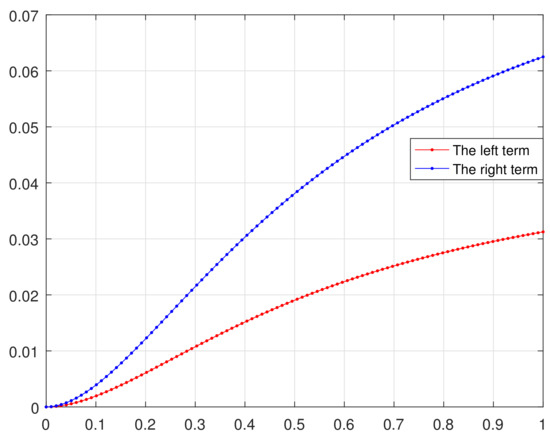
Let consider the convex function defined by and let and Under these assumptions, we have
Then the left hand side of the inequality (13) reduces to
On the other hand, by Definition 5, we get
Hence, we have
and
Therefore, the right hand side of the inequality (13) reduces to
By the inequality (13), we have the inequality
Figure 1.
An example to the inequality (13).
Theorem 5.
Let is a twice -differentiable function on and and integrable on If is convex on , we have the following inequality:
Proof.
By applying modulus on Lemma 1 and applying Power mean inequality, we get
Applying convexity of , we have
Hence we get required results. □
Remark 3.
By taking and then taking in Theorem 5, we get
which is given by Ali et al. in [33].
Theorem 6.
Let is a twice -differentiable function on and and integrable on If is convex on , for some and , then we have,
where .
Proof.
Take modulus on Lemma 1 and then, applying well-known Hölder’s inequality, we get
Since is convex, we have
Using the fact that
the required result can be obtained. □
Remark 4.
By taking and in Theorem 6, we get
where is Euler Beta function.
Theorem 7.
By using the assumptions of Theorem 6, following inequality holds
where
Proof.
Applying modulus in Lemma 1 and also using well-known Hölder’s inequality, we get
As is convex, we have
One can easily see that
and
We get the required results. □
Remark 5.
By taking and in Theorem 7, we have
and
Moreover, the inequality (16) reduces to the following inequality
4. Conclusions
The main findings of our study are designed to prove quantum Hermite-Hadamard inequalities utilizing the idea of convex function to get improved outcomes. Furthermore, we demonstrated that the newly discovered inequalities are strong generalizations of similar findings in the literature. Adopting the novel approach, we extended the study of Hermite-Hadamard type integral inequalities using Power-mean and Hölder’s integral inequalities. It is interesting to extend such findings for other convexities. We presume that our newly announced concept will be the focus of much research in this fascinating field of inequalities and analysis.
Author Contributions
Conceptualization, S.I.B.; writing—original draft preparation Q.U.A. and S.I.B.; writing—review and editing, H.B. and P.X.; methodology, S.I.B. and H.B.; validation, H.B.; investigation, S.I.B. and Q.U.A.; resources, Q.U.A.; data curation, P.X.; supervision, H.B.; formal analysis, S.I.B.; visualization, H.B. All authors have read and agreed to the published version of the manuscript.
Funding
This work was funded in part by the National Natural Science Foundation of China (grant no. 62002079).
Institutional Review Board Statement
Not applicable.
Informed Consent Statement
Not applicable.
Data Availability Statement
Not applicable.
Conflicts of Interest
The authors declare no conflict of interest.
References
- Ernst, T. A Comprehensive Treatment of Q-Calculus; Springer: Basel, Switzerland, 2012. [Google Scholar]
- Bokulich, A.; Jaeger, G. Philosophy of Quantum Information Theory and Entanglement; Cambridge University Press: Cambridge, UK, 2010. [Google Scholar]
- Jackson, F.H. On a q-definite Integrals. Q. J. Pure Appl. Math. 1910, 41, 193–203. [Google Scholar]
- Al-Salam, W. Some Fractional q-Integrals and q-Derivatives. Proc. Edinb. Math. Soc. 1966, 15, 135–140. [Google Scholar] [CrossRef] [Green Version]
- Kac, V.; Cheung, P. Quantum Calculus; Springer: Berlin, Germany, 2001. [Google Scholar]
- Mitrinovic, D.S.; Pecaric, J.E.; Fink, A.M. Classical and New Inequalities in Analysis; Mathematics and Its Applications (East European Series); Kluwer Academic Publishers Group: Dordrecht, The Netherlands, 1993; Volume 61. [Google Scholar]
- Agarwal, R.P.; Wong, P.J.Y. Error Inequalities in Polynomial Interpolation and Their Applications; Kluwer Academic Publishers: Dordrecht, The Netherlands, 1993. [Google Scholar]
- Qin, Y. Integral and Discrete Inequalities and Their Applications; Springer International Publishing: Basel, Switzerland, 2016. [Google Scholar]
- Butt, S.I.; Pečarić, J.; Perić, I. Refinement of Integral Inequalities for Monotone Functions. J. Inequal. Appl. 2012, 2012, 301. [Google Scholar] [CrossRef] [Green Version]
- Agarwal, P.; Dragomir, S.S.; Jleli, M.; Samet, B. Advances in Mathematical Inequalities and Applications; Springer: Singapore, 2018. [Google Scholar]
- Butt, S.I.; Bakula, M.K.; Pečarić, J. Steffensen-Grüss Inequality. J. Math. Inequal. 2012, 15, 799–810. [Google Scholar] [CrossRef]
- Butt, S.I.; Pečarić, J.; Vukelić, A. Generalization of Popoviciu type Inequalities Via Finḱs Identity. Mediterr. J. Math. 2016, 13, 1495–1511. [Google Scholar] [CrossRef]
- Butt, S.I.; Pečarić, J.; Praljak, M. Reversed Hardy Inequality for C-monotone Functions. J. Math. Inequal. 2016, 10, 603–622. [Google Scholar] [CrossRef] [Green Version]
- Baleanu, D.; Mohammed, P.O.; Zeng, S. Inequalities of trapezoidal type involving generalized fractional integrals. Alex. Eng. J. 2020, 59, 2975–2984. [Google Scholar] [CrossRef]
- Dragomir, S.S.; Pearce, C.E.M. Selected Topics on Hermite-Hadamard Inequalities and Applications; RGMIA Monographs; Victoria University: Melbourne, Australia, 2000. [Google Scholar]
- Pečarić, J.E.; Tong, Y.L. Convex Functions, Partial Orderings, and Statistical Applications; Mathematics in Science and Engineering; Academic Press, Inc.: Boston, MA, USA, 1992; p. 187. [Google Scholar]
- Mihesan, V.G. A Generalization of the Convexity, Seminar On Functional Equations, Approximation and Convexity. Cluj-Napoca, Romania. 1993. Available online: https://scholar.google.com/citations?view_op=view_citation&hl=en&user=8KOa8k8AAAAJ&citation_for_view=8KOa8k8AAAAJ:a0OBvERweLwC (accessed on 4 July 2022).
- Tariboon, J.; Ntouyas, S.K. Quantum calculus on finite intervals and applications to impulsive difference equations. Adv. Differ. Equ. 2013, 282, 282. [Google Scholar] [CrossRef] [Green Version]
- Bermudo, S.; Korus, P.; Valdés, J.N. On q-Hermite Hadamard inequalities for general convex functions. Acta Math. Hung. 2020, 162, 364–374. [Google Scholar] [CrossRef]
- Alp, N.; Sarikaya, M.Z.; Kunt, M.; Iscan, I. q-Hermite Hadamard inequalities and quantum estimates for midpoint type inequalities via convex and quasi-convex functions. J. King Saud Univ.-Sci. 2018, 30, 193–203. [Google Scholar] [CrossRef] [Green Version]
- Noor, M.A.; Noor, K.I.; Awan, M.U. Some quantum estimates for Hermite Hadamard inequalities. Appl. Math. Comput. 2015, 251, 675–679. [Google Scholar] [CrossRef]
- Anastassiou, G.A. Intelligent Mathematics: Computational Analysis; Springer: New York, NY, USA, 2011. [Google Scholar]
- Mohammed, P.O. Some integral inequalities of fractional quantum type. Malaya J. Mat. 2016, 4, 93–99. [Google Scholar]
- Zhao, D.; Ali, M.A.; Luangboon, W.; Budak, H.; Nonlaopon, K. Some generalizations of different types of quantum integral inequalities for differentiable convex functions with applications. Fractal Fract. 2022, 6, 129. [Google Scholar] [CrossRef]
- Zhao, D.; Gulshan, G.; Ali, M.A.; Nonlaopon, K. Some new midpoint and trapezoidal-type inequalities for general convex functions in q-calculus. Mathematics 2022, 10, 444. [Google Scholar] [CrossRef]
- Sitthiwirattham, T.; Murtaza, G.; Ali, M.A.; Promsakon, C.; Sial, I.B.; Agarwal, a.P. Post-quantum midpoint-type inequalities associated with twice-differentiable functions. Axioms 2022, 11, 46. [Google Scholar] [CrossRef]
- Almutairi, O.B. Quantum estimates for different type intequalities through generalized convexity. Entropy 2022, 24, 728. [Google Scholar] [CrossRef]
- Korus, P.; Valdes, J.E.N. q-Hermite-Hadamrd inequalities for functions with convex or h-convex q-derivarive. Math. Inequal. Appl. 2022, 25, 601–610. [Google Scholar]
- Kalsoom, H.; Ali, M.A.; Abbas, M.; Budak, H.; Murtaza, G. Generalized quantum Montgomery identity and Ostrowski type inequalities for preinvex functions. TWMS J. Pure Appl. Math. 2022, 13, 72–90. [Google Scholar]
- Budak, H. Some trapezoid and midpoint type inequalities for newly defined quantum integrals. Proyecciones 2021, 40, 199–215. [Google Scholar] [CrossRef]
- Alomari, M.W.; Darus, M.; Dragomir, S.S. New inequalities of Hermite Hadamard type for functions whose second derivatives absolute values are quasi-convex. Tamkang J. Math. 2010, 41, 353–359. [Google Scholar] [CrossRef] [Green Version]
- Sarikaya, M.Z.; Aktan, N. On the generalization of some integral inequalities and their applications. Math. Comput. Model. 2011, 54, 2175–2182. [Google Scholar] [CrossRef]
- Ali, M.A.; Budak, H.; Abbas, M.; Chu, Y.M. Quantum Hermite-Hadamard-type inequalities for functions with convex absolute values of second qb-derivatives. Adv. Differ. Equ. 2021, 2021, 7. [Google Scholar] [CrossRef]
Publisher’s Note: MDPI stays neutral with regard to jurisdictional claims in published maps and institutional affiliations. |
© 2022 by the authors. Licensee MDPI, Basel, Switzerland. This article is an open access article distributed under the terms and conditions of the Creative Commons Attribution (CC BY) license (https://creativecommons.org/licenses/by/4.0/).