1. Introduction
Double Roman domination of graphs [
1] is motivated by many applications at the present time and in the past [
2]. Initially, modern studies of Roman domination [
3,
4] were inspired by a real problem from the 4th century, when the Old Roman Emperor Constantine was faced with a problem of how to defend his empire with a limited number of armies. The decision was taken to allocate two types of military units to the empire provinces. Some units were able to move quickly from one province to another to respond to any attack. The second type were the local militia. These armies were permanently positioned in their home province. Emperor Constantine ordered that no legion should ever leave the province to defend the second, if in this case the first province remains undefended. Consequently, there were two armies at some provinces, and at some other provinces only local militia units were stationed. Some provinces had no permanent presence of an army, and were guarded by the armies from neighbouring provinces. Although the classical problem is still of interest in military operations research [
5], it also can be used to model and solve the problems where a time-critical service needs to be provided with some reserve. For example, a first aid emergency station should never send all its crew to answer an emergency call.
Following the reasoning above, understanding the double Roman domination problem and its variants may be crucial for positioning the fire stations, first aid stations, etc. at optimal positions. This may greatly improve the public services at no extra cost. A natural generalization of double Roman domination is the
k-Roman domination [
6]. In case of emergency services,
k teams are planned to be quickly available in case of severe emergency calls. The special case,
, is called double Roman domination.
The decision version of the double Roman domination problem (MIN-DOUBLE-RDF) is known to be NP-complete, also in cases when we are restricted to some special classes of graphs, for example, to planar graphs, bipartite graphs, chordal (bipartite) graphs, circle graphs, and to undirected path graphs [
7,
8,
9]. Due to the intractability of the problem, several avenues of research are of interest. For example, studies of the complexity of the problem for special families of graphs has been performed in the past. The results include linear time algorithms for interval graphs and block graphs [
8], for trees [
10], for proper interval graphs [
11], and for unicyclic graphs [
9]. Another popular way to explore are attempts to find closed expressions for the double Roman domination number of some graph families. Among popular examples are generalized Petersen graphs and some of their subfamilies that have been extensively studied recently. The published results include (see the subsection on related previous work) closed expressions for the double Roman domination number of some, and tight bounds for other subfamilies [
12,
13,
14,
15]. For more related work, we refer to [
16,
17,
18,
19] and the references there.
Here, in
Section 2.4, we summarize the previously known results on double Roman domination of generalized Petersen graphs
for
and provide improved new general bounds for arbitrary
c. The rest of the paper is organized as follows. In
Section 2 we summarize some basic definitions and previous results which are used in the following sections. In particular, our main result is outlined in
Section 2.5. The constructions and proofs are in
Section 3,
Section 4,
Section 5 and
Section 6. In the last section, we discuss the asymptotics and compare the new bounds to the best previously known.
2. Preliminaries
The definitions in the following subsections are recalled from [
20].
2.1. Graphs and Double Roman Domination
Assume is a graph without loops and multiple edges. Let be the vertex set of G and its edge set. A set is called a dominating set of G if every vertex in has at least one neighbour in D. The cardinality of a minimum dominating set of G is called the domination number . A double Roman dominating function (DRDF) on a graph is a function with the properties that
- (1)
every vertex u with is adjacent to at least one vertex assigned 3 or at least two vertices assigned 2, and
- (2)
every vertex u with is adjacent to at least one vertex assigned 2 or 3.
For an arbitrary subset define the weight of f on U as . Then, the weight of f equals . The double Roman domination number of a graph G is the minimum weight of a double Roman dominating function of G. A DRD function f is called a -function of G if .
Let f be a double Roman dominating function on G. We define the corresponding double Roman dominating partition of the vertex set , where .
The study of the double Roman domination in graphs was initiated by Beeler et al. [
1]. It was proved that
, and observed that in a double Roman dominating function
f of weight
, no vertex needs to be assigned the value 1.
2.2. Generalized Petersen Graphs
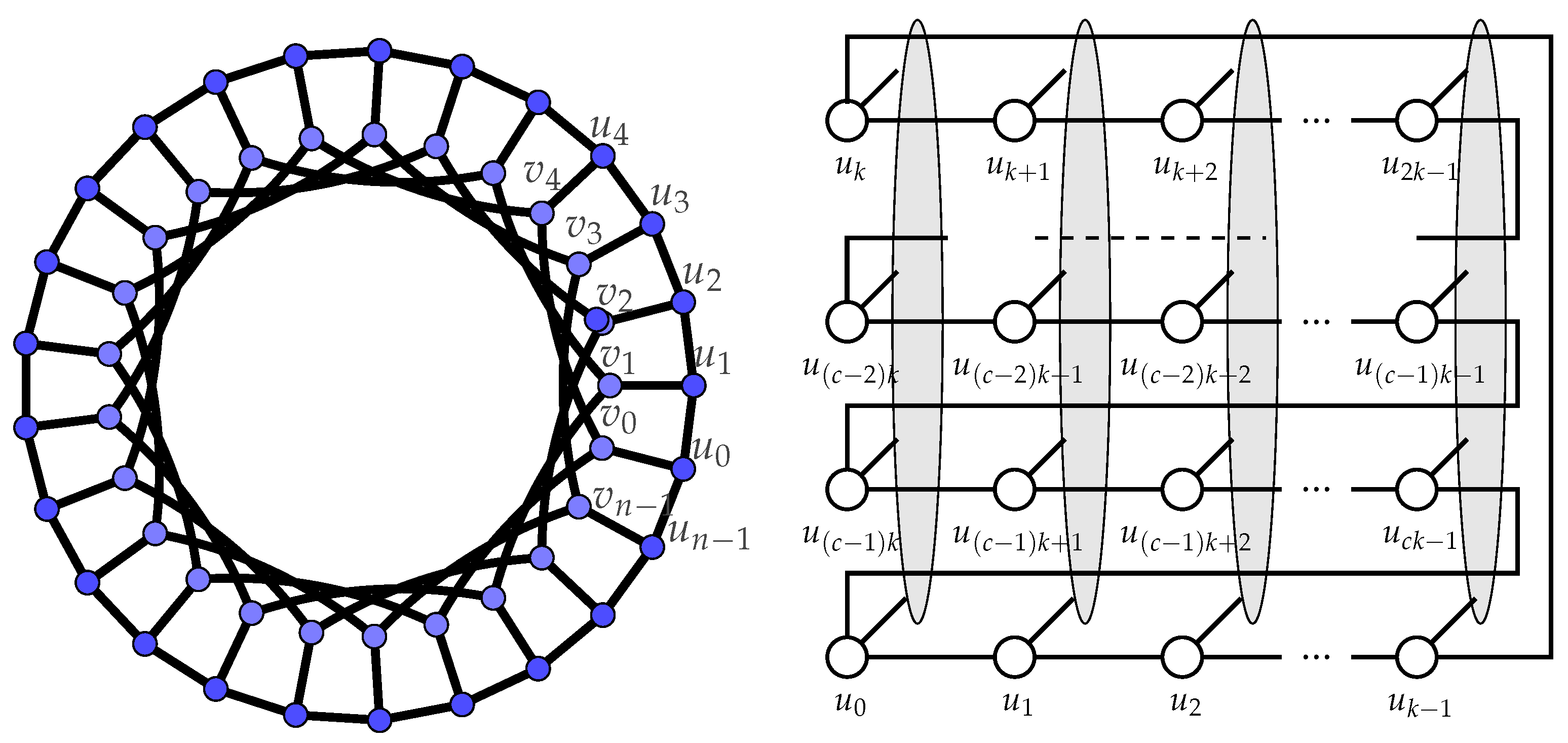
The generalized Petersen graph
is a graph with vertex set
and edge set
, where
,
,
,
,
. All subscripts are reduced modulo
n (see
Figure 1). Thus we identify integers
i and
j iff
.
It is well known that the graphs
are 3-regular unless
and that
are highly symmetric [
21,
22]. As
and
are isomorphic, it is natural to restrict attention to
with
and
k,
.
In this paper, we study generalized Petersen graphs for which
. In this case, the graph
has, in addition to the long outer cycle,
k shorter cycles of length
c, called the inner cycles (see
Figure 1, right). For graphs
, we will also use the following notation. We denote
Observe that each of the sets meets all the inner cycles, and vertices of are exactly the neighbors of on the outer cycle.
Petersen graphs are among the most interesting examples when considering nontrivial graph invariants [
23]. In particular, the domination and its variations, such as Roman domination and double Roman domination have been extensively studied in the last years.
2.3. Graph Covers
Following the approach used in [
24], we will summarize the basic definition of a covering graph. Let
and
be two graphs, and let
be a surjection. We say
p is a covering map from
H to
G if for each
, the restriction of
p to the neighbourhood of
is a bijection onto the neighbourhood of
in
G. In other words,
p maps edges incidental to
v one-to-one onto edges incidental to
. If there exists a covering map from
H to
G, we will call
H a covering graph, or a lift, of
G.
H is called an
h-lift of
G if
p has a property that for every vertex
, its
fiber has exactly
h elements. For some more information on covering graphs see [
25].
Obviously, a long cycle can be a covering graph of shorter cycles. For example, the cycle is a 2-lift of , using the surjection . Furthermore, is also a 30-lift of , etc.
2.4. Related Previous Work
To ensure better transparency, we have gathered most of the important results of the previous work in the following
Table 1,
Table 2 and
Table 3.
The double Roman domination number on Petersen graphs
for small
c (
, 4 and 5) has been studied in recent years. The results are summarized in
Table 3.
In [
20], it has been proven that certain generalized Petersen graphs are covering graphs of some other generalized Petersen graphs.
Proposition 1 ([
20])
. Let , , and . The generalized Petersen graph is an h-lift of . Proposition 1 immediately provides a method for establishing upper bounds for double Roman domination numbers of h-lifts.
Proposition 2 ([
20])
. .
2.5. Our Results
The main results of this paper are either exact values or narrow bounds for the double Roman domination numbers of all Petersen graphs , , .
More precisely, we will prove the following theorem.
Theorem 1. Let , and .
If and k odd, then If and k odd, then
3. Constructions and Proofs—Overview
Below we first observe that applying Propositions 1 and 2 gives exact values of double Roman domination number for all where and k odd.
The second tool is provided by two constructions that transform
to
and
to
by deleting some vertices and adding some edges. It is shown in Propositions 3 and 4 that the result of the construction indeed is isomorphic to
and to
. Based on the first construction, the upper bounds for
are established for arbitrary
c by using exact values for
, where
and
k odd (see
Section 5). The second construction allows extension of the results to even
k (elaborated upon in
Section 6).
4. The Constructions
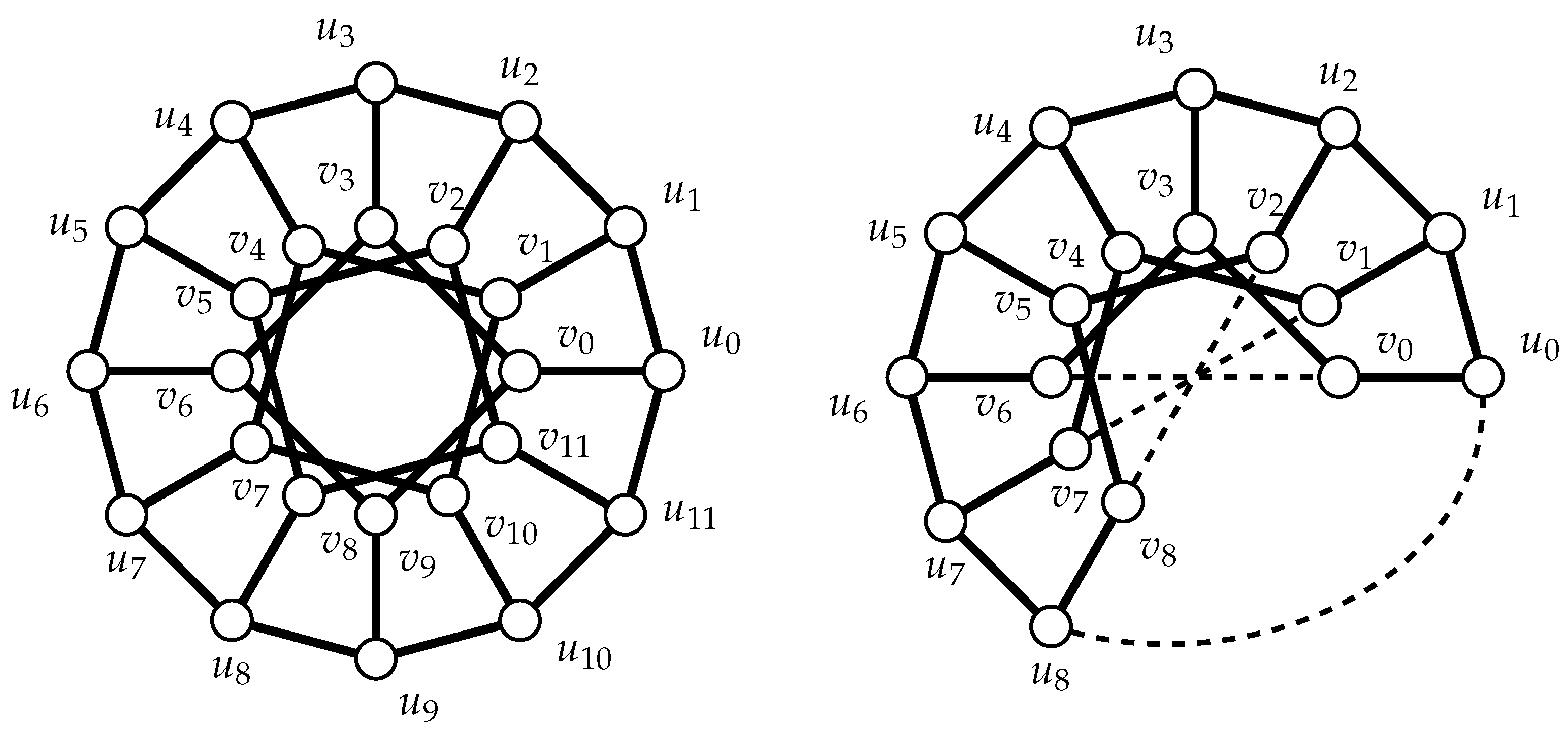
In the continuation we will heavily use the following construction which produces the graph from .
Construction 1. Start with.
Delete vertices
and
and delete all edges incident to these vertices.
Add edgeson the inner cycles and edgeon the outer cycle.
The construction is illustrated on example, from
to
(see
Figure 2).
Proposition 3. Construction Section 4 on results in the graph . Proof. Obviously, by the construction, each last vertex of each inner cycle is deleted, together with its neighbor on the outer cycle. The labels of the remaining vertices are the same as the standard labeling of , and it is easy to see that the construction adds exactly the edges that are missing to obtain . □
Obviously, repeated construction results in graphs and .
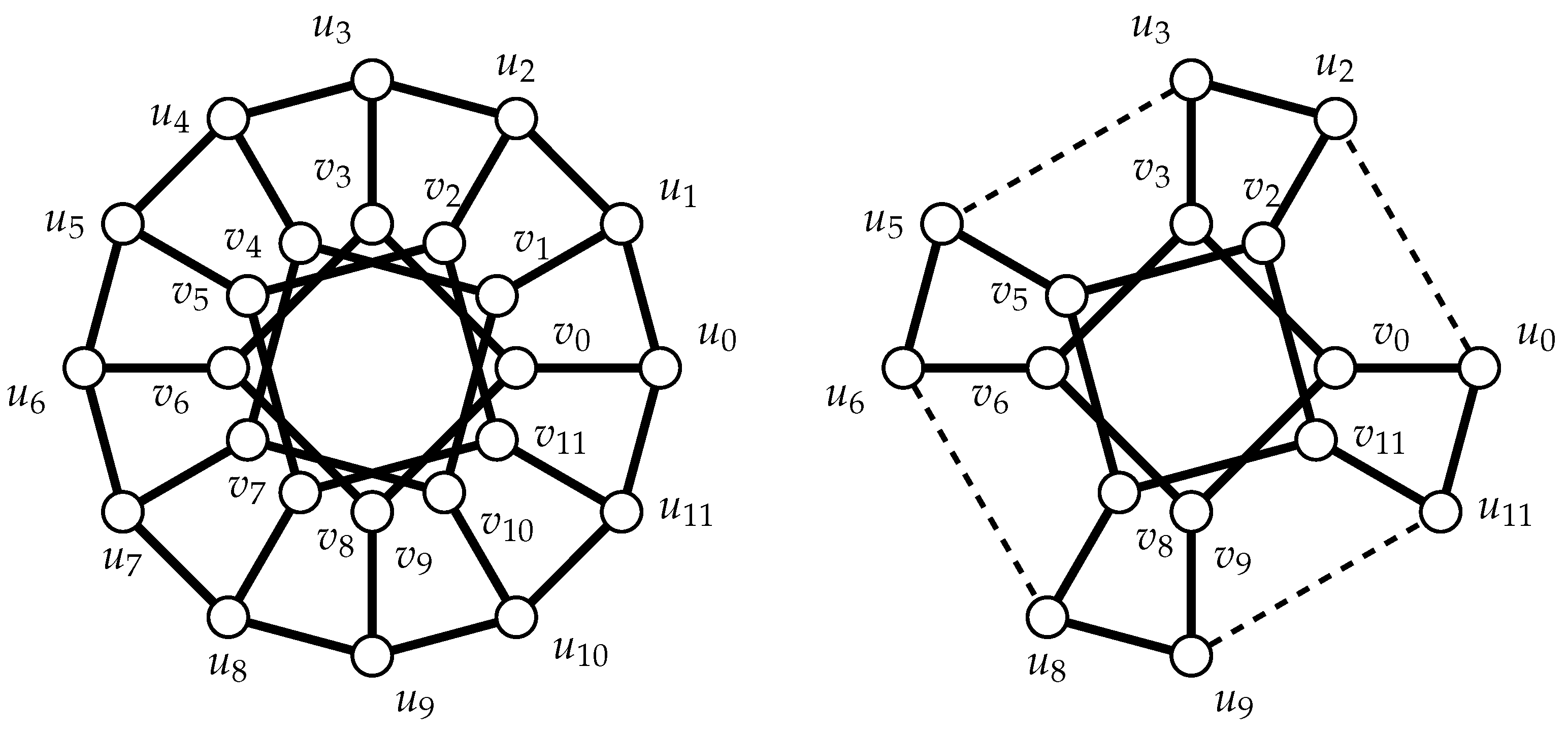
The second construction transforms to .
Construction 2. Start with. Choose.
Delete the verticesand vertices of the corresponding inner cycleand delete all edges incident to these vertices.
Add edges for .
The construction is illustrated on example, from
to
(see
Figure 3).
Proposition 4. Construction Section 4 on results in the graph that is isomorphic to . Proof. (Sketch.) Recall that the Petersen graph consists of a long outer cycle and k inner cycles of length c.
Let us choose one inner cycle and delete its vertices and all edges incident to these vertices. The resulting graph has exactly c vertices of degree 2 on the outer cycle. Deleting these vertices and replacing each of the paths of length two with a new edge clearly results in a graph that has cycles of length c, and one long (outer cycle of length . Observe that this graph is isomorphic to . We omit obvious technical details. □
We continue with explicit constructions of double Roman dominating sets that directly imply upper bounds, and, in some cases, exact values of .
5. Odd k
Recall that for odd
k, exact values of double Roman domination number are known, namely (see
Table 3)
In this section we first generalize this result to obtain exact values of for (or, ). Then we consider the cases where , and provide double Roman dominating functions implying upper bounds in each case.
5.1. Case 0 mod 4
Proposition 5. Let and .
If , then .
Proof. Let . Then, Propositions 1 and 2 imply
is a h-lift of and, consequently,
.
Recalling the general lower bound ([
13], see
Table 3) we conclude that the statement holds. □
For later use, observe that application of Proposition 1 provides explicit construction of the double Roman dominating partition. More precisely, for example,
is a double Roman domination partition for
of minimal weight. We call this partition the basic double Roman domination partition of
. Let
f be the corresponding double Roman dominating function. Then
for
and
otherwise.
Looking more closely to the partition, if
, then by trivial counting we observe that
It is useful to observe that summing up the weight of the sets for any two consecutive indices gives
, i.e.,
Also note that in the case
, by similar reasoning, we have
and, again,
for all
i.
Let us summarize the observations for a later reference formally.
Proposition 6. Let and k odd. Then the basic double Roman dominating partition of :gives rise to a double Roman domination function f that is a -function. Furthermore, for the function f, it holds thatandFurthermore, if then and
if then and
Obviously, for
, starting with double Roman domination partitions (indices are taken modulo
)
gives rise to double Roman domination function
that is a
-function. Clearly
, the basic double Roman domination partition.
5.2. Case 3 mod 4
According to Proposition 3, we know that can be obtained from by Construction 1.
Proposition 7. If , and , then .
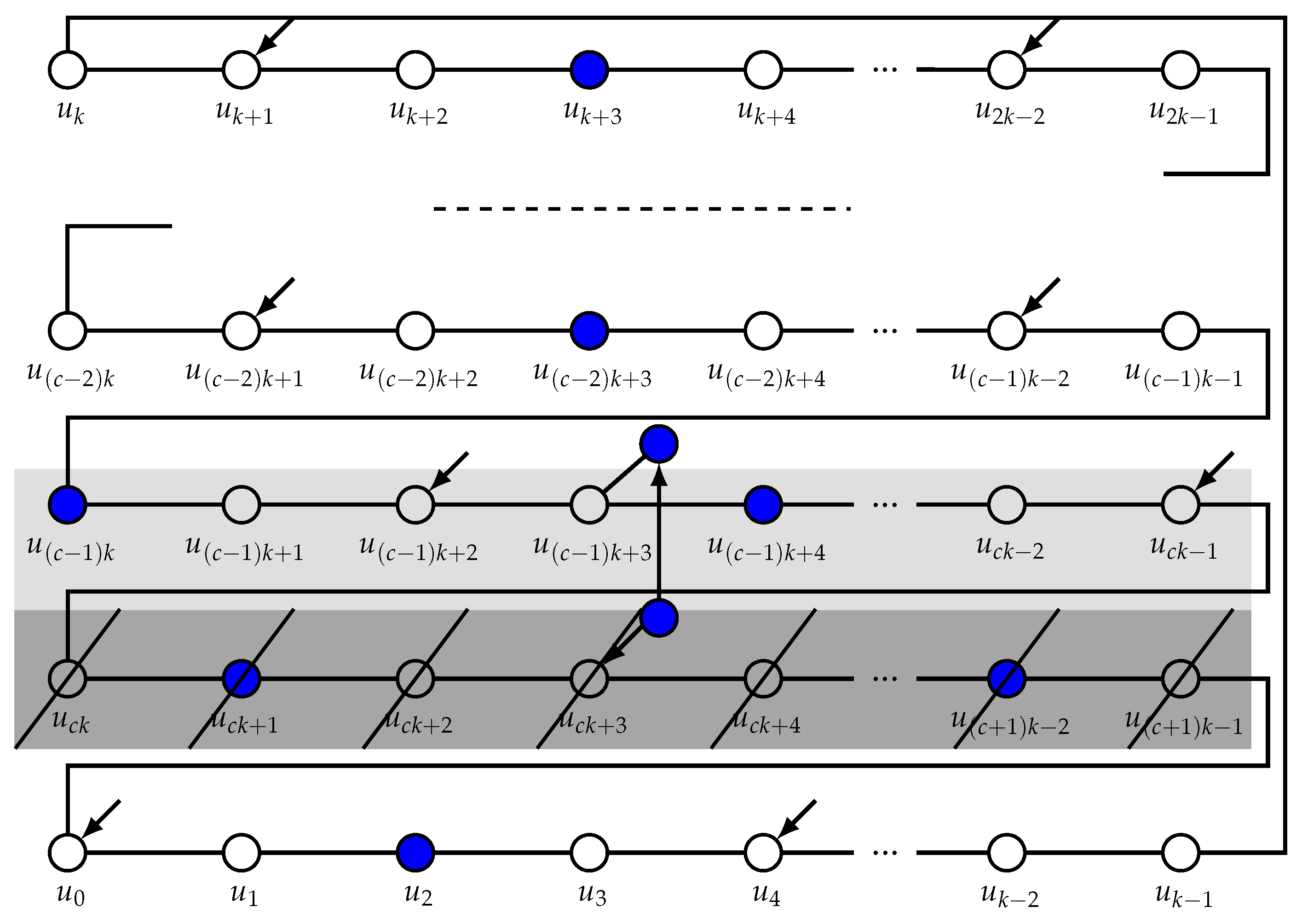
Proof. Let and let f be the double Roman dominating function of as defined above. Recall Construction 1 and note that and .
First assume, that . Define on as follows.
It is straightforward to observe that, by definition,
dominates all vertices on the inner cycle. On the outer cycle, the only interesting part are vertices
. By the basic assignment (see Equation (
7)), we know that
, and
. Furthermore,
and
are dominated by
, because
and
. See
Figure 4 below. We conclude that
is a double Roman dominating function of
.
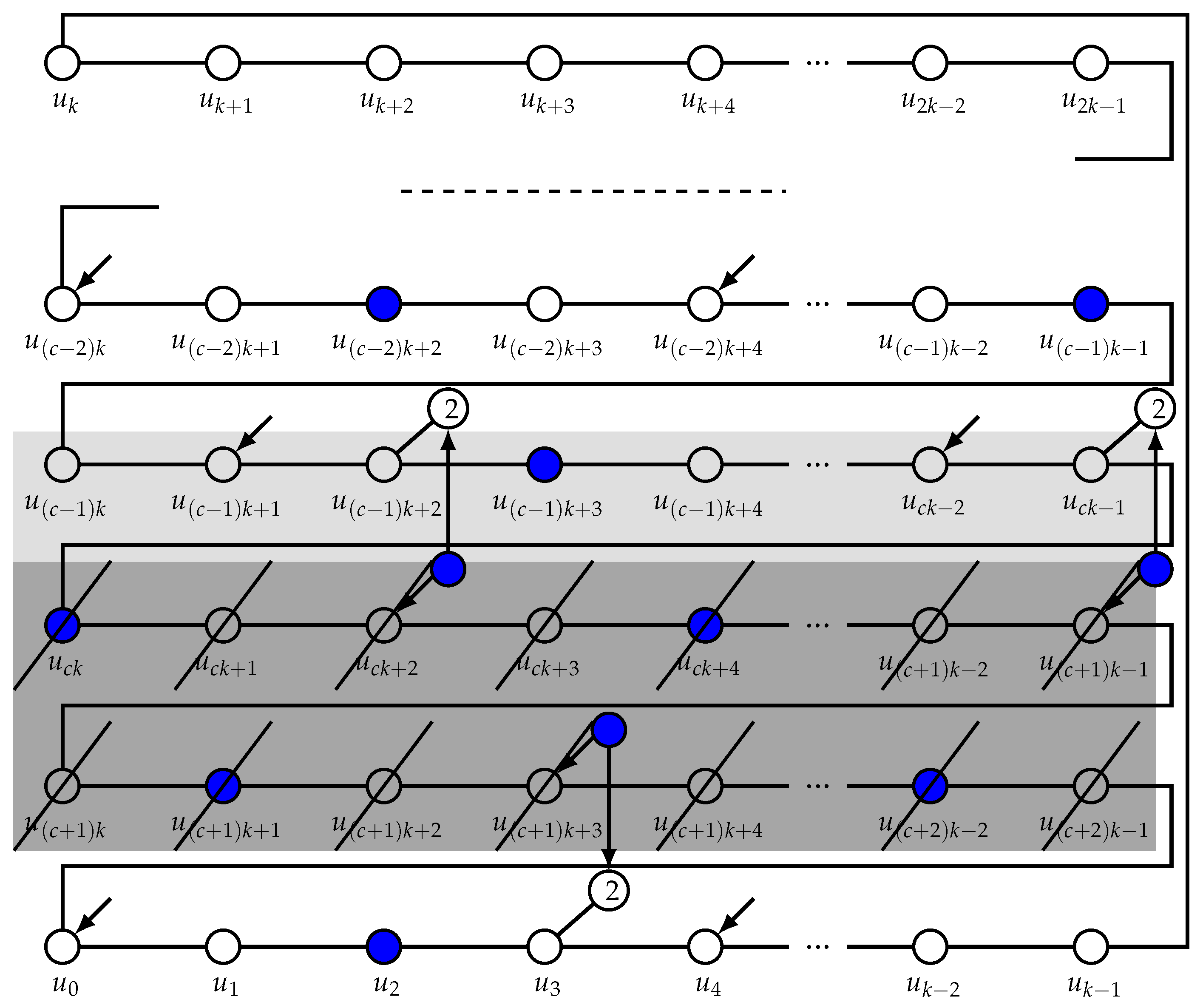
Now recall that, by Proposition 6, if then and It follows that , as needed.
The case can be treated similarly. Instead of D, is used (with ). We omit the details. □
5.3. Case 2 mod 4
According to Proposition 3, we know that is obtained from by Construction 1.
Proposition 8. If , and , then .
Proof. Let and let f be the double Roman dominating function of as defined above.
Define on as follows. (Recall that Construction 1 was applied twice.)
for
for
For , let , and set
For , let , and set
Observe that, by construction, is a double Roman dominating function of .
To compute the weight of
, recall that by Proposition 6
and hence
thus, the total additional weight assigned is
, because the weights transferred were multiplied by
. It follows that
, as claimed (see
Figure 5). □
5.4. Case 1 mod 4
According to Proposition 3, we know that can be obtained from by Construction 1, applied three times.
Proposition 9. If , and , then .
Proof. Let and f be the double Roman dominating function of as defined above.
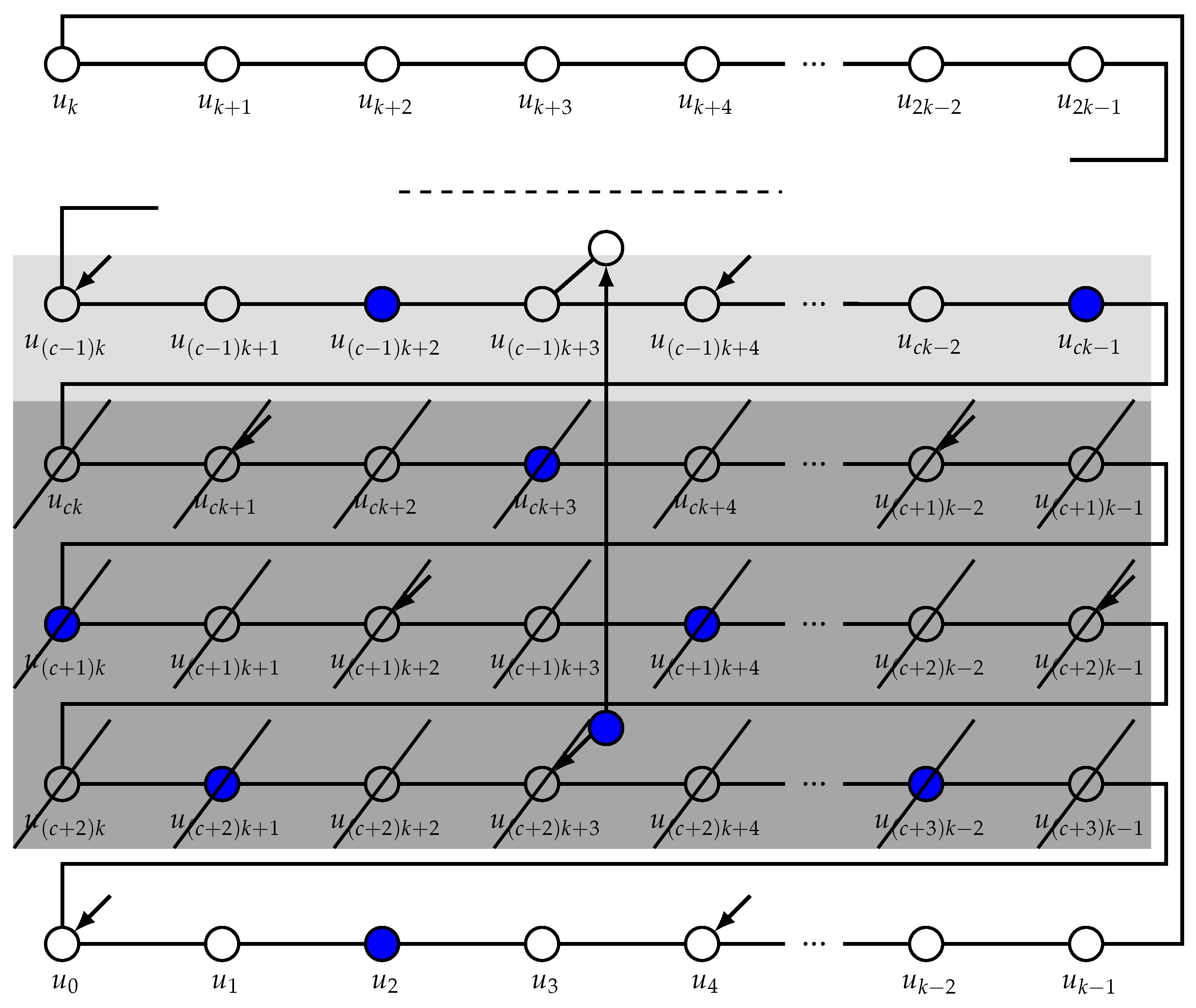
Recall Construction 1 and assume . Define on as follows.
Observe that, by construction,
is a double Roman dominating function of
and
, as needed (see
Figure 6). We omit the details.
The case is analogous. We skip the details. This completes the proof. □
6. Even k
For even k, we start with DRD functions for constructed in the previous considerations (Propositions 5–9). The upper bounds for for k even will be established by using the next observation.
Proposition 10. Assume f is a DRDF for . Then there is a DRDF for of weight .
Proof. Let f be a DRDF for . Recall Construction 2. By Proposition 4, if we choose any , delete the inner cycle , , and the corresponding K-th “column” of vertices , we obtain a graph that is isomorphic to .
Define a DRDF on , using the original labeling of , as follows.
for .
For we know that for some j and define .
For we know that for some j and define .
Recall that the basic double Roman dominating partition for with and k odd was higly symmetrical, in the sense that . Furthermore, in the proofs of Propositions 7–9, DRDF’s were constructed such that the property was preserved. Therefore, we can choose K such that the weight of the inner cycle is not under average, i.e., .
We conclude that, by construction,
is a double Roman dominating function of
, and
as needed. □
The Proposition just proved directly implies the next statement.
Proposition 11. ,
We are now ready to prove the upper bounds in case k is even.
Proposition 12. Let , then
- 1.
If , then .
- 2.
If , then .
- 3.
If , then .
- 4.
If , then .
Proof. By Proposition 5 we have for and odd. From the proof of Proposition 5, we have explicit definition of a -function f, with the property that for all i. By Proposition 10, there is a DRD function . Hence .
The other three cases follow from Propositions 7–9 by analogous reasoning. □
7. Conclusions and Future Work
Based on the previously known constructions of DRDF’s for , the upper bounds for double Roman domination numbers of were derived, using the notion of graph covers and some new constructions of DRDF’s.
It may be of interest to compare the upper bounds of Theorem 1 with the bounds given by Gao et al. [
12] (see
Table 2). Let us take
and compare the following cases based on formula by Gao et al. below.
- 1.
Case . Both formulas give exact value.
- 2.
Case
. Theorem 1 gives either
or
depending on
c. As
we conclude that Theorem 1 improves the upper bound of [
12] in these cases.
- 3.
Case
. Reasoning along the same lines as in the previous case shows that Theorem 1 also improves the upper bound of [
12] in these cases.
- 4.
Case
. As we assume
, it follows that we must have
and
c must be odd. Theorem 1 thus assures the upper bound
. Because
we conclude that in this case the upper bound in Theorem 1 does not improve the general bound of [
12].
- 5.
Case
Now we cannot extract any condition on
c so we compare
with the upper bound
and conclude that for large enough
k, the upper bound of Theorem 1 is better, whereas for the large
c, the bound of [
12] is not improved.
- 6.
Case . Compare with to conclude that in this case, the bound of Theorem 1 does not improve the general bound.
- 7.
Case
. In this case, comparing
and
leads to the conclusion that Theorem 1 improves the general bounds for large enough
k, and that for large
c, the bound of [
12] is not improved.
We can thus conclude that Theorem 1 in several cases improves the previously known general upper bound. The new bounds hold for all c and k, and are asymptoticaly the best possible, as the following corollary formally states.
Corollary 1. For the double Roman domination number of generalized Petersen graphs of large graphs the following holds.
- (1)
, where when .
- (2)
, where .
- (3)
.
The proof of Corollary 1 follows from Theorem 1.