Abstract
In this paper, we develop an efficient spectral method for numerically solving the nonlinear Volterra integral equation with weak singularity and delays. Based on the symmetric collocation points, the spectral method is illustrated, and the convergence results are obtained. In the end, two numerical experiments are carried out to confirm the theoretical results.
Keywords:
nonlinear delay Volterra integral equation; weak singularity; spectral method; convergence analysis MSC:
65R20; 45E05
1. Introduction
Volterra integral equations with weakly singular kernels arise in various areas, including prey–predator and competitive models, superfluidity, stereology, crystal growth, and the radiation of heat from a semi-infinite solid. More information about these equations can be found in [1,2,3,4,5,6,7].
In this paper, we shall investigate the nonlinear weakly singular Volterra integral equation with delays of the following form:
where is the unknown function, and are given constants. and G are given functions, where
Assume that all the functions in the above equation are sufficiently smooth. Without loss of generality, we used the prey–predator and competitive models to explain the biological background of this equation. Here, represents the numbers of eagles and snakes, respectively. On the one hand, eagles prey on snakes. These two kinds of species have different memories of killing and being killed. The parameters p and q depend on the memories of the eagles and snakes, respectively. On the other hand, eagles compete with snakes. They also take mice as prey. This complex relationship between predation and competition is illustrated by the nonlinear kernel function . In the end, the resource function represents the birth rates of the two species.
Research for solving high-dimensional weakly singular Volterra type equations has received much attention. For theoretical results, a class of two-dimensional Volterra type integral equations with singular boundary lines was proposed in [8]. Then, multidimensional Volterra type integral equations with singular boundary domains and kernels were considered by Rajabov [9]. For numerical results, collocation methods [10] were applied for solving two-dimensional weakly singular equations, which arise in the field of electrical engineering. In 2015, accuracy-optimal numerical methods for multidimensional equations were discussed [11]. However, the convergence efficiency in two of the above-mentioned references is not high.
It is well known that the spectral method is an efficient numerical method. One of the main reasons for this is that the method can be exponentially convergent. In [12], a spectral Jacobi collocation method was first proposed for solving linear Volterra integral equations of the second kind with weakly singular kernels, under the condition that the solutions of the equations were sufficiently smooth. Later, Volterra equations with weak singularity approximated by the spectral method received considerable attention. In [13], the authors extended the field of research to weakly singular Volterra integro-differential equations successfully. Spectral approximation for weakly singular Volterra integral equations with pantograph delays was studied in [14]. Chebyshev collocation methods were constructed to approximate weakly singular Volterra integral equations in [15]. A fractional order collocation method for second-kind Volterra integral equations with weakly singular kernels was considered in [16]. However, all these articles mentioned above dealt with the case of a linear situation. Yang et al. [17] discussed spectral collocation methods for the nonlinear Volterra integro-differential equations with weakly singular kernels and presented a rigorous convergence analysis. For more information related to this topic, we refer readers to to [18,19,20,21].
To our knowledge, there are fewer theoretical results from the spectral method available in the literature for nonlinear Volterra integral equations with weak singularity and delays in two-dimensional space. The aim of this paper is to develop the numerical solution of a two-dimensional nonlinear Volterra integral equation with weak singularity and delays. The novelty of our work lies not only in the use of the two-dimensional Gauss quadrature rule to approximate the integral with delays but also in the spectral error analysis for the Jacobi spectral collocation method.
The rest of this paper is organized as follows. In Section 2, we construct a spectral discretization scheme. Some useful spaces and lemmas are given in Section 3. The convergence analysis is proven in Section 4. In Section 5, some numerical examples are presented to verify the theoretical analysis. Section 6 is devoted to some concluding remarks.
2. Spectral Discretization
In this section, a spectral discretization scheme is established to solve Equation (1). First, three transformations are employed so that the Gauss quadrature rule can be applied expediently. Then, we introduce the Lagrange interpolation polynomial and define the approximate solution. Finally, we obtain the nonlinear numerical scheme through the help of spectral discretization.
Let , where each point is denoted by in . In order to use the theory of orthogonal polynomials, we first make the following linear transformations:
Then, we continue to give another couple of variable transformations, where
The set of collocation points in the two-dimensional space is denoted by , where and are the Gauss points in one dimension equipped with the weights and , respectively, and they are symmetrical. Obviously, Equation (3) holds at each two-dimensional collocation point such that
To apply the Gauss quadrature rule, we need to transform the integral domain of the double integral into by the following variable changes:
where , and then Equation (4) becomes
where
Using the Gauss integration formula, the integration term in Equation (7) can be approximated by
Let denote the Lagrange interpolation polynomial such that
where are the Lagrange interpolation basis functions associated with the collocation points and , respectively, and satisfies
Let and , where
Then, the spectral collocation method is used to seek a value that satisfies the following nonlinear system:
We can obtain the values by a proper solver, and at the same time, the approximate solution can also be obtained by the expression in Equation (9).
3. Some Spaces and Lemmas
In this section, we introduce some useful spaces and lemmas which are essential for establishing the Jacobi convergence analysis in the next section.
Now, we introduce three spaces. First, let denote a Banach space in which the measurable functions are bounded outside a set measuring zero with the following norm:
Then, let , and we can introduce another Banach space:
whose inner product and norm are given by
The third space is
which is endowed with the norm
and the semi-norm
Then, we can introduce seven important lemmas. They are essential for the derivation of error analysis in the next section.
Lemma 1
([22] Gronwall inequality). Suppose that nonnegative integrable functions and satisfy
where M is a nonnegative constant. Then, we have
Remark 1.
Throughout the paper, C denotes a generic positive constant which is independent of N but depends on T and the given functions.
Lemma 2
([23]). Let denote the space of all polynomials of a degree not exceeding N. Assume that the product is integrated by the Gauss quadrature formula, where for some and . Then, the following is true:
where
Lemma 3
([24]). Let , and it can be concluded that
Lemma 4
([23,25]). Assume that for , and denote as its interpolation polynomial associated with the collocation points . Then, the results of estimates are
Lemma 5
([26,27]). For a nonnegative integer r, and where , there exists a constant that makes any function hold a polynomial function such that
where
Obviously, is a linear operator from into .
Lemma 6
([28]). Let and be defined by
Then, for any functions , there exists a positive constant C such that
for any different couple of points . This implies that
Lemma 7
([29]). For every bounded function , there is a constant C not relying on , leading to
4. Jacobi Convergence Analysis
In this section, Jacobi convergence analysis is carried out. We first obtain the error equation using Equation (7), the discrete numerical scheme in Equation (10), two transformations (Equations (5) and (6)) and the definition of the approximation solution. Then, we present the error estimates precisely and derive the exponential rate of convergence in both the and spaces.
Theorem 1.
Let be the exact solution of Equation (3), which is sufficiently smooth. Assume that is the approximate solution and is the error function. If , and satisfies
Then, we obtain the following conclusion:
where
Proof.
By multiplying on both sides of Equation (28) and summing up from to N, then we obtain the following error equation:
where
Under the hypothesis of Theorem 1, we arrive at
In addition, through Lemma 1, we obtain that
Using Lemmas 2 and 3, the following holds true:
Drawing support from the condition of Equation (24) once more, we find that
Using the first conclusion in Lemma 4 yields
Due to Lemmas 5 and 6, we find that
Owing to Equations (30)–(35), we reach the conclusion for easily. Next, we will carry out the error analysis in the space.
With the help of Equation (29) and Gronwall inequality, we have that
By virtue of the first lemma and the last lemma, we obtain the following:
Using Lemma 4, we obtain that
According to Lemmas 5–7, we reach the following:
5. Numerical Experiments
In this section, we carry out the numerical experiments with a Thinkpad laptop. The environment was a 2.50 GHz Inteli5-3230M CPU with 4.0 GB of memory, and the operating system was Windows XP. Two numerical examples will be provided to confirm the theoretical analysis: one is the special case (i.e., ), and the other is the normal situation. For more details, see the following.
Example 1.
We consider Equation (3) to be
where a binary tangent function is selected as the exact solution, and we choose
Therefore, the following is true:
Starting from , the system of approximate equations has a unique solution. Here, we let and and carried out the numerical experiment supported by Matlab, and the resulting nonlinear discrete numerical scheme in Equation (10) was solved. The CPU time was 11.0953 s. The errors in the norm and norm are found in Table 1.
Table 1.
The errors for and .
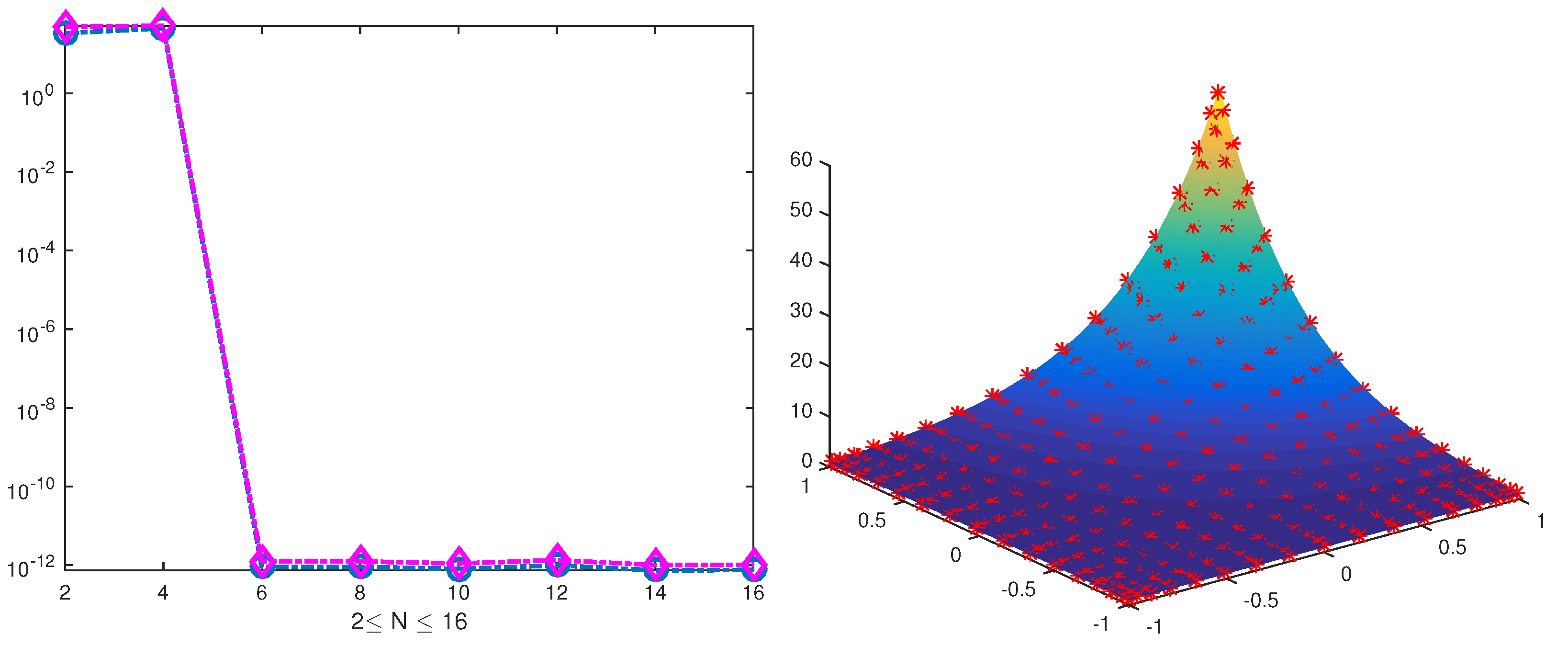
To show the exponential rate of convergence more visually, we exhibit the errors on the left side of Figure 1. Moreover, the high consistence between the exact solution and the approximate solution is also presented, which is located on the right side of Figure 1.
Figure 1.
The errors in the and norms (left) and the consistence between the exact solution and approximate solution (right).
Example 1.
Without losing generality, we substitute
and
into Equation (3). Please refer to
Then, after calculation, we have
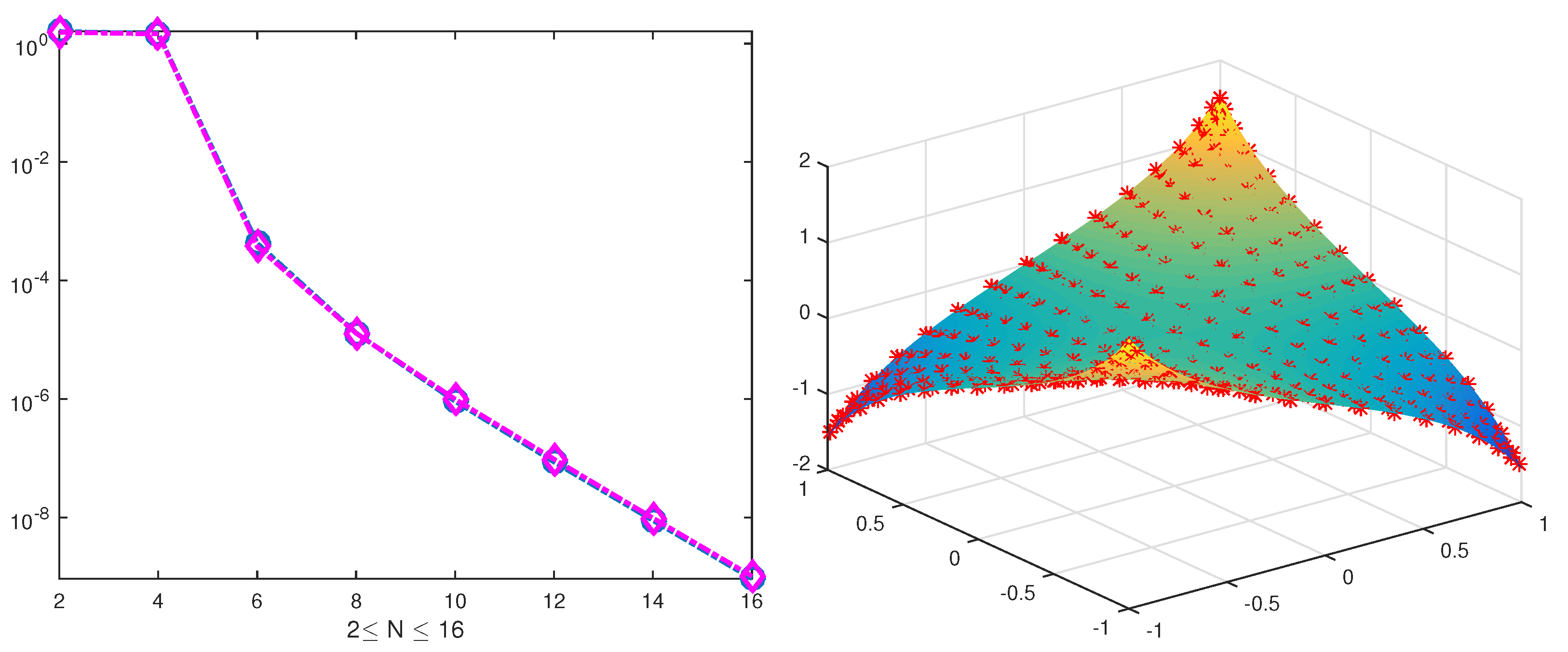
For any given , the approximation solution could be obtained by the spectral method. Then, we chose and as representatives. We carried out the numerical test using Matlab as well. We obtained the result that both kinds of errors decayed exponentially. The corresponding numerical errors are shown in Table 2. It can be seen that the exponential rate of convergence was achieved.
Table 2.
The errors for and .
Furthermore, in order to show this more clearly, we exhibit the exponential convergence rate in Figure 2, which is illustrated by two subgraphs. The left subgraph demonstrates two kinds of errors, and the excellent consistency between the exact solution and approximate solution is presented in the right subgraph. Based on the shown table and figures, one can easily find that numerical simulation highly agreed with the result obtained by theoretical analysis.
Figure 2.
The errors in the and norms (left) and the consistency between the exact solution and approximate solution (right).
6. Concluding Remarks
In this paper, we presented an efficient numerical method for solving the two-dimensional nonlinear Volterra integral equation with weak singularity and delays and developed the spectral approximation schemes carefully. Then, the rigorous convergence results were obtained. Some numerical experiments were carried out to confirm the theoretical analysis. The numerical results demonstrated that the exponential rate of convergence was obtained. It is worth mentioning that our work greatly improved the convergence efficiency compared with those in [10,11]. In the future, we will investigate an efficient numerical method for multidimensional Volterra integral equation with delays.
Author Contributions
Software, N.W. and W.G.; Writing—review and editing, W.Z. All authors have read and agreed to the published version of the manuscript.
Funding
This work was supported by a research project of the Guangdong Provincial Education Department (2021KTSCX071, HSGDJG21356-372), Guangdong Key Laboratory for Functional Substances in Medicinal Edible Resources and Healthcare Products (2021B1212040015) and a project of Hanshan Normal University (521036).
Institutional Review Board Statement
Not applicable.
Informed Consent Statement
Not applicable.
Data Availability Statement
Not applicable.
Conflicts of Interest
The authors declare no conflict of interest.
References
- Keller, J.B.; Olmstead, W.E. Temperature of a nonlinear radiating semi-infinite solid. Q. Appl. Math. 1972, 29, 559–566. [Google Scholar] [CrossRef][Green Version]
- Levinson, N. A nonlinear Volterra equation arising in the theory of super-fluidity. J. Math. Anal. Appl. 1960, 1, 1–11. [Google Scholar] [CrossRef]
- Linz, P. Analytical and Numerical Methods for Volterra Equations; SIAM: Philadelphia, PA, USA, 1985. [Google Scholar]
- Ladopoulos, E.G. Singular Integral Equations-Linear and Non-Linear Theory and Its Applications in Science and Engineering; Springer: Berlin/Heidelberg, Germany, 2000. [Google Scholar]
- Rasty, M.; Hadizadeh, M. A product integration approach based on new orthogonal polynomials for nonlinear weakly singular integral equations. Acta Appl. Math. 2010, 109, 861–873. [Google Scholar] [CrossRef]
- Jerri, A. Introduction to Integral Equations with Applications; John Wiley Sons: Chichester, UK, 1999. [Google Scholar]
- Vainikko, G. Multidimensional Weakly Singular Integral Equations; Springer: Berlin/Heidelberg, Germany, 1993. [Google Scholar]
- Rajabova, L. About a class of two dimensional Volterra type integral equations with singular boundary line. In Current Trends in Analysis and Its Applications; Mityushev, V., Ruzhansky, M., Eds.; Springer: Berlin/Heidelberg, Germany, 2015; pp. 123–131. [Google Scholar]
- Rajabov, N. Multidimensional Volterra type integral equation with singular boundary domains in kernels. Dokl. Akad. Nauk. 2011, 437, 158–161. [Google Scholar] [CrossRef]
- Graham, I. Collocation methods for two dimensional weakly singular integral equations. ANZIAM J. 1981, 22, 456–473. [Google Scholar] [CrossRef]
- Boykov, I.V.; Tynda, A.N. Numerical methods of optimal accuracy for weakly singular Volterra integral equations. Ann. Funct. Anal. 2015, 6, 114–133. [Google Scholar] [CrossRef]
- Chen, Y.; Tang, T. Spectral methods for weakly singular Volterra integral equations with smooth solutions. J. Comput. Appl. Math. 2009, 233, 938–950. [Google Scholar] [CrossRef]
- Wei, Y.; Chen, Y. Convergence analysis of the spectral methods for weakly singular Volterra integro-differential equations with smooth solutions. Adv. Appl. Math. Mech. 2012, 4, 1–20. [Google Scholar] [CrossRef]
- Zhang, R.; Zhu, B.; Xie, H. Spectral methods for weakly singular Volterra integral equations with pantograph delays. Front. Math. China 2013, 8, 281–299. [Google Scholar] [CrossRef]
- Liu, X.; Chen, Y. Convergence analysis for the Chebyshev collocation methods to Volterra integral equations with a weakly singular kernel. Adv. Appl. Math. Mech. 2016, 9, 1506–1524. [Google Scholar] [CrossRef]
- Cai, H.; Chen, Y. A fractional order collocation method for second kind Volterra integral equations with weakly singular kernels. J. Sci. Comput. 2018, 75, 970–992. [Google Scholar] [CrossRef]
- Yang, Y.; Chen, Y. Spectral collocation methods for nonlinear Volterra integro-differential equations with weakly singular kernels. Bull. Malays. Math. Sci. Soc. 2019, 42, 297–314. [Google Scholar] [CrossRef]
- Li, D.; Zhang, C.; Wang, S. Long time behavior of non–Fickian delay reaction–diffusion equations. Nonlinear Anal. Real World Applitions 2012, 13, 1401–1415. [Google Scholar] [CrossRef]
- Li, D.; Zhang, C. Long time numerical behaviors of fractional pantograph equations. Math. Comput. Simul. 2020, 172, 244–257. [Google Scholar] [CrossRef]
- Zheng, W.; Chen, Y. A spectral method for a weakly singular Volterra integro-differential equation with pantograph delay. Acta Math. Sci. 2022, 42, 387–402. [Google Scholar] [CrossRef]
- Li, D.; Zhang, J.; Zhang, Z. Unconditionally optimal error estimates of a linearized Galerkin method for nonlinear time fractional reaction-subdiffusion equations. J. Sci. Comput. 2018, 76, 848–866. [Google Scholar] [CrossRef]
- Headley, V.B. A multidimensional nonlinear Gronwall inequality. J. Math. Anal. Appl. 1974, 47, 250–255. [Google Scholar] [CrossRef][Green Version]
- Canuto, C.; Hussaini, M.Y.; Quarteroni, A.; Zang, T.A. Spectral Methods Fundamentals in Single Domains; Springer: Berlin/Heidelberg, Germany, 2006. [Google Scholar]
- Fedotov, A.I. Lebesgue constant estimation in multidimensional Sobolev space. J. Math. 2004, 14, 25–32. [Google Scholar]
- Wei, Y.; Chen, Y.; Shi, X.; Zhang, Y. Spectral method for multidimensional Volterra integral equation with regular kernel. Front. Math. China 2019, 14, 435–448. [Google Scholar] [CrossRef]
- Ragozin, D.L. Polynomial approximation on compact manifolds and homogeneous spaces. Trans. Am. Math. Soc. 1970, 150, 41–53. [Google Scholar] [CrossRef]
- Ragozin, D.L. Constructive polynomial approximation on spheres and projective spaces. Trans. Am. Math. Soc. 1971, 162, 157–170. [Google Scholar]
- Wei, Y.; Chen, Y.; Shi, X. A spectral collocation method of multidimensional nonlinear weakly singular Volterra integral equation. J. Comput. Appl. Math. 2018, 331, 52–63. [Google Scholar] [CrossRef]
- Nevai, P. Mean convergence of Lagrange interpolation. Trans. Am. Math. Soc. 1984, 282, 669–698. [Google Scholar] [CrossRef]
Publisher’s Note: MDPI stays neutral with regard to jurisdictional claims in published maps and institutional affiliations. |
© 2022 by the authors. Licensee MDPI, Basel, Switzerland. This article is an open access article distributed under the terms and conditions of the Creative Commons Attribution (CC BY) license (https://creativecommons.org/licenses/by/4.0/).