Abstract
We propose a new “superpotential” and find that neither the supersymmetric energy conditions nor the associated shape invariance conditions remain valid. On the other hand, a new energy condition between the two partner Hamiltonians emerges. A mathematical proof supports the present findings, with examples being presented. It is observed that when the superpotential is associated with discontinuity or distortion, the SUSY energy conditions and the shape invariance conditions will no longer hold well. The above formalism is also valid in complex space for models involving -symmetry.
PACS:
no-03.65.Ge; 11.30.Pb
1. Introduction
In physics, symmetry plays a major role in understanding different aspects of physical phenomena. Sometimes the symmetry is either visible or invisible (hidden). Similarly, sometimes symmetry is either broken or unbroken. In fact, Bose-Fermi symmetry or supersymmetry that relates bosons (particles with spin 0 or integer) and fermions (particles with half odd integral spin) were originally used to construct theories for the possible unification of internal symmetry with ordinary space–time symmetry. In 1981, Witten [1] considered a model supersymmetry that remains unbroken at the free level, but broken by small corrections [2]. This promoted many authors at the front level to propose a model to visualize “breaking in supersymmetry (SUSY) [3,4,5,6,7,8,9]”. Some of the interesting analyses on SUSY are: supersymmetry breaking in low-dimensional models [3], supersymmetry breaking in a quantum phase transition [4], dynamical supersymmetry breaking on quantum moduli spaces [5], breaking scale in atomic clocks [6], some experimental evidence of supersymmetry breaking [7], and metastable supersymmetry breaking [8]. Despite this analysis, Feldstein and Yanagida [9] discussed a general method, asking why is the supersymmetry breaking scale unnaturally high, considering CP violation, Peccei–Quinn (PQ) symmetry violation, and the non-conservation of R-parity, etc. However, in a very recent paper by Cai et al. [10], they observed supersymmetry breaking in a trapped ion quantum simulator. Similar papers on SUSY breaking have been discussed using the Rabi model [11,12]. In this context, we would like to point out that Cai et al.’s [10] work explains breaking using the Rabi type of model. On the other hand, supersymmetry in the quantum mechanics (SUSYQM) took a new turn in introducing the “shape invariance” property by Gendeshtein [13] (where the Schroedinger equation need not be solved in finding the supersymmetric energy condition). This novel idea triggers many interesting models [14,15,16,17,18,19,20,21,22,23,24,25,26,27,28,29,30,31,32,33,34,35] such as: harmonic oscillator, Morse oscillator, Rosen–Morse, Eckrat, Poshi-teller, etc., justifying the validity of “shape-invariance” (SI) in nature. However, these model potentials are only confined to real space but not in complex space. In complex space, the operators need to satisfy the PT-symmetry condition, (). It should be remembered that PT-invariant systems are mainly non-self-adjoint operators [36,37,38,39,40,41,42,43,44] (). Here, we highlight the basic features of PT-invariant systems as follows, saying that P stands for a parity invariant operator having the following properties: and . Similarly, T stands for the time-reversal operator and has the properties , , and . In this case, the commutation relation between coordinate and momentum remains invariant, i.e., . In fact, in this paper, we formulate a new model of superpotential and a new symmetry that remains valid in real as well as complex space. Further, we study the limitations of supersymmetric energy conditions (SUSYEC) and shape invariance (SI). Below, we first highlight a few important features of supersymmetric energy conditions (SUSYEC), as follows.
2. Supersymmetric Energy Conditions (SUSYEC) and Shape Invariance (SI) Relations
Let us consider an annihilation operator
satisfying the condition
Now, we select another operator B as
Now, using the above two operators , we have
and
Here, are related as per the algebraic structure as
with
and
satisfying the following relations as: , and ; and and .
From the assumed relation , we can write
This implies
Further, let
and
then
This means that is an eigenfunction of having eigenvalue . Similarly, we can write
In other words, the eigenvalues and eigenfunctions of two Hamiltonians are interrelated, i.e.,
and
The above energy relations are known as supersymmetric energy conditions (SUSYEC).
Shape Invariance Condition
Let
Here, and is independent of x [13]. Here, we present the previous analysis [13] and consider that is a set of parameters, then one can construct a hierarchy of Hamiltonians as
and considering and , then
or simply
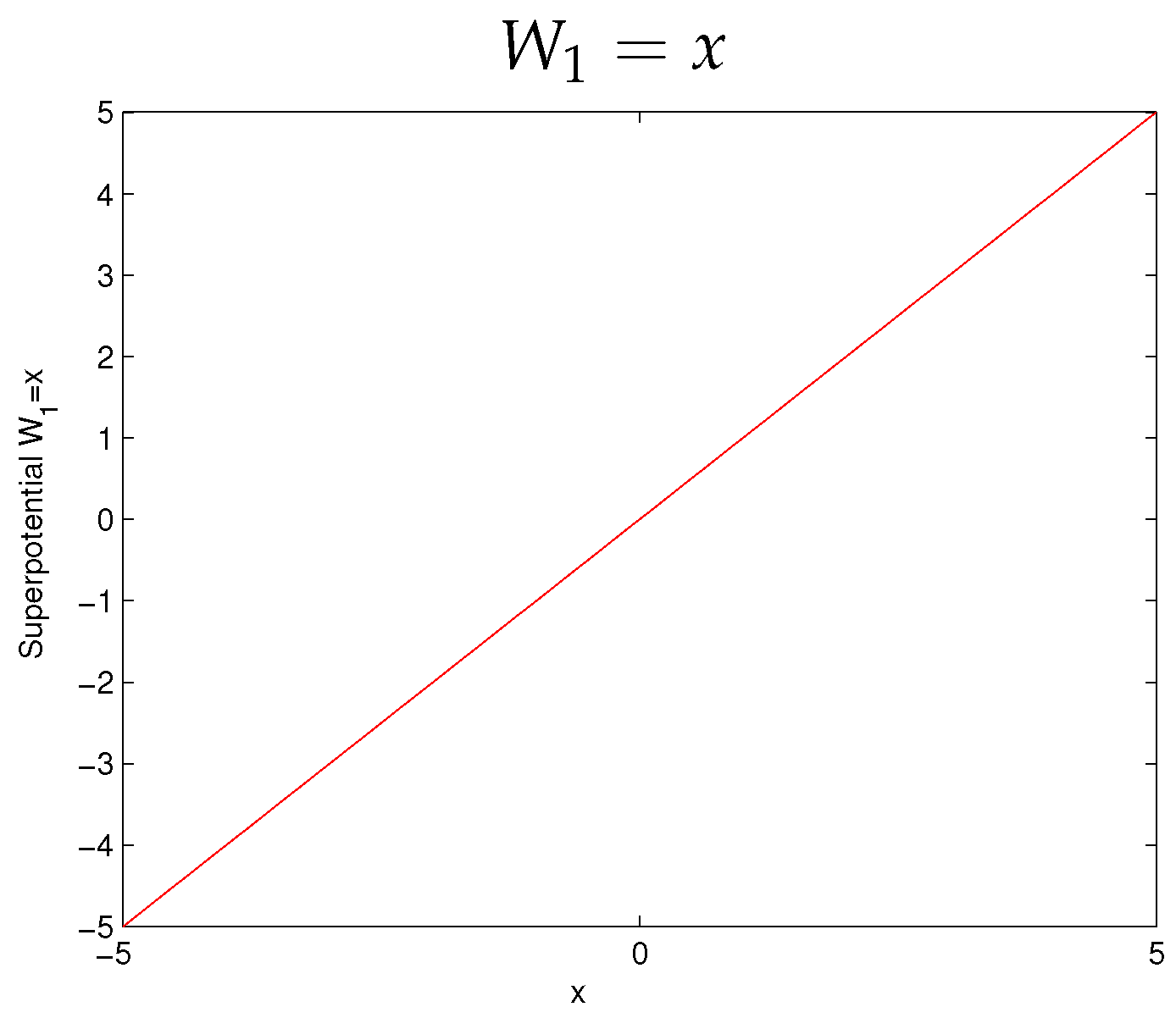
To justify this, we consider an exactly solvable model as the simple harmonic oscillator. Here, we chose superpotential as
In Figure 1, we plot the superpotential and reflect its behavior as
Figure 1.
Superpotential: SUSY and SI valid.
Here, superpotential is linear in nature and the above plot is for . For this, we have
Hence,
Now, we write the Hamiltonian
hence,
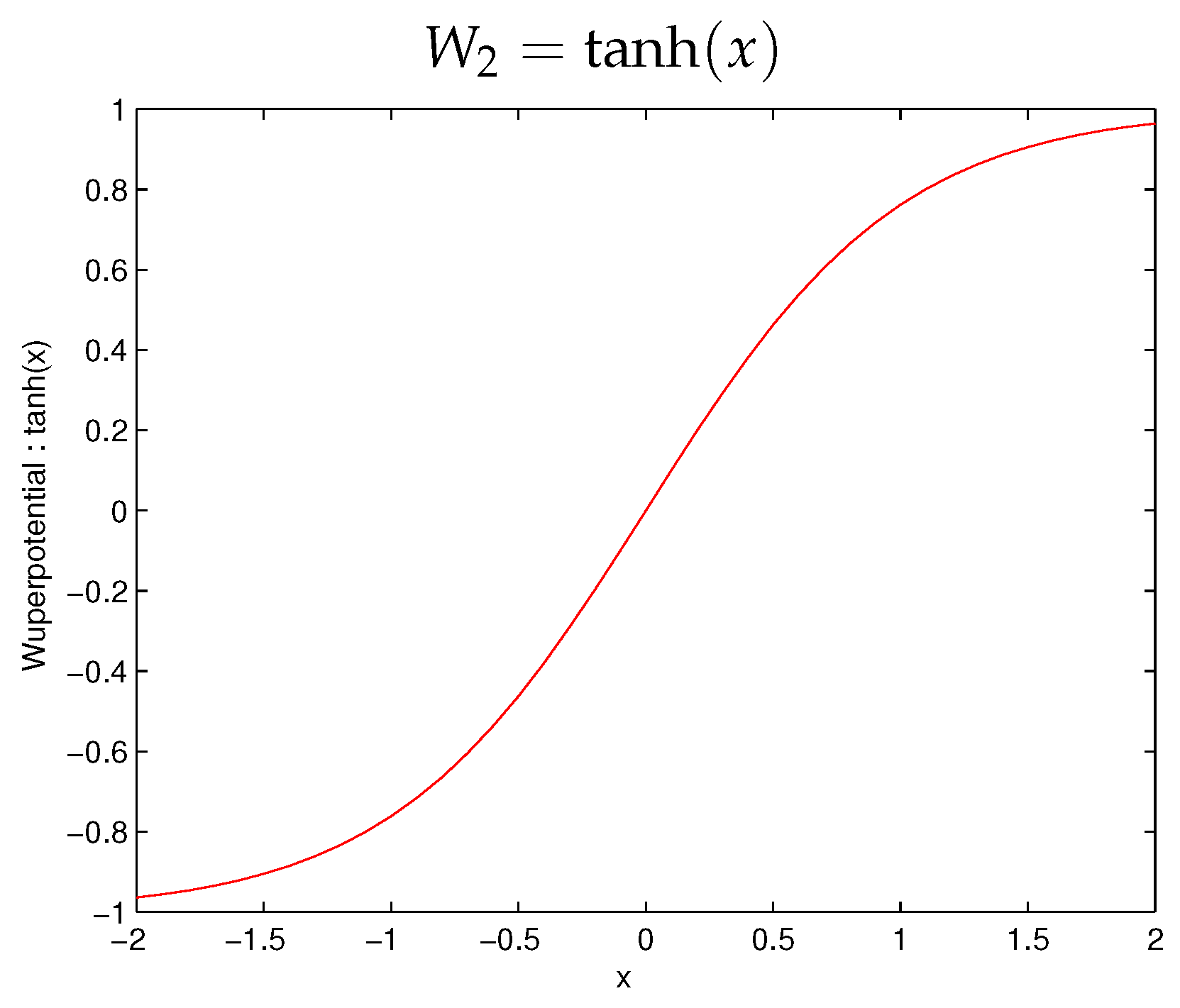
Hence, we find . Here, we would like to say that superpotential W need not be linear to justify SUSYEC and SI; however, its nonlinear nature can also be suitable to justify SUSYEC and SI [13,15,16,17]. Below, we reflect on one such behavior of the superpotential in Figure 2.
Figure 2.
Superpotential: SUSY and SI are valid.
Let us discuss a few different natures of the superpotential, as given below.
3. A Few Deviated Superpotentials with SUSYEC Being Valid and SI Being Invalid
Here, we consider two different model superpotentials where only SUSYEC remains valid. In this case, we consider the model proposed by Bogie, Gangopadhya, and Mallow [20] as
and claim a few interesting natures connecting to the Euler equation. However, neglecting the extra term, we have
Here, SUSY remains valid [27] but the shape invariance is no longer useful in releasing energy because it is practically impossible to visualize the relation
This simple superpotential nature has been reflected in Figure 3 as
Figure 3.
Superpotential: SUSY is valid.
Apart from the above, a similar feature is also seen in the model superpotential proposed by Marques, Negreni, and Da Silva [8] as
The nature of is reflected in Figure 4.
Figure 4.
Superpotential: SUSY is valid but SI is not valid.
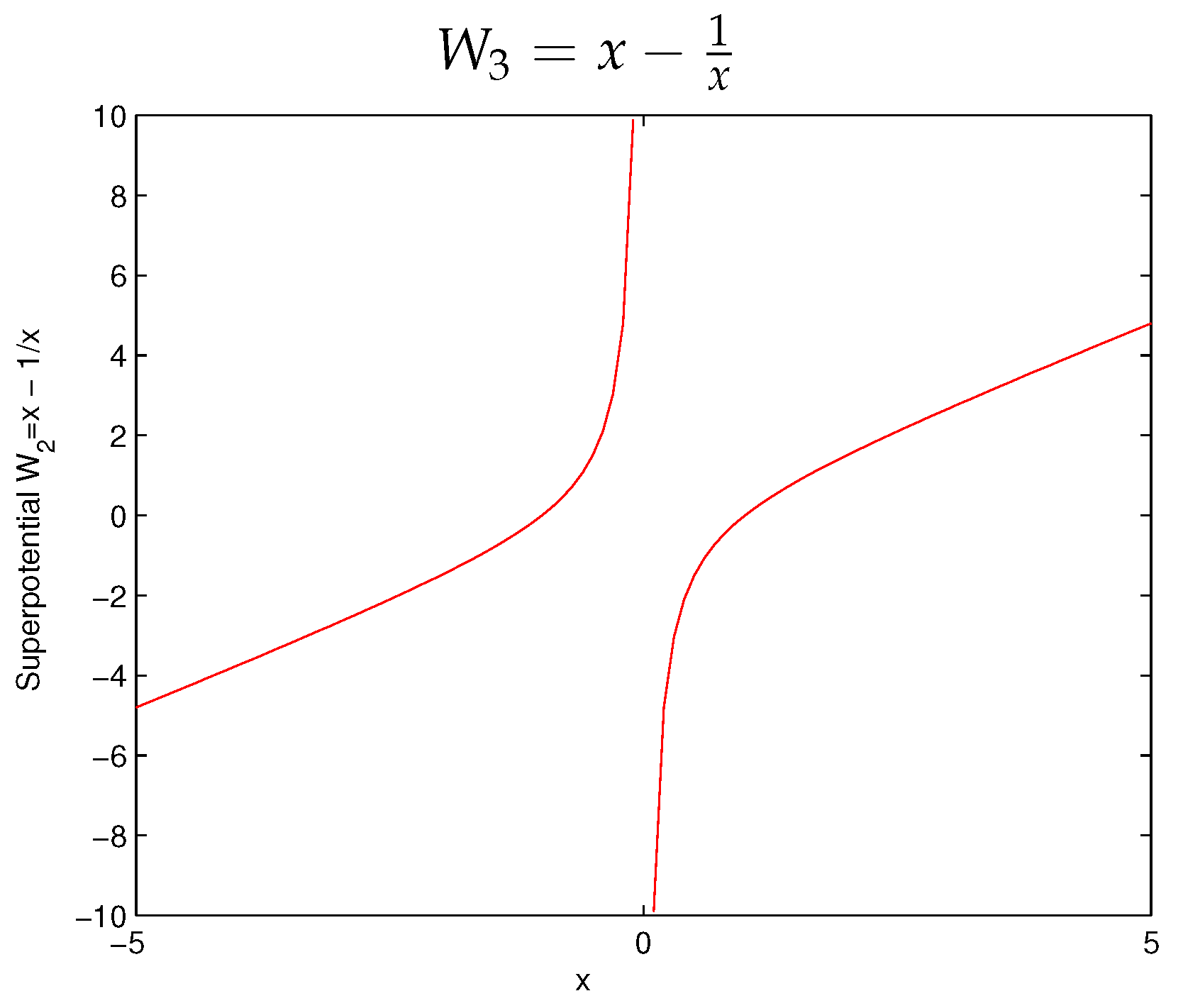
From and , we get
Here, neither SUSY nor the shape-invariance remain valid. Below, we present the nature of in Figure 5 as
Figure 5.
Superpotential: no SUSY and no SI.
Below, we cite the first few energy levels of
in Table 1.
Table 1.
Energy levels .
SUSY and SI failure model .
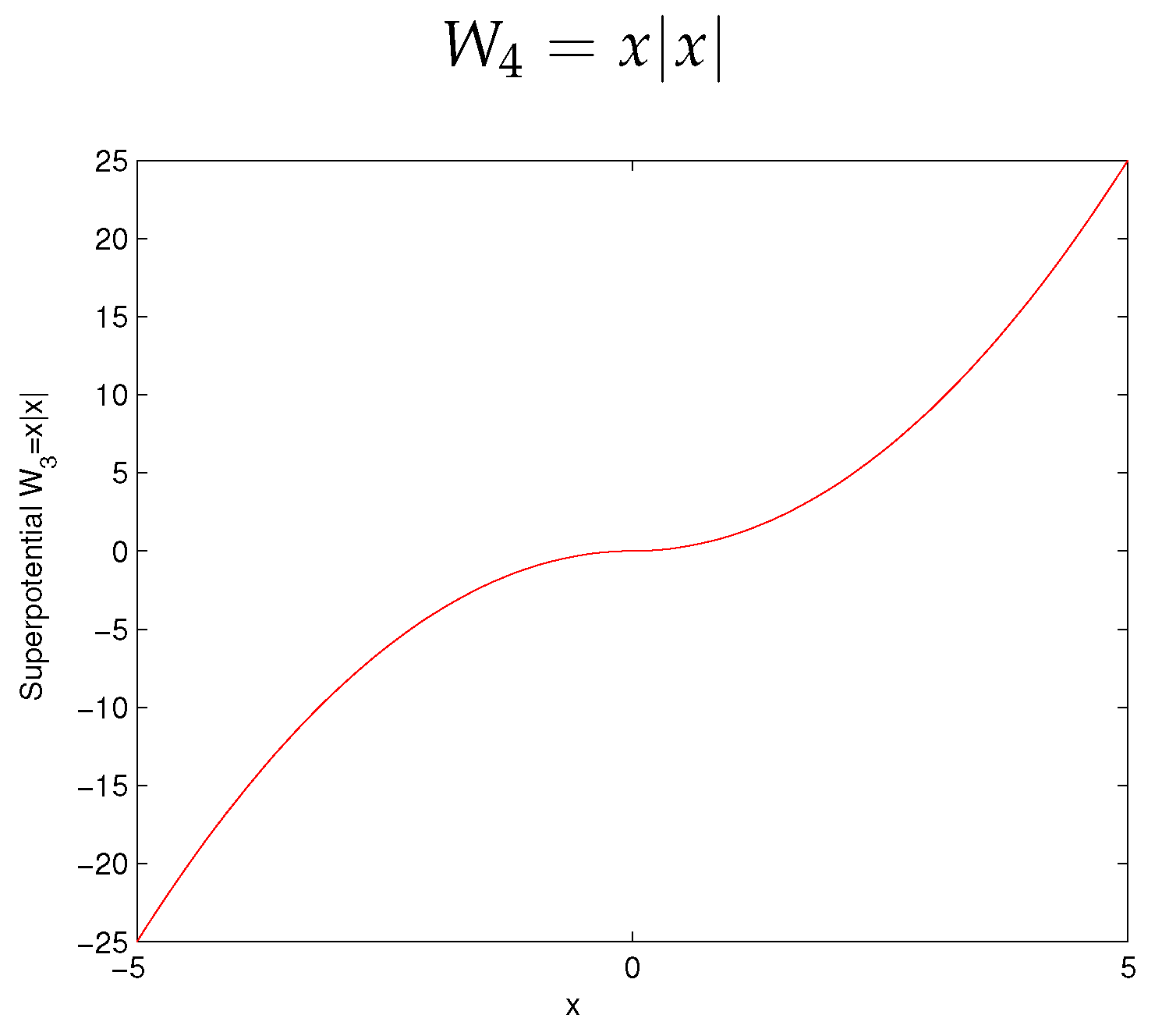
3.1. New Superpotential for Novel Symmetry in Real Space
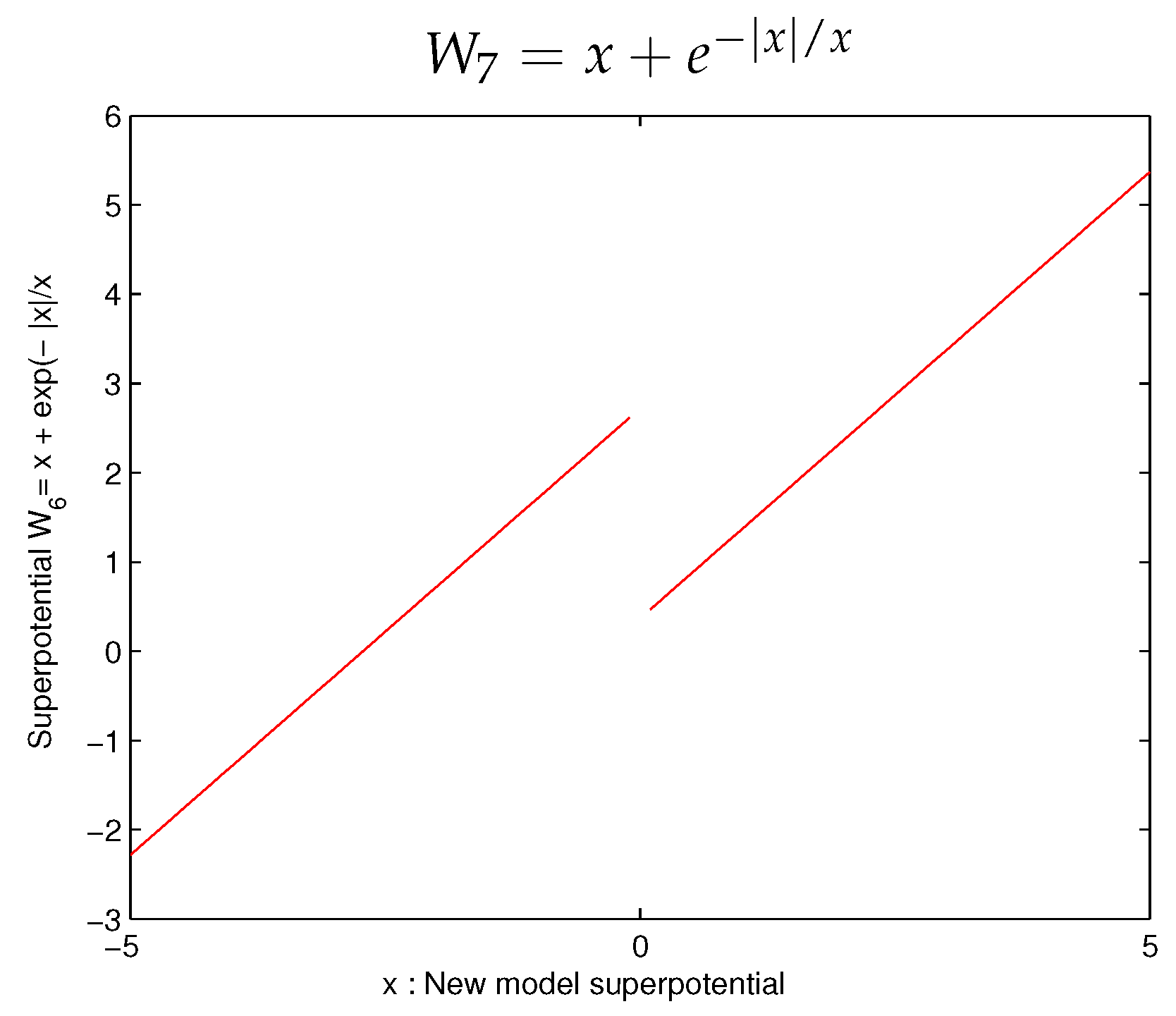
Here, we suggest a new model on superpotential as
whose nature is reflected in Figure 6 as
Figure 6.
Superpotential: no SUSY and no SI valid.
Further, the Hamiltonians generated from the above new model are
The corresponding SUSY potentials satisfy the relation
Hence, using the shape invariance condition, one can easily verify that
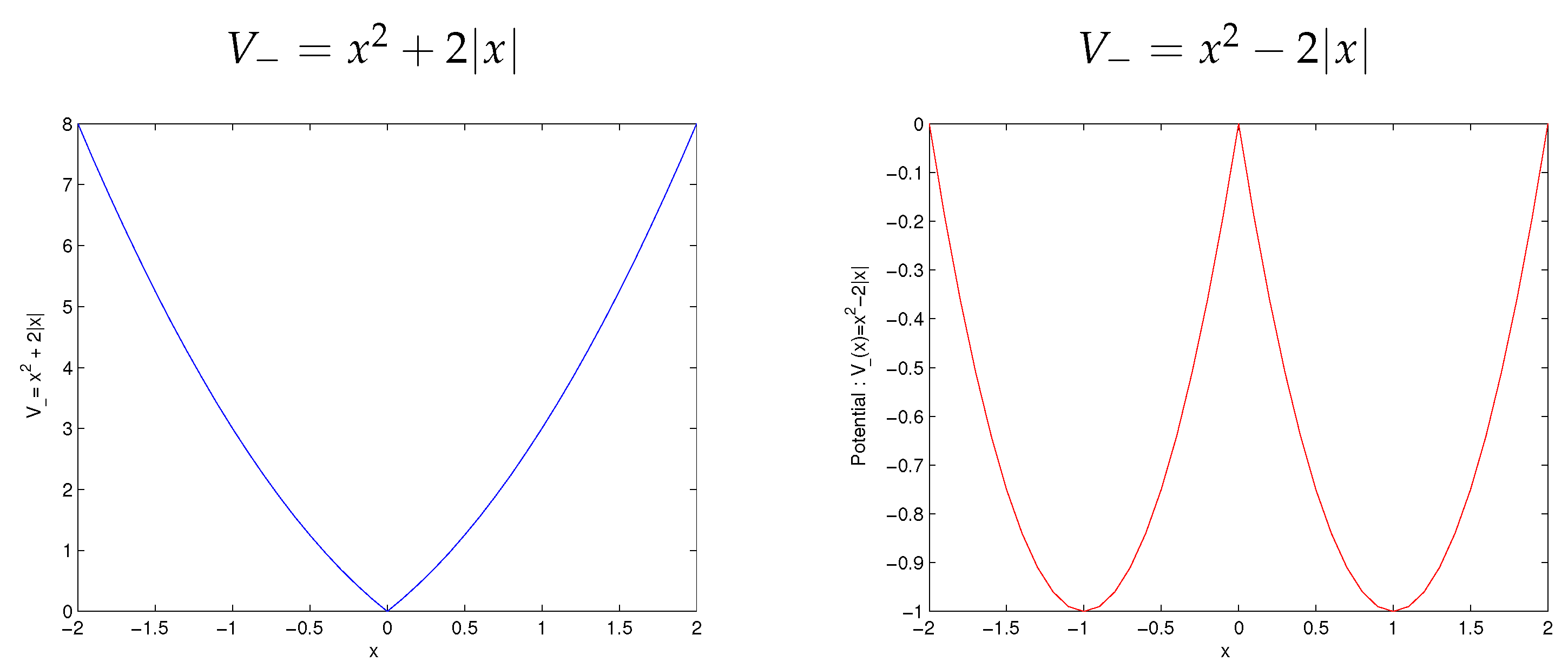
Further, the two potentials are different in nature (one is a single well and the other corresponds to a double well potential see Figure 7).
Figure 7.
Superpotential: no SUSY and no SI being valid.
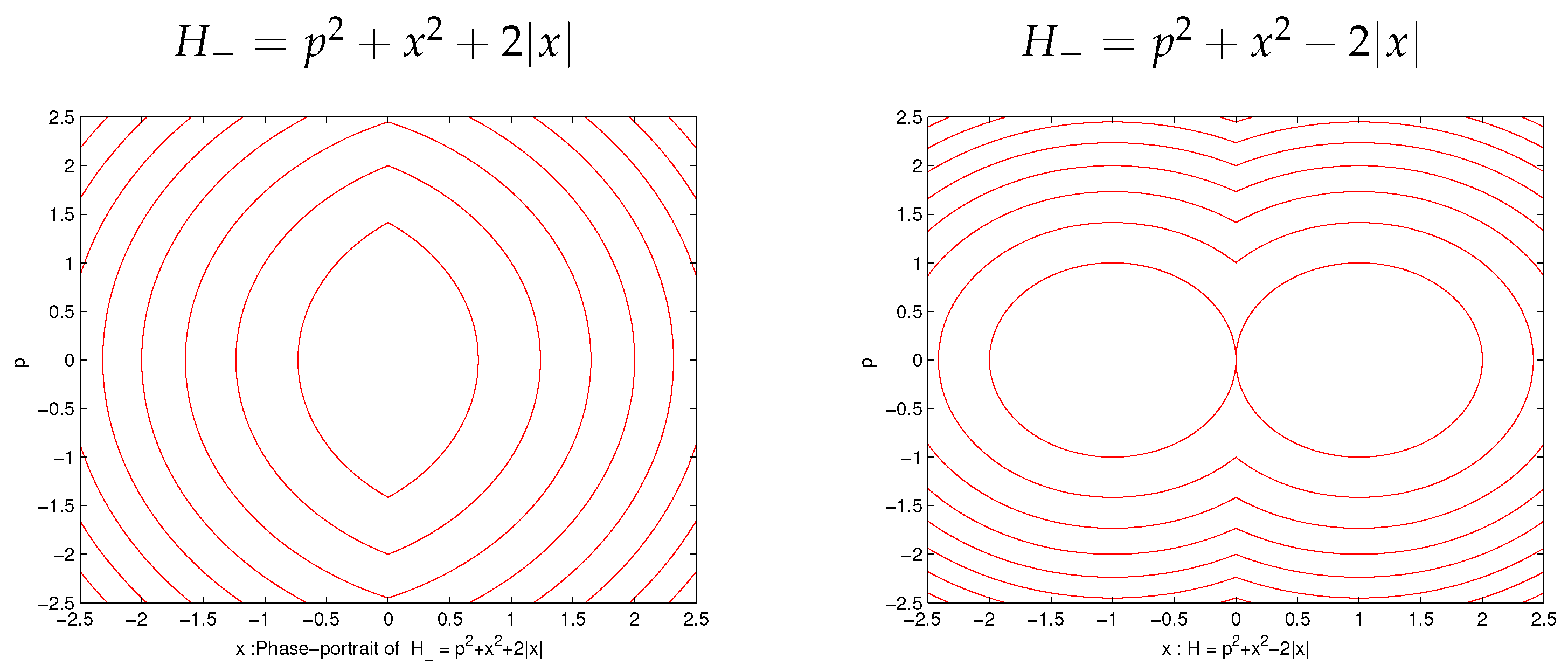
Further, both the cases have different natures of the phase-portrait; see Figure 8.
Figure 8.
Phase-portrait nature.
In other words, the shape invariance method fails to address the correct energy levels of
and are reflected in Table 2.
Table 2.
Novel symmetry: .
Novel symmetry Hamiltonians: superpotential model .
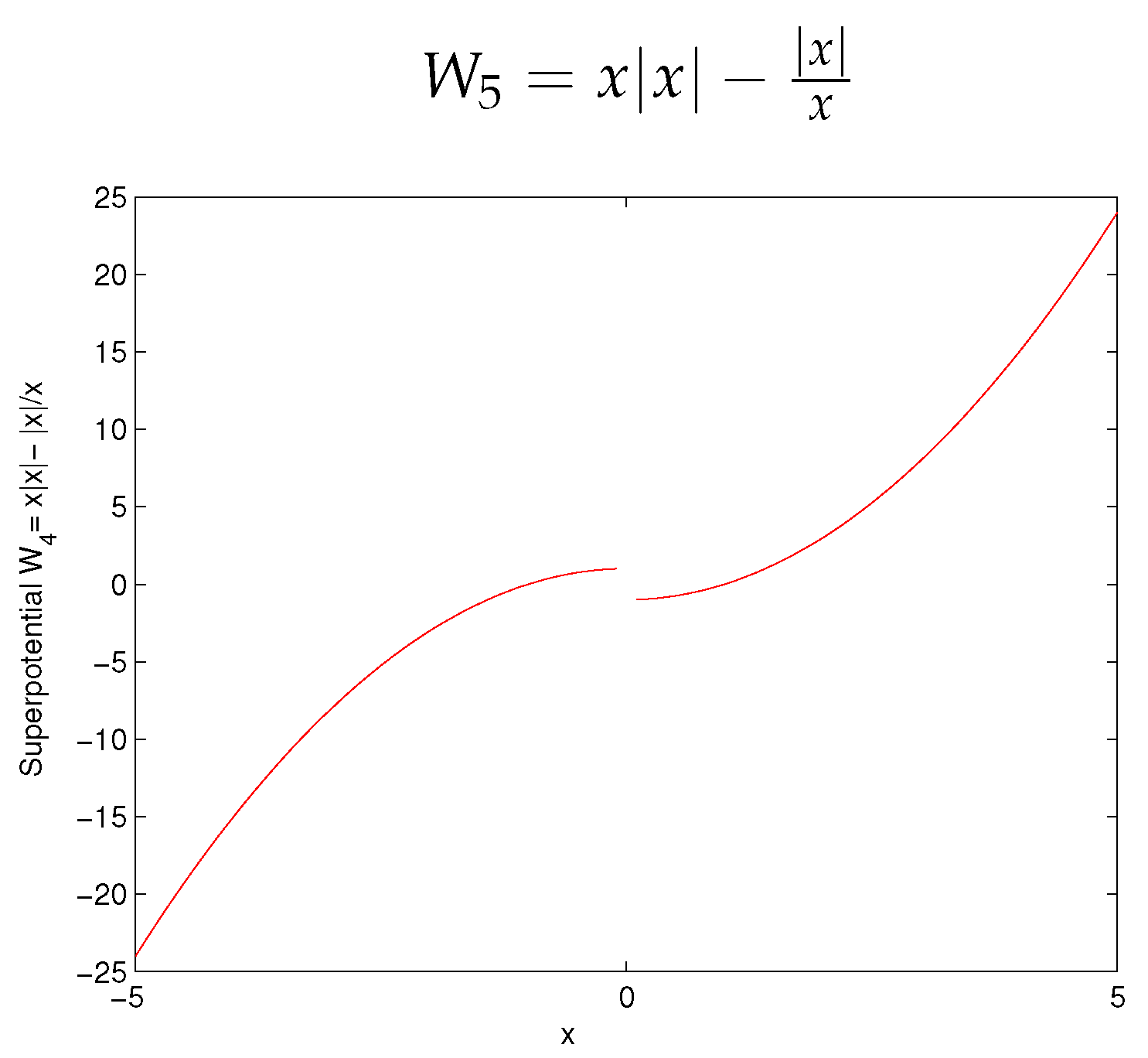
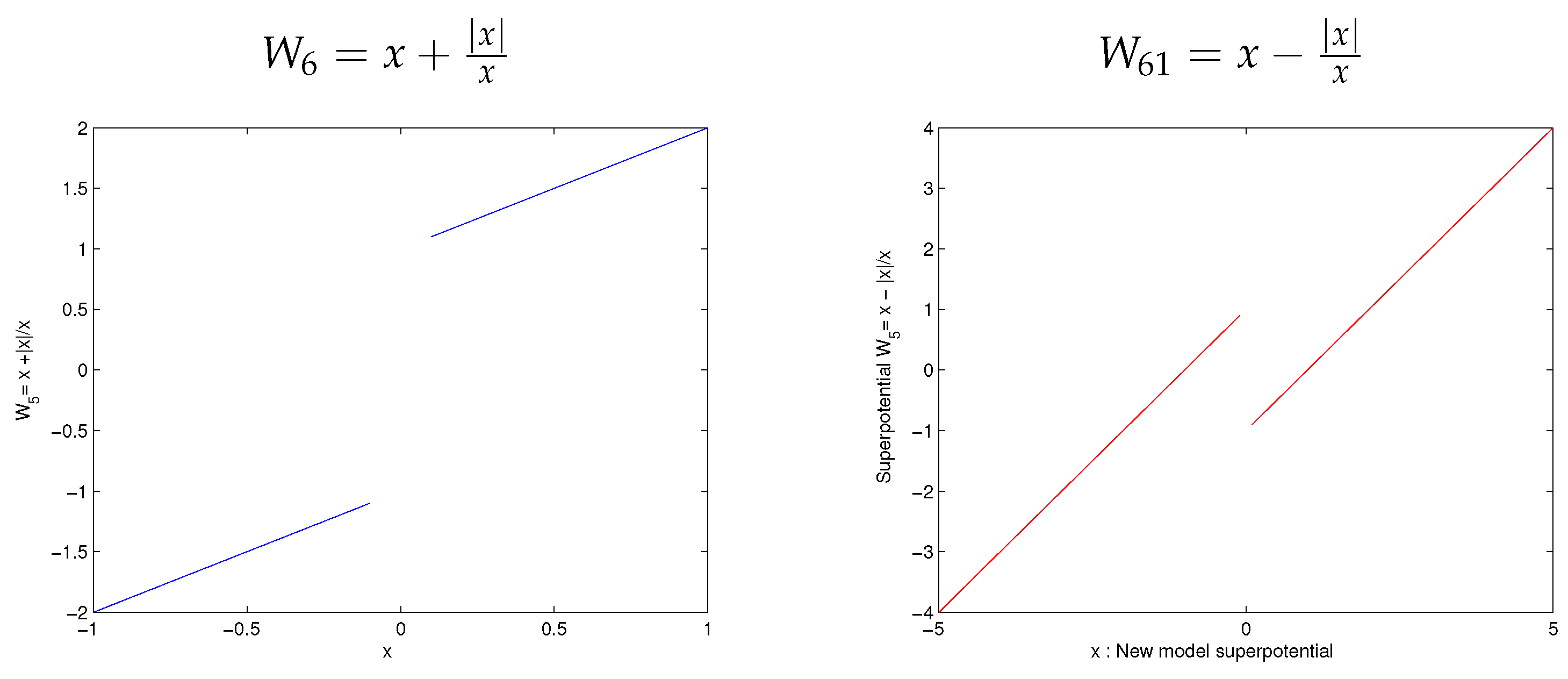
Similarly, we consider another superpotential
In this case, the nature of the superpotential is reflected in Figure 9 as
Figure 9.
Superpotential: no SUSY and no SI.
Here, we present the corresponding SUSY Hamiltonians as
In this case, we find the shape-invariance approach is also not valid
Below, we present few energy levels of corresponding to , as given in Table 3.
Table 3.
Energy levels .
Novel symmetry model .
3.2. Mathematical Proof of Novel Symmetry
Here, we present the proof of the relation as follows. Let be the energy of Hamiltonian
and
then, the energy of
becomes
Similarly,
becomes
Similarly,
Hence, it is easy to equate and to see that
For , we have
4. New Superpotential in Complex Space: -Symmetry
Here, we extend the above formalism to complex Hamiltonians satisfying the condition
In complex, the following conditions must be satisfied
and
Now, we define the superpotentials as
4.1. First Model in Complex Space Having -Symmetry Condition
The corresponding SUSY Hamiltonians [16] become
For , it is the same as discussed above in the real case.
4.2. Second Exponential Model in Complex Space Having a -Symmetry Condition
Let us consider the second model’s superpotential as
The corresponding Hamiltonians are
Below, we compute the energy levels for , considering , as given in Table 4:
Table 4.
Exponential model, few energy levels.
Exponential model .
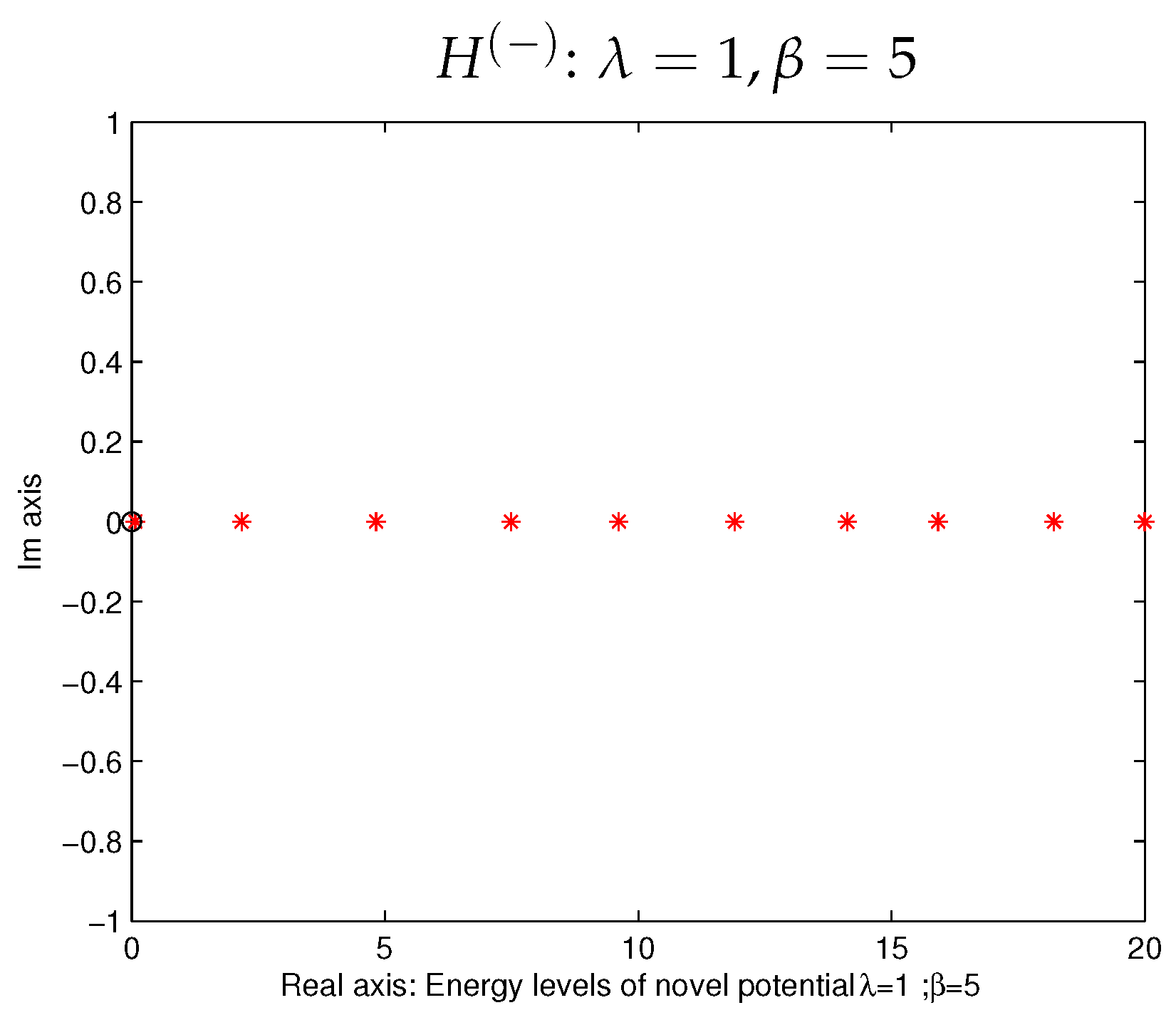
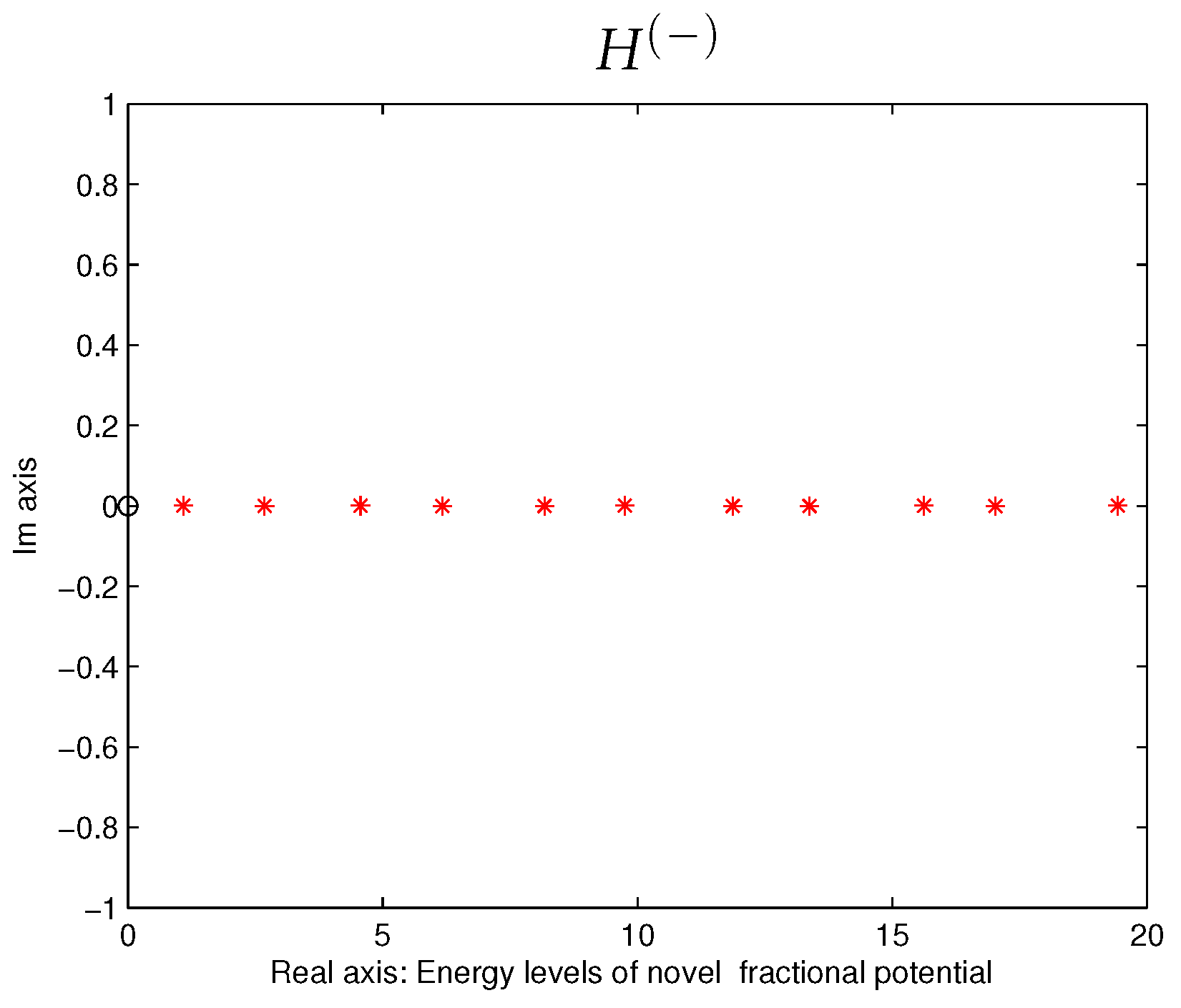
Below, we present its unbroken spectral in PT-symmetry, as in Figure 10.
Figure 10.
Unbroken spectra in PT-symmetry.
4.3. Third Fractional Model in Complex Space Having -Symmetry Condition
Similarly, we construct a new fractional model of superpotential satisfying the PT-invariant condition as
The corresponding Hamiltonians are
Table 5.
Few energy levels of fractional model: .
Fractional model .
Below, we present its unbroken spectral nature, as in Figure 11.
Figure 11.
Unbroken spectra.
5. Method of Calculation
Here, we solve the eigenvalue relation [42,44]
where
in which satisfies the eigenvalue relation
with
6. Conclusions
In conclusion, the new symmetry operator has no relation with the shape invariance and the traditional supersymmetric energy conditions: with in either real or complex space. On the other hand, a new relation has evolved as . This relation remains valid in real and complex space. It should be borne in mind that in is independent of x. In spite of this, the SUSYEC or SI conditions will no longer be valid. Similarly, many new models can be generated or fabricated using this “novel symmetry”. Interested readers can find many such similar cases as follows:
and
Further, the tabulated results presented above are the convergent results from the matrix diagonalization approach used in the MATLAB codes. At this point, the author would like to say that if one selects a superpotential as
then the new symmetry will be lost, i.e., .
Funding
This research has no external funding.
Data Availability Statement
The author declares that no additional data are required.
Acknowledgments
The author is very much thankful to Bijan Kumar Bagchi for generously bringing my attention to the literature on the SUSY-breaking work of M.L. Kai et al. in Nat. Comm. The author also thanks S. H. Dong for a fruitful discussion in real space analysis. The author expresses his deep sense of gratitude to all of the three referees for many valuable suggestions. In fact, suggestions of this kind are extremely helpful.
Conflicts of Interest
The author declares there are no conflict of interest of any kind. The author declares that the present paper is a modified version of the work reported in arxiv:1905.09724v4.
References
- Witten, E. Dynamical breaking on supersymmetry. Nucl. Phys. B 1981, 185, 513–554. [Google Scholar] [CrossRef]
- Witten, E. Constraints on supersymmetry breaking. Nucl. Phys. B 1982, 202, 253–316. [Google Scholar] [CrossRef]
- Wozor, C.; Wipf, A. Supersymmetry breaking in low dimensional models. arXiv 2011, arXiv:1107.3324v1. [Google Scholar] [CrossRef]
- Gies, H.; Synatschke, F.; Wipf, A. Supersymmetry breaking as a quantum phase transition. arXiv 2009, arXiv:0906.5492v2. [Google Scholar] [CrossRef]
- Intriligator, K.; Thomas, S. Dynamical Supersymmetry breaking on quantum moduli spaces. arXiv 1996, arXiv:9603158v1. [Google Scholar] [CrossRef][Green Version]
- Flambaum, V.; Liu, X.; Samsonov, I.; Wu, L.; Zhu, B. Probing supersymmetry breaking scale with atomic clocks. arXiv 2022, arXiv:2209.03231v1. [Google Scholar]
- Peskin, M.E. The experimental invastigation on supersymmetry breaking. arXiv 1996, arXiv:9604339v1. [Google Scholar]
- Intriligator, K.; Seiberg, N. Lectures on supersymmetry breaking. arXiv 2007, arXiv:0702069v1. [Google Scholar] [CrossRef]
- Feldstein, B.; Yanagida, T.T. Why is the supersymmetry breaking scale unnaturally high? arXiv 2012, arXiv:1210:7578v2. [Google Scholar] [CrossRef]
- Cai, M.L.; Wu, Y.K.; Mei, Q.X.; Zhao, W.D.; Jiang, Y.; Yao, L.; He, L.; Zhou, Z.C.; Duan, L.M. Observation of supersymmetry and its spontaneous breaking in a trapped ion quantum simulator. Nat. Commun. 2022, 13, 3412. [Google Scholar] [CrossRef]
- Hirokawa, M. The Rabi model gives off a flavour of spontaneous SUSY breaking. Quant. Stud. Math. Found. 2015, 2, 379–388. [Google Scholar] [CrossRef]
- Mei, Q. Experimental realization of Rabi-Hubbard model with trapped ions. Phys. Rev. Lett. 2022, 128, 160504. [Google Scholar] [CrossRef] [PubMed]
- Gendeshtein, L.E. Derivation of exact spectra of the Schrödinger equation by means of supersymmetry. JETP Lett. 1983, 38, 356–358. [Google Scholar]
- Oikonomou, V.K. A relation between Z3-graded symmetry and shape invariant supersymmetric systems. J. Phys. A 2014, 47, 435304. [Google Scholar] [CrossRef][Green Version]
- Junker, G. Supersymmetric Methods in Quantum and Statistical Physics; Springer: Berlin, Germany, 1996. [Google Scholar]
- Cooper, F.; Khare, A.; Sukhatme, U. Supersymmetry in Quantum Mechanics; World Scientific: Singapore, 2001. [Google Scholar]
- Bagchi, B.K. Supersymmetry in Quantum and Classical Mechanics; Hall CRC Press: Boca Raton, FL, USA, 2001. [Google Scholar]
- Biswas, S.N. Quantum Mechanics; Books and Allied(P) Limited: Kolkatta, India, 2013. [Google Scholar]
- Marques, F.; Negrini, O.; da Silva, A.J. A new simple class of superpotentials on SUSY quantum mechanics. J. Phys. A 2012, 45, 115307. [Google Scholar] [CrossRef]
- Mallow, J.V.; Gangopadhya, A.; Bougie, J.; Rasinariu, C. Inter-relations between additive shape invariant superpotentials. Phys. Lett. A 2019, 384, 126129. [Google Scholar] [CrossRef]
- Bougie, J.; Gangopadhya, A.; Mallow, J.V. Generation of a completa set of additive shape invariant potentials from an Euler equation. Phys. Rev. Lett. 2010, 105, 210402. [Google Scholar] [CrossRef]
- Sree Ranjani, S.; Sandhya, R.; Kapoor, A.K. Shape invariant rational extensions and potentials related to exceptional polynomials. Int. J. Mod. Phys. A 2015, 30, 1550146. [Google Scholar] [CrossRef]
- Sandhya, R.; Ranjani, S.S.; Kapoor, A.K. Shape invariant potentials in higher dimensions. Ann. Phys. 2015, 359, 125–135. [Google Scholar] [CrossRef][Green Version]
- Gangopadhya, A.; Mallow, J.V.; Rasinaru, C.; Bougie, J. Exacness of shape invariant potentials. Phys. Lett. A 2020, 384, 126722. [Google Scholar] [CrossRef]
- Roy, B.; Roy, P.; Roychoudhury, R. On solutions of Quantum Eigenvalue Problems: A supersymmetric approach. Fortschr. Phys. 1981, 89, 211–258. [Google Scholar] [CrossRef]
- Dong, S.H. Factorization Method in Quantum Mechanics; Springer: Dordrecht, The Netherlands, 2007. [Google Scholar]
- Rath, B. A generalisation of supersymmetric energy condition (SUSY-EC) from Fokker-Plank equatio. Nuovo Cimento B 2009, 115, 1229–1234, Erratum in Nuovo Cimento B 2009, 124, 1. [Google Scholar]
- Panigrahi, P.K.; Sukhatme, U. Singular superpotentials in supersymmetric quantum mechanics. Phys. Lett. A 1993, 178, 251–257. [Google Scholar] [CrossRef]
- Fernandez, F.M. Accurate calculation of the eigenvalues of a new simple class of superpotentials in SUSY quantum mechanics. Cent. Eur. J. Phys. 2013, 11, 470–473. [Google Scholar] [CrossRef]
- Nieto, M.M. Relation between supersymmetry and the inverse method in quantum mechanics. Phys. Lett. B 1984, 145, 208–210. [Google Scholar] [CrossRef]
- Znojil, M.; Jakubsky, V. Supersymmetric quantum mechanics living on topologically non-trivial Riemann surfaces. Pramana. J. Phys. 2009, 73, 397–404. [Google Scholar] [CrossRef]
- Jafarizadeh, M.A.; Fakhri, M.A. Supersymmetry and shape invariance in differential equations of mathematical physics. Phys. Lett. A 1997, 230, 164–170. [Google Scholar] [CrossRef]
- Quense, C. Solvable rational potentials and exceptional orthogonal polynomials in supersymmetric quantum mechanics. SIGMA 2009, 5, 084. [Google Scholar]
- Miao, C.H.; Qian, S.-W. Variational supersymmetric WKB approximation. Phys. Rev. A 1997, 56, 2414–2612. [Google Scholar] [CrossRef]
- Amir, N.; Iqbal, S. Algebraic solutions of shape invariant position dependent effective mass systems. J. Math. Phys. 2016, 57, 062105. [Google Scholar] [CrossRef]
- Abhinav, K.; Panigrahi, P.K. Supersymmetry, PT-symmetry and spectral bifurcation. Ann. Phys. 2010, 325, 1198–1206. [Google Scholar] [CrossRef]
- Bender, C.M.; Boettecher, S. Real spectra in non-Hermitian Hamiltonians having PT-symmetry. Phys. Rev. Lett. 1997, 24, 5243–5246. [Google Scholar]
- Znojil, M. PT-symmetrized supersymmetric quantum mechanics. Czech. J. Phys. 2001, 51, 420–428. [Google Scholar] [CrossRef]
- Andrianov, A.A.; Loffe, M.V.; Cannata, F.; Dedonder, J.P. SUSY quantum mechanics with complex superpotentials and real energy spectra. Int. J. Mod. Phys. A 1999, 14, 2675–2688. [Google Scholar] [CrossRef]
- Bezia, D.; Das, A.; Lasano, L.; Greenhood, L. The structure of supersymmetry in PT-symmetric quantum mechanics. Phys. Lett. B 2009, 673, 283–287. [Google Scholar] [CrossRef][Green Version]
- Rath, B.; Nanayakkara, A.; Mallick, P.; Samal, P.K. SUSY quantum mechanics for PT-symmetric systems. Proc. Natl. Acad. Sci. India Sect. A Phys. Sci. 2018, 88, 633–638. [Google Scholar] [CrossRef]
- Rath, B. Real spectra in some negative potentials: Linear and non-linear one-dimensional PT-invariant quantum systems. Eur. J. Phys. Plus 2021, 136, 493. [Google Scholar] [CrossRef]
- Bhosale, S.S.; Rath, B.; Panigrahi, P.K. On Bell’s inequality in PT-symmetric quantum systems. Quantum Rep. 2021, 3, 417–424. [Google Scholar] [CrossRef]
- Rath, B. Superpotential for novel symmetry in real and complex space. arXiv 2019, arXiv:1905.09724v4. [Google Scholar]
Publisher’s Note: MDPI stays neutral with regard to jurisdictional claims in published maps and institutional affiliations. |
© 2022 by the author. Licensee MDPI, Basel, Switzerland. This article is an open access article distributed under the terms and conditions of the Creative Commons Attribution (CC BY) license (https://creativecommons.org/licenses/by/4.0/).