


Abstract
A topological index being a graph theoretic parameter plays a role of function for the assignment of a numerical value to a molecular graph which predicts the several physical and chemical properties of the underlying molecular graph such as heat of evaporation, critical temperature, surface tension, boiling point, octanol-water partition coefficient, density and flash points. For a (molecular) graph , the Lanzhou index (Lz index) is obtained by the sum of over all the vertices, where and are degrees of the vertex v in and its complement respectively. Let be a class of unicyclic graphs (same order and size) such that each graph of this class has order and leaves (vertices of degree one). In this note, we compute the lower and upper bounds of Lz index for each unicyclic graph in the class of graphs Moreover, we characterize the extremal graphs with respect to Lz index in the same class of graphs.
1. Introduction
A topological index () is a function that associates a numerical value with a (molecular) graph that predicts its various chemical and structural properties, such as boiling point, stability, melting point, volatility, chirality, solubility, and connectivity. s are also used in cheminformatics to study the quantitative structure activities and property relationships (QSAR and QSPR) [1], which connect a molecular structure with some biological properties with the help of a mathematical formula
where P represents the property, M shows a molecular structure, and F plays the role of the function, which depends on the molecular structure. In general, s are divided into four classes (distance, degree, spectral, and polynomial based) but our focus is on degree-based s, which are mathematically defined as
where F is a function.
If , then we first have the Zagreb index, and for , we obtain the second Zagreb index. These s are defined by Gutman and Trinajsti in 1972 [2] to measure the total energy of molecules in the molecular structures. In the literature, there exists a large number of results related to these Zagreb indices for different graphs, such as nanotubes [3], dendrimer structures [4], silicate & oxide networks [5], and carbon structures [6]. In [2], another is defined by the sum of the cube of the degrees of all vertices. Furtula and Gutman in 2015 [7] re-investigated this index by studying its basic properties. After years of the obliviousness to this , they gave this index a new name: the forgotten topological index (F-index). For more details on various s, see [8,9,10,11].
Vukicevic et al. (2018) [12] defined the Lanzhou index (Lzindex) as the sum of the product between and the square of over all vertices v of where represents the degree of v in and represents the degree of v in the complement graph of . It is important to note that this index can be formed by the relation between the forgotten index and the first Zagreb index as
where and present the first Zagreb and forgotten indices of the (molecular) graph, respectively. Furthermore, they found the bounds of the Lz index for acyclic graphs. Dehgardi and Liu in 2021 extended these results of the Lz index for acyclic graphs under the condition of maximum degree [13]. Zeng and Wu (2021) determined the sharp upper bound of the Lz index for a special class of graphs that was obtained by some transformations on acyclic graphs [14]. Recently, Liu et al. (2022) determined the lower and upper bounds of unicyclic graphs [15]. Javaid et al. (2018) [16] found the upper and lower bounds of the forgotten index for a family of graphs known as unicyclic graphs with certain pendent vertices (leaves). In this note, we compute the bounds (lower and upper) for the Lz index on the class of unicyclic graphs under the condition of fixed leaves. Moreover, we characterized the extremal graphs with respect to the Lz index in the same class of graphs.
2. Preliminaries
Let be a graph with edge-set and vertex-set , such that and are the size and order of the graph , respectively. The adjacent vertices r and s were treated by an edge . The edges that have the same starting vertex and end vertex are known as loops. A connected graph with is called a tree (acyclic graph). Moreover, for a graph , if , then is called a unicyclic graph. This paper deals with simple (no loops and multiple edges) and undirected graphs. For a detailed study of graph-related notions, please refer to [17]. We define some TIs that are used in the present study for the development of our main results.
Definition 1
([2,7]). The
first Zagreb index and forgotten index (F-index) for a molecular graph Γ are and
Definition 2
([12]). The Lanzhou index (Lz index) for a molecular graph Γ is
For more details on TIs, see [18,19,20].
If a graph is connected and -cyclic, then , where s is the total number of edges (size) and is the total number of vertices (order) of the graph. If , then the graph is a tree, if then the graph is unicyclic, and if , then the graph is bicyclic.
Now, by using base graphs, we can use more unicyclic graphs. For , assume that is a cycle of order u, then the unicyclic graphs are obtained from by joining l leaves to the vertices of , where . Moreover, suppose that and present the path, cycle, and star graph of order y, v, and . Then the graph is obtained by emerging one vertex of degree one of the path with and the other vertex of degree one with the central vertex of , where and . If and then Table 1 and Table 2 present the vertex partition with respect to their degrees respectively as follows:

Table 1.
Degree-vertex partition of .
Table 2.
Degree-vertex partition .
For , then is obtained from the graph by removing leaves from the vertex whose degree is and connect these vertices to the end vertex whose degree is ; for more details of this transformation, see Figure 1.
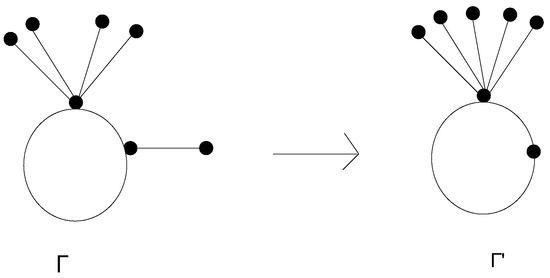
Figure 1.
is constructed from by the transformation (deleting a leaf from a cycle vertex of degree three and joining to the vertex of degree six).
Now, we define and have leaves}; suppose three subclasses—, , and of , such that leaves are connected with the tree vertices, cycle vertices, and both (and vice versa).
3. Main Results
In this section, we present our main findings related to the Lz index on the unicyclic graphs.
Lemma 1.
For two connected graphs, and , of the same size and order with degree sequences and if for , then , where is the degree of vertices in for and .
Proof.
If graphs are isomorphic, then we are done. Suppose that the graphs are non-isomorphic. As for , consequently,
Thus, for
, then
, which implies that
for Therefore, , which implies that
□
Lemma 2.
For a graph and , if is obtained from Γ by the deletion of and joining x to z, i.e., . Then,
(1) if , or
(2)
(i) If then
(ii) If then
(3)
(i) If then
(ii) If then where and are degrees of y and z in Γ, and vice versa.
Proof.
As and denote the degrees of y and z in , and vice versa, we have
Now, we face three cases for , , and . So, we obtain the required results. Thus, we are done. □
Lemma 3.
For , , , and , -index of and are
Putting in Lemma 3, we obtain the following results:
Corollary 1.
For unicyclic graphs V, the Lz index is
where , , and .
Theorem 1.
Let , , , and . Then,
Proof.
(i) By placing in Corollary 1, we have,
For , Lemma 3 (ii) gives
Since , , and , for and we have
Therefore, for .
(ii) By using Lemma 3 (ii),
Since for , we have . Hence,
Thus,
(iii) With the help of Corollary 1 and Lemma 3, we have
Since , and ; hence,
Therefore
(iv) With the help of Lemma 3 (i), we have
By Lemma 2 (iii), Using , we have
(v) With the help of (i) and (ii), we have
Therefore,
Thus, where . □
Theorem 2.
If , , , and then, for every
Furthermore, equality holds if and respectively.
Proof.
(a) The proof is computed with the help of the following cases.
Case 1: Suppose that and where Since, ; therefore, by using Theorem 1 (iv) where .
Case 2: If , such that . By using Theorems 1 (ii) and (iii), we have
Hence, for each . If is other than , then by applying the transformation of the addition and deletion of an edge, we have Then by Theorem 1 (ii) and Lemma 2, we have . Therefore, for each
Case 3: If , then we have the following possibilities. (i) By applying the transformations of the addition and deletion of the edges, we have or , such that by using Lemma 2. (ii) There exists , , and , which have the same degree sequence. Then, with the help of Lemma 2(i), ; eventually, we proved the above result with the help of case (i) and case (ii).
From the above cases, for every
(b) The proof was done on the same pattern as in the above part (a) using Theorem 1 and Lemmas 2. □
Theorem 3.
Let be a class of unicyclic graphs in such a way that every graph has α order and β leaves. Then,
for each , where the upper bound is obtained if and only if and the lower bound is obtained if and only if
Proof.
With the help of Corollary 1, we have and for leaves. Furthermore, with the help of Theorem 2, (a) implies that and for each Therefore, we obtain
for each . Furthermore, the upper bound is obtained if and only if and the lower bound is obtained if and only if □
4. Conclusions
In this article, we computed the Lz index for each graph that belonged to the class of unicyclic graphs with fixed pendent vertices. Moreover, we characterized the extremal graphs with respect to the Lz index in the same class of graphs. For the illustration of the obtained results, we presented the exact values of the Lz index (obtained by the definition) and bounded values of the Lz index (using Theorem 3) for some unicyclic graphs in Table 3. This table shows that the exact values fall within our established bounds.
Table 3.
The values of the Lz index for unicyclic graphs.
Open Problem: Investigate the lower and upper bounds of the Lz index for the classes of bicyclic and tricyclic graphs with fixed pendent vertices.
Author Contributions
Conceptualization, F.Z. and M.J.; methodology, D.A.A., F.Z. and M.J.; software, F.Z.; validation, M.J.; formal analysis, M.J. and D.A.A.; investigation, F.Z. and M.J.; resources, M.J.; data curation, F.Z.; writing—original draft preparation, F.Z.; writing—review and editing, M.J. and D.A.A.; visualization, F.Z. and M.J.; supervision, M.J.; project administration, M.J. and D.A.A.; funding acquisition, D.A.A. All authors have read and agreed to the published version of the manuscript.
Funding
This research received no external funding.
Data Availability Statement
Data sharing is not applicable to this article as no datasets were generated or analyzed during the current study.
Acknowledgments
The authors wish to thank the anonymous reviewers for the valuable comments which improved the original version of this manuscript.
Conflicts of Interest
The authors have no conflict of interest.
References
- Diudea, M.V. QSPR/QSAR Studies by Molecular Descriptors; Nova Science Publishers: Huntington, NY, USA, 2001. [Google Scholar] [CrossRef]
- Gutman, I.; Trinajstić, N. Graph theory and molecular orbitals. III. Total π-electron energy of alternant hydrocarbons. Chem. Phys. Lett. 1972, 17, 535–538. [Google Scholar] [CrossRef]
- Javaid, M.; Liu, J.B.; Rehman, M.A.; Wang, S. On the certain topological indices of titania nanotube TiO2 [m,n]. Z. Nat. 2017, 72, 647–654. [Google Scholar] [CrossRef]
- Gao, W.; Iqbal, Z.; Jaleel, A.; Aslam, A.; Ishaq, M.; Aamir, M. Computing entire Zagreb indices of some dendrimer structures. Main Group Met. Chem. 2020, 43, 229–236. [Google Scholar] [CrossRef]
- Javaid, M.; Rehman, M.U.; Cao, J. Topological indices of rhombus type silicate and oxide networks. Can. J. Chem. 2017, 95, 134–143. [Google Scholar] [CrossRef]
- Sarkar, P.; De, N.; Pal, A. The generalized Zagreb index of some carbon structures. Acta Chem. Iasi 2018, 26, 91–104. [Google Scholar] [CrossRef]
- Furtula, B.; Gutman, I. A forgotten topological index. J. Math. Chem. 2015, 53, 1184–1190. [Google Scholar] [CrossRef]
- Demirci, M.; Delen, S.; Cevik, A.S.; Cangul, I.N. Omega Index of Line and Total Graphs. J. Math. 2021, 2021, 5552202. [Google Scholar] [CrossRef]
- Das, K.C.; Shang, Y. Some extremal graph with respect to sombor index. Mathematics 2021, 9, 1202. [Google Scholar] [CrossRef]
- Das, K.C.; Çevik, A.S.; Cangul, I.N.; Shang, Y. On Sombor Index. Symmetry 2021, 13, 140. [Google Scholar] [CrossRef]
- Sadiq, G.; Ali, A.; Ahmad, S.; Nonlaopon, K.; Akgül, A. Bright soliton behaviours of fractional nonlinear good boussinesq equation with nonsingular kernels. Symmetry 2022, 14, 2113. [Google Scholar] [CrossRef]
- Vukicevic, D.; Li, Q.; Sedlar, J.; Došlic, T. Lanzhou index. MATCH Commun. Math. Comput. Chem. 2018, 80, 863–876. [Google Scholar]
- Dehgardi, N.; Liu, J.B. Lanzhou index of tree with maximum degree. MATCH Commun. Math. Comput. Chem. 2021, 86, 3–10. [Google Scholar]
- Zeng, X.; Wu, T. On the lanzhou indices of tree under graph decoration. Sci. Res. Publ. 2021, 12, 85–90. [Google Scholar] [CrossRef]
- Qian-qian, L.; Qui-li, L.; He-ping, Z. Unicyclic graphs with extremal Lanzhou index. Appl. Math. J. Chin. Univ. 2022, 37, 350–365. [Google Scholar] [CrossRef]
- Javaid, M.; Ahmad, M.; Hussain, M.; Teh, W.C. Bounds of F-index for unicyclic graph with fixed pendent vertices. J. Prime Res. Math. 2018, 14, 51–61. [Google Scholar]
- West, D.B. Introduction to Graph Theory; USA Printce Hall: Upper Saddle River, NJ, USA, 1996. [Google Scholar]
- Randic, M. On characterization of molecular branching. J. Am. Chem. Soc. 1975, 97, 6609–6615. [Google Scholar] [CrossRef]
- Bollobás, B.; Erdös, P. Graphs of extremal weights. Ars Combin. 1998, 50, 225–233. [Google Scholar] [CrossRef]
- Amić, D.; Bešlo, D.; Lucić, B.; Nikolić, S.; Trinajstić, N. The vertex-connectivity index revisited. J. Chem. Inf. Comput. Sci. 1998, 28, 819–822. [Google Scholar] [CrossRef]
Publisher’s Note: MDPI stays neutral with regard to jurisdictional claims in published maps and institutional affiliations. |
© 2022 by the authors. Licensee MDPI, Basel, Switzerland. This article is an open access article distributed under the terms and conditions of the Creative Commons Attribution (CC BY) license (https://creativecommons.org/licenses/by/4.0/).