

Abstract
The objective of the present paper is to obtain a quadruple infinite integral. This integral involves the product of the Struve and parabolic cylinder functions and expresses it in terms of the Hurwitz–Lerch Zeta function. Almost all Hurwitz-Lerch Zeta functions have an asymmetrical zero distributionSpecial cases in terms fundamental constants and other special functions are produced. All the results in the work are new.
Keywords:
Struve function; parabolic cylinder function; quadruple integral; Hurwitz–Lerch Zeta function; Catalan’s constant; Apéry’s constant MSC:
Primary 30E20; 33-01; 33-03; 33-04; 33-33B; 33E20
1. Significance Statement
In 1927, Watson et al. [1] published work on the infinite integral involving the product of the Struve and parabolic cylinder functions expressed in terms of the quotient of gamma functions. In 1945, Mitra [2] extended the work achieved by Watson et al. by deriving and evaluating other forms of these infinite integrals involving the product of Struve and parabolic cylinder functions. In this current work, we take this previous important work a step further by deriving a quadruple definite integral involving these special functions. We will derive a quadruple integral and express in terms of a Hurwitz–Lerch Zeta function. Special cases are derived in terms of the Polylogarithm function , Catalan’s constant C, Hurwitz Zeta function , the Harmonic function , the Zeta function of Riemann , and . An interesting invariant property of the indices in the Struve and parabolic cylinder functions is evaluated. This invariant property, related to multiple integrals, is a new topic to the best of our knowledge. We will be investigating this property along with other multiple integrals in future work. We will be looking at any similarities this property has to multiple definite integral of these functions and any real world applications which they possess.
2. Introduction
In this paper we derive the quadruple definite integral given by:
where the parameters and m are general complex numbers and . This definite integral will be used to derive special cases in terms of special functions and fundamental constants. The derivations follow the method used by us in [3]. This method involves using a form of the generalized Cauchy’s integral formula given by:
where C is, in general, an open contour in the complex plane where the bilinear concomitant has the same value at the end points of the contour. We then multiply both sides by a function of x, y, z, and t, then take a definite quadruple integral of both sides. This yields a definite integral in terms of a contour integral. Then, we multiply both sides of Equation (2) by another function of x, y, z, and t and take the infinite sums of both sides such that the contour integral of both equations are the same.
3. Definite Integral of the Contour Integral
We used the method in [3]. The variable of integration in the contour integral is . The cut and contour are in the first quadrant of the complex r-plane. The cut approaches the origin from the interior of the first quadrant; the contour goes round the origin with zero radius and is on opposite sides of the cut. Using a generalization of Cauchy’s integral formula, we form the quadruple integral by replacing y with and multiplying by , then taking the definite integral with respect to , , , and to obtain
from Equation (3.326.2) in [4], equations (3.9.1.3) and (3.15.1) in [5] where , and using the reflection formula (8.334.3) in [4] for the Gamma function. We are able to switch the order of integration over x, y, z, and t using Fubini’s theorem for multiple integrals see (9.112) in [6], as the integrand is of bounded measure over the space .
4. The Hurwitz–Lerch Zeta Function and Infinite Sum of the Contour Integral
In this section we use Equation (2) to derive the contour integral representations for the Hurwitz–Lerch Zeta function.
4.1. The Hurwitz–Lerch Zeta Function
The Hurwitz–Lerch Zeta function (25.14) in [7] and [8] has a series representation given by
where and is continued analytically by its integral representation given by
where , and either , or .
4.2. Infinite Sum of the Contour Integral
Using Equation (2) and replacing y with , then multiplying both sides by , taking the infinite sum over , and simplifying in terms of the Hurwitz–Lerch Zeta function we obtain
from Equation (1.232.2) in [4] where in order for the sum to converge.
5. Definite Integral in Terms of the Hurwitz–Lerch Zeta Function
Theorem 1.
For all , and , then
Proof.
Example 1.
The degenerate case
Proof.
Use Equation (7) and set and simplify using entry (2) in Table below (64:12:7) in [9]. □
Example 2.
The Polylogarithm function
Proof.
Use Equation (7) and set simplify using Equation (64:12:2) in [9]. □
Example 3.
Catalan’s constant C
Proof.
Use Equation (9) and set and simplify using Equation (2.1.2.2.7) in [10]. □
6. The Invariance of Indices and Relative to the Hurwitz–Lerch Zeta Function
In this section, we evaluate Equation (7) such that the indices of the Struve and parabolic cylinder functions are independent of the right-hand side. These types of integrals could involve properties related to orthogonal functions. This invariant property occurs as a result of how the gamma function is chosen for the definite integral of the contour integral to reduce to a trigonometric function. The derivation of this invariant property is not dependent on all the parameters involved.
Example 4.
The Polylogarihm function
Proof.
Use Equation (7) and set ; simplify using Equation (64:12:2) in [9]. □
Example 5.
The inverse hyperbolic cosine function
Proof.
Use Equation (11) and set and simplify. □
Example 6.
The Hurwitz Zeta function
Proof.
Use Equation (7) and set and simplify using entry (4) in Table below (64:12:70) in [9]. □
Example 7.
The Harmonic number function
Proof.
Example 8.
The Zeta function of Riemann
Proof.
Use Equation (7) and set and simplify using entry (4) in Table below (64:12:7) and entry (2) in table (64:7) in [9]. □
Example 9.
The fundamental constant
Proof.
Use Equation (15) and apply l’Hopitals’ rule as and simplify using Equation (25.6.11) in [7]. □
Example 10.
Apéry’s constant
Proof.
Use Equation (15) and set and simplify. □
Plots of a Special Case Involving
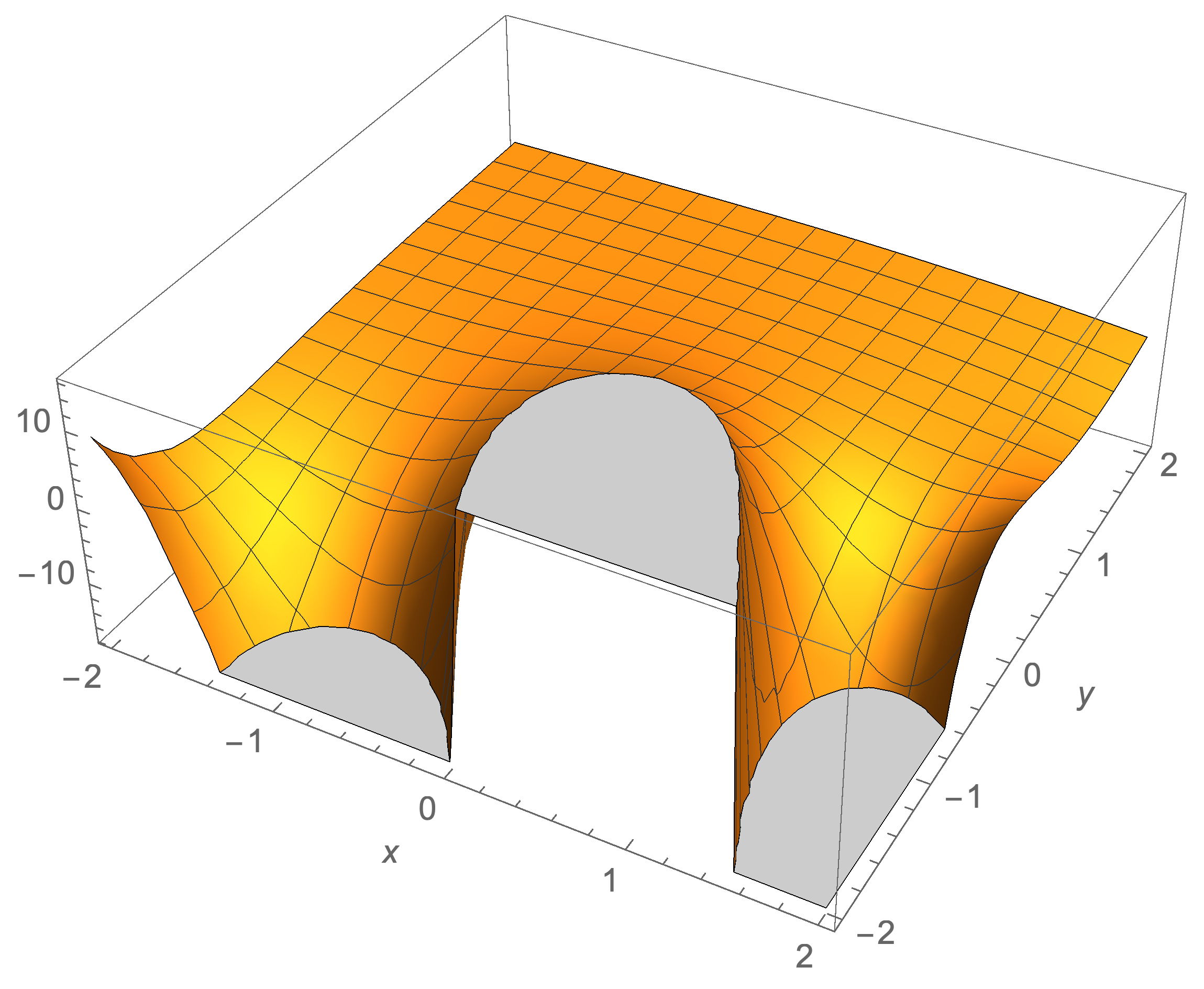
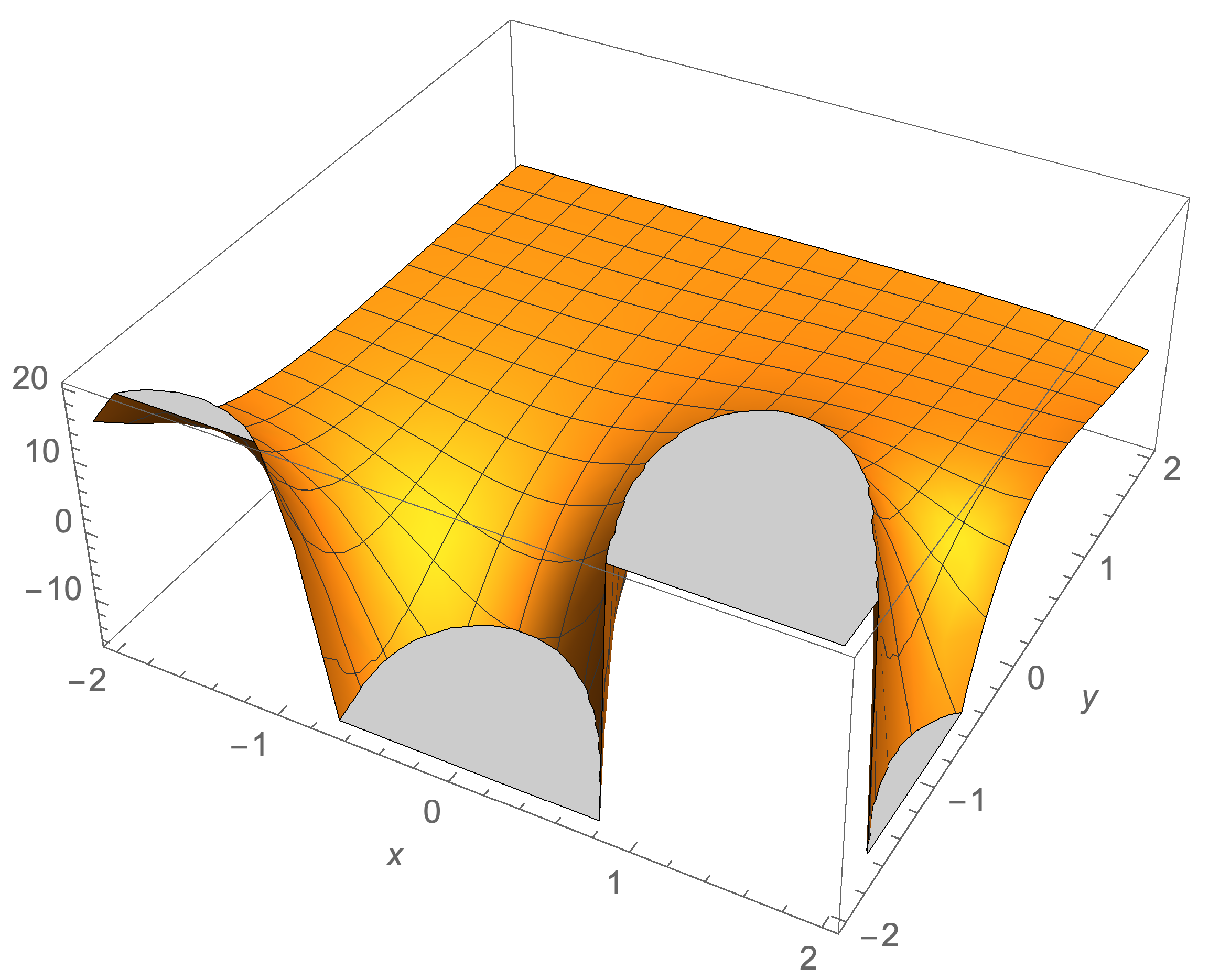
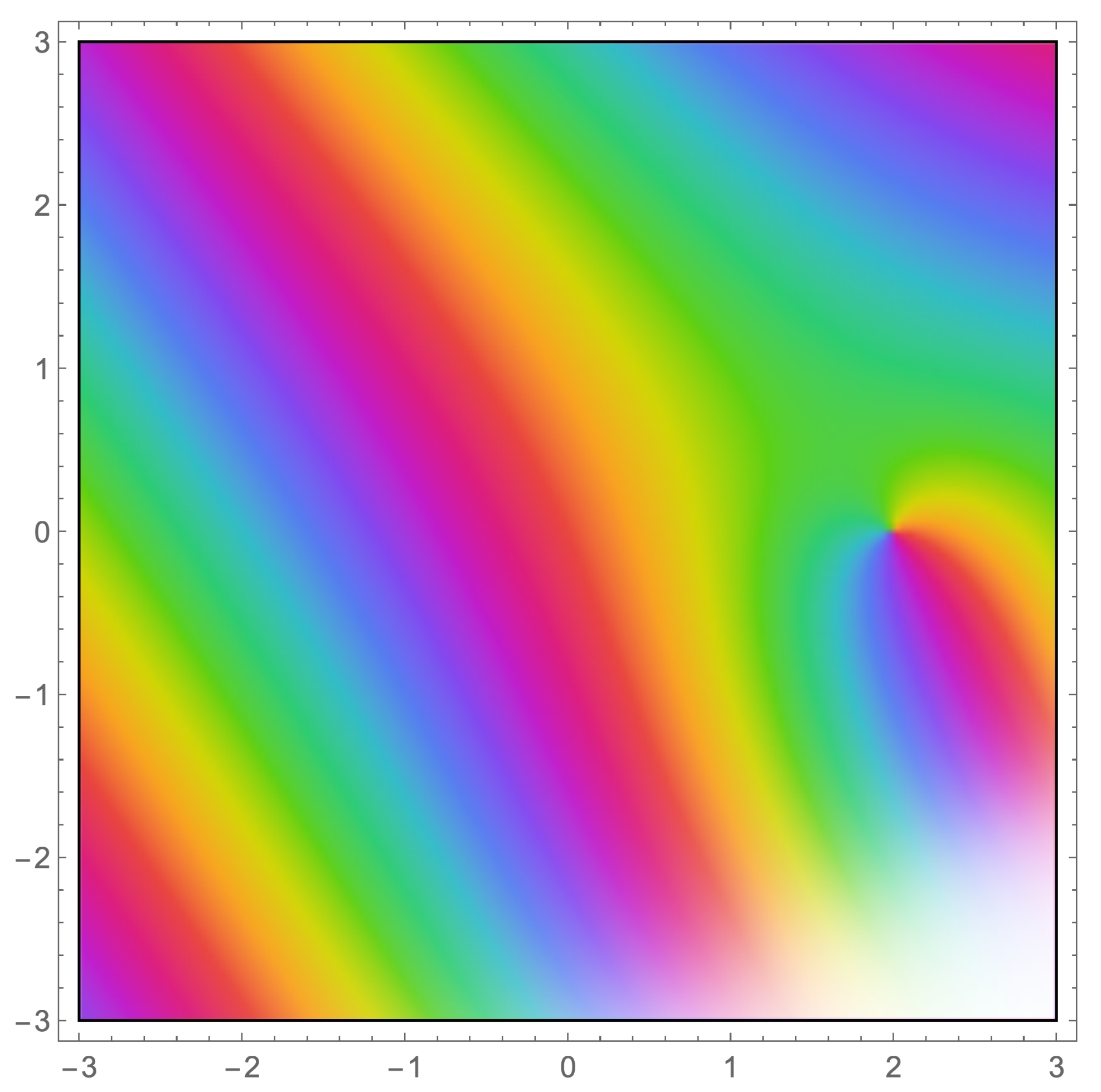
In this section, we evaluate the right-hand side of Equation (15) for complex values of the parameter k. The Figure 1, Figure 2 and Figure 3 are below:
Figure 1.
Plot of real part of .
Figure 2.
Plot of imaginary part of .
Figure 3.
Plot of arg of .
7. Conclusions and Observation
In this paper, we have presented a novel method for deriving a new integral transform involving the product of the Struve and parabolic cylinder functions along with some interesting definite integrals using contour integration. We also derived an invariant index form of the quadruple integral. We observed that the single integral of the product of the Struve and parabolic cylinder functions is in terms of the gamma function, while the higher dimensional integrals of the product of these functions can be constant. We will be investigating this property in future work. The Figure 1, Figure 2, Figure 3, and results presented were numerically verified for real, imaginary, and complex values of the parameters in the integrals using Mathematica by Wolfram.
Author Contributions
Conceptualization, R.R.; methodology, R.R.; writing—original draft preparation, R.R.; writing—review and editing, R.R. and A.S.; and funding acquisition, A.S. All authors have read and agreed to the published version of the manuscript.
Funding
This research is supported by NSERC Canada under grant 504070.
Institutional Review Board Statement
Not applicable.
Informed Consent Statement
Not applicable.
Data Availability Statement
Not applicable.
Conflicts of Interest
The authors declare no conflict of interest.
References
- Watson, G.; Whittaker, N.; Taylor, E. A course of Modern Analysis, 3rd ed.; Cambridge Mathematical Library: Cambridge, UK, 1927; p. 353. [Google Scholar]
- Mitra, S. On certain infinite integrals involving Struve functions and Parabolic cylinder functions. Proc. Edinb. Math. Soc. 1946, 7, 171–173. [Google Scholar] [CrossRef][Green Version]
- Reynolds, R.; Stauffer, A. A Method for Evaluating Definite Integrals in Terms of Special Functions with Examples. Int. Math. Forum 2020, 15, 235–244. [Google Scholar] [CrossRef]
- Gradshteyn, I.S.; Ryzhik, I.M. Tables of Integrals, Series and Products, 6th ed.; Academic Press: Cambridge, MA, USA, 2000. [Google Scholar]
- Brychkov, Y.A.; Marichev, O.I.; Savischenko, N.V. Handbook of Mellin Tranforms; CRC Press: Boca Raton, FL, USA, 2019; p. 149. [Google Scholar]
- Harrison, M.; Waldron, P. Mathematics for Economics and Finance; Taylor & Francis: Abingdon, UK, 2011. [Google Scholar]
- Olver, F.W.J.; Lozier, D.W.; Boisvert, R.F.; Clark, C.W. (Eds.) NIST Digital Library of Mathematical Functions; With 1 CD-ROM (Windows, Macintosh and UNIX). MR 2723248 (2012a:33001); U.S. Department of Commerce, National Institute of Standards and Technology: Washington, DC, USA; Cambridge University Press: Cambridge, UK, 2010. [Google Scholar]
- Laurincikas, A.; Garunkstis, R. The Lerch Zeta-Function; Springer Science & Business Media: Berlin/Heidelberg, Germany, 2013. [Google Scholar]
- Oldham, K.B.; Myland, J.C.; Spanier, J. An Atlas of Functions: With Equator, the Atlas Function Calculator, 2nd ed.; Springer: New York, NY, USA, 2009. [Google Scholar]
- Lewin, L. Polylogarithms and Associated Functions; North-Holland Publishing Co.: New York, NY, USA, 1981. [Google Scholar]
- Adamchik, V.S. Polygamma Functions of Negative Order. J. Comput. Appl. Math. 1999, 100, 191–199. [Google Scholar] [CrossRef]
Publisher’s Note: MDPI stays neutral with regard to jurisdictional claims in published maps and institutional affiliations. |
© 2021 by the authors. Licensee MDPI, Basel, Switzerland. This article is an open access article distributed under the terms and conditions of the Creative Commons Attribution (CC BY) license (https://creativecommons.org/licenses/by/4.0/).