Modeling Extreme Values Utilizing an Asymmetric Probability Function
 ,
,  ,
,  and
and 
Abstract
1. Introduction
- i.
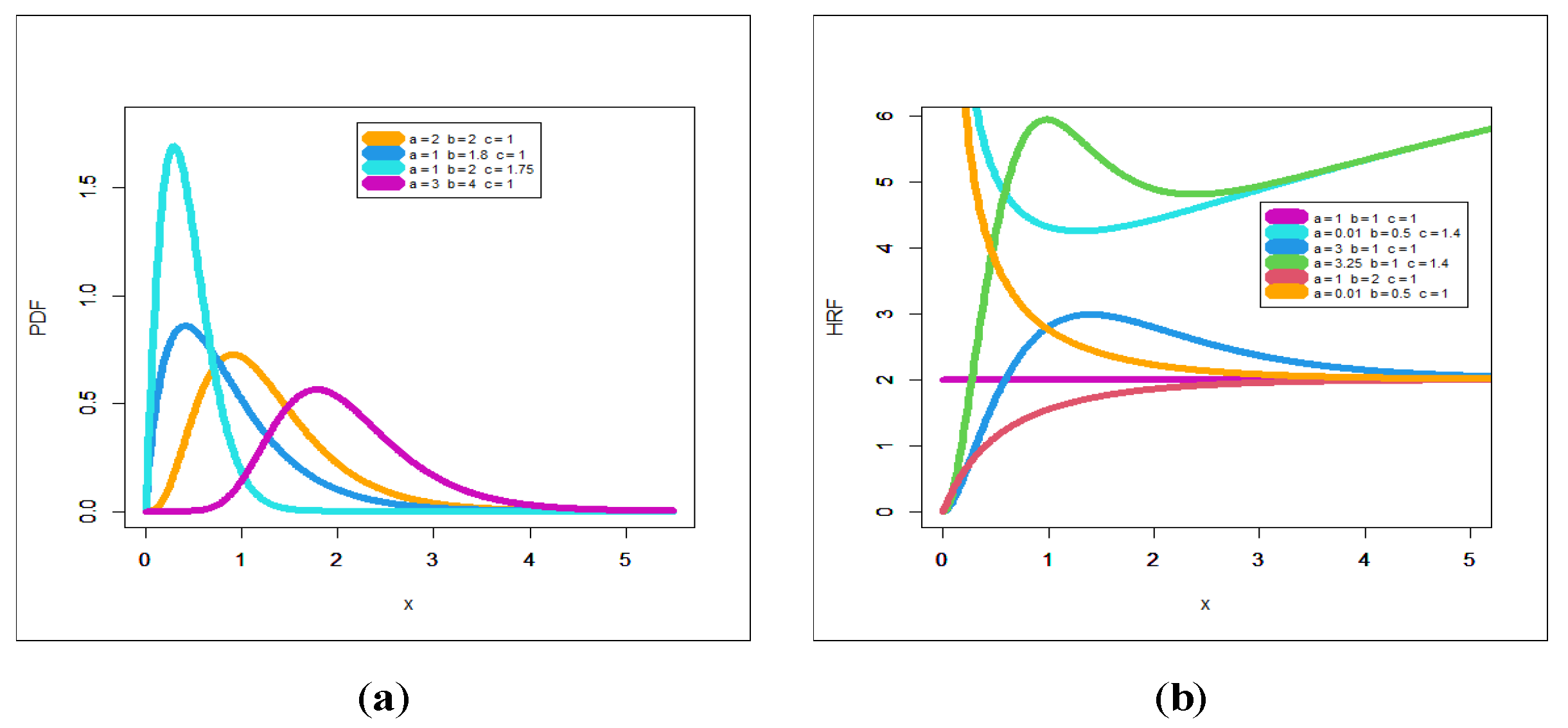
- The new density in (5) can be “asymmetric unimodal and right skewed” with many useful shapes.
- ii.
- The HRF of the new model can be constant, increasing-constant, bathtub (U-HRF), decreasing-constant and upside-down (reversed U-HRF). These characteristics give a great advantage to the TLE-NH model for analyzing the data sets in which its HRF can be constant, increasing-constant bathtub, decreasing-constant or upside down- bathtub.
- iii.
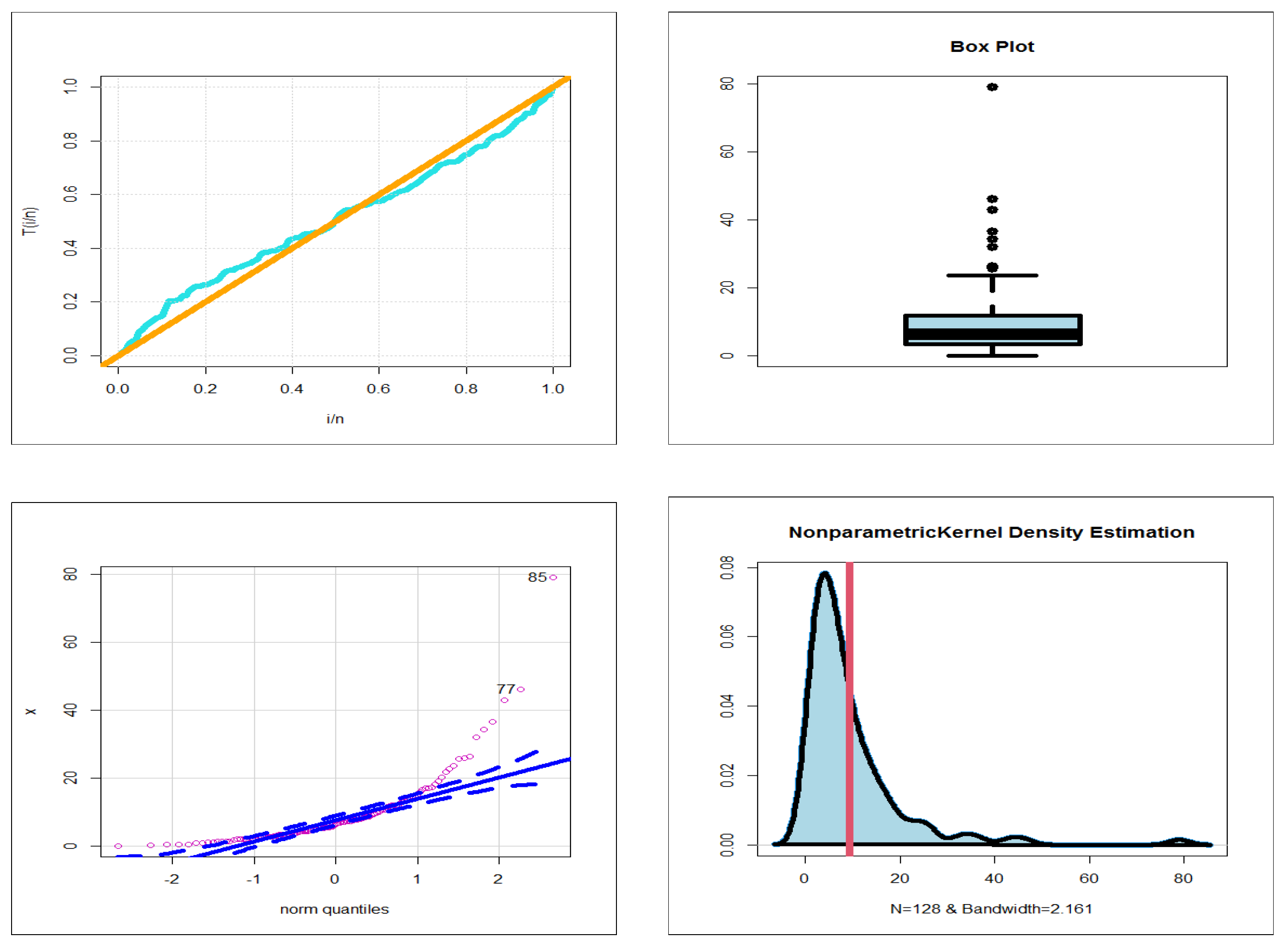
- The new TLE-NH model is recommended for modeling the remission times (in months) of the bladder cancer patients. The bladder cancer data have some extreme values.
- iv.
- Also, its nonparametric Kernel density estimation is asymmetric with heavy tail to the right. Therefore, the TLE-NH model could be useful asymmetric real data especially the unimodal symmetric heavy tailed right skewed data and the bimodal symmetric heavy tailed right skewed data.
- v.
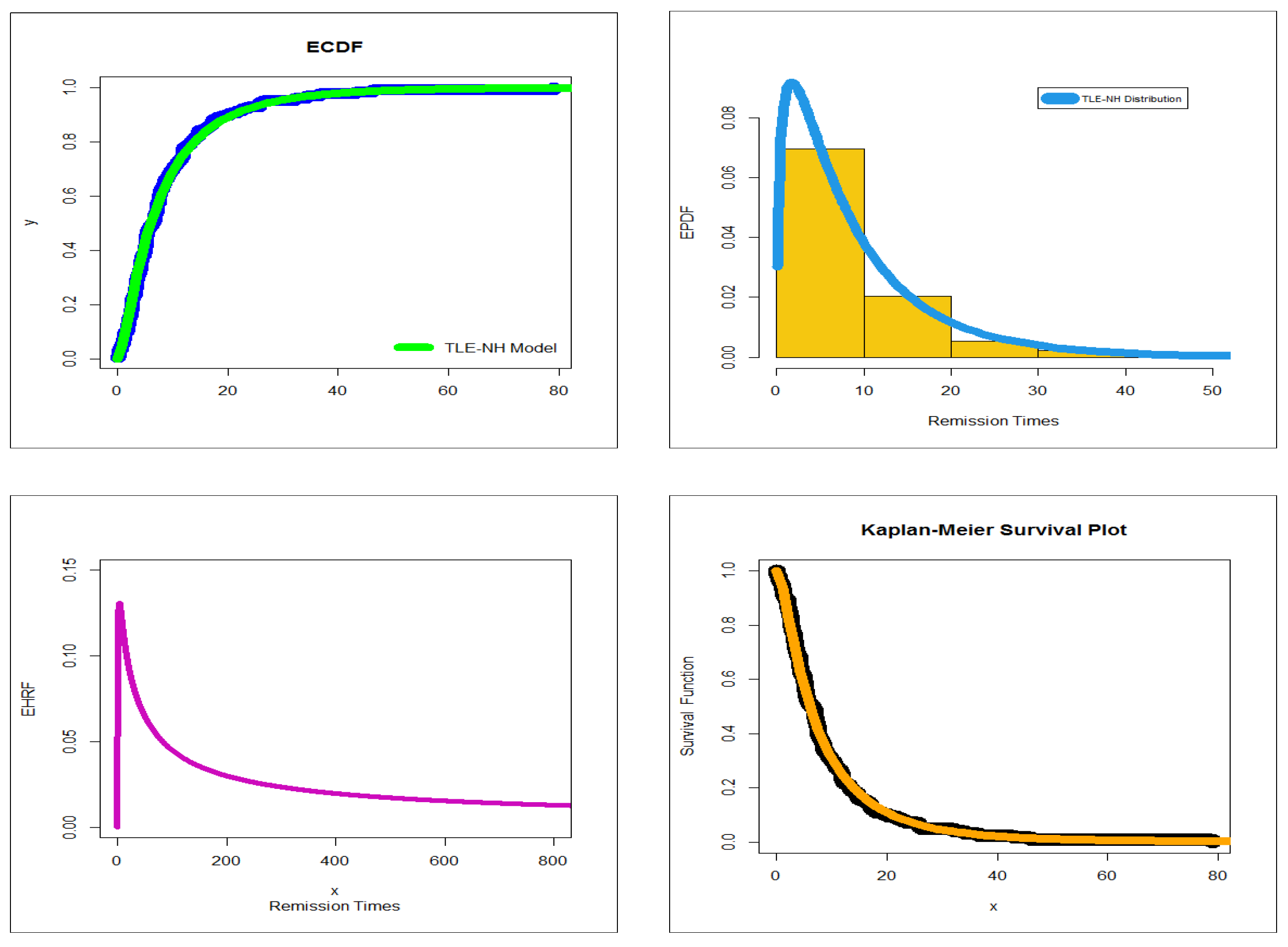
- On the other hand, the new TLE-NH model is flexible enough to exhibit the asymmetric densities and right heavy tail shapes as illustrated in Figure 1a.
- vi.
- Moreover, the HRF of the bladder cancer patients is upside-down; this property matches with our new model which contains the upside-down HRF as illustrated in Figure 1b. It is vital to mention that the presented class of probabilistic distributions suitable for modeling asymmetric data also have an important utilization in insurance (see Maciak et al. [12] for more details) and in dependence modeling (see Gijbels et al. [13]).
- vii.
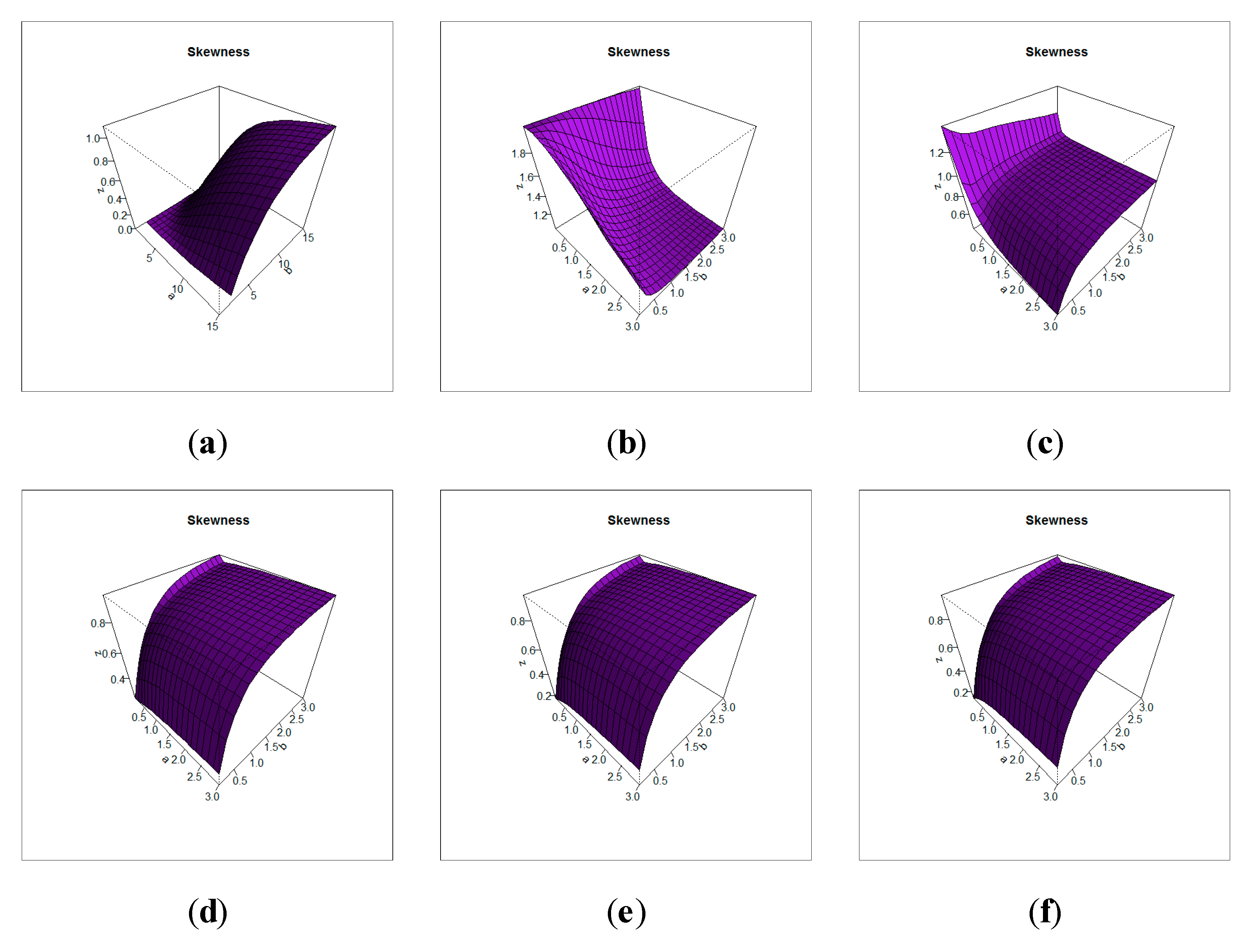
- The range of the skewness of the TLE-NH model is falling in the interval (). However, the skewness of the standard baseline NH model is falling in the interval (). The wide range of the skewness gives priority to the TLE-NH model in modeling and future prediction since many real-life datasets are negatively skewed. The standard baseline NH model cannot be useful in such cases (see Tables 1 and 2 and Figures 2 and 3).
- viii.
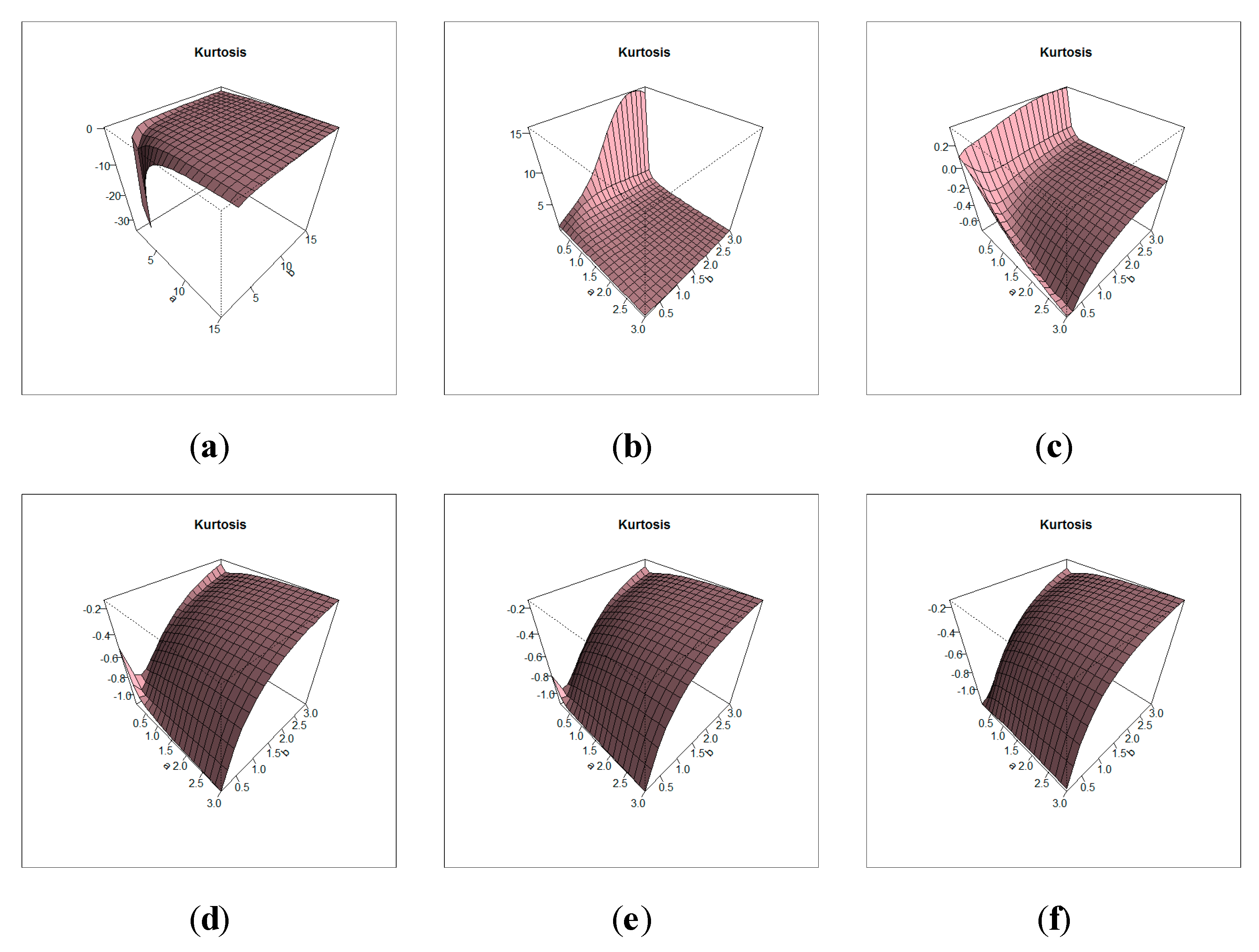
- The kurtosis of the TLE-NH model is located between and , however the kurtosis of the NH model starts from to . Thus, the TLE-NH extension could be useful for mesokurtic, leptokurtic and platykurtic data sets (see Tables 1 and 2 and Figures 2 and 3).
- ix.
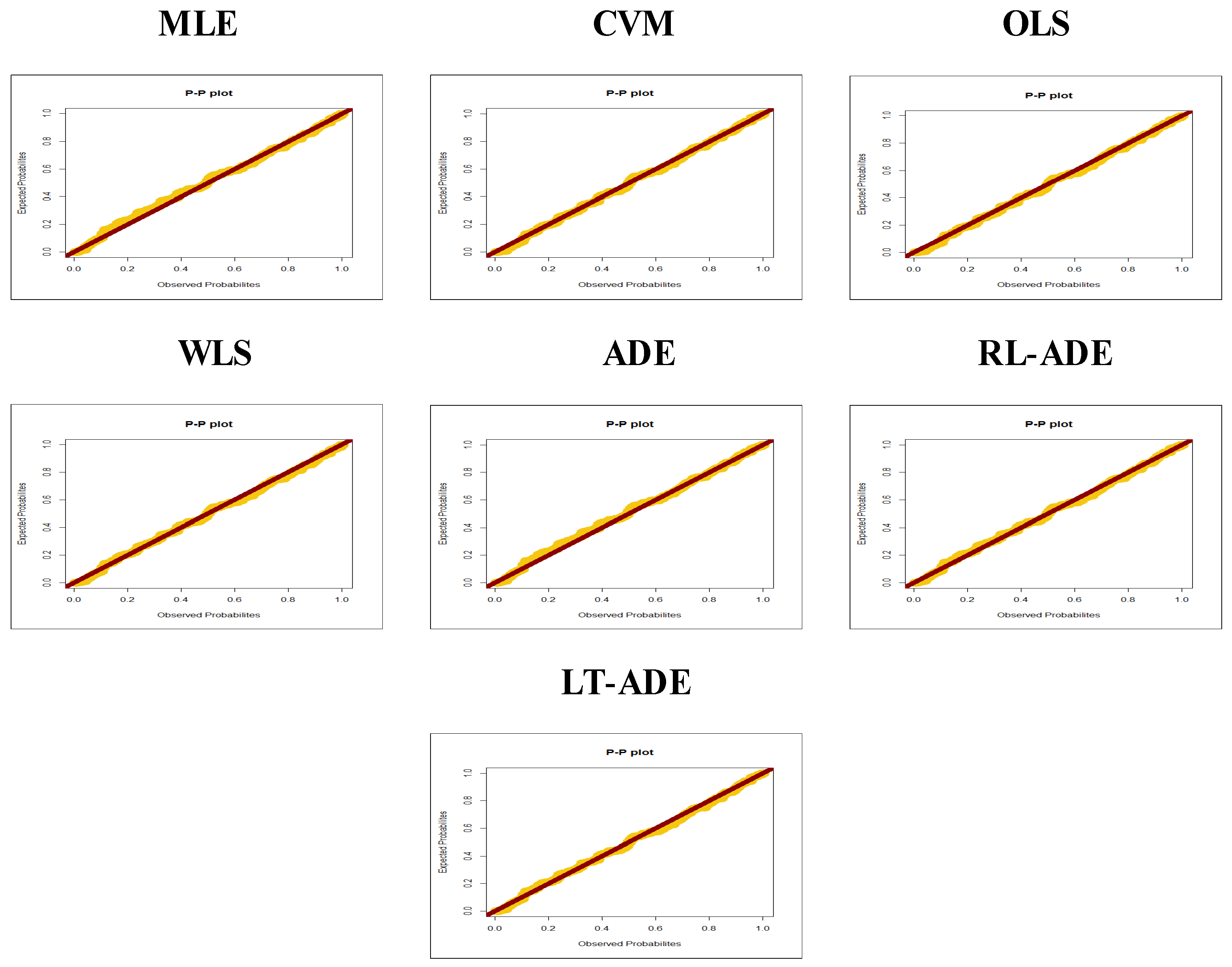
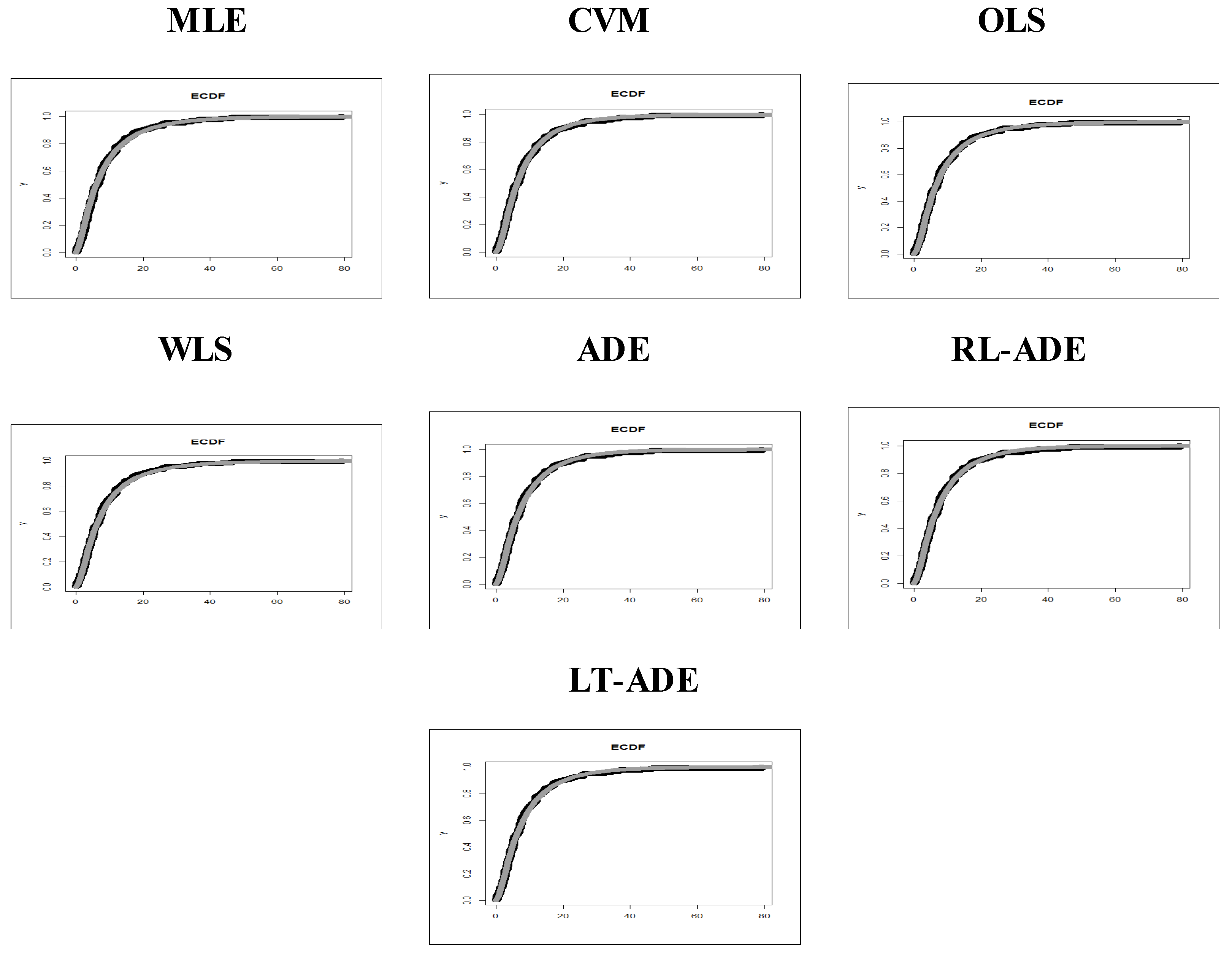
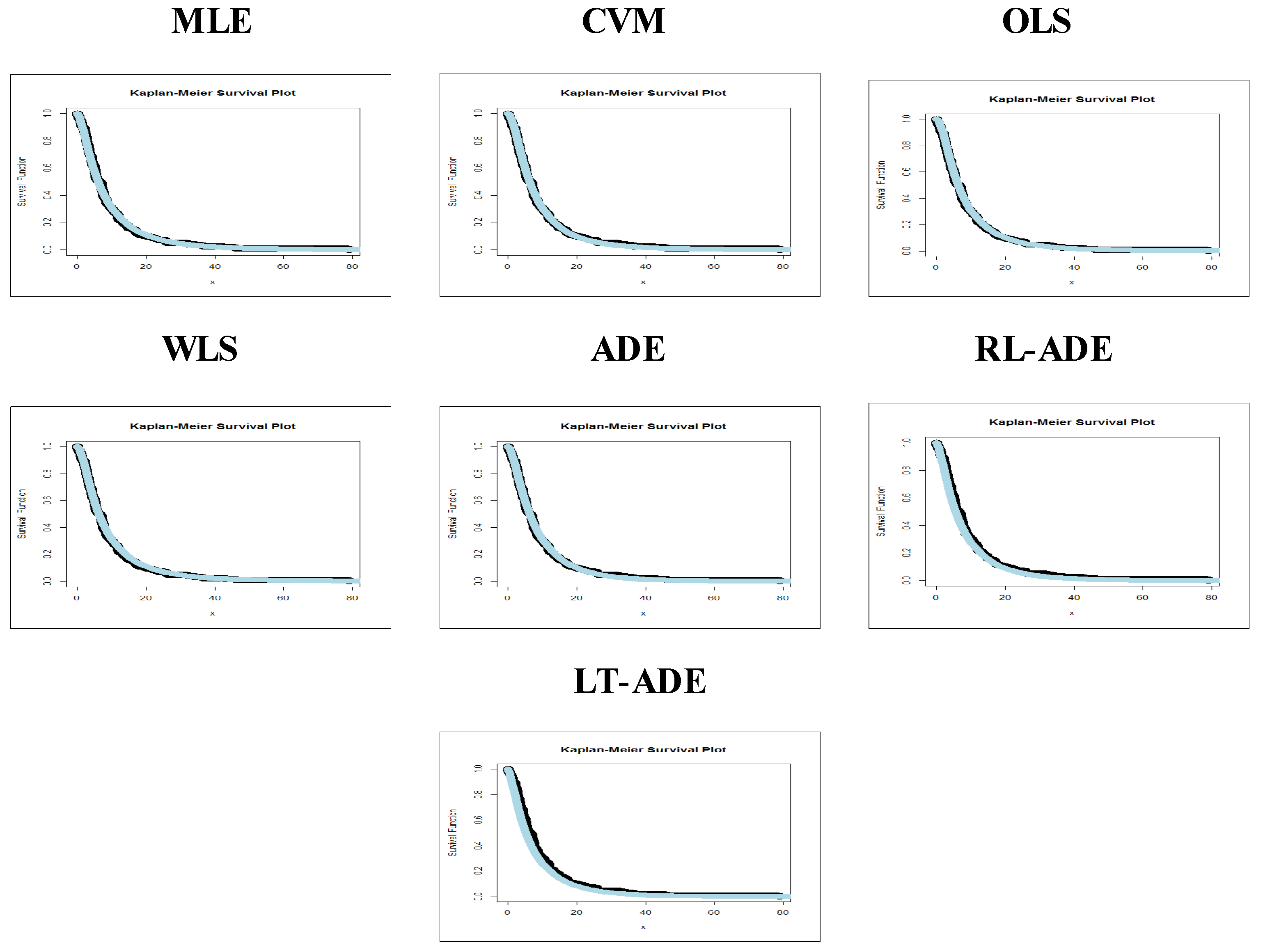
- The estimation persuaders of the TLE-NH model can be performed under the maximum likelihood, Anderson–Darling, ordinary least squares, Cramér–von Mises, weighted least squares, left-tail Anderson–Darling, and right-tail Anderson–Darling methods. Although all estimation methods perform well, the weighted least squares estimation method is the best in real data modeling, with slight differences in results.
2. Properties
2.1. Moments
2.2. Moment Generating Function (MGF)
2.3. Incomplete Moments (I-Ms)
2.4. The Moment of the Residual Life (MoRL)
2.5. The Moment of the Reversed Residual Life ()
2.6. Order Statistics
3. Estimation Methods
3.1. Maximum Likelihood Estimation (MLE) Method
3.2. Cramér–Von-Mises Estimation (CVME) Method
3.3. Ordinary Least Squares Estimation (OLSE) Method
3.4. Weighted Least Squares Estimation (WLSE) Method
3.5. Anderson–Darling Estimation (ADE) Method
3.6. Right Tail-Anderson–Darling Estimation (RT-ADE) Method
3.7. Left Tail-Anderson–Darling Estimation (LT-ADE) Method
4. Simulation for Comparing Various Estimation Methods
- i.
- The MSE under ML decreased from 0.27643to 0.08205.
- ii.
- The MSE under CVM decreased from 0.24741to 0.06579.
- iii.
- The MSE under OLS decreased from 0.29624to 0.07117.
- iv.
- The MSE under WLS decreased from 0.29093to 0.06882.
- v.
- The MSE under AD decreased from 0.19796to 0.05345.
- vi.
- The MSE under RT-AD decreased from 0.27743to 0.07353.
- vii.
- The MSE under LT-AD decreased from 0.18347to 0.04942.
5. Asymmetric Data Analysis
5.1. For Comparing Methods under Asymmetric Data
5.2. For Comparing Competitive Models
6. Conclusions
Author Contributions
Funding
Institutional Review Board Statement
Informed Consent Statement
Data Availability Statement
Conflicts of Interest
References
- Nadarajah, S.; Haghighi, F. An extension of the exponential distribution. Statistics 2011, 45, 543–558. [Google Scholar] [CrossRef] [Scilit]
- Lemonte, A.J.; Cordeiro, G.M.; Moreno-Arenas, G. A new useful three-parameter extension of the exponential distribution. Statistics 2016, 50, 312–337. [Google Scholar] [CrossRef] [Scilit]
- Ortega, E.M.; Lemonte, A.J.; Silva, G.O.; Cordeiro, G.M. New flexible models generated by gamma random variables for lifetime modeling. J. Appl. Stat. 2015, 42, 2159–2179. [Google Scholar] [CrossRef] [Scilit]
- Ahmed, A.; Muhammed, H.Z.; Elbatal, I. A new class of extension exponential distribution. Int. J. Appl. Math. Sci. 2015, 8, 13–30. [Google Scholar]
- Lima, S.R.L. The Half Normal Generalized Family and Kummaraswamy Nadarajah Haghighi Distribution. Master’s Thesis, Universidade Federal de Pernumbuco, Recife, Brazil, 2015. [Google Scholar]
- El Damcese, M.A.; Ramadan, D.A. Studies on Properties and Estimation Problems for Modified Extension of Exponential Distribution. Int. J. Comput. Appl. 2015, 2015, 125. [Google Scholar] [CrossRef] [Scilit]
- Lemonte, A.J. A new exponential-type distribution with constant, decreasing, increasing, upside-down bathtub and bathtub-shaped failure rate function. Comput. Stat. Data Anal. 2013, 62, 149–170. [Google Scholar] [CrossRef] [Scilit]
- Yousof, H.M.; Korkmaz, M.C. Topp-Leone Nadarajah Haghighi distribution: Mathematical properties and applications, International Journal of Applied Mathematics. J. Stat. Stat. Actuar. Sci. 2017, 2, 119–128. [Google Scholar]
- Dias, C.R.B.; Alizadeh, M.; Cordeiro, G.M. The beta Nadarajah-Haghighi distribution. Hacet. J. Math. Stat. 2018, 47, 1302–13203. [Google Scholar] [CrossRef] [Scilit]
- Tahir, M.H.; Cordeiro, G.M.; Ali, S.; Dey, S. The inverted Nadarajah-Haghighi distribution: Properties, estimation methods and applications. J. Stat. Comput. Simul. 2019, 88, 2775–2798. [Google Scholar] [CrossRef] [Scilit]
- Pena-Ramirez, F.A.; Guerra, R.R.; Cordeiro, G.M. The Nadarajah-Haghighi Lindley distribution. Acad Bras Cienc. 2019, 91, 1–20. [Google Scholar] [CrossRef] [Scilit]
- Maciak, M.; Okhrin, O.; Pešta, M. Infinitely stochastic micro reserving. Insur. Math. Econ. 2021, 100, 30–58. [Google Scholar] [CrossRef] [Scilit]
- Gijbels, I.; Omelka, M.; Pešta, M.; Veraverbeke, N. Score tests for covariate effects in conditional copulas. J. Multivar. Anal. 2017, 159, 111–133. [Google Scholar] [CrossRef] [Scilit]
- Eliwa, M.S.; Altun, E.; Alhussain, Z.A.; Ahmed, E.A.; Salah, M.M.; Ahmed, H.H.; El-Morshedy, M. A new one-parameter lifetime distribution and its regression model with applications. PLoS ONE 2021, 16, e0246969. [Google Scholar] [CrossRef] [Scilit] [PubMed]
- El-Morshedy, M.; Eliwa, M.S.; Altun, E. Discrete Burr-Hatke distribution with properties, estimation methods and regression model. IEEE Access 2020, 8, 74359–74370. [Google Scholar] [CrossRef] [Scilit]
- Hamedani, G.G.; Korkmaz, M.C.; Butt, N.S.; Yousof, H.M. The Type I Quasi Lambert Family: Properties, Characterizations and Different Estimation Methods. Pak. J. Stat. Oper. Res. 2021, 17, 545–558. [Google Scholar] [CrossRef] [Scilit]
- Elgohari, H.; Ibrahim, M.; Yousof, H.M. A New Probability Distribution for Modeling Failure and Service Times: Properties, Copulas and Various Estimation Methods. Stat. Optim. Inf. Comput. 2021, 8, 555–586. [Google Scholar] [CrossRef] [Scilit]
- Lee, E.T.; Wang, J. Statistical Methods for Survival Data Analysis; John Wiley & Sons: New York, NY, USA, 2003; Volume 476. [Google Scholar]
- Cordeiro, G.M.; Yousof, H.M.; Ramires, T.G.; Ortega, E.M. The Burr XII system of densities: Properties, regression model and applications. J. Stat. Comput. Simul. 2018, 88, 432–456. [Google Scholar] [CrossRef] [Scilit]
- Selim, M.A. Some theoretical and computational aspects of the inverse generalized power Weibull distribution. J. Data Sci. 2019, 17, 742–755. [Google Scholar] [CrossRef] [Scilit]



| a | b | c | E(Z) | V(Z) | S(Z) | K(Z) |
|---|---|---|---|---|---|---|
| 0.001 | 1.0 | 1.0 | 0.001286 | 0.0008056 | 43.03816 | 2722.165 |
| 0.01 | 0.012572 | 0.0078321 | 13.73513 | 279.9879 | ||
| 0.1 | 0.104002 | 0.0621733 | 4.697541 | 35.42657 | ||
| 0.25 | 0.208241 | 0.1193405 | 3.268103 | 18.69152 | ||
| 0.5 | 0.326534 | 0.1790888 | 2.557750 | 12.62371 | ||
| 1.0 | 0.5 | 0.25 | 2.0 | 9.0 | ||
| 1.5 | 0.665002 | 0.2803381 | 1.784458 | 7.855008 | ||
| 0.001 | 3.5 | 5.0 | 0.001209 | 0.0001259 | 14.00467 | 245.1215 |
| 0.1 | 0.080019 | 0.0037463 | 1.444700 | 4.787573 | ||
| 1.0 | 0.177359 | 0.0045912 | 0.402047 | 3.032383 | ||
| 3.0 | 0.222693 | 0.0061278 | −0.92852 | 4.867656 | ||
| 0.1 | 0.1 | 1.25 | 0.001482 | 0.0005384 | 32.69074 | 1578.728 |
| 0.5 | 0.026813 | 0.0108739 | 7.517766 | 84.14104 | ||
| 1.0 | 0.079014 | 0.0331868 | 4.274762 | 28.70463 | ||
| 5.0 | 0.558848 | 0.1322969 | 2.206003 | 7.477113 | ||
| 6.0 | 0.663141 | 0.1200882 | 3.039792 | 7.785333 | ||
| 0.25 | 1.5 | 0.5 | 1.019356 | 2.8743150 | 4.829448 | 47.14539 |
| 1.0 | 0.353175 | 0.1882723 | 2.492174 | 12.09759 | ||
| 5.0 | 0.055709 | 0.0032452 | 1.602556 | 5.778513 | ||
| 10.0 | 0.027117 | 0.0007387 | 1.521412 | 5.350372 | ||
| 20.0 | 0.013381 | 0.0001763 | 1.412999 | 5.279472 |
| c | E(Z) | V(Z) | S(Z) |
|---|---|---|---|
| 1.00 | 1.0 | 1.0 | 2.0 |
| 1.50 | 0.5516834 | 0.2353814 | 1.473465 |
| 2.00 | 0.3789361 | 0.0985353 | 1.253915 |
| 2.50 | 0.2881511 | 0.0531792 | 1.133407 |
| 3.00 | 0.2323270 | 0.0330535 | 1.057228 |
| 4.00 | 0.1673480 | 0.0162348 | 0.966298 |
| 5.00 | 0.1307332 | 0.0095934 | 0.913879 |
| 10.0 | 0.0623942 | 0.0020517 | 0.813496 |
| 15.0 | 0.0409678 | 0.0008665 | 0.781278 |
| 20.0 | 0.0304945 | 0.0004752 | 0.764709 |
| 25.0 | 0.0242857 | 0.0002996 | 0.825042 |
| 30.0 | 0.0201773 | 0.0002059 | 0.275571 |
| Method | A-V | MSE | 95% (LCI, UCI) | |
|---|---|---|---|---|
| ML | 50 | 3.03681 | 0.27643 | (2.18975, 4.24236) |
| CVM | 3.03876 | 0.24741 | (2.20664, 4.17194) | |
| OLS | 3.16297 | 0.29624 | (2.31059, 4.32059) | |
| WLS | 3.17337 | 0.29093 | (2.30181, 4.36224) | |
| AD | 3.04235 | 0.19796 | (2.29968, 4.06564) | |
| RT-AD | 3.07986 | 0.27743 | (2.20827, 4.27400) | |
| LT-AD | 3.02975 | 0.18347 | (2.33653, 3.99886) | |
| ML | 100 | 3.03694 | 0.17449 | (2.33953, 3.93597) |
| CVM | 3.03081 | 0.13932 | (2.39139, 3.87721) | |
| OLS | 3.09770 | 0.15591 | (2.46020, 3.95783) | |
| WLS | 3.10215 | 0.15521 | (2.47454, 3.97494) | |
| AD | 3.03040 | 0.11091 | (2.46244, 3.77999) | |
| RT-AD | 3.04675 | 0.15603 | (2.39973, 3.97069) | |
| LT-AD | 3.02643 | 0.10135 | (2.48184, 3.73488) | |
| ML | 150 | 3.02443 | 0.10695 | (2.43548, 3.73870) |
| CVM | 3.20857 | 0.09305 | (2.49738, 3.68579) | |
| OLS | 3.05006 | 0.09204 | (2.51645, 3.70989) | |
| WLS | 3.05504 | 0.08916 | (2.52952, 3.69274) | |
| AD | 3.00771 | 0.07070 | (2.54121, 3.58907) | |
| RT-AD | 3.01729 | 0.09353 | (2.45689, 3.67173) | |
| LT-AD | 3.00554 | 0.06687 | (2.54325, 3.56276) | |
| ML | 200 | 3.02241 | 0.08205 | (0.26984, 3.65394) |
| CVM | 3.02505 | 0.06579 | (2.56864, 3.57190) | |
| OLS | 3.04558 | 0.07117 | (2.57289, 3.59672) | |
| WLS | 3.05014 | 0.06882 | (2.58386, 3.59850) | |
| AD | 3.01060 | 0.05345 | (2.57513, 3.47962) | |
| RT-AD | 3.02168 | 0.07353 | (2.53566, 3.59174) | |
| LT-AD | 3.00676 | 0.04942 | (2.58677, 3.44691) |
| Method | A-V | MSE | 95% (LCI, UCI) | |
|---|---|---|---|---|
| ML | 50 | 0.30119 | 0.00106 | (0.26950, 0.34076) |
| CVM | 0.30128 | 0.00089 | (0.24819, 0.36707) | |
| OLS | 0.30876 | 0.00102 | (0.25515, 0.37516) | |
| WLS | 0.30949 | 0.00100 | (0.25491, 0.37580) | |
| AD | 0.30195 | 0.00077 | (0.25249, 0.36324) | |
| RT-AD | 0.30370 | 0.00098 | (0.24798, 0.37036) | |
| LT-AD | 0.30119 | 0.0075 | (0.25460, 0.36071) | |
| ML | 100 | 0.30281 | 0.00071 | (0.25957, 0.35778) |
| CVM | 0.30129 | 0.00051 | (0.26067, 0.35069) | |
| OLS | 0.30533 | 0.00055 | (0.26553, 0.35585) | |
| WLS | 0.30566 | 0.00055 | (0.26633, 0.35696) | |
| AD | 0.30148 | 0.00044 | (0.26439, 0.34838) | |
| RT-AD | 0.30214 | 0.00056 | (0.26144, 0.35536) | |
| LT-AD | 0.30128 | 0.00042 | (0.26485, 0.34544) | |
| ML | 150 | 0.30178 | 0.00042 | (0.26481, 0.34670) |
| CVM | 0.30134 | 0.00034 | (0.26797, 0.34002) | |
| OLS | 0.30266 | 0.00034 | (0.26924, 0.34110) | |
| WLS | 0.30300 | 0.00033 | (0.27002, 0.34034) | |
| AD | 0.30020 | 0.00028 | (0.26963, 0.33577) | |
| RT-AD | 0.30064 | 0.00035 | (0.26439, 0.33953) | |
| LT-AD | 0.30006 | 0.00028 | (0.26951, 0.33562) | |
| ML | 200 | 0.30161 | 0.00032 | (0.26984, 0.34085) |
| CVM | 0.30124 | 0.00024 | (0.27248, 0.33357) | |
| OLS | 0.30248 | 0.00026 | (0.27296, 0.33533) | |
| WLS | 0.30279 | 0.00025 | (0.27391, 0.33466) | |
| AD | 0.30047 | 0.00022 | (0.27244, 0.32996) | |
| RT-AD | 0.30101 | 0.00027 | (0.27062, 0.33456) | |
| LT-AD | 0.30023 | 0.00021 | (0.27235, 0.32815) |
| Method | A-V | MSE | 95% (LCI, UCI) | |
|---|---|---|---|---|
| ML | 50 | 0.10278 | 0.00019 | (0.08003, 0.13200) |
| CVM | 0.10325 | 0.00040 | (0.07203, 0.14932) | |
| OLS | 0.09856 | 0.00035 | (0.06916, 0.14042) | |
| WLS | 0.09829 | 0.00029 | (0.07108, 0.13747) | |
| AD | 0.10080 | 0.00027 | (0.07333, 0.13986) | |
| RT-AD | 0.10035 | 0.00023 | (0.07550, 0.13723) | |
| LT-AD | 0.10284 | 0.00048 | (0.0686, 0.15093) | |
| ML | 100 | 0.10088 | 0.00012 | (0.08288, 0.12489) |
| CVM | 0.10140 | 0.00020 | (0.07679, 0.13352) | |
| OLS | 0.09895 | 0.00019 | (0.07483, 0.12875) | |
| WLS | 0.09888 | 0.00016 | (0.07697, 0.12543) | |
| AD | 0.10046 | 0.00027 | (0.07333, 0.13986) | |
| RT-AD | 0.10037 | 0.00013 | (0.07932, 0.12518) | |
| LT-AD | 0.10121 | 0.00024 | (0.07412, 0.13534) | |
| ML | 150 | 0.10055 | 0.00007 | (0.08561, 0.11873) |
| CVM | 0.10066 | 0.00013 | (0.08098, 0.12565) | |
| OLS | 0.09979 | 0.00012 | (0.08058, 0.12422) | |
| WLS | 0.09964 | 0.00010 | (0.08221, 0.12250) | |
| AD | 0.10062 | 0.00010 | (0.08334, 0.12268) | |
| RT-AD | 0.10042 | 0.00008 | (0.08424, 0.12040) | |
| LT-AD | 0.10143 | 0.00016 | (0.07940, 0.12853) | |
| ML | 200 | 0.10045 | 0.00006 | (0.08675, 0.11694) |
| CVM | 0.10031 | 0.00009 | (0.08338, 0.12044) | |
| OLS | 0.09958 | 0.00009 | (0.08265, 0.12009) | |
| WLS | 0.09948 | 0.00008 | (0.08404, 0.11900) | |
| AD | 0.10024 | 0.00007 | (0.08518, 0.11782) | |
| RT-AD | 0.10008 | 0.00006 | (0.08585, 0.11621) | |
| LT-AD | 0.10086 | 0.00012 | (0.08238, 0.12495) |
| Method | a | b | c | CM | AD |
|---|---|---|---|---|---|
| MLE | 0.341 | 6.896 | 0.388 | 0.05587 | 0.38410 |
| CVM | 0.507 | 5.491 | 0.396 | 0.05416 | 0.37560 |
| OLS | 0.722 | 3.999 | 0.383 | 0.05871 | 0.40834 |
| WLS | 0.687 | 3.877 | 0.372 | 0.03673 | 0.24138 |
| ADE | 0.179 | 14.474 | 0.422 | 0.06226 | 0.41748 |
| RL-ADE | 0.162 | 15.808 | 0.424 | 0.06355 | 0.42509 |
| LT-ADE | 0.175 | 14.626 | 0.420 | 0.06264 | 0.42010 |
| Model | a | b | c |
|---|---|---|---|
| TLE-NH | 0.3414 | 6.896 | 0.3875 |
| (0.3277) | (6.366) | (0.0347) | |
| BuXII-NH | 1.4763 | 0.11737 | 0.8259 |
| (0.2510) | (0.0215) | (0.00264) | |
| B-Exp | 1.1726 | 26.8142 | 0.0046 |
| (0.1312) | (0.6327) | (0.0006) | |
| Kuw-Exp | 1.4512 | 0.2816 | 0.4105 |
| (0.0240) | (0.0274) | (0.0154) | |
| IGPW | 0.4435 | 15.7165 | 1.2110 |
| (0.0482) | (4.8326) | (0.1023) | |
| T-NH | (−1.0181) | 0.43629 | |
| (0.0505) | (0.01736) | ||
| TL-NH | 3.1644 | 0.3161 | |
| (0.3828) | (0.0165) | ||
| Lx-NH | 0.1786 | 0.8259 | |
| (0.01586) | (0.0027) | ||
| Exp-Exp | 1.2179 | 0.1211 | |
| (0.1488) | (0.0135) | ||
| NH | 0.9227 | 0.1216 | |
| (0.1515) | (0.0344) | ||
| IW | 2.4311 | 0.7520 | |
| (0.2192) | (0.0424) | ||
| INH | 0.5064 | 10.5947 | |
| (0.0480) | (2.3220) | ||
| IE | 2.4847 | ||
| (0.2020) | |||
| IR | 0.6174 | ||
| (0.0545) |
| Model | ℓ | |
|---|---|---|
| TLE-NH | 411.5920 | 829.1840, 829.3775, 837.7401, 832.6604 |
| Kuw-Exp | 412.4602 | 830.9204, 831.1139, 839.4765, 834.3968 |
| Exp-Exp | 413.0776 | 830.1552, 832.3487, 840.7113, 835.6316 |
| B-Exp | 413.3671 | 832.7342, 835.0594, 846.1423, 839.3693 |
| NH | 414.2255 | 832.4510, 832.5470, 838.1550, 834.7686 |
| T-NH | 414.4753 | 832.9505, 833.0465, 838.6546, 835.2681 |
| BuXII-NH | 414.5475 | 835.0949, 835.2885, 843.6510, 838.5713 |
| TL-NH | 415.0535 | 834.1069, 834.2029, 839.8110, 836.4245 |
| Lx-NH | 416.2293 | 836.4585, 836.5545, 842.1626, 838.7761 |
| IGPW | 426.9104 | 859.8194, 860.0135, 868.3751, 863.2964 |
| INH | 431.0593 | 866.1184, 866.2145, 871.8222, 868.4363 |
| IW | 444.0013 | 892.0022, 892.0986, 897.7060, 894.3192 |
| IE | 460.3826 | 922.7653, 922.7962, 925.6174, 923.9233 |
| IR | 774.3427 | 1550.683, 1550.715, 1553.535, 1551.842 |
Publisher’s Note: MDPI stays neutral with regard to jurisdictional claims in published maps and institutional affiliations. |
© 2021 by the authors. Licensee MDPI, Basel, Switzerland. This article is an open access article distributed under the terms and conditions of the Creative Commons Attribution (CC BY) license (https://creativecommons.org/licenses/by/4.0/).
Share and Cite
Almazah, M.M.A.; Almuqrin, M.A.; Eliwa, M.S.; El-Morshedy, M.; Yousof, H.M. Modeling Extreme Values Utilizing an Asymmetric Probability Function. Symmetry 2021, 13, 1730. https://doi.org/10.3390/sym13091730
Almazah MMA, Almuqrin MA, Eliwa MS, El-Morshedy M, Yousof HM. Modeling Extreme Values Utilizing an Asymmetric Probability Function. Symmetry. 2021; 13(9):1730. https://doi.org/10.3390/sym13091730
Chicago/Turabian StyleAlmazah, Mohammed M. A., Muqrin A. Almuqrin, Mohamed. S. Eliwa, Mahmoud El-Morshedy, and Haitham M. Yousof. 2021. "Modeling Extreme Values Utilizing an Asymmetric Probability Function" Symmetry 13, no. 9: 1730. https://doi.org/10.3390/sym13091730
APA StyleAlmazah, M. M. A., Almuqrin, M. A., Eliwa, M. S., El-Morshedy, M., & Yousof, H. M. (2021). Modeling Extreme Values Utilizing an Asymmetric Probability Function. Symmetry, 13(9), 1730. https://doi.org/10.3390/sym13091730