


Abstract
The derivation of conservation laws and invariant functions is an essential procedure for the investigation of nonlinear dynamical systems. In this study, we consider a two-field cosmological model with scalar fields defined in the Jordan frame. In particular, we consider a Brans–Dicke scalar field theory and for the second scalar field we consider a quintessence scalar field minimally coupled to gravity. For this cosmological model, we apply for the first time a new technique for the derivation of conservation laws without the application of variational symmetries. The results are applied for the derivation of new exact solutions. The stability properties of the scaling solutions are investigated and criteria for the nature of the second field according to the stability of these solutions are determined.
1. Introduction
The detailed analysis of recent cosmological observations indicates that the universe has been through two accelerating phases [1,2,3,4]. The current acceleration era is assumed to be driven by an unknown source known as dark energy, whose main characteristic is the negative pressure which provides an anti-gravity effect [5]. Furthermore, the early-universe acceleration era, known as inflation, is described by a scalar field, the inflaton, which is used to explain the homogeneity and isotropy of the present universe. In particular, the scalar field dominates the dynamics and explains the expansion era [6,7]. Nevertheless, the scalar field inflationary models are mainly defined on homogeneous spacetimes, or on background spaces with small inhomogeneities [8,9]. In [10] it was found that the presence of a positive cosmological constant in Bianchi cosmologies leads to expanding Bianchi spacetimes, evolving towards the de Sitter universe. That was the first result to support the cosmic “no-hair” conjecture [11,12]. This latter conjecture states that all expanding universes with a positive cosmological constant admit as asymptotic solution the de Sitter universe. The necessity of the de Sitter expansion is that it provides a rapid expansion for the size of the universe such that the latter effectively loses its memory on the initial conditions, which implies that the de Sitter expansion solves the “flatness”, “horizon” and the monopole problem [13,14].
In the literature scalar fields have been introduced in the gravitational theory in various ways. The simplest scalar field model is the quintessence model, which consists of a scalar field minimally coupled to gravity [15,16]. Another family of scalar fields are those which belong to the scalar-tensor theory. In this theory the scalar field is non-minimally coupled to gravity which makes it essential for the physical state of the theory. Another important characteristic of the scalar-tensor theories is that they are consistent with Mach’s principle. The most common scalar-tensor theory is the Brans–Dicke theory [17] which is considered in this study. For other scalar-tensor theories and generalizations we refer the reader to [18,19,20,21,22,23,24,25] and references therein.
The Einstein field equations of general relativity are a set of ten nonlinear second-order partial differential equations with independent variables the spacetime coordinates and dependent variables the coefficient functions of the metric tensor. However, by assuming specific forms for the metric tensor and the existence of collineations the field equations are simplified by reduce the number of independent variables of to be separable, see for instance [26,27,28,29,30] and references therein. According to the cosmological principle in large scale the universe is assumed to be homogeneous, isotropic and spatially flat. This implies that the background space is described by the Friedmann-Lemaître-Robertson-Walker (FLRW) spacetime. This spacetime is characterized by the scale factor which defines the radius of the three-dimensional (3d) Euclidean space, consequently because of the existence of the spacetime isommetries, the field equations are reduced to ordinary differential equations. Since General Relativity is a second-order theory the field equations involve second-order derivatives of the scale factor. For simple cosmological fluids such as the ideal gas or the cosmological constant, the field equations can be solved explicitly [31]. However, when additional degrees of freedom are introduced, such as a scalar field, the field equations cannot be solved with the use of closed-form functions and techniques of analytic mechanics and one looks for First Integrals (FIs) which establish their (Liouville) integrability [32,33,34,35]. The standard method for the determination of FIs is Noether’s theory [36]. However, there have appeared alternative geometric methods [37,38,39,40,41,42] which use the symmetries of the metric defined by the kinetic energy to determine the FIs of the dynamic equations. In the following, we shall make use of one such approach to determine the FIs (conservation laws) of the field equations.
In the present study, we consider a cosmological model in which the gravitational Action Integral is that of Brans–Dicke theory with an additional scalar field minimally coupled to gravity [43,44]. This two-scalar-field model belongs to the family of multi-scalar field models which have been used as unified dark energy models [45,46,47] or as alternative models for the description of the acceleration phases of the universe [48,49,50,51]. Indeed multifield inflationary models provide an alternative mechanism for the description of the early acceleration phase of the universe. The mechanism for the end of the inflation is much simple. Specifically, the scalar fields at the be beginning and at the end of the inflationary are not necessary the same. Thus, this can lead to different number of e-folds and affect the curvature perturbations [52,53]. The latter, in the non-adiabatic perturbations can provide detectable non-Gaussianities in the power spectrum [54]. As far as, the late-time acceleration phase, multifield cosmological models have been introduced to describe dark energy models with varying equation of state parameter which can cross the phantom divide line without the appearance of ghosts [54]. Such models can be solved the Hubble-tension problem [51]. Furthermore, multi-scalar field models can attribute the additional degrees of freedom provided by the alternative theories of gravity [55,56,57]. The structure of the paper is as follows.
In Section 2, we define the cosmological model, and we present the gravitational field equations. In Section 3, we present some important results on the derivation of quadratic first integrals (QFIs) for a family of second-order ordinary differential equations (ODEs) with linear damping and perform a classification according to the admitted conservation laws. The results are applied to the cosmological model we consider in Section 4 where we construct the conservation laws for the gravitational field equations. Due to the non-linearity of the field equations it is not possible to write the general solution of the field equation in closed form. However, we find some exact closed-form solutions with potential interest for the description of the cosmological history. The stability of these exact solutions is investigated in Section 5. Finally, in Section 6 we summarize our results, and we draw our conclusions.
2. Cosmological Model
For the gravitational Action Integral, we consider that of Brans–Dicke scalar field theory with an additional matter source leading to the expression [17,18]
where denotes the Brans–Dicke scalar field and is the Brans–Dicke parameter. The action is assumed to describe an ideal gas with constant equation of state parameter and the Lagrangian function corresponds to the second scalar field which is assumed to be that of quintessence and minimally coupled to the Brans–Dicke scalar field. With these assumptions the Action Integral (1) takes the following form
The gravitational field equations follow from the variation of the Action Integral (2) with respect to the metric tensor. They are
where is the Einstein tensor. The energy-momentum tensor where corresponds to the ideal gas and provides the contribution of the field in the field equations.
Concerning the equations of motion for the matter source and the two scalar fields, we find while variation with respect to the fields and provides the second-order differential equations
We assume the background space to be the Friedmann-Lemaître - Robertson-Walker (FLRW) spacetime with line element
where is the scale factor of the universe and is the Hubble function. We note that a dot indicates derivative with respect to the cosmic time t.
From the line element (6) follows that the Ricci scalar is . Replacing in the gravitational field Equation (3) we obtain
where are the mass density and the isotropic pressure of the ideal gas; and for the quintessence field
For the equations of motion for the scalar fields we find
and
Finally, for the matter source the continuity equation reads
For an ideal gas, the equation of state is , where is an arbitrary constant. Substituting in Equation (12) we find the solution
where is an arbitrary constant.
3. Quadratic First Integrals for a Class of Second-Order ODEs with Linear Damping
Consider the second-order ODE
where the constant . In the following we shall determine the relation between the functions for which the ODE (14) admits a quadratic first integral (QFI). The case of linear first integrals (LFIs) is also included in our study.
This problem has been considered previously in [58,59] (see Equation (28a) in [58] and Equation (17) in [59]) and has been answered partially using different methods. In [58], the author applied the Hamiltonian formalism and investigated for a canonical transformation in order to rewrite the Hamiltonian in a time-separable form. In [59], it was proposed direct approach for the derivation of FIs by multiplying the equation with an integrating factor. Moreover, in [59], it was that the two approaches are equivalent, while the the results of [59] can be seen as ageneralization of the results of [58]. Below, we extend the results of [59]. We note that a recent discussion of the same problem may be found in [60], where the authors apply more general results from the integrability of time-dependent dynamical systems of the form .
Equation (14) is equivalent (see e.g., [61]) to the equation
where the function and the new independent variable are defined as
We assume that equation (15) admits the general quadratic first integral
where the unknown coefficients are arbitrary functions of . We impose the condition
Replacing the second derivatives , whenever they appear, using Equation (15) we find that the function and the following system of equations must be satisfied
where are arbitrary functions.
As will be shown for the values there results a family of ‘frequencies’ parameterized with functions, whereas for the values results a family of ‘frequencies’ parameterized with constants.
3.1. Case
For the QFI (17) becomes
where , the parameters are arbitrary constants and the functions satisfy the condition
3.2. Case
For , we derive the well-known results of the one-dimensional (1d) time-dependent oscillator (see e.g., [62,63]). Specifically, we find for the frequency the LFI
and for the frequency , where is an arbitrary constant, the QFI. (For , where is an arbitrary function, the QFI takes the usual form of the Lewis invariant.)
Using the transformation (16) we deduce that the original equation
for the frequency
admits the general solution
where are arbitrary constants, and .
3.3. Case
For , we derive the function and the QFI
where are arbitrary constants and the function is given by
3.4. Case
For we find , and where are arbitrary constants.
It has been checked that (36) and (37) for give results compatible with the ones we found for these values of n. Using the transformation (16) we deduce that the original system (14) is integrable iff the functions are related as follows
In this case, the associated QFI (36) is
4. Cosmological Exact Solutions
We can use the above results as an alternative to the Euler-Duarte-Moreira method of integrability of the anharmonic oscillator [70] in order to find exact solutions in the modified Brans–Dicke (BD) theory.
Specifically, we consider the equation of motion for the quintessence scalar field with potential function , where . Then, Equation (11) becomes
which is a subcase of (14) for and . Replacing in the transformation (16), we find that
where Equation (40) now reads
where .
The latter transformation for the background space becomes
which means that the rest of the field equations read
Next, we apply the results of Section 3 for Equation (42) and we determine for several cases of the parameter n the corresponding QFIs. The resulting QFIs are expressed in terms of the scale factor and other arbitrary functions of (i.e., , , ) which satisfy additional conditions. Solving these conditions, whenever is possible, we find a scale factor for which Equation (42) is integrable. Replacing this scale factor in the original equation of motion (40) of the quintessence field, we end up with a new integrable second-order ODE for which most times can be solved using standard methods (e.g., Lie symmetries) from the symmetries of differential equations. As a final step, for the computation of exact solutions, we replace the solutions in the remaining field Equations (7)–(10) and we determine the BD field and the parameter .
4.1. Case
For the associated QFI (22) becomes
where , the parameters are arbitrary constants and the functions satisfy the condition
We note that for we find the results of Section 4.4 below when .
4.2. Case
Using the transformation (41) equation admits the solution
where and the functions satisfy the condition
4.3. Case
For we have and the associated QFI (31) becomes
where are arbitrary constants and the function is given by
Substituting the given functions in Equations (33)–(35) we find equivalently that
where the function is given by the differential equation
Equation (40) becomes . We note that for we retrieve the results of Section 4.4 below for .
In the special case with , we find for Equation (55) the special solution with constraint where is an arbitrary constant. Moreover from Equation (53) the scale factor is determined
Therefore, the Klein–Gordon Equation (40) becomes
The latter equation can be solved by quadratures. In particular it admits the Lie symmetries
Using the vector field we find the reduced equation in which . The latter equation is an Abel equation of second type. Moreover, if we assume that is a constant, then we find where by replacing in Equation (57) it follows . Therefore, we end up with the solution . Let us now find the complete solution for the gravitational field equations for this particular exact solution.
Replacing these results in the rest of the field equations for dust fluid source, i.e., and where is a constant, the evolution equation for the Brans–Dicke field becomes
which admits the general solution
where is an arbitrary constant. Finally, by replacing in the constraint Equation (7) follows (Equation (8) is satisfied identically)
We conclude that the gravitational field equations for this model with the use of the QFI for Equation (40) admit the following exact solution
with physical quantities
4.4. Case
Substituting the given functions in the relation (38) we find equivalently that
and the associated QFI (39) becomes
We consider the following special cases for which Equation (40) admits a closed-form solution for . In the case the spacetime is that of Minkowski space. Hence, we omit the analysis.
4.4.1. Subcase
For small values of (i.e., ) the scale factor (62) is approximated as , therefore it follows
where and is an arbitrary constant.
For this asymptotic solution the equation of motion (40) for the second field becomes
For the latter equation, the QFI (64) is
This QFI for the scale factor (65) together with the results of the cases produce new solutions which have not found before.
Furthermore, for the scale factor (65) the closed-form solution for the scalar field from (66) is derived
whereas for the BD field it follows that and . However, this value for the BD parameter is not physically acceptable. Hence, we do not have any close-form solution. In all discussion above we have considered .
The closed-form solution found in this section is not the general solution of the field equations. That is easy to be seen since they have less free parameters from the degrees of freedom of the dynamical system. However, this form of solutions is of special interest in cosmological studies because they can describe various phases of the cosmological evolution, such as the early inflationary epoch.
4.4.2. Subcase
For large values of (i.e., ), the scale factor (62) is approximated as . Therefore, in the original variable Equation (63) becomes
which implies (see Equation (31) of [43])
where and is an arbitrary constant. The scale factor (70) describes a scaling solution where the effective cosmological fluid is that of an ideal gas with effective parameter for the equation of state Furthermore, for the scale factor describes an accelerated universe. For is bounded as while for , crosses the phantom divide line, i.e., .
For this asymptotic solution the equation of motion (40) for the second field becomes
and the corresponding QFI (64) is written as
where .
However, the system admits the closed-form solution (see Equation (32) of [43])
in which is given by the expression . Replacing in the remaining Equations (7)–(10) for the Brans–Dicke field we calculate
in which
while we have assumed that there is not any other matter source, i.e., . The constants are given by the relations
In the following we perform a detailed study on the stability of the latter closed-form solutions.
5. Stability of Scaling Solutions
The analysis of the stability properties of the exact solutions provides us with important information about the evolution of the background space on the asymptotic solutions. In particular, we can infer if an exact solution is stable, which can be seen as a future attractor for the original dynamical system. On the other hand, in the cases of unstable solutions the behavior of the asymptotic solution and its dynamics give us results for the curvature and the dynamics of the metric space.
According to the methods in [15,71,72] let be
a second-order ODE in one dimension which admits a singular power law solution
where is an arbitrary constant. To examine the stability of the solution , the logarithmic time T through is introduced, such that as and as . We use in the following discussion.
The following dimensionless function is introduced
and the stability analysis in translated into the analysis of the stability of the equilibrium point of a transformed dynamical system. To construct the aforementioned system the following relations are useful:
In this section, we use a similar procedure for analyzing stability of the scaling solutions obtained in Section 4.4.
Case
Denoting we have
Hence
Equation (83) becomes
Substituting and it is obtained the second-order equation
Defining
we obtain the autonomous system
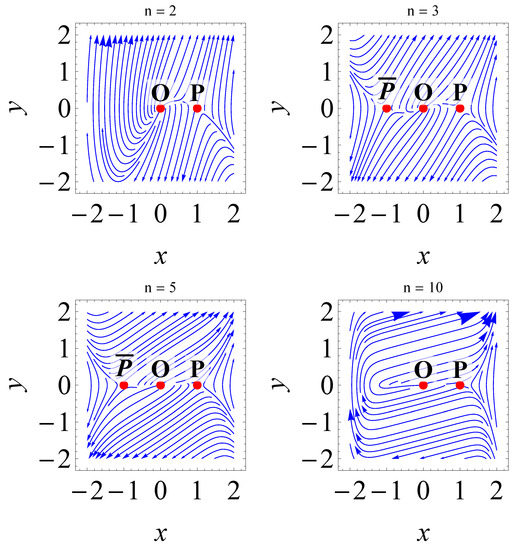
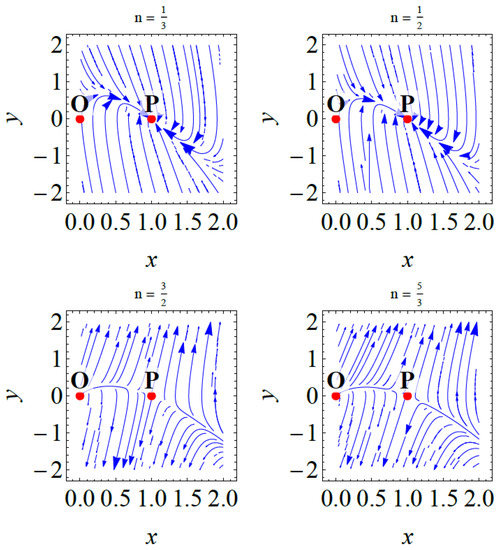
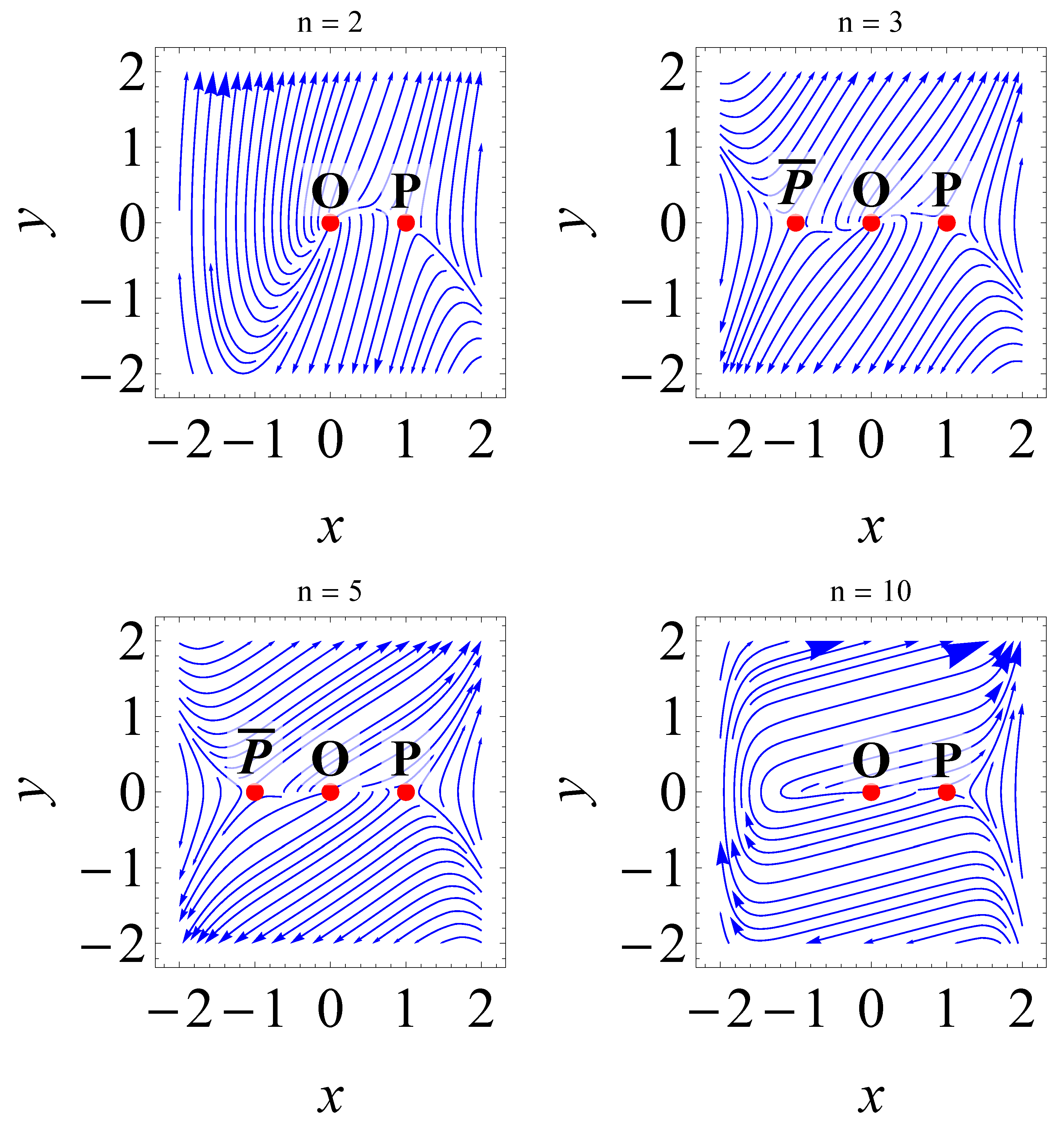
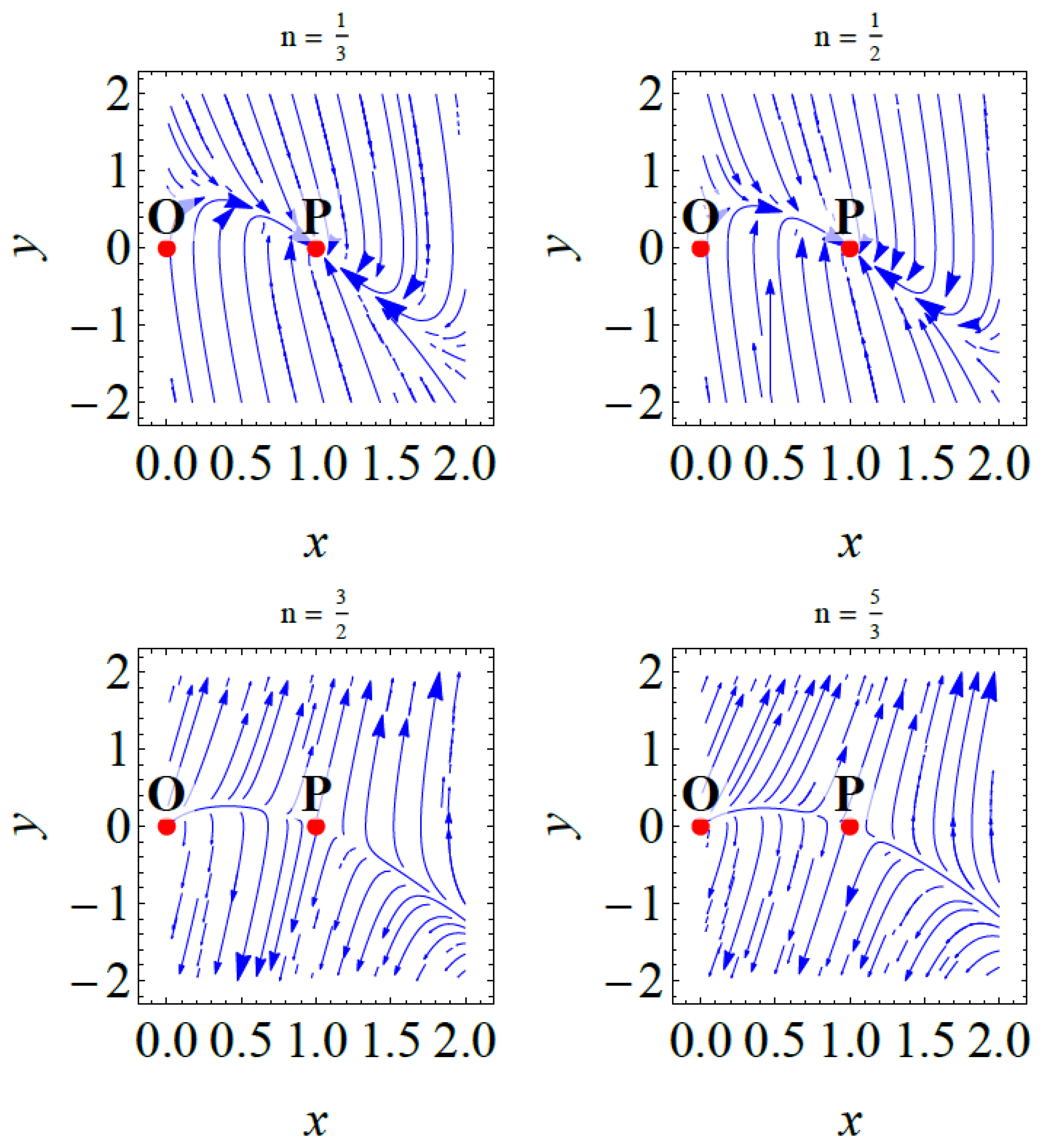
The scaling solution (73) is transformed to the equilibrium point . The system (93) and (94) also admits the trivial solution as an equilibrium point and in the case that n is odd, the symmetrical point P given by is also an equilibrium point.
For , is real-valued, with eigenvalues . Then, the origin is unstable for .
The eigenvalues of are . Therefore, is a sink for . It is a saddle for , or .
If n is odd number, say , with , the eigenvalues of are and when it exists, is a saddle.
In Figure 1, a phase-plot of system (93) and (94) for is presented. P is a saddle given . When n is odd, the symmetrical point is a saddle given . The origin O is a source, and the orbits diverge to infinity.
6. Conclusions
In this work, we considered a cosmological model consisted by a Brans–Dicke field and a minimally coupled quintessence field in a spatially flat FLRW background space. For this cosmological model, the gravitational field equations consist of a Hamiltonian system of six degrees of freedom. The dynamical variables correspond to the scale factor and to the two scalar fields.
To study the integrability of the field equations, we have applied a direct method which determines the FIs of a dynamical system without the use of Noether’s theorem. In this approach one assumes a generic form for the FIs, say I, and directly applies the condition using the dynamical equations. These considerations resulted in a system of partial differential equations involving the unknown coefficients defining I and the dynamical quantities which characterize the dynamical system. The resulting system of equations is solved in terms of the symmetries and the Killing tensors of the kinetic metric and its solution provides the considered FIs.
For a power law scalar field potential function of the quintessence field, we found conservation laws quadratic in the first order derivatives. Using the conservation laws, we were able to find exact solutions for the field equations. In particular, we found scaling solutions for the scale factor which describe ideal gas solutions. The stability properties of these solutions was investigated. We were able to recover previous published results in the literature and to find new QFIs.
Using methods in [15,71,72], we have studied second-order ODE in one dimension which admits a singular power law solution where is an arbitrary constant. To examine the stability of the solution , the logarithmic time T through was introduced, such that as and as . According to our analysis, the scaling solution (73) is transformed to the equilibrium point , which is a sink for or a saddle for , or . The dynamical system also admits the trivial solution as an equilibrium point and in the case that n is an odd, the symmetrical point P given by is also an equilibrium point. The origin is unstable for . If n is an odd number, the point exists and is a saddle.
Until now, most of this kind of studies, for the investigation of conservation laws, have been done mainly with the application of variational symmetries. Our approach is more general and does not required the existence of a point-like Lagrangian, i.e., of a minisuperspace description. Therefore, this generic approach can be applied in other gravitational models without minisuperspace such are the Class B Bianchi spacetimes.
Author Contributions
A.M. and M.T. established the research problem and proved the results presented in Section 3 and Section 4. G.L. worked on the stability analysis of Section 5. Finally, A.P. organized the plan of the paper and discussed the physical interpretation of the results. All authors have read and agreed to the published version of the manuscript.
Funding
The research of AP and GL was funded by Agencia Nacional de Investigación y Desarrollo-ANID through the program FONDECYT Iniciación grant no. 11180126. Additionally, GL was funded by Vicerrectoría de Investigación y Desarrollo Tecnológico at Universidad Católica del Norte. This work is based on the research supported in part by the National Research Foundation of South Africa (Grant Numbers 131604).
Institutional Review Board Statement
Not applicable.
Informed Consent Statement
Not applicable.
Data Availability Statement
Not applicable.
Conflicts of Interest
The authors declare no conflict of interest.
References
- Riess, A.G.; Filippenko, A.V.; Challis, P.; Clocchiatti, A.; Diercks, A.; Garnavich, P.M.; Gilliland, R.L.; Hogan, C.J.; Jha, S.; Kirshner, R.P.; et al. Observational Evidence from Supernovae for an Accelerating Universe and a Cosmological Constant. Astron. J. 1998, 116, 1009–1038. [Google Scholar] [CrossRef]
- Perlmutter, S.; Aldering, G.; Deustua, S.; Fabbro, S.; Goldhaber, G.; Groom, D.E.; Kim, A.G.; Kim, M.Y.; Knop, R.A.; Nugent, P.; et al. Cosmology from Type Ia supernovae. Bull. Am. Astron. Soc. 1997, 29, 1351. [Google Scholar]
- Riess, A.G.; Strolger, L.; Casertano, S.; Ferguson, H.C.; Mobasher, B.; Gold, B.; Challis, P.J.; Filippenko, A.V.; Jha, S.; Li, W.; et al. NewHubble Space TelescopeDiscoveries of Type Ia Supernovae at z>=1: Narrowing Constraints on the Early Behavior of Dark Energy. Astrophys. J. 2007, 659, 98–121. [Google Scholar] [CrossRef]
- Suzuki, N.; Rubin, D.; Lidman, C.; Aldering, G.S.; Amanullah, R.; Barbary, K.; Barrientos, L.F.; Botyanszki, J.; Brodwin, M.; Connolly, N.; et al. Thehubble space telescopecluster supernova survey. v. improving the dark-energy constraints abovez> 1 and building an early-type-hosted supernova sample. Astrophys. J. 2012, 746, 85. [Google Scholar] [CrossRef]
- di Valentino, E.; Mena, O.; Pan, S.; Visinelli, L.; Yang, W.; Melchiorri, A.; Mota, D.F.; Riess, A.G.; Silk, J. In the realm of the Hubble tension—A review of solutions. Class. Quantum Gravity 2021, 2103. [Google Scholar] [CrossRef]
- Starobinsky, A. A new type of isotropic cosmological models without singularity. Phys. Lett. B 1980, 91, 99–102. [Google Scholar] [CrossRef]
- Guth, A.H. Inflationary universe: A possible solution to the horizon and flatness problems. Phys. Rev. D 1981, 23, 347–356. [Google Scholar] [CrossRef]
- Müller, V.; Schmidt, H.-J.; Starobinsky, A. The stability of the de Sitter space-time in fourth order gravity. Phys. Lett. B 1988, 202, 198–200. [Google Scholar] [CrossRef]
- Kofman, L.; Linde, A.; Starobinsky, A. Inflationary universe generated by the combined action of a scalar field and gravitational vacuum polarization. Phys. Lett. B 1985, 157, 361–367. [Google Scholar] [CrossRef]
- Wald, R.M. Asymptotic behavior of homogeneous cosmological models in the presence of a positive cosmological constant. Phys. Rev. D 1983, 28, 2118–2120. [Google Scholar] [CrossRef]
- Gibbons, G.W.; Hawking, S.W. Cosmological event horizons, thermodynamics, and particle creation. Phys. Rev. D 1977, 15, 2738–2751. [Google Scholar] [CrossRef]
- Hawking, S.; Moss, I. Supercooled phase transitions in the very early universe. Phys. Lett. B 1982, 110, 35–38. [Google Scholar] [CrossRef]
- Sato, K. First-order phase transition of a vacuum and the expansion of the Universe. Mon. Not. R. Astron. Soc. 1981, 195, 467–479. [Google Scholar] [CrossRef]
- Barrow, J.D.; Ottewill, A. The stability of general relativistic cosmological theory. J. Phys. A Math. Gen. 1983, 16, 2757–2776. [Google Scholar] [CrossRef]
- Ratra, B.; Peebles, P.J.E. Cosmological consequences of a rolling homogeneous scalar field. Phys. Rev. D 1988, 37, 3406–3427. [Google Scholar] [CrossRef]
- Barrow, J.D.; Saich, P. Scalar-field cosmologies. Class. Quantum Gravity 1993, 10, 279–283. [Google Scholar] [CrossRef]
- Brans, C.H.; Dicke, R.H. Mach’s Principle and a Relativistic Theory of Gravitation. Phys. Rev. 1961, 124, 925–935. [Google Scholar] [CrossRef]
- Faraoni, V. Cosmology in Scalar-Tensor Gravity, Fundamental Theories of Physics; Kluwer Academic Press: Dordrecht, The Netherlands, 2004; Volume 139. [Google Scholar]
- Horndeski, G.W. Second-order scalar-tensor field equations in a four-dimensional space. Int. J. Theor. Phys. 1974, 10, 363–384. [Google Scholar] [CrossRef]
- O’Hanlon, J. Intermediate-Range Gravity: A Generally Covariant Model. Phys. Rev. Lett. 1972, 29, 137–138. [Google Scholar] [CrossRef]
- Nicolis, A.; Rattazzi, R.; Trincherini, E. Galileon as a local modification of gravity. Phys. Rev. D 2009, 79, 064036. [Google Scholar] [CrossRef]
- Deffayet, C.; Esposito-Farese, G.; Vikman, A. Covariant Galileon. Phys. Rev. D 2009, 79. [Google Scholar] [CrossRef]
- Belinchón, J.A.; Harko, T.; Mak, M.K. Exact scalar–tensor cosmological models. Int. J. Mod. Phys. D 2017, 26, 1750073. [Google Scholar] [CrossRef]
- Fomin, I.V.; Chervon, S.V. Exact and slow-roll solutions for exponential power-law inflation connected with f(R) gravity and observational constraints. arXiv 2006, arXiv:2006.16074. [Google Scholar]
- Fomin, I.V.; Chervon, S.; Maharaj, S.D. A new look at the Schrödinger equation in exact scalar field cosmology. Int. J. Geom. Methods Mod. Phys. 2019, 16, 1950022. [Google Scholar] [CrossRef]
- Saridakis, E.; Tsamparlis, M. Symmetry inheritance of conformal Killing vectors. J. Math. Phys. 1991, 32, 1541–1551. [Google Scholar] [CrossRef]
- Shapovalov, V.N. Stäckel spaces. Sib. Math. J. 1979, 20, 790. [Google Scholar] [CrossRef]
- Obukhov, V. Separation of variables in Hamilton-Jacobi and Klein-Gordon-Fock equations for a charged test particle in the Stäckel spaces of type. Int. J. Geom. Methods Mod. Phys. 2021, 18, 2150033. [Google Scholar] [CrossRef]
- Osetrin, E.; Osetrin, K. Pure radiation in space-time models that admit integration of the eikonal equation by the separation of variables method. J. Math. Phys. 2017, 58, 112504. [Google Scholar] [CrossRef]
- Tsamparlis, M.; Paliathanasis, A. The generic model of general relativity. Arab. J. Math. 2019, 8, 201–254. [Google Scholar] [CrossRef]
- Amendola, L.; Tsujikawa, S. Dark Energy: Theory and Observations; Cambrdige University Press: Cambridge, UK, 2010. [Google Scholar]
- Demiański, M.; De Ritis, R.; Marmo, G.; Platania, G.; Rubano, C.; Scudellaro, P.; Stornaiolo, C. Scalar field, nonminimal coupling, and cosmology. Phys. Rev. D 1991, 44, 3136–3146. [Google Scholar] [CrossRef] [PubMed]
- Dimakis, N.; Giacomini, A.; Paliathanasis, A. Integrability from point symmetries in a family of cosmological Horndeski Lagrangians. Eur. Phys. J. C 2017, 77, 458. [Google Scholar] [CrossRef]
- Dimakis, N.; Terzis, P.A.; Christodoulakis, T. Integrability of the mixmaster model. Phys. Rev. D 2019, 99, 023536. [Google Scholar] [CrossRef]
- Papagiannopoulos, G.; Barrow, J.D.; Basilakos, S.; Giacomini, A.; Paliathanasis, A. Dynamical symmetries in Brans-Dicke cosmology. Phys. Rev. D 2017, 95, 024021. [Google Scholar] [CrossRef]
- Tsamparlis, M.; Paliathanasis, A. Symmetries of Differential Equations in Cosmology. Symmetry 2018, 10, 233. [Google Scholar] [CrossRef]
- Katzin, G.H. Related integral theorem. II. A method for obtaining quadratic constants of the motion for conservative dynamical systems admitting symmetries. J. Math. Phys. 1973, 14, 1213–1217. [Google Scholar] [CrossRef]
- Katzin, G.H.; Levine, J. Geodesic first integrals with explicit path-parameter dependence in Riemannian space–times. J. Math. Phys. 1981, 22, 1878–1891. [Google Scholar] [CrossRef]
- Katzin, G.H.; Levine, J. Time-dependent quadratic constants of motion, symmetries, and orbit equations for classical particle dynamical systems with time-dependent Kepler potentials. J. Math. Phys. 1982, 23, 552–563. [Google Scholar] [CrossRef]
- Horwood, J.T. Higher order first integrals in classical mechanics. J. Math. Phys. 2007, 48, 102902. [Google Scholar] [CrossRef]
- Tsamparlis, M.; Mitsopoulos, A. Quadratic first integrals of autonomous conservative dynamical systems. J. Math. Phys. 2020, 61, 072703. [Google Scholar] [CrossRef]
- Tsamparlis, M.; Mitsopoulos, A. First integrals of holonomic systems without Noether symmetries. J. Math. Phys. 2020, 61, 122701. [Google Scholar] [CrossRef]
- Mukherjee, P.; Chakrabarti, S. Exact solutions and accelerating universe in modified Brans–Dicke theories. Eur. Phys. J. C 2019, 79, 681. [Google Scholar] [CrossRef]
- Giacomini, A.; Leon, G.; Paliathanasis, A.; Pan, S. Cosmological evolution of two-scalar fields cosmology in the Jordan frame. Eur. Phys. J. C 2020, 80, 1–31. [Google Scholar] [CrossRef]
- Cid, A.; Leon, G.; Leyva, Y. Intermediate accelerated solutions as generic late-time attractors in a modified Jordan-Brans-Dicke theory. J. Cosmol. Astropart. Phys. 2016, 2016, 27. [Google Scholar] [CrossRef][Green Version]
- Jamil, M.; Momeni, D.; Myrzakulov, R. Noether symmetry of F(T) cosmology with quintessence and phantom scalar fields. Eur. Phys. J. C 2012, 72, 2137. [Google Scholar] [CrossRef]
- Paliathanasis, A. Dynamics of chiral cosmology. Class. Quantum Gravity 2020, 37, 195014. [Google Scholar] [CrossRef]
- Dimakis, N.; Paliathanasis, A. Crossing the phantom divide line as an effect of quantum transitions. Class. Quantum Gravity 2021, 38, 075016. [Google Scholar] [CrossRef]
- Brown, A.R. Hyperbolic Inflation. Phys. Rev. Lett. 2018, 121, 251601. [Google Scholar] [CrossRef] [PubMed]
- Coley, A.A.; Hoogen, R.V.D. Dynamics of multi-scalar-field cosmological models and assisted inflation. Phys. Rev. D 2000, 62, 023517. [Google Scholar] [CrossRef]
- Cai, Y.-F.; Saridakis, E.; Setare, M.R.; Xia, J.-Q. Quintom cosmology: Theoretical implications and observations. Phys. Rep. 2010, 493, 1–60. [Google Scholar] [CrossRef]
- Choi, K.-Y.; Kim, S.A.; Kyae, B. Primordial curvature perturbation during and at the end of multi-field inflation. Nucl. Phys. B 2012, 861, 271–289. [Google Scholar] [CrossRef]
- Lyth, D.H. Generating the curvature perturbation at the end of inflation. JCAP 2005, 11, 6. [Google Scholar] [CrossRef][Green Version]
- Langlois, D.; Renaux-Peterl, S. Perturbations in generalized multi-field inflation. JCAP 2008, 804, 17. [Google Scholar] [CrossRef]
- Nojiri, S.; Odintsov, S.; Oikonomou, V. Ghost-free F (R) gravity with Lagrange multiplier constraint. Phys. Lett. B 2017, 775, 44–49. [Google Scholar] [CrossRef]
- Capozziello, S.; Matsumoto, J.; Nojiri, S.; Odintsov, S.D. Dark energy from modified gravity with Lagrange multipliers. Phys. Lett. B 2010, 693, 198–208. [Google Scholar] [CrossRef]
- Chervon, S.V.; Fomin, I.V.; Pozdeeva, E.O.; Sami, M.; Vernov, S.Y. Superpotential method for chiral cosmological models connected with modified gravity. Phys. Rev. D 2019, 100, 063522. [Google Scholar] [CrossRef]
- da Silva, M.R.M.C. A transformation approach for finding first integrals of motion of dynamical systems. Int. J. Non Linear Mech. 1974, 9, 241. [Google Scholar] [CrossRef]
- Sarlet, W.; Bahar, L. A direct construction of first integrals for certain non-linear dynamical systems. Int. J. Non-Linear Mech. 1980, 15, 133–146. [Google Scholar] [CrossRef]
- Mitsopoulos, A.; Tsamparlis, M. Quadratic first integrals of time-dependent dynamical systems of the form . Mathematics 2021, 9, 1503. [Google Scholar] [CrossRef]
- Karpathopoulos, L.; Paliathanasis, A.; Tsamparlis, M. Lie and Noether point symmetries for a class of nonautonomous dynamical systems. J. Math. Phys. 2017, 58, 082901. [Google Scholar] [CrossRef]
- Katzin, G.H.; Levine, J. Dynamical symmetries and constants of the motion for classical particle systems. J. Math. Phys. 1974, 15, 1460–1470. [Google Scholar] [CrossRef]
- Prince, G.E.; Eliezer, C.J. Symmetries of the time-dependent N-dimensional oscillator. J. Phys. A Math. Gen. 1980, 13, 815–823. [Google Scholar] [CrossRef]
- Stephani, H.; Kramer, D.; Maccallum, M.; Hoenselaers, C.; Herlt, E. Exact Solutions to Einstein’s Field Equations, 2nd ed.; Cambridge University Press: New York, NY, USA, 2009. [Google Scholar]
- Stephani, H. A new interior solution of Einstein’s field equations for a spherically symmetric perfect fluid in shear-free motion. J. Phys. A Math. Gen. 1983, 16, 3529–3532. [Google Scholar] [CrossRef]
- Srivastana, D.C. Exact solutions for shear-free motion of spherically symmetric perfect fluid distributions in general relativity. Class. Quant. Grav. 1987, 4, 1093. [Google Scholar] [CrossRef]
- Leach, P.G.L.; Maharaj, S.D. A first integral for a class of time-dependent anharmonic oscillators with multiple anharmonicities. J. Math. Phys. 1992, 33, 2023–2030. [Google Scholar] [CrossRef]
- Leach, P.G.L.; Maartens, R.; Maharaj, S.D. Self-similar solutions of the generalized Emden-Fowler equation. Int. J. Non-Linear Mech. 1992, 27, 575. [Google Scholar] [CrossRef]
- Maharaj, S.D.; Leach, P.G.L.; Maartens, R. Expanding spherically symmetric models without shear. Gen. Relativ. Gravit. 1996, 28, 35–50. [Google Scholar] [CrossRef]
- Duarte, L.G.S.; Moreira, I.C.; Euler, N.; Steeb, W.-H. Invertible point transformations, Lie symmetries and the Painlevé test for the equation d2x/dt2 + f1(t)dx/dt + f2(t)x + f3(t)xn = 0. Phys. Scr. 1991, 43, 449–451. [Google Scholar] [CrossRef]
- Liddle, A.; Scherrer, R.J. Classification of scalar field potentials with cosmological scaling solutions. Phys. Rev. D 1998, 59, 023509. [Google Scholar] [CrossRef]
- Uzan, J.P. Effects of a scalar fifth force on the dynamics of a charged particle as a new experimental design to test chameleon theories. Phys. Rev. D 1999, 59, 123510. [Google Scholar] [CrossRef]
Publisher’s Note: MDPI stays neutral with regard to jurisdictional claims in published maps and institutional affiliations. |
© 2021 by the authors. Licensee MDPI, Basel, Switzerland. This article is an open access article distributed under the terms and conditions of the Creative Commons Attribution (CC BY) license (https://creativecommons.org/licenses/by/4.0/).