


Abstract
The concept of arithmetic-geometric index was recently introduced in chemical graph theory, but it has proven to be useful from both a theoretical and practical point of view. The aim of this paper is to obtain new bounds of the arithmetic-geometric index and characterize the extremal graphs with respect to them. Several bounds are based on other indices, such as the second variable Zagreb index or the general atom-bond connectivity index), and some of them involve some parameters, such as the number of edges, the maximum degree, or the minimum degree of the graph. In most bounds, the graphs for which equality is attained are regular or biregular, or star graphs.
1. Introduction
In chemical graph theory, a topological descriptor is a function that associates each molecular graph with a real value. If it correlates well with some chemical property, then it is called a topological index. Since Winer’s work (see [1]), numerous topological indices have been defined and discussed, the growing interest in their study is because there are several applications in theoretical chemistry, especially in QSPR/QSAR research (see [2,3,4]).
In particular, vertex-degree-based topological indices belong to one of the largest and most studied classes of topological descriptors. The Randić index [5] and the Zagreb indices [6] are probably the best known such descriptors.
In [7,8,9], the first and second variable Zagreb indices are defined, for each , as
where denotes the degree of .
Note that, for , and , the index is the first Zagreb index , the inverse index , and the forgotten index F, respectively; also, for , and , the index is the second Zagreb index , the Randić index R and the modified Zagreb index.
The geometric-arithmetic index| is defined in [10] as
There are many papers studying the mathematical and computational properties of the index (see [10,11,12,13,14,15,16,17]).
In 2015, the arithmetic-geometric index [18] was defined as
The index of path graphs with pendant vertices attached was discussed in the papers [18,19]. Additionally, the arithmetic-geometric index of graphene, which is the most conductive and effective material for electromagnetic interference shielding, was computed in [20]. The paper [21] studied the spectrum and energy of arithmetic-geometric matrix, in which the sum of all elements is equal to 2. Other bounds of the arithmetic-geometric energy appeared in [22,23]. The paper [24] studies extremal -graphs for various classes of simple graphs, and it includes inequalities that involve , , , and . In [25,26,27,28], there are more bounds on the index and a discussion on the effect of deleting an edge from a graph on the arithmetic-geometric index.
Along the paper, we denote, by G, a simple graph without isolated vertices.
An important subject in the study of topological indices is to bind them in terms of some parameters. Reference [29] proves that many upper bounds of are not useful, and it shows the importance of obtaining upper bounds of less than the number of edges m. In a similar way, it is important to find lower bounds of that are greater than m. With this aim, in this paper we obtain several new lower bounds of , which are greater than m, and we characterize the extremal graphs.
2. Bounds Involving Other Indices
A graph is said biregular if it is bipartite and the degree of any vertex in one side of the bipartition is the maximum degree and the degree of any vertex in the other side is the minimum degree .
One can check that the following result holds.
Lemma 1.
Let g be the function with . Then
The equality in the upper bound is attained if and only if either and , or and , and the equality in the lower bound is attained if and only if .
The following inequalities follow from Lemma 1:
The lower bound in (1) also follows from the inequalities and , see [11],12]. The upper bound in (1) appears in [27].
The following result improves the lower bound in (1), see Remark 1.
Theorem 1.
If G is a graph with m edges, maximum degree Δ, and minimum degree δ, then
The equality in each bound is attained if and only if G is a regular graph.
Proof.
We have
Because
we conclude
Because
we conclude
If G is regular, then both bounds are the same, and they are equal to .
If the equality in some bound is attained, then we have either for every or for every , so for every or for every , and G is a regular graph. □
Remark 1.
The misbalance rodeg index [30] is
Theorem 1 and Remark 1 have the following consequence.
Corollary 1.
If G is a graph with m edges, maximum degree Δ, and minimum degree δ, then
and the equality is attained if and only if G is regular graph.
The following fact is elementary.
Lemma 2.
Let us consider the function with . Then
The following result provides bounds that relate the arithmetic-geometric and the second variable Zagreb indices.
Theorem 2.
If G is a graph with maximum degree Δ and minimum degree δ, and , then
and the equality in each bound is attained for some fixed α if and only if G is regular.
Proof.
We have
If , then Lemma 2 gives
If , then we have, by Lemma 2
If G is regular, then , and , and the equality in each bound is attained.
If the equality is attained, then for every ; thus, for every , and G is a regular graph. □
The symmetric division deg index
is another Adriatic index that appears in [30,31], see also [32].
We need the following inequality (see e.g., [14], Lemma 4) in the proof of Theorem 3 below.
Lemma 3.
Let be a measure space and measurable functions. If there exist positive constants with μ-a.e., then
If these norms are finite, the equality in the bound is attained if and only if and μ-a.e. or μ-a.e.
We have the following direct consequence.
Corollary 2.
If and for , then
If for some , then the equality holds if and only if and for every .
The following result provides an inequality relating the arithmetic-geometric and the symmetric division deg indices.
Theorem 3.
Let G be a graph with m edges, maximum degree Δ, and minimum degree δ. Subsequently,
The equality in the lower bound is attained if and only if G is a regular graph. The equality in the upper bound is attained if G is a regular or biregular graph.
Proof.
Let us consider
We have, by Corollary 1,
Thus, Corollary 2 gives
Because
we conclude
If the equality in this bound is attained, then Corollary 2 gives
Thus, Corollary 1 gives , and, so, G is regular.
If G is regular, then
On the other hand, the Cauchy–Schwarz inequality gives
Because
we conclude
If G is regular or biregular, then
□
The atom-bond connectivity index [33] is
Furtula et al. [34] made a generalization of index, defined as
They showed that the defined in this way, for , has better predictive power than the original index.
The three following results relate the arithmetic-geometric and the general atom-bond connectivity indices.
Theorem 4.
Let G be a graph with maximum degree Δ and without isolated edges, and . Then
and the equality in the inequality holds if and only if G is a union of stars .
Proof.
Note that , since G does not have isolated edges, hence . First of all, we are going to compute the minimum value of
on . We have
so, is strictly increasing on for every fixed and, so, . Consider
Subsequently,
so, w is strictly decreasing on . Thus, we have for every , and the equalities hold if and only if and . Therefore,
and the equality is attained if and only if and or vice versa for each edge , i.e., every connected component of G is a star . □
Remark 2.
The argument in the proof of Theorem 4 (with the same hypotheses) allows for obtaining the following lower bound of , but it is elementary:
and the equality in the inequality holds if and only if G is regular.
We can improve Theorem 4 when .
Theorem 5.
Let G be a graph with maximum degree Δ and minimum degree , and . Afterwards,
The equality in the inequality holds if G is regular.
Proof.
Consider the notation in the proof of Theorem 4, and the function
with . The argument in the proof of Theorem 4 gives that for every .
We have
Consider first the case . We have
Thus, .
Now, assume that . Let us consider the second degree polynomial
Because
there exists at least a non-positive zero of P. Hence, there exists at most a zero of P in the interval . Additionally, .
Thus, there exists, at most, a zero of in the interval and . Consequently,
for every and, so, for every . Therefore,
for every and, by symmetry, for every . Consequently,
for every , and
If G is regular, thus and
and the equality in the inequality holds. □
Now, we relate the arithmetic-geometric and general atom-bond connectivity indices with parameter greater than or equal to .
Theorem 6.
If G is a graph with minimum degree and maximum degree Δ, and , then
and the equality in the inequality is attained if and only if G is regular.
Proof.
Define . As in the proof of Theorem 4, let us consider
on . We have
on . Hence, when . We define now
Subsequently,
Consequently, b is a strictly decreasing function on , and
when . Hence, by symmetry,
for each , and
□
Remark 3.
The arguments in the proof of Theorem 6 (with the same hypotheses) allow to obtain the following lower bound of , but it is elementary:
and the equality in the inequality holds if and only if G is regular.
3. General Bounds on the Index
In this section we obtain additional lower bounds of improving the lower bound in (1), which do not involve other topological indices. The two following bounds involve m and the minimum degree.
Theorem 7.
If G is a graph with m edges, minimum degree δ, maximum degree , and α is the number of edges with , then α is an even integer and
Proof.
Let , then is the cardinality of D. Because is the minimum degree of G and is its maximum degree, if , then and or vice versa and, therefore,
If , then or , and therefore
Because there are exactly edges in D and edges in , we have
Assume, for contradiction, that is an odd integer.
Let be a subgraph of G induced by the vertices with degree in , and denote by the number of edges of . Handshaking Lemma gives . Because is an odd integer, is also an odd integer. Thus, is an even integer.
Let be a subgraph of G that is induced by the vertices with degree in , and denote, by , the number of edges of . Handshaking Lemma gives , a contradiction, since is an odd integer and is an even integer.
Thus, we conclude that is an even integer. □
Theorem 8.
If G is a connected graph with m edges, minimum degree δ and maximum degree , then
and the equality is attained for each δ.
Proof.
Let be the number of edges with . Theorem 7 gives that is an even integer. Because G is a connected graph, we have and so, . Since
and , Theorem 7 gives
Given a fixed , let us consider the complete graphs and with and vertices, respectively. Fix and , and denote by and the graphs obtained from and by deleting the edges and , respectively. Let be the graph with and . Thus, has edges, minimum degree , maximum degree , and Theorem 7 give
Hence, the equality is attained for each . □
A chemical graph is a graph with .
Corollary 3.
If G is a connected chemical graph with m edges, minimum degree δ, and maximum degree , then Then
Furthermore, the equality in the bound is attained.
Proof.
Because G is a chemical graph, we have . Since
Theorem 8 gives the desired inequality.
The graph in the proof of Theorem 8 provides that the equality is attained. □
We need some definitions. Let G be a graph with maximum degree and minimum degree . We denote, by , the cardinality of the subsets of edges
respectively.
We need the following result ([28], Theorem 5).
Lemma 4.
If G is a graph with m edges, maximum degree Δ, and minimum degree , then
We are going to use Lemma 4 to obtain the following lower bound of involving m and the minimum and maximum degree.
Theorem 9.
Let G be a connected graph with m edges, maximum degree Δ and minimum degree . Subsequently,
The equality in the bound is attained.
Proof. 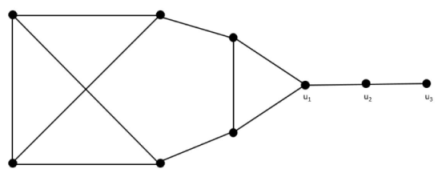
Because G is connected, we have two possibilities: , or and .
In the first case, and, since
Lemma 4 gives
In the second case, and Lemma 4 give
Let G be the graph in the figure.
We have , , , , , , , and . Additionally, if , then . Thus,
The lower bound is
and so, this graph attains the equality in the inequality. □
4. Conclusions
Topological indices have become a useful tool for the study of theoretical and practical problems in different areas of science. An important line of research that is associated with topological indices is to find optimal bounds and relations between known topological indices. In particular, to obtain bounds for the topological indices that are associated with invariant parameters of a graph.
We have the following nine results for the arithmetic-geometric index :
- An upper and lower bound of based on the first and second variable Zagreb indices (Theorem 1).
- An upper bound of that is based on the second variable Zagreb index (Theorem 2).
- An upper and lower bound of based on (Theorem 3).
- An upper bound of based on the general atom-bond connectivity index (Theorem 4).
- Another upper bound of based on the general atom-bond connectivity index for graphs with minimum degree (Theorem 5).
- A further upper bound of based on the general atom-bond connectivity index for graphs with minimum degree (Theorem 6).
- An exact formula of based on the number of edges m and the minimum degree if the maximum degree is (Theorem 7).
- A lower bound of based on the number of edges m and the minimum degree if the maximum degree is (Theorem 8). We provide a family of graphs for which the equality is attained.
- A lower bound of that is based on the number of edges m, the minimum degree , and the maximum degree (Theorem 9). We provide a graph for which the equality is attained.
Because the arithmetic-geometric index is useful from a practical point of view, to know extremal graphs for each bound involving this index allows for detecting chemical compounds that could satisfy desirable properties. Hence, these extremal graphs should correspond to molecules with a extremal value of a desired property correlated well with this index.
In the case of centrality indices, the generalization of degree has turned out to be a useful approach: the role of a more interconnected node can differ from a node that is connected to nodes having a lower degree [35]. We would like to purpose as a direction for future research to study similar problems for centrality indices.
Author Contributions
Investigation, J.M.R., J.L.S., J.M.S. and E.T. All authors have read and agreed to the published version of the manuscript.
Funding
This research was supported by a grant from Agencia Estatal de Investigación (PID2019-106433GBI00/ AEI/10.13039/501100011033), Spain. The research of José M. Rodríguez was supported by the Madrid Government (Comunidad de Madrid-Spain) under the Multiannual Agreement with UC3M in the line of Excellence of University Professors (EPUC3M23), and in the context of the V PRICIT (Regional Programme of Research and Technological Innovation).
Institutional Review Board Statement
Not applicable.
Informed Consent Statement
Not applicable.
Data Availability Statement
Not applicable.
Acknowledgments
We would like to thank the reviewers by their careful reading of the manuscript and their suggestions which have improved this work.
Conflicts of Interest
The authors declare no conflict of interest.
References
- Wiener, H. Structural determination of paraffin boiling points. J. Am. Chem. Soc. 1947, 69, 17–20. [Google Scholar] [CrossRef]
- Devillers, J.; Balaban, A.T. (Eds.) Topological Indices and Related Descriptors in QSAR and QSPR; Gordon and Breach: Amsterdam, The Netherlands, 1999. [Google Scholar]
- Karelson, M. Molecular Descriptors in QSAR/QSPR; Wiley-Interscience: New York, NY, USA, 2000. [Google Scholar]
- Todeschini, R.; Consonni, V. Handbook of Molecular Descriptors; Wiley-VCH: Weinheim, Germany, 2000. [Google Scholar]
- Randić, M. On characterization of molecular branching. J. Am. Chem. Soc. 1975, 97, 6609–6615. [Google Scholar] [CrossRef]
- Gutman, I.; Trinajstić, N. Graph theory and molecular orbitals. Total π–electron energy of alternant hydrocarbons. Chem. Phys. Lett. 1972, 17, 535–538. [Google Scholar] [CrossRef]
- Li, X.; Zheng, J. A unified approach to the extremal trees for different indices. MATCH Commun. Math. Comput. Chem. 2005, 54, 195–208. [Google Scholar]
- Li, X.; Zhao, H. Trees with the first smallest and largest generalized topological indices. MATCH Commun. Math. Comput. Chem. 2004, 50, 57–62. [Google Scholar]
- Miličević, A.; Nikolić, S. On variable Zagreb indices. Croat. Chem. Acta 2004, 77, 97–101. [Google Scholar]
- Vukičević, D.; Furtula, B. Topological index based on the ratios of geometrical and arithmetical means of end-vertex degrees of edges. J. Math. Chem. 2009, 46, 1369–1376. [Google Scholar] [CrossRef]
- Das, K.C. On geometric-arithmetic index of graphs. MATCH Commun. Math. Comput. Chem. 2010, 64, 619–630. [Google Scholar] [CrossRef]
- Das, K.C.; Gutman, I.; Furtula, B. Survey on Geometric-Arithmetic Indices of Graphs. MATCH Commun. Math. Comput. Chem. 2011, 65, 595–644. [Google Scholar]
- Das, K.C.; Gutman, I.; Furtula, B. On first geometric-arithmetic index of graphs. Discrete Appl. Math. 2011, 159, 2030–2037. [Google Scholar] [CrossRef]
- Martínez-Pérez, A.; Rodríguez, J.M.; Sigarreta, J.M. A new approximation to the geometric-arithmetic index. J. Math. Chem. 2018, 56, 1865–1883. [Google Scholar] [CrossRef]
- Mogharrab, M.; Fath-Tabar, G.H. Some bounds on GA1 index of graphs. MATCH Commun. Math. Comput. Chem. 2010, 65, 33–38. [Google Scholar]
- Rodríguez, J.M.; Sigarreta, J.M. Spectral properties of geometric-arithmetic index. Appl. Math. Comput. 2016, 277, 142–153. [Google Scholar] [CrossRef]
- Sigarreta, J.M. Bounds for the geometric-arithmetic index of a graph. Miskolc Math. Notes 2015, 16, 1199–1212. [Google Scholar] [CrossRef]
- Shegehall, V.S.; Kanabur, R. Arithmetic-geometric indices of path graph. J. Math. Comput. Sci. 2015, 16, 19–24. [Google Scholar]
- Shegehall, V.S.; Kanabur, R. Arithmetic-geometric indices of graphs with pendant vertices attached to the middle vertices of path. J. Math. Comput. Sci. 2015, 6, 67–72. [Google Scholar]
- Shegehall, V.S.; Kanabur, R. Computation of new degree-based topological indices of graphene. J. Math. 2016, 2016, 4341919. [Google Scholar] [CrossRef]
- Zheng, L.; Tian, G.-X.; Cui, S.-Y. On spectral radius and energy of arithmetic-geometric matrix of graphs. MACTH Commun. Math. Comput. Chem. 2020, 83, 635–650. [Google Scholar]
- Guo, X.; Gao, Y. Arithmetic-geometric spectral radius and energy of graphs. MACTH Commun. Math. Comput. Chem. 2020, 83, 651–660. [Google Scholar]
- Das, K.C.; Gutman, I. Degree-based energies of graphs. Linear Algebra Appl. 2018, 554, 185–204. [Google Scholar] [CrossRef]
- Vujošević, S.; Popivoda, G.; Vukićević, Ž.K.; Furtula, B.; Škrekovski, R. Arithmetic-geometric index and its relations with geometric-arithmetic index. Appl. Math. Comput. 2021, 391, 125706. [Google Scholar] [CrossRef]
- Carballosa, W.; Granados, A.; Méndez-Bermúdez, J.A.; Pestana, D.; Portilla, A. Computational properties of the arithmetic-geometric index. 2021. submitted. [Google Scholar]
- Cui, S.-Y.; Wang, W.; Tian, G.-X.; Wu, B. On the arithmetic-geometric index of graphs. MATCH Commun. Math. Comput. Chem. 2021, 85, 87–107. [Google Scholar]
- Milovanović, I.Ž.; Matejić, M.; Milovanović, E.I. Upper bounds for arithmetic-geometric index of graphs. Sci. Publ. State Univ. Novi Pazar Ser A Appl. Math. Inform. Mech. 2018, 10, 49–54. [Google Scholar] [CrossRef]
- Molina, E.; Rodríguez, J.M.; Sánchez, J.L.; Sigarreta, J.M. Inequalities on the arithmetic-geometric index. 2021. submitted. [Google Scholar]
- Milovanović, I.Ž.; Milovanović, E.I.; Matejić, M.M. On Upper Bounds for the Geometric–Arithmetic Topological Index. MATCH Commun. Math. Comput. Chem. 2018, 80, 109–127. [Google Scholar]
- Vukičević, D.; Gašperov, M. Bond Additive Modeling 1. Adriatic Indices. Croat. Chem. Acta 2010, 83, 243–260. [Google Scholar]
- Vukičević, D. Bond additive modeling 2. Mathematical properties of max-min rodeg index. Croat. Chem. Acta 2010, 83, 261–273. [Google Scholar]
- Furtula, B.; Das, K.C.; Gutman, I. Comparative analysis of symmetric division deg index as potentially useful molecular descriptor. Int. J. Quantum Chem. 2018, 118, e25659. [Google Scholar] [CrossRef]
- Estrada, E.; Torres, L.; Rodríguez, L.; Gutman, I. An atom-bond connectivity index. Modelling the enthalpy of formation of alkanes. Indian J. Chem. 1998, 37A, 849–855. [Google Scholar]
- Furtula, B.; Graovac, A.; Vukičević, D. Augmented Zagreb index. J. Math. Chem. 2010, 48, 370–380. [Google Scholar] [CrossRef]
- Csató, L. Measuring centrality by a generalization of degree. Central Europ. J. Oper. Res. 2017, 25, 771–790. [Google Scholar] [CrossRef]
Publisher’s Note: MDPI stays neutral with regard to jurisdictional claims in published maps and institutional affiliations. |
© 2021 by the authors. Licensee MDPI, Basel, Switzerland. This article is an open access article distributed under the terms and conditions of the Creative Commons Attribution (CC BY) license (https://creativecommons.org/licenses/by/4.0/).