


Abstract
In this paper, we introduce a new kind of generalized Fibonacci polynomials in the distance sense. We give a direct formula, a generating function and matrix generators for these polynomials. Moreover, we present a graph interpretation of these polynomials, their connections with Pascal’s triangle and we prove some identities for them.
Keywords:
generalized Fibonacci polynomials; Pascal’s triangle; generating function; matrix generator; Cassini formula MSC:
11B37; 11B39
1. Introduction
The well-known Fibonacci numbers , with and , for , have many interesting interpretations, applications and generalizations. It is worth mentioning that the golden ratio, closely related to Fibonacci numbers, is still being discovered in many fields of modern science such as theoretical physics (hydrogen bonds, chaos, superconductivity), astrophysics (pulsating stars, black holes), chemistry (quasicrystals, protein AB models), biology (natural and artificial phyllotaxis, genetic code of DNA) and technology (resistors, quantum computing). In the literature one can find a lot of Fibonacci-like modifications of the classical Fibonacci numbers. Some of them, such as for example Lucas numbers , with and the recursion for , are obtained by varying initial conditions. Others, like Pell numbers defined by and for , are obtained by slight modifying the basic recursion. There are variants that simultaneously generalize more that one recursion. For instance, the k-Fibonacci numbers introduced by S. Falcon and A. Plaza [1] by the formula , where and , , generalize both Fibonacci and Pell numbers.
Another direction of modification of the classical Fibonacci sequence is changing distance between terms of a sequence. Narayana numbers defined by the recursion for , with , are one of such examples, as well as k-Narayana numbers introduced by J. Ramirez and V. Sirvent [2] by the recursion for , with . Another one are generalized Fibonacci numbers introduced by M. Kwaśnik and I. Włoch [3] given by the formula , for , with initial conditions for .
A natural way of generalization is a polynomial direction, which has over a century-long history. Fibonacci polynomials defined by the recurrence relation
with initial conditions , were introduced by the Belgian mathematician E. C. Catalan in 1883 and have been intensively studied by many authors since then. V. E. Hoggatt Jr. and M. Bicknell have revealed a relationship between these polynomials and Pascal’s triangle, Zeckendorfs’s theorem and have found roots of Fibonacci polynomials of degree n (see References [4,5,6]). W. A. Webb and A. E. Parberry [7] and recently L. Chen and X. Wang [8] have proved some divisibility properties of these polynomials, whereas P. Filipponi and A. F. Horadam [9] have investigated derivative sequences of Fibonacci polynomials. Binet’s formula, a generating function and an extensive collection of identities for Fibonacci polynomials can be found in a book of T. Koshy [10]. Many interesting properties of these polynomials have also been proved by A. Lupas [11]. Obviously, and . Similarly, if in the recursion of k-Fibonacci numbers k is a real variable, then k-Fibonacci numbers correspond to the Fibonacci polynomials defined by (1) (see References [12,13]).
It is necessary to mention that another concept of Fibonacci polynomials arises in the context of the graph theory. In 1984, G. Hopkins and W. Staton introduced Fibonacci polynomials of graphs as a number of all independent sets of the composition of two graphs (for details see Reference [14]). As the consequence, another type of Fibonacci polynomials can be defined by the recurrence relation:
with initial conditions and . The sequence is different from , but also generalizes Fibonacci numbers, since . To compare, the first few Fibonacci polynomials and are given in Table 1.

Table 1.
Fibonacci polynomials and .
The interest in Fibonacci polynomials, both those given by the recursion (1) and by the recursion (2), has contributed to the emergence of many generalizations. Most of them, as in the case of Fibonacci numbers, are obtained by changing initial terms while preserving the recurrence relation (see References [15,16,17]). Some are obtained in the distance sense that is, by changing distance between terms of a sequence. Narayana polynomials defined by the formula for , with initial conditions , being a natural generalization of k-Narayana numbers, are a generalization in the distance sense. Such generalization are also the generalized Fibonacci polynomials defined by I. Włoch. Based on the idea given in Reference [14] I. Włoch introduced generalized Fibonacci polynomials of graphs as a number of all distance independent sets in the generalized join of graphs (details can be found in Reference [18]). Consequently, for integers generalized Fibonacci polynomials , being an extension of polynomials , are defined by for with and for . The sequence generalizes numbers , because . It generalizes Narayana numbers too, because .
In this paper we introduce distance Fibonacci polynomials being simultaneously a new generalization of Fibonacci polynomials and Narayana polynomials. We give a graph interpretation of these polynomials which allows us to obtain the direct formula for distance Fibonacci polynomials. Special cases of this formula are direct formulas for Fibonacci polynomials , Narayana polynomials as well as direct formulas for classical Fibonacci numbers and Narayana numbers . We reveal connections of distance Fibonacci polynomials with Pascal triangle and give combinatorial interpretations of coefficients of these polynomials. We prove some identities for the novel introduced distance Fibonacci polynomials and also derive the generting function and matrix generators for them.
2. Distance Fibonacci Polynomials and Their Interpretations
We begin this section with a definition. Let , be integers. The distance Fibonacci polynomials are given by the following recurrence relation
with initial conditions for
Table 2.
Distance Fibonacci polynomials .
Note that for we have and therefore and . For we have and consequently . Moreover, .
By recursion (3) one can easy check that
Before giving a graph interpretation of the distance Fibonacci polynomials let us recall that a finite graph G consists of two finite sets and . The elements of are called vertices and the set the vertex set, whereas the cardinality of is called the order of a graph. The elements of , called edges, are unordered pairs of vertices. A sequence of distinct vertices such that for is called a path. It is worth noting that Fibonacci sequences and polynomials appear in graph theory. The first mention of the use of Fibonacci numbers in graphs occurred in 1982 in the paper of Prodinger and Tichy, see Reference [19]. They showed the relationship between independent sets (i.e., subsets of vertices being pairwise nonadjacent) and Fibonacci numbers. This interest has been multiplied due to the use of counting independent sets, and consequently Fibonacci numbers, in chemical combinatorics. Fibonacci numbers are used to describe the quantitative properties of molecular graphs. Two indices play a special role—Merrifield–Simmons index and Hosoya index, see Reference [20] and references therein. Independent sets have many applications in localization problems as well as in relation to their generalized distances. As a such example is the concept of secondary independent dominating sets introduced in Reference [21] and next studied in Reference [22]. In this context, the study of the distance Fibonacci numbers and polynomials seems to be essential and important. One of the research directions concerning the application of Fibonacci numbers and polynomials in graphs is finding graph interpretations for them. Using graph interpretations for Fibonacci numbers and polynomials, we can give new identities, direct formulas and other properties. Now we present a graph interpretation of the distance Fibonacci polynomials using a special kind of covering and coloring. For graph theory concepts not described here, please see Reference [23].
By , for , we mean a path of order n with the vertex set . Let us consider a set of x colors, where We cover the set by the subgraphs and , with the vertex of a graph additionally colored with one of x colors. This operation is called -covering with -coloring. By we denote the number of all -covering with -coloring of the graph .
Theorem 1.
Let be integers. Then
Proof.
We prove this theorem by induction on n. Let be integers and be a path of order n with the vertex set .
If , then we cover the vertices only by subgraphs with coloring by one of x colors. Hence for . If , then we can cover the vertices of a path by k subgraphs which are colored with one of x colors or we can cover such a graph by one path . Hence .
Assume that and the theorem is valid for all integers less then n. We will prove that it is true for n. We have to consider two possibilities:
- .Then a vertex can be colored by one of x colors. Let denote the number of all -covering with -coloring of a graph with belonging to . Thus, .
- .Therefore vertices Let denote the number of all -covering with -coloring of a graph with belonging to . Hence .
Taking into account both cases and induction hypothesis we obtain
Thus the theorem is proved. □
Applying the above graph interpretation of we can derive the direct formula for .
Theorem 2.
Let be integers. Then
Proof.
If , then and Let us consider a path and a set of colors Suppose that By Theorem 1 the number of all -covering with -coloring of the graph is equal to . Each -covering consists of j subgraphs and vertices , where . Moreover, for a fixed j, we have possibilities of covering a path by a subgraph . Each of the other vertices can be colored with one of the x colors. Hence
Thus the theorem is proved. □
For by the Formula (5) and relation we get
which is the well-known direct formula for the Fibonacci polynomials. Analogously, for , by the Formula (5) and relation , we obtain
which is the direct formula for Narayana polynomials.
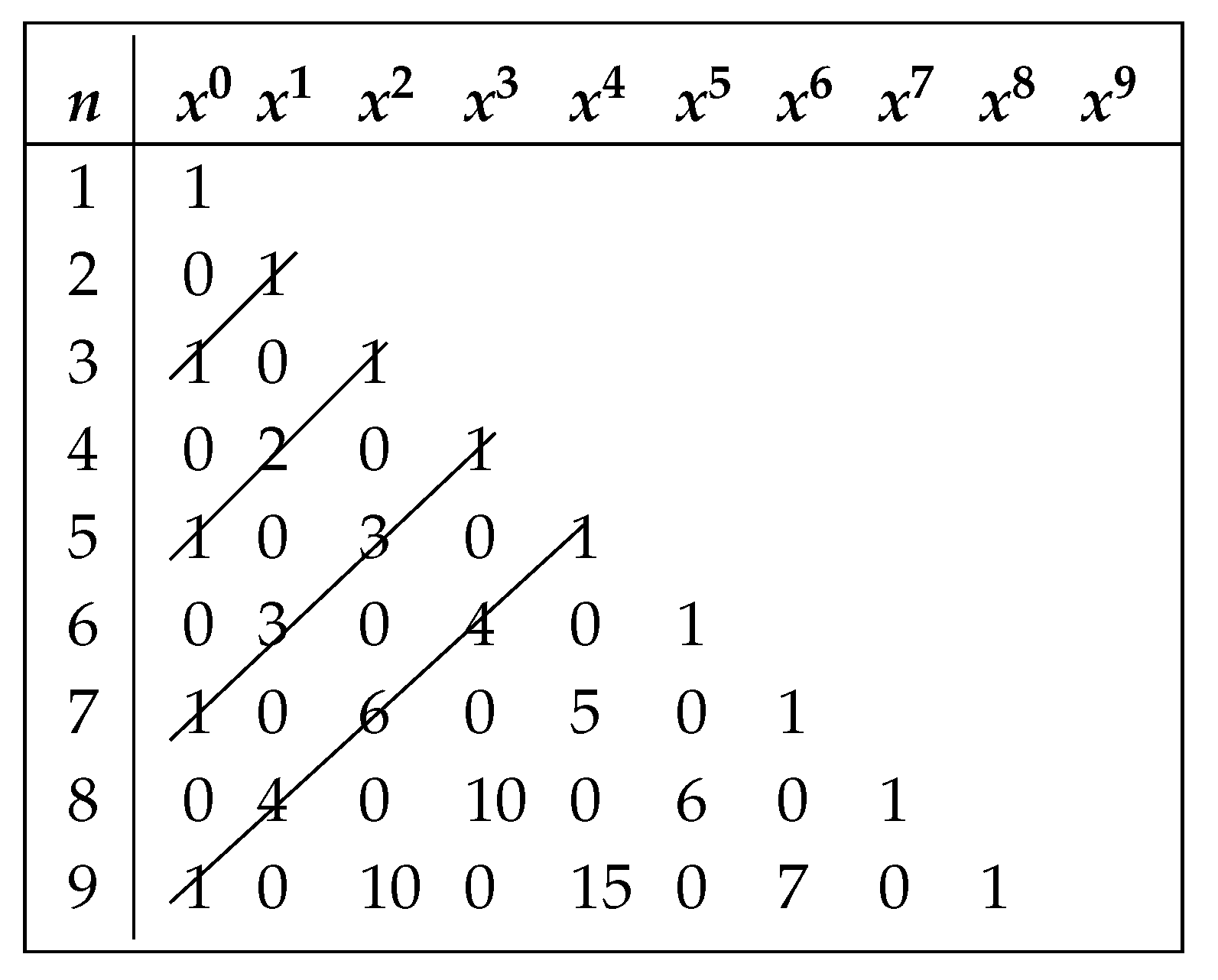
It is known that Fibonacci polynomials can be constructed using the binomial expansion of . This observation is due to M. Bicknell who has noticed (see Table 3) that the sums of rising diagonals give various Fibonacci polynomials (for details see References [4,10]).
Table 3.
Fibonacci polynomials as rising diagonals.
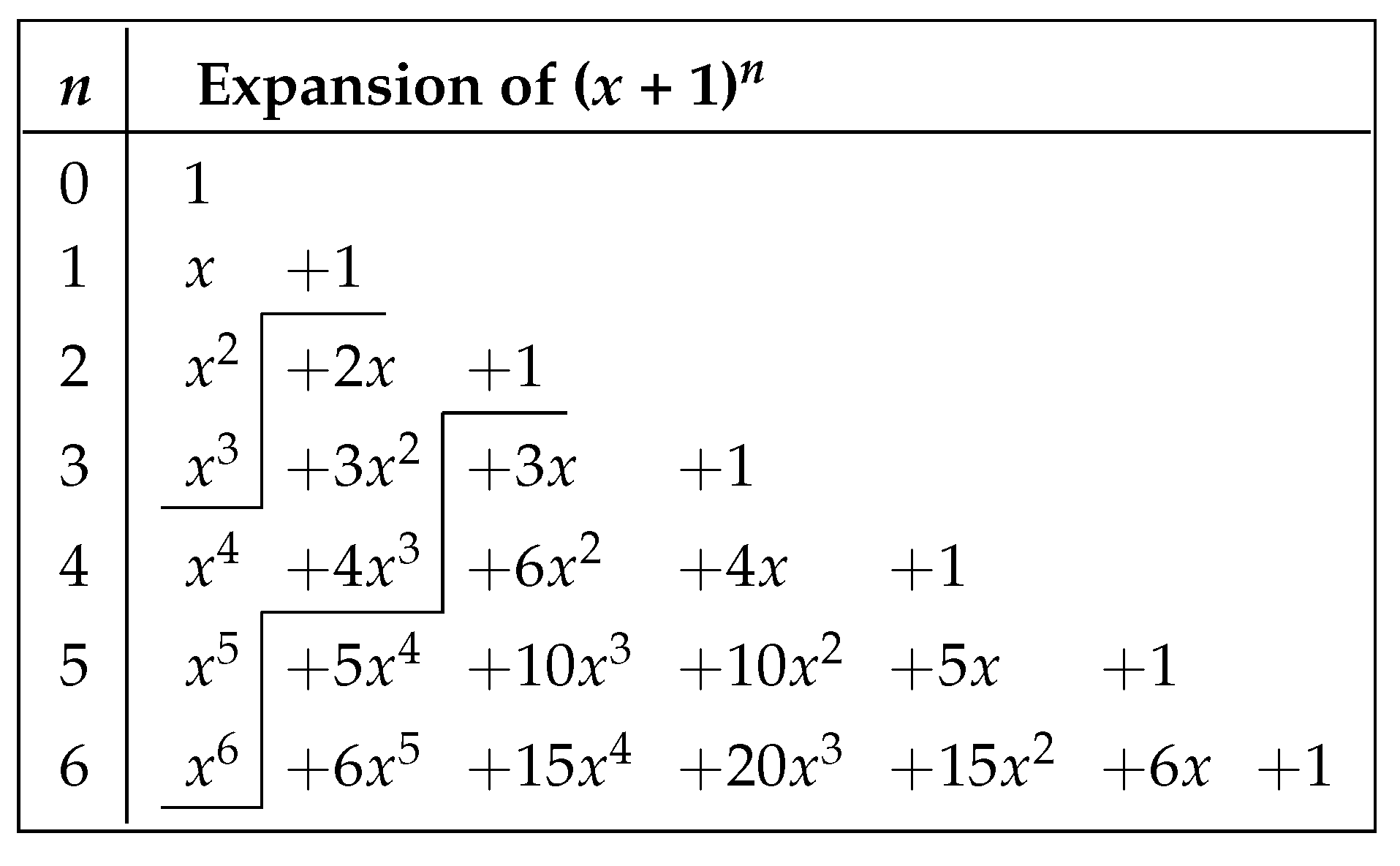
It turns out that the distance Fibonacci polynomials can also be constructed using binomials expansion of . For this purpose for a fixed integer k we have to replace diagonals by steps of heights . For instead of diagonals we obtain steps of hights 1. In Table 4 and Table 5 we present a few distance Fibonacci polynomials obtained by steps method for and 4.
Table 4.
Steps for .
Table 5.
Steps for .
Because the sum of elements on steps beginning in the row is , therefore we obtain in another way the direct Formula (5).
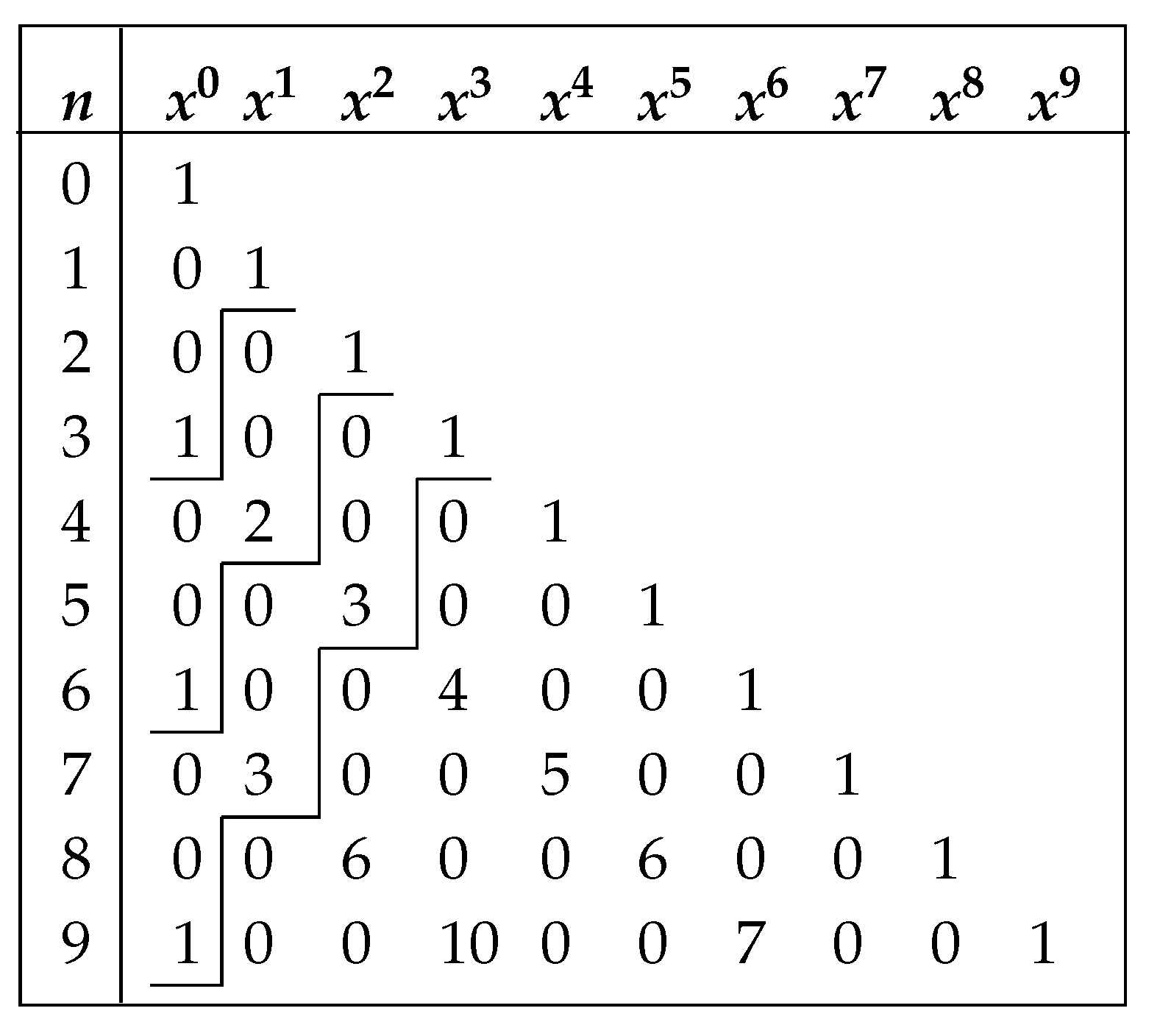
It is known (see Table 6) that if we arrange coefficients of the Fibonacci polynomials in increasing exponents then the elements on every rising diagonal on row is zero and the alternate rising diagonals form Pascal’s rows. Moreover if n is odd then the sum of the elements on the rising diagonal is (for details see Reference [10]).
Table 6.
Coefficients of in ascending order.
By steps method we can also compare coefficients of the distance Fibonacci polynomials with Pascal’s triangle. Namely, if for a fixed k we arrange the coefficients of the distance Fibonacci polynomials in ascending order starting with then numbers on steps beginning in row form Pascal’s row (as previously we build steps of height ). In the Table 7 we present few steps for coefficients of .
Table 7.
Coefficients of in ascending order.
The sum of elements on steps beginning in row is . Moreover, the sum of the row is equal to . In particular, for we obtain and for we get .
Now we present combinatorial interpretations of the distance Fibonacci polynomials’ coefficients. It turns out that the coefficients of a polynomial are connected with ordered sums and tillings. Let us denote . Then a coefficient is the number of representations of n as an ordered sum of 1 and k in such a way that 1 is used exactly i times. For the polynomial (see the above table) we have for example that is the number of ways we can represent 5 as an ordered sum of 3 and 1 with 1 used exactly twice. Namely, and . Instead of ordered sums we can consider tilings of rectangle by and shaped dominos. Then a coefficent is the number of ways we can cover rectangle by and rectangles in such a way that domino is used i times.
3. Generating Function and Some Identities
In this section we present a generating function and some identities for distance Fibonacci polynomials . We also extend these polynomials to negative integers.
Let us recall that a generating function of a sequence is the function . Generating functions are usefull tools for solving different kinds of counting problems, in discrete mathematics for solving recurrences.
Theorem 3.
Let be integers. The generating function of the distance Fibonacci polynomials sequence has the following form
Proof.
Note that from Theorem 3, the fact that and the right-shift rule for generating functions we obtain a function being a generating function for the classical Fibonacci polynomials .
Theorem 4.
Let be integers. Then
- (i)
- for
- (ii)
- (iii)
- (iv)
- (v)
- for
Proof.
At the beginning we prove the identity by induction on n. For it is obvious. Assume that and the equality is true for an arbitrary n. We will prove that it holds for .
By induction hypothesis and the recurrence relation (3) we have
Thus the identity is proved.
Analogously we can prove the identity .
Now we prove the identity . Using the recurrence relation (3) we have
Hence, for integers , we obtain
Adding these equalities we have
Thus the identity is proved.
To prove the identity we use the definition of distance Fibonacci polynomials (3) by times. Then we obtain
Hence the identity holds.
Using the recurrence relation (3) once again we can prove the last identity . Let be integers. Then
Thus the theorem is proved. □
Note that for we obtain the well-known identities for the Fibonacci polynomials and for we obtain well-known identities for Fibonacci numbers:
For we obtain the identities for Narayana polynomials and if we obtain identities for Narayana numbers:
Moreover, for and using the relation we obtain the identities for generalized Fibonacci numbers , see Reference [24].
The distance Fibonacci polynomials can be extended to negative integers n. Let , be integers. Then
with initial conditions for .
Table 8.
Distance Fibonacci polynomials .
Notice that setting in (6), we get the well-known extension of Fibonacci polynomials for negative numbers
For and and we obtain the extension of classical Fibonacci numbers and Narayana numbers for negative numbers.
Moreover, if we set in place of n and in (6), then we obtain the extension of generalized Fibonacci numbers for negative numbers. Hence we get the following relation
for and for
Proving analogously as Theorem 4, we get the following identities for the distance Fibonacci polynomials for negative integers.
Theorem 5.
Let be integers. Then
- (vi)
- (vii)
- (viii)
- (ix)
- for .
4. Matrix Generators
In this section we introduce matrix generators for distance Fibonacci polynomials using special upper Hessenberg matrices. Matrix generators for Fibonacci numbers and polynomials have its long history and many applications (see References [10,25]).
Based on the recursion (3) let us define a matrix , where as follows. For and an element of the matrix is equal to the coefficient of in the right-hand-side of the equation (3). For and we put
By the above definition for we obtain the following matrices:
We will call the matrix as the distance Fibonacci matrix.
Note that is a well-known matrix generator for the classical Fibonacci polynomials. Moreover, putting in we get the matrix which is a matrix generator for Fibonacci numbers, whereas for we obtain the matrix being a matrix generator for Pell numbers. The matrix is a matrix generator for Narayana polynomials and is a well-known matrix generator for Narayana numbers (see Reference [2]).
Now for a fixed integer let us define a matrix of order k being the matrix of initial conditions
Theorem 6.
Let , be integers. Then
Proof.
Theorem 7.
Let , be integers. Then
Proof.
From a definition of and basic properties of determinants follows that . Hence by Cauchy’s theorem for determinants we obtain equality (8). To prove equality (9) we will use relation (4).
Multiplying the last column of the above determinant respectively by and subtracting from the first, the second,…, the th column respectively we obtain the following determinant
Expanding this determinant along the last row and then changing columns by places we get
Hence . □
As an immediate consequence of Theorem 7 and Cauchy’s theorem for determinants we obtain the Cassini formula for distance Fibonacci polynomials.
Corollary 1.
Let , be integers. Then the generalized Cassini formula for the distance Fibonacci polynomials can be written as
Note that by Theorem 6 and the equallity we have
and then by Theorem 1 we obtain the well-known Cassini formula for the classical Fibonacci polynomials
5. Conclusions
Integers sequences defined by the homogenous linear recurrence relations were called as sequeneces of the Fibonacci type, see Reference [26], where the list of well known Fibonacci type sequences can be found. In that context introduced in this paper distance Fibonacci polynomials initiate studying the family of distance polynomials of the Fibonacci type. Distance Fibonacci type sequences which generalize Fibonacci, Lucas, Pell, Jacobsthal and others sequences can be extended to polynomials. Their properties will be interesting not only from the pure mathematical point of view but also from their applications.
Author Contributions
Conceptualization, U.B. and M.W.-M.; methodology, U.B. and M.W.-M.; validation, U.B. and M.W.-M.; formal analysis, U.B. and M.W.-M.; investigation, U.B. and M.W.-M.; writing–original draft preparation, U.B.and M.W.-M.; writing–review and editing, U.B. and M.W.-M.; visualization, U.B. and M.W.-M. All authors have read and agreed to the published version of the manuscript.
Funding
This research received no external funding.
Conflicts of Interest
The authors declare no conflict of interest.
References
- Falcon, S.; Plaza, A. On the Fibonacci k-numbers. Chaos Solitons Fractals 2007, 32, 1615–1624. [Google Scholar] [CrossRef]
- Ramirez, J.; Sirvent, V. A note on the k-Narayana sequence. Ann. Math. Inform. 2015, 45, 91–105. [Google Scholar]
- Kwaśnik, M.; Włoch, I. The total number of generalized stable sets and kernels of graphs. Ars Comb. 2000, 55, 139–146. [Google Scholar]
- Bicknell, M. A Primer for the Fibonacci Numbers: Part VII - An Introduction to Fibonacci Polynomials and their Divisibility Properties. Fibonacci Quart. 1970, 8, 407–420. [Google Scholar]
- Hoggatt, V.E., Jr.; Bicknell, M. Fibonacci polynomials and Zeckendorf theorem. Fibonacci Quart. 1973, 11, 399–419. [Google Scholar]
- Hoggatt, V.E., Jr.; Bicknell, M. Roots of Fibonacci polynomials. Fibonacci Quart. 1973, 11, 271–273. [Google Scholar]
- Webb, W.A.; Parberry, E.A. Divisibility properties of Fibonacci Polynomials. Fibonacci Quart. 1969, 7, 457–463. [Google Scholar]
- Chen, L.; Wang, X. The power sums involving Fibonacci polynomials and their applications. Symmetry 2019, 11, 635. [Google Scholar] [CrossRef]
- Filipponi, P.; Horadam, A.F. Derivative sequences of Fibonacci and Lucas polynomials. Appl. Fibonacci Numbers 1991, 4, 99–108. [Google Scholar]
- Koshy, T. Fibonacci and Lucas Numbers with Applications; John Wiley and Sons: New York, NY, USA, 2001. [Google Scholar]
- Lupas, A. A Guide of Fibonacci and Lucas Polynomial. Math. Mag. 1999, 7, 2–12. [Google Scholar]
- Falcon, S.; Plaza, A. On k-Fibonacci sequences and polynomials and their derivatives. Chaos Solitons Fractals 2009, 39, 1005–1019. [Google Scholar] [CrossRef]
- Boussayoud, A.; Boughaba, S.; Kerada, M.; Araci, S.; Acikgoz, M. Generating functions of binary products of k-Fibonacci and orthogonal polynomials. Rev. Real Acad. Cienc. Exactas Fis. Nat. Ser. A Mat. RACSAM 2019, 113, 2575–2586. [Google Scholar] [CrossRef]
- Hopkins, G.; Staton, W. Some identities arising from the Fibonacci numbers of certain graphs. Fibonacci Quart. 1984, 22, 255–258. [Google Scholar]
- Panwar, Y.K.; Singh, B.; Gupta, V.K. Generalized Fibonacci Polynomials. J. Anal. Number Theory 2013, 1, 43–47. [Google Scholar] [CrossRef]
- Singh, M.; Sikhwal, O.; Gupta, Y. Generalized Fibonacci-Lucas Polynomials. Int. J. Adv. Math. Sci. 2014, 2, 81–87. [Google Scholar] [CrossRef]
- Qi, F.; Kizilates, C.; Du, W.S. A Closed Formula for the Horadam Polynomials in Terms of a Tridiagonal Determinat. Symmetry 2019, 11, 782. [Google Scholar] [CrossRef]
- Włoch, I. Generalized Fibonacci polynomials of graphs. Ars Comb. 2003, 68, 49–55. [Google Scholar]
- Prodinger, H.; Tichy, R.F. Fibonacci numbers of graphs. Fibonacci Quart. 1982, 20, 16–21. [Google Scholar]
- Gutman, I.; Wagner, S. Maxima and minima of the Hosoya index and the Merrifield-Simmons index. A survey of results and techniques. Acta Appl. Math. 2010, 112, 323–346. [Google Scholar]
- Hedetniemi, S.M.; Hedetniemi, S.T.; Knisely, J.; Rall, D. F. Secondary domination in graphs. AKCE J. Graphs Comb. 2008, 5, 103–115. [Google Scholar]
- Michalski, A.; Włoch, I. On the existence and the number of independent (1,2)-dominating sets in the G-join of graphs. Appl. Math. Comput. 2020, 377, 125155. [Google Scholar] [CrossRef]
- Diestel, R. Graph Theory; Springer: Heidelberg, Germany; New York, NY, USA, 2005. [Google Scholar]
- Włoch, A. Some identities for the generalized Fibonacci numbers and the generalized Lucas numbers. Appl. Math. Comput. 2013, 219, 5564–5568. [Google Scholar] [CrossRef]
- Bahsi, A.K.; Yalcinbas, S. A New Algorithm for the Numerical Solution of Telegraph Equations by Using Fibonacci Polynomials. Math. Comput. Appl. 2016, 21, 15. [Google Scholar]
- Bednarz, U.; Włoch, I.; Wołowiec-Musiał, M. Total graph interpretation of numbers of the Fibonacci type. J. Appl. Math. 2015, 2015, 837917. [Google Scholar] [CrossRef]


© 2020 by the authors. Licensee MDPI, Basel, Switzerland. This article is an open access article distributed under the terms and conditions of the Creative Commons Attribution (CC BY) license (http://creativecommons.org/licenses/by/4.0/).