


Abstract
In this paper, a generalization of the modified slash Birnbaum–Saunders (BS) distribution is introduced. The model is defined by using the stochastic representation of the BS distribution, where the standard normal distribution is replaced by a symmetric distribution proposed by Reyes et al. It is proved that this new distribution is able to model more kurtosis than other extensions of BS previously proposed in the literature. Closed expressions are given for the pdf (probability density functio), along with their moments, skewness and kurtosis coefficients. Inference carried out is based on modified moments method and maximum likelihood (ML). To obtain ML estimates, two approaches are considered: Newton–Raphson and EM-algorithm. Applications reveal that it has potential for doing well in real problems.
1. Introduction
The BS distribution was introduced by Birnbaum and Saunders [1,2]. The aim of this distribution is to model the fatigue in lifetime of certain materials. Nowadays, its use has spread to other contexts such as economic and environmental data. In these new applications, it is quite common to find real datasets in which a BS model with heavier tails would be suitable. Slash models are a good option to deal with this kind of situations, in which heavy tails are a serious problem for the data analyst. This is the main reason slash distributions have received a great deal of attention during the last decades. In this context, we face the problem of improving BS distribution by introducing a generalization able to model more kurtosis than other slash extensions previously proposed in the literature. In these extensions, the emphasis is on kurtosis because, as Moors [3] pointed out, the presence of heavy tails produces high kurtosis. Next, we briefly describe the BS-model and the most relevant slash precedents of our proposal.
1.1. Birnbaum–Saunders Distribution
If a random variable (rv) follows a BS distribution with shape parameter and scale parameter , , then T can be expressed as
where . From Equation (1), T is a monotone transformation of Z, and its cumulative distribution function (cdf) is
with the cdf of a distribution and
The probability density function (pdf) of T is
where is the pdf of a distribution (Johnson et al. [4]).
As properties (see, for instance, Leiva [5]), we highlight that the BS distribution is continuous, unimodal and positively skewed (asymmetry to right). is the median of the distribution. is a shape parameter that modifies the skewness and kurtosis of the distribution. As tends to zero, the BS distribution tends to be symmetrical around and its variability decreases. On the other hand, as increases, the BS distribution exhibits heavier tails.
1.2. Slash Methodology
To use the BS distribution for modeling data with outliers, Gómez et al. [6] and Reyes et al. [7] proposed extensions of BS model based on the slash (S) and modified slash (MS) distribution. In this way, they got extensions of BS distribution with a high kurtosis coefficient.
The canonic slash distribution was introduced by Rogers and Tukey [8]. This model is defined as the ratio of a and an independent uniform distribution. It is proposed as a model for bell-shaped data with heavier tails than the corresponding normal distribution. Their theoretical properties can be seen, for instance, in Rogers and Tukey [8] or Johnson et al. [4]. The slash model, denoted as S, in which a kurtosis parameter q is introduced, is defined as
with independent of and . Based on the representation given in Equation (5), Reyes et al. [7] proposed the modified slash (MS) distribution in which the variable at the denominator of Equation (5) is replaced by an exponential distribution of parameter 2, that is, . The MS model exhibits greater kurtosis than the S model. A new extension, called generalized modified slash (GMS) distribution, was introduced recently by Reyes et al. [9]. These authors proposed a new slash model where the denominator in Equation (5) is a Gamma distribution of parameters () with . The GMS model generalizes the MS model. As main features of the GMS model, we highlight that is a bell-shaped distribution, symmetrical with respect to zero, and exhibits a greater level of kurtosis than its predecessors, thus it can be of interest to study the distribution of the BS extension obtained when in Equation (1) is replaced by a GMS distribution with kurtosis parameter . This proposal is a generalization of the papers by Gómez et al. [6] and Reyes et al. [7] where slash versions of the BS distribution were considered based on the slash and modified slash distribution, called slash Birnbaum–Saunders (SBS) and modified slash Birnbaum–Saunders (MSBS), respectively.
This paper is outlined as follows. In Section 2, the stochastic representation of the generalized modified slash Birnbaum–Saunders (GMSBS) distribution is introduced, and its probability density function, properties, moments, skewness and kurtosis coefficients are obtained. Section 3 is devoted to estimation methods: modified moment and maximum likelihood estimation (an iterative method and the EM-algorithm are proposed). Section 4 assesses the performance of the MLE using the EM algorithm via a simulation study. Two practical applications are given in Section 5.
2. GMSBS Distributions
In this section, the stochastic representation of a GMSBS distribution is introduced. A closed expression for its pdf is obtained and its properties are studied in depth. Motivated by Equation (1), the stochastic expression proposed for a GMSBS distribution is
where X follows a Generalized Modified Slash distribution, , . It is then said that T follows a GMSBS distribution with parameters , , and q, . Similar to the BS distribution, is a shape parameter and is a scale parameter. It is shown below that the new parameter q allows us to control the kurtosis and skewness of this new model and to obtain distributions with greater level of kurtosis than other slash Birnbaum–Saunders models. This fact allows us to model real datasets in which a BS-model can be appropriate but we have heavy tails, especially on the right.
2.1. Probability Density Function
Since T, introduced in Equation (6), is given as a function X with , to obtain the distribution of T, we need the pdf of X, which is given in next lemma.
Lemma 1.
Let be defined as with independent of , . Then, the pdf of X is
where denotes the pdf of a distribution.
Proof.
It can be seen in Reyes et al. [9]. ☐
Lemma 2.
The following closed expression for Equation (7) can be given
where denotes the confluent hypergeometric function of the second kind (Abramowitz and Stegun [10], p. 505).
Proof.
It can be seen in Reyes et al. [9]. ☐
Proposition 1.
Let . Then, the pdf of T is
with and
Proof.
From Equation (10), the following relationship for the pdf’s of T and X follows
where denotes the pdf of a .
The next corollary relates the new model, proposed in Equation (6), to other slash models previously introduced in the literature.
Corollary 2.
For , the pdf given in Equation (12) reduces to the pdf of a modified slash Birnbaum–Saunders distributions, proposed in Reyes el al. [11].
Proof.
This corollary follows from the fact that, for , a distribution reduces to an exponential, , and the stochastic representation proposed in Equation (6). ☐
Figure 1 illustrates the effect of the parameter q on the tails of our proposal. Plots given in this figure compare the pdfs of several models for different values of q. Specifically, the pdfs of a distribution for are given. Note that a greater level of kurtosis is observed for small values of q. These appreciations are formalized in Section 2.3 where moments are obtained.

Figure 1.
GMSMS pdfs for different values of q.
2.2. Properties
In this subsection, some properties of GMSBS distributions are deduced.
Proposition 2.
Let , with , , . Then,
- 1.
- Let be the pth quantile of T, .where denotes the pth quantile ofIn particular, the median of T is β, .
- 2.
- , .
- 3.
- .
Proof.
On the other hand, since is a symmetric distribution around zero, and therefore .
(2) and (3) are immediate from Proposition 1 by properly using the change-of-variable technique. ☐
Next, we show that if then model approaches to a Birnbaum–Saunders distribution. The subscript q is included in the notation to highlight this fact.
Proposition 3.
Let . Then, converges in law to as , that is
Proof.
See Appendix A, Proof of Proposition 3. ☐
Proposition 3 means that, for large q, model can be approached by a Birnbaum–Saunders distribution.
2.3. Moments
Formulae for the moments of order r, , in a GMSBS distribution are given next.
Proposition 4.
Let . For , exists if and only if and
Proof.
See Appendix A, Proof of Proposition 4. ☐
Remark 1.
From Equation (15), note that is a polynomial in β of degree r, in α of degree (only even powers are obtained), and coefficients that involve rational functions of q (with numerator and denominator of the same degree).
Next, some non-central moments for the GMSBS distribution are given. These expressions involve the Pochhammer symbol or rising factorial, defined for and as
Corollary 3.
Let and . Then
(mean or expected value of T),
,
,
.
Proof.
The proposed results follow from Proposition 4 and Equation (16). Aditional details can be seen in Appendix A, Proof of Corollary 3. ☐
From Corollary 3, it follows that the variance of T is
where
The skewness coefficient, , and the kurtosis coefficient, , can be computed by using the previous expressions and the relationships
Next, the behavior of and as functions of the kurtosis parameter q is studied.
Although the convergence in law, in general, does not imply the convergence in moments, in this case, we have such convergence as . The notation and is used. The next corollary states explicit results for and , if , along with others that help us to understand the behavior of these features. The explicit expressions of and , given in Appendix A, Equation (A12), are used.
Corollary 4.
(1) Limit behavior of skewness coefficient
that is, if then the skewness coefficient of a tends to the skewness coefficient of a distribution.
(2) Limit behavior of kurtosis coefficient
that is, if then the kurtosis coefficient of a tends to the kurtosis coefficient of a distribution.
Proof.
The proposed results follow from expressions for and given in Appendix A, Equation (A12), and the moments , given in Equation (15). ☐
Remark 2.
Interpretation of parameters in a model.
(i) In the model, as in the Birnbaum–Saunders distribution, is a scale parameter, which is also the median of the distribution (see Equation (6) and Proposition 2).
(ii) It can be seen in Leiva [5] that in the Birnbaum–Saunders distribution is a shape parameter that modifies the skewness and kurtosis of the distribution. As α tends to zero, the BS distribution tends to be more symmetrical around its median β and its variability decreases. The expressions of the skewness coefficient , given in Equations (A12) and (17), suggest that α has a similar interpretation in the model.
(iii) As for the parameter , it is proven through this paper that controls the kurtosis and skewness coefficient in the model, in such a way that allows us to obtain models with greater level of kurtosis than other slash BS distributions, previously introduced in the literature.
As graphical aid, to show the way in which and q determine the asymmetry and kurtosis of a model, see plots in Figure 2. Without loss of generality, the scale parameter is taken equal to one, . They illustrate the way in which the asymmetry and kurtosis coefficients depend on both parameters. Plots in Figure 2 suggest that, on the one hand, for increasing values of , the asymmetry and kurtosis increase. On the other hand, if is fixed, asymmetry and kurtosis coefficients are decreasing functions of q.

Figure 2.
Skewness and kurtosis coefficients for model as function of q taking and 5.
These considerations motivate that GMSBS distribution can be used for modeling more kurtosis than other slash Birnbaum–Saunders distributions previously introduced in the literature such as SBS and MSBS densities. Figure 3 displays the GMSBS pdf plot along with MSBS and SBS densities. Note that the right tail of the GMSBS distribution is heavier than the tails of the other ones.

Figure 3.
Comparison of right tails of densities for GMSBS, MSBS and SBS models for the same value for parameters and q.
3. Estimation
Let be a simple random sample (srs) from , . In this section, we face the problem of estimating . Next, we propose a couple of techniques to tackle this problem.
3.1. Modified Moment Estimation
Following Ng et al. [12], a modified method moment based on Property (3) given in Proposition 2 is next introduced. Thus, we propose to equal , , and to their corresponding sample moments, that is
where , , and .
Note that with the sample harmonic mean.
The solutions of previous equations for and are called the modified moment (MM) estimators, denoted as , , and .
3.2. Maximum Likelihood Estimation
Given a srs from a distribution and their observations, by applying Equation (9), the log-likelihood function is
with and .
To maximize in , consider the first derivatives of with respect to , and q, denoted as , and , respectively. From , and , we obtain the likelihood equations, whose expressions are given in Appendix B, and can be solved by using iterative Newton–Raphson methods.
Let us denote by . Then, the following iterative process can be proposed for
which needs starting values , and to start the recursion. As initial values, the modified moment estimators, previously proposed, can be considered.
Remark 3.
(1) In Equations (21)–(23), , and denote these expressions evaluated at , and . The expression of can be seen in Appendix B.
(2) It can be seen in Leiva [5] p. 41 that in the Birnbaum–Saunders model, , the iterative equations for the MLEs of and are
3.3. ML Estimation Using EM-Algorithm
Taking advantage of the stochastic representation of the GMSBS model, we can develop a more attractive iterative method to find the MLEs based on the EM algorithm (Dempster et al. [13]). This is a well-known tool when unobserved (missing) data or latent variables are present while modeling. This algorithm enables the computationally efficient determination of the ML estimates when iterative procedures are required. Looking at the stochastic representation of a generalized modified slash distribution given in Equation (6), we note that the scale factor V depends on the parameter q, thus we consider a re-parameterization to get the EM-algorithm in the GMSBS model. Then, the resulting stochastic representation for T can be expressed as
where , with independent of , i.e., the generalized gamma distribution whose pdf can be expressed as
Under the new parameterization, we have the conditional distribution of T, given , follows the distribution. Consequently, the pdf of the T reduces to
where is the pdf of distribution.
Let be a simple random sample of size n of . Here, the parameter vector is , with . Let and denote the complete-data log-likelihood function and its expected value, respectively. Each iteration of the EM algorithm involves two steps. Note that the above setup can be represented through a hierarchical representation given by
Let and be observed and unobserved data, respectively. The complete data corresponds to the original data augmented with . We now detail the implementation of the ML estimation of parameters of GMSBS distributions by using the EM-algorithm. In this section, the hierarchical representation given in Equations (28) and (29) is useful to obtain the complete log-likelihood function associated with , which can be expressed as
where .
Letting , it follows that the conditional expectation of the complete log-likelihood function has the form
where , with and . As both quantities and have no explicit forms in the context of our model, they have to be computed numerically. Thus, to compute , we use a similar approach to that by Lee and Xu (2004, Section 3.1) [14]. Specifically, let be a sample randomly drawn from the conditional distribution , so the quantity can be approximated as follows:
We then have the EM-algorithm for the ML estimation of the parameters of the GMSBS distributions as follows:
E-step. Given , compute , for .
CM-step I: Update by maximizing over , which leads to the expression:
CM-step II: Obtain as the solution of
CM-step III: Fix and , update by optimizing
where
with . The iterations are repeated until a suitable convergence rule is satisfied, say sufficiently small. Useful starting values required to implement this algorithm are those obtained under the normality assumption or by using the modified moment estimates , and .
Remark 4.
(1) Note that, if q tends to ∞, then the estimates of α and β in M-step reduce to those when the BS distribution is used.
(2) Note that CM-Step II requires a one-dimensional search for the root of β, respectively, which can easily be achieved by using the “uniroot" function built in R. On the other hand, CM-Step III can be very slow. An alternative is to use the idea by Lin and Liu [15] (Section 3), and it can be defined as:
CML-step: Update by optimizing the following constrained actual log-likelihood function
The corresponding standard errors (s.e.) are calculated from the observed information matrix.
4. Simulation
In this section, a simulation study is carried out to illustrate the behavior of EM algorithm to obtain MLEs of the parameters. By using the representation given in Equation (6), it is possible to generate random numbers for the distribution, which leads to the following algorithm.
- Simulate
- Simulate with .
- Compute Then, ,
- Compute , , . for
Table 1 shows results of simulation studies, which illustrate the behavior of the MLEs for 1000 samples of sizes , 100, and 200 generated from a population distributed as GMSBS() for different values of , and q. For each generated sample, MLEs were computed numerically using a EM-algorithm previously proposed. Bias, standard error (s.e) and of estimates are reported.

Table 1.
Empirical bias, standard error and for the MLEs of , , and q using the EM-algorithm.
Results in Table 1 show that, when the sample size increases, MLEs’ bias tends to zero, and their standard errors and decrease. Therefore, they are consistent.
5. Applications
Next, the model is illustrated with two datasets collected by the Department of Mines of the University of Atacama, Chile, representing Neodymium and Nickel levels in samples of minerals.
5.1. Neodymium Dataset
The descriptive summaries are given in Table 2 where denotes the sample mean, the sample standard deviation, the sample skewness coefficient, and the sample kurtosis coefficient. GMSBS, MSBS and SBS distributions are fitted to this dataset, the parameters are estimated via maximum likelihood (EM-algorithm), abd their corresponding standard errors are given in parentheses in Table 3. As goodness of fit criteria, the Akaike Information Criterion (AIC) and QQ-plots are considered. Recall that AIC = where p is the number of parameters to be estimated [16]. The AIC values we obtained are given in Table 3. They suggest that GMSBS model provides the best fit to these data since this model exhibits less AIC.
Table 2.
Summary of Neodymium dataset.
Table 3.
MLEs for Neodymium dataset, their standard errors (in parenthesis) and AIC values.
Figure 4 depicts the histogram for the data with the fitted density and the empirical cdf along with the cdf estimated by GMSBS model, as well QQ-plots given in Figure 5; these also show the good agreement of the GMSBS model for the Neodymium data.

Figure 4.
(left) Histogram of the Neodymium data with estimated pdf of GMSBS distribution; and (right) empirical cdf (dotted lines) with estimated cdf of GMSBS model.
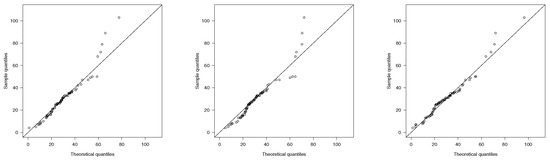
Figure 5.
Q-Q plots in Neodymium dataset for: SBS model (left); MSBS model (middle); and GMSBS model (right)
5.2. Nickel Dataset
The descriptive summaries are given in Table 4. GMSBS, MSBS and SBS distributions are fitted to this dataset, the parameters are estimated via maximum likelihood (EM-algorithm), and their corresponding standard errors are given in parentheses in Table 5. The AIC values we obtained are given in Table 5. They suggest that GMSBS model provides the best fit to these data since this model exhibits less AIC.
Table 4.
Summary of Nickel dataset.
Table 5.
MLEs for Nickel dataset, their standard errors (in parenthesis) and AIC values.
Figure 6 depicts the histogram for the data with the fitted density and the empirical cdf along with the cdf estimated by GMSBS model. QQ-plots are given in Figure 7. All of them show the good agreement of the GMSBS model for the Nickel data.

Figure 6.
(left) Histogram of the Nickel data with estimated pdf of GMSBS distribution; and (right) empirical cdf (dotted lines) with estimated cdf of GMSBS model.

Figure 7.
Q-Q plots in Nickel dataset for: SBS model (left); MSBS model (middle); and GMSBS model (right)
Author Contributions
All the authors contributed significantly to this research article.
Funding
This research received no external funding.
Acknowledgments
The research of J. Reyes and H.W. Gómez was supported by Grant SEMILLERO UA-2018 (Chile). The research of I. Barranco-Chamorro was supported by Grant CTM2015-68276-R (Spain).
Conflicts of Interest
The authors declare no conflict of interest.
Appendix A. Some Proofs of Results Given in Section 2
In this appendix, details about results dealing with the convergence in law of a model to a BS distribution (), moments, skewness and kurtosis coefficients for the are given.
Proof of Proposition 3.
To obtain the result proposed in Proposition 3, we must prove that , with the cdf of a model (see, for instance, Rohatgi and Ehsanes Saleh, [17]).
Since , then we can write where and was given in Equation (6). Recall that we have the following relationship for the cdf of
It can be seen in Reyes et al. [9] Proposition 3 that, given , then as where , that is,
So, taking the limit in Equation (A1), we have
that corresponds to the cdf of a distribution. Thus, we obtain the proposed result. ☐
Proof of Proposition 4.
By using the stochastic representation given in Equation (6), we have
with .
By using the binomial formula
and therefore exists iff exists, that is, iff (Reyes et al. [9], Proposition 4). Next we also show that Equation (A3) allows us to obtain the explicit expression of given in Equation (15).
Note that for odd s
and therefore for we can write
where is such that for , as can be seen in Reyes et al. [9]. Taking , the result proposed in Equation (15) is obtained. ☐
Proof of Corollary 3.
From Proposition 4, it is straightforward that
and, thus, the proposed results follow by using the notation introduced in Equation (16). ☐
Corollary A1 (Central moments).
Let . Then,
(1) The variance of T, , was given in Equation (17).
(2) The central moment of order 3 is
where
(3) The central moment of order 4 is
where
Proof.
They are obtained by considering the results given in Corollary 3 and the following relationships
☐
Proposition A1 (Skewness and kurtosis coefficient).
For distribution the skewness, , and kurtosis, , coefficients can be calculated as
From previous expressions, we have that
Appendix B. Likelihood Equations
The likelihood equations are
where
and is the digamma function.
References
- Birnbaum, Z.W.; Saunders, S.C. A New Family of Life Distributions. J. Appl. Probab. 1969, 6, 319–327. [Google Scholar] [CrossRef]
- Birnbaum, Z.W.; Saunders, S.C. Estimation for a family of life distributions with applications to fatigue. J. Appl. Probab. 1969a, 6, 328–347. [Google Scholar] [CrossRef]
- Moors, J.J.A. A quantile alternative for kurtosis. J. R. Stat. Soc. Ser. D 1988, 37, 25–32. [Google Scholar] [CrossRef]
- Johnson, N.L.; Kotz, S.; Balakrishnan, N. Continuous Univariate Distributions, 2nd ed.; Wiley: New York, NY, USA, 1995; Volume 1. [Google Scholar]
- Leiva, V. The Birnbaum–Saunders Distribution; Academic Press: New York, NY, US, 2016. [Google Scholar]
- Gómez, H.W.; Olivares-Pacheco, J.F.; Bolfarine, H. An extension of the generalized Birnbaum–Saunders distribution. Stat. Probab. Lett. 2009, 79, 331–338. [Google Scholar] [CrossRef]
- Reyes, J.; Gómez, H.W.; Bolfarine, H. Modified slash distribution. Stat. J. Theor. App. Stat. 2013, 47, 929–941. [Google Scholar] [CrossRef]
- Rogers, W.H.; Tukey, J.W. Understanding some long-tailed symmetrical distributions. Stat. Neerl. 1972, 26, 211–226. [Google Scholar] [CrossRef]
- Reyes, J.; Barranco-Chamorro, I.; Gómez, H.W. Generalized modified slash distribution. 2018. Submitted. [Google Scholar]
- Abramowitz, M.; Stegun, I.A. Handbook of Mathematical Functions, 10th ed.; Handbook of Mathematical Functions: Dover, NY, USA, 1972. [Google Scholar]
- Reyes, J.; Vilca, F.; Gallardo, D.I.; Gómez, H.W. Modified slash Birnbaum–Saunders distribution. Hacettepe J. Math. Stat. Ser. B 2017, 46, 969–984. [Google Scholar] [CrossRef]
- Ng, H.; Kundu, D.; Balakrishnan, N. Modified moment estimation for the two-parameter Birnbaum–Saunders distribution. Comput. Stat. Data Anal. 2003, 43, 283–298. [Google Scholar] [CrossRef]
- Dempster, A.P.; Rubin, D.B.; Laird, N.M. Maximum likelihood from incomplete data via the EM algorithm (with discussion). J. R. Stat. Soc. B 1977, 39, 1–38. [Google Scholar]
- Lee, S.Y.; Xu, L. Influence analyses of nonlinear mixed-effects model. Comput. Stat. Data Anal. 2004, 45, 321–341. [Google Scholar] [CrossRef]
- Lin, X.S.; Liu, X. Markow aging process and phase-type law of mortality. N. Am. Actuar. J. 2007, 11, 92–109. [Google Scholar] [CrossRef]
- Akaike, H. A new look at the statistical model identification. IEEE Trans. Autom. Control 1974, 19, 716–723. [Google Scholar] [CrossRef]
- Rohatgi, V.K.; Ehsanes Saleh, A.K.M.D. An Introduction to Probability and Statistics, 3rd ed.; John Wiley and Sons: New York, NY, USA, 2001. [Google Scholar]
© 2018 by the authors. Licensee MDPI, Basel, Switzerland. This article is an open access article distributed under the terms and conditions of the Creative Commons Attribution (CC BY) license (http://creativecommons.org/licenses/by/4.0/).