Land Use Structure Evolution in Resource-Based Cities: Drivers and Multi-Scenario Forecasting—Evidence from China’s Huaihai Economic Zone

Abstract
1. Introduction
2. Materials and Methods
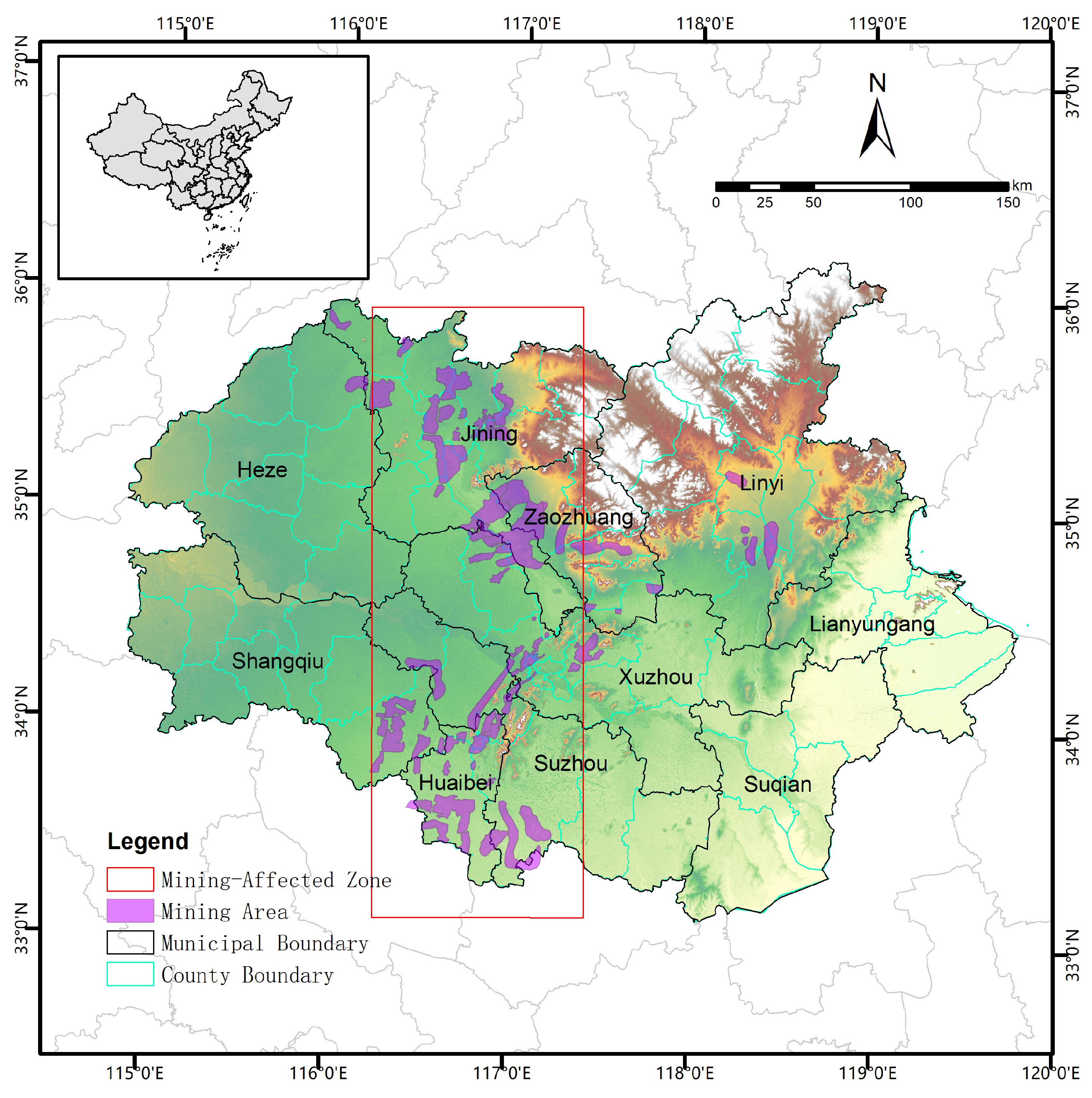
2.1. Study Area
2.2. Data Sources
2.3. Methods
2.3.1. Land Use Transfer Matrix
2.3.2. Land Use Dynamic Degree
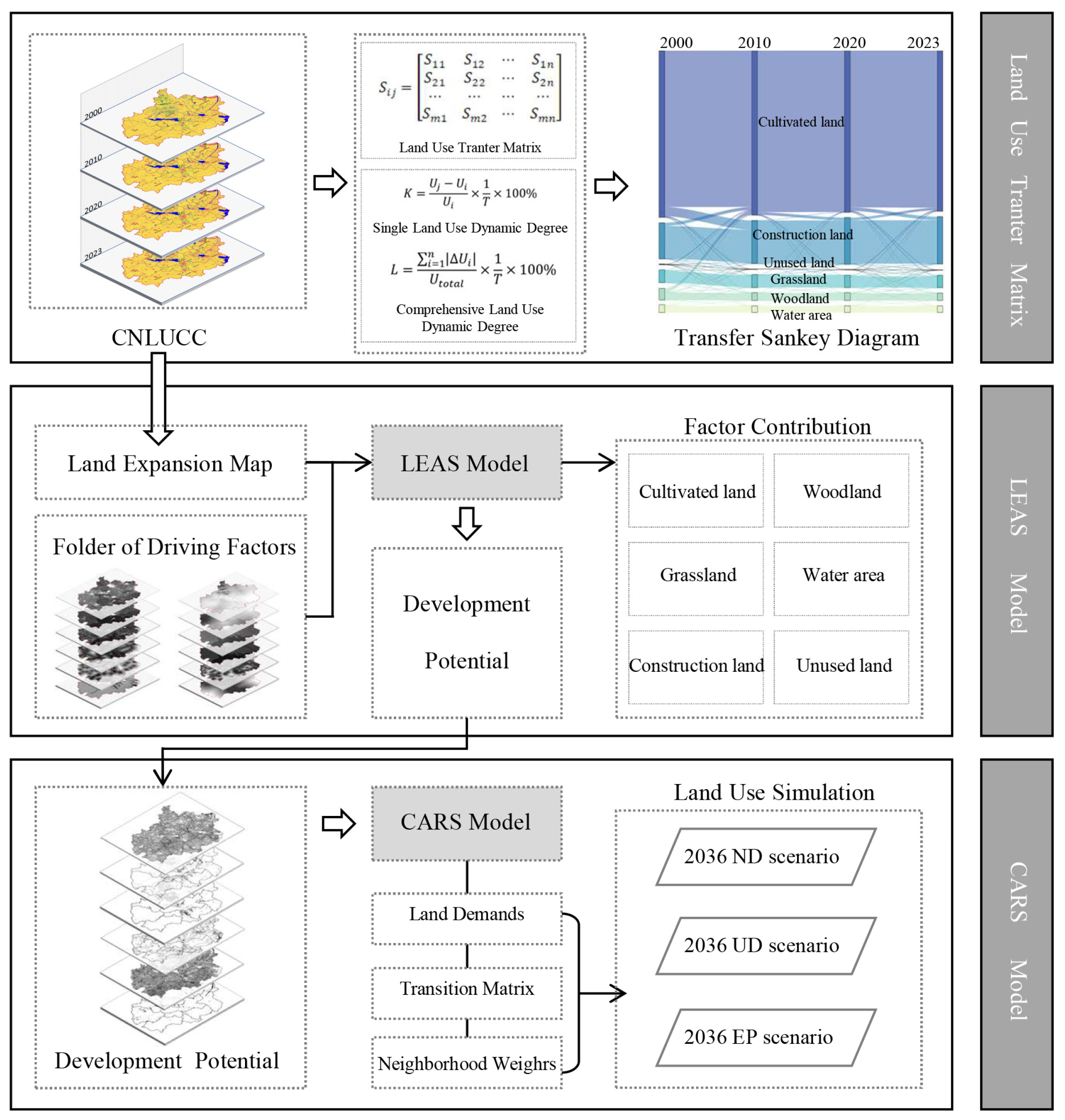
2.3.3. PLUS Model
3. Results
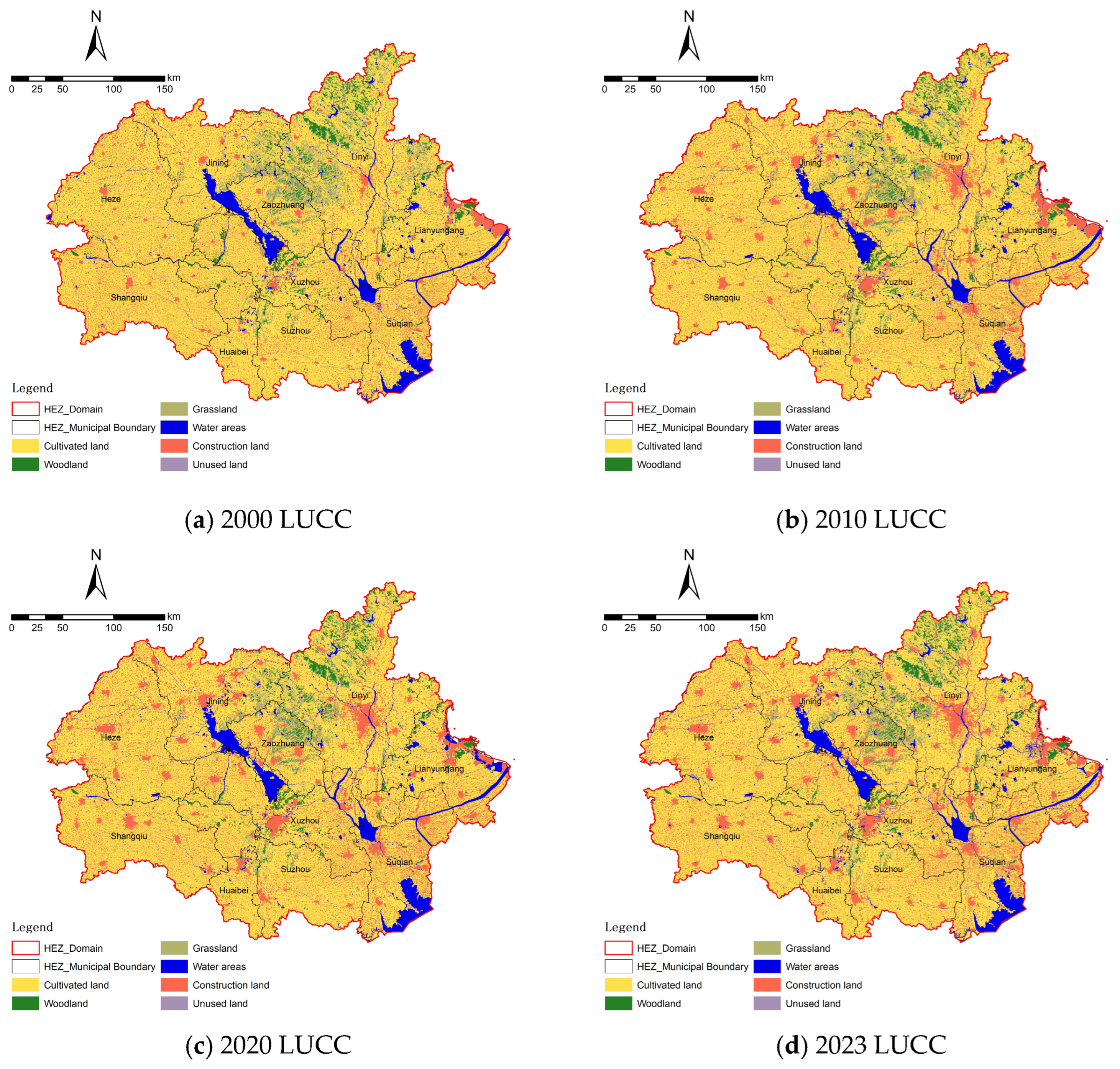
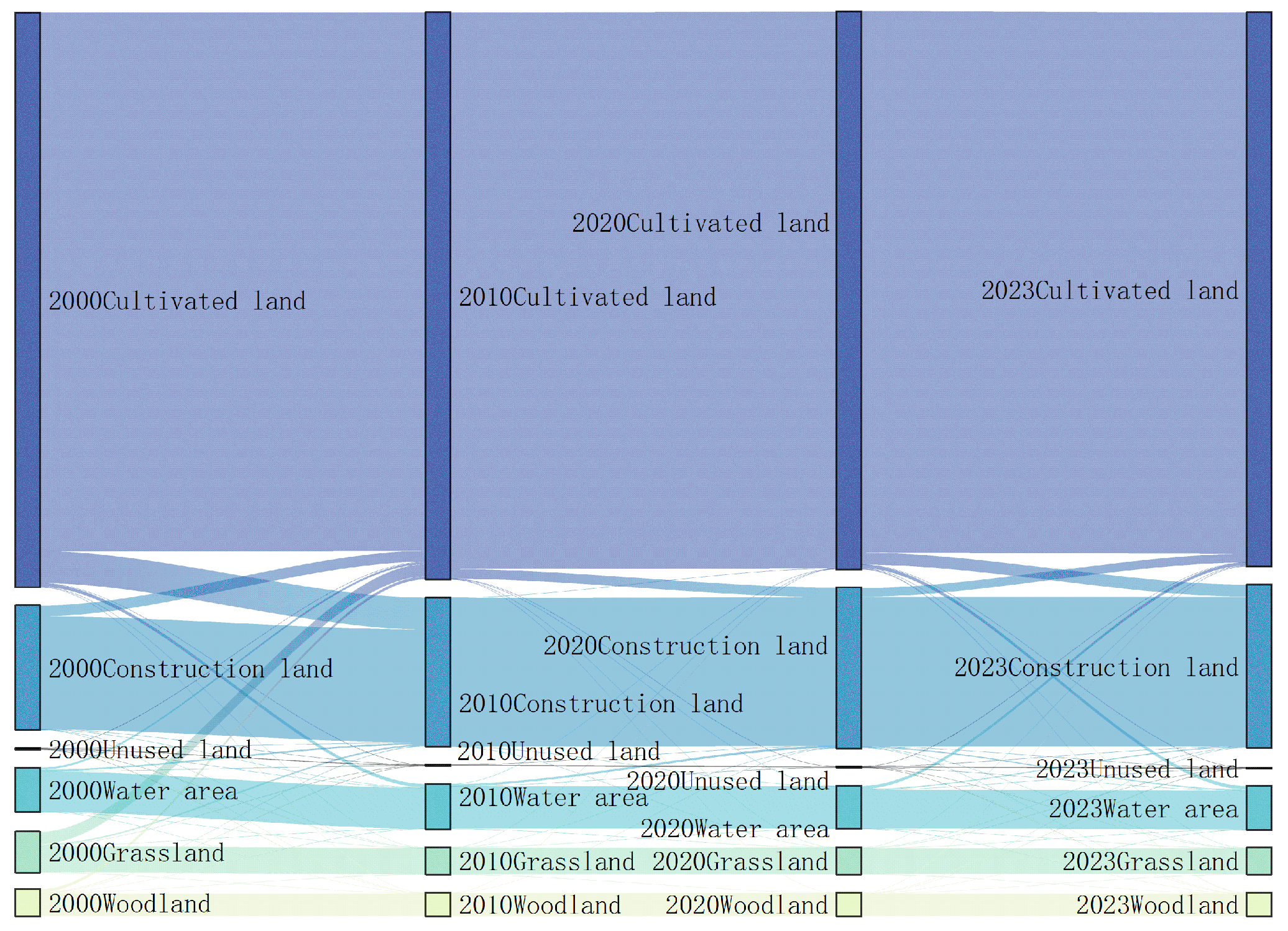
3.1. Spatiotemporal Characteristics of Land Use Change
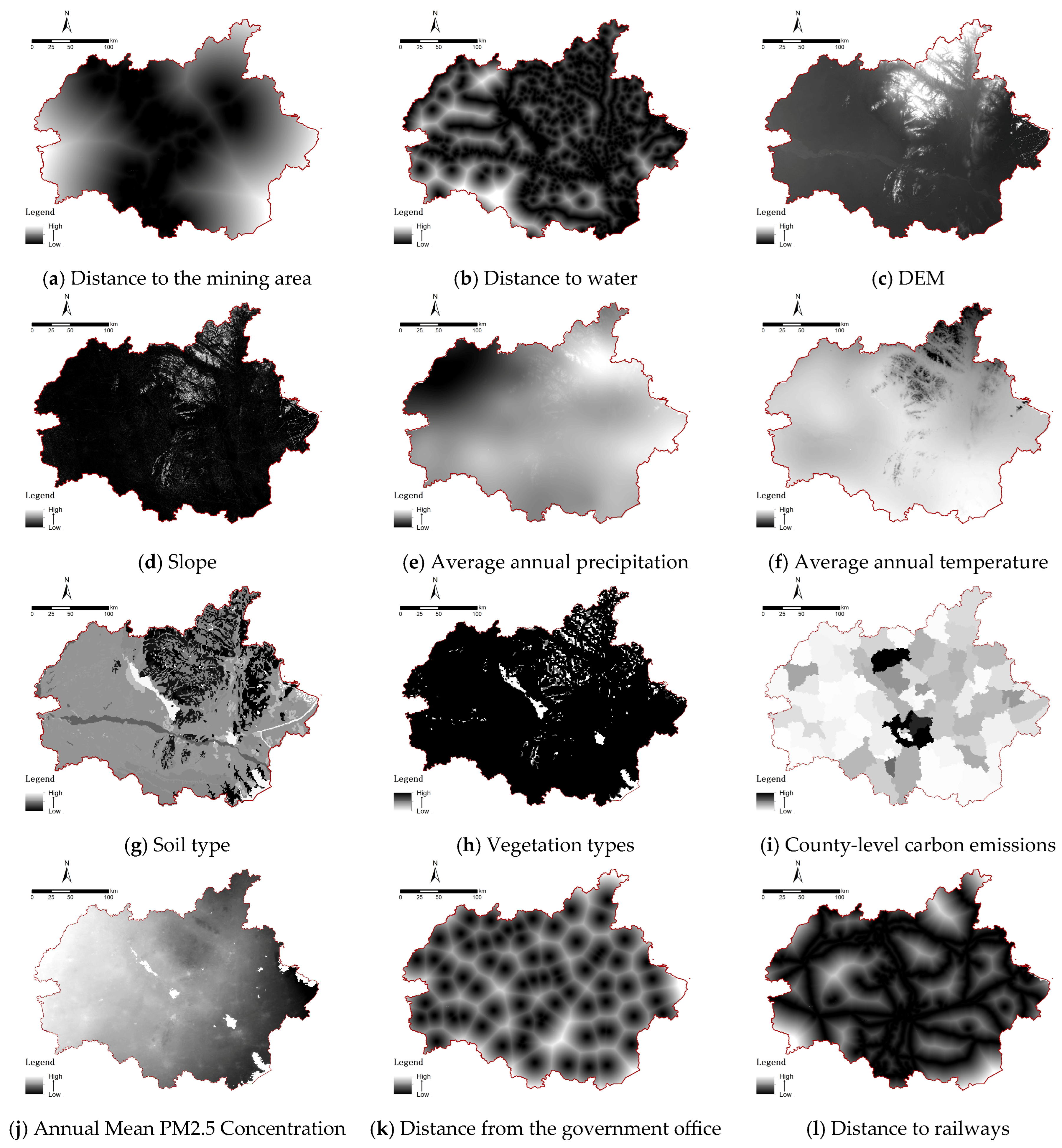
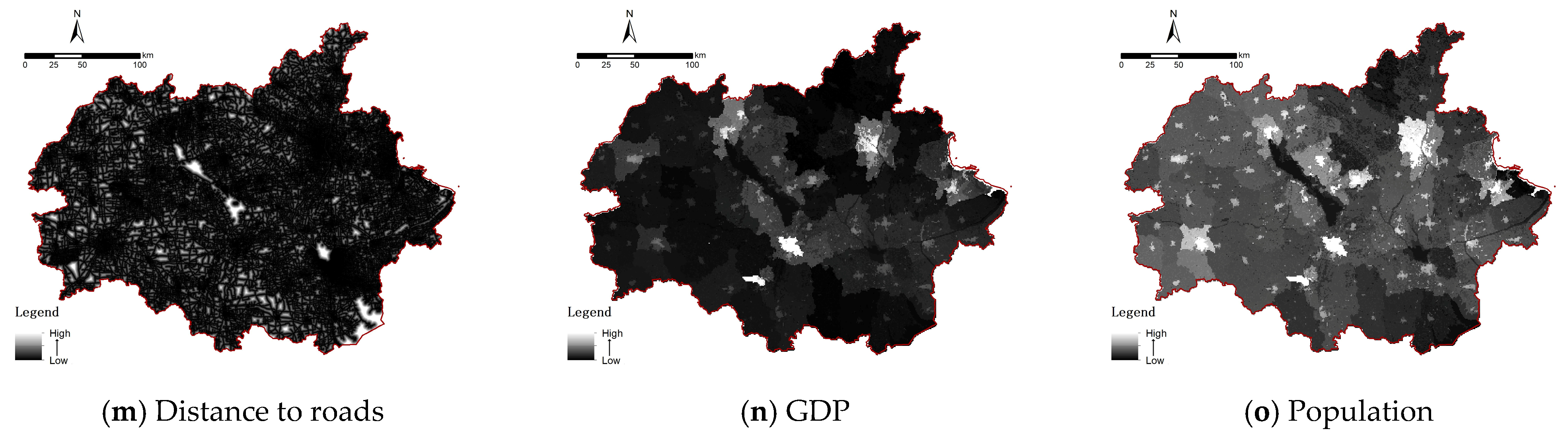
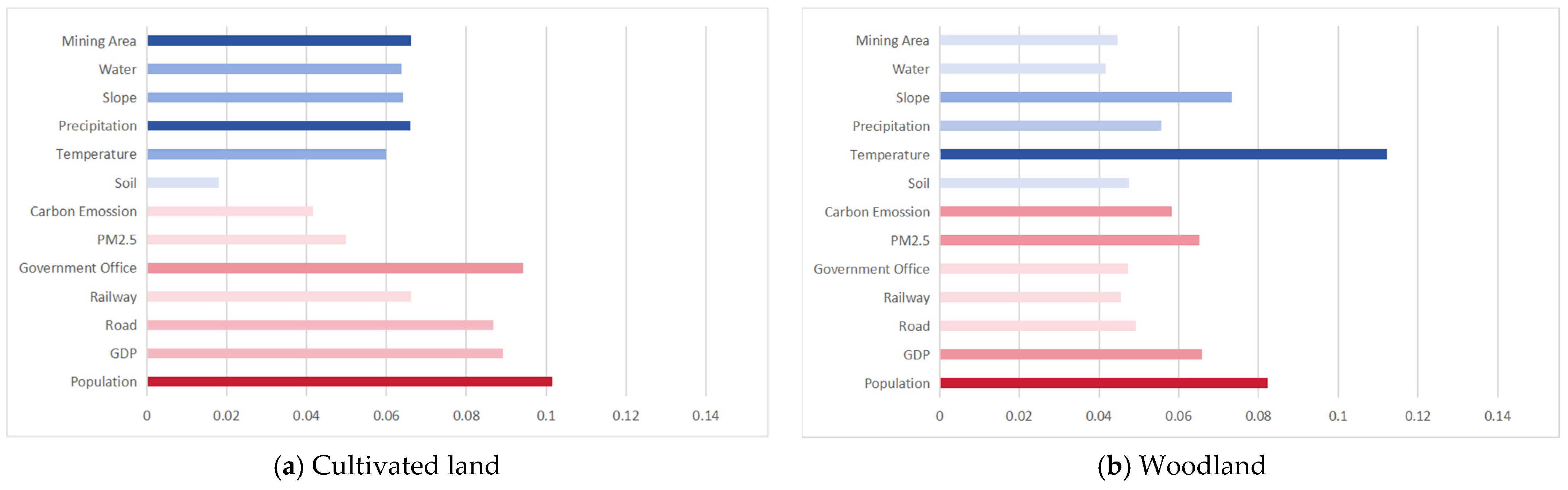
3.2. Driving Factors of Land Use Change
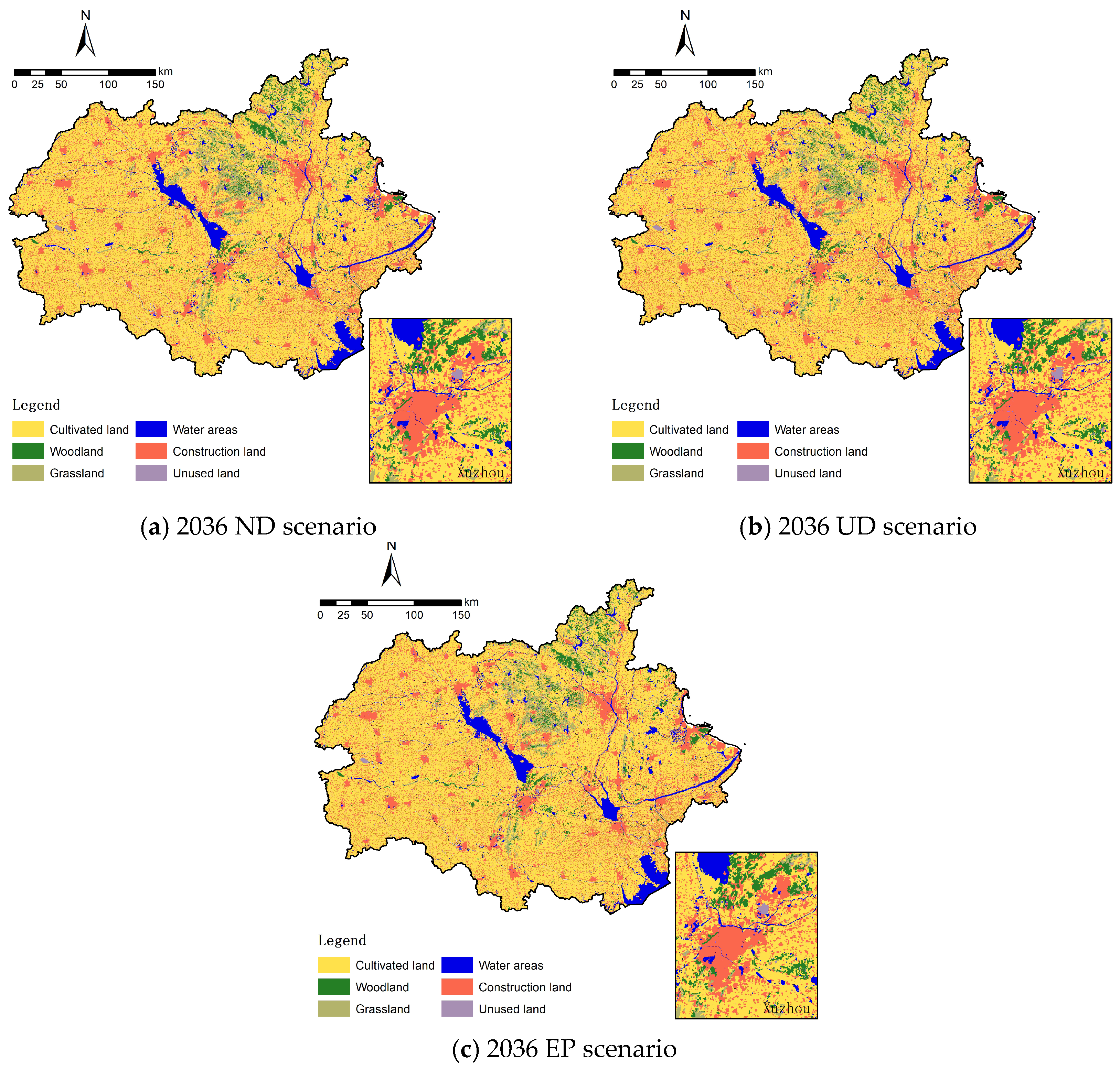
3.3. Multi-Scenario Land Use Simulation
4. Discussion
4.1. Direction for Land Use Structure Adjustment
4.2. Driving Mechanisms of Land Use Change
4.3. Policy Implications for Sustainable Transition
4.4. Limitations and Future Research Directions
5. Conclusions
Author Contributions
Funding
Data Availability Statement
Acknowledgments
Conflicts of Interest
Abbreviations
| HEZ | Huaihai Economic Zone |
| PLUS | Patch-generating Land Use Simulation |
| LEAS | Land Expansion Analysis Strategy |
| CARS | Cellular Automata based on Multiple Random Seeds |
References
- Seto, K.C.; Güneralp, B.; Hutyra, L.R. Global forecasts of urban expansion to 2030 and direct impacts on biodiversity and carbon pools. Proc. Natl. Acad. Sci. USA 2012, 109, 16083–16088. [Google Scholar] [CrossRef] [Scilit]
- Li, X.; Lu, Z. Spatiotemporal Evolution of Land Use Structure and Function in Rapid Urbanization: The Case of the Beijing–Tianjin–Hebei Region. Land 2024, 13, 1651. [Google Scholar] [CrossRef] [Scilit]
- Li, X.; Fu, J.; Jiang, D.; Lin, G.; Cao, C. Land Use Optimization in Ningbo City with a Coupled GA and PLUS Model. J. Clean. Prod. 2022, 375, 134004. [Google Scholar] [CrossRef] [Scilit]
- Riahi, K.; van Vuuren, D.P.; Kriegler, E.; Edmonds, J.; O’Neill, B.C.; Fujimori, S.; Bauer, N.; Calvin, K.; Dellink, R.; Fricko, O.; et al. The Shared Socioeconomic Pathways and Their Energy, Land Use, and Greenhouse Gas Emissions Implications: An Overview. Glob. Environ. Change 2017, 42, 153–168. [Google Scholar] [CrossRef] [Scilit]
- Marschalko, M.; Yilmaz, I.; Kubečka, K.; Bouchal, T.; Bednárik, M.; Drusa, M.; Bendová, M. Utilization of Ground Subsidence Caused by Underground Mining to Produce a Map of Possible Land-Use Areas for Urban Planning Purposes. Arab. J. Geosci. 2015, 8, 579–588. [Google Scholar] [CrossRef] [Scilit]
- Tang, Q.; Wang, J.; Jing, Z.; Yan, Y.; Niu, H. Response of Ecological Vulnerability to Land Use Change in a Resource-Based City, China. Resour. Policy 2021, 74, 102324. [Google Scholar] [CrossRef] [Scilit]
- Yıldız, T.D. Evaluation of Forestland Use in Mining Operation Activities in Turkey in Terms of Sustainable Natural Resources. Land Use Policy 2020, 99, 104638. [Google Scholar] [CrossRef] [Scilit]
- Chen, W.; Chen, W.; Ning, S.; Liu, E.N.; Zhou, X.; Wang, Y.; Zhao, M. Exploring the Industrial Land Use Efficiency of China’s Resource-Based Cities. Cities 2019, 93, 215–223. [Google Scholar] [CrossRef] [Scilit]
- Lu, S.; Liu, Q.; Xia, S.; Zhang, W. How Does Industrial Transition Drive Low-Carbon Transition? Evidence from China’s Resource-Based Cities. Environ. Dev. Sustain. 2025, 27, 16113–16134. [Google Scholar] [CrossRef] [Scilit]
- Imran, M.; Alam, M.S.; Jijian, Z.; Ozturk, I.; Wahab, S.; Doğan, M. From Resource Curse to Green Growth: Exploring the Role of Energy Utilization and Natural Resource Abundance in Economic Development. Nat. Resour. Forum 2024, 49, 2025–2047. [Google Scholar] [CrossRef] [Scilit]
- Marais, L.; Cloete, J.; Lenka, M. The Plight of Mining Cities in South Africa: Planning for Growth and Closure. Cities 2022, 130, 103965. [Google Scholar] [CrossRef] [Scilit]
- Khanal, M.; Hodgkinson, J.H. Subsidence Prediction versus Observation in Australia: A Short Comment. Environ. Impact Assess. Rev. 2021, 86, 106479. [Google Scholar] [CrossRef] [Scilit]
- Ratsep, A.; Liblik, V. Impact of Oil Shale Mining and Mine Closures on Hydrological Conditions of North-East Estonian Rivers. Oil Shale 2004, 21, 137–148. [Google Scholar] [CrossRef] [Scilit]
- Chand, K.; Koner, R. Mine Dump Slope Stability and Failure Behaviour Analysis under Geo-Mining Condition Using Hybrid Numerical Modelling. Curr. Sci. 2025, 128, 667–676. [Google Scholar] [CrossRef] [Scilit]
- He, S.Y.; Lee, J.; Zhou, T.; Wu, D. Shrinking Cities and Resource-Based Economy: The Economic Restructuring in China’s Mining Cities. Cities 2017, 60, 75–83. [Google Scholar] [CrossRef] [Scilit]
- Gumbo, E.B.; Matsa, M.M.; Kowe, P. Bridging Extraction and Environmentalism: A Sustainability-Oriented Framework for Managing Mining-Induced Land Degradation. Environ. Manag. 2026, 76, 33. [Google Scholar] [CrossRef] [Scilit]
- Awotwi, A.; Anornu, G.K.; Quaye-Ballard, J.A.; Annor, T. Monitoring Land Use and Land Cover Changes Due to Extensive Gold Mining, Urban Expansion, and Agriculture in the Pra River Basin of Ghana, 1986–2025. Land Degrad. Dev. 2018, 29, 3331–3343. [Google Scholar] [CrossRef] [Scilit]
- Zang, S.Y.; Huang, X.; Na, X.D.; Sun, L. An Assessment Approach of Land-Use to Resource-Based Cities: A Case Study on Land-Use Process of Daqing Region. Int. J. Environ. Sci. Technol. 2015, 12, 3827–3836. [Google Scholar] [CrossRef] [Scilit]
- Qian, X.; Wang, D.; Wang, J.; Chen, S. Resource Curse, Environmental Regulation and Transformation of Coal-Mining Cities in China. Resour. Policy 2021, 74, 101447. [Google Scholar] [CrossRef] [Scilit]
- Kosatica, M.; Ziegler, E.; Buchstaller, I. From Winding Tower to Eiffel Tower (of the Ruhr Area): The Symbolic Economy of Industrial Signs. Multimodality Soc. 2024, 4, 402–432. [Google Scholar] [CrossRef] [Scilit]
- Whitington, J.; Oguz, Z. Mining the Sun: Coal-to-Solar Transitions and Energetic Place-Making in Appalachia. Crit. Anthropol. 2024, 44, 276–293. [Google Scholar] [CrossRef] [Scilit]
- Pratiwi; Narendra, B.H.; Siregar, C.A.; Iskandar; Mulyanto, B.; Suwardi; Suryaningtyas, D.T.; Dharmawan, I.W.S.; Suharti, S.; Marsandi, F. Tin Mining and Post-Tin Mining Reclamation Initiatives in Indonesia: With Special Reference to Bangka Belitung Areas. Land 2025, 14, 1947. [Google Scholar] [CrossRef] [Scilit]
- Sterling, S.M.; Ducharne, A.; Polcher, J. The Impact of Global Land-Cover Change on the Terrestrial Water Cycle. Nat. Clim. Change 2013, 3, 385–390. [Google Scholar] [CrossRef] [Scilit]
- Dhakal, B.; Kattel, R.R. Effects of Global Changes on Ecosystems Services of Multiple Natural Resources in Mountain Agricultural Landscapes. Sci. Total Environ. 2019, 676, 665–682. [Google Scholar] [CrossRef] [Scilit]
- Leta, M.K.; Demissie, T.A.; Tränckner, J. Modeling and Prediction of Land Use Land Cover Change Dynamics Based on Land Change Modeler (LCM) in Nashe Watershed, Upper Blue Nile Basin, Ethiopia. Sustainability 2021, 13, 3740. [Google Scholar] [CrossRef] [Scilit]
- Serra, P.; Pons, X.; Saurí, D. Land-Cover and Land-Use Change in a Mediterranean Landscape: A Spatial Analysis of Driving Forces Integrating Biophysical and Human Factors. Appl. Geogr. 2008, 28, 189–209. [Google Scholar] [CrossRef] [Scilit]
- Zhou, H.; Tang, M.; Huang, J.; Mei, X.; Zhao, H. Driving Mechanisms and Multi-Scenario Simulation of Land Use Change Based on National Land Survey Data: A Case in Jianghan Plain, China. Front. Environ. Sci. 2024, 12, 1422987. [Google Scholar] [CrossRef] [Scilit]
- Hashimoto, S.; DasGupta, R.; Kabaya, K.; Matsui, T.; Haga, C.; Saito, O.; Takeuchi, K. Scenario Analysis of Land-Use and Ecosystem Services of Social-Ecological Landscapes: Implications of Alternative Development Pathways Under Declining Population in the Noto Peninsula, Japan. Sustain. Sci. 2019, 14, 53–75. [Google Scholar] [CrossRef] [Scilit]
- Li, B.; He, C.; Jiang, X.; Zheng, Q.; Li, J. Land Use Evolution and Multi-Scenario Simulation of Shrinking Border Counties Based on the PLUS Model: A Case Study of Changbai County. Sustainability 2025, 17, 6441. [Google Scholar] [CrossRef] [Scilit]
- Li, Y.; Ma, J.; Li, Y.; Jia, Q.; Shen, X.; Xia, X. Spatiotemporal Variations in the Soil Quality of Agricultural Land and Its Drivers in China from 1980 to 2018. Sci. Total Environ. 2023, 892, 164649. [Google Scholar] [CrossRef] [Scilit]
- Rong, T.; Zhang, P.; Zhu, H.; Jiang, L.; Li, Y.; Liu, Z. Spatial Correlation Evolution and Prediction Scenario of Land Use Carbon Emissions in China. Ecol. Inform. 2022, 71, 101802. [Google Scholar] [CrossRef] [Scilit]
- Du, S.; Zhou, Z.; Huang, D.; Zhang, F.; Deng, F.; Yang, Y. The Response of Carbon Stocks to Land Use/Cover Change and a Vulnerability Multi-Scenario Analysis of the Karst Region in Southern China Based on PLUS-InVEST. Forests 2023, 14, 2307. [Google Scholar] [CrossRef] [Scilit]
- Gao, F.; Xin, X.; Song, J.; Li, X.; Zhang, L.; Zhang, Y.; Liu, J. Simulation of LUCC Dynamics and Estimation of Carbon Stock under Different SSP-RCP Scenarios in Heilongjiang Province. Land 2023, 12, 1665. [Google Scholar] [CrossRef] [Scilit]
- Shooshtari, S.J.; Gholamalifard, M. Scenario-Based Land Cover Change Modeling and Its Implications for Landscape Pattern Analysis in the Neka Watershed, Iran. Remote Sens. Appl. Soc. Environ. 2015, 1, 1–19. [Google Scholar] [CrossRef] [Scilit]
- Lei, J.; Chen, Y.; Li, L.; Chen, Z.; Chen, X.; Wu, T.; Li, Y. Spatiotemporal Change of Habitat Quality in Hainan Island of China Based on Changes in Land Use. Ecol. Indic. 2022, 145, 109707. [Google Scholar] [CrossRef] [Scilit]
- Ma, R.; Zhou, W.; Ren, J.; Huang, Y.; Wang, H. Multi-Scenario Simulation and Optimization Control of Ecological Security Based on GeoSOS-FLUS Model in Ecological Fragile Area in Northeast Qinghai-Tibet Plateau, China. Ecol. Indic. 2023, 151, 110324. [Google Scholar] [CrossRef] [Scilit]
- Chen, Z.; Huang, M.; Zhu, D.; Altan, O. Integrating Remote Sensing and a Markov-FLUS Model to Simulate Future Land Use Changes in Hokkaido, Japan. Remote Sens. 2021, 13, 2621. [Google Scholar] [CrossRef] [Scilit]
- Xu, K.; Chi, Y.; Ge, R.; Wang, X.; Liu, S. Land Use Changes in Zhangjiakou from 2005 to 2025 and the Importance of Ecosystem Services. PeerJ 2021, 9, e12122. [Google Scholar] [CrossRef] [Scilit]
- Jin, Q.; Liu, G.; Li, L.; He, C.; Huang, Y.; Yao, Y. Land Use Scenarios Simulation Based on the CLUE-S Model of the Lijiang River Basin in Guilin, China. In Proceedings of the 6th Digital Earth Summit, Beijing, China, 7–8 July 2016. [Google Scholar] [CrossRef] [Scilit]
- Su, S.; Sun, Y.; Lei, C.; Weng, M.; Cai, Z. Reorienting Paradoxical Land Use Policies towards Coherence: A Self-Adaptive Ensemble Learning Geo-Simulation of Tea Expansion under Different Scenarios in Subtropical China. Land Use Policy 2017, 67, 415–425. [Google Scholar] [CrossRef] [Scilit]
- Liu, J.; Liu, B.; Wu, L.; Miao, H.; Liu, J.; Jiang, K.; Gao, W.; Liu, T. Prediction of Land Use for the Next 30 Years Using the PLUS Model’s Multi-Scenario Simulation in Guizhou Province, China. Sci. Rep. 2024, 14, 13143. [Google Scholar] [CrossRef] [Scilit]
- Liang, X.; Guan, Q.; Clarke, K.C.; Liu, S.; Wang, B.; Yao, Y. Understanding the Drivers of Sustainable Land Expansion Using a Patch-Generating Land Use Simulation (PLUS) Model: A Case Study in Wuhan, China. Comput. Environ. Urban Syst. 2021, 85, 101569. [Google Scholar] [CrossRef] [Scilit]
- Wang, J.; Wu, Y.; Gou, A. Habitat Quality Evolution Characteristics and Multi-Scenario Prediction in Shenzhen Based on PLUS and InVEST Models. Front. Environ. Sci. 2023, 11, 1146347. [Google Scholar] [CrossRef] [Scilit]
- Zhang, J.; Zhu, H.; Zhang, P.; Song, Y.; Zhang, Y.; Li, Y.; Rong, T.; Liu, Z.; Yang, D.; Lou, Y. Construction of GI Network Based on MSPA and PLUS Model in the Main Urban Area of Zhengzhou: A Case Study. Front. Environ. Sci. 2022, 10, 878656. [Google Scholar] [CrossRef] [Scilit]
- Bai, Y.; Tang, X.; Xue, F.; Long, D.; Li, J.; Tang, Y. Spatiotemporal Variation and Dynamic Simulation of Carbon Stock Based on PLUS and InVEST Models in the Li River Basin, China. Sci. Rep. 2025, 15, 6060. [Google Scholar] [CrossRef] [Scilit] [PubMed]
- Wang, L.; Liu, D.; Wu, X.; Zhang, X.; Liu, Q.; Kong, W.; Yang, S. Simulation Analysis of Land Use Change via the PLUS-GMOP Coupling Model. Land 2025, 14, 802. [Google Scholar] [CrossRef] [Scilit]
- Fan, F.; Zhang, X. Transformation Effect of Resource-Based Cities Based on PSM-DID Model: An Empirical Analysis from China. Environ. Impact Assess. Rev. 2021, 91, 106648. [Google Scholar] [CrossRef] [Scilit]
- Tong, S.; Ji, X.; Chu, Y.; Liu, T.; Wang, F. Spatio-Temporal Analysis About Resource and Environmental Carrying Capacity (RECC) of Mining Cities in Coal-Concentrated Areas: A Case Study of Huaihai Economic Zone in China. Sustainability 2023, 15, 1367. [Google Scholar] [CrossRef] [Scilit]
- Teng, G.; Chen, L.; Zhang, T.; Li, L.; Xiao, J.; Ma, L. The Spatiotemporal Evolution of Land Use Ecological Efficiency in the Huaihai Economic Zone: Insights from a Multi-Dimensional Framework and Geospatial Modeling. Land 2025, 14, 883. [Google Scholar] [CrossRef] [Scilit]
- IEA. Coal Mid-Year Update 2025; IEA: Paris, France, 2025; Available online: https://www.iea.org/reports/coal-mid-year-update-2025 (accessed on 13 March 2026).
- Shen, Y.; Zhang, L.; Fang, X.; Zhao, Z.; Li, X.; Wang, J.; Chai, Q. Long-Term Analysis of Aerosol Optical Depth over the Huaihai Economic Region (HER): Possible Causes and Implications. Atmosphere 2018, 9, 93. [Google Scholar] [CrossRef] [Scilit]
- Li, Z.; Chang, J.; Li, C.; Gu, S. Ecological Restoration and Protection of National Land Space in Coal Resource-Based Cities from the Perspective of Ecological Security Pattern: A Case Study in Huaibei City, China. Land 2023, 12, 442. [Google Scholar] [CrossRef] [Scilit]
- Hemmavanh, C.; Ye, Y.; Yoshida, A. Forest Land Use Change at Trans-Boundary Laos-China Biodiversity Conservation Area. J. Geogr. Sci. 2010, 20, 889–898. [Google Scholar] [CrossRef] [Scilit]
- Quan, B.; Bai, Y.; Römkens, M.J.M.; Chang, K.T.; Song, H.; Guo, T.; Lei, S. Urban Land Expansion in Quanzhou City, China, 1995–2010. Habitat Int. 2015, 48, 131–139. [Google Scholar] [CrossRef] [Scilit]
- Huang, F.; Huang, B.; Huang, J.; Li, S. Measuring Land Change in Coastal Zone Around a Rapidly Urbanized Bay. Int. J. Environ. Res. Public Health 2018, 15, 1059. [Google Scholar] [CrossRef] [Scilit] [PubMed]
- Quan, B.; Römkens, M.J.M.; Tao, J.; Li, B.; Li, C.; Yu, G.; Chen, Q. Spatial-Temporal Pattern and Population Driving Force of Land Use Change in Liupan Mountains Region, Southern Ningxia, China. Chin. Geogr. Sci. 2008, 18, 323–330. [Google Scholar] [CrossRef] [Scilit]
- Luo, J.; Hu, Y.; Chen, Y.; Zhou, W.; Zhang, H.; Liang, T. Spatiotemporal Evolution of Land Use in Ili, Xinjiang, China: A Comparative Evaluation of PLUS and Logistic-CA-Markov Models. Geocarto Int. 2025, 40, 2570049. [Google Scholar] [CrossRef] [Scilit]
- Wu, Q.; Wang, L.; Wang, T.; Ruan, Z.; Du, P. Spatial–Temporal Evolution Analysis of Multi-Scenario Land Use and Carbon Storage Based on PLUS-InVEST Model: A Case Study in Dalian, China. Ecol. Indic. 2024, 166, 112448. [Google Scholar] [CrossRef] [Scilit]
- Borowski, M.; Zwolińska-Glądys, K.; Cheng, J. Methane Emissions from Coal Mines: Quantification, Capture, and Utilization Strategies for Atmospheric Impact Mitigation—A Case Study from Poland. Atmosphere 2025, 16, 174. [Google Scholar] [CrossRef] [Scilit]
- Humer, A.; Cardoso, R.V.; Meijers, E. Breaking with the Spatial-Cycle Model: The Shift towards ‘Syncurbanization’ in Polycentric Urban Regions. Reg. Stud. 2022, 56, 21–35. [Google Scholar] [CrossRef] [Scilit]
- Bren d’Amour, C.; Reitsma, F.; Baiocchi, G.; Barthel, S.; Güneralp, B.; Erb, K.H.; Haberl, H.; Creutzig, F.; Seto, K.C. Future Urban Land Expansion and Implications for Global Croplands. Proc. Natl. Acad. Sci. USA 2017, 114, 8939–8944. [Google Scholar] [CrossRef] [Scilit]
- Güneralp, B.; Reba, M.; Hales, B.U.; Wentz, E.A.; Seto, K.C. Trends in Urban Land Expansion, Density, and Land Transitions from 1970 to 2010: A Global Synthesis. Environ. Res. Lett. 2020, 15, 044015. [Google Scholar] [CrossRef] [Scilit]
- Kulish, M.; Richards, A.; Gillitzer, C. Urban Structure and Housing Prices: Some Evidence from Australian Cities. Econ. Rec. 2012, 88, 303–322. [Google Scholar] [CrossRef] [Scilit]
- Bebbington, A.; Hinojosa, L.; Bebbington, D.H.; Burneo, M.L.; Warnaars, X. Contention and Ambiguity: Mining and the Possibilities of Development. Dev. Change 2008, 39, 887–914. [Google Scholar] [CrossRef] [Scilit]
- Ma, Y.; Zhang, P.; Zhao, K.; Zhou, Y.; Zhao, S. A Dynamic Performance and Differentiation Management Policy for Urban Construction Land Use Change in Gansu, China. Land 2022, 11, 942. [Google Scholar] [CrossRef] [Scilit]
- Tondaś, D.; Ilieva, M.; van Leijen, F.; van der Marel, H.; Rohm, W. Kalman Filter-Based Integration of GNSS and InSAR Observations for Local Nonlinear Strong Deformations. J. Geod. 2023, 97, 109. [Google Scholar] [CrossRef] [Scilit]
- Hu, X.; Li, Z.; Cai, Y.; Wu, F. Urban Construction Land Demand Prediction and Spatial Pattern Simulation under Carbon Peak and Neutrality Goals: A Case Study of Guangzhou, China. J. Geogr. Sci. 2022, 32, 2251–2270. [Google Scholar] [CrossRef] [Scilit]




| Type | Data | Year | Accuracy | Resource | Website |
|---|---|---|---|---|---|
| Land use data | Huaihai Economic Zone LUCC data | 2000 | 30 m | Resource and Environmental Science Data Platform | https://www.resdc.cn/DataList.aspx (accessed on 20 August 2025) |
| 2010 | |||||
| 2020 | |||||
| 2023 | |||||
| Environmental data | Distance to the mining area | 2024 | 30 m | Provincial, Municipal, and County Planning Atlas | Government official websites |
| Distance to water | 2021 | 30 m | Zhongli Data Network | https://zldatas.com/ | |
| DEM | 2019 | 30 m | Geospatial Data Cloud | https://www.gscloud.cn/ | |
| Slope | 2019 | 30 m | Generated from DEM | ||
| Average annual precipitation | 2020 | 1000 m | Resource and Environmental Science Data Platform | https://www.resdc.cn/DataList.aspx (accessed on 24 March 2026) | |
| Average annual temperature | 2020 | 1000 m | |||
| Soil type | 2017 | 30 m | |||
| Vegetation types | 2001 | 1000 m | Resource and Environmental Science Data Platform | https://www.resdc.cn/DataList.aspx | |
| Socioeconomic data | County-level carbon emissions | 2024 | / | Emissions Database for Global Atmospheric Research | https://edgar.jrc.ec.europa.eu/ (accessed on 15 January 2026) |
| Annual mean PM2.5 concentration | 2020 | 1000 m | National Tibetan Plateau/Third Pole Environment Data Center | https://data.tpdc.ac.cn/zh-hans/data/6168e75d-93ab-4e4a-b7ff-33152e49d0bf (accessed on 15 October 2025) | |
| Distance from the government office | 2020 | 30 m | National Geographic Information Resource Directory Service System | https://www.webmap.cn/main.do?method=index (accessed on 15 October 2025) | |
| Distance to railways | 2020 | 30 m | |||
| Distance to roads | 2020 | 30 m | |||
| GDP | 2020 | 1000 m | Resource and Environmental Science Data Platform | https://www.resdc.cn/DataList.aspx (accessed on 24 March 2026) | |
| Population | 2020 | 1000 m |
| 2036 ND Scenario | 2036 UD Scenario | 2036 EP Scenario | ||||||||||||||||
|---|---|---|---|---|---|---|---|---|---|---|---|---|---|---|---|---|---|---|
| a | b | c | d | e | f | a | b | c | d | e | f | a | b | c | d | e | f | |
| a | 1 | 1 | 1 | 1 | 1 | 1 | 1 | 0 | 0 | 0 | 1 | 1 | 1 | 1 | 1 | 1 | 1 | 1 |
| b | 1 | 1 | 1 | 1 | 1 | 1 | 1 | 1 | 1 | 0 | 1 | 1 | 0 | 1 | 0 | 0 | 0 | 0 |
| c | 1 | 1 | 1 | 1 | 1 | 1 | 1 | 1 | 1 | 0 | 1 | 1 | 0 | 1 | 1 | 0 | 0 | 0 |
| d | 0 | 0 | 0 | 1 | 0 | 0 | 0 | 1 | 1 | 1 | 1 | 0 | 0 | 1 | 1 | 1 | 0 | 0 |
| e | 0 | 0 | 0 | 0 | 1 | 0 | 0 | 0 | 0 | 0 | 1 | 0 | 0 | 0 | 0 | 0 | 1 | 0 |
| f | 1 | 1 | 1 | 1 | 1 | 1 | 1 | 1 | 1 | 1 | 1 | 1 | 1 | 1 | 1 | 1 | 1 | 1 |
| Type | 2000–2010 | 2010–2020 | 2020–2023 | |||
|---|---|---|---|---|---|---|
| SLUD | CLUD | SLUD | CLUD | SLUD | CLUD | |
| Cultivated land | −0.10% | 0.58% | −0.19% | 0.28% | −0.25% | 0.35% |
| Woodland | −1.27% | −0.07% | 0.04% | |||
| Grassland | −3.36% | −0.03% | −0.40% | |||
| Water area | 0.21% | 0.56% | 0.51% | |||
| Construction land | 1.77% | 0.61% | 0.67% | |||
| Unused land | −2.75% | 0.07% | 2.14% | |||
| 2036 ND | 2036 UD | 2036 EP | |||||||
|---|---|---|---|---|---|---|---|---|---|
| Area Change (km2) | SLUD (%) | CLUD (%) | Area Change (km2) | SLUD (%) | CLUD (%) | Area Change (km2) | SLUD (%) | CLUD (%) | |
| Cultivated land | −1643.70 | −0.25% | 0.35% | −1933.53 | −0.30% | 0.43% | −1087.55 | −0.17% | 0.76% |
| Woodland | −9.40 | −0.03% | −23.33 | −0.08% | 19.86 | 0.07% | |||
| Grassland | 85.21 | 0.28% | −83.74 | −0.27% | 171.53 | 0.56% | |||
| Water area | 107.93 | 0.22% | 2.31 | 0.00% | 111.10 | 0.23% | |||
| Construction land | 1399.11 | 0.73% | 1825.00 | 0.95% | 784.90 | 0.41% | |||
| Unused land | 60.94 | 1.57% | 213.33 | 5.50% | 0.21 | 0.01% | |||
Disclaimer/Publisher’s Note: The statements, opinions and data contained in all publications are solely those of the individual author(s) and contributor(s) and not of MDPI and/or the editor(s). MDPI and/or the editor(s) disclaim responsibility for any injury to people or property resulting from any ideas, methods, instructions or products referred to in the content. |
© 2026 by the authors. Licensee MDPI, Basel, Switzerland. This article is an open access article distributed under the terms and conditions of the Creative Commons Attribution (CC BY) license.
Share and Cite
Lin, Y.; Wang, B.; Zhao, L. Land Use Structure Evolution in Resource-Based Cities: Drivers and Multi-Scenario Forecasting—Evidence from China’s Huaihai Economic Zone. Land 2026, 15, 555. https://doi.org/10.3390/land15040555
Lin Y, Wang B, Zhao L. Land Use Structure Evolution in Resource-Based Cities: Drivers and Multi-Scenario Forecasting—Evidence from China’s Huaihai Economic Zone. Land. 2026; 15(4):555. https://doi.org/10.3390/land15040555
Chicago/Turabian StyleLin, Yan, Binjie Wang, and Liyuan Zhao. 2026. "Land Use Structure Evolution in Resource-Based Cities: Drivers and Multi-Scenario Forecasting—Evidence from China’s Huaihai Economic Zone" Land 15, no. 4: 555. https://doi.org/10.3390/land15040555
APA StyleLin, Y., Wang, B., & Zhao, L. (2026). Land Use Structure Evolution in Resource-Based Cities: Drivers and Multi-Scenario Forecasting—Evidence from China’s Huaihai Economic Zone. Land, 15(4), 555. https://doi.org/10.3390/land15040555