Article

Urban Structural Imbalance Under Rapid Expansion: Evidence from Service Accessibility and Housing Prices

College of Earth Sciences, Jilin University, Changchun 130061, China
*
Author to whom correspondence should be addressed.
Land 2026, 15(3), 446; https://doi.org/10.3390/land15030446
Submission received: 31 January 2026 / Revised: 9 March 2026 / Accepted: 10 March 2026 / Published: 11 March 2026

Abstract

This research examines the structural evolution and functional performance of urban spatial expansion in Changchun, Northeast China. Utilizing an integrated framework of the Adjusted Sprawl Index, Gaussian two-step floating catchment area (Gaussian 2SFCA) accessibility modeling, and XGBoost-SHAP machine learning, the study identifies a decoupled growth pattern where land development and infrastructure construction proceed without a corresponding increase in population density, reflecting a structural-demographic divergence. Empirical results demonstrate that land expansion reached a significant peak between 2015 and 2020, followed by a transition toward morphological equalization and stabilization after 2020. This process manifests as asynchronous urbanism, where the strategic deployment of physical infrastructure frameworks systematically precedes the functional integration of essential social services. The analysis reveals the emergence of localized service-value misalignment clusters in peripheral zones. The phenomenon represents a deviation from the traditional monocentric paradigm toward McCann’s framework of modern urban economics, as high residential valuations are sustained by social capital and institutional expectations despite physical service gaps. Within these clusters, the club realm and private enclosure function as critical forward-looking mechanisms, where the presence of influential groups signals future social and infrastructural investment. A negative interaction effect between property management levels and regional accessibility confirms that these private governance structures effectively substitute for maturing public resources. These findings suggest that future development should prioritize the functional integration of social systems over mere material expansion.

1. Introduction

The trajectory of urbanization in China has transitioned into a complex evolutionary phase. Following extensive periods of rapid industrial development and landscape modification, the spatial configuration of urban growth is exhibiting a profound structural shift. By 2024, the national urbanization rate reached approximately 67%, yet this quantitative milestone reflects an emerging spatial trend defined as the structural-demographic divergence—a pronounced asymmetric decoupling where the physical expansion of built-up environments persists despite a stabilizing or contracting demographic base [1]. This spatial-demographic divergence is particularly evident in Northeast China, where continuous land conversion for infrastructure and residential development occurs alongside regional demographic stagnation [2]. While conventional urban theories frequently associate expansion with consumer-driven preferences for low-density living, the current regional context demonstrates a distinct pattern of physical sprawl that remains statistically independent of organic demographic growth.
To analyze the structural dynamics sustaining this phenomenon, it is essential to situate urban evolution within the broader transition of governance frameworks. Historically, urban development was characterized by a paradigm of urban entrepreneurialism, a planning style where city growth is driven by attracting investment and selling land for development [3]. Recent observations, however, suggest a transition toward more integrated governance models in the post-pandemic era, defined by the consolidation of spatial regulation and the implementation of multi-jurisdictional collaborative frameworks [4]. Within this evolving framework, land-use configuration functions as a primary instrument for regional coordination—evidenced by the strategic structural optimization of the main urban area of Changchun—transcending its role as a reactive economic input [5]. This structural optimization is underpinned by a spatial configuration inherited from early 20th-century radial-grid planning and mid-century industrial integration. The urban core maintains a robust network of radial axes and embedded green wedges, ensuring high landscape connectivity [6]. Furthermore, the establishment of the First Automobile Works (FAW) district provided a template for functionally integrated industrial units, exerting a stabilizing structural influence on the city’s southwestern growth vector [7]. These historical and industrial determinants facilitate a state of asynchronous urbanism, where physical infrastructure deployment systematically outpaces the functional integration of social services [8].
The persistence of this infrastructure-centric development pattern has resulted in a unique spatial configuration, manifesting as a localized service-value misalignment. In emerging peripheral zones, such as those within the Changchun New Area, the deployment of physical infrastructure—comprising road networks and residential clusters—has progressed at a rate that significantly exceeds the integration of institutional services, including healthcare, education, and public ecological spaces [9]. This spatial divergence necessitates a critical revision of the traditional Alonso-Muth-Mills (AMM) monocentric paradigm [10]. As McCann (2013) demonstrates, urban growth is no longer a simple function of physical distance to the city center but is increasingly shaped by institutional quality and local governance resilience [11]. In Changchun’s peripheral clusters, institutionalized urban blueprints have superseded the static distance-decay logic, suggesting that the bid-rent function is now driven by forward-looking resource allocation rather than traditional commuting trade-offs. The emergence of value highlands (HL clusters) in Changchun indicates that top-down governmental zoning and institutionalized urban blueprints have superseded physical distance to the city center as the primary determinant of the bid-rent function. As elevated asset valuations are increasingly recorded in localized areas characterized by a temporary lag in public service accessibility, it is therefore necessary to elucidate the determinants of residential asset utility and valuation in expansion zones where the provision of social services exhibits a distinct temporal decoupling from material construction.
This evolutionary trajectory signifies a shift toward a model defined by the club realm, where urban space fragmentizes into private enclosures. Within these communities, the essential amenity is increasingly defined by the social composition itself—specifically the concentration of influential people. This creates a forward-looking logic where high-value social networks function as a signal that triggers subsequent social and infrastructural investment [12]. Consequently, the club realm does not merely compensate for service deficits; it actively locks in future institutional commitments by leveraging the collective social capital of its residents. Within these transitional settings, residential clusters supported by professional management frameworks function as integrated spatial units where inhabitants access excludable club goods—such as internal landscape maintenance, security protocols, and premium facility management—that complement existing regional infrastructure. In Changchun’s peripheral expansion zones, Property Management Fees (PMF) function as a critical governance substitution mechanism, reflecting a resident preference for private governance structures to compensate for the temporal lag in maturing municipal infrastructure. This compensatory mechanism indicates that the primary determinant of residential asset valuation in peripheral zones is transitioning from spatial centrality to the efficacy of localized service provision. Consequently, the urban landscape displays a stratified configuration where these localized domains provide functional continuity amidst the temporal decoupling of regional service integration [13].
Conventional econometric frameworks, specifically linear Hedonic Price Models (HPM), encounter limitations in capturing the complex, non-linear interactions between spatial expansion, resource-service distribution, and localized management effects. These models typically assume spatial stationarity, often overlooking threshold effects where specific amenities begin to function as functional complements to broader service infrastructures [14]. To resolve this methodological constraint, the current research implements an algorithmic approach to urban analytics. Complementing global feature importance, SHAP Force Plots are utilized to address analytical opacity at a granular level, facilitating the explicit deconstruction of value-generation dynamics for individual residential units across diverse spatial configurations.
This research utilizes an integrated methodological framework to deconstruct the evolutionary trajectory of urban morphology and value mechanisms in the main urban area of Changchun. First, the Adjusted Sprawl Index ( S I a d j ) and Standard Deviational Ellipse (SDE) are employed to quantify the kinematic trajectory of physical expansion and the objective extent of land-population decoupling [15]. Second, the Gaussian Two-Step Floating Catchment Area (Gaussian 2SFCA) method models the spatial stratification of public service accessibility to identify variations in service distribution across the built environment [16]. Third, Bivariate Local Indicators of Spatial Association (Bivariate LISA) diagnose the spatial mismatch between service provision and asset valuation, specifically identifying clusters where high valuations coexist with localized service lags [17]. Finally, an interpretable machine learning framework based on Extreme Gradient Boosting (XGBoost) and SHAP resolves the non-linear attribution of residential value [18]. This facilitates the explicit quantification of interaction effects between Property Management Fees (PMF) and the Comprehensive Accessibility Index (CAI), empirically testing the functional complementarity between localized service frameworks and regional institutional resources within the valuation of urban space.

2. Materials and Methods

2.1. Data Acquisition and Multi-Source Information Fusion

This study constructs a high-resolution spatiotemporal geospatial database for the main urban area of Changchun (2000–2024) to capture the intricate evolutionary logic of urban morphology and institutional functions. Urban built-up area boundaries were derived from the China Land Cover Dataset (CLCD), a 30 m resolution annual product that precisely records the trajectory of socialist urban construction [19].
Road network structures and public transport data were obtained from OpenStreetMap (OSM) (https://www.openstreetmap.org, accessed on 1 September 2025) and the Changchun Public Transport. Population distribution was estimated using the WorldPop dataset. Urban functional facilities (POIs) were sourced from the Amap platform API (https://lbs.amap.com/, accessed on 1 September 2025) to establish spatial coordinates for institutional resource allocation.
This research further utilized 2024 cross-sectional housing price data for 3590 residential communities (Xiaoqu) in the main urban area of Changchun, sourced from leading commercial platforms (e.g., Beike (https://cc.ke.com/, accessed on 5 September 2025), Anjuke (https://m.anjuke.com/cc/, accessed on 5 September 2025)) to ensure comprehensive market representation. The evaluation units are defined as the discrete spatial coordinates (points) of these communities, as each point encapsulates the specific geographical location, standardized property management protocols, and regional service accessibility profiles associated with a distinct residential complex. Housing prices are measured as the average secondary market listing prices for each community in Renminbi per square meter ( R M B / m 2 ).
To account for the temporal variations in residential development, residential units established across different expansion phases are integrated into the 2024 cross-sectional database. This approach treats current valuation as the cumulative result of historical infrastructure-led expansion. By evaluating all units within the same terminal functional and market framework, the model captures the long-term impact of service integration and spatial production on both legacy and newly developed residential points.

2.2. Measurement of Urban Morphological Evolution

2.2.1. Adjusted Sprawl Index ( S I a d j )

To quantify the structural-demographic divergence—defined as the observed discordance between physical expansion and demographic dynamics—this research utilizes the Adjusted Sprawl Index ( S I a d j ) [15]. Traditional metrics of urban sprawl, such as linear land-to-population growth ratios, are highly sensitive to the initial urban base size, frequently producing incomparable results when evaluating cities of different scales or evolutionary stages. In contrast, the S I a d j utilizes a logarithmic standardization of the land-population growth elasticity coefficient, incorporating a normalization factor Γ to effectively correct for allometric scaling biases [20]. This methodology facilitates a precise quantification of spatial production by isolating the physical expansion increment from baseline interference, further integrating the United Nations Sustainable Development Goal (SDG 11.7.1) to evaluate urban growth from an integrated landscape performance perspective [9]:
S I a d j = ln ( A t A t 1 P t P t 1 × P t 1 A t 1 × Γ )
where A t and A t 1 denote the urban built-up area ( k m 2 ) in years t and t 1 , respectively; P t and P t 1 represent the urban population for the corresponding years. Γ is a normalization factor based on the maximum expansion rate observed.

2.2.2. Center of Gravity and Standard Deviational Ellipse (SDE)

The Standard Deviational Ellipse (SDE) method was employed to reveal the directional anisotropy of urban expansion [21]. By computing parameters such as the center of gravity, rotation angle ( θ ), and axis ratio, we test whether urban morphology is shaped by regional development and spatial planning initiatives—such as the “Chang-Ji-Tu” initiative—rather than market-driven resource allocation inertia [22].

2.3. Functional Performance and Spatial Stratification

2.3.1. Gaussian Two-Step Floating Catchment Area (Gaussian 2SFCA)

Standard 2SFCA methods employ a binary search radius that assumes uniform service accessibility within a fixed threshold and zero accessibility beyond it. This binary logic fails to represent the continuous distance decay characteristic of human travel behavior. The integration of a Gaussian impedance function simulates the non-linear decline in service utility as spatial distance increases. This continuous decay modeling is essential for identifying subtle variations in service accessibility within peripheral expansion zones where infrastructure remains immature [23]. The Gaussian impedance function is defined as:
G t i j , t 0 = e 0.5 × t i j t 0 2 e 0.5 1 e 0.5 ,         i f   t i j t 0 0 ,                                                                                   i f   t i j > t 0
The time threshold ( t 0 ) was strictly aligned with China’s “15 min Community Life Circle” planning standards (GB50180-2018 [24]). we set t 0 = 15 min for pedestrian-scale amenities (e.g., Food and Beverage Services) and t 0 = 30 min for transit-dependent facilities (e.g., Leisure and Entertainment), reflecting distinct behavioral tolerances for different service tiers. This parameter setting resonates with the current urban governance emphasis on non-commuting behaviors and equitable social resource allocation [25]. Furthermore, an improved Gaussian decay function was implemented to enhance the scientific assessment of social equity in resource accessibility [16]. Heterogeneous demand weights were applied based on facility tiers as detailed in Appendix A Table A1.

2.3.2. Multimodal Transport Network Construction via r5r

To minimize measurement errors, all origin-destination (OD) matrices were computed using the r5r routing engine (V2.2.0) [26]. A time-window smoothing protocol was implemented for the morning peak transit schedules by utilizing the time-window parameter in the travel-time-matrix() function.

2.4. Spatial Coupling and Attribution Framework

A multi-dimensional econometric framework was constructed to resolve the drivers of residential resource value heterogeneity. Bivariate LISA Analysis was used to deconstruct the spatial coupling between the Comprehensive Accessibility Index (CAI) and housing resource valuation, identifying service-value misalignment clusters [17].

2.5. Machine Learning Attribution Framework and Interpretability Modeling

To resolve the complex non-linear coupling between urban morphology, institutional service accessibility, and residential resource value, this study employs the Extreme Gradient Boosting (XGBoost) model as the core tool for feature attribution. Conventional econometric frameworks, including the Hedonic Price Model (HPM) and Geographically Weighted Regression (GWR), operate under linear assumptions that fail to capture the high heterogeneity and threshold effects characteristic of transitional urban systems. This study further introduces the SHAP (SHapley Additive exPlanations) framework, based on cooperative game theory, to deconstruct the non-linear interaction effects and feature dependencies that traditional models often obscure. Such an analytical shift provides the explanatory depth necessary to identify the club realm mechanism and the compensatory relationship between property management fees (PMF) and regional accessibility, advancing urban informatics beyond simple prediction toward the empirical testing of causal mechanisms in spatial production.
The model utilizes the natural logarithm of housing unit prices ( l n ( P r i c e ) ) as the target variable to stabilize conditional variance. However, as this transformation primarily predicts geometric means and may overlook allometric fluctuations at the arithmetic scale, the XGBoost framework is implemented to maintain feature engineering at the original arithmetic scales to mitigate potential biases in assessing urban scaling laws. By utilizing micro-scale coordinate points instead of aggregated administrative units, the model prevents the loss of granular information and resolves the scale-dependent distortions inherent in spatial growth modeling. Prediction accuracy by minimizing the objective function O b j ( Θ ):
O b j Θ = i = 1 n l ( y i ,   y i ^ ) + k = 1 K Ω ( f k )
where l is the loss function measuring the discrepancy between the predicted value y i and the true value y i , and Ω ( f k ) represents the regularization term, which mitigates overfitting through step-size penalties and complexity constraints. In the specific model configuration, 2000 base learners ( K ) were established, and the l 1 (Lasso) and l 2 (Ridge) regularization parameters were meticulously tuned to ensure the robustness of the model when processing micro-scale residential samples in the main urban area of Changchun. The feature set incorporates 10 variables, including property management fees ( P M F ), brand property premium ( B r a n d P M F ), the Comprehensive Accessibility Index ( C A I ), and key spatial distance metrics ( D C B D , D S U B , D E S , D L A N , and D F A C ). Details of these variables are in Appendix A Table A2.
To address the algorithmic non-transparency of machine learning models, this study introduces the SHAP (SHapley Additive exPlanations) framework based on cooperative game theory. While SHAP quantifies the contribution of each variable to the price prediction, these results represent associations within the 2024 dataset and do not imply direct causal effects. This method quantifies the marginal contribution of feature j by calculating the Shapley value ϕ j according to the additive decomposition logic:
ϕ j   = S     x 1 ,   ,   x p   x j | S | ! ( p     | S |     1 ) ! p !   [ f x ( S   x j )     f x ( S ) ]
This analytical path facilitates the adaptive recovery of spatial non-stationarity while circumventing linearity constraints [18]. To address algorithmic opacity, the interpretability protocol initiates with global feature importance to establish the structural determinants of residential value. Building upon this, SHAP Force Plots visualize marginal contributions of individual variables, identifying how factors like property management fees ( P M F ) or transit proximity ( D S U B ) push predicted prices away from the base value. This granular diagnosis facilitates the identification of spatial clusters characterized by service-value misalignments and localized variations in resource accessibility. Furthermore, the analytical framework quantifies the interaction effects between Property Management Fees ( P M F ) and the Comprehensive Accessibility Index ( C A I ) to evaluate the co-variation between localized service frameworks and regional institutional resources [18]. Finally, the predictive accuracy and algorithmic robustness of the model are rigorously validated using R 2 , MAE, RMSE, and MAPE metrics.

3. Results

3.1. Kinematic Measurement and Morphological Response of Urban Spatial Evolution

3.1.1. Phase-Based Asymmetric Decoupling and Decoupled Physical Expansion

Empirical analysis reveals a significant phase-based asymmetric decoupling in the main urban area of Changchun between 2000 and 2024. This trend is characterized by a structural misalignment between the physical expansion of built-up land and resident population dynamics. Such mismatch provides empirical evidence of a specific structural-demographic divergence within the context of regional urban transitions, where the rate of spatial expansion is statistically uncorrelated with demographic demand trajectories [27].
According to the quantitative assessments in Table 1, the built-up area of the main urban area of Changchun expanded from 189.59 k m 2 in 2000 to 694.42 k m 2 in 2024. While the resident population growth rate remained within a stable and low interval of 2.91% to 3.76%, land expansion exhibited significant non-linear volatility. Most notably, during the 2015–2020 interval, the elasticity of land expansion relative to population growth surged to an extraordinary peak of 15.90. This value exceeds international sustainability thresholds, indicating an extreme decoupling phase. This expansionary spike is characterized by a profound transition in the spatial organization of the urban environment [4]. The 2016 development of the “Changchun New Area” functioned as a primary spatial catalyst, coinciding with a systemic supply-side acceleration of urban space through large-scale infrastructure construction and land resource allocation [28]. Consequently, the Adjusted Sprawl Index ( S I a d j ) reached its maximum value of 7.37 during this period, confirming that this expansion is defined by decoupled physical growth rather than population-synchronized development [9].
The longitudinal analysis identifies a contraction in the Adjusted Sprawl Index ( S I a d j ) from the historical maximum of 7.37 to 5.15 during the 2020–2024 interval. This downward trajectory signifies a transition from speculative construction to institutional stabilization [11]. In addition to systemic financial regulations like the “Three Red Lines” [29], the COVID-19 pandemic functioned as a structural shock [30] that constrained capital liquidity and stalled the delivery of social services, thereby affecting the pace of development. Three primary mechanisms underscore this deceleration. First, the implementation of systemic financial regulation in 2020 functioned as a structural shock to the property-led growth engine [29]. By imposing rigid deleveraging requirements on development entities regarding asset-liability ratios and liquidity buffers, institutional authorities effectively modified the trajectory of debt-fueled land conversion. For Changchun, this financing constraint led to a systemic cooling of land auction markets and a contraction in new residential starts. Second, spatial governance has transitioned toward a model of coordinated spatial regulation [4]. This paradigm shift involves the consolidation of spatial planning where institutional frameworks prioritize the structural optimization of the existing urban fabric over material expansion. Third, the stabilization of regional demographics and the transition toward a phase of aggregate investment saturation have rendered high-elasticity expansion unsustainable [30]. Consequently, the city has entered a phase of geometric symmetry where lower-velocity growth across multiple directions results in morphological rounding.

3.1.2. Strategic Development Deviation and Regional Growth Traction

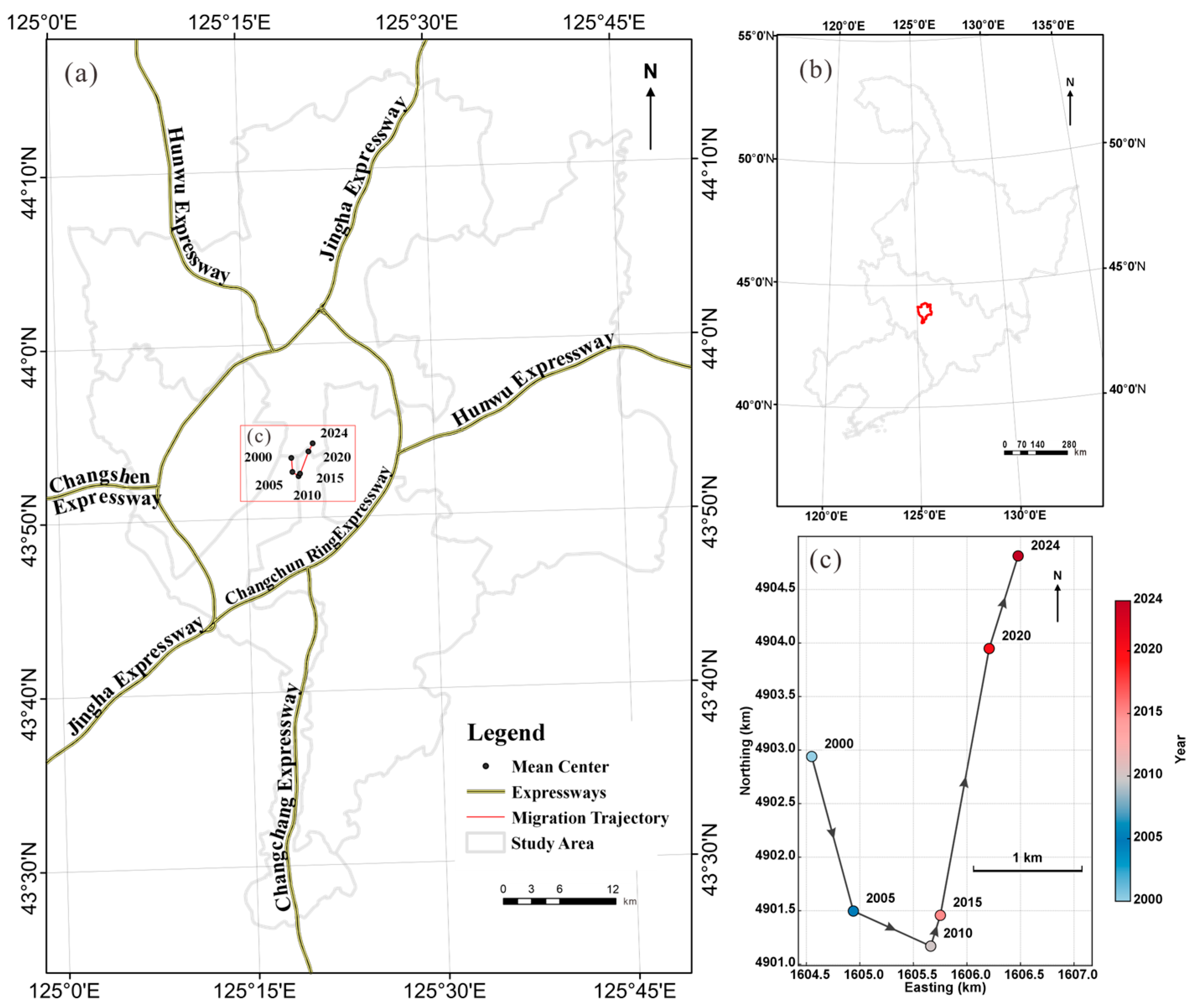
Spatiotemporal deconstruction of the urban Mean Center trajectory reveals a significant reconfiguration of spatial expansion patterns, transitioning from diffuse outward spillover to a phase of pronounced directional acceleration. This shift reflects a fundamental change in the city’s spatial dynamics, where the velocity and orientation of growth vectors exhibit a distinct departure from historical expansion trends.
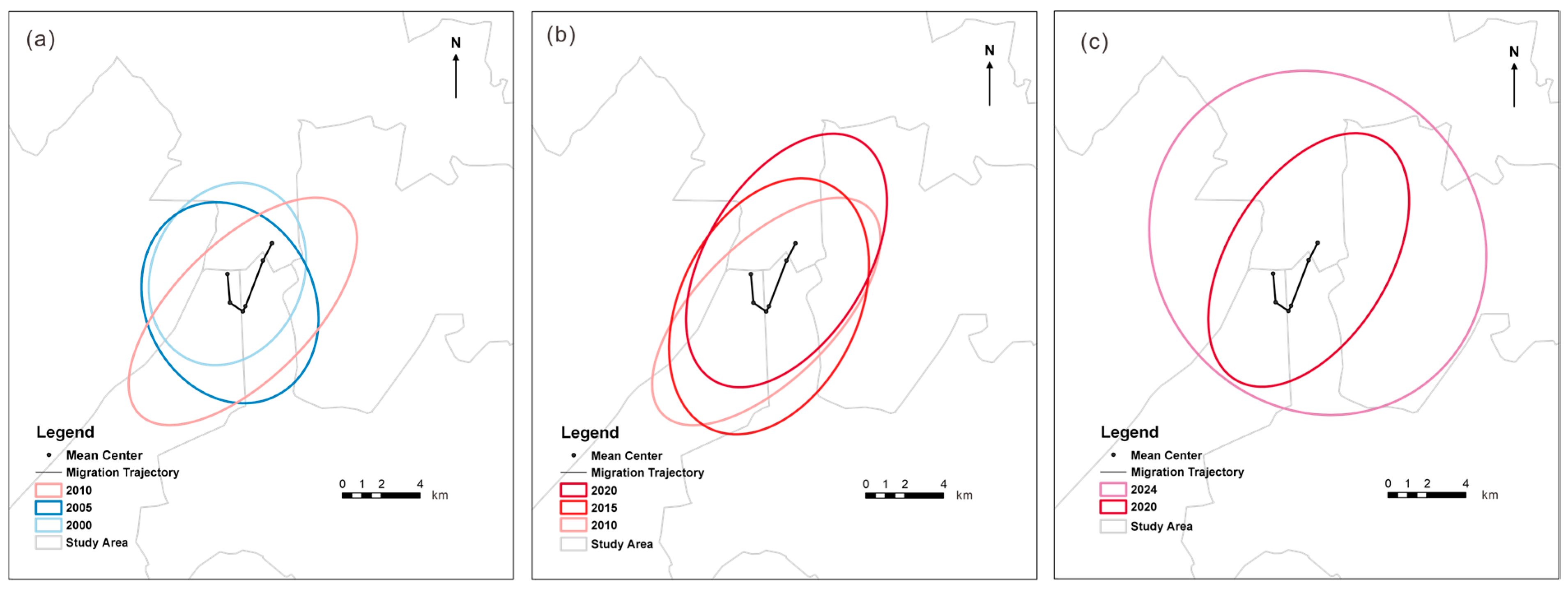
Kinematic analysis of Figure 1 and the parameters in Table 2 identifies two distinct evolutionary phases of urban spatial transition. Between 2000 and 2015, the city underwent a phase of relatively low-velocity centroid migration (0.06–0.30 km/year), reflecting conventional outward expansion from the established core areas. However, the 2015–2024 interval exhibited a marked acceleration, with migration velocity reaching 0.51 km/year—an 8.5-fold increase compared to the previous decade’s minimum. This acceleration was accompanied by a sharp northward deflection toward the North-Northeast (NNE), representing a significant spatial reconfiguration of the urban growth vector [31]. The NNE vector aligns with the extensive development of northern corridors, resulting in a structural expansion of the built environment into the northern periphery [28]. This rapid trajectory leads to the establishment of physical infrastructure frameworks that significantly precede the functional integration of social services in these peripheral zones.

3.1.3. Morphological Equalization vs. Functional Compactness

The evolution of Standard Deviational Ellipse (SDE) parameters further characterizes the morphological anisotropy of the main urban area of Changchun’s growth, revealing a discrepancy between geometric symmetry and functional utility [21].
As detailed in Table 2 and Figure 2, the SDE axis ratio decreased from 2.13 in 2010 to 1.09 in 2024, signifying a transition toward a near-perfect geometric circle. While such morphological rounding is frequently associated with compact development, this observation requires nuanced clarification within the framework of spatial expansion [32]. Given that the Adjusted Sprawl Index ( S I a d j ) remains elevated, this circularity reflects a process of morphological equalization, where low-density expansion occurs across multiple directions, leading to a geometric cancelation of directional vectors. Consequently, the 2020–2024 interval represents a phase of geometric symmetry rather than functional compactness. This underscores a distinctive characteristic of spatial organization: while physical infrastructure frameworks are systematically established, the synchronized integration of corresponding social reproduction services exhibits a persistent structural lag [33]. This divergence between geometric form and functional density remains a defining feature of contemporary urban expansion patterns in the region [34].

3.2. Spatial Stratification of Public Services: From Accessibility Gradients to Structural Inequality

3.2.1. Methodological Framework and Indicator Weighting

Following the kinematic characterization of decoupled physical expansion in Section 3.1, this research implements the Comprehensive Accessibility Index (CAI) to assess the functional performance and service utility of newly developed urban areas. To maintain analytical objectivity and determine the structural configuration of public resources, the Entropy Weight Method (EWM) was employed to assign weights to 15 service indicators. The EWM calculates weights according to the degree of spatial dispersion; specifically, higher dispersion results in lower information entropy and a correspondingly higher weight, thereby highlighting the spatial distribution characteristics and structural variations within the urban service landscape [35].
The results of the weight assessment in Table 3 reveal a non-equilibrium state in the institutional landscape of the study area. Parks and Squares (0.184) received the highest weighting, which highlights the pronounced spatial heterogeneity and significantly uneven distribution of public green spaces. This indicates that these specific resources have become primary determinants of localized functional utility and spatial service hierarchies within the urban built environment. The significant weight assigned to Postal Services (0.156) reflects a spatial discontinuity between the historical core and the emerging expansion zones. In the main urban area of Changchun, a characteristic post-socialist urban fabric, infrastructure such as postal facilities remains concentrated within traditional “Danwei” (work-unit) communities [36]. Their high density in the legacy districts and near-total absence in the peripheral development areas serve as a spatial proxy for the structural divergence between the established city and new expansion sectors.
Conversely, commercial facilities such as Retail and Convenience Stores (0.031) and Shopping Malls and Markets (0.021) exhibit extremely low weights. This reflects a high degree of spatial homogeneity and regional saturation of market-oriented services, which have achieved extensive cross-regional coverage [35]. The dichotomy in weights between institutionally provided public goods and market commodities defines the specific spatial distribution patterns of urban functions. While the urban fabric undergoes rapid physical infrastructure expansion, the integration of social reproduction services exhibits a distinct temporal lag, resulting in significant spatial variations in service accessibility at the urban periphery.

3.2.2. Quintile Stratification of Urban Service Space

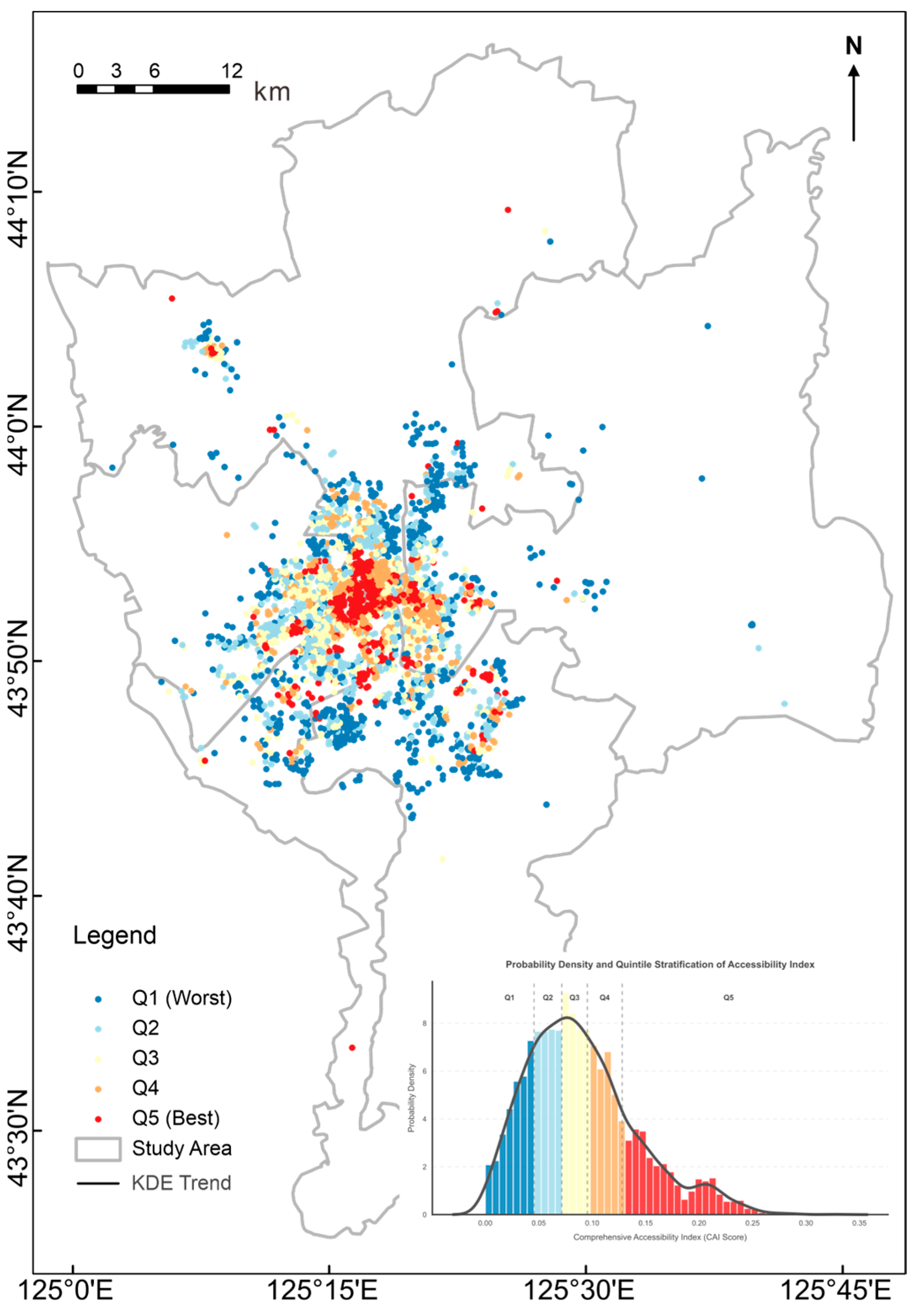
A Quintile Stratification Protocol was implemented to categorize the urban landscape into five hierarchical levels, ranging from zones with minimal institutional support (Q1) to high-accessibility core zones (Q5).
The spatial configuration illustrated in Figure 3 identifies a core-periphery structure. High-accessibility core zones (Q5) are concentrated within the historical districts of Nanguan and Chaoyang. These areas are characterized by a state of multi-dimensional service saturation, functioning as integrated complexes of social reproduction underpinned by historical resource accumulation and central place efficiency. As the spatial trajectory moves toward the northern expansion axis identified in the kinematic analysis, service levels decrease rapidly. This configuration reveals the inequality between the historical core and peripheral expansion areas, reflecting a coupling between residential spatial stratification and the capacity for public resource acquisition [37].

3.2.3. Analysis of Service Hierarchies and the Structural-Demographic Divergence

The spatial stratification results elucidate the logical mismatch between urban expansion strategies and functional configuration efficiency. Q2 zones exhibit a uniform circumferential distribution adjacent to the historical core, projecting the structural-demographic divergence where social service provision lags behind physical expansion. This homogenized fringe distribution confirms universal access barriers, reflecting a systemic misalignment between physical and service-oriented urbanization. Although physical infrastructure is complete, a functional lag persists in high-tier public goods like tertiary healthcare. Consequently, livability benchmarks remain at a secondary-low level despite formal urbanization [38].
In contrast, Q1 zones at the urban fringe and leapfrog patches exhibit a decoupling of land expansion from population needs. This fragmentation indicates structural constraints in spatial development, where the deployment of strategic physical infrastructure outpaces the integration of social reproduction services. These areas function as functional voids characterized by vacancies in high-tier public services and essential social software. Such environments reflect an asynchrony between physical expansion and the functional requirements of urban inhabitation [39].

3.3. Spatial Coupling of Service Accessibility and Housing Value: Evidence from Bivariate LISA Analysis

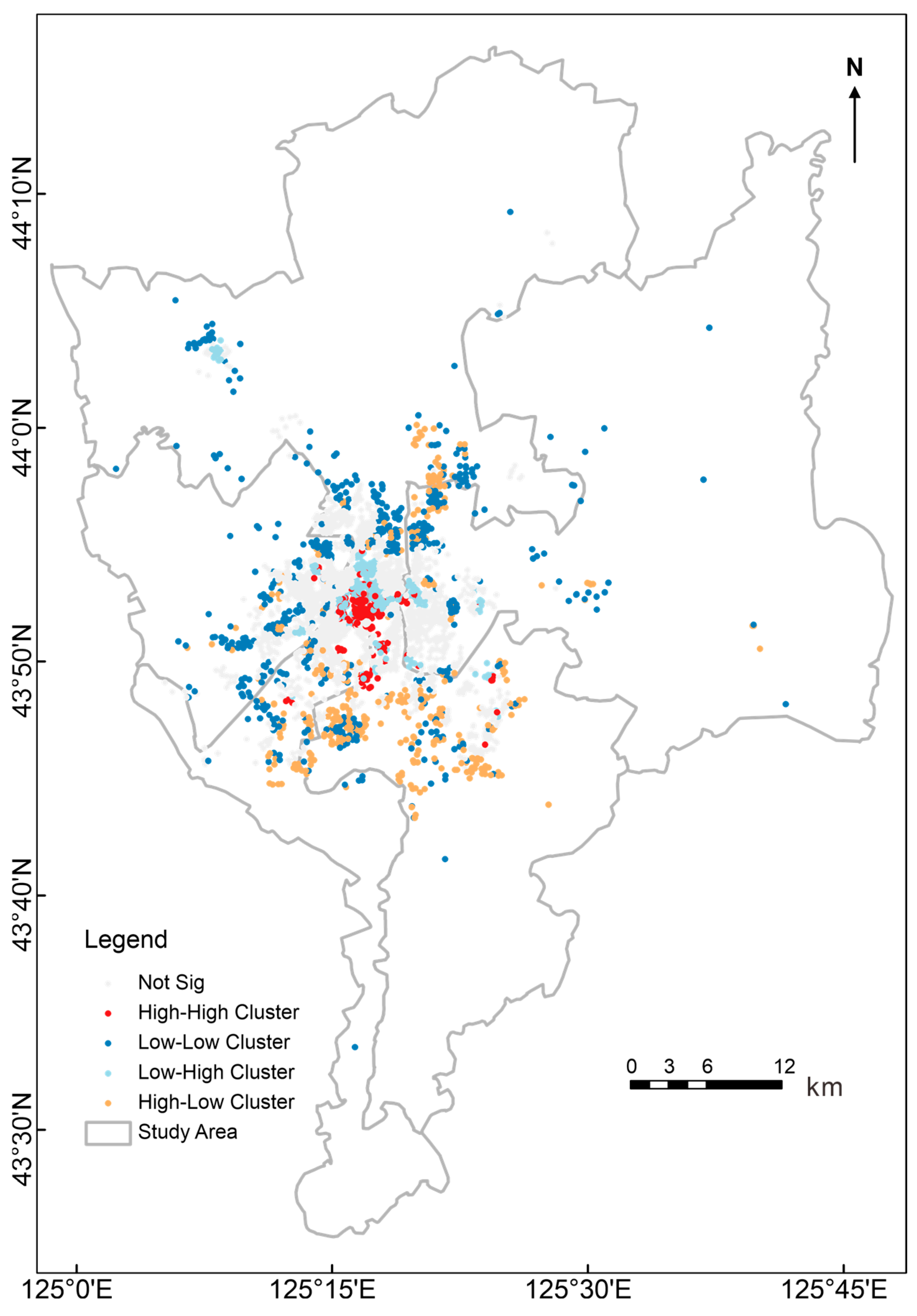
To diagnose the degree of spatial mismatch between the provision of public services and the valuation of residential assets, this study implemented a Bivariate Local Indicators of Spatial Association (LISA) analysis across 3590 residential units in the main urban area of Changchun. Following 999 permutations, the Global Bivariate Moran’s I was recorded at 0.0488 ( p   <   0.001 ). While technically positive, this near-zero correlation coefficient signifies a fundamental departure from the classical Alonso monocentric bid-rent model. In coordinated urban systems, accessibility to socialized reproduction services typically exhibits a high positive correlation with asset utility. However, in the main urban area of Changchun, this statistical state indicates a systemic restructuring of the urban value logic under the conditions of the structural-demographic divergence. This weak global correlation effectively obscures strong local structural heterogeneity, suggesting that the urban space has fragmented into distinct sectors following divergent value-generation logics [17,40].
The spatial distribution of the residential units reveals a complex mosaic of value-service relationships, illustrating the non-equilibrium nature of spatial production in this transitional city (Figure 4). Among the total sample, 1820 units exhibited statistically significant spatial clustering, providing empirical evidence of structural inequality. A total of 329 units, predominantly concentrated in the historical cores of Nanguan and Chaoyang, displayed high-high (HH) correlation patterns. In these domains, residential utility is functionally anchored by multi-dimensional service saturation, validating the historical efficiency of centralized resource allocation in mature urban cores [37]. Conversely, 498 units located in transition zones surrounding the core exhibited low-high (LH) correlation. Despite maintaining high levels of institutional accessibility, the residential valuation in these clusters remains suppressed. This value lag is attributed to the negative externalities of decaying legacy infrastructure and the depreciation of older work-unit community assets, confirming that in the absence of governance renewal, physical centrality alone is insufficient to maintain contemporary asset utility [41].
Additionally, 612 units characterized by low-low (LL) correlation were identified along industrial belts and at the urban periphery. These areas exhibit a combined disparity in both spatial utility and service accessibility, representing zones where spatial production and functional integration display a lack of immediate synchronization [42]. A notable finding involves 381 units exhibiting high-low (HL) correlation, identified as service-value misalignment zones. Concentrated in the southern extensions and the northern acceleration axis, these clusters indicate a deviation from the classical monocentric bid-rent model, where elevated asset valuations coexist with observed disparities in public service accessibility. This spatial configuration suggests that in expansion sectors, the logic of location-determined value has undergone a reconfiguration. The presence of these inversion zones points to a development pattern where asset appreciation precedes the integration of functional services, reflecting the characteristics of spatial organization at the micro-scale.

3.4. Nonlinear Attribution of Residential Value: Heterogeneity Deconstruction Based on XGBoost-SHAP

3.4.1. Model Performance and Algorithmic Robustness Verification

The Extreme Gradient Boosting (XGBoost) framework is implemented to resolve high-dimensional feature interactions and non-linear dynamics within the residential value structure of the main urban area of Changchun [18]. This tree-based approach effectively simulates the structural heterogeneity of spatial data, surmounting the constraints of conventional linear modeling [14]. The model demonstrates high predictive fidelity and robust generalization capability. R 2 values for the training and testing sets are 0.8416 and 0.7814, respectively, with a marginal discrepancy of 0.06 indicating minimal overfitting. Consistently low error metrics further validate the fit: the training phase recorded MAE = 0.0711, RMSE = 0.0904, and MAPE = 0.0080, while the testing phase achieved MAE = 0.0834, RMSE = 0.1070, and MAPE = 0.0094. This rigorous computational logic provides a reliable foundation for the SHAP framework to deconstruct urban asset valuation [18].

3.4.2. Global Feature Attribution: Paradigm Shift from Location Centrality to Governance Quality

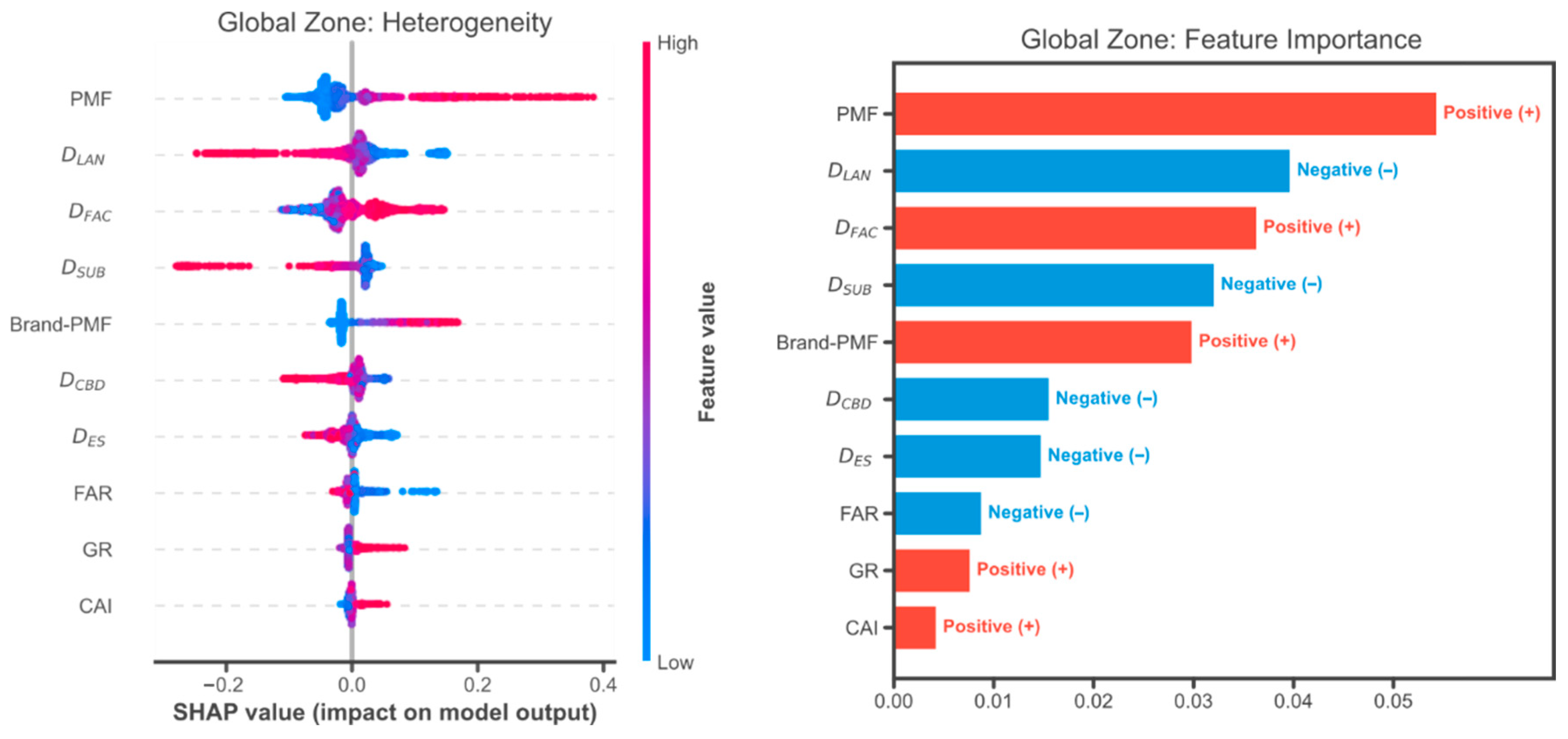
The global SHAP summary analysis reveals a profound structural reconfiguration of the value logic in the study area, transitioning from a model where location is the primary predictor of value toward one where localized governance quality (PMF) has the highest predictive influence. This shift reflects how housing price is valued not merely by their physical coordinates but by the quality of localized institutional guarantees provided by marketized actors [4].
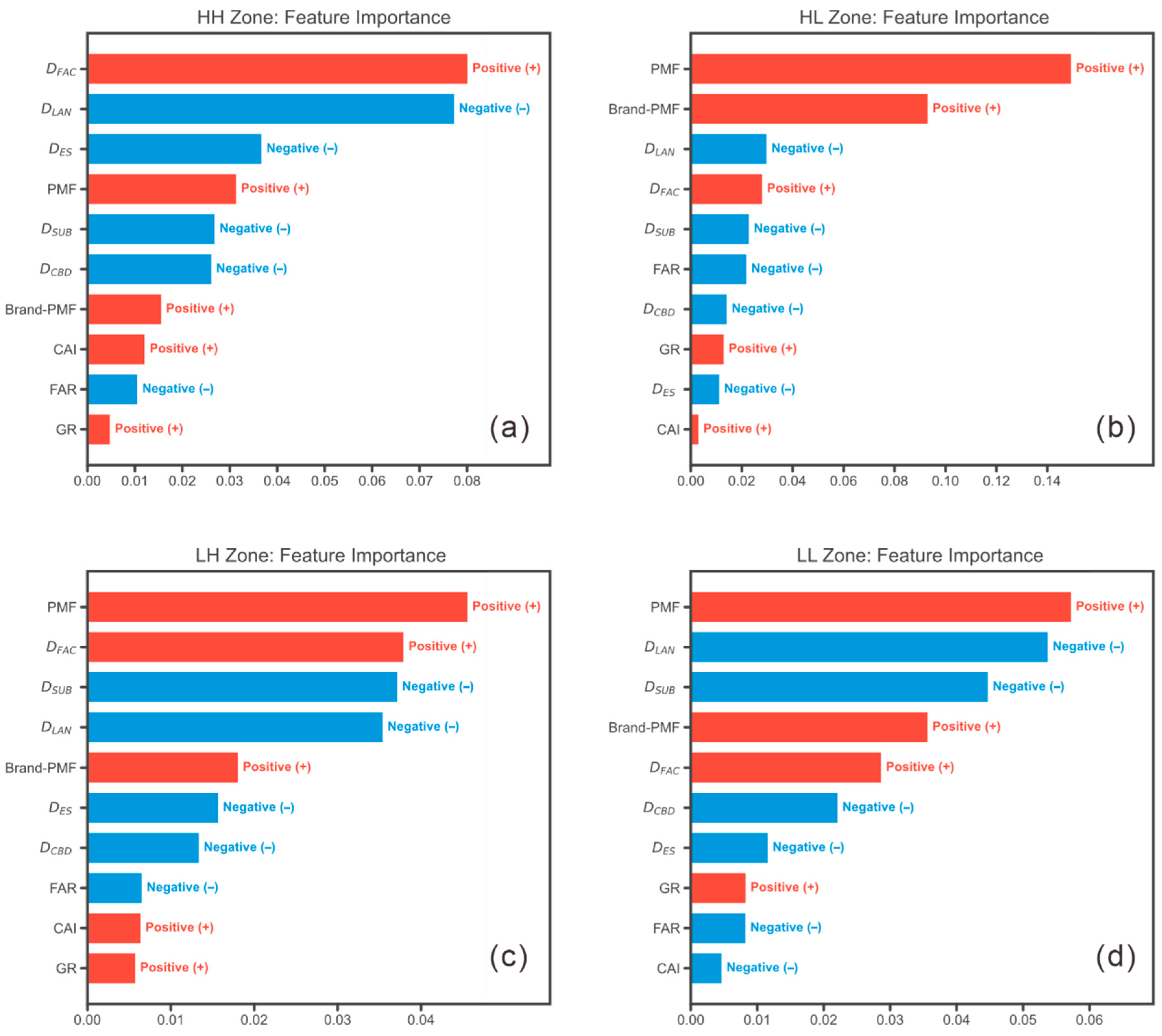
As detailed in Figure 5, among the ten features evaluated, the Property Management Fee ( P M F ) shows a high relative importance, exhibiting a positive marginal contribution to residential value. This observation suggests that residential asset valuation is associated with localized management services, especially in areas where regional service accessibility displays spatial variations [43]. The negative contribution of Distance to Landscape ( D L A N ) follows in importance, reflecting the premium associated with natural ecological features in an inland metropolitan context. Distance to Industry ( D F A C ) shows a positive effect, indicating a spatial preference regarding the avoidance of industrial externalities.
Subway proximity ( D S U B ) remains a fundamental principle of transit-oriented development, exerting a consistent negative contribution to price—meaning proximity increases value. The positive premium associated with the Brand-PMF interaction term further reinforces the club good characteristic of combined developer reputation and governance quality. Notably, the relative displacement of variables such as distance to the CBD ( D C B D ) and proximity to elite schools ( D E S ) suggests a dilution of monocentric advantages [44]. Regarding internal property attributes, the Floor Area Ratio (FAR) imposes a significant negative constraint on value, while the Greening Rate (GR) provides a stable positive ecological gain. Most significantly, while the Comprehensive Accessibility Index (CAI) yields a positive impact globally, its explanatory power is diluted by highly fragmented governance factors and the compensatory role of localized management services.

3.4.3. Spatial Heterogeneity in Attribution: Deconstructing the Structural-Demographic Divergence

A comparison of the spatial clusters identified via Bivariate LISA analysis shows variations in the patterns of residential value, illustrating the spatial characteristics of the urban transition (Figure 6). In the High-High (HH) Zone, which corresponds to the historical core, residential value is associated with the existing functional density and established service capacity. The positive association with industrial distance ( D F A C ) is a notable feature, followed by the negative correlation with landscape distance ( D L A N ) and the proximity to educational facilities ( D E S ), reflecting the relationship between value and environmental or service proximity in mature districts. PMF also exhibits explanatory relevance, followed by subway proximity ( D S U B ) and CBD proximity ( D C B D ), which align with spatial concentration patterns. The B r a n d P M F interaction and C A I contribute positive marginal effects, while internal FAR and GR provide the remaining marginal influences. These results indicate that in the established urban core, value is linked to the long-term presence of regional service resources.
In the High-Low (HL) Zone, an institutional compensatory logic prevails where P M F emerges as the paramount driver of residential value, surpassing all physical locational variables. The B r a n d P M F interaction and D L A N operate in synergy to anchor the utility of private governance domains [13]. While D F A C and D S U B exert significant secondary influences—reflecting the strategic avoidance of industrial externalities and a critical dependency on transit lifelines—the marginal effects of F A R and D C B D follow in hierarchical importance. Notably, the positive contribution of internal G R exceeds that of D E S , as educational facilities remains immature in these developing sectors. Finally, the C A I demonstrates the lowest significance, empirically confirming the functional deficiencies inherent in infrastructure-led spatial production [45].
In the Low-High (LH) Zone, the legacy of the traditional work-unit system dominates the attribution landscape. P M F remains the primary factor, followed by the negative externalities of industrial proximity ( D F A C ). Subway proximity ( D S U B ) and landscape distance ( D L A N ) also exert high marginal contributions, reflecting the sensitivity of these mature communities to infrastructure upgrades. The B r a n d P M F interaction, D E S , and D C B D collectively maintain the value floor, while F A R , C A I , and G R provide only marginal influence, confirming that physical accessibility alone struggles to reverse the utility suppression of aging assets. Finally, the Low-Low (LL) Zone illustrates a specific spatial configuration where a divergence between landscape expansion and demographic trends is observed. P M F and D L A N serve as the primary engines for value premium, with subway proximity ( D S U B ) acting as a critical lifeline. Contributions from B r a n d P M F , D F A C , D C B D , and D E S follow in decreasing order, while internal G R and F A R have negligible impact. Critically, the C A I exhibits a negative marginal effect in this zone. This finding suggests that at the urban fringe, the indiscriminate allocation of low-quality physical facilities is perceived by the market as a governance inefficiency or developmental redundancy, thereby actively suppressing residential value.

3.4.4. Micro-Scale Deconstruction of Residential Value Generation Across Distinct Spatial Configurations

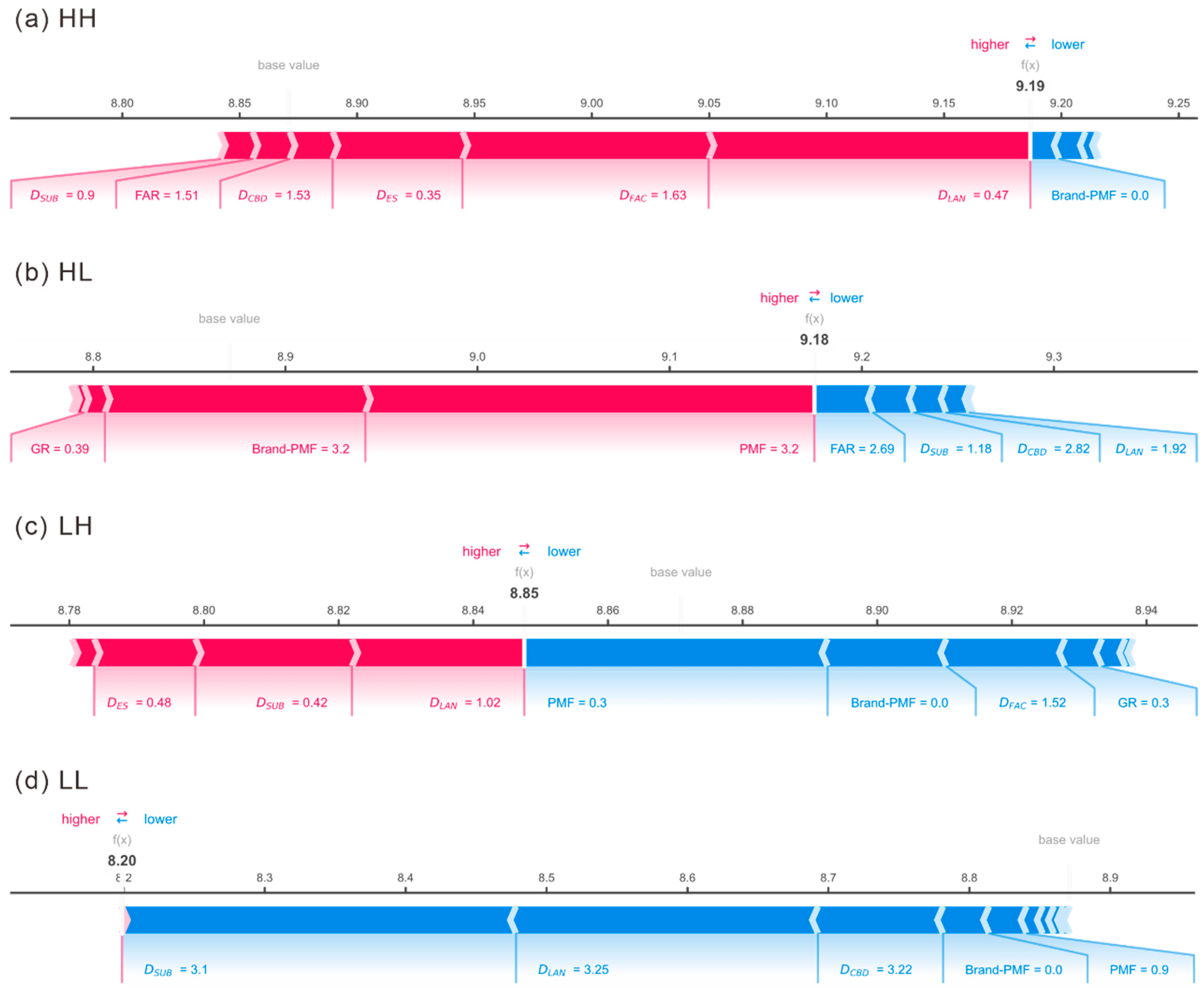
To provide granular evidence for the spatial non-stationarity identified in the previous sections, this study utilizes SHapley Additive exPlanations (SHAP) force plots to deconstruct the value generation mechanisms of representative residential samples across distinct spatial configurations (Figure 7). These visualizations elucidate the high-dimensional feature attributions that shift the predicted asset value from the global base value of 8.87 toward the final estimation f ( x ) . In the High-High (HH) spatial cluster, which represents the mature urban core, the predicted valuation of 9.19 is anchored by profound functional dependency and institutional resilience. The dominant positive contributions of landscape proximity ( D L A N = 0.47 ), elite school accessibility ( D E S = 0.35 ), and central place efficiency ( D C B D = 1.53 ) reinforce a value logic dictated by historical resource accumulation [37]. Within this domain, spatial utility is strictly aligned with the classical monocentric bid-rent model, where physical centrality and public service saturation function as the primary determinants of asset premiums.
In the High-Low (HL) spatial cluster, a pattern is observed where localized service features correspond with the spatial configuration of regional resources, allowing for elevated asset valuations (9.18) to coexist with variations in service accessibility. In these areas, the variables associated with residential value transition from traditional locational factors to localized management characteristics, with property management fees ( P M F = 3.2 ) and the brand-service premium ( B r a n d P M F = 3.2 ) showing a positive association that correlates with the specific conditions of peripheral infrastructure [46]. This relationship indicates that in expansion zones defined by contemporary spatial patterns, localized management functions as a functional complement to regional service frameworks by providing distinct micro-environments, such as internal landscaping ( G R = 0.39 ).
In contrast, residential units within the Low-High (LH) spatial cluster reveal a systematic utility suppression where aging work-unit assets struggle to translate physical centrality into contemporary value (8.85). Despite maintaining favorable proximity to elite schools ( D E S = 0.48 ) and transit lifelines ( D S U B = 0.42 ), the final valuation is severely constrained by the negative externalities of industrial proximity ( D F A C = 1.52 ) and the absence of high-standard localized management services ( P M F = 0.3 ) [41]. This reflects a functional lag in legacy urban fabrics, where physical accessibility alone is insufficient to reverse the utility suppression of decaying infrastructure. Finally, the Low-Low (LL) spatial cluster is characterized by lower levels of functional connectivity and associated valuation intervals. In this representative sample, the predicted value plummets to 8.20, driven by the combined inhibitory effects of extreme distance to the CBD ( D C B D = 3.22 ), transit isolation ( D S U B = 3.1 ), and landscape scarcity ( D L A N = 3.25 ). The observed lower levels of both regional service resources and localized management ( P M F = 0.9 ) indicate the presence of functional voids at the urban periphery, where the built environment exhibits a lack of immediate synchronization with service integration [27].

3.4.5. Synergistic Governance Effects: Evidence from SHAP Interaction Analysis

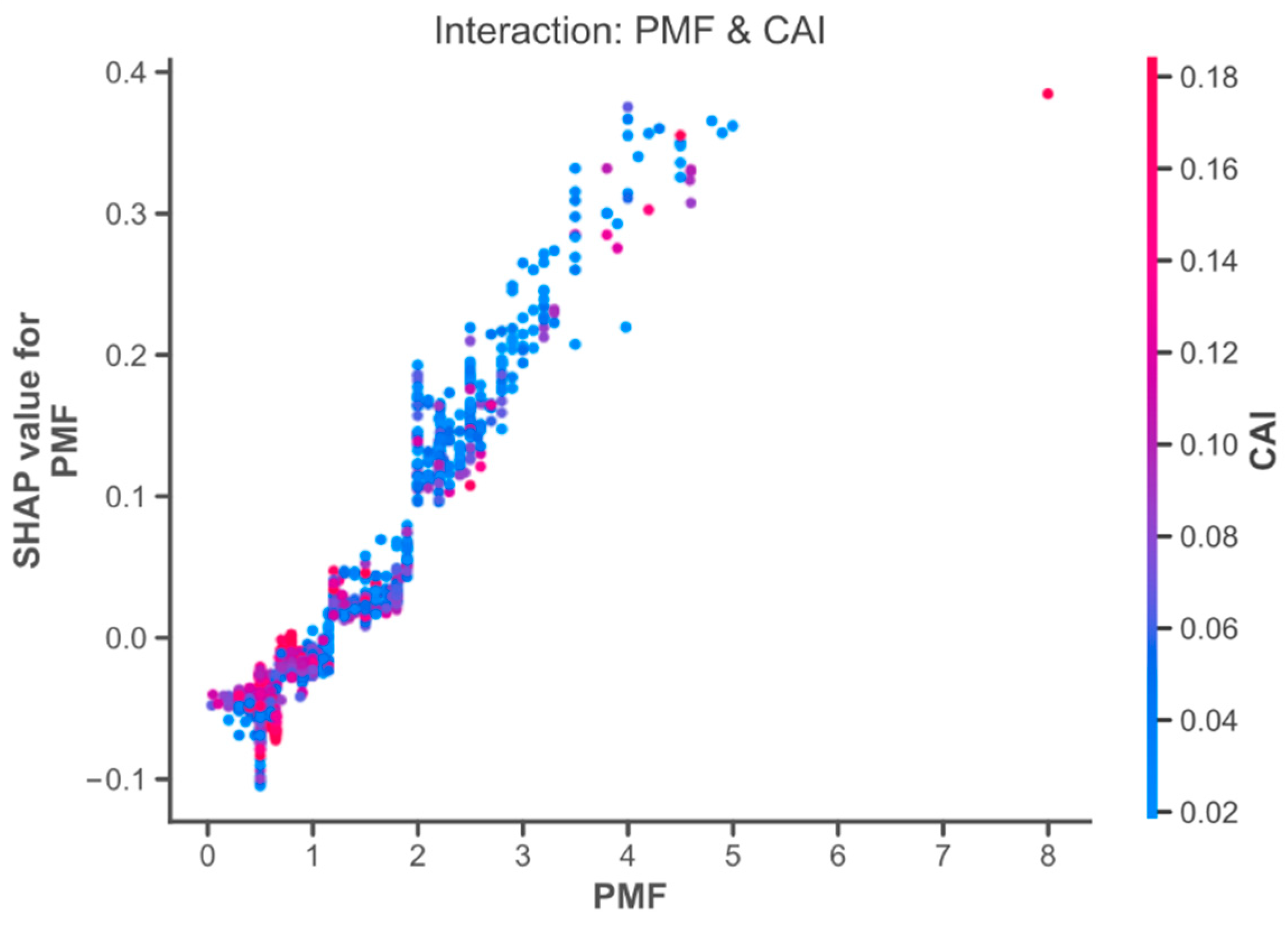
To further deconstruct how marketized club goods reshape the logic of urban asset valuation, this study utilizes SHAP interaction values to reveal the nonlinear coupling between property management levels (PMF) and public institutional services (CAI) (Figure 8). A negative interaction effect is observed between PMF and the CAI. In regions characterized by low CAI values, the positive marginal contribution of high-standard property management to residential value is significantly amplified. This relationship suggests that localized management features exhibit a degree of functional complementarity with regional service provision, allowing residential assets to maintain utility within peripheral areas showing varying functional configurations.

4. Discussion

4.1. Development Governance and the Economic Logic of Decoupled Physical Expansion

The empirical evidence presented in this study, particularly the extreme land expansion elasticity of 15.90 recorded between 2015 and 2020, provides a definitive characterization of the structural-demographic divergence within the context of Northeast China’s urban transition. This degree of asymmetric decoupling—where physical expansion proceeds independently of demographic trajectories—diverges fundamentally from the market-led suburbanization patterns observed in North America and Western Europe. In those market-liberal contexts, sprawl is typically driven by consumer preference for low-density living and localized capital flows [47]. In contrast, the spatial evolution of the main urban area of Changchun represents a paradigmatic case of decoupled physical expansion and systematic spatial organization.
Within this framework, land conversion is utilized as a primary spatial catalyst within a coordinated development trajectory [48]. The 2016 development of the Changchun New Area coincided with a phase of accelerated land conversion and the systematic deployment of urban space, aligning with broader regional development patterns. By utilizing coordinated capital frameworks to integrate infrastructure, the development process demonstrates a specific temporal sequence. This infrastructure-centric transition results in a spatial mismatch: the production of the urban shell exhibits a specific trajectory while demographic growth remains stable. This indicates that in certain transitional settings, spatial production follows a pattern where the establishment of physical environments precedes the integration of social functions [49].

4.2. Asynchronous Urbanization: Transitional Development Divergence and Policy-Supported Resilience

The dynamics observed in the main urban area of Changchun exhibit a distinct trajectory compared to the discourse on shrinking cities in post-socialist Eastern Europe and Russia. In regions such as Vorkuta or industrial centers in Eastern Germany, demographic changes have historically corresponded with physical contraction or the perforation of the urban fabric [50]. In contrast, the main urban area of Changchun demonstrates a pattern where population stability coexists with extensive spatial expansion. This divergence indicates that certain development models facilitate spatial continuity through systematic expansion despite demographic stabilization [51].
This phenomenon can be described as asynchronous urbanism, where infrastructure precedes the integration of social inhabitation [52]. The observed morphological equalization—the city’s transition toward a near-perfect geometric circle (SDE axis ratio dropping to 1.09 by 2024)—further illustrates a systematic directional expansion. Unlike the irregular sprawl patterns often associated with market-oriented systems, the growth in Changchun exhibits high geometric regularity. This geometric symmetry coexists with a functional asynchrony, where the establishment of physical frameworks occurs ahead of the integration of corresponding social functions, reflecting specific characteristics in the evolution of the built environment [53].

4.3. Service-Value Misalignment and the Imbalance of Social Reproduction

The identification of service-value misalignment zones (HL clusters) represents a systemic disruption of classical urban economic assumptions. In coordinated urban systems, accessibility to social service resources typically correlates positively with land rent, as posited by the Alonso-Muth-Mills model. However, in the main urban area of Changchun’s peripheral expansion zones, high housing prices coexist with profound deficits in public service accessibility. This spatial mismatch is not merely about employment access but is increasingly defined by a disconnect from essential social wage goods such as education, healthcare, and municipal green infrastructure [54]. This phenomenon unveils a distinctive causal inversion within urban expansion, where asset pricing precedes service integration and serves as a precursor for spatial production. This aligns with speculative development patterns where urban governance is reframed as an investment strategy; institutional actors anchor capital through the visual projection of large-scale infrastructure plans before social functions are fully matured [55]. Within development axes like the Changchun New Area, rising house prices represent a forward-looking capitalization of future infrastructure planning rather than a market reaction to existing service density [56].
This inversion relates to the temporal sequence observed in the urban expansion process. In these development sectors, the deployment of physical infrastructure, including transportation networks and utilities, precedes the integration of social service facilities, resulting in a temporal gap [57]. This creates a transitional geography where asset value is associated with projected spatial configurations rather than immediate functional utility. This temporal gap was significantly widened by the COVID-19 pandemic, which acted as a structural shock to speculative construction. The pandemic induced labor shortages and capital liquidity constraints—reinforced by macro-prudential policies like the “Three Red Lines”—effectively stalling the delivery of municipal social software. In this context of heightened uncertainty, the market logic shifted: while asset value remains anchored in speculative blueprints, the marginal importance of Property Management Fees (PMF) increased as a risk-hedging tool. High-quality private governance serves as a necessary resilience bridge, providing immediate functional substitutes that allow residents to endure the extended functional lag of municipal promises [58]. Furthermore, the circumferential distribution of the second-lowest accessibility quintile (Q2) zones reveals a failure to universalize the 15 min city concept. Residents in these areas must endure a transitional functional lag, where the physical container of the city is complete, but the functional components of social reproduction remain absent [59].

4.4. The Rise of the Club Realm and Governance Substitution

A notable implication of this research involves the quantified shift in urban value determinants from geographical proximity to management characteristics. The XGBoost-SHAP analysis demonstrates that Property Management Fees (PMF) have eclipsed traditional locational variables (such as distance to the CBD) as the primary predictor of residential value in expansion zones. The micro-scale evidence from Force Plots confirms that the club realm is not merely a theoretical construct but a functional reality in the main urban area of Changchun’s peripheral expansion. As seen in the HL cluster samples, the positive push from P M F and B r a n d P M F effectively offsets the negative pull of extreme distance to the CBD. This relationship illustrates that localized management services are associated with asset utility in sectors where regional service density is lower. These findings provide empirical context for models where residential utility is linked to localized service structures [60]. This shift suggests a necessary deviation from the static AMM bid-rent logic toward McCann’s framework of modern urban economics, where institutional quality and social capital supersede physical centrality. In the identified HL clusters, the essential amenity is redefined by the social composition of the community itself—a private enclosure of high-value social networks. The concentration of influential people within these club realms functions as a forward-looking signal that triggers subsequent social and infrastructural investment [11]. Consequently, high PMF and brand premiums are not merely payments for current services; they represent a strategic bet on future resource commitments. By leveraging the presence of elite social groups to lock in future institutional support, these areas create a self-fulfilling prophecy of regional prosperity, validating their high valuations despite existing accessibility deficits [12].
The negative interaction effect between PMF and the Comprehensive Accessibility Index (CAI) confirms a substitution mechanism. In areas with lower CAI values, the marginal contribution of management levels to residential value is higher, as localized services correspond with the current phase of spatial expansion [13]. This indicates a framework where service integration occurs within residential developments. Consequently, the housing unit is transformed from a simple shelter into the access to localized service environments [61]. While this model is associated with maintaining asset utility, it highlights observations regarding the spatial distribution of service access within different management frameworks.

4.5. Epistemological Contributions of Non-Linear Urban Analytics

The methodological integration of XGBoost and SHAP interpretability offers a necessary corrective to the limitations of linear Hedonic Price Models (HPM) and Geographically Weighted Regression (GWR). Complex urban systems, particularly those in transition, are characterized by high heterogeneity and threshold effects that linear assumptions fail to capture [14]. By visualizing the spatial heterogeneity of feature importance, this study reveals the granular, localized logic of value creation. The integration of Force Plots facilitates the identification of critical thresholds in asset valuation that traditional models often obscure. For example, the valuation collapse (8.20) in the Low-Low (LL) spatial cluster demonstrates the cumulative suppression resulting from the synergy of transit isolation and service deficiency. This high-resolution lens further reveals institutional redundancy within the same cluster, where the indiscriminate allocation of low-quality facilities actively suppresses value [14]. This algorithmic paradigm shift facilitates the extraction of causal mechanisms from opaque models, advancing urban informatics beyond predictive analysis toward the empirical testing and refinement of critical urban theory [62]. This analytical structure provides a diagnostic method for identifying spatial variations in urban development, suggesting a transition in emphasis from the physical expansion of urban forms toward the functional integration of social systems and community environments [63].

5. Conclusions

This research provides a deconstructive analysis of the spatial evolution of Changchun, a representative industrial metropolis, revealing a profound structural-demographic divergence during its post-industrial transition.
First, the spatial structure remains heavily influenced by early twentieth-century radial planning and industrial zoning, exhibiting strong path dependency. However, the rapid shift in the urban center toward the north-northeast between 2015 and 2024, at a velocity of 0.51 km per year, marks a strategic effort to escape traditional industrial constraints and reshape the regional strategic center through the “Chang-Ji-Tu” strategy.
Second, Changchun demonstrates the asynchronous modernity prevalent in the Global East and post-socialist cities such as Lodz and Belgrade, where the production of physical space systematically precedes population movement. This reversed causality reflects a resilient expansion strategy in which old industrial cities utilize large-scale infrastructure layouts as tools to anchor spatial value, hedging against regional contraction risks through blueprint-based credit.
Third, the governance model has transitioned from the traditional work-unit system toward a localized club realm, where private management effectively fills the public service vacuum following the deconstruction of industrial frameworks. This process of clubbization enhances micro-level management efficiency by encapsulating landscape and security resources, transforming residential units into entry tickets for specific services and replacing traditional welfare distribution models in post-industrial voids.
Fourth, the service-value misalignment in peripheral zones proves that residential value growth stems from the anticipation of planning blueprints rather than immediate utility, which maintains quality of life while potentially leading to institutional redundancy and resource inequality between neighborhoods.
Finally, as an active laboratory for achieving resilient expansion through administrative planning and marketized governance amidst stable demographics, Changchun reveals a unique path for reconstructing the spatial logic of industrial cities in transition.
To address the structural-demographic divergence observed in transitioning industrial metropolises, urban governance must shift from a paradigm of physical expansion toward a framework of comprehensive functional integration. Policymakers should implement coordination protocols to ensure that the deployment of essential social services—particularly in healthcare and education—aligns with land development phases to prevent the formation of localized service-value misalignment clusters in the urban periphery. Furthermore, as the club realm increasingly functions as a critical compensatory mechanism for public resource deficits, strategic planning should guide these private governance frameworks to ensure they enhance community utility without facilitating social fragmentation or institutional redundancy. Future inquiries should therefore utilize longitudinal datasets to monitor the temporal alignment between physical construction and social maturation, while expanding the application of interpretable machine learning models like XGBoost-SHAP to diverse urban systems to better understand the long-term impacts of spatial production on social welfare.

Author Contributions

Conceptualization, W.Z. and J.W.; methodology, W.Z.; software, W.Z.; validation, W.Z. and J.W.; formal analysis, W.Z.; investigation, W.Z.; resources, W.Z.; data curation, W.Z.; writing—original draft preparation, W.Z.; writing—review and editing, J.W.; visualization, W.Z.; supervision, J.W. All authors have read and agreed to the published version of the manuscript.

Funding

This research received no external funding.

Data Availability Statement

The datasets supporting the findings of this research were acquired from several specialized geospatial repositories and commercial platforms. Land cover information was obtained from the China Land Cover Dataset (CLCD) (https://zenodo.org/records/18180184, accessed on 2 September 2025). Demographic data were sourced from WorldPop (https://www.worldpop.org/datacatalog/, accessed on 2 September 2025), while road network and public transport geometries were derived from OpenStreetMap (OSM) (https://www.openstreetmap.org, accessed on 1 September 2025) and Changchun Public Transport. Micro-scale residential metrics were gathered from the Beike (https://cc.ke.com/, accessed on 5 September 2025) and Anjuke (https://m.anjuke.com/cc/, accessed on 5 September 2025) platforms. Urban functional facilities (Points of Interest) were acquired from the Amap platform (https://lbs.amap.com/, accessed on 1 September 2025).

Acknowledgments

The authors are deeply grateful to the anonymous reviewers for their valuable and insightful suggestions.

Conflicts of Interest

The authors declare no conflicts of interest.

Appendix A

Table A1. Hierarchical Classification and Weighting Framework for Urban Public Service Facilities.
CategorySub-CategoryFacility TypeTime WindowWeightDemand Pop.
Food and Beverage Services-Major Restaurants15 min3Total
Fast Food/Pubs15 min2Total
Cafes/Tea Houses15 min1Total
Daily ShoppingShopping Malls and MarketsShopping Mall30 min10Total
Comprehensive Market30 min5Total
Retail and Convenience StoresSupermarket15 min4Total
Convenience Store15 min1Total
Basic Medical Services-Community Health Center15 min3Total
Clinic15 min2Total
Pharmacy15 min1Total
Tertiary Healthcare Services-Tertiary Grade A Hospital30 min5Total
Specialized Hospital30 min4Total
General Hospital30 min3Total
Basic EducationKindergarten FacilitiesProvincial/City Level15 min5Age: 3~6
District/Backbone15 min3Age: 3~6
Other15 min1Age: 3~6
Primary SchoolKey/Core School15 min3Age: 6~12
Ordinary/Basic15 min2Age: 6~12
Other15 min1Age: 6~12
Middle SchoolKey Middle School30 min8Age: 13~18
Ordinary Middle School30 min3Age: 13~18
Parks and Squares-Park15 minAreaTotal
Squares15 minAreaTotal
Leisure and Entertainment-KTV30 min2Total
Cinema30 min3Total
Gym/Museum30 min5Total
Public ServicesPostal ServicesBranch/Center15 min3Total
Service Station15 min2Total
Kiosk/Locker15 min1Total
Government Service CentersProvincial Center30 min20Total
Municipal Center30 min10Total
District Center30 min5Total
Street Office30 min2Total
Community Committee30 min1Total
Public ToiletsPublic Toilet15 min1Total
Public Security (Police)City/District Bureau30 min3Total
Police Station30 min2Total
Police Kiosk30 min1Total
Financial Services-ATM15 min1Total
Bank15 min3Total
Note: Commute durations of 30 min via public transit and 15 min via walking.
Table A2. Multi-Dimensional Indicators and Theoretical Significance for Housing Price Assessment.
DimensionVariable NameAbbrDefinition and MeasurementTheoretical Significance
Location and StrategyDistance to CBD D C B D Euclidean distance to Renmin Square (125.33° E, 43.89° N), the traditional administrative center.Evaluates the decay of traditional monocentric efficiency and the emergence of peripheral value highlands.
Distance to Subway D S U B Proximity to the nearest rapid transit station.Quantifies the Transit-Oriented Development premium and critical connectivity to the urban core.
Housing and Club GoodsProperty Management Fee P M F Monthly management fee per unit area ( R M B / m 2 · m o ).Core proxy for club goods; represents the replacement of collective services with market-based governance.
Brand Property Premium B r a n d P r o p e r t y Binary variable (1 = developed by top-tier firms like Vanke or China Overseas; 0 = others).Serves as a Credit Endorsement for the promise of high-quality market-based governance.
Greening Rate G R Ratio of vegetation cover within the residential community.Captures the premium for exclusionary, private ecological amenities.
Floor Area Ratio F A R Total building area relative to the plot area.Reflects the scarcity of low-density living environments; often inversely related to asset value.
Institutional and EducationalDistance to Elite School D E S Proximity to top-tier educational institutions.Quantifies the Locking Effect of scarce capital on asset value premiums.
Performance and ExternalitiesComprehensive Accessibility C A I Integrated score of 15 service types (medical, retail, etc.) via Gaussian 2SFCA and EWM.Quantifies the functional saturation of urban space and identifies service-value misalignment zones.
Distance to Landscape D L A N Proximity to major ecological anchors (e.g., Jingyuetan, South Lake, North Lake).Captures Ecological Gentrification and the capitalization of natural landscape rights.
Distance to Industry D F A C Distance to the nearest heavy industry or chemical plant.Reflects the avoidance of environmental externalities and industrial risks.

References

  1. Bai, X.; Shi, P. China’s urbanization at a turning point—Challenges and opportunities. Science 2025, 388, eadw3443. [Google Scholar] [CrossRef]
  2. Wang, X.; Hu, J.; Zhao, S.; Hu, R. Spatial relationship between population shrinkage and land development in northeast China. Front. Environ. Sci. 2025, 13, 1522999. [Google Scholar] [CrossRef]
  3. Harvey, D. From Managerialism to Entrepreneurialism: The Transformation in Urban Governance in Late Capitalism. Geogr. Ann. Ser. B Hum. Geogr. 1989, 71, 3–17. [Google Scholar]
  4. Wu, F.; Deng, H.; Feng, Y.; Wang, W.; Wang, Y.; Zhang, F. From entrepreneurial to managerial statecraft: New trends of urban governance transformation in post-pandemic China. Urban Stud. 2025, 62, 3092–3109. [Google Scholar] [CrossRef]
  5. Wu, F.; Deng, H.; Feng, Y.; Wang, W.; Wang, Y.; Zhang, F. Statecraft at the frontier of capitalism: A grounded view from China. Prog. Hum. Geogr. 2024, 48, 779–804. [Google Scholar] [CrossRef]
  6. Liu, Y. Competing Visions of the Modern: Urban Transformation and Social Change of Changchun, 1932–1957. Ph.D. Thesis, University of California, Berkeley, CA, USA, 2011. [Google Scholar]
  7. Han, R.; Liu, D.; Zhu, G.; Li, L. A Comparative Study on Planning Patterns of Industrial Bases in Northeast China Based on Spatial Syntax. Sustainability 2022, 14, 1041. [Google Scholar] [CrossRef]
  8. Zhu, J.; Tu, Y.; Zhu, J. Institution-driven urban sprawl in China: Evidence from Wuhan. Cities 2024, 148, 104899. [Google Scholar] [CrossRef]
  9. Wang, K.; Dang, X.; Bai, J.; Hua, J.; Tian, G. The relationship between urban land expansion and spatiotemporal dynamics of SDG 11.7: Evidence from Xi’an, China. Environ. Dev. Sustain. 2025. [Google Scholar] [CrossRef]
  10. McDonald, J.F. William Alonso, Richard Muth, Resources for the Future, and the Founding of Urban Economics. J. Hist. Econ. Thought 2007, 29, 67–84. [Google Scholar] [CrossRef]
  11. McCann, P. Modern Urban and Regional Economics, 2nd ed.; Oxford University Press: Oxford, UK, 2013. [Google Scholar]
  12. Roskruge, M.; Grimes, A.; McCann, P.; Poot, J. Social Capital and Regional Social Infrastructure Investment: Evidence from New Zealand. Int. Reg. Sci. Rev. 2012, 35, 3–25. [Google Scholar]
  13. Woo, Y.; Webster, C. Co-evolution of gated communities and local public goods. Urban Stud. 2014, 51, 2539–2554. [Google Scholar] [CrossRef]
  14. Chen, Y.; Ye, Y.; Liu, X.; Yin, C.; Jones, C.A. Examining the nonlinear and spatial heterogeneity of housing prices in urban Beijing: An application of GeoShapley. Habitat Int. 2025, 162, 103439. [Google Scholar] [CrossRef]
  15. Feng, Y.; Wang, X.; Du, W.; Liu, J.; Li, Y. Spatiotemporal characteristics and driving forces of urban sprawl in China during 2003–2017. J. Clean. Prod. 2019, 241, 118061. [Google Scholar] [CrossRef]
  16. Huang, Y.; Wu, W.; Shen, Z.; Zhu, J.; Chen, H. Beyond Proximity: Assessing Social Equity in Park Accessibility for Older Adults Using an Improved Gaussian 2SFCA Method. Land 2025, 14, 2102. [Google Scholar] [CrossRef]
  17. Cortés, Y. Spatial Accessibility to Local Public Services in an Unequal Place: An Analysis from Patterns of Residential Segregation in the Metropolitan Area of Santiago, Chile. Sustainability 2021, 13, 442. [Google Scholar] [CrossRef]
  18. Li, Z. Extracting spatial effects from machine learning model using local interpretation method: An example of SHAP and XGBoost. Comput. Environ. Urban Syst. 2022, 96, 101845. [Google Scholar] [CrossRef]
  19. Yang, J.; Huang, X. The 30 m Annual Land Cover Datasets and Its Dynamics in China from 1985 to 2025; Zenodo: Geneva, Switzerland, 2026. [Google Scholar]
  20. Sutton, P.C. A scale-adjusted measure of ‘Urban sprawl’ using nighttime satellite imagery. Remote Sens. Environ. 2003, 86, 353–369. [Google Scholar] [CrossRef]
  21. Lefever, D.W. Measuring Geographic Concentration by Means of the Standard Deviational Ellipse. Am. J. Sociol. 1926, 32, 88–94. [Google Scholar] [CrossRef]
  22. Gong, J. Clarifying the Standard Deviational Ellipse. Geogr. Anal. 2002, 34, 155–167. [Google Scholar] [CrossRef]
  23. Chen, X.; Jia, P. A comparative analysis of accessibility measures by the two-step floating catchment area (2SFCA) method. Int. J. Geogr. Inf. Sci. 2019, 33, 1739–1758. [Google Scholar] [CrossRef]
  24. GB50180-2018; Standard for Urban Residential Area Planning and Design. China Architecture & Building Press: Beijing, China, 2018.
  25. Song, G.; He, X.; Kong, Y.; Li, K.; Song, H.; Zhai, S.; Luo, J. Improving the Spatial Accessibility of Community-Level Healthcare Service toward the ‘15-Minute City’ Goal in China. ISPRS Int. J. Geo-Inf. 2022, 11, 436. [Google Scholar] [CrossRef]
  26. Pereira, R.H.M.; Saraiva, M.; Herszenhut, D.; Braga, C.K.V.; Conway, M.W. r5r: Rapid Realistic Routing on Multimodal Transport Networks with R5 in R. Findings 2021. [Google Scholar] [CrossRef]
  27. Sun, Y.; Jiao, L.; Guo, Y.; Xu, Z. Recognizing urban shrinkage and growth patterns from a global perspective. Appl. Geogr. 2024, 166, 103247. [Google Scholar] [CrossRef]
  28. Li, Y.; Chen, W.; Wu, F. Building Chinese city-regions under state entrepreneurialism. Territ. Polit. Gov. 2025, 13, 505–522. [Google Scholar] [CrossRef]
  29. Yang, C.; Zhang, X.; Zhu, Y.; Sun, Y. The Impact of Three Red Lines Policy on Chinas Real Estate Industry. Adv. Econ. Manag. Polit. Sci. 2023, 7, 335–342. [Google Scholar] [CrossRef]
  30. Sheng, Y. The Development Path for Real Estate of China During the Normalization of the COVID-19. BCP Bus. Manag. 2023, 38, 491–498. [Google Scholar] [CrossRef]
  31. Yue, F.; Hu, C.; Chen, S.; Zeng, H. Identification and tracking of heat and cold cores in highly urbanized areas: Spatiotemporal characteristics and evolutionary patterns. Int. J. Digit. Earth 2026, 19, 2616889. [Google Scholar] [CrossRef]
  32. Li, X.; Gu, B.; Zhao, H.; Tu, T.; Zhu, Z. Urban shrinkage morphology: A quantitative classifying framework using deep learning. Cities 2025, 162, 105956. [Google Scholar] [CrossRef]
  33. Jin, Y.; Shin, H.B. Revisiting urban governance in China: The manifestation of entrepreneurial neo-managerialism in shantytown redevelopment in Luzhou. Urban Stud. 2025, 62, 2136–2153. [Google Scholar] [CrossRef]
  34. Chen, X.; Lang, W.; Yuan, Y.; Yan, G.; Hou, X. Conceptualizing the nexus between spatiotemporal shrinkage patterns of natural cities and driving mechanisms: Insights into urban shrinkage in Northeast China. Cities 2024, 152, 105179. [Google Scholar] [CrossRef]
  35. Wang, Y.; Pan, P.; Pu, L. Measuring Location Dominance Based on Public Service Accessibility: Case Study of Shijiazhuang, China. Land 2025, 14, 830. [Google Scholar] [CrossRef]
  36. Zhang, C.; Chai, Y. Un-gated and integrated Work Unit communities in post-socialist urban China: A case study from Beijing. Habitat Int. 2014, 43, 79–89. [Google Scholar] [CrossRef]
  37. Li, H.; Wang, Q.; Shi, W.; Deng, Z.; Wang, H. Residential clustering and spatial access to public services in Shanghai. Habitat Int. 2015, 46, 119–129. [Google Scholar] [CrossRef]
  38. Li, S.; Zhao, P. Examining commuting disparities across different types of new towns and different income groups: Evidence from Beijing, China. Habitat Int. 2022, 124, 102558. [Google Scholar] [CrossRef]
  39. Yin, G.; Liu, Y.; Chen, Y. ‘Ghost city’ or habitable city? The production and transformation of space in China’s new towns. Cities 2024, 145, 104678. [Google Scholar] [CrossRef]
  40. Anselin, L. Local Indicators of Spatial Association—LISA. Geogr. Anal. 1995, 27, 93–115. [Google Scholar] [CrossRef]
  41. Wen, H.; Jin, Y.; Zhang, L. Spatial heterogeneity in implicit housing prices: Evidence from Hangzhou, China. Int. J. Strateg. Prop. Manag. 2017, 21, 15–28. [Google Scholar] [CrossRef]
  42. Wu, F.; Zhang, F. Rethinking China’s urban governance: The role of the state in neighbourhoods, cities and regions. Prog. Hum. Geogr. 2022, 46, 775–797. [Google Scholar] [CrossRef]
  43. Wu, X.; Li, H. Gated Communities and Market-Dominated Governance in Urban China. J. Urban Plan. Dev. 2020, 146, 04020025. [Google Scholar] [CrossRef]
  44. Han, J.; Woo, A.; Lee, S. Effects of neighborhood streetscape on the single-family housing price: Focusing on nonlinear and interaction effects using interpretable machine learning. PLoS ONE 2025, 20, e0323495. [Google Scholar] [CrossRef]
  45. Wu, Y.; Li, X.; Lin, G.C.S. Reproducing the city of the spectacle: Mega-events, local debts, and infrastructure-led urbanization in China. Cities 2016, 53, 51–60. [Google Scholar] [CrossRef]
  46. Lu, T.; Zhang, F.; Wu, F. The Meaning of ‘Private Governance’ in Urban China: Researching Residents’ Preferences and Satisfaction. Urban Policy Res. 2019, 37, 378–392. [Google Scholar] [CrossRef]
  47. Liu, L.; Meng, L. Patterns of Urban Sprawl from a Global Perspective. J. Urban Plan. Dev. 2020, 146, 04020004. [Google Scholar] [CrossRef]
  48. Wu, F. Land financialisation and the financing of urban development in China. Land Use Policy 2022, 112, 104412. [Google Scholar] [CrossRef]
  49. Lin, G.C.S. Chinese Urbanism in Question: State, Society, and the Reproduction of Urban Spaces. Urban Geogr. 2007, 28, 7–29. [Google Scholar] [CrossRef]
  50. Sandu, A. The post-socialist cities from Central and Eastern Europe: Between spatial growth and demographic decline. Urban Stud. 2024, 61, 821–837. [Google Scholar] [CrossRef]
  51. Batunova, E.; Gunko, M. Urban shrinkage: An unspoken challenge of spatial planning in Russian small and medium-sized cities. Eur. Plan. Stud. 2018, 26, 1580–1597. [Google Scholar] [CrossRef]
  52. Sorace, C.; Hurst, W. China’s Phantom Urbanisation and the Pathology of Ghost Cities. J. Contemp. Asia 2016, 46, 304–322. [Google Scholar] [CrossRef]
  53. Chu, Y. China’s new urbanization plan: Progress and structural constraints. Cities 2020, 103, 102736. [Google Scholar] [CrossRef]
  54. Xiao, Y.; Wen, H.; Wang, S. Measuring spatial mismatch in education capitalization via the housing market: An empirical study based on geographically weighted regression and Geodetector. Appl. Geogr. 2025, 182, 103716. [Google Scholar] [CrossRef]
  55. Goldman, M. Speculative Urbanism and the Making of the Next World City: Speculative urbanism in Bangalore. Int. J. Urban Reg. Res. 2011, 35, 555–581. [Google Scholar] [CrossRef]
  56. Vegliò, S.; Silver, J.; Pollio, A.; Governa, F.; Apostolopoulou, E. A dialogue on global infrastructure-led urbanization: Concepts and reorientations. Dialogues Hum. Geogr. 2025, 20438206251321093. [Google Scholar] [CrossRef]
  57. Apostolopoulou, E. Tracing the Links between Infrastructure-Led Development, Urban Transformation, and Inequality in China’s Belt and Road Initiative. Antipode 2021, 53, 831–858. [Google Scholar] [CrossRef]
  58. Li, Y. The Impact of COVID-19 on China’s Real Estate Industry and the Outlook for Industry Trends. BCP Bus. Manag. 2022, 34, 337–343. [Google Scholar] [CrossRef]
  59. Chen, H.; Zheng, Y.; Xing, J.; Zhou, C. Urban planning priorities analysis based on urban heat risk supply—demand mismatch: A case study of Hangzhou, China. Sustain. Cities Soc. 2025, 130, 106502. [Google Scholar] [CrossRef]
  60. Warner, M.E. Club Goods and Local Government: Questions for Planners. J. Am. Plann. Assoc. 2011, 77, 155–166. [Google Scholar] [CrossRef]
  61. Chen, S.C.Y.; Webster, C.J. Homeowners Associations, Collective Action and the Costs of Private Governance. Hous. Stud. 2005, 20, 205–220. [Google Scholar] [CrossRef]
  62. Kee, T.; Ho, W.K.O. eXplainable Machine Learning for Real Estate: XGBoost and Shapley Values in Price Prediction. Civ. Eng. J. 2025, 11, 2116–2133. [Google Scholar] [CrossRef]
  63. Shangguan, Z. An Explainable Machine-Learning Framework Based on XGBoost–SHAP and Big Data for Revealing the Socioeconomic Drivers of Population Urbanization in China. Systems 2025, 13, 679. [Google Scholar] [CrossRef]
Figure 1. Spatiotemporal Migration Trajectory of Built-up Land Gravity Center: (a) Detailed migration path of the gravity center from 2000 to 2024 relative to the urban expressway network; (b) Geographic location of the study area in Northeast China (red line); (c) Quantitative coordinate shifts of the gravity center.
Land 15 00446 g001
Figure 2. Spatio-temporal evolution and directional anisotropy of urban construction land ellipses: (a) Morphological orientation and center of gravity shifts from 2000 to 2010; (b) Ellipsoidal expansion and structural transition from 2010 to 2020; (c) Phase of morphological equalization and geometric stabilization from 2020 to 2024.
Land 15 00446 g002
Figure 3. Frequency distribution and spatial configuration of the Comprehensive Accessibility Index (CAI).
Land 15 00446 g003
Figure 4. Bivariate LISA cluster map between housing price (X) and comprehensive accessibility (Y).
Land 15 00446 g004
Figure 5. Global SHAP summary plot of residential value determinants.
Land 15 00446 g005
Figure 6. SHAP summary plots of residential value determinants across local spatial clusters: (a) Feature importance in the High-High (HH) zone; (b) Feature importance in the High-Low (HL) zone; (c) Feature importance in the Low-High (LH) zone; (d) Feature importance in the Low-Low (LL) zone.
Land 15 00446 g006
Figure 7. Decomposition of residential value determinants for representative samples across spatial clusters through SHAP force plots.
Land 15 00446 g007
Figure 8. SHAP interaction plot illustrating the compensatory relationship between private governance (PMF) and the Comprehensive Accessibility Index (CAI).
Land 15 00446 g008
Table 1. Statistical analysis of built-up land expansion and population growth.
Indicators200020052010201520202024
Built-up land area ( k m 2 )189.59238.43299.16382.08610.61694.42
Land expansion rate (%)——25.7625.4727.7259.8113.73
Resident population ( 10 4 persons)308.98320.48332.50344.94357.90368.30
Population growth rate (%)——3.723.753.743.762.91
Elasticity of land expansion relative to population growth——6.926.797.4115.904.71
Adjusted Sprawl Index ( S I a d j )——5.005.205.597.375.15
Note: Elasticity of land expansion relative to population growth is calculated as the ratio of the land expansion rate to the population growth rate: E l a s t i c i t y   =   G r o w t h _ R a t e l a n d G r o w t h _ R a t e p o p u l a t i o n .
Table 2. Kinematic parameters of urban morphological evolution.
Time IntervalBearing (Direction)Shift Distance (km)Shift Velocity (km/year)SDE Axis Ratio Δ S I a d j
2000–2005SSE ( 164.9 )1.490.301.24-
2005–2010ESE ( 114.4 )0.790.162.13+0.20
2010–2015NNE ( 17.4 )0.300.061.54+0.40
2015–2020NNE ( 10.4 )2.530.511.76+1.78
2020–2024NNE ( 17.4 )0.910.231.09−2.22
Table 3. Weighting scheme of urban public service indicators based on the Entropy Weight Method.
Facility (Variables)Weight
Parks and Squares0.184
Postal Services0.156
Public Toilets0.106
Kindergarten Facilities0.078
Primary Schools0.077
Financial Services0.062
Public Security (Police)0.048
Middle Schools0.047
Government Service Centers0.042
Tertiary Healthcare Services0.041
Food and Beverage Services0.040
Leisure and Entertainment0.035
Basic Medical Services0.032
Retail and Convenience Stores0.031
Shopping Malls and Markets0.021
Disclaimer/Publisher’s Note: The statements, opinions and data contained in all publications are solely those of the individual author(s) and contributor(s) and not of MDPI and/or the editor(s). MDPI and/or the editor(s) disclaim responsibility for any injury to people or property resulting from any ideas, methods, instructions or products referred to in the content.