Abstract
Proximity and access to urban green spaces (UGSs) provide city dwellers with multiple benefits related to health and well-being. Understanding what (and how) characteristics of these spaces affect individuals’ perceived preferences and sense of well-being (subjective well-being) could be critical for relevant future planning interventions, policy design, and investments in green spaces. This scoping review aims to summarize, synthesize, and compare previous research findings about the application of (stated) preference-based methods, using non-market valuation techniques (e.g., willingness-to-pay methods), and non-preference-based measures of well-being (e.g., subjective well-being) to evaluate UGSs. By comparing these two methodologies, we aim to explore the differences and similarities among the determinants of benefits associated with UGS design and planning. We also seek to identify the most commonly used research approaches for measuring and/or projecting the impact of (new or rejuvenated) UGSs on people’s welfare and well-being. The review focuses on peer-reviewed empirical scientific work published during the period from 2010 to 2022.
1. Introduction
Urban green spaces (UGSs) have many positive functions in urban environments, providing city dwellers with multiple benefits. The relevant literature has long recognized that different green spaces contribute to experiences of well-being in different ways for different people. Hence, the adequate provision and effective management of these vital components of the urban environment necessitates that planners are able to understand how UGSs and their characteristics may affect individuals’ utility and sense of well-being. In this context, a great challenge for both policymakers and urban planners is to develop and apply a comprehensive decision framework—based on citizens’ preferences and perceptions—for assessing socially optimal solutions regarding the development and future design of UGSs (i.e., decisions on “where” and “how” we need to act for green space development).
This challenge drives the need to examine the association between urban green spaces and well-being. Meanwhile, exploring how considerations of well-being can be integrated into UGS planning raises more challenges, such as how we conceptualize well-being, as well as how we measure or assess well-being. According to Parfit [1], there are three main accounts of well-being: (a) mental states (or subjective well-being) and the self-reported experience of individuals, (b) preference satisfaction, and (c) objective lists (or basic needs). The first two categories are considered subjective because they permit each individual to determine what is important for their welfare. On the other hand, objective lists consist of the fulfillment of a fixed set of material, psychological, and social needs, which are identified exogenously [2]. Most studies on the role that UGSs play in citizens’ well-being can be primarily classified into these three categories.
For many years, the neoclassical economic theory used to conceptualize well-being in terms of the second category, i.e., regarding preference satisfaction [3]. Conventional economic theory is based on the traditional utilitarian approach, according to which, the decision maker is the individual. Their preferences summarize whatever motivations lead them to favor one option instead of another and to choose the preferred one, given the opportunity [4]. Hence, the individual’s preferences (or utility function) are assumed to reflect their judgments about the potential benefits/costs of different choices. According to this assumption, which is based on the ideals of rationality1 and consumer sovereignty2, the value of something (e.g., the value of a new urban park) is the maximum amount of something else (goods or services) that an individual would be willing to give up (or sacrifice) in exchange for their choice [5].
In many cases, there is no market for public goods and environmental/ecosystem goods and services (such as the provision of UGSs, GI, etc.). However, their impact needs to be evaluated as part of the assessment procedure within the framework of a planning policy or a project appraisal. Non-market valuation3 arose from the desire to include such goods and services in the decision-making calculus aiming to account for their contribution to the satisfaction of human preferences. Based on the foundation of rational choice, individuals are assumed to be able to value changes in public or environmental goods and services (e.g., quality improvements of a UGS), despite their absence from the market. If changes are considered improvements, then individuals may be willing to pay money to safeguard them. These willingness-to-pay (WTP) estimates are generally assumed to reflect individuals’ economic valuation of improved public or environmental goods and services [6]. Yet, it should be noted that the basic aim of a non-market valuation is not to approach goods or services in money or market terms; it is the generation of benefit and cost estimates, to be used in cost–benefit analysis [7], as well as the framing of the choices and the clarification of the trade-offs between alternative outcomes [8].
Over the last few decades, several non-market valuation methods have been developed. These methods can be classified into two approaches: revealed preference and stated preference. Revealed Preference (RP) methods, also considered as indirect methods, are using observed (revealed) behaviors of individuals in existing markets (e.g., purchasing decisions) to estimate the marginal willingness-to-pay (WTP) of individuals for a particular attribute of an environmental good or service. The literature includes several RP methods such as the hedonic pricing, travel cost, defensive expenditure method, etc. [9]. On the other hand, Stated Preference (SP) methods seek to infer individuals’ preferences for environmental goods or services. In this context, SP methods are those using surveys to elicit willingness-to-pay (WTP) from households by constructing hypothetical scenarios and a hypothetical “market”. Contingent valuation (CV), conjoint analysis, and choice experiments are the most used SP methods.
In the face of the dependence of non-market valuation on a number of assumptions regarding the validity of preferences, an alternative research strand has been developed aspiring to explore the first account (category) of well-being, as suggested by Parfit (i.e., on mental states and the self-reported experience of individuals), and particularly on people’s pleasure and satisfaction. In a wider sense, it can be argued that studying the urban environment cannot be free of the connotations of interest in well-being, as a significant number of research efforts and urban planning activities are driven by a striving to understand what affects the latter and how the interventions can improve it. This approach to measuring perceptions and life experiences has been referred to as Subjective Well-Being (SWB), which has increasingly attracted interest over the past decades [2,10]. Its application has also increased in studies focusing on urban planning and/or on UGSs. This growing interest has its roots in acknowledging the need for better data and new methodologies to measure people’s well-being at the societal level. This debate was initiated around the mid-20th century [11,12] and gradually challenged more profoundly the measures and indexes deployed in traditional economic theories to measure well-being [13,14].
In fact, the subjective well-being notion covers a range of different aspects of a person’s subjective state and experience [15,16], unfolding new perspectives and providing different tools to collect and empirically analyze data on people’s perspectives on a variety of life domains [14,17,18,19]. Nonetheless, consensus over a commonly agreed definition remains hard to achieve [20]. Some of the definitions [21] fall within the hedonic perspective, stressing the importance of maximizing pleasure while minimizing or avoiding pain to achieve higher well-being levels. Others [22] put emphasis on the eudaimonic dimension (rooted in the Aristotelian philosophy), highlighting the significant role of virtue ethics such as self-actualization, the purpose of life, and psychological flourishing in reaching well-being. More recently, definitions emerged [19,23] approaching SWB as the combination of the various evaluations that people make of their lives and dimensions of it, their affective reactions to experiences and events, and the maintenance of good mental states, thus incorporating both perspectives.
Accordingly, the different approaches in the definitions determine the methodologies and measures utilized to empirically record levels of well-being. Based on the above-described concepts comprising subjective well-being, three types of measures are recognized [14,19,24,25]: Life Evaluation measures i.e., the cognitive evaluations made by a person regarding their life as a whole and/or aspects of it; measures of Affect, capturing positive and negative feelings experienced at a particular point in time; as well as Eudaimonic measures, reflecting sense of purpose, engagement, and psychological flourishing [16,19,22,25,26].
A fundamental difference between the approach of SWB and the non-market (i.e. preference-based) valuation is that the latter derives from the assumption of well-behaved preferences abetted with a strict set of axioms. In contrast, SWB assessment relies on individuals’ direct expressions of utility (well-being) [27]. NVM methods are based on utility, which reflects people’s choices, while SWB examines how people feel after their choice [28]. On the other hand, both approaches generally reject external criteria or judgments, privileging the individual as the only one qualified to assess his or her own well-being [10]. It is worth noting that recent applications have attempted to integrate both approaches. For example, OECD [29] identified some new developments regarding the integration of SWB applications and the stated preference frameworks.
The purpose of this study is to summarize, synthesize, and compare previous research findings about the application of preference-based (using non-market valuation techniques) and non-preference-based measures (i.e., subjective well-being) used to evaluate UGSs. Specifically, we aim to identify the main methods and techniques for assessing economic values and well-being indices, and the policy goals and implications of all relevant studies. Another objective of this paper is to explore, across the reviewed studies, the main determinants of individual and/or social benefits associated with UGSs and to compare them within the two distinct groups of methods.
2. Materials and Methods
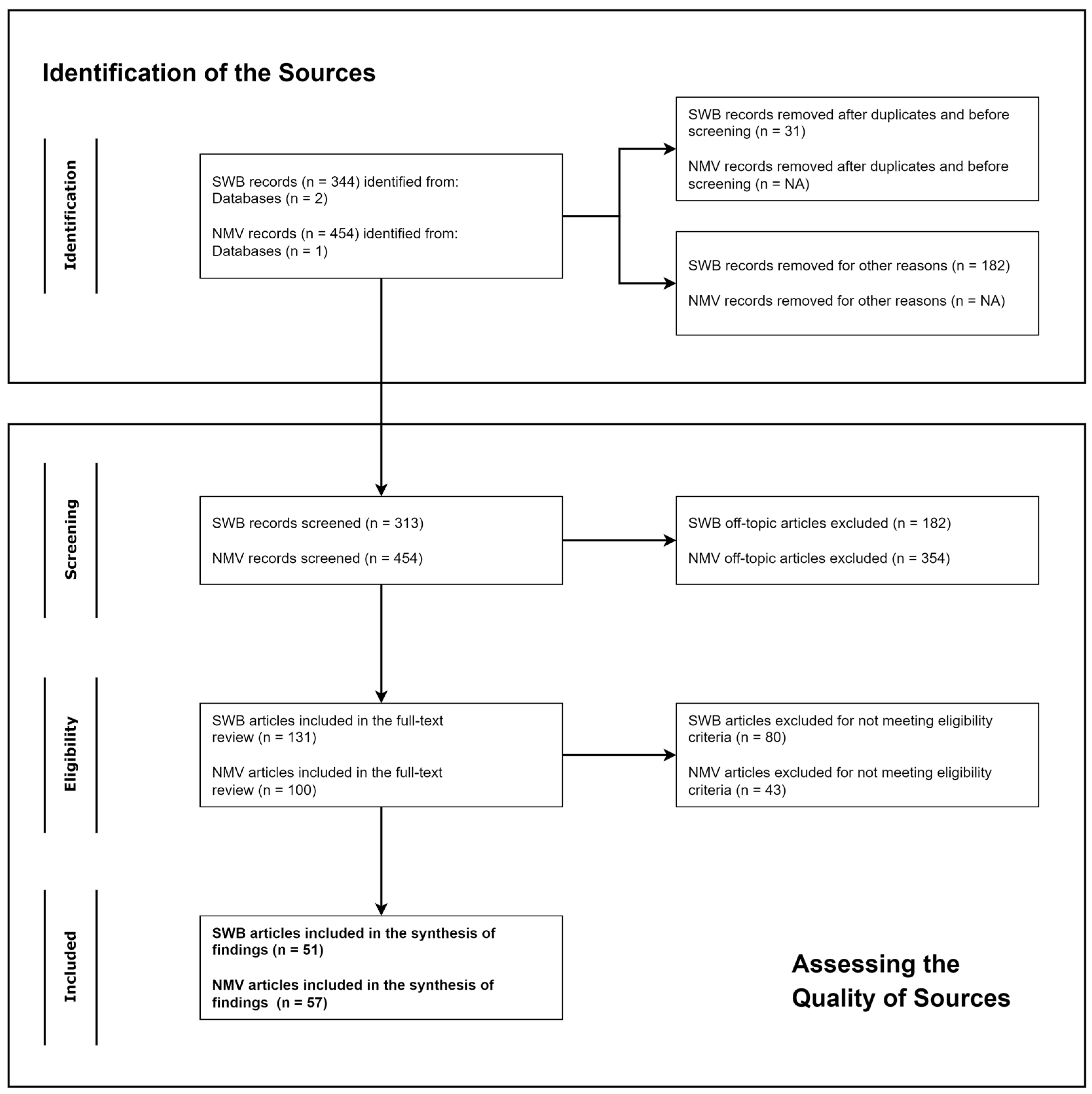
The herein scoping review followed a rigorous and well-structured protocol. This was applied during all steps of the procedure, from identifying the relevant literature results and screening for eligibility, to data extraction and methodological quality assessment. This formula imparted 108 articles covering both strands of the review (non-market valuation and subjective well-being) and a wide range of urban green space types and characteristics. The remainder of this section provides a detailed insight into the procedures followed, while Figure 1 showcases the flow of these procedures.
Figure 1.
Flow chart of the methodological process followed to execute the review of the articles, based on the PRISMA method.
2.1. Identification of Sources
To identify the studies for our scoping review paper, we searched for the relevant and most recent literature (from 2010 to 2022) during November 2022, using the ScienceDirect and Web of Science (Social Sciences Citation Index (SSCI)—1975-present) databases. Given our interest in studies that relate specific characteristics of urban green spaces to different aspects of subjective well-being, on the one hand, and studies utilizing the non-market value approach to evaluate UGSs, on the other, it was necessary to apply two different Boolean search queries. Therefore, we worked in two review teams. As regards the pool of articles related to the subjective well-being approach, we initiated our search to acquire them by using the following simple syntax: “urban green space” AND “subjective well-being” OR “subjective wellbeing”. As regards the non-market-value approach, the syntax was similarly simple, using the same first term and differentiating the second one as follows: “urban green space” AND “economic valuation” OR “non-market valuation”.
2.2. Assessing the Quality of Sources
2.2.1. Screening Process
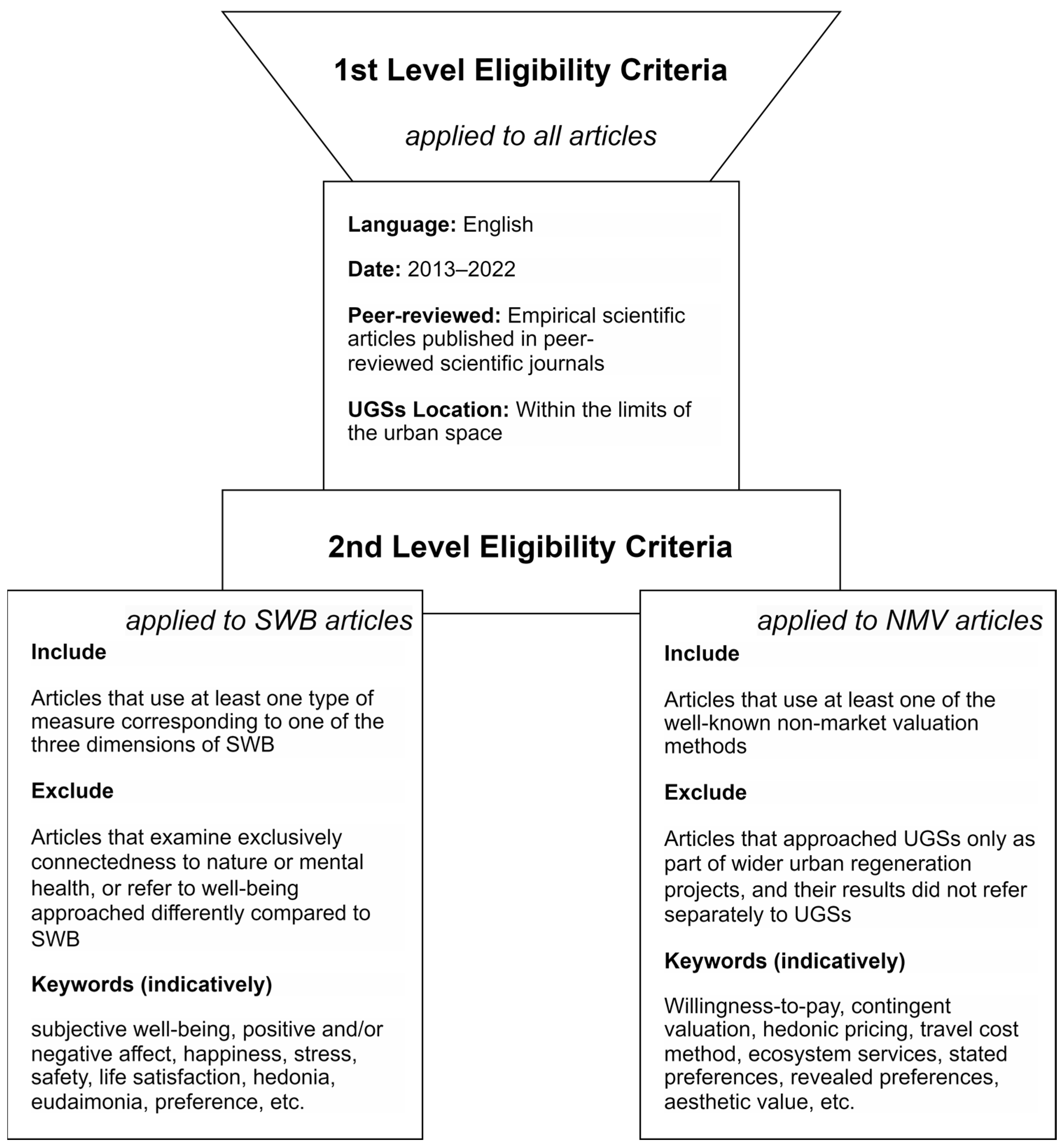
To deduce the relevance of an article, we determined several decision rules and inclusion criteria, organized into three sets (Figure 2): the first set of decision rules was applied to all articles, regardless of the specific methodology; the second set of rules referred specifically to the articles that examined urban green spaces under the prism of subjective well-being; and finally, the third set was applied exclusively to the studies that utilized the non-market value approach. In brief, the first set of general rules and inclusion criteria determined the following: our search focused on articles that were written in the English language and published during the period 2010–2022. Additionally, we focused exclusively on peer-reviewed empirical scientific articles published in relevant scientific journals. Upon acquiring the two raw collections of articles, the two review teams worked separately and in phases. Initially, we removed all the duplicate records. Following that, we performed the screening of the remaining articles. In this early stage of the procedure, we applied the first set of eligibility criteria as described above. We examined the keywords and read the abstracts to determine whether a study was relevant to the topic of our analysis and met our general decision rules, eliminating any reviews, opinion articles, non-peer-reviewed papers, or articles related to other fields. In sum, we excluded any article that did not align with the topic or rationale and scope of the herein review.
Figure 2.
The sets of decision rules applied while reviewing the collected articles.
2.2.2. Eligibility Screening Process
The articles that resulted from the aforementioned steps underwent eligibility screening. Given that the abstracts and keywords were not enough to determine whether the articles met the inclusion criteria as determined by the second and third set of rules, respectively, we delved into the articles’ bodies. We read the full text of each article, focusing primarily on the sections referring to the methodology that was followed and the results produced, and further eliminated any articles that did not align with the scope of our review.
Considering that the syntax we used to search for the articles that related urban green space characteristics to subjective well-being dimensions gave us a broad pool of results, we applied additional decision rules. We examined the texts to identify if the study used at least one type of measure corresponding to one of the three dimensions of subjective well-being. We excluded articles that examined only connectedness to nature or mental health, as well as those that referred to well-being but approached it differently compared to the subjective well-being approach. Further, we affirmed that the following keywords could be identified in one of the parts of the article, namely the title, the keywords, or the text: subjective well-being (or subjective wellbeing, or SWB), well-being (or wellbeing, or human well-being, or mental well-being), positive and/or negative affect (or positive emotions, or feelings), reference to emotions (such as happiness, or stress, or safety), life satisfaction (or environmental satisfaction, or satisfaction), hedonia, eudaimonia, quality of life, preference, environmental psychology.
Finally, concerning the decision rules applied to the studies of non-market valuation, we followed a similar procedure to the studies of SWB; however, it was adapted to the particular characteristics of these methods. Namely, we examined the manuscripts to identify at least one of the well-known non-market valuation methods, and we excluded articles where the urban green space was only a part of wider urban regeneration projects (and in which the valuation results did not refer separately to the UGS). As in the case of SWB studies, we also investigated the text for the presence of certain keywords in the title, the keywords, or the main text of each article. Specifically, the following keywords were considered as inclusion criteria: willingness-to-pay (WTP), contingent valuation (CVM), hedonic pricing, travel-cost method, (discrete) choice experiment, use/non-use values, ecosystem services, stated preferences, revealed preferences, benefit transfer, meta-analysis, cost–benefit analysis, aesthetic value, recreation value, amenity value.
Based on the aforementioned inclusion criteria, we eliminated the articles that did not contain the necessary information for our analysis and, ultimately, identified fifty-one articles corresponding to the subjective well-being methodologies and fifty-seven articles related to the non-market value approach4.
2.3. Data and Synthesis Process
Apart from including and eliminating articles, during the screening procedure, we identified the most frequently studied types and attributes of urban green spaces. Given that urban green spaces can be very diverse (ranging from parks and gardens to street greenery and urban forests), and there is no globally accepted inventory system, with studies following a wide range of classification approaches, the procedure revealed a significant number of types in the reviewed articles. This diversity made it necessary to organize the typology of urban green spaces in a way that would serve the needs of the specific review and facilitate the procedure of analysis. Therefore, we classified the UGS typology in an eleven-category inventory (Table 1). Further, the identification of the most frequently studied urban green space attributes posed a challenge in organizational terms due to the significant number of characteristics in the reviewed articles. Therefore, we created a classification of five major UGS-characteristic categories: Locational, Natural, Structural, Amenities, and Quality (Table 2). In many cases, articles examined more than one group of characteristics; thus, we ascribed these articles to multiple categories.
Table 1.
Inventory of Urban Green Space Types.
Table 2.
Categories of Urban Green Space Characteristics.
The definition and guidelines provided by the OECD [19] served as the foundation for our analysis regarding subjective well-being articles. Specifically, in each article, we identified the measure (or measures) used to evaluate the impact of UGSs on people’s subjective well-being and thereafter appointed it to the corresponding type: Life Evaluation measures, Affect measures, and Eudaimonic measures. The “Life Evaluation measures” type was ascribed to articles that utilized tools to assess satisfaction with one’s life as a whole or a more specific aspect of it. The “Affect measures” type corresponded to articles that used tools to record particular feelings or emotional states (positive or negative), referring, in most cases, to a specific point in time. Lastly, the category of “Eudaimonic measures” was matched to the articles embracing the notions of psychological flourishing or purpose of life, using measures to record concepts such as “worthwhileness”. In several cases, the reviewed articles used a combination of subjective well-being measure types and, therefore, were accordingly ascribed to multiple categories. For each article, we further identified the specific measures, indexes, or research tools they used, in order to evaluate whether specific ones are dominating the field. Additionally, we organized the effects of the UGS characteristics on the level of subjective well-being in three classes: positive, negative, or mixed (the latter was assigned to cases in which the results were not clearly positive or negative, or they found both high and low correlations when controlling variables, accordingly).
The analysis of the non-market valuation (NMV) articles relied on the broad classification between stated and revealed preference techniques. Among these techniques, we particularly focused on the most commonly used, which are the contingent valuation method (CVM), the hedonic pricing method (HPM), the (discrete) choice experiment (CE) method, and the travel cost method (TCM). Several studies, especially those that employed the TCM, used more than one valuation technique; therefore, we classified them into multiple categories. For each valuation study, we identified the specific econometric technique used, the spatial scale of analysis, and the socio–economic attributes that were selected to be explored. We also organized the studies based on the specific values which they attempted to assess, by considering the Total Economic Value (TEV) framework, which takes into account both the use and non-use values.
The information derived from the selected articles was organized in two databases. The first included the articles under the subjective well-being strand, and the second included those under the non-market value (NMV) strand (Appendix A).
3. Results
3.1. Bibliometric Analysis
This section presents the bibliometric analysis of the selected studies regarding the year of publication, the country of origin, the main keywords, the main terms used in titles and abstracts, and the type(s) of urban green space analyzed or examined in each article. This analysis is carried out for all the reviewed articles but also separately for the two groups of studies, i.e., the two methodological approaches (SWB and NMV). As shown in Figure 3, the two groups of studies display a similar evolution through time. The number of articles collected remains relatively steady for the largest part of the period concerned (roughly 2010–2018), while there is an evident spike in publication activity since 2019.
Figure 3.
Cumulative number of articles by year (2010–2022).
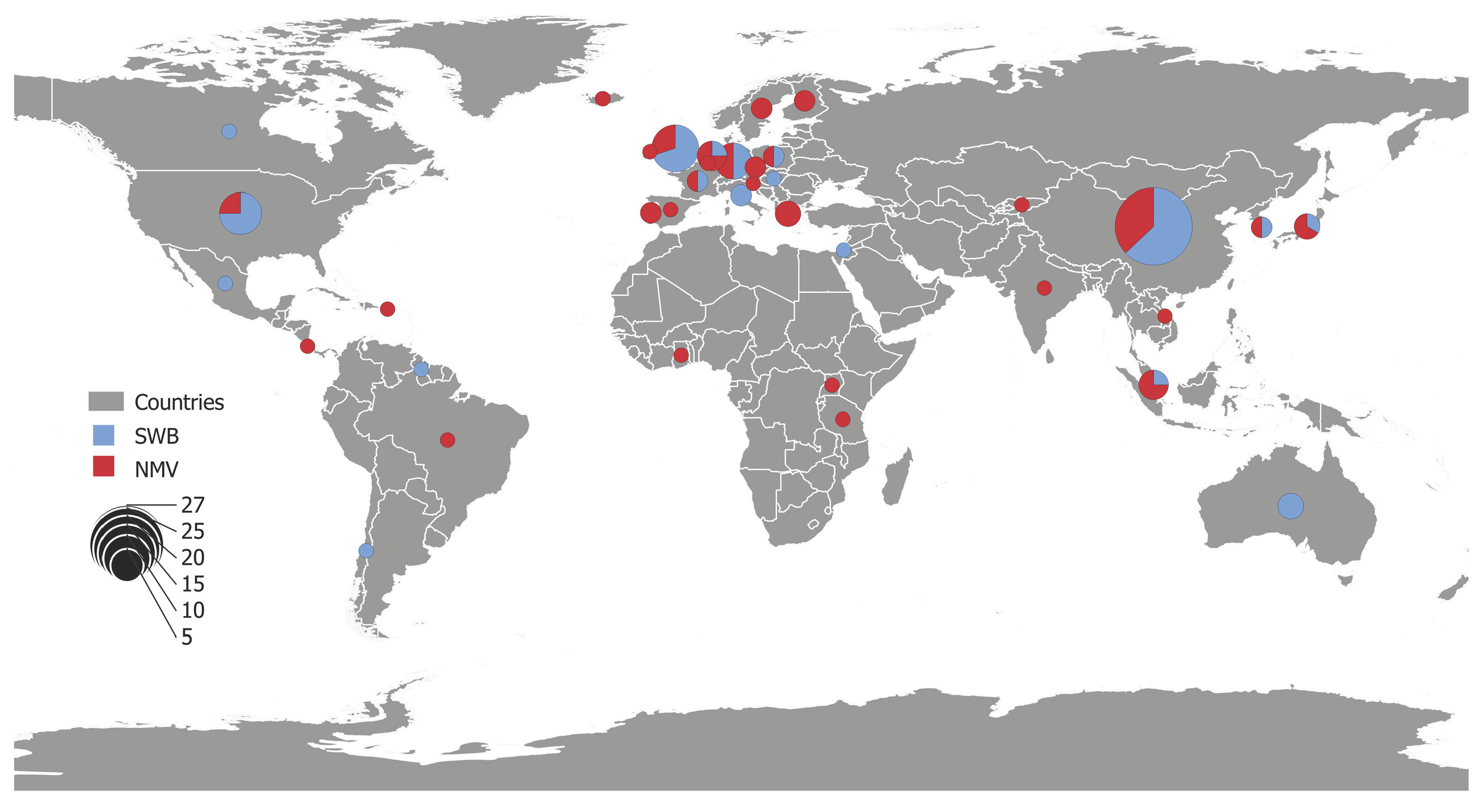
Figure 4 presents on a map the geographical distribution of the reviewed articles. This demonstrates that although there is a global interest in the topic, most of the articles are located in Europe, China, and the US. Specifically, the non-market valuation studies are derived from 29 countries (1.96 NMV articles per country), while the subjective well-being studies are derived from 19 countries (2.68 articles per country). Therefore, it seems that the NMV group has a wider geographical distribution, which also includes less developed countries. The countries upon which most of the NMV studies were derived are China (19%), Germany (7%), Greece (5%), the UK (5%), Singapore (5%), and the Netherlands (5%). On the other hand, the countries with the most published SWB studies are China (33%), the UK (14%), the US (12%), Australia (6%), and Germany (6%). It is worth noting that only two NMV studies were applied in more than one country focusing on cross-country evidence and comparisons.
Figure 4.
Geographical distribution of reviewed articles.
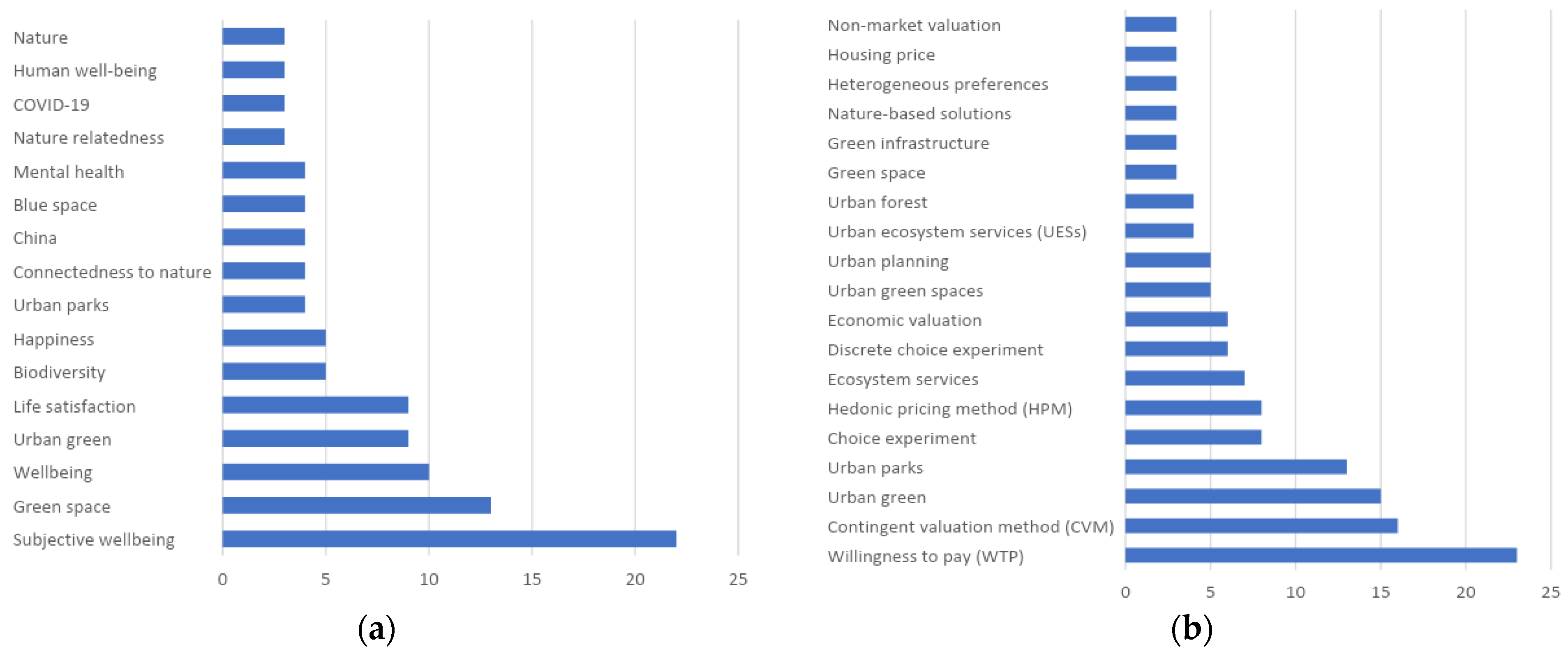
Next, after the elimination of duplicate keywords, we investigated the keywords listed in all research articles, considering them as important indicators of the underlying concepts, theories, and methods used in evaluating well-being as impacted by UGSs. The analysis was first performed in each group of studies, by examining only keywords that had been used at least three times. As shown in Figure 5, 16 keywords meet this threshold in the SWB studies. As expected, “subjective wellbeing” is the keyword that occurs more frequently, while the second most important keyword is “greenspace”. Frequent terms are related to the green areas’ typology (e.g., “urban green”, “urban parks”, “blue space”) and to the “metrics” of well-being (e.g., “happiness”, “life satisfaction”, “human well-being”), while the only geographically related keyword was “China” since almost 1/3 of the SWB studies came from this country. Concerning the NMV studies, 19 keywords meet the threshold (Figure 4). “Willingness to pay” was the most frequent term, followed by “contingent valuation method (CVM)”. Once again, several keywords are related to the typology of green areas (e.g., “urban green”, “urban parks”, “urban green spaces”, “urban forest”, “green space”). Other frequent keywords in the NMV studies are “ecosystem services” and the valuation method applied in each study (e.g., “contingent valuation”, “hedonic pricing method”, “(discrete) choice experiment”).
Figure 5.
(a) Most frequent keywords in SWB studies; (b) most frequent keywords in NMV studies.
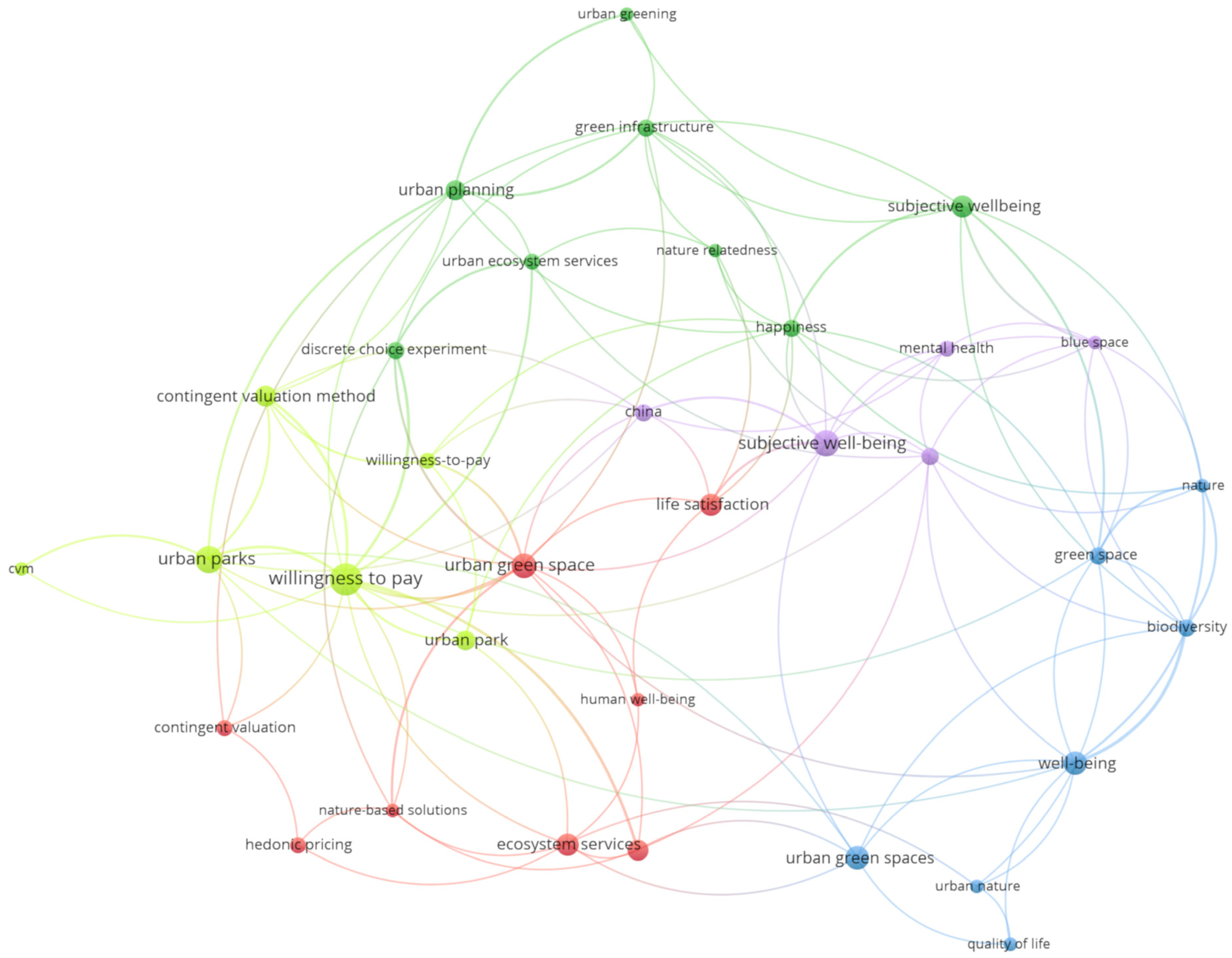
Then, we used the VOSviewer software (version 1.6.19) to visualize the connection networks of (a) keywords and (b) main terms in titles and abstracts [30]. Concerning the first, we again examined keywords that had been used at least three times. Accordingly, 34 of the 371 total keywords were entered into the network, which was clustered into 5 clusters, illustrated with different colors in Figure 6. The most frequent keywords are “willingness to pay”, “subjective wellbeing”, “(urban) green space(s)”, and “urban park(s)”. Two clusters (yellow and pink) include publications that are mainly focusing on NMV studies, while one of them (yellow) is mainly related to the contingent valuation method. Two other clusters (blue and purple) are about SWB applications; among them, the purple cluster seems to focus on mental health dimensions and includes most of the SWB articles coming from China. Finally, there is one mixed-method cluster (green) that relates both methodologies (NMV and SWB) with urban planning issues, urban ecosystem services, and (citizens’) happiness.
Figure 6.
Connection network of keywords (5 clusters).
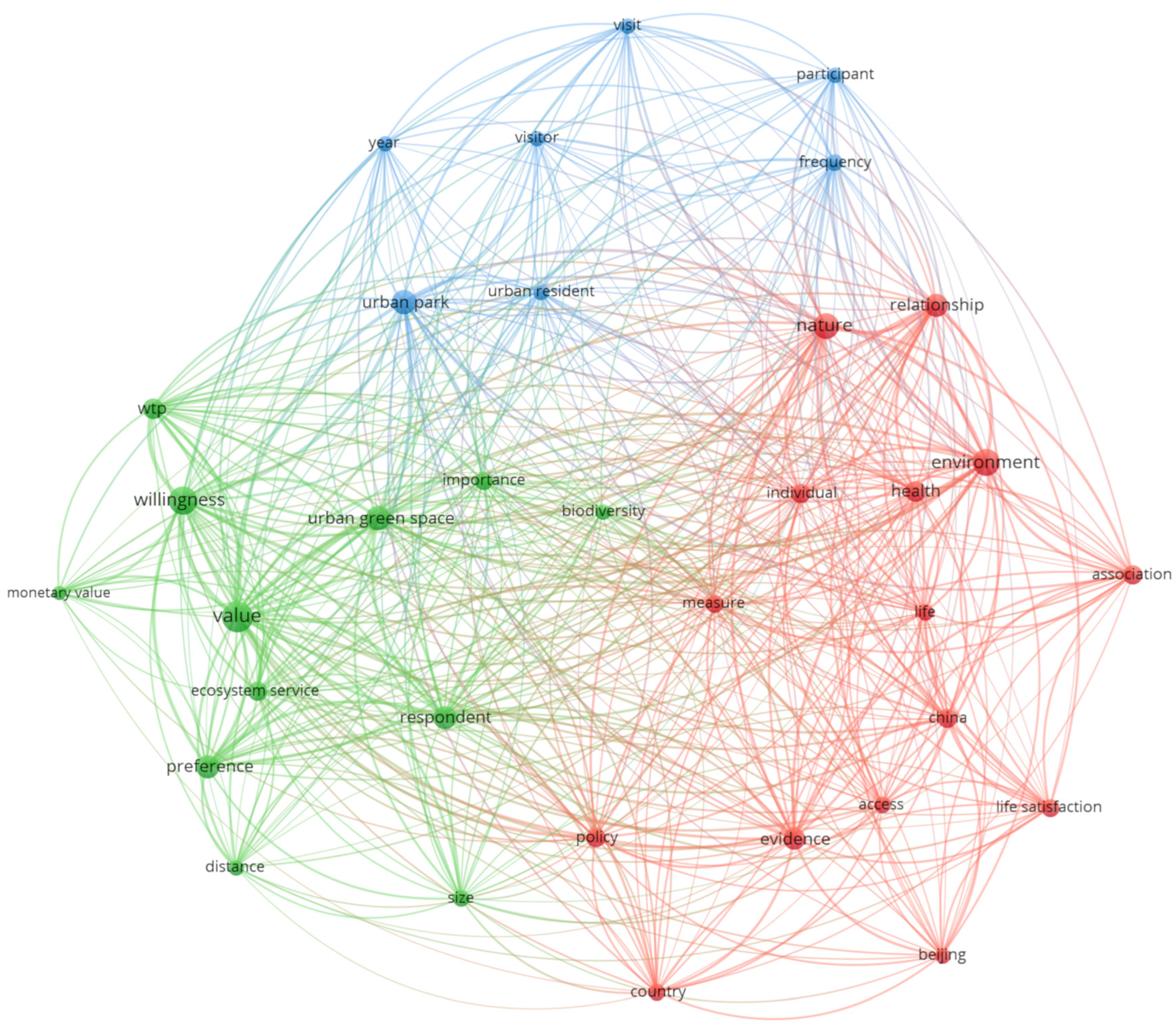
The same procedure was followed to investigate the terms used in the title and abstract of all the reviewed articles. Namely, we visualized the connection network of those terms which apply at least 10 times in titles and abstracts. As a result, 34 out of 2885 terms entered the network and were clustered into three large groups (Figure 7). The most frequent terms are “(monetary) value”, “urban green space”, “willingness (to pay)”, “urban park”, and “environment”. It is interesting to highlight that the three clusters seem to represent (a) the economic dimension of UGSs (green), (b) the environmental and (c) well-being/social dimension of UGSs (red), and finally, (d) the individual (mainly visit) characteristics of urban residents (blue).
Figure 7.
Connection network of terms in titles and abstracts (3 clusters).
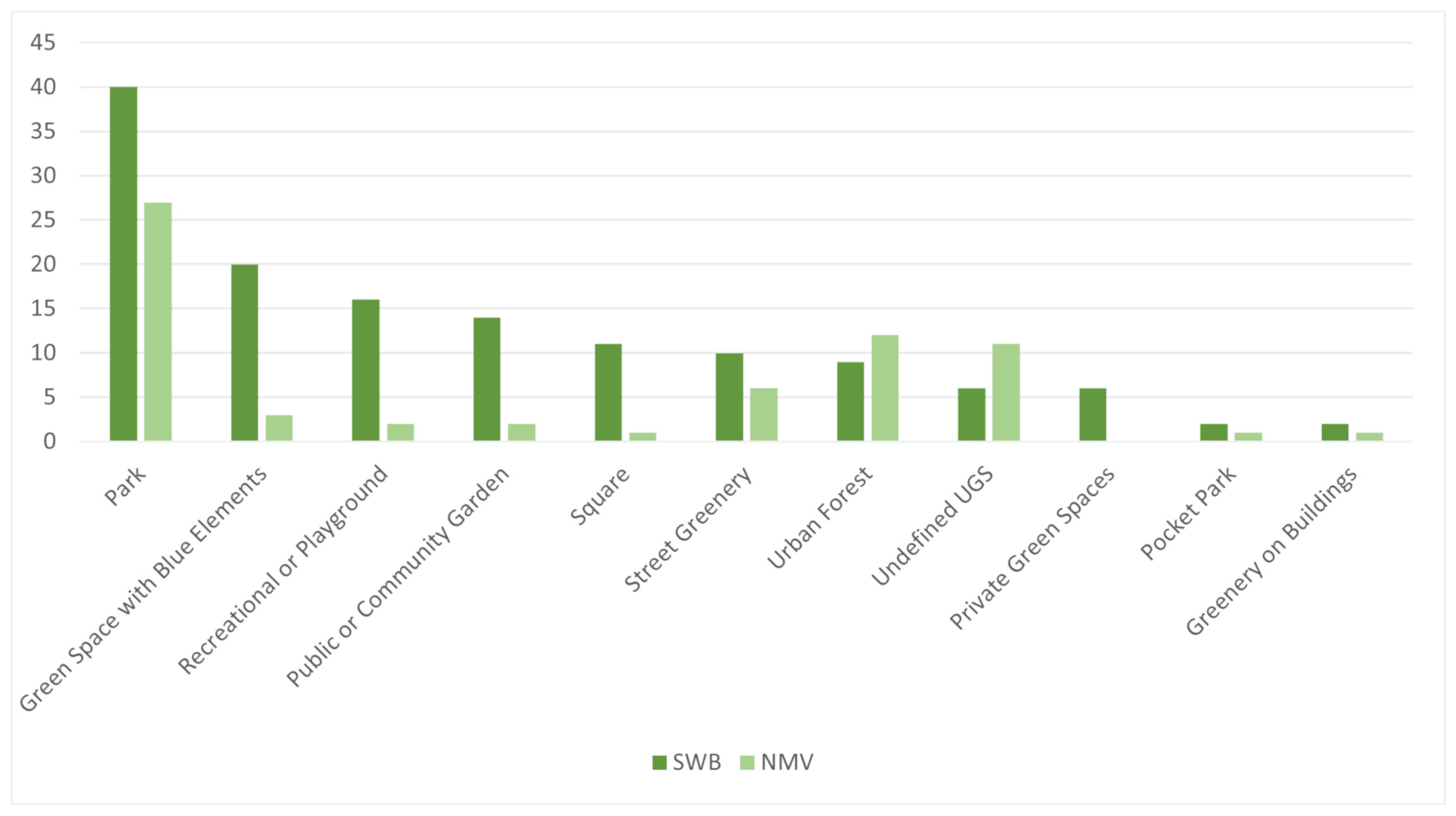
As indicated in Figure 8, the most common UGS types studied in the SWB articles is (urban) “Parks” (40 cases). The next most frequent type in this category was “Green Space with Blue Elements” (20 studies), followed by “Recreational or Playground” (16), “Public or Community Garden” (14), “Square” (11), “Street Greenery” (10), “Urban Forest” (9), “Undefined UGS” (6), and “Private Green Spaces” (6). The least-examined UGS types are “Pocket Parks” and “Greenery of Buildings”, with only two references each. Regarding the articles using NMV methodologies, “Parks” is again the most frequent UGS type studied, with a total of 27 cases, followed by “Urban Forest” (12). A total of 11 out of the 57 studies do not refer to a specific type of UGS (Undefined UGS). Other types of green spaces evaluated in the NMV studies are “Street Greenery” (6), “Green Space with Blue Elements” (3), “Recreational or Playground” (2), “Public or Community Garden” (2), “Square” (1), “Pocket Park” (1), and “Greenery on Buildings” (1). It is noted that no article refers to “Private Green Spaces”. Finally, it is worth mentioning that several articles—29 out of the 51 SWB and 8 out of the 57 NMV—examined more than one type of UGS.
Figure 8.
Types of urban green spaces studied per category of articles.
3.2. Methodologies for the Evaluation of Urban Green Spaces
3.2.1. Subjective Well-Being Methodologies
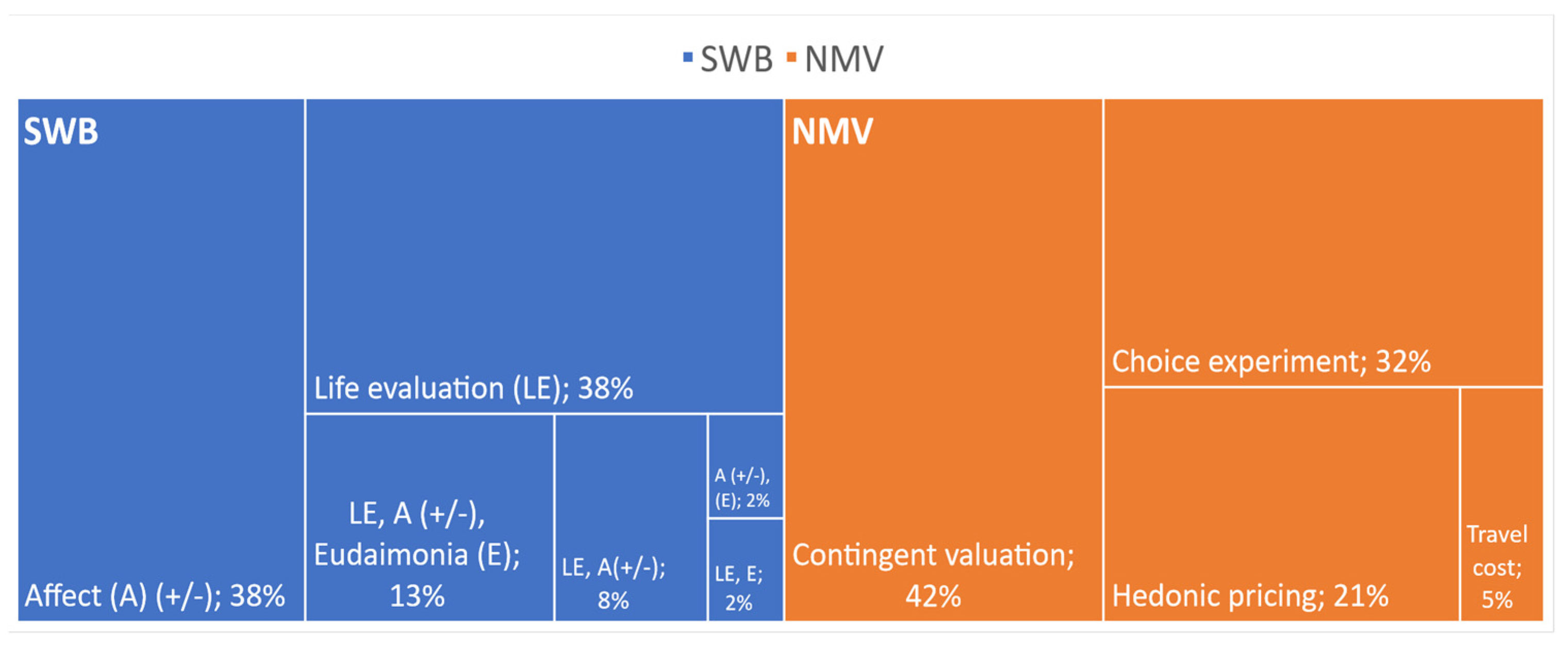
The review of the articles that used subjective well-being measures to evaluate urban green spaces highlighted three methodological patterns. The most dominant one (70.6%) refers to articles that used a single type of SWB measures. Half of these studies utilized Life Evaluation measures. Precisely, the majority (94.4%) of these articles used only one Life Evaluation measure, with the most prevailing (66.7%) being the single-item Overall Satisfaction with Life measure [31,32,33]. The other half of the articles that employed a single type of SWB measures utilized measures of Affect. In this case, we found a greater variety in the measures used to estimate how urban green spaces impact participants’ well-being: 27.8% of these articles measured a Positive Affect, such as happiness [34,35,36], 16.7% used the Warwick–Edinburgh Mental Well-being Scale (WEMWS) [37,38,39], 11.1% employed the Positive and Negative Affect Schedule (PANAS) index [40,41], while 44.4% used other multi-item measures [42,43] or word analysis methodologies [44].
It is important to stress that none of the reviewed studies in this category utilized Eudaimonic measures. This could be explained by the fact that it is relatively more complicated to empirically blueprint the impact of UGS features on concepts such as self-actualization or sense of purpose. We found also that 17.7% of the reviewed articles employed two types of SWB measures, revealing a second methodological pattern. The prevailing practice in this category was the combination of Life Evaluation and measures of Affect (77.8%), while the other two combination varieties, i.e., Affect and Eudaimonic measures, and Life Evaluation and Eudaimonic measures, represented an equal share of 11.1% each. The remaining 11.8% of the reviewed articles followed a third methodological pattern utilizing all three types of SWB measures. In these cases, the majority of studies (83.3%) employed the ONS4 measure (four item survey questions), developed by the UK Office for National Statistics [25]. The frequency of the various SWB approaches employed in the 51 reviewed articles is displayed in Figure 9.
Figure 9.
Frequency of the different methods employed per category of articles.
3.2.2. Non-Market Valuation Methodologies
Regarding the economic valuation of UGSs, contingent valuation (CVM) seems to be the most widely used method (41% of the reviewed studies). Its dominance can be explained by its ability to capture the total economic value by evaluating both use and non-use values under hypothetical (future) scenarios of UGS development, planning, or amendments. It is a stated preference method that is able to measure different types of ecosystems and UGSs, as well as different environmental services. In our sample of studies, CVM was mainly used to draw conclusions about (a) the motivation leading to a (potential) visit of a UGS and the expectations of such a place for (future) visitors [45,46,47,48], (b) the heterogeneity of preferences among urban residents for the services provided by urban greenery [49], (c) the cost–benefit assessment of future UGS development or of future improvements (investments) on parks’ maintenance and/or preservation [50,51]. CVM supports the economic valuation of ecosystem services [52] and can be used to estimate several values: landscape values, health values, socio–economic values, leisure values, etc.
Similar to the CVM approach, which is also commonly used to evaluate UGSs (32% of the reviewed articles), is the choice experiment method (CE). CE is also a stated preference approach, which is based on the assumption that UGSs can be described by their attributes (characteristics), one of them being the citizens’ monetary assessment/value (i.e., their WTP) for selecting a particular scenario of UGS development or improvement. Therefore, CE may evaluate (a) citizens’ preferences with regard to particular green and blue infrastructures [53,54], (b) the different leisure activities, ecosystem services, and/or types of vegetation in UGSs [55,56,57], as well as (c) different UGS preservation and planning needs/policies [58,59,60].
On the other hand, the hedonic pricing method (HPM) is a revealed preference method which is commonly used to measure the positive (or negative) externality effects of UGS, by looking at the real-estate markets [61]. The main principle of the HPM is that changes/differences in property characteristics and/or in its surrounding environment/ neighborhood (including UGS) will be reflected in property values. HPM accounted for 21% of our sample of studies and is mainly used to assess the “added value” (implicit price) of UGS availability/proximity and to understand/explain how these values differ across space. Therefore, this method is likely to assess the distributional impact (and social equity effects) of UGS and to compare UGS values among different sites or within a metropolitan area [62,63]. It is also applied in cases where the quality/attractiveness of UGS is examined [64].
Another revealed preference method used to assess UGS values is the travel cost method (TCM), which is used to assess the recreational/amenity/leisure value of UGSs. Citizens’ WTP for visiting an UGS is thus estimated based on the number of trips that they make at different travel costs [65], under the hypothesis that the shorter the travel distance to an UGS the higher the possibility to attract visitors. Only 5% of the reviewed studies are using this method, most of them in combination with other non-market valuation methods (like CVM/CE) [31,66]. It should be noted that WTP estimates can also be collected based on meta-regression analysis for green spaces in order to create a benefit transfer function [67]. Figure 9 displays the frequency of application of the various NMV approaches in the 57 reviewed articles.
3.3. Characteristics of Urban Green Spaces
3.3.1. Urban Green Space Characteristics and Their Effect on Subjective Well-Being
In terms of urban green space characteristics and their effect on dimensions of subjective well-being, the analysis indicated three groups of articles. The first group (35.3%) incorporates those articles that examine only one group of characteristics. We found that Natural characteristics of urban green spaces were the most studied (55.6% of articles) in this group. Factors such as the levels of naturalness and biodiversity, amount of greenery, and scenic beauty were examined, among others, to investigate whether more intense natural characteristics have a greater impact on the levels of people’s subjective well-being [41,68,69,70,71]. These characteristics were positively related to dimensions of subjective well-being except for one article that studied the relationship between naturalness and the sense of safety [69]. In this case, a significant negative correlation was found to dominate the relationship between the two variables, indicating that “the greater the quantity of (wild-looking) greenery, the less the safety” [69], recognizing, though, that legibility acts as a mediating factor, being positively correlated with safety. In the second place (22.2% of articles) of the most studied UGS characteristics, we find the Locational ones [43,72,73,74]. By locational characteristics, we refer to the distance from people’s residences or workplaces to the nearest urban green space, as well as to people’s accessibility to green spaces, examined, in some cases, by indicators related to transportation facilities, such as road networks and parking. The reviewed articles indicated that the greater the proximity to urban green spaces, the stronger the positive effect they have on people’s subjective well-being. Only 16.7% of the sample articles studied specific characteristics related to the structure of urban green spaces [70,75,76]. One commonly studied Structural characteristic is the size of the UGSs, which was found to positively influence the various dimensions of subjective well-being as it increased, especially in cases where happiness was measured (for example [75]). However, Lin et al. [76] highlighted the importance of approaching this relationship as contextually dependent, given that they found differences between the results arising from residential zones and the other zones they examined. Among the articles focusing on one group of UGS characteristics, the majority (88.9%) utilized a single type of subjective well-being measures, with equal share between Life Evaluation [71,72,77] and Affect [35,41,78] measures (44.4% each). In comparison, only 11.1% used two or all three types of SWB measures [73,79].
The second group refers to studies that examined two categories of UGS characteristics, concentrating the majority (41.2%) of the reviewed articles. Almost half (42.9%) of these studies estimated the effect of urban green spaces on people’s subjective well-being as determined by Natural and Locational characteristics [31,80,81,82]. Among the articles of the second group, 23.8% studied the Natural and Structural characteristics of urban green spaces [40,44,83], while another 33.3% focused on other combinations, such as Locational and Quality characteristics [84], Structural and Amenities [42], Locational and Structural [32], and Natural and Quality [85]. In comparison with the previous group, here we found that the greatest volume of articles (46.9%) use Life Evaluation measures to estimate the impact of urban green spaces on people’s well-being. For example, an important number of articles [82,85,86] utilized a single-item measure to record the overall satisfaction with life, aiming to understand the impact of UGSs on it. As regards the measures of Affect, only 19.1% of the articles in this group employed this type of measure [40,44,87,88], while an equivalent percentage of articles combined two types of SWB measures [83,84,89,90], dominated by the combination of Life Evaluation and Affect measures. Significantly enough, in this group, we found the majority of the articles using all three types of subjective well-being measures, namely 66.7% of all the sample articles that used all three types. Predominantly, the findings of the articles in the second group align with those of the previous one. For example, Knight et al. [84] support the existence of a strong correlation between the distance of residence from urban green spaces and the levels of life satisfaction, while Liu et al. [81]) highlighted the positive association between the nearest park area and affect (both positive—happiness and negative—anxiety), but also worthwhileness (eudaimonic dimension). Further, structural variables, such as the size and design elements of a UGS, were also acclaimed as critical dimensions of the experience of visiting urban green spaces. Both Sharifi et al. [32] and Schwartz et al. [44] found notable evidence of a positive relationship between the size of green spaces and the levels of subjective well-being: the larger the size of the green space the greater the size of the effect on SWB. Additionally, natural characteristics, such as the amount of greenness and biodiversity, were again found to be critical determinants of subjective well-being [91] and positively related to higher levels of positive affect and restorative properties [83], as well as to lower levels of negative affect [92].
Finally, under the third group, we find articles (23.5%) that examined three or more categories of urban green space characteristics and their impact on subjective well-being [36,37,93,94]. Here, we found that the Structural, Amenities, and Quality characteristics of urban green spaces were studied in 66.7% of the articles [37,38,95,96,97]. In comparison, the Natural and Locational variables were studied in 50% of them [98,99]. Observing these data in parallel with the other two categories, it can be argued that the categories of Amenities and Quality characteristics tend to be studied in combination with at least one more UGS category of characteristics. In contrast, to a large extent, the Natural characteristics are the prevailing ones, and often it is the only category examined by studies that evaluate the impact of UGSs on subjective well-being. The same applies also to the category of Locational characteristics but to a lesser extent.
3.3.2. Urban Green Space Characteristics and Their Effect on Non-Market Values
Regarding the attributes used in the non-market valuation studies under consideration, it is noticed that they significantly differ from the SWB studies. The analysis indicated once again three groups of articles. However, these groups do not differ on the number of categories of urban green space characteristics (as in the previous case) but on how UGS/GI characteristics are used for the elicitation of WTP (i.e., as predictors/determinants of UGS values). The first group incorporates those studies that are examining case-specific attributes/characteristics of the UGS under study. This group (59.6% of all the reviewed articles) is actually the one that is more similar to the SWB studies, as it analyzes the existing Structural, Natural, Locational, recreational (i.e., Amenities), and Quality characteristics of green spaces. In fact, these studies are mainly examining the use values (both direct and indirect) of urban green spaces. For this reason, all the hedonic pricing and TCM studies of our sample belong to this category.
Structural characteristics of UGSs were found to be widely used and quite critical determinants of the UGSs’ values (used in 50% of this group of studies). The most important structural characteristics are the type of UGS, its size, the green area, the area covered by trees, and the NDVI index [55,100,101]. In general, the size and percentage of tree/green areas are found to have a positive effect on non-market values of urban green spaces. Locational characteristics were used in 58% of these studies and are equally found in both stated (CVM, CE) and revealed preference (HPM, TCM) applications. Locational attributes were used in various forms such as (a) distance/proximity of parks to citizens’ residences [64], traveling time (by various means of transport) to (nearest) UGS [102], travel cost between home and (nearest) park [49], or even more general accessibility indicators. The reviewed articles indicated a significant negative effect of distance or travel time on non-market values. Natural characteristics/attributes in this category are mainly associated with the perceived or described (in the survey) level of biodiversity in UGSs. These characteristics are not very common (11.1%) in this category of studies (as they are usually considered ecosystem services, usually associated with option and/or bequest values that are going to be examined in the following category) but are usually positively correlated with UGS values [47]. Amenities in non-market valuation are usually referred to as recreational characteristics and were used in several studies (38.9%) of this category describing several recreational features or facilities for certain population groups [55,100,103], scenic views [60], or the number of visitors [104]. Finally, only six valuation studies (16.7%) used Quality characteristics either in the form of satisfaction level [105], suitability index [46], air quality, acoustical environment, and park maintenance and preservation.
The second group of studies (24.6% of the reviewed articles) refers to non-market valuation studies that do not include case-specific UGS attributes because they are focusing on the ecosystem service assessment of UGSs. This group only includes stated preference applications (CVM and CE) that are aiming to elicit the preferences and WTP of the ecosystem services that may arise from improvements/investments of existing UGSs or from the provision/development of new urban parks. A number of ecosystem services are evaluated for different types of urban green areas. By analyzing these data, we may sort these services in a descending order of appearance in the reviewed articles, as follows: (i) Biodiversity (47.4%) [57], (ii) climate change mitigation (carbon sequestration)/adaptation and local climate services, also addressing the urban heat island effect (31.6%) [58], (iii) Leisure and recreational values (31.6%) [106], (iv) aesthetic value and UGS attractiveness (26.3%) [107], (v) water quality and water regulation (21.1%) [54], (vi) air quality (10.1%) [108], and (vii) existence and altruistic values [106].
Finally, the third group of articles includes the non-market valuation studies (15.8%) that are not taking into account either the UGS attributes or the ecosystem services of urban greenery. Here, we found only contingent valuation studies. Most of these CVM studies (66.6%) are exclusively using socio–economic determinants of WTP values [109]. However, there are also some studies (33.3%) that are combining the socio–economic determinants of WTP with several motivational attributes (such as the reasoning for visiting a park), environmental awareness attributes, and/or frequency of visiting a UGS [110].
4. Discussion and Conclusions
At the core of this scoping review lays our interest in examining and investigating, critically, the intersection points between the methodologies of (a) non-market valuation and (b) subjective well-being, as applied in the assessment of urban green spaces, with reference to their economic value and impact on people’s well-being, respectively. We examined previous research findings that stem from 108 articles (of which 57 used non-market valuation methodologies while 51 used subjective well-being ones) aiming at identifying, synthesizing, and comparing data referring to the predominant methods and techniques used in each group of articles, as well as the typology of UGSs more often examined. Further, the article sought to determine the UGS characteristics that have been studied the most, approached as factors promoting the individual and/or social benefits of UGSs, and compare how the two methods examine these characteristics. As regards the evaluation of UGSs, there is a sustained research interest in examining and utilizing both the non-market valuation and the subjective well-being methodologies. However, it is noteworthy that these two methodological approaches have been studied separately rather than in combination. We acknowledged this gap as an optimum opportunity to inaugurate a state-of-the-art topic of discussion that can provide the research community with updated knowledge and could potentially identify important policy and planning implications.
4.1. Summary of Results
This scoping review summarizes the current state of research on measuring the impact of urban green spaces on people’s subjective well-being, as well as on estimating the preference-based value of UGSs using non-market valuation methods. The bibliometric analysis identified that both strands of research presented exponential growth over the last decade. An evident spike in interest is observed since 2019, increasing further in the following years. At this point, it would be remiss not to mention the COVID-19 pandemic and its possible role in triggering this growth of interest, given that green spaces served as getaway spots during the lockdown periods, attracting interest in public discourse and policy making. The synthesis of literature findings of both approaches indicates that the most frequently studied type of urban green space is the (urban) “Park”. However, in many cases (particularly in the case of SWB studies), a significant number of articles examined more than one UGS type.
In terms of methods employed, consistent results revealed that the Life Evaluation and Affect measures dominate the subjective well-being literature, while the contingent valuation method is the prevailing one in non-market valuation articles, followed by the choice experiment method. One essential methodological difference identified between the two approaches is that non-market valuation articles tend to employ a single valuation technique (e.g., only the contingent valuation or only the hedonic pricing, etc.). In comparison, we found that a significant share of subjective well-being articles (29.4%) utilizes a combination of measures covering more than one SWB dimension (e.g., measures of Life Evaluation and Affect, or measures of Life Evaluation, Affect, and Eudaimonia combined). Regarding the non-market valuation articles, a noteworthy exception is the travel cost method. Even if limitedly employed, when used, this method is applied in combination with others, such as the CVM or CE methods.
The domination of Life Evaluation measures employed to cognitively assess life as a whole, or a specific dimension of it, aligns with the general trend in measuring subjective well-being beyond the particular focus of the herein review. These measures (e.g., Satisfaction with Life Scale, Cantril’s Ladder of Life Scale, single-item Life Satisfaction measures) are commonly employed as extensive evidence indicates that they exceed the acceptable required reliability threshold (particularly the multi-item measures) [19]. Respectively, measures of Affect—despite the variable nature of emotions and moods—were also found to exhibit an acceptable degree of reliability. On the other hand, evidence on the reliability of Eudaimonic measures is weaker, and further research is required to this end. This could explain our findings pursuant to which none of the reviewed articles utilized exclusively Eudaimonic measures. Likewise, the combination of Life Evaluation methodologies and measures of Affect is a frequently used approach to measuring subjective well-being. Research evidence indicates a moderate correlation between these two types of measures [21,111].
In comparison, when it comes to the non-market value literature, the dominance of the contingent valuation method is related to its ability to capture the total economic value by evaluating both use and non-use values under hypothetical (future) scenarios related to UGS development/planning/changes. Furthermore, it is frequently applied due to the fact that it is an easy-to-apply (easier than the CE) and relatively low-cost (related to the HPM) valuation method, which facilitates the measurement of different types of ecosystems/UGSs, as well as different environmental values/services. On the other hand, during recent years, CE has also become an increasingly popular stated preference approach, which is an alternative and more sophisticated valuation method than contingent valuation as (a) it does not rely on information about specific UGSs, but it is able to describe UGSs through their attributes, and (b) it allows for respondents to make a tradeoff between different attributes of UGSs and exercise real-world decision making [112].
Although there have been efforts to converge experienced and decision utility, which allows researchers to value and compare the two approaches (i.e., well-being valuation and utility valuation [113,114]), these efforts are still limited in number and, to the best of the authors’ knowledge, have not addressed the valuation of UGSs. This may present some interesting and promising opportunities for future research.
The synthesis of our findings demonstrates that an intersection point between these two methodological approaches is the Locational characteristics. A significant number of reviewed studies in both the subjective well-being and non-market valuation literature [43,49,64,72,73,102] examined this category of urban green space characteristics (attributes). Precisely, the reviewed articles focused on the distance/proximity of urban green spaces to people’s residences and accessibility. In general, greater proximity to urban green spaces demonstrated a significantly positive relationship with (a) higher levels of subjective well-being and (b) higher non-market values. In contrast to the above-mentioned alignment, in the case of Natural characteristics (e.g., levels of naturalness and biodiversity, amount of greenery, and scenic beauty), it appears that they were primarily studied in the subjective well-being literature (most studied group of UGS characteristics). In comparison, the non-market value literature approached these characteristics mainly as distinct ecosystem services that urban green spaces provide and vastly associated them with their relative economic values (i.e., with their relative importance for future policy/decision making). Nevertheless, it can be stated that there is a common consensus that enriched natural characteristics of urban green spaces have a positive impact on both subjective well-being levels and non-market values for UGSs.
Concerning the Structural characteristics of urban green spaces, such as their size and vegetation coverage, we found that these attributes were widely used and acclaimed as important determinants of both economic values and well-being. Namely, concerning the case of the non-market value literature, these characteristics were the focus of an important number of studies. On the other hand, this category was also extensively examined in the subjective well-being literature by means of a different approach. Most of the SWB studies investigated the Structural characteristics of urban green spaces in combination with other categories. In both methodologies, the most researched attribute under this category was the size of UGSs. Adequate evidence shows that the greater the size of an urban green space, the more positive its influence on both non-market values and various dimensions of subjective well-being. However, it is suggested [76] that we contextually approach this correlation when examining UGSs, as other factors may indirectly influence the positive impact of size on citizens’ preferences/values or subjective well-being.
4.2. Limitations of the Review
As this scoping review attempted to examine two different methodological approaches, applying the performance of inferential statistical processes (e.g., a meta-analysis method) was more complicated and required a large number of studies and a common metric of effect size. Thus, our analysis performed narrative synthesis while descriptive statistics were also applied. A possible future expansion of our research will allow us to perform a comparative meta-analysis of the effect of UGS characteristics and well-being/welfare in NMV and SWB studies. Other limitations were evoked due to the applied eligibility criteria. Possibly, the fact that we limited our search to only English language sources and to articles published during 2010–2022 has actually narrowed down our sample of articles. Finally, another limitation results from the fact that we did not contextually approach the findings from the reviewed studies based on, for example, the location (developed or developing countries) and the level of segregation of the examined neighborhoods, etc. Despite these limitations, the herein scoping review gives prominence to updated knowledge, exciting possibilities for future research, and important implications for future planning and policy making.
4.3. Implications for Future Research, Urban Planning, and Policy-Making Applications
The current review represents a step toward a nuanced comprehension of the correlation between urban green spaces and well-being. Understanding how green spaces interfere with the daily urban experience and impact people’s well-being can be reached in several ways. This review focalized on investigating the preference-based (non-market valuation techniques) and non-preference-based (subjective well-being) measures of well-being. The synthesis of findings demonstrates the supplemental nature of these methods when evaluating urban green spaces but also when planning future spatial applications.
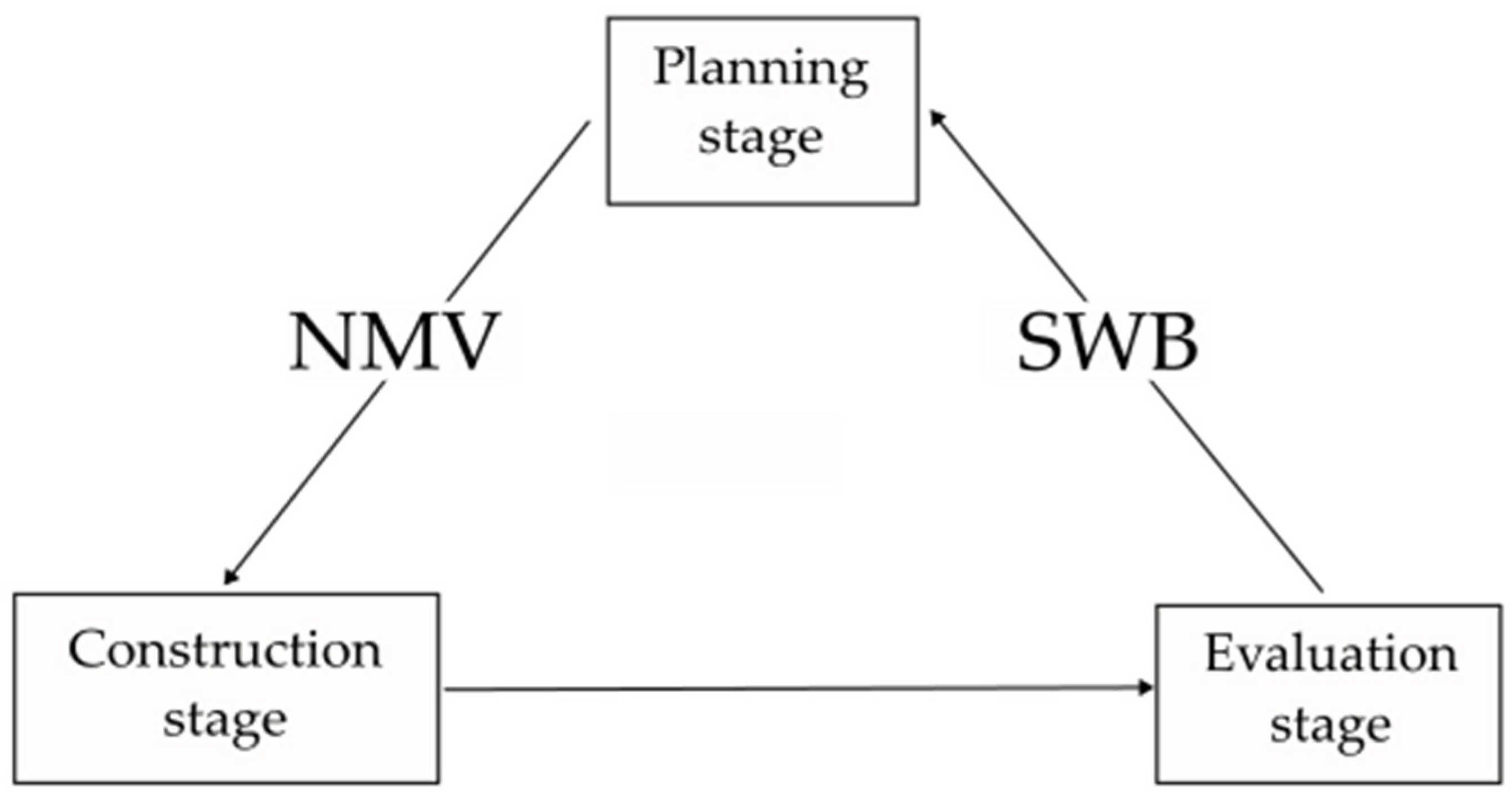
This complementarity can be exploited and optimized by using the non-market valuation measures during the planning stages and prior to the construction of urban green spaces, aiming to generate cost–benefit estimations. This information may feed decision-making procedures and provide relevant tools and directions to facilitate the justification of integrating urban green spaces into planning applications, determining also important details, such as where an urban green space should be located and when the construction should take place. On the other hand, subjective well-being measures can be applied to evaluate existing urban green spaces aiming (a) at developing a thorough understanding of their actual impact on citizens’ well-being, as well as (b) at identifying the specific characteristics of UGSs that are likely to promote or hinder the achievement of greater well-being levels. This highlights the critical role that the subjective well-being approach may have in providing better-developed guidelines, as well as planning and design protocols for urban green spaces. Therefore, the combination of the two methodological approaches seems to imply the presence of a feedback loop, in which each approach fits into a different stage of an intervention, as depicted in Figure 10.
Figure 10.
The relevance of the two methodological approaches within a project’s life cycle.
Future research should focus on unpacking additional evidence regarding the complementarity of these two methodological approaches. Over and above that, future efforts should try to integrate well-established knowledge as regards the economic benefits (values) produced by urban green spaces and their specific characteristics mediating the relationship with well-being. Transmitting this from research into practicable policy and planning applications can forge a new path of strategic multi-disciplinary interventions, leading to higher levels of quality of life and better environmental conditions within the densely built urban fabric. Furthermore, expanded knowledge related to spatial planning and design details can potentially lead to increased use of urban green spaces [115].
As already mentioned, both non-market valuation and subjective well-being approaches reflect people’s experience(s), preferences, and evaluations of a specific under-study subject and identify the individual as the only one sufficient to assess their own well-being. Thus, their application in the field of public goods and public space—such as UGSs—can provide more accurate and nuanced data and information on how residents (i.e., the group directly and/or indirectly affected via UGS planning) assess the impact of UGSs on their well-being and everyday life. In the same vein, Vondolia et al. [116] argue that the conjunction of these two approaches can yield a more profound comprehension of how the different states of subjective well-being may project on stated preference valuations, consequently affecting preference heterogeneity. Stepping forward and expanding this rationale, if these two methodological approaches are combined with collaborative practices of placemaking and participatory planning, it can be argued that a strong democratic character can be ascribed to the planning practice for urban green spaces.
Author Contributions
All authors contributed to conceptualization; methodology; writing- original draft preparation; writing-review and editing; visualization. All authors have read and agreed to the published version of the manuscript.
Funding
This research received no external funding.
Institutional Review Board Statement
Not applicable.
Informed Consent Statement
Not applicable.
Conflicts of Interest
The authors declare no conflict of interest.
Appendix A
Table A1.
List of Articles Reviewed.
Table A1.
List of Articles Reviewed.
| ID | Lead Author | Year | Title |
|---|---|---|---|
| Subjective Well-Being Articles | |||
| 1 | Samus et al. | 2022 | How do urban green spaces increase well-being? The role of perceived wildness and nature connectedness |
| 2 | Lis et al. | 2022 | How the amount of greenery in city parks impacts visitor preferences in the context of naturalness, legibility and perceived danger |
| 3 | Saint-Onge et al. | 2022 | How urban parks nurture eudaimonic and hedonic wellbeing: An explorative large scale qualitative study in Québec, Canada |
| 4 | Liu et al. | 2022 | The effect of nature exposure, nature connectedness on mental well-being and ill-being in a general Chinese population |
| 5 | Kong et al. | 2022 | How do different types and landscape attributes of urban parks affect visitors’ positive emotions? |
| 6 | Allard-Poesi, Matos, and Massu | 2022 | Not all types of nature have an equal effect on urban residents’ well-being: A structural equation model approach |
| 7 | Hung and Chang | 2022 | How do humans value urban nature? Developing the perceived biophilic design scale (PBDs) for preference and emotion |
| 8 | Wu et al. | 2022 | Urban greenness, mixed land-use, and life satisfaction: Evidence from residential locations and workplace settings in Beijing |
| 9 | Kelly et al. | 2022 | Urban greening for health and wellbeing in low-income communities: A baseline study in Melbourne, Australia |
| 10 | Holy-Hasted and Burchell | 2022 | Does public space have to be green to improve well-being? An analysis of public space across Greater London and its association to subjective well-being |
| 11 | Lin, Wood, and Lawler | 2022 | The relationship between natural environments and subjective well-being as measured by sentiment expressed on Twitter |
| 12 | Jiang and Huang | 2022 | Urban residential quarter green space and life satisfaction |
| 13 | Knight, McClean, and White | 2022 | The importance of ecological quality of public green and blue spaces for subjective well-being |
| 14 | Hu et al. | 2022 | Using natural intervention to promote subjective well-being of essential workers during public-health crises: A Study during COVID-19 pandemic |
| 15 | Cheng et al. | 2021 | Effects of urban parks on residents’ expressed happiness before and during the COVID-19 pandemic |
| 16 | Huerta and Utomo | 2021 | Evaluating the association between urban green spaces and subjective well-being in Mexico City during the COVID-19 pandemic |
| 17 | Sharifi, Nygaard, and Stone | 2021 | Heterogeneity in the subjective well-being impact of access to urban green space |
| 18 | Poortinga et al. | 2021 | The role of perceived public and private green space in subjective health and wellbeing during and after the first peak of the COVID-19 outbreak |
| 19 | Jones | 2021 | Planting urban trees to improve quality of life? The life satisfaction impacts of urban afforestation |
| 20 | Fisher et al. | 2021 | Exploring how urban nature is associated with human wellbeing in a neotropical city |
| 21 | Zhu, Wang, and Qin | 2021 | Quantity or quality? Exploring the association between public open space and mental health in urban China |
| 22 | Liu et al. | 2021 | The effect of urban nature exposure on mental health—a case study of Guangzhou |
| 23 | Maurer et al. | 2021 | More than nature: Linkages between well-being and greenspace influenced by a combination of elements of nature and non-nature in a New York City urban park |
| 24 | Wu et al. | 2021 | Perceived influence of street-level visible greenness exposure in the work and residential environment on life satisfaction: Evidence from Beijing, China |
| 25 | Maurer et al. | 2021 | Understanding Multiple Dimensions of Perceived Greenspace Accessibility and Their Effect on Subjective Well-Being During a Global Pandemic |
| 26 | Zhang et al. | 2021 | The influence of Community Sports Parks on residents’ subjective well-being: A case study of Zhuhai City, China |
| 27 | Wu et al. | 2021 | Residential self-selection in the greenness-wellbeing connection: A family composition perspective |
| 28 | Vries et al. | 2021 | In which natural environments are people happiest? Large-scale experience sampling in The Netherlands |
| 29 | Liu et al. | 2021 | Natural outdoor environments and subjective well-being in Guangzhou, China: Comparing different measures of access |
| 30 | Cameron et al. | 2020 | Where the wild things are! Do urban green spaces with greater avian biodiversity promote more positive emotions in humans? |
| 31 | Chang et al. | 2020 | Life satisfaction linked to the diversity of nature experiences and nature views from the window |
| 32 | Wu et al. | 2020 | Greenness, Perceived Pollution Hazards and Subjective Wellbeing: Evidence from China |
| 33 | Wenjie, Chen, and Ye | 2020 | Perceived spillover effects of club-based green space: Evidence from Beijing golf courses, China |
| 34 | Schnell, Harel, and Mishori | 2019 | The benefits of discrete visits in urban parks |
| 35 | Wu et al. | 2019 | Residential satisfaction about urban greenness: Heterogeneous effects across social and spatial gradients |
| 36 | Mavoa et al. | 2019 | Higher levels of greenness and biodiversity associate with greater subjective wellbeing in adults living in Melbourne, Australia |
| 37 | Navarrete-Hernandez and Laffan | 2019 | A greener urban environment: Designing green infrastructure interventions to promote citizens’ subjective wellbeing |
| 38 | Schwartz et al. | 2019 | Visitors to urban greenspace have higher sentiment and lower negativity on Twitter |
| 39 | Houlden et al. | 2019 | A spatial analysis of proximate greenspace and mental wellbeing in London |
| 40 | Yuan, Shin, and Managi | 2018 | Subjective Well-being and Environmental Quality: The Impact of Air Pollution and Green Coverage in China |
| 41 | Kim and Jin | 2018 | Does happiness data say urban parks are worth it? |
| 42 | Tsurumi, Imauji, and Managi | 2018 | Greenery and Subjective Well-being: Assessing the Monetary Value of Greenery by Type |
| 43 | Kothencz et al. | 2017 | Urban Green Space Perception and Its Contribution to Well-Being |
| 44 | White et al. | 2017 | Natural environments and subjective wellbeing: Different types of exposure are associated with different aspects of wellbeing |
| 45 | Krekel, Kolbe, and Wüstemann | 2016 | The greener, the happier? The effect of urban land use on residential well-being |
| 46 | Blessi et al. | 2015 | Cities, the Urban Green Environment, and Individual Subjective Well-Being: The Case of Milan, Italy |
| 47 | Bertram and Rehdanz | 2015 | The role of urban green space for human well-being |
| 48 | Carrus et al. | 2015 | Go greener, feel better? The positive effects of biodiversity on the well-being of individuals visiting urban and peri-urban green areas |
| 49 | Zhang, Howell, and Iyer | 2014 | Engagement with natural beauty moderates the positive relation between connectedness with nature and psychological well-being |
| 50 | McKerron and Mourato | 2013 | Happiness is greater in natural environments |
| 51 | Qin et al. | 2013 | Influence of green spaces on environmental satisfaction and physiological status of urban residents |
| Non-Market Value Articles | |||
| 52 | Cole et al. | 2022 | Expert guidance for environmental compensation is consistent with public preferences—Evidence from a choice experiment in Sweden |
| 53 | Dell’Anna et al. | 2022 | Urban Green infrastructures: How much did they affect property prices in Singapore? |
| 54 | Toledo-Gallegos et al. | 2022 | Valuing ecosystem services and disservices of blue/green infrastructure. Evidence from a choice experiment in Vietnam |
| 55 | Yan et al. | 2022 | Where did the ecosystem services value go? Adaptive supply, demand and valuation of new urban green spaces |
| 56 | Luo et al. | 2022 | Residential open space and the perception of health benefits: How much is the public willing to pay? |
| 57 | van Oijstaeijen et al. | 2022 | The politics of green infrastructure: A discrete choice experiment with Flemish local decision-makers |
| 58 | Macháč, Brabec, and Arnberger | 2022 | Exploring public preferences and preference heterogeneity for green and blue infrastructure in urban green spaces |
| 59 | Johnson and Geisenforf | 2022 | Valuing ecosystem services of sustainable urban drainage systems: A discrete choice experiment to elicit preferences and willingness to pay |
| 60 | Roberts, Glenkb, and McVittie | 2022 | Urban residents value multi-functional urban greenspaces |
| 61 | Mäntymaa et al. | 2022 | Visitors’ heterogeneous preferences for urban park management: The case of a city park in Oulu, Finland |
| 62 | Silva et al. | 2022 | Economic valuation of urban parks with historical importance: The case of Quinta do Castelo, Portugal |
| 63 | Halkos et al. | 2022 | Determinants of willingness to pay for urban parks: An empirical analysis in Greece |
| 64 | Halkos et al. | 2022 | Determinants of willingness to pay for entrance to urban parks: A quantile regression analysis |
| 65 | Stromberg et al. | 2021 | Valuing urban green amenities with an inequality lens |
| 66 | Piaggio | 2021 | The value of public urban green spaces: Measuring the effects of proximity to and size of urban green spaces on housing market values in San Jose, Costa Rica |
| 67 | Badura et al. | 2021 | Public support for urban climate adaptation policy through nature-based solutions in Prague |
| 68 | Diluiso, Guastella, and Pareglio | 2021 | Changes in urban green spaces’ value perception: A meta-analytic benefit transfer function for European cities |
| 69 | Sato, Aoshima, and Chang | 2021 | Connectedness to nature and the conservation of the urban ecosystem: Perspectives from the valuation of urban forests |
| 70 | Kim et al. | 2021 | Estimating the economic value of urban forest parks: Focusing on restorative experiences and environmental concerns |
| 71 | Gelo and Turpie | 2021 | Bayesian analysis of demand for urban green space: A contingent valuation of developing a new urban park |
| 72 | Zhou, Song, and Tan | 2021 | Public perception matters: Estimating homebuyers’ willingness to pay for urban park quality |
| 73 | Mäntymaa et al. | 2021 | Providing ecological, cultural and commercial services in an urban park: A travel cost–contingent behavior application in Finland |
| 74 | Dinda and Ghosh | 2021 | Perceived benefits, aesthetic preferences and willingness to pay for visiting urban parks: A case study in Kolkata, India |
| 75 | Zhang et al. | 2021 | The rising and heterogeneous demand for urban green space by Chinese urban residents: Evidence from Beijing |
| 76 | Liu, Hanley, and Campbell | 2020 | Linking urban air pollution with residents’ willingness to pay for greenspace: A choice experiment study in Beijing |
| 77 | Tian et al. | 2020 | Perceptions of ecosystem services, disservices and willingness-to-pay for urban green space conservation |
| 78 | Bockarjova et al. | 2020 | Property price effects of green interventions in cities: A meta-analysis and implications for gentrification |
| 79 | Xu et al. | 2020 | Uncovering the willingness-to-pay for urban green space conservation: A survey of the capital area in China |
| 80 | Sabyrbekov, Dallimer, and Navrud | 2020 | Nature affinity and willingness to pay for urban green spaces in a developing country |
| 81 | Fruth et al. | 2020 | Discrete choice experiment data for street-level urban greening in Berlin |
| 82 | Deely and Hynes | 2020 | Blue-green or grey, how much is the public willing to pay? |
| 83 | Kim et al. | 2020 | Understanding services from ecosystem and facilities provided by urban green spaces: A use of partial profile choice experiment |
| 84 | Bockarjova, Botzen, and Koetse | 2020 | Economic valuation of green and blue nature in cities: A meta-analysis |
| 85 | Neckel et al. | 2020 | Estimation of the economic value of urban parks in Brazil, the case of the City of Passo Fundo |
| 86 | Tibesigwa, Ntuli, and Lokina | 2020 | Valuing recreational ecosystem services in developing cities: The case of urban parks in Dar es Salaam, Tanzania |
| 87 | Łaszkiewicz, Czembrowski and Kronenberg | 2019 | Can proximity to urban green spaces be considered a luxury? Classifying a non-tradable good with the use of hedonic pricing method |
| 88 | Dongen and Timmermans | 2019 | Preference for different urban greenscape designs: A choice experiment using virtual environments |
| 89 | Fruth et al. | 2019 | Economic valuation of street-level urban greening: A case study from an evolving mixed-use area in Berlin |
| 90 | Daams, Sijtsma, and Veneri | 2019 | Mixed monetary and non-monetary valuation of attractive urban green space: A case study using Amsterdam house prices |
| 91 | Tavárez and Elbakidze | 2019 | Valuing recreational enhancements in the San Patricio Urban Forest of Puerto Rico: A choice experiment approach |
| 92 | Franco and Macdonald | 2018 | Measurement and valuation of urban greenness: Remote sensing and hedonic applications to Lisbon, Portugal |
| 93 | Cook et al. | 2018 | The contingent valuation study of Heiðmork, Iceland- Willingness to pay for its preservation |
| 94 | Xiao et al. | 2017 | Estimating the willingness to pay for green space services in Shanghai: Implications for social equity in urban China |
| 95 | Tu, Abildtrup, and Garcia | 2016 | Preferences for urban green spaces and peri-urban forests: An analysis of stated residential choices |
| 96 | Verbič, Slabe-Erker, and Klun | 2016 | Contingent valuation of urban public space: A case study of Ljubljana riverbanks |
| 97 | Mell et al. | 2016 | To green or not to green: Establishing the economic value of green infrastructure investments in The Wicker, Sheffield |
| 98 | Latinopoulos, Mallios, and Latinopoulos | 2016 | Valuing the benefits of an urban park project: A contingent valuation study in Thessaloniki, Greece |
| 99 | Song, Lv, and Li | 2015 | Willingness and motivation of residents to pay for conservation of urban green spaces in Jinan, China |
| 100 | Tsurumi and Managi | 2015 | Environmental value of green spaces in Japan: An application of the life satisfaction approach |
| 101 | López-Mosquera, García, and Barrena | 2014 | An extension of the Theory of Planned Behavior to predict willingness to pay for the conservation of an urban park |
| 102 | Mell et al. | 2013 | Promoting urban greening: Valuing the development of green infrastructure investments in the urban core of Manchester, UK |
| 103 | Dumenu | 2013 | What are we missing? Economic value of an urban forest in Ghana |
| 104 | Saphores and Li | 2012 | Estimating the value of urban green areas: A hedonic pricing analysis of the single-family housing market in Los Angeles, CA |
| 105 | Brander and Koetse | 2011 | The value of urban open space: Meta-analyses of contingent valuation and hedonic pricing results |
| 106 | Majumdar et al. | 2011 | Using contingent valuation to estimate the willingness of tourists to pay for urban forests: A study in Savannah, Georgia |
| 107 | Lo and Jim | 2010 | Willingness of residents to pay and motives for conservation of urban green spaces in the compact city of Hong Kong |
| 108 | Jiao and Liu | 2010 | Geographic Field Model based hedonic valuation of urban open spaces in Wuhan, China |
Appendix B
Table A2.
Themes (Focus) of the Purpose of Study.
Table A2.
Themes (Focus) of the Purpose of Study.
| Theme (Focus) | Comments | Article ID5 |
|---|---|---|
| Subjective Well-Being Articles | ||
| Explicit reference to UGS characteristics | These articles examine the effect of UGS characteristics on levels of SWB, focusing on one, or more, dimensions (Life Evaluation, Affect, Eudaimonia). | [2,3,5,6,7,11,12,15,23,28,35,36,38,43,48,49,51] |
| Focus on exposure/access to UGSs and well-being | These are the articles to which we assigned the ‘locational characteristics’, among others. | [4,6,14,18,20,22,25,27,29,31,32,34,44,45,46,47] |
| Focus on the quality and/or quantity of greenness | These articles examined issues related to the quality of green spaces, including the amount of greenery. | [8,9,13,17,19,21,24,37,39,40,41,45] |
| Green spaces versus other non-green public spaces | These studies did not investigate exclusively the effect of UGSs on SWB. Instead, they examined the association between SWB and UGSs in comparison to the correlation between SWB and other public spaces, e.g., hard-surfaced ones. | [10,30,50] |
| Typology of UGSs and well-being | These articles examined specific types of UGSs, e.g., community parks, golf parks, etc. | [1,26,33,35,42] |
| Non-Market Value Articles | ||
| Explicit reference to UGS characteristics | Public preferences/values for specific UGS characteristics. Some studies focused on citizens’ heterogeneity with regard to UGS characteristics. | [52,56,58,60,63,64,74,81,88,89,90,94,101] |
| Focus on exposure/access to UGSs and its impact on values | These are the articles to which we assigned the ‘locational characteristics’, among others. They also consider the environmental benefits of this exposure. | [55,65,66,69,76,87,92,96,100,108] |
| Focus on the overall value of UGS to support decision-making (green spaces versus other land uses) | Supporting UGS values at the city/metropolitan area level. Supporting new UGS development. | [53,57,71,72,73,77,79,80,85,93,95,97,98,99,102,103] |
| Focus on UGS services | Public preferences/values for specific (one or more than one) ecosystem services of UGS. | [54,59,61,62,67,70,82,83,86,91,106,107] |
| Typology of UGSs and values | Usually refer to meta-analysis and benefit transfer studies. | [68,78,84,104,105] |
Note: Some studies could be classified in more than one Theme. We selected to list them under the most suitable one.
Notes
| 1 | An individual consistently knows what he/she wants and needs. |
| 2 | An individual is able to make choices that affect his/her own well-being. |
| 3 | Millennium Ecosystem Assessment (MEA) defines valuation as “the process of expressing a value for a particular good or service in terms of something that can be counted (often money) but also through methods and measures from other disciplines (e.g., sociology, ecology, etc.)”. |
| 4 | Appendix B summarizes the main areas of focus of the articles included in the analysis. |
| 5 | The numbering corresponds to the ID numbering of Appendix A. |
References
- Parfit, D. Reasons and Persons; Oxford University Press: Oxford, UK, 1986; ISBN 978-0-19-824908-5. [Google Scholar]
- Dolan, P.; White, M.P.; Peasgood, T. Review of Research on the Influences on Personal Well-Being and Application to Policy Making. Report for Defra; Department for Environment, Food & Rural Affairs: London, UK, 2006. [Google Scholar]
- Harsanyi, J.C. Utilities, Preferences, and Substantive Goods. Soc. Choice Welf. 1997, 14, 129–145. [Google Scholar] [CrossRef]
- National Research Council (US). Perspectives on Biodiversity: Valuing Its Role in an Everchanging World; National Academies Press (US): Washington, DC, USA, 1999; ISBN 978-0-309-06581-8. [Google Scholar]
- Champ, P.A.; Boyle, K.J.; Brown, T.C. (Eds.) A Primer on Nonmarket Valuation (The Economics of Non-Market Goods and Resources, 13), The Economics of Non-Market Goods and Resources, 2nd ed.; Springer: Berlin/Heidelberg, Germany, 2017; ISBN 94-007-7103-7. [Google Scholar]
- Hanley, N.; Shogren, J.F.; White, B. Environmental Economics: In Theory and Practice, 2nd ed.; Red Globe Press: Basingstoke, UK, 2006; ISBN 978-0-333-97137-6. [Google Scholar]
- Birol, E.; Koundouri, P. (Eds.) Choice Experiments Informing Environmental Policy; Edward Elgar Publishing: Northampton, MA, USA, 2008; ISBN 978-1-84542-725-2. [Google Scholar]
- Boyer, T.; Polasky, S. Valuing Urban Wetlands: A Review of Non-Market Valuation Studies. Wetlands 2004, 24, 744–755. [Google Scholar] [CrossRef]
- Mendelsohn, R. An Examination of Recent Revealed Preference Valuation Methods and Results. Rev. Environ. Econ. Policy 2019, 13, 267–282. [Google Scholar] [CrossRef]
- MacKerron, G. Happiness Economics from 35 000 Feet. J. Econ. Surv. 2012, 26, 705–735. [Google Scholar] [CrossRef]
- Andrews, F.M.; Withey, S.B. Social Indicators of Well-Being; Plenum Press: New York, NY, USA, 1976. [Google Scholar]
- Easterlin, R.A. Does Economic Growth Improve the Human Lot? Some Empirical Evidence. In Nations and Households in Economic Growth; David, P.A., Reder, M.W., Eds.; Academic Press: Cambridge, MA, USA, 1974; pp. 89–125. ISBN 978-0-12-205050-3. [Google Scholar]
- Land, K.C.; Michalos, A.C. Fifty Years After the Social Indicators Movement: Has the Promise Been Fulfilled? Soc. Indic. Res. 2018, 135, 835–868. [Google Scholar] [CrossRef]
- Stiglitz, J.E.; Sen, A.; Fitoussi, J.-P. Report by the Commission on the Measurement of Economic Performance and Social Progress; The Commission: Paris, France, 2010. [Google Scholar]
- Diener, E.; Suh, E.M.; Lucas, R.E.; Smith, H.L. Subjective Well-Being: Three Decades of Progress. Psychol. Bull. 1999, 125, 276–302. [Google Scholar] [CrossRef]
- Kahneman, D.; Diener, E.; Schwarz, N. (Eds.) Well-Being: Foundations of Hedonic Psychology; Russell Sage Foundation: New York, NY, USA, 1999; ISBN 978-0-87154-424-7. [Google Scholar]
- Frey, B.S.; Stutzer, A. What Can Economists Learn from Happiness Research? J. Econ. Lit. 2002, 40, 402–435. [Google Scholar] [CrossRef]
- Moro-Egido, A.L.; Navarro, M.; Sánchez, A. Changes in Subjective Well-Being Over Time: Economic and Social Resources Do Matter. J. Happiness Stud. 2022, 23, 2009–2038. [Google Scholar] [CrossRef]
- OECD. OECD Guidelines on Measuring Subjective Well-Being; Organisation for Economic Co-operation and Development: Paris, France, 2013. [Google Scholar]
- Atkinson, S.; Bagnall, A.-M.; Corcoran, R.; South, J.; Curtis, S. Being Well Together: Individual Subjective and Community Wellbeing. J. Happiness Stud. 2020, 21, 1903–1921. [Google Scholar] [CrossRef]
- Kahneman, D.; Krueger, A.B. Developments in the Measurement of Subjective Well-Being. J. Econ. Perspect. 2006, 20, 3–24. [Google Scholar] [CrossRef]
- Huppert, F.A.; Marks, N.; Clark, A.; Siegrist, J.; Stutzer, A.; Vittersø, J.; Wahrendorf, M. Measuring Well-Being Across Europe: Description of the ESS Well-Being Module and Preliminary Findings. Soc. Indic. Res. 2009, 91, 301–315. [Google Scholar] [CrossRef]
- Diener, E. Guidelines for National Indicators of Subjective Well-Being and Ill-Being. Appl. Res. Qual. Life 2006, 1, 151–157. [Google Scholar] [CrossRef]
- Dolan, P.; White, M.P. How Can Measures of Subjective Well-Being Be Used to Inform Public Policy? Perspect. Psychol. Sci. 2007, 2, 71–85. [Google Scholar] [CrossRef] [PubMed]
- Tinkler, L.; Hicks, S. Measuring Subjective Well-Being; Office for National Statistics: London, UK, 2011. [Google Scholar]
- Diener, E. Subjective Well-Being. Psychol. Bull. 1984, 95, 542–575. [Google Scholar] [CrossRef] [PubMed]
- Kahneman, D.; Sugden, R. Experienced Utility as a Standard of Policy Evaluation. Environ. Resour. Econ. 2005, 32, 161–181. [Google Scholar] [CrossRef]
- Kimball, M.; Willis, R. Utility and Happiness; University of Michigan: Ann Arbor, MI, USA, 2006; pp. 1–67. [Google Scholar]
- OECD. Cost-Benefit Analysis and the Environment: Further Developments and Policy Use; Organisation for Economic Co-operation and Development: Paris, France, 2018. [Google Scholar]
- Van Eck, N.J.; Waltman, L. Software Survey: VOSviewer, a Computer Program for Bibliometric Mapping. Scientometrics 2010, 84, 523–538. [Google Scholar] [CrossRef]
- Krekel, C.; Kolbe, J.; Wüstemann, H. The Greener, the Happier? The Effect of Urban Land Use on Residential Well-Being. Ecol. Econ. 2016, 121, 117–127. [Google Scholar] [CrossRef]
- Sharifi, F.; Nygaard, A.; Stone, W.M. Heterogeneity in the Subjective Well-Being Impact of Access to Urban Green Space. Sustain. Cities Soc. 2021, 74, 103244. [Google Scholar] [CrossRef]
- Wu, J.; Peng, Y.; Liu, P.; Weng, Y.; Lin, J. Is the Green Inequality Overestimated? Quality Reevaluation of Green Space Accessibility. Cities 2022, 130, 103871. [Google Scholar] [CrossRef]
- Cheng, Y.; Zhang, J.; Wei, W.; Zhao, B. Effects of Urban Parks on Residents’ Expressed Happiness before and during the COVID-19 Pandemic. Landsc. Urban Plan. 2021, 212, 104118. [Google Scholar] [CrossRef]
- MacKerron, G.; Mourato, S. Happiness Is Greater in Natural Environments. Glob. Environ. Chang. 2013, 23, 992–1000. [Google Scholar] [CrossRef]
- Maurer, M.; Cook, E.M.; Yoon, L.; Visnic, O.; Orlove, B.; Culligan, P.J.; Mailloux, B.J. Understanding Multiple Dimensions of Perceived Greenspace Accessibility and Their Effect on Subjective Well-Being During a Global Pandemic. Front. Sustain. Cities 2021, 3, 709997. [Google Scholar] [CrossRef]
- Mayen Huerta, C.; Utomo, A. Evaluating the Association between Urban Green Spaces and Subjective Well-Being in Mexico City during the COVID-19 Pandemic. Health Place 2021, 70, 102606. [Google Scholar] [CrossRef] [PubMed]
- Zhang, Z.; Wang, M.; Xu, Z.; Ye, Y.; Chen, S.; Pan, Y.; Chen, J. The Influence of Community Sports Parks on Residents’ Subjective Well-Being: A Case Study of Zhuhai City, China. Habitat Int. 2021, 117, 102439. [Google Scholar] [CrossRef]
- Zhu, W.; Wang, J.; Qin, B. Quantity or Quality? Exploring the Association between Public Open Space and Mental Health in Urban China. Landsc. Urban Plan. 2021, 213, 104128. [Google Scholar] [CrossRef]
- Hung, S.-H.; Chang, C.-Y. How Do Humans Value Urban Nature? Developing the Perceived Biophilic Design Scale (PBDs) for Preference and Emotion. Urban For. Urban Green. 2022, 76, 127730. [Google Scholar] [CrossRef]
- Samus, A.; Freeman, C.; van Heezik, Y.; Krumme, K.; Dickinson, K.J.M. How Do Urban Green Spaces Increase Well-Being? The Role of Perceived Wildness and Nature Connectedness. J. Environ. Psychol. 2022, 82, 101850. [Google Scholar] [CrossRef]
- Kong, L.; Liu, Z.; Pan, X.; Wang, Y.; Guo, X.; Wu, J. How Do Different Types and Landscape Attributes of Urban Parks Affect Visitors’ Positive Emotions? Landsc. Urban Plan. 2022, 226, 104482. [Google Scholar] [CrossRef]
- Poortinga, W.; Bird, N.; Hallingberg, B.; Phillips, R.; Williams, D. The Role of Perceived Public and Private Green Space in Subjective Health and Wellbeing during and after the First Peak of the COVID-19 Outbreak. Landsc. Urban Plan. 2021, 211, 104092. [Google Scholar] [CrossRef]
- Schwartz, A.J.; Dodds, P.S.; O’Neil-Dunne, J.P.M.; Danforth, C.M.; Ricketts, T.H. Visitors to Urban Greenspace Have Higher Sentiment and Lower Negativity on Twitter. People Nat. 2019, 1, 476–485. [Google Scholar] [CrossRef]
- Halkos, G.; Leonti, A.; Sardianou, E. Determinants of Willingness to Pay for Entrance to Urban Parks: A Quantile Regression Analysis. Econ. Anal. Policy 2022, 74, 421–431. [Google Scholar] [CrossRef]
- Dinda, S.; Ghosh, S. Perceived Benefits, Aesthetic Preferences and Willingness to Pay for Visiting Urban Parks: A Case Study in Kolkata, India. Int. J. Geoheritage Park. 2021, 9, 36–50. [Google Scholar] [CrossRef]
- Mäntymaa, E.; Jokinen, M.; Juutinen, A.; Lankia, T.; Louhi, P. Providing Ecological, Cultural and Commercial Services in an Urban Park: A Travel Cost–Contingent Behavior Application in Finland. Landsc. Urban Plan. 2021, 209, 104042. [Google Scholar] [CrossRef]
- Latinopoulos, D.; Mallios, Z.; Latinopoulos, P. Valuing the Benefits of an Urban Park Project: A Contingent Valuation Study in Thessaloniki, Greece. Land Use Policy 2016, 55, 130–141. [Google Scholar] [CrossRef]
- Mäntymaa, E.; Jokinen, M.; Louhi, P.; Juutinen, A. Visitors’ Heterogeneous Preferences for Urban Park Management: The Case of a City Park in Oulu, Finland. Urban For. Urban Green. 2022, 77, 127751. [Google Scholar] [CrossRef]
- Neckel, A.; Da Silva, J.L.; Saraiva, P.P.; Kujawa, H.A.; Araldi, J.; Paladini, E.P. Estimation of the Economic Value of Urban Parks in Brazil, the Case of the City of Passo Fundo. J. Clean. Prod. 2020, 264, 121369. [Google Scholar] [CrossRef]
- Tian, Y.; Wu, H.; Zhang, G.; Wang, L.; Zheng, D.; Li, S. Perceptions of Ecosystem Services, Disservices and Willingness-to-Pay for Urban Green Space Conservation. J. Environ. Manag. 2020, 260, 110140. [Google Scholar] [CrossRef]
- Xu, F.; Wang, Y.; Xiang, N.; Tian, J.; Chen, L. Uncovering the Willingness-to-Pay for Urban Green Space Conservation: A Survey of the Capital Area in China. Resour. Conserv. Recycl. 2020, 162, 105053. [Google Scholar] [CrossRef]
- Macháč, J.; Brabec, J.; Arnberger, A. Exploring Public Preferences and Preference Heterogeneity for Green and Blue Infrastructure in Urban Green Spaces. Urban For. Urban Green. 2022, 75, 127695. [Google Scholar] [CrossRef]
- Van Oijstaeijen, W.; Van Passel, S.; Back, P.; Cools, J. The Politics of Green Infrastructure: A Discrete Choice Experiment with Flemish Local Decision-Makers. Ecol. Econ. 2022, 199, 107493. [Google Scholar] [CrossRef]
- Roberts, M.; Glenk, K.; McVittie, A. Urban Residents Value Multi-Functional Urban Greenspaces. Urban For. Urban Green. 2022, 74, 127681. [Google Scholar] [CrossRef]
- Toledo-Gallegos, V.M.; My, N.H.D.; Tuan, T.H.; Börger, T. Valuing Ecosystem Services and Disservices of Blue/Green Infrastructure. Evidence from a Choice Experiment in Vietnam. Econ. Anal. Policy 2022, 75, 114–128. [Google Scholar] [CrossRef]
- Johnson, D.; Geisendorf, S. Valuing Ecosystem Services of Sustainable Urban Drainage Systems: A Discrete Choice Experiment to Elicit Preferences and Willingness to Pay. J. Environ. Manag. 2022, 307, 114508. [Google Scholar] [CrossRef] [PubMed]
- Sato, M.; Aoshima, I.; Chang, Y. Connectedness to Nature and the Conservation of the Urban Ecosystem: Perspectives from the Valuation of Urban Forests. For. Policy Econ. 2021, 125, 102396. [Google Scholar] [CrossRef]
- Fruth, E.; Kvistad, M.; Marshall, J.; Pfeifer, L.; Rau, L.; Sagebiel, J.; Soto, D.; Tarpey, J.; Weir, J.; Winiarski, B. Discrete Choice Experiment Data for Street-Level Urban Greening in Berlin. Data Brief 2020, 28, 105027. [Google Scholar] [CrossRef]
- Tu, G.; Abildtrup, J.; Garcia, S. Preferences for Urban Green Spaces and Peri-Urban Forests: An Analysis of Stated Residential Choices. Landsc. Urban Plan. 2016, 148, 120–131. [Google Scholar] [CrossRef]
- Cao, J.; Liu, F.; Shang, M.; Zhou, X. Toward Street Vending in Post COVID-19 China: Social Networking Services Information Overload and Switching Intention. Technol. Soc. 2021, 66, 101669. [Google Scholar] [CrossRef]
- Stromberg, P.M.; Öhrner, E.; Brockwell, E.; Liu, Z. Valuing Urban Green Amenities with an Inequality Lens. Ecol. Econ. 2021, 186, 107067. [Google Scholar] [CrossRef]
- Xiao, Y.; Lu, Y.; Guo, Y.; Yuan, Y. Estimating the Willingness to Pay for Green Space Services in Shanghai: Implications for Social Equity in Urban China. Urban For. Urban Green. 2017, 26, 95–103. [Google Scholar] [CrossRef]
- Daams, M.N.; Sijtsma, F.J.; Veneri, P. Mixed Monetary and Non-Monetary Valuation of Attractive Urban Green Space: A Case Study Using Amsterdam House Prices. Ecol. Econ. 2019, 166, 106430. [Google Scholar] [CrossRef]
- Ward, F.A.; Beal, D. Valuing Nature with Travel Cost Models; Edward Elgar Publishing: Northampton, MA, USA, 2000. [Google Scholar]
- Bockarjova, M.; Botzen, W.J.W.; Koetse, M.J. Economic Valuation of Green and Blue Nature in Cities: A Meta-Analysis. Ecol. Econ. 2020, 169, 106480. [Google Scholar] [CrossRef]
- Diluiso, F.; Guastella, G.; Pareglio, S. Changes in Urban Green Spaces’ Value Perception: A Meta-Analytic Benefit Transfer Function for European Cities. Land Use Policy 2021, 101, 105116. [Google Scholar] [CrossRef]
- Carrus, G.; Scopelliti, M.; Lafortezza, R.; Colangelo, G.; Ferrini, F.; Salbitano, F.; Agrimi, M.; Portoghesi, L.; Semenzato, P.; Sanesi, G. Go Greener, Feel Better? The Positive Effects of Biodiversity on the Well-Being of Individuals Visiting Urban and Peri-Urban Green Areas. Landsc. Urban Plan. 2015, 134, 221–228. [Google Scholar] [CrossRef]
- Lis, A.; Zalewska, K.; Pardela, Ł.; Adamczak, E.; Cenarska, A.; Bławicka, K.; Brzegowa, B.; Matiiuk, A. How the Amount of Greenery in City Parks Impacts Visitor Preferences in the Context of Naturalness, Legibility and Perceived Danger. Landsc. Urban Plan. 2022, 228, 104556. [Google Scholar] [CrossRef]
- Qin, J.; Zhou, X.; Sun, C.; Leng, H.; Lian, Z. Influence of Green Spaces on Environmental Satisfaction and Physiological Status of Urban Residents. Urban For. Urban Green. 2013, 12, 490–497. [Google Scholar] [CrossRef]
- Wu, W.; Yao, Y.; Song, Y.; He, D.; Wang, R. Perceived Influence of Street-Level Visible Greenness Exposure in the Work and Residential Environment on Life Satisfaction: Evidence from Beijing, China. Urban For. Urban Green. 2021, 62, 127161. [Google Scholar] [CrossRef]
- Chang, C.; Oh, R.R.Y.; Nghiem, T.P.L.; Zhang, Y.; Tan, C.L.Y.; Lin, B.B.; Gaston, K.J.; Fuller, R.A.; Carrasco, L.R. Life Satisfaction Linked to the Diversity of Nature Experiences and Nature Views from the Window. Landsc. Urban Plan. 2020, 202, 103874. [Google Scholar] [CrossRef]
- Schnell, I.; Harel, N.; Mishori, D. The Benefits of Discrete Visits in Urban Parks. Urban For. Urban Green. 2019, 41, 179–184. [Google Scholar] [CrossRef]
- Wenjie, W.; Chen, Y.; Ye, L. Perceived Spillover Effects of Club-Based Green Space: Evidence from Beijing Golf Courses, China. Urban For. Urban Green. 2020, 48, 126518. [Google Scholar] [CrossRef]
- Kim, D.; Jin, J. Does Happiness Data Say Urban Parks Are Worth It? Landsc. Urban Plan. 2018, 178, 1–11. [Google Scholar] [CrossRef]
- Lin, Y.; Wood, S.A.; Lawler, J.J. The Relationship between Natural Environments and Subjective Well-Being as Measured by Sentiment Expressed on Twitter. Landsc. Urban Plan. 2022, 227, 104539. [Google Scholar] [CrossRef]
- Zhang, J.W.; Howell, R.T.; Iyer, R. Engagement with Natural Beauty Moderates the Positive Relation between Connectedness with Nature and Psychological Well-Being. J. Environ. Psychol. 2014, 38, 55–63. [Google Scholar] [CrossRef]
- De Vries, S.; Nieuwenhuizen, W.; Farjon, H.; van Hinsberg, A.; Dirkx, J. In Which Natural Environments Are People Happiest? Large-Scale Experience Sampling in the Netherlands. Landsc. Urban Plan. 2021, 205, 103972. [Google Scholar] [CrossRef]
- Kelly, D.; Davern, M.; Farahani, L.; Higgs, C.; Maller, C. Urban Greening for Health and Wellbeing in Low-Income Communities: A Baseline Study in Melbourne, Australia. Cities 2022, 120, 103442. [Google Scholar] [CrossRef]
- Houlden, V.; Porto de Albuquerque, J.; Weich, S.; Jarvis, S. A Spatial Analysis of Proximate Greenspace and Mental Wellbeing in London. Appl. Geogr. 2019, 109, 102036. [Google Scholar] [CrossRef]
- Liu, H.; Nong, H.; Ren, H.; Liu, K. The Effect of Nature Exposure, Nature Connectedness on Mental Well-Being and Ill-Being in a General Chinese Population. Landsc. Urban Plan. 2022, 222, 104397. [Google Scholar] [CrossRef]
- Wu, W.; Chen, W.Y.; Yun, Y.; Wang, F.; Gong, Z. Urban Greenness, Mixed Land-Use, and Life Satisfaction: Evidence from Residential Locations and Workplace Settings in Beijing. Landsc. Urban Plan. 2022, 224, 104428. [Google Scholar] [CrossRef]
- Hu, C.; Zhu, K.; Huang, K.; Yu, B.; Jiang, W.; Peng, K.; Wang, F. Using Natural Intervention to Promote Subjective Well-Being of Essential Workers during Public-Health Crises: A Study during COVID-19 Pandemic. J. Environ. Psychol. 2022, 79, 101745. [Google Scholar] [CrossRef]
- Knight, S.J.; McClean, C.J.; White, P.C.L. The Importance of Ecological Quality of Public Green and Blue Spaces for Subjective Well-Being. Landsc. Urban Plan. 2022, 226, 104510. [Google Scholar] [CrossRef]
- Yuan, L.; Shin, K.; Managi, S. Subjective Well-Being and Environmental Quality: The Impact of Air Pollution and Green Coverage in China. Ecol. Econ. 2018, 153, 124–138. [Google Scholar] [CrossRef]
- Bertram, C.; Rehdanz, K. The Role of Urban Green Space for Human Well-Being. Ecol. Econ. 2015, 120, 139–152. [Google Scholar] [CrossRef]
- Maurer, M.; Zaval, L.; Orlove, B.; Moraga, V.; Culligan, P. More than Nature: Linkages between Well-Being and Greenspace Influenced by a Combination of Elements of Nature and Non-Nature in a New York City Urban Park. Urban For. Urban Green. 2021, 61, 127081. [Google Scholar] [CrossRef]
- Kong, F.; Yin, H.; Nakagoshi, N.; Zong, Y. Urban Green Space Network Development for Biodiversity Conservation: Identification Based on Graph Theory and Gravity Modeling. Landsc. Urban Plan. 2010, 95, 16–27. [Google Scholar] [CrossRef]
- Holy-Hasted, W.; Burchell, B. Does Public Space Have to Be Green to Improve Well-Being? An Analysis of Public Space across Greater London and Its Association to Subjective Well-Being. Cities 2022, 125, 103569. [Google Scholar] [CrossRef]
- Liu, H.; Ren, H.; Remme, R.P.; Nong, H.; Sui, C. The Effect of Urban Nature Exposure on Mental Health—A Case Study of Guangzhou. J. Clean. Prod. 2021, 304, 127100. [Google Scholar] [CrossRef]
- Mavoa, S.; Davern, M.; Breed, M.; Hahs, A. Higher Levels of Greenness and Biodiversity Associate with Greater Subjective Wellbeing in Adults Living in Melbourne, Australia. Health Place 2019, 57, 321–329. [Google Scholar] [CrossRef]
- Liu, Y.; Xiao, T.; Liu, Y.; Yao, Y.; Wang, R. Natural Outdoor Environments and Subjective Well-Being in Guangzhou, China: Comparing Different Measures of Access. Urban For. Urban Green. 2021, 59, 127027. [Google Scholar] [CrossRef]
- Cameron, R.W.F.; Brindley, P.; Mears, M.; McEwan, K.; Ferguson, F.; Sheffield, D.; Jorgensen, A.; Riley, J.; Goodrick, J.; Ballard, L.; et al. Where the Wild Things Are! Do Urban Green Spaces with Greater Avian Biodiversity Promote More Positive Emotions in Humans? Urban Ecosyst. 2020, 23, 301–317. [Google Scholar] [CrossRef]
- Saint-Onge, K.; Coulombe, S.; Philibert, M.; Wiesztort, L.; Houle, J. How Urban Parks Nurture Eudaimonic and Hedonic Wellbeing: An Explorative Large Scale Qualitative Study in Québec, Canada. Wellbeing Space Soc. 2022, 3, 100095. [Google Scholar] [CrossRef]
- Jiang, Y.; Huang, G. Urban Residential Quarter Green Space and Life Satisfaction. Urban For. Urban Green. 2022, 69, 127510. [Google Scholar] [CrossRef]
- Allard-Poesi, F.; Matos, L.B.S.; Massu, J. Not All Types of Nature Have an Equal Effect on Urban Residents’ Well-Being: A Structural Equation Model Approach. Health Place 2022, 74, 102759. [Google Scholar] [CrossRef] [PubMed]
- Tavano Blessi, G.; Grossi, E.; Pieretti, G.; Ferilli, G.; Landi, A. Cities, the Urban Green Environment, and Individual Subjective Well-Being: The Case of Milan, Italy. Urban Stud. Res. 2015, 2015, e137027. [Google Scholar] [CrossRef]
- Tsurumi, T.; Imauji, A.; Managi, S. Greenery and Subjective Well-Being: Assessing the Monetary Value of Greenery by Type. Ecol. Econ. 2018, 148, 152–169. [Google Scholar] [CrossRef]
- Claris Fisher, J.; Emmerson Bicknell, J.; Nesbitt Irvine, K.; Fernandes, D.; Mistry, J.; Georgina Davies, Z. Exploring How Urban Nature Is Associated with Human Wellbeing in a Neotropical City. Landsc. Urban Plan. 2021, 212, 104119. [Google Scholar] [CrossRef]
- Cole, S.; Hasselström, L.; Jönsson, K.I.; Lindblom, E.; Söderqvist, T. Expert Guidance for Environmental Compensation Is Consistent with Public Preferences—Evidence from a Choice Experiment in Sweden. Land Use Policy 2022, 118, 106127. [Google Scholar] [CrossRef]
- Dell’Anna, F.; Bravi, M.; Bottero, M. Urban Green Infrastructures: How Much Did They Affect Property Prices in Singapore? Urban For. Urban Green. 2022, 68, 127475. [Google Scholar] [CrossRef]
- Yan, Y.; Jaung, W.; Richards, D.R.; Carrasco, L.R. Where Did the Ecosystem Services Value Go? Adaptive Supply, Demand and Valuation of New Urban Green Spaces. Resour. Conserv. Recycl. 2022, 187, 106616. [Google Scholar] [CrossRef]
- Tavárez, H.; Elbakidze, L. Valuing Recreational Enhancements in the San Patricio Urban Forest of Puerto Rico: A Choice Experiment Approach. For. Policy Econ. 2019, 109, 102004. [Google Scholar] [CrossRef]
- Sabyrbekov, R.; Dallimer, M.; Navrud, S. Nature Affinity and Willingness to Pay for Urban Green Spaces in a Developing Country. Landsc. Urban Plan. 2020, 194, 103700. [Google Scholar] [CrossRef]
- Kim, J.S.; Lee, T.J.; Hyun, S.S. Estimating the Economic Value of Urban Forest Parks: Focusing on Restorative Experiences and Environmental Concerns. J. Destin. Mark. Manag. 2021, 20, 100603. [Google Scholar] [CrossRef]
- Halkos, G.; Leonti, A.; Petropoulos, C.; Sardianou, E. Determinants of Willingness to Pay for Urban Parks: An Empirical Analysis in Greece. Land Use Policy 2022, 119, 106186. [Google Scholar] [CrossRef]
- Lo, A.Y.; Jim, C.Y. Willingness of Residents to Pay and Motives for Conservation of Urban Green Spaces in the Compact City of Hong Kong. Urban For. Urban Green. 2010, 9, 113–120. [Google Scholar] [CrossRef]
- Mell, I.C.; Henneberry, J.; Hehl-Lange, S.; Keskin, B. Promoting Urban Greening: Valuing the Development of Green Infrastructure Investments in the Urban Core of Manchester, UK. Urban For. Urban Green. 2013, 12, 296–306. [Google Scholar] [CrossRef]
- Majumdar, S.; Deng, J.; Zhang, Y.; Pierskalla, C. Using Contingent Valuation to Estimate the Willingness of Tourists to Pay for Urban Forests: A Study in Savannah, Georgia. Urban For. Urban Green. 2011, 10, 275–280. [Google Scholar] [CrossRef]
- Song, Y.; Li, J.; Wang, J.; Hao, S.; Zhu, N.; Lin, Z. Multi-Criteria Approach to Passive Space Design in Buildings: Impact of Courtyard Spaces on Public Buildings in Cold Climates. Build. Environ. 2015, 89, 295–307. [Google Scholar] [CrossRef]
- Diener, E.; Kahneman, D.; Tov, W.; Arorad, R. Income’s Association with Judgments of Life versus Feelings. In International Differences in Well-Being; Oxford University Press: New York, NY, USA, 2010; pp. 3–15. ISBN 978-0-19-973273-9. [Google Scholar]
- Boxall, P.C.; Adamowicz, W.L.; Swait, J.; Williams, M.; Louviere, J. A Comparison of Stated Preference Methods for Environmental Valuation. Ecol. Econ. 1996, 18, 243–253. [Google Scholar] [CrossRef]
- Dolan, P.; Fujiwara, D. Valuing Adult Learning: Comparing Wellbeing Valuation to Contingent Valuation; Department for Business, Innovation and Skills: London, UK, 2012. [Google Scholar]
- Bakhshi, H.; Fujiwara, D.; Mourato, S.; Lawton, R.; Dolan, P. Measuring Economic Value in Cultural Institutions: A Report Commissioned by the Arts and Humanities Research Council’s Cultural Value Project; Arts and Humanities Research Council: Swindon, UK, 2015. [Google Scholar]
- Anthun, K.S.; Maass, R.E.K.; Hope, S.; Espnes, G.A.; Bell, R.; Khan, M.; Lillefjell, M. Addressing Inequity: Evaluation of an Intervention to Improve Accessibility and Quality of a Green Space. Int. J. Environ. Res. Public Health 2019, 16, 5015. [Google Scholar] [CrossRef]
- Vondolia, G.K.; Hynes, S.; Armstrong, C.W.; Chen, W. Subjective Well-Being and Stated Preferences: Explorations from a Choice Experiment in Norway. J. Behav. Exp. Econ. 2021, 91, 101682. [Google Scholar] [CrossRef]
Disclaimer/Publisher’s Note: The statements, opinions and data contained in all publications are solely those of the individual author(s) and contributor(s) and not of MDPI and/or the editor(s). MDPI and/or the editor(s) disclaim responsibility for any injury to people or property resulting from any ideas, methods, instructions or products referred to in the content. |
© 2023 by the authors. Licensee MDPI, Basel, Switzerland. This article is an open access article distributed under the terms and conditions of the Creative Commons Attribution (CC BY) license (https://creativecommons.org/licenses/by/4.0/).