Abstract
This article presents six probability distributions from the gamma family with three parameters for the flood frequency analysis in hydrology. The choice of the gamma family of statistical distributions was driven by its frequent use in hydrology. In the Faculty of Hydrotechnics, the improvement of the estimation of maximum flows, including the methodological bases for the realization of a regionalization study with the linear moments method with the corrected parameters, was researched and is an element of novelty. The linear moments method performs better than the method of ordinary moments because it avoids the choice of skewness depending on the origin of the flows, and is the method practiced in Romania. The L-moments method conforms to the current trend for estimating the parameters of statistical distributions. Observed data from hydrometric stations are of relatively short length, so the statistical parameters that characterize them are of a sample that requires correction. The correction of the statistical parameters is proposed using the method of least squares based on the inverse functions of the statistical distributions expressed with the frequency factor for L-moments. All the necessary elements for their use are presented, such as quantile functions, the exact and approximate relations for estimating parameters, and frequency factors. A flood frequency analysis case study was carried out for the Ialomita river to verify the proposed methodology. The performance of this distributions is evaluated using Kling–Gupta and Nash–Sutcliff coefficients.
1. Introduction
The frequency analysis of extreme values in hydrology is of particular importance in the determination of the values with certain probability of occurrence, necessary in the management of water resources [1], human activities, design of hydrotechnical constructions [2,3], environment-related studies [4], and biodiversity protection, especially in the current context of climate change.
In most cases, the flood frequency analysis is performed using some of the well-known distributions in the statistical analysis of extreme values, such as Pearson III, log-Pearson III, three-parameter log-normal, and generalized extreme value [5,6].
To estimate the parameters of these types of statistical distributions, the most used methods are the method of ordinary moments (MOM) and the method of linear moments (L-moments), the latter having the advantage that it is less influenced by the length of the data series [7,8,9,10], the extreme values in the data series, or in some cases, outlier values requiring the elaboration of specific verification tests. However, a correction of the statistical parameters () of the short series of maximum flows is necessary because they differ from those of the considered statistical population, that is, of the theoretical probability distribution function.
This article presents six distributions from the gamma family, which are useful in hydrology for flood frequency analysis, namely the Kristsky–Menkel distribution (KM), the Pearson III distribution (PE3), the Wilson–Hilferty distribution (WH), the chi distribution (CHI), the inverse chi distribution (ICH), and the pseudo-Weibull distribution (PW). The inverse functions (quantiles) of the analyzed distributions do not have explicit forms; they are represented in this article with the help of the predefined function from Mathcad, which is equivalent to other functions from other dedicated programs (e.g., the Gamma.Inv function from Excel) or with the frequency factor, both for MOM and L-moments, which are presented in the Appendix B, Appendix C, Appendix D, Appendix E and Appendix F depending on skewness () and L-skewness (), for the most common exceeding probabilities in hydrology.
The methods for estimating the parameters of these distributions are the method of ordinary moments (MOM) and the method of linear moments (L-moments). In general, to estimate the parameters, it is necessary to solve some nonlinear systems of equations, which leads to various difficulties in using these distributions. Thus, for the ease applications of these distributions, parameter approximation relations are presented, which use polynomial, exponential, or rational functions.
It should be mentioned that the proposed methodology differs from the classical one popularized by Hosking [7], in that it applies a correction to the indicators obtained by the L-moments method, the method being more stable than other estimation methods but still requiring a certain correction for short data length.
New elements—such as the expressions of the cumulative complementary functions and the inverse functions for these distributions; the approximation relations for parameters estimation, for both MOM and L-moments; the distributions frequency factors for MOM and L-moments; and the approximation relations for the frequency factors for most common probability in hydrology, for PE3, WH, CHI, and PW—facilitate the ease of using these distributions in flood frequency analysis. Another new element is the correction of the statistical parameters of the data series for hydrometric stations with the method of least squares (LSM).
Thus, all the novelty elements for these distributions presented in Table 1 will help hydrology researchers to use these distributions easily.
Table 1.
Novelty elements.
The WH, CHI, ICH, and PW distributions are used for the first time in the flood frequency analysis.
The KM distribution is used for the first time in the flood frequency analysis using the L-moments method. All the raw and central moments were obtained on the basis of the algorithm presented in the Supplementary Material.
Analyses were carried out for several characteristic hydrometric stations in Romania at all levels of altitude (mountainous, hilly, and plain areas), implicitly for hydrographic basin areas from 100 km2 to 10,000 km2. In order to verify the performances of the proposed distributions, a flood frequency analysis was carried out using the Ialomita River as a case study because it is also presented in the Romanian normative NP 129/2011 [11].
The main objective of the article is the presentation of the methodological elements for the realization of a methodology based on the L-moment method necessary for the correction of various statistical indicators used later for regionalization, considering that in Romania, there are no regulations regarding this analysis.
Comparing the results and choosing the best distribution is based on the performance indicators [12]: the Kling–Gupta coefficient (KGE), the Nash–Sutcliffe coefficient (E), and diagram.
The article is organized as follows. The description of methodology, the statistical distributions (presented by their density functions), the complementary cumulative function, and the quantile function are presented in Section 2.1. The relations for exact calculation and the approximate relations for determining the parameters of the distributions are presented in Section 2.3. A methodology for determining the maximum flows using the L-moments method and correcting the statistical parameters of the data string for hydro-metric stations with LSM is presented in Section 2.4. A case study by applying these distributions in flood frequency analysis for the Ialomita river is elucidated in Section 3. Results, discussions, and conclusions are presented in Section 4 and Section 5.
2. Methodology
In various scientific materials [7,8,9,13,14], MOM was presented compared with the L-moments method, showing the advantages of the latter. However, a more mathematically rigorous presentation is needed to see the differences and advantages when applied to three-parameter distributions.
Table 2 presents the statistical parameters used for the use of three-parameter distributions [7].
where and represent the first three central ordinary moments; and represent the first three moments obtained on the basis of the L-moments method [7,8,14]; and represent the expected value, standard deviation, and the multiplication coefficient chosen according to the origin of the maximum flows [1,14,15,16], respectively.
Table 2.
Statistical parameters.
Table 2.
Statistical parameters.
| Statistical Parameters | Quantitative Measures | |
|---|---|---|
| MOM | L-Moments | |
| Expected value (arithmetic mean) | ||
| Coefficient of variation/L-coefficient of variation | ||
| Skewness/L-skewness | ||
| Skewness chosen in Romania | ||
Based on the inverse function of the distribution, these statistical parameters can be expressed as:
In Romania, the calibration of parameters with MOM is performed using moments of the first and second order, while the moment of the third order is ignored by choosing skewness by multiplying the coefficient of variation [16].
A greater stability of the distribution is obtained knowing that the parameters of the distribution curves are different from those of the observed data, especially due to the small length, an aspect defined by the Empirical Law of Averages.
In fact, the moment of the third order requires a very large series of values (n ≥ 100), thus, the need to approximate it by knowing the statistical characteristics depending on the climate correlated with the physical–geographical conditions.
In the INHGA methodology for sections that are not monitored and have a relatively small hydrographic basin area but which do not comply with [16], the coefficient of variation is ignored, adopting the value 1, without considering a proposed regionalization of it [17], leading to very large errors regarding the determination of maximum flows.
It is observed that the skewness is taken as a function of the coefficient of variation; an attempt to obtain a better estimate is often conservative, i.e., it results in higher values of the maximum flows compared with other more precise estimates, such as the least squares method (LSM). This aspect is for the benefit of safety, but it is often economically prohibitive, especially for low exceedance probabilities used in hydraulic constructions (p ≥ 5‰). In general, LSM is avoided [1] in applications of distributions from the gamma family because it results in very complex systems of nonlinear equations. This inconvenience is eliminated by using the nonlinear least squares method where the values are obtained by successive approximation (iterative methods).
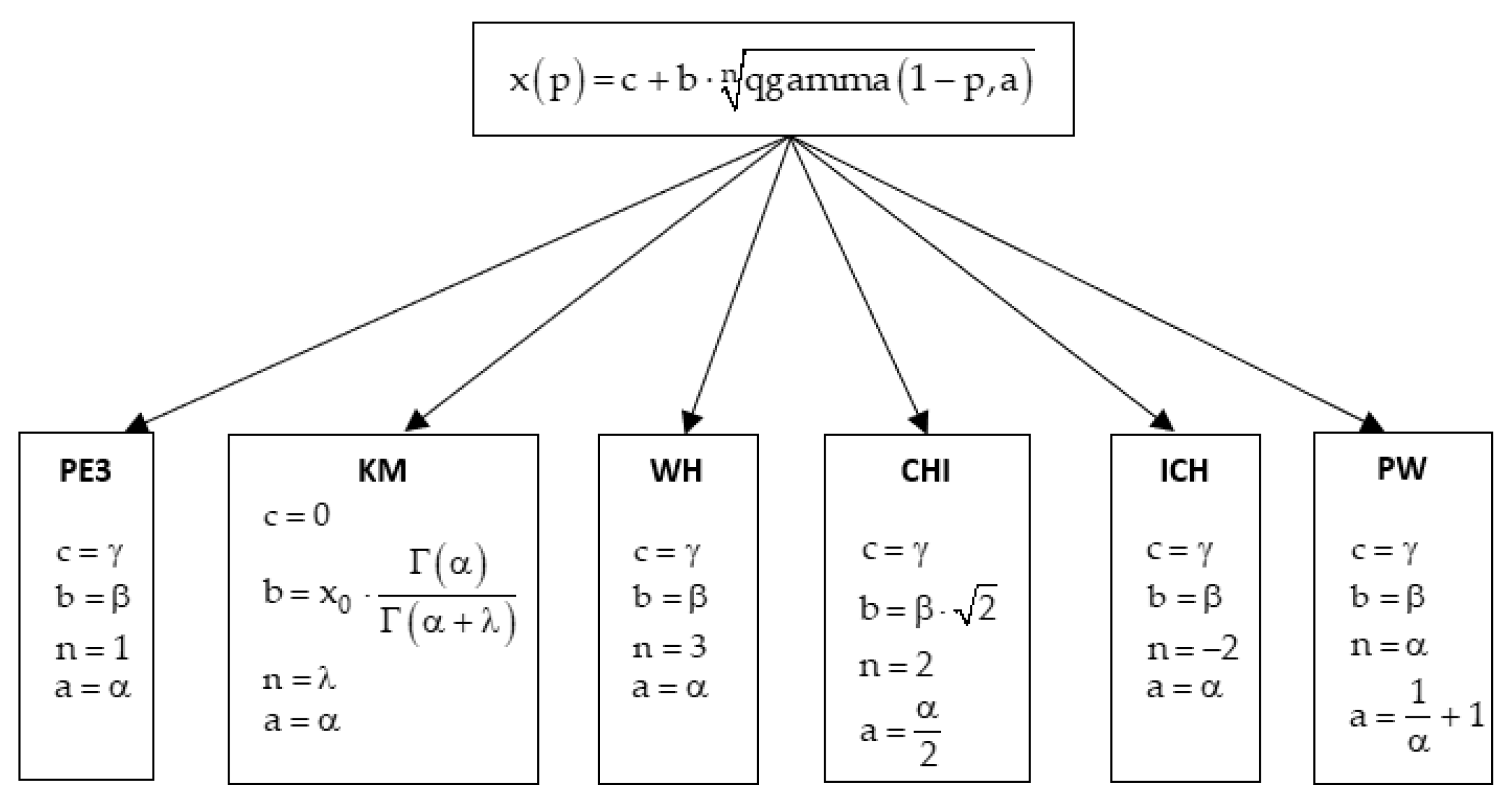
Following the analysis of the inverse functions of the gamma family distributions analyzed in this article, it can be observed that they represent forms of the inverse function of the cumulative probability distribution “parent”, having the general expression presented in Figure 1.
Figure 1.
Cases of the inverse function for the analyzed gamma family distributions.
Other particular forms of the inverse function are the distribution Pearson V (; ; ; ) [18], four-parameter generalized extreme value (; ; ; ) [19], and generalized dual gamma extreme value (; ; ; ) [20].
In the next section are presented the theoretical distributions from the gamma family analyzed in the research of the Faculty of Hydrotechnics regarding the regionalization studies of the maximum flows.
2.1. Probability Distributions
The probability density function, ; the complementary cumulative distribution function, ; and quantile function, for the analyzed distributions are:
2.2. Kritsky–Menkel (KM)
This distribution is similar to the Pearson III distribution, a special case of the four-parameter exponential gamma distribution [19,21]. It also represents a reparametrized form of the generalized gamma distribution [22]. It is also known as the generalized Weibull distribution, Stacy, hyper gamma, Nukiyama–Tanasawa, generalized semi-normal, or modified gamma [19]. It was popularized in the analysis of maximum flows by Kristky and Menkel, and starting in 1969, it became the standard distribution in the statistical analysis of maximum flows in the Soviet Union [22]. This was used in Romania as an alternative to Pearson III because it has a positive lower bound. Its application uses the linear interpolation of the values from the Kritsky–Menkel tables with values for from 0 to 2, with a step of 0.1; and for the skewness coefficient, it uses multiplication of the coefficient of variation, with values from 2 to 4, with a step of 0.5. Logarithmic interpolation of values is mandatory because linear interpolation causes errors.
where is the arithmetic mean; are the shape parameters; is the whole part of the parameter; can take any values in the range .; and can be negative or positive. If (negative skewness), then the first argument of the inverse of the distribution function gamma, , becomes .
The built-in function from Mathcad returns the inverse cumulative probability distribution for probability p for the gamma distribution, where is the inverse of the lower incomplete gamma function [23].
2.3. Pearson III (PE3)
The Pearson III distribution represents a generalized form of the two-parameter gamma distribution and a particular case of the four-parameter gamma distribution [14,24,25].
where are the shape, the scale, and the position parameters, respectively, and can take any values in the range if or if and ; represent the mean (expected value) and standard deviation, respectively. If (negative skewness), then the first argument of the inverse of the distribution function gamma, , becomes .
In Romania, the Pearson III distribution is applied using the table of Foster–Ribkin. This table is improperly used with linear interpolation.
2.4. Wilson–Hilferty (WH)
The three-parameter Wilson–Hilferty distribution is a generalized form of the two-parameter Wilson–Hilferty distribution. Both are cases of the Amoroso distribution [19].
where are the shape, the scale, and the position parameters, respectively; ; and can take any values in the range .
2.5. Chi Distribution (CHI)
The chi distribution is a particular case of the Amoroso distribution. It is also known as the Nakagami distribution [19].
where are the shape, the scale, and the position parameters, respectively; ; and can take any values in the range .
2.6. Inverse Chi Distribution (ICH)
The ICH distribution represents the inverse form of the chi distribution. It is also known as the inverse Nakagami distribution [19].
where are the shape, the scale, and the position parameters, respectively; ; and can take any values in the range .
2.7. Pseudo-Weibull Distribution (PW)
The generalized pseudo-Weibull distribution is a particular case of the Amoroso distribution. It was presented for the first time by Viorel Gh. Voda in 1989 [26].
where are the shape, the scale, and the position parameters, respectively; ; and can take any values in the range .
The quantile functions (inverse functions) of the distributions can also be expressed on the basis of the frequency factor, both for MOM and L-moments, expressed with the inverse gamma function.
For the ease of application of the PE3, WH, CHI, and PW distributions, the frequency factor can be approximately expressed with polynomial/rational functions, whose coefficients can be found in Appendix C, Appendix D, Appendix E and Appendix F for the most common exceedance probability in hydrology.
3. Parameter Estimation
The parameter estimation of the analyzed statistical distributions is presented for MOM and L-moments, two of the most used methods in hydrology for parameter estimation [13,24,27,28,29].
3.1. Kritsky–Menkel
The equations needed to estimate the parameters with MOM have the following expressions [22]:
For gamma function argument values greater than 171.6, the parameters are determined from the following system of nonlinear equations:
The parameter estimation with the L-moment method is calculated numerically (definite integrals) on the basis of the equations using the quantile of the function.
where represent the L-coefficient of variation and the L-coefficient of skewness, respectively. The integrals are calculated numerically with the Gaussian quadrature method.
3.2. Pearson III
For estimation with MOM, the distribution parameters have the following expressions [14,24,27,28]:
where represents the skewness coefficient.
The parameter estimation with the L-moment method is calculated numerically (definite integrals) on the basis of the equations using the quantile of the function.
An approximate form of parameter estimation can be adopted. The parameter can be estimated using an approximation composed of two polynomial functions and one rational, depending on the definition domain of the estimated parameter [24].
Thus, for the estimation with the L-moments, the shape parameter can be evaluated numerically with the following approximate forms, depending on L-skewness ():
if :
if :
if :
The scale parameter and the position parameter are determined by the following expressions [24]:
3.3. Wilson–Hilferty
The equations needed to estimate the parameters with MOM have the following expressions:
The shape parameter can be obtained approximately, depending on the skewness coefficient, using the following exponential function:
The parameter estimation with the L-moment method is calculated numerically (definite integrals) on the basis of the equations using the quantile of the function.
An approximate form can be adopted, which is based on the parameter estimation depending on L-skewness (), as follows:
if :
if :
if :
where , which can be approximated with the following equation:
An attempt was made to use a single approximation function for the entire L-skewness domain, but the results were unsatisfactory. Thus, considering the variation of the shape coefficient depending on L-skewness, the domain of L-skewness was discretized into three subdomains, similar to the structure of Hosking’s approximation for the shape parameter for estimation with L-moments for the Pearson III distribution [8,13].
3.4. Chi Distribution
The three equations needed to estimate the parameters with MOM are the following:
The shape parameter can be obtained approximately, depending on the skewness coefficient, using the following exponential function:
The parameter estimation with the L-moment method is calculated numerically (definite integrals) on the basis of the equations using the quantile of the function.
An approximate form can be adopted, which is based on the parameter estimation depending on L-skewness (), as follows:
if :
if :
where , which can be approximated with the following equation:
3.5. Inverse Chi Distribution
The three equations needed to estimate the parameters with MOM are the following:
The shape parameter can be obtained approximately, depending on the skewness coefficient, using the following exponential function:
The parameter estimation with the L-moment method is calculated numerically (definite integrals) on the basis of the equations using the quantile of the function.
An approximate form can be adopted, which is based on the parameter estimation, depending on L-skewness (), as follows:
where
3.6. Pseudo-Weibull Distribution
The three equations needed to estimate the parameters with MOM are the following:
The shape parameter can be obtained approximately, depending on the skewness coefficient, using the following rational function:
The parameter estimation with the L-moment method is calculated numerically (definite integrals) on the basis of the equations using the quantile of the function.
An approximate form can be adopted, which is based on the parameter estimation, depending on L-skewness (), as follows:
where
4. The Choice of Skewness
In many cases in hydrology, especially when the number of observed values is less than 100, a correction of the skewness coefficient () is necessary to estimate the parameters with MOM, [5,6,13,30].
In Romania, the is established according to the origin of flood [11,15] by multiplying the with a coefficient. The use of multiplication coefficients for the calculation of the corrected skewness is an outdated method based on principles from the abrogated norms of 1962 [31]. This fact shows the need to update them to align with modern norms and methodologies.
As part of the research in the Faculty of Hydrotechnics, series of values were generated by sampling for several theoretical distributions, and the statistical parameters of the series were calculated. With the obtained values, the statistical distributions were recalibrated, which were much different for the MOM method compared with the L-moments method. Calibration with LSM demonstrated that the theoretical curves (statistical population) are practically obtained. Mathematical statistical analysis of sampling errors was performed for all distributions in the gamma family, with an example of the error analysis for the pseudo-Weibull and Pearson III distributions being presented next.
The theoretical curves having the statistical parameters , , , , and are considered known. Sampling was carried out for number of years using Landwehr [13] empirical probability. Table 3 presents the obtained values.
Table 3.
Theoretical curve sampling results.
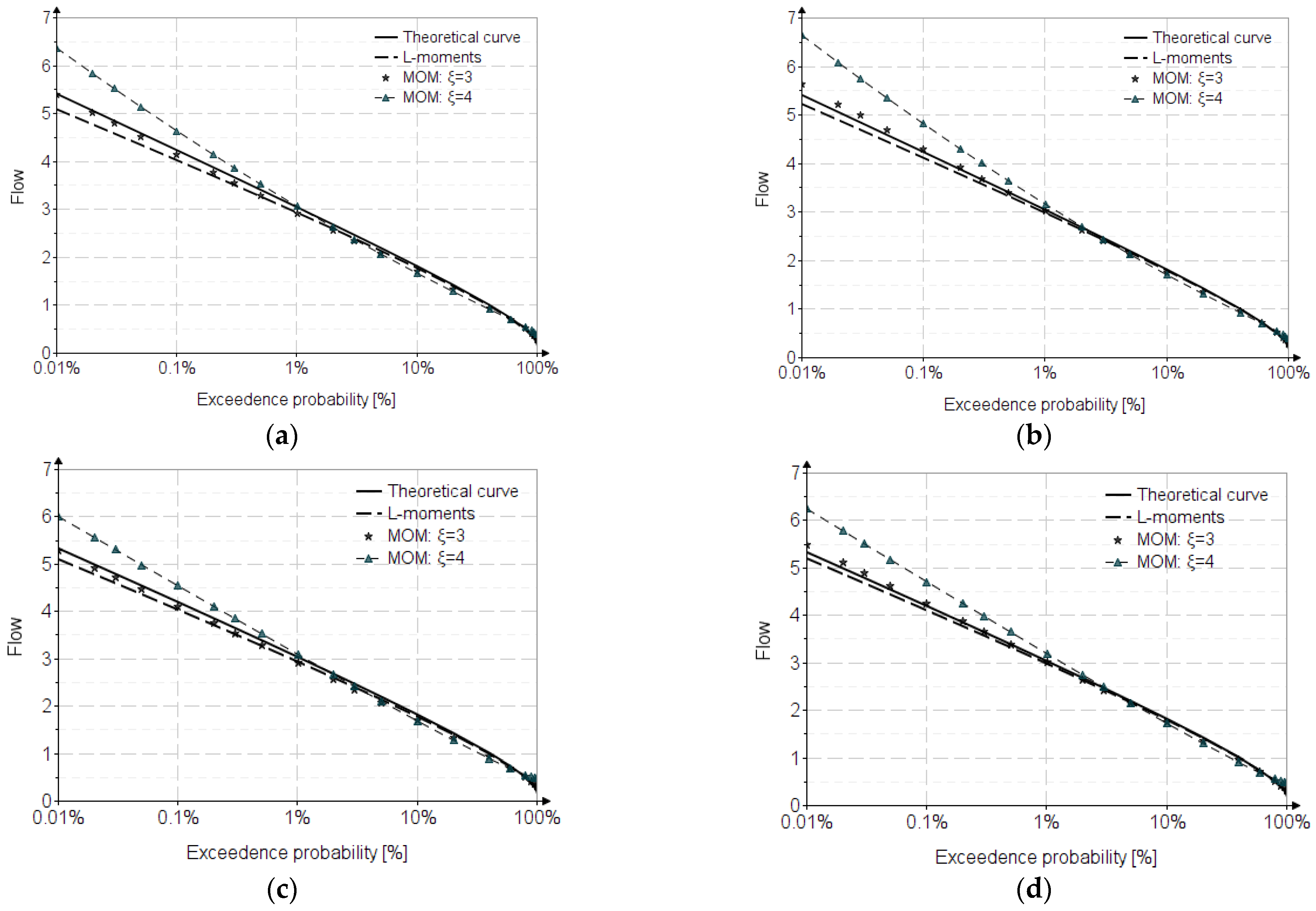
Figure 2 shows the curves obtained with the sampling parameters for and . It is observed that the curve calibrated with MOM is very sensitive to the choice of the multiplier. The Romanian regulations [16] recommend a skewness coefficient for determining the maximum flows, regardless of the flow origin. The exceedance probability curves using these multiplication factors are presented for comparison. The importance of the correct choice of skewness can be observed, which is not rigorously substantiated in Romanian regulations. This aspect leads to maximum flows for hydrotechnical constructions having very high values, resulting in a significant economic impact in terms of their safety.
Figure 2.
Theoretical and sample curves for PW and PE3. (a) Pseudo-Weibull, n = 20; (b) Pseudo-Weibull, n = 50; (c) Pearson III, n = 20; (d) Pearson III, n = 50.
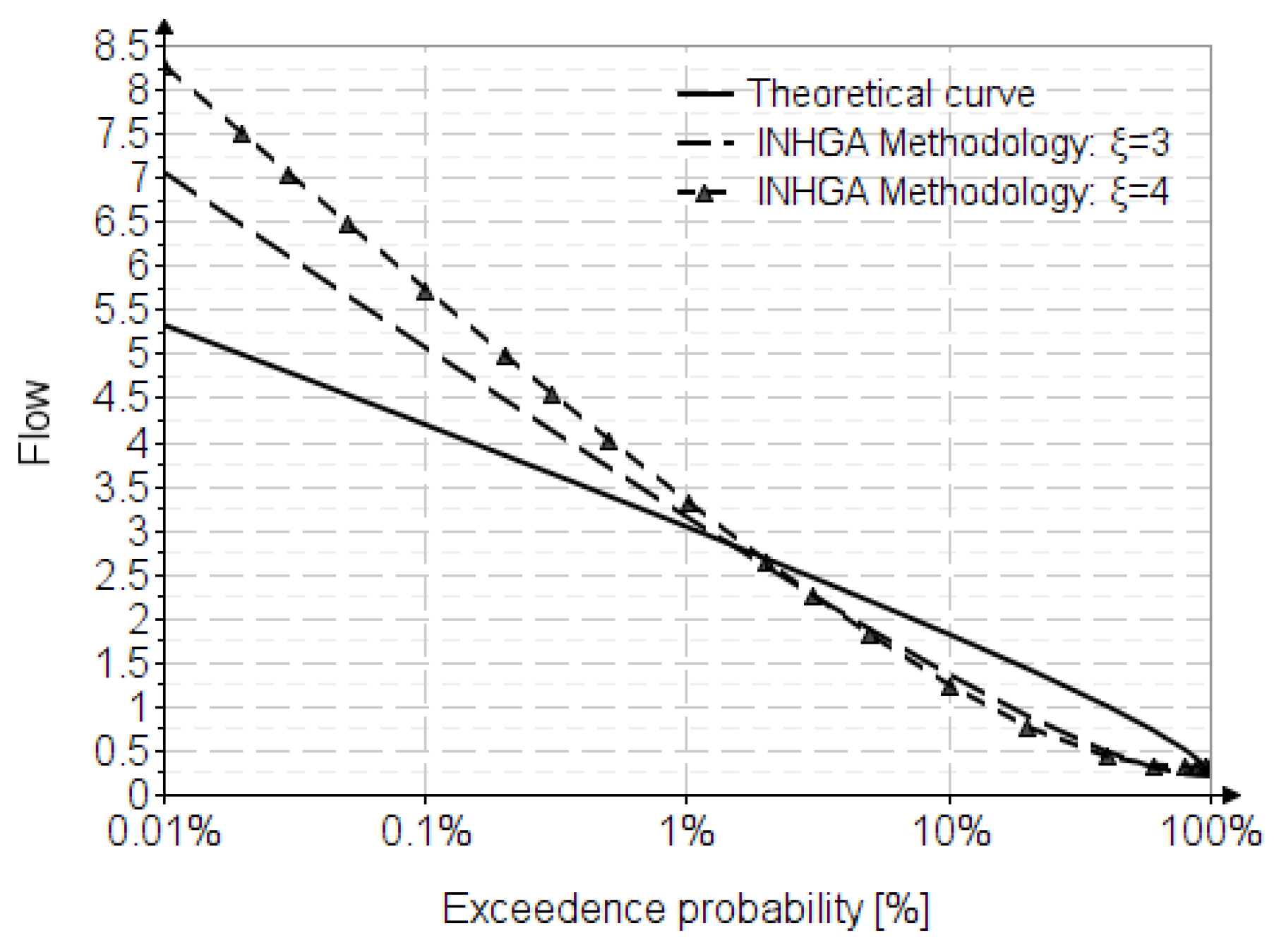
The theoretical Pearson III distribution curves applying the INHGA methodology are presented. This methodology involves multiplying the flow with a probability of exceedance of 1%, generally calculated with genetic formulas, with transition coefficients of the Pearson III distribution of and . STAS 4068/1-82 [16] specifies that this may apply only for small basins (F ≤ 50 km2); the internal rules of the INHGA specify up to 100 km2.
It is observed that it does not take into account a regionalization of , which leads to very large errors compared with the theoretical values. These errors are also amplified by the arbitrary choice of .
Figure 3 shows the graph with the theoretical curves and those used by INHGA.
Figure 3.
The theoretical curve PE3 and the curves from the INHGA methodology.
As the estimation of the parameters of the statistical distributions with the L-moments method has been established as more stable [8,13], it is required to use it for the correction of the statistical parameters of the observed data ().
The best method for estimating the corrected parameters is LSM based on the quantile with the frequency factor on L-moments of a best fit distribution.
The quantile for L-moments, expressed with the frequency factor, has the following expression:
where, .
The best fit distribution for L-moments is based on the statistical indicator recommended by [8,13], and the graph of variation between skewness and kurtosis is obtained based on L-moments, presented in Appendix A.
The LSM corrects the , , and statistical parameters. In the system of equations, appears in the frequency factor through the shape parameter.
The solutions of the system are and as well as the corrected shape parameter; the latter determines the corrected .
Solving the system of equations is achieved by numerical methods. The system of equations for the LSM is:
In the Kritski–Menkel case, where there are two parameters in the frequency factor, an additional equation appears.
The regionalization maps for the L-moments method with the corrected and can be obtained by applying the LSM to the data strings of the hydrometric stations.
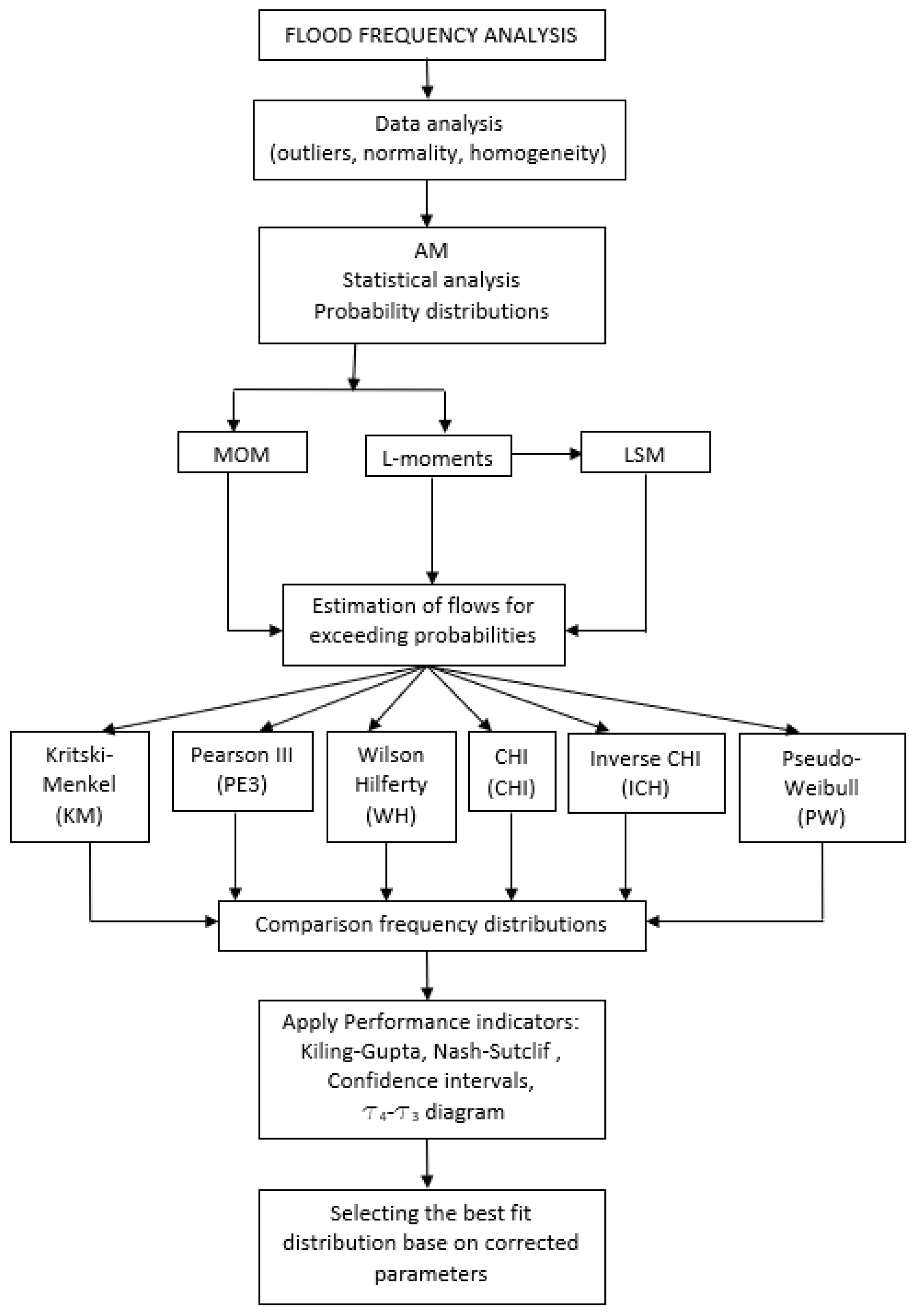
The methodological approach regarding the determination of maximum flows is presented in Figure 4.
Figure 4.
Methodological approach.
5. Application to Hydrologic Data
The case study consists of verifying the performances of this distribution through the statistical analysis of the maximum annual flows on the Ialomita River, Romania [11].
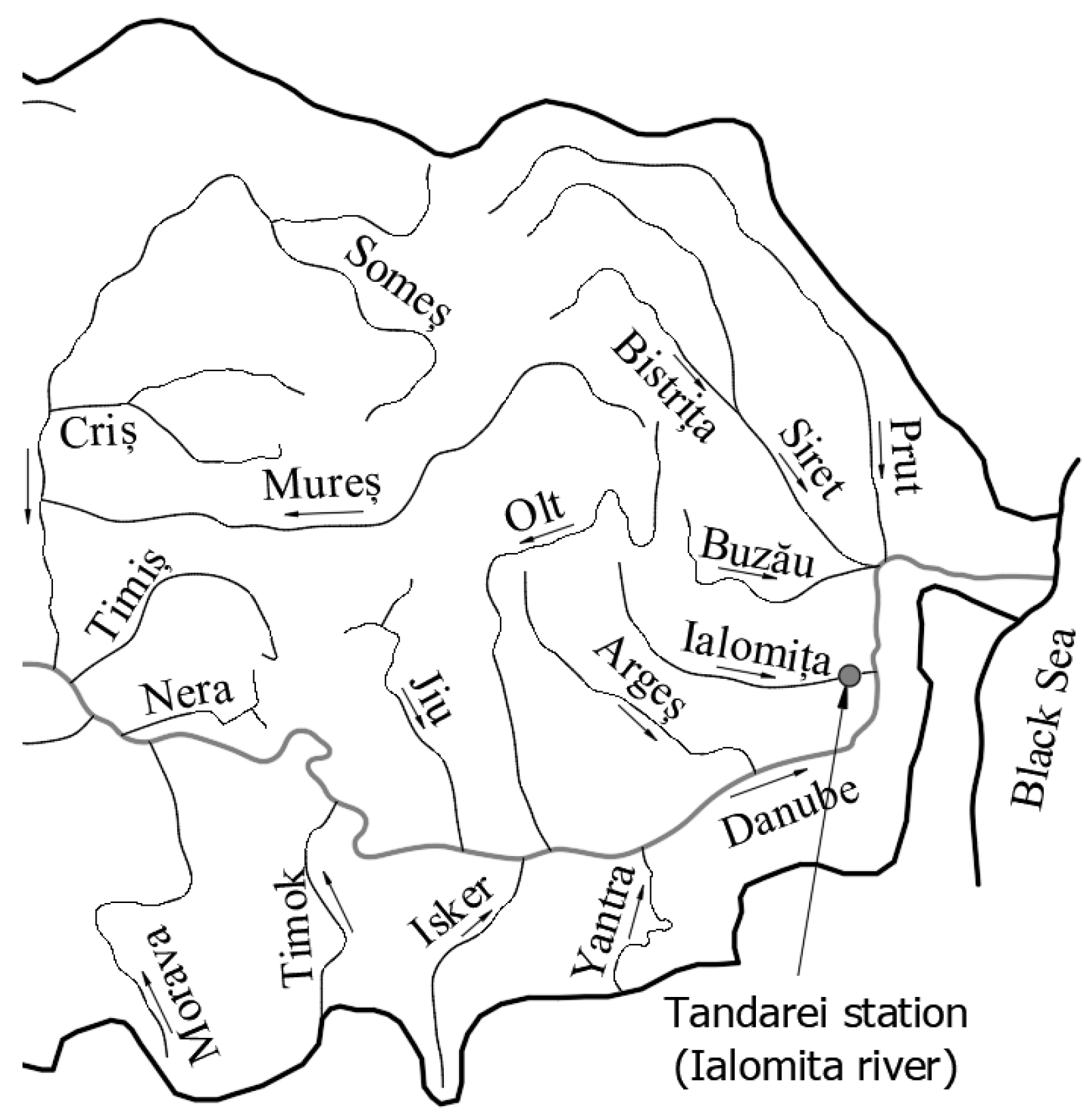
Ialomita River, code XI, is the left tributary of the Danube hydrographic basin located in the southern part of Romania (Figure 5).
Figure 5.
The Ialomita River location—Tandarei hydrometric station.
The main morphometric characteristics of the Ialomita River are presented in Table 4 [14].
Table 4.
The morphometric characteristics.
The observed data are presented in Table 5, in descending order.
Table 5.
The observed data from the Tandarei hydrometric station.
There are 33 annual records of flood, and the values of the main statistical indicators are presented in Table 6.
Table 6.
The statistical indicators of the observed values.
Table 6.
The statistical indicators of the observed values.
| (m3/s) | (m3/s) | (-) | (-) | (-) | (m3/s) | (m3/s) | (m3/s) | (m3/s) | (-) | (-) | (-) |
|---|---|---|---|---|---|---|---|---|---|---|---|
| 224.1 | 118 | 0.527 | 0.327 | 2.074 | 224.1 | 68.6 | 6.13 | 1.69 | 0.306 | 0.089 | 0.025 |
For parameter estimation with L-moments, the data series must be in ascending order for the calculation of natural estimators, namely L-moments.
6. Results
The proposed methodology and distributions were applied to perform a statistical analysis of the maximum annual flows on the Ialomita River.
The distribution parameters were estimated for MOM, L-moments, and LSM. For the MOM, the skewness coefficient was chosen depending on the origin of the flows according to Romanian regulations. Skewness is established on the basis of various multiplication coefficients for , chosen many times without reflecting the origin of the flows.
For the analyzed case study, the multiplication coefficient 2 was applied to the coefficient of variation of the data string, resulting in a skewness of 1.054, which is different from 0.327 of the observed values.
In Table 7 are presented the results values of quantile distributions for some of the most common exceedance probabilities in extreme values analysis.
Table 7.
Quantile results of the analyzed distributions.
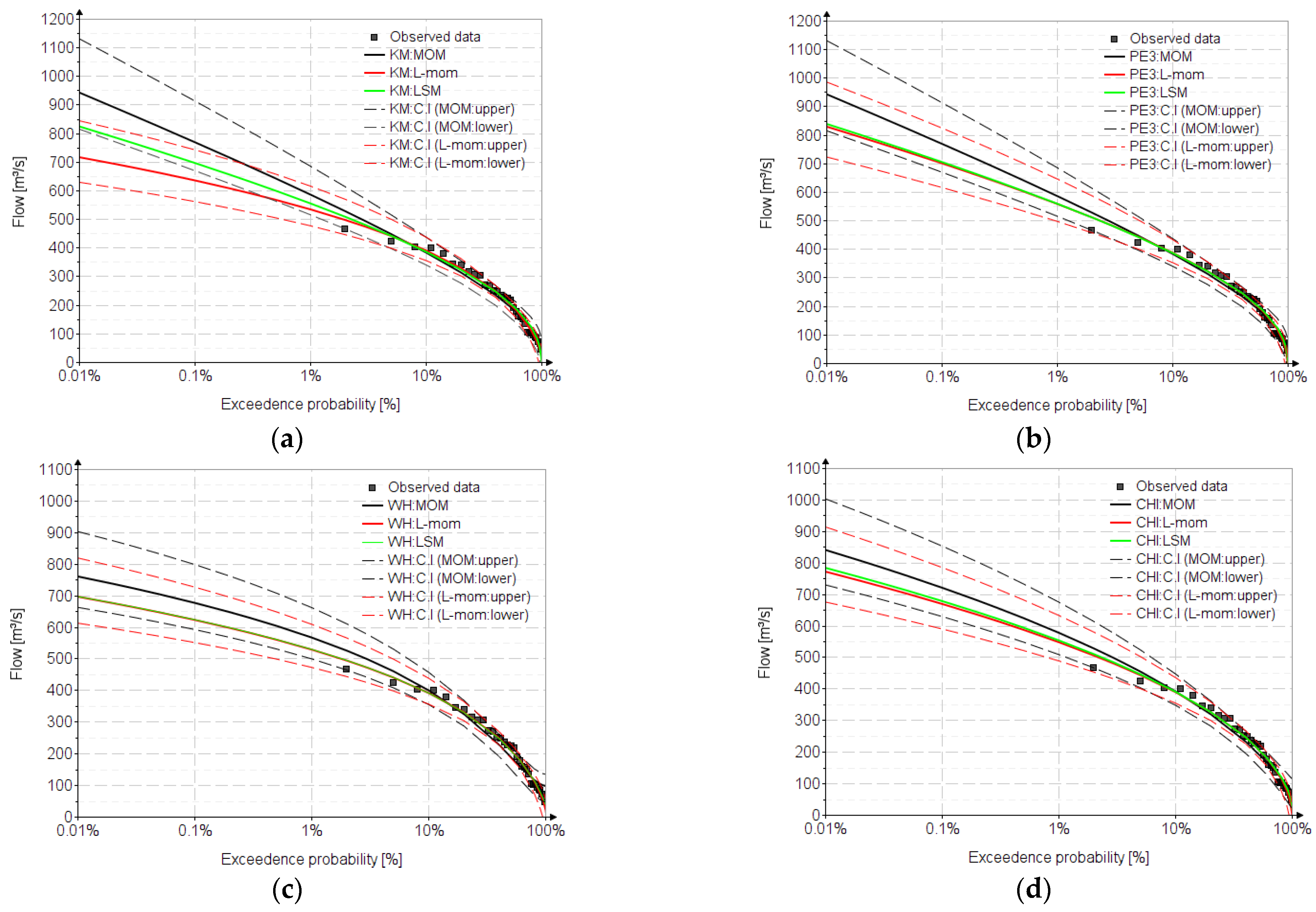
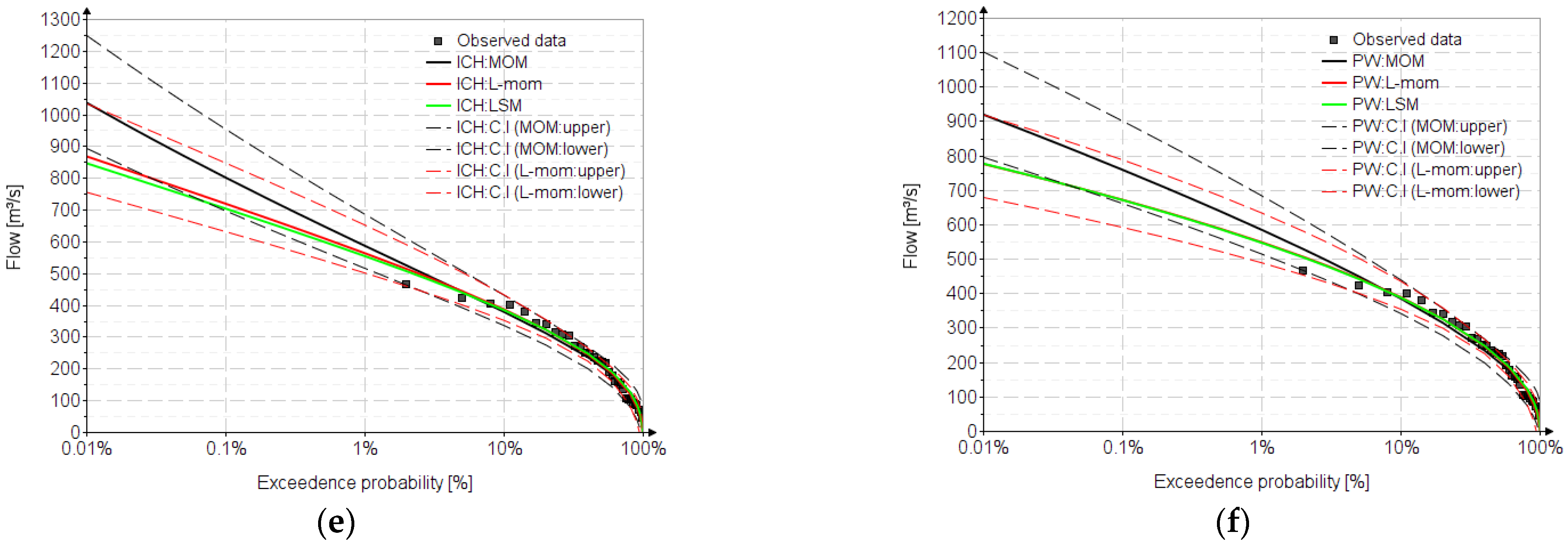
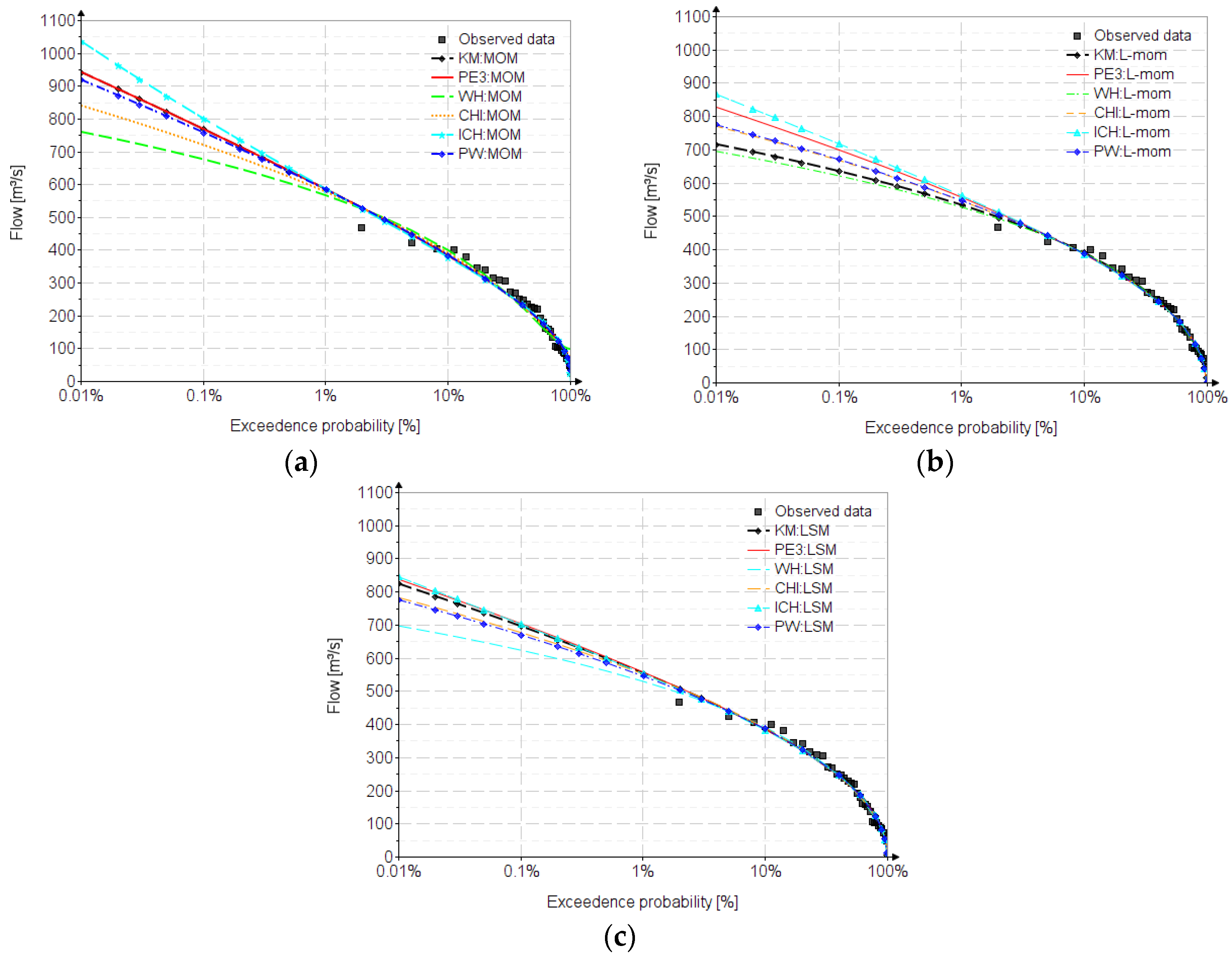
Figure 6 and Figure 7 show the fitting distributions for annual minimum flow for the Ialomita River. For plotting positions, the Landwehr formula was used.

Figure 6.
Fitting distributions. (a) Kritsky–Menkel; (b) Pearson III; (c) Wilson–Hilferty; (d) chi; (e) inverse chi; (f) pseudo-Weibull.
Figure 7.
Comparison of estimation with (a) MOM, (b) L-moments, and (c) LSM.
Table 8 shows the values of the distributions parameters for the three methods of estimation.
Table 8.
Estimated parameter values.
The performance of the analyzed distribution was evaluated using the next two statistical measures [12]: Kling–Gupta coefficient and Nash–Sutcliff coefficient, presented as follows:
- -
- Nash–Sutcliffe coefficient (E):
- -
- Kling–Gupta coefficient (KGE):
The value of the coefficients E and KGE is between 1 and . The concordance criterion is represented by the value closest to the value 1. The distributions performance values are presented in Table 9.
Table 9.
Distributions performance values.
7. Discussion
The distributions analyzed within the research of the Faculty of Hydrotechnics were exemplified in this article by the case study of the Ialomița River, Tandarei section, presenting the results obtained for the two methods of estimating the parameters of the distributions and for the LSM of correcting the statistical parameters of the observed values.
The proposed methodology was applied to this case study because the Romanian regulation regarding the determination of maximum flows uses this river as a case study, and the proposed methodology must be analyzed compared with the existing legislation.
Evaluation of the performance of distributions, the indicators Kling–Gupta coefficient, Nash–Sutcliff coefficient, and diagram were chosen, the latter having the disadvantage that it requires .
In Romania, PE3 and KM are used for flood frequency analysis. Since the gamma family distributions are frequently used in other countries as well, analysis was carried out to determine which of the distributions from this family produces the best results in the climatic and physiographic conditions in Romania. The method for estimating distribution parameters used in Romania is MOM.
Because MOM was used to estimate the parameters, the choice of the skewness coefficient is made by multiplying the with a coefficient that reflects the origin of the flows; however, this methodology has the disadvantage that the choice does not always reflect the origin of the flows. Thus, it is proposed to achieve a regionalization regarding the maximum flows using the LSM method based on the statistical parameters estimated with the L-moments method, the latter being a method less influenced by the length of the data.
Another disadvantage of using the methodology by choosing the origin of flows is the fact that, in general, in Romania, the determination of maximum flows is based on the Pearson III transition coefficients where and only for relatively small hydrographic basins.
As can be seen from the results presented in Table 8, the WH distribution produced the best results for both indicators. However, in the domain of low probabilities, this underestimates the maximum flows, preferring the PE3 and PW distributions, which are less sensitive to the length of the data. A possible disadvantage of the proposed distributions is the fact that their inverse functions are expressed using the inverse function of the gamma distribution. However, this impediment is overcome by presenting the expression relations of the inverse function using the frequency factors, both for MOM and L-moments, and their approximation relations for the most used exceedance probabilities from the flood frequency analysis.
In Romania, KM was an alternative for PE3 [16], but it is difficult to estimate the parameters. The PW distribution is a better alternative to PE3 than KM, having an inverse function similar to KM but with the advantage that the frequency factor for MOM and L-moments depends on a single shape parameter. Another advantage in choosing the PW distribution as an alternative to KM is the existence of the approximate forms for estimating the parameters and the frequency factors of the distribution for the most common exceedance probabilities in hydrology.
The correction of the statistical parameters of the data observed from the case study with LSM led to similar values for and , and the differences appear at , distinguishing three different value classes. The diagram shows that for , which is characteristic of climatic and physiographic conditions in Romania, the distribution closest to the parent (PE3) is PW.
8. Conclusions
This article presents a methodology for estimating maximum flows to replace the existing one which is outdated and a legacy from the USSR normative standards. The proposed methodology has the purpose of carrying out studies and regionalization of the maximum flows using the estimation of the parameters of the statistical distributions with the L-moments method calibrated with LSM. The calibration consists of obtaining the corrected statistical indicators () of the observed values, followed by spatial interpolation and correlations depending on the physiographic characteristics, thus obtaining the regionalization of the maximum flows on the territory of Romania.
From the sampling analysis of the theoretical curves, it was observed that the stability of the curves is better for the parameter estimation with the L-moments method compared with the currently used method (MOM). The existing methodology leads to unrealistic maximum flow values. This approach results in not only the overestimation of flows in the area of low exceedance probabilities, which leads to unsustainable costs for dams, but also the underestimation of flows for high exceedance probabilities, which are used for bankfull discharge channels.
Six distributions from the gamma family were analyzed, with the PW distribution closest to PE3, the parent distribution. The PW distribution is an easily implemented alternative to the KM distribution.
Approximation relationships of distribution parameters are presented, eliminating the need for iterative numerical calculation; in many cases, this was an inconvenience in the application of certain probability distributions.
The frequency factor quantile expression for L-moments facilitated the application of distributions for regionalization studies, being presented and applied for the first time. Another advantage is the presentation of approximation relationships of the frequency factor for exceedance probabilities common in hydrology.
The future scope is the establishment of guidelines necessary for the realization of a robust, clear, and concise normative regarding the regionalization of maximum flows using the L-moment estimation method. The final results of the research in the Faculty of Hydrotechnics will form the basis of future material [32,33].
All research was carried out by the authors in the Faculty of Hydrotechnics with data from hydrological studies in Romania.
Supplementary Materials
The following supporting information can be downloaded at: https://www.mdpi.com/article/10.3390/w15071389/s1.
Author Contributions
Conceptualization, C.I. and C.G.A.; methodology, C.I. and C.G.A.; software, C.I. and C.G.A.; validation, C.I. and C.G.A.; formal analysis, C.I. and C.G.A.; investigation, C.I. and C.G.A.; resources, C.I. and C.G.A.; data curation, C.I. and C.G.A.; writing—original draft preparation, C.I. and C.G.A.; writing—review and editing, C.I. and C.G.A.; visualization, C.I. and C.G.A.; supervision, C.I. and C.G.A.; project administration, C.I. and C.G.A.; funding acquisition, C.I. and C.G.A. All authors have read and agreed to the published version of the manuscript.
Funding
This research received no external funding.
Institutional Review Board Statement
Not applicable.
Informed Consent Statement
Not applicable.
Data Availability Statement
Not applicable.
Conflicts of Interest
The authors declare no conflict of interest.
Abbreviations
| MOM | the method of ordinary moments |
| L-moments | the method of linear moments |
| LSM | the method of least squares |
| expected value; arithmetic mean | |
| standard deviation | |
| coefficient of variation | |
| coefficient of skewness; skewness | |
| linear moments | |
| coefficient of variation based on the L-moments method | |
| coefficient of skewness based on the L-moments method | |
| coefficient of kurtosis based on the L-moments method | |
| multiplication factor | |
| PE3 | Pearson III distribution |
| KM | Kristky–Menkel distribution |
| WH | Wilson–Hilferty distribution |
| CHI | three-parameter chi distribution |
| ICH | three-parameter inverse chi distribution |
| PW | pseudo-Weibull distribution |
| INHGA | The National Institute of Hydrology and Water Management |
Appendix A. The Variation of L-Skewness and L-Kurtosis
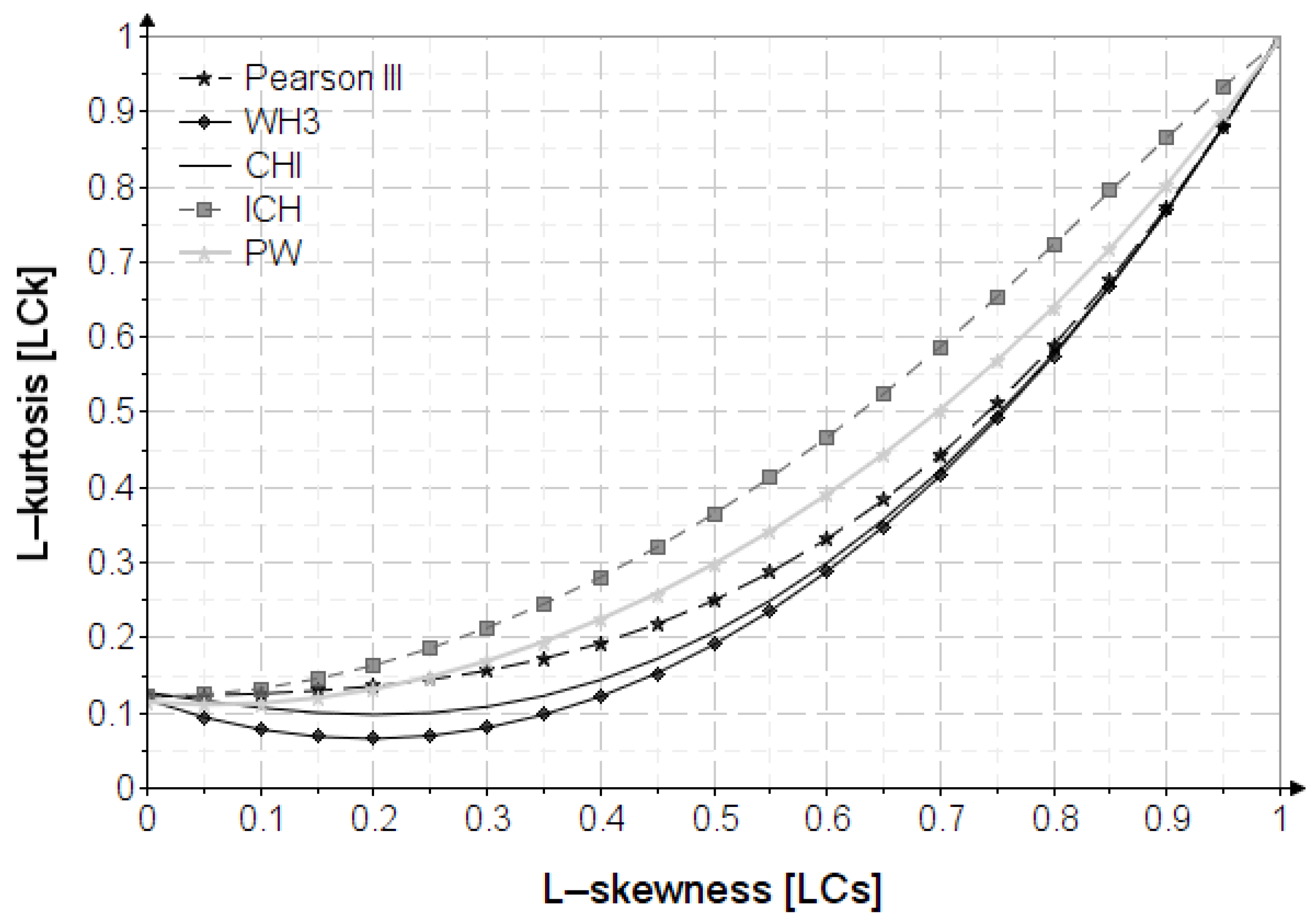
In the next section are presented the variation of L-kurtosis depending on the positive L-skewness obtained with the L-moments method for certain theoretical distributions often used in hydrology and in this article.
Figure A1.
The variation diagram of .
Appendix B. The Frequency Factors for the Analyzed Distributions
Table A1 shows the expressions of the frequency factors for MOM and L-moments.
Table A1.
Frequency factors.
Table A1.
Frequency factors.
| Distribution | ||
|---|---|---|
| Quantile Function (Inverse Function) | ||
| Method of Ordinary Moments (MOM) | L-Moments | |
| KM | ||
| PE3 | ||
| WH | ||
| CHI | ||
| ICH | ||
| PW | ||
Appendix C. Estimation of the Frequency Factor for the PE3 Distribution
The frequency factor for L-moments can be estimated using a polynomial function:
Table A2.
The frequency factor for estimation with MOM for Pearson III.
Table A2.
The frequency factor for estimation with MOM for Pearson III.
| P (%) | a | b | c | d | e | f | g | h |
|---|---|---|---|---|---|---|---|---|
| 0.01 | 3.71828 | 2.146200 | 1.55790 × 10⁻¹ | −7.69315 × 10⁻² | 1.50378 × 10⁻² | −1.72710 × 10⁻³ | 1.1060 × 10⁻⁴ | −3.033 × 10⁻⁶ |
| 0.1 | 3.09014 | 1.426290 | 4.96310 × 10⁻² | −4.21189 × 10⁻² | 7.94983 × 10⁻³ | −8.33091 × 10⁻⁴ | 4.7935 × 10⁻⁵ | −1.179 × 10⁻⁶ |
| 0.5 | 2.57601 | 0.937811 | −4.85114 × 10⁻³ | −2.43670 × 10⁻² | 4.59158 × 10⁻³ | −4.29197 × 10⁻⁴ | 2.0466 × 10⁻⁵ | −3.82 × 10⁻⁷ |
| 1 | 2.32661 | 0.733146 | −2.18707 × 10⁻² | −1.85502 × 10⁻² | 3.58677 × 10⁻³ | −3.15387 × 10⁻⁴ | 1.3017 × 10⁻⁵ | −1.71 × 10⁻⁷ |
| 2 | 2.05408 | 0.533496 | −3.42010 × 10⁻² | −1.38703 × 10⁻² | 2.86305 × 10⁻³ | −2.39574 × 10⁻⁴ | 8.3060 × 10⁻⁶ | −4.17 × 10⁻⁸ |
| 3 | 1.88115 | 0.419782 | −3.89303 × 10⁻² | −1.16643 × 10⁻² | 2.57668 × 10⁻³ | −2.13746 × 10⁻⁴ | 6.8730 × 10⁻⁶ | −5.63 × 10⁻⁹ |
| 5 | 1.64524 | 0.280836 | −4.18754 × 10⁻² | −9.45489 × 10⁻³ | 2.37315 × 10⁻³ | −2.02670 × 10⁻⁴ | 6.5730 × 10⁻⁶ | −4.92 × 10⁻⁹ |
| 10 | 1.28196 | 0.103328 | −3.95043 × 10⁻² | −7.48248 × 10⁻³ | 2.41382 × 10⁻³ | −2.31322 × 10⁻⁴ | 8.9870 × 10⁻⁶ | −8.238 × 10⁻⁸ |
| 20 | 0.842052 | −0.0526706 | −2.7535 × 10⁻² | −6.8667 × 10⁻³ | 2.9690 × 10⁻³ | −3.3372 × 10⁻⁴ | 1.4454 × 10⁻⁵ | −1.620 × 10⁻⁷ |
| 40 | 0.254237 | −0.164334 | 7.0463 × 10⁻³ | −1.5678 × 10⁻² | 7.8439 × 10⁻³ | −1.3773 × 10⁻³ | 1.0621 × 10⁻⁴ | −3.076 × 10⁻⁶ |
| 50 | 0.0006921 | −0.174131 | 1.9451 × 10⁻² | −1.8001 × 10⁻² | 1.0156 × 10⁻² | −2.0960 × 10⁻³ | 1.8921 × 10⁻⁴ | −6.3925 × 10⁻⁶ |
| 80 | −0.845883 | −0.0108923 | −4.1893 × 10⁻² | 6.4938 × 10⁻² | −2.2096 × 10⁻² | 3.3839 × 10⁻³ | −2.4937 × 10⁻⁴ | 7.203 × 10⁻⁶ |
The frequency factor for L-moments can be estimated using a polynomial function:
Table A3.
The frequency factor for estimation with L-moments for Pearson III.
Table A3.
The frequency factor for estimation with L-moments for Pearson III.
| P (%) | a | b | c | d |
|---|---|---|---|---|
| 0.01 | 6.5901 | 23.380 | 17.214 | −3.7117 |
| 0.1 | 5.4765 | 15.559 | 8.9860 | 0.47591 |
| 0.5 | 4.5651 | 10.245 | 4.4167 | 1.5525 |
| 1 | 4.1231 | 8.0174 | 2.8187 | 1.5366 |
| 2 | 3.6401 | 5.8441 | 1.4754 | 1.2797 |
| 3 | 3.3336 | 4.6063 | 0.81958 | 1.0420 |
| 5 | 2.9154 | 3.0940 | 0.14699 | 0.66702 |
| 10 | 2.2715 | 1.1625 | −0.45319 | 0.082415 |
| 20 | 1.4918 | −0.53214 | −0.63128 | −0.39305 |
| 40 | 0.44907 | −1.6990 | −0.25238 | −0.49031 |
| 50 | 4.4000 × 10⁻⁶ | −1.8140 | 4.2269 × 10⁻³ | −0.28014 |
| 80 | −1.4918 | −0.52533 | 0.62038 | 0.92798 |
| 90 | −2.2715 | 1.1681 | 0.44733 | 1.1400 |
Appendix D. Estimation of the Frequency Factor for the PW Distribution
The frequency factor for MOM can be estimated using a polynomial function:
Table A4.
The frequency factor for estimation with MOM for pseudo-Weibull.
Table A4.
The frequency factor for estimation with MOM for pseudo-Weibull.
| P (%) | a | b | c | d | e | f |
|---|---|---|---|---|---|---|
| 0.01 | 3.4996 | 1.5864 | 0.86821 | −0.23732 | 0.025030 | −9.7960 × 10⁻⁴ |
| 0.1 | 2.9199 | 1.3301 | 0.30426 | −0.12436 | 0.015293 | −6.5680 × 10⁻⁴ |
| 0.5 | 2.4562 | 1.0397 | 8.5597 × 10⁻³ | −0.046888 | 7.2443 × 10⁻³ | −3.4540 × 10⁻⁴ |
| 1 | 2.2328 | 0.88003 | −0.081686 | −0.017965 | 3.9244 × 10⁻³ | −2.0810 × 10⁻⁴ |
| 2 | 1.9883 | 0.69793 | −0.14374 | 6.1815 × 10⁻³ | 9.4670 × 10⁻⁴ | −7.9600 × 10⁻⁵ |
| 3 | 1.8324 | 0.58099 | −0.16511 | 0.017381 | −5.4670 × 10⁻⁴ | −1.2400 × 10⁻⁵ |
| 5 | 1.6181 | 0.42340 | −0.17444 | 0.027637 | −2.0649 × 10⁻³ | 5.9200 × 10⁻⁵ |
| 10 | 1.2825 | 0.19499 | −0.15223 | 0.033044 | −3.2535 × 10⁻³ | 1.2290 × 10⁻⁴ |
| 20 | 0.86399 | −0.036722 | −0.085717 | 0.026066 | −3.0572 × 10⁻³ | 1.2980 × 10⁻⁴ |
| 40 | 0.27955 | −0.22427 | 0.023522 | 3.8173 × 10⁻³ | −9.5000 × 10⁻⁴ | 5.2600 × 10⁻⁵ |
| 50 | 0.019272 | −0.25020 | 0.063046 | −6.6079 × 10⁻³ | 2.1180 × 10⁻⁴ | 4.6000 × 10⁻⁶ |
| 80 | −0.86666 | −0.069671 | 0.098113 | −0.025802 | 2.8927 × 10⁻³ | −1.2040 × 10⁻⁴ |
| 90 | −1.3247 | 0.17748 | 0.039823 | −0.019393 | 2.6296 × 10⁻³ | −1.2090 × 10⁻⁴ |
The frequency factor for L-moments can be estimated using a polynomial function:
Table A5.
The frequency factor for estimation with L-moments for pseudo-Weibull.
Table A5.
The frequency factor for estimation with L-moments for pseudo-Weibull.
| P (%) | a | b | c | d |
|---|---|---|---|---|
| 0.01 | 6.1892 | 17.503 | 27.734 | 87.400 |
| 0.1 | 5.2382 | 12.376 | 18.193 | 37.067 |
| 0.5 | 4.4311 | 8.6236 | 11.153 | 12.622 |
| 1 | 4.0301 | 6.9597 | 8.1540 | 5.2011 |
| 2 | 3.5848 | 5.2680 | 5.2722 | −0.18468 |
| 3 | 3.2983 | 4.2675 | 3.6844 | −2.3498 |
| 5 | 2.9026 | 3.0001 | 1.8468 | −4.0126 |
| 10 | 2.2826 | 1.2872 | −0.19313 | −4.3663 |
| 20 | 1.5151 | −0.35053 | −1.3496 | −2.7006 |
| 40 | 0.46429 | −1.6574 | −0.88083 | 0.13155 |
| 50 | 0.0053035 | −1.8582 | −0.17379 | 0.84985 |
| 80 | −1.5241 | −0.66641 | 2.0718 | 0.069287 |
| 90 | −2.3051 | 1.2100 | 1.3526 | −0.62836 |
Appendix E. Estimation of the Frequency Factor for the WH Distribution
The frequency factor for MOM can be estimated using a polynomial function:
Table A6.
The frequency factor for estimation with MOM for Wilson-Hilferty.
Table A6.
The frequency factor for estimation with MOM for Wilson-Hilferty.
| P (%) | a | b | c | d | e | f | g | h |
|---|---|---|---|---|---|---|---|---|
| 0.01 | 3.6510405 | 0.2505395 | 0.7676395 | −0.2464009 | 0.0512864 | −0.0067085 | 0.0004888 | −0.000015 |
| 0.1 | 3.0545055 | 0.3000583 | 0.5675829 | −0.1826804 | 0.0359966 | −0.0044818 | 0.0003147 | −0.0000094 |
| 0.5 | 2.5588885 | 0.3077142 | 0.4177707 | −0.1419139 | 0.0264387 | −0.0031008 | 0.0002072 | −0.0000059 |
| 1 | 2.3161851 | 0.2995336 | 0.3494063 | −0.1261503 | 0.0227822 | −0.0025723 | 0.0001664 | −0.0000047 |
| 2 | 2.0493565 | 0.2811829 | 0.2776375 | −0.1120499 | 0.0195234 | −0.0020986 | 0.0001322 | −0.0000036 |
| 3 | 1.8791548 | 0.2649262 | 0.2323711 | −0.1038466 | 0.0174799 | −0.0017770 | 0.0001113 | −0.0000032 |
| 5 | 1.6454272 | 0.2412568 | 0.1614119 | −0.0851039 | 0.0109925 | −0.0004410 | −0.0000055 | 0.0000004 |
| 10 | 1.2876723 | 0.1587243 | 0.1123855 | −0.0984686 | 0.0124264 | 0.0010469 | −0.0002802 | 0.0000137 |
| 20 | 0.8568022 | −0.0261822 | 0.2459759 | −0.3251841 | 0.1209999 | −0.0204256 | 0.0016521 | −0.0000522 |
| 40 | 0.221592 | 0.2283007 | −0.6972333 | 0.3479014 | −0.0756093 | 0.0080699 | −0.0003912 | 0.0000058 |
| 50 | −0.0234312 | 0.1284028 | −0.7683876 | 0.5215176 | −0.1544872 | 0.0236166 | −0.001829 | 0.0000569 |
| 80 | −0.8056988 | −0.5881204 | 0.7109393 | −0.2807399 | 0.0555428 | −0.0058035 | 0.0002953 | −0.0000053 |
| 90 | −1.2747028 | −0.3048433 | 0.9443876 | −0.5464102 | 0.1534292 | −0.0232169 | 0.0018152 | −0.0000575 |
The frequency factor for L-moments can be estimated using a polynomial function:
Table A7.
The frequency factor for estimation with L-moments for Wilson-Hilferty.
Table A7.
The frequency factor for estimation with L-moments for Wilson-Hilferty.
| P (%) | a | b | c | d |
|---|---|---|---|---|
| 0.01 | 6.4509 | 1.9071 | 41.617 | −105.32 |
| 0.1 | 5.4003 | 2.6569 | 26.320 | −60.802 |
| 0.5 | 4.5263 | 2.8800 | 16.160 | −32.938 |
| 1 | 4.0979 | 2.8467 | 12.038 | −22.373 |
| 2 | 3.6266 | 2.6984 | 8.1403 | −13.072 |
| 3 | 3.3260 | 2.5422 | 5.9927 | −8.3770 |
| 5 | 2.9141 | 2.2514 | 3.4594 | −3.4404 |
| 10 | 2.2759 | 1.6342 | 0.41013 | 1.0766 |
| 20 | 1.4978 | 0.64805 | −2.0137 | 2.5104 |
| 40 | 0.45153 | −0.88689 | −3.1967 | 1.8128 |
| 50 | −8.8000 × 10⁻⁵ | −1.5121 | −2.8183 | 2.4211 |
| 80 | −1.4975 | −2.2811 | 6.5256 | −1.7016E |
| 90 | −2.2759 | −0.68892 | 15.925 | −31.219 |
Appendix F. Estimation of the Frequency Factor for the Chi Distribution
The frequency factor for MOM can be estimated using a polynomial function:
Table A8.
The frequency factor for estimation with MOM for chi.
Table A8.
The frequency factor for estimation with MOM for chi.
| P (%) | a | b | c | d | e | f | g | h |
|---|---|---|---|---|---|---|---|---|
| 0.01 | 3.8180365 | 1.2940979 | −0.0921369 | 0.1793798 | −0.0663766 | 0.0113496 | −0.0009526 | 0.0000317 |
| 0.1 | 3.1506027 | 0.9297019 | 0.0097711 | 0.0854903 | −0.0376125 | 0.0068066 | −0.0005868 | 0.0000198 |
| 0.5 | 2.6120951 | 0.6514242 | 0.0705661 | 0.0190737 | −0.0171001 | 0.0035688 | −0.0003263 | 0.0000114 |
| 1 | 2.3532411 | 0.5253934 | 0.0912867 | −0.0090844 | −0.0083033 | 0.0021816 | −0.0002148 | 0.0000078 |
| 2 | 2.0720383 | 0.3959552 | 0.1067083 | −0.0364377 | 0.0003724 | 0.0008178 | −0.0001049 | 0.0000042 |
| 3 | 1.8944635 | 0.3189768 | 0.1123408 | −0.0517504 | 0.005335 | 0.000044 | −0.0000422 | 0.0000021 |
| 5 | 1.6530963 | 0.2219528 | 0.113368 | −0.0688344 | 0.0109944 | −0.0007973 | 0.0000254 | −0.0000002 |
| 10 | 1.2833294 | 0.092811 | 0.0982755 | −0.0830704 | 0.0152487 | −0.0009201 | −0.000008 | 0.0000019 |
| 20 | 0.8506717 | −0.1081478 | 0.2126606 | −0.2104821 | 0.0669975 | −0.009839 | 0.0006949 | −0.0000192 |
| 40 | 0.2198563 | 0.0387651 | −0.2445912 | 0.0445053 | 0.0167409 | −0.0063776 | 0.0007446 | −0.0000299 |
| 50 | −0.0495036 | 0.1528366 | −0.5577415 | 0.3104498 | −0.0757608 | 0.0094393 | −0.0005846 | 0.0000141 |
| 80 | −0.7928764 | −0.3107709 | 0.2053254 | 0.0291907 | −0.0367498 | 0.0087558 | −0.0008757 | 0.0000325 |
| 90 | −1.2094798 | −0.3843972 | 0.7941788 | −0.3843311 | 0.0923544 | −0.0121178 | 0.0008302 | −0.0000233 |
The frequency factor for L-moments can be estimated using a polynomial function:
Table A9.
The frequency factor for estimation with L-moments for chi.
Table A9.
The frequency factor for estimation with L-moments for chi.
| P (%) | a | b | c | d |
|---|---|---|---|---|
| 0.01 | 6.6340 | 20.104 | −82.733 | 290.55 |
| 0.1 | 5.4994 | 13.934 | −48.112 | 169.46 |
| 0.5 | 4.5769 | 9.4634 | −25.980 | 92.610 |
| 1 | 4.1311 | 7.5119 | −17.365 | 62.699 |
| 2 | 3.6449 | 5.5593 | −9.5834 | 35.580 |
| 3 | 3.3369 | 4.4238 | −5.5300 | 21.350 |
| 5 | 2.9172 | 3.0116 | −1.0878 | 5.5510 |
| 10 | 2.2719 | 1.1633 | 3.3838 | −10.973 |
| 20 | 1.4915 | −0.50748 | 5.2537 | −19.221 |
| 40 | 0.44887 | −1.6942 | 2.8105 | −12.662 |
| 50 | −1.3200 × 10⁻⁴ | −1.8160 | 0.54992 | −4.6652 |
| 80 | −1.4923 | −0.48443 | −7.3019 | 32.222 |
| 90 | −2.2723 | 1.2407 | −7.0520 | 39.498 |
Appendix G. Built-In Function in Mathcad and Excel
| returns the value of the Euler gamma function of x; | |
| returns the value of the incomplete gamma function of x with parameter a; | |
| returns the probability density for value x for the gamma distribution; | |
| returns the cumulative probability distribution for value x for the gamma distribution; | |
| returns the inverse cumulative probability distribution for probability p for the gamma distribution. |
This can also be found in other dedicated programs (e.g., the GAMMA.INV function in Excel).
| returns the inverse standard cumulative probability distribution for probability p for the normal distribution (NORM.INV function in Excel); | |
| returns the cumulative probability distribution for value x for the log-normal distribution; | |
| returns the inverse cumulative probability distribution for probability p for the log-normal distribution (LOGNORM.INV function in Excel); | |
| returns the error function. |
References
- Teodorescu, I.; Filotti, A.; Chiriac, V.; Ceausescu, V.; Florescu, A. Water Management; Ceres Publishing House: Bucharest, Romania, 1973. [Google Scholar]
- Popovici, A. Dams for Water Accumulations; Technical Publishing House: Bucharest, Romania, 2002; Volume 2. [Google Scholar]
- Popescu-Busan, A.-I.; Ilinca, C.; Nicoara, S.-V.; Constantin, A.T.; Anghel, C.G. Breach Forming Scenarios at Concrete Faced Rock-fill Dams. IOP Conf. Ser. Mater. Sci. Eng. 2019, 471, 102049. [Google Scholar] [CrossRef]
- Carrillo, V.; Petrie, J.; Timbe, L.; Pacheco, E.; Astudillo, W.; Padilla, C.; Cisneros, F. Validation of an Experimental Procedure to Determine Bedload Transport Rates in Steep Channels with Coarse Sediment. Water 2021, 13, 672. [Google Scholar] [CrossRef]
- Bulletin 17B Guidelines for Determining Flood Flow Frequency; Hydrology Subcommittee, Interagency Advisory Committee on Water Data, U.S. Department of the Interior, U.S. Geological Survey, Office of Water Data Coordination: Reston, VA, USA, 1981.
- Bulletin 17C Guidelines for Determining Flood Flow Frequency; U.S. Department of the Interior, U.S. Geological Survey: Reston, VA, USA, 2017.
- Hosking, J.R.M. L-moments: Analysis and Estimation of Distributions Using Linear, Combinations of Order Statistics. J. R. Statist. Soc. 1990, 52, 105–124. [Google Scholar] [CrossRef]
- Hosking, J.R.M.; Wallis, J.R. Regional Frequency Analysis, An Approach Based on L-Moments; Cambridge University Press: Cambridge, UK, 1997; ISBN 978-0-521-43045-6. [Google Scholar]
- Papukdee, N.; Park, J.-S.; Busababodhin, P. Penalized likelihood approach for the four-parameter kappa distribution. J. Appl. Stat. 2022, 49, 1559–1573. [Google Scholar] [CrossRef] [PubMed]
- Shin, Y.; Park, J.-S. Modeling climate extremes using the four-parameter kappa distribution for r-largest order statistics. Weather Clim. Extrem. 2023, 39, 100533. [Google Scholar] [CrossRef]
- The Regulations Regarding the Establishment of Maximum Flows and Volumes for the Calculation of Hydrotechnical Retention Constructions; Indicative NP 129-2011; Ministry of Regional Development and Tourism: Bucharest, Romania, 2012.
- Shaikh, M.P.; Sanjaykumar, M.; Yadav, S.; Manekar, V. Assessment of the empirical methods for the development of the synthetic unit hydrograph: A case study of a semi-arid river basin. Water Pract. Technol. 2022, 17, 139–156. [Google Scholar] [CrossRef]
- Rao, A.R.; Hamed, K.H. Flood Frequency Analysis; CRC Press LLC: Boca Raton, FL, USA, 2000. [Google Scholar]
- Ilinca, C.; Anghel, C.G. Flood-Frequency Analysis for Dams in Romania. Water 2022, 14, 2884. [Google Scholar] [CrossRef]
- Constantinescu, M.; Golstein, M.; Haram, V.; Solomon, S. Hydrology; Technical Publishing House: Bucharest, Romania, 1956. [Google Scholar]
- STAS 4068/1-82; Maximum Water Discharges and Volumes, Determination of maximum Water Discharges and Volumes of Watercourses. The Romanian Standardization Institute: Bucharest, Romania, 1982.
- Diaconu, C.; Serban, P. Syntheses and Hydrological Regionalization; Technical Publishing House: Bucharest, Romania, 1994. [Google Scholar]
- Matalas, N.C. Probability Distribution of Low Flows; Statistical Studies in Hydrology; Geological Survey, United States Government Printing Office: Washington, WA, USA, 1963.
- Crooks, G.E. Field Guide To Continuous Probability Distributions; Berkeley Institute for Theoretical Science: Berkeley, CA, USA, 2019. [Google Scholar]
- Fernando, N.; Marcelo, B.; Jeremias, L. Extended generalized extreme value distribution with applications in environmental data. Hacet. J. Math. Stat. 2016, 45, 1847–1864. [Google Scholar] [CrossRef]
- Song, S.; Kang, Y.; Song, X.; Singh, V.P. MLE-Based Parameter Estimation for Four-Parameter Exponential Gamma Distribution and Asymptotic Variance of Its Quantiles. Water 2021, 13, 2092. [Google Scholar] [CrossRef]
- Ashkar, F.; Bobée, B.; Leroux, D.; Morisette, D. The generalized method of moments as applied to the generalized gamma distribution. Stoch. Hydrol Hydraul. 1988, 2, 161–174. [Google Scholar] [CrossRef]
- Milton, A.; Irene Ann, S. Handbook of Mathematical Functions with Formulas, Graphs, and Mathematical Tables; Applied Mathematics Series; United States Department of Commerce, National Bureau of Standards: Washington, WA, USA; Dover Publications: New York, NY, USA; Volume 55, ISBN 978-0-486-61272-0.
- Anghel, C.G.; Ilinca, C. Parameter Estimation for Some Probability Distributions Used in Hydrology. Appl. Sci. 2022, 12, 12588. [Google Scholar] [CrossRef]
- Haktanir, T. Statistical modelling of annual maximum flows in Turkish rivers. Hydrol. Sci. J. 1991, 36, 367–389. [Google Scholar] [CrossRef]
- Voda, V.G. New Statistical Models in Durability Analysis; Academy Pubication House: Bucharest, Romania, 1980. (In Romanian) [Google Scholar]
- Gubareva, T.S.; Gartsman, B.I. Estimating Distribution Parameters of Extreme Hydrometeorological Characteristics by L-Moment Method. Water Resour. 2010, 37, 437–445. [Google Scholar] [CrossRef]
- Singh, V.P. Entropy-Based Parameter Estimation in Hydrology; Springer Science + Business Media: Dordrecht, The Netherlands, 1998. [Google Scholar] [CrossRef]
- Hatice, C.; Vahdettin, D.; Tefaruk, H. L−Momentler Yöntemiyle Karadeniz’e Dökülen Akarsulara Ait Yillik Anlik Maksimum Akim Değerlerinin Bölgesel Frekans Analizi. Ömer Halisdemir Üniversitesi Mühendislik Bilim. Derg. 2017, 6, 571–580. [Google Scholar] [CrossRef]
- World Meteorological Organization. (WMO-No.718) 1989 Statistical Distributions for Flood Frequency Analysis; Operational Hydrology Report no. 33; WHO: Geneva, Switzerland, 1989.
- STAS 4068/1962; Maximum Water Discharges and Volumes, Determination of maximum Water Discharges and Volumes of Watercourses. The Romanian Standardization Institute: Bucharest, Romania, 1962.
- Goia, I.; Igret, S.; Marinas, V.; Olariu, A.; Roman, M. Internships, Skills and Employability: Mapping the Field through a Bibliometric Analysis. Econ. Comput. Econ. Cybern. Stud. Res. 2022, 56, 331–348. [Google Scholar] [CrossRef]
- Stanca, S.C.; Dimache, A.N.; Ilinca, C.; Anghel, C.G. Methodology for determining hydromorphological indicators for rivers with hydropower uses. IOP Conf. Ser. Earth Environ. Sci. 2023, 1136, 012032. [Google Scholar] [CrossRef]
Disclaimer/Publisher’s Note: The statements, opinions and data contained in all publications are solely those of the individual author(s) and contributor(s) and not of MDPI and/or the editor(s). MDPI and/or the editor(s) disclaim responsibility for any injury to people or property resulting from any ideas, methods, instructions or products referred to in the content. |
© 2023 by the authors. Licensee MDPI, Basel, Switzerland. This article is an open access article distributed under the terms and conditions of the Creative Commons Attribution (CC BY) license (https://creativecommons.org/licenses/by/4.0/).