


Abstract
Seafood covering fish, crustaceans, molluscs and cephalopods is broadly recognised for its nutritional value and popularity, but it can pose some hazards to health to the potential consumer. The aim of the study was to analyse Rapid Alert System for Food and Feed (RASFF) notifications for seafood over the period 1996–2020 by hazard, year, product, notifying country, country of origin, notification type, notification basis, distribution status and action taken. The research applied cluster analysis using the joining and two-way joining methods. The main reported hazards were micro-organisms (Listeria, Salmonella, Escherichia coli, Vibrio, norovirus, mesophiles, Enterobacteriaceae and histamine), heavy metals (mercury and cadmium), veterinary products (nitrofuran, chloramphenicol and leucomalachite green), controls (poor temperature control and hygienic state), parasites (Anisakis) and additives/allergens (sulphite). The reported seafood products originated mainly from European and Asian countries and were notified on the basis of official or border controls, respectively. In order to minimize or eliminate risks, it is important to have the right activity of control authorities, appropriate legislation at the European and national levels and awareness at the different stages of the food chain.
1. Introduction
Seafood is broadly known worldwide for its high nutritional value and growing popularity among consumers. It is consumed in various forms, i.e., as fresh products, eaten raw or minimally processed, as well as salted, smoked, cured, canned and ready-to-eat [1]. Seafood can include fish, crustaceans, molluscs and cephalopods.
Due to the widespread consumption of seafood, its safety for consumers is of paramount important. Meanwhile, in the European Rapid Alert System for Food and Feed (RASFF), designed for the swift exchange of information on food posing a risk to public health, notifications relating to seafood products account for as much as about 17% of all notifications.
1.1. Characteristics of the RASFF
1.1.1. Basis for the Functioning of the System
The RASFF was established in 1979, but now operates under the Regulation (EC) No 178/2002 laying down the general principles and requirements of food law, establishing the European Food Safety Authority and laying down procedures in matters of food safety [2]. The system allows information to be shared (sent, received and responded to) between its members, namely the 27 countries of the European Union (EU), the European Commission, the European Food Safety Authority (EFSA), the European Free Trade Association Surveillance Authority (ESA), Norway, Iceland, Liechtenstein and Switzerland. Food or feed inspectors control the product on the market or at the border and, if necessary, also take samples and receive test results from the laboratory. If the product is non-compliant, it is reported to the national system. The surveillance authority then decides whether the issue falls under the RASFF and forwards it to the national RASFF contact point. The contact point in turn verifies the notification and transmits it to the European Commission using the appropriate form.
1.1.2. Types of Notifications
There are four types of notifications in the RASFF (alert, information, border rejection and news). Alert notifications are sent if food or feed poses a serious health risk on the market and rapid action is required. The system member who identifies the problem takes appropriate action (e.g., a withdrawal from the market) and triggers the alert. The purpose of this kind of notification is to provide all RASFF members with information so that they can check whether the product is on their market and initiate relevant measures. Information notifications are used if a risk has been identified in a food or feed placed on the market, but other RASFF members do not need to take rapid action. This is what is done for a product that has not reached their market, is no longer on their market or the nature of the risk does not require rapid action. Border rejections can refer to consignments that have been tested and rejected at the external borders of the EU (and more broadly the European Economic Area—EEA) after a health risk has been detected. Notifications are sent to all EEA border posts to reinforce controls and ensure that rejected products do not pass through another border post. Any other information relating to food or feed safety that may be of interest to the control authorities is reported under the heading “News” [3].
1.2. Product and Hazard Categories Related to the Seafood in the RASFF
Table 1 shows the number of notifications and their percentage for seafood groups and product categories reported in the RASFF in 1979–2020 (some of them are already obsolete). They are ordered from largest to smallest number of notifications in particular groups of products and within these groups. Due to rounding to the first decimal place, the percentages in the groups and the sum of the percentages in the categories may differ slightly.

Table 1.
The number of notifications and their percentage for seafood groups and product categories reported in the RASFF in 1979–2020.
Figure 1 and Figure 2 (cumulative stratified charts) present the number of notifications by groups of products and hazards (respectively) concerning seafood reported in the RASFF in 1979–2020. As notifications were made in 28 hazard categories, they were grouped together.
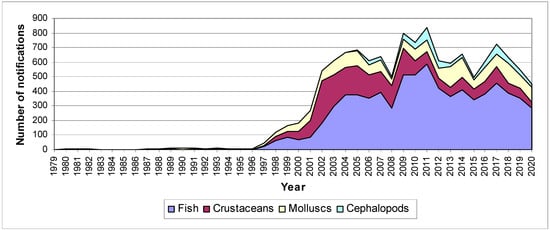
Figure 1.
Number of notifications by groups of products concerning seafood reported in the RASFF in 1979–2020.
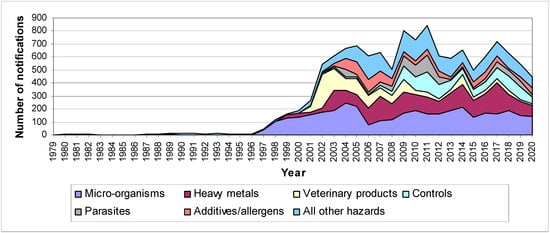
Figure 2.
Number of notifications by groups of hazards concerning seafood reported in the RASFF in 1979–2020.
Of particular attention is the significant number of notifications concerning fish (for groups of products) and micro-organisms (including also microbial and biological contaminants), and heavy metals (for groups of hazards). It should also be pointed out that notifications on seafood have only been noticeable since 1986, with the highest number reported between 2009 and 2011 (over 700), then declining significantly, with around 500 notifications in 2019–2020.
It is also worth noting some distinct increases in the number of notifications seen in Figure 1 and Figure 2. They mainly related to the presence of veterinary products in: Fish from China in 2002 and from Taiwan in 2003, as well as in crustaceans from China, India, Thailand and Vietnam in 2002 and from Bangladesh in 2009. Heavy metals were reported in more in fish from Singapore in 2003 and in crustaceans from France in 2009. For molluscs, however, the increase was related to notifications for micro-organisms. In 2013, it concerned products from France, Spain, Turkey and Vietnam, and in 2018, products from France and Spain. The increases in the number of notifications in the RASFF may also have been influenced by the introduction of border rejections since 2008, as well as the dividing of information notifications into two subtypes (information for attention and information for follow-up) since 2011 [4].
Seafood notifications are not discussed in detail in the annual RASFF reports. They only mention hazards reported against product categories involving seafood for the year covered by the annual report in question. More detailed analyses are included in the researchers’ articles, but these refer only to several years or certain products. Therefore, the aim of the study was to analyse RASFF notifications for seafood over the period 1996–2020 by hazard, year, product, notifying country, country of origin, notification type, notification basis, distribution status and action taken.
2. Materials and Methods
2.1. Data
2.1.1. Data Pre-Processing
Data was sourced from the RASFF notifications pre-2021 public information database [4] and covered product categories including seafood, namely cephalopods, crustaceans, fish and molluscs (see Table 1). It should also be added that the RASFF database currently maintained by the European Commission does not contain historical data, but only data since 2000.
The detailed product names varied widely and therefore needed to be processed in the Microsoft Excel (Microsoft Corporation, Redmond, DC, USA) using the filtering and vertical look up:
- the method of preservation of the food was omitted (e.g., frozen, chilled, dried, smoked, salted, cooked, baked, cream, paste, sauce);
- type/part of product was omitted (e.g., claws, sticks, fillets);
- species was unified (e.g., tiger shrimps changed to shrimps, Atlantic cod to cod);
- if only a word “fish”, “seafood”, Latin name was given as the product, the name of the species was not clearly defined, the species was rare, product consisted of several species, it was changed to “(other product)”.
2.1.2. Hazards Analysed
It was adopted that only notifications reported between 1996 and 2020 (the 25-year period) would be examined. Due to the small number of notifications, studying earlier years would not be meaningful (see Figure 1 and Figure 2) and would not contribute much to the study, while their removal will facilitate the interpretation of the results. Due to the very diverse nature of the hazards (252 hazard types), only hazards with more than 100 notifications were selected for detailed study. These 25 hazards that covered a total of 10,551 (83%) notifications and also other hazards reported in 1996–2020 were presented in Table 2 (from largest to smallest number of notifications in particular groups of hazards and within these groups, with a few exceptions).
Table 2.
Number of notifications on the 25 most frequently reported hazards and other hazards in seafood reported in the RASFF in 1996–2020.
The data was processed in Microsoft Excel using filtering, pivot tables, sub-totals, transposition and data reorganisation with extracting the following variables: Hazard, hazard category, year, product, notifying country, country of origin, notification type, notification basis, distribution status and action taken. For the variable notification type, the values “information for attention” and “information for follow-up” have been changed to the value “information” to align the name throughout the period considered. In the case of variables, hazard category, hazard, notification basis, distribution status and action taken empty cells (no textual value) have been filled with the phrase “(not specified)” and if there was no notification the value “0” was entered. For the variables: product, country of origin, and action taken, the number of series of values was limited to the 30 with the highest sum (due to the low readability of results on charts with a larger number of values).
2.2. Methods
The overall research (covering all 12,707 notifications) was concerned with identifying the most frequent values for each variable, i.e., product, notifying country, country of origin, notification type, notification basis, distribution status and action taken, and the results are shown in Table 3.
Table 3.
Number of notifications on seafood reported in the RASFF in 1996–2020 by variable.
The data was then transferred to the source tables in Statistica 13.3 (TIBCO Software Inc., Palo Alto, CA, USA) and subjected to cluster analysis (one of the multivariate exploratory techniques). By using cluster analysis, data can be organised into meaningful structures whose elements are similar to each other.
2.2.1. Joining Cluster Analysis
In the preliminary research (using the joining cluster analysis) examined, the similarities in 12,707 notifications reported within particular variables, i.e.,: year, product, notifying country, country of origin, notification type, notification basis, distribution status and action taken–particular values in columns of source tables, combined in relation for hazards–in rows (an analysis of the similarity between hazards and hazard categories would not be justified). The joining cluster analysis (tree clustering) was applied using the following settings: Amalgamation (linkage) rule–Ward’s method, distance measure–Euclidean distances and vertical icicle charts. The Ward’s method uses an analysis of variance to evaluate the distances between clusters, attempting to minimize the sum of the squares of any two (hypothetical) clusters that can be created at each step. This method generates clusters of small size (cluster flattening), and it is considered to be very efficient. In turn, the Euclidean distance is the geometric distance in the multidimensional space [5]. Results of joining cluster analysis were presented in Supplementary Materials in Figure S1 in panels a–h (for particular variables), i.e., 8 charts, and summarized in Table 4.
Table 4.
Results of joining cluster analysis related to notifications on seafood in the RASFF in 1996–2020.
2.2.2. Two-Way Joining Cluster Analysis
More detailed research covering 10,551 notifications (i.e., relating to the 25 most frequently reported hazards identified in Table 2) was carried out using two-way joining cluster analysis. The following variables were taken into account: Product, notifying country, country of origin, notification type, notification basis, distribution status and action taken (particular values in columns of source tables) and year (in rows). The two-way joining cluster analysis can be used when it can be expected that the values in the rows and columns can simultaneously reveal significant cluster patterns. Although the cluster structure in this method is not homogeneous by nature, it can be considered a powerful data analysis tool [5]. The similarities in the notifications were shown in the contour/discrete charts by colored squares: green, yellow, orange, red and brown, with the largest clusters expressed by the latter coolers. To increase the readability of the chart, the dark green color (occupying the largest part of the chart but expressing no or little clustering) has been changed to white. Results of two-way joining cluster analysis were presented in Supplementary Materials in Figures S2–S26 (25 hazards) in panels a–g (for particular variables), i.e., 175 charts, and summarized in Table 5, Table 6, Table 7, Table 8, Table 9, Table 10 and Table 11.
Table 5.
Results of two-way joining cluster analysis related to notifications on micro-organisms in seafood in the RASFF in 1996–2020.
Table 6.
Results of two-way joining cluster analysis related to notifications on heavy metals in seafood in the RASFF in 1996–2020.
Table 7.
Results of two-way joining cluster analysis related to notifications on veterinary products in seafood in the RASFF in 1996–2020.
Table 8.
Results of two-way joining cluster analysis related to notifications on controls in seafood in the RASFF in 1996–2020.
Table 9.
Results of two-way joining cluster analysis related to notifications on parasites (Anisakis) in seafood in the RASFF in 1996–2020.
Table 10.
Results of two-way joining cluster analysis related to notifications on additives/allergens (sulphite) in seafood in the RASFF in 1996–2020.
Table 11.
Results of two-way joining cluster analysis related to other hazards above 100 notifications in seafood in the RASFF in 1996–2020.
3. Results
3.1. Overall Results. Number of Notifications by Variable
Table 3 presents a number of notifications on seafood reported in the RASFF in 1996–2020 by particular variables and values (from largest to smallest number of notifications within particular variables). Only values with the number of notifications above 200 have been shown, and the others have been summed up as “Other”.
The most frequently notified were shrimps (13.0%), tuna (10.0%), swordfish (9.6%), salmon (5.5%), mussels (4.7%), and also prawns, calms, squid, mackerel, oysters, shark, hake and panga. It should be noted that some of the species reported live in freshwater (panga and also tilapia and catfish), but notifications to them would be a distinct minority, however their removal from the study would alter the structure of the population examined. Other species mentioned can live both in fresh or brackish water (perch and prawns) or in fresh and salt water (salmon).
Notifications were reported by Italy (34.2%), Spain (15.9%), as well as France (7.7%), the United Kingdom (7.5%) and Germany (7.4%). The notified products originated mainly from European countries, i.e., Spain (11.3%), France (5.8%), the Netherlands and Italy and Asian countries, i.e., Vietnam (8.6%), India (5.4%), China (4.8%), Thailand, Indonesia and Morocco.
The largest number of information notifications was reported (49.1%), followed by alerts (28.6%) and border rejections (22.4%). Notifications were based to a similar extent on official controls on the market (37.0%) and border controls (32.2%), after which the consignment was detained. Mostly the reported product was not distributed (18.3%), although the distribution status was also often left not specified (18.1%). Notified products were re-dispatched (15.2%), destroyed (13.8%), withdrawn from the market (12.7%) or import was not authorized (11.1%).
3.2. Results of Joining Cluster Analysis
In Table 4 presented results of joining cluster analysis (Figure S1 in Supplementary Materials) related to notifications on seafood in the RASFF in 1996–2020. Clusters and subclusters were listed starting with the most outstanding. The most similar values (directly related to each other in the charts) were mentioned first in the respective cluster or sub-cluster and linked by a long hyphen.
For the first variable analyzed (year), the similarities in notifications in the following two years (i.e., 1996–1997, 1998–1999, 2002–2003, 2004–2005 and 2012–2016) are noteworthy. Problems with notified hazards therefore often either lasted for two years or only at the turn of the years mentioned. In terms of products, notifications against swordfish occurred in such large numbers that a one-element cluster was formed. Notifications for salmon and tuna, clams and mussels, cuttlefish and octopus, hake and mackerel were similar, meaning that these species were affected by the same hazards (due to similar environment, area of occurrence or mode of functioning of the organism). In the case of the notifying country, the large number of notifications made by Italy resulted in a separate one-element cluster being created here as well. It is worth noting, however, that notifications were reported in a similar way by geographically close countries, that is, Belgium and the Netherlands, Denmark and Sweden, Austria and Poland, and Greece and Portugal. The pairs of countries share similar climatic conditions, and in the case of the first two pairs, close trade relations can also be said to exist.
Regarding the next variable (country of origin), for some country pairs it can also be seen that similar hazards were present in geographically close countries (Bangladesh and Thailand, Denmark and Germany, Brazil and Ecuador). However, here too, a one-element cluster emerged (Spain), indicating a high number of notifications against products originating from this country.
In the case of the variable notification type, a separate one-element cluster was created by border rejections, which involved products being stopped at the external border of the European Union. In turn, alert and information notifications sent against products already in the common market were similar. However, a similarity can be noted for another variable (notification basis) resulting from market and border controls carried out by the authorities of individual European countries. It is noteworthy that there were also similarities in notifications based on companies’ own checks, as well as food poisoning, which may have been the result of increased producers awareness following food safety rules due to market observation. Notifications relating to distribution status, in turn, varied widely, but the similarities were notable in terms of possible distribution on the market and distribution restricted to the notifying country, as well as no distribution and a situation where the product was not (yet) placed on the market. In the case of the last variable analyzed (action taken), notifications regarding destruction and re-dispatch of products were similar.
3.3. Results of Two-Way Joining Cluster Analysis
Table 5, Table 6, Table 7, Table 8, Table 9, Table 10 and Table 11 present the results of two-way joining cluster analysis (Figures S2–S26 in Supplementary Materials) related to notifications on seafood in the RASFF in 1996–2020. The following subsections present the results of the two-way joining cluster analysis, by groups and hazards most frequently reported (according to Figure 2 and Table 2). The range of years (variable “year”) was based on the variable “product” (colors: Light green, yellow, orange, red and brown). However, if some years are missing with a given other variable, it does not mean that there were no notifications at all, but that they occurred in smaller numbers (different shades of green or white).
3.3.1. Micro-Organisms
Notifications on pathogenic micro-organisms, microbial and biological contaminants related to Listeria, Salmonella, Escherichia coli, Vibrio, norovirus, and also mesophiles, Enterobacteriaceae and histamine were presented in Table 5 (they covered 27.6% of all seafood notifications).
Listeria (6.4% of notifications) was reported primarily in salmon over a wide range of time (1999, 2000–2001, 2004–2005, 2009–2018 and 2020). This product was notified by Italy and originated mostly from Poland, but also from Denmark, Germany and Vietnam. In turn, Salmonella (4.1%) was notified in the similar years (1998, 2000–2001, 2003–2005, 2007, 2013, 2017–2019), however, reported products were much more varied. They were mostly mussels, but also clams, octopus, perch and shrimps. Notifications were made mainly by Italy for products originating from Asia (Indonesia and Vietnam), but also Spain. Notifications related to Escherichia coli (3.9%) were reported in 2004, 2007–2010, 2013–2014 and 2016–2019. They also involved mussels and clams. The products were notified by Italy and came mainly from that country, but also from France, Spain and Turkey. In turn, Vibrio (3.6%) was notified in shrimps in 1999–2005 and 2008 mainly by Italy and Norway, but also France. Reported products originated from Asian countries (Bangladesh, China, India, Indonesia, Malaysia, Thailand and Vietnam). Norovirus (2.2%) was found in oysters and clams in 2013–2014, 2018 and 2020. They were notified by Italy and Spain and originated from France and Vietnam.
Information notifications were most commonly used against reported products, followed by alerts and border rejections, however, closer analysis of the data showed that the notification type varied depending on the micro-organisms. In the case of Listeria (reported as a pathogenic micro-organism as indicated in Table 2), almost all notifications concerned Listeria monocytogenes and half of these were alerts, implying a serious risk to consumer health and requiring a rapid response from RASFF members. Notifications relating to Salmonella (reported as pathogenic micro-organism) mainly concerned Salmonella spp. and in 17.9% these were alerts and in 45.3% information notifications not requiring a rapid action.
In turn, in the case of Escherichia coli (reported as microbial contaminants), the notifications were due to too high count of this bacterium and were alerts in one third and information notifications in half. Notifications regarding Vibrio (reported as pathogenic micro-organism) referred in half to the presence of Vibrio parahaemolyticus and in 10.5% were reported as alerts and in 40.3% as information notifications. Also reported were Vibrio cholerae, including NON O:1 and NON O:1/NON O:139, and in much smaller numbers Vibrio vulnificus and Vibrio alginolyticus. In turn, for norovirus, (reported also as pathogenic micro-organism) 40.8% were alerts and 46.5% information notifications.
Seafood concerning micro-organisms was notified mainly on the basis of official controls in the market, controls at the border, after which the consignment was detained or released, the company’s own checks and food poisoning, but in many cases the notification basis was not specified. The distribution status was often not specified, but it was also indicated that the product was no longer on the market, could be found in other member countries or that distribution was restricted to the notifying country. Products were withdrawn from the market or imports were not authorized, and they could also be re-dispatched, destroyed or recalled from consumers, but in many cases the action taken against them was not specified.
Mesophiles (1.0%) were notified in shrimps, prawns, mussels, octopus and squid in 2001–2003 and 2005. They were reported by Spain in products from Chile and Morocco. In turn, Enterobacteriaceae (0.8%) was found in hake and panga in 1999 and 2005. For both mesophiles (three quarters of the notifications related to aerobic mesophiles) and Enterobacteriaceae, the problem was too high to count. However, due to the type of notifications (information notifications were by far the predominant type), there was no need for rapid action by RASFF members. These bacteria were also notified by Spain, and products from Namibia and Vietnam were affected. These were mainly information notifications, but the notification basis was most often not specified or it was a border control, after which the shipment was detained. The distribution status was also usually not specified. Imports of notified products were not authorized or products were re-dispatched.
Histamine was reported in 5.6% of notifications in 2004–2017 and 2019 mainly in tuna, but also in sardines. The notifications were transmitted mostly by Italy and concerned products from Spain, Morocco, and also from Asia (Indonesia, Malaysia, Sri Lanka and Vietnam). These were generally information notifications, but also alerts and border rejections. The basis for the notifications was usually an official control on the market, but also food poisoning and a control at the border, after which the consignment was detained. The distribution status varied and the products were not distributed or were no longer on the market, distribution could be restricted to the notifying country, but could also be distribution to other member countries. The product was withdrawn from the market and it was also recalled from consumers or destroyed.
3.3.2. Heavy Metals (Mercury and Cadmium)
Notifications on heavy metals (Table 6) covered 19.8% of all seafood notifications.
Mercury (13.9% of notifications) was reported mainly by Italy in swordfish originated from Spain in the long term (2006–2020). The notification type was alert or information and notification basis was the official control on the market. Recently, most often the product was no longer on the market, although in earlier years it was possible. The actions taken with regard to the product consisted mainly in its destruction, official detention or withdrawal from the market.
In turn, cadmium (reported in crab and swordfish) covering 5.9% of notifications, is no longer such a hazard, having been notified mainly in 2003 and 2009. The notifying countries were Italy and France, and the countries of origin were France, Singapore and Thailand. These were information notifications on the basis of which, after border controls, the consignment was detained and re-dispatched or official controls on the market.
3.3.3. Veterinary Products (Nitrofuran, Chloramphenicol and Leucomalachite Green)
Notifications relating to residues of veterinary products (Table 7) covered 8.5% of all notifications referring to seafood.
Nitrofuran (metabolite) (5.4%) was found in shrimps and prawns in 2002–2003, 2006 and 2008–2009. It was reported by Belgium and the United Kingdom in products from Asian countries (Bangladesh, India, Taiwan and Thailand). Chloramphenicol (2.2%) was notified in 2001–2002 in shrimps also from Asian countries (China and Vietnam) and notifying countries were Germany, the Netherlands, Spain and the United Kingdom. Leucomalachite green (0.9%) was reported in catfish, eel, panga and tilapia in 2004–2006. They were notified by Belgium, Poland, Spain and the United Kingdom and originated from Vietnam.
Products were reported mainly as information notifications, to a lesser extent as alerts or border rejections. Notifications were based on border control, after which the consignment was detained or released, official control on the market, but in many cases this was also not specified. The distribution status was also often not specified or indicated as no distribution or distribution restricted to the notifying country. Products were most often destroyed, re-dispatched or imports were not authorized.
3.3.4. Controls (Poor Temperature Control and Hygienic State)
Notifications regarding poor or insufficient controls (Table 8) accounted for 7.6% of all notifications relating to seafood.
3.3.5. Parasites (Anisakis)
Notifications on Anisakis (4.7%) was found mainly in mackerel and hake, but also in anchovies, anglerfish and squid in 2004, 2007–2012, 2017 and 2019 (Table 9).
It was reported by Italy, Greece and Spain in products originated from European countries (Croatia, Denmark, France, Norway, Spain, the United Kingdom) and also from New Zealand.
Information notifications were mainly reported, but also alerts and rejections at the border. Notifications were based on official control on the market and controls at the border, after which the consignment was detained. Products were not distributed, but distribution could also be possible. They were mostly destroyed, but also re-dispatched or withdrawn from the market.
3.3.6. Additives/Allergens (Sulphite)
Sulphite (4.2% of notifications) was reported in shrimps and prawns in 2004–2008 and 2016–2017 by Italy in products originated from Brazil, France, Spain and Tunisia (Table 10).
These were mainly information notifications, and to a lesser extent alerts, and these were based on official controls on the market and border controls, after which the consignment was detained or released. The status of the distribution and the action taken varied greatly, depending on the year of notification.
3.3.7. Other Hazards above 100 Notifications
Other hazards above 1000 notifications accounted for 10.9% of the notifications studied were usually made in earlier years (Table 11). They were related to carbon monoxide in tuna, benzo(a)pyren in sprats, Diarrhoeic Shell-fish Poisoning (DSP) toxins in mussels, organoleptic aspects (organoleptic characteristics and spoilage) in clams and shrimps, but also concerned health certificate(s), packaging and foodborne outbreaks.
4. Discussion
4.1. Seafood Import and Supply in the European Union
Seafood is the main type of food subjected to international trade and is often transported over very long distances [1]. The Standard International Trade Classification (SITC) managed by Eurostat contains data on the European Union’s imports (million kg) of seafood (fish–not marine mammals, crustaceans, molluscs and aquatic invertebrates, and preparations thereof) [6]. Over the period 1999–2020 a clear upward trend can be observed in the import of seafood to the EU market (an increase of 55.5%). The vast majority of imported seafood came from other European countries (65.9% in 1999 and 69.5% in 2020), so it was mostly intra-EU imports (only in second place can one notice products from Asia with 9.2% in 1999 and 11.2% in 2020). It should be added that only countries from which seafood reported in the RASFF originated were taken into account, so a marked increase in imports of these foods may expose European consumers to additional hazards. It should be borne in mind that individual EU countries manufactured the products only for their own markets, which, however, should also be reported in the RASFF when a hazard is detected.
Faostat publishes data on the average supply of fish and seafood across the population, measured in kilograms per person per year [7]. Food supply can be defined as food available for human consumption, however, it does not include consumption waste, so the amount of food consumed may be overestimated [8]. The average supply of fish and seafood in the EU in the period 2010–2019 remained stable at around 22 kg. The largest changes in this supply were recorded in countries such as Latvia (−13.2%), Slovakia (+10.6%) and Luxembourg (+12.3%). However, it is worth noting that it varied greatly from country to country, with the lowest in Hungary (6 kg), Bulgaria and Romania (7 kg), and with the highest in Portugal (56 kg), Spain (43 kg), France (34 kg), and also other Mediterranean and Scandinavian countries. Therefore, in these countries, seafood should receive special attention from official surveillance authorities, taking into account notifications in the RASFF.
4.2. RASFF Notifications on Seafood in EU Reports and by Various Authors
4.2.1. RASFF Annual Reports
Since 2010, the RASFF annual reports have included information on the 10 most frequently reported hazards for the year in question. For the period 2010–2020, seafood has appeared in every such report (Table 12).
Table 12.
Frequently reported hazards on seafood in the RASFF by annual reports for 2010–2020.
The most common problem among the 10 most frequently reported hazards was mercury in fish from Spain, notified by Italy. Other apparent problems were also pathogenic micro-organisms (Escherichia coli and norovirus in bivalve molluscs, Listeria monocytogenes in fish) and Anisakis also in fish. It should also be noted that Italy was the most active country in terms of these most common notifications.
4.2.2. EFSA Reports and Opinions
Table 13 shows hazards on seafood notified in the RASFF by EFSA reports and opinions for 1999–2017. The notifying country and the country of origin were not indicated in these documents.
Table 13.
Hazards on seafood notified in the RASFF by EFSA reports and opinions for 1999–2017.
EFSA’s reports and opinions therefore mainly highlight residues of veterinary medicinal products (nitrofuran, chloramphenicol, malachite and leucomalachite green) in fish and pathogenic micro-organisms (Listeria monocytogenes in fish, and also norovirus and Salmonella in shellfish), as well as the biological contaminant histamine.
4.2.3. Various Authors
Table 14 presents hazards on seafood in the RASFF reported by various authors for 1979–2020. The name of the hazard/hazard category, product/product category is given as provided by the individual authors. Sources that referred to the RASFF notifications in relation to seafood but did not state that the hazards were omitted.
An analysis of the papers on notifications in the RASFF shows that they highlight four main hazards (similar to EU reports), i.e., pathogenic micro-organisms, heavy metals, residues of veterinary medicinal products and parasitic infestation in seafood originated from Europe and Asia.
Some authors also supplemented the information on RASFF notifications with additional comments. Amagliani et al. (2012) pointed out that the presence of Salmonella in seafood can be due to natural causes as well as during processing. In doing so, they added that Salmonella is resistant and multi-resistant to antibiotics [1]. Crossley and Baines (2014) outlined that mercury is released into the environment from both natural and anthropogenic sources and can occur as methylmercury or organic mercury. They indicated that fish and seafood is the main source of methylmercury in most populations, with the highest concentrations in predatory and long-lived fish such as marlin, swordfish and shark [29]. In turn, Golden at al. (2022), referring to Portugal as the country with one of the highest levels of fish consumption in the world (see Section 4.1), highlighted that anisakiosis (associated with the consumption of raw or undercooked fish) poses some risk to consumers there, but it seems quite small. However, it is necessary to communicate the risk and implement consumer education campaigns on this issue [30].
Table 14.
Hazards on seafood notified in the RASFF by various authors for 1979–2020.
Table 14.
Hazards on seafood notified in the RASFF by various authors for 1979–2020.
| Year/ Years | Hazard/Hazard Category | Product/Product Category | Notifying Country/ Country of Origin * | Reference |
|---|---|---|---|---|
| 1979–2020 | Residues of veterinary medicinal products | Crustaceans and products thereof | NDA | [31] |
| Microbial contaminants (other), metals | Fish and fish products | |||
| 1980–2015 | Antibiotic residues | Shrimps (farmed and wild) | NDA | [32] |
| 1980–2016 | Heavy metals | Fish and fish products | NDA | [33] |
| 1980–2020 | Histamine | Fish (canned) | NDA | [34] |
| 1987–2017 | Absence of health certificate(s) | Swordfish (chilled) | Country of origin–Morocco | [35] |
| False certificate | Hake | Country of origin–Ecuador | ||
| Absence of health certificate(s) | Cuttlefish, squid (frozen) | Country of origin–Morocco | ||
| 1997–2005 | Anisakis | Fish products | NDA | [36] |
| 1998–2011 | Pathogenic micro-organisms, antibiotics | Pangasius | Country of origin–Vietnam | [37] |
| Antibiotics | Shrimps | |||
| Heavy metals, food additives | Swordfish, tuna | |||
| 2001–2008 | Chloramphenicol | Shrimps | NDA | [38] |
| 2001–2011 | Benzo[a]pyren | Sprats (smoked canned) | Country of origin–Latvia, Poland | [39] |
| 2001–2011 | Heavy metals | Fish products | NDA | [40] |
| 2001–2021 | Veterinary drugs | Pangasius, tilapia, trout, eel, catfish, salmon | Country of origin–Vietnam, China | [41] |
| 2002–2010 | Nitrofuran, chloramphenicol | Aquaculture | Country of origin–Asian countries | [42] |
| 2002–2010 | Histamine | Fish products | NDA | [43] |
| 2002–2014 | Drug residues | Fish and seafood products | Country of origin–Asian countries | [44] |
| 2002–2014 | Pesticides, preservatives, antibiotics | Pangasius | Country of origin–Vietnam | [45] |
| 2002–2015 | Residues of veterinary medicinal products, pesticide residues, heavy metals | Pangasius | Country of origin–Vietnam | [46] |
| 2003 | Malachite green | Salmon | Country of origin–Chile | [47] |
| 2003–2007 | Anisakis | Fish products | NDA | [48] |
| 2003–2007 | Drug residues, cadmium, mercury, Escherichia coli, Vibrio, norovirus, Anisakis, problems with temperature control, organoleptic characteristics, spoilage | Seafood | NDA | [49] |
| 2004–2006 | Nitrofuran (metabolite) | Aquaculture products | Country of origin–Asian countries | [50] |
| 2005–2007 | Carbon monoxide | Fishery products | Country of origin–Germany | [51] |
| 2006 | Residues of chloramphenicol, nitrofurans and malachite green | Aquaculture products | Country of origin–China | [52] |
| 2006–2010 | Norovirus | Oysters | NDA | [53] |
| 2007 | Mercury, cadmium, lead | Seafood | NDA | [54] |
| 2007 | Mercury | Swordfish, shark | Notifying country–Italy, Spain, Country of origin–Spain, France, Indonesia | [55] |
| 2007–2009 | Cadmium | Crabs | Notifying country–Italy, Country of origin–France, Ireland, United Kingdom | [56] |
| 2007–2015 | Escherichia coli | Bivalves (live/fresh) | NDA | [57] |
| Norovirus | Oysters (live/fresh) | |||
| Listeria monocytogenes | Fish (smoked) | |||
| Histamine | Seafood (canned) | |||
| 2008 | Chloramphenicol, nitrofuran | Crustaceans | NDA | [58] |
| Malachite green | Fish | |||
| 2008 | Bacteria, viruses, histamine, allergens | Shellfish (precooked frozen) | Country of origin–Ireland | [59] |
| 2008–2009 | Heavy metals | Fish | Country of origin–Sri Lanka | [60] |
| 2008–2012 | Histamine | Tuna | NDA | [61] |
| 2009 | Biocontaminants, biotoxins, heavy metals, industrial contaminants, pesticide residues, residues of veterinary medicinal products | Fish, crustaceans and molluscs | Country of origin–Asian and European countries | [62] |
| 2009–2010 | Nitrofuran (metabolite) | Shrimps | NDA | [63] |
| 2009–2010 | Nitrofuran (semicarbazide) | Shrimps, fish | NDA | [64] |
| 2009–2011 | Escherichia coli, biotoxins, norovirus, Salmonella, labelling and organoleptic causes | Bivalve molluscs | NDA | [65] |
| 2009–2013 | Anisakis | Fish and seafood | Notifying country–Italy, Spain | [66] |
| 2009–2013 | Anisakis | Fish | Notifying country–Italy, Spain | [67] |
| 2010 | Anisakis | Anchovies | NDA | [68] |
| 2010 | Escherichia coli | Bivalve molluscs (live) | NDA | [69] |
| 2010–2013 | Histamine, heavy metals | Tuna | Country of origin–Sri Lanka | [70] |
| 2010–2016 | Anisakis | Fishery products | NDA | [71] |
| 2011 | Listeria monocytogenes | Catfish (striped fillets) | NDA | [72] |
| 2011–2014 | Allergens | Seafood | NDA | [73] |
| 2011–2015 | Mercury | Fish and fish products | Country of origin–Spain | [74] |
| 2011–2015 | Heavy metals | Fish, cephalopods | Country of origin–Italy, Spain, Vietnam, Morocco | [75] |
| 2011–2015 | Heavy metals | Fish, cephalopods | Notifying country–Italy, Spain Country of origin–Italy, Spain, Vietnam, Morocco | [76] |
| Pathogenic micro-organisms | Bivalve molluscs | |||
| Poor temperature control, unsuitable transport conditions, fraudulent/absence of health certificate | Seafood | |||
| 2011–2019 | Anisakis | Mackerel, hake, anglerfish | Notifying country–Italy | [77] |
| 2012 | Listeria monocytogenes | Crustaceans and product thereof, fish and products thereof | NDA | [78] |
| 2012–2013 | Chemical residues, undeclared substances, mercury, fraudulent health certificates | Fish and fish products | Country of origin–Vietnam | [79] |
| 2013 | Environmental contaminants | Fish and fish products | NDA | [80] |
| 2013 | Heavy metals, residues of veterinary drugs, prohibited substances | Fishery products | Country of origin–China | [81] |
| 2014 | Mercury | Seafood products | NDA | [82] |
| 2014–2018 | Fraud | Fish and seafood | NDA | [83] |
| 2015 | Listeria monocytogenes, Staphylococcus epidermidis | Fishery products | Country of origin–Thailand | [84] |
| 2015–2020 | Poor temperature control | Tuna, salmon, shrimps, squid, octopus | Notifying country–Spain, United Kingdom Country of origin–China, Morocco, United States | [85] |
| 2016 | Listeria monocytogenes | Salmon (smoked) | NDA | [86] |
Note: * NDA—No Data Available.
4.3. Limitations in Using RASFF Data
Interpretation of the results was hampered by: lack of some data for the variables: hazard category, hazard, notification basis, distribution status and action taken, especially in the earlier years of the RASFF functioning, giving product names in a non-uniform manner and the large variation in notifications for some hazards, which required a wide range of colors to be adopted in the two-way joining cluster analysis.
D’Amico et al., (2014), referring to seafood from China, noted problems with the scientific name and approximate label names reported in the RASFF. In this regard, they recalled the need, suggested earlier, for comprehensive tracking of trade flows through global standardization of procedures and conventions and even relying on molecular testing of fish [87,88]. D’Amico et al. (2018) also noted the increasing number of notifications in the RASFF against products originating from the EU, but emphasized that the raw materials used in their production come from third countries [76]. It is therefore important to point out that the declared country of origin of a product is not necessarily the same as the country of origin of the hazard.
In turn, Lawrence et al., (2022), referring to the adulteration of seafood, and relying on research by other authors, found that most RASFF reports come from border inspections, after which the food is rejected, so some adulteration may not even be detected. They add that incidents of food adulteration, especially of food exported to many EU countries, may be repeatedly reported. Some authors also noted that the high number of notifications from several countries (they pointed to the United Kingdom, Spain, Germany, Italy and Belgium) may be due to conditions related to their laws, as well as purposeful inspections [76,89,90]. It has been noted, for example, that the increase in controls on shipments from Spain has put this country in first place in terms of the notification of mercury in fish [74,76].
5. Conclusions
The most common hazards reported in the Rapid Alert System for Food and Feed (RASFF) in seafood between 1996 and 2020 were: micro-organisms, heavy metals veterinary products, controls parasites and additives/allergens.
Particularly worrying is the fact that in recent years notifications have largely concerned products originating from European Union countries, where free movement of goods is allowed within the common market, which, together with the growth of intra-EU seafood trade, further increases the possibility of the spread of hazards. Particularly important is the activity of the control authorities within traceability (based on their knowledge, training and experience) in southern European and Scandinavian countries, where seafood consumption is highest, as well as the relevant legislation at EU and national level.
However, a high awareness and training for marine species farmers in the use of veterinary medical products (authorized, in specific concentrations) to reduce or eliminate diseases and parasites in marine organisms, as well as the observance of withdrawal periods for these products, is already important. In turn, in order to reduce the occurrence of pathogenic micro-organisms, it is essential to maintain the right temperature, humidity, cleanliness of premises, means of transport, composition and quality of packaging using traceability at the production and distribution stages, as well as additives during processing.
Unfortunately, a large part of the notification was also heavy metals (particularly dangerous due to bioaccumulation), whose presence results from specific human activities (e.g., emissions and mineral extraction) and whose elimination from the environment is difficult or even impossible. In this, it is particularly important to pay attention to land-based emissions in semi-enclosed seas such as the Baltic Sea [91]. Other causes of hazards to seafood, also indirectly due to anthropopressure, are changes in salinity, sea level and temperature, as well as winds, currents and tides.
Further research could look for a correlation between the volume of seafood produced or imported (according to Eurostat or Faostat databases) and the number of RASFF notifications.
Supplementary Materials
The following supporting information can be downloaded at: https://www.mdpi.com/article/10.3390/w15030548/s1, Figure S1: Results of joining cluster analysis; (a) year; (b) product; (c) notifying country; (d) country of origin; (e) notification type; (f) notification basis; (g) distribution status; (h) action taken; Figure S2: Results of two-way joining cluster analysis related to Listeria; (a) product; (b) notifying country; (c) country of origin; (d) notification type; (e) notification basis; (f) distribution status; (g) action taken; Figure S3: Results of two-way joining cluster analysis related to Salmonella; (a) product; (b) notifying country; (c) country of origin; (d) notification type; (e) notification basis; (f) distribution status; (g) action taken; Figure S4: Results of two-way joining cluster analysis related to Escherichia coli; (a) product; (b) notifying country; (c) country of origin; (d) notification type; (e) notification basis; (f) distribution status; (g) action taken; Figure S5: Results of two-way joining cluster analysis related to Vibrio; (a) product; (b) notifying country; (c) country of origin; (d) notification type; (e) notification basis; (f) distribution status; (g) action taken; Figure S6: Results of two-way joining cluster analysis related to norovirus; (a) product; (b) notifying country; (c) country of origin; (d) notification type; (e) notification basis; (f) distribution status; (g) action taken; Figure S7: Results of two-way joining cluster analysis related to mesophiles; (a) product; (b) notifying country; (c) country of origin; (d) notification type; (e) notification basis; (f) distribution status; (g) action taken; Figure S8: Results of two-way joining cluster analysis related to Enterobacteriaceae; (a) product; (b) notifying country; (c) country of origin; (d) notification type; (e) notification basis; (f) distribution status; (g) action taken; Figure S9: Results of two-way joining cluster analysis related to histamine; (a) product; (b) notifying country; (c) country of origin; (d) notification type; (e) notification basis; (f) distribution status; (g) action taken; Figure S10 Results of two-way joining cluster analysis related to mercury; (a) product; (b) notifying country; (c) country of origin; (d) notification type; (e) notification basis; (f) distribution status; (g) action taken; Figure S11: Results of two-way joining cluster analysis related to cadmium; (a) product; (b) notifying country; (c) country of origin; (d) notification type; (e) notification basis; (f) distribution status; (g) action taken; Figure S12: Results of two-way joining cluster analysis related to nitrofuran (metabolite); (a) product; (b) notifying country; (c) country of origin; (d) notification type; (e) notification basis; (f) distribution status; (g) action taken; Figure S13: Results of two-way joining cluster analysis related to chloramphenicol; (a) product; (b) notifying country; (c) country of origin; (d) notification type; (e) notification basis; (f) distribution status; (g) action taken; Figure S14: Results of two-way joining cluster analysis related to leucomalachite green; (a) product; (b) notifying country; (c) country of origin; (d) notification type; (e) notification basis; (f) distribution status; (g) action taken; Figure S15: Results of two-way joining cluster analysis related to poor temperature control; (a) product; (b) notifying country; (c) country of origin; (d) notification type; (e) notification basis; (f) distribution status; (g) action taken; Figure S16: Results of two-way joining cluster analysis related to poor hygienic state; (a) product; (b) notifying country; (c) country of origin; (d) notification type; (e) notification basis; (f) distribution status; (g) action taken; Figure S17: Results of two-way joining cluster analysis related to Anisakis; (a) product; (b) notifying country; (c) country of origin; (d) notification type; (e) notification basis; (f) distribution status; (g) action taken; Figure S18: Results of two-way joining cluster analysis related to sulphite; (a) product; (b) notifying country; (c) country of origin; (d) notification type; (e) notification basis; (f) distribution status; (g) action taken; Figure S19: Results of two-way joining cluster analysis related to carbon monoxide; (a) product; (b) notifying country; (c) country of origin; (d) notification type; (e) notification basis; (f) distribution status; (g) action taken; Figure S20: Results of two-way joining cluster analysis related to benzo(a)pyrene; (a) product; (b) notifying country; (c) country of origin; (d) notification type; (e) notification basis; (f) distribution status; (g) action taken; Figure S21: Results of two-way joining cluster analysis related to Diarrhoeic Shell-fish Poisoning (DSP) toxins; (a) product; (b) notifying country; (c) country of origin; (d) notification type; (e) notification basis; (f) distribution status; (g) action taken; Figure S22: Results of two-way joining cluster analysis related to organoleptic characteristics; (a) product; (b) notifying country; (c) country of origin; (d) notification type; (e) notification basis; (f) distribution status; (g) action taken; Figure S23: Results of two-way joining cluster analysis related to spoilage; (a) product; (b) notifying country; (c) country of origin; (d) notification type; (e) notification basis; (f) distribution status; (g) action taken; Figure S24: Results of two-way joining cluster analysis related to health certificate(s); (a) product; (b) notifying country; (c) country of origin; (d) notification type; (e) notification basis; (f) distribution status; (g) action taken; Figure S25: Results of two-way joining cluster analysis related to packaging; (a) product; (b) notifying country; (c) country of origin; (d) notification type; (e) notification basis; (f) distribution status; (g) action taken; Figure S26: Results of two-way joining cluster analysis related to foodborne outbreak; (a) product; (b) notifying country; (c) country of origin; (d) notification type; (e) notification basis; (f) distribution status; (g) action taken.
Funding
This research received no external funding.
Institutional Review Board Statement
Not applicable.
Informed Consent Statement
Not applicable.
Conflicts of Interest
The author declares no conflict of interest.
References
- Amagliani, G.; Brandi, G.; Schiavano, G. Incidence and role of Salmonella in seafood safety. Food Res. Int. 2012, 45, 780–788. [Google Scholar] [CrossRef]
- European Parliament; Council of the European Union. Regulation (EC) 178/2002 of the European Parliament and of the Council of 28 January 2002 Laying Down the General Principles and Requirements of Food Law, Establishing the European Food Safety Authority and Laying Down Procedures in Matters of Food Safety; OJ L 31, 1.02.2002; European Parliament and Council of the European Union: Brussels, Belgium, 2002; pp. 1–24.
- RASFF—Food and Feed Safety Alerts. Available online: https://ec.europa.eu/food/safety/rasff-food-and-feed-safety-alerts_en (accessed on 8 August 2022).
- RASFF Notifications Pre-2021 Public Information. Available online: https://data.europa.eu/data/datasets/restored_rasff?locale=en (accessed on 25 March 2022).
- TIBCO Statistica® User’s Guide. Available online: https://docs.tibco.com/pub/stat/14.0.0/doc/html/UsersGuide/ (accessed on 21 April 2022).
- EU Trade Since 1988 by SITC (DS-018995). Available online: https://ec.europa.eu/eurostat/data/database (accessed on 4 August 2022).
- Food Balances (2010). Available online: https://www.fao.org/faostat/en/#data/FBS (accessed on 10 August 2022).
- Our World in Data. Available online: https://ourworldindata.org/grapher/fish-and-seafood-consumption-per-capita?tab=table (accessed on 10 August 2022).
- European Communities. The Rapid Alert System for Food and Feed (RASFF)—Annual Report 2010; Office for Official Publications of the European Communities: Luxembourg, 2011.
- European Communities. RASFF—The Rapid Alert System for Food and Feed—2011 Annual Report; Office for Official Publications of the European Communities: Luxembourg, 2012.
- European Union. RASFF—The Rapid Alert System for Food and Feed—2012 Annual Report; Publications Office of the European Union: Luxembourg, 2013.
- European Union. RASFF—The Rapid Alert System for Food and Feed—2013 Annual Report; Publications Office of the European Union: Luxembourg, 2014.
- European Union. RASFF for Safer Food—The Rapid Alert System for Food and Feed—2014 Annual Report; Publications Office of the European Union: Luxembourg, 2015.
- European Union. RASFF—The Rapid Alert System for Food and Feed—2015 Annual Report; Publications Office of the European Union: Luxembourg, 2016.
- European Union. RASFF—The Rapid Alert System for Food and Feed—2016 Annual Report; Publications Office of the European Union: Luxembourg, 2017.
- European Union. RASFF—The Rapid Alert System for Food and Feed—2017 Annual Report; Publications Office of the European Union: Luxembourg, 2018.
- European Union. RASFF—The Rapid Alert System for Food and Feed—2018 Annual Report; Publications Office of the European Union: Luxembourg, 2019.
- European Union. RASFF—The Rapid Alert System for Food and Feed—Annual Report 2019; Publications Office of the European Union: Luxembourg, 2020.
- European Union. RASFF—The Rapid Alert System for Food and Feed—Annual Report 2020; Publications Office of the European Union: Luxembourg, 2021.
- European Food Safety Authority. Tracing of food items in connection to the multinational hepatitis A virus outbreak in Europe. EFSA J. 2014, 12, 3821. [Google Scholar]
- European Food Safety Authority. Scientific opinion on an update on the present knowledge on the occurrence and control of foodborne viruses. EFSA J. 2011, 9, 2190. [Google Scholar]
- European Food Safety Authority. Scientific opinion on chloramphenicol in food and feed. EFSA J. 2014, 12, 3907. [Google Scholar]
- European Food Safety Authority. Scientific opinion on nitrofurans and their metabolites in food. EFSA J. 2015, 13, 4140. [Google Scholar]
- European Food Safety Authority. Malachite green in food. EFSA J. 2016, 14, 4530. [Google Scholar]
- European Food Safety Authority. Scientific opinion on risk based control of biogenic amine formation in fermented foods. EFSA J. 2011, 9, 2393. [Google Scholar] [CrossRef]
- European Food Safety Authority. Evaluation of heat treatments, different from those currently established in the EU legislation, that could be applied to live bivalve molluscs from B and C production areas, that have not been submitted to purification or relaying, in order to eliminate pathogenic microorganisms. EFSA J. 2015, 13, 4332. [Google Scholar]
- European Food Safety Authority. Listeria monocytogenes contamination of ready-to-eat foods and the risk for human health in the EU. EFSA J. 2018, 16, 5134. [Google Scholar]
- European Food Safety Authority. The use of the so-called ‘superchilling’ technique for the transport of fresh fishery products. EFSA J. 2021, 19, 6378. [Google Scholar]
- Crossley, S.J.; Baines, J. Public Health Measures: Monitoring of Contaminants. In Encyclopedia of Food Safety, Food Safety Management; Motarjemi, Y., Moy, G., Todd, E., Eds.; Elsevier: San Diego, CA, USA; Academic Press: San Diego, CA, USA, 2014; Volume 4, pp. 55–61. [Google Scholar]
- Golden, O.; Rodrigues Caldeira, A.J.; Santos, M. Raw fish consumption in Portugal: A survey on trends in consumption and consumer characteristics. Food Control 2022, 135, 108810. [Google Scholar] [CrossRef]
- Nogales, A.; Mora-Cantallops, M.; Morón, R.; García-Tejedor, A.J. Network analysis for food safety: Quantitative and structural study of data gathered through the RASFF system in the European Union. Food Control 2023, 145, 109422. [Google Scholar] [CrossRef]
- Newton, R.; Zhang, W.; Leaver, M.; Murray, F.; Little, D. Assessment and communication of the toxicological risk of consuming shrimp in the EU. Aquaculture 2019, 500, 148–159. [Google Scholar] [CrossRef]
- Panebianco, F.; Nava, V.; Giarratana, F.; Gervasi, T.; Cicero, N. Assessment of heavy- and semi-metals contamination in edible seaweed and dried fish sold in ethnic food stores on the Italian market. J. Food Compos. Anal. 2021, 104, 104150. [Google Scholar] [CrossRef]
- Zheng, J.; Tian, L.; Bayen, S. Chemical contaminants in canned food and can-packaged food: A review. Crit. Rev. Food Sci. 2021, 1–32. [Google Scholar] [CrossRef]
- Soon, J.M.; Manning, L. Food smuggling and trafficking: The key factors of influence. Trends Food Sci. Technol. 2018, 81, 132–138. [Google Scholar] [CrossRef]
- Mazzucco, W.; Lacca, G.; Cusimano, R.; Provenzani, A.; Costa, A.; Noto, A.; Massenti, M.; Leto-Barone, M.; Di Lorenzo, G.; Vitale, F. Prevalence of Sensitization to Anisakis simplex Among Professionally Exposed Populations in Sicily. Arch. Environ. Occup. Health 2012, 67, 91–97. [Google Scholar] [CrossRef]
- Little, D.C.; Bush, S.R.; Belton, B.; Phuong, N.T.; Young, J.A.; Murray, F.J. Whitefish wars: Pangasius, politics and consumer confusion in Europe. Mar. Policy 2012, 36, 738–745. [Google Scholar] [CrossRef]
- Wahidin, D.; Purnhagen, K. Improving the level of food safety and market access in developing countries. Heliyon 2018, 4, e00683. [Google Scholar] [CrossRef]
- Drábová, L.; Pulkrabová, J.; Kalachova, K.; Tomaniová, M.; Kocourek, V.; Hajslova, J. Polycyclic aromatic hydrocarbons and halogenated persistent organic pollutants in canned fish and seafood products: Smoked versus non-smoked products. Food Addit. Contam. A 2013, 30, 515–527. [Google Scholar] [CrossRef]
- Galitsopoulou, A.; Georgantelis, D.; Kontominas, M. The influence of industrial-scale canning on cadmium and lead levels in sardines and anchovies from commercial fishing centres of the Mediterranean Sea. Food Addit. Contam. B 2012, 5, 75–81. [Google Scholar] [CrossRef] [PubMed]
- Guardone, L.; Tinacci, L.; Armani, A.; Trevisani, M. Residues of veterinary drugs in fish and fish products: An analysis of RASFF data over the last 20 years. Food Control 2022, 135, 108780. [Google Scholar] [CrossRef]
- Morris, D.; Gray, A.; Kay, J.; Gettinby, G. EU sampling strategies for the detection of veterinary drug residues in aquaculture species: Are they working? Drug Test. Anal. 2012, 4 (Suppl. S1), 1–9. [Google Scholar] [CrossRef] [PubMed]
- Leuschner, R.; Hristova, A.; Robinson, T.; Hugas, M. The Rapid Alert System for Food and Feed (RASFF) database in support of risk analysis of biogenic amines in food. J. Food Compos. Anal. 2013, 29, 37–42. [Google Scholar] [CrossRef]
- Barani, A.; Fallah, A.A. Occurrence of tetracyclines, sulfonamides, fluoroquinolones and florfenicol in farmed rainbow trout in Iran. Food Agric. Immunol. 2015, 26, 420–429. [Google Scholar] [CrossRef]
- Murk, A.J.; Rietjens, I.M.C.M.; Bush, S.R. Perceived versus real toxicological safety of pangasius catfish: A review modifying market perspectives. Rev. Aquac. 2018, 10, 123–134. [Google Scholar] [CrossRef]
- Nguyen, T.A.T.; Jolly, C.M. Macro-Economic and Product Challenges Facing Vietnamese the Pangasius Industry. Rev. Fish. Sci. Aquac. 2018, 26, 183–194. [Google Scholar] [CrossRef]
- Hashimoto, J.C.; Paschoal, J.A.R.; De Queiroz, J.F.; Reyes, F.G.F. Considerations on the Use of Malachite Green in Aquaculture and Analytical Aspects of Determining the Residues in Fish: A Review. J. Aquat. Food Prod. Technol. 2011, 20, 273–294. [Google Scholar] [CrossRef]
- Kleter, G.; Marvin, H.J.P. Indicators of emerging hazards and risk to food safety. Food Chem. Toxicol. 2009, 47, 1022–1039. [Google Scholar] [CrossRef]
- Kleter, G.A.; Prandini, A.; Filippi, L.; Marvin, H.J.P. Identification of potentially emerging food safety issues by analysis of reports published by the European Community’s Rapid Alert System for Food and Feed (RASFF) during a four-year period. Food Chem. Toxicol. 2009, 47, 932–950. [Google Scholar] [CrossRef]
- Hassan, M.N.; Rahman, M.; Hossain, M.B.; Hossain, M.M.; Mendes, R.; Nowsad, A.A.K.M. Monitoring the presence of chloramphenicol and nitrofuran metabolites in cultured prawn, shrimp and feed in the Southwest coastal region of Bangladesh. Egypt. J. Aquat. Res. 2013, 39, 51–58. [Google Scholar] [CrossRef]
- Schubring, R. Use of “filtered smoke” and carbon monoxide with fish. J. Verbrauch. Lebensm. 2008, 3, 31–44. [Google Scholar] [CrossRef]
- Broughton, E.I.; Walker, D.G. Policies and practices for aquaculture food safety in China. Food Policy 2010, 35, 471–478. [Google Scholar] [CrossRef]
- International Commission on Microbiological Specifications for Foods (ICMSF). Viruses in Oysters. In Microorganisms in Foods 7. Microbiological Testing in Food Safety Management, 2nd ed.; Buchanan, R.L., Ed.; Springer: Cham, Switzerland, 2018; pp. 411–434. [Google Scholar]
- Nepusz, T.; Petróczi, A.; Naughton, D. Food alert patterns for metal contamination analyses in seafoods: Longitudinal and geographical perspectives. Environ. Int. 2009, 35, 1030–1033. [Google Scholar] [CrossRef]
- Petróczi, A.; Naughton, D. Mercury, cadmium and lead contamination in seafood: A comparative study to evaluate the usefulness of Target Hazard Quotients. Food Chem. Toxicol. 2008, 47, 298–302. [Google Scholar] [CrossRef]
- Noël, L.; Chafey, C.; Testu, C.H.; Pinte, J.; Velge, P.; Guérin, T. Contamination levels of lead, cadmium and mercury in imported and domestic lobsters and large crab species consumed in France: Differences between white and brown meat. J. Food Compos. Anal. 2011, 24, 368–375. [Google Scholar] [CrossRef]
- Rodríguez Herrera, J.J. Safety of Ready-to-Eat Seafood. In Food Hygiene and Toxicology in Ready-to-Eat Foods; Kotzekidou, P., Ed.; Elsevier, Academic Press: London, UK, 2016; pp. 225–240. [Google Scholar]
- Capita, R.; Alonso-Calleja, C. Antibiotic-Resistant Bacteria: A Challenge for the Food Industry. Crit. Rev. Food Sci. 2013, 53, 11–48. [Google Scholar] [CrossRef]
- Cheftel, J.C. Emerging Risks Related to Food Technology. In Advances in Food Protection. Focus on Food Safety and Defence; Hefnawy, M., Ed.; Springer: Dordrecht, The Netherlands, 2011; pp. 223–254. [Google Scholar]
- Jinadasa, B.K.K.K.; Edirisinghe, E.M.R.K.B.; Wickramasinghe, I. Total mercury, cadmium and lead levels in main export fish of Sri Lanka. Food Addit. Contam. B 2014, 7, 309–314. [Google Scholar] [CrossRef]
- Piersanti, A.; Tavoloni, T.; Lestingi, C.; Galarini, R. High-throughput histamine analysis approach in an official control laboratory: Analytical methods and four years fish products results. Food Chem. 2014, 153, 437–443. [Google Scholar] [CrossRef]
- Marques, A.; Rosa, R.; Nunes, M.L. Seafood Safety and Human Health Implications. In The Mediterranean Sea. Its history and Present Challenges; Goffredo, S., Dubinsky, Z., Eds.; Springer: Dordrecht, The Netherlands, 2014; pp. 589–603. [Google Scholar]
- Valera-Tarifa, N.M.; Plaza-Bolaños, P.; Romero-González, R.; Martínez-Vidal, J.L.; Garrido-Frenich, A. Determination of nitrofuran metabolites in seafood by ultra high performance liquid chromatography coupled to triple quadrupole tandem mass spectrometry. J. Food Compos. Anal. 2013, 30, 86–93. [Google Scholar] [CrossRef]
- Radovnikovic, A.; Conroy, E.-R.; Gibney, M.; O’Mahony, J.; Danaher, M. Residue analyses and exposure assessment of the Irish population to nitrofuran metabolites from different food commodities in 2009–2010. Food Addit. Contam. A 2013, 30, 1858–1869. [Google Scholar] [CrossRef] [PubMed]
- Karunasagar, I. Recent International Efforts to Improve Bivalve Molluscan Shellfish Safety. In Molluscan Shellfish Safety; Sauvé, G., Ed.; Springer: Dordrecht, The Netherlands, 2014; pp. 1–12. [Google Scholar]
- Chalmers, R.; Robertson, L.; Dorny, P.; Jordan, S.; Kärssin, A.; Katzer, F.; Carbona, S.; Lalle, M.; Lassen, B.; Mladineo, I.; et al. Parasite detection in food: Current status and future needs for validation. Trends Food Sci. Technol. 2020, 99, 337–350. [Google Scholar] [CrossRef]
- D’Amico, P.; Malandra, R.; Costanzo, F.; Castigliego, L.; Guidi, A.; Gianfaldoni, D.; Armani, A. Evolution of the Anisakis risk management in the European and Italian context. Food Res. Int. 2014, 64, 348–362. [Google Scholar] [CrossRef] [PubMed]
- Mladineo, I.; Šimat, V.; Miletić, J.; Beck, R.; Poljak, V. Molecular identification and population dynamic of Anisakis pegreffii (Nematoda: Anisakidae Dujardin, 1845) isolated from the European anchovy (Engraulis encrasicolus L.) in the Adriatic Sea. Int. J. Food Microbiol. 2012, 157, 224–229. [Google Scholar] [CrossRef]
- Vidaček, S. Seafood. In Food Safety Management. A Practical Guide for the Food Industry; Motarjemi, Y., Lelieveld, H., Eds.; Elsevier: London, UK; Academic Press: London, UK, 2014; pp. 189–212. [Google Scholar]
- Jinadasa, B.K.K.K.; Galhena, C.K.; Liyanage, N.P.P. Histamine formation and the freshness of yellowfin tuna (Thunnus albacares) stored at different temperatures. Cogent Food Agric. 2015, 1, 2–10. [Google Scholar] [CrossRef]
- Guardone, L.; Nucera, D.; Lodola, L.B.; Tinacci, L.; Acutis, P.L.; Guidi, A.; Armani, A. Anisakis spp. larvae in different kinds of ready to eat products made of anchovies (Engraulis encrasicolus) sold in Italian supermarkets. Int. J. Food Microbiol. 2018, 268, 10–18. [Google Scholar] [CrossRef]
- Dao, N.L.A.; Phu, T.M.; Douny, C.; Quetin-Leclercq, J.; Hue, B.T.B.; Bach, L.T.; Nhu, T.Q.; Hang, B.T.B.; Huong, D.T.T.; Phuong, N.T.; et al. Effects of Phyllanthus amarus and Euphorbia hirta Dip Treatments on the Protection of Striped Catfish (Pangasianodon hypophthalmus) Fillets against Spoilage during Ice Storage. J. Aquat. Food Prod. T 2021, 30, 1218–1234. [Google Scholar]
- Bucchini, L.; Guzzon, A.; Poms, R.; Senyuva, H. Analysis and critical comparison of food allergen recalls from the EU, USA, Canada, Hong Kong, Australia and New Zealand. Food Addit. Contam. A 2016, 33, 760–771. [Google Scholar] [CrossRef]
- Giusti, A.; Bianchi, E.; Barontini, F.; Cripezzi, M.; Tasselli, G.; Armani, A. Data analysis of official checks on intra-EU seafood trade: A survey on the Italian veterinary office for compliance with EU requirement (UVAC) of Tuscany in three-year period 2014–2016. Food Control 2019, 95, 274–282. [Google Scholar] [CrossRef]
- El Youssfi, M.; Sifou, A.; Ben Aakame, R.; Mahnine, N.; Arsalane, S.; Halim, M.; Laghzizil, A.; Zinedine, A. Trace elements in Foodstuffs from the Mediterranean Basin—Occurrence, Risk Assessment, Regulations, and Prevention strategies: A review. Biol. Trace Elem. Res. 2022, 1–30. [Google Scholar] [CrossRef]
- D’Amico, P.; Nucera, D.; Guardone, L.; Mariotti, M.; Nuvoloni, R.; Armani, A. Seafood products notifications in the EU Rapid alert system for food and feed (RASFF) database: Data analysis during the period 2011–2015. Food Control 2018, 93, 241–250. [Google Scholar] [CrossRef]
- Rodrigues Caldeira, A.J.; Pereira Alves, C.P.; Santos, M. Anisakis notification in fish: An assessment of the cases reported in the European Union Rapid Alert System for Food and Feed (RASFF) database. Food Control 2021, 124, 107913. [Google Scholar] [CrossRef]
- Allerberger, F.; Bagó, Z.; Huhulescu, S.; Pietzka, A. Listeriosis: The Dark Side of Refrigeration and Ensiling. In Zoonoses—Infections Affecting Humans and Animals. Focus on Public Health Aspects; Sing, A., Ed.; Springer: Dordrecht, The Netherlands, 2015; pp. 249–286. [Google Scholar]
- He, J. A review of Chinese fish trade involving the development and limitations of food safety strategy. Ocean Coast. Manag. 2015, 116, 150–161. [Google Scholar] [CrossRef]
- Tediosi, A.; Fait, G.; Jacobs, S.; Verbeke, W.; Alvarez-Muñoz, D.; Diogène, J.; Reuver, M.; Marques, A.; Capri, E. Insights from an international stakeholder consultation to identify informational needs related to seafood safety. Environ. Res. 2015, 143, 20–28. [Google Scholar] [CrossRef]
- Xiong, X.; D’Amico, P.; Guardone, L.; Castigliego, L.; Guidi, A.; Gianfaldoni, D.; Armani, A. The uncertainty of seafood labeling in China: A case study on Cod, Salmon and Tuna. Mar. Policy 2016, 68, 123–135. [Google Scholar] [CrossRef]
- Jadán-Piedra, C.; Alcántara, C.; Monedero, V.; Zúñiga, M.; Vélez, D.; Devesa, V. The use of lactic acid bacteria to reduce mercury bioaccessibility. Food Chem. 2017, 228, 158–166. [Google Scholar] [CrossRef]
- Dourado, M.; Martins, C.; Palma, M.; Bettencourt-Câmara, M. Do we really know what’s in our plate? Ann. Med. 2019, 51, S179. [Google Scholar] [CrossRef]
- Tantasuttikul, A.; Mahakarnchanakul, W. Growth parameters and sanitizer resistance of Raoultella ornithinolytica and Raoultella terrigena isolated from seafood processing plant. Cogent Food Agric. 2019, 5, 1–14. [Google Scholar] [CrossRef]
- Visciano, P.; Schirone, M. Food frauds: Global incidents and misleading situations. Trends Food Sci. Technol. 2021, 114, 424–442. [Google Scholar] [CrossRef]
- Holck, A.; Liland, K.H.; Carlehög, M.; Heir, E. Reductions of Listeria monocytogenes on cold-smoked and raw salmon fillets by UV-C and pulsed UV light. Innov. Food Sci. Emerg. 2018, 50, 1–10. [Google Scholar] [CrossRef]
- Armani, A.; Castigliego, L.; Tinacci, L.; Gandini, G.; Gianfaldoni, D.; Guidi, A. A rapid PCReRFLP method for the identification of Lophius species. Eur. Food Res. Technol. 2012, 235, 253–263. [Google Scholar] [CrossRef]
- D’Amico, P.; Armani, A.; Castigliego, L.; Sheng, G.; Gianfaldoni, D.; Guidi, A. Seafood traceability issues in Chinese food business activities in the light of the European provisions. Food Control 2014, 35, 7–13. [Google Scholar] [CrossRef]
- Kowalska, A.; Manning, L. Using the rapid alert system for food and feed: Potential benefits and problems on data interpretation. Crit. Rev. Food Sci. 2021, 61, 906–919. [Google Scholar] [CrossRef] [PubMed]
- Lawrence, S.; Elliott, C.H.; Huisman, W.; Dean, M.; van Ruth, S. The 11 sins of seafood: Assessing a decade of food fraud reports in the global supply chain. Comp. Rev. Food Sci. F 2022, 21, 3746–3769. [Google Scholar] [CrossRef]
- Dobrzycka-Krahel, A.; Bogalecka, M. The Baltic Sea under Anthropopressure—The Sea of Paradoxes. Water 2022, 14, 3772. [Google Scholar] [CrossRef]
Disclaimer/Publisher’s Note: The statements, opinions and data contained in all publications are solely those of the individual author(s) and contributor(s) and not of MDPI and/or the editor(s). MDPI and/or the editor(s) disclaim responsibility for any injury to people or property resulting from any ideas, methods, instructions or products referred to in the content. |
© 2023 by the author. Licensee MDPI, Basel, Switzerland. This article is an open access article distributed under the terms and conditions of the Creative Commons Attribution (CC BY) license (https://creativecommons.org/licenses/by/4.0/).