


Derivation of Sustainable Reference Chemical Levels for the Protection of Italian Freshwater Ecosystems

 , ,
, ,
Abstract
1. Introduction
- The original sensitivity data from which EQSs are derived frequently refer to species that do not naturally occur in Italy and are not representative of the Italian freshwater ecosystems;
- Because of the safety factors applied, EQS are often too low to be detected in field by the most common analytical techniques (i.e., Fluoranthene = 0.0063 μg L−1; Heptachlor = 2 × 10⁻⁷ μg L−1; Cypermethrin = 8 × 10⁻⁵ μg L−1);
- The safety factors applied are arbitrarily chosen (depending on data availability of toxicity data for organisms at certain trophic levels, taxonomic groups, or feeding strategies), overly precautionary, and not subjected to a process of verifying their correspondence with toxicity measured in real environments;
- EQSs are not representative of the overall sensitivity of aquatic communities, but only that of a few species (frequently the same ones and belonging mainly to fish or crustacean) chosen for their highest sensitivity.
2. Materials and Methods
2.1. Creation of Dataset
- A quality check of raw data was performed in order (i) to eliminate duplicate records referring to the same experiment but reported in two or more sources and/or with different units and (ii) to verify that data were related to pure substances rather that to molecular weight of salts or compounds;
- NOECs/LOECs values from toxicological tests with prolonged exposures and/or sublethal end points were used as a priority, and only as a subordinate EC50/LC50s from acute tests;
- For the same species and substance, when multiple values referring to tests with the same conditions (i.e., duration, data expression, measured end point) were available, the geometric mean among them was considered;
- In rare cases for which NOECs/LOECs were not available, the NOECs/LOECs were inferred as EC5 by dividing the value of EC50 by a factor of 10 (extrapolated NOEC = EC50/10), assuming that a typical sigmoid dose–response relationship can be approximately linearized on a logarithmic scale;
- A single representative NOEC value (Aggregated NOEC = NOECA) was considered for each taxonomic group (i.e., Crustacea, Mollusca, Anellida), given by the geometric mean of all available data for that group. This allowed the final PNEC to be balanced among taxonomic groups and not biased toward taxa characterized by greater availability of values (usually fishes and/or crustaceans);
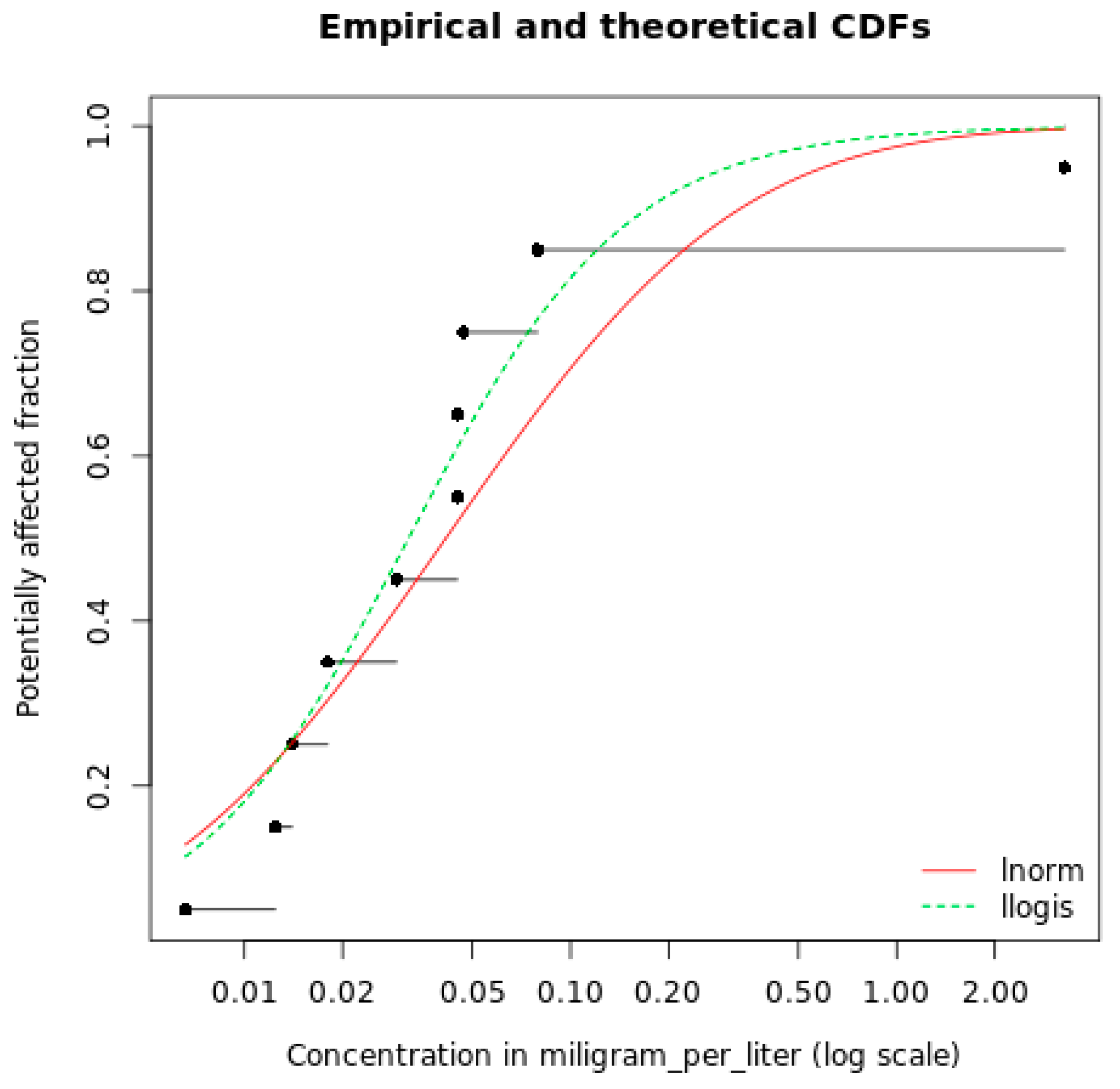
- Finally, when NOECA were obtained for at least three taxonomic groups for a specific substance, the PNEC was estimated using the SSD model.
2.2. The Application of the SSD Model and PNECs Estimation
3. Results and Discussion
- ▪
- The procedure referred to toxicity tests, which assume that the active substance is fully bioavailable;
- ▪
- Priority was given to NOECs and/or LOECs values referring to chronic toxicity tests, with sub-lethal end points and/or prolonged exposures;
- ▪
- Where only EC50/LC50 was available, the values obtained in equal test conditions but with a longer exposure period were selected;
- ▪
- The estimated PNECs by SSD model are lower than the lowest available data of the most sensitive taxonomic group in 83.3% of the cases.
4. Conclusions
Supplementary Materials
Author Contributions
Funding
Data Availability Statement
Acknowledgments
Conflicts of Interest
References
- Directive 2000/60/EC of the European Parliament and of the Council of 23 October 2000 Establishing a Framework for Community Action in the Field of Water Policy. Available online: https://eur-lex.europa.eu/legal-content/EN/TXT/?uri=CELEX:32000L0060 (accessed on 1 February 2023).
- Commission Decision 2455/2001/EC of the European Parliament and of the Council of 20 November 2001 Establishing the List of Priority Substances in the Field of Water Policy and Amending Directive 2000/60/EC [cf. Annex 10 of Water Framework Directive]. Available online: https://eur-lex.europa.eu/legal-content/EN/TXT/HTML/?uri=CELEX:32001D2455 (accessed on 9 April 2023).
- Directive 2008/105/EC of the European Parliament and of the Council of 16 December 2008 on Environmental Quality Standards in the Field of Water Policy, Amending and Subsequently Repealing Council Directives 82/176/EEC, 83/513/EEC, 84/156/EEC, 84/491/EEC, 86/280/EEC and Amending Directive 2000/60/EC of the European Parliament and of the Council. Available online: http://data.europa.eu/eli/dir/2008/105/oj (accessed on 1 February 2023).
- Directive 2013/39/EU of the European Parliament and of the Council Amending Directives 2000/60/EC and 2008/105/EC as Regards Priority Substances in the Field of Water Policy. Available online: http://data.europa.eu/eli/dir/2013/39/oj (accessed on 1 February 2023).
- Decreto Legislativo 13 Ottobre 2015, n. 172. Attuazione Della Direttiva 2013/39/UE, che Modifica la Direttiva 2000/60/CE per Quanto Riguarda le Sostanze Prioritarie nel Settore della Politica delle Acque. Available online: https://www.gazzettaufficiale.it/eli/id/2015/10/27/15G00186/sg (accessed on 9 April 2023). (In Italian).
- Guidance Document No. 27. In Technical Guidance for Deriving Environmental Quality Standards; Technical Report–2011–055; European Union: Maastricht, The Netherlands, 2011; ISBN 978-92-79-16228-2. [CrossRef]
- SCHEER. Scientific Advice on Technical Guidance n° 27, Technical Guidance for Deriving Environmental Quality Standards. 2017. Available online: https://data.europa.eu/doi/10.2875/018826 (accessed on 1 February 2023).
- TGD. Technical Guidance Document on Risk Assessment in Support of Commission Directive 93/67/EEC on Risk Assessment for New Notified Substances, Commission Regulation (EC) No 1488/94 on Risk Assessment for Existing Substances, Directive 98/8/EC of the European Parliament and of the Council Concerning the Placing of Biocidal Products on the Market. Part II. Institute for Health and Consumer Protection. 2003. Available online: https://op.europa.eu/en/publication-detail/-/publication/212940b8-3e55-43f8-8448-ba258d0374bb (accessed on 9 April 2023).
- OECD. Report of the OECD Workshop on the Extrapolation of Laboratory Aquatic Toxicity Data on the Real Environment; Organisation for Economic Cooperation and Development (OECD), OECD Environment Monographs No. 59; Organisation for Economic Co-Operation and Development: Paris, France, 1992. [Google Scholar]
- Finizio, A.; Villa, S.; Vighi, M. Predicted No Effect Concentration (PNEC), Reference Module in Biomedical Sciences; Elsevier: Amsterdam, The Netherlands, 2021; ISBN 9780128012383. [Google Scholar] [CrossRef]
- Di Toro, D.; Allen, H.E.; Bergman, H.L.; Meyer, J.S.; Paquin, P.R.; Santore, R.C. Biotic ligand model of the acute toxicity of metals. 1. Technical Basis. Environ. Toxicol. Chem. 2001, 20, 2383–2396. [Google Scholar] [CrossRef] [PubMed]
- Niyogi, S.; Wood, C.M. Biotic Ligand Model, a flexible tool for developing site-specific water quality guidelines for metals. Environ. Sci. Technol. 2004, 28, 6177–6192. [Google Scholar] [CrossRef] [PubMed]
- Verschoor, A.J.; Vink, J.P.M.; Vijver, M.G. Simplification of biotic ligand models of Cu, Ni, and Zn by 1-, 2-, and 3-parameter transfer functions. Integr. Environ. Assess Manag. 2012, 8, 738–748. [Google Scholar] [CrossRef] [PubMed]
- Posthuma, L.; Suter, G.W., II; Traas, T.P. Species Sensitivity Distributions in Cotoxicology; Lewish Publishers: New York, NY, USA, 2002; 579p. [Google Scholar] [CrossRef]
- Scott-Fordsmand, J.J.; Damgaard, C. Uncertainty analysis of single- concentration exposure data for risk assessment-introducing the species effect distribution approach. Environ. Toxicol. Chem. 2006, 25, 3078–3081. [Google Scholar] [CrossRef] [PubMed]
- Chen, B.T.; Zheng, S.; Ni, X.; Zhao, J. Species sensitivity distribution and its application in ecotoxicology. Asian J. Ecotoxicol. 2010, 5, 491–497. [Google Scholar]
- Fox, D.R. A Bayesian approach for determining the no effect concentration and hazardous concentration in ecotoxicology. Ecotoxicol. Environ. Saf. 2010, 73, 123–131. [Google Scholar] [CrossRef]
- Commission Directive 93/67/EEC of 20 July 1993 Laying down the Principles for Assessment of Risks to Man and the Environment of Subtances Notified in Accordance with Council Directive 67/548/EEC OJ L 227 08.09.1993. p. 9. Available online: http://data.europa.eu/eli/dir/1993/67/oj (accessed on 1 February 2023).
- Forbes, V.E.; Calow, P. Population growth rate as a basis for ecological risk assessment of toxic chemicals. Phil. Trans. R. Soc. Lond. B 2002, 357, 1299–1306. [Google Scholar] [CrossRef]
- Smetanová, S.; Bláha, L.; Liess, M.; Schäfer, R.B.; Beketov, M.A. Do predictions from Species Sensitivity Distributions match with field data? Environ. Pollut. 2014, 189, 126–133. [Google Scholar] [CrossRef] [PubMed]
- Connors, K.A.; Beasley, A.; Barron, M.G.; Belanger, S.E.; Bonnel, M.; Brill, J.L.; De Zwart, D.; Kienzler, A.; Krailler, J.; Otter, R.; et al. Creation of a Curated Aquatic Toxicology Database: EnviroTox. Environ. Toxicol. Chem. 2019, 38, 1062–1073. [Google Scholar] [CrossRef] [PubMed]
- Beasley, A.; Belanger, S.E.; Otter, R.R. Stepwise Information-Filtering Tool (SIFT): A method for using risk assessment metadata in a nontraditional way. Environ. Toxicol. Chem. 2015, 34, 1436–1442. [Google Scholar] [CrossRef] [PubMed]
- van Leeuwen, C.J.; Vermeire, T.G. Risk Assessment of Chemicals: An Introduction, 2nd ed.; Springer: Dordrecht, The Netherlands, 2007; ISBN 978-1-4020-6101-1 (HB). [Google Scholar]
- Verdonck, F.A.M.; Jaworska, J.; Thas, O.; Vanrolleghem, P.A. Determining environmental standards using bootstrapping, bayesia and maximum likelihood techniques: A comparative study. Anal. Chim. Acta 2001, 446, 429–438. [Google Scholar] [CrossRef]
- Isnard, P.; Flammarion, P.; Roman, G.; Babut, M.; Bastien, P.; Binstein, S.; Essermeant, L.; Ferard, J.F.; Gallotti-Schmitt, S.; Saouter, E.; et al. Statistical analysis of regulatory ecotoxicity tests. Chemosphere 2001, 45, 659–669. [Google Scholar] [CrossRef] [PubMed]
- Monti, G.S.; Filzmoser, P.; Deutsch, R.C. A robust approach to risk assessment based on Species Sensitivity Distributions. Risk Anal. 2018, 38, 2073–2086. [Google Scholar] [CrossRef] [PubMed]
- Wheeler, J.R.; Grist, E.P.M.; Leung, K.M.Y.; Morritt, D.; Crane, M. Species sensitivity distributions: Data and model choice. Mar. Pollut. Bull. 2002, 45, 192–202. [Google Scholar] [CrossRef] [PubMed]
- Gottschalk, F.; Nowack, B. A Probabilistic Method for Species Sensitivity Distributions Taking into Account the Inheren Uncertainty and Variability of Effects to Estimate Environmental Risk. Integr. Environ. Assess. Manag. 2013, 9, 14791126. [Google Scholar] [CrossRef] [PubMed]

| Available Data | Assessment Factor |
|---|---|
| At least one short-term L(E)C50 from each of three trophic levels of the base set (fish, Daphnia, and algae) | 1000 |
| One long-term NOEC (either fish or Daphnia) | 100 |
| Two long-term NOECs from species representing two trophic levels (fish and/or Daphnia and/or algae) | 50 |
| Long-term NOECs from at least three species (normally fish, Daphnia, and algae) representing three trophic levels | 10 |
| Specie Sensitivity Distribution (SSD) method | 5-1 (to be fully justified case by case) |
| Field data or model ecosystems | Reviewed on a case by case basis |
| Cyanobacteria | Chlorophyta | Ciliophora | Euglenozoa | Rotifera | Platyhelminthes | Cnidaria | Mollusca | Crustacea | Anellida | Insecta | Pisces | Amphibia | |
|---|---|---|---|---|---|---|---|---|---|---|---|---|---|
| Al | 7014 | 999 | 1910 | 300 | 410 | 250 | 47 | ||||||
| As | 280 | 334 | 3190 | 105 | 271 | ||||||||
| Ba | 4729 | 70,800 | 7090 | 3360 | 37,690 | ||||||||
| Cd | 7.3 | 58.4 | 18 | 6.6 | 3268 | 14 | 79.2 | 13.5 | 45 | 264.4 | 45 | ||
| CrIII | 34.2 | 516 | 291 | 1185 | |||||||||
| CrVI | 21 | 164.7 | 257 | 520 | 730 | 59.7 | 136.5 | 8099 | |||||
| Cu | 8.1 | 70.2 | 91.5 | 23.6 | 208.2 | 4 | 26.6 | 12.7 | 1.2 | 70 | 73.4 | ||
| Fe | 14,056 | 11.7 × 10⁵ | 1104 | 3694 | 10,184 | 260 | |||||||
| Hg | 1.8 | 3.8 | 2.0 | 5.4 | 90 | 1.6 | 20.6 | 37.4 | 14.4 | ||||
| Mn | 349 | 3870 | 4000 | 4355 | 17,061 | 286 | 5000 | ||||||
| Ni | 99.8 | 400 | 655 | 126 | 101 | 6675 | 7240 | 3805 | |||||
| Pb | 508 | 226 | 400 | 16,000 | 44 | 1462 | 707 | ||||||
| Sb | 200 | 712 | 10,800 | 1522 | |||||||||
| Se | 588 | 136 | 1610 | 48.3 | 771 | 303 | 1666 | ||||||
| Sn | 144 | 56.8 | 3.7 | 0.2 | 480 | 1.39 | 4.9 | 0.2 | 16.3 | 0.17 | |||
| Tl | 0.5 | 3.2 | 949 | 122 | 2441 | ||||||||
| V | 1200 | 500 | 780 | ||||||||||
| Zn | 1.6 | 10.7 | 250 | 123 | 637 | 166 | 318 | 73.8 | 288 | 9430 | 1346 |
| Cyanobacteria | Chlorophyta | Ocrophyta | Ciliophora | Rotifera | Platyhelminthes | Cnidaria | Mollusca | Crustacea | Anellida | Insecta | Pisces | Amphibia | |
|---|---|---|---|---|---|---|---|---|---|---|---|---|---|
| Alachlor | 17.1 | 840 | 1272 | 100 | 94.9 | ||||||||
| Aldrin | 200 | 17.7 | 1.7 | ||||||||||
| Atrazine | 48 | 20 | 190 | 14,500 | 80 | 404 | 480 | ||||||
| Azynphos ethyl | 0.4 | 1.9 | |||||||||||
| Chlorfenviphos | 3720 | 720 | 20.91 | 19.83 | |||||||||
| Chlorpyriphos methyl | 0.7 | 1.0 | 15.6 | ||||||||||
| Chlorpyriphos ethyl | 1000 | 1 | 0.27 | 0.13 | 0.07 | 8.4 | |||||||
| Chinossifen | 1240 | 6.36 | 9.1 | 38.39 | |||||||||
| Cybutryne | 0.52 | 0.51 | 829 | 4 | |||||||||
| Cypermethtrine | 0.07 | 8.0 × 10⁻⁶ | 6.0 × 10⁻⁶ | 2.1 × 10⁻⁴ | |||||||||
| Diazinon | 1 × 10⁻⁴ | 1107 | 879 | 63 | 346 | 0.69 | 1.6 | 113.1 | |||||
| Dichlorvos | 212 | 477 | 0.034 | 2.4 | 188 | ||||||||
| Dicofol | 3788 | 141 | 62 | 46.1 | |||||||||
| Dieldrin | 25.6 | 0.16 | 1.2 | ||||||||||
| Endosulfan | 130 | 1750 | 0.05 | 640 | 2.3 | 0.19 | |||||||
| Endrin | 2.36 | 0.78 | 0.092 | ||||||||||
| Fenitrothion | 669 | 170 | 534 | 0.1 | 0.5 | 104 | |||||||
| DDE | 30.7 | 0.1 | 3.2 | ||||||||||
| DDT | 0.8 | 350 | 0.5 | 400 | 1.3 | 4.5 | |||||||
| Heptachlor | 3.2 | 5.6 | 5.3 | ||||||||||
| Heptachlor epox | 24 | 2 | |||||||||||
| Pirimiphosmethyl | 0.03 | 0.04 | 73.8 | ||||||||||
| Simazine | 13.4 | 28.6 | 3931 | 1972 | |||||||||
| Terbuthryn | 2.2 | 1450 | 30.9 | 234 | |||||||||
| Trifularin | 273 | 92 | 3000 | 4.1 | 100 | 58 | |||||||
| Benzene | 12,339 | 1.0 × 10⁶ | 5565 | 4913 | 5713 | ||||||||
| Toluene | 14,820 | 11,300 | 2263 | 7778 |
| Cyanobacteria | Chlorophyta | Angiospermae | Ciliophora | Rotifera | Platyhelminthes | Mollusca | Crustacea | Insecta | Pisces | Amphibia | |
|---|---|---|---|---|---|---|---|---|---|---|---|
| Acenaphtene | 710 | 84 | 85 | ||||||||
| Anthracene | 3.7 | 46.9 | 40.5 | ||||||||
| Benzo(a)anthracene | 13.7 | 1.1 | |||||||||
| Benzo(a)pyrene | 0.87 | 447 | 0.82 | ||||||||
| Phenanthrene | 249 | 167 | 19,600 | 58 | 25.9 | 167 | |||||
| Fluorene | 1670 | 51.5 | 204 | 128 | |||||||
| Fluoranthene | 16.3 | 16.3 | 4.5 | 22 | |||||||
| Indeno(1,2,c,d)pyrene | 0.08 | 1.2 | |||||||||
| Naphtalene | 3701 | 290 | 635 | ||||||||
| Pyrene | 219 | 282 | 20 | 200 | |||||||
| 1,2-Dichloroethane | 31,625 | 10,302 | 13,250 | ||||||||
| Carbon tetrachloride | 670 | 8.3 × 10⁴ | 353,130 | 19,084 | 197 | ||||||
| DEHP | 32 | 100 | 5000 | 74 | 1800 | 2462 | |||||
| Dichloromethane | 5.6 × 10⁴ | 202,000 | 46,417 | 21,298 | |||||||
| Exabromocyclododecane | 3.7 | 5.6 | 72,900 | 340 | |||||||
| Exachlorobutadiene | 21 | 13 | 10.8 | ||||||||
| Exachlorocycloesane | 23 | 1.6 | |||||||||
| Octylphenols | 0.275 | 3.146 | |||||||||
| Pentachlorobenzene | 100 | 25.3 | 32 | ||||||||
| Pentachlorophenol | 13.1 | 72 | 182.2 | 32 | 15.2 | 92.6 | 3400 | 10.4 | |||
| Tetrachloroethylene | 12,066 | 298 | 539 | ||||||||
| Trichloromethane | 72,938 | 781 | 74,155 | 4560 | |||||||
| Trichloroethylene | 40,249 | 5600 | 3467 | 5500 | 4200 |
| Metals and Trace Elements | Pesticides | PAHs | Other Substances | |||||
|---|---|---|---|---|---|---|---|---|
| Geometric Mean | Median | Geometric Mean | Median | Geometric Mean | Median | Geometric Mean | Median | |
| Cyanobacteria | 0.93 | 0.67 | 1.79 | 33.35 | 0.17 | 0.14 | ||
| Chlorophyta | 1.48 | 2.76 | 4.64 | 2.22 | 2.94 | 6.37 | 1.67 | 1.28 |
| Ocrophyta | 4.70 | 23.70 | ||||||
| Angiospermae | 9.85 | 3.62 | ||||||
| Ciliophora | 3.11 | 3.85 | 79.91 | 106.90 | 4.35 | 4.35 | ||
| Euglenozoa | 38.41 | 160.69 | ||||||
| Rotifera | 3.32 | 3.38 | 39.93 | 93.69 | 2.26 | 10.24 | ||
| Platyhelminthes | 31.56 | 14.31 | 393.98 | 895.65 | ||||
| Cnidaria | 0.57 | 0.68 | ||||||
| Mollusca | 7.37 | 4.31 | 139.83 | 389.86 | 0.75 | 1.62 | ||
| Crustacea | 1 | 1 | 1 | 1 | 1 | 1 | 1 | 1 |
| Anellida | 3.91 | 3.71 | ||||||
| Insecta | 11.11 | 19.59 | 0.41 | 0.82 | 65.53 | 30.52 | ||
| Pisces | 4.52 | 5.55 | 3.74 | 2.62 | 2.22 | 2.34 | 0.70 | 1.02 |
| Amphibia | 0.25 | 0.12 | 0.34 | 0.64 | ||||
| Substance | Shapiro-Wilk (p) | Normal Distribution (ANOECs) | Model (SSD) | Nr. Plotted Taxonomic Groups | PNEC (μg L−1) | EQS-AA (μg L−1) | SQA-MAC (μg L−1) |
|---|---|---|---|---|---|---|---|
| Al | 0.0013 | No | Log-logistic | 7 | 44 | ||
| As | 0.0009 | No | Log-logistic | 5 | 54 | ||
| Ba | 0.0898 | Yes | Log-normal | 5 | 1700 | ||
| Cd | <0.0001 | No | Log-logistic | 11 | 2.4 | 0.08–0.25 * | 0.45–1.5 * |
| CrIII | 0.6541 | Yes | Log-normal | 4 | 32.0 | ||
| CrVI | <0.0001 | No | Log-logistic | 8 | 15 | ||
| Cu | 0.0081 | No | Log-logistic | 11 | 2.2 | ||
| Fe | <0.0001 | No | Log-logistic | 6 | 330 | ||
| Hg | 0.0013 | No | Log-logistic | 9 | 0.62 | - | 0.07 |
| Mn | 0.0102 | No | Log-logistic | 7 | 260 | ||
| Ni | 0.0081 | No | Log-logistic | 8 | 27 | 4 | 34 |
| Pb | <0.0001 | No | Log-logistic | 7 | 38 | 1.2 | 14 |
| Sb | 0.0230 | No | Log-logistic | 4 | 90 | ||
| Se | 0.1691 | Yes | Log-normal | 7 | 58 | ||
| Sn | <0.0001 | No | Log-logistic | 10 | 0.037 | ||
| Tl | 0.0527 | Yes | Log-normal | 5 | 0.25 | ||
| V | 0.0408 | No | Log-logistic | 3 | 410 | ||
| Zn | <0.0001 | No | Log-logistic | 11 | 5.9 | ||
| Alachlor | 0.1051 | Yes | Log-normal | 5 | 13 | 0.3 | 0.7 |
| Aldrin | 0.1388 | Yes | Log-normal | 3 | 0.74 | 10 | - |
| Atrazine | <0.0001 | No | Log-logistic | 7 | 7.6 | 0.6 | 2 |
| Chlorfenviphos | 0.0451 | No | Log-logistic | 4 | 2.4 | 0.1 | 0.3 |
| Chlorpyriphos methyl | 0.0336 | No | Log-logistic | 3 | 0.15 | ||
| Chlorpyriphos ethyl | <0.0001 | No | Log-logistic | 6 | 0.005 | 0.03 | 0.1 |
| Chinossifen | 0.0025 | No | Log-logistic | 4 | 0.85 | 0.15 | 2.7 |
| Cybutryne | 0.0014 | No | Log-logistic | 4 | 0.02 | 0.0025 | 0.016 |
| Cypermethtrine | 0.0013 | No | Log-logistic | 4 | 1.4 × 10⁻⁷ | 8 × 10⁻⁵ | 6 × 10⁻⁴ |
| Diazinon | <0.0001 | No | Log-logistic | 8 | 0.71 | ||
| Dichlorvos | 0.3202 | Yes | Log-normal | 5 | 0.045 | 6 × 10⁻⁴ | 7 × 10⁻⁴ |
| Dicofol | 0.0024 | No | Log-logistic | 4 | 7.8 | 0.0013 | - |
| Dieldrin | 0.0690 | Yes | Log-normal | 3 | 0.055 | 10 | - |
| Endosulfan | 0.0085 | No | Log-logistic | 6 | 0.008 | 0.005 | 0.01 |
| Endrin | 0.5736 | Yes | Log-normal | 3 | 0.055 | ||
| Fenitrothion | 0.1293 | Yes | Log-normal | 6 | 0.089 | ||
| DDE | 0.1760 | Yes | Log-normal | 3 | 0.044 | ||
| DDT | 0.0033 | No | Log-logistic | 6 | 0.04 | 0.025 | - |
| Heptachlor | 0.2196 | Yes | Log-normal | 3 | 3.0 | 2 × 10⁻⁷ | 3 × 10⁻⁴ |
| Pirimiphos | 0.0002 | No | Log-logistic | 3 | 4.1 × 10⁻⁴ | ||
| Simazine | 0.2807 | Yes | Log-normal | 4 | 3.8 | 1 | 4 |
| Terbuthryn | 0.0345 | No | Log-logistic | 4 | 0.99 | 0.065 | 0.34 |
| Trifularin | 0.0112 | No | Log-logistic | 4 | 4.4 | 0.03 | - |
| Benzene | 0.0002 | No | Log-logistic | 5 | 1500 | 10 | 50 |
| Toluene | 0.9425 | Yes | Log-normal | 4 | 2300 | ||
| Acenaphtene | 0.0026 | No | Log-logistic | 3 | 25 | ||
| Anthracene | 0.2630 | Yes | Log-normal | 3 | 2.8 | 0.1 | 0.1 |
| Benzo(a)pyrene | 0.0002 | No | Log-logistic | 3 | 0.022 | 1.7 × 10⁻⁴ | 0.27 |
| Phenanthrene | <0.0001 | No | Log-logistic | 6 | 6.9 | ||
| Fluorene | 0.0132 | No | Log-logistic | 4 | 21 | ||
| Fluoranthene | 0.3857 | Yes | Log-normal | 4 | 4.6 | 0.0063 | 0.12 |
| Naphtalene | 0.1757 | Yes | Log-normal | 3 | 150 | 2 | 130 |
| Pyrene | 0.3616 | Yes | Log-normal | 4 | 22 | ||
| 1,2-Dichloroethane | 0.2433 | Yes | Log-normal | 3 | 7400 | 10 | - |
| Carbon tetrachloride | 0.0141 | No | Log-logistic | 5 | 56 | 12 | - |
| DEHP | 0.1112 | Yes | Log-normal | 6 | 17 | 1.3 | - |
| Dichloromethane | 0.0856 | Yes | Log-normal | 4 | 15,000 | 20 | - |
| Exabromocyclododecane | 0.0014 | No | Log-logistic | 4 | 0.084 | 0.0016 | 0.5 |
| Exachlorobutadiene | 0.3942 | Yes | Log-normal | 3 | 9 | 0.005 | 0.6 |
| Pentachlorobenzene | 0.1550 | Yes | Log-normal | 3 | 16 | 0.007 | - |
| Pentachlorophenol | <0.0001 | No | Log-logistic | 8 | 2.9 | 0.4 | 1 |
| Tetrachloroethylene | 0.0342 | No | Log-logistic | 3 | 14 | 10 | - |
| Trichloromethane | 0.0468 | No | Log-logistic | 4 | 360 | 2.5 | - |
| Trichloroethylene | 0.0007 | No | Log-logistic | 5 | 1500 | 10 | - |
Disclaimer/Publisher’s Note: The statements, opinions and data contained in all publications are solely those of the individual author(s) and contributor(s) and not of MDPI and/or the editor(s). MDPI and/or the editor(s) disclaim responsibility for any injury to people or property resulting from any ideas, methods, instructions or products referred to in the content. |
© 2023 by the authors. Licensee MDPI, Basel, Switzerland. This article is an open access article distributed under the terms and conditions of the Creative Commons Attribution (CC BY) license (https://creativecommons.org/licenses/by/4.0/).
Share and Cite
Onorati, F.; Tornambé, A.; Paina, A.; Bellucci, M.; Chiaretti, G.; Catalano, B. Derivation of Sustainable Reference Chemical Levels for the Protection of Italian Freshwater Ecosystems. Water 2023, 15, 1811. https://doi.org/10.3390/w15101811
Onorati F, Tornambé A, Paina A, Bellucci M, Chiaretti G, Catalano B. Derivation of Sustainable Reference Chemical Levels for the Protection of Italian Freshwater Ecosystems. Water. 2023; 15(10):1811. https://doi.org/10.3390/w15101811
Chicago/Turabian StyleOnorati, Fulvio, Andrea Tornambé, Andrea Paina, Micol Bellucci, Gianluca Chiaretti, and Barbara Catalano. 2023. "Derivation of Sustainable Reference Chemical Levels for the Protection of Italian Freshwater Ecosystems" Water 15, no. 10: 1811. https://doi.org/10.3390/w15101811
APA StyleOnorati, F., Tornambé, A., Paina, A., Bellucci, M., Chiaretti, G., & Catalano, B. (2023). Derivation of Sustainable Reference Chemical Levels for the Protection of Italian Freshwater Ecosystems. Water, 15(10), 1811. https://doi.org/10.3390/w15101811

