You are currently viewing a new version of our website. To view the old version click .
Water
  • Editor’s Choice
  • Article
  • Open Access

12 January 2022

Underwater Fish Detection and Counting Using Mask Regional Convolutional Neural Network
,
,
and
1
Center for Cyber Security, Faculty of Information Science and Technology, Universiti Kebangsaan Malaysia, Bangi 43600, Malaysia
2
Mahjung Aquabest Hatchery, Lot 9569 Kampung Batu 4, Segari 32200, Malaysia
*
Authors to whom correspondence should be addressed.
This article belongs to the Special Issue AI and Deep Learning Applications for Water Management

Abstract

Fish production has become a roadblock to the development of fish farming, and one of the issues encountered throughout the hatching process is the counting procedure. Previous research has mainly depended on the use of non-machine learning-based and machine learning-based counting methods and so was unable to provide precise results. In this work, we used a robotic eye camera to capture shrimp photos on a shrimp farm to train the model. The image data were classified into three categories based on the density of shrimps: low density, medium density, and high density. We used the parameter calibration strategy to discover the appropriate parameters and provided an improved Mask Regional Convolutional Neural Network (Mask R-CNN) model. As a result, the enhanced Mask R-CNN model can reach an accuracy rate of up to 97.48%.

1. Introduction

Shrimp counting is essential for farmers to estimate and manage hatching. The domain of importance in the agricultural field can help farmers improve their resources’ productivity. An accurate automated shrimp detection and counting algorithm can enable farmers to optimize and streamline their hatching period. However, counting shrimp from images is a challenging task for several reasons, including the small size of shrimp and their transparent color, which we cannot easily see. An additional challenge to shrimp counting that is not present in shrimp detection is distinguishing multiple overlapping shrimps.
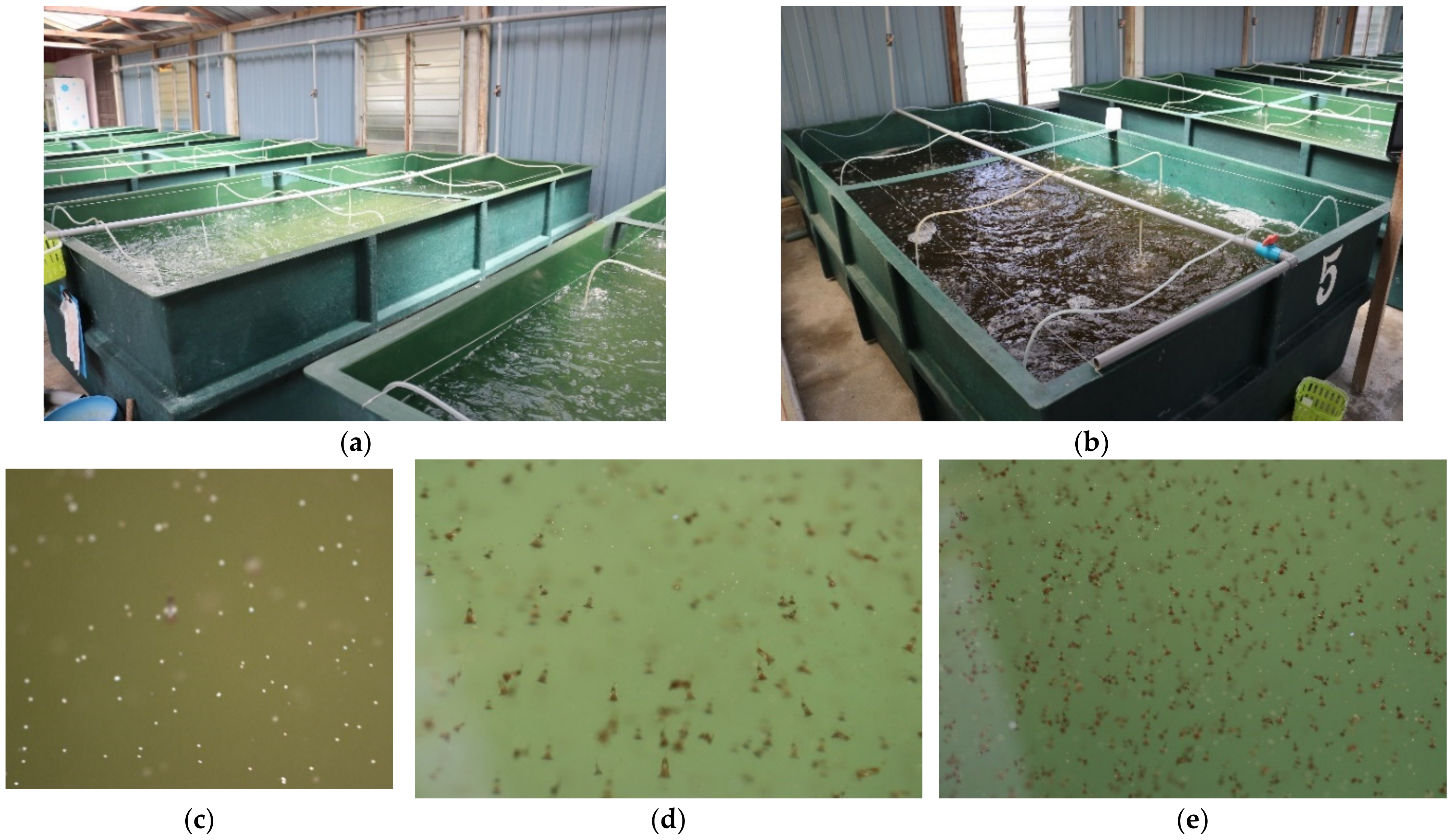
Shrimp farmers who use ponds for production rely on cast netting shrimp and then relating the amount caught in the surface area of the cast net to the surface area of the entire pond (Figure 1a,b). While this has been useful for estimating growth, it is not a reliable predictor of survival. The farmer must drain the tank, collect the shrimp in a mesh bag and weigh them out of the water to accurately count the shrimps in a tank culture system. Holding shrimp in water causes stress due to a lack of dissolved oxygen and the fact that they are highly concentrated when packed for weighing, which can take up to two minutes. This increase in stress and potential exoskeleton damage increases mortality and hastens the spread of black spot occurrences (Figure 1c). The unresolved challenges are when the shrimp’s photographs can be visualized in three difficulties, as shown in Figure 1c for low, Figure 1d for intermediate and Figure 1e for shrimps with high density is captured from the very low- or very high-contrast images. Furthermore, the amount of water adhering to the shrimp must be considered in this method.
Figure 1. The challenges of shrimp detection using CNN with various illumination types: (a) low and (b) high contrast, from the side view; (c) low, (d) intermediate, and (e) high density of very low-contrast images due to its transparent color from the top view.
Deep learning is an obvious choice for dealing with cluttered scenes where conventional vision analytics machine methods struggle with semantic segmentation. This paper presents a novel pipeline that accurately estimates shrimp counting. The board steps of the pipelines are:
  • Capture a set of shrimps images;
  • Label the shrimp in each of the images captured;
  • Train a ResNet101 backbone by using a default parameter to perform image segmentation;
  • Train a ResNet101 backbone by performing image segmentation with the parameter calibration; and
  • Use a parameter calibration to train a convolutional network to take the segmented image and output an intermediate estimate of shrimp counting.
This study aims to provide a data-driven shrimp counting methodology that a farmer can implement in cluttered farm settings. As a result, the proposed method focuses on labeling and training in speed and accuracy. The major contributions in this paper are:
  • The application of a region-based convolutional network to accurately detect the shrimp; and
  • The application of a region-based convolutional network to accurately count the number of shrimp.
The rest of the paper is organized as follows: (1) a summary of related work on counting approaches, (2) methods used with the introduction of Mask R-CNN and improved Mask-RCNN, (3) experimental results and analysis, and (4) conclusion.

3. Mask R-CNN

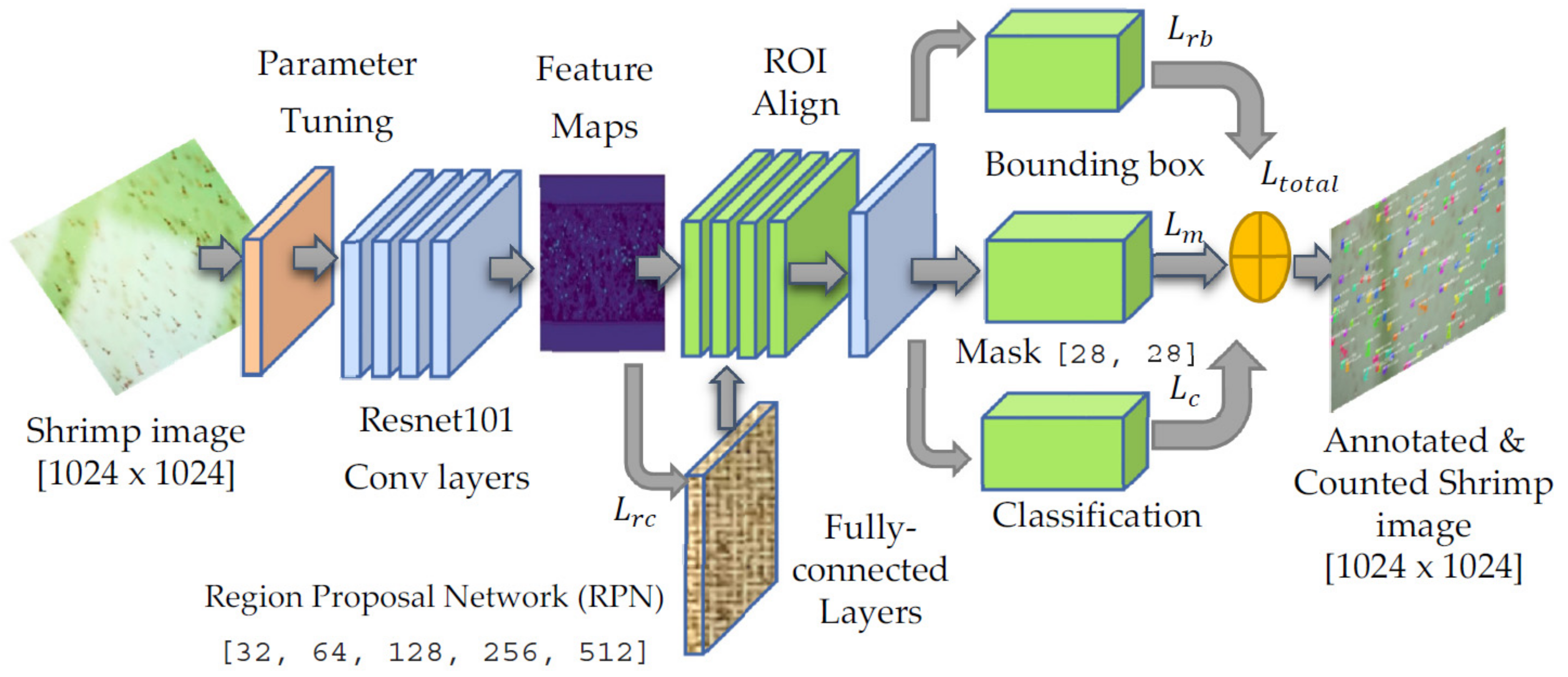
Mask R-CNN [25] aims to solve the instance segmentation problem and separate objects in an image or a video. The output will give the object bounding boxes, classes, and masks. Mask R-CNN includes two stages: generating the proposals regions with an object given the input image or video in the first stage. The second stage covers a pipeline that can anticipate the object class label, uncover the bounding box, and create an object mask at the pixel level specified in the first stage proposal region. In a nutshell, the Mask R-CNN backbone structure is subsequently associated with both stages.
Instance segmentation is an extension of object detection, in which a binary mask is associated with each bounding box. This instance segmentation allows for more refined information about the extent of the object in the bounding box. Several algorithms perform segmentation, but the one used by the Tensorflow Object Detection API is the Mask R-CNN. Mask R-CNN detects objects through a series of steps. Firstly, the default parameter remains, and a CNN feature descriptor extracts a global feature image. Second, apply to these feature maps using the region proposal network. These steps produce ROIs representing the object proposals accompanied by their objectness scores. The ROIs and corresponding feature maps are then passed through the Region of Interest (RoI) Align layer. Mask R-CNN employs the ROI Align layer rather than the ROI Pooling layer. The RoI Align layer is intended to fix the location misalignment in the ROI pooling affected by quantization. An ROI is appropriately mapped from the actual image to the feature map without rounding up to integers. In the next step, a softmax layer is used on top of the fully connected network to predict classes. A linear regression layer is used parallelly to output bounding box coordinates for predicted classes and the softmax layer.
Faster R-CNN [26] is also a unique algorithm used for object detection. Similarly, the Faster R-CNN consists of two phases. The first phase, known as the regional proposed network (RPN), recommends a bounding box only for nominees with constrained objects. In the second stage, after extracting features from each bounding box via Region of Interest Pooling (RoIPool), Faster R-CNN executes subsequent processes involving the classification and regression for each bounding box. For a faster conclusion, the features used by both processes can be exchanged. The concept of Mask R-CNN [25] is straightforward: the Faster R-CNN mask has two outputs for each nominee object, a class label, and a bounding-box offset, and extends a third branch that generates the object mask in binary form to represent the pixels in the bounding box where the object is. The output of the extension mask is dissimilar from the output of the class. In contrast, the bounding box indulges a more acceptable spatial arrangement of the object during the extraction process.
We measure the loss function, L t o t a l , for each shrimp RoI as follows:
L t o t a l =   w 1 × L r c   +   w 2 × L r b   +   w 3 × L c   + w 4 × L b + w 5 × L m   .
where w is a set of weights of each loss function, L r c is the region proposal network (rpn) class loss, L r b is the shrimp rpn bounding box loss, L c   is the shrimp class loss, L b is the shrimp bounding box loss, and L m   is the shrimp mask loss. It calculates L t o t a l after changing a set of hyperparameters in Mask R-CNN such as maximum detection instance, maximum ground truth instance, number of thresholds, train anchors for each image, number of steps for each epoch, number of train regions of interest of each image, number of validation steps, number of steps in each epoch, and numbers of epoch, regularization, optimizers, learning rate, batch size, learning momentum, and weight decay. Undertaking the most minimum loss, we achieved calibration of those parameters manually. Hence, Figure 3 describes the improved Mask R-CNN after the parameter had changed based on the default Mask R-CNN. The steps to detect objects in the improved Mask R-CNN model will remain the same.
Figure 3. Algorithm for improved Mask R-CNN with parameters calibration step.

4. Experimental Results and Analysis

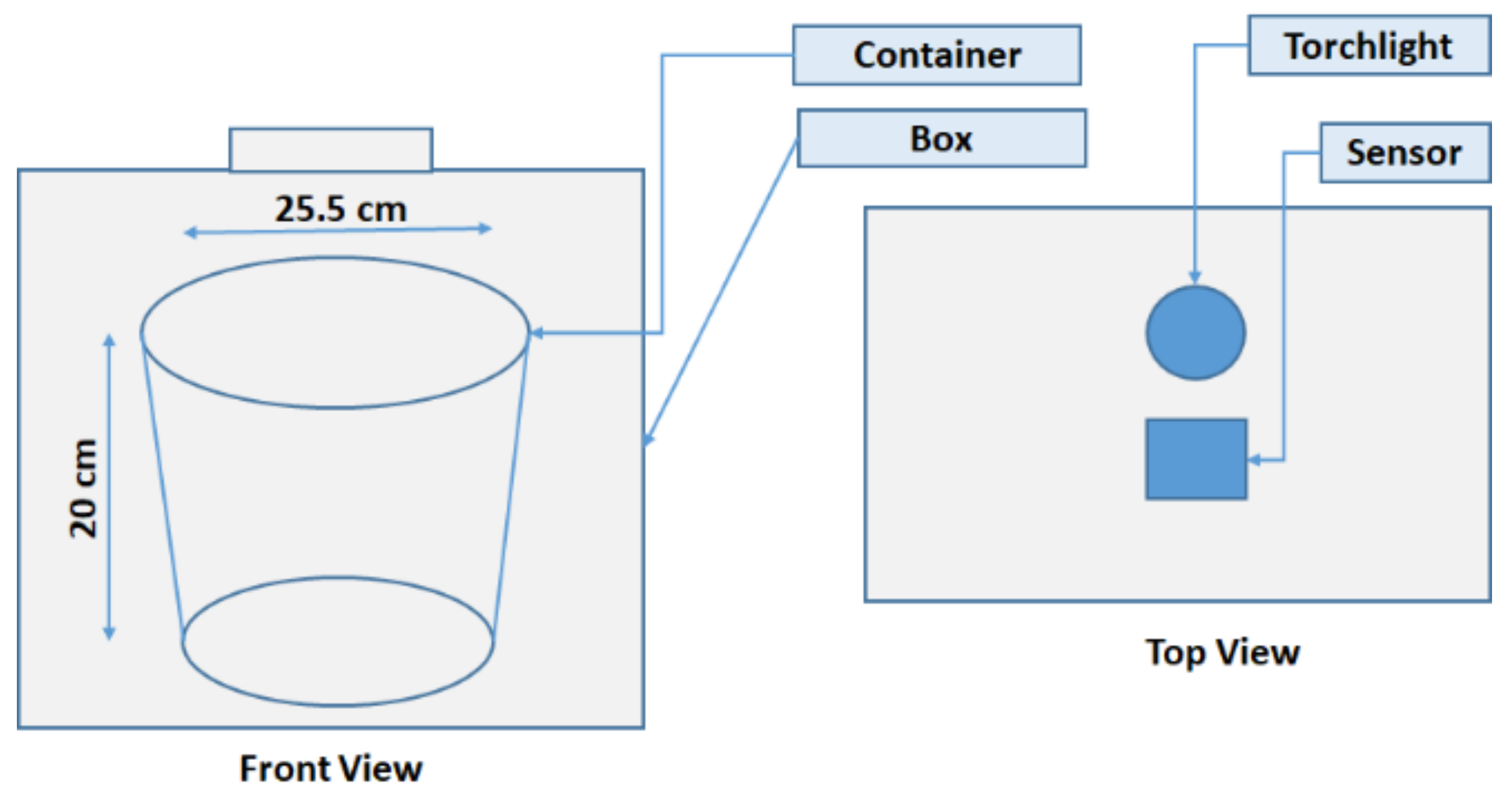
To save time in the training models’ process and shorten the time in the labeling dataset, Mask R-CNN is used in this paper to find out the best parameter and detect the total number of shrimps in an image. We designed and sketched the experimental setup for the shrimp counting system, as shown in Figure 4, encompassing the container, box, sensor, and touch light.
Figure 4. The experimental design to set up the shrimp counting system.
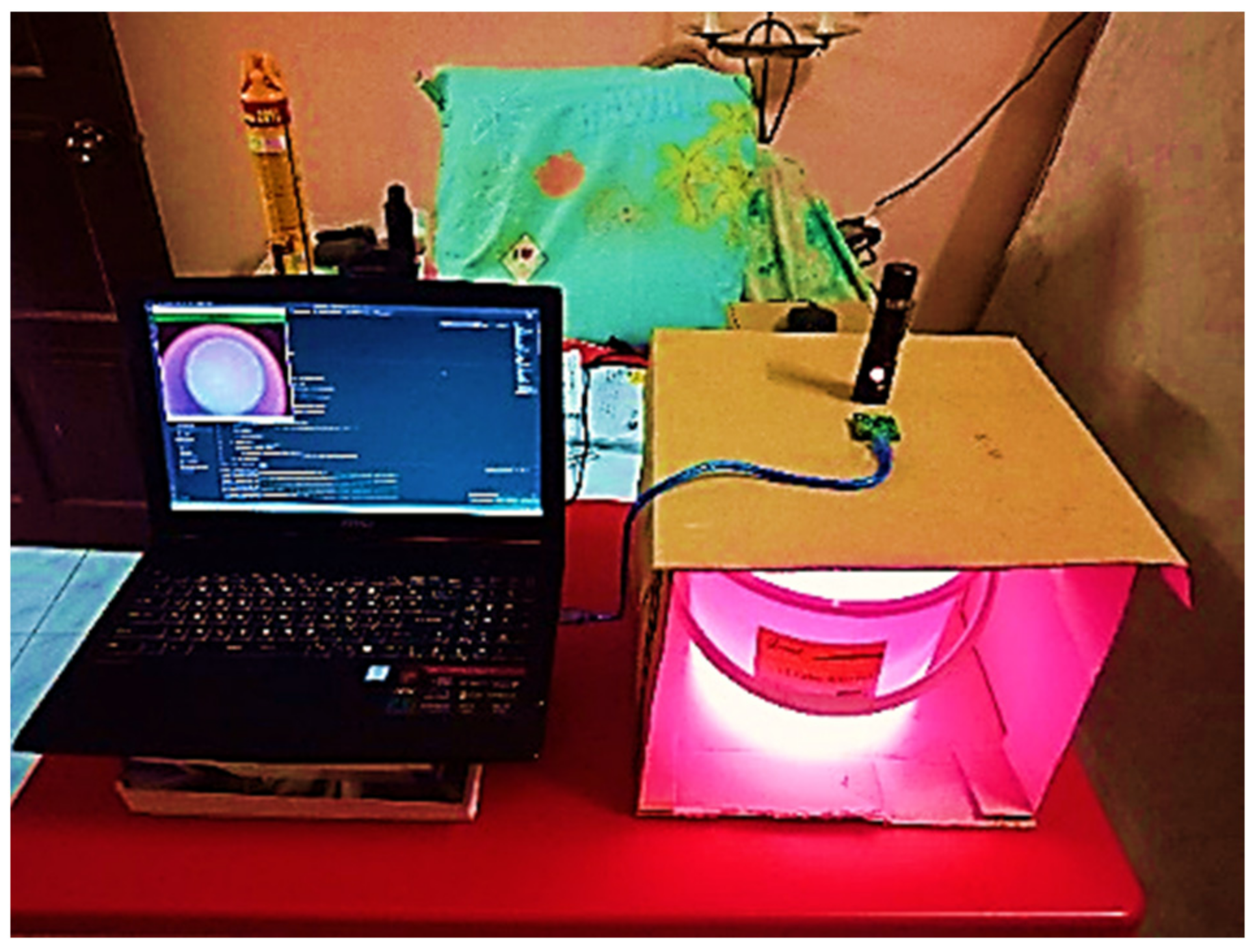
The sensor used in this experiment was a camera with a model Arducam USB camera module 8MP Sony IMX 219. The other types of equipment that were included a container, box, and torchlight. The pixels for capturing the photo were set to 640 pixels for width and 480 pixels for height. The image taken was saved in .jpg format. The height of the container was 20 cm, and the diameter was 25.5 cm. The torchlight was adjusted until all the light could cover the container’s water surface. The actual view of the experimental setup for our shrimp counting system is depicted in Figure 5.
Figure 5. The real view of the experimental setup for the shrimp counting system.

4.1. Building a Dataset

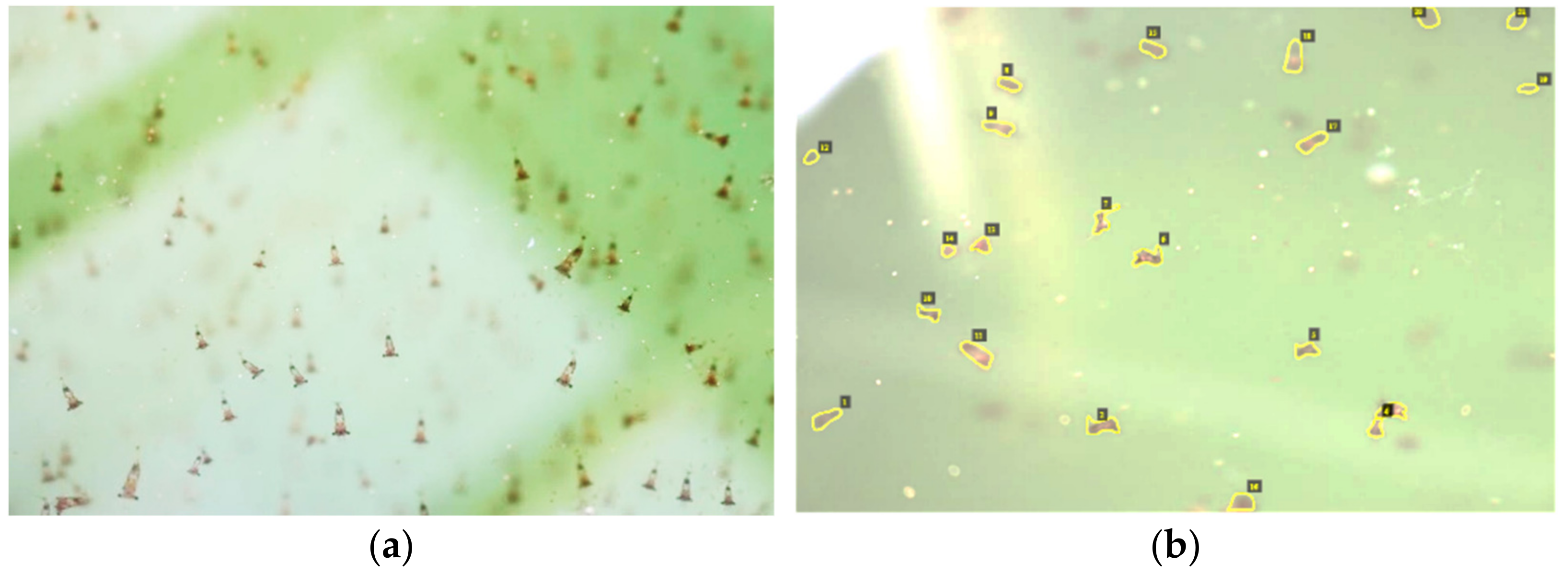
The dataset used for this paper is a picture that consists of a troupe of shrimps. The picture was collected and captured using a Canon EOS 80D model DSLR camera. The aperture was f/5.6, the shutter speed was 1 per 100 s, ISO 100, the camera lens used was 18–55 mm, and the distance to take pictures was 10 cm from the top of the water level. The picture captured is shown in Figure 6a. The picture was collected with a total number of 120 images. With envision, an 80:20 supplied train and test dataset split concept was applied, consisting of 100 images for the training set and 20 images for the testing dataset.
Figure 6. (a) Underwater image detection for shrimp, and (b) example of a labeled picture.
Underwater cameras obtained some of the data used in the experiment for marine animals and others. The data are divided into seven categories: fish, shrimp, scallop, crab, lobster, abalone, and sea cucumber. Each category ranges from 1000 to 1400 sheets, with a total of 8455 sheets where 80% of data were used for training and 20% for testing sets. We enhanced the training set data; moreover, each original image was generated into three deformed images by three processing methods: rotation, translation, and flipping. The training set can be expanded to 27,056 pictures.
The image taken changed the image size from 6000 pixels for width and 4000 pixels for height to 960 pixels for width and 640 pixels for height to facilitate the labeling of the shrimp in the pictures. The shrimp in the picture was labeled using the VGG Image Annotator, and the labeled picture is shown in Figure 6b.
The folder of “datasets” was created in Google Drive, along with two subfolders named “train” and “test” to store the training dataset and testing dataset. After the labeled picture, the annotation information with the .json file with the same name was saved in the corresponding subfolders “train” and “test”. Less dense category ranges totaled 81 images, medium dense category ranges totaled 15 images, and dense category ranges had four images. After labeling the shrimp in each image, it generated 5041 ground truth in training the model phase.

4.2. Training the Model

We chose ResNet101 in combination with FPNs from the Mask R-CNN backbone networks. The feature map was extracted from the input image by the backbone network first, and then the features were output by the backbone network. The map was given to the region proposal network (RPN) and ROIAlign (ROI) to generate the area of interest. Finally, the ROI used the convolutional and fully connected layers to forecast the target category and bounding box and the fully convolutional neural network to recognize the target region (FCN). The target’s instance detection task has finally been accomplished.
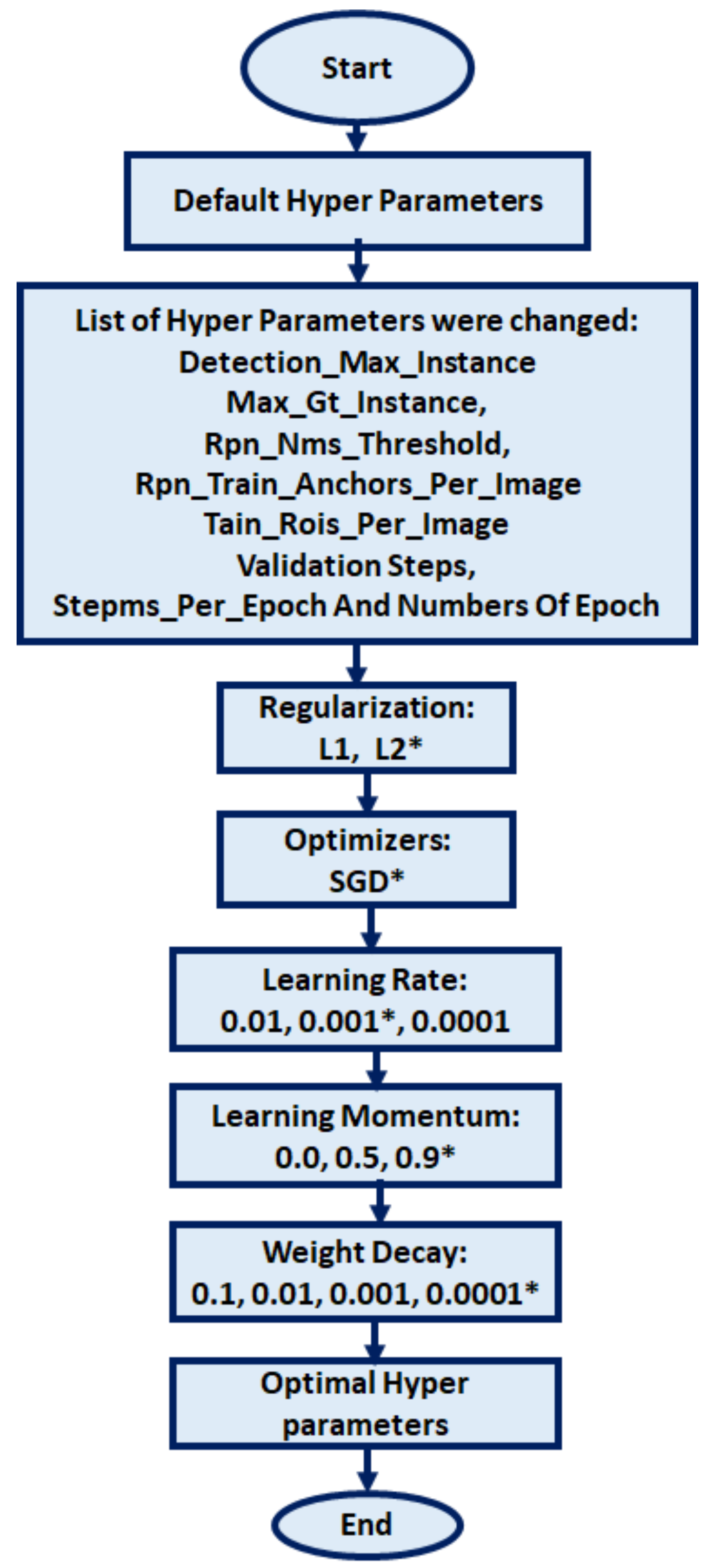
The training model procedure in this paper uses 100 training images and the default and improved hyperparameters of the Mask R-CNN model, as shown in Table 2 and Appendix A. The default number of steps for each epoch is 50, but the upgraded version calls for roughly 100. In the training phase, using the above model requires a significant amount of memory resources and time. As a result, Google Collab is used in the training model process. Figure 3 depicts the method of determining the best hyperparameters.
Table 2. Experimental parameters.
Regularization L1 and optimizer SGD with the lowest loss function is taken to the next step, converting the learning rate. Referring to Table 2 and Figure 7, the values for the learning rate to be tested are 0.01, 0.001, and 0.0001; maintaining the lower learning rate with the lowest loss function will be maintained and taken to the next step, which is a conversion on the learning momentum. The values for learning momentum to be tested are 0, 0.5, and 0.9. The value of learning momentum with the lowest loss function will also be maintained and taken to the next step to convert the weight decay. The values for weight decay to be tested are 0.1, 0.01, and 0.001.
Figure 7. The process of finding the optimal hyperparameter.
In the last step, the optimal hyperparameters are selected based on their performance, and the model is used in the next phase, which is the implementation phase or the testing phase. The performance of the model is then tested in terms of accuracy.

4.3. Experimental Environment

In Table 3, we declare our experimental environment information, where we use Tensorflow version 1.3.0 [27,28] and Keras version 2.0.8 to extract important MR-CNN libraries for the software part. We ran the code on a computer with 8GB RAM, and i-7 Processor with a CPU clock speed of 2.8 GHz, and a GPU Geforce GTX1050 running Windows 10, 64 bit.
Table 3. Experimental environmental information.

4.4. Evaluation Index

The evaluation index for the performance of the model is evaluated based on precisions, recall, mean average precision (mAP), accuracy based on category, and value of R2. With 20 images as the validation set, the validation results of the improved method are compared with those of other methods. Several symbols are used in the equations, and Table 4 shows the notation table.
Table 4. List of notations.
The test set obtains the precision following Equation (2) and the recall following Equation (3). This index is used to measure and evaluate the effect of the model on shrimps positioning. Precision is defined as the fraction of relevant instances among all retrieved instances. Recall, sometimes referred to as “sensitivity”, is the fraction of retrieved samples among all appropriate instances. A perfect model or classifier has precision and recalls equal to 1.
p r e c i s i o n = T P T P + F P  
r e c a l l = T P T P + F N  
where TP is the number of images that correctly localize the shrimp, FP is the number of images that unsuccessfully or partially localize the shrimp, and FN is the number of images that unsuccessfully localize the shrimp.
Equation (4) shows how the m A P is calculated by q , where q is the number of queries in the set and A v e P q is the average accuracy average precision for a particular query, Q.
m A P = q = 1 Q A v e P q Q  
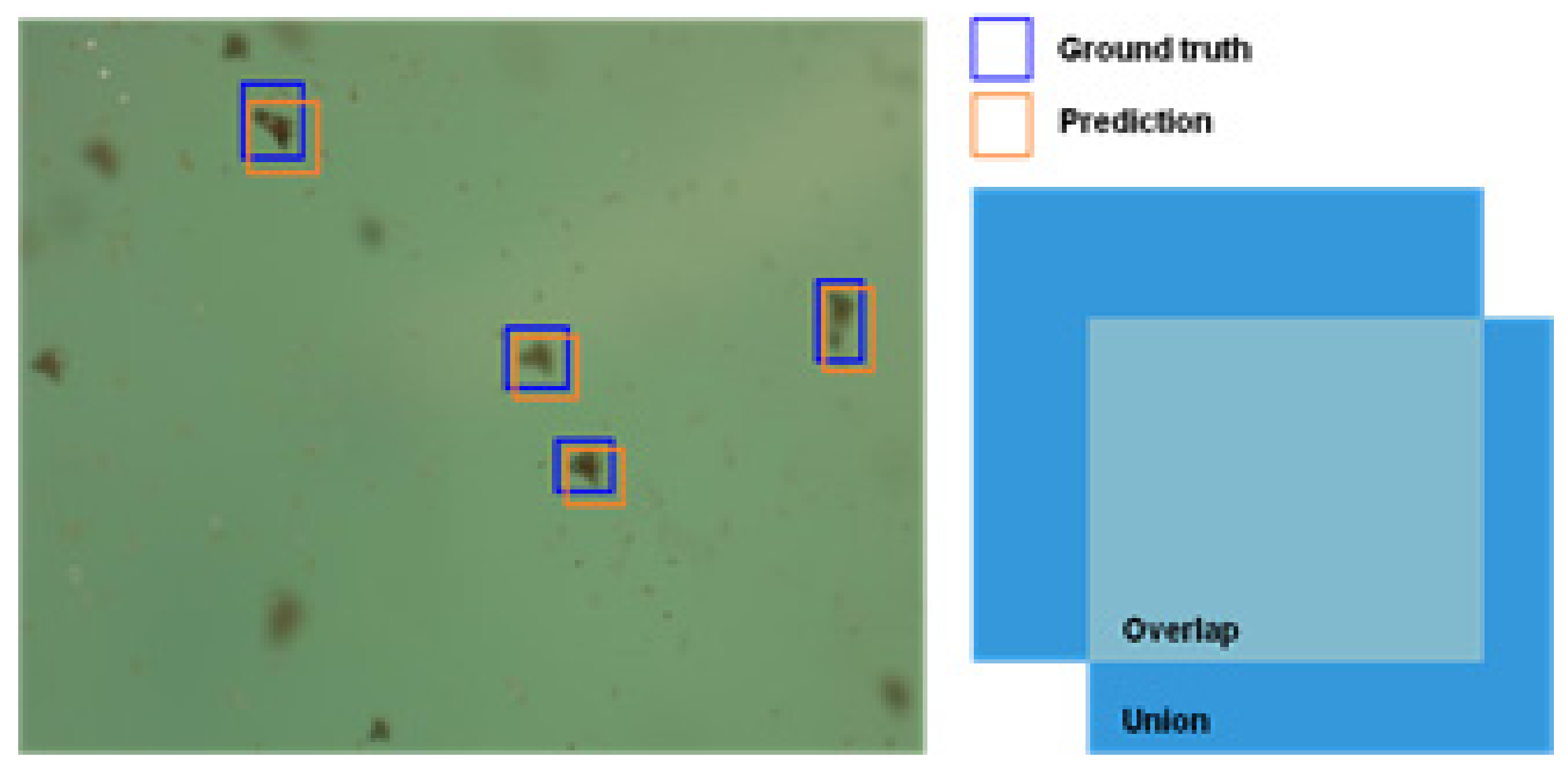
Before testing the mAP, the value of intersection over union (IoU) needs to be specified. IoU is an intersection area between two boundaries (real object boundaries and object boundaries predicted). Equation (5) shows how IoU is calculated, and an example of IoU in the picture is shown in Figure 8.
I o U = A r e a   o f   o v e r l a p A r e a   o f   u n i o n
Figure 8. Example of calculated IoU.
By using the equation shown in Equation (3), the value of IoU determined in this experiment is 0.50. If the value of IoU is greater than or equal to 0.50, the object will be classified as TP, which is true positive; if the value of IoU is less than 0.5, the object will be classified as false negative (FN). Equation (6) shows how to calculate AP (average precision) with precision and recall. The value of IoU will be tested on 0.50 and 0.75.
A P = 0 1 p r   d r
To calculate the accuracy based on the category is a comparison between the actual number (ground truth) and the number predicted based on the training dataset. Equation (7) shows how to calculate the accuracy rate, and Equation (8) shows how to calculate the error rate.
A c c u r a c y   R a t e = N o . o f   P r e d i c t e d N o . o f   G r o u n d   T r u t h   x   100 %
E r r o r   R a t e = 100 % A c c u r a c y   R a t e
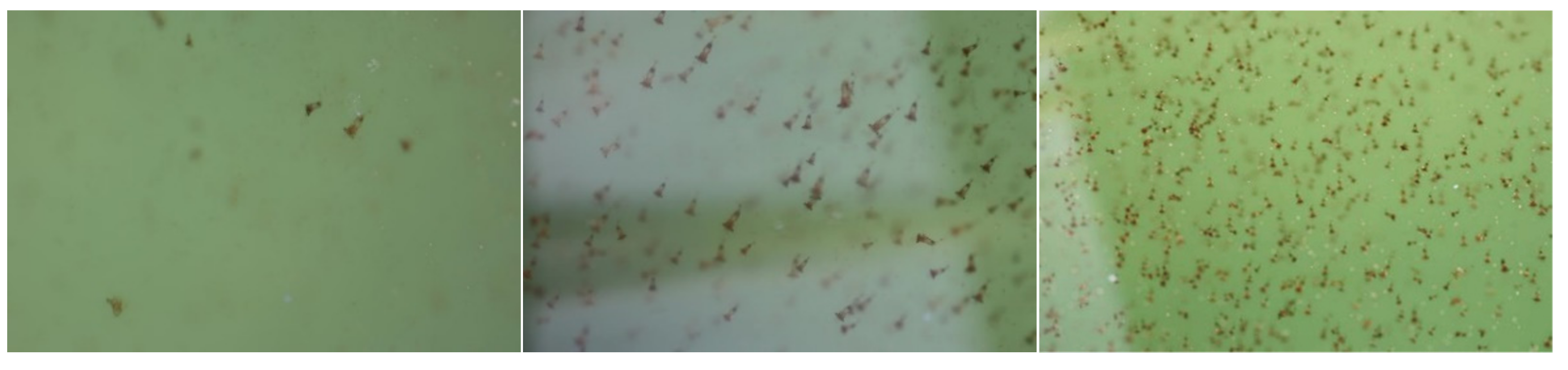
The density of the number of shrimps is divided into three categories: less dense, medium dense, and highly dense. The maximum number of actual numbers is 256 shrimps, and the minimum number is four shrimps. For the less dense category, the ground truth is between 1 to 90 shrimps, consisting of 82 images, and one of the pictures is shown in Figure 9 (left). For the category of medium dense, the ground truth is between 91 to 180 shrimps, consisting of 15 images, and one of the pictures is shown in Figure 9 (middle). For the high dense category, the ground truth is between 181 to 270 shrimps, consisting of three images and one of the pictures shown in Figure 9 (right).
Figure 9. (left) Less dense category, (middle) medium dense category, and (right) high dense category.
The value of R2 is the comparison of results between the actual number of shrimps and the predicted number of shrimps. The method performed on the actual number with the predicted number is using linear regression. In comparing the actual number and the predicted number of shrimps, the value of R2 is evaluated. From the value of R2, we know whether the regression line corresponds to the data used or not. Equation (9) shows how to calculate the value of R2.
R 2 = n x y x y n x 2 x 2 n y 2 y 2 2 ,
where x is the predicted number of shrimps in each of the images and y is the actual number (ground truth). The value of R2 is always between 0% and 100%. The value of R2 of 0% represents a model that does not explain any variations in the response variable around its mean. The mean of the dependent variable predicts the dependent variable and the regression model. The value of R2 of 100% represents a model that explains all the variations in the response variable around its mean. Usually, the more significant the R2 value, the better the regression model fits the observations.

4.5. Experimental Results and Analysis

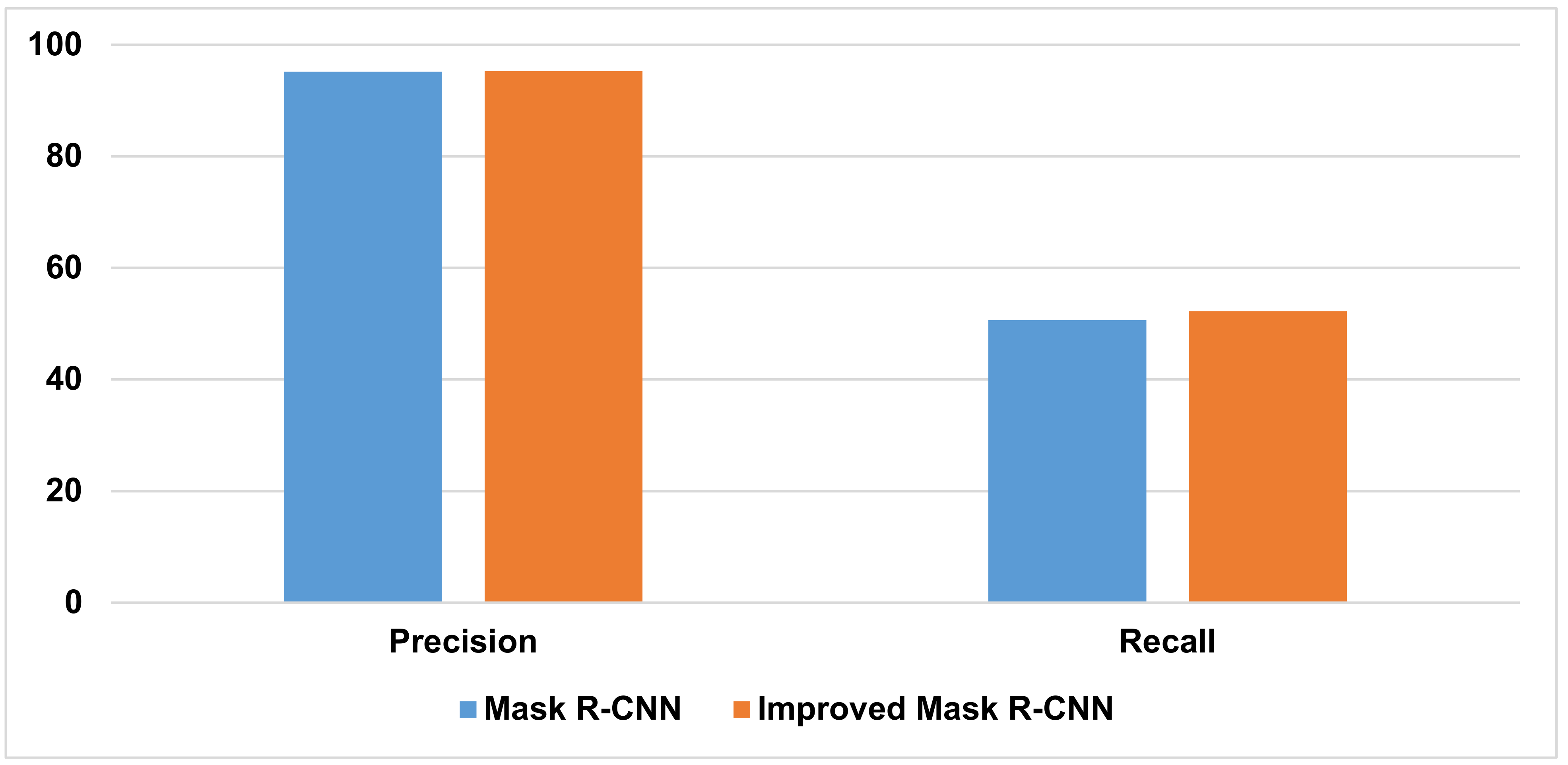
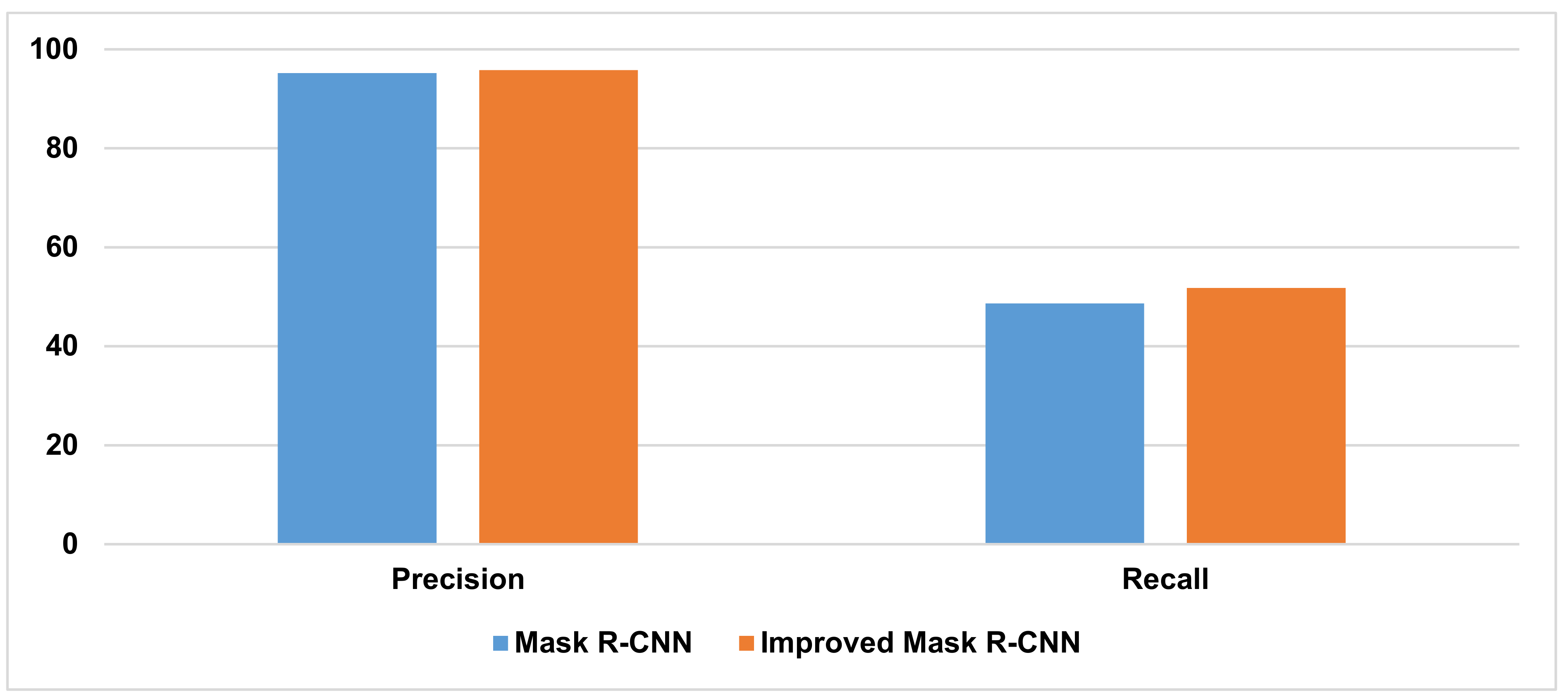
We studied the performance of the proposed improved Mask R-CNN model and compared it with the existing Mask R-CNN model using the shrimp datasets. Figure 10 shows the precision and recall results for the training dataset, and Figure 11 shows the accuracy and identification of the validation dataset. It can be seen from Figure 10 and Figure 11 that the improved Mask R-CNN model has a significant improvement in precision and recall by comparing the Mask R-CNN model.
Figure 10. Results of precision and recall for the training dataset for default and improved Mask R-CNN.
Figure 11. Results of precision and recall for the testing dataset for default and improved Mask R-CNN.
Table 5 displays the results of precision and recall from this experiment. The precision in the training dataset increased from 95.18% to 95.79%. For the recall in the training phase, the dataset significantly increased to 51.77%, whereas the precision in the validation dataset slightly increased to 95.30%. For the recall in the validation, the dataset increased from 50.63% to 52.20%.
Table 5. Results of precision and recall on the training and testing datasets.
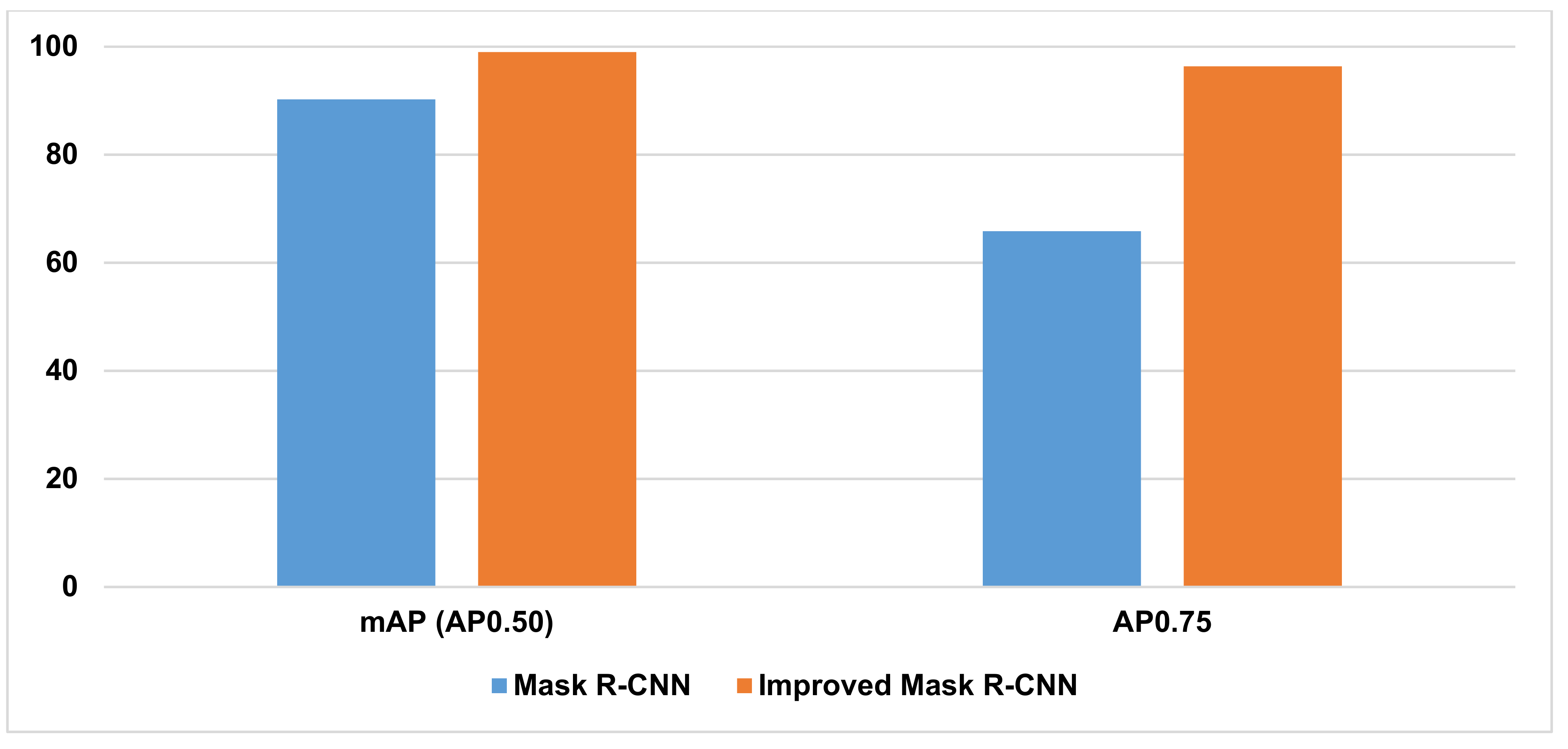
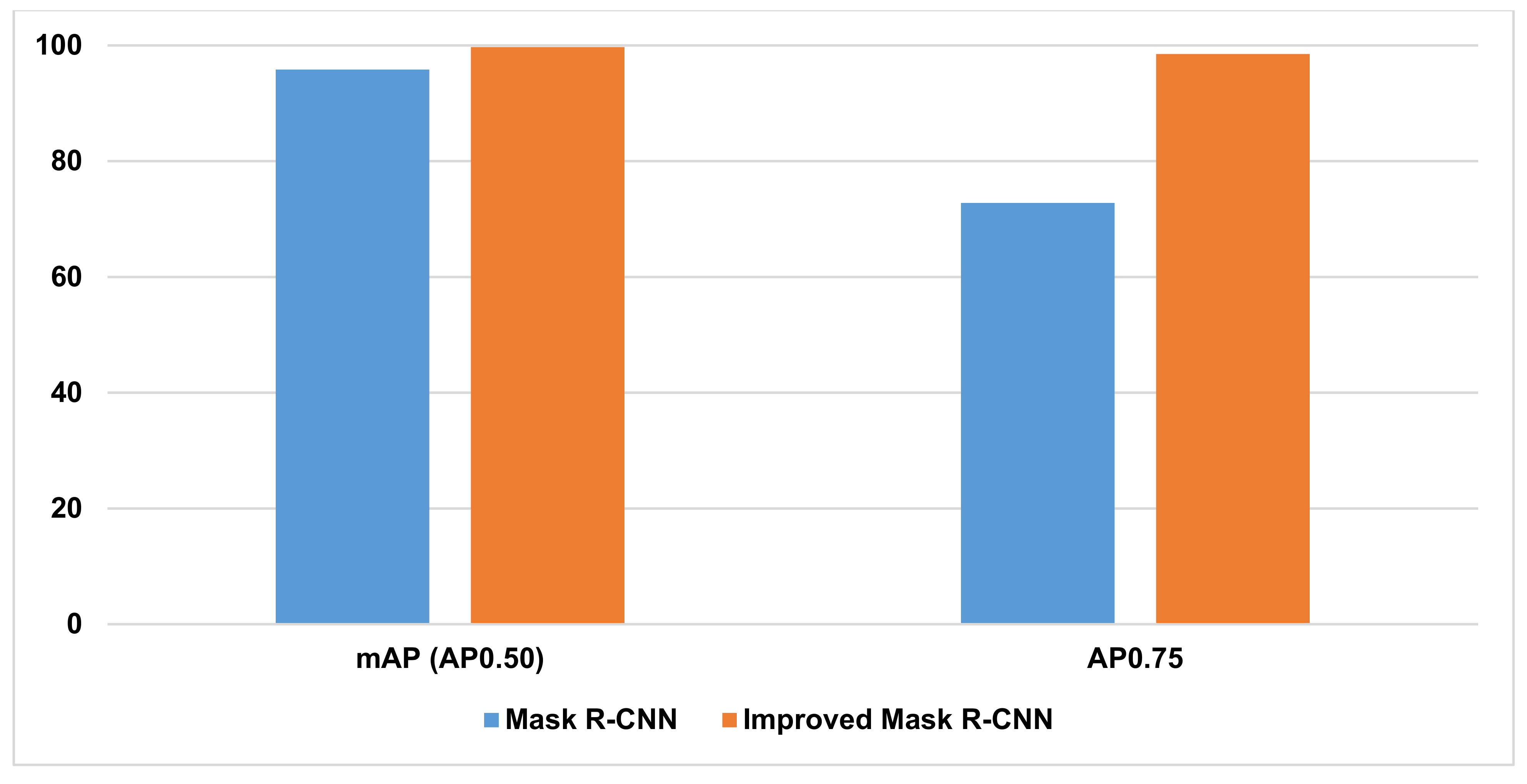
As can be seen from Table 6, the AP value 0.50 of the improved Mask R-CNN in the training dataset is 99%, which is 8.77% higher than the existing detection model Mask R-CNN. The AP value 0.75 of the improved Mask R-CNN is 96.35%, which is 30.5% higher than the existing detection model Mask R-CNN. On the other hand, the improved Mask R-CNN has an AP value of 0.50 in the validation dataset, which is 3.87% higher than the existing detection model Mask R-CNN, as shown in Table 6. The improved Mask R-CNN has an AP value of 0.75, which is 25.73% higher than the existing Mask R-CNN detection model.
Table 6. Results of mean average precision.
Performance measurement of mAP considers the value of 0.50 and 0.75 for the training dataset shown in Figure 12. The proposed improved Mask R-CNN has shown significant performance compared to the existing Mask R-CNN (Figure 12 and Figure 13) using the validates the dataset shown in Figure 14.
Figure 12. Results of mAP when AP = 0.50 and AP 0.75 for the training dataset for default and improved Mask R-CNN.
Figure 13. Results of mAP when AP = 0.50 and AP = 0.75 for the testing dataset after applying default and improved Mask R-CNN.
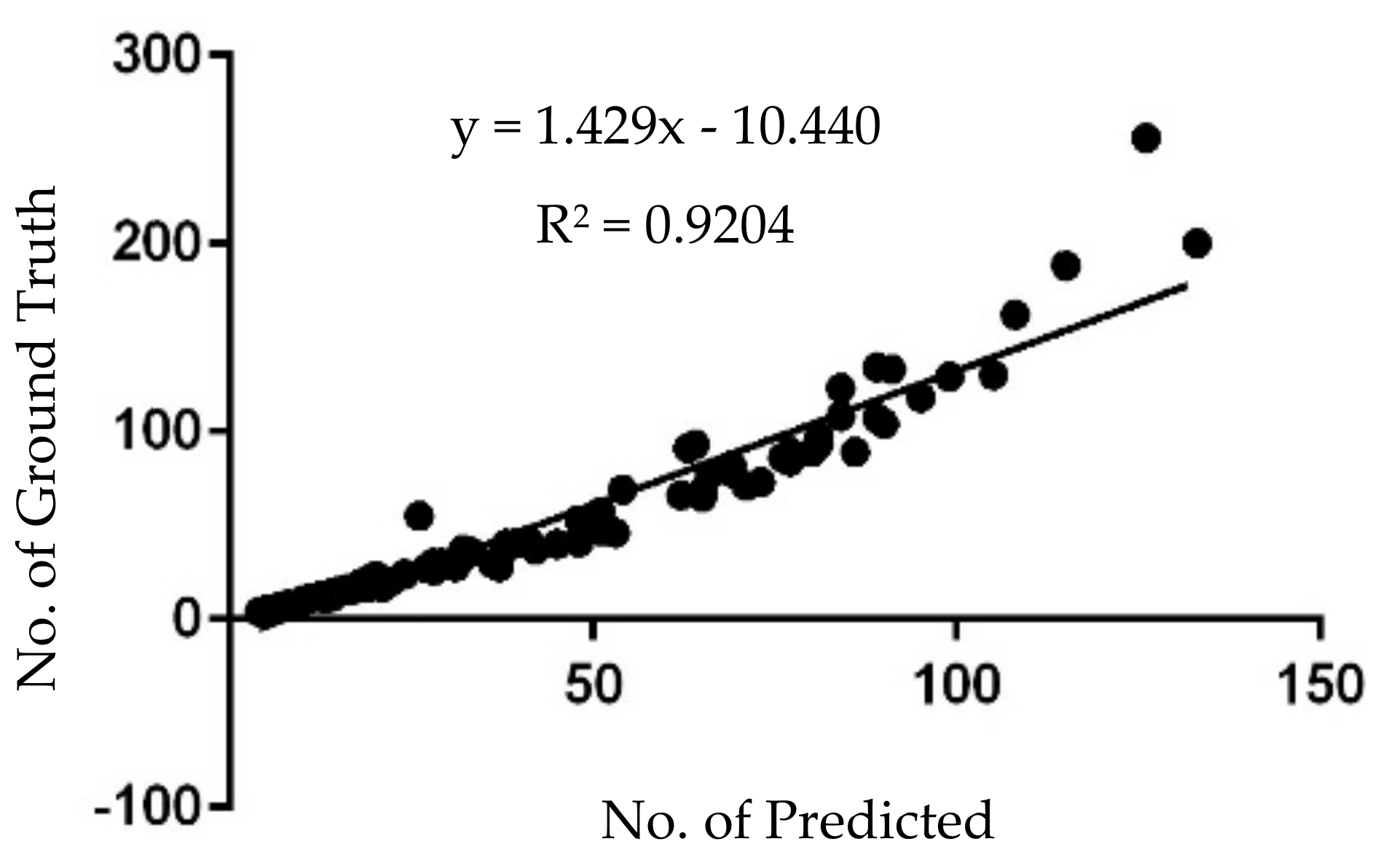
Figure 14. Linear regression between the number of ground truths and the predicted number of shrimps for 100 images in the training dataset for the default Mask R-CNN.
Notably, the accuracy drops as the density increases, as tabulated in Table 7. It also suggests that in the less dense category with the number of ground truths of 2682, the proposed model can obtain the predicted number of shrimps of 2671 and achieve the value for an accuracy rate of 99.59% and an error rate of 0.41%.
Table 7. Results of accuracy rate and error rate based on category.
In the medium dense category with the ground truth number of 1715, the proposed model can achieve the predicted number of 1679 shrimps, 97.90% accuracy, and 2.10% error rate. Meanwhile, if the number of ground truths is 644, the proposed model still predicts 564 shrimps and 87.58% accuracy, and a 12.42% error rate. Therefore, the analysis recommends that the overall accuracy rate for the proposed model on the training dataset reached 97.48%, which is 4914 shrimps out of 5041 shrimps.
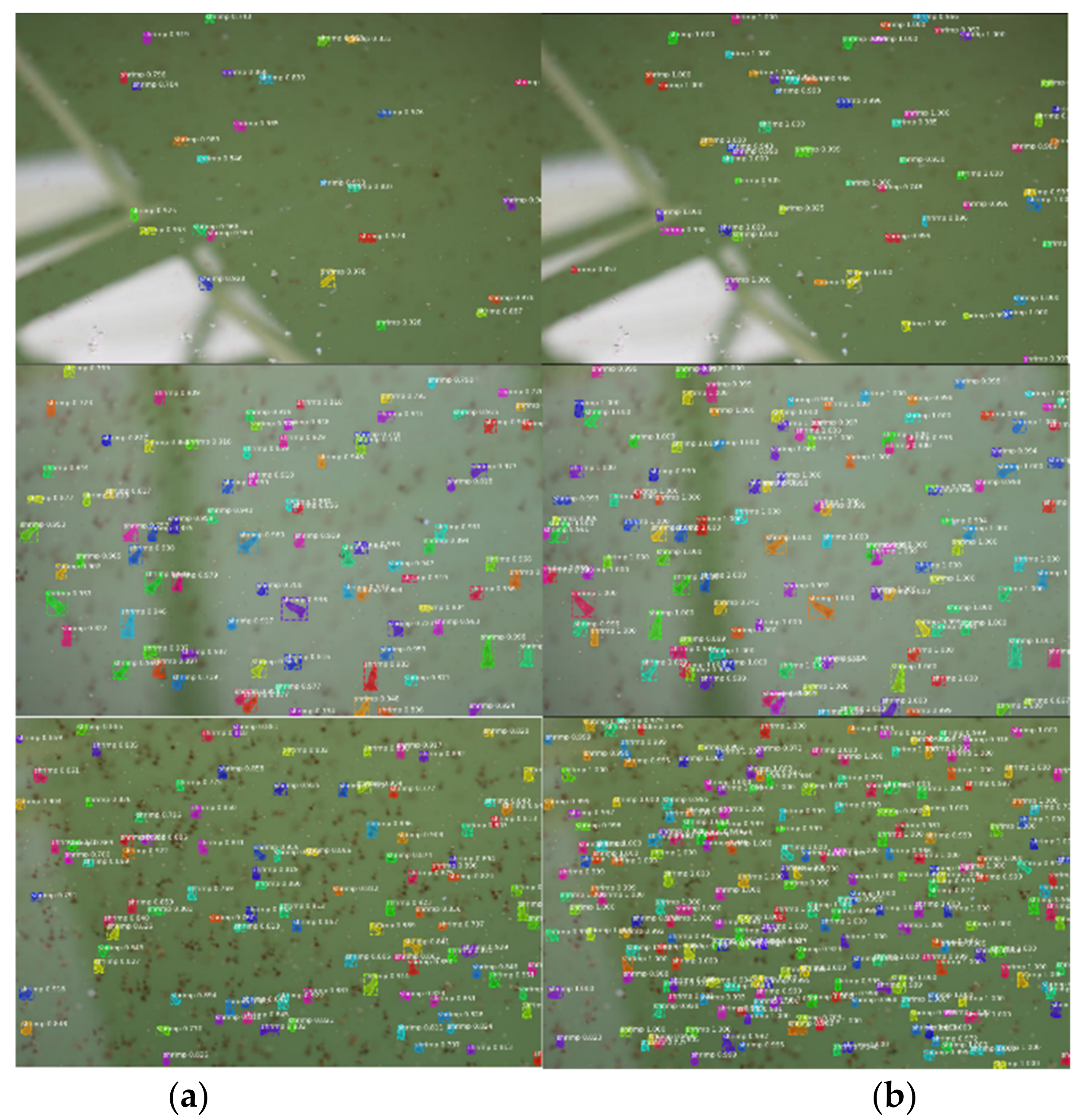
Figure 14 shows the result of the pictures based on each category using the (i) default Mask R-CNN model and (ii) the improved Mask R-CNN model. Figure 15 depicts three shrimp images by density category, where the (a) less dense category has predicted 26 shrimps (GT = 26) in (a) and 55 (GT = 55) in (b); the (b) medium dense category has predicted about 83 shrimps (GT = 84) in (a) and 97 (GT = 99) in (b); finally, the (c) high dense category has predicted 100 shrimps (GT = 104) in (a) and 213 (GT = 256) in (b).
Figure 15. Comparison of the results of shrimps by using the (a) default Mask R-CNN model and (b) improved Mask R-CNN model. The images of shrimp by density: row 1, less dense with the predicted number of shrimps of 26 (GT = 26) in (a) and 55 (GT = 55) in (b); row 2, medium dense with the predicted number of shrimps of 83 (GT = 84) in (a) and 97 (GT = 99) in (b); row 3, high dense with the predicted number of shrimps of 100 (GT = 104) in (a) and 213 (GT = 256) in (b).
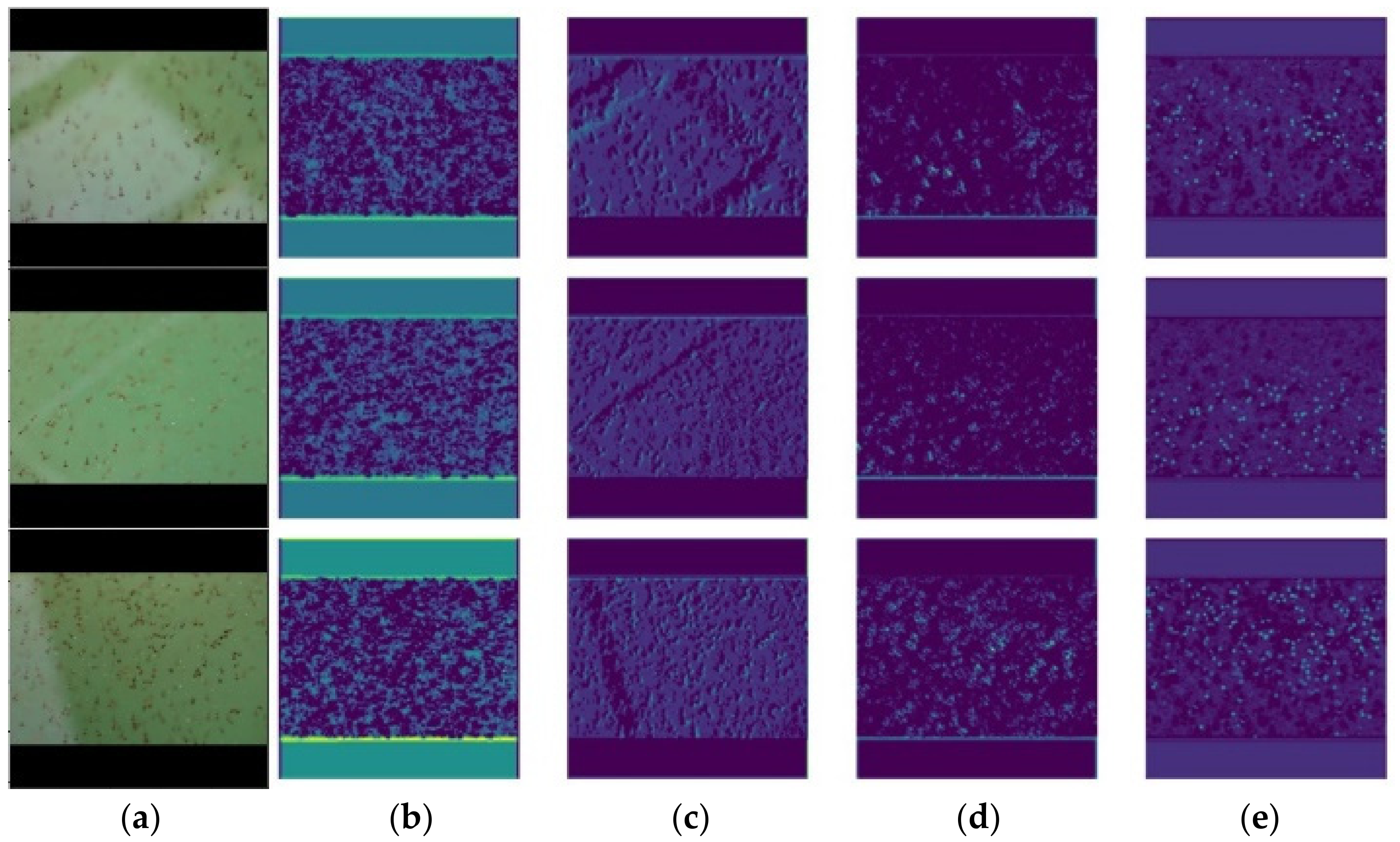
One of the ideas in counting is to calculate the object indirectly by estimating the density map. The first step is to prepare a practice sample dataset with an appropriate density map for each picture. Density maps are created by performing a convolution with a Gaussian kernel and normalizing it so that integrating it yields the number of objects. The main objective is to train the convolutional network to plot an image to a density map that can accumulate the number of object occurrences. The density maps according to the shrimp density are shown in Figure 16.
Figure 16. (a) Image of shrimp by density: row 1, less dense with the actual number of shrimps of 46 and predicted number of shrimps of 46; row 2, medium dense with the actual number of 118 and predicted number of 118; row 3, dense with the actual number of 188 and predicted a number of 170. (b) Layer of Resnet101 res2c_out, (c) layer of Resnet101 res3c_out, (d) layer of Resnet101 res4w_out and (e) predicted number of shrimps.
Linear regression for the existing Mask R-CNN model and improved Mask R-CNN was performed between the actual and the predicted number of shrimps. Linear regression for the existing Mask R-CNN model for the detection is shown in Figure 17. The value of R2 of 0.9204 in Figure 14 suggests that the regression line does not fit well over the data, which means the predicted number of shrimps is not similar to the actual number of shrimps.
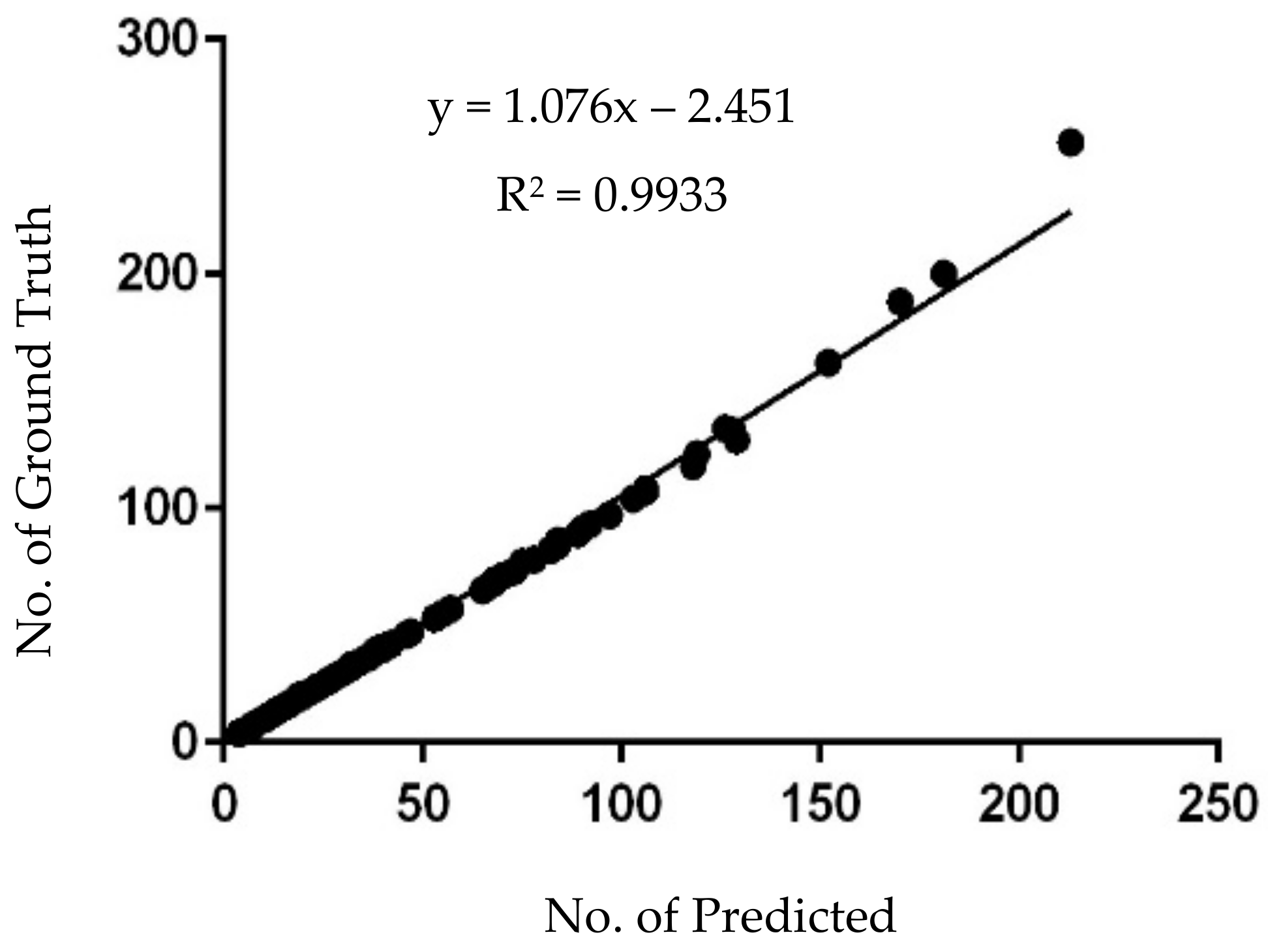
Figure 17. Linear regression between the number of ground truths and the predicted number of shrimps for 100 images in the training dataset for the improved Mask R-CNN.
Linear regression for the improved Mask R-CNN model is shown in Figure 17. The value of R2 of 0.9933 in Figure 17 suggests that the regression line fits nicely over the data, which means the predicted number of the shrimps is similar to the actual number of shrimps.
Despite these shortcomings, no studies have investigated shrimp counting using computer vision with deep learning. Hence, this work offers several significant contributions:
i
The shrimp images were recorded from the top view with the assumption of equal size due to similar shrimp age kept in the container.
ii
It can automatically estimate the number of shrimps using computer vision and deep learning.
iii
Default Mask R-CNN can be manipulated to effectively segment and count tiny shrimps or objects.
iv
The shrimp counting accuracy depreciates as the shrimp density increases or intensifies.
v
The shrimp estimation efficacy has a linear proportion when the hyperparameters such as maximum detection instance, learning rate, maximum ground truth instance, RPN threshold value, RPN train anchors per image, the number of steps per epoch, train region of interest per image, validation steps, and weight decay are increasing.
vi
The linear regression shows that R 2 increases with better precision after performing hyperparameter manipulation over the default Mask R-CNN.
vii
This application can reduce shrimp death risk compared to practicing manual counting.
Moreover, this work can be extended using IoT [29,30,31] with explainable future communication technologies for further data collection and processing, and further validation will be carried out on a large scale of implementation.

5. Conclusions

This study successfully developed a detection and recognition model based on a deep learning-based Mask R-CNN model for underwater shrimp counting. After testing and improvement, the proposed method improved the mAP, precision, and recall. The critical parameters that influence this advancement for the proposed method are maximum detection instance, maximum ground truth instance, number of thresholds, train anchors for each image, number of steps for each epoch, number of train regions of interest of each image, number of validation steps, number of steps in each epoch, and numbers of epochs, regularization, optimizers, learning rate, batch size, learning momentum, and weight decay. After intensive manual changing of these parameters, we identified the best Mask R-CNN parameters. The backbone used in this paper is ResNet-101, either with default or parameter tuning to verify the precision and efficiency of shrimp recognition. The training dataset and validation dataset results show that the improved Mask R-CNN model can detect and locate the shrimp accurately with a value of 97.48% compared to the existing method, which is more accurate than existing methods. The contribution of this study is evident as the resulting outcomes can be capitalized as guidelines for the agriculture industry when estimating the number of underwater animals using computer vision versus manual counting. In fact, the current study contributes to our underwater computer vision knowledge by addressing three critical issues: reducing underwater animal death risk despite manual counting, Mask R-CNN configuration, and highlighting the pitfalls and advantages in terms of efficacy when dealing with different densities of small animals.

Author Contributions

Conceptualization, T.H.K. and S.N.H.S.A.; Formal analysis, T.H.K., S.N.H.S.A. and M.K.H.; Funding acquisition, S.N.H.S.A.; Investigation, T.H.K.; Methodology, T.H.K., S.N.H.S.A. and M.K.H.; Resources, S.N.H.S.A. and Ahmad Tarmizi; Software, T.H.K. and M.K.H.; Supervision, S.N.H.S.A.; Validation, S.N.H.S.A.; Visualization, M.K.H. and A.T.; Writing—original draft, T.H.K.; Writing—review & editing, S.N.H.S.A. and M.K.H. All authors have read and agreed to the published version of the manuscript.

Funding

The Ministry of Higher Education Malaysia supported this research via a research grant award (no. FRGS/1/2019/ICT02/UKM/02/9).

Data Availability Statement

All data has been supplied with the manuscript.

Acknowledgments

Authors would like to thank the Faculty of Information Science and Technology, Universiti Kebangsaan Malaysia, for supporting this research and the Ministry of Higher Education, Malaysia. The authors also extend theirs acknowledges to the industry collaborators for the technical setup and environment assistance.

Conflicts of Interest

The authors declare no conflict of interest.

Appendix A

Hyperparameter settings for the proposed Mask R-CNN pipeline calibration.
BACKBONEresnet101
BACKBONE_STRIDES[4, 8, 16, 32, 64]
BATCH_SIZE1
BBOX_STD_DEV[0.1 0.1 0.2 0.2]
COMPUTE_BACKBONE_SHAPENone
DETECTION_MAX_INSTANCES400
DETECTION_MIN_CONFIDENCE0.7
DETECTION_NMS_THRESHOLD0.3
FPN_CLASSIF_FC_LAYERS_SIZE1024
GPU_COUNT1
GRADIENT_CLIP_NORM5.0
IMAGES_PER_GPU1
IMAGE_CHANNEL_COUNT3
IMAGE_MAX_DIM1024
IMAGE_META_SIZE14
IMAGE_MIN_DIM800
IMAGE_MIN_SCALE0
IMAGE_RESIZE_MODEsquare
IMAGE_SHAPE[1024 1024 3]
LEARNING_MOMENTUM0.9
LEARNING_RATE0.01
LOSS_WEIGHTS{'rpn_class_loss': 1.0, 'rpn_bbox_loss': 1.0, 'mrcnn_class_loss': 1.0, 'mrcnn_bbox_loss': 1.0, 'mrcnn_mask_loss': 1.0}
MASK_POOL_SIZE14
MASK_SHAPE[28, 28]
MAX_GT_INSTANCES400
MEAN_PIXEL[123.7 116.8 103.9]
MINI_MASK_SHAPE(56, 56)
NAMEshrimp
NUM_CLASSES2
POOL_SIZE7
POST_NMS_ROIS_INFERENCE1000
POST_NMS_ROIS_TRAINING2000
PRE_NMS_LIMIT6000
ROI_POSITIVE_RATIO0.33
RPN_ANCHOR_RATIOS[0.5, 1, 2]
RPN_ANCHOR_SCALES(32, 64, 128, 256, 512)
RPN_ANCHOR_STRIDE1
RPN_BBOX_STD_DEV[0.1 0.1 0.2 0.2]
RPN_NMS_THRESHOLD0.8
RPN_TRAIN_ANCHORS_PER_IMAGE512
STEPS_PER_EPOCH100
TOP_DOWN_PYRAMID_SIZE256
TRAIN_BNFalse
TRAIN_ROIS_PER_IMAGE300
USE_MINI_MASKTrue
USE_RPN_ROISTrue
VALIDATION_STEPS200
WEIGHT_DEC0.001

References

  1. Ghazvini, A.; Abdullah, S.N.H.S.; Ayob, M. A Recent Trend in Individual Counting Approach Using Deep Network. Int. J. Interact. Multimed. Artif. Intell. 2019, 5, 7–14. [Google Scholar] [CrossRef] [Green Version]
  2. Abdullah, S.N.H.S.; Zaini, A.S.; Yilmaz, B.; Abdullah, A.; Othman, N.S.M.; Kok, V.J. Contour Based Tracking for Driveway Entrance Counting System. Int. J. Integr. Eng. 2019, 11, 1–10. [Google Scholar] [CrossRef]
  3. Abu-Ain, T.A.K.; Abdullah, S.N.H.S.; Omar, K.; Abd Rahman, S.Z. Advanced Stroke Labeling Technique Based on Directions Features for Arabic Character Segmentation. Asia-Pac. J. Inf. Technol. Multimed. 2019, 8, 97–127. [Google Scholar] [CrossRef]
  4. Abdullah, S.N.H.S.; Abdullah, S.; Petrou, M.; Abdullah, S.; Fitriayanshah, A.; Razalan, M.H.A. A portable rice disease diagnosis tool based on bi-level color image thresholding. Appl. Eng. Agric. 2016, 32, 295–310. [Google Scholar] [CrossRef]
  5. Alomari, Y.M.; Abdullah, S.N.H.S.; Zin, R.R.M.; Omar, K. Iterative Randomized Irregular Circular Algorithm for Proliferation Rate Estimation in Brain Tumor Ki-67 Histology Images. Expert Syst. Appl. 2015, 48, 111–129. [Google Scholar] [CrossRef]
  6. Solahudin, M.; Slamet, W.; Dwi, A.S. Vaname (Litopenaeus vannamei) Shrimp Fry Counting Based on Image Processing Method. IOP Conf. Ser. Earth Environ. Sci. 2018, 147, 012014. [Google Scholar] [CrossRef]
  7. Kumar, G.; Bhatia, P.K. A Detailed Review of Feature Extraction in Image Processing Systems. In Proceedings of the 2014 Fourth International Conference on Advanced Computing & Communication Technologies, Rohtak, India, 8–9 February 2014. [Google Scholar] [CrossRef]
  8. Young, T.; Hazarika, D.; Poria, S.; Cambria, E. Recent Trends in Deep Learning Based Natural Language Processing. IEEE Comput. Intell. Mag. 2018, 13, 55–75. [Google Scholar] [CrossRef]
  9. Ruiz, L.A.; Recio, J.A.; Fernández-Sarría, A.; Hermosilla, T. A feature extraction software tool for agricultural object-based image analysis. Comput. Electron. Agric. 2011, 76, 284–296. [Google Scholar] [CrossRef] [Green Version]
  10. Khurana, U.; Turaga, D.; Samulowitz, H.; Parthasrathy, S. Cognito: Automated Feature Engineering for Supervised Learning. In Proceedings of the 2016 IEEE 16th International Conference on Data Mining Workshops (ICDMW), Barcelona, Spain, 12–15 December 2016; pp. 1304–1307. [Google Scholar] [CrossRef]
  11. Gai, J.; Tang, L.; Steward, B.L. Automated crop plant detection based on the fusion of color and depth images for robotic weed control. J. Field Robot. 2019, 37, 35–52. [Google Scholar] [CrossRef]
  12. Toh, Y.H.; Ng, T.M.; Liew, B.K. Automated Fish Counting Using Image Processing. In Proceedings of the 2009 International Conference on Computational Intelligence and Software Engineering, Wuhan, China, 11–13 December 2009. [Google Scholar] [CrossRef]
  13. Labuguen, R.T.; Volante, E.J.P.; Causo, A.; Bayot, R.; Peren, G.; Macaraig, R.M.; Libatique, N.J.C.; Tangonan, G.L. Automated fish fry counting and schooling behavior analysis using computer vision. In Proceedings of the 2012 IEEE 8th International Colloquium on Signal Processing and Its Applications (CSPA 2012), Malacca, Malaysia, 23–25 March 2012. [Google Scholar] [CrossRef]
  14. Fabic, J.N.; Turla, I.E.; Capacillo, J.A.; David, L.T.; Naval, P.C. Fish population estimation and species classification from underwater video sequences using blob counting and shape analysis. In Proceedings of the 2013 IEEE International Underwater Technology Symposium (UT 2013), Tokyo, Japan, 5–8 March 2013; pp. 1–6. [Google Scholar] [CrossRef]
  15. Subdurally, S.; Dya, D.; Pudaruth, S. Counting People Using Blobs and Contours. Int. J. Comput. Vis. Image Processing 2015, 3, 1–16. [Google Scholar] [CrossRef]
  16. Punn, M.; Bhalla, N. Classification of Wheat Grains Using Machine Algorithms. Int. J. Sci. Res. 2013, 2, 363–366. [Google Scholar]
  17. Nasirahmadi, A.; Sturm, B.; Olsson, A.C.; Jeppsson, K.H.; Müller, S.; Edwards, S.; Hensel, O. Automatic scoring of lateral and sternal lying posture in grouped pigs using image processing and Support Vector Machine. Comput. Electron. Agric. 2019, 156, 475–481. [Google Scholar] [CrossRef]
  18. Sethy, P.K.; Barpanda, N.K.; Rath, A.K.; Behera, S.K. Deep feature-based rice leaf disease identification using support vector machine. Comput. Electron. Agric. 2020, 175, 105527. Available online: https://www.sciencedirect.com/science/article/abs/pii/S0168169919326997 (accessed on 29 November 2021). [CrossRef]
  19. Rahnemoonfar, M.; Sheppard, C. Deep Count: Fruit Counting Based on Deep Simulated Learning. Sensors 2017, 17, 905. [Google Scholar] [CrossRef] [PubMed] [Green Version]
  20. Li, W.; Chen, P.; Wang, B.; Xie, C. Automatic Localization and Count of Agricultural Crop Pests Based on an Improved Deep Learning Pipeline. Sci. Rep. 2019, 9, 7024. [Google Scholar] [CrossRef] [PubMed]
  21. Wang, Z.; Walsh, K.; Koirala, A. Mango Fruit Load Estimation Using a Video Based MangoYOLO—Kalman Filter—Hungarian Algorithm Method. Sensors 2019, 19, 2742. [Google Scholar] [CrossRef] [PubMed] [Green Version]
  22. Liu, X.; Jia, Z.; Hou, X.; Fu, M.; Ma, L.; Sun, Q. Real-time Marine Animal Images Classification by Embedded System Based on Mobilenet and Transfer Learning. In Proceedings of the OCEANS 2019—Marseille, Marseille, France, 17–20 June 2019; pp. 1–5. [Google Scholar] [CrossRef]
  23. Merencilla, N.E.; Alon, A.S.; Fernando, G.J.O.; Cepe, E.M.; Malunao, D.C. Shark-EYE: A Deep Inference Convolutional Neural Network of Shark Detection for Underwater Diving Surveillance. In Proceedings of the 2021 International Conference on Computational Intelligence and Knowledge Economy (ICCIKE), Dubai, United Arab Emirates, 17–18 March 2021; pp. 384–388. [Google Scholar] [CrossRef]
  24. Li, L.; Dong, B.; Rigall, E.; Zhou, T.; Dong, J.; Chen, G. Marine Animal Segmentation. IEEE Trans. Circuits Syst. Video Technol. 2021. [Google Scholar] [CrossRef]
  25. He, K.; Gkioxari, G.; Dollár, P.; Girshick, R. Mask R-CNN. In Proceedings of the 2017 IEEE International Conference on Computer Vision (ICCV), Venice, Italy, 22–29 October 2017; pp. 2980–2988. [Google Scholar] [CrossRef]
  26. Ren, S.; He, K.; Girshick, R.; Sun, J. Faster R-CNN: Towards Real-Time Object Detection with Region Proposal Networks. IEEE Trans. Pattern Anal. Mach. Intell. 2016, 39, 1137–1149. [Google Scholar] [CrossRef] [Green Version]
  27. Boom, B.J.; He, J.; Palazzo, S.; Huang, P.X.; Beyan, C.; Chou, H.M.; Lin, F.P.; Spampinato, C.; Fisher, R.B. A research tool for long-term and continuous analysis of fish assemblage in coral-reefs using underwater camera footage. Ecol. Inform. 2014, 23, 83–97. [Google Scholar] [CrossRef] [Green Version]
  28. Spampinato, C.; Chen-Burger, Y.H.; Nadarajan, G.; Fisher, R.B. Detecting, Tracking and Counting Fish in Low Quality Unconstrained Underwater Videos. VISAPP 2008, 2008, 1–6. [Google Scholar]
  29. Patel, H.; Singh Rajput, D.; Thippa Reddy, G.; Iwendi, C.; Kashif Bashir, A.; Jo, O. A review on classification of imbalanced data for wireless sensor networks. Int. J. Distrib. Sens. Netw. 2020, 16, 4. [Google Scholar] [CrossRef]
  30. Iwendi, C.; Maddikunta, P.K.R.; Gadekallu, T.R.; Lakshmanna, K.; Bashir, A.K.; Piran, M.J. A metaheuristic optimization approach for energy efficiency in the IoT networks. Softw. Pract. Exp. 2021, 51, 2558–2571. [Google Scholar] [CrossRef]
  31. Wang, S.; Qureshi, M.A.; Miralles-Pechuaán, L.; Huynh-The, T.; Gadekallu, T.R.; Liyanage, M. Explainable AI for B5G/6G: Technical Aspects, Use Cases, and Research Challenges. arXiv 2021, arXiv:2112.04698. [Google Scholar]
Publisher’s Note: MDPI stays neutral with regard to jurisdictional claims in published maps and institutional affiliations.

Article Metrics

Citations

Article Access Statistics

Multiple requests from the same IP address are counted as one view.