


Status of Endemic Freshwater Fish Fauna Inhabiting Major Lakes of Turkey under the Threats of Climate Change and Anthropogenic Disturbances: A Review


Abstract
1. Introduction
2. Materials and Methods
3. Results and Discussion
4. Conclusions
Author Contributions
Funding
Institutional Review Board Statement
Informed Consent Statement
Data Availability Statement
Acknowledgments
Conflicts of Interest
References
- Mittermeier, R.S.; Gil, P.R.; Hoffmann, M.; Pilgrim, J.; Brooks, J.; Goettsch Mittermeier, C.; Lamoreux, J.; Da Fonseca, G.A.B. Hotspot Revisited: Earth’s Biologically Richest and Most Endangered Terrestrial Ecoregions; CEMEX: Mexico City, Mexico, 2011. [Google Scholar]
- Şekercioğlu, C.H.; Anderson, S.; Akçay, E.; Bilgin, R. Turkey’s rich natural heritage under assault. Science 2011, 334, 1637–1639. [Google Scholar] [CrossRef] [PubMed]
- Ambarlı, S.; Zeydanlı, U.S.; Balkı, Ö.; Aslan, S.; Karaçetin, E.; Sözen, M.; Ilgaz, Ç.; Gürsoy Ergen, A.; Lise, Y.; Demirbas Çağlayan, S.; et al. An overview of biodiversity and conservation status of steppes of the Anatolian Biogeographical Region. Biodivers. Conserv. 2016, 25, 2491–2519. [Google Scholar] [CrossRef]
- Reyjol, Y.; Hugueny, B.; Pont, D.; Bianco, P.G.; Beier, U.; Caiola, N.; Casals, F.; Cowx, I.G.; Economou, A.; Ferreira, M.T.; et al. Patterns in species richness and endemism of European freshwater fish. Glob. Ecol. Biogeogr. 2007, 16, 65–75. [Google Scholar] [CrossRef]
- Bilgin, R. Back to the future: The distribution of intraspecific genetic diversity in and around Anatolia. Int. J. Mol. Sci. 2011, 12, 4080–4103. [Google Scholar] [CrossRef] [PubMed]
- Kashima, K. Environmental and climatic changes during the last 20,000 years at Lake Tuz, central Turkey. Catena 2002, 48, 1–20. [Google Scholar] [CrossRef]
- Özesmi, U.; Maurer, S.L. Sulakalanlar. In Türkiye’nin onemli doğa alanları; Eken, G., Bozdoğan, M., İsfendiaroğlu, S., Kılıç, D.T., Lise, Y., Eds.; Doğa Derneği: Ankara, Turkey, 2006; p. 79. ISBN 948-975-98901. (In Turkish) [Google Scholar]
- Nivet, C.; Frazier, S. A Review of European Wetland Inventory Information. In Collaborative Report by Wetlands International and Institute for Inland Water Management and Waste Water Treatment; Taylor, A.R.D., van Eerden, M., Eds.; Wetland International: Wageningen, The Netherlands, 2004; p. 262. [Google Scholar]
- ECSN. Climate of Europe: Recent Variation, Present State and Future Prospects; European Climate Support Network (ECSN): Nijkerk, The Netherlands, 1995. [Google Scholar]
- Johns, T.C.; Gregory, J.M.; Ingram, W.J.; Johnson, C.E.; Jones, A.; Lowe, J.A.; Mitchell, J.F.B.; Roberts, D.L.; Sexton, D.M.H.; Stevenson, D.S.; et al. Anthropogenic climate change for 1860 to 2100 simulated with the HadCM3 model under updated emissions scenarios. Clim. Dyn. 2003, 20, 583–612. [Google Scholar] [CrossRef]
- Reed, J.M.; Leng, M.J.; Ryan, S.; Black, S.; Altınsaçlı, S.; Griffiths, H.I. Recent habitat degradation in karstic Lake Uluabat, western Turkey: A coupled limnological–palaeolimnological approach. Biol. Conserv. 2008, 141, 2765–2783. [Google Scholar] [CrossRef]
- Beklioğlu, M.; Tan, C.O. Restoration of a shallow Mediterranean lake by biomanipulation complicated by drought. Fundam. Appl. Limnol. 2008, 171, 105–118. [Google Scholar] [CrossRef]
- Türkeş, M. Vulnerability of Turkey to Desertification with Respect to Precipitation and Aridity Conditions. Turk. J. Eng. Environ. Sci. 1999, 23, 363–380. [Google Scholar]
- Balık, S. Freshwater fishes in Anatolia. Biol. Conserv. 1995, 72, 213–223. [Google Scholar] [CrossRef]
- Woodward, G.; Perkins, D.M.; Brown, L.E. Climate change and freshwater ecosystems: Impacts across multiple levels of organization. Phil. Trans. R. Soc. B. 2010, 365, 2093–2106. [Google Scholar] [CrossRef] [PubMed]
- Panlasiguia, S.; Davisa, A.J.S.; Mangiantea, M.J.; Darling, J.A. Assessing threats of non-native species to native freshwater biodiversity: Conservation priorities for the United States. Biol. Conserv. 2018, 224, 199–208. [Google Scholar] [CrossRef] [PubMed]
- Cucherousset, J.; Olden, J.O. Ecological Impacts of Nonnative Freshwater Fishes. Fisheries 2011, 36, 215–230. [Google Scholar] [CrossRef]
- Mack, R.M.; Simberloff, D.; Lonsdale, W.M.; Evans, E.; Clout, M.; Bazzaz, F.A. Biotic Invasions: Causes, Epidemiology, Global Consequences, and Control. Ecol. Appl. 2000, 10, 689–710. [Google Scholar] [CrossRef]
- FAO. Biodiversity of Turkey. In Contribution of Genetic Resources to Sustainable Agriculture and Food Systems; FAO: Ankara, Turkey, 2018; p. 222. [Google Scholar]
- Britton, J.R.; Cucherousset, J.; Davies, G.D.; Godard, M.J.; Copp, G.H. Non-native fishes and climate change: Predicting species responses to warming temperatures in a temperate region. Freshw. Biol. 2011, 55, 1130–1141. [Google Scholar] [CrossRef]
- Savini, D.; Occhipinti, A.; Marchini, A.; Tricarico, E. The top 27 animal alien species introduced into Europe for aquaculture and related activities. J. Appl. Ichthyol. 2010, 26, 1–7. [Google Scholar] [CrossRef]
- Ribeiro, F.; Leunda, P.M. Non-native fish impacts on Mediterranean freshwater ecosystems: Current knowledge and research needs. Fish. Manag. Ecol. 2012, 19, 142–156. [Google Scholar] [CrossRef]
- Havel, J.E.; Kovalenko, K.E.; Thomaz, S.M.; Amalfitano, S.; Kats, L.B. Aquatic invasive species: Challenges for the future. Hydrobiologia 2015, 750, 147–170. [Google Scholar] [CrossRef]
- Froese, R.; Pauly, D. FishBase. World Wide Web electronic publication. Froese and Pauly Editors. Version (12/2020). 2020. Available online: www.fishbase.org (accessed on 3 April 2021).
- Fricke, R.; Eschmeyer, W.N.; van der Laan, R. Eschmeyer’s Catalog of Fishes: Genera, Species, References. 2021. Available online: http://researcharchive.calacademy.org/research/ichthyology/catalog (accessed on 24 May 2021).
- IUCN. The IUCN Red List of Threatened Species. Version 2014.1. 2020. Available online: www.iucnredlist.org (accessed on 3 May 2021).
- Ahnelt, H. Two new species of Knipowitschia from Western Anatolia (Turkey). Mitt. Hamb. Zool. Mus. Inst. 1995, 92, 155–168. [Google Scholar]
- Erkakan, F.; Atalay Ekmekçi, F.G.; Nalbant, T.T. A review of the genus Cobitis in Turkey (Pisces: Ostariophysi: Cobitidae). Hydrobiologia 1999, 403, 13–26. [Google Scholar] [CrossRef]
- Wildekamp, R.H.; Küçük, H.H.; Ünlüsayın, M.; van Neer, W. Species and subspecies of the genus Aphanius Nardo 1897 (Pisces: Cyprinodontidae) in Turkey. Turk. J. Zool. 1999, 23, 23–44. [Google Scholar]
- Kuru, M. Recent systematic status of inland water fishes of Turkey. J. Fac. Educ. Gaz 2004, 24, 1–21. [Google Scholar]
- Darwall, W.R.T.; Smith, K.G. The Status and Distribution of Freshwater Fish Endemic to the Mediterranean Basin; IUCN Red List of Threatened Species—Mediterranean Regional Assessment; IUCN: Gland, Switzerland; Cambridge, UK, 2006; p. 34. Available online: https://portals.iucn.org/library/sites/library/files/documents/RL-2006-002.pdf (accessed on 5 April 2021).
- Van der Laan, R.; Eschmeyer, V.N.; Fricke, R. Family-group names of Recent fishes. Zootaxa Monogr. 2014, 3882, 1–230. [Google Scholar] [CrossRef]
- Kottelat, M.; Freyhof, J. Handbook of European Freshwater Fishes; Kottelat Publication: Cornol, Switzerland, 2007; Volume 13, p. 646. [Google Scholar]
- Kartal, K.; Öztürk, M.O. Akşehir Gölü (Konya)’ndeki bazı balıkların (Cyprinus carpio Linnaeus, 1758; Cobitis simplicispinna Hanko, 1924) ektoparazit faunası üzerinde araştırmalar. Türk. Paraz. Derg. 2009, 33, 101–106. (In Turkish) [Google Scholar]
- Ahnelt, H. Two new sympatric Knipowitschia species (Teleostei: Gobiidae) from an eastern Mediterranean coastal lake—Examples of different dispersal patterns? Zootaxa 2011, 3114, 22–30. [Google Scholar] [CrossRef]
- Kuru, M.; Yerli, S.V.; Mangıt, F.; Ünlü, E.; Alp, A. Fish Biodiversity in Inland Waters of Turkey. J. Ac. Doc. Fish. Aquac. 2014, 1, 93–120. [Google Scholar]
- Smith, K.G.; Barrios, V.; Darwall, W.R.T.; Numa, C. (Eds.) The Status and Distribution of Freshwater Biodiversity in the Eastern Mediterranean; IUCN: Cambridge, UK; Malaga, Spain; Gland, Switzerland, 2014; Volume 14, p. 132. [Google Scholar]
- Çiçek, E.; Birecikligil, S.S.; Fricke, R. Freshwater fishes of Turkey; a revised and updated annotated checklist. Biharean Biol. 2015, 9, 141–157. [Google Scholar]
- Gülle, İ.; Küçük, F.; Innal, D.; Güçlü, S.S. Burdur İli Balıkları: Biyoçeşitlilik Envanteri, Popülasyon ve Habitat Durumları. Mehmet Akif Ersoy Üniversitesi Fen Bilimleri Enstitüsü Dergisi 2016, 7, 232–239. (In Turkish) [Google Scholar]
- Küçük, F.; Gülle, İ.; Güçlü, S.S. Burdur Lake Monograph”-Chapter 7: Burdur Lake Fish Fauna; Gülle, İ., Atayeter, Y., Eds.; Dumat Ofset: Burdur, Turkey, 2016. [Google Scholar]
- Çiçek, E.; Sungur, S.; Fricke, R. Freshwater lampreys and fishes of Turkey; a revised and updated annotated checklist. Zootaxa 2018, 4809, 241–270. [Google Scholar]
- Mangıt, F.; Yerli, S.V. Systematic evaluation of the genus Alburnus (Cyprinidae) with description of a new species. Hydrobiologia 2018, 807, 297–312. [Google Scholar] [CrossRef]
- Çiçek, E.; Fricke, R.; Eagderi, S.; Sungur, S.; Vanni, S. Knipowitschia ephesi Ahnelt, 1995, a junior synonym of Gobius ricasolii Di Caporiaccio, 1935 (Teleostei: Gobiidae). Zool. Middle East 2019, 65, 330–335. [Google Scholar] [CrossRef]
- Doğan, M. Yapraklı Barajı (Burdur/Gölhisar) Alburnus carianorum Freyhof, Kaya, Bayçelebi, Geiger & Turan, 2018 (Teleostei: Cyprinidae) Populasyonu için Bazı Populasyon Dinamiği Parametrelerinin Belirlenmesi. Master’s Thesis, Nevşehir Hacı Bektaş Veli Üniversitesi, Nevşehir, Turkey, 2019. [Google Scholar]
- Çiçek, E.; Sungur, S. Ichthyofauna of Sultan Marshes (Turkey) and Possible Effects of Fish Invasion from Seyhan Basin on Diversity and Conservation. Kommagene Biyol. Derg. 2020, 4, 115–120. [Google Scholar] [CrossRef]
- Çiçek, E.; Sungur, S.; Fricke, R. Freshwater lampreys and fishes of Turkey; a revised and updated annotated checklist. Zootaxa 2020, 4809, 241–270. [Google Scholar] [CrossRef]
- Bektas, Y.; Aksu, I.; Kaya, C.; Bayçelebi, E.; Küçük, F.; Turan, D. Molecular systematics and phylogeography of the genus Alburnus Rafinesque, 1820 (Teleostei, Leuciscidae) in Turkey. Mitochondrial DNA 2020, 31, 273–284. [Google Scholar] [CrossRef]
- Hrbek, T.; Stölting, K.N.; Bardakcı, F.; Küçük, F.; Wildekamp, R.H.; Meyer, A. Plate tectonics and biogeographical patterns of Pseudophoxinus (Pisces: Cypriniformes) species complex of central Anatolia, Turkey. Mol. Phylogenet. Evol. 2004, 32, 297–308. [Google Scholar] [CrossRef]
- Wildekamp, R.H. A world of killies. Atlas of the oviparous Cyprinodontiform fishes of the world. In The Genera Adamas, Adinia, Aphanius, Aphyoplatys and Aphyosemion; American Killifish Association, Ed.; American Killifish Association: Saint Louis, MO, USA, 1993; Volume 1, p. 311. [Google Scholar]
- Hrbek, T.; Küçük, F.; Frickey, T.; Stölting, K.N.; Wildekamp, R.H.; Meyer, A. Molecular phylogeny and historical biogeography of the Aphanius (Pisces, Cyprinodontiformes) species complex of central Anatolia, Turkey. Mol. Phylogenet. Evol. 2002, 25, 125–137. [Google Scholar] [CrossRef]
- Innal, D.; Güçlü, S.S.; Ünal, M.C.; Doğangil, B.; Giannetto, D. Age Structure and Length-Weight Relationship for Four Species of Aphanius Nardo, 1827 (Actinopterygii: Aphaniidae) Endemic to the Lake District, Central Anatolia, Turkey. Acta Zool. Bulg. 2019, 71, 211–217. [Google Scholar]
- Sungur, S.; Jalili, P.; Eagderi, S. Oxynoemacheilus ciceki, new nemacheilid species (Teleostei, Nemacheilidae) from the Sultan Marsh, Kayseri Province, Turkey. Iran. J. Ichthyol. 2017, 4, 375–383. [Google Scholar]
- Freyhof, J.; Kaya, C.; Turan, D.; Geiger, M.F. Review of the Oxynoemacheilus tigris group with the description of two new species from the Euphrates drainage (Teleostei: Nemacheilidae). Zootaxa 2019, 4612, 029–057. [Google Scholar] [CrossRef]
- Turan, D.; Kaya, C.; Kalaycı, G.; Bayçelebi, E.; Aksu, I. Oxynoemacheilus cemali, a new species of stone loach (Teleostei: Nemacheilidae) from the Çoruh River drainage. J. Fish Biol. 2019, 94, 458–468. [Google Scholar] [CrossRef]
- Sungur, S. Oxynoemacheilus kosswigi a Junior Synonym of O. seyhanensis (Teleostei: Nemacheilidae). Iran. J. Sci. Technol. Trans. Sci. 2020, 44, 563–573. [Google Scholar] [CrossRef]
- Ahnelt, H. A second record of Knipowitschia byblisia Ahnelt, 2011 (Teleostei: Perciformes: Gobiidae) from southwestern Anatolia, Turkey. J. Threat Taxa 2016, 8, 9195–9197. [Google Scholar] [CrossRef]
- Freyhof, J. Alburnus nicaeensis. The IUCN Red List of Threatened Species 2014: 2014a, e.T19018670A19222798. Available online: https://dx.doi.org/10.2305/IUCN.UK.2014-1.RLTS.T19018670A19222798.en (accessed on 3 May 2021).
- Freyhof, J. Alburnus akili. The IUCN Red List of Threatened Species 2014: 2014b, e.T787A19005895. Available online: https://dx.doi.org/10.2305/IUCN.UK.2014-1.RLTS.T787A19005895.en (accessed on 3 May 2021).
- Freyhof, J. Aphanius splendens. The IUCN Red List of Threatened Species 2014: 2014c, e.T1848A19006085. Available online: https://dx.doi.org/10.2305/IUCN.UK.2014-1.RLTS.T1848A19006085.en (accessed on 2 April 2021).
- Freyhof, J. Pseudophoxinus handlirschi. The IUCN Red List of Threatened Species 2014: 2014d e.T40747A19007061. Available online: https://dx.doi.org/10.2305/IUCN.UK.2014-1.RLTS.T40747A19007061.en (accessed on 3 May 2021).
- Polat, N.; Zengin, M.; Gümüş, A. İstilacı Balık Türleri ve Hayat Stratejileri. Karadeniz Fen Bilim. Derg. 2011, 2, 63–86. (In Turkish) [Google Scholar]
- Kalayci, G.; Ozturk, R.C.; Capkin, E.; Altinok, I. Genetic and molecular evidence that brown trout Salmo trutta belonging to the Danubian lineage are a single biological species. J. Fish Biol. 2018, 93, 792–804. [Google Scholar] [CrossRef]
- Freyhof, J. Salmo abanticus. The IUCN Red List of Threatened Species. 2019, E.T19515210A19849316. Available online: https://dx.doi.org/10.2305/IUCN.UK.2019-1.RLTS.T19515210A19849316.en (accessed on 10 May 2021).
- Reid, G.M.; MacBeath, T.C.; Csatádi, K. Global challenges in freshwater fish conservation related to public aquariums and the aquarium industry. Intern. Zoo. Yearb. 2013, 47, 6–45. [Google Scholar] [CrossRef]
- Cambray, J.A. Impact on indigenous species biodiversity caused by the globalisation of alien recreational freshwater fisheries. Hydrobiologia 2003, 500, 217–230. [Google Scholar] [CrossRef]
- García-Berthou, E.; Moyle, P.B. Rivers. In Encyclopedia of Biological Invasions; Simberloff, D., Rejmánek, M., Eds.; University of California Press: Berkeley & Los Angeles, CA, USA, 2011; pp. 609–612. [Google Scholar]
- Innal, D.; Erk’akan, F. Effects of exotic and translocated fish species in inland waters of Turkey. Rev. Fish Biol. Fish. 2006, 16, 39–50. [Google Scholar] [CrossRef]
- Hoş, A.C. Studies on Bio-Ecology of Salmo trutta abanticus Tortonese, 1954 (Abant trout) and Tinca tinca (Linneaeus 1758) (Tench) Living in Abant Lake (Bolu/Turkey). Ph.D. Thesis, Hacettepe Üniversity, Ankara, Turkey, 2005; p. 147. [Google Scholar]
- Özuluğ, M.; Altun, Ö.; Meriç, N. On the fish fauna of Lake İznik (Turkey). Turk. J. Zool. 2005, 29, 371–375. [Google Scholar]
- Balık, S.; Ustaoğlu, M.R. Türkiye’nin göl, gölet ve baraj göllerinde gerçekleştirilen balıklandırma çalışmaları ve sonuçları. In Balıklandırma ve Rezervuar Yönetimi Sempozyumu Bildiriler Kitabı, T.K.B Akdeniz Su Ürünleri Araştırma, Üretim ve Eğitim Enst; Emre, Y., Diler, I., Eds.; Yayınları: Antalya, Turkey, 2006; pp. 1–10. (In Turkish) [Google Scholar]
- Yeğen, V.; Balık, S.; Bostan, H.; Uysal, R.; Bilcen, E. Göller bölgesindeki bazı göl ve baraj göllerinin balık faunalarının son durumu. In Balıklandırma ve Rezervuar Yönetimi Sempozyumu Bildiriler Kitabı T.K.B Akdeniz Su Ürünleri Araştırma, Üretim ve Eğitim Enst; Emre, Y., Diler, I., Eds.; Yayınları: Antalya, Turkey, 2006; Volume 550, pp. 129–141. (In Turkish) [Google Scholar]
- Geldiay, R.; Balık, S. Türkiye Tatlısu Balıkları, 644, No: 46; Ege Üniv. Su Ürünleri Fakültesi: İzmir, Turkey, 2007. (In Turkish) [Google Scholar]
- Özuluğ, M.; Tarkan, A.S.; Gaygusuz, Ö.; Gürsoy, Ç. Two new records for the fish fauna of Lake Sapanca Basin (Sakarya, Turkey). J. Fish Sci. Com. 2007, 1, 152–159. [Google Scholar]
- Zengin, M.; Buhan, E. Almus-Ataköy Baraj Gölleri’nde (Yeşilirmak Havzasi, Tokat) baliklandirma sonrasi balik faunasinda görülen değişimin değerlendirilmesi. In Proceedings of the Ulusal Su Ürünleri Sempozyumu, Antalya, Turkey, 16–18 May 2007. (In Turkish). [Google Scholar]
- Gülle, İ.; Yıldırım, M.Z.; Küçük, F. Limnological history of Lake Eğirdir (Turkey): From 1950’s to the present. Nat. Monteneg. 2008, 7, 115–128. [Google Scholar]
- Özen, M.R.; Turna, I.I.; Cınar, K. As an example of ecological devastation Egirdir lake (Turkey). Bulg. J. Agric. Sci. 2008, 14, 195–200. [Google Scholar]
- Küçük, F.; Sari, H.M.; Demir, O.; Gülle, İ. Review of the ichthyofaunal changes in Lake Eğirdir between 1915 and 2007. Turk. J. Zool. 2009, 33, 277–286. [Google Scholar]
- Innal, D. Distribution and impacts of Carassius species (Cyprinidae) in Turkey: A review. Manag. Biol. Invasions 2011, 2, 57–68. [Google Scholar] [CrossRef]
- Innal, D. Alien fish species in reservoir systems in Turkey: A review. Manag. Biol. Invasions. 2012, 3, 115–119. [Google Scholar] [CrossRef][Green Version]
- Ergüden, S.A.; Göksu, M.Z.L. The fish fauna of the Seyhan Dam Lake (Adana). J. Fish. Sci. 2012, 6, 39–52. [Google Scholar] [CrossRef]
- Küçük, F. Extinct endemic fishes of Turkey: Alburnus akili (gövce) and Pseudophoxinus handlirschi (Kavinne) (Pisces: Cyprinidae). Turk. J. Fish. Aquat. Sci. 2012, 12, 345–347. [Google Scholar]
- Çınar, Ş.; Küçükkara, R.; Balık, İ.; Çubuk, H.; Ceylan, M.; Erol, K.G.; Yegen, V.; Bulut, C. Uluabat (Apolyont) Gölü’ndeki Balık Faunasının Tespiti, Tür Kompozisyonu ve Ticari Avciliğin Türlere Göre Dağılımı. J. Fish. Sci. 2013, 7, 309–316. [Google Scholar] [CrossRef]
- Ekmekçi, F.G.; Kırankaya, Ş.G.; Gençoğlu, L.; Yoğurtçuoğlu, B. Türkiye Içsularindaki Istilaci Balıkların Güncel Durumu ve Istilanin Etkilerinin Değerlendirilmesi. I.U. J. Fish. Aqu. Sci. 2013, 28, 105–140. (In Turkish) [Google Scholar]
- Güçlü, S.S.; Küçük, F.; Ertan, Ö.O.; Güçlü, Z. The fish fauna of the Büyük Menderes River (Turkey): Taxonomic and zoogeographic features. Turk. J. Fish. Aquat. Sci. 2013, 13, 685–698. [Google Scholar] [CrossRef]
- Özuluğ, M.; Saç, G.; Gaygusuz, Ö. İstilaci özellikteki Gambusia holbrooki, Carassius gibelio ve Pseudorasbora parva (Teleostei) Türleri için Türkiye’den yeni yayılım Alanları. I.U. J. Fish. Aqu. Sci. 2013, 28, 1–22. (In Turkish) [Google Scholar]
- Yağcı, A.; Apaydın Yağcı, M.; Bostan, H.; Yeğen, V. Distribution of the topmouth gudgeon, Pseudorasbora parva (Cyprinidae: Gobioninae) in Lake Eğirdir, Turkey. Sur. Fish. Sci. 2014, 1, 46–55. [Google Scholar] [CrossRef]
- Yerli, S.V.; Alp, A.; Yeğen, V.; Uysal, R.; Apaydın Yağcı, M.; Balık, İ. Evaluation of the Ecological and Economical Results of the Introduced Alien Fish Species in Lake Eğirdir, Turkey. Turk. J. Fish. Aquat. Sci. 2013, 13, 795–809. [Google Scholar] [CrossRef]
- İlhan, A.; Sarı, H.M. Length-weight relationships of fish species in Marmara Lake, West Anatolia, Turkey. Ribarstvo 2015, 73, 30–32. [Google Scholar] [CrossRef][Green Version]
- Tarkan, A.S.; Marr, S.M.; Ekmekçi, F.G. Non-native and translocated freshwater fish species in Turkey. FiSHMED Fishes Mediterr. Environ. 2015, 3, 28. [Google Scholar] [CrossRef]
- Uysal, R.; Alp, A.; Yeğen, V.; Apaydın Yağcı, M.; Çetinkaya, S.; Yağcı, A.; Bostan, H.; Cesur, M.; Küçükkara, R. İznik Gölü (Bursa/Türkiye)’ndeki Gümüşi Havuz Balığının (Carassius gibelio Bloch, 1782) Büyüme Özellikleri. LIMNOFISH 2015, 1, 19–27. (In Turkish) [Google Scholar]
- Yeğen, V.; Uysal, R.; Yağcı, A.; Cesur, M.; Çetinkaya, S.; Bilgin, F.; Bostan, H.; Yağcı, M.A. New Records for Distribution of Invasive Topmouth gudgeon (Pseudorasbora parva Temminck & Schlegel, 1846) in Anatolia. LIMNOFISH 2015, 1, 57–65. [Google Scholar]
- Elp, M.; Atıcı, A.A.; Şen, F.; Duyar, H.A. Distribution of Fish Species in the Van Lake Basin. Yuz. Yıl Univ. J. Agric. Sci. 2016, 26, 563–568. [Google Scholar]
- Tarkan, A.S.; Sarı, H.M.; İlhan, A.; Kurtul, I.; Vilizzi, L. Risk screening of non-native and translocated freshwater fish species in a Mediterranean-type shallow lake: Lake Marmara (West Anatolia). Zool. Middle East 2017, 63, 48–57. [Google Scholar] [CrossRef]
- Innal, D.; Çağlan, D.C.; Özdemir, F. Species composition of fish community in Onaç Creek (Burdur-Turkey) and their length-weight relationships. Acta Biol. Turc. 2019, 32, 135–142. [Google Scholar]
- Bayçelebi, E. Distribution and diversity of fish from Seyhan, Ceyhan and Orontes river systems. Zoosys. Evol. 2020, 96, 747–767. [Google Scholar] [CrossRef]
- Bayçelebi, E.; Kaya, C.; Güçlü, S.S.; Küçük, F.; Turan, D. Taxonomic status of endemic fish species in Lake Beyşehir Basin (Turkey). Acta Aqu. Turc. 2020, 16, 138–147. [Google Scholar]
- Saç, G.; Gaygusuz, Ö. Relationships between body size, weight and fecundity of the endangered fish Alburnus carinatus Battalgil, 1941 in the Manyas Lake (Turkey). Aquat. Sci. Eng. 2020, 35, 27–30. [Google Scholar] [CrossRef]
- Küçük, F.; Güçlü, S.S.; Gülle, İ. Manavgat Irmağı (Antalya) balık faunasının çeyrek asırlık değişimi. Acta Aqu. Turc. 2020, 16, 433–446. [Google Scholar]
- Saç, G.; Gaygusuz, Ö.; Ertürk, A. Invasive fish threat in Manyas Lake (Turkey). Biyol. Çeşit. Kor. 2020, 13, 115–119. [Google Scholar]
- GEKA Feasibility Report for the Rescue and Sustainable Management of Işık and Gökgöl Wetlands Project. Project Report 2015. Available online: https://geka.gov.tr/uploads/pages_v/isikli-ve-gokgol-sulak-alanlarinin-surdurulebilir-yonetimi-fizibilite-raporu-2014.pdf (accessed on 1 April 2021). (In Turkish)
- Global Invasive Species Database. Available online: http://www.iucngisd.org/gisd/100_worst.php (accessed on 26 August 2019).
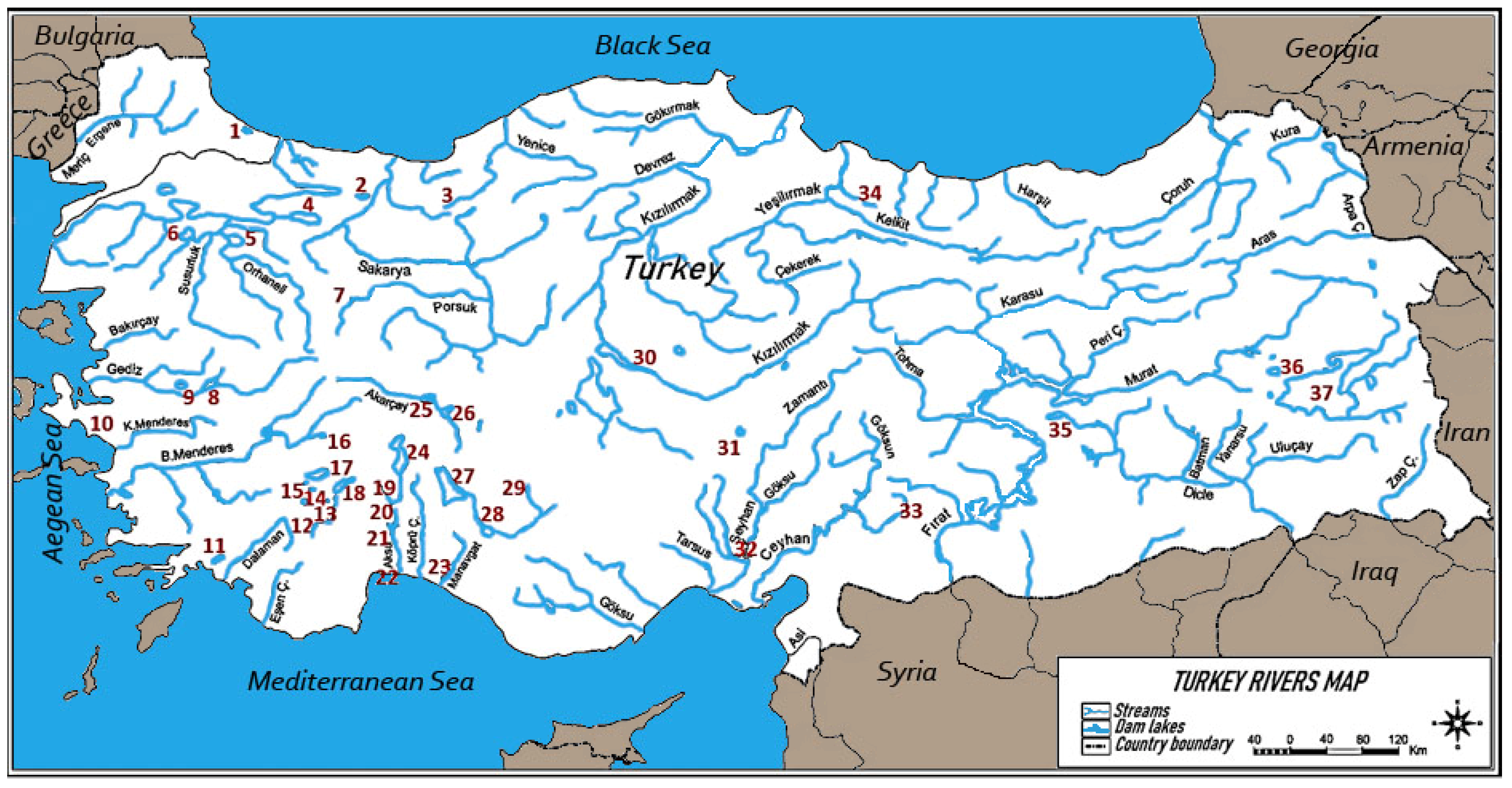

| Lake | N | River Basin | Area (km2) | Height from Sea (Altitude) (m) | Maximum Depth (m) | Origin |
|---|---|---|---|---|---|---|
| Abant | 3 | Western Black Sea | 1.28 | 1335 | 18 | Landslide Set |
| Acıgöl | 17 | Burdur (Closed) | 92 | 844 | 2 | Tectonic |
| Aksehir | 26 | Akarçay | 102 | 958 | 4 | Tectonic |
| Almus Dam | 29 | Yeşilırmak | 31.3 | 817 | 75 | Artificial |
| Altınapa Dam | 5 | Konya (Closed) | 2.20 | 1257 | 30 | Artificial |
| Apolyont | 27 | Susurluk | 135 | 6 | 10 | Tectonic |
| Beyşehir | 18 | Konya (Closed) | 656 | 1125 | 10 | Tectonic–Karstic |
| Burdur | 34 | Burdur (Closed) | 150 | 845 | 61 | Tectonic |
| Demirkopru Dam | 8 | Gediz | 47.7 | 238 | 50 | Artificial |
| Durusu Dam | 1 | Marmara | 30.4 | 2 | 3.4 (mean) | Coastal set–artificial |
| Eber | 25 | Akarçay | 120 | 967 | 6 | Tectonic |
| Eğirdir | 24 | Antalya | 470 | 916 | 13 | Tectonic–Karstic |
| Enne Dam | 7 | Sakarya | 0.94 | 1001 | 22 | Artificial |
| Gölbasi | 33 | Ceyhan | 2.19 | 880 | 22 | Tectonic–Karstic |
| Gölcük | 19 | Antalya | 1 | 1360 | 41 | Volcanic |
| Gölhisar | 13 | Western Mediterranean | 4 | 946 | 10 | Karstic |
| Hazar | 35 | Fırat Dicle | 86 | 1248 | 210 | Tectonic |
| Hirfanlı Dam | 30 | Kızılırmak | 263 | 870 | 40 | Artificial |
| Işıklı | 16 | Büyük Menderes | 65 | 815 | 8 | Tectonic |
| Iznik | 4 | Marmara | 298 | 85 | 65 | Tectonic |
| Kırkgöz | 21 | Antalya | <2 | 302 | 2 | Karstic |
| Kocagöz | 10 | Küçük Menderes | <1 | 8 | 7 | Tectonic–Alluvial Set |
| Köyceğiz | 11 | Western Mediterranean | 52 | 8 | 30 | Alluvial Set |
| Manavgat Dam | 23 | Antalya | 8.6 | 58 | 30 | Artificial |
| Manyas | 6 | Susurluk | 161 | 17 | 5 | Tectonic |
| Marmara | 9 | Gediz | 41 | 71 | 7 | Alluvial Set |
| Nazik | 31 | Van (Closed) | 45 | 1816 | 48 | Lava Set |
| Onaç Dam | 36 | Antalya | 3.56 | 838 | 21 | Artificial |
| Salda | 20 | Burdur (Closed) | 43 | 1140 | 180 | Tectonic |
| Sapanca | 15 | Sakarya | 47 | 34 | 61 | Alluvial Set |
| Seyhan Dam | 2 | Seyhan | 67.8 | 10 | 45 | Artificial |
| Suğla | 32 | Konya (Closed) | 40 | 1090 | 2 | Tectonic–Karstic |
| Sultan Marshes | 28 | Kızırmak | 200 | 1070 | 2 | Tectonic |
| Van | 37 | Van (Closed) | 3713 | 1646 | 451 | Volcanic–Lava Set |
| Yamansaz | 22 | Antalya | 11 | 2 | 5 | Karstic |
| Yapraklı Dam | 12 | Western Mediterranean | 6.5 | 1070 | >20 | Artificial |
| Yarışlı | 14 | Burdur (Closed) | 14 | 912 | 2 | Tectonic |
| Lake | N | Family | Species | English Common Name | IUCN | Endemism |
|---|---|---|---|---|---|---|
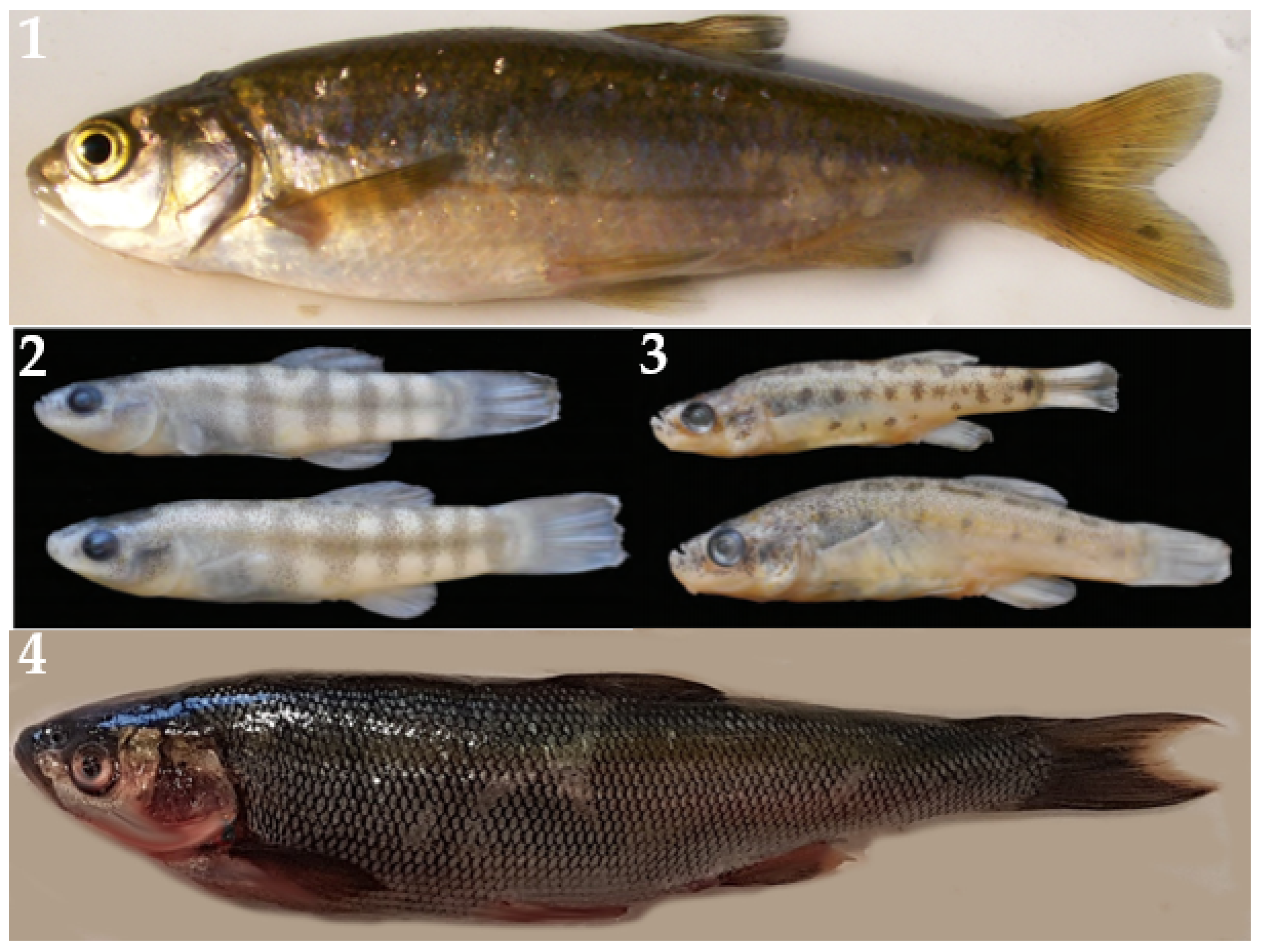
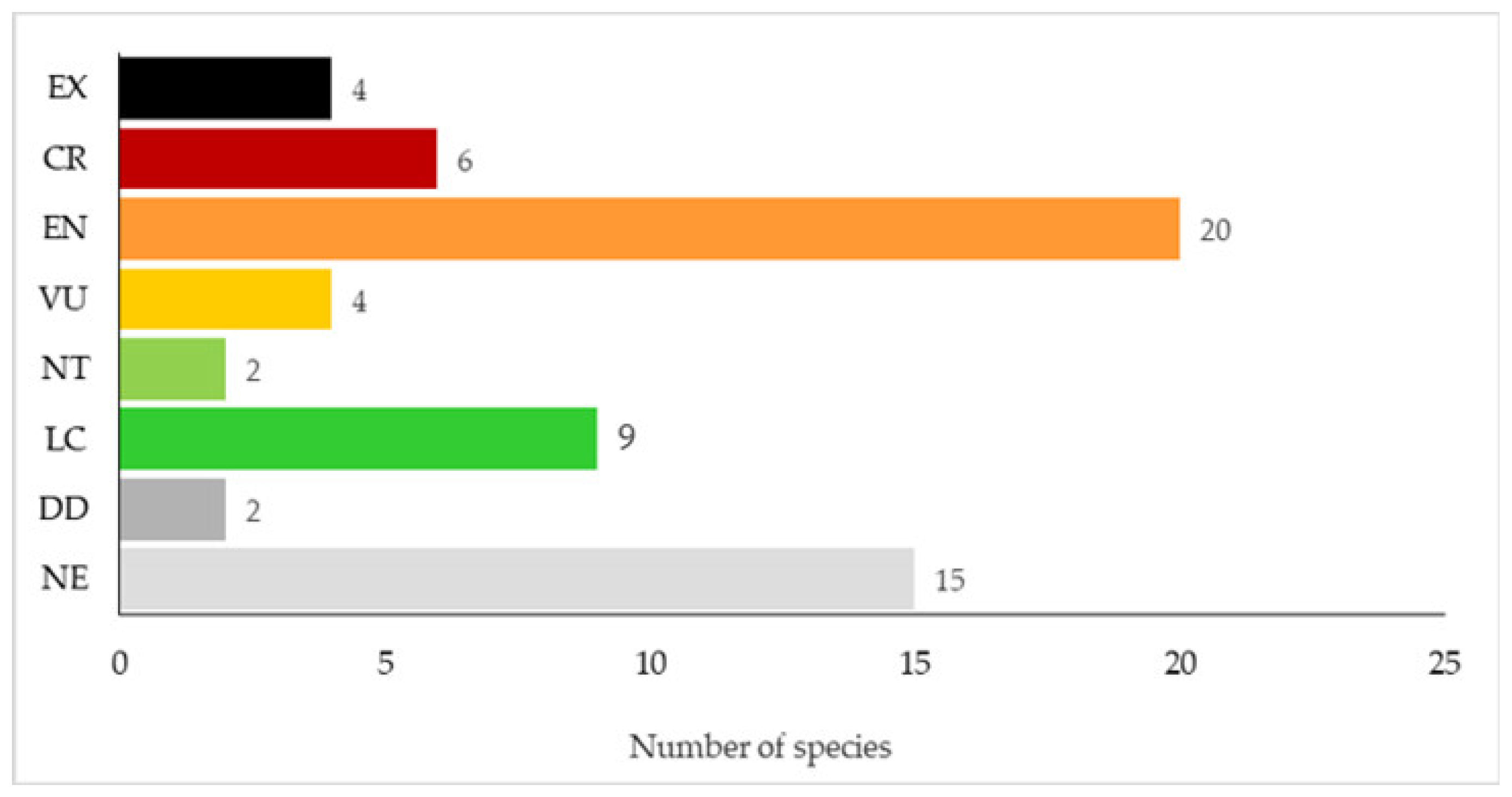
| Abant | 3 | Salmonidae | Salmo abanticus Tortonese, 1954 | Abant trout | NE | LE |
| Acıgöl | 17 | Aphaniidae | Anatolichthys transgrediens (Ermin 1946) | Acipinar killifish | CR | LE |
| Cobitidae | Cobitis phrygica Battalgil 1944 | Aci spined loach | NE | RE | ||
| Aksehir | 26 | Gobionidae | Gobio intermedius Battalgil, 1944 | Eber gudgeon | EN | RE |
| Leuciscidae | Squalius recurvirostris Özulug & Freyhof, 2011 | Akşehir chub | VU | RE | ||
| Almus Dam | 34 | Cyprinidae | Barbus anatolicus Turan, Kaya, Geiger & Freyhof, 2018 | - | DD | RE |
| Altınapa Dam | 29 | Leuciscidae | Squalius anatolicus (Bogutskaya, 1997) | Beysehir dace | LC | RE |
| Apolyont | 5 | Clupeidae | Clupeonella muhlisi Neu, 1934 | Apolyont sprat | NE | RE |
| Leuciscidae | Alburnus carinatus Battalgil, 1941 | Manyas shemaya | EN | RE | ||
| Beysehir | 27 | Aphaniidae | Anatolichthys iconii (Akşiray 1948) | Konya killifish | NE | RE |
| Cobitidae | Cobitis battalgilae Bacescu, 1962 | Battalgil spined loach | EN | RE | ||
| Cobitis bilseli Battalgil, 1942 | Beysehir spined loach | EN | LE | |||
| Cyprinidae | Capoeta mauricii Küçük, Turan, Şahin & Gülle, 2009 | Longsnout scraper | EN | RE | ||
| Garra kemali (Hankó, 1925) | Ereğli minnow | EN | RE | |||
| Gobionidae | Gobio microlepidotus Battalgil, 1942 | Beyşehir gudgeon | VU | RE | ||
| Leuciscidae | Alburnus akili Battalgil, 1942 | Beysehir bleak | EX | LE | ||
| Chondrostoma beysehirense Bogutskaya, 1997 | Beysehir nase | EN | RE | |||
| Pseudophoxinus anatolicus (Hankó, 1925) | Anatolian minnow | EN | RE | |||
| Pseudophoxinus battalgilae Bogutskaya, 1997 | Beysehir minnow | NE | RE | |||
| Pseudophoxinus hittitorum Freyhof & Özulug, 2010 | Hittitic spring minnow | EN | RE | |||
| Squalius anatolicus (Bogutskaya, 1997) | Beysehir dace | LC | RE | |||
| Nemacheilidae | Oxynoemacheilus atili Erk’akan, 2012 | Beysehir loach | NT | RE | ||
| Burdur | 18 | Aphaniidae | Anatolichthys sureyanus (Ney 1937) | Sureyan killifish | EN | LE |
| Demirköprü Dam | 8 | Gobiidae | Knipowitschia mermere Ahnelt, 1995 | Marmara goby | VU | RE |
| Durusu | 1 | Leuciscidae | Alburnus istanbulensis Battalgil 1941 | Thracian shemaya | LC | RE |
| Eber | 25 | Leuciscidae | Squalius recurvirostris Özulug & Freyhof, 2011 | Akşehir chub | VU | RE |
| Nemacheilidae | Seminemacheilus lendlii (Hankó, 1925) | Anatolian loach | VU | RE | ||
| Eğirdir | 24 | Aphaniidae | Anatolichthys iconii (Akşiray 1948) | Konya killifish | NE | RE |
| Cyprinidae | Garra klatti (Kosswig 1950) | Isparta minnow | EN | RE | ||
| Capoeta pestai (Pietschmann, 1933) | Egirdir barb | CR | RE | |||
| Leuciscidae | Pseudophoxinus egridiri (Karaman, 1972) | Egirdir minnow | EN | LE | ||
| Pseudophoxinus handlirschi (Pietschmann, 1933) | Handlirsch’s minnow | EX | LE | |||
| Enne Dam | 7 | Leuciscidae | Alburnus escherichii Steindachner, 1897 | Caucasian bleak | LC | RE |
| Gölbasi | 33 | Cobitidae | Cobitis erkakanae Freyhof, Bayçelebi & Geiger, 2018 | Gölbasi spined loach | NE | RE |
| Gölcük | 19 | Aphaniidae | Anatolichthys splendens Kosswig & Sözer 1945 | Splendid killifish | EX | LE |
| Cyprinidae | Garra klatti (Kosswig 1950) | Isparta minnow | EN | RE | ||
| Gölhisar | 13 | Leuciscidae | Scardinius elmaliensis Bogutskaya, 1997 | Antalya rudd | EN | RE |
| Hazar | 35 | Aphaniidae | Kosswigichthys asquamatus Sözer 1942 | Scaleless killifish | LC | LE |
| Leuciscidae | Alburnus heckeli Battalgil, 1944 | Hazar bleak | LC | LE | ||
| Nemacheilidae | Oxynoemacheilus hazarensis Freyhof & Özulug, 2017 | Hazar loach | NE | LE | ||
| Hirfanlı Dam | 30 | Aphaniidae | Anatolichthys danfordii (Boulenger 1890) | Danford’s killifish | CR | RE |
| Işıklı | 16 | Gobionidae | Gobio maeandricus Naseka, Erk’akan & Küçük, 2006 | Işıklı gudgeon | EN | RE |
| Leuciscidae | Squalius carinus Özulug & Freyhof, 2011 | Chocolate chub | EN | LE | ||
| Iznik | 4 | Leuciscidae | Alburnus nicaeensis Battalgil, 1941 | Iznik shemaya | EX | LE |
| Kırkgöz | 21 | Aphaniidae | Paraphanius mentoides (Akşiray, 1948) | - | NE | RE |
| Kocagöz | 10 | Gobiidae | Knipowitschia ricasolii (Di Caporiacco 1935) | Ephesus goby | CR | RE |
| Köyceğiz | 11 | Gobiidae | Knipowitschia byblisia Ahnelt, 2011 | Byblis goby | LC | RE |
| Knipowitschia caunosi Ahnelt, 2011 | Caunos goby | LC | LE | |||
| Manavgat Dam | 23 | Leuciscidae | Alburnus baliki Bogutskaya, Küçük & Ünlü, 2000 | Antalya bleak | EN | RE |
| Manyas | 6 | Leuciscidae | Alburnus carinatus Battalgil, 1941 | Manyas shemaya | EN | RE |
| Leuciscidae | Alburnoides manyasensis Turan, Ekmekçi, Kaya & Güçlü, 2013 | Manyas spirlin | LC | LE | ||
| Marmara | 9 | Gobiidae | Knipowitschia mermere Ahnelt, 1995 | Marmara goby | VU | RE |
| Marsh Sultan | 31 | Cobitidae | Cobitis joergbohleni Freyhof, Bayçelebi & Geiger, 2018 | Sultan spined loach | NE | LE |
| Leuciscidae | Pseudophoxinus elizavetae Bogutskaya, Küçük & Atalay, 2006 | Sultan Sazligi minnow | CR | RE | ||
| Nemacheilidae | Oxynoemacheilus ciceki Sungur, Eagderi & Jalili, 2017 | Loach | NE | LE | ||
| Seminemacheilus ahmeti Sungur, Jalili, Eagderi & Çiçek, 2018 | Sultan crested loach | NE | LE | |||
| Nazık | 36 | Cyprinidae | Capoeta kosswigi Karaman, 1969 | Van barb | DD | RE |
| Leuciscidae | Alburnus tarichi (Güldenstädt, 1814) | Van bleak | NT | RE | ||
| Nemacheilidae | Oxynoemacheilus ercisianus (Erk’akan & Kuru, 1986) | Van loach | EN | RE | ||
| Onaç Dam | 20 | Leuciscidae | Pseudophoxinus ninae Freyhof & Özulug, 2006 | Onaç spring minnow | CR | RE |
| Salda watersheds | 15 | Aphaniidae | Anatolichthys fontinalis (Akşiray 1948) | Burdur killifish | NE | RE |
| Anatolichthys saldae (Akşiray 1955) | Salda killifish | NE | LE | |||
| Cobitidae | Cobitis phrygica Battalgazi, 1944 | Aci spined loach | NE | RE | ||
| Leuciscidae | Pseudophoxinus burduricus Küçük, Gülle, Güçlü, Çiftçi & Erdogan, 2013 | Burdur spring minnow | EN | RE | ||
| Squalius fellowesii (Günther, 1868) | Aegean chub | LC | RE | |||
| Sapanca | 2 | Cobitidae | Cobitis emrei Freyhof, Bayçelebi & Geiger, 2018 | Sapanca spined loach | NE | LE |
| Seyhan Dam | 32 | Leuciscidae | Chondrostoma ceyhanensis Küçük, Turan, Güçlü, Mutlu & Çiftçi, 2017 | Ceyhan Nase | NE | RE |
| Suğla | 28 | Cobitidae | Cobitis battalgilae Bacescu, 1962 | Battalgil spined loach | EN | RE |
| Leuciscidae | Pseudophoxinus anatolicus (Hankó, 1925) | Anatolian minnow | EN | RE | ||
| Pseudophoxinus battalgilae Bogutskaya, 1998 | Beysehir minnow | NE | RE | |||
| Van | 37 | Leuciscidae | Alburnus tarichi (Güldenstädt, 1814) | Van bleak | NT | RE |
| Nemacheilidae | Oxynoemacheilus ercisianus (Erk’akan & Kuru, 1986) | Van loach | EN | RE | ||
| Yamansaz | 22 | Leuciscidae | Pseudophoxinus alii Küçük, 2007 | Pamphylian spring minnow | EN | RE |
| Yapraklı Dam | 12 | Leuciscidae | Alburnus carianorum Freyhof, Kaya, Bayçelebi, Geiger & Turan, 2018 | - | EN | RE |
| Yarışlı | 14 | Aphaniidae | Anatolichthys fontinalis (Akşiray 1948) | Burdur killifish | NE | RE |
| Lake | N | Main Threats | ||||||||||||||
|---|---|---|---|---|---|---|---|---|---|---|---|---|---|---|---|---|
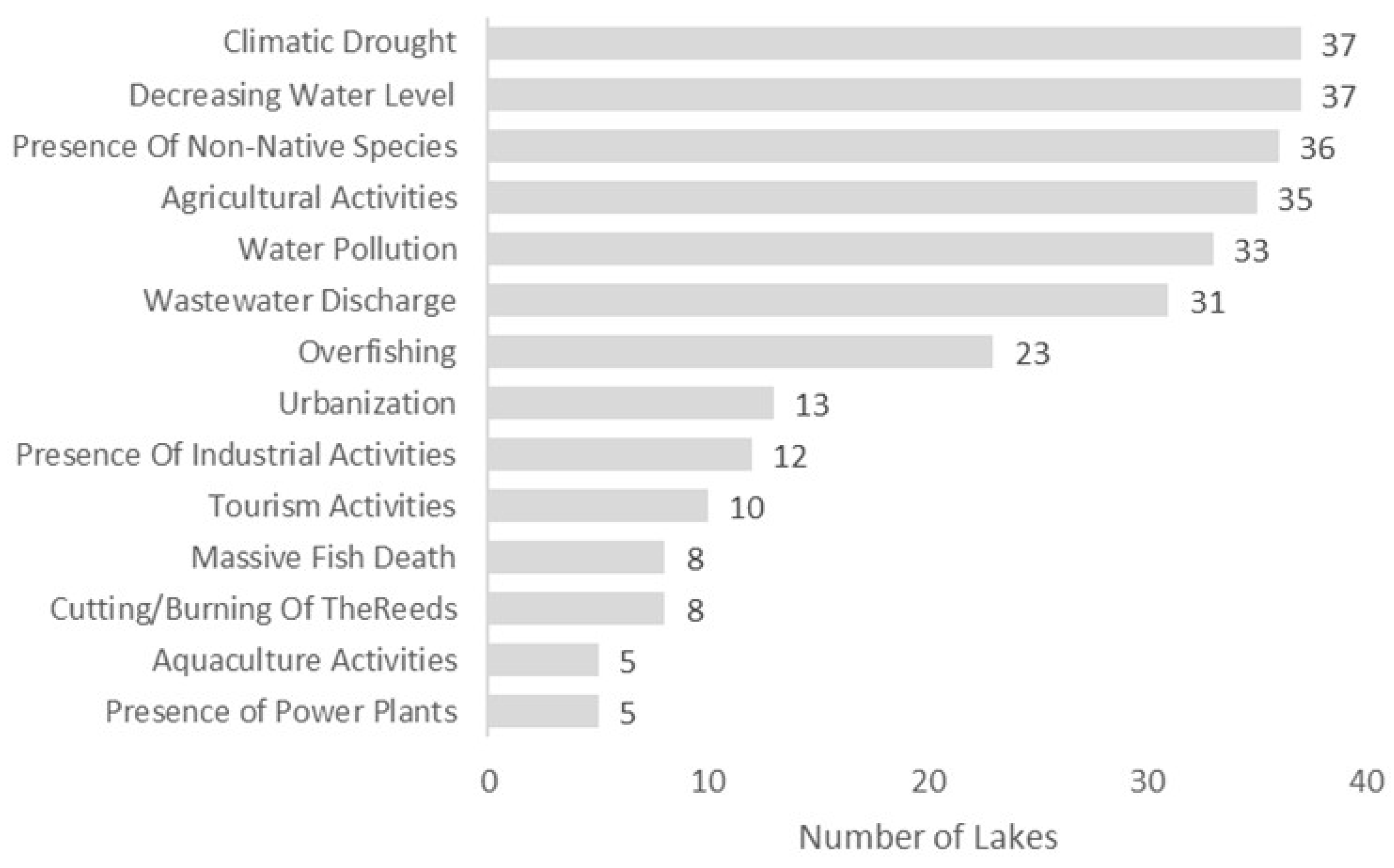
| Climatic Drought | Decreasing Water Level | Presence of Non-Native Species | Agricultural Activities | Water Pollution | Wastewater Discharge | Overfishing | Urbanization | Presence of Industrial Activities | Tourism Activities | Massive Fish Death | Cutting/Burning of The Reeds | Aquaculture Activities | Presence of Power Plants | Number of Threats Per Lake | ||
| Abant | 3 | 6 | ||||||||||||||
| Acıgöl | 17 | 8 | ||||||||||||||
| Aksehir | 26 | 9 | ||||||||||||||
| Almus Dam | 29 | 9 | ||||||||||||||
| Altınapa Dam | 5 | 7 | ||||||||||||||
| Apolyont | 27 | 9 | ||||||||||||||
| Beyşehir | 18 | 9 | ||||||||||||||
| Burdur | 34 | 9 | ||||||||||||||
| Demirkopru Dam | 8 | 10 | ||||||||||||||
| Durusu | 1 | 7 | ||||||||||||||
| Eber | 25 | 10 | ||||||||||||||
| Eğirdir | 24 | 8 | ||||||||||||||
| Enne Dam | 7 | 6 | ||||||||||||||
| Gölbasi | 33 | 8 | ||||||||||||||
| Gölcük | 19 | 6 | ||||||||||||||
| Gölhisar | 13 | 7 | ||||||||||||||
| Hazar | 35 | 10 | ||||||||||||||
| Hirfanlı Dam | 30 | 9 | ||||||||||||||
| Işıklı | 16 | 7 | ||||||||||||||
| Iznik | 4 | 9 | ||||||||||||||
| Kırkgöz | 21 | 8 | ||||||||||||||
| Kocagöz | 10 | 5 | ||||||||||||||
| Köyceğiz | 11 | 9 | ||||||||||||||
| Manavgat Dam | 23 | 5 | ||||||||||||||
| Manyas | 6 | 8 | ||||||||||||||
| Marmara | 9 | 10 | ||||||||||||||
| Nazık | 31 | 7 | ||||||||||||||
| Onaç Dam | 36 | 8 | ||||||||||||||
| Salda | 20 | 7 | ||||||||||||||
| Sapanca | 15 | 10 | ||||||||||||||
| Seyhan Dam | 2 | 11 | ||||||||||||||
| Suğla | 32 | 8 | ||||||||||||||
| Sultan Marshes | 28 | 7 | ||||||||||||||
| Van | 37 | 6 | ||||||||||||||
| Yamansaz | 22 | 8 | ||||||||||||||
| Yapraklı Dam | 12 | 7 | ||||||||||||||
| Yarışlı | 14 | 6 | ||||||||||||||
| Lake | Introduced (Non-Native and Translocated) Species | |||||||||||
|---|---|---|---|---|---|---|---|---|---|---|---|---|
| Atherina boyeri | Carassius gibelio | Cyprinus carpio | Esox cucius | Gambusia coolbroki | Knipowitschia caucasica | Lepomis cibbosus | Oncorhynchus cykiss | Pseudorosbora parva | Sander lucioperca | Tinca Tinca | Other Species | |
| Abant | ||||||||||||
| Acıgöl | ||||||||||||
| Aksehir | ||||||||||||
| Almus Dam | ||||||||||||
| Altınapa Dam | ||||||||||||
| Apolyont | ||||||||||||
| Beyşehir | ||||||||||||
| Burdur | ||||||||||||
| Demirkopru Dam | ||||||||||||
| Eber | ||||||||||||
| Eğirdir | ||||||||||||
| Enne Dam | ||||||||||||
| Gölbasi | ||||||||||||
| Gölcük | ||||||||||||
| Gölhisar | ||||||||||||
| Hazar | ||||||||||||
| Hirfanlı Dam | ||||||||||||
| Işıklı | ||||||||||||
| Iznik | ||||||||||||
| Kırkgöz | ||||||||||||
| Kocagöz | ||||||||||||
| Köyceğiz | ||||||||||||
| Manavgat Dam | ||||||||||||
| Manyas | ||||||||||||
| Marmara | ||||||||||||
| Nazik | ||||||||||||
| Onaç Dam | ||||||||||||
| Salda | ||||||||||||
| Sapanca | ||||||||||||
| Seyhan Dam | ||||||||||||
| Suğla | ||||||||||||
| Sultan Marshes | ||||||||||||
| Van | ||||||||||||
| Yamansaz | ||||||||||||
| Yapraklı Dam | ||||||||||||
| Yarışlı | ||||||||||||
Publisher’s Note: MDPI stays neutral with regard to jurisdictional claims in published maps and institutional affiliations. |
© 2021 by the authors. Licensee MDPI, Basel, Switzerland. This article is an open access article distributed under the terms and conditions of the Creative Commons Attribution (CC BY) license (https://creativecommons.org/licenses/by/4.0/).
Share and Cite
Giannetto, D.; Innal, D. Status of Endemic Freshwater Fish Fauna Inhabiting Major Lakes of Turkey under the Threats of Climate Change and Anthropogenic Disturbances: A Review. Water 2021, 13, 1534. https://doi.org/10.3390/w13111534
Giannetto D, Innal D. Status of Endemic Freshwater Fish Fauna Inhabiting Major Lakes of Turkey under the Threats of Climate Change and Anthropogenic Disturbances: A Review. Water. 2021; 13(11):1534. https://doi.org/10.3390/w13111534
Chicago/Turabian StyleGiannetto, Daniela, and Deniz Innal. 2021. "Status of Endemic Freshwater Fish Fauna Inhabiting Major Lakes of Turkey under the Threats of Climate Change and Anthropogenic Disturbances: A Review" Water 13, no. 11: 1534. https://doi.org/10.3390/w13111534
APA StyleGiannetto, D., & Innal, D. (2021). Status of Endemic Freshwater Fish Fauna Inhabiting Major Lakes of Turkey under the Threats of Climate Change and Anthropogenic Disturbances: A Review. Water, 13(11), 1534. https://doi.org/10.3390/w13111534


