Lost in Optimisation of Water Distribution Systems? A Literature Review of System Design



Abstract
1. Introduction
2. Aim, Scope and Structure of the Paper
3. Design Problems
3.1. Application Areas
3.1.1. New Systems: Design
3.1.2. Existing Systems
Strengthening
Rehabilitation
Expansion
3.1.3. Problem Elements
Pipes
Pumps
Tanks
Valves
3.2. Time, Uncertainty and Performance Considerations
3.2.1. Staged Design
3.2.2. Flexible Design
3.2.3. Resilient, Reliable and Robust Design
3.2.4. Design for Water Quality
4. General Classification of Reviewed Publications
4.1. Application Area
- Design of new systems is an application area with the highest representation (41%). Interestingly, an almost identical percentage (43%) totals applications for existing systems (i.e., strengthening, expansion and rehabilitation).
- An application area with the second highest representation (25%) is strengthening of existing systems.
- Expansion and rehabilitation of existing systems are both represented evenly by 9% of applications each.
- Optimisation of the system operation is represented by 16% of applications.
4.2. Optimisation Model
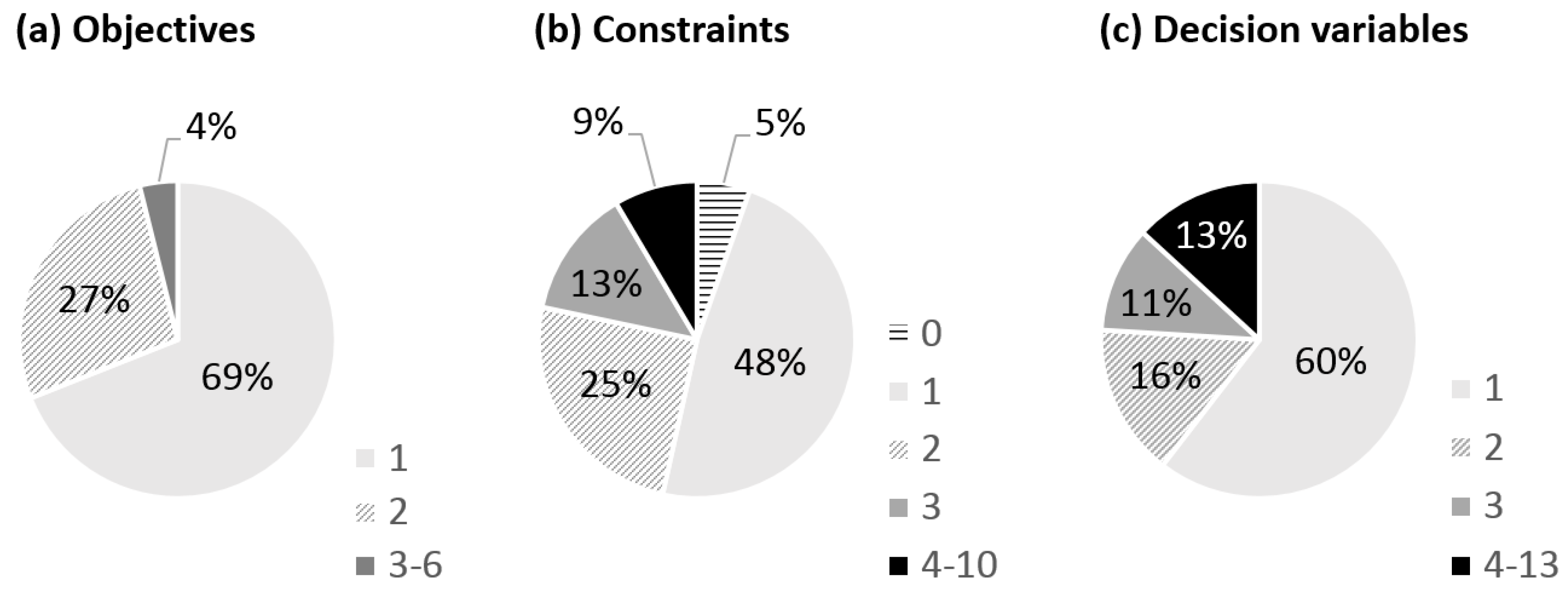
- The number of objectives included in optimisation models ranges from one to six. The majority of models (69%) are single-objective, determining the least-cost design. The second largest proportion (27%) represents two-objective optimisation models. Multi-objective models including more than two objectives (i.e., 3–6 objectives) are very sparse as they represent only 4% of all formulations.
- The number of constraints incorporated in optimisation models ranges from zero to ten. Hydraulic constraints (such as conservation of mass of flow, conservation of energy and conservation of mass of constituent) are normally included as implicit constraints and are forced to be satisfied by a WDS modelling tool, such as EPANET, and thus are not included in these statistics. There are 5% of models with no constraints, which are mainly multi-objective optimisation models where the pressure requirement is defined as an objective rather than a constraint. Almost half models (48%) include only one constraint (mostly the minimum pressure requirement). A quarter of models (25%) incorporate two constraints. The proportion of optimisation models with exactly three or more (i.e., 4–10) constraints is 13% and 9%, respectively.
- The number of types of a decision (i.e., control) variable included in optimisation models ranges from one to 13. The majority of optimisation models (60%) uses one type of a decision variable, being a pipe diameter/size or pipe segment length of a constant (known) diameter. The use of more than one type of a decision variable is considerably less frequent and is represented by 16%, 11% and 13%, respectively, for two, three and more (i.e., 4–13) types of a decision variable.
4.2.1. General Optimisation Model
Objectives
Constraints
Decision Variables
4.3. Solution Methodology
4.3.1. Computational Efficiency
4.3.2. Recent Developments
4.4. Test Network
5. Future Research
6. Summary and Conclusion
7. List of Terms
- Deterministic dynamic design = staged design over a long planning horizon divided into several construction phases, without considering future uncertainties.
- Deterministic static design = traditional design with a single construction phase for an entire expected life cycle of the system, without considering future uncertainties.
- Dynamic design = staged (i.e., real-life) design capturing the system modifications/growth over a long planning horizon divided into several construction phases (adopted from [118]).
- Hydraulic constraints = constraints arising from physical laws of fluid flow in a pipe network, such as conservation of mass of flow, conservation of energy, conservation of mass of constituent.
- Optimisation approach = single-objective approach or multi-objective approach.
- Optimisation method = method, either deterministic or stochastic, used to solve an optimisation problem.
- Optimisation model = mathematical formulation of an optimisation problem inclusive of objective functions, constraints and decision variables.
- Probabilistic dynamic design = flexible design over a long planning horizon divided into several construction phases, with considering future uncertainties.
- Probabilistic static design = traditional design with a single construction phase for an entire expected life cycle of the system, with considering future uncertainties.
- Simulation model = mathematical model or software used to solve hydraulics and water quality network equations.
- Single pipe design = design which uses pipe sizes/diameters as decision variables (either discrete or continuous).
- Solution = result of optimisation, either from feasible or infeasible domain, so we refer to a ‘feasible solution’ or ‘infeasible solution’, respectively. In mathematical terms though an ‘infeasible solution’ is not classified as a solution.
- Split-pipe design = design which uses pipe segment lengths of a constant (known) diameter as decision variables.
- Static design = traditional (i.e., theoretical) design with a single construction phase for an entire expected life cycle of the system (adopted from [118]).
- System constraints = constraints arising from the limitations of a WDS or its operational requirements, such as water level limits at storage tanks, limits for nodal pressures or constituent concentrations, tank volume deficit etc.
Conflicts of Interest
Abbreviations
| ACO | ant colony optimisation |
| ACOCTC | convergence-trajectory controlled ant colony optimisation |
| ACS | ant colony system |
| AEF | average emissions factor |
| AIM | artificial inducement mutation |
| ALCO-GA | adaptive locally constrained genetic algorithm |
| AMPSO | accelerated momentum particle swarm optimisation |
| ANN | artificial neural network |
| AS | ant system |
| ASelite | elitist ant system |
| ASrank | elitist rank ant system |
| BB | branch and bound |
| BB-BC | big bang-big crunch |
| BLIP | binary linear integer programming |
| BLP-DE | combined binary linear programming and differential evolution |
| BWN-II | battle of the water networks II (optimisation problem) |
| CA | cellular automaton |
| CAMOGA | cellular automaton and genetic approach to multi-objective optimisation |
| CANDA | cellular automaton for network design algorithm |
| CC | chance constraints |
| CDGA | crossover dither creeping mutation genetic algorithm |
| CE | cross entropy |
| CFO | central force optimisation |
| CGA | crossover-based genetic algorithm with creeping mutation |
| CMBGA | non-crossover dither creeping mutation-based genetic algorithm |
| CR | crossover probability (parameter) |
| CS | cuckoo search |
| CSHS | combined cuckoo-harmony search |
| CTM | cohesive transport model |
| D | design |
| dDE | dither differential evolution |
| DDSM | demand-driven simulation method |
| DE | differential evolution |
| DMA | district metering area |
| DPM | discoloration propensity model |
| DSO | newly developed swarm-based optimisation algorithm |
| EA | evolutionary algorithm |
| EA-WDND | evolutionary algorithm for solving water distribution network design |
| EEA | embodied energy analysis |
| EEF | estimated (24-h) emissions factor (curve) |
| EF | emissions factor |
| EPANETpdd | pressure-driven demand extension of EPANET |
| EPS | extended period simulation |
| ES | evolution strategy |
| F | mutation weighting factor (parameter) |
| FCV | flow control valve |
| fmGA | fast messy genetic algorithm |
| FSP | fixed speed pump |
| GA | genetic algorithm |
| GA-ILP | combined genetic algorithm and integer linear programming |
| GA-LP/GALP | combined genetic algorithm and linear programming |
| GANEO | genetic algorithm network optimisation (program) |
| GENOME | genetic algorithm pipe network optimisation model |
| GHEST | genetic heritage evolution by stochastic transmission |
| GHG | greenhouse gas (emissions) |
| GOF | gradient of the objective function |
| GP | genetic programming |
| GRG2 | generalised reduced gradient (solver) |
| GUI | graphical user interface |
| HBA | heuristic-based algorithm |
| HBMO | honey bee mating optimisation |
| HD-DDS | hybrid discrete dynamically dimensioned search |
| HDSM | head-driven simulation method |
| HMCR | harmony memory considering rate (parameter) |
| HMS | harmony memory size (parameter) |
| HS | harmony search |
| IA | immune algorithm |
| IDPSO | integer discrete particle swarm optimisation |
| ILP | integer linear programming |
| IMBA | improved mine blast algorithm |
| IPSO | improved particle swarm optimisation |
| KLSM | Kang and Lansey’s sampling method [26] |
| LCA | life cycle analysis |
| LHS | Latin hypercube sampling |
| LINDO | linear interactive discrete optimiser |
| LM | Lagrange’s method |
| LP | linear programming |
| LTF | linear transfer function |
| MA | memetic algorithm |
| MBA | mine blast algorithm |
| MBLP | mixed binary linear problem |
| MCHH | Markov-chain hyper-heuristic |
| MdDE | modified dither differential evolution |
| MENOME | metaheuristic pipe network optimisation model |
| mIA | modified immune algorithm |
| MILP | mixed integer linear programming |
| MINLP | mixed integer nonlinear programming |
| MMAS | max-min ant system |
| MO | multi-objective |
| MODE | multi-objective differential evolution |
| MOEA | multi-objective evolutionary algorithm |
| MOGA | multi-objective genetic algorithm |
| MSATS | mixed simulated annealing and tabu search |
| NBGA | non-crossover genetic algorithm with traditional bitwise mutation |
| NFF | needed fire flow |
| NLP | nonlinear programming |
| NLP-DE | combined nonlinear programming and differential evolution |
| NSES | non-dominated sorting evolution strategy |
| NSGA-II | non-dominated sorting genetic algorithm II |
| OP | operation |
| OPTIMOGA | optimised multi-objective genetic algorithm |
| OPUS | optimal power use surface |
| PAR | pitch adjustment rate (parameter) |
| PESA-II | Pareto envelope-based selection algorithm II |
| PHSM | prescreened heuristic sampling method |
| PIV | pipe index vector |
| PRV | pressure reducing valve |
| PSF HS | parameter setting free harmony search |
| PSHS | particle swarm harmony search |
| PSO | particle swarm optimisation |
| PSO-DE | combined particle swarm optimisation and differential evolution |
| PVA | present value analysis |
| RC | robust counterpart (approach) |
| ROs | real options (approach) |
| RS | random sampling |
| RST | random search technique |
| SA | simulated annealing |
| SADE | self-adaptive differential evolution |
| SAMODE | self-adaptive multi-objective differential evolution |
| SCA | shuffled complex algorithm |
| SCE | shuffled complex evolution |
| SDE | standard differential evolution |
| SE | search enforcement |
| SFLA | shuffled frog leaping algorithm |
| SGA | crossover-based genetic algorithm with bitwise mutation |
| SMGA | structured messy genetic algorithm |
| SMODE | standard multi-objective differential evolution (i.e., optimising the whole network directly without decomposition into subnetworks) |
| SMORO | scenario-based multi-objective robust optimisation |
| SO | single-objective |
| SPEA2 | strength Pareto evolutionary algorithm 2 |
| SS | scatter search |
| SSSA | scatter search using simulated annealing as a local searcher |
| STA | state transition algorithm |
| TC | time cycle |
| TRS | tank reserve size |
| TS | tabu search |
| VSP | variable speed pump |
| WCEN | water distribution cost-emission nexus |
| WDS | water distribution system |
| WDSA | water distribution systems analysis (conference) |
| WPP | water purification plant |
| WSMGA | water system multi-objective genetic algorithm |
| WTP | water treatment plant |
Appendix A

| ID. Authors (Year) [Ref] SO/MO * Brief Description | Optimisation Model (Objective Functions +, Constraints **, Decision Variables ++) | Water Quality Network Analysis Optimisation Method | Notes |
|---|---|---|---|
| 1. Alperovits and Shamir (1977) [14] SO Optimal water distribution system (WDS) design and operation with split pipes considering multiple loading conditions using linear programming (LP) with a two-phase procedure. | Objective (1): Minimise (a) the overall capital cost of the network including pipes, pumps, reservoirs and valves, (b) present value of operating costs (pumps, penalties on operating the dummy valves). Constraints: (1) Min/max pressure limits, (2) sum of lengths of pipe segments within an arc equals to the length of this arc, (3) non-negativity requirement for the length of pipe segments. Decision variables: (1) Flows in pipes as primary variables, (2) length of pipe segments of constant pipe diameter (so called split-pipe decision variables), (3) dummy valve variables to represent multiple loadings (demands), (4) pump locations and capacities, (5) valve locations, (6) reservoir elevations, (7) pump operation statuses, (8) valve settings. | Water quality: N/A. Network analysis: Initial flow distribution is to be specified, flows are then redistributed using a gradient method within an optimisation process. Optimisation method: LP gradient method. |
|
| 2. Schwarz et al. (1985) [129] SO Optimal development of a regional multiquality water resources system over a planning horizon (e.g., several years) using LP. | Objective (1): Minimise the costs of (a) water supply (water), (b) temporary curtailment of water supply, (c) network expansion, (d) conveying water, (e) excess salination. Major constraints: (1) Water quantity bounds, (2) water quality bounds, (3) regional water balance (quantity), (4) capacity expansion of the network, (5) annual source water balance (quantity), (6) annual source mass balance (salinity), (7) node mass balance (salinity). Decision variables: (1) Target water supply (m3/year), (2) temporary curtailment of water supply (m3/year), (3) capacity expansion (m3/day), (4) conveyance of water (m3/day), (5) amount of water used from storage (m3/day), (6) salinity (mg/L). | Water quality: Salinity. Network analysis: TEKUMA model [202,203]. Optimisation method: TEKUMA model [202,203] using LP. |
|
| 3. Kessler and Shamir (1989) [114] SO Optimal WDS design with split pipes using LP with a two-phase procedure. | Objective (1): Minimise (a) the design cost of the network (pipes). Constraints: (1) Pressure limitations at selected nodes, (2) sum of lengths of pipe segments within an arc equals to the length of this arc. Decision variables: (1) Lengths of pipe segments of constant (all available) pipe diameters (so called split-pipe decision variables), (2) flows in pipes. | Water quality: N/A. Network analysis: Flow in pipes is calculated using projected gradient method within an optimisation process. Optimisation method: LP gradient method. |
|
| 4. Lansey and Mays (1989) [16] SO Optimal WDS design, rehabilitation and operation considering multiple loading conditions using nonlinear programming (NLP) with a two-phase procedure. | Objective (1): Minimise (a) the design cost of the network including pipes, pumps and tanks, (b) penalty cost for violating nodal pressure heads. Constraints: (1) Lower and upper pressure bounds at nodes, (2) design constraints (i.e., storage requirements), (3) general constraints. Decision variables: (1) Pipe diameters (continuous), (2) pump sizes (horsepower or head-flow), (3) valve settings, (4) tank volumes. | Water quality: N/A. Network analysis: KYPIPE [12]. Optimisation method: NLP solver generalised reduced gradient (GRG2) [206]. |
|
| 5. Lansey et al. (1989) [110] SO Optimal WDS design including uncertainties in demands, minimum pressure requirements and pipe roughnesses using NLP. | Objective (1): Minimise (a) the design cost of the network (pipes). Constraints: (1) Conservation of mass of flow and energy, (2) min pressure at the nodes, (3) pipe diameter bigger than or equal to zero. Decision variables: (1) Pipe diameters (continuous), (2) pressure head at nodes. | Water quality: N/A. Network analysis: Network hydraulics is included as a constraint to the optimisation model. Optimisation method: NLP solver GRG2 [206]. |
|
| 6. Eiger et al. (1994) [115] SO Optimal WDS design with split pipes using mixed-integer NLP (MINLP) with a two-phase procedure. | Objective (1): Minimise (a) the design cost of the network (pipes). Constraints: (1) Pressure limitations at selected nodes, (2) sum of lengths of pipe segments within an arc equals to the length of this arc. Decision variables: (1) Lengths of pipe segments of constant (all available) pipe diameters (so called split-pipe decision variables), (2) flows in pipes. Note: Same formulation as in Kessler and Shamir (1989). | Water quality: N/A. Network analysis: Flow in pipes is calculated using projected gradient method within an optimisation process. Optimisation method: Branch and bound (BB) method. |
|
| 7. Kim and Mays (1994) [17] SO Optimal WDS rehabilitation and operation over a planning horizon (e.g., 20 years) using MINLP with a two-phase procedure. | Objective (1): Minimise the sum of the present value of the (a) pipe replacement cost, (b) pipe rehabilitation cost, (c) expected pipe repair (i.e., break repair) cost, (d) pump energy cost. Constraints: (1) Demand supplied to each node should be greater or equal to the required demand, (2) min/max pressures at demand nodes, (3) constraints on binary decision variables representing pipe replacement and rehabilitation options, (4) constraints on continuous decision variables representing the diameter of the replaced pipe and pump horsepower. Decision variables: (1) Pipe replacement option (binary), (2) pipe rehabilitation option (binary), (3) pipe diameters of the replaced pipes (continuous), (4) pump horsepower (continuous). | Water quality: N/A. Network analysis: KYPIPE [12]. Optimisation method: BB method combined with GRG2 [206]. |
|
| 8. Murphy et al. (1994) [96] SO Optimal WDS strengthening, expansion, rehabilitation and operation considering multiple loading conditions using genetic algorithm (GA). | Objective (1): Minimise the design cost of the network including (a) pipes, (b) pumps, (c) tanks, and (d) the pump energy costs. Constraints: (1) Limits for nodal pressure heads, (2) limits for tank water levels. Decision variables: Options for (1) new pipes, (2) duplicated pipes, (3) cleaned/lined pipes, (4) pumps, (5) tanks. | Water quality: N/A. Network analysis: Unspecified steady state hydraulic solver. Optimisation method: GA. |
|
| 9. Loganathan et al. (1995) [116] SO Optimal WDS design and strengthening with split pipes using a combination of LP, mutlistart local search and simulated annealing (SA) in a two-phase procedure. | Objective (1): Minimise (a) the design cost of the network (pipes). Constraints: (1) Min pressure at the nodes, (2) sum of pipe segment lengths must be equal to the link length, (3) nonnegativity of segment lengths. Decision variables: (1) Lengths of pipe segments of known diameters (so called split-pipe decision variables). | Water quality: N/A. Network analysis: Explicit mathematical formulation (steady state). Optimisation method: Combined LP, mutlistart local search and SA. |
|
| 10. Dandy et al. (1996) [85] SO Optimal WDS strengthening using GA. | Objective (1): Minimise (a) the sum of material and construction costs of pipes, (b) the penalty cost for violating the pressure constraints. Constraints: (1) Min/max pressure limits at certain network nodes, (2) min diameters for certain pipes in the network. Decision variables: (1) Pipe diameters (discrete diameters are coded using binary substrings). | Water quality: N/A. Network analysis: KYPIPE [12] and another hydraulic solver developed for the paper. Optimisation method: GA. |
|
| 11. Halhal et al. (1997) [63] MO Optimal WDS rehabilitation and strengthening over a planning horizon (e.g., several years) using structured messy GA (SMGA). | Objective (1): Maximise the weighted sum of the following benefits of the network: (a) hydraulic performance, (b) physical integrity of the pipes, (c) system flexibility, (d) water quality. Objective (2): Minimise the cost (supply and installation) of the network including (a) new parallel pipes (i.e., duplication), (b) cleaning and lining existing pipes, (c) replacing existing pipes. Constraints: (1) Costs cannot exceed the available budget. Decision variables: String comprising 2 substrings: (1) substring consisting of pipe numbers, (2) substring consisting of decisions associated with those pipes (8 possible decisions). Note: One MO model including both objectives. | Water quality: A general water quality consideration. Network analysis: EPANET. Optimisation method: SMGA. |
|
| 12. Savic and Walters (1997) [42] SO Optimal WDS design and strengthening using GA. | Objective (1): Minimise (a) the design cost of the network (pipes). Constraints: (1) Min pressure at the nodes. Decision variables: (1) Pipe diameters (discrete). | Water quality: N/A. Network analysis: Network solver based on the EPANET. Optimisation method: GANET [208] using GA. |
|
| 13. Cunha and Sousa (1999) [102] SO Optimal WDS design using SA. | Objective (1): Minimise (a) the design cost of the network (pipes). Constraints: (1) Min pressure at the nodes, (2) min pipe diameter. Decision variables: (1) Pipe diameters (discrete). | Water quality: N/A. Network analysis: Newton method to solve hydraulic equations to obtain flows and heads. Optimisation method: SA. |
|
| 14. Gupta et al. (1999) [188] SO Optimal WDS strengthening and expansion using GA with search space reduction. | Objective (1): Minimise (a) the design cost of the network (pipes), (b) penalty for violating minimum residual head. Constraints: (1) Min residual head, (2) min desirable velocity in a pipe. Decision variables: (1) Pipe diameters (discrete). | Water quality: N/A. Network analysis: ANALIS [212]. Optimisation method: GA. |
|
| 15. Halhal et al. (1999) [131] MO Optimal WDS rehabilitation and strengthening over a planning horizon (i.e., 10 years) using SMGA. | Objective (1): Maximise the present value of the benefit of the network rehabilitation over the planning period (incorporating the welfare index), using the following performance criteria: (a) carrying capacity, (b) physical integrity of the pipes, (c) system flexibility, (d) water quality. Objective (2): Minimise (a) the present value of the rehabilitation costs over the planning period. Constraints: (1) Rehabilitation costs less than or equal to the budget. Decision variables: String comprising 3 substrings (1) location substring: pipe numbers of pipes scheduled for rehabilitation (integer), (2) decision substring: rehabilitation option (integer), (3) timing substring: year of rehabilitation execution (integer). Note: One MO model including both objectives. | Water quality: A general water quality consideration. Network analysis: Unspecified solver (steady state). Optimisation method: SMGA. |
|
| 16. Montesinos et al. (1999) [86] SO Optimal WDS strengthening using GA. | Objective (1): Minimise (a) the design cost of the network (pipes). Constraints: (1) Min pressure at the nodes, (2) max velocity in the pipes. Decision variables: (1) Pipe diameters (discrete). | Water quality: N/A. Network analysis: Newton-Raphson method [10]. Optimisation method: GA. |
|
| 17. Walters et al. (1999) [99] MO Optimal WDS strengthening, expansion, rehabilitation and operation with multiple loading conditions and two approaches to model tanks using SMGA. Note: Discussion: [213], Erratum to Discussion: [214] | Objective (1): Maximise the weighted sum of the benefits of the network rehabilitation, using the following performance criteria: (a) nodal pressure shortfall, (b) storage capacity difference, (c) tank operating level difference or tank flow difference. Objective (2): Minimise (a) the capital cost of the network including pipes, pumps, tanks, (b) present value of the energy consumed during a specified period. Constraints: (1) Pressure constraints for different loading patterns, (2) flow constraints into and out of the tanks. Decision variables: String comprising 2 substrings (1) location substring: pipes, pumps, tanks (integer of 1 or 2 digits), (2) decision substring (expansion/rehabilitation options): pipes, pumps, tanks (integer of 1, 2 or 5 digits). Note: One MO model including both objectives. | Water quality: N/A. Network analysis: Unspecified solver (steady state). Optimisation method: SMGA. |
|
| 18. Costa et al. (2000) [60] SO Optimal WDS design and operation using SA. | Objective (1): Minimise the capital cost of the network including (a) pipes, (b) pumps, (c) present value of pump energy costs. Constraints: (1) Min head bound on demand nodes. Decision variables: (1) Pipe diameters (discrete), (2) pump sizes (discrete). | Water quality: N/A. Network analysis: Newton-Raphson method [10]. Optimisation method: SA. |
|
| 19. Dandy and Hewitson (2000) [120] SO Optimal WDS design, strengthening and operation including water quality considerations using GA with search space reduction. | Objective (1): Minimise (a) the capital cost of new pipes, pumps and tanks, present value of (b) pump energy costs, (c) likely cost to the community due to waterborne diseases, (d) likely community cost due to disinfection by-products, (e) community cost of chlorine levels that exceed acceptable limits, (f) cost of disinfection, (g) penalty cost for violating constraints. Constraints: (1) Min pressure at the demand nodes, (2) tanks must refill at the end of the cycle. Decision variables: (1) Sizes of new and duplicate pipes, (2) sizes of new pumps and tanks, (3) locations of new pumps and tanks, (4) decision rules for operating the system, (5) dosing rates of chloramine/chlorine at selected points. | Water quality: Chloramine, chlorine. Network analysis: EPANET (extended period simulation (EPS)). Optimisation method: GA. |
|
| 20. Vairavamoorthy and Ali (2000) [43] SO Optimal WDS design and strengthening incorporating a linear transfer function (LTF) model to approximate network hydraulics using GA. | Objective (1): Minimise (a) the capital cost of the network (pipes), (b) penalty for violating the pressure constraints. Constraints: (1) Min/max pressure at the nodes. Decision variables: (1) Pipe diameters (discrete). | Water quality: N/A. Network analysis: Steady state hydraulic solver based on the gradient method [215]. Optimisation method: GA. |
|
| 21. Dandy and Engelhardt (2001) [130] SO Optimal WDS rehabilitation (considering only pipe replacement) over a planning horizon (i.e., 20 years) using GA. | Objective (1): Minimise (a) the system cost of the rehabilitated network (pipes)—present values of pipe failure costs (i.e., repair costs of existing and new pipes) and pipe replacement costs are considered. Constraints (case 1): N/A. Constraints (case 2): (1) Allowable budget for each time step (i.e., 5-year block). Constraints (case 3): (1) As above in the case 2, (2) min pressure at the nodes, (3) max velocity in the pipes. Decision variables (case 1): (1) Replacement decision (0 = no replacement, 1 = replace). Decision variables (case 2): (1) Timing of the replacement (integer) (“all pipe representation”); or (1) pipe to be replaced (integer), (2) timing of the replacement (integer) (“limited pipe representation”). Decision variables (case 3): (1)–(2) as above in the case 2, (3) diameter of the new pipe (integer). | Water quality: N/A. Network analysis: EPANET (Case 3 only). Optimisation method: GA. |
|
| 22. Wu and Simpson (2002) [88] SO Optimal WDS strengthening using fast messy GA (fmGA). | Objective (1): Minimise (a) the design cost of the network (pipes), (b) penalty for violating the pressure constraint. Constraints: (1) Min pressure at the nodes. Decision variables: (1) Pipe diameters (discrete). | Water quality: N/A. Network analysis: EPANET. Optimisation method: fmGA. |
|
| 23. Eusuff and Lansey (2003) [103] SO Optimal WDS design and strengthening using shuffled frog leaping algorithm (SFLA). | Objective (1): Minimise (a) the design cost of the network (pipes), (b) penalty cost for pressure head violations. Constraints: (1) Min pressure at the nodes. Decision variables: (1) Pipe diameters (discrete). | Water quality: N/A. Network analysis: EPANET. Optimisation method: SFLA. |
|
| 24. Maier et al. (2003) [104] SO Optimal WDS strengthening, expansion and rehabilitation using ant colony optimisation (ACO). | Objective (1): Minimise (a) the design cost of the network (pipes), (b) penalty for violating the pressure constraint. Constraints: (1) Min pressure at the nodes. Decision variables: (1) Pipe diameters (discrete), (2) pipe rehabilitation options (binary). | Water quality: N/A. Network analysis: WADISO [217], final solutions checked by EPANET. Optimisation method: ACO. |
|
| 25. Liong and Atiquzzaman (2004) [157] SO Optimal WDS design using SCE. | Objective (1): Minimise (a) the design cost of the network (pipes), (b) penalty cost for violating the pressure head bound. Constraints: (1) Min nodal pressure head bound, (2) min/max bound on pipe sizes. Decision variables: (1) Pipe sizes (converted to commercially available diameters). | Water quality: N/A. Network analysis: EPANET. Optimisation method: SCE [218]. |
|
| 26. Broad et al. (2005) [87] SO Optimal WDS strengthening including water quality considerations using offline artificial neural networks (ANNs) and GA. | Objective (1): Minimise (a) the design cost of the network (pipes), (b) penalty cost for violating pressure head, (c) penalty cost for violating chlorine residual. Constraints: (1) Min/max pressure at the nodes, (2) min/max chlorine residual at the nodes. Decision variables: (1) Pipe diameters, (2) chlorine dosing rates. | Water quality: Chlorine. Network analysis: Offline ANN. Optimisation method: GA. |
|
| 27. Farmani et al. (2005) [65] MO Optimal WDS design and strengthening using non-dominated sorting genetic algorithm II (NSGA-II) and strength Pareto evolutionary algorithm 2 (SPEA2). | Objective (1): Minimise (a) the design cost of the network (pipes). Objective (2): Minimise (a) the maximum individual head deficiency at the network nodes. Objective (3) (only for the EXNET test network): Minimise (a) the number of demand nodes with head deficiency. Constraints: N/A. Decision variables: (1) Pipe diameters (discrete). Note: Two MO models, the first including objectives (1) and (2) (applied to the New York City tunnels and Hanoi network); the second objectives (1), (2) and (3) (applied to the EXNET network). | Water quality: N/A. Network analysis: EPANET. Optimisation method: NSGA-II and SPEA2 are compared. |
|
| 28. Keedwell and Khu (2005) [44] SO Optimal WDS design using a combined cellular automaton for network design algorithm (CANDA) and GA (CANDA-GA) including an engineered initial population. | Objective (1): Minimise (a) the design cost of the network (pipes), (b) penalty for violating the pressure constraint. Constraints: (1) Min/max pressure at the nodes. Decision variables: (1) Pipe diameters (discrete). | Water quality: N/A. Network analysis: EPANET. Optimisation method: CANDA-GA. |
|
| 29. Ostfeld (2005) [53] SO Optimal design and operation of multiquality WDSs including multiple loading conditions and water quality considerations using GA. | Objective (1): Minimise (a-D ?) the construction costs of pipes, tanks, pump stations and treatment facilities, (b-OP ??) annual operation costs of pump stations and treatment facilities. Constraints: (1) Min/max heads at consumer nodes, (2) max permitted amounts of water withdrawals at sources, (3) tank volume deficit at the end of the simulation period, (4) min/max concentrations at consumer nodes, (5) removal ratio constraints. Decision variables: D: (1) Pipe diameters, (2) tank max storage, (3) max pumping unit power, (4) max removal ratios at treatment facilities, OP: (5) scheduling of pumping units, (6) treatment removal ratios. | Water quality: Unspecified conservative parameters. Network analysis: EPANET (EPS). Optimisation method: GA. |
|
| 30. Vairavamoorthy and Ali (2005) [189] SO Optimal WDS design using GA with a pipe index vector (PIV) and search space reduction in a three-phase procedure. | Objective (1): Minimise (a) the design cost of the network (pipes). Constraints: (1) Min/max pressure at the nodes. Decision variables: (1) Pipe diameters (discrete). | Water quality: N/A. Network analysis: Explicit mathematical formulation (steady state for peak demands). Optimisation method: GA with PIV. |
|
| 31. Vamvakeridou-Lyroudia et al. (2005) [93] MO Optimal WDS strengthening, expansion, rehabilitation and operation considering multiple loading conditions using GA with fuzzy reasoning. | Objective (1): Minimise (a) the design cost of the network including pipes, pumps and tanks. Objective (2): Maximise the benefit/quality of the solution, using the following system performance criteria (constraints): (a) min pressure at the nodes, (b) max velocity in the pipes, (c) safety volume capacity for tanks, (d) safety volume capacity for the network as a whole, (e) pump operational capacity, (f) operational volume capacity for tanks, (g) filling capacity for tanks, (h) operational volume capacity for the network as a whole, (i) filling capacity for the network as a whole. Constraints: N/A. Decision variables: (1) Commercially available pipe diameters (integer), (2) cleaning/lining of existing pipes (binary: 0 = no action, 1 = cleaning/lining), (3) the number of new pumps (integer) with pre-defined operation curve, (4) volume of a new tank (integer, 0 = no tank), (5) min operational level of this tank (integer). Note: One MO model including both objectives. | Water quality: N/A. Network analysis: EPANET. Optimisation method: GA combined with fuzzy reasoning. |
|
| 32. Atiquzzaman et al. (2006) [64] MO Optimal WDS design using NSGA-II. | Objective (1): Minimise (a) the design cost of the network (pipes). Objective (2): Minimise (a) the total pressure deficit at the network nodes. Constraints: (1) Pipe diameters limited to commercially available sizes, (2) min pressure at the nodes, (3) lower and upper limit of total pressure deficit, (4) lower and upper limit of total network cost. Decision variables: (1) Commercially available pipe diameters (integer). Note: One MO model including both objectives. | Water quality: N/A. Network analysis: EPANET. Optimisation method: NSGA-II. |
|
| 33. Geem (2006) [105] SO Optimal WDS design and strengthening using harmony search (HS). | Objective (1): Minimise (a) the design cost of the network (pipes), (b) the penalty cost for violating the pressure constraint. Constraints: (1) Min pressure at the nodes. Decision variables: (1) Pipe diameters (discrete). | Water quality: N/A. Network analysis: EPANET. Optimisation method: HS. |
|
| 34. Keedwell and Khu (2006) [66] MO Optimal WDS design using cellular automaton and genetic approach to multi-objective optimisation (CAMOGA) and NSGA-II including an engineered initial population. | Objective (1): Minimise (a) the design cost of the network (pipes). Objective (2): Minimise (b) the total head deficit at the network nodes. Constraints: (1) Max total head deficit. Decision variables: (1) Pipe diameters (discrete). Note: One MO model including both objectives. | Water quality: N/A. Network analysis: EPANET. Optimisation method: CAMOGA and NSGA-II are compared. |
|
| 35. Reca and Martínez (2006) [50] SO Optimal WDS and irrigation network design using GA. | Objective (1): Minimise (a) the design cost of the network (pipes), (b) penalty for violating the pressure constraint. Constraints: (1) Min pressure at the nodes, (2) min/max flow velocities. Decision variables: (1) Pipe diameters (discrete). | Water quality: N/A. Network analysis: EPANET. Optimisation method: Genetic algorithm pipe network optimisation model (GENOME) using GA. |
|
| 36. Samani and Mottaghi (2006) [51] SO Optimal WDS design, operation and maintenance using integer LP (ILP). Note: Discussion: [229] | Objective (1): Minimise (a) the capital cost of the network (pipes), (b) capital, operation and maintenance costs of pumps and reservoirs. Constraints: (1) Only one pipe diameter per network branch, (2) only one pump or reservoir per network location, (3) min/max pressure at the nodes, (4) min/max velocity in the pipes. Decision variables: (1) Integer variables related to pipe diameters and pumps/reservoirs. | Water quality: N/A. Network analysis: Unspecified hydraulic solver (a single loading condition). Optimisation method: Linear interactive discrete optimiser (LINDO) program using BB method. |
|
| 37. Suribabu and Neelakantan (2006) [106] SO Optimal WDS design using PSO. | Objective (1): Minimise (a) the design cost of the network (pipes), (b) penalty for violating the pressure constraint. Constraints: (1) Min pressure at the nodes. Decision variables: (1) Pipe diameters (discrete). | Water quality: N/A. Network analysis: EPANET. Optimisation method: PSONET program using PSO. |
|
| 38. Babayan et al. (2007) [89] MO Optimal robust WDS strengthening considering uncertainties in future demands and pipe roughnesses using NSGA-II. | Objective (1): Minimise (a) the design cost of the network/rehabilitation. Objective (2): Maximise (a) the level of network robustness. Constraints: (1) Design/rehabilitation options are limited to the discrete set of available options. Decision variables: (1) Design/rehabilitation option index (discrete). Note: One MO model including both objectives. | Water quality: N/A. Network analysis: EPANET. Optimisation method: NSGA-II. |
|
| 39. Lin et al. (2007) [166] SO Optimal WDS design and strengthening using scatter search (SS). | Objective (1): Minimise (a) the design cost of the network (pipes). Constraints: (1) Min pressure at the nodes. Decision variables: (1) Pipe diameters (discrete). | Water quality: N/A. Network analysis: EPANET. Optimisation method: SS. |
|
| 40. Perelman and Ostfeld (2007) [61] SO Optimal WDS design, operation and maintenance using cross entropy (CE). | Objective (1): Minimise (a) (all test networks) the design cost of the network (pipes), (b) (test network (3) only) construction costs of pumps and tanks, (c) (test network (3) only) operation and maintenance costs of pumps. Constraints: (1) Min pressure at the nodes. Decision variables: (1) Pipe diameters (discrete). | Water quality: N/A. Network analysis: EPANET. Optimisation method: CE for combinatorial optimisation [230]. |
|
| 41. Tospornsampan et al. (2007) [112] SO Optimal WDS design and strengthening with split pipes using SA. | Objective (1): Minimise (a) the design cost of the network (pipes). Constraints: (1) Min/max pressure at the nodes, (2) min/max diameter for the pipes, (3) min discharge for the pipes, (4) the total length of pipe segments equal to the length of the corresponding link, (5) nonnegativity for pipe segment lengths. Decision variables: (1) Two pipe diameters for each link (discrete), (2) pipe segment lengths (continuous) for the first diameter. | Water quality: N/A. Network analysis: Not specified. Optimisation method: SA. |
|
| 42. Zecchin et al. (2007) [156] SO Optimal WDS design and strengthening using ACO. | Objective (1): Minimise (a) the design cost of the network (pipes), (b) the penalty cost for violating the pressure constraint. Constraints: (1) Min pressure at the nodes. Decision variables: (1) Pipe diameters (discrete). Note: Formulated in [201]. | Water quality: N/A. Network analysis: EPANET. Optimisation method: ACO (5 algorithms). |
|
| 43. Chu et al. (2008) [167] SO Optimal WDS strengthening using immune algorithm (IA). | Objective (1): Minimise (a) the design cost of the network (pipes), (b) penalty for violating the pressure constraint. Constraints: (1) Min pressure at the nodes. Decision variables: (1) Pipe diameters (discrete). | Water quality: N/A. Network analysis: Not specified. Optimisation method: IA and modified IA (mIA) are compared. |
|
| 44. Jin et al. (2008) [95] MO Optimal WDS rehabilitation and operation using NSGA-II with artificial inducement mutation (AIM) to accelerate algorithm convergence. | Objective (1): Minimise (a) the rehabilitation cost of the network involving pipe replacement, (b) energy cost for pumping. Objective (2): Minimise (a) the sum of the velocity violations (shortfalls or excesses) weighted by the pipe flow. Objective (3): Minimise (a) the sum of pressure violations (excesses) weighted by the node demand. Constraints: (1) Pipe diameters limited to available standard diameter set. Decision variables: (1) Pipe diameters (real). Note: One MO model including all objectives. | Water quality: N/A. Network analysis: EPANET. Optimisation method: NSGA-II with AIM. |
|
| 45. Kadu et al. (2008) [45] SO Optimal WDS design using GA with search space reduction. | Objective (1): Minimise (a) the design cost of the network (pipes), (b) penalty for violating the pressure constraint. Constraints: (1) Min pressure at the nodes. Decision variables: (1) Pipe diameters (discrete). | Water quality: N/A. Network analysis: GRA-NET, a hydraulic solver based on gradient method [215]. Optimisation method: GA-WAT program using GA. |
|
| 46. Ostfeld and Tubaltzev (2008) [54] SO Optimal WDS design and operation considering multiple loading conditions using ACO. | Objective (1): Minimise (a) the pipe construction costs, (b) annual pump operation costs, (c) pump construction costs, (d) tank construction costs, (e) penalty function for violating pressure at nodes. Constraints: (1) Min/max pressure at consumer nodes, (2) max water withdrawals from sources, (3) tank volume deficit at the end of the simulation period. Decision variables: (1) Pipe diameters, (2) pump power at each time interval. | Water quality: N/A. Network analysis: EPANET (EPS). Optimisation method: ACO, compared to the previous study also using ACO [104]. |
|
| 47. Perelman et al. (2008) [62] MO Optimal WDS design, strengthening, operation and maintenance using CE. | Objective (1): Minimise (a) (both test networks) the design cost of the network (pipes), (b) (test network (2) only) construction costs of pumps and tanks, (c) (test network (2) only) operation and maintenance costs of pumps. Objective (2): Minimise (a) the maximum pressure deficit of the network demand nodes. Constraints: N/A. Decision variables: (1) Pipe diameters (discrete). Note: One MO model including both objectives. | Water quality: N/A. Network analysis: EPANET. Optimisation method: CE for combinatorial optimisation [230]. |
|
| 48. Van Dijk et al. (2008) [152] SO Optimal WDS design and strengthening using GA with an improved convergence. | Objective (1): Minimise (a) the design cost of the network (pipes), (b) penalty for violating the pressure constraint. Constraints: (1) Min pressure at the nodes. Decision variables: (1) Pipe diameters (discrete). | Water quality: N/A. Network analysis: EPANET. Optimisation method: Genetic algorithm network optimisation (GANEO) program using GA. |
|
| 49. Wu et al. (2008) [71] MO, SO Optimal WDS design and operation including greenhouse gas (GHG) emissions using multi-objective GA (MOGA). | Objective (1): Minimise (a) the capital cost of the network including pipes and pumps, (b) present value of pump replacement costs, (c) present value of pump operating costs (due to electricity consumption). Objective (2): Minimise GHG emissions including (a) capital GHG emissions (due to manufacturing), (b) present value of operating GHG emissions (due to electricity consumption). Constraints: (1) Min flowrate in pipes. Decision variables: (1) Pipe sizes (discrete), (2) pump sizes (discrete), (3) tank locations (discrete). Note: One MO model including both objectives, one SO model including objective (1). | Water quality: N/A. Network analysis: EPANET. Optimisation method: MOGA (based on NSGA-II). |
|
| 50. Dandy et al. (2009) [127] SO Optimal expansion, strengthening and operation of wastewater, recycled and potable water systems for planning purposes using GA. | Objective (1): Minimise the total design cost of (a) wastewater, (b) recycled and potable networks. Constraints: Wastewater system: (1) Max surcharge in gravity sewers, (2) min/max velocity in rising mains, (3) treatment plant capacity. Potable/recycled systems: (4) Min pressure at the nodes. Decision variables: Wastewater system: Options for (1) trunk sewers upgrades, (2) new diversion sewers, (3) pump stations upgrades, (4) new pump stations, (5) new storage facilities, (6) new treatment plants. Potable/recycled systems: Options for (7) new/duplicate pipelines, (8) new/expanded pump stations, (9) new storages, (10) valve settings, (11) pump controls, (12) potable top-ups, (13) flowrates from sources. | Water quality: Not specified. Network analysis: Not specified. Optimisation method: GA. |
|
| 51. di Pierro et al. (2009) [67] MO Optimal WDS design using ParEGO and LEMMO with a limited number of function evaluations. | Objective (1): Minimise (a) the total cost of the network (pipes). Objective (2): Minimise (a) the head deficit. Constraints: (1) Min head at the nodes. Decision variables: (1) Pipe diameters (discrete). Note: One MO model including both objectives. | Water quality: N/A. Network analysis: EPANET (EPS for the test network (2)). Optimisation method: Hybrid algorithms ParEGO [192] and LEMMO [242]. |
|
| 52. Geem (2009) [160] SO Optimal WDS design and strengthening using particle swarm HS (PSHS). | Objective (1): Minimise (a) the design cost of the network (pipes). Constraints: (1) Min pressure at the nodes. Decision variables: (1) Pipe diameters (discrete). | Water quality: N/A. Network analysis: EPANET. Optimisation method: PSHS. |
|
| 53. Giustolisi et al. (2009) [141] SO, MO Optimal robust WDS design considering uncertainties in demands and pipe roughness using optimised multi-objective GA (OPTIMOGA) with a two-phase procedure. | Objective (1) (for a deterministic phase): Minimise (a) the design cost of the network (pipes), (b) pressure deficit at the critical node (i.e., the worst-performing node). Objective (2) (for a stochastic phase): Minimise (a) the design cost of the network (pipes). Objective (3) (for a stochastic phase): Maximise (a) the robustness of the network. Constraints: (1) Min pressure at the nodes. Decision variables: (1) Pipe diameters (discrete) (for both deterministic and stochastic problems), (2) future nodal demands (for stochastic problem only), (3) future pipe roughnesses (for stochastic problem only). Note: One SO model (i.e., deterministic) including objective (1); one MO model (i.e., stochastic) including objectives (2) and (3). | Water quality: N/A. Network analysis: Demand-driven analysis [11]. Optimisation method: OPTIMOGA [245]. |
|
| 54. Krapivka and Ostfeld (2009) [117] SO Optimal WDS design with split pipes using a combination of GA and LP (GA-LP) in a two-phase procedure. | Objective (1): Minimise (a) the design cost of the network (pipes). Constraints: (1) Min pressure at the nodes, (2) sum of pipe segment lengths must be equal to the link length, (3) nonnegativity of segment lengths. Decision variables: (1) Lengths of pipe segments of known diameters (so called split-pipe decision variables). Note: Formulated in [116]. | Water quality: N/A. Network analysis: Explicit mathematical formulation (steady state). Optimisation method: Combined GA-LP. |
|
| 55. Mohan and Babu (2009) [168] SO Optimal WDS design using heuristic-based algorithm (HBA). | Objective (1): Minimise (a) the design cost of the network (pipes). Constraints: (1) Min head at the nodes. Decision variables: (1) Pipe diameters (discrete). | Water quality: N/A. Network analysis: EPANET. Optimisation method: HBA. |
|
| 56. Mora et al. (2009) [158] SO Optimal WDS design using HS with optimised algorithm parameters. | Objective (1): Minimise (a) the design cost of the network (pipes), (b) penalty for violating the pressure constraint. Constraints: (1) Min pressure at the nodes. Decision variables: (1) Pipe diameters (discrete). | Water quality: N/A. Network analysis: Not specified. Optimisation method: HS. |
|
| 57. Rogers et al. (2009) [100] SO Optimal WDS expansion, operation and maintenance planning with reliability and water quality considerations over a planning horizon (i.e., 25 years) using GA. | Objective (1): Minimise the life cycle cost of the network including (a) capital costs, (b) energy costs, (c) operation costs, (d) maintenance costs, (e) penalty cost for violating constraints. Constraints: (1) Min pressure at the nodes, (2) min/max storage facility levels, (3) min/max watermain velocities. Decision variables: Options for (1) watermains (pipe sizing and routes), (2) new pump stations, (3) pump station expansions, (4) elevated storage facilities, (5) reservoir expansions, (6) control valves, (7) expansions at the two existing water purification plants (WPPs), (8) pressure zone configurations (pressure zone boundaries). | Water quality: Water age (as a surrogate measure for water quality). Network analysis: EPANET. Optimisation method: GANET using GA, and a heuristic solver for postprocessing. |
|
| 58. Tolson et al. (2009) [180] SO Optimal WDS design and strengthening using hybrid discrete dynamically dimensioned search (HD-DDS). | Objective (1): Minimise (a) the design cost of the network (pipes), (b) penalty for violating the pressure constraint. Constraints: (1) Min pressure at the nodes. Decision variables: (1) Pipe diameter option numbers (integer). | Water quality: N/A. Network analysis: EPANET. Optimisation method: HD-DDS. |
|
| 59. Banos et al. (2010) [107] SO Optimal WDS design using memetic algorithm (MA). | Objective (1): Minimise (a) the design cost of the network (pipes), (b) penalty for violating the pressure constraint. Constraints: (1) Min pressure at the nodes, (2) min/max flow velocities. Decision variables: (1) Pipe diameters (discrete). | Water quality: N/A. Network analysis: EPANET. Optimisation method: MA. |
|
| 60. Bolognesi et al. (2010) [169] SO Optimal WDS design and strengthening using genetic heritage evolution by stochastic transmission (GHEST). | Objective (1): Minimise (a) the design cost of the network (pipes), (b) penalty for violating the head constraint. Constraints: (1) Min head at the nodes. Decision variables: (1) Pipe diameters (discrete). | Water quality: N/A. Network analysis: EPANET. Optimisation method: GHEST. |
|
| 61. Cisty (2010) [113] SO Optimal WDS design with split pipes using a combined GA and LP method (GALP) in a two-phase procedure. | Objective (1): Minimise (a) the design cost of the network (pipes). Constraints: (1) The sum of the unknown lengths of the individual diameters in each section has to be equal to its total length, (2) total pressure losses in a hydraulic path between a pump/tank and every critical node should be equal to or less than the known value (based on the minimum pressure requirements), (3) the lengths are positive (and greater than a nominated minimum value). Decision variables: (1) Lengths of selected pipe diameters for each section. | Water quality: N/A. Network analysis: Explicit mathematical formulation, EPANET used only for the computation of friction headlosses. Optimisation method: GALP. |
|
| 62. Filion and Jung (2010) [142] SO Optimal WDS design including fire flow protection using PSO. | Objective (1): Minimise (a) the design cost of the network (pipes), (b) cost of potential economic damages by the fire (expected conditional fire damages). Constraints: (1) Max velocity in the pipes. Decision variables: (1) Pipe diameters (discrete). | Water quality: N/A. Network analysis: EPANET. Optimisation method: PSO. |
|
| 63. Mohan and Babu (2010) [170] SO Optimal WDS design using honey bee mating optimisation (HBMO). | Objective (1): Minimise (a) the design cost of the network (pipes), (b) penalty for violating the head constraint. Constraints: (1) Min head at the nodes. Decision variables: (1) Pipe diameters (discrete). | Water quality: N/A. Network analysis: EPANET. Optimisation method: HBMO [249]. |
|
| 64. Prasad (2010) [98] SO Optimal WDS strengthening, expansion, rehabilitation and operation with a new approach for tank sizing considering multiple loading conditions using GA. | Objective (1): Minimise the capital cost of the network including (a) pipes, (b) pumps, (c) tanks, (d) present value of the energy cost. Constraints: (1) Min pressure at the nodes, (2) max velocity in the pipes, (3) volume of water pumped greater than or equal to the system daily demand, (4) tanks recover their levels by the end of the simulation period, (5) total tank inflows greater than or equal to total tank outflows, (6) bounds on decision variables. Decision variables: For pipes: (1) New/duplicate diameters (integer), (2) options for existing pipes (0 = no change, 1 = clean and line). For pumps: (3) the number of pumps (integer). For tanks: (4) Location (integer), (5) total volume (real), (6) min operational level (real), (7) ratio between diameter and height (real), (8) ratio between emergency volume and total volume (real). | Water quality: N/A. Network analysis: EPANET (EPS). Optimisation method: GA. |
|
| 65. Suribabu (2010) [171] SO Optimal WDS design, strengthening, expansion and rehabilitation using differential evolution (DE). | Objective (1): Minimise (a) the design cost of the network (pipes), (b) penalty for violating the pressure constraint. Constraints: (1) Min pressure at the nodes. Decision variables: (1) Pipe diameters (discrete at the initialisation, converted to continuous in the DE process and back to discrete before the selection for the next generation), (2) pipe rehabilitation options. | Water quality: N/A. Network analysis: EPANET. Optimisation method: DE [250]. |
|
| 66. Wu et al. (2010) [77] MO, SO Optimal WDS design and operation including GHG emissions over a planning horizon (i.e., 100 years) using water system multi-objective GA (WSMGA). | Objective (1): Minimise (a) the capital cost of the network including pipes and pumps (i.e., purchase and installation of pipes and pumps, and construction of pump stations), (b) present value of pump replacement/refurbishment costs, (c) present value of pump operating costs (i.e., electricity consumption). Objective (2): Minimise GHG emission cost including (a) capital GHG emissions (i.e., manufacturing and installation of pipes), (b) present value of operating GHG emissions (i.e., electricity consumption). Constraints: (1) System must be able to deliver at least the average flow(s) on the peak day to the tank(s). Decision variables: (1) Pipe sizes (discrete), (2) pump sizes (discrete). Note: One MO model including both objectives; one SO model summing up objectives (1) and (2). | Water quality: N/A. Network analysis: Not specified. Optimisation method: WSMGA (used for both single-objective and multi-objective problems, based on NSGA-II). |
|
| 67. Wu et al. (2010) [72] MO Optimal WDS design and operation including GHG emissions over a planning horizon (i.e., 100 years) using WSMGA. | Objective (1): Minimise (a) the capital cost of the network including pipes and pumps (i.e., purchase and installation of pipes and pumps, and construction of pump stations), (b) present value of pump replacement/refurbishment costs, (c) present value of pump operating costs (i.e., electricity consumption). Objective (2): Minimise GHG emissions including (a) capital GHG emissions (i.e., manufacturing and installation of pipes), (b) present value of operating GHG emissions (i.e., electricity consumption). Constraints: (1) Min pressure at the nodes. Decision variables: (1) Pipe sizes (discrete), (2) pump selection (discrete), (3) tank location selection (discrete). Note: One MO model including both objectives. | Water quality: N/A. Network analysis: EPANET. Optimisation method: WSMGA (based on NSGA-II with several modifications). |
|
| 68. Geem and Cho (2011) [161] SO Optimal WDS design using parameter setting free HS (PSF HS). | Objective (1): Minimise (a) the design cost of the network (pipes), (b) penalty cost for violating the pressure constraint. Constraints: (1) Min pressure at the nodes. Decision variables: (1) Pipe diameters (discrete). | Water quality: N/A. Network analysis: EPANET. Optimisation method: PSF HS. |
|
| 69. Geem et al. (2011) [159] SO Optimal WDS design using HS. | Objective (1): Minimise (a) the design cost of the network (pipes). Constraints: (1) Min/max pressure at the nodes, (2) min/max velocity in the pipes. Decision variables: (1) Pipe diameters (discrete). | Water quality: N/A. Network analysis: EPANET. Optimisation method: HS. |
|
| 70. Goncalves et al. (2011) [52] SO Optimal WDS design and operation using a decomposition-based heuristic with a three-phase procedure. | Objective (1): Minimise (a) the investment cost of pipes, (b) investment cost of pumps and the power cost, (c) energy cost of the system. Constraints: (1) Each hydrant visited by exactly one path, (2) each junction/withdrawal visited at the most by one path, (3) a single diameter selected for an arc, (4) one pressure class selected for an arc, (5) min/max velocity in arcs, (6) max pressure in arcs, (7) min pressure at the hydrants, (8) min/max height for a pump at the nodes, (9) min/max land area to irrigate downstream the arcs, (10) binary and nonnegativity constraints. Decision variables: (1) Arc included into the route (0 = no, 1 = yes), (2) diameter assigned to the arc (0 = no, 1 = yes), (3) pressure class assigned to the arc (0 = no, 1 = yes), (4) pump installed at the node (0 = no, 1 = yes), (5) pumping height of installed pumps, (6) water flow in arcs, (7) land area to irrigate downstream the arcs. | Water quality: N/A. Network analysis: Explicit mathematical formulation. Optimisation method: Steiner tree constructive-based heuristic followed by improved local search heuristic (first subproblem), simple calculation of flows and irrigated areas (second subproblem), CPLEX [207] (third subproblem). |
|
| 71. Haghighi et al. (2011) [178] SO Optimal WDS design using a combined GA and ILP method (GA-ILP) in a two-phase procedure. | Objective (1): Minimise (a) the design cost of the network (pipes). Constraints: (1) Min/max pressure limits, (2) min/max velocity in the pipes, (3) only one diameter for each pipe can be assigned. Decision variables: (1) Zero-unity variables related to the pipe diameters. | Water quality: N/A. Network analysis: EPANET. Optimisation method: GA-ILP. |
|
| 72. Qiao et al. (2011) [163] SO Optimal WDS design using improved PSO (IPSO). | Objective (1): Minimise (a) the design cost of the network (pipes), (b) penalty cost for violating the pressure constraints. Constraints: (1) Min/(max) pressure at the nodes. Decision variables: (1) Pipe diameters (discrete). | Water quality: N/A. Network analysis: Not specified. Optimisation method: IPSO. |
|
| 73. Wu et al. (2011) [73] MO Optimal WDS design and operation including GHG emissions over a planning horizon (i.e., 100 years), analysing sensitivity of tradeoffs between economic costs and GHG emissions, using WSMGA. | Objective (1): Minimise (a) the capital cost of the network including pipes and pumps (i.e., purchase and installation of pipes and pumps, and construction of pump stations), (b) present value of pump replacement/refurbishment costs, (c) present value of pump operating costs (i.e., electricity consumption). Objective (2): Minimise GHG emissions including (a) capital GHG emissions (i.e., manufacturing and installation of pipes), (b) present value of operating GHG emissions (i.e., electricity consumption). Constraints: (1) Min pressure at the nodes, (2) min flowrates within the system. Decision variables: (1) Pipe sizes (discrete). Note: One MO model including both objectives. | Water quality: N/A. Network analysis: EPANET. Optimisation method: WSMGA (based on NSGA-II with several modifications). |
|
| 74. Zheng et al. (2011) [111] SO Optimal WDS design and strengthening using a combined NLP and DE method (NLP-DE) in a three-phase procedure. | Objective (1): Minimise (a) the design cost of the network (pipes). Constraints: (1) Min pressure at the nodes, (2) min/max diameter of pipes. Decision variables: (1) Pipe diameters (continuous for NLP, discrete for DE where continuous diameters are rounded to the nearest commercial pipe sizes after the mutation process). | Water quality: N/A. Network analysis: Explicit mathematical formulation for NLP, EPANET for DE. Optimisation method: NLP-DE. |
|
| 75. Artina et al. (2012) [70] MO Optimal WDS design using parallel NSGA-II. | Objective (1): Minimise (a) the design cost of the network (pipes). Objective (2): Minimise (a) the penalty cost for violating the pressure constraint. Constraints: (1) Min pressure at the nodes. Decision variables: (1) Pipe diameters (discrete). Note: One MO model including both objectives. | Water quality: N/A. Network analysis: EPANET. Optimisation method: Parallel NSGA-II. |
|
| 76. Bragalli et al. (2012) [147] SO Optimal WDS design and strengthening using MINLP. | Objective (1): Minimise (a) the design cost of the network (pipes). Constraints: (1) Min/max pipe diameters/pipe cross sectional areas, (2) min/max hydraulic heads, (3) flow bounds. Decision variables: (1) Pipe flows, (2) pipe diameters/pipe cross sectional areas, (3) hydraulic heads at junctions. | Water quality: N/A. Network analysis: Explicit mathematical formulation. Optimisation method: BONMIN (an open source MINLP code) [255] using BB method. |
|
| 77. Kang and Lansey (2012) [26] SO Optimal WDS design and operation including the integrated transmission-distribution network considering multiple loading conditions using GA with an engineered initial population. | Objective (1): Minimise (a) the pipe construction (the sum of the base installation cost, trenching and excavation, embedment, backfill and compaction costs, and valve, fitting, and hydrant cost), (b) pump construction cost, (c) pump operation cost (energy consumed by pumps), (d) penalty for violating the pressure constraint. Constraints: (1) Min pressure at the nodes for three demand loading conditions (average, instantaneous peak and fire flows). Decision variables: (1) Pipe sizes, pump station capacity including (2) pump sizes and (3) the number of pumps. | Water quality: N/A. Network analysis: EPANET. Optimisation method: GA (for optimisation), a new heuristic (for generating an engineered initial population to improve the GA convergence). |
|
| 78. Kanta et al. (2012) [92] MO Optimal WDS redesign/rehabilitation (pipe replacement) including fire damage and water quality objectives using non-dominated sorting evolution strategy (NSES). | Objective (1): Minimise (a) the potential fire damage, calculated as lack of available fire flows at selected hydrant nodes taking into account the importance of a hydrant location. Objective (2): Minimise (a) the water quality deficiencies, represented by a performance function on chlorine residual at selected monitoring nodes reflecting governmental regulations for drinking water quality. Objective (3): Minimise (a) the system redesign cost, expressed as a ratio of actual redesign cost over maximum expected redesign cost. Constraints: (1) Min pressure at the hydrant nodes, (2) pipe diameters limited to commercially available sizes, (3) max number of pipe decision variables (i.e., pipes to be replaced). Decision variables: (1) Pipes selected for replacement (integer), (2) diameters of replaced pipes (integer). Note: One MO model including all objectives. | Water quality: Disinfectant (i.e., chlorine). Network analysis: EPANET (demand-driven analysis to calculate the fire flows, using a hydrant lifting technique to satisfy the pressure constraint). Optimisation method: NSES. |
|
| 79. McClymont et al. (2012) [194] SO Optimal WDS rehabilitation (pipe resizing) using ES with evolved mutation heuristics. | Objective (1): Minimise (a) the design cost of the network (pipes). Constraints: (1) Min/max pressure at the nodes, (2) max velocity in the pipes. Decision variables: (1) Pipe diameters (discrete). | Water quality: N/A. Network analysis: Not specified. Optimisation method: ES. |
|
| 80. Sedki and Ouazar (2012) [172] SO Optimal WDS design and strengthening using a combined PSO and DE method (PSO-DE). | Objective (1): Minimise (a) the design cost of the network (pipes), (b) penalty cost for violating the pressure constraint. Constraints: (1) Min pressure at the nodes. Decision variables: (1) Pipe diameters (discrete). | Water quality: N/A. Network analysis: EPANET. Optimisation method: PSO-DE. |
|
| 81. Wu et al. (2012) [74] MO Optimal WDS design, operation and maintenance including GHG emissions, incorporating variable speed pumps (VSPs) using MOGA. | Objective (1): Minimise the total economic cost of the system including (a) capital cost (i.e., purchase, installation and construction of network components), (b) present value of operating costs (i.e., electricity consumption due to pumping), (c) present value of maintenance and end-of-life costs. Objective (2): Minimise the total GHG emissions of the system including (a) capital GHG emissions (i.e., manufacturing and installation of network components), (b) present value of operating GHG emissions (i.e., electricity consumption due to pumping), (c) present value of maintenance and end-of-life emissions. Constraints: (1) Min flowrates within the system. Decision variables: (1) Pipe sizes (discrete). Note: One MO model including both objectives. | Water quality: N/A. Network analysis: EPANET. Optimisation method: MOGA. |
|
| 82. Fu et al. (2013) [97] MO Optimal WDS strengthening, expansion, rehabilitation and operation including multiple loading conditions and water quality objective applying many-objective visual analytics using ε-NSGA-II. | Objective (1): Minimise the capital cost for network expansion/rehabilitation including (a) pipes, (b) storage tanks, (c) pumps. Objective (2): Minimise (a) the operating cost of the system (i.e., energy cost for pump operation) during a design period. Objective (3): Minimise hydraulic failure of the system, expressed by the total system failure index (SFI) combining (a) nodal failure index and (b) tank failure index. Objective (4): Minimise (a) the fire flow deficit, representing the potential fire damage. Objective (5): Minimise (a) the total leakage of the system, considering background leakage from pipes only (calculated based on the pipe pressure). Objective (6): Minimise (a) the water age. Constraints: N/A. Decision variables: (1) Pipe diameters for new pipes (integer), (2) options for existing pipes including cleaning and lining or duplicating with a parallel pipe (integer), (3) tank locations (integer), (4) the number of pumps in operation during 24 hours (integer). Note: One MO model including all objectives. | Water quality: Water age (as a surrogate measure for water quality). Network analysis: Pressure-driven demand extension of EPANET (EPANETpdd) (EPS). Optimisation method: ε-NSGA-II. |
|
| 83. Kang and Lansey (2013) [121] MO Scenario-based robust optimal planning of an integrated water and wastewater system considering demand uncertainties using NSGA-II. | Objective (1): Minimise (a) the systems initial construction cost (pipes, pumps, tanks, wastewater plants), (b) expected operation and maintenance costs, (c) adaptive construction cost to expand the system if needed, (d) penalty cost for violating constraints. Objective (2): Minimise (a) the variability of actual costs across scenarios for the design solution, calculated as the standard deviation. Constraints: (1) Min pressure at the nodes, (2) min velocity in the sewer pipes, (3) max pump station capacities, (4) max storage tank sizes. Decision variables: (1) Pipe sizes (discrete), (2) pump station capacities (discrete), (3) wastewater treatment plant capacities (discrete). Note: One MO model including both objectives. | Water quality: N/A. Network analysis: Not specified. Optimisation method: NSGA-II. |
|
| 84. McClymont et al. (2013) [144] MO Optimal WDS design and rehabilitation including the water discolouration risk using NSGA-II and SPEA2 integrated with a new heuristic Markov-chain hyper-heuristic (MCHH). | Objective (1): Minimise (a) the cost of network infrastructure (pipes), (b) penalty for violating the pressure constraint, (c) penalty for violating the velocity constraint. Objective (2): Minimise (a) the water discolouration risk expressed as the sum of cumulative potential material after daily conditioning shear stress for all pipes in the network, (b) penalty for violating the pressure constraint, (c) penalty for violating the velocity constraint. Objective (3): Minimise (a) the sum of the cumulative head excess, (b) penalty for violating the pressure constraint, (c) penalty for violating the velocity constraint. Constraints: (1) Min head at the nodes, (2) max velocity in the pipes. Decision variables: (1) Pipe diameters. Note: One MO model including all objectives. | Water quality: Water discolouration. Network analysis: EPANET, discoloration propensity model (DPM). Optimisation method: NSGA-II and SPEA2 integrated with MCHH. |
|
| 85. Zhang et al. (2013) [134] SO Optimal design, strengthening, expansion and operation of a reclaimed WDS considering demand uncertainty with the time-staged construction over a planning horizon (i.e., 20 years) using ILP. | Objective (1): Minimise (a) the cost of installing pipes, (b) cost of constructing pump stations, (c) pump energy cost of operating the system, at the stage one (time horizon 0–10 years), (d) expected cost of installing additional pipes, pumps and operating the system, at the stage two (time horizon 10–20 years). Constraints: (1) Min pressure at the nodes for peak demands, (2) min pressure at the nodes for average demands, (3) only one pipe size selected for each link, (4) only one pump size selected for average demands, (5) only one pump size selected for peak demands, (6) ensuring that the existing pump station is either expanded or a new one constructed at the stage two, (7) binary constraints. Decision variables (stage 1): (1) Pipe of size j installed in link i, (2) pump size p installed at station s for peak demands, (3) same as (2) for average demands. Decision variables (stage 2): (4) Additional pipe of size k installed for link i, (5) if no pump installed at stage 1, pump size p installed at station s for peak demands, (6) if pump installed at stage 1, additional pump of size p installed at station s for peak demands, (7) pump size p installed at station s for average demands. Note: All decision variables are binary (0 = no, 1 = yes). | Water quality: N/A. Network analysis: Explicit mathematical formulation. Optimisation method: GAMS CPLEX solver [207] using branch and cut method. |
|
| 86. Zheng et al. (2013) [46] SO Optimal design of a multisource WDS using network decomposition and DE in a two-phase procedure. | Objective (1): Minimise (a) the design cost of the network (pipes). Constraints: (1) Min/max pressure at the nodes. Decision variables: (1) Pipe diameters (discrete). | Water quality: N/A. Network analysis: EPANET. Optimisation method: DE (the modification based on the approach of [171] to manage a discrete problem). |
|
| 87. Zheng et al. (2013) [173] SO Optimal WDS design and strengthening using a self-adaptive DE method (SADE). | Objective (1): Minimise (a) the design cost of the network (pipes). Constraints: (1) Min head at the nodes. Decision variables: (1) Pipe diameters (integer, with continuous values created during the mutation process which are then truncated to the nearest integer size). | Water quality: N/A. Network analysis: EPANET. Optimisation method: SADE. |
|
| 88. Zheng et al. (2013) [149] SO Optimal WDS design and strengthening using non-crossover dither creeping mutation-based GA (CMBGA). | Objective (1): Minimise (a) the design cost of the network (pipes). Constraints: (1) Min pressure at the nodes. Decision variables: (1) Pipe diameters (discrete). | Water quality: N/A. Network analysis: EPANET. Optimisation method: CMBGA. |
|
| 89. Aghdam et al. (2014) [164] SO Optimal WDS design and strengthening using accelerated momentum PSO (AMPSO). | Objective (1): Minimise (a) the design cost of the network (pipes), (b) penalty for violating the pressure constraint. Constraints: (1) Min pressure at the nodes. Decision variables: (1) Pipe diameters (discrete). | Water quality: N/A. Network analysis: EPANET. Optimisation method: AMPSO. |
|
| 90. Bi and Dandy (2014) [27] SO Optimal WDS design and strengthening including water quality considerations using online ANN and DE. | Objective (1): Minimise (a) the design cost of the network (pipes), (b) the net present value of chlorine cost over a planning horizon. Constraints: (1) Min head at the nodes, (2) min chlorine concentration at the nodes. Decision variables: (1) Pipe diameters (discrete), (2) chlorine dosage rates at the WTPs. | Water quality: Chlorine. Network analysis: Online ANN. Optimisation method: DE. |
|
| 91. Creaco et al. (2014) [118] MO Optimal WDS design, strengthening and expansion accounting for construction phasing in prefixed time intervals (i.e., 25 years) over a planning horizon (i.e., 100 years) using NSGA-II. | Objective (1): Minimise (a) the total present worth construction cost of the network (pipes), calculated as the sum of the present worth costs of the n upgrades, (b) penalty for violating the pressure surplus constraint. Objective (2): Maximise (a) the network reliability, calculated as the minimum pressure surplus over the whole construction time. Constraints: (1) Pressure surplus bigger or equal to zero. Decision variables: (1) Pipe diameters (coded as integer numbers), with the genes consistently ordered (within each individual) according to the construction phases. Note: One MO model including both objectives. | Water quality: N/A. Network analysis: Demand-driven analysis [11]. Optimisation method: Modified NSGA-II. |
|
| 92. Ezzeldin et al. (2014) [165] SO Optimal WDS design using integer discrete PSO (IDPSO). | Objective (1): Minimise (a) the design cost of the network (pipes), (b) penalty cost for violating the pressure constraint. Constraints: (1) Min pressure at the nodes, (2) min/max pipe diameters. Decision variables: (1) Pipe diameters (discrete). | Water quality: N/A. Network analysis: Newton-Raphson method [10]. Optimisation method: IDPSONET program using IDPSO. |
|
| 93. Johns et al. (2014) [155] SO Optimal WDS design, strengthening and operation using adaptive locally constrained GA (ALCO-GA). | Objective (1): Minimise (a) (all test networks) the design cost of the network (pipes), (b) (test network (4) only) cost of tanks, (c) (test network (4) only) pump energy cost. Constraints: (1) Min pressure at the nodes. Decision variables: (1) Pipe diameters (discrete), (2) (test network (4) only) tank locations (binary), (3) (test network (4) only) the number of pumps in operation during 24 h at every 1-h time step (binary). | Water quality: N/A. Network analysis: Not specified. Optimisation method: ALCO-GA. |
|
| 94. McClymont et al. (2014) [68] MO Optimal WDS rehabilitation (pipe resizing) using ES with evolved mutation operators in a three-phase procedure. | Objective (1): Minimise (a) the design cost of the network (pipes). Objective (2): Minimise (a) the total head deficit at the nodes. Constraints: N/A. Decision variables: (1) Pipe diameters (discrete). Note: One MO model including both objectives. | Water quality: N/A. Network analysis: Not specified. Optimisation method: ES. |
|
| 95. Roshani and Filion (2014) [124] MO Optimal WDS rehabilitation, strengthening, expansion and operation with asset management strategies over a planning horizon (i.e., 20 years) using NSGA-II with event-based coding. | Objective (1): Minimise the present value of the capital costs of the network including (a) pipe replacement, (b) pipe duplication, (c) pipe lining, (d) installation of new pipes. Objective (2): Minimise the present value of the operating costs including (a) lost water to leakage, (b) break repair, (c) electricity to pump water. Constraints: (1) Max yearly annual budget for the total of all costs (excluding leakage), (2) min pressure at the nodes, (3) max velocity in the pipes. Decision variables: (1) Time of rehabilitation, (2) place of rehabilitation, type of rehabilitation including (3) the diameter of a pipe being replaced/duplicated and (4) the diameter of a new pipe in an area slated for future growth, (5) the type of lining technology used. Note: One MO model including both objectives. | Water quality: N/A. Network analysis: EPANET. Optimisation method: NSGA-II. |
|
| 96. Zheng et al. (2014) [179] SO Optimal WDS design and strengthening using a combined binary LP and DE method (BLP-DE) in a three-phase procedure. | Objective (1): Minimise (a) the design cost of the network (pipes), (b) penalty cost for violating the nodal head requirement. Constraints: (1) Total head loss used by the pipes (from the source to a node) should be less than the value of the head at the source minus the head requirement at a node, (2) only one pipe diameter selected for each link. Decision variables: (1) Pipe diameters (binary for BLP, continuous for DE rounded to the nearest commercially available discrete diameters after the mutation process). | Water quality: N/A. Network analysis: EPANET Optimisation method: BLP-DE. |
|
| 97. Basupi and Kapelan (2015) [135] MO Optimal flexible WDS strengthening, expansion, rehabilitation and operation considering demand uncertainty and optional intervention paths in prefixed time intervals (i.e., 25 years) over a planning horizon (i.e., 50 years) using NSGA-II. | Objective (1): Minimise the total intervention cost including (a) capital cost of rehabilitation intervention, (b) pump energy consumption cost. Objective (2): Maximise (a) the end-of-planning horizon system resilience, using a resilience index [266]. Constraints: (1) Min head requirement at the nodes. Decision variables: Intervention options (discrete) including (1) addition of new pipes, (2) duplication/cleaning/lining of existing pipes, (3) addition and (4) sizing of new tanks, (5) pump schedules, (6) threshold demands (discrete). Note: One MO model including both objectives. | Water quality: N/A. Network analysis: EPANET. Optimisation method: NSGA-II. |
|
| 98. Bi et al. (2015) [108] SO Optimal WDS design using GA with an engineered initial population. | Objective (1): Minimise (a) the design cost of the network (pipes), (b) penalty cost for violating the pressure constraints. Constraints: (1) Min/(max) pressure at the nodes. Decision variables: (1) Pipe diameters (discrete). | Water quality: N/A. Network analysis: EPANET. Optimisation method: GA (for optimisation), a new heuristic called prescreened heuristic sampling method (PHSM) (for generating an engineered initial population to improve the GA convergence). |
|
| 99. Creaco et al. (2015) [136] MO Optimal WDS design, strengthening and expansion accounting for demand uncertainty and construction phasing in prefixed time intervals (i.e., 25 years) over a planning horizon (i.e., 100 years) using NSGA-II. | Objective (1): Minimise (a) the total present worth construction cost of the network including (a) the cost of installing pipes at new sites, (b) cost of installing pipes in parallel to existing pipes. Objective (2): Maximise (a) the network reliability, calculated as the minimum pressure surplus over the whole construction time. Constraints: (1) Min pressure at the nodes. Decision variables: (1) Pipe diameters (coded as integer numbers). Note: One MO model including both objectives. | Water quality: N/A. Network analysis: Demand-driven analysis [11]. Optimisation method: Modified NSGA-II. |
|
| 100. Dziedzic and Karney (2015) [119] SO Optimal WDS design, strengthening and operation considering multiple loading conditions over a planning horizon (i.e., 20 years) using cost gradient-based heuristic method with computational time savings. | Objective (1): Minimise (a) the pump energy cost, (b) damage cost, (c) capital cost of the network (pipes). Constraints: (1) Min pressure at the nodes. Decision variables: (1) Pipe diameters (discrete). | Water quality: N/A. Network analysis: EPANET. Optimisation method: Cost gradient-based heuristic method. |
|
| 101. Marques et al. (2015) [122] SO Optimal WDS design, strengthening, expansion and operation with a real options (ROs) concept and demand uncertainty, accounting for construction phasing in prefixed time intervals (10–20 years) over a planning horizon (60 years) using SA. | Objective (1): Minimise (a) the cost of the initial solution to be implemented in year zero (for interval 0–20 years) incl. pipes, pumps and pump energy costs, (b) cost of the future conditions incl. pipes, pumps and pump energy costs (cost of all scenarios weighted by the corresponding probability of each scenario), (c) regret term incl. pipes, pumps and pump energy costs (squared differences between the cost of the solution to implement and the optimal cost for each scenario). Constraints: (1) Min/max pressure at the nodes, (2) min pipe diameter, (3) only one commercial diameter assigned to a pipe. Decision variables: (1) Pipe diameters (discrete), (2) pump heads. | Water quality: N/A. Network analysis: EPANET. Optimisation method: SA. |
|
| 102. Marques et al. (2015) [137] MO Optimal WDS design, expansion and operation with a ROs concept and network expansion uncertainty, accounting for construction phasing in prefixed time intervals (20 years) over a planning horizon (60 years) using multi-objective SA. | Objective (1): Minimise (a) the cost of the initial solution to be implemented in year zero (for interval 0–20 years) incl. pipes, pumps, pump energy costs, carbon emissions cost for pipes and energy (b) cost of the future conditions incl. pipes, pumps, pump energy costs, carbon emissions cost for pipes and energy (cost of all scenarios weighted by the corresponding probability of each scenario). Objective (2): Minimise (a) total pressure violations for future scenarios (the sum of pressure violations for each scenario, each interval (starting from T = 2), each demand condition and each network node). Constraints: (1) Min pressure at the nodes, (2) min pipe diameter, (3) only one commercial diameter assigned to a pipe. Decision variables: (1) Pipe diameters (discrete). Note: One MO model including both objectives. | Water quality: N/A. Network analysis: EPANET. Optimisation method: Multi-objective SA. |
|
| 103. McClymont et al. (2015) [29] SO Optimal WDS design and operation, investigating linkages between algorithm search operators and the WDS design problem features, using elitist EA. | Objective (1): Minimise (a) the design cost of the network (pipes), (b) the energy cost of running pumps. Constraints: (1) Min/max pressure at the nodes, (2) max velocity in the pipes. Decision variables: (1) Pipe diameters (discrete), (2) pump statuses (binary). | Water quality: N/A. Network analysis: EPANET. Optimisation method: Elitist EA. |
|
| 104. Roshani and Filion (2015) [132] MO Optimal WDS rehabilitation, strengthening, expansion and operation with GHG emissions over a planning horizon (i.e., 20 years) using NSGA-II with event-based coding. | Objective (1): Minimise the present value of the capital costs of the network including (a) pipe replacement, (b) pipe duplication, (c) pipe lining, (d) installation of new pipes. Objective (2): Minimise the present value of the operating costs including (a) lost water to leakage, (b) break repair, (c) electricity to pump water, (d) carbon cost associated with electricity use. Constraints: (1) Min pressure at the nodes, (2) max velocity in the pipes. Decision variables: (1) Time of rehabilitation, (2) place of rehabilitation, type of rehabilitation including (3) the diameter of a pipe being replaced/duplicated and (4) the diameter of a new pipe in an area slated for future growth, (5) the type of lining technology used. Note: One MO model including both objectives. | Water quality: N/A. Network analysis: EPANET. Optimisation method: NSGA-II. |
|
| 105. Sadollah et al. (2015) [174] SO Optimal WDS design and strengthening using improved mine blast algorithm (IMBA). | Objective (1): Minimise (a) the design cost of the network (pipes). Constraints: (1) Min pressure at the nodes. Decision variables: (1) Pipe diameters (discrete). | Water quality: N/A. Network analysis: EPANET. Optimisation method: IMBA. |
|
| 106. Saldarriaga et al. (2015) [47] SO Optimal WDS design using optimal power use surface (OPUS) method paired with metaheuristic algorithms. | Objective (1): Minimise (a) the design cost of the network (pipes), (b) penalty for violating the pressure constraint. Constraints: (1) Min pressure at the nodes. Decision variables: (1) Pipe diameters (discrete). | Water quality: N/A. Network analysis: Not specified. Optimisation method: OPUS combined with: GA in REDES, GA in GANETXL, GA in MATLAB, HS in REDES, SA in MATLAB, greedy algorithm in REDES. |
|
| 107. Stokes et al. (2015) [76] MO Optimal WDS design and operation including GHG emissions over a planning horizon (i.e., 100 years), investigating the effect of changing tank reserve size (TRS), using Borg multi-objective EA (MOEA). | Objective (1): Minimise (a) the construction costs of the network (pipes, pumps, tanks), (b) operating costs (electricity consumed by pumps). Objective (2): Minimise GHG emissions associated with the system (a) construction, (b) operation (electricity consumed by pumps). Constraints: (1) Min pressure at the nodes, (2) the total volume pumped equal to or greater than the total demand during the EPS. Decision variables: (1) Pipe diameters (discrete), (2) pump types (discrete), (3) pump scheduling decision variable (continuous). Note: One MO model including both objectives. For the test network (1), both design and operation components are included; for the test network (2) (D-town), only operation components are included. | Water quality: N/A. Network analysis: EPANET (EPS). Optimisation method: Borg MOEA [273]. |
|
| 108. Stokes et al. (2015) [75] MO Optimal WDS design and operation including GHG emissions considering varying emission factors, electricity tariffs and water demands using NSGA-II. | Objective (1): Minimise (a) the design costs of the network (pipes and pumps), (b) operating costs (electricity consumed by pumps). Objective (2): Minimise GHG emissions associated with the system (a) design (pipes), (b) operation (electricity consumed by pumps). Constraints: (1) Min pressure at the nodes, (2) the sum of the instantaneous pump supply equal to or greater than the sum of the instantaneous water demands. Decision variables: (1) Pipe diameters (discrete), (2) pump types (discrete), (3) pump schedules (discrete options representing the time at which a pump is turned on/off, using a time step of 30 minutes). Note: One MO model including both objectives. | Water quality: N/A. Network analysis: EPANET (EPS). Optimisation method: NSGA-II. |
|
| 109. Wang et al. (2015) [195] MO Optimal WDS design, strengthening and rehabilitation of well-known benchmark problems with the aim to obtain the best-known approximation of the true Pareto front using various MOEAs. | Objective (1): Minimise (a) the design costs of the network (pipes). Objective (2): Maximise (a) the network resilience [275]. Constraints: (1) Min/max pressure at the nodes (max pressure only for some test networks), (2) max velocity in the pipes (only for some test networks). Decision variables: (1) Diameters of new or duplicate pipes (integer) (duplicate pipes only for some test networks), (2) cleaning of existing pipes or do-nothing option (integer) (only for some test networks). Note: One MO model including both objectives. | Water quality: N/A. Network analysis: EPANET. Optimisation method: Five state-of-the-art MOEAs are used including AMALGAM [276], Borg [273], NSGA-II [258], ε-MOEA [277], ε-NSGA-II [278]. |
|
| 110. Zheng (2015) [196] SO Optimal WDS design and strengthening using four DE variants with a comparison of their searching behaviour. | Objective (1): Minimise (a) the design cost of the network (pipes), (b) penalty cost for violating the pressure constraint. Constraints: (1) Min pressure at the nodes. Decision variables: (1) Pipe diameters (discrete, with continuous values adjusted to the closest discrete sizes according to [111]). | Water quality: N/A. Network analysis: EPANET. Optimisation method: DE (4 variants). |
|
| 111. Zheng et al. (2015) [69] MO Optimal WDS design considering multiple loading conditions using multi-objective DE algorithm (MODE) with a graph decomposition technique. | Objective (1): Minimise (a) the design cost of the network (pipes), (b) penalty for violating the pressure head constraint. Objective (2): Maximise (a) the minimum head excess across the network of multiple demand loading cases, (b) penalty for violating the pressure head constraint. Constraints: (1) Min/max allowable pipe diameters. Decision variables: (1) Pipe diameters (discrete). Note: One MO model including both objectives. | Water quality: N/A. Network analysis: EPANET (EPS for the second objective). Optimisation method: MODE. |
|
| 112. Zheng et al. (2015) [48] SO Optimal WDS design using DE, analysing impact of algorithm parameters on its search behaviour. | Objective (1): Minimise (a) the design cost of the network (pipes), (b) penalty cost for violating the pressure constraint. Constraints: (1) Min pressure at the nodes. Decision variables: (1) Pipe diameters (discrete, with continuous values produced in the initialisation and mutation processes of DE converted to the nearest discrete pipe diameters). | Water quality: N/A. Network analysis: EPANET. Optimisation method: DE. |
|
| 113. Zhou et al. (2015) [175] SO Optimal WDS design and strengthening using discrete state transition algorithm (STA). | Objective (1): Minimise (a) the design cost of the network (pipes), (b) penalty for violating the pressure constraint. Constraints: (1) Min pressure at the nodes. Decision variables: (1) Pipe diameters (discrete). | Water quality: N/A. Network analysis: Newton-Raphson method [10]. Optimisation method: Discrete STA [282]. Note: Continuous STA [283]. |
|
| 114. Andrade et al. (2016) [143] SO Optimal WDS design with improved offline ANNs to replace water quality simulations and the probabilistic approach to generate training data sets, using GA. | Objective (1): Minimise (a) the system cost of the network (the pipe and installation costs). Constraints: (1) Min pressure at the nodes, (2) min chlorine concentration at the nodes. Decision variables: (1) Pipe diameters (discrete), (2) chlorine dosages at the water source (discrete). | Water quality: Chlorine. Network analysis: EPANET, offline ANN (for water quality analyses). Optimisation method: GA. |
|
| 115. Jabbary et al. (2016) [181] SO Optimal WDS design using a modified central force optimisation algorithm (CFOnet). | Objective (1): Minimise (a) the design cost of the network (pipes), (b) penalty cost of violating the pressure constraint, (c) penalty cost of violating the velocity constraint. Constraints: (1) Min/max commercial pipe diameters, (2) min/max velocity in the pipes, (3) min/max pressure at the nodes. Decision variables: (1) Pipe diameters (discrete). | Water quality: N/A. Network analysis: EPANET. Optimisation method: CFOnet. |
|
| 116. Schwartz et al. (2016) [123] SO Optimal robust WDS design and operation considering multiple loading conditions and demand uncertainty using the robust counterpart (RC) approach and CE. | Objective (1): Minimise the construction and operation costs of the network including (a) pipe capital costs, (b) tank capital costs, (c) pump station capital cost, (d) energy costs related to the operation of the system during a TC of operation. Constraints: (1) Min/max tank water volumes at the last time period of the cycle, (2) min desired nodal heads, (3) tank closure constraints defined by the difference between the tank water level at the start and end of the TC. Decision variables: (1) Pipe diameters (discrete), (2) pump station heads at all time periods reflecting the pump curve needed for the system. | Water quality: N/A. Network analysis: Explicit mathematical formulation (nonlinear equations are linearised). Optimisation method: CE for combinatorial optimisation [230,285]. |
|
| 117. Sheikholeslami and Talatahari (2016) [150] SO Optimal WDS design using a newly developed swarm-based optimisation(DSO) algorithm. | Objective (1): Minimise (a) the design cost of the network (pipes). Constraints: (1) Min pressure at the nodes. Decision variables: (1) Pipe diameters (discrete). | Water quality: N/A. Network analysis: EPANET. Optimisation method: DSO algorithm. |
|
| 118. Sheikholeslami et al. (2016) [162] SO Optimal WDS design using a combined cuckoo-HS algorithm (CSHS) in a two-phase procedure. | Objective (1): Minimise (a) the design cost of the network (pipes), (b) penalty for violating the pressure constraint. Constraints: (1) Min pressure at the nodes. Decision variables: (1) Pipe diameters (discrete). | Water quality: N/A. Network analysis: EPANET. Optimisation method: CSHS algorithm. |
|
| 119. Zheng et al. (2016) [28] MO Optimal WDS design and strengthening, analysis and comparison of the searching behaviour of NSGA-II, self-adaptive multi-objective DE (SAMODE) and Borg. | Objective (1): Minimise (a) the total network cost, including pipe material and construction costs. Objective (2): Maximise (a) the network resilience. Constraints: (1) Min/max pressure at the nodes, (2) min/max velocity in the pipes. Decision variables: (1) Pipe diameters (discrete). Note: One MO model including both objectives. | Water quality: N/A. Network analysis: EPANET. Optimisation method: NSGA-II, SAMODE, and Borg are compared. |
|
| 120. Avila-Melgar et al. (2017) [109] SO Optimal WDS design using EA in a grid computing environment. | Objective (1): Minimise (a) the design cost of the network (pipes). Constraints: (1) Min/max pressure at the nodes, (2) min/max velocity in the pipes. Decision variables: (1) Pipe diameters (discrete). | Water quality: N/A. Network analysis: EPANET. Optimisation method: EA. |
|
| 121. Cisty et al. (2017) [30] MO Optimal WDS design using NSGA-II with a two-phase procedure and search space reduction. | Objective (1): Minimise (a) the design cost of the network (pipes). Objective (2): Minimise (a) the total head deficit in the network. Constraints: N/A. Decision variables: (1) Pipe diameters (discrete). Note: One MO model including both objectives. | Water quality: N/A Network analysis: Not specified. Optimisation method: NSGA-II (for both phases of the optimisation procedure). |
|
| 122. Muhammed et al. (2017) [90] MO Optimal WDS strengthening using a cluster-based technique and NSGA-II in a two-phase procedure. | Objective (1): Minimise (a) the total capital cost of duplicated pipes. Objective (2): Minimise (a) the total number of demand nodes with pressure below the minimum pressure requirement. Constraints: (1) The sum of the pressure deficiencies in all the nodes with negative pressure. Decision variables: (1) Pipe diameters (discrete). Note: One MO model including both objectives. | Water quality: N/A. Network analysis: EPANET. Optimisation method: GANETXL [208] using NSGA-II. |
|
| 123. Shokoohi et al. (2017) [78] MO Optimal WDS design including water quality objective using ACO. | Objective (1): Minimise (a) the construction cost of the network (pipe cost, excavation, demolition etc.), (b) chlorine cost calculated as one-year chlorine usage (applied in the tanks). Objective (2A): Maximise (a) water quality reliability based on chlorine residual [145]. Objective (2B): Maximise (a) water quality reliability based on water age. Objective (2C): Maximise (a) combined water quality reliability based on both chlorine residual and water age. Constraints: (1) Min/max pressure at the nodes, (2) max velocity in the pipes. Decision variables: (1) Pipe diameters (discrete), (2) tank heads (discrete), (3) chlorine injection dosages in the tanks (discrete). Note: Three two-objective optimisation models, where the objective (1) is combined with either objective (2A), (2B) or (2C). | Water quality: Chlorine, water age. Network analysis: EPANET (EPS). Optimisation method: ACO. |
|
| 124. Zheng et al. (2017) [176] SO Optimal WDS design and strengthening using convergence-trajectory controlled ACO (ACOCTC) algorithm with parameter-adaptive strategy. | Objective (1): Minimise (a) the design cost of the network (pipes), (b) penalty for violating the pressure constraint. Constraints: (1) Min pressure at the nodes. Decision variables: (1) Pipe diameters (discrete). | Water quality: N/A. Network analysis: EPANET. Optimisation method: ACOCTC. |
|
References
- Mays, L.W. Reliability Analysis of Water Distribution Systems; American Society of Civil Engineers (ASCE): New York, NY, USA, 1989. [Google Scholar]
- Tuttle, G.W. The economic velocity of transmission of water through pipes. Eng. REC 1895, XXXII, 258. [Google Scholar]
- True, A.O. Economical sizes for water force mains. J. AWWA 1937, 29, 536–547. [Google Scholar]
- Braca, R.M.; Happel, J. New cost data bring economic pipe sizing up to date. Chem. Eng. 1953, 60, 180–187. [Google Scholar]
- Genereaux, R.P. Fluid-flow design methods. Ind. Eng. Chem. 1937, 29, 385–388. [Google Scholar] [CrossRef]
- Camp, T.R. Economic pipe sizes for water distribution systems. Trans. Am. Soc. Civ. Eng. 1939, 104, 190–213. [Google Scholar]
- Lischer, V.C. Determination of economical pipe diameters in distribution systems. J. AWWA 1948, 40, 849–867. [Google Scholar]
- Aldrich, E.H. Solution of transmission problems of a water system. Trans. Am. Soc. Civ. Eng. 1937, 103, 1579–1619. [Google Scholar]
- Ormsbee, L.E. The history of water distribution network analysis: The computer age. In Proceedings of the 8th Annual Water Distribution Systems Analysis Symposium, Cincinnati, OH, USA, 27–30 August 2006. [Google Scholar]
- Martin, D.W.; Peters, G. The application of newton’s method to network analysis by digital computer. J. Inst. Water Eng. 1963, 17, 115–129. [Google Scholar]
- Todini, E.; Pilati, S. A gradient algorithm for the analysis of pipe networks. In Computer Applications in Water Supply: Vol. 1—System Analysis and Simulation; Coulbeck, B., Orr, C.H., Eds.; Wiley: London, UK, 1988; pp. 1–20. [Google Scholar]
- Wood, D.J. Computer Analysis of Flow in Pipe Networks Including Extended Period Simulations: User’s Manual; Office of Continuing Education and Extension of the College of Engineering of the University of Kentucky: Lexington, KY, USA, 1980. [Google Scholar]
- Rossman, L.A. Epanet Users Manual; Risk Reduction Engineering Laboratory, U.S. Environmental Protection Agency (EPA): Cincinnati, OH, USA, 1993.
- Alperovits, E.; Shamir, U. Design of optimal water distribution systems. Water Resour. Res. 1977, 13, 885–900. [Google Scholar] [CrossRef]
- Su, Y.C.; Mays, L.W.; Duan, N.; Lansey, K.E. Reliability-based optimization model for water distribution systems. J. Hydraul. Eng. 1987, 113, 1539–1556. [Google Scholar] [CrossRef]
- Lansey, K.E.; Mays, L.W. Optimization model for water distribution system design. J. Hydraul. Eng. ASCE 1989, 115, 1401–1418. [Google Scholar] [CrossRef]
- Kim, J.H.; Mays, L.W. Optimal rehabilitation model for water-distribution systems. J. Water Resour. Plan. Manag. ASCE 1994, 120, 674–692. [Google Scholar] [CrossRef]
- Cembrowicz, R.G.; Krauter, G.W. Optimization of urban and regional water supply systems. In Proceedings of the Conference on Systems Approach for Development, IFAC, Cairo, Egypt, 26–29 November 1977. [Google Scholar]
- Goldberg, D.E.; Kuo, C.H. Genetic algorithms in pipeline optimization. In Proceedings of the PSIG Annual Meeting, Albuquerque, NM, USA, 24–25 October 1985. [Google Scholar]
- Simpson, A.R.; Dandy, G.C.; Murphy, L.J. Genetic algorithms compared to other techniques for pipe optimization. J. Water Resour. Plan. Manag. ASCE 1994, 120, 423–443. [Google Scholar] [CrossRef]
- Nicklow, J.; Reed, P.; Savic, D.; Dessalegne, T.; Harrell, L.; Chan-Hilton, A.; Karamouz, M.; Minsker, B.; Ostfeld, A.; Singh, A.; et al. State of the art for genetic algorithms and beyond in water resources planning and management. J. Water Resour. Plan. Manag. ASCE 2010, 136, 412–432. [Google Scholar] [CrossRef]
- Mala-Jetmarova, H.; Sultanova, N.; Savic, D. Lost in optimisation of water distribution systems? A literature review of system operation. Environ. Model. Softw. 2017, 93, 209–254. [Google Scholar] [CrossRef]
- Maier, H.R.; Kapelan, Z.; Kasprzyk, J.; Kollat, J.; Matott, L.S.; Cunha, M.C.; Dandy, G.C.; Gibbs, M.S.; Keedwell, E.; Marchi, A.; et al. Evolutionary algorithms and other metaheuristics in water resources: Current status, research challenges and future directions. Environ. Model. Softw. 2014, 62, 271–299. [Google Scholar] [CrossRef]
- Walski, T.M. The wrong paradigm—Why water distribution optimization doesn’t work. J. Water Resour. Plan. Manag. ASCE 2001, 127, 203–205. [Google Scholar] [CrossRef]
- Pareto, V. Cours D’economie Politique; F. Rouge: Lausanne, Switzerland, 1896. [Google Scholar]
- Kang, D.S.; Lansey, K. Revisiting optimal water-distribution system design: Issues and a heuristic hierarchical approach. J. Water Resour. Plan. Manag. ASCE 2012, 138, 208–217. [Google Scholar] [CrossRef]
- Bi, W.; Dandy, G. Optimization of water distribution systems using online retrained metamodels. J. Water Resour. Plan. Manag. ASCE 2014, 140. [Google Scholar] [CrossRef]
- Zheng, F.; Zecchin, A.C.; Maier, H.R.; Simpson, A.R. Comparison of the searching behavior of nsga-ii, samode, and borg moeas applied to water distribution system design problems. J. Water Resour. Plan. Manag. 2016, 142. [Google Scholar] [CrossRef]
- McClymont, K.; Keedwell, E.; Savic, D. An analysis of the interface between evolutionary algorithm operators and problem features for water resources problems. A case study in water distribution network design. Environ. Model. Softw. 2015, 69, 414–424. [Google Scholar] [CrossRef]
- Cisty, M.; Bajtek, Z.; Celar, L. A two-stage evolutionary optimization approach for an irrigation system design. J. Hydroinform. 2017, 19, 115–122. [Google Scholar] [CrossRef]
- Shamir, U. Optimization in water distribution systems engineering. Eng. Optim. 1979, 11, 65–84. [Google Scholar]
- Walski, T.M. State-of-the-art pipe network optimization. In Computer Applications in Water Resources; ASCE: Buffalo, NY, USA, 1985; pp. 559–568. [Google Scholar]
- Lansey, K.E.; Mays, L.W. Optimization models for design of water distribution systems. In Reliability Analysis of Water Distribution Systems; Mays, L.R., Ed.; ASCE: New York, NY, USA, 1989; pp. 37–84. [Google Scholar]
- Goulter, I.C. Systems analysis in water-distribution network design: From theory to practice. J. Water Resour. Plan. Manag. ASCE 1992, 118, 238–248. [Google Scholar] [CrossRef]
- Walters, G.A. A review of pipe network optimization techniques. In Pipeline Systems; Springer: Dordrecht, The Netherlands, 1992; pp. 3–13. [Google Scholar]
- Dandy, G.C.; Simpson, A.R.; Murphy, L.J. A review of pipe network optimisation techniques. In Proceedings of the Watercomp 93: 2nd Australasian Conference on Computing for the Water Industry Today and Tomorrow, Melbourne, Australia, 30 March–1 April 1993. [Google Scholar]
- Engelhardt, M.O.; Skipworth, P.J.; Savic, D.A.; Saul, A.J.; Walters, G.A. Rehabilitation strategies for water distribution networks: A literature review with a uk perspective. Urban Water 2000, 2, 153–170. [Google Scholar] [CrossRef]
- Lansey, K.E. The evolution of optimizing water distribution system applications. In Proceedings of the 8th Annual Water Distribution Systems Analysis Symposium, Cincinnati, OH, USA, 27–30 August 2006. [Google Scholar]
- De Corte, A.; Sörensen, K. Optimisation of gravity-fed water distribution network design: A critical review. Eur. J. Oper. Res. 2013, 228, 1–10. [Google Scholar] [CrossRef]
- Walski, T.M.; Chase, D.V.; Savic, D.A.; Grayman, W.; Beckwith, S.; Koelle, E. Advanced Water Distribution Modeling and Management; Haestad Methods Press: Waterbury, CT, USA, 2003. [Google Scholar]
- Rossman, L.A. Epanet 2 Users Manual; U.S. Environmental Protection Agency (EPA): Cincinnati, OH, USA, 2000.
- Savic, D.A.; Walters, G.A. Genetic algorithms for least-cost design of water distribution networks. J. Water Resour. Plan. Manag. ASCE 1997, 123, 67–77. [Google Scholar] [CrossRef]
- Vairavamoorthy, K.; Ali, M. Optimal design of water distribution systems using genetic algorithms. Comput. Aided Civ. Infrastruct. Eng. 2000, 15, 374–382. [Google Scholar] [CrossRef]
- Keedwell, E.; Khu, S.-T. A hybrid genetic algorithm for the design of water distribution networks. Eng. Appl. Artif. Intell. 2005, 18, 461–472. [Google Scholar] [CrossRef]
- Kadu, M.S.; Gupta, R.; Bhave, P.R. Optimal design of water networks using a modified genetic algorithm with reduction in search space. J. Water Resour. Plan. Manag. ASCE 2008, 134, 147–160. [Google Scholar] [CrossRef]
- Zheng, F.; Simpson, A.R.; Zecchin, A.C. A decomposition and multistage optimization approach applied to the optimization of water distribution systems with multiple supply sources. Water Resour. Res. 2013, 49, 380–399. [Google Scholar] [CrossRef]
- Saldarriaga, J.; Páez, D.; León, N.; López, L.; Cuero, P. Power use methods for optimal design of wds: History and their use as post-optimization warm starts. J. Hydroinform. 2015, 17, 404–421. [Google Scholar] [CrossRef][Green Version]
- Zheng, F.; Zecchin, A.C.; Simpson, A.R. Investigating the run-time searching behavior of the differential evolution algorithm applied to water distribution system optimization. Environ. Model. Softw. 2015, 69, 292–307. [Google Scholar] [CrossRef]
- Fujiwara, O.; Khang, D.B. A two-phase decomposition method for optimal design of looped water distribution networks. Water Resour. Res. 1990, 26, 539–549. [Google Scholar] [CrossRef]
- Reca, J.; Martínez, J. Genetic algorithms for the design of looped irrigation water distribution networks. Water Resour. Res. 2006, 42. [Google Scholar] [CrossRef]
- Samani, H.M.V.; Mottaghi, A. Optimization of water distribution networks using integer linear programming. J. Hydraul. Eng. ASCE 2006, 132, 501–509. [Google Scholar] [CrossRef]
- Goncalves, G.M.; Gouveia, L.; Pato, M.V. An improved decomposition-based heuristic to design a water distribution network for an irrigation system. Ann. Oper. Res. 2011, 219, 1–27. [Google Scholar] [CrossRef]
- Ostfeld, A. Optimal design and operation of multiquality networks under unsteady conditions. J. Water Resour. Plan. Manag. ASCE 2005, 131, 116–124. [Google Scholar] [CrossRef]
- Ostfeld, A.; Tubaltzev, A. Ant colony optimization for least-cost design and operation of pumping water distribution systems. J. Water Resour. Plan. Manag. ASCE 2008, 134, 107–118. [Google Scholar] [CrossRef]
- De Corte, A.; Sörensen, K. Hydrogen: An artificial water distribution network generator. Water Resour. Manag. 2014, 28, 333–350. [Google Scholar] [CrossRef]
- Möderl, M.; Sitzenfrei, R.; Fetz, T.; Fleischhacker, E.; Rauch, W. Systematic generation of virtual networks for water supply. Water Resour. Res. 2011, 47. [Google Scholar] [CrossRef]
- Trifunović, N.; Maharjan, B.; Vairavamoorthy, K. Spatial network generation tool for water distribution network design and performance analysis. Water Sci. Technol. 2012, 13, 1–19. [Google Scholar] [CrossRef]
- Marchi, A.; Salomons, E.; Ostfeld, A.; Kapelan, Z.; Simpson, A.; Zecchin, A.; Maier, H.; Wu, Z.; Elsayed, S.; Song, Y.; et al. The battle of the water networks ii (bwn-ii). J. Water Resour. Plan. Manag. ASCE 2014, 140. [Google Scholar] [CrossRef]
- Giustolisi, O.; Berardi, L.; Laucelli, D.; Savic, D.; Kapelan, Z. Operational and tactical management of water and energy resources in pressurized systems: Competition at wdsa 2014. J. Water Resour. Plan. Manag. ASCE 2015, 142. [Google Scholar] [CrossRef]
- Costa, A.L.H.; Medeiros, J.L.; Pessoa, F.L.P. Optimization of pipe networks including pumps by simulated annealing. Br. J. Chem. Eng. 2000, 17, 887–896. [Google Scholar] [CrossRef]
- Perelman, L.; Ostfeld, A. An adaptive heuristic cross-entropy algorithm for optimal design of water distribution systems. Eng. Optim. 2007, 39, 413–428. [Google Scholar] [CrossRef]
- Perelman, L.; Ostfeld, A.; Salomons, E. Cross entropy multiobjective otimization for water distribution systems design. Water Resour. Res. 2008, 44. [Google Scholar] [CrossRef]
- Halhal, D.; Walters, G.A.; Ouazar, D.; Savic, D.A. Water network rehabilitation with structured messy genetic algorithm. J. Water Resour. Plan. Manag. ASCE 1997, 123, 137–146. [Google Scholar] [CrossRef]
- Atiquzzaman, M.; Liong, S.-Y.; Yu, X. Alternative decision making in water distribution network with nsga-II. J. Water Resour. Plan. Manag. ASCE 2006, 132, 122–126. [Google Scholar] [CrossRef]
- Farmani, R.; Savic, D.A.; Walters, G.A. Evolutionary multi-objective optimization in water distribution network design. Eng. Optim. 2005, 37, 167–183. [Google Scholar] [CrossRef]
- Keedwell, E.; Khu, S.-T. A novel evolutionary meta-heuristic for the multi-objective optimization of real-world water distribution networks. Eng. Optim. 2006, 38, 319–333. [Google Scholar] [CrossRef]
- Di Pierro, F.; Khu, S.-T.; Savic, D.; Berardi, L. Efficient multi-objective optimal design of water distribution networks on a budget of simulations using hybrid algorithms. Environ. Model. Softw. 2009, 24, 202–213. [Google Scholar] [CrossRef]
- McClymont, K.; Keedwell, E.C.; Savić, D.; Randall-Smith, M. Automated construction of evolutionary algorithm operators for the bi-objective water distribution network design problem using a genetic programming based hyper-heuristic approach. J. Hydroinform. 2014, 16, 302–318. [Google Scholar] [CrossRef][Green Version]
- Zheng, F.; Simpson, A.; Zecchin, A. Improving the efficiency of multi-objective evolutionary algorithms through decomposition: An application to water distribution network design. Environ. Model. Softw. 2015, 69, 240–252. [Google Scholar] [CrossRef]
- Artina, S.; Bragalli, C.; Erbacci, G.; Marchi, A.; Rivi, M. Contribution of parallel nsga-ii in optimal design of water distribution networks. J. Hydroinform. 2012, 14, 310–323. [Google Scholar] [CrossRef]
- Wu, W.; Simpson, A.R.; Maier, H.R. Multi-objective genetic algorithm optimisation of water distribution systems accounting for sustainability. In Proceedings of Water Down Under 2008; Engineers Australia: Barton, Australia, 2008. [Google Scholar]
- Wu, W.; Simpson, A.; Maier, H. Accounting for greenhouse gas emissions in multiobjective genetic algorithm optimization of water distribution systems. J. Water Resour. Plan. Manag ASCE 2010, 136, 146–155. [Google Scholar] [CrossRef]
- Wu, W.; Simpson, A.R.; Maier, H.R. Sensitivity of optimal tradeoffs between cost and greenhouse gas emissions for water distribution systems to electricity tariff and generation. J. Water Resour. Plan. Manag. ASCE 2011, 138, 182–186. [Google Scholar] [CrossRef]
- Wu, W.; Simpson, A.R.; Maier, H.R.; Marchi, A. Incorporation of variable-speed pumping in multiobjective genetic algorithm optimization of the design of water transmission systems. J. Water Resour. Plan. Manag. ASCE 2012, 138, 543–552. [Google Scholar] [CrossRef]
- Stokes, C.S.; Simpson, A.R.; Maier, H.R. A computational software tool for the minimization of costs and greenhouse gas emissions associated with water distribution systems. Environ. Model. Softw. 2015, 69, 452–467. [Google Scholar] [CrossRef]
- Stokes, C.S.; Maier, H.R.; Simpson, A.R. Effect of storage tank size on the minimization of water distribution system cost and greenhouse gas emissions while considering time-dependent emissions factors. J. Water Resour. Plan. Manag. ASCE 2015, 142. [Google Scholar] [CrossRef]
- Wu, W.; Maier, H.R.; Simpson, A.R. Single-objective versus multiobjective optimization of water distribution systems accounting for greenhouse gas emissions by carbon pricing. J. Water Resour. Plan. Manag. ASCE 2010, 136, 555–565. [Google Scholar] [CrossRef]
- Shokoohi, M.; Tabesh, M.; Nazif, S.; Dini, M. Water quality based multi-objective optimal design of water distribution systems. Water Resour. Manag. 2017, 31, 93–108. [Google Scholar] [CrossRef]
- Beygi, S.; Bozorg Haddad, O.; Fallah-Mehdipour, E.; Marino, M.A. Bargaining models for optimal design of water distribution networks. J. Water Resour. Plan. Manag. ASCE 2014, 140, 92–99. [Google Scholar] [CrossRef]
- Bhattacharjee, K.; Singh, H.; Ryan, M.; Ray, T. Bridging the gap: Many-objective optimization and informed decision-making. IEEE Trans. Evol. Comput. 2017, 21, 813–820. [Google Scholar] [CrossRef]
- Schaake, J.C.; Lai, D. Linear Programming and Dynamic Programming Application to Water Distribution Network Design; Report No. 116; Hydrodynamics Laboratory, Department of Civil Engineering, Massachusetts Institute of Technology: Cambridge, MA, USA, 1969. [Google Scholar]
- Farmani, R.; Savic, D.A.; Walters, G.A. “Exnet” benchmark problem for multi-objective optimization of large water systems. In Proceedings of the Modelling and Control for Participatory Planning and Managing Water Systems, IFAC Workshop, Venice, Italy, 29 September–1 October 2004. [Google Scholar]
- Gessler, J. Pipe network optimization by enumeration. In Computer Applications for Water Resources; Torno, H.C., Ed.; ASCE: New York, NY, USA, 1985; pp. 572–581. [Google Scholar]
- Walski, T.M.; Brill, E.D.J.; Gessler, J.; Goutler, I.C.; Jeppson, R.M.; Lansey, K.; Lee, H.-L.; Liebman, J.C.; Mays, L.; Morgan, D.R.; et al. Battle of network models: Epilogue. J. Water Resour. Plan. Manag. ASCE 1987, 113, 191–203. [Google Scholar] [CrossRef]
- Dandy, G.C.; Simpson, A.R.; Murphy, L.J. An improved genetic algorithm for pipe network optimization. Water Resour. Res. 1996, 32, 449–458. [Google Scholar] [CrossRef]
- Montesinos, P.; Garcia-Guzman, A.; Ayuso, J.L. Water distribution network optimization using a modified genetic algorithm. Water Resour. Res. 1999, 35, 3467–3473. [Google Scholar] [CrossRef]
- Broad, D.R.; Dandy, G.C.; Maier, H.R. Water distribution system optimization using metamodels. J. Water Resour. Plan. Manag. ASCE 2005, 131, 172–180. [Google Scholar] [CrossRef]
- Wu, Z.Y.; Simpson, A.R. A self-adaptive boundary search genetic algorithm and its application to water distribution systems. J. Hydraul. Res. 2002, 40, 191–203. [Google Scholar] [CrossRef]
- Babayan, A.V.; Savic, D.A.; Walters, G.A. Multiobjective optimisation of water distribution system design under uncertain demand and pipe roughness. In Topics on System Analysis and Integrated Water Resources Management; Castelletti, A., Soncini-Sessa, R., Eds.; Elsevier: Amsterdam, The Netherlands, 2007; pp. 161–172. [Google Scholar]
- Muhammed, K.; Farmani, R.; Behzadian, K.; Diao, K.; Butler, D. Optimal rehabilitation of water distribution systems using a cluster-based technique. J. Water Resour. Plan. Manag. ASCE 2017, 143. [Google Scholar] [CrossRef]
- Morrison, R.; Sangster, T.; Downey, D.; Matthews, J.; Condit, W.; Sinha, S.; Maniar, S.; Sterling, R. State of Technology for Rehabilitation of Water Distribution Systems; U.S. Environmental Protection Agency (EPA): Edison, NJ, USA, 2013.
- Kanta, L.; Zechman, E.; Brumbelow, K. Multiobjective evolutionary computation approach for redesigning water distribution systems to provide fire flows. J. Water Resour. Plan. Manag. ASCE 2012, 138, 144–152. [Google Scholar] [CrossRef]
- Vamvakeridou-Lyroudia, L.S.; Walters, G.A.; Savic, D.A. Fuzzy multiobjective optimization of water distribution networks. J. Water Resour. Plan. Manag. ASCE 2005, 131, 467–476. [Google Scholar] [CrossRef]
- Barkdoll, B.D.; Murray, K.; Sherrin, A.; O’Neill, J.; Ghimire, S.R. Effective-power-ranking algorithm for energy and greenhouse gas reduction in water distribution systems through pipe enhancement. J. Water Resour. Plan. Manag. ASCE 2015. [Google Scholar] [CrossRef]
- Jin, X.; Zhang, J.; Gao, J.-L.; Wu, W.-Y. Multi-objective optimization of water supply network rehabilitation with non-dominated sorting genetic algorithm-II. J. Zhejiang Univ. Sci. A 2008, 9, 391–400. [Google Scholar] [CrossRef]
- Murphy, L.J.; Dandy, G.C.; Simpson, A.R. Optimum design and operation of pumped water distribution systems. In Proceedings of the 5th International Conference on Hydraulics in Civil Engineering, Brisbane, Australia, 15–17 February 1994. [Google Scholar]
- Fu, G.; Kapelan, Z.; Kasprzyk, J.; Reed, P. Optimal design of water distribution systems using many-objective visual analytics. J. Water Resour. Plan. Manag. ASCE 2013, 139, 624–633. [Google Scholar] [CrossRef]
- Prasad, T.D. Design of pumped water distribution networks with storage. J. Water Resour. Plan. Manag. ASCE 2010, 136, 129–132. [Google Scholar] [CrossRef]
- Walters, G.A.; Halhal, D.; Savic, D.; Ouazar, D. Improved design of “anytown” distribution network using structured messy genetic algorithms. Urban Water 1999, 1, 23–38. [Google Scholar] [CrossRef]
- Rogers, C.K.; Randall-Smith, M.; Keedwell, E.; Diduch, R. Application of Optimization Technology to Water Distribution System Master Planning. In Proceedings of the World Environmental and Water Resources Congress 2009: Great Rivers, Kansas City, MO, USA, 17–21 May 2009; Volume 342, pp. 375–384. [Google Scholar]
- Wolpert, D.H.; Macready, W.G. No free lunch theorems for optimization. IEEE Trans. Evol. Comput. 1997, 1, 67–82. [Google Scholar] [CrossRef]
- Cunha, M.C.; Sousa, J. Water distribution network design optimization: Simulated annealing approach. J. Water Resour. Plan. Manag. ASCE 1999, 125, 215–221. [Google Scholar] [CrossRef]
- Eusuff, M.M.; Lansey, K.E. Optimization of water distribution network design using the shuffled frog leaping algorithm. J. Water Resour. Plan. Manag. ASCE 2003, 129, 210–225. [Google Scholar] [CrossRef]
- Maier, H.R.; Simpson, A.R.; Zecchin, A.C.; Foong, W.K.; Phang, K.Y.; Seah, H.Y.; Tan, C.L. Ant colony optimization for design of water distribution systems. J. Water Resour. Plan. Manag. ASCE 2003, 129, 200–209. [Google Scholar] [CrossRef]
- Geem, Z.W. Optimal cost design of water distribution networks using harmony search. Eng. Optim. 2006, 38, 259–277. [Google Scholar] [CrossRef]
- Suribabu, C.R.; Neelakantan, T.R. Design of water distribution networks using particle swarm optimization. Urban Water J. 2006, 3, 111–120. [Google Scholar] [CrossRef]
- Banos, R.; Gil, C.; Reca, J.; Montoya, F.G. A memetic algorithm applied to the design of water distribution networks. Appl. Soft Comput. 2010, 10, 261–266. [Google Scholar] [CrossRef]
- Bi, W.; Dandy, G.C.; Maier, H.R. Improved genetic algorithm optimization of water distribution system design by incorporating domain knowledge. Environ. Model. Softw. 2015, 69, 370–381. [Google Scholar] [CrossRef]
- Avila-Melgar, E.Y.; Cruz-Chávez, M.A.; Martinez-Bahena, B. General methodology for using epanet as an optimization element in evolutionary algorithms in a grid computing environment for water distribution network design. Water Sci. Technol. 2017, 17, 39–51. [Google Scholar] [CrossRef]
- Lansey, K.E.; Duan, N.; Mays, L.W.; Tung, Y.K. Water distribution system design under uncertainties. J. Water Resour. Plan. Manag. ASCE 1989, 115, 630–645. [Google Scholar] [CrossRef]
- Zheng, F.; Simpson, A.R.; Zecchin, A.C. A combined nlp-differential evolution algorithm approach for the optimization of looped water distribution systems. Water Resour. Res. 2011, 47. [Google Scholar] [CrossRef]
- Tospornsampan, J.; Kita, I.; Ishii, M.; Kitamura, Y. Split-pipe design of water distribution network using simulated annealing. Int. J. Comput. Inf. Syst. Sci. Eng. 2007, 1, 153–163. [Google Scholar]
- Cisty, M. Hybrid genetic algorithm and linear programming method for least-cost design of water distribution systems. Water Resour. Manag. 2010, 24, 1–24. [Google Scholar] [CrossRef]
- Kessler, A.; Shamir, U. Analysis of the linear programming gradient method for optimal design of water supply networks. Water Resour. Res. 1989, 25, 1469–1480. [Google Scholar] [CrossRef]
- Eiger, G.; Uri, S.; Ben-Tal, A. Optimal design of water distribution networks. Water Resour. Res. 1994, 30, 2637–2646. [Google Scholar] [CrossRef]
- Loganathan, G.V.; Greene, J.J.; Ahn, T.J. Design heuristic for globally minimum cost water-distribution systems. J. Water Resour. Plan. Manag. ASCE 1995, 121, 182–192. [Google Scholar] [CrossRef]
- Krapivka, A.; Ostfeld, A. Coupled genetic algorithm-linear programming scheme for last-cost pipe sizing of water-distribution systems. J. Water Resour. Plan. Manag. ASCE 2009, 135, 298–302. [Google Scholar] [CrossRef]
- Creaco, E.; Franchini, M.; Walski, T. Accounting for phasing of construction within the design of water distribution networks. J. Water Resour. Plan. Manag. ASCE 2014, 140, 598–606. [Google Scholar] [CrossRef]
- Dziedzic, R.; Karney, B.W. Cost gradient–based assessment and design improvement technique for water distribution networks with varying loads. J. Water Resour. Plan. Manag. ASCE 2015. [Google Scholar] [CrossRef]
- Dandy, G.; Hewitson, C. Optimizing hydraulics and water quality in water distribution networks using genetic algorithms. In Building Partnerships-2000, Joint Conference on Water Resources Engineering and Water Resources Planning and Management; Rollin, H.H., Michael, G., Eds.; ASCE: Reston, VA, USA, 2000. [Google Scholar]
- Kang, D.; Lansey, K. Scenario-based robust optimization of regional water and wastewater infrastructure. J. Water Resour. Plan. Manag. ASCE 2013, 139, 325–338. [Google Scholar] [CrossRef]
- Marques, J.; Cunha, M.; Savic, D. Using real options in the optimal design of water distribution networks. J. Water Resour. Plan. Manag. ASCE 2015, 141. [Google Scholar] [CrossRef]
- Schwartz, R.; Housh, M.; Ostfeld, A. Least-cost robust design optimization of water distribution systems under multiple loading. J. Water Resour. Plan. Manag. ASCE 2016, 142. [Google Scholar] [CrossRef]
- Roshani, E.; Filion, Y. Event-based approach to optimize the timing of water main rehabilitation with asset management strategies. J. Water Resour. Plan. Manag. ASCE 2014, 140. [Google Scholar] [CrossRef]
- Batchabani, E.; Fuamba, M. Optimal tank design in water distribution networks: Review of literature and perspectives. J. Water Resour. Plan. Manag. ASCE 2014, 140, 136–145. [Google Scholar] [CrossRef]
- Giustolisi, O.; Berardi, L.; Laucelli, D. Optimal water distribution network design accounting for valve shutdowns. J. Water Resour. Plan. Manag. ASCE 2014, 140, 277–287. [Google Scholar] [CrossRef]
- Dandy, G.; Duncker, A.; Wilson, J.; Pedeux, X. An Approach for Integrated Optimization of Wastewater, Recycled and Potable Water Networks. In Proceedings of the World Environmental and Water Resources Congress 2009: Great Rivers, Kansas City, MO, USA, 17–21 May 2009; Volume 342, pp. 364–374. [Google Scholar]
- Farley, M. District Metering. Part 1-System Design and Installation; WRc Engineering: Swindon, UK, 1985. [Google Scholar]
- Schwarz, J.; Meidad, N.; Shamir, U. Water quality management in regional systems. In Scientific Basis for Water Resources Management; IAHS Publisher: Koblenz, Germany, 1985. [Google Scholar]
- Dandy, G.C.; Engelhardt, M. Optimal scheduling of water pipe replacement using genetic algorithms. J. Water Resour. Plan. Manag. ASCE 2001, 127, 214–223. [Google Scholar] [CrossRef]
- Halhal, D.; Walters, G.A.; Savic, D.A.; Ouazar, D. Scheduling of water distribution system rehabilitation using structured messy genetic algorithms. Evol. Comput. 1999, 7, 311–329. [Google Scholar] [CrossRef] [PubMed]
- Roshani, E.; Filion, Y. Water distribution system rehabilitation under climate change mitigation scenarios in Canada. J. Water Resour. Plan. Manag. ASCE 2015, 141. [Google Scholar] [CrossRef]
- Pellegrino, R.; Costantino, N.; Giustolisi, O. Flexible investment planning for water distribution networks. J. Hydroinform. 2017. [Google Scholar] [CrossRef]
- Zhang, W.; Chung, G.; Pierre-Louis, P.G.; Bayraksan, G.Z.; Lansey, K. Reclaimed water distribution network design under temporal and spatial growth and demand uncertainties. Environ. Model. Softw. 2013, 49, 103–117. [Google Scholar] [CrossRef]
- Basupi, I.; Kapelan, Z. Flexible water distribution system design under future demand uncertainty. J. Water Resour. Plan. Manag. ASCE 2015, 141. [Google Scholar] [CrossRef]
- Creaco, E.; Franchini, M.; Walski, T. Taking account of uncertainty in demand growth when phasing the construction of a water distribution network. J. Water Resour. Plan. Manag. ASCE 2015, 141. [Google Scholar] [CrossRef]
- Marques, J.; Cunha, M.; Savić, D.A. Multi-objective optimization of water distribution systems based on a real options approach. Environ. Model. Softw. 2015, 63, 1–13. [Google Scholar] [CrossRef]
- Lansey, K. Sustainable, robust, resilient, water distribution systems. In Proceedings of the 14th Water Distribution Systems Analysis Conference (WDSA 2012), Adelaide, Australia, 24–27 September 2012. [Google Scholar]
- Zhuang, B.; Lansey, K.; Kang, D. Reliability/availability analysis of water distribution systems considering adaptive pump operation. In World Environmental and Water Resources Congress 2011: Bearing Knowledge for Sustainability; ASCE: Reston, VA, USA, 2011. [Google Scholar]
- Babayan, A.V.; Savic, D.A.; Walters, G.A.; Kapelan, Z.S. Robust least-cost design of water distribution networks using redundancy and integration-based methodologies. J. Water Resour. Plan. Manag. 2007, 133, 67–77. [Google Scholar] [CrossRef]
- Giustolisi, O.; Laucelli, D.; Colombo, A.F. Deterministic versus stochastic design of water distribution networks. J. Water Resour. Plan. Manag. ASCE 2009, 135, 117–127. [Google Scholar] [CrossRef]
- Filion, Y.; Jung, B. Least-cost design of water distribution networks including fire damages. J. Water Resour. Plan. Manag. 2010, 136, 658–668. [Google Scholar] [CrossRef]
- Andrade, M.A.; Choi, C.Y.; Lansey, K.; Jung, D. Enhanced artificial neural networks estimating water quality constraints for the optimal water distribution systems design. J. Water Resour. Plan. Manag. 2016, 142. [Google Scholar] [CrossRef]
- McClymont, K.; Keedwell, E.; Savic, D.; Randall-Smith, M. A general multi-objective hyper-heuristic for water distribution network design with discolouration risk. J. Hydroinform. 2013, 15, 700–716. [Google Scholar] [CrossRef][Green Version]
- Gupta, R.; Dhapade, S.; Bhave, P.R. Water quality reliability analysis of water distribution networks. In Proceedings of the International Conference on Water Engineering for Sustainable Environment Organized by IAHR, Vancouver, BC, Canada, 9–14 August 2009; pp. 5607–5613. [Google Scholar]
- Shang, F.; Uber, J.G.; Rossman, L.A. Epanet Multi-Species Extension User’s Manual, Epa/600/s-07/021; U.S. Environmental Protection Agency: Cincinnati, OH, USA, 2011. Available online: https://cfpub.epa.gov/si/si_public_record_report.cfm?address=nhsrc/&dirEntryId=218488 (accessed on 18 August 2016).
- Bragalli, C.; D’Ambrosio, C.; Lee, J.; Lodi, A.; Toth, P. On the optimal design of water distribution networks: A practical minlp approach. Optim. Eng. 2012, 13, 219–246. [Google Scholar] [CrossRef]
- Deb, K. An efficient constraint handling method for genetic algorithms. Comput. Methods Appl. Mech. Eng. 2000, 186, 311–338. [Google Scholar] [CrossRef]
- Zheng, F.; Zecchin, A.; Simpson, A.; Lambert, M. Non-crossover dither creeping mutation genetic algorithm for pipe network optimization. J. Water Resour. Plan. Manag. ASCE 2013. [Google Scholar] [CrossRef]
- Sheikholeslami, R.; Talatahari, S. Developed swarm optimizer: A new method for sizing optimization of water distribution systems. J. Comput. Civ. Eng. 2016, 30. [Google Scholar] [CrossRef]
- Murphy, L.J.; Simpson, A.R. Pipe Optimization Using Genetic Algorithms; Department of Civil Engineering, University of Adelaide: Adelaide, Australia, 1992. [Google Scholar]
- Van Dijk, M.; Van Vuuren, S.J.; Van Zyl, J.E. Optimising water distribution systems using a weighted penalty in a genetic algorithm. Water SA 2008, 34, 537–548. [Google Scholar]
- Dandy, G.; Wilkins, A.; Rohrlach, H. A methodology for comparing evolutionary algorithms for optimising water distribution systems. In Water Distribution Systems Analysis 2010, 12–15 September 2010, 41203 ed.; ASCE: Tucson, Arizona, 2010. [Google Scholar]
- Marchi, A.; Dandy, G.; Wilkins, A.; Rohrlach, H. Methodology for comparing evolutionary algorithms for optimization of water distribution systems. J. Water Resour. Plan. Manag. ASCE 2014, 140, 22–31. [Google Scholar] [CrossRef]
- Johns, M.B.; Keedwell, E.; Savic, D. Adaptive locally constrained genetic algorithm for least-cost water distribution network design. J. Hydroinform. 2014, 16, 288–301. [Google Scholar] [CrossRef][Green Version]
- Zecchin, A.C.; Maier, H.R.; Simpson, A.R.; Leonard, M.; Nixon, J.B. Ant colony optimization applied to water distribution system design: Comparative study of five algorithms. J. Water Resour. Plan. Manag. ASCE 2007, 133, 87–92. [Google Scholar] [CrossRef]
- Liong, S.-Y.; Atiquzzaman, M. Optimal design of water distribution network using shuffled complex evolution. J. Inst. Eng. Singap. 2004, 44, 93–107. [Google Scholar]
- Mora, D.; Iglesias, P.L.; Martinez, F.J.; Fuertes, V.S. Statistical analysis of water distribution networks design using harmony search. In World Environmental and Water Resources Congress 2009: Great Rivers; American Society of Civil Engineers: Reston, VA, USA, 2009. [Google Scholar]
- Geem, Z.W.; Kim, J.H.; Jeong, S.H. Cost efficient and practical design of water supply network using harmony search. Afr. J. Agric. Res. 2011, 6, 3110–3116. [Google Scholar]
- Geem, Z.W. Particle-swarm harmony search for water network design. Eng. Optim. 2009, 41, 297–311. [Google Scholar] [CrossRef]
- Geem, Z.W.; Cho, Y.H. Optimal design of water distribution networks using parameter-setting-free harmony search for two major parameters. J. Water Resour. Plan. Manag. ASCE 2011, 137, 377–380. [Google Scholar] [CrossRef]
- Sheikholeslami, R.; Zecchin, A.C.; Zheng, F.; Talatahari, S. A hybrid cuckoo-harmony search algorithm for optimal design of water distribution systems. J. Hydroinform. 2016, 18, 544–563. [Google Scholar] [CrossRef]
- Qiao, J.F.; Wang, Y.F.; Chai, W.; Sun, L.B. Optimal water distribution network design with improved particle swarm optimisation. Int. J. Comput. Sci. Eng. 2011, 6, 34–42. [Google Scholar] [CrossRef]
- Aghdam, K.M.; Mirzaee, I.; Pourmahmood, N.; Aghababa, M.P. Design of water distribution networks using accelerated momentum particle swarm optimisation technique. J. Exp. Theor. Artif. Intell. 2014, 26, 459–475. [Google Scholar] [CrossRef]
- Ezzeldin, R.; Djebedjian, B.; Saafan, T. Integer discrete particle swarm optimization of water distribution networks. J. Pipeline Syst. Eng. Pract. ASCE 2014, 5. [Google Scholar] [CrossRef]
- Lin, M.-D.; Liu, Y.-H.; Liu, G.-F.; Chu, C.-W. Scatter search huristic for least-cost design of water distribution networks. Eng. Optim. 2007, 39, 857–876. [Google Scholar] [CrossRef]
- Chu, C.-W.; Lin, M.-D.; Liu, G.-F.; Sung, Y.-H. Application of immune algorithms on solving minimum-cost problem of water distribution network. Math. Comput. Model. 2008, 48, 1888–1900. [Google Scholar] [CrossRef]
- Mohan, S.; Babu, K.S.J. Water distribution network design using heuristics-based algorithm. J. Comput. Civ. Eng. 2009, 23, 249–257. [Google Scholar] [CrossRef]
- Bolognesi, A.; Bragalli, C.; Marchi, A.; Artina, S. Genetic heritage evolution by stochastic transmission in the optimal design of water distribution networks. Adv. Eng. Softw. 2010, 41, 792–801. [Google Scholar] [CrossRef]
- Mohan, S.; Babu, K.S.J. Optimal water distribution network design with honey-bee mating optimization. J. Comput. Civ. Eng. 2010, 24, 117–126. [Google Scholar] [CrossRef]
- Suribabu, C. Differential evolution algorithm for optimal design of water distribution networks. J. Hydroinform. 2010, 12, 66–82. [Google Scholar] [CrossRef]
- Sedki, A.; Ouazar, D. Hybrid particle swarm optimization and differential evolution for optimal design of water distribution systems. Adv. Eng. Inf. 2012, 26, 582–591. [Google Scholar] [CrossRef]
- Zheng, F.; Zecchin, A.; Simpson, A. Self-adaptive differential evolution algorithm applied to water distribution system optimization. J. Comput. Civ. Eng. ASCE 2013, 27, 148–158. [Google Scholar] [CrossRef]
- Sadollah, A.; Yoo, D.G.; Kim, J.H. Improved mine blast algorithm for optimal cost design of water distribution systems. Eng. Optim. 2015, 47, 1602–1618. [Google Scholar] [CrossRef]
- Zhou, X.; Gao, D.Y.; Simpson, A.R. Optimal design of water distribution networks by a discrete state transition algorithm. Eng. Optim. 2015, 48, 603–628. [Google Scholar] [CrossRef]
- Zheng, F.; Zecchin, A.; Newman, J.; Maier, H.; Dandy, G. An adaptive convergence-trajectory controlled ant colony optimization algorithm with application to water distribution system design problems. IEEE Trans. Evol. Comput. 2017, 21, 773–791. [Google Scholar] [CrossRef]
- Maier, H.R.; Kapelan, Z.; Kasprzyk, J.; Matott, L. Thematic issue on evolutionary algorithms in water resources. Environ. Model. Softw. 2015, 69, 222–225. [Google Scholar] [CrossRef][Green Version]
- Haghighi, A.; Samani, H.M.; Samani, Z.M. Ga-ilp method for optimization of water distribution networks. Water Resour. Manag. 2011, 25, 1791–1808. [Google Scholar] [CrossRef]
- Zheng, F.; Simpson, A.; Zecchin, A. Coupled binary linear programming-differential evolution algorithm approach for water distribution system optimization. J. Water Resour. Plan. Manag. ASCE 2014, 140, 585–597. [Google Scholar] [CrossRef]
- Tolson, B.A.; Asadzadeh, M.; Maier, H.R.; Zecchin, A. Hybrid discrete dynamically dimensioned search (hd-dds) algorithm for water distribution system design optimization. Water Resour. Res. 2009, 45. [Google Scholar] [CrossRef]
- Jabbary, A.; Podeh, H.T.; Younesi, H.; Haghiabi, A.H. Development of central force optimization for pipe-sizing of water distribution networks. Water Sci. Technol. 2016, 16, 1398–1409. [Google Scholar] [CrossRef]
- Zheng, F.; Simpson, A.R.; Zecchin, A.C. A method for assessing the performance of genetic algorithm optimization for water distribution design. In Water Distribution Systems Analysis 2010, 12–15 September 2010, 41203 ed.; ASCE: Tucson, Arizona, 2010. [Google Scholar]
- Zitzler, E.; Deb, K.; Thiele, L. Comparison of multiobjective evolutionary algorithms: Empirical results. Evol. Comput. 2000, 8, 173–195. [Google Scholar] [CrossRef] [PubMed]
- Knowles, J.; Corne, D. On metrics for comparing non-dominated sets. In Proceedings of the 2002 Congress on Evolutionary Computation, Honolulu, HI, USA, 12–17 May 2002. [Google Scholar]
- Kollat, J.B.; Reed, P.M. The value of online adaptive search: A performance comparison of nsgaii, ε-nsgaii and εmoea. In The Third International Conference on Evolutionary Multi-Criterion Optimization (EMO 2005); Lecture Notes in Computer Science; Coello, C.C., Aguirre, A.H., Zitzler, E., Eds.; Springer Verlag: Guanajuato, NM, USA, 2005; pp. 386–398. [Google Scholar]
- Zitzler, E.; Thiele, L.; Laumanns, M.; Fonseca, C.M.; da Fonseca, V.G. Performance assessment of multiobjective optimizers: An analysis and review. Evol. Comput. 2003, 7, 117–132. [Google Scholar] [CrossRef]
- Wang, Q.; Creaco, E.; Franchini, M.; Savić, D.; Kapelan, Z. Comparing low and high-level hybrid algorithms on the two-objective optimal design of water distribution systems. Water Resour. Manag. 2015, 29, 1–16. [Google Scholar] [CrossRef]
- Gupta, I.; Gupta, A.; Khanna, P. Genetic algorithm for optimization of water distribution systems. Environ. Model. Softw. 1999, 14, 437–446. [Google Scholar] [CrossRef]
- Vairavamoorthy, K.; Ali, M. Pipe index vector: A method to improve genetic-algorithm-based pipe optimization. J. Hydraul. Eng. 2005, 131, 1117–1125. [Google Scholar] [CrossRef]
- Giustolisi, O.; Laucelli, D.; Berardi, L.; Savic, D.A. Computationally efficient modeling method for large water network analysis. J. Hydraul. Eng. 2012, 138, 313–326. [Google Scholar] [CrossRef]
- Bhave, P.R. Noncomputer optimization of single-source networks. J. Environ. Eng. Div. 1978, 104, 799–814. [Google Scholar]
- Knowles, J. Parego: A hybrid algorithm with on-line landscape approximation for expensive multiobjective optimization problems. IEEE Trans. Evol. Comput. 2006, 10, 50–66. [Google Scholar] [CrossRef]
- Andrade, M.; Kang, D.; Choi, C.; Lansey, K. Heuristic postoptimization approaches for design of water distribution systems. J. Water Resour. Plan. Manag. ASCE 2013, 139, 387–395. [Google Scholar] [CrossRef]
- McClymont, K.; Keedwell, E.; Savic, D.; Randall-Smith, M. Automated construction of fast heuristics for the water distribution network design problem. In Proceedings of the 10th International Conference on Hydroinformatics (HIC 2012), Hamburg, Germany, 14–18 July 2012. [Google Scholar]
- Wang, Q.; Guidolin, M.; Savic, D.; Kapelan, Z. Two-objective design of benchmark problems of a water distribution system via moeas: Towards the best-known approximation of the true pareto front. J. Water Resour. Plan. Manag. ASCE 2015, 141. [Google Scholar] [CrossRef]
- Zheng, F. Comparing the real-time searching behavior of four differential-evolution variants applied to water-distribution-network design optimization. J. Water Resour. Plan. Manag. ASCE 2015, 141. [Google Scholar] [CrossRef]
- Murphy, L.; Simpson, A.; Dandy, G.; Frey, J.; Farill, T. Genetic algorithm optimization of the fort collins–loveland water distribution system. In Proceedings of the Conference in Computers in the Water Industry, Chicago, IL, USA, 15–18 April 1996. [Google Scholar]
- Savic, D.A.; Walters, G.A.; Randall-Smith, M.; Atkinson, R.M. Cost savings on large water distribution systems: Design through genetic algorithm optimization. In Building Partnerships Joint Conference on Water Resources Engineering and Water Resources Planning and Management; Rollin, H.H., Michael, G., Eds.; ASCE: Reston, VA, USA, 2000. [Google Scholar]
- Wu, W.; Maier, H.R.; Dandy, G.C.; Leonard, R.; Bellette, K.; Cuddy, S.; Maheepala, S. Including stakeholder input in formulating and solving real-world optimisation problems: Generic framework and case study. Environ. Model. Softw. 2016, 79, 197–213. [Google Scholar] [CrossRef]
- Walski, T.M. Real-world considerations in water distribution system design. J. Water Resour. Plan. Manag. ASCE 2015, 141. [Google Scholar] [CrossRef]
- Zecchin, A.C.; Simpson, A.R.; Maier, H.R.; Nixon, J.B. Parametric study for an ant algorithm applied to water distribution system optimization. IEEE Trans. Evol. Comput. 2005, 9, 175–191. [Google Scholar] [CrossRef]
- Schwarz, J. Use of mathematical programming in the management and development of israel’s water resources. In Ground Water in Water Resources Planning; No. 142, 917–929; IAHS Publisher: Koblenz, Germany, 1983; Available online: http://hydrologie.org/redbooks/a142/142078.pdf (accessed on 20 July 2017).
- TAHAL. The Tekuma Model: User’s Manual; Report No. 01/81/50; TAHAL-Water Planning for Israel, Ltd.: Tel Aviv, Israel, 1981. [Google Scholar]
- Goulter, I.C.; Lussier, B.M.; Morgan, D.R. Implications of head loss path choice in the optimization of water distribution networks. Water Resour. Res. 1986, 22, 819–822. [Google Scholar] [CrossRef]
- Fujiwara, O.; Jenchaimahakoon, B.; Edirishinghe, N. A modified linear programming gradient method for optimal design of looped water distribution networks. Water Resour. Res. 1987, 23, 977–982. [Google Scholar] [CrossRef]
- Lasdon, L.S.; Waren, A.D. Grg2 User’s Guide; Department of General Business Administration, University of Texas: Austin, TX, USA, 1984. [Google Scholar]
- IBM-ILOG-CPLEX. V12.1: User’s Manual for Cplex; International Business Machines Corporation: Armonk, NY, USA, 2009. [Google Scholar]
- Savic, D.A.; Bicik, J.; Morley, M.S. A dss generator for multiobjective optimisation of spreadsheet-based models. Environ. Model. Softw. 2011, 26, 551–561. [Google Scholar] [CrossRef]
- Fujiwara, O.; Khang, D.B. Correction to “a two-phase decomposition method for optimal design of looped water distribution networks” by okitsugu fujiwara and do ba khang. Water Resour. Res. 1991, 27, 985–986. [Google Scholar] [CrossRef]
- Sonak, V.V.; Bhave, P.R. Global optimum tree solution for single-source looped water distribution networks subjected to a single loading pattern. Water Resour. Res. 1993, 29, 2437–2443. [Google Scholar] [CrossRef]
- Varma, K.V.K.; Narasimhan, S.; Bhallamudi, S.M. Optimal design of water distribution systems using an nlp method. J. Environ. Eng. 1997, 123, 381–388. [Google Scholar] [CrossRef]
- Bassin, J.; Gupta, I.; Gupta, A. Graph theoretic approach to the analysis of water distribution system. J. Indian Water Works Assoc. 1992, 24, 269. [Google Scholar]
- Walski, T.M.; Gessler, J. Improved design of ‘anytown’ distribution network using structured messy genetic algorithms. Urban Water 1999, 1, 265–268. [Google Scholar]
- Walski, T.M.; Gessler, J. Erratum to discussion of the paper “improved design of ‘anytown’ distribution network using structured messy genetic algorithms”. Urban Water 2000, 2, 259. [Google Scholar] [CrossRef]
- Todini, E.; Pilati, S. A gradient method for the analysis of pipe networks. In Proceedings of the International Conference on Computer Applications for Water Supply and Distribution, Leicester, UK, 8–10 September 1987. [Google Scholar]
- Morgan, D.R.; Goulter, I. Optimal urban water distribution design. Water Resour. Res. 1985, 21, 642–652. [Google Scholar] [CrossRef]
- Gessler, J.; Sjostrom, J.; Walski, T. Wadiso Program User’s Manual; United States Army Engineers Waterways Experiment Station: Vicksburg, MS, USA, 1987. [Google Scholar]
- Duan, Q.; Sorooshian, S.; Gupta, V. Effective and efficient global optimization for conceptual rainfall-runoff models. Water Resour. Res. 1992, 28, 1015–1031. [Google Scholar] [CrossRef]
- Nelder, J.A.; Mead, R. A simplex method for function minimization. Comput. J. 1965, 7, 308–313. [Google Scholar] [CrossRef]
- Solomatine, D.P. Two strategies of adaptive cluster covering with descent and their comparison to other algorithms. J. Glob. Optim. 1999, 14, 55–78. [Google Scholar] [CrossRef]
- Von Neuman, J. Theory of Self-Reproducing Automata; Burks, A.W., Ed.; University of Illinois Press: Urbana, IL, USA; London, UK, 1966. [Google Scholar]
- Savic, D.A.; Walters, G.A.; Randall-Smith, M.; Atkinson, R.M. Large water distribution systems design through genetic algorithm optimisation. In Proceedings of the ASCE 2000 Joint Conference on Water Resources Engineering and Water Resources Planning and Management, Minneapolis, MN, USA, 30 July–2 August 2000. [Google Scholar]
- Ostfeld, A.; Salomons, E. Optimal operation of multiquality water distribution systems: Unsteady conditions. Eng. Optim. 2004, 36, 337–359. [Google Scholar] [CrossRef]
- Vairavamoorthy, K. Water Distribution Networks: Design and Control for Intermittent Supply; University of London: London, UK, 1994. [Google Scholar]
- Vamvakeridou-Lyroudia, L.S. Optimal extension and partial renewal of an urban water supply network, using fuzzy reasoning and genetic algorithms. In Proceedings of the 30th IAHR World Congress, Thessaloniki, Greece, 24–29 August 2003. [Google Scholar]
- Kim, J.H.; Kim, T.G.; Kim, J.H.; Yoon, Y.N. A study on the pipe network system design using non-linear programming. J. Korean Water Resour. Assoc. 1994, 27, 59–67. [Google Scholar]
- Lee, S.-C.; Lee, S.-I. Genetic algorithms for optimal augmentation of water distribution networks. J. Korean Water Resour. Assoc. 2001, 34, 567–575. [Google Scholar]
- Zitzler, E.; Thiele, L. Multiobjective optimization using evolutionary algorithms—A comparative case study. In Parallel Problem Solving from Nature V (PPSN-V); Springer: Amsterdam, The Netherlands, 1998. [Google Scholar]
- Martínez, J.B. Discussion of “optimization of water distribution networks using integer linear programming” by hossein mv samani and alireza mottaghi. J. Hydraul. Eng. 2008, 134, 1023–1024. [Google Scholar] [CrossRef]
- Rubinstein, R.Y.; Kroese, D.P. The Cross-Entropy Method: A Unified Approach to Combinatorial Optimization, Monte-Carlo Simulation and Machine Learning; Springer: New York, NY, USA, 2004. [Google Scholar]
- Salomons, E. Optimal Design of Water Distribution Systems Facilities and Operation; Technion: Haifa, Israel, 2001. [Google Scholar]
- Dorigo, M.; Maniezzo, V.; Colorni, A. Ant system: Optimization by a colony of cooperating agents. IEEE Trans. Syst. Man Cybern. Part B 1996, 26, 29–41. [Google Scholar] [CrossRef] [PubMed]
- Dorigo, M.; Gambardella, L.M. Ant colony system: A cooperative learning approach to the traveling salesman problem. IEEE Trans. Evol. Comput. 1997, 1, 53–66. [Google Scholar] [CrossRef]
- Bullnheimer, B.; Hartl, R.F.; Strauss, C. A new rank based version of the ant system: A computational study. Central Eur. J. Oper. Res. Econ. 1999, 7, 25–38. [Google Scholar]
- Stützle, T.; Hoos, H.H. Max–min ant system. Future Gener. Comput. Syst. 2000, 16, 889–914. [Google Scholar] [CrossRef]
- United States Environmental Protection Agency (USEPA). Epanet 2.0; USEPA: Washington, DC, USA, 2016. Available online: http://www.epa.gov/water-research/epanet (accessed on 10 February 2016).
- Goldberg, D.E. Genetic Algorithms in Search, Optimization and Machine Learning; Addison-Wesley Publishing Company: Reading, MA, USA, 1989. [Google Scholar]
- Michalewicz, Z. Genetic Algorithms + Data Structures = Evolution Programs; Springer: Berlin/Heidelberg, Germany; New York, NY, USA, 2013. [Google Scholar]
- Deb, K. Multi-Objective Optimisation Using Evolutionary Algorithms; John Wiley & Sons: Chichester, West Sussex, UK, 2001. [Google Scholar]
- Van Veldhuizen, D.A. Multiobjective Evolutionary Algorithms: Classifications, Analyses, and New Innovations. Ph.D. Thesis, Department of Electrical and Computer Engineering, Graduate School of Engineering, Air Force Institute of Technology, Wright-Patterson Air Force Base, Dayton, OH, USA, 1999. [Google Scholar]
- Ang, K.H.; Chong, G.; Li, Y. Visualization technique for analyzing non-dominated set comparison. In Proceedings of the 4th Asia-Pacific Conference on Simulated Evolution and Learning (SEAL 2002), Singapore, 18–22 November 2002. [Google Scholar]
- Jourdan, L.; Corne, D.; Savic, D.; Walters, G. Lemmo: Hybridising rule induction and nsga II for multi-objective water systems design. In Proceedings of the 8th International Conference on Computing and Control for the Water Industry, Exeter, UK, 5–7 September 2005. [Google Scholar]
- Corne, D.W.; Jerram, N.R.; Knowles, J.D.; Oates, M.J. Pesa-II: Region-based selection in evolutionary multiobjective optimization. In Proceedings of the 3rd Annual Conference on Genetic and Evolutionary Computation; Morgan Kaufmann Publishers Inc.: Burlington, VT, USA, 2001. [Google Scholar]
- Giustolisi, O.; Doglioni, A. Water distribution system failure analysis. In Proceedings of the 8th International Conference on Computing and Control for the Water Industry; University of Exeter, Centre for Water Systems: Exeter, UK, 2005. [Google Scholar]
- Giustolisi, O.; Doglioni, A.; Savic, D.A.; Laucelli, D. A Proposal for an Effective Multi-Objective Non-Dominated Genetic Algorithm: The Optimised Multi-Objective Genetic Algorithm-Optimoga; School of Engineering, Computer Science and Mathematics, Centre for Water Systems, University of Exeter: Exeter, UK, 2004. [Google Scholar]
- Tolson, B.A.; Shoemaker, C.A. Dynamically dimensioned search algorithm for computationally efficient watershed model calibration. Water Resour. Res. 2007, 43. [Google Scholar] [CrossRef]
- Reca, J.; Martínez, J.; Gil, C.; Baños, R. Application of several meta-heuristic techniques to the optimization of real looped water distribution networks. Water Resour. Manag. 2008, 22, 1367–1379. [Google Scholar] [CrossRef]
- Jung, B.S.; Boulos, P.F.; Wood, D.J. Effect of pressure-sensitive demand on surge analysis. Am. Water Works Assoc. 2009, 101, 100–111. [Google Scholar] [CrossRef]
- Abbass, H.A. A monogenous mbo approach to satisfiability. In Proceeding of the International Conference on Computational Intelligence for Modelling, Control and Automation CIMCA 2001, Las Vegas, Nev.; Canberras University Publication: Canberra, Australia, 2001. [Google Scholar]
- Storn, R.; Price, K. Differential Evolution—A Simple and Efficient Adaptive Scheme for Global Optimization Over Continuous Spaces; Technical report; International Computer Science Institute: Berkeley, CA, USA, 1995. [Google Scholar]
- Jang, H.S. Rational design method of water network using computer. J. Korean Prof. Eng. Assoc. 1968, 1, 3–8. [Google Scholar]
- Gonçalves, G.M.; Pato, M.V. A three-phase procedure for designing an irrigation system’s water distribution network. Ann. Oper. Res. 2000, 94, 163–179. [Google Scholar] [CrossRef]
- Bansal, J.C.; Deep, K. Optimal design of water distribution networks via particle swarm optimization. In Proceedings of the International Advance Computing Conference IACC 2009, Patiala, India, 6–7 March 2009. [Google Scholar]
- Bragalli, C.; D’Ambrosio, C.; Lee, J.; Lodi, A.; Toth, P. Water Network Design by Minlp; Report No. Rc24495 (wos02–056); IBM Research: Yorktown Heights, NY, USA, 2008. [Google Scholar]
- Bonami, P.; Lee, J. Bonmin Users’ Manual; COIN-OR Foundation: Baltimore, MD, USA, 2013; Available online: https://www.coin-or.org/Bonmin/ (accessed on 9 September 2017).
- Tawarmalani, M.; Sahinidis, N.V. Global optimization of mixed-integer nonlinear programs: A theoretical and computational study. Math. Program. 2004, 99, 563–591. [Google Scholar] [CrossRef]
- Sherali, H.D.; Subramanian, S.; Loganathan, G.V. Effective relaxations and partitioning schemes for solving water distribution network design problems to global optimality. J. Glob. Optim. 2001, 19, 1–26. [Google Scholar] [CrossRef]
- Deb, K.; Pratap, A.; Agarwal, S.; Meyarivan, T. A fast and elitist multiobjective genetic algorithm: Nsga-II. IEEE Trans. Evol. Comput. 2002, 6, 182–197. [Google Scholar] [CrossRef]
- Brumbelow, K.; Bristow, E.C.; Torres, J. Micropolis: A virtual city for water distribution systems research applications. In AWRA 2006 Spring Specialty Conference: GIS and Water Resources IV; American Water Resources Association: Denver, CO, USA, 2005. [Google Scholar]
- Brumbelow, K.; Torres, J.; Guikema, S.; Bristow, E.; Kanta, L. Virtual cities for water distribution and infrastructure system research. In ASCE World Environmental and Water Resources Congress 2007: Restoring Our Natural Habitat; ASCE: Reston, VA, USA, 2007. [Google Scholar]
- Burden, R.L.; Faires, J.D. Numerical Analysis; Brooks/Cole, Cengage Learning: Boston, MA, USA, 2005. [Google Scholar]
- Boxall, J.; Skipworth, P.; Saul, A. A novel approach to modelling sediment movement in distribution mains based on particle characteristics. Water Softw. Syst. 2001, 1, 263–273. [Google Scholar]
- Boxall, J.; Saul, A. Modeling discoloration in potable water distribution systems. J. Environ. Eng. 2005, 131, 716–725. [Google Scholar] [CrossRef]
- Broad, D.R.; Maier, H.R.; Dandy, G.C. Optimal operation of complex water distribution systems using metamodels. J. Water Resour. Plan. Manag. ASCE 2010, 136, 433–443. [Google Scholar] [CrossRef]
- Bader, J.; Deb, K.; Zitzler, E. Faster hypervolume-based search using monte carlo sampling. In Multiple Criteria Decision Making for Sustainable Energy and Transportation Systems, Lecture Notes in Economics and Mathematical Systems; Ehrgott, M., Naujoks, B., Stewart, T., Wallenius, J., Eds.; Springer: Berlin/Heidelberg, Germany, 2010; pp. 313–326. [Google Scholar]
- Todini, E. Looped water distribution networks design using a resilience index based heuristic approach. Urban Water 2000, 2, 115–122. [Google Scholar] [CrossRef]
- Farina, G.; Creaco, E.; Franchini, M. Using epanet for modelling water distribution systems with users along the pipes. Civ. Eng. Environ. Syst. 2014, 31, 36–50. [Google Scholar] [CrossRef]
- Creaco, E.; Franchini, M. A new algorithm for real-time pressure control in water distribution networks. Water Sci. Technol. 2013, 13, 875–882. [Google Scholar] [CrossRef]
- Taher, S.A.; Labadie, J.W. Optimal design of water-distribution networks with gis. J. Water Resour. Plan. Manag. ASCE 1996, 122, 301–311. [Google Scholar] [CrossRef]
- Marques, J.; Cunha, M.; Savić, D.A. Using real options for an eco-friendly design of water distribution systems. J. Hydroinform. 2015, 17, 20–35. [Google Scholar] [CrossRef]
- Walski, T.M.; Gessler, J.; Sjostrom, J.W. Water distribution systems: Simulation and sizing. In Environmental Progress; Wentzel, M., Ed.; Lewis Publishers: Chelsea, MI, USA, 1990. [Google Scholar]
- Sung, Y.-H.; Lin, M.-D.; Lin, Y.-H.; Liu, Y.-L. Tabu search solution of water distribution network optimization. J. Environ. Eng. Manag. 2007, 17, 177–187. [Google Scholar]
- Hadka, D.; Reed, P. Borg: An auto-adaptive many-objective evolutionary computing framework. Evol. Comput. 2013, 21, 231–259. [Google Scholar] [CrossRef] [PubMed]
- Salomons, E.; Ostfeld, A.; Kapelan, Z.; Zecchin, A.; Marchi, A.; Simpson, A.R. The battle of the water networks ii. In 14th Water Distribution Systems Analysis Conference (WDSA 2012); Engineers Australia: Adelaide, Australia, 2012. [Google Scholar]
- Prasad, T.D.; Park, N.-S. Multiobjective genetic algorithms for design of water distribution networks. J. Water Resour. Plan. Manag. ASCE 2004, 130, 73–82. [Google Scholar] [CrossRef]
- Vrugt, J.A.; Robinson, B.A. Improved evolutionary optimization from genetically adaptive multimethod search. Proc. Natl. Acad. Sci. USA 2007, 104, 708–711. [Google Scholar] [CrossRef] [PubMed]
- Deb, K.; Mohan, M.; Mishra, S. Evaluating the ε-domination based multi-objective evolutionary algorithm for a quick computation of pareto-optimal solutions. Evol. Comput. 2005, 13, 501–525. [Google Scholar] [CrossRef] [PubMed]
- Kollat, J.B.; Reed, P.M. Comparing state-of-the-art evolutionary multi-objective algorithms for long-term groundwater monitoring design. Adv. Water Resour. 2006, 29, 792–807. [Google Scholar] [CrossRef]
- Das, S.; Konar, A.; Chakraborty, U.K. Two improved differential evolution schemes for faster global search. In Proceedings of the 7th Annual Conference on Genetic and Evolutionary Computation (GECCO 2005), Washington, DC, USA, 25–29 June 2005. [Google Scholar]
- Zheng, F.; Zecchin, A. An efficient decomposition and dual-stage multi-objective optimization method for water distribution systems with multiple supply sources. Environ. Model. Softw. 2014, 55, 143–155. [Google Scholar] [CrossRef]
- Zheng, F.; Simpson, A.R.; Zecchin, A.C.; Deuerlein, J.W. A graph decomposition-based approach for water distribution network optimization. Water Resour. Res. 2013, 49, 2093–2109. [Google Scholar] [CrossRef]
- Yang, C.H.; Tang, X.L.; Zhou, X.J.; Gui, W.H. A discrete state transition algorithm for traveling salesman problem. Control Theor. Appl. 2013, 30, 1040–1046. [Google Scholar]
- Zhou, X.; Yang, C.; Gui, W. State transition algorithm. J. Ind. Manag. Optim. 2012, 8, 1039–1056. [Google Scholar] [CrossRef]
- Samani, H.M.; Zanganeh, A. Optimisation of water networks using linear programming. Water Manag. 2010, 163, 475–485. [Google Scholar] [CrossRef]
- Rubinstein, R. The cross-entropy method for combinatorial and continuous optimization. Methodol. Comput. Appl. Probab. 1999, 1, 127–190. [Google Scholar] [CrossRef]
- Boulos, P.F.; Lansey, K.E.; Karney, B.W. Comprehensive Water Distribution Systems Analysis Handbook for Engineers and Planners, 2nd ed.; MWH Soft: Pasadena, CA, USA, 2006. [Google Scholar]
- Gephi.org. Gephi, an Open Source Graph Visualization and Manipulation Software. 2017. Available online: https://gephi.org/ (accessed on 19 October 2017).
- Coelho, S.T. Performance Assessment in Water Supply and Distribution; Heriot-Watt University: Edinburg, UK, 1996. [Google Scholar]
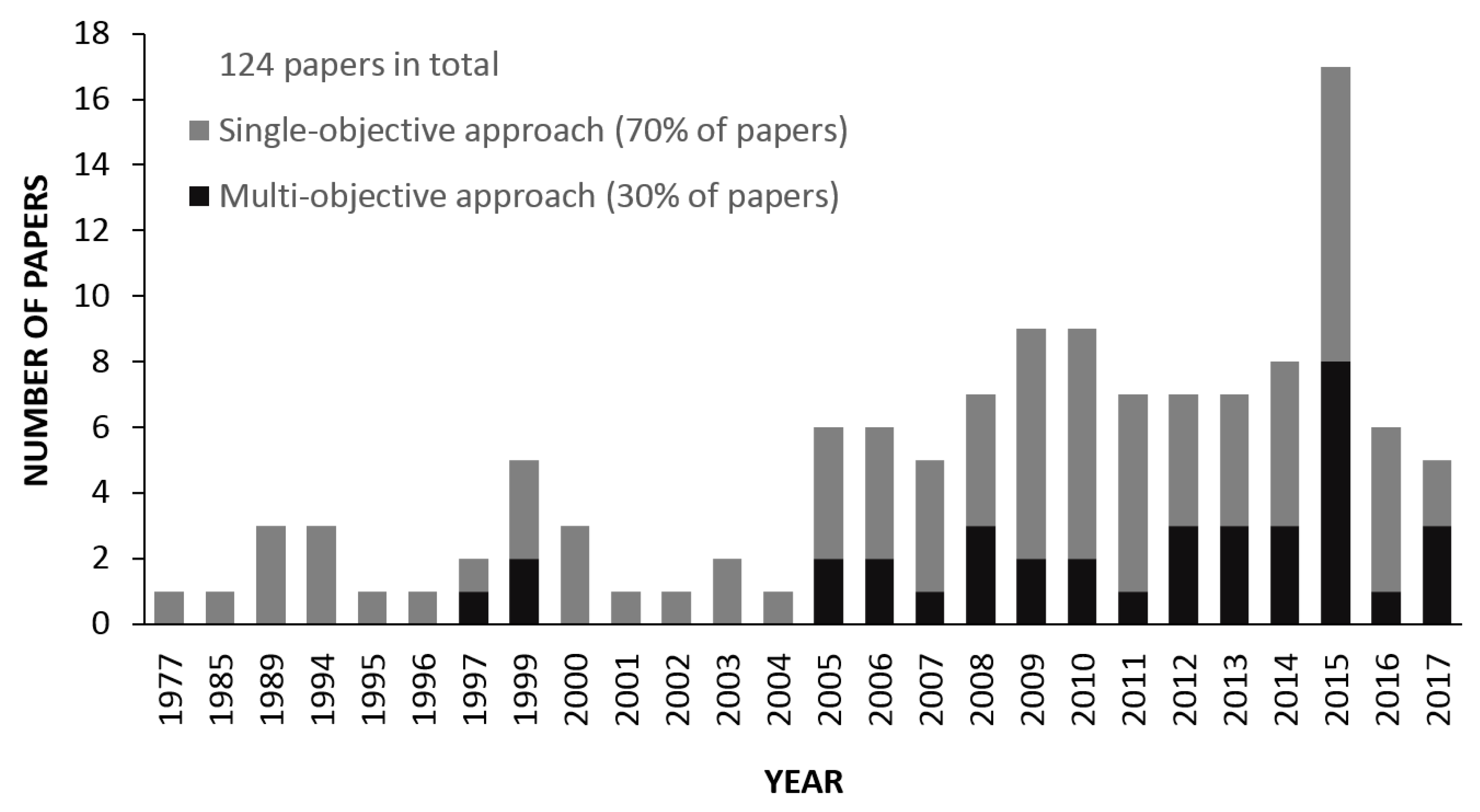
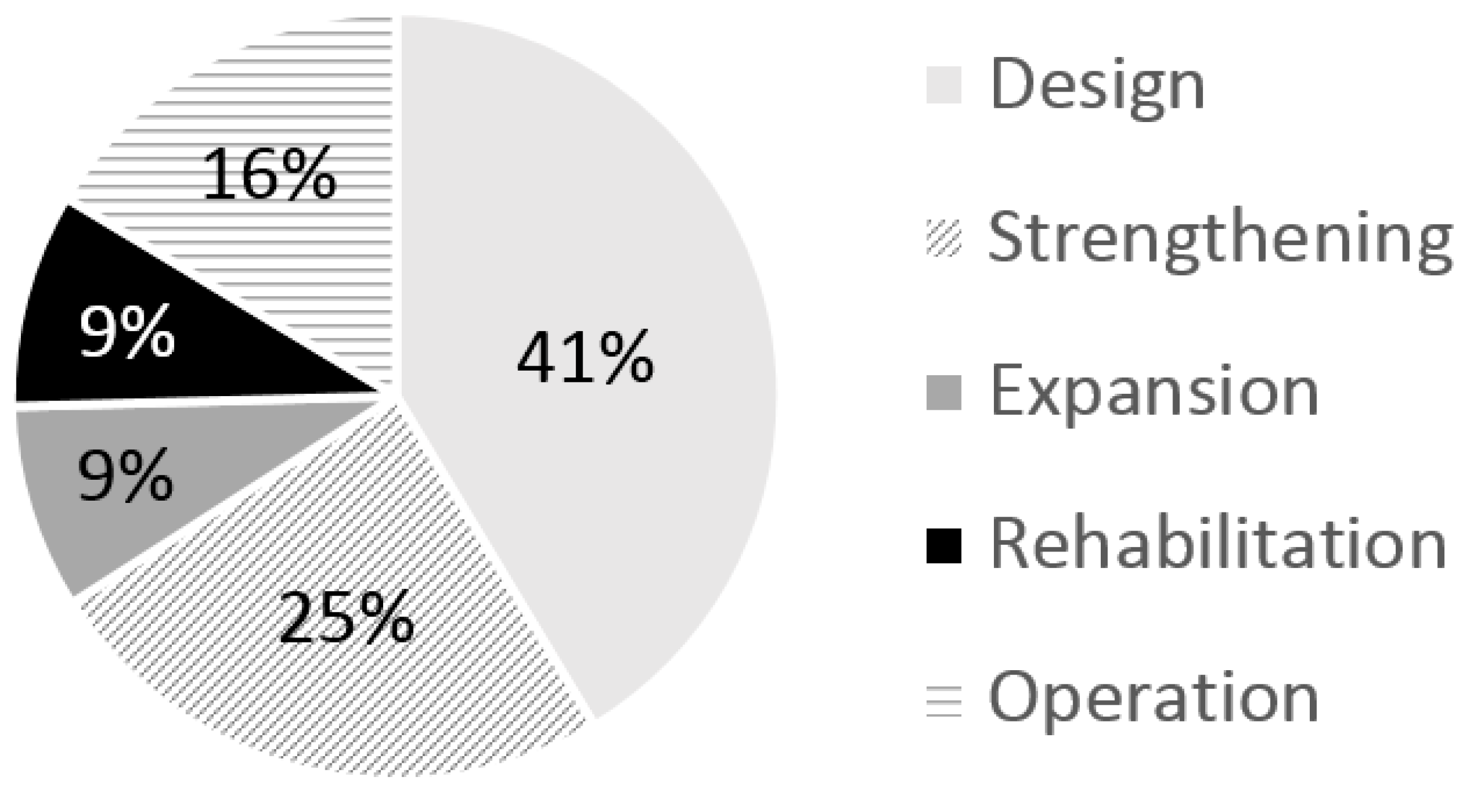

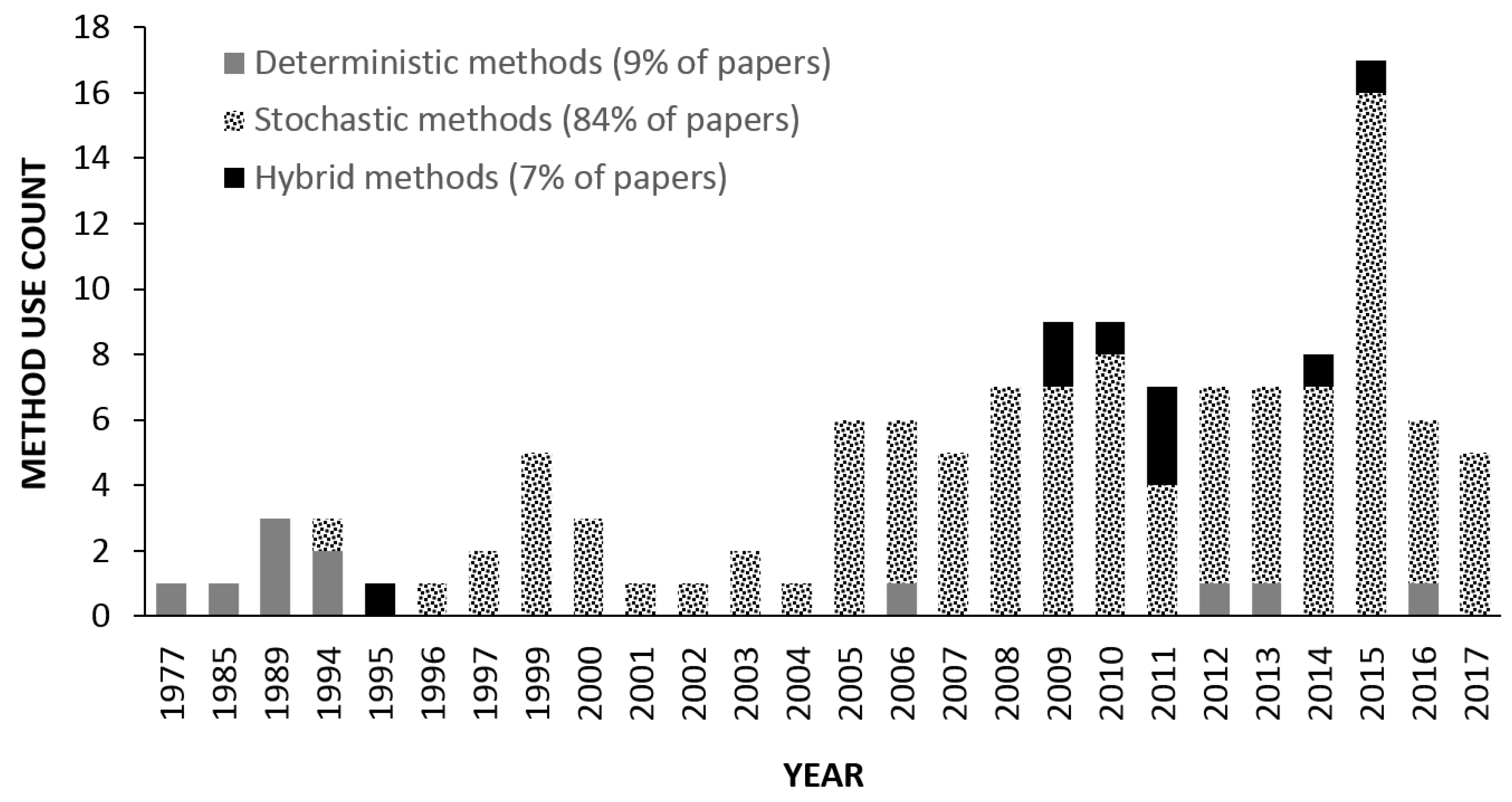
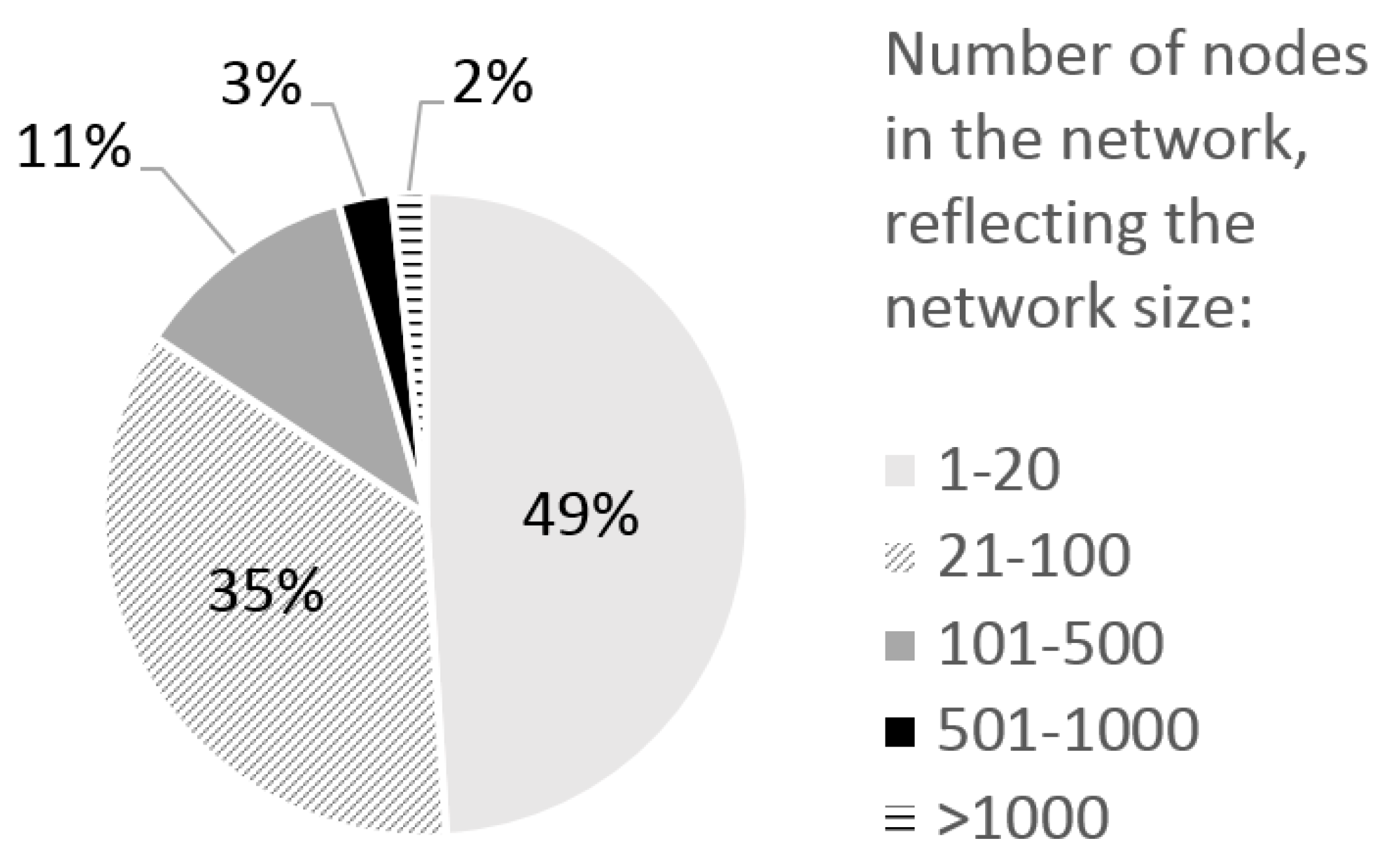
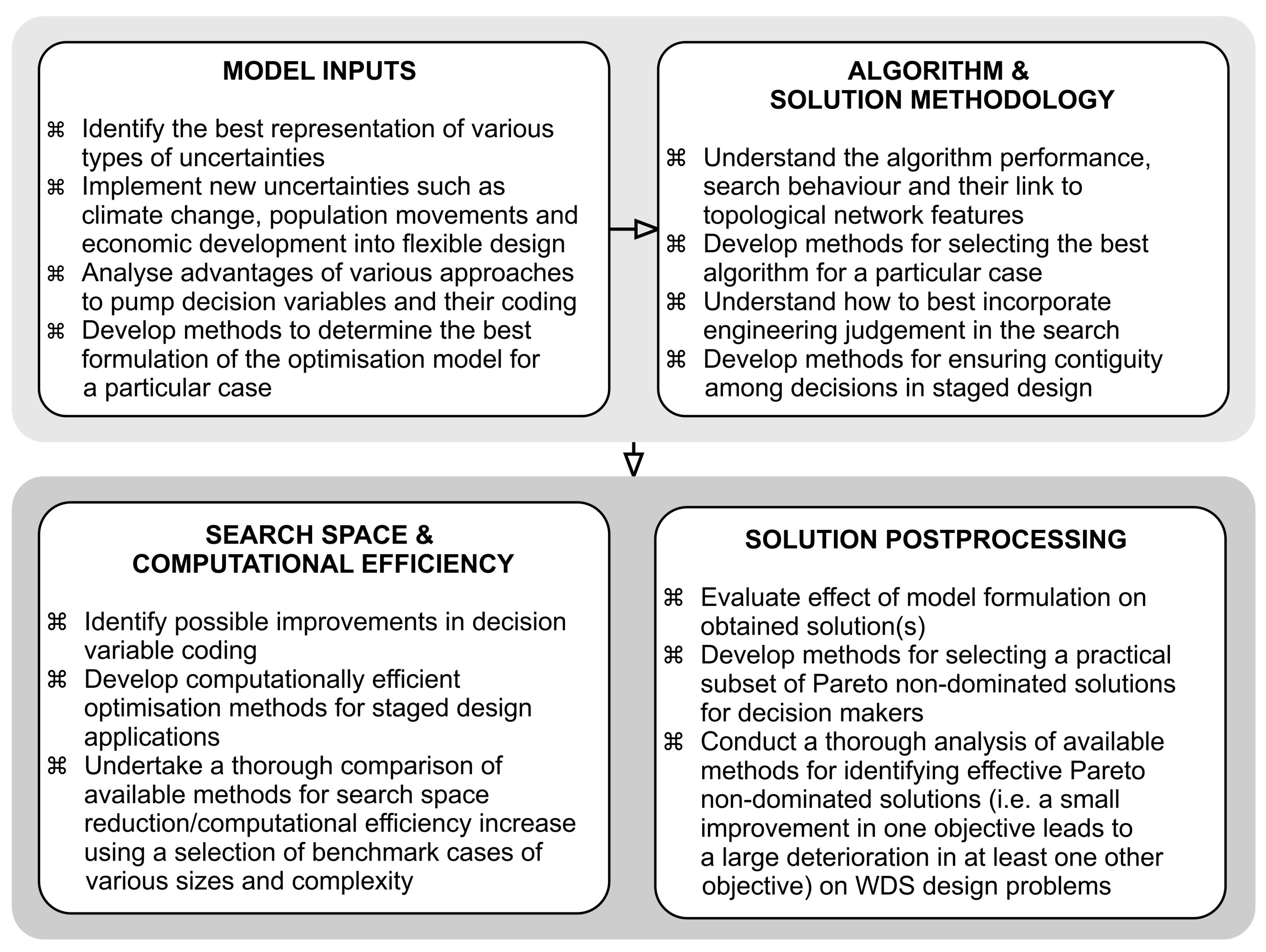
| Objective Type | Objectives | Reference (An Example) |
|---|---|---|
| Economic | Capital costs of the system, including purchase, installation and construction of network components (pipes, pumps, tanks, treatment plants, valves, etc.) | [53,74,121] |
| Rehabilitation costs of the system, including pipe/pump replacement, pipe cleaning/lining, pipe break repair | [17,124] (pipes), [77] (pumps) | |
| Expected operation costs of the system, including pump stations, treatment plants and disinfectant dosage | [53] (pump stations and treatment plants), [27] (disinfectant dosage) | |
| Expected maintenance costs of the system | [121] | |
| Community | Benefit/benefit of the solution (i.e., rehabilitation, expansion and strengthening) using various performance criteria by authors | [131] (welfare index to place greater importance on early improvements), [99] (quantity shortfalls as criteria), [93] (e.g., safety volumes and operational capacities as criteria) |
| Water quality (e.g., disinfectant, sedimentation, discolouration) deficiencies or water age at customer demand nodes, water discolouration risk, velocity violations (causing sedimentation/discolouration) | [92,120] (water quality deficiencies), [97] (water age), [144] (water discolouration), [95] (velocity violations) | |
| Pressure deficit at customer demand nodes (maximum individual or total), or the number of demand nodes with the pressure deficit | [65] (maximum individual deficit), [66,68] (total deficit), [90] (the number of demand nodes) | |
| Hydraulic failure of the system expressed by the failure index | [97] | |
| Potential fire damages using either expected conditional fire damages or fire flow deficit | [142] (expected conditional fire damages), [92] (fire flow deficit) | |
| Performance | System robustness using either a redundant design approach, integration approach (via objective function or constraints), two-phase optimisation approach, scenario-based approach or RC approach | [140] (redundant design), [89] (integration via objective function), [110,140] (integration via constraints), [141] (two-phase optimisation), [121] (scenario-based), [123] (RC) |
| System reliability | [118] | |
| System resilience | [135] | |
| Environmental | GHG emissions or emission costs consisting of capital emissions (due to manufacturing and installation of network components) and operating emissions (due to electricity consumption) | [77] (capital and operating GHG emission costs), [73,75] (capital and operating GHG emissions), [132] (operating GHG emission cost) |
| Constraints | Reference (An Example) |
|---|---|
| Hydraulic constraints given by physical laws of fluid flow in a pipe network: (i) conservation of mass of flow, (ii) conservation of energy, (iii) conservation of mass of constituent | [41] |
| System constraints given by limitations and operational requirements of a WDS, for example, minimum/maximum pressure at (demand) nodes and flow velocity in pipes, water deficit/surplus at storage tanks at the end of the simulation period, maximum water withdrawals from sources | [54] (limits on nodal pressure, storage tank deficit and water withdrawals from sources), [127] (limits on pipe velocity) |
| Constraints on decision variables , for example, limits on pipe diameters, pipe segment lengths (so called split-pipe design), pump station capacities | [92] (limits on pipe diameters), [117] (limits on pipe segments), [121] (limits on pump stations) |
| Decision Variables | Reference (An Example) |
|---|---|
| Pipes: pipe diameters/sizes, pipe duplications, pipe rehabilitation options (pipe replacement, pipe cleaning/lining), pipe break repair, pipe segment lengths (so called split-pipe design), future pipe roughnesses, pipe routes, pipe closures/openings (to adjust a pressure zone boundary) | [75] (diameters), [132] (duplications, replacement, lining and break repair), [117] (segments), [141] (roughnesses), [52] (routes), [100] (routes and closures/openings) |
| Pumps: pump locations, pump sizes (pump capacities, pump types, pumping power, pump head/height or head-flow), the number of pumps, pump schedules (pumping power or pump head at each time step, the number of pumps in operation during 24 h, binary statuses at time steps, on/off times) | [52,99] (locations), [14] (locations and capacities), [75] (types), [17] (power), [52,122] (head/height), [93] (head-flow), [26] (sizes and the number of pumps), [53,123] (power or head at each time step), [97] (the number of pumps in operation), [29] (binary statuses), [75] (on/off times) |
| Tanks: tank locations, tank sizes/volumes, minimum operational level, ratio between diameter and height, ratio between emergency volume and total volume, tank heads | [98] (locations, sizes/volumes, minimum operational level, ratios), [78] (heads) |
| Valves: valve locations, valve settings (headlosses or flows) | [14] (locations), [16] (headlosses via a roughness coefficient), [127] (headlosses and flows) |
| Nodes: flowrates from sources, future nodal demands, threshold demands, hydraulic heads at junctions | [127] (flowrates), [135,141] (demands), [147] (heads) |
| Water quality: disinfectant dosage rates (at the sources, at the treatment plants, in the tanks), treatment removal ratios, treatment plant capacities | [143] (dosage at the sources), [27] (dosage at the treatment plants), [78] (dosage in the tanks), [53] (removal ratios), [121] (capacities) |
| Timing: year of action (e.g., network expansion, rehabilitation, pipe replacements) execution | [131] (network expansion and rehabilitation), [130] (pipe replacements) |
| Test Network Name | No. of Nodes | Network Description | Optimisation Problem | Network Modified Versions | Network Usage Count * |
|---|---|---|---|---|---|
| Hanoi network ++ [49] | 32 | Network organised in three loops supplied by gravity from a single source | New system design (pipes) | Double Hanoi network, triple Hanoi network (both [113]) | 55 |
| New York City tunnels ++ [81] | 20 | Tunnel system supplied by gravity from a single source, constituting the primary WDS of the New York city | Existing system strengthening (i.e., pipe paralleling) to meet projected demands | Double New York City tunnels [201] | 42 |
| Two-loop network ++ [14] | 7 | Small network with two loops supplied by gravity from a single source | New system design (pipes) | Adapted to system strengthening and expansion over a planning horizon [118] | 40 |
| Balerma irrigation network ++ [50] | 447 | Large looped network supplied by gravity from four sources, adapted from the existing irrigation network in Balerma, Spain | New system design (pipes) | N/A | 20 |
| Anytown network [84] | 19 | Hypothetical looped system supplied by three parallel pumps from a single source | Existing system strengthening, expansion and rehabilitation (pipes, pumps, tanks) to meet projected demands | ** With additional source and tank [53], with additional tank [119] proposed by [83] | 15 |
© 2018 by the authors. Licensee MDPI, Basel, Switzerland. This article is an open access article distributed under the terms and conditions of the Creative Commons Attribution (CC BY) license (http://creativecommons.org/licenses/by/4.0/).
Share and Cite
Mala-Jetmarova, H.; Sultanova, N.; Savic, D. Lost in Optimisation of Water Distribution Systems? A Literature Review of System Design. Water 2018, 10, 307. https://doi.org/10.3390/w10030307
Mala-Jetmarova H, Sultanova N, Savic D. Lost in Optimisation of Water Distribution Systems? A Literature Review of System Design. Water. 2018; 10(3):307. https://doi.org/10.3390/w10030307
Chicago/Turabian StyleMala-Jetmarova, Helena, Nargiz Sultanova, and Dragan Savic. 2018. "Lost in Optimisation of Water Distribution Systems? A Literature Review of System Design" Water 10, no. 3: 307. https://doi.org/10.3390/w10030307
APA StyleMala-Jetmarova, H., Sultanova, N., & Savic, D. (2018). Lost in Optimisation of Water Distribution Systems? A Literature Review of System Design. Water, 10(3), 307. https://doi.org/10.3390/w10030307