
Article

NDVI Variation and Yield Prediction in Growing Season: A Case Study with Tea in Tanuyen Vietnam
1
State Key Laboratory of Information Engineering in Surveying, Mapping, and Remote Sensing, Wuhan University, Wuhan 430079, China
2
The Faculty of Tourism, Thai Nguyen University of Science, Thai Nguyen 250000, Vietnam
3
Collaborative Innovation Center of Geospatial Technology, Wuhan 430079, China
4
Faculty of Geography, Thai Nguyen University of Education, 20 Luong Ngoc Quyen, Thai Nguyen 250000, Vietnam
5
Department of Hydrology and Water Resources, University of Science, Vietnam National University, Hanoi, 334 Nguyen Trai, Thanh Xuan, Hanoi 100000, Vietnam
*
Author to whom correspondence should be addressed.
Atmosphere 2021, 12(8), 962; https://doi.org/10.3390/atmos12080962
Submission received: 29 June 2021 / Revised: 17 July 2021 / Accepted: 21 July 2021 / Published: 27 July 2021
(This article belongs to the Special Issue Tropical Ocean-Atmosphere Interaction and Climate Change)

Abstract

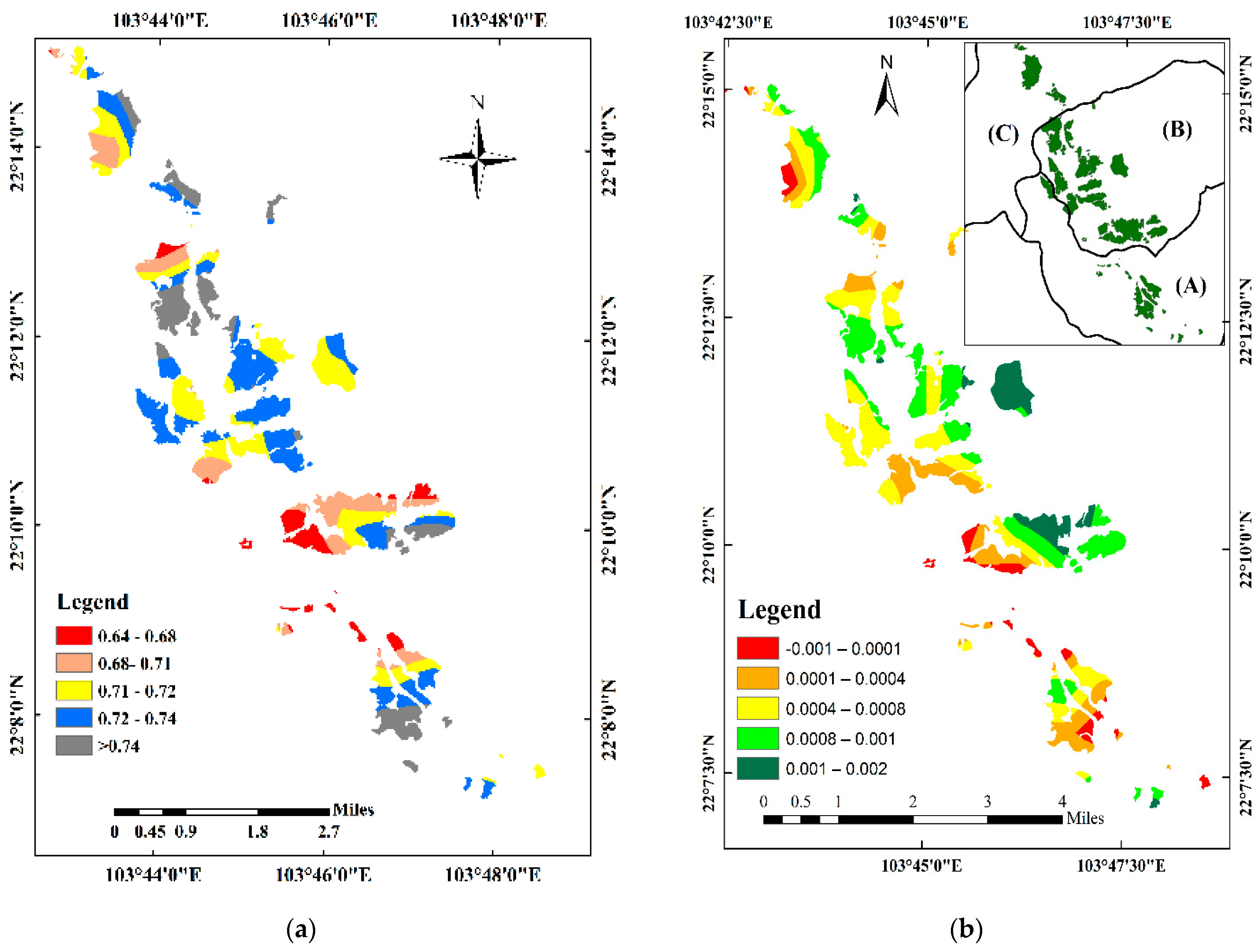
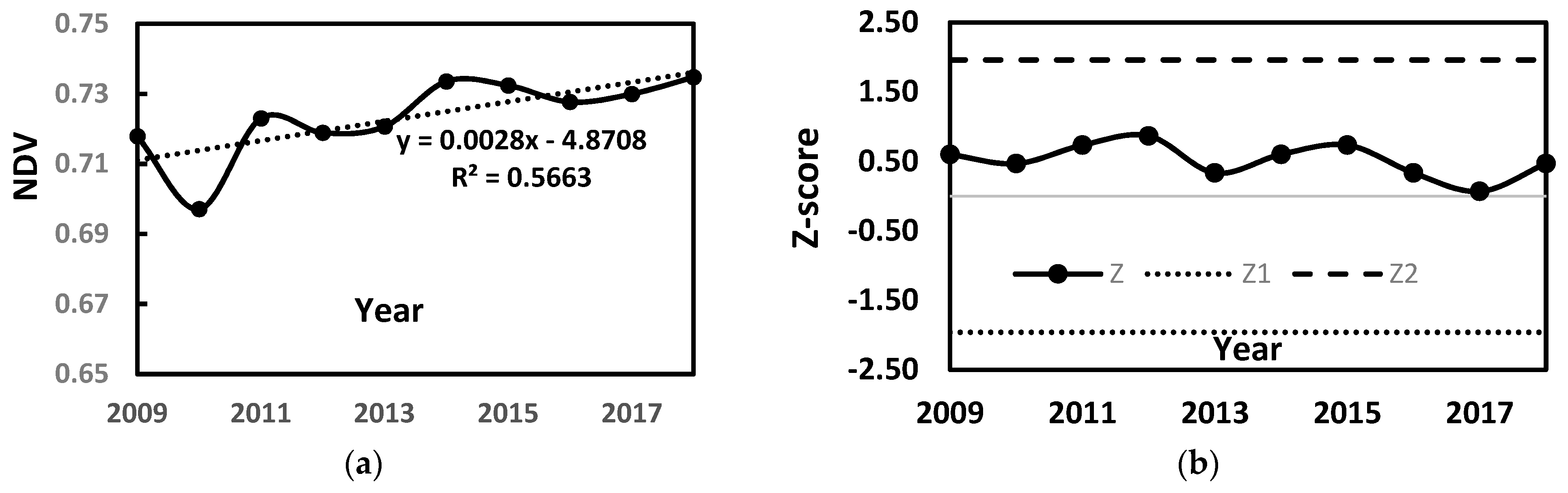
Tea is one of the most significant cash crops and plays an important role in economic development and poverty reduction. On the other hand, tea is an optimal choice in the extreme weather conditions of Tanuyen Laichau, Vietnam. In our study, the NDVI variation of tea in the growing season from 2009 to 2018 was showed by calculating NDVI trend and the Mann-Kendall analysis to assess trends in the time series. Support Vector Machine (SVM) and Random Forest (RF) model were used for predicting tea yield. The NDVI of tea showed an increasing trend with a slope from −0.001–0.001 (88.9% of the total area), a slope from 0.001–0.002 (11.1% of the total area) and a growing rate of 0.00075/year. The response of tea NDVI to almost climatic factor in a one-month time lag is higher than the current month. The tea yield was estimated with higher accuracy in the RF model. Among the input variables, we detected that the role of Tmean and NDVI is stronger than other variables when squared with each of the independent variables into input data.
Keywords: NDVI trend; mann-kendall test; the Pearson correlation coefficients; tea yield prediction; support vector machine; random forest NDVI trend; mann-kendall test; the Pearson correlation coefficients; tea yield prediction; support vector machine; random forest