Next-Generation Sequencing-Based Detection of KRAS G12D Variants in Colorectal Cancer: A Retrospective Cohort Study


Abstract
1. Introduction
2. Materials and Methods
2.1. Patients
2.2. Next-Generation Sequencing
2.3. Microsatellite Instability
2.4. Copy Number Variation
2.5. Data Analysis
2.6. Classification and Evidence Levels
2.7. NGS Quality Metrics
2.8. Statistical Analysis
3. Results
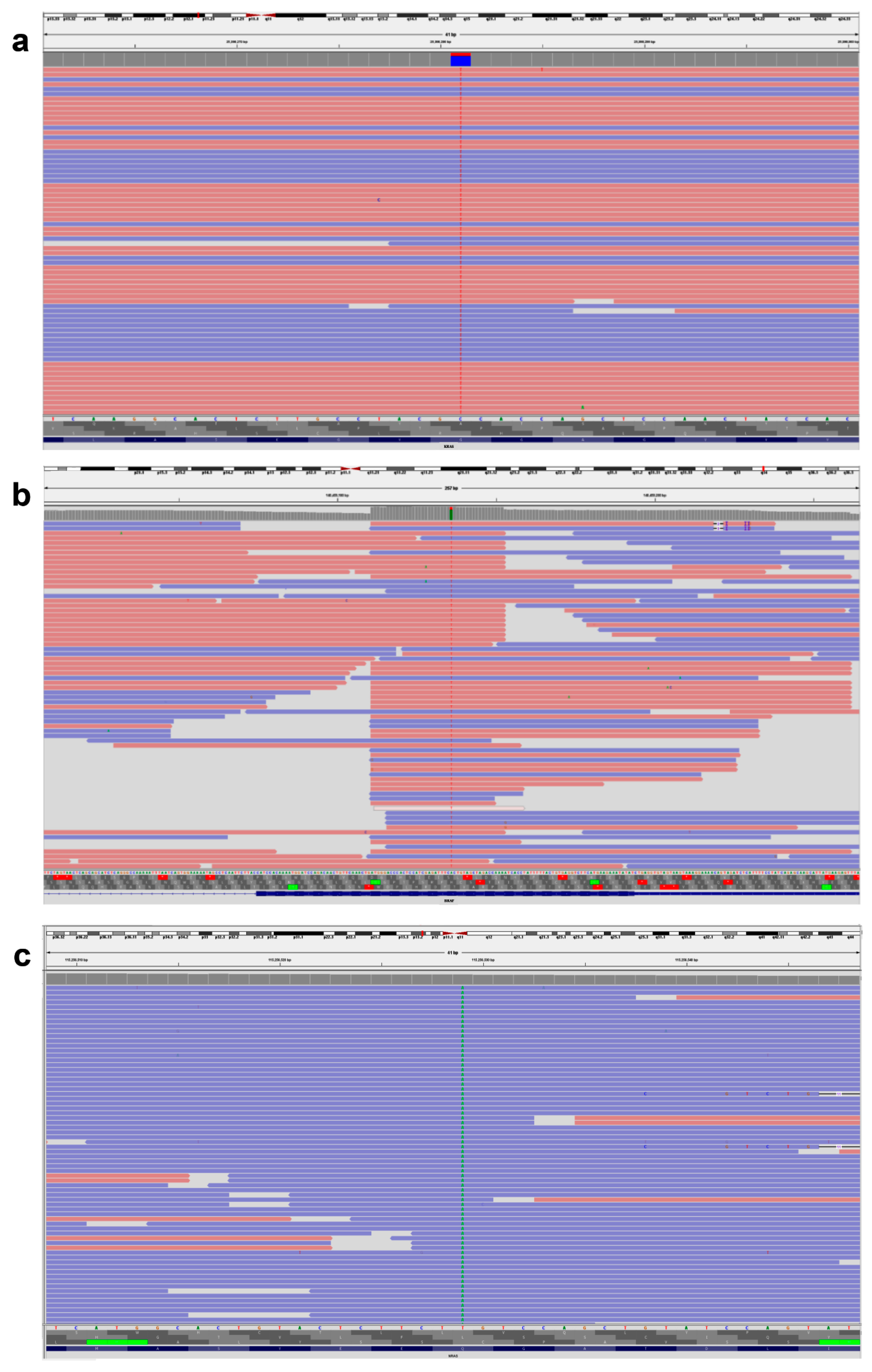
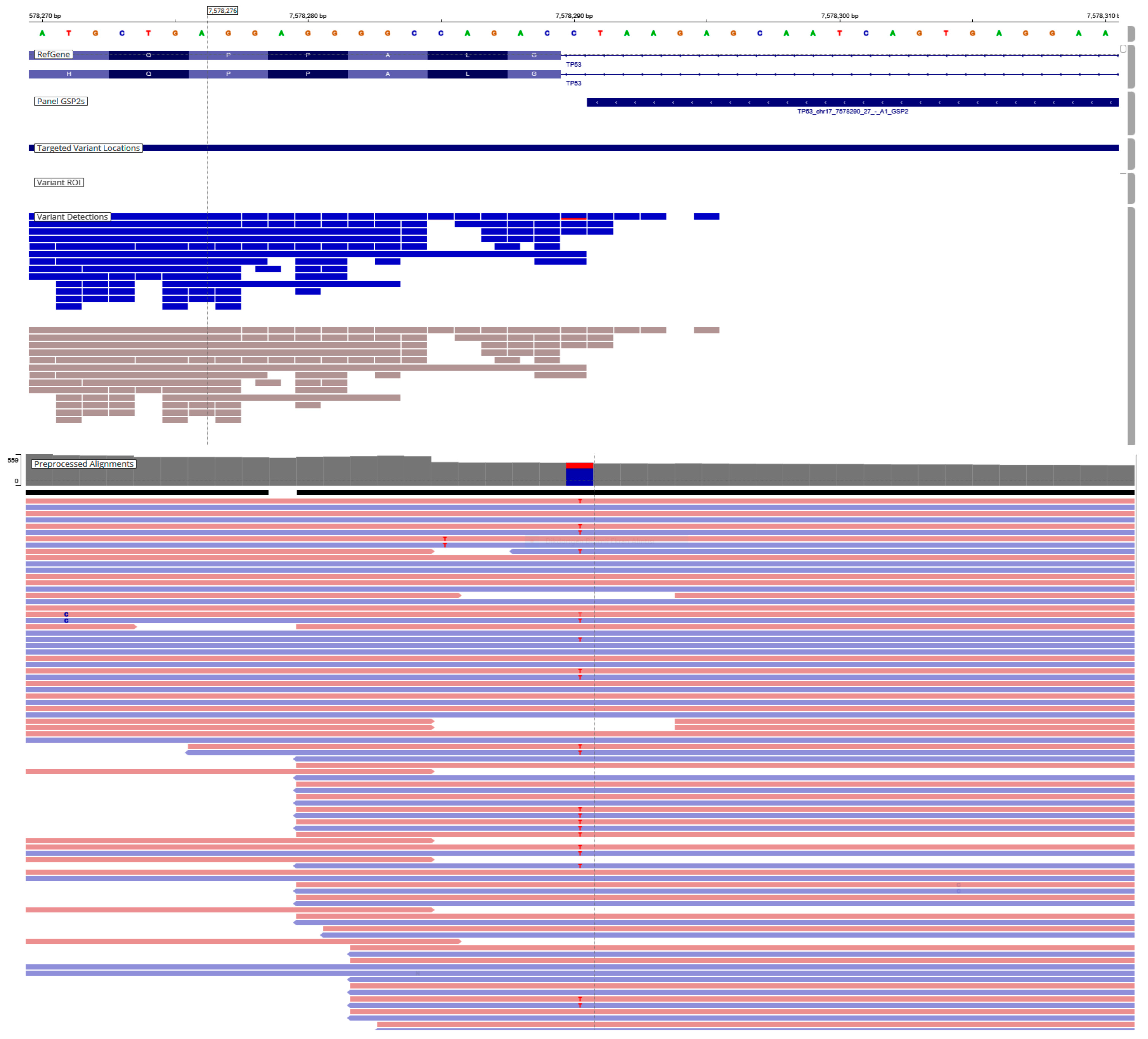
3.1. Clinical Characteristics of Patients’ Cohort and Frequencies of RAS Variants
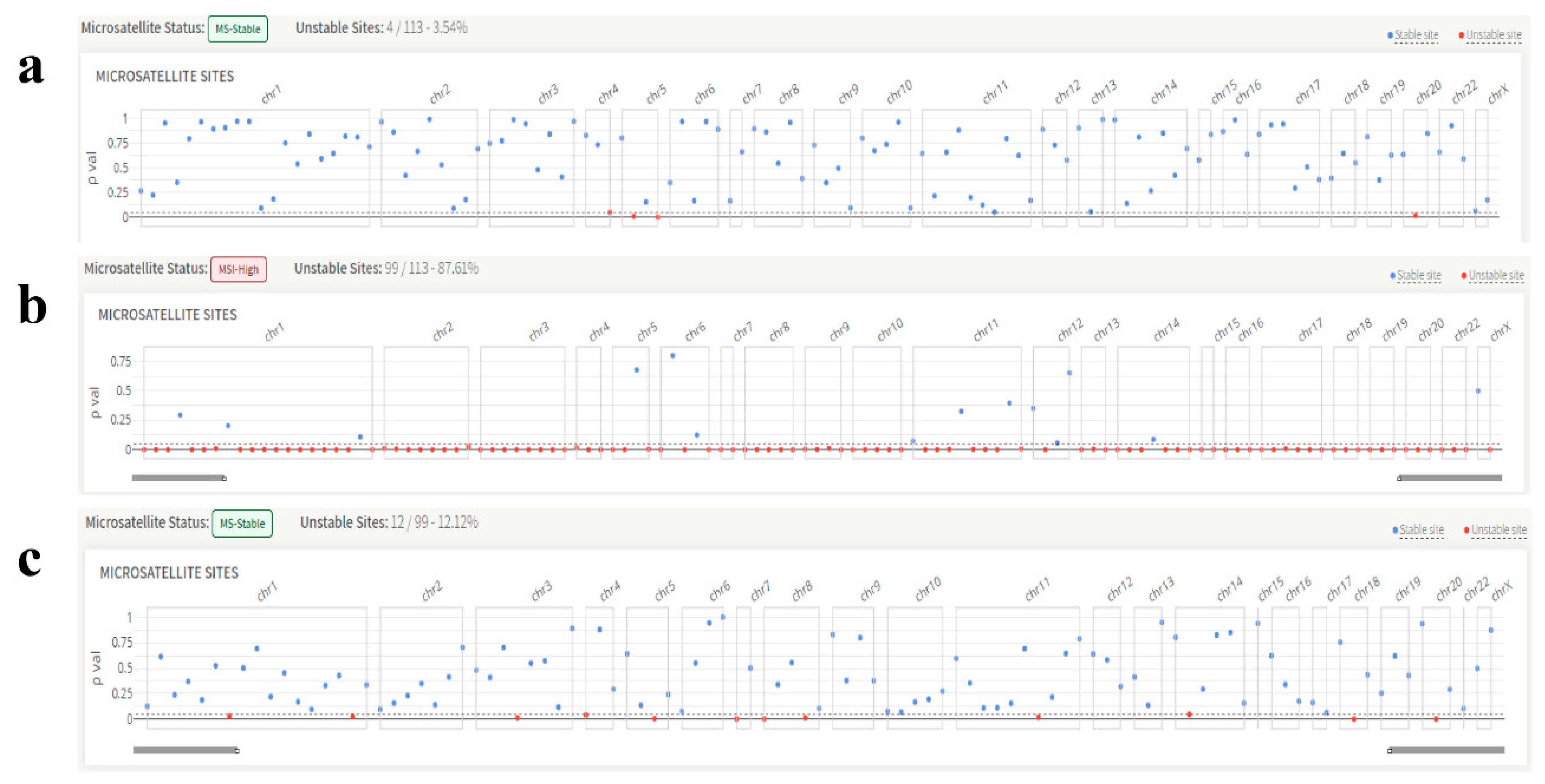
3.2. Microsatellite Instability Evaluation
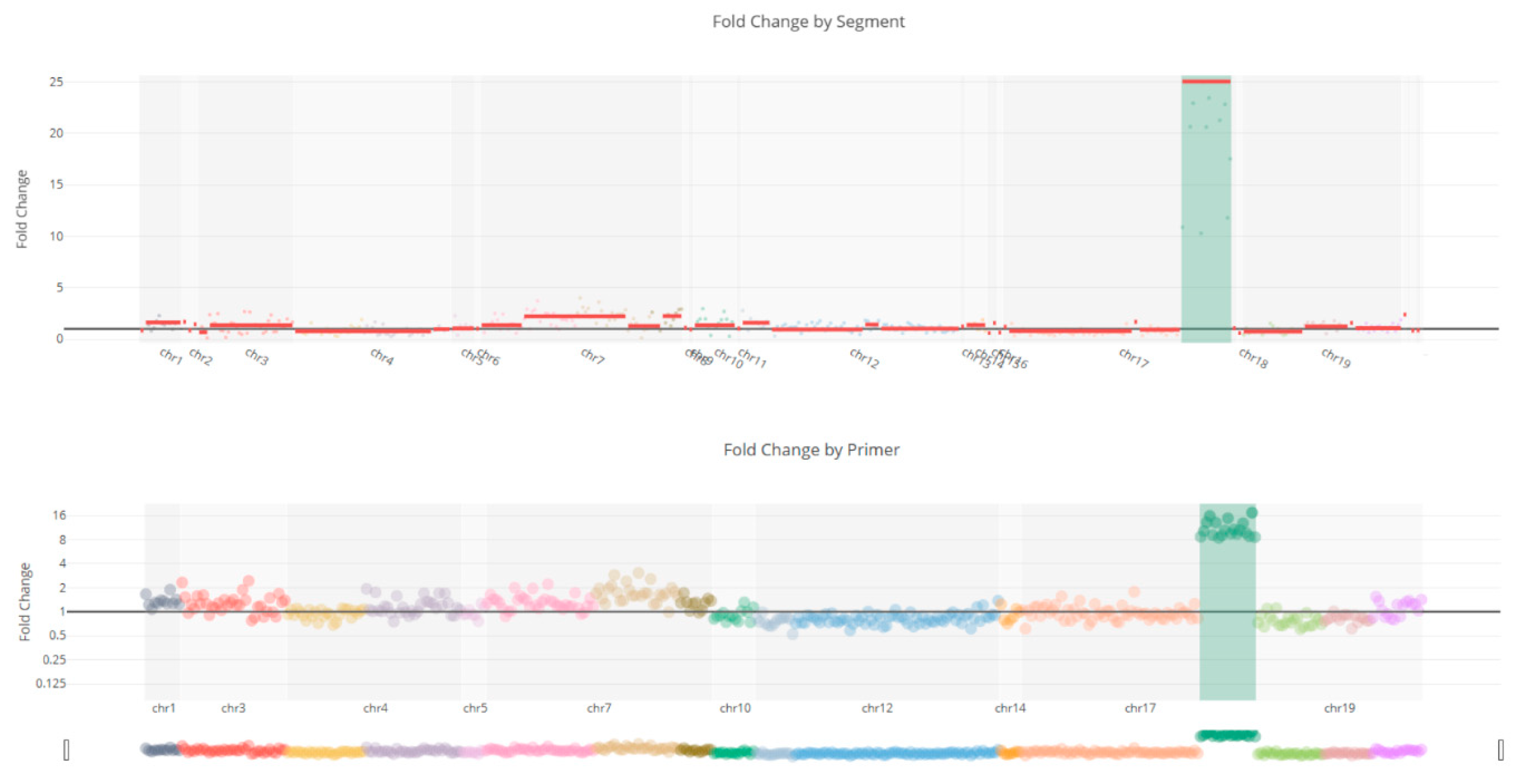
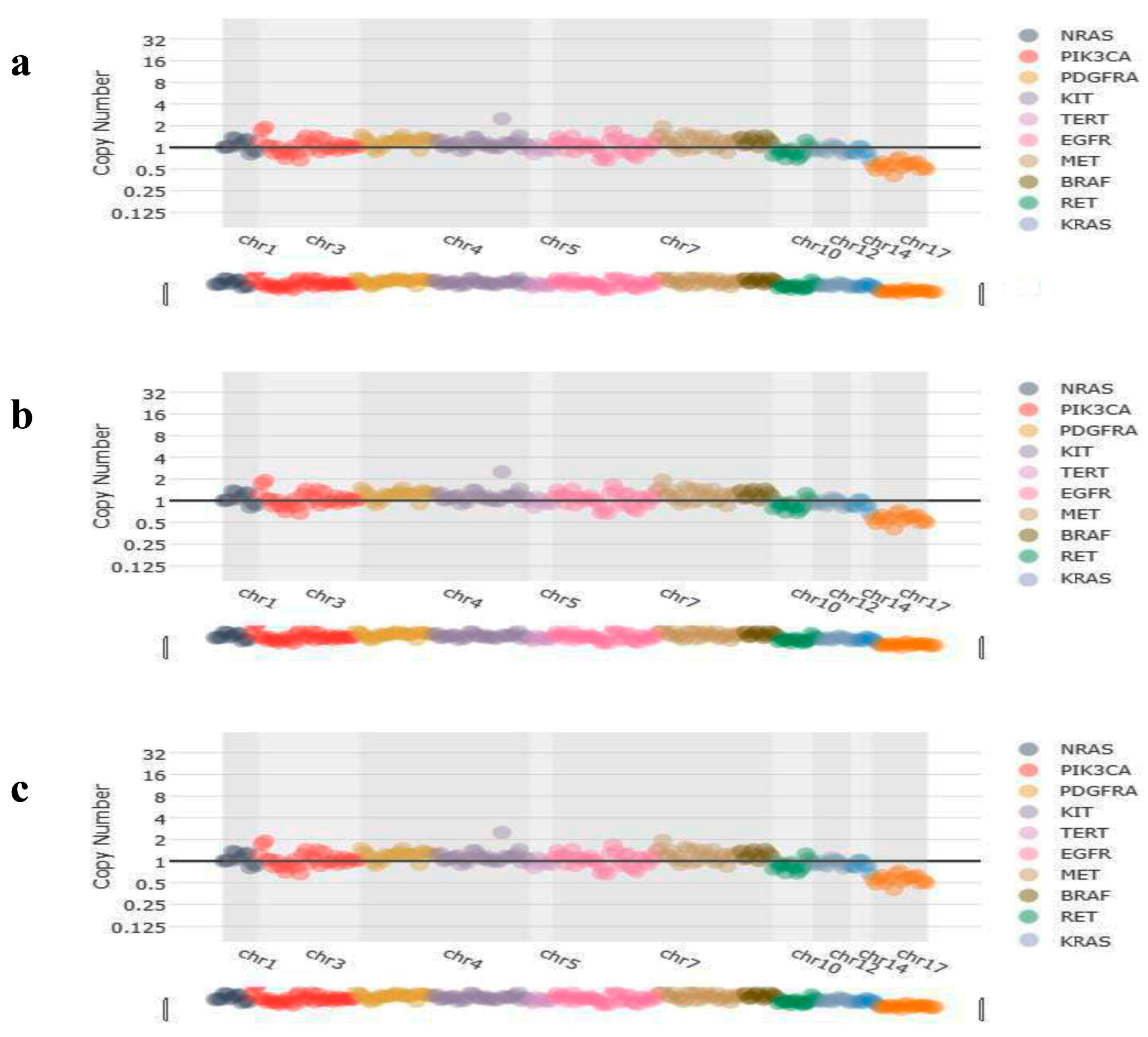
3.3. Copy Number Variation Assessment
4. Discussion
Author Contributions
Funding
Institutional Review Board Statement
Informed Consent Statement
Data Availability Statement
Conflicts of Interest
References
- Cardoso, R.; Guo, F.; Heisser, T.; Hackl, M.; Ihle, P.; De Schutter, H.; Van Damme, N.; Valerianova, Z.; Atanasov, T.; Májek, O.; et al. Colorectal cancer incidence, mortality, and stage distribution in European countries in the colorectal cancer screening era: An international population-based study. Lancet Oncol. 2021, 22, 1002–1013. [Google Scholar] [CrossRef] [PubMed]
- Guo, F.; Gong, H.; Zhao, H.; Chen, J.; Zhang, Y.; Zhang, L.; Shi, X.; Zhang, A.; Jin, H.; Zhang, J.; et al. Mutation status and prognostic values of KRAS, NRAS, BRAF and PIK3CA in 353 Chinese colorectal cancer patients. Sci. Rep. 2018, 8, 6076. [Google Scholar] [CrossRef] [PubMed]
- Sanchez-Ibarra, H.E.; Jiang, X.; Gallegos-Gonzalez, E.Y.; Cavazos-González, A.C.; Chen, Y.; Morcos, F.; Barrera-Saldaña, H.A. KRAS, NRAS, and BRAF mutation prevalence, clinicopathological association, and their application in a predictive model in Mexican patients with metastatic colorectal cancer: A retrospective cohort study. PLoS ONE 2020, 15, e0235490. [Google Scholar] [CrossRef] [PubMed]
- Mahdi, Y.; Khmou, M.; Souadka, A.; Agouri, H.E.; Ech-Charif, S.; Mounjid, C.; Khannoussi, B.E. Correlation between KRAS and NRAS mutational status and clinicopathological features in 414 cases of metastatic colorectal cancer in Morocco: The largest North African case series. BMC Gastroenterol. 2023, 23, 193. [Google Scholar] [CrossRef]
- Kodaz, H.; Kostek, O.; Hacioglu, M.B.; Erdogan, B.; Kodaz, C.E.; Hacibekiroglu, I.; Turkmen, E.; Uzunoglu, S.; Cicin, I. Frequency of RAS mutations (KRAS, NRAS, HRAS) in human solid cancer. Eurasian J. Med. Oncol. 2017, 7, 1–7. [Google Scholar] [CrossRef]
- Rimbert, J.; Tachon, G.; Junca, A.; Villalva, C.; Karayan-Tapon, L.; Tougeron, D. Association between clinicopathological characteristics and RAS mutation in colorectal cancer. Mod. Pathol. 2018, 31, 517–526. [Google Scholar] [CrossRef]
- Aljehani, M.A.; Bien, J.; Lee, J.S.H.; Fisher, G.A.; Lin, A.Y. KRAS Sequence Variation as Prognostic Marker in Patients with Young- vs Late-Onset Colorectal Cancer. JAMA Netw. Open 2023, 6, e2345801. [Google Scholar] [CrossRef]
- Ozer, M.; Goksu, S.Y.; Sanford, N.N.; Ahn, C.; Beg, M.S.; Ali Kazmi, S.M. Age-dependent prognostic value of KRAS mutation in metastatic colorectal cancer. Future Oncol. 2021, 17, 4883–4893. [Google Scholar] [CrossRef]
- Li, W.; Qiu, T.; Zhi, W.; Shi, S.; Zou, S.; Ling, Y.; Shan, L.; Ying, J.; Lu, N. Colorectal carcinomas with KRAS codon 12 mutation are associated with more advanced tumor stages. BMC Cancer 2015, 15, 340. [Google Scholar] [CrossRef]
- Yamashita, S.; Chun, Y.S.; Kopetz, S.E.; Vauthey, J.N. Biomarkers in colorectal liver metastases. Br. J. Surg. 2018, 105, 618–627. [Google Scholar] [CrossRef]
- Goldstein, J.; Tran, B.; Ensor, J.; Gibbs, P.; Wong, H.L.; Wong, S.F.; Vilar, E.; Tie, J.; Broaddus, R.; Kopetz, S.; et al. Multicenter retrospective analysis of metastatic colorectal cancer (CRC) with high-level microsatellite instability (MSI-H). Ann. Oncol. 2014, 25, 1032–1038. [Google Scholar] [CrossRef] [PubMed]
- Kadowaki, S.; Kakuta, M.; Takahashi, S.; Takahashi, A.; Arai, Y.; Nishimura, Y.; Yatsuoka, T.; Ooki, A.; Yamaguchi, K.; Matsuo, K.; et al. Prognostic value of KRAS and BRAF mutations in curatively resected colorectal cancer. World J. Gastroenterol. 2015, 21, 1275–1283. [Google Scholar] [CrossRef] [PubMed]
- Day, F.; Muranyi, A.; Singh, S.; Shanmugam, K.; Williams, D.; Byrne, D.; Pham, K.; Palmieri, M.; Tie, J.; Grogan, T.; et al. A mutant BRAF V600E-specific immunohistochemical assay: Correlation with molecular mutation status and clinical outcome in colorectal cancer. Target. Oncol. 2015, 10, 99–109. [Google Scholar] [CrossRef] [PubMed]
- Yaeger, R.; Cercek, A.; O’Reilly, E.M.; Reidy, D.L.; Kemeny, N.; Wolinsky, T.; Capanu, M.; Gollub, M.J.; Rosen, N.; Berger, M.F.; et al. Pilot trial of combined BRAF and EGFR inhibition in BRAF-mutant metastatic colorectal cancer patients. Clin. Cancer Res. 2015, 21, 1313–1320. [Google Scholar] [CrossRef]
- Guitton, T.; Allaume, P.; Rabilloud, N.; Rioux-Leclercq, N.; Henno, S.; Turlin, B.; Galibert-Anne, M.D.; Lièvre, A.; Lespagnol, A.; Pécot, T.; et al. Artificial Intelligence in Predicting Microsatellite Instability and KRAS, BRAF Mutations from Whole-Slide Images in Colorectal Cancer: A Systematic Review. Diagnostics 2023, 14, 99. [Google Scholar] [CrossRef]
- Torshizi Esfahani, A.; Seyedna, S.Y.; Nazemalhosseini Mojarad, E.; Majd, A.; Asadzadeh Aghdaei, H. MSI-L/EMAST is a predictive biomarker for metastasis in colorectal cancer patients. J. Cell Physiol. 2019, 234, 13128–13136. [Google Scholar] [CrossRef]
- Nguyen, H.T.; Le, D.T.; Duong, Q.H.; Tatipamula, V.B.; Van Nguyen, B. High frequency of microsatellite instability and its substantial co-existence with KRAS and BRAF mutations in Vietnamese patients with colorectal cancer. Oncol. Lett. 2021, 21, 41. [Google Scholar] [CrossRef]
- Amodio, V.; Yaeger, R.; Arcella, P.; Cancelliere, C.; Lamba, S.; Lorenzato, A.; Arena, S.; Montone, M.; Mussolin, B.; Bian, Y.; et al. EGFR Blockade Reverts Resistance to KRASG12C Inhibition in Colorectal Cancer. Cancer Discov. 2020, 10, 1129–1139. [Google Scholar] [CrossRef]
- Vagnini, L.D.; Renzi, A.; Oliveira-Pelegrin, G.R.; Canas, M.D.C.T.; Petersen, C.G.; Mauri, A.L.; Oliveira, J.B.; Baruffi, R.L.; Cavagna, M.; Franco, J.G., Jr. The TP73 gene polymorphism (rs4648551, A>G) is associated with diminished ovarian reserve. PLoS ONE 2015, 10, e0120048. [Google Scholar] [CrossRef]
- Narayan, P.; Osgood, C.L.; Singh, H.; Chiu, H.J.; Ricks, T.K.; Chiu Yuen Chow, E.; Qiu, J.; Song, P.; Yu, J.; Namuswe, F.; et al. FDA Approval Summary: Fam-Trastuzumab Deruxtecan-Nxki for the Treatment of Unresectable or Metastatic HER2-Positive Breast Cancer. Clin. Cancer Res. 2021, 27, 4478–4485. [Google Scholar] [CrossRef]
- Li, M.M.; Datto, M.; Duncavage, E.J.; Kulkarni, S.; Lindeman, N.I.; Roy, S.; Tsimberidou, A.M.; Vnencak-Jones, C.L.; Wolff, D.J.; Younes, A.; et al. Standards and Guidelines for the Interpretation and Reporting of Sequence Variants in Cancer: A Joint Consensus Recommendation of the Association for Molecular Pathology, American Society of Clinical Oncology, and College of American Pathologists. J. Mol. Diagn. 2017, 19, 4–23. [Google Scholar] [CrossRef]
- Tsilimigras, D.I.; Ntanasis-Stathopoulos, I.; Bagante, F.; Moris, D.; Cloyd, J.; Spartalis, E.; Pawlik, T.M. Clinical significance and prognostic relevance of KRAS, BRAF, PI3K and TP53 genetic mutation analysis for resectable and unresectable colorectal liver metastases: A systematic review of the current evidence. Surg. Oncol. 2018, 27, 280–288. [Google Scholar] [CrossRef] [PubMed]
- Li, S.; Balmain, A.; Counter, C.M. A model for RAS mutation patterns in cancers: Finding the sweet spot. Nat. Rev. Cancer 2018, 18, 767–777. [Google Scholar] [CrossRef] [PubMed]
- Cook, J.H.; Melloni, G.E.M.; Gulhan, D.C.; Park, P.J.; Haigis, K.M. The origins and genetic interactions of KRAS mutations are allele- and tissue-specific. Nat. Commun. 2021, 12, 1808. [Google Scholar] [CrossRef] [PubMed]
- Skoulidis, F.; Li, B.T.; Dy, G.K.; Price, T.J.; Falchook, G.S.; Wolf, J.; Italiano, A.; Schuler, M.; Borghaei, H.; Barlesi, F.; et al. Sotorasib for Lung Cancers with KRAS p.G12C Mutation. N. Engl. J. Med. 2021, 384, 2371–2381. [Google Scholar] [CrossRef]
- Ryan, M.B.; Coker, O.; Sorokin, A.; Fella, K.; Barnes, H.; Wong, E.; Kanikarla, P.; Gao, F.; Zhang, Y.; Zhou, L.; et al. KRASG12C-independent feedback activation of wild-type RAS constrains KRASG12C inhibitor efficacy. Cell Rep. 2022, 39, 110993. [Google Scholar] [CrossRef]
- Hassin, O.; Oren, M. Drugging p53 in cancer: One protein, many targets. Nat. Rev. Drug Discov. 2023, 22, 127–144. [Google Scholar] [CrossRef]
- Mishra, A.; Tamari, R.; DeZern, A.E.; Byrne, M.T.; Gooptu, M.; Chen, Y.B.; Deeg, H.J.; Sallman, D.; Gallacher, P.; Wennborg, A.; et al. Eprenetapopt Plus Azacitidine After Allogeneic Hematopoietic Stem-Cell Transplantation for TP53-Mutant Acute Myeloid Leukemia and Myelodysplastic Syndromes. J. Clin. Oncol. 2022, 40, 3985–3993. [Google Scholar] [CrossRef]
- Jacobio Pharma Receives IND Approval for P53 Y220C Activator JAB-30300 in the U.S. News Release. Jacobio Pharma. 2024. Available online: https://tinyurl.com/33e3axf3 (accessed on 1 March 2024).
- Sartore-Bianchi, A.; Trusolino, L.; Martino, C.; Bencardino, K.; Lonardi, S.; Bergamo, F.; Zagonel, V.; Leone, F.; Depetris, I.; Martinelli, E.; et al. Dual-targeted therapy with trastuzumab and lapatinib in treatment-refractory, KRAS codon 12/13 wild-type, HER2-positive metastatic colorectal cancer (HERACLES): A proof-of-concept, multicentre, open-label, phase 2 trial. Lancet Oncol. 2016, 17, 738–746, Correction in Lancet Oncol. 2016, 17, e420. https://doi.org/10.1016/S1470-2045(16)30463-6. [Google Scholar] [CrossRef]
- Keam, S.J. Trastuzumab Deruxtecan: First Approval. Drugs 2020, 80, 501–508. [Google Scholar] [CrossRef]
- Wang, K.S.; Yu, G.; Xu, C.; Meng, X.H.; Zhou, J.; Zheng, C.; Deng, Z.; Shang, L.; Liu, R.; Su, S.; et al. Accurate diagnosis of colorectal cancer based on histopathology images using artificial intelligence. BMC Med. 2021, 19, 76. [Google Scholar] [CrossRef]
- Davri, A.; Birbas, E.; Kanavos, T.; Ntritsos, G.; Giannakeas, N.; Tzallas, A.T.; Batistatou, A. Deep Learning on Histopathological Images for Colorectal Cancer Diagnosis: A Systematic Review. Diagnostics 2022, 12, 837. [Google Scholar] [CrossRef]
- Chlorogiannis, D.D.; Verras, G.I.; Tzelepi, V.; Chlorogiannis, A.; Apostolos, A.; Kotis, K.; Anagnostopoulos, C.N.; Antzoulas, A.; Davakis, S.; Vailas, M.; et al. Tissue classification and diagnosis of colorectal cancer histopathology images using deep learning algorithms. Is the time ripe for clinical practice implementation? Prz. Gastroenterol. 2023, 18, 353–367. [Google Scholar] [CrossRef]
- Feng, X.; Yin, W.; Ye, Q.; Chi, Y.; Wen, H.; Sun, Y.; Zheng, J.; Wang, Q.; Wang, Q.; Zhao, M.; et al. Deepath-MSI: A clinic-ready deep learning model for microsatellite instability detection in colorectal cancer using whole-slide imaging. npj Precis. Oncol. 2025, 9, 302. [Google Scholar] [CrossRef]
- Actkins, K.V.; Srinivasan, S.; Spees, L.P.; Turbitt, E.; Allen, C.G.; Roberts, M.C. Uptake of Genetic Testing Among Patients with Cancer at Risk for Lynch Syndrome in the National Health Interview Survey. Cancer Prev. Res. 2021, 14, 927–932. [Google Scholar] [CrossRef]




| Clinical Characteristics | Numbers (%) | KRAS Variant Status | p-Value | ||
|---|---|---|---|---|---|
| Wild-Type n (%) | Variant n (%) | ||||
| Sex | Female | 38 (52%) | 21 (48.84) | 17 (56.66) | |
| Male | 35 (48%) | 22 (51.16) | 13 (43.33) | 0.6349 | |
| Age | <65 | 47 (64.38%) | 31 (72.09) | 16 (53.33) | |
| ≥65 | 26 (35.62%) | 12 (27.91) | 14 (46.66) | 0.1369 | |
| Exons | Codons | Type of Variants | Number of KRAS Variants (%) |
|---|---|---|---|
| 2 | 12 | c.35G > A (G12D) | 5 (16.66) |
| 2 | 12 | c.35G > T (G12V) | 8 (26.66) |
| 2 | 13 | c.38G > A (G13D) | 8 (26.66) |
| 3 | 61 | c.183A > C (Q61H) | 2 (6.66) |
| 3 | 61 | c.183A > T (Q61H) | 1 (3.33) |
| 4 | 146 | c.436G > A (A146T) | 6 (20.00) |
| Case No. | Gender /Age | Gene | Transcript | Variant /Protein | MSI | COSMIC | Classification According to AMP/ASCO/CAP Guideline | Response /Resistance |
|---|---|---|---|---|---|---|---|---|
| 1 | M/67 | No | No | No | Stable | No | No | Yes |
| 2 | M/66 | KRAS | NM_004985.4 | c.35G > T p.Gly12Val | Stable | COSM520 | TierIA | /Yes |
| 3 | F/59 | No | No | No | Stable | No | No | No/No |
| 4 | M/69 | KRAS | NM_004985.4 | c.38G > A p.Gly13Asp | Stable | COSM532 | TierIA | /Yes |
| 5 | F/71 | KRAS | NM_004985.4 | c.436G > A p.Ala146Thr | Stable | COSM19404 | TierIA | /Yes |
| 6 | M/61 | PIK3CA | NM_006218.3 | c.3140A > G p.His1047Arg | Stable | COSM775 | TierIIC | No/No |
| 7 | F/39 | KRAS TP53 | NM_004985.4 NM_000546.5 | c.35G > T p.Gly12Val c.532C > G p.His178Asp | Stable | COSM520 COSM44901 | TierIA | /Yes |
| 8 | F/35 | No | No | No | Stable | No | No | No/No |
| 9 | M/62 | KRAS | NM_004985.4 | c.436G > A p.Ala146Thr | Stable | COSM19404 | TierIA | /Yes |
| 10 | M/42 | NRAS TP53 | NM_002524.4 NM_000546.5 | c.182A > T p.Gln61Leu c.524G > A p.Arg175His | Stable | COSM583 COSM10648 | TierIA TierIII | /Yes |
| 11 | F/55 | PIK3CA | NM_006218.3 | c.33140A > G p.His1047Arg | Stable | COSM775 | TierIIC | No/No |
| 12 | F/50 | KRAS PIK3CA | NM_004985.4 NM_006218.3 | c.38G > A p.Gly13Asp c.3140A > G p.His1047Arg | Stable | COSM532 COSM775 | TierIA TierII | /Yes |
| 13 | F/44 | KRAS | NM_004985.4 | c.35G > A p.Gly12Asp | Stable | COSM521 | TierIA | /Yes |
| 14 | M/73 | TP53 | NM_000546.5 | c.524G > A p.Arg175His | Stable | COSM10648 | TierIII | No/No |
| 15 | F/45 | KRAS TP53 | NM_004985.4 NM_000546.5 | c.35G > T p.Gly12Val c.743G > A p.Arg248Gln | Stable | COSM520 COSM99602 | Tier IA TierIII | /Yes |
| 16 | F/63 | KRAS | NM_004985.4 | c.35G > A p.Gly12Asp | Stable | COSM521 | TierIA | /Yes |
| 17 | M/50 | PIK3CA TP53 | NM_006218.3 NM_000546.5 | c.1258T > C p.Cys420Arg c.266_270del p.Pro89LeufsTer58 | Stable | COSM757 No | TierIIC TierIII | No/No |
| 18 | M/51 | KRAS PIK3CA TP53 | NM_004985.4 NM_006218.3 NM_000546.5 | c.436G > A p.Pro89LeufsTer58 c.1258T > C p.Cys420Arg c.742C > T p.Arg248Trp | Stable | COSM19404 COSM757 COSM10656 | TierIA TierIIC TierIII | /Yes |
| 19 | M/33 | No | No | No | Stable | No | No | No/No |
| 20 | F/77 | KRAS PIK3CA | NM_004985.4 NM_006218.3 | c.35G > T p.Gly12Val c.1633G > C p.Glu545Gln | Stable | COSM520 COSM27133 | TierIA TierIIC | /Yes |
| 21 | F/67 | KRAS | NM_004985.4 | c.35G > T p.Gly12Val | Stable | COSM520 | TierIA | /Yes |
| 22 | F/59 | TP53 | NM_000546.5 | c.726C > A p.Cys242Ter | Stable | COSM44378 | TierIII | |
| 23 | F/62 | KRAS | NM_004985.5 | c.38G > A p.Gly13Asp | Stable | COSM532 | TierIA | /Yes |
| 24 | F/31 | TP53 | NM_000546.6 | c.844C > T p.Arg282Trp | Stable | COSM3378339 | Tier-III | No/No |
| 25 | M/74 | NRAS TP53 | NM_002524.5 NM_000546.6 | c.181C > A p.Gln61Lys c.583A > T p.Ile195Phe | Stable | COSM580 COSM44633 | Tier-IA Tier-IB | /Yes |
| 26 | M/59 | No | No | No | Stable | No | No | No/No |
| 27 | F/43 | KRAS TP53 | NM_004985.5 NM_000546.6 | c.436G > A p.Ala146Thr c.517G > C p.Val173Leu | Stable | COSM1904 COSM44057 | TierIA TierIB | /Yes |
| 28 | F/70 | No | No | No | Stable | No | No | No/No |
| 29 | M/67 | BRAF | NM_004333.4 | c.1799T > A p.Val600Glu | Stable | COSM476 | Tier-IA | Yes/ |
| 30 | M/46 | TP53 | NM_000546.6 | c.844C > T p.Arg282Trp | Stable | COSM10704 | Tier-III | No/No |
| 31 | M/71 | KRAS PIK3CA | NM_004985.4 NM_006218.3 | c.183A > T p.Gln61His c.1624G > A p.Glu542Lys | Stable | COSM555 COSM125369 | Tier-IA Tier-IIC | /Yes |
| 32 | F/83 | KRAS GNAS AKT1 TP53 | NM_004985.4 NM_000516.7 NM_005163.2 NM_000546.6 | c.35G > A p.Gly12Asp c.602G > A p.Arg201His c.49G > A p.Glu17Lys c.706T > G p.Tyr236Asp | Stable | COSM521 COSM27895 COSM33765 COSM43602 | Tier-IA Tier-IB Tier-IB Tier-IB | /Yes |
| 33 | F/70 | No | No | No | Stable | No | No | No/No |
| 34 | F/58 | TP53 | NM_000546.6 | c.818G > A p.Arg273His | Stable | COSM10660 | Tier-III | No/No |
| 35 | F/63 | No | No | No | Stable | No | No | No/No |
| 36 | F/58 | No | No | No | Stable | No | No | No/No |
| 37 | M/72 | KRAS | NM_004985.5 | c.38G > A p.Gly13Asp | Stable | COSM532 | Tier-IA | /Yes |
| 38 | M/64 | TP53 | NM_000546.5 | c.438_454del p.Trp146CysfsTer29 | Stable | No | TierIII | No/No |
| 39 | F/67 | TP53 | NM_000546.5 | c.818G > A p.Arg273His | Stable | COSM10660 | TierIII | No/No |
| 40 | M/57 | No | No | No | Stable | No | No | No/No |
| 41 | F/36 | KRAS | NM_004985.4 | c.436G > A p.Ala146Thr | Stable | COSM19404 | TierIA | /Yes |
| 42 | M/53 | TP53 | NM_000546.5 | c.993 + 2T > A p.(?) | Stable | COSM707067 | TierIII | No/No |
| 43 | M/57 | No | No | No | Stable | No | No | No/No |
| 44 | F/44 | BRAF TP53 | NM_004333.4 NM_000546.5 | c.1799T > A p.Val600Glu c.417G > C p.Lys139Asn | Stable | COSM476 COSM44101 | TierIA TierIII | Yes/ |
| 45 | M/42 | NRAS TP53 | NM_002524.4 NM_000546.5 | c.182A > T p.Gln61Leu c.524G > A p. Arg175His | Stable | COSM583 COSM10648 | TierIA TierIII | /Yes |
| 46 | M/42 | TP53 | NM_000546.5 | c.301A > T p.(Lys101*) | Stable | COSM45259 | TierIII | No/No |
| 47 | F/39 | KRAS TP53 | NM_004985.4 NM_000546.5 | c.35G > T p.Gly12Val c.532C > G p.His178Asp | Stable | COSM520 COSM44901 | TierIA No | /Yes |
| 48 | M/61 | PIK3CA | NM_006218.3 | c.3140A > G p.His1047Arg | Stable | COSM775 | TierIIC | No/No |
| 49 | F/69 | No | No | No | Stable | No | No | No/No |
| 50 | M/69 | KRAS | NM_004985.4 | c.38G > A p.Gly13Asp | Unstable | COSM532 | TierIA | /Yes |
| 51 | M/55 | KRAS TP53 | NM_004985.4 NM_000546.5 | c.38G > A p.Gly13Asp c.97-8_97-1dup p.Ser33Ilefs* 14 | Stable | COSM532 No | TierIA TierIII | /Yes |
| 52 | M/78 | No | No | No | Stable | No | No | No/No |
| 53 | F/59 | No | No | No | Stable | No | No | No/No |
| 54 | F/58 | BRAF TP53 | NM_004333.4 NM_000546.5 | c.1799T > A p.Val600Glu c.660del p.Tyr220Ter | Stable | COSM476 COSM45582 | TierIA TierIII | Yes/ |
| 55 | F/46 | No | No | No | Stable | No | No | No/No |
| 56 | F/62 | KRAS | NM_004985.4 | c.35G > A p.Gly12Asp | Stable | COSM521 | Tier IA | /Yes |
| 57 | F/53 | TP53 | NM_000546.6 | c.524G > A p.Arg175His | Stable | COSM10648 | Tier-III | No/No |
| 58 | F/79 | TP53 | NM_000546.6 | c.375G > A p.Thr125= | Stable | COSM43904 | Tier-III | No/No |
| 59 | M/73 | TP53 | NM_000546.6 | c.580C > T p.Leu194Phe | Stable | COSM10995 | Tier-III | No/No |
| 60 | M/81 | KRAS TP53 | NM_004985.5 NM_000546.6 | c.38G > A p.Gly13Asp c.527G > A p.Cys176Tyr | Stable | COSM532 COSM10687 | TierIA TierIB | /Yes |
| 61 | M/63 | KRAS TP53 | NM_004985.4 NM_000546.6 | c.35G > A p.Gly12Asp c.560-1G > A p.(?) | Stable | COSM521 COSM43753 | Tier-IA Tier-IB | /Yes |
| 62 | F/71 | No | No | No | Stable | No | No | No/No |
| 63 | M/79 | KRAS TP53 | NM_004985.5 NM_000546.5 | c.35G > T p.Gly12Val c.45_48del p.Ser15ArgfsTer28 | Stable | COSM520 COSM5622808 | Tier-IA Tier-IB | No/Yes |
| 64 | M/50 | No | No | No | Stable | No | No | No/No |
| 65 | F/58 | KRAS | NM_004985.4 | c.38G > A p.Gly13Asp | Stable | COSM532 | TierIA | /Yes |
| 66 | F/45 | KRAS NRAS | NM_004985.4 NM_002524.4 | c.436G > A p.Ala146Thr c.38G > A p.Gly13Asp | Stable | COSM19404 COSM573 | TierIA TierIA | /Yes |
| 67 | F/61 | No | No | No | Stable | No | No | No/No |
| 68 | M/69 | KRAS TP53 | NM_004985.5 NM_000546.6 | c.183A > C p.Gln61His c.1146del p.Lys382AsnfsTer40 | Stable | COSM554 COSM13747 | Tier-IA Tier-IB | /Yes |
| 69 | M/67 | KRAS TP53 | NM_004985.5 NM_000546.6 | c.35G > T p.Gly12Val c.524G > A p.Arg175His | Stable | COSM520 COSM10648 | Tier-IA Tier-IB | /Yes |
| 70 | M/44 | TP53 ERBB2 (CNV Fold Change) | NM_000546.6 | c.673-2del | Stable | COSM10460500 | Tier-III | |
| 71 | F/56 | AKT1 TP53 TP53 | NM_005163.2 NM_000546.6 NM_000546.6 | c.49G > A p.Glu17Lys c.817C > T p.Arg273Cys c.267del p.Ser90ProfsTer33 | Unstable | COSM33765 COSM10659 COSM18610 | Tier-IIC Tier-III Tier-III | |
| 72 | F/74 | KRAS | NM_004985.5 | c.27_29dup p.Gly10dup | Stable | No | Tier-IID | |
| 73 | M/44 | TP53 | NM_000546.6 | c.637C > T p.Arg213Ter | Stable | COSM10654 | Tier-III |
Disclaimer/Publisher’s Note: The statements, opinions and data contained in all publications are solely those of the individual author(s) and contributor(s) and not of MDPI and/or the editor(s). MDPI and/or the editor(s) disclaim responsibility for any injury to people or property resulting from any ideas, methods, instructions or products referred to in the content. |
© 2026 by the authors. Licensee MDPI, Basel, Switzerland. This article is an open access article distributed under the terms and conditions of the Creative Commons Attribution (CC BY) license.
Share and Cite
Hekimoglu, G.; Eser, M.; Yarar, M.H.; Ayranci, F.G.; Ozcelik, M. Next-Generation Sequencing-Based Detection of KRAS G12D Variants in Colorectal Cancer: A Retrospective Cohort Study. Genes 2026, 17, 174. https://doi.org/10.3390/genes17020174
Hekimoglu G, Eser M, Yarar MH, Ayranci FG, Ozcelik M. Next-Generation Sequencing-Based Detection of KRAS G12D Variants in Colorectal Cancer: A Retrospective Cohort Study. Genes. 2026; 17(2):174. https://doi.org/10.3390/genes17020174
Chicago/Turabian StyleHekimoglu, Gulam, Metin Eser, Murat Hakki Yarar, Fatma Gulcicek Ayranci, and Melike Ozcelik. 2026. "Next-Generation Sequencing-Based Detection of KRAS G12D Variants in Colorectal Cancer: A Retrospective Cohort Study" Genes 17, no. 2: 174. https://doi.org/10.3390/genes17020174
APA StyleHekimoglu, G., Eser, M., Yarar, M. H., Ayranci, F. G., & Ozcelik, M. (2026). Next-Generation Sequencing-Based Detection of KRAS G12D Variants in Colorectal Cancer: A Retrospective Cohort Study. Genes, 17(2), 174. https://doi.org/10.3390/genes17020174