Molecular Profiling of Polish Pediatric Patients with Epilepsy: A Single-Center Diagnostic Experience Using Next-Generation Sequencing
 , , , , , , , and
Abstract
1. Introduction
2. Materials and Methods
2.1. Patients
2.2. Genetic Testing and Data Analysis
2.2.1. Next-Generation Sequencing and Variant Interpretation
2.2.2. Sanger Sequencing
3. Results
3.1. Clinical Characteristics of Patients
3.2. Molecular Findings and Genotyping
4. Discussion
5. Conclusions
- Our study confirms that next-generation sequencing (NGS), including both targeted gene panels and whole-exome sequencing (WES), is an effective and reliable diagnostic tool for pediatric epilepsy. These approaches substantially improve the detection of underlying genetic causes, facilitating more accurate clinical decision-making and enabling individualized therapeutic strategies.
- Establishing an etiological diagnosis remains essential for accurate disease classification and for guiding both current and future pharmacological interventions.
- The identification of novel genetic markers—both genes and variants—and their associated phenotypes expands the clinical and genetic spectrum of epilepsies, providing valuable insights into the pathomechanism of these disorders in children.
- The molecular profile observed in our Polish pediatric cohort closely mirrors patterns reported in the literature, supporting the broader applicability and generalizability of our findings.
Supplementary Materials
Author Contributions
Funding
Institutional Review Board Statement
Informed Consent Statement
Data Availability Statement
Acknowledgments
Conflicts of Interest
References
- Zhang, D.; Liu, X.; Deng, X. Genetic Basis of Pediatric Epilepsy Syndromes. Exp. Ther. Med. 2017, 13, 2129–2133. [Google Scholar] [CrossRef]
- Fisher, R.S.; Cross, J.H.; French, J.A.; Higurashi, N.; Hirsch, E.; Jansen, F.E.; Lagae, L.; Moshé, S.L.; Peltola, J.; Roulet Perez, E.; et al. Operational Classification of Seizure Types by the International League Against Epilepsy: Position Paper of the ILAE Commission for Classification and Terminology. Epilepsia 2017, 58, 522–530. [Google Scholar] [CrossRef] [PubMed]
- Sołowiej, E.; Sołowiej, W.; Blecharz-Klin, K. The Impact of Antiepileptic Drug Therapy on Oral Health in Children with Epilepsy: Current Evidence, Mechanisms, and Management Strategies. Prospect. Pharm. Sci. 2025. [Google Scholar] [CrossRef]
- Guerrini, R.; Balestrini, S.; Wirrell, E.C.; Walker, M.C. Monogenic Epilepsies: Disease Mechanisms, Clinical Phenotypes, and Targeted Therapies. Neurology 2021, 97, 817–831. [Google Scholar] [CrossRef]
- McTague, A.; Howell, K.B.; Cross, J.H.; Kurian, M.A.; Scheffer, I.E. The Genetic Landscape of the Epileptic Encephalopathies of Infancy and Childhood. Lancet Neurol. 2016, 15, 304–316. [Google Scholar] [CrossRef] [PubMed]
- Andjelkovic, M.; Klaassen, K.; Skakic, A.; Marjanovic, I.; Kravljanac, R.; Djordjevic, M.; Vucetic Tadic, B.; Kecman, B.; Pavlovic, S.; Stojiljkovic, M. Characterization of 13 Novel Genetic Variants in Genes Associated with Epilepsy: Implications for Targeted Therapeutic Strategies. Mol. Diagn. Ther. 2024, 28, 645–663. [Google Scholar] [CrossRef]
- Halat-Wolska, P.; Ciara, E.; Pac, M.; Obrycki, Ł.; Wicher, D.; Iwanicka-Pronicka, K.; Bielska, E.; Chałupczyńska, B.; Siestrzykowska, D.; Kostrzewa, G.; et al. Molecular Review of Suspected Alport Syndrome Patients—A Single-Centre Experience. Genes 2025, 16, 196. [Google Scholar] [CrossRef]
- Robinson, J.T.; Thorvaldsdóttir, H.; Winckler, W.; Guttman, M.; Lander, E.S.; Getz, G.; Mesirov, J.P. Integrative Genomics Viewer. Nat. Biotechnol. 2011, 29, 24–26. [Google Scholar] [CrossRef]
- McLaren, W.; Gil, L.; Hunt, S.E.; Riat, H.S.; Ritchie, G.R.S.; Thormann, A.; Flicek, P.; Cunningham, F. The Ensembl Variant Effect Predictor. Genome Biol. 2016, 17, 122. [Google Scholar] [CrossRef]
- Richards, S.; Aziz, N.; Bale, S.; Bick, D.; Das, S.; Gastier-Foster, J.; Grody, W.W.; Hegde, M.; Lyon, E.; Spector, E.; et al. Standards and Guidelines for the Interpretation of Sequence Variants: A Joint Consensus Recommendation of the American College of Medical Genetics and Genomics and the Association for Molecular Pathology. Genet. Med. 2015, 17, 405–424. [Google Scholar] [CrossRef]
- Houge, G.; Laner, A.; Cirak, S.; de Leeuw, N.; Scheffer, H.; den Dunnen, J.T. Stepwise ABC System for Classification of Any Type of Genetic Variant. Eur. J. Hum. Genet. 2022, 30, 150–159. [Google Scholar] [CrossRef]
- Stawiński, P.; Płoski, R. Genebe.Net: Implementation and Validation of an Automatic ACMG Variant Pathogenicity Criteria Assignment. Clin. Genet. 2024, 106, 119–126. [Google Scholar] [CrossRef] [PubMed]
- Morales, J.; Pujar, S.; Loveland, J.E.; Astashyn, A.; Bennett, R.; Berry, A.; Cox, E.; Davidson, C.; Ermolaeva, O.; Farrell, C.M.; et al. A Joint NCBI and EMBL-EBI Transcript Set for Clinical Genomics and Research. Nature 2022, 604, 310–315. [Google Scholar] [CrossRef] [PubMed]
- Stödberg, T.; Tomson, T.; Barbaro, M.; Stranneheim, H.; Anderlid, B.; Carlsson, S.; Åmark, P.; Wedell, A. Epilepsy Syndromes, Etiologies, and the Use of Next-generation Sequencing in Epilepsy Presenting in the First 2 Years of Life: A Population-based Study. Epilepsia 2020, 61, 2486–2499. [Google Scholar] [CrossRef] [PubMed]
- Koh, H.Y.; Smith, L.; Wiltrout, K.N.; Podury, A.; Chourasia, N.; D’Gama, A.M.; Park, M.; Knight, D.; Sexton, E.L.; Koh, J.J.; et al. Utility of Exome Sequencing for Diagnosis in Unexplained Pediatric-Onset Epilepsy. JAMA Netw. Open 2023, 6, e2324380. [Google Scholar] [CrossRef]
- Zou, H.; Zhang, Q.; Liao, J.; Zou, D.; Hu, Z.; Li, B.; Chen, L.; Wen, J.; Zhao, X.; Zhang, V.W.; et al. Diagnostic Efficiency of Exome-Based Sequencing in Pediatric Patients with Epilepsy. Front. Genet. 2025, 15, 1496411. [Google Scholar] [CrossRef]
- Stefanski, A.; Calle-López, Y.; Leu, C.; Pérez-Palma, E.; Pestana-Knight, E.; Lal, D. Clinical Sequencing Yield in Epilepsy, Autism Spectrum Disorder, and Intellectual Disability: A Systematic Review and Meta-analysis. Epilepsia 2021, 62, 143–151. [Google Scholar] [CrossRef]
- Krygier, M.; Pietruszka, M.; Zawadzka, M.; Sawicka, A.; Lemska, A.; Limanówka, M.; Żurek, J.; Talaśka-Liczbik, W.; Mazurkiewicz-Bełdzińska, M. Next-Generation Sequencing Testing in Children with Epilepsy Reveals Novel Clinical, Diagnostic and Therapeutic Implications. Front. Genet. 2024, 14, 1300952. [Google Scholar] [CrossRef]
- Steel, D.; Symonds, J.D.; Zuberi, S.M.; Brunklaus, A. Dravet Syndrome and Its Mimics: Beyond SCN 1A. Epilepsia 2017, 58, 1807–1816. [Google Scholar] [CrossRef]
- De Sainte Agathe, J.; Monin, P.; Riccardi, F.; Nava, C.; Arnaud, L.; Mignot, C.; Ville, D.; Auvin, S.; Tardieu, S.; Larcher, K.; et al. The Clinical and Genetic Landscape of a French Multicenter Cohort of 2563 Epilepsy Patients Referred for Genetic Diagnosis. Eur. J. Neurol. 2025, 32, e70324. [Google Scholar] [CrossRef]
- Zuberi, S.M.; Wirrell, E.; Yozawitz, E.; Wilmshurst, J.M.; Specchio, N.; Riney, K.; Pressler, R.; Auvin, S.; Samia, P.; Hirsch, E.; et al. ILAE Classification and Definition of Epilepsy Syndromes with Onset in Neonates and Infants: Position Statement by the ILAE Task Force on Nosology and Definitions. Epilepsia 2022, 63, 1349–1397. [Google Scholar] [CrossRef] [PubMed]
- Smith, L.; Malinowski, J.; Ceulemans, S.; Peck, K.; Walton, N.; Sheidley, B.R.; Lippa, N. Genetic Testing and Counseling for the Unexplained Epilepsies: An Evidence-based Practice Guideline of the National Society of Genetic Counselors. J. Genet. Couns. 2023, 32, 266–280. [Google Scholar] [CrossRef] [PubMed]
- Sheidley, B.R.; Malinowski, J.; Bergner, A.L.; Bier, L.; Gloss, D.S.; Mu, W.; Mulhern, M.M.; Partack, E.J.; Poduri, A. Genetic Testing for the Epilepsies: A Systematic Review. Epilepsia 2022, 63, 375–387. [Google Scholar] [CrossRef] [PubMed]
- Krey, I.; Platzer, K.; Esterhuizen, A.; Berkovic, S.F.; Helbig, I.; Hildebrand, M.S.; Lerche, H.; Lowenstein, D.; Møller, R.S.; Poduri, A.; et al. Current Practice in Diagnostic Genetic Testing of the Epilepsies. Epileptic Disord. 2022, 24, 765–786. [Google Scholar] [CrossRef]
- Romasko, E.J.; DeChene, E.T.; Balciuniene, J.; Akgumus, G.T.; Helbig, I.; Tarpinian, J.M.; Keena, B.A.; Vogiatzi, M.G.; Zackai, E.H.; Izumi, K.; et al. PCDH19-Related Epilepsy in a Male with Klinefelter Syndrome: Additional Evidence Supporting PCDH19 Cellular Interference Disease Mechanism. Epilepsy Res. 2018, 145, 89–92. [Google Scholar] [CrossRef]
- Kolc, K.L.; Sadleir, L.G.; Scheffer, I.E.; Ivancevic, A.; Roberts, R.; Pham, D.H.; Gecz, J. A Systematic Review and Meta-Analysis of 271 PCDH19-Variant Individuals Identifies Psychiatric Comorbidities, and Association of Seizure Onset and Disease Severity. Mol. Psychiatry 2019, 24, 241–251. [Google Scholar] [CrossRef]
- Kolc, K.L.; Sadleir, L.G.; Depienne, C.; Marini, C.; Scheffer, I.E.; Møller, R.S.; Trivisano, M.; Specchio, N.; Pham, D.; Kumar, R.; et al. A Standardized Patient-Centered Characterization of the Phenotypic Spectrum of PCDH19 Girls Clustering Epilepsy. Transl. Psychiatry 2020, 10, 127. [Google Scholar] [CrossRef]
- Kozina, A.A.; Okuneva, E.G.; Baryshnikova, N.V.; Fedonyuk, I.D.; Kholin, A.A.; Il’ina, E.S.; Krasnenko, A.Y.; Stetsenko, I.F.; Plotnikov, N.A.; Klimchuk, O.I.; et al. Two Novel PCDH19 Mutations in Russian Patients with Epilepsy with Intellectual Disability Limited to Females: A Case Report. BMC Med. Genet. 2020, 21, 209. [Google Scholar] [CrossRef]
- Trivisano, M.; Pietrafusa, N.; Terracciano, A.; Marini, C.; Mei, D.; Darra, F.; Accorsi, P.; Battaglia, D.; Caffi, L.; Canevini, M.P.; et al. Defining the Electroclinical Phenotype and Outcome of PCDH19-related Epilepsy: A Multicenter Study. Epilepsia 2018, 59, 2260–2271. [Google Scholar] [CrossRef]
- Kowkabi, S.; Yavarian, M.; Kaboodkhani, R.; Mohammadi, M.; Shervin Badv, R. PCDH19-Clustering Epilepsy, Pathophysiology and Clinical Significance. Epilepsy Behav. 2024, 154, 109730. [Google Scholar] [CrossRef]
- Depienne, C.; Trouillard, O.; Bouteiller, D.; Gourfinkel-An, I.; Poirier, K.; Rivier, F.; Berquin, P.; Nabbout, R.; Chaigne, D.; Steschenko, D.; et al. Mutations and Deletions in PCDH19 Account for Various Familial or Isolated Epilepsies in Females. Hum. Mutat. 2011, 32, E1959–E1975. [Google Scholar] [CrossRef] [PubMed]
- Zhou, W.; Ouyang, Y.; Ji, Y.; Xi, Q.; Zhao, L. Genetic Variants and Phenotype Analysis in a Five-Generation Chinese Pedigree with PCDH19 Female-Limited Epilepsy. Front. Neurol. 2023, 14, 1107904. [Google Scholar] [CrossRef] [PubMed]
- Shibata, M.; Ishii, A.; Goto, A.; Hirose, S. Comparative Characterization of PCDH19 Missense and Truncating Variants in PCDH19-Related Epilepsy. J. Hum. Genet. 2021, 66, 569–578. [Google Scholar] [CrossRef] [PubMed]
- Smith, L.; Singhal, N.; El Achkar, C.M.; Truglio, G.; Rosen Sheidley, B.; Sullivan, J.; Poduri, A. PCDH 19-related Epilepsy Is Associated with a Broad Neurodevelopmental Spectrum. Epilepsia 2018, 59, 679–689. [Google Scholar] [CrossRef]
- Chen, Y.; Yang, X.; Chen, J.; Yang, X.; Yang, Y.; Liu, A.; Zhang, X.; Wu, W.; Sun, D.; Yang, Z.; et al. PCDH19-Related Epilepsy in Mosaic Males: The Phenotypic Implication of Genotype and Variant Allele Frequency. Front. Neurol. 2022, 13, 1041509. [Google Scholar] [CrossRef]
- Oliver, K.L.; Scheffer, I.E.; Bennett, M.F.; Grinton, B.E.; Bahlo, M.; Berkovic, S.F. Genes4Epilepsy: An Epilepsy Gene Resource. Epilepsia 2023, 64, 1368–1375. [Google Scholar] [CrossRef]
- Sharma, S.; Prasad, A. Inborn Errors of Metabolism and Epilepsy: Current Understanding, Diagnosis, and Treatment Approaches. Int. J. Mol. Sci. 2017, 18, 1384. [Google Scholar] [CrossRef]
- Lindy, A.S.; Stosser, M.B.; Butler, E.; Downtain-Pickersgill, C.; Shanmugham, A.; Retterer, K.; Brandt, T.; Richard, G.; McKnight, D.A. Diagnostic Outcomes for Genetic Testing of 70 Genes in 8565 Patients with Epilepsy and Neurodevelopmental Disorders. Epilepsia 2018, 59, 1062–1071. [Google Scholar] [CrossRef]
- Lemke, J.R.; Riesch, E.; Scheurenbrand, T.; Schubach, M.; Wilhelm, C.; Steiner, I.; Hansen, J.; Courage, C.; Gallati, S.; Bürki, S.; et al. Targeted next Generation Sequencing as a Diagnostic Tool in Epileptic Disorders. Epilepsia 2012, 53, 1387–1398. [Google Scholar] [CrossRef]
- Møller, R.S.; Larsen, L.H.G.; Johannesen, K.M.; Talvik, I.; Talvik, T.; Vaher, U.; Miranda, M.J.; Farooq, M.; Nielsen, J.E.K.; Lavard Svendsen, L.; et al. Gene Panel Testing in Epileptic Encephalopathies and Familial Epilepsies. Mol. Syndr. 2016, 7, 210–219. [Google Scholar] [CrossRef]
- Segal, E.; Pedro, H.; Valdez-Gonzalez, K.; Parisotto, S.; Gliksman, F.; Thompson, S.; Sabri, J.; Fertig, E. Diagnostic Yield of Epilepsy Panels in Children with Medication-Refractory Epilepsy. Pediatr. Neurol. 2016, 64, 66–71. [Google Scholar] [CrossRef] [PubMed]
- Butler, K.M.; Da Silva, C.; Alexander, J.J.; Hegde, M.; Escayg, A. Diagnostic Yield From 339 Epilepsy Patients Screened on a Clinical Gene Panel. Pediatr. Neurol. 2017, 77, 61–66. [Google Scholar] [CrossRef] [PubMed]
- Miao, P.; Feng, J.; Guo, Y.; Wang, J.; Xu, X.; Wang, Y.; Li, Y.; Gao, L.; Zheng, C.; Cheng, H. Genotype and Phenotype Analysis Using an Epilepsy-associated Gene Panel in Chinese Pediatric Epilepsy Patients. Clin. Genet. 2018, 94, 512–520. [Google Scholar] [CrossRef] [PubMed]
- Arafat, A.; Jing, P.; Ma, Y.; Pu, M.; Nan, G.; Fang, H.; Chen, C.; Fei, Y. Unexplained Early Infantile Epileptic Encephalopathy in Han Chinese Children: Next-Generation Sequencing and Phenotype Enriching. Sci. Rep. 2017, 7, 46227. [Google Scholar] [CrossRef]
- Leduc-Pessah, H.; White-Brown, A.; Hartley, T.; Pohl, D.; Dyment, D.A. The Benefit of Multigene Panel Testing for the Diagnosis and Management of the Genetic Epilepsies. Genes 2022, 13, 872. [Google Scholar] [CrossRef]
- Haviland, I.; Daniels, C.I.; Greene, C.A.; Drew, J.; Love-Nichols, J.A.; Swanson, L.C.; Smith, L.; Nie, D.A.; Benke, T.; Sheidley, B.R.; et al. Genetic Diagnosis Impacts Medical Management for Pediatric Epilepsies. Pediatr. Neurol. 2023, 138, 71–80. [Google Scholar] [CrossRef]
- Symonds, J.D.; Zuberi, S.M.; Stewart, K.; McLellan, A.; O’Regan, M.; MacLeod, S.; Jollands, A.; Joss, S.; Kirkpatrick, M.; Brunklaus, A.; et al. Incidence and Phenotypes of Childhood-Onset Genetic Epilepsies: A Prospective Population-Based National Cohort. Brain 2019, 142, 2303–2318. [Google Scholar] [CrossRef]
- Peng, J.; Pang, N.; Wang, Y.; Wang, X.; Chen, J.; Xiong, J.; Peng, P.; Zhu, C.; Kessi, M.B.; He, F.; et al. Next-generation Sequencing Improves Treatment Efficacy and Reduces Hospitalization in Children with Drug-resistant Epilepsy. CNS Neurosci. Ther. 2019, 25, 14–20. [Google Scholar] [CrossRef]
- Henry, O.J.; Ygberg, S.; Barbaro, M.; Lesko, N.; Karlsson, L.; Peña-Pérez, L.; Båvner, A.; Töhönen, V.; Lindstrand, A.; Stödberg, T.; et al. Clinical Whole Genome Sequencing in Pediatric Epilepsy: Genetic and Phenotypic Spectrum of 733 Individuals. Epilepsia 2025, 66, 2966–2979. [Google Scholar] [CrossRef]
- Kim, S.H.; Seo, J.; Kwon, S.S.; Teng, L.; Won, D.; Shin, S.; Lee, J.S.; Lee, S.; Choi, J.R.; Kang, H. Common Genes and Recurrent Causative Variants in 957 Asian Patients with Pediatric Epilepsy. Epilepsia 2024, 65, 766–778. [Google Scholar] [CrossRef]
- Boonsimma, P.; Ittiwut, C.; Kamolvisit, W.; Ittiwut, R.; Chetruengchai, W.; Phokaew, C.; Srichonthong, C.; Poonmaksatit, S.; Desudchit, T.; Suphapeetiporn, K.; et al. Exome Sequencing as First-Tier Genetic Testing in Infantile-Onset Pharmacoresistant Epilepsy: Diagnostic Yield and Treatment Impact. Eur. J. Hum. Genet. 2023, 31, 179–187. [Google Scholar] [CrossRef]
- Truty, R.; Patil, N.; Sankar, R.; Sullivan, J.; Millichap, J.; Carvill, G.; Entezam, A.; Esplin, E.D.; Fuller, A.; Hogue, M.; et al. Possible Precision Medicine Implications from Genetic Testing Using Combined Detection of Sequence and Intragenic Copy Number Variants in a Large Cohort with Childhood Epilepsy. Epilepsia Open 2019, 4, 397–408. [Google Scholar] [CrossRef]
- Liu, J.; Tong, L.; Song, S.; Niu, Y.; Li, J.; Wu, X.; Zhang, J.; Zai, C.C.; Luo, F.; Wu, J.; et al. Novel and de Novo Mutations in Pediatric Refractory Epilepsy. Mol. Brain 2018, 11, 48. [Google Scholar] [CrossRef]
- Gaily, E.; Lommi, M.; Lapatto, R.; Lehesjoki, A. Incidence and Outcome of Epilepsy Syndromes with Onset in the First Year of Life: A Retrospective Population-based Study. Epilepsia 2016, 57, 1594–1601. [Google Scholar] [CrossRef] [PubMed]
- Balestrini, S.; Sisodiya, S.M. Pharmacogenomics in Epilepsy. Neurosci. Lett. 2018, 667, 27–39. [Google Scholar] [CrossRef]
- Borowicz-Reutt, K.; Czernia, J.; Krawczyk, M. Genetic Background of Epilepsy and Antiepileptic Treatments. Int. J. Mol. Sci. 2023, 24, 16280. [Google Scholar] [CrossRef]
- Mullagulova, A.I.; Timechko, E.E.; Solovyeva, V.V.; Yakimov, A.M.; Ibrahim, A.; Dmitrenko, D.D.; Sufianov, A.A.; Sufianova, G.Z.; Rizvanov, A.A. Adeno-Associated Viral Vectors in the Treatment of Epilepsy. Int. J. Mol. Sci. 2024, 25, 12081. [Google Scholar] [CrossRef]
- Goodspeed, K.; Bailey, R.M.; Prasad, S.; Sadhu, C.; Cardenas, J.A.; Holmay, M.; Bilder, D.A.; Minassian, B.A. Gene Therapy: Novel Approaches to Targeting Monogenic Epilepsies. Front. Neurol. 2022, 13, 805007. [Google Scholar] [CrossRef]



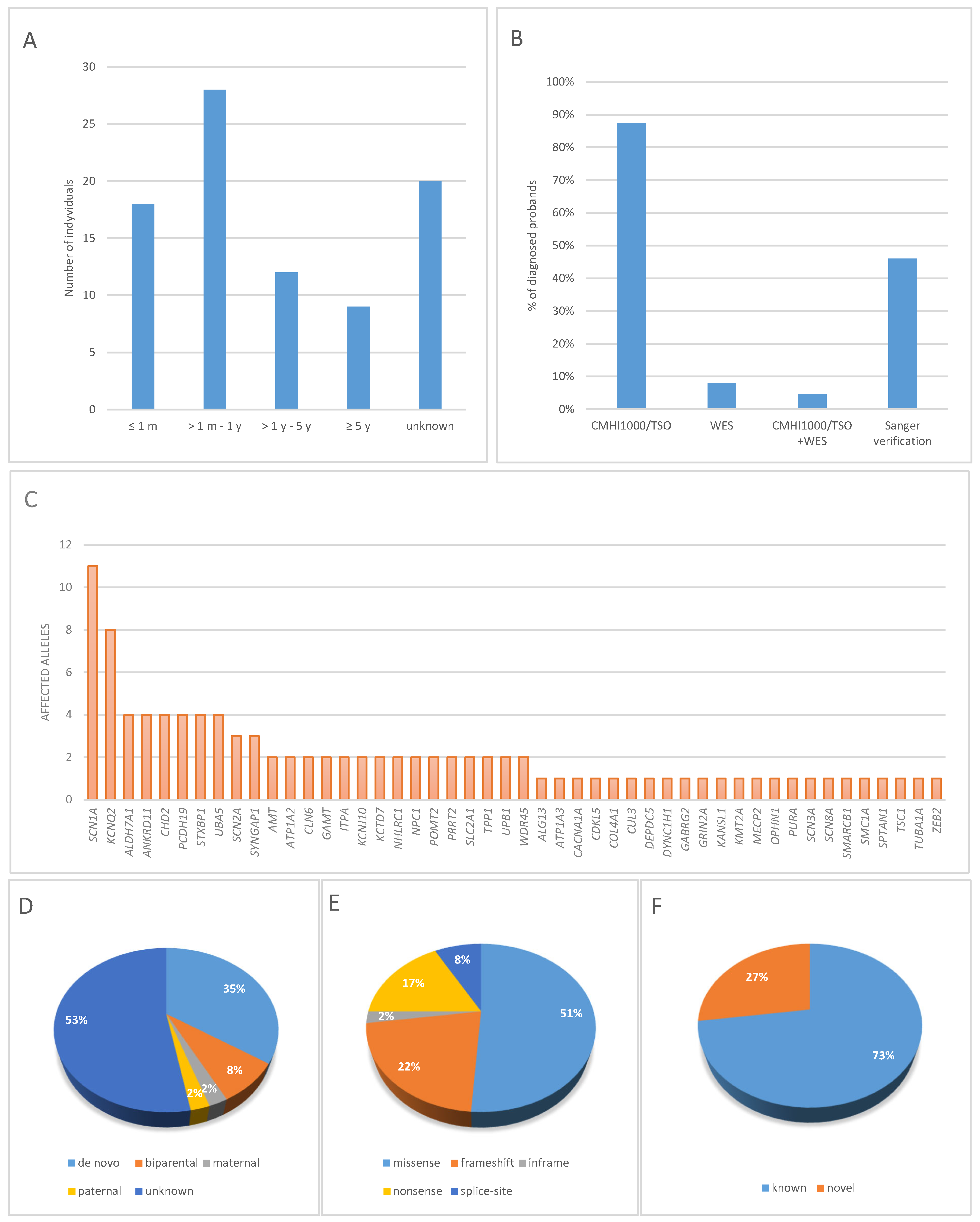
| Patient ID | Gender | Epileptic Encephalopathy Suspected | Dravet Syndrome Suspected | Generalized/Focal Seizures | Type of Seizures | Seizures Onset | Dysmorphism | ID/Developmental Delay or Regression | Motor Delay | Speech Delay | Refractory Seizures | MRI Abnormalities | EEG Abnormalities | Genetic Testing Method | Gene | Genotype (cDNA) | Protein Effect | hereditary Pattern | Type of Inheritance | Genotype-Fenotype Correlation [OMIM] | Classification of Epilepsies Based on Genetic/Molecular Pathomechanism |
|---|---|---|---|---|---|---|---|---|---|---|---|---|---|---|---|---|---|---|---|---|---|
| P01 | M | n/a | n/a | n/a | n/a | yes | yes | n/a | n/a | yes | n/a | TSO, Sanger | TUBA1A | c.[920C>T];[=] | p.[Pro307Leu];[=] | de novo | AD | LIS3 | DEVELOP | ||
| P02 | M | yes | n/a | TON | 4 m | n/a | n/a | n/a | yes | n/a | yes | yes | TSO, Sanger | ITPA | c.[124+1G>A];[124+1G>A] | p.[?];[?] | biparental | AR | DEE35 | DEVELOP | |
| P03 | F | yes | yes | GE | MYOCLON | 6 m | n/a | n/a | n/a | n/a | yes | n/a | n/a | TSO, Sanger | SCN1A | c.[3789C>A];[=] | p.[Phe1263Leu];[=] | n/a | AD | DS/DEE6B/GEFSP2 | CHANNNEL |
| P04 | F | yes | n/a | TON-CLON | 1 d | n/a | n/a | n/a | n/a | yes | n/a | yes | CMHI1000, Sanger | KCNQ2 | c.[802C>T];[=] | p.[Leu268Phe];[=] | de novo | AD | DEE7 | CHANNNEL | |
| P05 | F | GE | n/a | 2 m | n/a | yes | yes | n/a | n/a | yes | n/a | CMHI1000, Sanger | CDKL5 | c.[1675C>T];[=] | p.[Arg559*];[=] | de novo | XLD | DEE2 | DEVELOP | ||
| P06 | F | yes | n/a | TON-CLON, FEBR, ATON | n/a | n/a | yes | n/a | n/a | yes | yes | yes | CMHI1000 | GAMT | c.[520T>C];[(520T>C)] | p.[Trp174Arg];[=] | n/a | AR | CCDS2 | METAB | |
| P07 | M | yes | GE | FEBR | 6 m | n/a | n/a | n/a | n/a | n/a | n/a | n/a | CMHI1000, Sanger | SCN1A | c.[2576G>A];[=] | p.[Arg859His];[=] | maternal | AD | DS | CHANNNEL | |
| P08 | F | yes | FE | IS, TON-CLON | 5 d | n/a | yes | yes | n/a | yes | n/a | yes | WES, Sanger | GRIN2A | c.[1903G>A];[=] | p.[Ala635Thr];[=] | de novo | AD | FESD | RECEPTOR | |
| P09 | F | yes | GE | ABSEN | 8 m | n/a | no | no | n/a | n/a | n/a | n/a | CMHI1000, Sanger | SCN1A | c.[752T>A];[=] | p.[Met251Lys];[=] | de novo | AD | DS | CHANNNEL | |
| P10 | F | yes | GE | ABSEN, NOC, TON-CLON, MYOCLON | n/a | n/a | yes | n/a | yes | n/a | no | yes | CMHI1000, Sanger | CHD2 | c.[4797_4798dupCA];[=] | p.[Asn1600Thrfs*215];[=] | de novo | AD | DEE94 | DEVELOP | |
| P11 | M | n/a | IS, TON, TON-CLON | 1 d | yes | n/a | n/a | n/a | yes | yes | yes | CMHI1000, Sanger | SCN3A | c.[3998C>T];[=] | p.[Pro1333Leu];[=] | de novo | AD | DEE62 | CHANNNEL | ||
| P12 | M | yes | GE | FEBR, TON-CLON | 8 m | n/a | no | no | no | n/a | n/a | n/a | CMHI1000 | SCN1A | c.[1177C>T];[=] | p.[Arg393Cys];[=] | n/a | AD | DS | CHANNNEL | |
| P13 | F | FE | TON, CLON | 2 m | n/a | yes | yes | n/a | n/a | n/a | yes | CMHI1000, Sanger | STXBP1 | c.[1162C>T];[=] | p.[Arg388*];[=] | de novo | AD | DEE4 | DEVELOP | ||
| P14 | F | n/a | IS, MYOCLON | 5 m | n/a | yes | yes | n/a | yes | no | yes | TSO | ALG13 | c.[320A>G];[=] | p.[Asn107Ser];[=] | n/a | XL | DEE36 (WS) | DEVELOP | ||
| P15 | F | yes | n/a | CLON | 3 y | yes | yes | yes | n/a | n/a | n/a | yes | CMHI1000, Sanger | SYNGAP1 | c.[333del];[=] | p.[Lys114Serfs*20];[=] | de novo | AD | MRD5 | DEVELOP | |
| P16 | M | n/a | IS, CLON | 1 m | n/a | n/a | n/a | n/a | n/a | yes | n/a | TSO, Sanger | COL4A1 | c.[4031G>A];[=] | p.[Gly1344Asp];[=] | de novo | AD | BSVD1 | DEVELOP | ||
| P17 | M | n/a | n/a | n/a | yes | n/a | n/a | n/a | n/a | n/a | n/a | CMHI1000, Sanger | KANSL1 | c.[808_809del];[=] | p.[Leu270Valfs*11];[=] | de novo | AD | KDVS | DEVELOP | ||
| P18 | M | n/a | n/a | n/a | no | yes | yes | yes | yes | n/a | n/a | CMHI1000 | SYNGAP1 | c.[509G>A];[=] | p.[Pro170Argfs*25];[=] | n/a | AD | MRD5 | DEVELOP | ||
| P19 | F | yes | n/a | FEBR, TON-CLON, ABSEN | 6 m | n/a | n/a | yes | n/a | yes | no | no | CMHI1000 | SCN1A | c.[301C>T];[=] | p.[Arg101Trp];[=] | n/a | AD | DS | CHANNNEL | |
| P20 | M | yes | MFE | MYOCLON, IS | 4 m | yes | yes | yes | n/a | yes | yes | yes | CMHI1000, Sanger | SPTAN1 | c.[6908_6916dup];[=] | p.[Asp2303_Leu2305dup];[=] | de novo | AD | DEE5 | DEVELOP | |
| P21 | F | GE | n/a | 13 y | n/a | yes | n/a | n/a | n/a | n/a | yes | CMHI1000 | CACNA1A | c.[4252C>T];[=] | p.[Arg418*];[=] | n/a | AD | DEE42 | CHANNNEL | ||
| P22 | M | yes | yes | n/a | CLON, MYOCLON, NOC, ATON | 2 d | n/a | n/a | n/a | n/a | n/a | n/a | n/a | CMHI1000 | ATP1A3 | c.[2443G>A];[=] | p.[Glu815Lys];[=] | n/a | AD | DEE99 | DEVELOP |
| P23 | M | GE | ATON, MYOCLON | n/a | yes | yes | n/a | n/a | n/a | no | n/a | CMHI1000, Sanger | ANKRD11 | c.[1442C>A];[=] | p.[Ser481*];[=] | de novo | AD | KBGS | DEVELOP | ||
| P24 | M | yes | GE | CLON, MYOCLON | 10 m | n/a | yes | yes | n/a | yes | yes | yes | CMHI1000, WES | WDR45 | c.[103G>T];[0] | p.[Glu35*];[0] | de novo | XLD | NBIA5 | METAB | |
| P25 | M | n/a | n/a | n/a | yes | n/a | n/a | n/a | n/a | yes | n/a | TSO, Sanger | POMT2 | c.[70del];[70del] | p.[Gln24Argfs*41];[Gln24Argfs*41] | biparental | AR | MDDGA2 | DEVELOP | ||
| P26 | F | n/a | MULTIPLE | n/a | n/a | n/a | n/a | n/a | n/a | n/a | n/a | CMHI1000 | SCN1A | c.[302G>A];[=] | p.[Arg101Gln];[=] | n/a | AD | DS/DEE6B/GEFSP2 | CHANNNEL | ||
| P27 | F | n/a | n/a | n/a | n/a | yes | yes | n/a | yes | n/a | n/a | CMHI1000 | TPP1 | c.[622C>T(;)833A>C] | p.[Arg208*(;)Gln278Pro] | n/a | AR | CLN2 | METAB | ||
| P28 | M | yes | GE, FE | FEBR | 18 m | n/a | n/a | n/a | n/a | n/a | no | n/a | CMHI1000, Sanger | SCN1A | c.[4219C>T];[=] | p.[Arg1407*];[=] | de novo | AD | DS/DEE6B/GEFSP2 | CHANNNEL | |
| P29 | M | yes | FE | n/a | n/a | n/a | n/a | n/a | n/a | n/a | n/a | n/a | CMHI1000 | SCN2A | c.[781G>T];[=] | p.[Val261Leu];[=] | n/a | AD | DEE11 | CHANNNEL | |
| P30 | F | yes | n/a | n/a | 2 m | n/a | n/a | n/a | n/a | n/a | n/a | yes | CMHI1000, Sanger | STXBP1 | c.[722C>A];[=] | p.[Ser241Tyr];[=] | de novo | AD | DEE4 | DEVELOP | |
| P31 | F | n/a | n/a | 1 m | n/a | n/a | n/a | n/a | n/a | n/a | n/a | CMHI1000 | AMT | c.[452_466del];[452_466del] | p.[Lys151_Leu155del];[Lys151_Leu155del] | n/a | AR | GCE | METAB | ||
| P32 | F | GE | n/a | n/a | n/a | no | no | n/a | n/a | no | yes | CMHI1000 | PCDH19 | c.[1145del];[=] | p.[Gly382Aspfs*187];[=] | n/a | XL | DEE9 | DEVELOP | ||
| P33 | F | GE | FEBR, TON-CLON | 8 m | n/a | n/a | n/a | n/a | n/a | n/a | n/a | CMHI1000, Sanger | SCN1A | c.[2468A>T];[=] | p.[Asp823Val];[=] | de novo | AD | DS/DEE6B/GEFSP2 | CHANNNEL | ||
| P34 | F | FE | ABSEN | 6 y | n/a | yes | yes | n/a | yes | yes | n/a | CMHI1000, Sanger | CLN6 | c.[373A>G];[(373A>G)] | p.[Ser125Gly];[Ser125Gly] | biparental | AR | CLN | METAB | ||
| P35 | F | yes | n/a | n/a | n/a | n/a | yes | yes | n/a | yes | n/a | n/a | WES | SCN8A | c.[2895C>A];[=] | p.[Asn965Lys];[=] | de novo | AD | DEE13 | CHANNNEL | |
| P36 | F | yes | n/a | n/a | n/a | n/a | yes | n/a | n/a | yes | n/a | n/a | TSO | SMC1A | c.[3061dup];[=] | p.[Ala1021Glyfs*24];[=] | de novo | XLD | DEE85 | DEVELOP | |
| P37 | M | n/a | n/a | 2 d | no | n/a | yes | yes | n/a | yes | n/a | CMHI1000 | KCNQ2 | c.[1678C>T];[=] | p.[Arg560Trp];[=] | de novo | AD | DEE7 | CHANNNEL | ||
| P38 | M | n/a | IS | 6 d | n/a | yes | yes | n/a | n/a | no | yes | CMHI1000, Sanger | STXBP1 | c.[1162C>T];[=] | p.[Arg388*];[=] | n/a | AD | DEE4 | DEVELOP | ||
| P39 | M | n/a | n/a | 3 y | n/a | yes | n/a | n/a | n/a | n/a | n/a | CMHI1000, Sanger | SYNGAP1 | c.[3471G>A];[=] | p.[Trp1157*];[=] | de novo | AD | MRD5 | DEVELOP | ||
| P40 | F | n/a | n/a | 5 y | n/a | yes | no | n/a | n/a | n/a | yes | CMHI1000, Sanger | SLC2A1 | c.[667C>T];[=] | p.[Arg223Trp];[=] | paternal | AD | GLUT1DS | METAB | ||
| P41 | F | yes | n/a | FEBR | 6 m | n/a | n/a | no | n/a | n/a | n/a | n/a | CMHI1000, Sanger | SCN1A | c.[5285G>A];[=] | p.[Gly1762Glu];[=] | de novo | AD | DS | CHANNNEL | |
| P42 | M | n/a | n/a | n/a | n/a | yes | n/a | n/a | n/a | n/a | n/a | CMHI1000 | ATP1A2 | c.[889G>A];[=] | p.[Ala297Thr];[=] | n/a | AD | FHM2/DEE98 | DEVELOP | ||
| P43 | F | GE, FE | TON | 5 m | yes | yes | n/a | n/a | yes | n/a | n/a | TSO, Sanger | PCDH19 | c.[1031C>G];[=] | p.[Pro344Arg];[=] | paternal | XL | DEE9 | DEVELOP | ||
| P44 | F | FE | CLON | 11 m | n/a | n/a | n/a | no | yes | no | yes | CMHI1000 | PCDH19 | c.[1091dup];[=] | p.[Tyr366Leufs*10];[=] | n/a | XL | DEE9 | DEVELOP | ||
| P45 | M | n/a | MYOCLON, TON-CLON | 15 y | n/a | n/a | n/a | n/a | n/a | n/a | n/a | CMHI1000 | NHLRC1 | c.[660dup];[(660dup)] | p.[Val221Cysfs*13];[(Val221Cysfs*13)] | n/a | AR | MELF | METAB | ||
| P46 | F | n/a | n/a | n/a | n/a | n/a | n/a | n/a | n/a | n/a | n/a | CMHI1000, Sanger | SLC2A1 | c.[236G>T];[=] | p.[Gly79Val];[=] | de novo | AD | GLUT1DS | METAB | ||
| P47 | M | GE | TON, CLON | 3 y | yes | n/a | n/a | yes | n/a | yes | n/a | CMHI1000, Sanger | SMARCB1 | c.[919T>C];[=] | p.[Phe307Leu];[=] | de novo | AD | CSS3 | DEVELOP | ||
| P48 | M | GE, FE | CLON | 10 d | n/a | no | no | n/a | n/a | no | yes | CMHI1000 | ALDH7A1 | c.[328C>T];[328C>T] | p.[Arg110*];[Arg110*] | n/a | AR | EPEO4 | METAB | ||
| P49 | M | FE | CLON, MULTIPLE | 2 d | n/a | n/a | n/a | n/a | n/a | n/a | yes | CMHI1000 | KCNQ2 | c.[821C>T];[=] | p.[Thr274Met];[=] | n/a | AD | DEE7 | CHANNNEL | ||
| P50 | F | n/a | n/a | 1 m | n/a | no | no | no | n/a | no | n/a | TSO, Sanger | ALDH7A1 | c.[328C>T];[902A>T] | p.[Arg110*];[Asn301Ile] | biparental | AR | EPEO4 | METAB | ||
| P51 | M | yes | n/a | TON, IS | 3 d | n/a | yes | yes | n/a | yes | n/a | yes | CMHI1000 | KCNQ2 | c.[740C>T];[=] | p.[Ser247Leu];[=] | n/a | AD | DEE7 | CHANNNEL | |
| P52 | M | GE, FE | n/a | 12 m | yes | n/a | no | yes | n/a | n/a | yes | WES, Sanger | ANKRD11 | c.[4387_4390del];[=] | p.[Glu1463Asnfs*67];[=] | de novo | AD | KBGS | DEVELOP | ||
| P53 | M | n/a | n/a | 12 m | n/a | n/a | yes | yes | yes | yes | yes | WES, Sanger | WDR45 | c.[235+1G>T];[0] | p.[?];[0] | de novo | XLD | NBIA5 | METAB | ||
| P54 | M | FE | CLON | n/a | n/a | yes | yes | yes | yes | yes | n/a | CMHI1000, Sanger | ATP1A2 | c.[1127C>T];[=] | p.[Thr376Met];[=] | n/a | AD | DEE98 | DEVELOP | ||
| P55 | M | yes | GE | TON, TON-CLON | 2 d | n/a | yes | yes | n/a | yes | n/a | yes | CMHI1000, Sanger | SCN2A | c.[775C>A];[=] | p.[Leu259Ile];[=] | de novo | AD | DEE11 | CHANNNEL | |
| P56 | M | GE | IS, TON | 2 y | yes | yes | yes | yes | yes | yes | yes | CMHI1000, WES, Sanger | UBA5 | c.[796G>C];[1111G>A] | p.[Val266Leu];[Ala371Thr] | biparental | AR | DEE44 | DEVELOP | ||
| P57 | M | yes | FE | CLON, TON, MYOCLON | 2 m | n/a | n/a | n/a | n/a | yes | n/a | yes | CMHI1000 | SCN1A | c.[626T>C];[=] | p.[Leu209Pro];[=] | n/a | AD | DEE6B | CHANNNEL | |
| P58 | F | n/a | TON, CLON | 15 d | n/a | n/a | n/a | n/a | n/a | no | yes | CMHI1000 | KCNQ2 | c.[1678C>T];[=] | p.[Arg560Trp];[=] | n/a | AD | DEE7 | CHANNNEL | ||
| P59 | M | yes | GE | FEBR, CLON, TON | 2.5 y | n/a | n/a | n/a | yes | yes | no | n/a | CMHI1000 | PCDH19 | c.[2452C>T];[=] | p.[Gln818*];[=] | n/a | XL | DEE9 | DEVELOP | |
| P60 | F | n/a | FEBR | 2 y | yes | yes | yes | yes | n/a | n/a | n/a | CMHI1000 | ANKRD11 | c.[7216C>T];[=] | p.[Gln2406*];[=] | n/a | AD | KBGS | DEVELOP | ||
| P61 | F | GE, FE | ABSEN, MYOCLON, TON-CLON | 6 y | yes | yes | yes | n/a | n/a | n/a | n/a | CMHI1000 | ZEB2 | c.[851G>A];[=] | p.[Cys284Tyr];[=] | n/a | AD | MOWS | DEVELOP | ||
| P62 | F | yes | n/a | TON-CLON, FEBR | 2 y | yes | yes | yes | n/a | no | no | no | CMHI1000 | KMT2A | c.[1154del];[=] | p.[Lys385Argfs*15];[=] | n/a | AD | WDSTS | DEVELOP | |
| P63 | F | GE | ABSEN, FEBR | 10 m | n/a | no | no | n/a | no | no | n/a | CMHI1000 | GABRG2 | c.[670C>T];[=] | p.[Arg224*];[=] | n/a | AD | DEE74 | RECEPTOR | ||
| P64 | F | GE | n/a | 6 m | n/a | n/a | n/a | n/a | n/a | n/a | n/a | CMHI1000, Sanger | PRRT2 | c.[649dup];[=] | p.[Arg217Profs*8];[=] | n/a | AD | BFIS2 | DEVELOP | ||
| P65 | F | yes | n/a | n/a | 1 m | n/a | n/a | n/a | n/a | n/a | n/a | n/a | CMHI1000 | KCNQ2 | c.[436T>C];[=] | p.[Trp146Arg];[=] | n/a | AD | DEE7 | CHANNNEL | |
| P66 | F | n/a | n/a | n/a | n/a | yes | n/a | yes | n/a | n/a | n/a | CMHI1000, Sanger | CHD2 | c.[693-3C>A];[=] | p.[?];[=] | de novo | AD | DEE94 | DEVELOP | ||
| P67 | M | GE | TON-CLON, ATON | 8 y | n/a | yes | n/a | n/a | n/a | n/a | n/a | CMHI1000 | STXBP1 | c.[560C>T];[=] | p.[Pro187Leu];[=] | n/a | AD | DEE4 | DEVELOP | ||
| P68 | F | n/a | TON | 1 d | n/a | n/a | n/a | n/a | n/a | n/a | n/a | CMHI1000 | KCNQ2 | c.[1955dup];[=] | p.[Thr653Aspfs*212];[=] | n/a | AD | DEE7 | CHANNNEL | ||
| P69 | F | n/a | n/a | 2 y | n/a | n/a | n/a | n/a | n/a | yes | n/a | CMHI1000, WES, Sanger | UPB1 | c.[917-1G>A];[917-1G>A] | p.[?];[?] | biparental | AR | UPB1D | METAB | ||
| P70 | F | GE | n/a | 12 y | n/a | no | n/a | n/a | n/a | no | n/a | WES | DEPDC5 | c.[4674G>A];[=] | p.[Trp1558*];[=] | n/a | AD | FFEVF1 | DEVELOP | ||
| P71 | F | n/a | TON-CLON | 3 m | n/a | no | no | n/a | n/a | no | n/a | CMHI1000 | PRRT2 | c.[649dup];[=] | p.[Arg217Profs*8];[=] | n/a | AD | BFIS2 | DEVELOP | ||
| P72 | F | n/a | CLON, TON-CLON | 4 y | yes | yes | yes | n/a | n/a | yes | yes | WES | MECP2 | c.[1115C>A];[=] | p.[Ser372*];[=] | n/a | XLD | RTT | DEVELOP | ||
| P73 | F | yes | GE | TON-CLON | 6 m | n/a | n/a | yes | yes | n/a | no | yes | CMHI1000 | SCN1A | c.[5590del];[=] | p.[Cys1864Valfs*13];[=] | n/a | AD | DS | CHANNNEL | |
| P74 | M | yes | FE | CLON | 2 m | n/a | n/a | n/a | n/a | n/a | no | yes | CMHI1000 | SCN2A | c.[3956G>C];[=] | p.[Arg1319Pro];[=] | n/a | AD | DEE11 | CHANNNEL | |
| P75 | M | n/a | n/a | 15 m | yes | yes | yes | yes | n/a | yes | yes | CMHI1000, Sanger | OPHN1 | c.[1026-1G>T];[0] | p.[?];[0] | maternal | XLR | MRXSBL | DEVELOP | ||
| P76 | M | yes | n/a | n/a | n/a | yes | yes | yes | yes | n/a | n/a | n/a | TSO, WES | UBA5 | c.[698T>A];[796G>C] | p.[Leu233His];[Val266Leu] | biparental | AR | DEE44 | DEVELOP | |
| P77 | M | n/a | ABSEN, IS, TON, CLON | 3 m | n/a | n/a | no | yes | yes | yes | yes | CMHI1000 | TSC1 | c.[2228_2229del];[=] | p.[Gln743Argfs*10];[=] | n/a | AD | TSC | DEVELOP | ||
| P78 | M | GE | TON-CLON, CLON, TON, MYOCLON, NOC, IS | 4.5 y | n/a | yes | yes | yes | yes | n/a | yes | CMHI1000 | CHD2 | c.[2804_2813del];[=] | p.[Leu935Trpfs*2];[=] | n/a | AD | DEE94 | DEVELOP | ||
| P79 | F | n/a | MYOCLON | 3 y | n/a | yes | yes | yes | yes | n/a | yes | CMHI1000 | KCTD7 | c.[190A>G];[249del] | p.[Thr64Ala];[Arg84Glyfs*25] | n/a | AR | EPM3 | DEVELOP | ||
| P80 | M | GE | ABSEN, ATON, TON-CLON | 5 y | n/a | yes | n/a | yes | yes | no | yes | WES | NPC1 | c.[1274C>A(;)3019C>G] | p.[Ser425*(;)Pro1007Ala] | n/a | AR | NPC | METAB | ||
| P81 | M | yes | GE | MYOCLON | 3 m | n/a | n/a | n/a | n/a | n/a | yes | n/a | CMHI1000 | KCNJ10 | c.[179T>C];[179T>C] | p.[Ile60Thr];[Ile60Thr] | n/a | AR | SESAMES | CHANNNEL | |
| P82 | F | n/a | n/a | n/a | n/a | yes | yes | yes | n/a | n/a | n/a | CMHI1000 | CUL3 | c.[655-1G>A];[=] | p.[?];[=] | n/a | AD | NEDAUS | DEVELOP | ||
| P83 | F | yes | n/a | n/a | 2 d | n/a | yes | yes | n/a | n/a | n/a | n/a | CMHI1000, Sanger | PURA | c.[885delinsGC];[=] | p.[His296Profs*21];[=] | de novo | AD | NEDRIHF | DEVELOP | |
| P84 | M | yes | n/a | MYOCLON, TON | 3 d | n/a | n/a | n/a | n/a | n/a | n/a | yes | CMHI1000 | KCNQ2 | c.[619C>T];[=] | p.[Arg207Trp];[=] | n/a | AD | DEE7 | DEVELOP | |
| P85 | M | FE | ABSEN | 6 y | n/a | yes | yes | yes | n/a | yes | n/a | CMHI1000 | DYNC1H1 | c.[874C>T];[=] | p.[Arg292Trp];[=] | n/a | AD | CDCBM13 | DEVELOP | ||
| P86 | F | n/a | MYOCLON | 12 m | n/a | n/a | n/a | yes | n/a | no | yes | CMHI1000 | CHD2 | c.[3499dup];[=] | p.[Val1167Glyfs*9];[=] | n/a | AD | DEE94 | DEVELOP | ||
| P87 | M | n/a | n/a | n/a | yes | yes | yes | yes | n/a | n/a | n/a | CMHI1000, Sanger | ANKRD11 | c.[6191_6192del];[=] | p.(Ser2064Phefs*37) | de novo | AD | KBGS | DEVELOP |
| Classification of Epilepsies Based on Genetic/Molecular Pathomechanism | ||||
|---|---|---|---|---|
| Channelopathies | Receptoropathies | Metabolic Epilepsy | Structural-Genetic/Developmental Epilepsy | |
| Associated genes | CACNA1A, KCNJ10, KCNQ2, SCN1A, SCN2A, SCN3A, SCN8A | GABRG2, GRIN2A | ALDH7A1, AMT, CLN6, GAMT, NHLRC1, NPC1, SLC2A1, TPP1, UPB1, WDR45 | ALG13, ANKRD11, ATP1A2, ATP1A3, CDKL5, CHD2, COL4A1, CUL3, DEPDC5, DYNC1H1, ITPA, KANSL1, KCTD7, KMT2A, MECP2, OPHN1, PCDH19, POMT2, PRRT2, PURA, SMARCB1, SMC1A, SPTAN1, STXBP1, SYNGAP1, TSC1, TUBA1A, UBA5, ZEB2 |
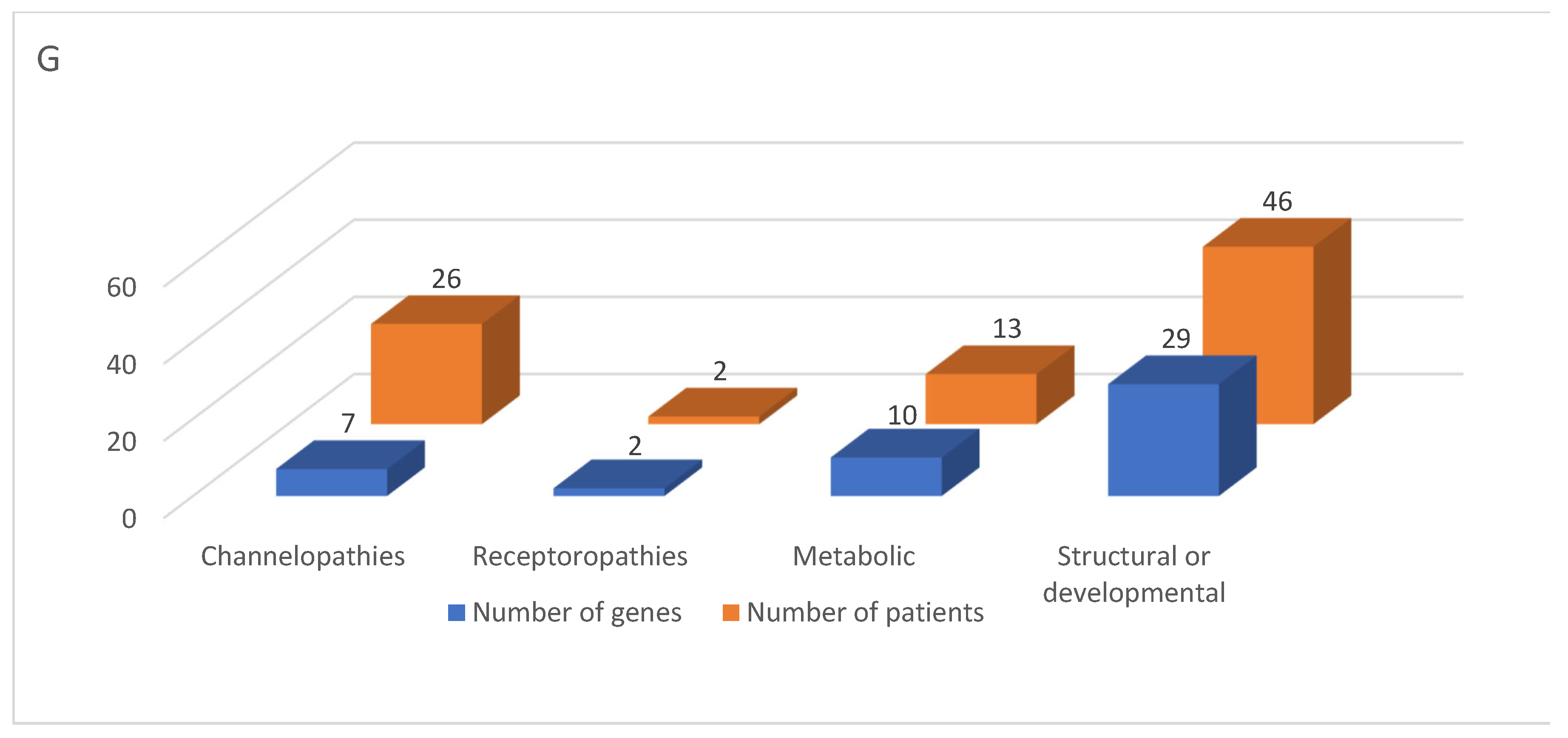
| Number of genes (%) | 7 (14.6%) | 2 (4.2%) | 10 (20.8) | 29 (60.4%) |
| Number of patients (%) | 26 (29.9%) | 2 (2.3%) | 13 (14.9%) | 46 (52.9%) |
Disclaimer/Publisher’s Note: The statements, opinions and data contained in all publications are solely those of the individual author(s) and contributor(s) and not of MDPI and/or the editor(s). MDPI and/or the editor(s) disclaim responsibility for any injury to people or property resulting from any ideas, methods, instructions or products referred to in the content. |
© 2026 by the authors. Licensee MDPI, Basel, Switzerland. This article is an open access article distributed under the terms and conditions of the Creative Commons Attribution (CC BY) license.
Share and Cite
Chałupczyńska, B.; Ciara, E.; Halat-Wolska, P.; Pollak, A.; Stawiński, P.; Jurkiewicz, D.; Piekutowska-Abramczuk, D.; Gawlik, M.; Pietrasik, J.; Cieślikowska, A.; et al. Molecular Profiling of Polish Pediatric Patients with Epilepsy: A Single-Center Diagnostic Experience Using Next-Generation Sequencing. Genes 2026, 17, 133. https://doi.org/10.3390/genes17020133
Chałupczyńska B, Ciara E, Halat-Wolska P, Pollak A, Stawiński P, Jurkiewicz D, Piekutowska-Abramczuk D, Gawlik M, Pietrasik J, Cieślikowska A, et al. Molecular Profiling of Polish Pediatric Patients with Epilepsy: A Single-Center Diagnostic Experience Using Next-Generation Sequencing. Genes. 2026; 17(2):133. https://doi.org/10.3390/genes17020133
Chicago/Turabian StyleChałupczyńska, Beata, Elżbieta Ciara, Paulina Halat-Wolska, Agnieszka Pollak, Piotr Stawiński, Dorota Jurkiewicz, Dorota Piekutowska-Abramczuk, Marzena Gawlik, Justyna Pietrasik, Agata Cieślikowska, and et al. 2026. "Molecular Profiling of Polish Pediatric Patients with Epilepsy: A Single-Center Diagnostic Experience Using Next-Generation Sequencing" Genes 17, no. 2: 133. https://doi.org/10.3390/genes17020133
APA StyleChałupczyńska, B., Ciara, E., Halat-Wolska, P., Pollak, A., Stawiński, P., Jurkiewicz, D., Piekutowska-Abramczuk, D., Gawlik, M., Pietrasik, J., Cieślikowska, A., Wicher, D., Ulatowska, A., Jedlińska, D., Borkowska, J., Chmielewski, D., Dunin-Wąsowicz, D., Kotulska-Jóźwiak, K., Chrzanowska, K., & Madej-Pilarczyk, A. (2026). Molecular Profiling of Polish Pediatric Patients with Epilepsy: A Single-Center Diagnostic Experience Using Next-Generation Sequencing. Genes, 17(2), 133. https://doi.org/10.3390/genes17020133