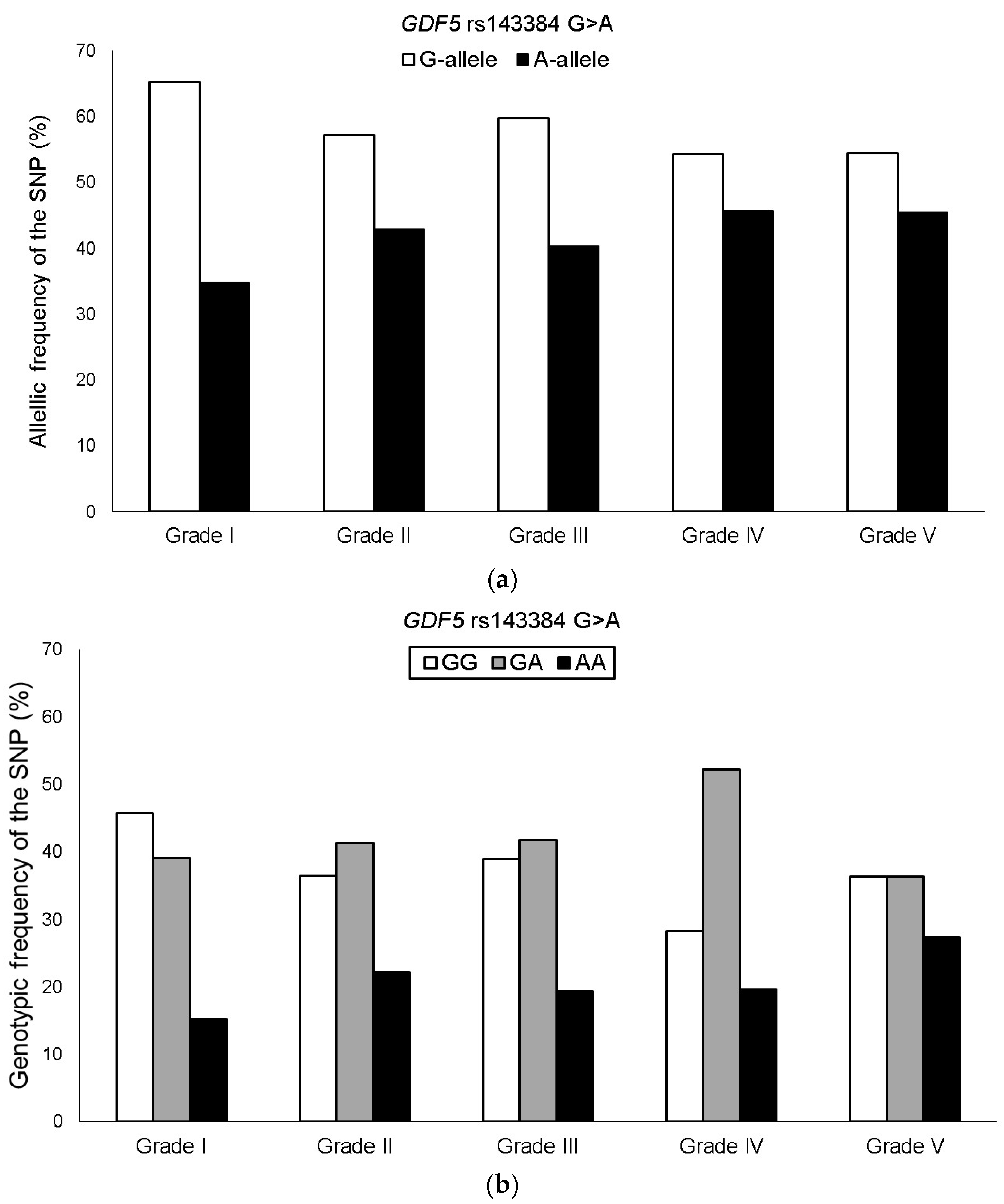
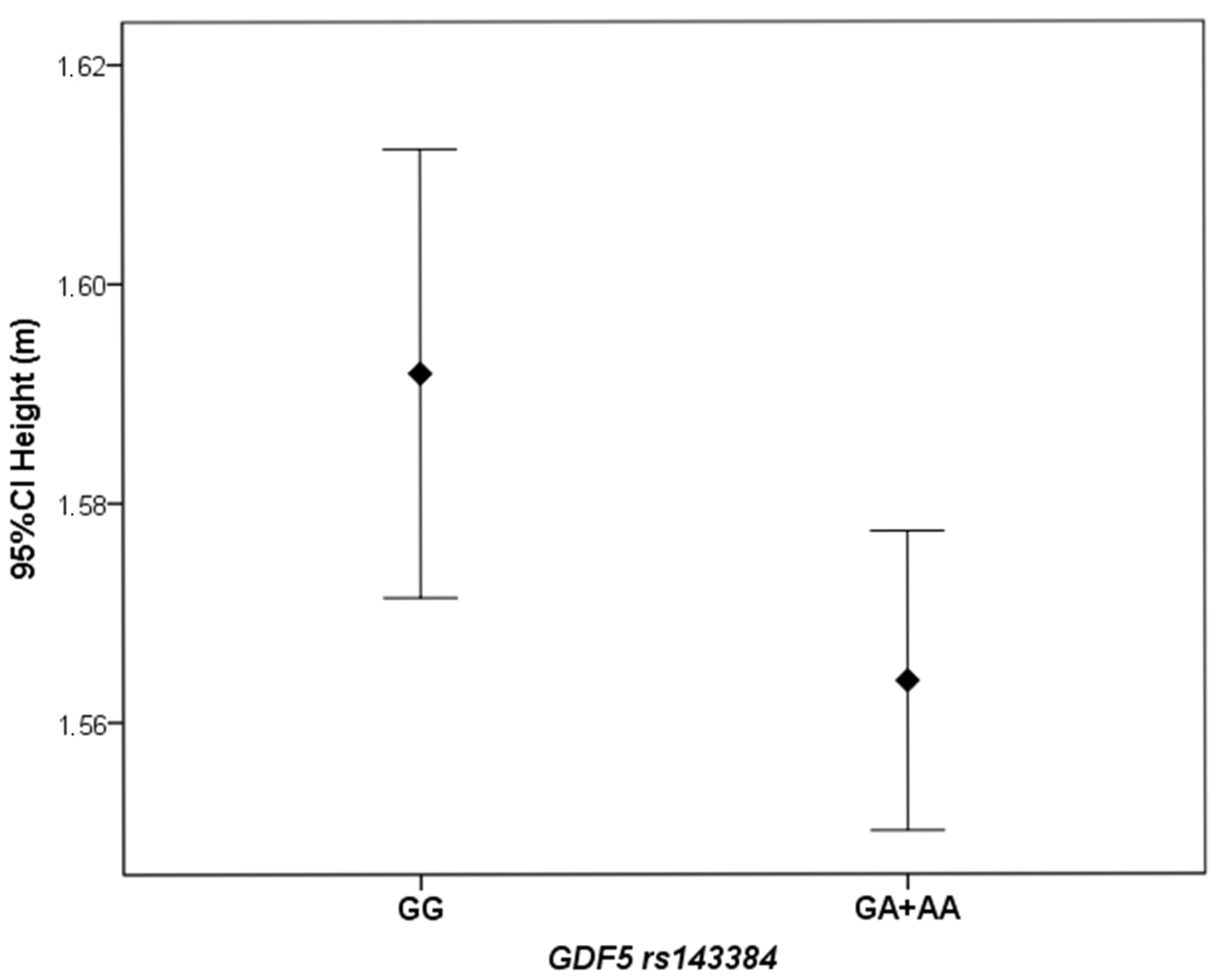
The GDF5 rs143384 Polymorphism Is Associated with the Severity of Knee Osteoarthritis and Shorter Stature in Female Brazilian Patients: A Cross-Sectional Study

 ,
, 
Abstract
1. Introduction
2. Materials and Methods
3. Results
4. Discussion
5. Conclusions
Author Contributions
Funding
Institutional Review Board Statement
Informed Consent Statement
Data Availability Statement
Acknowledgments
Conflicts of Interest
Abbreviations
| BMI | Body mass index |
| CI | Confidence intervals |
| GDF5 | Growth differentiation factor 5 |
| GWAS | Genome-wide association studies |
| HWE | Hardy–Weinberg equilibrium |
| IQR | Interquartile range |
| KOA | Knee osteoarthritis |
| NIH | National Institutes of Health |
| OR | Odds ratio |
| PCR | Real-Time Polymerase Chain Reaction |
| SNP | Single nucleotide polymorphism |
References
- Tang, S.; Zhang, C.; Oo, W.M.; Fu, K.; Risberg, M.A.; Bierma-Zeinstra, S.M.; Neogi, T.; Atukorala, I.; Malfait, A.M.; Ding, C.; et al. Osteoarthritis. Nat. Rev. Dis. Primers 2025, 11, 10. [Google Scholar] [CrossRef] [PubMed]
- Lv, Y.; Sui, L.; Lv, H.; Zheng, J.; Feng, H.; Jing, F. Burden of knee osteoarthritis in China and globally from 1992 to 2021, and projections to 2030: A systematic analysis from the Global Burden of Disease Study 2021. Front. Public Health 2025, 13, 1543180. [Google Scholar] [CrossRef] [PubMed]
- Boyan, B.D.; Hart, D.A.; Enoka, R.M.; Nicolella, D.P.; Resnick, E.; Berkley, K.J.; Sluka, K.A.; Kwoh, C.K.; Tosi, L.L.; O’Connor, M.I.; et al. Hormonal modulation of connective tissue homeostasis and sex differences in risk for osteoarthritis of the knee. Biol. Sex Differ. 2013, 4, 3. [Google Scholar] [CrossRef] [PubMed]
- Welling, M.; Auvinen, J.; Lehenkari, P.; Männikkö, M.; Karppinen, J.; Eskola, P.J. Association between height and osteoarthritis of the knee and hip: The Northern Finland Birth Cohort 1966 Study. Int. J. Rheum. Dis. 2017, 20, 1095–1104. [Google Scholar] [CrossRef]
- Pires, D.P.C.; Monte, F.A.D.; Monteiro, L.F.; Soares, F.R.D.C.; Faria, J.L.R. Updates in the Treatment of Knee Osteoarthritis. Rev. Bras. Ortop. 2024, 59, e337–e348. [Google Scholar] [CrossRef]
- Li, E.; Tan, J.; Xu, K.; Pan, Y.; Xu, P. Global burden and socioeconomic impact of knee osteoarthritis: A comprehensive analysis. Front. Med. 2024, 11, 1323091. [Google Scholar] [CrossRef]
- Takuwa, H.; Uchio, Y.; Ikegawa, S. Genome-wide association study of knee osteoarthritis: Present and future. Ann. Jt. 2018, 3, 64. [Google Scholar] [CrossRef]
- Magnusson, K.; Turkiewicz, A.; Englund, M. Nature vs nurture in knee osteoarthritis—The importance of age, sex and body mass index. Osteoarthr. Cartil. 2019, 27, 586–592. [Google Scholar] [CrossRef]
- Tachmazidou, I.; Hatzikotoulas, K.; Southam, L.; Esparza-Gordillo, J.; Haberland, V.; Zheng, J.; Johnson, T.; Koprulu, M.; Zengini, E.; Steinberg, J.; et al. Identification of new therapeutic targets for osteoarthritis through genome-wide analyses of UK Biobank data. Nat. Genet. 2019, 51, 230–236. [Google Scholar] [CrossRef]
- Tao, Y.; Pan, Q.; Cai, T.; Yang, L.; Haque, M.; Dottorini, T.; Meng, W. A genome-wide association study identifies novel genetic variants associated with knee pain in the UK Biobank (N = 441,757). medRxiv 2024. [Google Scholar] [CrossRef]
- GWAS Catalog. Available online: https://www.ebi.ac.uk/gwas/search?query=osteoarthritis,%20knee (accessed on 13 June 2025).
- Styrkarsdottir, U.; Lund, S.H.; Thorleifsson, G.; Zink, F.; Stefansson, O.A.; Sigurdsson, J.K.; Juliusson, K.; Bjarnadottir, K.; Sigurbjornsdottir, S.; Jonsson, S.; et al. Meta-analysis of Icelandic and UK data sets identifies missense variants in SMO, IL11, COL11A1 and 13 more new loci associated with osteoarthritis. Nat. Genet. 2018, 50, 1681–1687. [Google Scholar] [CrossRef] [PubMed]
- Boer, C.G.; Hatzikotoulas, K.; Southam, L.; Stefánsdóttir, L.; Zhang, Y.; Coutinho de Almeida, R.; Wu, T.T.; Zheng, J.; Hartley, A.; Teder-Laving, M.; et al. Deciphering osteoarthritis genetics across 826,690 individuals from 9 populations. Cell 2021, 184, 4784–4818. [Google Scholar] [CrossRef]
- Novakov, V.; Novakova, O.; Churnosova, M.; Aristova, I.; Ponomarenko, M.; Reshetnikova, Y.; Churnosov, V.; Sorokina, I.; Ponomarenko, I.; Efremova, O.; et al. Polymorphism rs143384 GDF5 reduces the risk of knee osteoarthritis development in obese individuals and increases the disease risk in non-obese population. Arthroplasty 2024, 6, 12. [Google Scholar] [CrossRef] [PubMed]
- Capellini, T.D.; Chen, H.; Cao, J.; Doxey, A.C.; Kiapour, A.M.; Schoor, M.; Kingsley, D.M. Ancient selection for derived alleles at a GDF5 enhancer influencing human growth and osteoarthritis risk. Nat. Genet. 2017, 49, 1202–1210. [Google Scholar] [CrossRef] [PubMed]
- Styrkarsdottir, U.; Stefansson, O.A.; Gunnarsdottir, K.; Thorleifsson, G.; Lund, S.H.; Stefansdottir, L.; Juliusson, K.; Agustsdottir, A.B.; Zink, F.; Halldorsson, G.H.; et al. GWAS of bone size yields twelve loci that also affect height, BMD, osteoarthritis or fractures. Nat. Commun. 2019, 10, 2054. [Google Scholar] [CrossRef]
- Yan, S.; Nie, H.; Bu, G.; Yuan, W.; Wang, S. The effect of common variants in GDF5 gene on the susceptibility to chronic postsurgical pain. J. Orthop. Surg. Res. 2021, 16, 420. [Google Scholar] [CrossRef]
- Perini, J.A.; Cunha, R.W.C.; Cury Fernandes, M.B.; Peixoto, L.P.; Guimarães, J.A.M.; Cavalcanti, A.D.S.; Cardoso, J.V. GDF5 rs143384 Polymorphism Associated with Developmental Dysplasia of the Hip in Brazilian Patients: A Case-Control Study. Int. J. Mol. Sci. 2025, 26, 5012. [Google Scholar] [CrossRef]
- Keyes, G.W.; Carr, A.J.; Miller, R.K.; Goodfellow, J.W. The radiographic classification of medial gonarthrosis: Correlation with operation methods in 200 knees. Acta Orthop. Scand. 1992, 63, 497–501. [Google Scholar] [CrossRef]
- Altman, R.; Asch, E.; Bloch, D.; Bole, G.; Borenstein, D.; Brandt, K.; Christy, W.; Cooke, T.D.; Greenwald, R.; Hochberg, M.; et al. Development of criteria for the classification and reporting of osteoarthritis. Classification of osteoarthritis of the knee. Arthritis Rheum. 1986, 29, 1039–1049. [Google Scholar] [CrossRef]
- Weir, C.B.; Jan, A. BMI classification percentile and cut-off points. In StatPearls; StatPearls Publishing: Treasure Island, FL, USA, 2023. [Google Scholar]
- Allen, K.D.; Thoma, L.M.; Golightly, Y.M. Epidemiology of osteoarthritis. Osteoarthr. Cartil. 2022, 30, 184–195. [Google Scholar] [CrossRef]
- Batushansky, A.; Zhu, S.; Komaravolu, R.K.; South, S.; Mehta-D’Souza, P.; Griffin, T.M. Fundamentals of OA: An initiative of Osteoarthritis and Cartilage. Obesity and metabolic factors in OA. Osteoarthr. Cartil. 2022, 30, 501–515. [Google Scholar] [CrossRef] [PubMed]
- Brisola, A.A.; Colovati, M.E.S.; Cernach, M.C.S.P.; Riera, R.; Pacheco, R.L.; Crizol, G.R.; Martimbianco, A.L.C. Association between genetic polymorphisms and osteoarthritis development. Overview of systematic reviews. Int. J. Rheum. Dis. 2022, 25, 733–742. [Google Scholar] [CrossRef] [PubMed]
- Flore, L.; Francalacci, P.; Massidda, M.; Robledo, R.; Calò, C.M. Influence of different evolutive forces on GDF5 gene variability. Genes 2023, 14, 1895. [Google Scholar] [CrossRef] [PubMed]
- Meng, W.; Adams, M.J.; Palmer, C.N.A.; 23andMe Research Team; Shi, J.; Auton, A.; Ryan, K.A.; Jordan, J.M.; Mitchell, B.D.; Jackson, R.D.; et al. Genome-wide association study of knee pain identifies associations with GDF5 and COL27A1 in UK Biobank. Commun. Biol. 2019, 2, 321. [Google Scholar] [CrossRef]
- Tsepilov, Y.A.; Freidin, M.B.; Shadrina, A.S.; Sharapov, S.Z.; Elgaeva, E.E.; Zundert, J.V.; Karssen, L.C.; Suri, P.; Williams, F.M.K.; Aulchenko, Y.S. Analysis of genetically independent phenotypes identifies shared genetic factors associated with chronic musculoskeletal pain conditions. Commun. Biol. 2020, 3, 329. [Google Scholar] [CrossRef]
- Hatzikotoulas, K.; Roposch, A.; DDH Case Control Consortium; Shah, K.M.; Clark, M.J.; Bratherton, S.; Limbani, V.; Steinberg, J.; Zengini, E.; Warsame, K.; et al. Genome-wide association study of developmental dysplasia of the hip identifies an association with GDF5. Commun. Biol. 2018, 1, 56. [Google Scholar] [CrossRef]
- Kenanidis, E.; Gkekas, N.K.; Karasmani, A.; Anagnostis, P.; Christofilopoulos, P.; Tsiridis, E. Genetic Predisposition to Developmental Dysplasia of the Hip. J. Arthroplasty 2020, 35, 291–300.e1. [Google Scholar] [CrossRef]
- Wang, Y.P.; Di, W.J.; Yang, S.; Qin, S.L.; Xu, Y.F.; Han, P.F.; Hou, K.D. The association of growth differentiation factor 5 rs143383 gene polymorphism with osteoarthritis: A systematic review and meta-analysis. J. Orthop. Surg. Res. 2023, 18, 763. [Google Scholar] [CrossRef]
- Peng, L.; Jin, S.; Lu, J.; Ouyang, C.; Guo, J.; Xie, Z.; Shen, H.; Wang, P. Association between growth differentiation factor 5 rs143383 genetic polymorphism and the risk of knee osteoarthritis among Caucasian but not Asian: A meta-analysis. Arthritis Res. Ther. 2020, 22, 215. [Google Scholar] [CrossRef]
- Wu, D.D.; Li, G.M.; Jin, W.; Li, Y.; Zhang, Y.P. Positive selection on the osteoarthritis-risk and decreased-height associated variants at the GDF5 gene in East Asians. PLoS ONE 2012, 7, e42553. [Google Scholar] [CrossRef]
- Wood, A.R.; Esko, T.; Yang, J.; Vedantam, S.; Pers, T.H.; Gustafsson, S.; Chu, A.Y.; Estrada, K.; Luan, J.; Kutalik, Z.; et al. Defining the role of common variation in the genomic and biological architecture of adult human height. Nat. Genet. 2014, 46, 1173–1186. [Google Scholar] [CrossRef] [PubMed]
- Chan, Y.; Salem, R.M.; Hsu, Y.H.; McMahon, G.; Pers, T.H.; Vedantam, S.; Esko, T.; Guo, M.H.; Lim, E.T.; GIANT Consortium; et al. Genome-wide Analysis of Body Proportion Classifies Height-Associated Variants by Mechanism of Action and Implicates Genes Important for Skeletal Development. Am. J. Hum. Genet. 2015, 96, 695–708. [Google Scholar] [CrossRef]
- Leslie, W.D.; Lix, L.M.; Morin, S.N.; Johansson, H.; Odén, A.; McCloskey, E.V.; Kanis, J.A. Hip axis length is a FRAX- and bone density-independent risk factor for hip fracture in women. J. Clin. Endocrinol. Metab. 2015, 100, 2063–2070. [Google Scholar] [CrossRef] [PubMed]
- Vaes, R.B.; Rivadeneira, F.; Kerkhof, J.M.; Hofman, A.; Pols, H.A.; Uitterlinden, A.G.; van Meurs, J.B. Genetic variation in the GDF5 region is associated with osteoarthritis, height, hip axis length and fracture risk: The Rotterdam study. Ann. Rheum. Dis. 2009, 68, 1754–1760. [Google Scholar] [CrossRef] [PubMed]
- Sanna, S.; Jackson, A.U.; Nagaraja, R.; Willer, C.J.; Chen, W.M.; Bonnycastle, L.L.; Shen, H.; Timpson, N.; Lettre, G.; Usala, G.; et al. Common variants in the GDF5-UQCC region are associated with variation in human height. Nat. Genet. 2008, 40, 198–203. [Google Scholar] [CrossRef]
- Miyamoto, Y.; Mabuchi, A.; Shi, D.; Kubo, T.; Takatori, Y.; Saito, S.; Fujioka, M.; Sudo, A.; Uchida, A.; Yamamoto, S.; et al. A functional polymorphism in the 5′ UTR of GDF5 is associated with susceptibility to osteoarthritis. Nat. Genet. 2007, 39, 529–533. [Google Scholar] [CrossRef]
- Reynard, L.N.; Bui, C.; Syddall, C.M.; Loughlin, J. CpG methylation regulates allelic expression of GDF5 by modulating binding of SP1 and SP3 repressor proteins to the osteoarthritis susceptibility SNP rs143383. Hum. Genet. 2014, 133, 1059–1073. [Google Scholar] [CrossRef]
- Enochson, L.; Stenberg, J.; Brittberg, M.; Lindahl, A. GDF5 reduces MMP13 expression in human chondrocytes via DKK1-mediated canonical Wnt signaling inhibition. Osteoarthr. Cartil. 2014, 22, 566–577. [Google Scholar] [CrossRef]
- Sun, K.; Guo, J.; Yao, X.; Guo, Z.; Guo, F. Growth differentiation factor 5 in cartilage and osteoarthritis: A possible therapeutic candidate. Cell Prolif. 2021, 54, e12998. [Google Scholar] [CrossRef]
- Jia, B.; Jiang, Y.; Xu, Y.; Wang, Y.; Li, T. Correlation between growth differentiation factor 5 (rs143383) gene polymorphism and knee osteoarthritis: An updated systematic review and meta-analysis. J. Orthop. Surg. Res. 2021, 16, 146. [Google Scholar] [CrossRef]
- Witoonpanich, B.; Jinawath, A.; Wongtawan, T.; Tawonsawatruk, T. Association of synovial expression of growth and differentiation factor 5 (GDF5) with radiographic severity of knee osteoarthritis. Heliyon 2022, 8, e11798. [Google Scholar] [CrossRef]
- Kanthawang, T.; Bodden, J.; Joseph, G.B.; Lane, N.E.; Nevitt, M.; McCulloch, C.E.; Link, T.M. Obese and overweight individuals have greater knee synovial inflammation and associated structural and cartilage compositional degeneration: Data from the osteoarthritis initiative. Skeletal Radiol. 2021, 50, 217–229. [Google Scholar] [CrossRef]



| Characteristics | All Patients (n = 224) | Grades I–III (n = 145) | Grades IV–V (n = 79) | p-Value a | OR (95% CI) b |
| Age (years) d | n (%) | n (%) | |||
| <58 | 46 (20.5) | 39 (26.9) | 7 (8.9) | <0.001 | 1 c |
| 58–64 | 74 (33.0) | 50 (34.5) | 24 (30.4) | 3.14 (1.20–8.27) | |
| 65–70 | 53 (23.7) | 36 (24.8) | 17 (21.5) | 2.86 (1.04–7.90) | |
| >70 | 51 (22.8) | 20 (13.8) | 31 (39.2) | 9.34 (3.35–26.01) | |
| Sex | |||||
| Female | 170 (75.9) | 114 (78.6) | 56 (70.9) | 0.16 | 1 c |
| Male | 54 (24.1) | 31 (21.4) | 23 (29.1) | 1.66 (0.82–3.35) | |
| Stature (meters) | |||||
| <1.54 | 45 (20.1) | 22 (15.2) | 23 (29.1) | 0.35 | 1 c |
| 1.54–1.59 | 69 (30.8) | 46 (31.7) | 23 (29.1) | 0.67 (0.29–1.54) | |
| 1.60–1.66 | 58 (25.9) | 41 (28.3) | 17 (21.5) | 0.51 (0.20–1.31) | |
| >1.66 | 52 (23.2) | 36 (24.8) | 16 (20.3) | 0.36 (0.12–1.13) | |
| BMI (kg/m2) | |||||
| ≤29.9 | 73 (32.6) | 42 (29.0) | 31 (39.2) | 0.10 | 1 c |
| 30–35 | 72 (32.1) | 53 (36.6) | 19 (24.1) | 0.59 (0.28–1.25) | |
| >35 | 79 (35.3) | 50 (34.4) | 29 (36.7) | 1.37 (0.65–2.89) | |
| Trauma | |||||
| No | 211 (94.2) | 133 (91.7) | 78 (98.7) | 0.16 | 1 c |
| Yes | 13 (5.8) | 12 (8.3) | 1 (1.3) | 0.22 (0.03–1.82) | |
| Female KOA patients (n = 170) | |||||
| Characteristics | All Patients (n = 170) | Grades I–III (n = 114) | Grades IV–V (n = 56) | p-Value a | OR (95% CI) e |
| Age (years) d | n (%) | n (%) | |||
| <58 | 36 (21.2) | 30 (26.3) | 6 (10.7) | 0.004 | 1 c |
| 58–64 | 56 (32.9) | 38 (33.3) | 18 (32.1) | 2.95 (1.01–8.59) | |
| 65–70 | 43 (25.3) | 30 (26.4) | 13 (23.3) | 2.72 (0.89–8.35) | |
| >70 | 35 (20.6) | 16 (14.0) | 19 (33.9) | 8.18 (2.56–26.16) | |
| Stature (meters) | |||||
| <1.54 | 45 (26.5) | 22 (19.3) | 23 (41.1) | 0.43 | 1 c |
| 1.54–1.59 | 63 (37.0) | 45 (39.5) | 18 (32.1) | 0.61 (0.26–1.46) | |
| 1.60–1.66 | 45 (26.5) | 36 (31.6) | 9 (16.1) | 0.44 (0.16–1.24) | |
| >1.66 | 17 (10.0) | 11 (9.6) | 6 (10.7) | 0.86 (0.25–2.99) | |
| BMI (kg/m2) | |||||
| ≤29.9 | 44 (25.9) | 29 (25.4) | 15 (26.8) | 0.20 | 1 c |
| 30–35 | 53 (31.2) | 39 (34.2) | 14 (25.0) | 0.87 (0.35–2.15) | |
| >35 | 73 (42.9) | 46 (40.4) | 27 (48.2) | 1.73 (0.74–1.13) | |
| Trauma | |||||
| No | 161 (94.7) | 105 (92.1) | 56 (100.0) | 0.99 | 1 c |
| Yes | 9 (5.3) | 9 (7.9) | 0 (0.0) | - | |
| GDF5 rs143384 G > A | Grades I–III (n = 114) | Grades IV–V (n = 56) | p-Value a | OR (95% CI) b |
| n (%) | ||||
| GG | 48 (42.1) | 13 (23.2) | 0.05 | 1 c |
| GA | 43 (37.7) | 30 (53.6) | 2.73 (1.21–6.18) | |
| AA | 23 (20.2) | 13 (23.2) | 2.03 (0.76–5.40) | |
| GA + AA | 66 (57.9) | 43 (76.8) | 0.02 | 2.48 (1.16–5.33) |
| GDF5 rs143384 G > A | Grades I–II (n = 84) | Grades III–V (n = 86) | p-Value a | OR (95% CI) b |
| n (%) | ||||
| GG | 37 (44.0) | 24 (27.9) | 0.09 | 1 c |
| GA | 31 (36.9) | 42 (48.8) | 2.25 (1.06–4.79) | |
| AA | 16 (19.1) | 20 (23.3) | 1.98 (0.79–4.96) | |
| GA + AA | 47 (56.0) | 62 (72.1) | 0.03 | 2.16 (1.08–4.33) |
| GDF5 rs143384 G > A | Grades I–II (n = 84) | Grades IV–V (n = 56) | p-Value a | OR (95% CI) b |
| n (%) | ||||
| GG | 37 (44.0) | 13 (23.2) | 0.09 | 1 c |
| GA | 31 (36.9) | 30 (53.6) | 2.66 (1.11–6.37) | |
| AA | 16 (19.1) | 13 (23.2) | 2.08 (0.71–6.06) | |
| GA + AA | 47 (56.0) | 43 (76.8) | 0.03 | 2.47 (1.09–5.58) |
Disclaimer/Publisher’s Note: The statements, opinions and data contained in all publications are solely those of the individual author(s) and contributor(s) and not of MDPI and/or the editor(s). MDPI and/or the editor(s) disclaim responsibility for any injury to people or property resulting from any ideas, methods, instructions or products referred to in the content. |
© 2025 by the authors. Licensee MDPI, Basel, Switzerland. This article is an open access article distributed under the terms and conditions of the Creative Commons Attribution (CC BY) license (https://creativecommons.org/licenses/by/4.0/).
Share and Cite
Perini, J.A.; Menescal Pedrinha, I.S.; Lopes, L.R.; Valente Maia, P.A.; Vilarinho Cardoso, J.; Branco de Sousa, E. The GDF5 rs143384 Polymorphism Is Associated with the Severity of Knee Osteoarthritis and Shorter Stature in Female Brazilian Patients: A Cross-Sectional Study. Genes 2025, 16, 1520. https://doi.org/10.3390/genes16121520
Perini JA, Menescal Pedrinha IS, Lopes LR, Valente Maia PA, Vilarinho Cardoso J, Branco de Sousa E. The GDF5 rs143384 Polymorphism Is Associated with the Severity of Knee Osteoarthritis and Shorter Stature in Female Brazilian Patients: A Cross-Sectional Study. Genes. 2025; 16(12):1520. https://doi.org/10.3390/genes16121520
Chicago/Turabian StylePerini, Jamila Alessandra, Igor Stefano Menescal Pedrinha, Lucas Rafael Lopes, Phelippe Augusto Valente Maia, Jéssica Vilarinho Cardoso, and Eduardo Branco de Sousa. 2025. "The GDF5 rs143384 Polymorphism Is Associated with the Severity of Knee Osteoarthritis and Shorter Stature in Female Brazilian Patients: A Cross-Sectional Study" Genes 16, no. 12: 1520. https://doi.org/10.3390/genes16121520
APA StylePerini, J. A., Menescal Pedrinha, I. S., Lopes, L. R., Valente Maia, P. A., Vilarinho Cardoso, J., & Branco de Sousa, E. (2025). The GDF5 rs143384 Polymorphism Is Associated with the Severity of Knee Osteoarthritis and Shorter Stature in Female Brazilian Patients: A Cross-Sectional Study. Genes, 16(12), 1520. https://doi.org/10.3390/genes16121520