You are currently on the new version of our website. Access the old version .
CellsCells
  • Review
  • Open Access

7 January 2026

Decoding the lncRNA World: Comprehensive Approaches to lncRNA Structure and Interactome Studies

,
and
1
Graduate Program in Molecular and Cell Biology and Genetics, Graduate School of Biomedical Sciences and Professional Studies, College of Medicine, Drexel University, Philadelphia, PA 19102, USA
2
Department of Biochemistry and Molecular Biology, College of Medicine, Drexel University, Philadelphia, PA 19102, USA
*
Author to whom correspondence should be addressed.

Abstract

Recent advances in sequencing technologies have highlighted long non-coding RNAs (lncRNAs) as key regulators that perform essential biological functions without encoding proteins. Despite growing interest, the molecular mechanisms of most lncRNAs remain poorly understood, with only a few characterized in detail. A promising strategy to elucidate these mechanisms is to explore their structure–function relationships. Such studies require advanced biophysical and biochemical methods due to the large size and structural complexity of lncRNAs. Equally important is the analysis of lncRNA interactomes, which reveal how lncRNAs engage RNA-binding proteins and other biomolecules to drive conformational and functional changes underlying diverse biological pathways. Ultimately, integrative approaches combining structural and interactome analyses will yield deeper insight into lncRNA function and uncover new therapeutic opportunities. This review highlights recent advances in elucidating lncRNA structure–function relationships by integrating biophysical, biochemical, and sequencing-based approaches to overcome challenges of size and heterogeneity, identify functional binding partners, and inform therapeutic target development.

1. Introduction

RNAs that play crucial biological roles yet do not encode proteins—such as XIST, H19, and RNase P—have been empirically recognized for decades. More recently, advances in high-throughput RNA sequencing have revealed that protein-coding genes comprise less than 2% of the human genome, even though much of the genome is transcribed into RNA in a highly regulated manner [1,2]. This discovery has driven interest in the vast repertoire of non-coding transcripts, particularly long non-coding RNAs (lncRNAs) [1], which are RNA molecules longer than 200 nucleotides lacking protein-coding potential.
Recent studies have revealed that lncRNAs play key roles in cell development, aging, and disease progression [3,4,5]. As such, lncRNAs are garnering significant interest as potential therapeutic targets against various diseases, including cancer and neurological disorders [6,7,8]. Despite their functional significance and therapeutic potential, lncRNAs’ mechanisms of action remain unknown. Do lncRNAs function through interacting with protein-binding partners, or do they function on their own? Until now, only a few lncRNAs, such as Xist, have been intensively studied, even though the number of lncRNAs in the human genome is estimated to be approximately 20,000 [9]. Notably, many lncRNAs have been implicated in human disease, including cancer and developmental disorders, yet their mechanisms of action remain poorly. This disparity underscores a major gap in our understanding of how lncRNAs function at the molecular level. Therefore, investigating the molecular mechanisms of lncRNAs is urgently needed.
This review highlights recent advances in elucidating lncRNA structure–function relationships through integrated biophysical, biochemical, and sequencing-based approaches. To build a conceptual foundation, we first provide a brief background covering lncRNA definitions, major mechanistic principles, disease relevance, and therapeutic implications. These topics provide the context for structural studies of lncRNAs and the challenges posed by lncRNA size, heterogeneity, and functional complexity. We next review experimental methods, discuss structure-based therapeutic strategies, and examine structure-guided analyses of lncRNA interactomes.

2. Long Non-Coding RNA (lncRNA)

2.1. Definition

Long non-coding RNAs (lncRNAs) have long been defined as RNA transcripts longer than 200 nucleotides (nt) without protein-coding potential, a threshold that remains the most used in the field. This cutoff, while practical for distinguishing RNA types during purification, is somewhat arbitrary [10,11]. In an effort to provide a more biologically relevant classification, Mattick et al. (2023) proposed dividing non-coding RNAs into three categories: small RNAs (less than 50 nt), RNA polymerase III (Pol III) and Pol V transcripts (50–500 nt), and lncRNAs (greater than 500 nt) [10,11]. However, given the substantial diversity of lncRNAs in terms of function, processing, and genomic origin, a single, universally applicable definition remains elusive. As a result, some researchers suggest narrowing the focus to lncRNAs transcribed from RNA polymerase II (Pol II) primary transcription units [11]. Taken together, while the ~200 nt threshold remains the standard for defining lncRNAs, efforts are ongoing to refine the definition to reflect biological function better and gain broader consensus in the field. For a comprehensive review of ncRNA definition, see Mattick et al. (2023) [11].

2.2. Expression and Conservation of lncRNA

LncRNAs possess many mRNA-like characteristics, in addition to being transcribed by RNA Pol II [12,13]. Many lncRNAs undergo extensive processing, including splicing, 5′ capping, and 3′ polyadenylation [2,13]. However, several features set lncRNAs apart from mRNAs. Their expression is often tightly restricted to specific tissues, developmental stages, and subcellular compartments, suggesting that lncRNAs play context-dependent functional roles [14,15]. In addition, lncRNAs are typically expressed at lower copy numbers, consistent with regulatory rather than housekeeping functions [15].
Compared to mRNAs, lncRNAs exhibit reduced sequence conservation. However, this does not imply a lack of functional conservation. Instead, specific features such as exon–intron architecture, splice junctions, and promoter regions show measurable conservation, although generally weaker than that observed for mRNAs [13,16]. Thus, it has been proposed that the identification of conserved sequence motifs can enable the exploration of the extensive noncoding genome to discover functional lncRNAs and prioritize key sequences for experimental validation within the already-identified lncRNAs [17].

3. Mechanisms and Functions of lncRNA

LncRNAs are increasingly recognized for their functional importance, with growing evidence highlighting their involvement in key biological processes such as development, aging, and disease progression [18]. Central to these roles is their ability to regulate gene expression through diverse and complex mechanisms. Depending on their subcellular localization, either in the nucleus or cytoplasm, lncRNAs employ distinct mechanisms to exert their function [19]. Nuclear lncRNAs regulate gene expression at the epigenetic and transcriptional levels by influencing processes such as histone modification, DNA methylation, and chromatin remodeling through interacting with various proteins and transcription factors [19]. For example, HOTAIR interacts with the PRC2 chromatin-remodeling complex to mediate gene repression, whereas HOTTIP associates with the WDR5/MLL complex to promote gene activation [20,21]. Additionally, lncRNA APOLO interacts with DNA to form R-loop structures, which help control the expression of specific genes [22]. More recently, lncRNA SLERT has been shown to regulate transcription by RNA polymerase I by altering the biophysical properties of the fibrillar center and dense fibrillar component in the nucleus [23].
Conversely, cytoplasmic lncRNAs regulate gene expression mainly at the post-transcriptional level. Through interactions with microRNAs (miRNAs) and various proteins, they impact RNA stability, translation, and RNA metabolism, thereby fine-tuning protein production and contributing to gene silencing pathways [19]. lncRNA PNUTS serves as a miR-205 sponge, increasing ZEB mRNA levels [24]. lncRNA TINCR binds differentiation mRNAs with STAU1 to stabilize them, ensuring normal epidermal differentiation [25].
Although additional research is required to fully elucidate the functions of mitochondrial long non-coding RNAS (mtlncRNAs), emerging evidence suggests that they are key regulators of mitochondrial gene expression, metabolism, and even nuclear gene expression [26]. For example, mtlncRNA lncMtDloop—named after the region of the mitochondrial genome that encodes the lncRNA—increases mitochondrial regulation and suppresses Alzheimer’s progression [27].
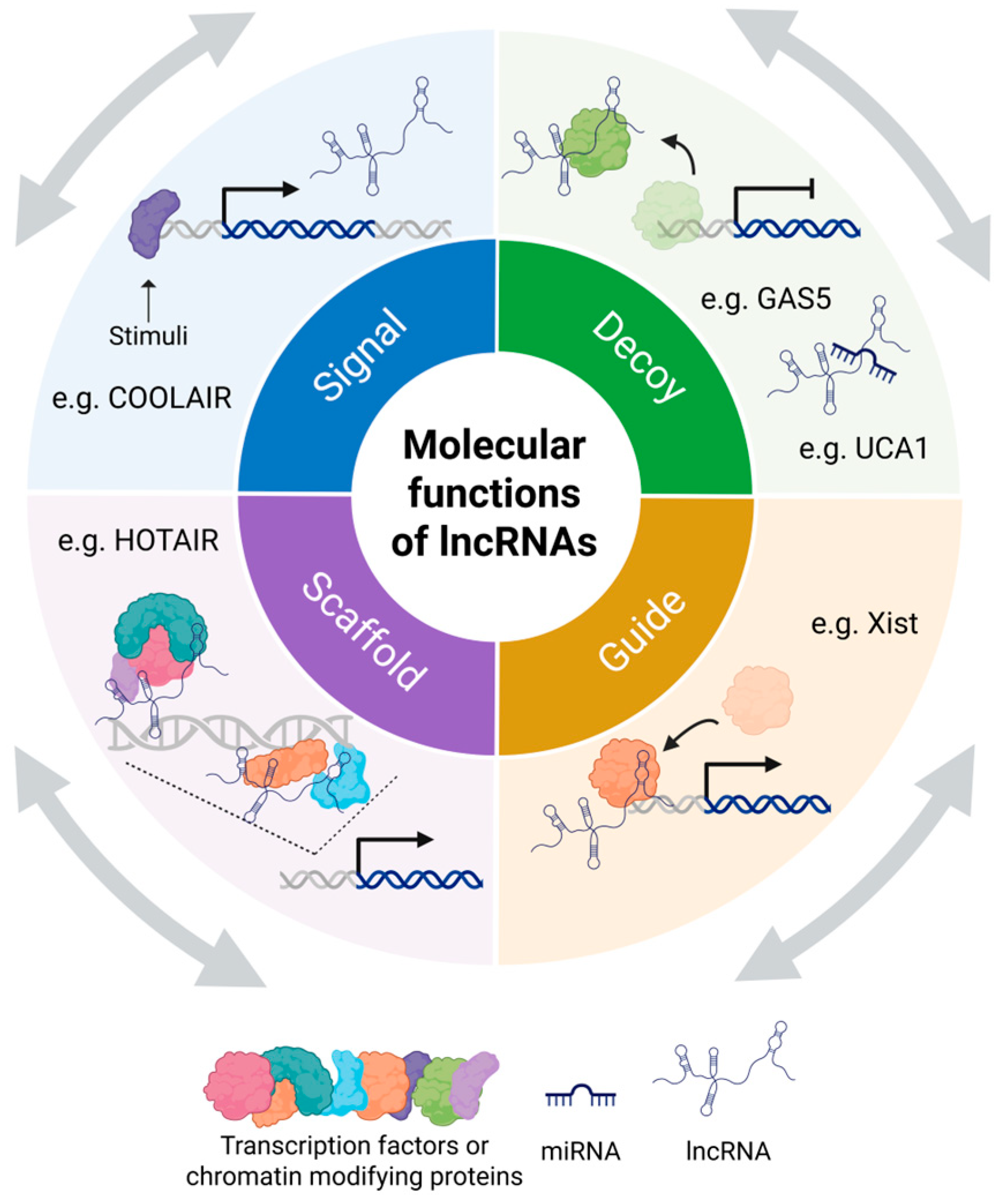
The ability to interact with proteins, DNA, and RNA enables lncRNAs to regulate gene expression [3,4,5]. Four archetypes of molecular functions that lncRNAs perform through interactions with other biomolecules have been proposed: signals, decoys, guides, and scaffolds (Figure 1) [28]. As signals, they act as rapid responders that convey the activity of transcription factors and signaling pathways without requiring protein translation [28]. For instance, COOLAIR is induced by cold and marks temperature-responsive gene expression in plants [29]. As decoys, lncRNAs, such as GAS5, bind and sequester regulatory proteins, including transcription factors, thereby modulating pathways like steroid hormone signaling [28,30]. Other lncRNAs function as molecular sponges for microRNAs (miRNAs). For example, PCAT1 acts as a molecular sponge for miR-145-5p, while UCA1 serves as a molecular sponge for miR-204, miR-143, and miR-331-3p [31,32,33,34]. In their role as guides, lncRNAs direct ribonucleoprotein (RNP) complexes to specific genomic sites [28]. For example, Xist’s RepA region recruits the PRC2 complex to the X chromosome to initiate inactivation [35]. Lastly, lncRNAs like HOTAIR and NEAT1 act as scaffolds by binding different regulatory factors and RNA-binding proteins (RBPs) in coordinating gene repression across the genome and driving the formation of stress-induced nuclear bodies [36,37].
Figure 1. Molecular functions of lncRNAs. Four archetypes of molecular functions that lncRNAs perform include: signals, decoys, guides, and scaffolds [28]. By interacting with various biomolecules, lncRNAs use these archetypes, often in combination, to exert their regulatory roles. Created in BioRender. Oh, M. (2025) https://BioRender.com/y6o1edd (accessed on 12 November 2025).
Importantly, these four archetypes are not mutually exclusive [28]. A single lncRNA may function in multiple roles simultaneously or in different contexts, illustrating a combinatorial modality that enhances the complexity and specificity of its regulatory function [28]. This multifaceted capacity underscores the diverse and dynamic roles that lncRNAs play in regulating gene expression and cellular function.

4. LncRNAs in Human Diseases

The diverse modes of lncRNA action suggest their involvement in many fundamental cellular pathways. Consequently, dysregulated lncRNA expression has been linked to the development of various diseases. This section discusses representative lncRNAs and their roles in disease pathogenesis.

4.1. LncRNAs in Cancer

Due to their vital regulatory functions, lncRNAs play critical roles in cancer biology, including regulating tumor growth, invasion, and drug resistance [19,38,39]. LncRNAs function through diverse molecular mechanisms. One such mechanism is chromatin regulation in cis [6]. For example, in hepatocellular carcinoma (HCC), the lncRNA lncTCF7 recruits the SWI/SNF chromatin remodeling complex to the TCF7 promoter, activating Wnt signaling and promoting liver cancer [40,41]. In contrast, some lncRNAs act in trans to regulate chromatin at distant genomic loci [6]. A well-known example is HOTAIR, which contributes to breast cancer metastasis by directing the PRC2 complex to epigenetically silence genes in the HOXD cluster [6,20,42].
LncRNAs also function at the post-transcriptional level. MALAT1, for instance, regulates alternative splicing by modulating the activity of serine/arginine-rich (SR) splicing factors, influencing gene expression patterns involved in cancer progression [6,43]. Another mechanism involves lncRNAs acting as microRNA sponges [6]. For example, FAM83H-AS1 promotes prostate cancer growth and cell cycle progression by sequestering miR-15a, leading to increased expression of CCNE2 [44]. See Table 1 for additional lncRNAs implicated in tumorigenesis.
Table 1. lncRNA in human diseases.
Through diverse mechanisms, lncRNAs can act as either oncogenes or tumor suppressors, depending on their specific targets and disease context. Their functional versatility and central involvement in cancer signaling make them compelling subjects for ongoing research.

4.2. LncRNAs in Other Diseases

Beyond cancer, lncRNAs act as key regulators in the progression of various diseases. In neurological disorders, SNHG1 modulates neurotoxicity by interacting with microRNAs and has been implicated in the pathogenesis of Parkinson’s disease [50]. Similarly, the expression of NAT-RAD18 exhibits an inverse correlation with that of Rad18, a DNA-repair factor, suggesting a potential role in Alzheimer’s disease [51].
In cardiovascular disease, lncKCND1 binds and upregulates YBX1, promoting cardiac hypertrophy [52], while TUG1 may drive atherosclerosis by sponging miR-145-5p to increase FGF10 expression [53]. In autoimmune disorders, GAS5 regulates inflammatory signaling and cytokine expression and is linked to systemic lupus erythematosus (SLE) [55], whereas promoter SNPs in SAS-ZFAT are associated with autoimmune thyroid disease [56]. In aging, ANRIL recruits the PRC2 complex to repress p15 (INK4B) expression, implicating it in cellular senescence and age-related pathophysiology [58] (Table 1).

4.3. Therapeutic Applications of lncRNAs

Given their roles in diverse biological pathways, several lncRNAs have shown promise as biomarkers for cancer progression. For example, the lncRNA PCA3 has been approved by the FDA for the early detection and management of prostate cancer [59,60,61].
Antisense oligonucleotides (ASOs) remain a widely used approach for disrupting lncRNA function [62]. ASO-based strategies targeting oncogenic lncRNAs such as MALAT1 in breast and lung cancer have been shown to suppress tumor progression [63,64]. More recently, CRISPR/Cas-based genome editing tools have emerged as promising alternatives.
Emerging therapies exploit their tumor-specific expression to improve treatment precision and limit off-target effects [6]. One example is BC-819 (DTA-H19), a plasmid-based therapy that uses the H19 promoter to drive diphtheria toxin expression selectively in tumor cells. This approach has completed a Phase 1/2a clinical trial, showing reduced tumor size across carcinomas [65]. Similarly, Xist has been engineered to silence an extra copy of chromosome 21 in trisomic cells derived from individuals with Down syndrome [66]. These studies underscore the versatility of lncRNA-based therapeutic strategies and support the continued investigation of their clinical applications.

5. Technologies for lncRNA Functional Characterization and Validation

While lncRNAs are garnering significant interest as potential therapeutic targets for various diseases, including cancer, the mechanisms by which they exert their functions remain largely unexplored. To date, only a limited number of lncRNAs have been extensively studied, despite an estimated 20,000 lncRNAs being annotated in the human genome [9]. As one of the promising strategies for studying lncRNAs at the molecular level, this paper focuses on their structure-function relationships.

5.1. Structure-Function Relationships of lncRNA

By revealing the structural and mechanistic basis of biomolecular function, structural biology has greatly advanced therapeutic discovery and design. Three-dimensional protein structures illuminate ligand binding and self-assembly, deepening our understanding of molecular mechanisms. Extending these insights to nucleic acids, studies of RNA and DNA structures have proven to be central to understanding biological processes. For example, the double-helical structure of DNA revealed how genetic information is stored, replicated, and transmitted with high fidelity [67].
The development of advanced RNA structural determination techniques has enabled the determination of RNA structures, including those of riboswitch RNAs and self-splicing introns [68,69,70]. With growing recognition of RNA’s diverse roles in gene regulation and disease, structural characterization of RNA molecules will remain central to both fundamental discovery and the development of RNA-centric therapies.
In general, RNAs form versatile structures through canonical and non-canonical base-pairings as well as non-specific backbone-to-base and backbone-to-backbone interactions [71]. Because of these physical properties and their length, most lncRNAs can fold into complex secondary and tertiary structures. These secondary structural elements are often evolutionarily conserved and functionally relevant [35,72]. For example, the lncRNAs roX1 and roX2 assemble the male-specific lethal (MSL) dosage compensation complex in Drosophila melanogaster, via multiple tandem stem-loop motifs as a binding platform [73]. The lncRNA MEG3 is another example that well-illustrates the functional significance of lncRNAs’ structural motifs. The tumor suppressor MEG3 has conserved, structured domains. Mutations that disrupt the long-range, pseudoknot interaction between its two distal structural motifs destroy MEG3-dependent p53 stimulation, whereas mutations that retain the secondary structure remain functional [74].
Although these examples have often been used to demonstrate that lncRNAs’ functions are more dependent on structural conservation than on sequence conservation, Rivas et al. (2017) reported that their R-scape method did not detect conserved secondary structure in several lncRNAs, indicating possible sequence-based functions in some lncRNAs [75]. These findings highlight the difficulty of drawing definitive conclusions about the relative contributions of structure versus sequence, in part because high-resolution structural data are available for only a limited number of RNAs. As additional genomes are sequenced and comparative datasets expand, conserved features—whether structural or sequence-based—may become more readily detectable across lncRNAs. Nonetheless, accumulating evidence supports the conservation of structural elements in lncRNAs [76,77].

5.2. Hierarchical Nature of lncRNA Structural Complexity

5.2.1. The Primary Structure of lncRNA and Its Functional Significance

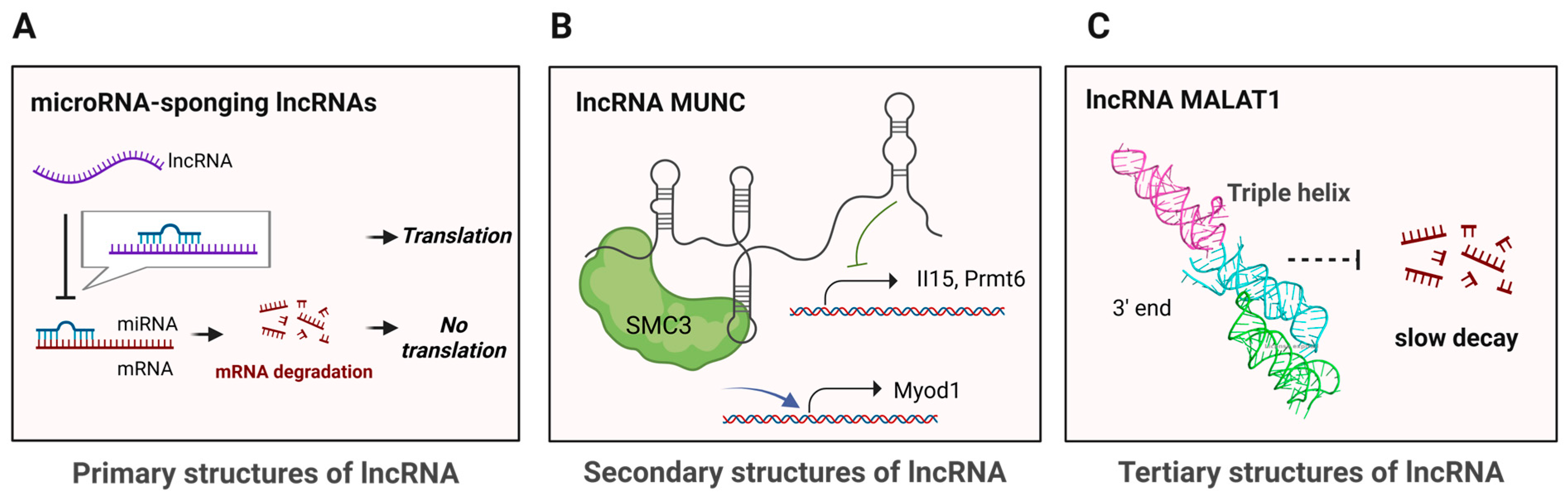
LncRNAs function at structural complexity levels ranging from primary structure to tertiary structure. On one end, there are lncRNAs whose mechanisms are based on their primary structures. The primary structure, defined as the linear nucleotide sequence of lncRNA, can be determined using standard RNA sequencing and can itself have functional significance. For example, lncRNA 1/2-sbsRNA forms Alu element–mediated duplexes with complementary sequences in the 3′ UTR of target mRNAs, creating a double-stranded structure recognized by STAU1, which triggers Staufen-mediated mRNA decay (SMD) [78]. Another way through which lncRNAs exert translational control is by sponging miRNAs that would otherwise sequester and regulate the translation of target mRNAs (Figure 2A) [79,80].
Figure 2. Examples of lncRNAs’ structural complexity levels. (A) At the primary structure level, antisense lncRNA complementarily base pairs with corresponding mRNA to dysregulate gene expression. (B) At the secondary structure level, lncRNA MUNC has modular domains with distinct functions. (C) At the tertiary structure level, lncRNA MALAT1’s triple helix at its 3′ end stabilizes the lncRNA to prevent rapid decay (PBD: 4PLX). Created in BioRender. Oh, M. (2025) https://BioRender.com/j3fkj1g (accessed on 2 December 2025).

5.2.2. The Secondary Structure of lncRNA and Its Functional Significance

Some lncRNAs function by adopting specific secondary structures. Secondary structure refers to local base-pairing interactions within RNA that fold a linear sequence into motifs such as stem-loops, multi-way junctions, and bulges. These structures can be dynamic and provide platforms for interactions with proteins and other nucleic acids, while also contributing to higher-order three-dimensional RNA architecture. Their functional relevance is typically assessed by combining structural characterization with cellular or biochemical assays. For example, the independent secondary-structure modules of HOTAIR are crucial for binding to multiple chromatin-modifying proteins, including PRC2 [81]. Additionally, the A-repeat region of Xist forms multiple helices, providing a structural scaffold for the binding of functional proteins such as SPEN [82]. More recently, the secondary structure of the lncRNA MUNC was determined (Figure 2B), revealing multiple structurally defined domains that function independently to regulate distinct gene programs during myogenesis, likely through interactions with different protein partners [83]. Additionally, lncRNA SChLAP1 was shown to harbor functionally important terminal structural modules that promote cancer cell proliferation and invasion [84,85].

5.2.3. The Tertiary Structure of lncRNA and Its Functional Significance

In contrast, some lncRNAs depend on complex tertiary structures for function. These higher-order three-dimensional architectures involve long-range interactions between distant RNA regions. The crystal structure of the 3′ end of MALAT1, for example, revealed a triple-helix motif that stabilizes the transcript by protecting it from rapid decay (Figure 2C) [86]. Recently, the low-resolution tertiary structure of full-length Braveheart was revealed utilizing SAXS, showing that it is made up of three structured domains that cooperatively interact with CNBP [87]. In addition, HOTAIR and Xist have emerged as prominent models for investigating lncRNA tertiary structure [88,89].
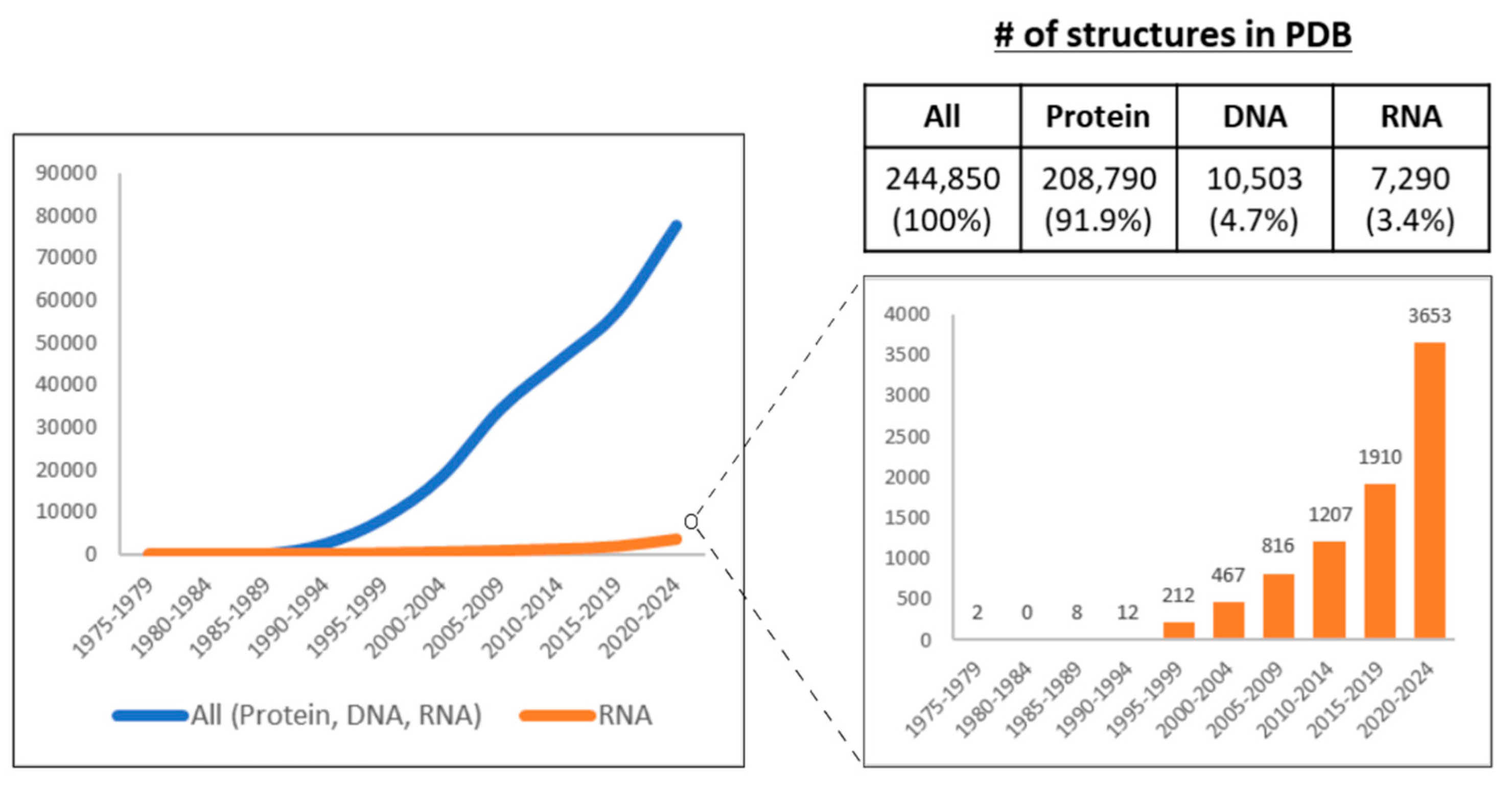
As discussed above, structural features contribute to lncRNA function. However, only a small fraction of the ~20,000 annotated human lncRNAs have been examined using structural approaches. With recent advances in RNA structure determination methods, an increasing number of lncRNAs are now being structurally characterized (Figure 3). The following section discusses these methodological approaches.
Figure 3. The number (#) of experimentally determined structures of biomolecules in the Protein Data Bank (PDB) from 1975 to 2024. The PDB has been archiving structural data since 1975. The graph presents the data aggregated in four-year intervals. PDB database search was performed for polymer entity types, including protein, DNA, and RNA. All structures were included regardless of refinement resolution. Data from early 2025 are not included in the figure; however, between January 2025 and June 2025, an additional 9561 entries were deposited, comprising 8505, 529, and 527 newly determined protein, DNA, and RNA structures, respectively. Contrary to the exponential expansion of protein structures, structural studies of RNA have lagged (left). However, thanks to the recent advances of diverse experimental methods for the structural determination of RNA, the number of RNAs whose structures have been studied has increased, including lncRNAs (right). Created in BioRender. Oh, M. (2025) https://BioRender.com/0i4qtl0 (accessed on 11 November 2025).

5.3. Experimental Methods to Determine Secondary Structures of lncRNA

To determine lncRNA secondary structure, several experimental approaches are commonly used. Chemical probing methods modify flexible nucleotides, while enzymatic methods cleave structured or unstructured regions. These modifications are typically detected by reverse transcription followed by high-throughput sequencing. When applying these methods, key factors include probe selection, reverse transcriptase selection, and sequencing strategy to accurately capture nucleotide reactivities.

5.3.1. Probes

Secondary structure studies of lncRNA are an active area of research, primarily focusing on inferring single- and double-stranded regions of RNA. Since each probe reacts differently with RNA, mixing and matching various probes can yield a more accurate secondary structural map. There are two main types of probes: enzymatic and chemical.
Enzymatic probes. Enzymatic probes include RNases with different reactivities toward RNA. RNase V1 digests double-stranded RNA regions, whereas RNase S1 and RNase P1 specifically cleave single-stranded regions. Combined with high-throughput sequencing for the digested fragments, these enzymatic footprinting techniques can map single- and double-stranded regions of RNA [90]. The secondary structures of lncRNAs roX1 and roX2 were determined utilizing enzymatic probing [73]. Unfortunately, enzymatic probing is highly sensitive to steric hindrance. Additionally, since RNases cannot penetrate cellular membranes, they are applicable to in vitro structural studies, and not in cellulo [91].
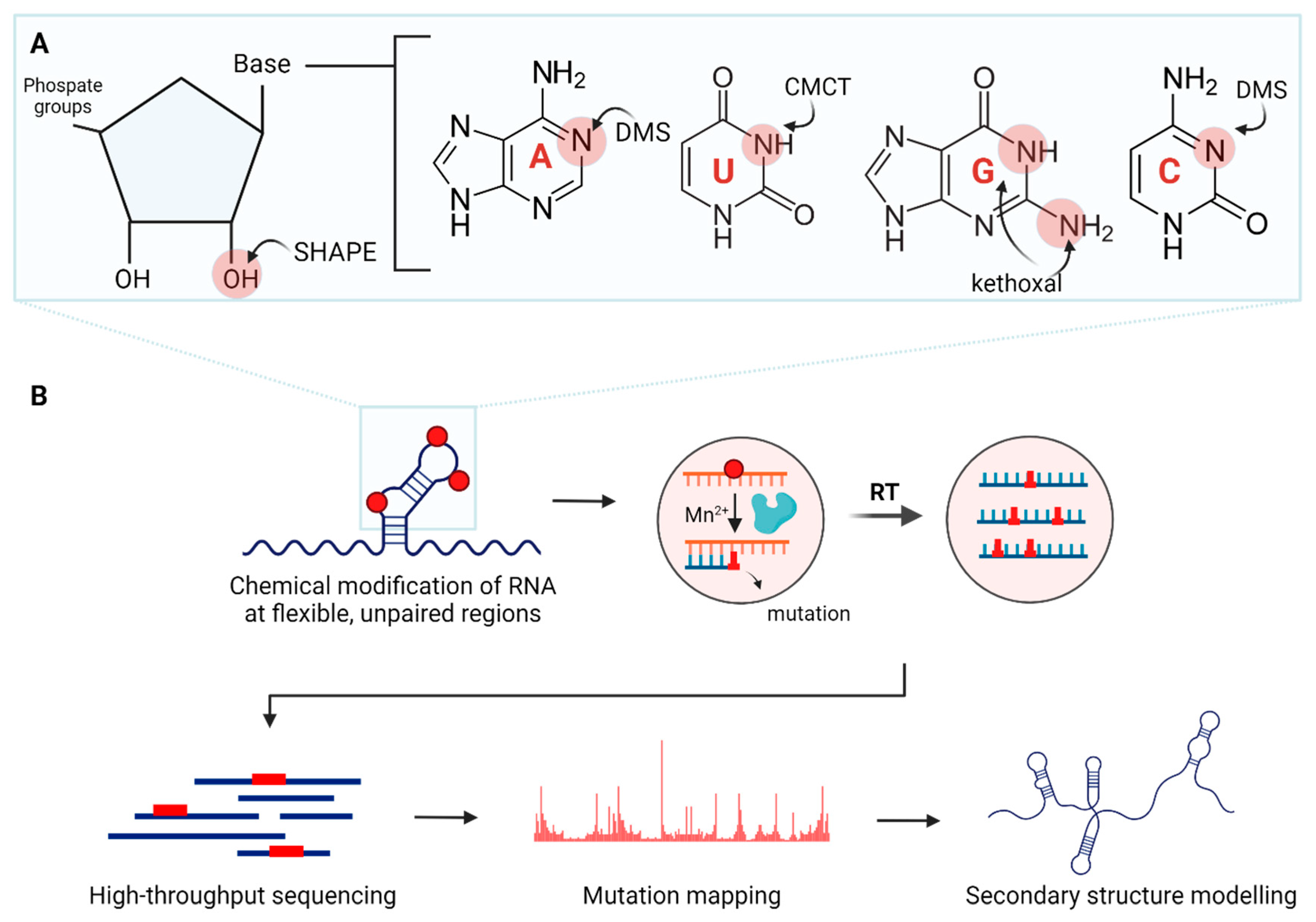
Chemical probes. Chemical probes involve RNA-modifying chemicals (Table 2). There are probes with base-specificity (Figure 4A). For instance, dimethyl sulfate (DMS) methylates mainly unpaired A and C, while 1-cyclohexyl-3-(2-morpholinoethyl) carbodiimide metho-p-toluene sulfonate (CMCT) acylates unpaired U and G [92,93]. There are other probes, such as 2-keto-3-ethoxy-butyraldehyde (kethoxal) and diethylpyrocarbonate (DEPC), which modify single-stranded G and A, respectively [94,95].
Table 2. Chemical probes for determining the secondary structure of lncRNA.
Figure 4. Overview of chemical probing combined with mutational profiling for RNA secondary structural studies. (A) Examples of chemical probes with their target areas of modification. (B) Chemical probes modify RNA at flexible, unpaired regions. The modifications cause mutations incorporated in newly synthesized cDNA strands during reverse transcription (RT). After high-throughput sequencing, the resulting reads are mapped to the reference RNA sequence to calculate mutation rates. Finally, secondary structural models are determined based on the mutational profiles. Created in BioRender. Oh, M. (2025) https://BioRender.com/lkcu4j9 (accessed on 11 November 2025).
Secondary structure probing with traditional probes can be less efficient due to bias in base specificities and the need for multiple enzymatic reactions. Recently, chemical probes without base-specificity have become widely used, streamlining the structure determination processes. They react with the sugar-phosphate backbone (Figure 4A) [100]. Typical examples are SHAPE (selective 2′-hydroxyl acylation and primer extension) reagents such as N-methylisatoic anhydride (NMIA) and 1-methyl-7-nitroisatoic anhydride (1M7), each with distinct half-lives that allow for RNA structural studies over different time scales [99,100,116]. This is beneficial when RNAs have multiple transition states with functional significance. This is particularly important in cellular environments where RNAs gradually form structures co-transcriptionally and interact with binding partners. Most SHAPE probes, including 2-methylnicotinic acid imidazolide (NAI), are suitable for RNA structural probing in vitro and in cellulo [103]. An increasing number of SHAPE reagents are being developed, such as 5-nitroisatoic anhydride (5NIA), 2-methyl-3-furoic acid imidazolide (FAI), and 2-aminopyridine-3-carboxylic acid imidazolide (2A3) [103,105,107]. Newer SHAPE reagents provide improved signal-to-noise ratios, cellular permeability and performance in cellular environments, expanding the toolkit for RNA structure determination.
Chemical probing in cellular environments. In cellulo chemical probing is increasingly important for functional structure determination, particularly for identifying stable motifs and interaction sites on lncRNA molecules. RNA folding under physiological conditions is influenced by RNA chaperones as well as interacting partners, such as proteins, DNA, and other RNA species [4,117,118]. As such, a lack of reactivity in cellulo does not necessarily indicate a double-stranded region. Non-reactive sites may also result from protection by proteins or other nucleic acids, or from intra- or intermolecular interactions that block probe access [119,120,121].
To identify direct binding sites on lncRNAs in cellulo, a novel technique called RNP-MaP (ribonucleoprotein networks analyzed by mutational profiling) has recently been developed [122]. In this process, cells are treated with NHS-diazirine (SDA), whose succinimidyl esters react with the lysine side chains of interacting proteins. The SDA-treated and non-treated cells are then exposed to UV light. UV-activated diazirine reacts with RNA nucleotides, labeling protein binding sites on lncRNAs. Subsequently, the cells are lysed, and crosslinked proteins are digested by proteinase K treatment. The remaining small peptides after digestion act as bulky adducts, introducing mutations during reverse transcription. After sequencing, the reads are mapped to the full-length lncRNA sequence, allowing for the localization of direct protein-binding sites on the lncRNA within cells [122].

5.3.2. Reverse Transcriptase

Selecting an optimal reverse transcriptase is crucial for structure probing, as the current readout heavily relies on high-throughput sequencing, where cDNA synthesis is key. An efficient reverse transcriptase should synthesize cDNA smoothly, without natural pausing, and accurately drop off or incorporate mutations at modification sites. For this purpose, the SuperScript reverse transcriptase family (Invitrogen) has been widely used. These enzymes demonstrate lower fidelity of reverse transcription (RT) reaction in the presence of Mn2+, introducing random nucleotides at the chemically modified sites [123].
Reverse transcription (RT) of long RNA. Recently, highly processive reverse transcriptases have been developed. These include thermostable group II intron reverse transcriptase, TGIRT, and group II intron maturase of Eubacterium rectale, MarathonRT (MRT) [124,125,126]. In contrast to conventional reverse transcriptases such as SuperScript II, which often fail to produce long amplicons, these novel enzymes can generate long cDNA products in a single pass, enabling detection of all modifications across the RNA strand (>1 kb) in a single analysis [126]. These novel reverse transcriptases enable accurate secondary structure prediction of long RNAs.
Post-transcriptional RNA modification detection. Reverse transcriptase has been further adapted for multiple purposes beyond synthesizing cDNA from long RNAs. For instance, MRT, when combined with mutational profiling, has been utilized to detect chemical modifications in RNA [127,128].
Thus far, a wide range of post-transcriptional modifications has been characterized, including pseudouridine (Ψ), N6-methyladenosine (m6A), and 5-methylcytosine (m5C). These RNA modifications play crucial roles in cellular functions by regulating gene expression, and they can significantly alter RNA structures, ultimately affecting RNA-protein interactions [129]. For example, HNRNPC binds and stabilizes mRNA to promote mRNA processing [130,131,132,133]. The U-tract sequences on its target mRNA, where HNRNPC binds, are buried in a stem-loop structure, thereby inhibiting the binding of HNRNPC to this region [134]. However, when adenosines in the stem-loop are methylated (m6A), the tight stem-loop structure destabilizes, exposing the U-tract region [134]. Therefore, HNRNPC could readily bind to the U-tract region [134]. Taken together, linking RNA modifications and structures will allow for a deeper understanding of RNA’s functional mechanisms and significance.
Recently, MRT-ModSeq, which combines next-generation sequencing and machine learning, has been developed to detect multiple types of RNA modifications [128]. Overall, the choice of reverse transcriptase is critical not only for resolving RNA secondary structure but also for enabling the detection of RNA modifications. Here, we highlighted this technical aspect in the context of structural probing, whereas the biological implications of RNA modifications are examined separately in Section 8.2.

5.3.3. Reactivity Readout

Traditionally, gel- and capillary-electrophoresis–based methods were used to detect enzymatic or chemical modifications in RNA, yielding nucleotide reactivity profiles. More recently, these approaches have been replaced mainly by high-throughput next-generation sequencing (NGS). By enabling parallel analysis of multiple RNA species in a single experiment, NGS-based methods support transcriptome-scale determination of RNA secondary structure. At present, the combination of chemical probing with high-throughput sequencing is widely used to infer RNA secondary structure. The general principle underlying these approaches is the detection of reverse transcriptase (RT) stops or mutation events, which are mapped back to a reference RNA sequence to generate reactivity profiles.
Reverse-transcriptase termination: In these methods, reverse transcriptase prematurely terminates cDNA synthesis upon encountering chemically modified nucleotides, generating truncated cDNA fragments that are subsequently deep sequenced (reviewed in [135]). Interpretation requires distinguishing true modification-induced termination events from natural RNA ends, a challenge that becomes more pronounced for long RNAs due to RNA degradation and incomplete reverse transcription [135].
Reverse-transcriptase mutation: Mutational profiling (MaP-Seq) was developed to address several limitations of RT termination strategies (Figure 4B). Under defined reaction conditions—such as substituting Mn2+ for Mg2+—reverse transcriptase fidelity is reduced, causing chemically modified nucleotides to be misread and encoded as mutations in the resulting cDNA [123]. Mapping these mutations to the reference RNA generates reactivity profiles, in which elevated mutation frequencies correspond to flexible or unpaired regions, while reduced mutation frequencies indicate base-paired or structurally constrained regions [102,136].
While MaP-Seq has gained broad adoption, RT termination–based methods remain valuable. Each approach exhibits distinct biases, and together they can provide complementary insights into RNA secondary structure [137].

5.3.4. Limitations and Breakthroughs

Since the tools for determining RNA secondary structure, as discussed above, primarily focus on identifying whether nucleotides are single-stranded or double-stranded, subsequent structure modeling based on nucleotide reactivities is required [102,136]. The reactivities represent an averaged profile of potential alternative structures, if present. Moreover, the structures of lncRNA are complicated due to repetitive sequences, long-range intramolecular interactions, and intermolecular interactions with binding partners. This complexity often results in the generation of multiple structural models, making structural analysis more challenging [138]. Taken together, structural studies of lncRNAs must address the difficulties arising from their large size and structural heterogeneity.
Large-sized lncRNA. To address the large size of lncRNA, the 3S (Shotgun Secondary Structure) approach can be utilized, where a full-length lncRNA is fragmented into shorter segments [139]. The fragments will be probed, and then, their reactivities will be matched with the reactivity of a full-length lncRNA [139]. High correlation indicates the presence of independently folding domains that fold locally, whereas low correlation indicates long-distance interactions [139].
While 3S applies conventional chemical probing to fragmented RNAs, long-range probing methods are actively being developed to directly detect base-pairings and multiple conformations. By incorporating crosslinking steps into the protocol, PARIS (psoralen analysis of RNA interactions and structures) can identify direct base-pairing interactions and alternative structures [82]. Other methods using psoralen and its derivatives include SPLASH (sequencing of psoralen cross-linked, ligated, and selected hybrids) and COMRADES (cross-linking of matched RNAs and deep sequencing [140,141]). They have unique strategies to increase the efficiency of psoralen crosslinking. Finally, another method, RING-MaP (RNA interaction groups by mutational profiling), analyzes correlated positions of chemical modifications to identify base pairs [142].
Notably, researchers are revisiting terbium (III) (Tb3+) as a chemical probe to detect local tertiary structures of large RNAs. When RNA folds into compact tertiary structures, negatively charged phosphate groups are positioned closely together, creating localized regions of high negative charge [112,113]. These sites recruit multivalent cations such as Mg2+, which reduce electrostatic repulsion and stabilize the fold [112,113]. Lanthanide ions, including Tb3+, also bind to these negatively charged regions, but in contrast to Mg2+, Tb3+ promotes RNA cleavage [114]. The resulting cleavage pattern marks local tertiary structures near the bound sites [114]. Combined with deep sequencing, Tb-seq maps these tertiary motifs and enables targeted functional or high-resolution structural analyses [115].
Structural heterogeneity. Cellular RNA exhibits structural heterogeneity due to alternative processing and inherent structural dynamics. This is well-illustrated by eight distinct structural models proposed for the Xist A-repeat, each derived using different techniques [35,82,89,143,144,145,146,147,148,149,150]. lncRNA can exist as dynamic conformations in a physiological condition, changing the abundance of specific conformations according to environmental stimuli [151]. Such conformational changes can regulate cellular function. For example, riboswitches alter their structure in response to small molecules, thereby controlling gene expression. For a comprehensive review on RNA structural dynamics, see Spitale and Incarnato (2023) [152].
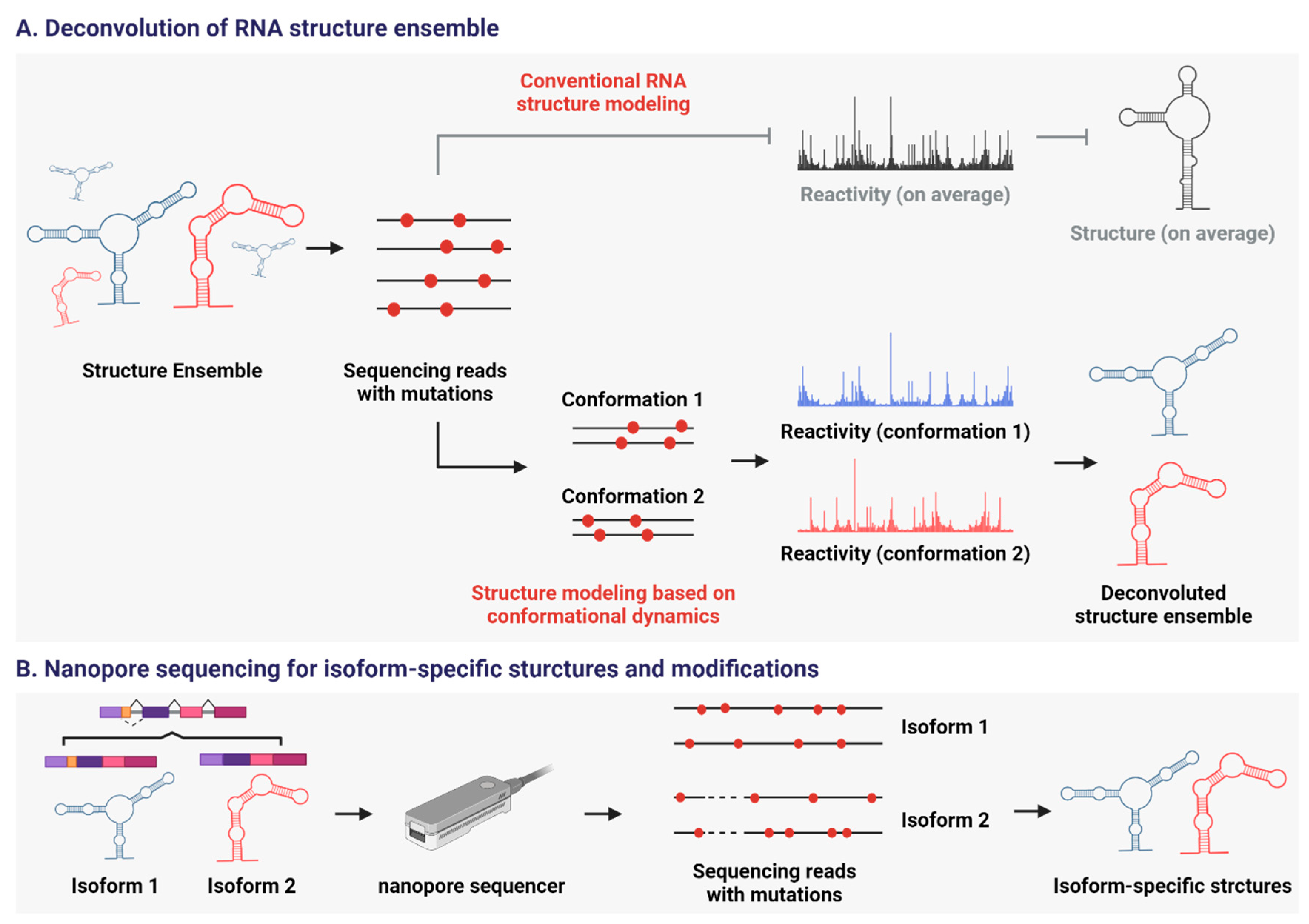
To address the structural heterogeneity of lncRNAs, several algorithms for single-molecule RNA structural analysis have been developed (Figure 5A). They focus on a single RNA molecule to model its structures, whereas current structure probing methods create a structural model based on the population average of RNA. For example, the DaVinci algorithm showed that lncRNA COOLAIR exists in diverse conformations in vivo, with these variations influencing gene expression in response to environmental stimuli [153]. Similarly, the DREEM algorithm demonstrated the structural heterogeneity of HIV RNA in vivo and its functional significance [154].
Figure 5. Strategies to deal with the structural heterogeneity of RNA. (A) MaP combined with novel algorithms to deconvolute RNA structure ensemble. Their focus is a single RNA molecule, not a population average, to model its structure. (B) MaP combined with long-read sequencing. Nano-DMS-MaP can be applied to determine isoform-specific structures and post-transcriptional modifications of RNA. Created in BioRender. Oh, M. (2025) https://BioRender.com/choeb5z (11 November 2025).
To address the challenges posed by the large size and heterogeneity of lncRNAs, long-read sequencing technologies have recently gained significant attention. While second-generation platforms such as Illumina are widely used, their short reads limit the analysis of full-length and repetitive lncRNAs [155,156]. Third-generation approaches, including nanopore sequencing (Oxford Nanopore Technologies), overcome these limitations by reading individual RNA molecules in full length. As each nucleotide passes through a nanoscale pore, characteristic changes in ionic current allow base identification [157,158,159,160,161]. This enables the sequencing of RNA molecules up to megabase lengths [162,163].
Using this new technology, Nanopore DMS-MaP (Nano-DMS-MaP) was developed to determine isoform-specific RNA structures [164] (Figure 5B). Following DMS probing, long cDNAs are synthesized using an ultra-processive reverse transcriptase, and nanopore sequencing is then applied to analyze full-length transcripts—something not achievable with short-read methods. Using Nano-DMS-MaP, researchers examined human immunodeficiency virus (HIV)-1 transcripts and discovered that spliced isoforms contain unfolded regions within the 5′ untranslated region (UTR) that are absent in unspliced transcripts. These structural differences occur near the packaging site, suggesting a mechanism by which spliced viral RNAs are excluded from virions [164].
Moreover, Nanopore sequencing can detect a broader range of RNA modifications than current methods, which are largely limited to only a few of the most common modifications, such as m6A and 5mC [165]. Additionally, Nanopore sequencing enables direct sequencing of native RNA strands without the need for RT or PCR amplification, making it a promising tool for studying lncRNA, which often has low expression levels [165].
Overall, the inherent flexibility of lncRNA poses a significant challenge to their structural determination, necessitating an integrative approach that combines various experimental methods that address the dynamic, polydisperse conformations lncRNA may adopt.

5.4. Towards Tertiary Structures of lncRNA

While tertiary lncRNA structures remain underexplored, recent advances in secondary structure studies and the development of a wide range of techniques have accelerated efforts in this area [166]. Low-resolution tertiary structure studies benefit from small-angle X-ray scattering (SAXS) and atomic force microscopy (AFM), whilst cryo-electron microscopy (Cryo-EM) and nuclear magnetic resonance (NMR) provide useful tools for high-resolution tertiary structures at an atomic level.
Cryo-EM. In cryo-EM, biomolecules are rapidly frozen and subjected to transmission electron microscopy. Hundreds of thousands of two-dimensional images taken from different orientations are used to reconstruct the biomolecule’s tertiary structure. The high-resolution structure of the ribosome was determined utilizing cryo-EM, and more recently, this technique was applied to study the tertiary structure of PRC2 and the G-quadruplex RNA complex [167].
The PRC2 complex is a chromatin modifier that methylates histone H3 lysine 27 through its enzymatic subunit EZH2 [168]. The 3.3 Å resolution cryo-EM structure of the PRC2-RNA complex revealed the mechanism of RNA-mediated PRC2 inhibition [167]. The G-quadruplex RNA binds and dimerizes PRC2, forming an interface between two EZH2 subunits and blocking nucleosome binding [167]. This illustrates how small RNA domains can mediate interactions with protein partners.
Other chromatin modifiers and transcription factors also interact with RNA, often without canonical RNA-binding motifs [167,169,170]. This highlights the need for structural studies to investigate the detailed regulatory roles of RNA. In this context, cryo-EM has emerged as a leading tool for investigating RNA and RNP complexes due to the recent advances in electron microscopy and computational modeling. Cryo-EM has been applied to large RNP complexes, such as ribosomes, as well as protein-free RNAs, including small riboswitches and portions of SARS-CoV-2 RNA. It also enables analysis of RNAs with dynamic conformations.
X-ray crystallography. In X-ray crystallography, crystallized RNA scatters X-ray radiation, creating a unique scattering pattern, or ‘electron density’, which is used to determine the RNA’s tertiary structure. This method determined the tertiary structure of the 3′-end of MALAT1, revealing how its stable triple-helix structure protects it from rapid degradation [86]. However, this technique is not ideal for determining unstructured and flexible biomolecules, as large RNAs often have flexible regions and multiple conformations [171]. Additionally, RNA is intrinsically more difficult to crystallize than proteins [172]. As a result, engineering the RNA of interest is beneficial for obtaining well-diffracted RNA crystals, as shown by deleting flexible regions that are not functionally important [70]. Crystallization can also benefit from screening and choosing the RNA target, which may fold at lower Mg2+ concentrations and adopt a stable conformation more readily, facilitating crystal growth. For example, the tertiary structure of the self-splicing group II intron from Oceanobacillus iheyensis was successfully determined by X-ray crystallography [70]. The crystal structure of this ribozyme revealed that its domains and subdomains exhibit extensive tertiary interactions, forming a core with a catalytic triple helix [70]. Ultimately, this cooperatively constructed triplex generates a negatively charged binding pocket for two catalytically important magnesium ions [70].
Recently, cryo-EM structures of group II intron captured at different splicing stages provided a detailed understanding of its catalysis mechanism [173]. This suggests that combining X-ray crystallography with alternative techniques, such as SAXS and cryo-EM, is gaining popularity because they do not require RNAs to be crystallized.
SAXS. Unlike X-ray crystallography, SAXS measures scattering from non-crystallized, randomly oriented molecules in solution. This technique constructs tertiary structures by averaging the sizes and shapes of the molecule, providing an overall structural architecture of lncRNA. For instance, the low-resolution, tertiary structure of the lncRNA Braveheart was determined by SAXS [87]. This, in turn, can serve as a foundation for higher-resolution structure determination using techniques like cryo-EM.
Furthermore, SAXS is ideal for studying lncRNA structures with multiple conformations in solution. Plumridge et al. (2018) utilized SAXS to study RNA structural ensembles during magnesium ion-induced RNA folding of a three-helix junction, where novel folding intermediates were identified [174]. In addition, they coupled SAXS with MD simulation, which benefits structural studies of lncRNA with dynamic conformations. More recently, significant advancements have been made in integrating SAXS experimental data with MD simulations [175].
Atomic force microscopy (AFM). In AFM, a minute tip is brought close to a sample’s surface. The tip, connected to a cantilever, detects Van der Waals forces between the tip and the atoms on the surface of the sample, thereby generating structural data. AFM allows structural analysis of native RNAs in physiological conditions and is a well-suited tool to study flexible structures of lncRNA. For example, in vitro transcribed HOTAIR RNA was examined by AFM, revealing nine structural segments that form well-defined local structures within a flexible global architecture [88]. Dynamic movements of HOTAIR were observed during interactions with genomic DNA, and its flexible nature was further supported by cryo-EM 2D images [88]. AFM can thus complement techniques such as cryo-EM, although it is less commonly used due to its lower resolution.
Nuclear Magnetic Resonance Spectroscopy (NMR). In NMR, nuclei absorb electromagnetic radiation and transit to different energy levels in a strong magnetic field. Each nucleus has a unique resonance frequency in different chemical environments, allowing NMR to obtain the molecule’s structural information. Recently, NMR was used to investigate individual exons of HOTAIR, elucidating its intrinsic flexibility [176]. This finding aligns well with previous secondary structure probing data, demonstrating NMR’s utility in lncRNA with multiple conformations and transition rates. Although NMR can apply only to small RNA motifs, and it has limitations on buffer conditions, it can become a useful tool when combined with other biophysical techniques. For instance, structural studies with NMR and X-ray crystallography revealed how m6A modifications of the XIST A-repeat are recognized by the YTHDC1 protein and ultimately lead to conformational changes that alter the accessibility of additional RNA-binding proteins [177]. The A-repeat has conserved AUCG tetraloops with m6A modifications [178]. X-ray crystallography indicated that YTHDC1 binds the (m6A)UCG-tetraloop in a manner consistent with single-stranded recognition, while the lower stem-loop remains base-paired [177]. NMR confirmed that YTHDC1 binding locally destabilizes the upper stem, partially loosening the hairpin without full disruption. This partial destabilization further facilitates YTHDC1 binding and modulates the accessibility of additional RNA-binding proteins [177].

6. LncRNA Structures as Therapeutic Targets

Small-Molecule Targeting of RNA Structures. LncRNAs with well-defined biological functions can serve as therapeutic targets. Therapeutic strategies include directly targeting structured RNA regions or disrupting lncRNA-protein interactions.
MALAT1 provides a well-characterized example of an lncRNA that can be directly targeted by small molecules. Small-molecule ligands have been shown to bind a structured region at the 3′ end of MALAT1 that regulates RNA stability [179]. MALAT1 is particularly well suited for such approaches due to its stable and unique 3′ structural motif. Accordingly, techniques such as SHAPE-MaP are essential for defining structured and targetable RNA motifs.
A major limitation of structure-based RNA targeting is the scarcity of high-resolution three-dimensional structures for lncRNAs. RNA structural dynamics present an additional challenge, as many RNAs adopt multiple conformations rather than a single stable state [171]. Identifying the functional conformation and its associated protein partners, therefore, remains difficult. For example, the A-repeat region of Xist exhibits substantial structural heterogeneity. In such cases, small-molecule strategies often focus on disrupting lncRNA interaction networks rather than targeting a single defined structure. Consistent with this approach, small molecules that bind Xist reduce the conformational freedom and suppress breast cancer growth and metastasis by interfering with PRC2 interactions [180]. To better address RNA conformational heterogeneity, hybrid strategies combining experimental methods with molecular dynamics (MD) simulations are being developed to characterize RNA structural ensembles.
In parallel with structural studies, RNA-focused small-molecule libraries are being generated. These libraries incorporate physicochemical features associated with RNA binding and enable high-throughput screening of lead compounds [181]. Such approaches increasingly integrate rational design strategies, further accelerated by advances in artificial intelligence (AI). Expanding RNA structural datasets now allow machine-learning (ML) models to analyze large chemical libraries, identify RNA-binding chemotypes, and optimize lead compounds. For example, the Hargrove laboratory employs ML-based QSAR models trained on in vitro datasets to evaluate physicochemical and structural features associated with RNA affinity [182].

7. RNA Structure and Its Protein Interactome

LncRNA function depends heavily on RNA-protein interactions [118,183,184]. These interactions occur through several modes: recruitment of proteins to genomic regions (guide), assembly of ribonucleoprotein (RNP) complexes (scaffold), or sequestration of proteins (decoy) [183].
Adaptor proteins represent a subclass of RNA-binding proteins RBPs that link lncRNAs to large protein complexes and broaden the range of possible interactions [185]. Both RBPs and lncRNAs show functional diversity and often exhibit broad interaction profiles rather than strict specificity [186]. Classic examples include the PRC2 chromatin-modifying complex, whose binding to specific lncRNAs is debated [187,188]. More recent evidence has emerged for adaptor proteins that mediate specific interactions between lncRNAs and chromatin remodeling complexes [41]. Mapping the full set of lncRNA-protein interactions and identifying functionally essential pairs is therefore a key objective.

7.1. lncRNA-Protein Interaction in Gene Regulation

Many lncRNAs are associated with chromatin-modifying complexes such as SWI/SNF, which regulate both gene activation and repression by altering nucleosome positioning [18,189,190]. lncTCF7 recruits the SWI/SNF complex to activate TCF7 transcription, thereby stimulating WNT signaling and cancer progression [40,41]. In contrast, UCA1 binds SWI/SNF and inhibits its chromatin association at the p21 promoter, promoting cancer cell proliferation [191].
These examples, among many others, highlight the need to determine how lncRNAs modulate chromatin remodeling. Identifying direct binding partners and defining the corresponding binding sites are essential for understanding lncRNA-mediated gene regulation.

7.2. Methods to Analyze lncRNA-Protein Interactions

Methods to study lncRNA-protein interactions include protein-centric and RNA-centric approaches. Protein-centric methods, such as RNA immunoprecipitation (RIP) and cross-linking and immunoprecipitation (CLIP), identify lncRNAs bound to specific proteins [192,193]. RNA-centric methods use the lncRNA as bait to isolate interacting proteins. Here, we focus on RNA-centric approaches to systematically uncover proteins that associate with a specific lncRNA. While protein-centric methods are widely used to discover RNAs bound to a given protein, RNA-centric strategies are necessary to determine which proteins interact with a particular lncRNA, providing direct insight into its functional roles. For a comprehensive overview of RNA-protein interaction methods, including protein-centric approaches, see Ramanathan et al. (2019) [192].
Among in vitro RNA-centric approaches, biotinylated RNA pulldown is widely used. Biotin-tagged in vitro transcribed RNA is incubated with cell lysate, and associated proteins are captured by streptavidin beads and identified by mass spectrometry. This method is rapid and compatible with mutagenesis studies but does not reflect native RNA modifications or cellular structural context [192].
In vivo methods such as RNA antisense purification coupled with mass spectrometry (RAP-MS) and comprehensive identification of RBPs by mass spectrometry (ChIRP-MS) address these limitations [194,195]. RAP-MS uses long biotin-labeled DNA probes (~120 nt) and UV crosslinking, increasing specificity and detecting primarily direct interactions [192,194]. ChIRP-MS uses short probes (~20 nt) and formaldehyde crosslinking, capturing both direct and indirect interactions [192,195]. Both methods require large cell numbers due to low recovery after crosslinking and hybridization (Table 3) [192].
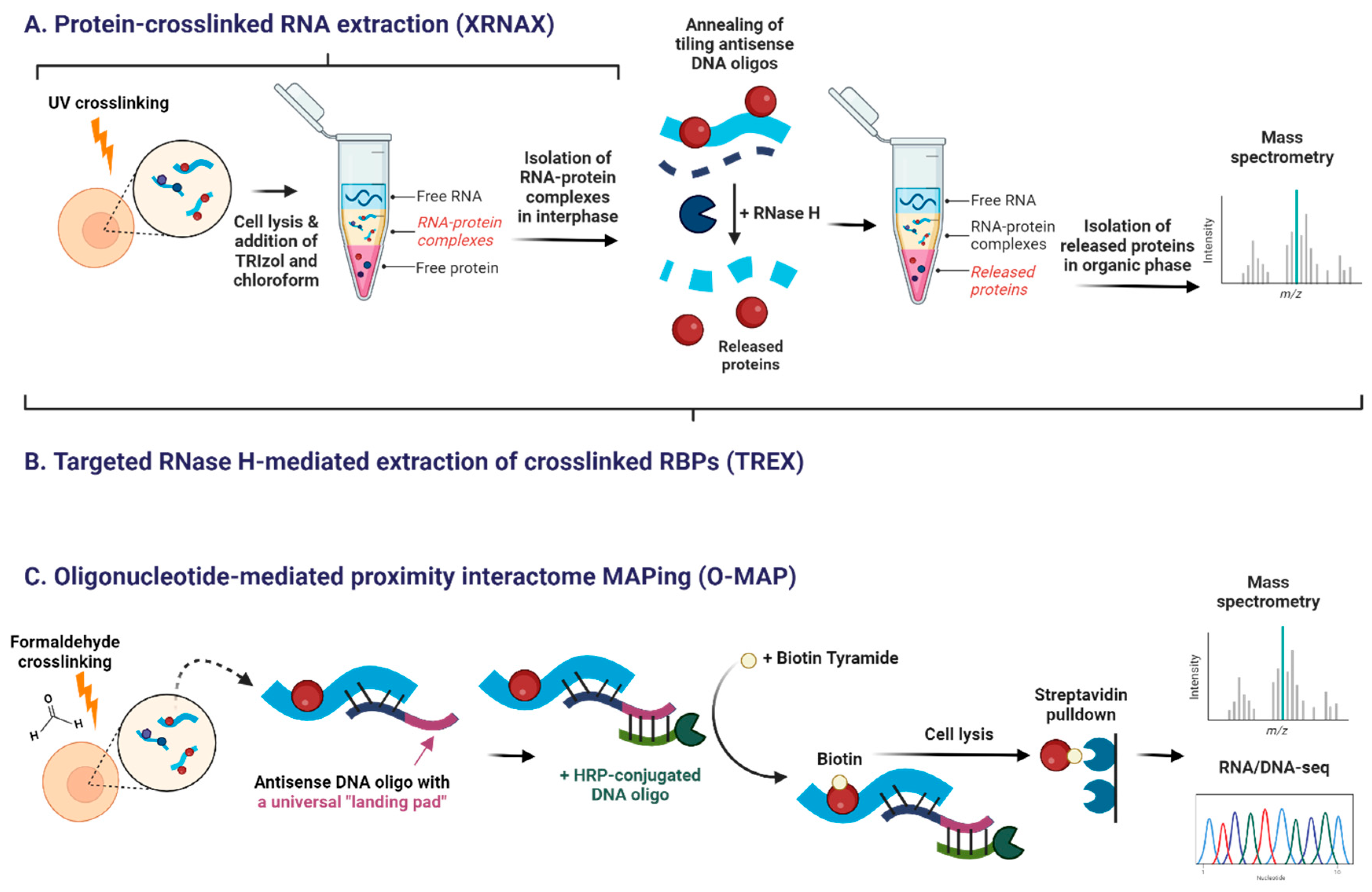
Newer techniques aim to overcome these limitations. Protein-crosslinked RNA extraction (XRNAX) isolates UV-crosslinked RNA-protein complexes from the interphase of acidic guanidinium thiocyanate–phenol extraction (TRIzol) (Table 3 and Figure 6A) [196,197]. XRNAX allows global discovery of RNA-binding proteins, and, when combined with immunoprecipitation, can detect specific interactions [197].
Figure 6. Novel experimental approaches to study RNA interactome. (A) Protein-crosslinked RNA extraction (XRNAX) recovers UV-crosslinked RNA-protein complexes in interphase during TRIzol-based RNA extraction. (B) Targeted RNase H-mediated extraction of crosslinked RBPs (TREX) isolates crosslinked RNA-protein complexes in a similar way to XRNAX. The RNA of interest is then annealed with tiling antisense DNA oligonucleotides. RNase H specifically digests hybridized RNA, thereby releasing free RNA-binding proteins (RBPs). In the second round of TRIzol-based extraction, the released RBPs are recovered in the organic phase. (C) Oligonucleotide-mediated proximity-interactome MAPping (O-MAP) first formaldehyde-crosslinks RAN-protein complexes, followed by annealing of antisense DNA oligos with a universal “landing pad.” The landing pad allows for the annealing of the complementary HRP-conjugated secondary oligos. In the end, the HRP-conjugated oligos biotinylate biomolecules in proximity. After cell lysis, the labeled interactors are recovered by streptavidin pulldown. In all techniques, recovered interactors can be subsequently analyzed by mass spectrometry (MS). Created in BioRender. Oh, M. (2025) https://BioRender.com/s53h2gu (12 November 2025).
Table 3. The required cell quantity for selected RNA-protein interactome studies.
MethodApplicationCell NumberReference
RAP-MSXist,
SARS-CoV-2 viral RNA
200–800 million[198,199]
ChIRP-MSXist100–500 million[200]
XRNAXRNA-bound proteome10–100 million[197,201,202,203,204]
O-MAP47S pre-ribosomal RNA, lncRNA Xist0.35 million[205]
TREXNORAD lncRNA, U1 snRNA, 45S rRNA10–100 million[206]
Targeted RNase H-mediated extraction of crosslinked RBPs (TREX) improves on XRNAX by using tiling antisense DNA oligonucleotides and RNase H digestion to release proteins bound to defined RNA regions, enabling region-specific interactome mapping (Figure 6B) [206].
Oligonucleotide-mediated proximity-interactome MAPping (O-MAP) is a proximity-labeling method (Figure 6C) [205]. Cells are formaldehyde-fixed, antisense DNA oligos anneal to the RNA, and HRP-conjugated probes bind these oligos to biotinylate nearby proteins and nucleic acids. Biotinylated molecules are directly captured with streptavidin beads and analyzed by mass spectrometry or sequencing [205,207,208].

7.3. Applications: RNA-Protein Interactomes in Disease

Interactome studies of lncRNAs have identified protein partners associated with tumor progression and other disease processes [209]. In colorectal cancer (CRC), ChIRP-MS identified hnRNPA1 as a binding partner of SNHG6, which regulates alternative splicing of PKM2 transcripts and glucose metabolism [210]. Using the same technique, CYTOR was shown to form a complex with NCL and Sam68 to activate NF-κB signaling and drive epithelial–mesenchymal transition (EMT) and metastasis [211]. In non–small cell lung cancer (NSCLC), lncRNA TRIDENT binds TRIM28 and enhances its phosphorylation, promoting cell proliferation [212].
Interactome analysis further reveals the functional diversity of lncRNAs in cancer. DUBR acts as a nuclear scaffold for the NuRD complex and mediates gene repression in CRC [213]. LncRNAs also regulate protein localization. LUCAT1 binds HSP90 and retains it in the nucleus, driving constitutive activation of STAT3 in hepatocellular carcinoma (HCC) [214].
A single lncRNA can exert distinct biological effects through different protein partners. LncRNA AC245100.4 interacts with proteins in the p38-MAPK pathway to promote p38 phosphorylation and cell migration in prostate cancer (PCa) [215]. The same lncRNA also binds HSP90, stabilizes IκB kinase, and activates NF-κB signaling in PCa cells [216].
Some lncRNAs have tumor-suppressive roles. LINC02487, for example, inhibits EMT and metastasis in oral squamous cell carcinoma by binding USP17 and blocking SNAI1 deubiquitylation [217]. RUVBL1-AS1 binds VCP and reduces its expression, inducing G2/M arrest in HER2+ breast cancer [218].
In addition to cancer, lncRNAs have been demonstrated to play a significant role in other diseases through their interactions with various RNPs [8,219]. For example, ChIRP-MS was used to demonstrate that lncRNA Gm41724 interacts with lamina-associated polypeptide 2α (lap2α) upon pressure overload signals, which in turn increases the expression of Rgs4, a signaling protein for GPCRs that activates cardiac fibroblasts and promotes cardiac fibrosis [220]. In diabetic nephropathy, overexpressed lncRNA, evf-2, has been found to interact with hnRNPU, which increases the transactivation of genes associated with cell cycle re-entry and inflammation, driving podocyte injury [221]. In the case of β-thalassemia, lncRNA, NR_120525, has been shown to inversely regulate the expression of HBG1/2, the gene for HbF, through direct binding with ILF2/3, which inhibits S6 kinase [222]. Decreased HbF presents as increased clinical burden in β-thalassemia patients and thus, targeting NR_120525 has therapeutic potential in alleviating symptoms [222].

8. Emerging Themes of lncRNAs

As the field of lncRNAs rapidly expands, so have new ways of studying lncRNAs. While most are beyond the scope of this review paper, here we briefly highlight two new areas of interest in lncRNA research.

8.1. RNA-RNA Interactions

While lncRNA-protein interactions are crucial for lncRNAs’ function in the cell, lncRNAs’ interactions with various RNAs such as mRNAs, miRNAs, and other lncRNAs are another key mechanism through which lncRNAs fulfill their biological functions [79,80,223].
Most methods that examine lncRNA-RNA interactome start with a crosslinking step that preserves secondary and tertiary structures of lncRNAs, followed by RNA preparation and high-throughput sequencing. For example, Psoralen Analysis of RNA Interactions and Structure (PARIS) involves a psoralen UV crosslinking step, after which RNA duplexes are purified from a 2D gel, ligated via proximity ligation, prepared into a library, and sequenced via high-throughput sequencing [224]. Methods that utilize psoralen cross-linking, such as PARIS, LIGR-seq, and SPLASH, target double-stranded RNA duplexes as psoralen derivatives intercalate between RNA helices and reversibly fix the base-pairing upon UV irradiation [82,225].
In RNA in situ conformation sequencing (RIC-seq), formaldehyde is used to crosslink protein-RNA and protein–protein interactions to fix RBP-mediated RNA-RNA interactions in the cell [225]. Following the crosslinking step, RNP complexes are isolated from cells, labeled with pCp-biotin at the free 3′ RNA ends, and RNAs of the RNP complexes are ligated with proximity ligation, after which the chimeric RNAs are converted into a library and sequenced [225]. Rather than identifying every RNA-RNA interaction in the cell, RIC-seq focuses on RNA-RNA interactions that are stabilized by RNPs and can be modified to determine the RNA-RNA interactome for specific RNPs.
More recently, kethoxal-assisted RNA-RNA interaction sequencing (KARR-seq) was developed to capture intra- and inter-molecular RNA-RNA interactions independent of RBPs and with high sensitivity for low-expressing transcripts. Such high sensitivity is achieved using N3 kethoxal, which tags RNAs with an azide group that crosslinks with DBCO on functionalized dendrimers via “click” reactions [226]. The crosslinked RNAs are then isolated, ligated, and sequenced. Additionally, by varying the size of dendrimers, KARR-seq can detect RNA-RNA interactions over a longer spatial distance than PARIS or RIC-seq [226]. These methods that examine lncRNA-RNA interactome have been instrumental in expanding our understanding of lncRNA structures and their biological functions.

8.2. Post-Transcriptional Modification of lncRNAs

Akin to proteins, lncRNAs can be modified post-transcriptionally, and these modifications can alter the structure of lncRNAs and thereby, their biological functions. LncRNA modifications refer to reversible or irreversible covalent changes to the nucleosides that are catalyzed by writer enzymes, recognized by reader enzymes, and removed by eraser enzymes. There are more than 100 characterized RNA modifications, and some of these modifications have been implicated in various disease processes, including cancer [227]. Therefore, interrogating how RNA modifications affect lncRNA structure will further enhance our understanding of the relationship between lncRNA structure and function. For example, RNA modifications such as pseudouridylation of U2 snRNA or 2′-O-methylation of rRNA stabilize the structure of the target RNA and optimize its function in splicing or ribosomal biogenesis, respectively [228,229]. For detailed coverage on this topic, please refer to the reviews by Lewis et al. (2017) [129] and Incarnato and Oliviero (2017) [230].

9. Conclusions

Growing evidence links lncRNA structure to function, highlighting the value of structural studies for uncovering key molecular mechanisms. Current findings indicate that lncRNAs are globally flexible and organized into modular domains that act as protein-binding sites and scaffolds. This intrinsic flexibility complicates structural determination, necessitating integrative approaches that capture dynamic and heterogeneous conformations. Nevertheless, recent methodological advances are increasingly addressing these challenges.
Because lncRNAs rarely act alone, interactome analyses are equally important. Their molecular partners can influence lncRNA folding, serving as structural switches that stabilize or remodel specific regions. We also reviewed emerging tools that expand the scope and resolution of lncRNA interactome mapping. Combined structure-focused and interactome-based analyses will be essential for elucidating the mechanisms of still understudied lncRNAs.
Although structural and interactome studies have substantially advanced the field, RNA modifications remain an underexplored layer that can profoundly affect RNA structure and activity. Exploring how these modifications influence lncRNA architecture and interactions will provide further insight into their diverse functional mechanisms.

Author Contributions

M.O. and S.S. conceived the review. M.O., B.L.L. and S.S. have written, read, and revised the manuscript. All authors have read and agreed to the published version of the manuscript.

Funding

Work in the Somarowthu Lab is partially supported by the National Institute of General Medical Sciences of the National Institutes of Health under award number R01GM149780 and by the Pennsylvania Department of Health CURE Grant [SAP #4100095603].

Institutional Review Board Statement

Not applicable.

Data Availability Statement

No new data were created or analyzed in this study.

Acknowledgments

We thank members of the Somarowthu lab for helpful discussions and technical assistance.

Conflicts of Interest

The authors declare no conflicts of interest.

References

  1. Consortium, E.P. An integrated encyclopedia of DNA elements in the human genome. Nature 2012, 489, 57. [Google Scholar] [CrossRef]
  2. Kapranov, P.; Drenkow, J.; Cheng, J.; Long, J.; Helt, G.; Dike, S.; Gingeras, T.R. Examples of the complex architecture of the human transcriptome revealed by RACE and high-density tiling arrays. Genome Res. 2005, 15, 987–997. [Google Scholar] [CrossRef]
  3. Khalil, A.M.; Guttman, M.; Huarte, M.; Garber, M.; Raj, A.; Rivea Morales, D.; Thomas, K.; Presser, A.; Bernstein, B.E.; van Oudenaarden, A. Many human large intergenic noncoding RNAs associate with chromatin-modifying complexes and affect gene expression. Proc. Natl. Acad. Sci. USA 2009, 106, 11667–11672. [Google Scholar] [CrossRef]
  4. Guttman, M.; Rinn, J.L. Modular regulatory principles of large non-coding RNAs. Nature 2012, 482, 339–346. [Google Scholar] [CrossRef] [PubMed]
  5. Kazimierczyk, M.; Kasprowicz, M.K.; Kasprzyk, M.E.; Wrzesinski, J. Human long noncoding RNA interactome: Detection, characterization and function. Int. J. Mol. Sci. 2020, 21, 1027. [Google Scholar] [CrossRef] [PubMed]
  6. Huarte, M. The emerging role of lncRNAs in cancer. Nat. Med. 2015, 21, 1253–1261. [Google Scholar] [CrossRef]
  7. He, J.; Tu, C.; Liu, Y. Role of lncRNAs in aging and age-related diseases. Aging Med. 2018, 1, 158–175. [Google Scholar] [CrossRef]
  8. Gurha, P. Noncoding RNAs in cardiovascular diseases. Curr. Opin. Cardiol. 2019, 34, 241–245. [Google Scholar] [CrossRef]
  9. Howe, K.L.; Achuthan, P.; Allen, J.; Allen, J.; Alvarez-Jarreta, J.; Amode, M.R.; Armean, I.M.; Azov, A.G.; Bennett, R.; Bhai, J. Ensembl 2021. Nucleic Acids Res. 2021, 49, D884–D891. [Google Scholar] [CrossRef] [PubMed]
  10. Deng, W.; Zhu, X.; Skogerbø, G.; Zhao, Y.; Fu, Z.; Wang, Y.; He, H.; Cai, L.; Sun, H.; Liu, C. Organization of the Caenorhabditis elegans small non-coding transcriptome: Genomic features, biogenesis, and expression. Genome Res. 2006, 16, 20–29. [Google Scholar] [CrossRef]
  11. Mattick, J.S.; Amaral, P.P.; Carninci, P.; Carpenter, S.; Chang, H.Y.; Chen, L.-L.; Chen, R.; Dean, C.; Dinger, M.E.; Fitzgerald, K.A. Long non-coding RNAs: Definitions, functions, challenges and recommendations. Nat. Rev. Mol. Cell Biol. 2023, 24, 430–447. [Google Scholar] [CrossRef]
  12. Kapranov, P.; Cheng, J.; Dike, S.; Nix, D.A.; Duttagupta, R.; Willingham, A.T.; Stadler, P.F.; Hertel, J.; Hackermüller, J.; Hofacker, I.L. RNA maps reveal new RNA classes and a possible function for pervasive transcription. Science 2007, 316, 1484–1488. [Google Scholar] [CrossRef]
  13. Derrien, T.; Johnson, R.; Bussotti, G.; Tanzer, A.; Djebali, S.; Tilgner, H.; Guernec, G.; Martin, D.; Merkel, A.; Knowles, D.G. The GENCODE v7 catalog of human long noncoding RNAs: Analysis of their gene structure, evolution, and expression. Genome Res. 2012, 22, 1775–1789. [Google Scholar] [CrossRef]
  14. Amaral, P.P.; Mattick, J.S. Noncoding RNA in development. Mamm. Genome 2008, 19, 454–492. [Google Scholar] [CrossRef] [PubMed]
  15. Cabili, M.N.; Dunagin, M.C.; McClanahan, P.D.; Biaesch, A.; Padovan-Merhar, O.; Regev, A.; Rinn, J.L.; Raj, A. Localization and abundance analysis of human lncRNAs at single-cell and single-molecule resolution. Genome Biol. 2015, 16, 20. [Google Scholar] [CrossRef]
  16. Carninci, P.; Kasukawa, T.; Katayama, S.; Gough, J.; Frith, M.; Maeda, N.; Oyama, R.; Ravasi, T.; Lenhard, B.; Wells, C. The transcriptional landscape of the mammalian genome. Science 2005, 309, 1559–1563. [Google Scholar] [CrossRef]
  17. Ross, C.J.; Rom, A.; Spinrad, A.; Gelbard-Solodkin, D.; Degani, N.; Ulitsky, I. Uncovering deeply conserved motif combinations in rapidly evolving noncoding sequences. Genome Biol. 2021, 22, 29. [Google Scholar] [CrossRef] [PubMed]
  18. Statello, L.; Guo, C.-J.; Chen, L.-L.; Huarte, M. Gene regulation by long non-coding RNAs and its biological functions. Nat. Rev. Mol. Cell Biol. 2021, 22, 96–118. [Google Scholar] [CrossRef]
  19. Mirzaei, S.; Paskeh, M.D.A.; Okina, E.; Gholami, M.H.; Hushmandi, K.; Hashemi, M.; Kalu, A.; Zarrabi, A.; Nabavi, N.; Rabiee, N. Molecular landscape of LncRNAs in prostate cancer: A focus on pathways and therapeutic targets for intervention. J. Exp. Clin. Cancer Res. 2022, 41, 214. [Google Scholar] [CrossRef] [PubMed]
  20. Gupta, R.A.; Shah, N.; Wang, K.C.; Kim, J.; Horlings, H.M.; Wong, D.J.; Tsai, M.-C.; Hung, T.; Argani, P.; Rinn, J.L. Long non-coding RNA HOTAIR reprograms chromatin state to promote cancer metastasis. Nature 2010, 464, 1071–1076. [Google Scholar] [CrossRef]
  21. Wang, K.C.; Yang, Y.W.; Liu, B.; Sanyal, A.; Corces-Zimmerman, R.; Chen, Y.; Lajoie, B.R.; Protacio, A.; Flynn, R.A.; Gupta, R.A. A long noncoding RNA maintains active chromatin to coordinate homeotic gene expression. Nature 2011, 472, 120–124. [Google Scholar] [CrossRef]
  22. Ariel, F.; Lucero, L.; Christ, A.; Mammarella, M.F.; Jegu, T.; Veluchamy, A.; Mariappan, K.; Latrasse, D.; Blein, T.; Liu, C. R-loop mediated trans action of the APOLO long noncoding RNA. Mol. Cell 2020, 77, 1055–1065.e4. [Google Scholar] [CrossRef]
  23. Wu, M.; Xu, G.; Han, C.; Luan, P.F.; Xing, Y.H.; Nan, F.; Yang, L.Z.; Huang, Y.; Yang, Z.H.; Shan, L.; et al. lncRNA SLERT controls phase separation of FC/DFCs to facilitate Pol I transcription. Science 2021, 373, 547–555. [Google Scholar] [CrossRef]
  24. Grelet, S.; Link, L.A.; Howley, B.; Obellianne, C.; Palanisamy, V.; Gangaraju, V.K.; Diehl, J.A.; Howe, P.H. A regulated PNUTS mRNA to lncRNA splice switch mediates EMT and tumour progression. Nat. Cell Biol. 2017, 19, 1105–1115. [Google Scholar] [CrossRef]
  25. Kretz, M.; Siprashvili, Z.; Chu, C.; Webster, D.E.; Zehnder, A.; Qu, K.; Lee, C.S.; Flockhart, R.J.; Groff, A.F.; Chow, J. Control of somatic tissue differentiation by the long non-coding RNA TINCR. Nature 2013, 493, 231–235. [Google Scholar] [CrossRef] [PubMed]
  26. Ren, B.; Guan, M.-X.; Zhou, T.; Cai, X.; Shan, G. Emerging functions of mitochondria-encoded noncoding RNAs. Trends Genet. 2023, 39, 125–139. [Google Scholar] [CrossRef] [PubMed]
  27. Xiong, W.; Xu, K.; Sun, J.K.; Liu, S.; Zhao, B.; Shi, J.; Herrup, K.; Chow, H.M.; Lu, L.; Li, J. The mitochondrial long non-coding RNA lncMtloop regulates mitochondrial transcription and suppresses Alzheimer’s disease. EMBO J. 2024, 43, 6001–6031. [Google Scholar] [CrossRef]
  28. Wang, K.C.; Chang, H.Y. Molecular mechanisms of long noncoding RNAs. Mol. Cell 2011, 43, 904–914. [Google Scholar] [CrossRef] [PubMed]
  29. Swiezewski, S.; Liu, F.; Magusin, A.; Dean, C. Cold-induced silencing by long antisense transcripts of an Arabidopsis Polycomb target. Nature 2009, 462, 799–802. [Google Scholar] [CrossRef]
  30. Kino, T.; Hurt, D.E.; Ichijo, T.; Nader, N.; Chrousos, G.P. Noncoding RNA gas5 is a growth arrest–and starvation-associated repressor of the glucocorticoid receptor. Sci. Signal. 2010, 3, ra8. [Google Scholar] [CrossRef]
  31. Xu, W.; Chang, J.; Du, X.; Hou, J. Long non-coding RNA PCAT-1 contributes to tumorigenesis by regulating FSCN1 via miR-145-5p in prostate cancer. Biomed. Pharmacother. 2017, 95, 1112–1118. [Google Scholar] [CrossRef]
  32. He, C.; Lu, X.; Yang, F.; Qin, L.; Guo, Z.; Sun, Y.; Wu, J. LncRNA UCA1 acts as a sponge of miR-204 to up-regulate CXCR4 expression and promote prostate cancer progression. Biosci. Rep. 2019, 39, BSR20181465. [Google Scholar] [CrossRef]
  33. Yu, Y.; Gao, F.; He, Q.; Li, G.; Ding, G. lncRNA UCA1 functions as a ceRNA to promote prostate cancer progression via sponging miR143. Mol. Ther. Nucleic Acids 2020, 19, 751–758. [Google Scholar] [CrossRef] [PubMed]
  34. Hu, M.; Yang, J. Down-regulation of lncRNA UCA1 enhances radiosensitivity in prostate cancer by suppressing EIF4G1 expression via sponging miR-331-3p. Cancer Cell Int. 2020, 20, 449. [Google Scholar] [CrossRef] [PubMed]
  35. Wutz, A.; Rasmussen, T.P.; Jaenisch, R. Chromosomal silencing and localization are mediated by different domains of Xist RNA. Nat. Genet. 2002, 30, 167–174. [Google Scholar] [CrossRef] [PubMed]
  36. Tsai, M.-C.; Manor, O.; Wan, Y.; Mosammaparast, N.; Wang, J.K.; Lan, F.; Shi, Y.; Segal, E.; Chang, H.Y. Long noncoding RNA as modular scaffold of histone modification complexes. Science 2010, 329, 689–693. [Google Scholar] [CrossRef]
  37. Wang, C.; Duan, Y.; Duan, G.; Wang, Q.; Zhang, K.; Deng, X.; Qian, B.; Gu, J.; Ma, Z.; Zhang, S.; et al. Stress Induces Dynamic, Cytotoxicity-Antagonizing TDP-43 Nuclear Bodies via Paraspeckle LncRNA NEAT1-Mediated Liquid-Liquid Phase Separation. Mol. Cell 2020, 79, 443–458.e7. [Google Scholar] [CrossRef]
  38. Prensner, J.R.; Iyer, M.K.; Sahu, A.; Asangani, I.A.; Cao, Q.; Patel, L.; Vergara, I.A.; Davicioni, E.; Erho, N.; Ghadessi, M. The long noncoding RNA SChLAP1 promotes aggressive prostate cancer and antagonizes the SWI/SNF complex. Nat. Genet. 2013, 45, 1392. [Google Scholar] [CrossRef]
  39. Shi, Q.; Li, Y.; Li, S.; Jin, L.; Lai, H.; Wu, Y.; Cai, Z.; Zhu, M.; Li, Q.; Li, Y. LncRNA DILA1 inhibits Cyclin D1 degradation and contributes to tamoxifen resistance in breast cancer. Nat. Commun. 2020, 11, 5513. [Google Scholar] [CrossRef]
  40. Wang, Y.; He, L.; Du, Y.; Zhu, P.; Huang, G.; Luo, J.; Yan, X.; Ye, B.; Li, C.; Xia, P. The long noncoding RNA lncTCF7 promotes self-renewal of human liver cancer stem cells through activation of Wnt signaling. Cell Stem Cell 2015, 16, 413–425. [Google Scholar] [CrossRef]
  41. Yankey, A.; Oh, M.; Lee, B.L.; Desai, T.K.; Somarowthu, S. A novel partnership between lncTCF7 and SND1 regulates the expression of the TCF7 gene via recruitment of the SWI/SNF complex. Sci. Rep. 2024, 14, 19384. [Google Scholar] [CrossRef]
  42. Rinn, J.L.; Kertesz, M.; Wang, J.K.; Squazzo, S.L.; Xu, X.; Brugmann, S.A.; Goodnough, L.H.; Helms, J.A.; Farnham, P.J.; Segal, E. Functional demarcation of active and silent chromatin domains in human HOX loci by noncoding RNAs. Cell 2007, 129, 1311–1323. [Google Scholar] [CrossRef]
  43. Tripathi, V.; Ellis, J.D.; Shen, Z.; Song, D.Y.; Pan, Q.; Watt, A.T.; Freier, S.M.; Bennett, C.F.; Sharma, A.; Bubulya, P.A. The nuclear-retained noncoding RNA MALAT1 regulates alternative splicing by modulating SR splicing factor phosphorylation. Mol. Cell 2010, 39, 925–938. [Google Scholar] [CrossRef]
  44. Liu, B.; Qian, D.; Zhou, W.; Jiang, H.; Xiang, Z.; Wu, D. A novel androgen-induced lncRNA FAM83H-AS1 promotes prostate cancer progression via the miR-15a/CCNE2 axis. Front. Oncol. 2021, 10, 620306. [Google Scholar] [CrossRef]
  45. Yang, C.; Li, X.; Wang, Y.; Zhao, L.; Chen, W. Long non-coding RNA UCA1 regulated cell cycle distribution via CREB through PI3-K dependent pathway in bladder carcinoma cells. Gene 2012, 496, 8–16. [Google Scholar] [CrossRef]
  46. Shukla, S.; Zhang, X.; Niknafs, Y.S.; Xiao, L.; Mehra, R.; Cieślik, M.; Ross, A.; Schaeffer, E.; Malik, B.; Guo, S. Identification and validation of PCAT14 as prognostic biomarker in prostate cancer. Neoplasia 2016, 18, 489–499. [Google Scholar] [CrossRef] [PubMed]
  47. Yan, Y.; Liu, J.; Xu, Z.; Ye, M.; Li, J. lncRNA PCAT14 is a diagnostic marker for prostate cancer and is associated with immune cell infiltration. Dis. Markers 2021, 2021, 9494619. [Google Scholar] [CrossRef] [PubMed]
  48. Schalken, J.A.; Hessels, D.; Verhaegh, G. New targets for therapy in prostate cancer: Differential display code 3 (DD3PCA3), a highly prostate cancer–specific gene. Urology 2003, 62, 34–43. [Google Scholar] [CrossRef] [PubMed]
  49. Ferreira, L.B.; Palumbo, A.; de Mello, K.D.; Sternberg, C.; Caetano, M.S.; de Oliveira, F.L.; Neves, A.F.; Nasciutti, L.E.; Goulart, L.R.; Gimba, E.R. PCA3 noncoding RNA is involved in the control of prostate-cancer cell survival and modulates androgen receptor signaling. BMC Cancer 2012, 12, 507. [Google Scholar] [CrossRef]
  50. Cao, B.; Wang, T.; Qu, Q.; Kang, T.; Yang, Q. Long noncoding RNA SNHG1 promotes neuroinflammation in Parkinson’s disease via regulating miR-7/NLRP3 pathway. Neuroscience 2018, 388, 118–127. [Google Scholar] [CrossRef] [PubMed]
  51. Parenti, R.; Paratore, S.; Torrisi, A.; Cavallaro, S. A natural antisense transcript against Rad18, specifically expressed in neurons and upregulated during β-amyloid-induced apoptosis. Eur. J. Neurosci. 2007, 26, 2444–2457. [Google Scholar] [CrossRef]
  52. Yang, R.; Li, L.; Hou, Y.; Li, Y.; Zhang, J.; Yang, N.; Zhang, Y.; Ji, W.; Yu, T.; Lv, L. Long non-coding RNA KCND1 protects hearts from hypertrophy by targeting YBX1. Cell Death Dis. 2023, 14, 344. [Google Scholar] [CrossRef]
  53. Shi, L.; Tian, C.; Sun, L.; Cao, F.; Meng, Z. The lncRNA TUG1/miR-145-5p/FGF10 regulates proliferation and migration in VSMCs of hypertension. Biochem. Biophys. Res. Commun. 2018, 501, 688–695. [Google Scholar] [CrossRef] [PubMed]
  54. Weiss, L.M.; Warwick, T.; Zehr, S.; Günther, S.; Wolf, S.; Schmachtel, T.; Izquierdo Ponce, J.; Pálfi, K.; Teichmann, T.; Schneider, A. RUNX1 interacts with lncRNA SMANTIS to regulate monocytic cell functions. Commun. Biol. 2024, 7, 1131. [Google Scholar] [CrossRef]
  55. Xiao, J.; Wang, D. LncRNA GAS5 as an inflammatory regulator acting through pathway in human lupus. Curr. Pharm. Des. 2023, 29, 1293–1299. [Google Scholar] [CrossRef] [PubMed]
  56. Shirasawa, S.; Harada, H.; Furugaki, K.; Akamizu, T.; Ishikawa, N.; Ito, K.; Ito, K.; Tamai, H.; Kuma, K.; Kubota, S. SNPs in the promoter of a B cell-specific antisense transcript, SAS-ZFAT, determine susceptibility to autoimmune thyroid disease. Hum. Mol. Genet. 2004, 13, 2221–2231. [Google Scholar] [CrossRef] [PubMed]
  57. Li, Z.; Chao, T.-C.; Chang, K.-Y.; Lin, N.; Patil, V.S.; Shimizu, C.; Head, S.R.; Burns, J.C.; Rana, T.M. The long noncoding RNA THRIL regulates TNFα expression through its interaction with hnRNPL. Proc. Natl. Acad. Sci. USA 2014, 111, 1002–1007. [Google Scholar] [CrossRef]
  58. Kotake, Y.; Nakagawa, T.; Kitagawa, K.; Suzuki, S.; Liu, N.; Kitagawa, M.; Xiong, Y. Long non-coding RNA ANRIL is required for the PRC2 recruitment to and silencing of p15INK4B tumor suppressor gene. Oncogene 2011, 30, 1956–1962. [Google Scholar] [CrossRef]
  59. Mouraviev, V.; Lee, B.; Patel, V.; Albala, D.; Johansen, T.; Partin, A.; Ross, A.; Perera, R. Clinical prospects of long noncoding RNAs as novel biomarkers and therapeutic targets in prostate cancer. Prostate Cancer Prostatic Dis. 2016, 19, 14–20. [Google Scholar] [CrossRef]
  60. Prensner, J.R.; Zhao, S.; Erho, N.; Schipper, M.; Iyer, M.K.; Dhanasekaran, S.M.; Magi-Galluzzi, C.; Mehra, R.; Sahu, A.; Siddiqui, J. RNA biomarkers associated with metastatic progression in prostate cancer: A multi-institutional high-throughput analysis of SChLAP1. Lancet Oncol. 2014, 15, 1469–1480. [Google Scholar] [CrossRef]
  61. Groskopf, J.; Aubin, S.M.; Deras, I.L.; Blase, A.; Bodrug, S.; Clark, C.; Brentano, S.; Mathis, J.; Pham, J.; Meyer, T. APTIMA PCA3 molecular urine test: Development of a method to aid in the diagnosis of prostate cancer. Clin. Chem. 2006, 52, 1089–1095. [Google Scholar] [CrossRef]
  62. Quinn, J.J.; Chang, H.Y. Unique features of long non-coding RNA biogenesis and function. Nat. Rev. Genet. 2016, 17, 47–62. [Google Scholar] [CrossRef] [PubMed]
  63. Arun, G.; Diermeier, S.; Akerman, M.; Chang, K.-C.; Wilkinson, J.E.; Hearn, S.; Kim, Y.; MacLeod, A.R.; Krainer, A.R.; Norton, L. Differentiation of mammary tumors and reduction in metastasis upon Malat1 lncRNA loss. Genes Dev. 2016, 30, 34–51. [Google Scholar] [CrossRef] [PubMed]
  64. Gutschner, T.; Hämmerle, M.; Eißmann, M.; Hsu, J.; Kim, Y.; Hung, G.; Revenko, A.; Arun, G.; Stentrup, M.; Groß, M. The noncoding RNA MALAT1 is a critical regulator of the metastasis phenotype of lung cancer cells. Cancer Res. 2013, 73, 1180–1189. [Google Scholar] [CrossRef]
  65. Hanna, N.; Ohana, P.; Konikoff, F.; Leichtmann, G.; Hubert, A.; Appelbaum, L.; Kopelman, Y.; Czerniak, A.; Hochberg, A. Phase 1/2a, dose-escalation, safety, pharmacokinetic and preliminary efficacy study of intratumoral administration of BC-819 in patients with unresectable pancreatic cancer. Cancer Gene Ther. 2012, 19, 374–381. [Google Scholar] [CrossRef]
  66. Jiang, J.; Jing, Y.; Cost, G.J.; Chiang, J.-C.; Kolpa, H.J.; Cotton, A.M.; Carone, D.M.; Carone, B.R.; Shivak, D.A.; Guschin, D.Y. Translating dosage compensation to trisomy 21. Nature 2013, 500, 296–300. [Google Scholar] [CrossRef]
  67. Watson, J.D.; Crick, F.H. The structure of DNA. In Cold Spring Harbor Symposia on Quantitative Biology; Cold Spring Harbor Laboratory Press: Cold Spring Harbor, NY, USA, 1953. [Google Scholar]
  68. Garst, A.D.; Edwards, A.L.; Batey, R.T. Riboswitches: Structures and mechanisms. Cold Spring Harb. Perspect. Biol. 2011, 3, a003533. [Google Scholar] [CrossRef]
  69. Adams, P.L.; Stahley, M.R.; Kosek, A.B.; Wang, J.; Strobel, S.A. Crystal structure of a self-splicing group I intron with both exons. Nature 2004, 430, 45–50. [Google Scholar] [CrossRef]
  70. Toor, N.; Keating, K.S.; Taylor, S.D.; Pyle, A.M. Crystal structure of a self-spliced group II intron. Science 2008, 320, 77–82. [Google Scholar] [CrossRef]
  71. Leontis, N.B.; Stombaugh, J.; Westhof, E. The non-Watson–Crick base pairs and their associated isostericity matrices. Nucleic Acids Res. 2002, 30, 3497–3531. [Google Scholar] [CrossRef] [PubMed]
  72. Ross, C.J.; Ulitsky, I. Discovering functional motifs in long noncoding RNAs. Wiley Interdiscip. Rev. RNA 2022, 13, e1708. [Google Scholar] [CrossRef]
  73. Ilik, I.A.; Quinn, J.J.; Georgiev, P.; Tavares-Cadete, F.; Maticzka, D.; Toscano, S.; Wan, Y.; Spitale, R.C.; Luscombe, N.; Backofen, R. Tandem stem-loops in roX RNAs act together to mediate X chromosome dosage compensation in Drosophila. Mol. Cell 2013, 51, 156–173. [Google Scholar] [CrossRef]
  74. Uroda, T.; Anastasakou, E.; Rossi, A.; Teulon, J.-M.; Pellequer, J.-L.; Annibale, P.; Pessey, O.; Inga, A.; Chillón, I.; Marcia, M. Conserved pseudoknots in lncRNA MEG3 are essential for stimulation of the p53 pathway. Mol. Cell 2019, 75, 982–995.e9. [Google Scholar] [CrossRef]
  75. Rivas, E.; Clements, J.; Eddy, S.R. A statistical test for conserved RNA structure shows lack of evidence for structure in lncRNAs. Nat. Methods 2017, 14, 45–48. [Google Scholar] [CrossRef] [PubMed]
  76. Chillón, I.; Marcia, M. The molecular structure of long non-coding RNAs: Emerging patterns and functional implications. Crit. Rev. Biochem. Mol. Biol. 2020, 55, 662–690. [Google Scholar] [CrossRef] [PubMed]
  77. Tavares, R.C.A.; Pyle, A.M.; Somarowthu, S. Phylogenetic Analysis with Improved Parameters Reveals Conservation in lncRNA Structures. J. Mol. Biol. 2019, 431, 1592–1603. [Google Scholar] [CrossRef]
  78. Gong, C.; Maquat, L.E. lncRNAs transactivate STAU1-mediated mRNA decay by duplexing with 3’ UTRs via Alu elements. Nature 2011, 470, 284–288. [Google Scholar] [CrossRef]
  79. Han, D.X.; Sun, X.L.; Wang, C.J.; Yu, Z.W.; Zheng, Y.; Huang, Y.J.; Wang, W.H.; Jiang, H.; Gao, Y.; Yuan, B.; et al. Differentially expressed lncRNA-m433s1 regulates FSH secretion by functioning as a miRNA sponge in male rat anterior pituitary cellsdagger. Biol. Reprod. 2019, 101, 416–425. [Google Scholar] [CrossRef]
  80. Meng, X.; Zhang, Y.; Hu, Y.; Zhong, J.; Jiang, C.; Zhang, H. LncRNA CCAT1 sponges miR-218-5p to promote EMT, cellular migration and invasion of retinoblastoma by targeting MTF2. Cell. Signal. 2021, 86, 110088. [Google Scholar] [CrossRef] [PubMed]
  81. Somarowthu, S.; Legiewicz, M.; Chillón, I.; Marcia, M.; Liu, F.; Pyle, A.M. HOTAIR forms an intricate and modular secondary structure. Mol. Cell 2015, 58, 353–361. [Google Scholar] [CrossRef]
  82. Lu, Z.; Zhang, Q.C.; Lee, B.; Flynn, R.A.; Smith, M.A.; Robinson, J.T.; Davidovich, C.; Gooding, A.R.; Goodrich, K.J.; Mattick, J.S.; et al. RNA Duplex Map in Living Cells Reveals Higher-Order Transcriptome Structure. Cell 2016, 165, 1267–1279. [Google Scholar] [CrossRef]
  83. Przanowska, R.K.; Weidmann, C.A.; Saha, S.; Cichewicz, M.A.; Jensen, K.N.; Przanowski, P.; Irving, P.S.; Janes, K.A.; Guertin, M.J.; Weeks, K.M. Distinct MUNC lncRNA structural domains regulate transcription of different promyogenic factors. Cell Rep. 2022, 38, 110361. [Google Scholar] [CrossRef] [PubMed]
  84. Oh, M.; Kadam, R.N.; Charania, Z.S.; Somarowthu, S. LncRNA SChLAP1 Promotes Cancer Cell Proliferation and Invasion Via Its Distinct Structural Domains and Conserved Regions. J. Mol. Biol. 2025, 437, 169350. [Google Scholar] [CrossRef]
  85. Falese, J.P.; McFadden, E.J.; D’Inzeo, C.A.; Hargrove, A.E. Structural analysis of the lncRNA SChLAP1 reveals protein binding interfaces and a conformationally heterogenous retroviral insertion. RNA 2025, 31, 1260–1286. [Google Scholar] [CrossRef]
  86. Brown, J.A.; Bulkley, D.; Wang, J.; Valenstein, M.L.; Yario, T.A.; Steitz, T.A.; Steitz, J.A. Structural insights into the stabilization of MALAT1 noncoding RNA by a bipartite triple helix. Nat. Struct. Mol. Biol. 2014, 21, 633–640. [Google Scholar] [CrossRef]
  87. Kim, D.N.; Thiel, B.C.; Mrozowich, T.; Hennelly, S.P.; Hofacker, I.L.; Patel, T.R.; Sanbonmatsu, K.Y. Zinc-finger protein CNBP alters the 3-D structure of lncRNA Braveheart in solution. Nat. Commun. 2020, 11, 148. [Google Scholar] [CrossRef]
  88. Spokoini-Stern, R.; Stamov, D.; Jessel, H.; Aharoni, L.; Haschke, H.; Giron, J.; Unger, R.; Segal, E.; Abu-Horowitz, A.; Bachelet, I. Visualizing the structure and motion of the long noncoding RNA HOTAIR. RNA 2020, 26, 629–636. [Google Scholar] [CrossRef]
  89. Liu, F.; Somarowthu, S.; Pyle, A.M. Visualizing the secondary and tertiary architectural domains of lncRNA RepA. Nat. Chem. Biol. 2017, 13, 282–289. [Google Scholar] [CrossRef]
  90. Wan, Y.; Qu, K.; Zhang, Q.C.; Flynn, R.A.; Manor, O.; Ouyang, Z.; Zhang, J.; Spitale, R.C.; Snyder, M.P.; Segal, E. Landscape and variation of RNA secondary structure across the human transcriptome. Nature 2014, 505, 706–709. [Google Scholar] [CrossRef] [PubMed]
  91. Ehresmann, C.; Baudin, F.; Mougel, M.; Romby, P.; Ebel, J.-P.; Ehresmann, B. Probing the structure of RNAs in solution. Nucleic Acids Res. 1987, 15, 9109–9128. [Google Scholar] [CrossRef] [PubMed]
  92. Mustoe, A.M.; Lama, N.N.; Irving, P.S.; Olson, S.W.; Weeks, K.M. RNA base-pairing complexity in living cells visualized by correlated chemical probing. Proc. Natl. Acad. Sci. USA 2019, 116, 24574–24582. [Google Scholar] [CrossRef] [PubMed]
  93. Harris, K.; Crothers, D.M.; Ullu, E. In vivo structural analysis of spliced leader RNAs in Trypanosoma brucei and Leptomonas collosoma: A flexible structure that is independent of cap4 methylations. RNA 1995, 1, 351–362. [Google Scholar] [PubMed]
  94. Xu, Z.; Culver, G. Chapter 8—Chemical Probing of RNA and RNA/Protein Complexes. In Methods in Enzymology; Academic Press: New York, NY, USA, 2009. [Google Scholar]
  95. Brunel, C.; Romby, P. Probing RNA structure and RNA-ligand complexes with chemical probes. Methods Enzym. 2000, 318, 3–21. [Google Scholar]
  96. Mitchell, D.; Ritchey, L.E.; Park, H.; Babitzke, P.; Assmann, S.M.; Bevilacqua, P.C. Glyoxals as in vivo RNA structural probes of guanine base-pairing. RNA 2018, 24, 114–124. [Google Scholar] [CrossRef]
  97. Mitchell, D.; Renda, A.J.; Douds, C.A.; Babitzke, P.; Assmann, S.M.; Bevilacqua, P.C. In vivo RNA structural probing of uracil and guanine base-pairing by 1-ethyl-3-(3-dimethylaminopropyl) carbodiimide (EDC). RNA 2019, 25, 147–157. [Google Scholar] [CrossRef] [PubMed]
  98. Douds, C.A.; Babitzke, P.; Bevilacqua, P.C. A new reagent for in vivo structure probing of RNA G and U residues that improves RNA structure prediction alone and combined with DMS. RNA 2024, 30, 901–919. [Google Scholar] [CrossRef]
  99. Mortimer, S.A.; Weeks, K.M. Time-resolved RNA SHAPE chemistry. J. Am. Chem. Soc. 2008, 130, 16178–16180. [Google Scholar] [CrossRef]
  100. Merino, E.J.; Wilkinson, K.A.; Coughlan, J.L.; Weeks, K.M. RNA structure analysis at single nucleotide resolution by selective 2′-hydroxyl acylation and primer extension (SHAPE). J. Am. Chem. Soc. 2005, 127, 4223–4231. [Google Scholar] [CrossRef]
  101. Rice, G.M.; Leonard, C.W.; Weeks, K.M. RNA secondary structure modeling at consistent high accuracy using differential SHAPE. RNA 2014, 20, 846–854. [Google Scholar] [CrossRef]
  102. Siegfried, N.A.; Busan, S.; Rice, G.M.; Nelson, J.A.; Weeks, K.M. RNA motif discovery by SHAPE and mutational profiling (SHAPE-MaP). Nat. Methods 2014, 11, 959–965. [Google Scholar] [CrossRef]
  103. Spitale, R.C.; Crisalli, P.; Flynn, R.A.; Torre, E.A.; Kool, E.T.; Chang, H.Y. RNA SHAPE analysis in living cells. Nat. Chem. Biol. 2013, 9, 18–20. [Google Scholar] [CrossRef] [PubMed]
  104. Spitale, R.C.; Flynn, R.A.; Zhang, Q.C.; Crisalli, P.; Lee, B.; Jung, J.-W.; Kuchelmeister, H.Y.; Batista, P.J.; Torre, E.A.; Kool, E.T. Structural imprints in vivo decode RNA regulatory mechanisms. Nature 2015, 519, 486–490. [Google Scholar] [CrossRef]
  105. Busan, S.; Weidmann, C.A.; Sengupta, A.; Weeks, K.M. Guidelines for SHAPE reagent choice and detection strategy for RNA structure probing studies. Biochemistry 2019, 58, 2655–2664. [Google Scholar] [CrossRef] [PubMed]
  106. Chan, D.; Beasley, S.; Zhen, Y.; Spitale, R.C. Facile synthesis and evaluation of a dual-functioning furoyl probe for in-cell SHAPE. Bioorg. Med. Chem. Lett. 2018, 28, 601–605. [Google Scholar] [CrossRef]
  107. Marinus, T.; Fessler, A.B.; Ogle, C.A.; Incarnato, D. A novel SHAPE reagent enables the analysis of RNA structure in living cells with unprecedented accuracy. Nucleic Acids Res. 2021, 49, e34. [Google Scholar] [CrossRef]
  108. Poulsen, L.D.; Kielpinski, L.J.; Salama, S.R.; Krogh, A.; Vinther, J. SHAPE Selection (SHAPES) enrich for RNA structure signal in SHAPE sequencing-based probing data. RNA 2015, 21, 1042–1052. [Google Scholar] [CrossRef]
  109. Feng, C.; Chan, D.; Joseph, J.; Muuronen, M.; Coldren, W.H.; Dai, N.; Corrê, I.R., Jr.; Furche, F.; Hadad, C.M.; Spitale, R.C. Light-activated chemical probing of nucleobase solvent accessibility inside cells. Nat. Chem. Biol. 2018, 14, 276–283. [Google Scholar] [CrossRef]
  110. Singer, B. All oxygens in nucleic acids react with carcinogenic ethylating agents. Nature 1976, 264, 333–339. [Google Scholar] [CrossRef]
  111. Das, R.; Kudaravalli, M.; Jonikas, M.; Laederach, A.; Fong, R.; Schwans, J.P.; Baker, D.; Piccirilli, J.A.; Altman, R.B.; Herschlag, D. Structural inference of native and partially folded RNA by high-throughput contact mapping. Proc. Natl. Acad. Sci. USA 2008, 105, 4144–4149. [Google Scholar] [CrossRef] [PubMed]
  112. Pyle, A. Metal ions in the structure and function of RNA. JBIC J. Biol. Inorg. Chem. 2002, 7, 679–690. [Google Scholar] [CrossRef]
  113. Draper, D.E. A guide to ions and RNA structure. RNA 2004, 10, 335–343. [Google Scholar] [CrossRef]
  114. Forconi, M.; Herschlag, D. Metal ion-based RNA cleavage as a structural probe. In Methods in Enzymology; Elsevier: Amsterdam, The Netherlands, 2009; Volume 468, pp. 91–106. [Google Scholar]
  115. Patel, S.; Sexton, A.N.; Strine, M.S.; Wilen, C.B.; Simon, M.D.; Pyle, A.M. Systematic detection of tertiary structural modules in large RNAs and RNP interfaces by Tb-seq. Nat. Commun. 2023, 14, 3426. [Google Scholar] [CrossRef] [PubMed]
  116. Steen, K.-A.; Rice, G.M.; Weeks, K.M. Fingerprinting noncanonical and tertiary RNA structures by differential SHAPE reactivity. J. Am. Chem. Soc. 2012, 134, 13160–13163. [Google Scholar] [CrossRef] [PubMed]
  117. Rajkowitsch, L.; Chen, D.; Stampfl, S.; Semrad, K.; Waldsich, C.; Mayer, O.; Jantsch, M.F.; Konrat, R.; Bläsi, U.; Schroeder, R. RNA chaperones, RNA annealers and RNA helicases. RNA Biol. 2007, 4, 118–130. [Google Scholar] [CrossRef]
  118. Jonas, K.; Calin, G.A.; Pichler, M. RNA-binding proteins as important regulators of long non-coding RNAs in cancer. Int. J. Mol. Sci. 2020, 21, 2969. [Google Scholar] [CrossRef]
  119. Ding, Y.; Tang, Y.; Kwok, C.K.; Zhang, Y.; Bevilacqua, P.C.; Assmann, S.M. In vivo genome-wide profiling of RNA secondary structure reveals novel regulatory features. Nature 2014, 505, 696–700. [Google Scholar] [CrossRef] [PubMed]
  120. Ding, Y.; Kwok, C.K.; Tang, Y.; Bevilacqua, P.C.; Assmann, S.M. Genome-wide profiling of in vivo RNA structure at single-nucleotide resolution using structure-seq. Nat. Protoc. 2015, 10, 1050–1066. [Google Scholar] [CrossRef]
  121. Zubradt, M.; Gupta, P.; Persad, S.; Lambowitz, A.M.; Weissman, J.S.; Rouskin, S. DMS-MaPseq for genome-wide or targeted RNA structure probing in vivo. Nat. Methods 2017, 14, 75–82. [Google Scholar] [CrossRef]
  122. Weidmann, C.A.; Mustoe, A.M.; Jariwala, P.B.; Calabrese, J.M.; Weeks, K.M. Analysis of RNA–protein networks with RNP-MaP defines functional hubs on RNA. Nat. Biotechnol. 2021, 39, 347–356. [Google Scholar] [CrossRef]
  123. Kristen, M.; Plehn, J.; Marchand, V.; Friedland, K.; Motorin, Y.; Helm, M.; Werner, S. Manganese ions individually alter the reverse transcription signature of modified ribonucleosides. Genes 2020, 11, 950. [Google Scholar] [CrossRef]
  124. Enyeart, P.J.; Mohr, G.; Ellington, A.D.; Lambowitz, A.M. Biotechnological applications of mobile group II introns and their reverse transcriptases: Gene targeting, RNA-seq, and non-coding RNA analysis. Mob. DNA 2014, 5, 2. [Google Scholar] [CrossRef] [PubMed]
  125. Mohr, S.; Ghanem, E.; Smith, W.; Sheeter, D.; Qin, Y.; King, O.; Polioudakis, D.; Iyer, V.R.; Hunicke-Smith, S.; Swamy, S. Thermostable group II intron reverse transcriptase fusion proteins and their use in cDNA synthesis and next-generation RNA sequencing. RNA 2013, 19, 958–970. [Google Scholar] [CrossRef] [PubMed]
  126. Zhao, C.; Liu, F.; Pyle, A.M. An ultraprocessive, accurate reverse transcriptase encoded by a metazoan group II intron. RNA 2018, 24, 183–195. [Google Scholar] [CrossRef]
  127. Guo, L.-T.; Adams, R.L.; Wan, H.; Huston, N.C.; Potapova, O.; Olson, S.; Gallardo, C.M.; Graveley, B.R.; Torbett, B.E.; Pyle, A.M. Sequencing and structure probing of long RNAs using MarathonRT: A next-generation reverse transcriptase. J. Mol. Biol. 2020, 432, 3338–3352. [Google Scholar] [CrossRef]
  128. Tavares, R.d.C.A.; Mahadeshwar, G.; Wan, H.; Pyle, A.M. MRT-ModSeq–Rapid detection of RNA modifications with MarathonRT. J. Mol. Biol. 2023, 435, 168299. [Google Scholar] [CrossRef]
  129. Lewis, C.J.; Pan, T.; Kalsotra, A. RNA modifications and structures cooperate to guide RNA–protein interactions. Nat. Rev. Mol. Cell Biol. 2017, 18, 202–210. [Google Scholar] [CrossRef]
  130. König, J.; Zarnack, K.; Rot, G.; Curk, T.; Kayikci, M.; Zupan, B.; Turner, D.J.; Luscombe, N.M.; Ule, J. iCLIP reveals the function of hnRNP particles in splicing at individual nucleotide resolution. Nat. Struct. Mol. Biol. 2010, 17, 909–915. [Google Scholar] [CrossRef]
  131. McCloskey, A.; Taniguchi, I.; Shinmyozu, K.; Ohno, M. hnRNP C tetramer measures RNA length to classify RNA polymerase II transcripts for export. Science 2012, 335, 1643–1646. [Google Scholar] [CrossRef] [PubMed]
  132. Rajagopalan, L.E.; Westmark, C.J.; Jarzembowski, J.A.; Malter, J.S. hnRNP C increases amyloid precursor protein (APP) production by stabilizing APP mRNA. Nucleic Acids Res. 1998, 26, 3418–3423. [Google Scholar] [CrossRef]
  133. Cienikova, Z.; Damberger, F.F.; Hall, J.; Allain, F.H.-T.; Maris, C. Structural and mechanistic insights into poly (uridine) tract recognition by the hnRNP C RNA recognition motif. J. Am. Chem. Soc. 2014, 136, 14536–14544. [Google Scholar] [CrossRef]
  134. Liu, N.; Dai, Q.; Zheng, G.; He, C.; Parisien, M.; Pan, T. N 6-methyladenosine-dependent RNA structural switches regulate RNA–protein interactions. Nature 2015, 518, 560–564. [Google Scholar] [CrossRef]
  135. Mailler, E.; Paillart, J.C.; Marquet, R.; Smyth, R.P.; Vivet-Boudou, V. The evolution of RNA structural probing methods: From gels to next-generation sequencing. Wiley Interdiscip. Rev. RNA 2019, 10, e1518. [Google Scholar] [CrossRef]
  136. Smola, M.J.; Rice, G.M.; Busan, S.; Siegfried, N.A.; Weeks, K.M. Selective 2′-hydroxyl acylation analyzed by primer extension and mutational profiling (SHAPE-MaP) for direct, versatile and accurate RNA structure analysis. Nat. Protoc. 2015, 10, 1643–1669. [Google Scholar] [CrossRef] [PubMed]
  137. Sexton, A.N.; Wang, P.Y.; Rutenberg-Schoenberg, M.; Simon, M.D. Interpreting reverse transcriptase termination and mutation events for greater insight into the chemical probing of RNA. Biochemistry 2017, 56, 4713–4721. [Google Scholar] [CrossRef]
  138. Graf, J.; Kretz, M. From structure to function: Route to understanding lncRNA mechanism. BioEssays 2020, 42, 2000027. [Google Scholar] [CrossRef]
  139. Novikova, I.V.; Dharap, A.; Hennelly, S.P.; Sanbonmatsu, K.Y. 3S: Shotgun secondary structure determination of long non-coding RNAs. Methods 2013, 63, 170–177. [Google Scholar] [CrossRef] [PubMed]
  140. Aw, J.G.A.; Shen, Y.; Wilm, A.; Sun, M.; Lim, X.N.; Boon, K.-L.; Tapsin, S.; Chan, Y.-S.; Tan, C.-P.; Sim, A.Y. In vivo mapping of eukaryotic RNA interactomes reveals principles of higher-order organization and regulation. Mol. Cell 2016, 62, 603–617. [Google Scholar] [CrossRef] [PubMed]
  141. Ziv, O.; Gabryelska, M.M.; Lun, A.T.; Gebert, L.F.; Sheu-Gruttadauria, J.; Meredith, L.W.; Liu, Z.-Y.; Kwok, C.K.; Qin, C.-F.; MacRae, I.J. COMRADES determines in vivo RNA structures and interactions. Nat. Methods 2018, 15, 785–788. [Google Scholar] [CrossRef]
  142. Homan, P.J.; Favorov, O.V.; Lavender, C.A.; Kursun, O.; Ge, X.; Busan, S.; Dokholyan, N.V.; Weeks, K.M. Single-molecule correlated chemical probing of RNA. Proc. Natl. Acad. Sci. USA 2014, 111, 13858–13863. [Google Scholar] [CrossRef]
  143. Jones, A.N.; Sattler, M. Challenges and perspectives for structural biology of lncRNAs—The example of the Xist lncRNA A-repeats. J. Mol. Cell Biol. 2019, 11, 845–859. [Google Scholar] [CrossRef]
  144. Delli Ponti, R.; Marti, S.; Armaos, A.; Tartaglia, G.G. A high-throughput approach to profile RNA structure. Nucleic Acids Res. 2017, 45, e35. [Google Scholar] [CrossRef]
  145. Duszczyk, M.M.; Wutz, A.; Rybin, V.; Sattler, M. The Xist RNA A-repeat comprises a novel AUCG tetraloop fold and a platform for multimerization. RNA 2011, 17, 1973–1982. [Google Scholar] [CrossRef]
  146. Duszczyk, M.M.; Zanier, K.; Sattler, M. A NMR strategy to unambiguously distinguish nucleic acid hairpin and duplex conformations applied to a Xist RNA A-repeat. Nucleic Acids Res. 2008, 36, 7068–7077. [Google Scholar] [CrossRef]
  147. Fang, R.; Moss, W.N.; Rutenberg-Schoenberg, M.; Simon, M.D. Probing Xist RNA structure in cells using targeted structure-seq. PLoS Genet. 2015, 11, e1005668. [Google Scholar] [CrossRef]
  148. Maenner, S.; Blaud, M.; Fouillen, L.; Savoye, A.; Marchand, V.; Dubois, A.; Sanglier-Cianferani, S.; Van Dorsselaer, A.; Clerc, P.; Avner, P. 2-D structure of the A region of Xist RNA and its implication for PRC2 association. PLoS Biol. 2010, 8, e1000276. [Google Scholar] [CrossRef] [PubMed]
  149. Rivas, E.; Clements, J.; Eddy, S.R. Lack of evidence for conserved secondary structure in long noncoding RNAs. Nat. Methods 2017, 14, 45. [Google Scholar] [CrossRef] [PubMed]
  150. Smola, M.J.; Christy, T.W.; Inoue, K.; Nicholson, C.O.; Friedersdorf, M.; Keene, J.D.; Lee, D.M.; Calabrese, J.M.; Weeks, K.M. SHAPE reveals transcript-wide interactions, complex structural domains, and protein interactions across the Xist lncRNA in living cells. Proc. Natl. Acad. Sci. USA 2016, 113, 10322–10327. [Google Scholar] [CrossRef]
  151. Ganser, L.R.; Kelly, M.L.; Herschlag, D.; Al-Hashimi, H.M. The roles of structural dynamics in the cellular functions of RNAs. Nat. Rev. Mol. Cell Biol. 2019, 20, 474–489. [Google Scholar] [CrossRef]
  152. Spitale, R.C.; Incarnato, D. Probing the dynamic RNA structurome and its functions. Nat. Rev. Genet. 2023, 24, 178–196. [Google Scholar] [CrossRef] [PubMed]
  153. Yang, M.; Zhu, P.; Cheema, J.; Bloomer, R.; Mikulski, P.; Liu, Q.; Zhang, Y.; Dean, C.; Ding, Y. In vivo single-molecule analysis reveals COOLAIR RNA structural diversity. Nature 2022, 609, 394–399. [Google Scholar] [CrossRef]
  154. Tomezsko, P.J.; Corbin, V.D.; Gupta, P.; Swaminathan, H.; Glasgow, M.; Persad, S.; Edwards, M.D.; Mcintosh, L.; Papenfuss, A.T.; Emery, A. Determination of RNA structural diversity and its role in HIV-1 RNA splicing. Nature 2020, 582, 438–442. [Google Scholar] [CrossRef]
  155. Zhuang, F.; Fuchs, R.T.; Sun, Z.; Zheng, Y.; Robb, G.B. Structural bias in T4 RNA ligase-mediated 3′-adapter ligation. Nucleic Acids Res. 2012, 40, e54. [Google Scholar] [CrossRef]
  156. Raabe, C.A.; Tang, T.-H.; Brosius, J.; Rozhdestvensky, T.S. Biases in small RNA deep sequencing data. Nucleic Acids Res. 2014, 42, 1414–1426. [Google Scholar] [CrossRef]
  157. Kasianowicz, J.J.; Brandin, E.; Branton, D.; Deamer, D.W. Characterization of individual polynucleotide molecules using a membrane channel. Proc. Natl. Acad. Sci. USA 1996, 93, 13770–13773. [Google Scholar] [CrossRef]
  158. Ayub, M.; Bayley, H. Individual RNA base recognition in immobilized oligonucleotides using a protein nanopore. Nano Lett. 2012, 12, 5637–5643. [Google Scholar] [CrossRef]
  159. Cherf, G.M.; Lieberman, K.R.; Rashid, H.; Lam, C.E.; Karplus, K.; Akeson, M. Automated forward and reverse ratcheting of DNA in a nanopore at 5-Å precision. Nat. Biotechnol. 2012, 30, 344–348. [Google Scholar] [CrossRef]
  160. Manrao, E.A.; Derrington, I.M.; Laszlo, A.H.; Langford, K.W.; Hopper, M.K.; Gillgren, N.; Pavlenok, M.; Niederweis, M.; Gundlach, J.H. Reading DNA at single-nucleotide resolution with a mutant MspA nanopore and phi29 DNA polymerase. Nat. Biotechnol. 2012, 30, 349–353. [Google Scholar] [CrossRef]
  161. Smith, A.M.; Abu-Shumays, R.; Akeson, M.; Bernick, D.L. Capture, unfolding, and detection of individual tRNA molecules using a nanopore device. Front. Bioeng. Biotechnol. 2015, 3, 91. [Google Scholar] [CrossRef]
  162. Gong, L.; Wong, C.-H.; Idol, J.; Ngan, C.Y.; Wei, C.-L. Ultra-long read sequencing for whole genomic DNA analysis. J. Vis. Exp. 2019, 145, e58954. [Google Scholar] [CrossRef]
  163. Payne, A.; Holmes, N.; Rakyan, V.; Loose, M. BulkVis: A graphical viewer for Oxford nanopore bulk FAST5 files. Bioinformatics 2019, 35, 2193–2198. [Google Scholar] [CrossRef]
  164. Bohn, P.; Gribling-Burrer, A.-S.; Ambi, U.B.; Smyth, R.P. Nano-DMS-MaP allows isoform-specific RNA structure determination. Nat. Methods 2023, 20, 849–859. [Google Scholar] [CrossRef]
  165. White, L.K.; Hesselberth, J.R. Modification mapping by nanopore sequencing. Front. Genet. 2022, 13, 1037134. [Google Scholar] [CrossRef]
  166. Haack, D.B.; Rudolfs, B.; Jin, S.; Khitun, A.; Weeks, K.M.; Toor, N. Scaffold-enabled high-resolution cryo-EM structure determination of RNA. Nat. Commun. 2025, 16, 880. [Google Scholar] [CrossRef]
  167. Song, J.; Gooding, A.R.; Hemphill, W.O.; Love, B.D.; Robertson, A.; Yao, L.; Zon, L.I.; North, T.E.; Kasinath, V.; Cech, T.R. Structural basis for inactivation of PRC2 by G-quadruplex RNA. Science 2023, 381, 1331–1337. [Google Scholar] [CrossRef]
  168. Cao, R.; Zhang, Y. The functions of E (Z)/EZH2-mediated methylation of lysine 27 in histone H3. Curr. Opin. Genet. Dev. 2004, 14, 155–164. [Google Scholar] [CrossRef]
  169. G Hendrickson, D.; Kelley, D.R.; Tenen, D.; Bernstein, B.; Rinn, J.L. Widespread RNA binding by chromatin-associated proteins. Genome Biol. 2016, 17, 28. [Google Scholar] [CrossRef]
  170. Oksuz, O.; Henninger, J.E.; Warneford-Thomson, R.; Zheng, M.M.; Erb, H.; Vancura, A.; Overholt, K.J.; Hawken, S.W.; Banani, S.F.; Lauman, R. Transcription factors interact with RNA to regulate genes. Mol. Cell 2023, 83, 2449–2463.e13. [Google Scholar] [CrossRef]
  171. Dethoff, E.A.; Chugh, J.; Mustoe, A.M.; Al-Hashimi, H.M. Functional complexity and regulation through RNA dynamics. Nature 2012, 482, 322–330. [Google Scholar] [CrossRef]
  172. Ferré-D’Amaré, A.R.; Zhou, K.; Doudna, J.A. A general module for RNA crystallization. J. Mol. Biol. 1998, 279, 621–631. [Google Scholar] [CrossRef]
  173. Xu, L.; Liu, T.; Chung, K.; Pyle, A.M. Structural insights into intron catalysis and dynamics during splicing. Nature 2023, 624, 682–688. [Google Scholar] [CrossRef]
  174. Plumridge, A.; Katz, A.M.; Calvey, G.D.; Elber, R.; Kirmizialtin, S.; Pollack, L. Revealing the distinct folding phases of an RNA three-helix junction. Nucleic Acids Res. 2018, 46, 7354–7365. [Google Scholar] [CrossRef]
  175. Bernetti, M.; Hall, K.B.; Bussi, G. Reweighting of molecular simulations with explicit-solvent SAXS restraints elucidates ion-dependent RNA ensembles. Nucleic Acids Res. 2021, 49, e84. [Google Scholar] [CrossRef]
  176. Abzhanova, A.; Hirschi, A.; Reiter, N.J. An exon-biased biophysical approach and NMR spectroscopy define the secondary structure of a conserved helical element within the HOTAIR long non-coding RNA. J. Struct. Biol. 2021, 213, 107728. [Google Scholar] [CrossRef]
  177. Jones, A.N.; Tikhaia, E.; Mourão, A.; Sattler, M. Structural effects of m6A modification of the Xist A-repeat AUCG tetraloop and its recognition by YTHDC1. Nucleic Acids Res. 2022, 50, 2350–2362. [Google Scholar] [CrossRef]
  178. Patil, D.P.; Chen, C.-K.; Pickering, B.F.; Chow, A.; Jackson, C.; Guttman, M.; Jaffrey, S.R. m6A RNA methylation promotes XIST-mediated transcriptional repression. Nature 2016, 537, 369–373. [Google Scholar] [CrossRef]
  179. Abulwerdi, F.A.; Xu, W.; Ageeli, A.A.; Yonkunas, M.J.; Arun, G.; Nam, H.; Schneekloth, J.S., Jr.; Dayie, T.K.; Spector, D.; Baird, N. Selective small-molecule targeting of a triple helix encoded by the long noncoding RNA, MALAT1. ACS Chem. Biol. 2019, 14, 223–235. [Google Scholar] [CrossRef]
  180. Aguilar, R.; Spencer, K.B.; Kesner, B.; Rizvi, N.F.; Badmalia, M.D.; Mrozowich, T.; Mortison, J.D.; Rivera, C.; Smith, G.F.; Burchard, J. Targeting Xist with compounds that disrupt RNA structure and X inactivation. Nature 2022, 604, 160–166. [Google Scholar] [CrossRef]
  181. Kovachka, S.; Panosetti, M.; Grimaldi, B.; Azoulay, S.; Di Giorgio, A.; Duca, M. Small molecule approaches to targeting RNA. Nat. Rev. Chem. 2024, 8, 120–135. [Google Scholar] [CrossRef]
  182. Cai, Z.; Zafferani, M.; Akande, O.M.; Hargrove, A.E. Quantitative structure–activity relationship (QSAR) study predicts small-molecule binding to RNA structure. J. Med. Chem. 2022, 65, 7262–7277. [Google Scholar] [CrossRef]
  183. Yang, Y.; Wen, L.; Zhu, H. Unveiling the hidden function of long non-coding RNA by identifying its major partner-protein. Cell Biosci. 2015, 5, 59. [Google Scholar] [CrossRef]
  184. Huang, H.; Li, L.; Wen, K. Interactions between long non-coding RNAs and RNA-binding proteins in cancer. Oncol. Rep. 2021, 46, 256. [Google Scholar] [CrossRef] [PubMed]
  185. Dangelmaier, E.; Lal, A. Adaptor proteins in long noncoding RNA biology. Biochim. Biophys. Acta (BBA)-Gene Regul. Mech. 2020, 1863, 194370. [Google Scholar] [CrossRef] [PubMed]
  186. Geisler, S.; Coller, J. RNA in unexpected places: Long non-coding RNA functions in diverse cellular contexts. Nat. Rev. Mol. Cell Biol. 2013, 14, 699–712. [Google Scholar] [CrossRef]
  187. Davidovich, C.; Cech, T.R. The recruitment of chromatin modifiers by long noncoding RNAs: Lessons from PRC2. RNA 2015, 21, 2007–2022. [Google Scholar] [CrossRef] [PubMed]
  188. Davidovich, C.; Zheng, L.; Goodrich, K.J.; Cech, T.R. Promiscuous RNA binding by Polycomb repressive complex 2. Nat. Struct. Mol. Biol. 2013, 20, 1250–1257. [Google Scholar] [CrossRef]
  189. Wilson, B.G.; Roberts, C.W. SWI/SNF nucleosome remodellers and cancer. Nat. Rev. Cancer 2011, 11, 481–492. [Google Scholar] [CrossRef]
  190. Tang, Y.; Wang, J.; Lian, Y.; Fan, C.; Zhang, P.; Wu, Y.; Li, X.; Xiong, F.; Li, X.; Li, G. Linking long non-coding RNAs and SWI/SNF complexes to chromatin remodeling in cancer. Mol. Cancer 2017, 16, 42. [Google Scholar] [CrossRef]
  191. Wang, X.; Gong, Y.; Jin, B.; Wu, C.; Yang, J.; Wang, L.; Zhang, Z.; Mao, Z. Long non-coding RNA urothelial carcinoma associated 1 induces cell replication by inhibiting BRG1 in 5637 cells. Oncol. Rep. 2014, 32, 1281–1290. [Google Scholar] [CrossRef]
  192. Ramanathan, M.; Porter, D.F.; Khavari, P.A. Methods to study RNA–protein interactions. Nat. Methods 2019, 16, 225–234. [Google Scholar] [CrossRef]
  193. Ule, J.; Jensen, K.B.; Ruggiu, M.; Mele, A.; Ule, A.; Darnell, R.B. CLIP identifies Nova-regulated RNA networks in the brain. Science 2003, 302, 1212–1215. [Google Scholar] [CrossRef]
  194. McHugh, C.A.; Guttman, M. RAP-MS: A method to identify proteins that interact directly with a specific RNA molecule in cells. RNA Detect. Methods Protoc. 2018, 1649, 473–488. [Google Scholar]
  195. Chu, C.; Chang, H.Y. ChIRP-MS: RNA-directed proteomic discovery. X-Chromosome Inact. Methods Protoc. 2018, 1861, 37–45. [Google Scholar]
  196. Chomczynski, P.; Sacchi, N. The single-step method of RNA isolation by acid guanidinium thiocyanate–phenol–chloroform extraction: Twenty-something years on. Nat. Protoc. 2006, 1, 581–585. [Google Scholar] [CrossRef]
  197. Trendel, J.; Schwarzl, T.; Horos, R.; Prakash, A.; Bateman, A.; Hentze, M.W.; Krijgsveld, J. The human RNA-binding proteome and its dynamics during translational arrest. Cell 2019, 176, 391–403.e19. [Google Scholar] [CrossRef]
  198. Schmidt, N.; Ganskih, S.; Wei, Y.; Gabel, A.; Zielinski, S.; Keshishian, H.; Lareau, C.A.; Zimmermann, L.; Makroczyova, J.; Pearce, C. SND1 binds SARS-CoV-2 negative-sense RNA and promotes viral RNA synthesis through NSP9. Cell 2023, 186, 4834–4850.e23. [Google Scholar] [CrossRef]
  199. McHugh, C.A.; Chen, C.-K.; Chow, A.; Surka, C.F.; Tran, C.; McDonel, P.; Pandya-Jones, A.; Blanco, M.; Burghard, C.; Moradian, A. The Xist lncRNA interacts directly with SHARP to silence transcription through HDAC3. Nature 2015, 521, 232–236. [Google Scholar] [CrossRef]
  200. Chu, C.; Zhang, Q.C.; Da Rocha, S.T.; Flynn, R.A.; Bharadwaj, M.; Calabrese, J.M.; Magnuson, T.; Heard, E.; Chang, H.Y. Systematic discovery of Xist RNA binding proteins. Cell 2015, 161, 404–416. [Google Scholar] [CrossRef]
  201. Wang, W.; Saha, S.; Yang, X.; Pommier, Y.; Huang, S.-y.N. Identification and characterization of topoisomerase III beta poisons. Proc. Natl. Acad. Sci. USA 2023, 120, e2218483120. [Google Scholar] [CrossRef] [PubMed]
  202. Zhao, S.; Cordes, J.; Caban, K.M.; Götz, M.J.; Mackens-Kiani, T.; Veltri, A.J.; Sinha, N.K.; Weickert, P.; Kaya, S.; Hewitt, G. RNF14-dependent atypical ubiquitylation promotes translation-coupled resolution of RNA-protein crosslinks. Mol. Cell 2023, 83, 4290–4303.e9. [Google Scholar] [CrossRef] [PubMed]
  203. Estell, C.; Davidson, L.; Eaton, J.D.; Kimura, H.; Gold, V.A.; West, S. A restrictor complex of ZC3H4, WDR82, and ARS2 integrates with PNUTS to control unproductive transcription. Mol. Cell 2023, 83, 2222–2239.e5. [Google Scholar] [CrossRef] [PubMed]
  204. Estell, C.; Davidson, L.; Steketee, P.C.; Monier, A.; West, S. ZC3H4 restricts non-coding transcription in human cells. Elife 2021, 10, e67305. [Google Scholar] [CrossRef]
  205. Tsue, A.F.; Kania, E.E.; Lei, D.Q.; Fields, R.; McGann, C.D.; Hershberg, E.; Deng, X.; Kihiu, M.; Ong, S.-E.; Disteche, C.M. Oligonucleotide-directed proximity-interactome mapping (O-MAP): A unified method for discovering RNA-interacting proteins, transcripts and genomic loci in situ. bioRxiv 2023, 19, 524825. [Google Scholar]
  206. Dodel, M.; Guiducci, G.; Dermit, M.; Krishnamurthy, S.; Alard, E.L.; Capraro, F.; Rekad, Z.; Stojic, L.; Mardakheh, F.K. TREX reveals proteins that bind to specific RNA regions in living cells. Nat. Methods 2024, 21, 423–434. [Google Scholar] [CrossRef]
  207. Kishi, J.Y.; Lapan, S.W.; Beliveau, B.J.; West, E.R.; Zhu, A.; Sasaki, H.M.; Saka, S.K.; Wang, Y.; Cepko, C.L.; Yin, P. SABER amplifies FISH: Enhanced multiplexed imaging of RNA and DNA in cells and tissues. Nat. Methods 2019, 16, 533–544. [Google Scholar] [CrossRef]
  208. Dopie, J.; Sweredoski, M.J.; Moradian, A.; Belmont, A.S. Tyramide signal amplification mass spectrometry (TSA-MS) ratio identifies nuclear speckle proteins. J. Cell Biol. 2020, 219, e201910207. [Google Scholar] [CrossRef]
  209. Mouhou, E.; Genty, F.; El M’selmi, W.; Chouali, H.; Zagury, J.F.; Le Clerc, S.; Proudhon, C.; Noirel, J. High tissue specificity of lncRNAs maximises the prediction of tissue of origin of circulating DNA. Sci. Rep. 2025, 15, 12941. [Google Scholar] [CrossRef] [PubMed]
  210. Lan, Z.; Yao, X.; Sun, K.; Li, A.; Liu, S.; Wang, X. The Interaction Between lncRNA SNHG6 and hnRNPA1 Contributes to the Growth of Colorectal Cancer by Enhancing Aerobic Glycolysis Through the Regulation of Alternative Splicing of PKM. Front. Oncol. 2020, 10, 363. [Google Scholar] [CrossRef]
  211. Wang, X.; Yu, H.; Sun, W.; Kong, J.; Zhang, L.; Tang, J.; Wang, J.; Xu, E.; Lai, M.; Zhang, H. The long non-coding RNA CYTOR drives colorectal cancer progression by interacting with NCL and Sam68. Mol. Cancer 2018, 17, 110. [Google Scholar] [CrossRef] [PubMed]
  212. Saxena, T.; Quan, A.; Chan, E.; Kozlova, N.; Matai, L.; Lee, J.D.; Rupaimoole, R.; Beca, F.; Muranen, T.; Slack, F.J. EGFR-induced lncRNA TRIDENT promotes drug resistance in non-small cell lung cancer via phospho-TRIM28-mediated DNA damage repair. Proc. Natl. Acad. Sci. USA 2025, 122, e2415389122. [Google Scholar] [CrossRef] [PubMed]
  213. Hall, S.D.; Tran, K.; Zhu, J.; Su, T.; McHugh, C.A. DUBR non-coding RNA regulates gene expression by affecting AP-1 enhancer accessibility. Funct. Integr. Genom. 2025, 25, 68. [Google Scholar] [CrossRef]
  214. Bai, Y.; Zhang, H.; Lin, Z.; Huang, S.; Xie, F.; Gao, S.; Wong, C.C.L.; Wu, Y.; Wang, X.; Zhao, H.; et al. Lung cancer associated transcript 1 binds heat shock protein 90 to promote growth of hepatocellular carcinoma. Cell. Signal. 2025, 129, 111671. [Google Scholar] [CrossRef]
  215. Liu, C.; Jiang, S.; Xie, H.; Jia, H.; Li, R.; Zhang, K.; Wang, N.; Lin, P.; Yu, X. Long non-coding RNA AC245100.4 contributes to prostate cancer migration via regulating PAR2 and activating p38-MAPK pathway. Med. Oncol. 2022, 39, 94. [Google Scholar] [CrossRef]
  216. Cui, R.; Liu, C.; Lin, P.; Xie, H.; Wang, W.; Zhao, J.; Jiang, S.; Shi, J.; Yu, X. LncRNA AC245100.4 binds HSP90 to promote the proliferation of prostate cancer. Epigenomics 2020, 12, 1257–1271. [Google Scholar] [CrossRef]
  217. Feng, L.; Zhang, J.; Sun, M.; Qiu, F.; Chen, W.; Qiu, W. Tumor Suppressor LINC02487 Inhibits Oral Squamous Cell Carcinoma Cell Migration and Invasion Through the USP17-SNAI1 Axis. Front. Oncol. 2020, 10, 559808. [Google Scholar] [CrossRef]
  218. Bi, Z.; Zhang, Y.; Song, X.R.; Zheng, W.H.; Chen, P.; Qiu, P.F.; Liu, Y.B.; Lu, Y.J.; Song, X.G.; Wang, Y.S. Identification of biomarkers of shrinkage modes after neoadjuvant therapy in HER-2 positive breast cancer. Int. J. Surg. 2025, 111, 3677–3684. [Google Scholar] [CrossRef]
  219. Dechamethakun, S.; Muramatsu, M. Long noncoding RNA variations in cardiometabolic diseases. J. Hum. Genet. 2017, 62, 97–104. [Google Scholar] [CrossRef]
  220. Kong, Q.; Zhou, J.; Ma, C.; Wei, Z.; Chen, Y.; Cheng, Y.; Wu, W.; Zhou, Z.; Tang, Y.; Liu, X. Inhibition of long noncoding RNA Gm41724 alleviates pressure overload-induced cardiac fibrosis by regulating lamina-associated polypeptide 2alpha. Pharmacol. Res. 2023, 188, 106677. [Google Scholar] [CrossRef]
  221. Zhang, C.; Zhao, H.; Yan, Y.; Li, Y.; Lei, M.; Liu, Y.; Yang, L.; Zhao, H.; Zhou, S.; Pan, S.; et al. LncRNA evf-2 Exacerbates Podocyte Injury in Diabetic Nephropathy by Inducing Cell Cycle Re-entry and Inflammation Through Distinct Mechanisms Triggered by hnRNPU. Adv. Sci. 2024, 11, e2406532. [Google Scholar] [CrossRef] [PubMed]
  222. Jia, W.; Wu, X.; Chen, Z.; Lin, W.; He, Y. Negative regulation of HBG1/2 expression through S6K by long noncoding RNA NR_120526. Transl. Pediatr. 2023, 12, 907–917. [Google Scholar] [CrossRef] [PubMed]
  223. Pelechano, V.; Steinmetz, L.M. Gene regulation by antisense transcription. Nat. Rev. Genet. 2013, 14, 880–893. [Google Scholar] [CrossRef] [PubMed]
  224. Lu, Z.; Gong, J.; Zhang, Q.C. PARIS: Psoralen Analysis of RNA Interactions and Structures with High Throughput and Resolution. Methods Mol. Biol. 2018, 1649, 59–84. [Google Scholar] [CrossRef]
  225. Cao, C.; Cai, Z.; Ye, R.; Su, R.; Hu, N.; Zhao, H.; Xue, Y. Global in situ profiling of RNA-RNA spatial interactions with RIC-seq. Nat. Protoc. 2021, 16, 2916–2946. [Google Scholar] [CrossRef] [PubMed]
  226. Wu, T.; Cheng, A.Y.; Zhang, Y.; Xu, J.; Wu, J.; Wen, L.; Li, X.; Liu, B.; Dou, X.; Wang, P.; et al. KARR-seq reveals cellular higher-order RNA structures and RNA-RNA interactions. Nat. Biotechnol. 2024, 42, 1909–1920. [Google Scholar] [CrossRef] [PubMed]
  227. Haruehanroengra, P.; Zheng, Y.Y.; Zhou, Y.; Huang, Y.; Sheng, J. RNA modifications and cancer. RNA Biol. 2020, 17, 1560–1575. [Google Scholar] [CrossRef] [PubMed]
  228. Newby, M.I.; Greenbaum, N.L. A conserved pseudouridine modification in eukaryotic U2 snRNA induces a change in branch-site architecture. RNA 2001, 7, 833–845. [Google Scholar] [CrossRef]
  229. Yelland, J.N.; Bravo, J.P.K.; Black, J.J.; Taylor, D.W.; Johnson, A.W. A single 2′-O-methylation of ribosomal RNA gates assembly of a functional ribosome. Nat. Struct. Mol. Biol. 2023, 30, 91–98. [Google Scholar] [CrossRef]
  230. Incarnato, D.; Oliviero, S. The RNA epistructurome: Uncovering RNA function by studying structure and post-transcriptional modifications. Trends Biotechnol. 2017, 35, 318–333. [Google Scholar] [CrossRef]
Disclaimer/Publisher’s Note: The statements, opinions and data contained in all publications are solely those of the individual author(s) and contributor(s) and not of MDPI and/or the editor(s). MDPI and/or the editor(s) disclaim responsibility for any injury to people or property resulting from any ideas, methods, instructions or products referred to in the content.

Article Metrics

Citations

Article Access Statistics

Multiple requests from the same IP address are counted as one view.