


In the original publication [1], there was an error in Figure 1D that was caused by a misprint—the corrected values were not automatically saved in the PDF file. The time labels should be corrected as follows: instead of 0.3 ms, 1.0 ms, and 3.0 ms, they should read 0.6 ms, 2.0 ms, and 6.0 ms, respectively, in both graphs. The correct Figure appears below:
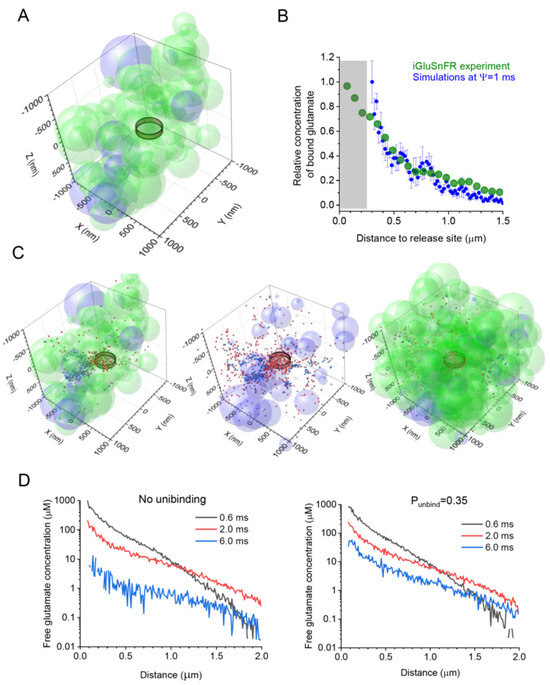
Figure 1.
Simulating extrasynaptic glutamate escape and transporter binding and unbinding using a stochastic model of probabilistic synaptic environment. (A) Diagram depicting the extracellular space filled with overlapping spheroids representing neuronal (light green) and astroglial (light magenta) structures, with an extracellular space volume fraction α = 0.2, and an astroglial volume fraction VFastro = 0.1; the ring illustrates approximately the extent of the synaptic cleft (with two hemispheric obstacles representing pre- and postsynaptic elements [33]); and a tissue fragment (2 × 2 × 1 μm3 slab of the 4 × 4 × 4 μm3 simulation arena) is shown for presentation clarity. (B) The average spatial profile of iGluSnFR fluorescence (green) with respect to the glutamate release site (zero distance) near an individual CA3-CA1 synapse at its peak post-release, as recorded earlier [26], and the average profile (mean ± SEM, n = 10) of the simulated transporter-bound glutamate concentration (blue) at 4 ms post-release, for Ψ = 1 ms, as indicated. (C) Diagram as in A, but shown, for clarity, with astroglial transporter-bound (red) and free (blue) glutamate molecules (1000 particles, 1 ms post-release) using three presentations: as a space slab similar to A (left); with astroglial elements only (centre); and as a 2 × 2 × 2 μm3 arena filled with both neuronal and astroglial elements (right). (D) Simulated spatial profiles of free glutamate concentration at various time points post-release, as indicated, with no transporter unbinding (left) and with unbinding at a probability Punbind = 0.35 (right).
The authors state that the scientific conclusions are unaffected. This correction was approved by the Academic Editor. The original publication has also been updated.
Reference
- Savtchenko, L.P.; Rusakov, D.A. Glutamate–Transporter Unbinding in Probabilistic Synaptic Environment Facilitates Activation of Distant NMDA Receptors. Cells 2023, 12, 1610. [Google Scholar] [CrossRef] [PubMed]
Disclaimer/Publisher’s Note: The statements, opinions and data contained in all publications are solely those of the individual author(s) and contributor(s) and not of MDPI and/or the editor(s). MDPI and/or the editor(s) disclaim responsibility for any injury to people or property resulting from any ideas, methods, instructions or products referred to in the content. |
© 2025 by the authors. Licensee MDPI, Basel, Switzerland. This article is an open access article distributed under the terms and conditions of the Creative Commons Attribution (CC BY) license (https://creativecommons.org/licenses/by/4.0/).