Review

A Comparative Evaluation of Soil Amendments in Mitigating Soil Salinization and Modifying Geochemical Processes in Arid Land

1
State Key Laboratory of Ecological Safety and Sustainable Development in Arid Lands, Xinjiang Institute of Ecology and Geography, Chinese Academy of Sciences, Urumqi 830011, China
2
Research Center for Ecology and Environment of Central Asia, Chinese Academy of Sciences, Urumqi 830011, China
3
University of Chinese Academy of Sciences, Beijing 100049, China
4
College of Ecology and Environment, Xinjiang University, Urumqi 830017, China
5
National Engineering Technology Research Center for Desert-Oasis Ecological Construction, Xinjiang Institute of Ecology and Geography, Chinese Academy of Sciences, Urumqi 830011, China
*
Author to whom correspondence should be addressed.
Agronomy 2026, 16(2), 222; https://doi.org/10.3390/agronomy16020222
Submission received: 9 November 2025 / Revised: 8 January 2026 / Accepted: 12 January 2026 / Published: 16 January 2026

Abstract

Salinization is a growing global problem, particularly in arid and semi-arid areas, where salt concentration interferes with the soil structure, altering natural cycling, decreasing agricultural outputs, and threatening food security. Although many soil amendments have been studied, there is still a limited understanding of their interaction with soil after mixture application and the geochemical processes and long-term sustainability that govern their effects. To address this knowledge gap, this review elucidated the effectiveness and sustainability of soil amendments, biochar, humic substances, and mineral additives in restoring saline and sodic soils of arid and semi-arid region to explore the geochemical processes that underlie their impact. A systematic search of 174 peer-reviewed studies was conducted across multiple databases (Web of Science, Google Scholar, and Scopus) using relevant keywords and the findings were converted into quantitative values to evaluate the effects of biochar, gypsum, zeolite, and humic substances on key soil properties. Biochar significantly improved cation exchange capacity, nutrient retention, microbial activity, and water retention by enhancing soil porosity and capillarity, thereby increasing plant-available water. Gypsum improved phosphorus availability, while zeolite facilitated the removal of sodium and supported microbial activity. Humic substances enhanced soil porosity, water retention, and aggregate stability. When applied together, these amendments improved soil health by regulating salinity, enhancing nutrient cycling, while also stabilizing soil conditions and ensuring long-term sustainability through improved geochemical balance and reduced environmental impacts. The findings highlight the critical role of multi-functional amendments in promoting climate-resilient agriculture and long-term soil health restoration in saline-degraded regions. Further research and field implementation are crucial to optimize their effectiveness and ensure sustainable soil management across diverse agricultural environments.

1. Introduction

Soil salinization, marked by the excessive accumulation of soluble salts in soil profiles, poses a significant global threat in arid and semi-arid areas [1]. This phenomenon dramatically changes soil properties, disrupts plant–water interactions, and reduces agricultural production which may threaten food security in salt-affected regions [2]. High temperatures, erratic rainfall, and high evaporation rates in these regions result in salt accumulation, particularly in soils with low water percolation, leading to land degradation and challenges in sustainable management [3]. This problem is further exacerbated by salinity in the irrigation water, as insufficient leaching concentrates salts in the upper soil profile, reducing soil fertility and hindering plant growth in arid and semi-arid regions [1,4]. According to the latest global assessment by the FAO (2024), about 1.38 billion hectares of land globally are salt-affected (≈10.7% of global land area), and roughly 10% of irrigated croplands are currently estimated to be salt-affected [5]. Furthermore, the FAO notes that most of these salt-affected soils are found in dry and semi-arid regions [5]. This salinization process can be broadly classified into primary and secondary mechanisms. Primary salinization (geological/climatic) is the process by which salts build up in soil over time [6]. This happens naturally when parent material breaks down or when water evaporates in dry areas [7]. Meanwhile secondary salinization results from human activities, particularly irrigation, where waterlogging and poor drainage cause salts to move from deeper soil layers to the surface, degrading soil quality and fertility [8]. To obtain a deeper insight into salinization, it is imperative to differentiate the types of salinization, with each having its own specific management requirements. Salinization takes place in three major forms, with primary salinization having three further categories: Dryland salinity is caused by an increase in salty ground water, usually in regions that contain salty clay [9]. Salts such as sulphate (SO42−) and chloride (Cl) ions are brought to the surface by water that percolates through the soil, leading to salinization in dryland situations [6]. Irrigation-induced salinity occurs when salts (Cl) accumulate due to irrigation, especially with low-quality water, such as brackish water or water with high dissolved salts [6]. It is further worsened by a lack of rainfall to leech and a lack of drainage [10]. Saline water intrusion occurs when the over-extraction of groundwater allows saline water to infiltrate previously fresh reservoirs, particularly in coastal regions [1].
Besides salt accumulation, hydrological and nutrient degradation are key constraints to arid soils and long-term agricultural sustainability, especially with increasing climate variability and intensive land use [11]. Such alterations of dry and waterlogged conditions, along with ineffective fertilization, accelerate nutrient loss. Waterlogging promotes denitrification, converting nitrate to nitrogen gases (N2O, N2), which are released into the atmosphere. It also causes leaching, which washes nutrients like potassium (K+) and magnesium (Mg2+) away from the root zone, disrupting redox reactions and natural nutrient cycles. This leads to soil degradation and reduced crop yields, especially in arid/semi-arid regions [4]. These challenges are particularly severe in salt-affected soils, where high salt concentrations cause osmotic pressure (creating a water deficit for plants) and ionic pressure (from Na+ and Cl accumulation in plant tissues) [2]. This limits water uptake and nutrient assimilation, and causes physiological imbalances in vegetation [12]. Furthermore, salinization has a significant impact on soil structure [13]. Soil clays typically have a platelet structure, where individual clay particles are arranged in flat, plate-like forms. Divalent cations such as Ca2+ and Mg2+ bind these platelets together and stabilize the soil structure, ensuring the integrity of the aggregate. But, as Na+ ions accumulate in saline soils, they cause the divalent cations to be displaced, causing the dispersal of clay particles [10]. This process, known as ion exchange, disrupts the aggregation of the soil particles, causing the platelets to disperse throughout the soil [14]. As a result, soil aggregation weakens, reducing porosity, increasing compaction, and forming a surface crust that limits water infiltration. The loss of the soil structure impairs water movement and root penetration, decreasing water-holding capacity and hindering nutrient access for plants [2]. Addressing the interlinked challenges of soil salinization and nutrient imbalance needs sustainable and evidence-driven strategies that recover soil health and maintain long-term agricultural sustainability [15]. This review indicates recent developments associated with the utilization of biochar, humic substances, and mineral-based materials in the restoration of salt-affected soils in arid regions. Amendments like biochar, gypsum, humic substances, and zeolites enhance soil structure, promote microbial activity, reduce salt buildup in the root zone, and improve nutrient retention, making essential nutrients more available to plants [15]. The selection of these amendments is based on their distinctive properties and proven effectiveness in addressing soil salinity, particularly in arid and semi-arid regions [16]. Although other amendments including sulfur, organic manures, microbial inoculants, and phytoremediation also have potential advantages, this review focuses on the discussed amendments due to their widespread application and the availability of extensive research on their impact on soil salinity [17]. Biochar is a carbon-rich material that is formed from the pyrolysis of organic material. It has been shown to increase soil CEC, improve soil structure, and increase water-holding capacity. These properties are important in salinity mitigation, especially in arid regions [18]. It also helps microbial activity and nutrient cycling, and enhances the ability of plants to resist salinity stress through the enhancement of soil conditions and physiological balance [19]. Moreover, biochar helps maintain soil pH and mitigates the adverse effects of salinity on soil’s biological and chemical properties [20]. In conjunction with the use of biochar, humic substances especially fulvic acids and humic acids have been found to be effective in localized downside effects of soil salinity through enhanced nutrient retention, soil aggregate stabilization, and enhanced soil permeability [21]. They positively affect microbial diversity and enzyme activity, contributing to restoring nutrient balance and reconstructing the functioning of the soil in saline dry environments [22]. Mineral-based interventions have also been crucial in saline soil rehabilitation in view of the beneficial effects of organic amendment products like biochar and humic substances [23]. The commonly used mineral amendments for reclaiming saline–sodic soils include gypsum (CaSO4·2H2O), which provides Ca2+ ions to replace Na+ at exchange sites through cation exchange. Displaced Na+ must be leached, and flocculation occurs due to increased electrolyte concentration and Ca2+ bridging between clay particles [24]. This results in the improvement of the soil structure, the enhancement of permeability, the improved draining of salts from the root zone, and the reduction in salinity-induced stress [7]. Besides gypsum, crystalline aluminosilicate minerals such as zeolites with a high CEC have been suggested as potential additions to salt-affected soils [25]. Their porous nature enhances water and nutrient adsorption hence reduces leaching losses and improves nutrient availability under saline environments [26]. They also participate in ion modulation by adsorbing the excess Na+ and Cl ions, enhancing soil structure and alleviating ionic toxicity, hence promoting plant growth and soil health in arid systems [27].
Although the short-term benefits of soil amendments are well documented, their long-term effectiveness, environmental sustainability, and synergistic interactions across diverse agroecological contexts remain poorly understood [28]. Existing reviews tend to focus on immediate improvements in soil physical and chemical properties, often neglecting the temporal persistence, functional interdependencies, and broader ecological implications of these interventions [15]. To illustrate this, some studies have pointed out that there are no long-term field trials of the long-term effects of using amendments such as biochar and gypsum to soil health across several growing seasons [14]. Furthermore, research in arid regions has have received less attention, as well as the geochemical processes that drive soil salinization, nutrient dynamics, and microbial activity under conditions of water scarcity and high evaporation rates [24].
The objective of this review is to bridge knowledge gaps by synthesizing findings on biochar, mineral amendments, and humic substances, focusing on their role in modulating geochemical processes such as mineral dissolution/precipitation, redox reactions, complexation, and sorption/desorption. These processes are critical in influencing soil properties under salinity stress, enhancing long-term soil functionality, and restoring water–nutrient balance in salt-affected soils.
This review evaluates the existing literature on how organic and inorganic amendments induce long-term geochemical changes, which are critical for enhancing soil properties under salinity stress and supporting the sustainability of saline soil remediation in arid, nutrient-deficient conditions [9]. In this review, the term “long-term” refers to impacts noticed over three to five years or longer, with an emphasis on the long-term effects of amendments on key geochemical parameters such as soil salinity, nutrient availability, soil structure, and some enzyme activity [29]. Building on past research efforts that have mainly concentrated on short-term effects, this paper critically examines the long-term effects of these amendments, both individually and synergistically, on soil resilience and geochemical stability in response to environmental stressors. These strategies aim to enhance soil functionality and promote climate-resilient agriculture, ultimately contributing to sustainable land management and global food security.

2. Data Sources and Research Methods

A keyword-based mapping approach was used to capture a representative and multidisciplinary body of literature. Multiple databases (Web of Science, Google Scholar, Scopus) were searched for literature studies published between 2000 and 2025. Studies were selected on the base inclusion criteria, including peer-reviewed publications that addressed the use of biochar, gypsum, humic substances, and zeolites in salt-affected soils. A total of 174 studies were reviewed, with selection criteria including the representation of long-term effects and the applicability of findings to salt-affected soils in arid regions.
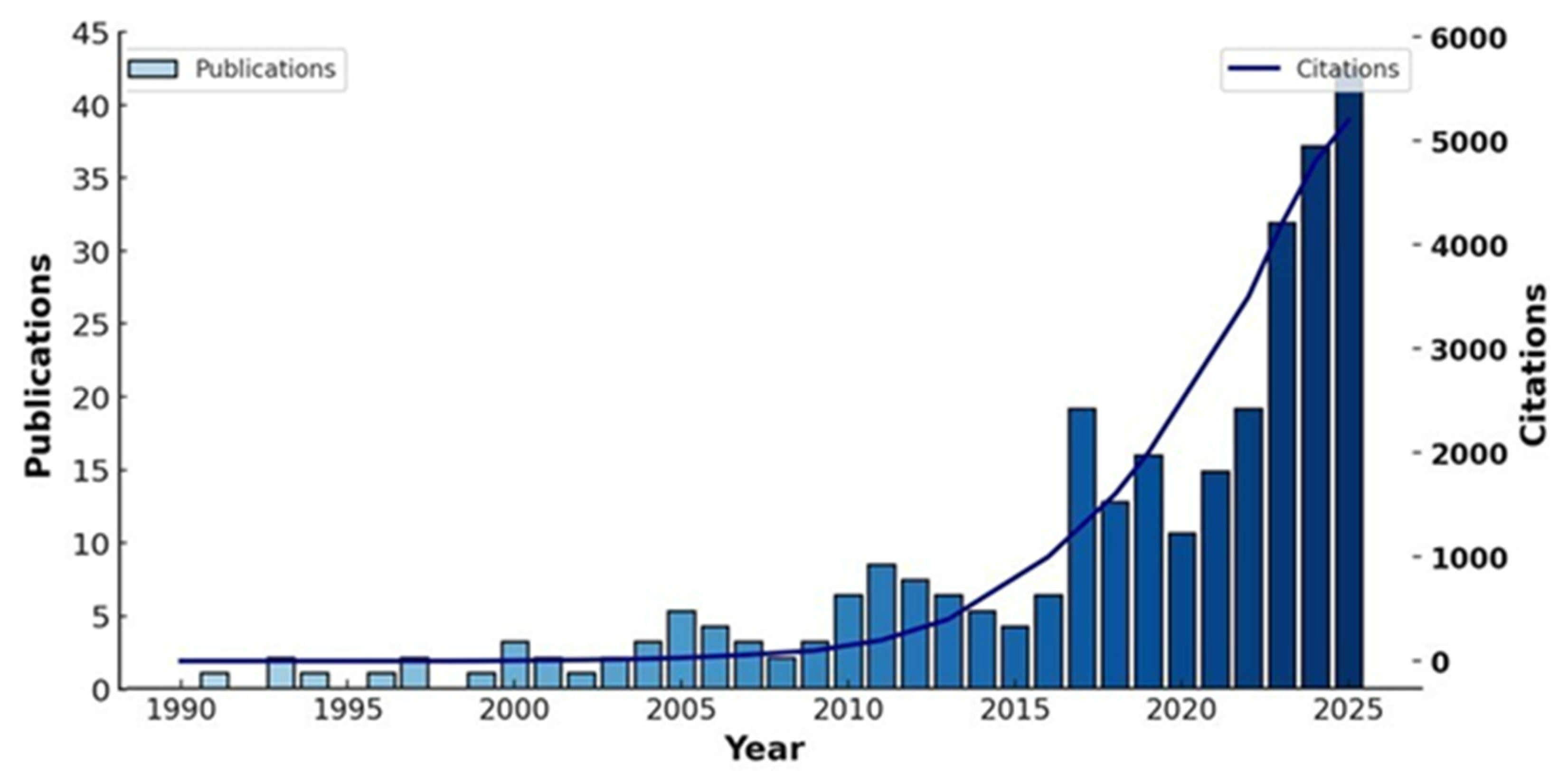
Furthermore, the publication distribution for research articles on “salinization” and “arid” was analyzed using Web of Science. Figure S1 presents the number of articles published each year, along with their percentage of the total 1360 records. The data reveals temporal trends, with a peak in publications from 2021 to 2025 and consistent output since 1999. Despite recent progress, there remains a clear lack of systematic evaluations of amendment performance and interaction mechanisms over time and across environmental gradients. Given the accelerating impact of salinity—especially in arid and semi-arid regions—advancing a mechanistic, context-specific understanding of amendment-induced transformations is essential for developing resilient and climate-adaptive soil management strategies. As illustrated in Figure 1, the increasing scientific interest in soil amendment research highlights the urgent need for sustainable solutions to address salinization and correct hydrological imbalances and nutrient deficiencies that affect soil fertility and agricultural productivity. The research trend suggests that addressing these challenges requires not only innovative solutions but also a deeper understanding of the long-term impacts of amendments in various environmental contexts.

3. Dynamics and Biogeochemical Effects on Soil Salinization

3.1. Soil Salinization and Physicochemical Degradation

Salinization results in the formation of saline, sodic, and saline–sodic soils, each exhibiting unique physicochemical properties and characterized by high concentrations of soluble salts and increased Na+ ions activity. These soils typically have pH values influenced by the carbonate (CO32−), carbon dioxide (CO2), and bicarbonates (HCO3) equilibrium system, and hydroxide (OH) ions from the hydrolysis of sodium carbonate (Na2CO3) [8]. Excess Na+ ions further displace essential cations like Ca2+ and Mg2+, causing nutrient deficiencies and limiting plant absorption of K [30]. In alkaline–saline soils, higher pH levels promote the precipitation of P with Ca2+, forming insoluble Ca3(PO4)2 [31]. This process reduces P mobility, making it less available to plants [31]. This salt stress causes an osmotic imbalance by reducing soil water potential, making it harder for plants (i.e., requiring more energy) to extract water from the soil, which leads to the accumulation of toxic ions, causes nutrient competition, and inhibits plant growth and nutrient absorption; this results in a major risk to crop productivity [9]. These processes (osmotic imbalance, accumulation of toxic ions, and nutrient imbalance), however, are reversible with the application of appropriate soil amendments which can restore nutrient balance, mitigate osmotic imbalance, and reduce the accumulation of toxic ions [8]. Geochemical processes that include mineral dissolution (increasing the concentration of ions), redox reactions (affecting metal ion mobility), complexation (where metal ions bind to organic or inorganic substances, affecting their mobility), and sorption/desorption (regulating ion retention or release back into the solution) significantly impact soil chemistry [3]. Geochemical processes such as solute movement and evaporation are the main contributors, while mineral weathering and ion exchange (to a lesser extent) are the major determinants of salt build-up and its redistribution in the soil profile [9]. Salinization alters soil chemistry, reduces nutrient availability, and impacts microbial activity and composition in an adverse manner [2]. In saline soils, an imbalance in essential nutrients such as K, Ca2+, and Mg2+ commonly occurs due to the competitive inhibition by excess Na+ and cation exchange on soil colloids, which leads to clay dispersion and aggregate breakdown, impairing water absorption and hindering root development [24]. This leads to malnutrition and low agricultural production [32]. Biologically, high salt levels expose soil microbes to osmotic pressure and high Na+ ion concentrations which decrease microbial biomass and compromise microbial functional diversity [33]. This affects vital soil processes like nitrogen fixation and the decomposition of organic matter, leading to the accumulation of organic carbon and reduced ability of microbes towards resilience to salinity [34]. This self-perpetuating process of soil damage makes it vulnerable to erosion due to both the loss of organic matter (especially roots) and the degradation of soil structure which exposes the underlying saline layers of subsoil [34]. This imbalance in nutrient level impairs the growth of plants resulting in the loss of organic input to the soil that plays an important part in soil structure and the proliferation of microbes [10]. This process results in a succession of adverse effects on nutrient cycling, soil texture eventually resulting in soils with low soil available water content (low soil water potential), limited nutrients, and decreased biological activity, aspects reflective of extremely low soil functionality [35].
These salt-affected soils are categorized using diagnostic indices such as electrical conductivity (EC), sodium adsorption ratio (SAR), exchangeable sodium percentage (ESP), and pH, which collectively indicate the level of physicochemical degradation [36]. EC and pH are usually determined in a soil–water slurry at a 1:2 soil-to-water ratio, where EC is calculated by measuring the EC of the slurry and pH is measured using a pH meter. The formulas for SAR and ESP are as follows (Equations (1) and (2) [36]):
S A R = N a + C a 2 + + M g 2 + 2
where the concentrations of Na+, Ca2+, and Mg2+ are expressed in mol/L.
E S P = ( N a + ) C E C × 100
where exchangeable sodium is expressed as a %.
As summarized in Table 1, saline soils exhibit high EC (≥4 dSm−1) and low SAR (<13), conditions that allow infiltration but impose osmotic constraints. In contrast, sodic and saline–sodic soils, with high SAR (>13) and ESP (>15), promote clay dispersion, reduce permeability, and severely disrupt water and nutrient fluxes [1].
In sodium-dominated systems, salinity and sodicity often co-occur but affect the soil–plant interface through distinct mechanisms: salinity induces osmotic stress that restricts water uptake, while sodicity disrupts soil structure, impairing hydraulic conductivity and nutrient availability [33,37]. These interactions deteriorate the soil fertility as well as crop productivity.
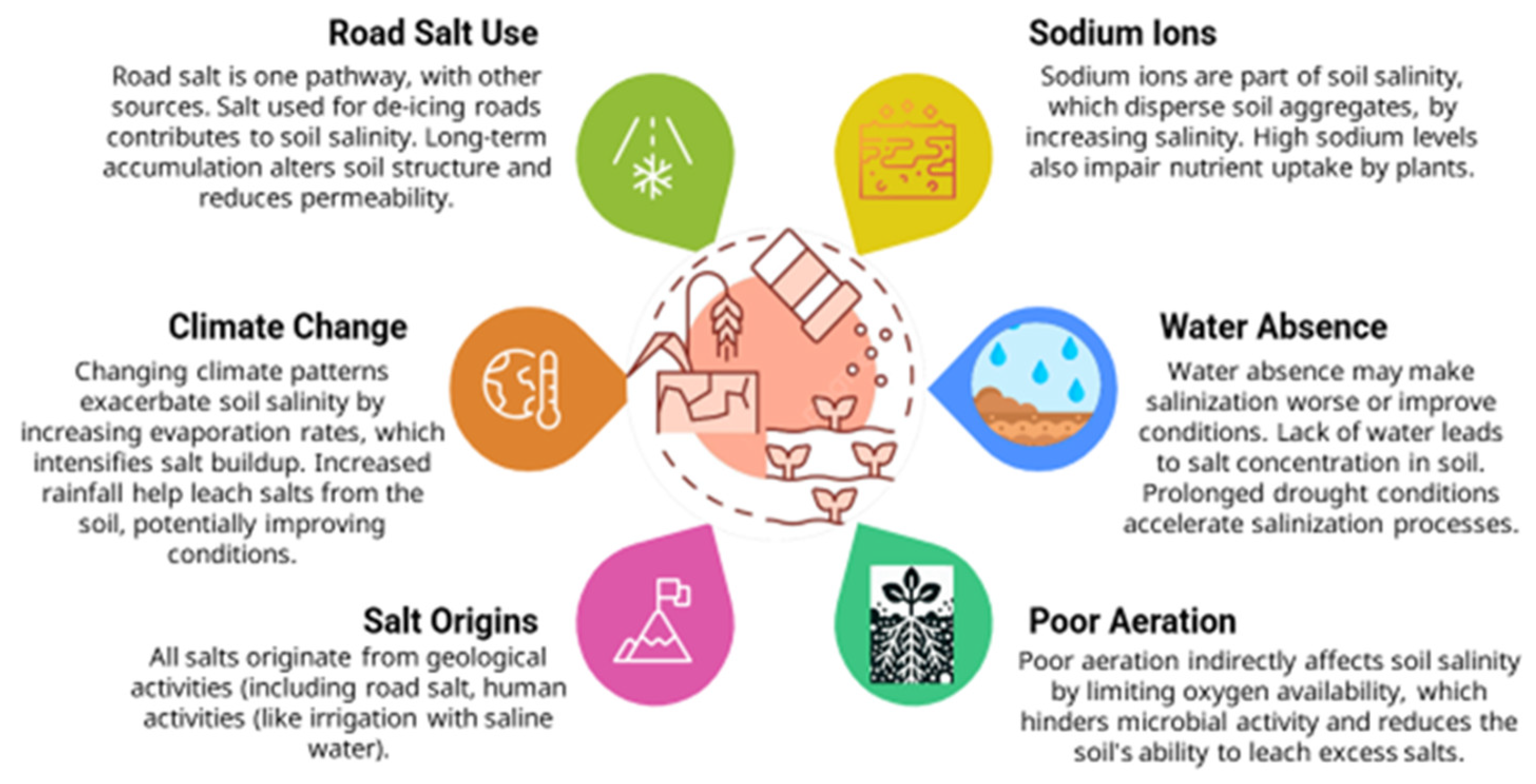
Furthermore, these conditions in arid and semi-arid regions are made worse by climatic changes and anthropogenic pressures [38,39]. Climate change can affect salinization by altering the pattern of precipitation, increasing the frequency of droughts, and accelerating evaporation rates, which accumulate salts in the soil [1]. Changes in vegetation cover, e.g., through a decrease in plant cover, the alteration of the species pool, etc., may also influence salinization through changing water use and soil organic matter processes [40]. Low-quality irrigation water, the excessive use of fertilizers, groundwater extraction, and seawater encroachment may interact (e.g., sandy deserts may have low and erratic rainfall but they do not have salination) to destabilize water and nutrient cycling and to ensure a downward spiral in condition [16]. Figure 2 shows a conceptual representation of these interacting drivers, focusing on how they add value to increasing salt accumulation, nutrient losses, and the decline in soil functions.

3.2. Role of Geochemical Cycle in Soil Health Sustainability

Geochemical cycles play a pivotal role in soil health regarding the regulation of elemental fluxes, mineral stability, nutrients, and their bioavailability in terrestrial ecosystems [41]. In arid and semi-arid areas, geochemical mechanisms of soil salinization are largely governed by gypsum dissolution (CaSO4) and the precipitation of carbonate minerals (CaCO3) such as calcite and aragonite, which affect the chemical properties of the soil [9]. In particular, the dissolution of gypsum increases the concentration of Ca2+ and SO42− in the soil solution and alters the physical properties of the soil (plasticity, cohesion, etc.) [14]. Conversely, the precipitation of calcite during evaporation lowers the soil alkalinity and alters the availability of certain nutrients [42]. Apart from natural processes, anthropogenic factors such as use of saline irrigation water and over-fertilization also intensify the salinization process [40]. The dissolution of halite (NaCl), which is the most abundant soluble salt, is also important as it can lead to an increase in mineralization in soils [9]. The combined effect of these geochemical reactions lead to soil degradation, a reduction in the amount of water that plants can take up, and can also lead to the fixation of trace elements in unavailable forms for plant uptake [43]. Furthermore, redox reactions are a key process in the chemistry of saline soils in arid environments, influencing nutrient cycling and soil structure [44]. Variations in moisture and aeration affect the redox state of elements like Fe, S, and Mn. Oxic conditions cause Fe3+ precipitation as oxides while reducing conditions cause Fe2+ dissolution and thus increases the mobility of nutrients and metals [44]. In saline soils, complexation reactions are essential in regulating the availability of nutrients and the mobility of metals. Metal ions, such as Ca2+ and Mg2+, interact with anions like sulfate SO42− and CO32−, forming stable complexes that influence both soil pH and nutrient cycling [45]. Furthermore, in solutions of high ionic strength, activity coefficients reduce the ion concentration (effective ion concentrations), resulting in a reduced effectiveness of cation exchange, mineral precipitation/dissolution, and nutrient uptake [39]. As ionic strength increases, the activity of the ions Na+ and Ca2+ is reduced, affecting soil fertility and microorganisms’ functions [30]. In addition, soil composition and functionality are variably altered by the interactions of geochemical processes like atmospheric processes (such as oxidation and soil erosion), which can significantly affect the properties of soils by altering mineral composition and the nutrient availability of soils, as well as biological processes on different time scales [46]. Furthermore, the geochemical alteration of silicate and carbonate minerals, although a slow process, also provides vital macronutrients, Ca, Mg, and K, which are vital to maintaining plant growth and microbial populations [47]. However, such mineralogical changes are transient, influenced by climatic factors, water level, and anthropogenic manipulations producing spatial variability in soil fertility and structure [9]. The geochemical processes underlying soil salinity cause a disturbance in the osmotic balance and destabilize the cellular structures of plants [22]. In saline environments, high ionic strength in saline conditions results in osmotic stress that restricts water uptake as well as triggering biochemical responses that impose adverse effects on plants [48]. The accumulation of Cl and Na+ beyond normal levels may create ionic imbalances resulting in impaired enzymatic activity and chlorophyll formation, resulting in poor photosynthetic performance and decreased farm production [49]. Moreover, saline-induced oxidative stress facilitates the rapid peroxidation of lipids and the destruction of cell integrity which further intensifies plant degradation during long-term exposure to high salt levels [45]. Although the same oxidative stress may take place during waterlogged periods since there is a lack of oxygen, salinity enhances this phenomenon by inducing more cellular stress [50]. These geochemical changes in soils and microbial-mediated nutrient turnover affect the functionality of soil ecosystems. The maintenance of soil fertility relies on assuring primary biogeochemical processes, which are catalyzed through soil microbial groupings synergism, such as nitrogen fixation, sulfur oxidation (under certain conditions, mostly the presence of H2S), and carbon mineralization [51]. In extremely saline and pH-distorted environments, however, microbial enzymes are inactivated and community structure is altered, decreasing the rates of organic matter decomposition and slowing nutrient cycling [52]. The loss of microbial diversity under saline stress conditions also weakens symbiotic relationships between plant roots and mycorrhizal fungi, further limiting nutrient acquisition and water uptake [30]. Understanding geochemical pathways is essential for the development of appropriate soil and water management strategies to counteract the negative impacts of salinity in arid environments.
The mitigation of these negative effects caused by geochemical imbalances in soils requires a holistic and multi-pronged strategy that focuses on overall soil restoration with a combination of specific amendments to achieve long-term future agricultural sustainability. Gypsum has been well known for its ability to improve saline–sodic soils by increasing CEC, displacing exchangeable Na+ from soil colloid surfaces through cation exchange, and increasing the stability of soil structure, which helps mitigate the adverse effects of sodium saturation [53]. Although Ca2+ ions enhance soil structure by increasing the flocculation and aggregation of soil particles, it does not significantly affect soil pH [54]. The movement of Na+ ions by Ca+ ions may also increase the leaching potential of Na+ ions, which will further improve soil conditions [53]. In addition to inorganic additives, organic supplements like biochar and compost are essential for maintaining soil pH (with additives like superphosphate), enhancing water-holding capacity (critical for plant access), and supporting microbial processes. These contributions ultimately strengthen soil fertility and resilience [55]. Approximately 25% of global irrigated land is being salinized, which significantly harms food security and ecosystem stability [37]. Therefore, effective mitigation strategies must be developed and implemented. However, the sustainability of soil health in the long term requires a holistic solution, which includes geochemical perceptions to maximize nutrient circulation, reduce prospects of salinization, and maximize the sustainability of agroecosystems undergoing environmental stresses [56].

4. Overview of Amendment Strategies

Soil amendments are a vital tool for enhancing soil health, particularly in salt-affected soils [57]. The objectives of soil amendments are to improve soil functionality by improving its chemical and physical properties [58]. The choice of appropriate amendment relies on its efficiency in solving major soil problems, nutrient enhancement, moisture conservation, soil stabilization, and the mitigation of salinity-related stress [59].
In addition to the direct benefits of soil amendments, managing leaching fractions in irrigation is a crucial strategy for controlling soil salinity [60]. Leaching fractions refer to the proportion of applied water that percolates beyond the root zone, carrying excess salts away from the soil [61]. In salt-affected soils, particularly in arid regions, optimizing leaching fractions helps prevent the accumulation of salts, thereby enhancing the effectiveness of soil amendments like biochar or gypsum in mitigating salinity [6]. By effectively managing leaching fractions, water retention, nutrient availability, and microbial activity are improved, which in turn boosts the performance of soil amendments. This comprehensive approach ultimately contributes to enhanced soil health, fertility, and agricultural productivity [13].

4.1. Classification of Amendments

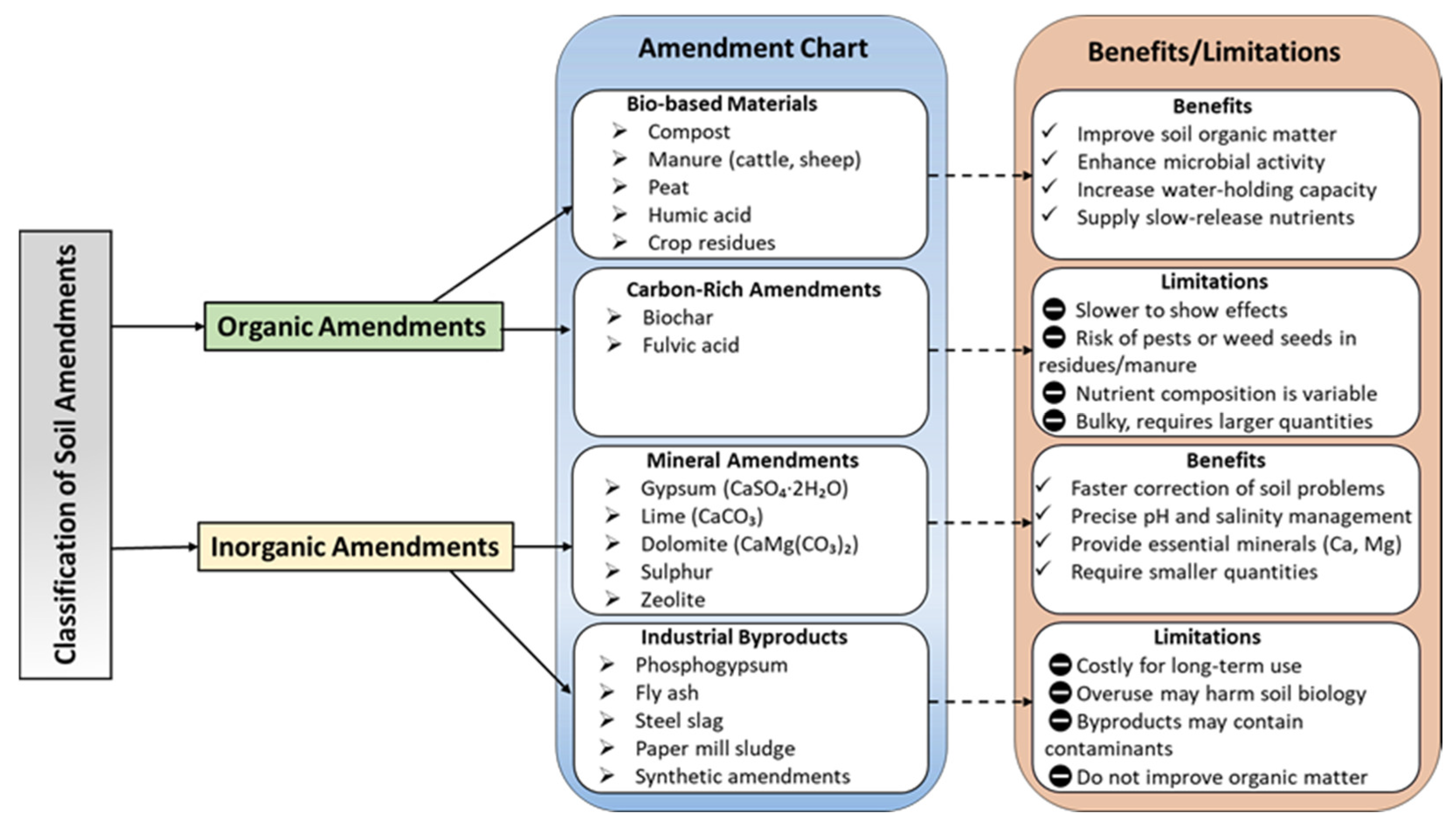
Figure 3 illustrates that soil amendments fall in two main categories: organic and inorganic. Each category plays a different role in terms of reducing salinity and increasing nutrient availability [58].
The sources of organic amendments are plant-based or animal-based, such as biochar, compost, and humic substances. These inputs (biochar, compost, and humic substances) have been highly appreciated in terms of strengthening soil structure, enhancing water retention, and stimulating microbial diversity [62]. Biochar, a carbonaceous and stable product, has been shown to have a high potential for improving soil porosity, moisture retention abilities, and nutrient storage capabilities, particularly through its impact on CEC, in saline soils [63]. Biochar, a carbonaceous and stable product, has been shown to have a high potential for improving soil porosity, moisture retention abilities, and nutrient storage capabilities, particularly through its impact on CEC, in saline soils [55]. The surface functional groups of biochar, such as carboxyl (-COOH), hydroxyl (-OH), and phenolic groups, alter its CEC, ash content, and liming equilibrium, thereby influencing soil pH and nutrient dynamics [18]. Low-temperature biochar provides a larger CEC and surface area, while high-temperature biochar has a greater stability but lower CEC [64]. These properties, along with the intricate pore structure of biochar, increase porosity, and that enables better aeration and promotes root development, leading to crop productivity and better tolerance to salinity [65]. In addition, biochar’s priming effects on native soil organic matter decomposition can either accelerate or slow down organic matter breakdown, depending on its chemical properties and interactions with soil microbes, contributing to salt tolerance [63]. Another important organic input to soil is humic substances, particularly humic acids (complex organic bounds that are formed by breaking down plant and animal materials), which improve aggregation, water-holding capacity, and nutrient cycling [21]. These compounds are particularly useful in soils where nutrients are limited as they improve the availability of critical elements to the plants by increasing solubility [66]. Moreover, humic acids are known to enhance soil permeability and minimize the negative effects of high cation concentrations in salty soils and favor a more sustainable and functional soil ecosystem [66].
Meanwhile, inorganic amendments include both naturally occurring products, such as gypsum, zeolites, and bentonite, and processed mineral products, such as lime (derived from limestone) [57]. Although mineral amendments are physically and chemically different from synthetic or refined inorganic compounds, they are usually categorized with the broader classification, inorganic amendments, because they are non-organic in origin [67]. The widespread application of inorganic amendments include gypsum, lime, and some acids (such as superphosphate), with the aim of altering soil chemical properties in saline and sodic soil [54]. Inorganic amendments are classified on the basis of their chemical composition, functional groups, and physiochemical properties. Mineral amendments, such as gypsum (CaSO4), lime (CaCO3), and superphosphate, are derived from natural sources, while synthetic additions, such as ammonium nitrate, potassium chloride, and ammonium phosphate, are chemically synthesized [68]. These amendments have distinct functions: lime is used to reduce acidity by raising pH, whereas gypsum helps reduce Na level in sodic soils [69]. Based on their physiochemical properties, soluble amendments such as superphosphate and ammonium nitrate dissolve quickly in water, providing immediate nutrient availability, while slower-release amendments, such as lime and gypsum, gradually improve soil structure over time [70]. Gypsum has extensively been used in the remediation of sodic soils. Gypsum (CaSO4·2H2O) dissolution releases Ca2+ ions, which displace exchangeable Na+ ions from soil colloid surfaces through a cation exchange process. The displaced Na+ ions then form soluble Na2SO4, which can be leached from the soil [54]. This cation exchange decreases sodicity, balances soil structure, enhances water permeability, and facilitates the absorption of nutrients [71]. It reduces the adverse consequences of sodium buildup in the soil by decreasing SAR, hence improving water permeability, which facilitates improved water infiltration and the growth of roots [72]. Furthermore, mineral amendments, such as zeolites, are important for increasing soil CEC and retaining nutrients [73]. These aluminosilicate crystals are useful for reducing the loss in nutrients and improving the availability of these nutrients to plants in saline soils by adsorbing important cations such as ammonium (NH4+) and K+ ions [74]. Zeolites are aluminosilicate minerals with a permanent negative charge, which primarily function through cation exchange rather than adsorption [75]. Their high ion exchange capacity makes them effective in the desalinization of soils and in improving water-holding capacity [76]. Zeolites primarily exchange cations, such as Na+, for other cations like Ca2+ and Mg2+. However, due to the negative charge of their framework, they retain minimal anions, including Cl [77]. As a result, Cl adsorption by zeolites is negligible under typical soil conditions [76]. Similarly, bentonite, a clay mineral that has the well-known property of swelling, is often added to enhance soil aggregation and increase water retention especially in sandy or compact soils that have a poor water penetration ability [78]. Its unique ability to hold moisture renders it particularly useful for retaining moisture in dry or salty states of soil, thereby promoting the growth and life of plants [79]. Also, basalt, applied in the form of rock dust, is a source of trace elements and micronutrients and with continued use over time, it can improve long-term soil fertility, especially in saline-affected areas [80]. The gradual breakdown of such minerals enriches land to ensure a long-term crop output [81].

4.2. Criteria for Amendment Selection

The proper selection of a soil amendment strategy is based on various factors, such as soil type, sandy, clayey, or loamy soils, which will respond differently to different treatments, and these factors determine its effectiveness in addressing salinity and nutrient deficiencies [40]. Biochar is useful in sandy soils where the water- and nutrient-holding capacity is generally low [82]. Salinity concentration is a crucial consideration in the determination of the right amendment [64]. In soils of mild to moderate salinity, it is possible to ameliorate osmotic stress and enhance soil structure through the implementation of biochar, depending on the specific situation. If biochar increases water retention, it could help dilute the salts, improving soil conditions [83]. Gypsum can be utilized to rectify sodic soils by displacing exchangeable Na+ with Ca2+ ions from soil colloid surfaces through cation exchange, which increase soil aggregation and boost its moisture conditions [14]. It also reduces the ESP, as excess levels adversely influence the growth of plants through reduced soil permeability and hindering nutrient uptake [84]. Humic substances can also enhance nutrient availability in nutrient-deficient soils due to their ability to chelate metals and enhance the solubility of elements like K, P, and some micronutrients [66]. Furthermore, biochar improves nutrient retention in nutrient-deficient soils by boosting the soil CEC and fostering an environment conducive to microbial activity [21]. The use of biochar and compost is often chosen for environmental reasons, such as maintaining long-term organic matter levels in soils, and economic reasons, such as enhancing crop yields and reducing the need for chemical fertilizers [64]. Enhanced soil health and microbial growth can make their application cost effective on a large scale [64]. Conversely, mineral amendments such as gypsum could provide faster outcomes; but, while they reduce ESP, they do not offer some of the long-term benefits associated with biochar and other organic amendments [71].

5. Amendment Modulation of Soil Salinity

5.1. Sole Effect of Amendments on Salinity

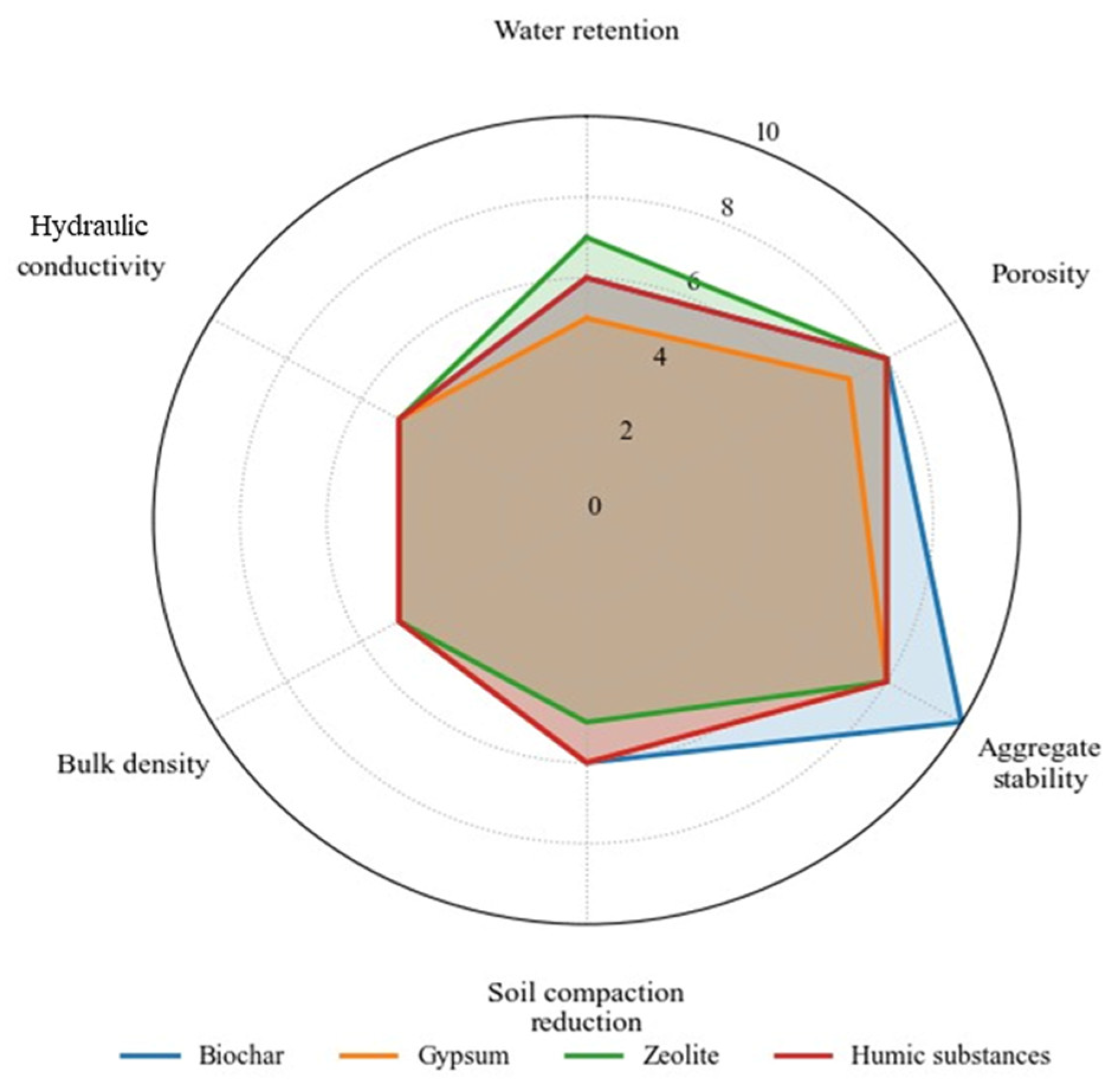
Organic and mineral amendments such as biochar, gypsum, zeolites, and humic substances have been proven to enhance the physical and chemical properties of saline soils and sodic soils [85]. These amendments help to enhance the aggregate stability, porosity, and water retention of soil, thus reducing the negative effects of salinity and sodicity on soil structure [86]. As illustrated in Figure 4, the effectiveness of these amendments varies in terms of their influence on bulk density, soil compaction reduction, water retention, porosity, aggregate stability, and hydraulic conductivity. Biochar helps to alleviate soil compaction by improving aggregate stability and lowering bulk density, which leads to a better soil structure and supports plant development [87].
Furthermore, its ability to improve the soil’s water retention helps reduce moisture loss through evaporation and ensures the more even distribution of water within the soil, particularly in dry and semi-arid climates [88]. The incorporation of biochar also improves soil hydraulic conductivity, which decreases surface runoff and enhances the infiltration of irrigation water, which is crucial for sustainable soil productivity in water-scarce environments [89]. In addition to enhancing physical properties, biochar influences cation exchange by providing exchange sites (carboxyl, phenolic groups) with a negative charge. External divalent cations (Ca2+ and Mg2+) from sources like irrigation water, gypsum co-application, or biochar ash compete with Na+ for these sites [89]. The selectivity coefficients favor divalent cations (Ca2+, Mg2+) over monovalent Na+. Therefore, biochar is a passive substrate and not an active facilitator. The driving force is the thermodynamic preference for divalent cations at exchange sites, which contributes to the stabilization of aggregates and prevents the structural break down from high sodium levels [90]. Nonetheless, the efficiency of biochar in restoring saline–sodic soils is greatly influenced by its origin and manufacturing process [87]. High-ash biochar can raise the soil’s pH, as the ash content is often alkaline [91]. This change in pH can alter the CEC of the soil, potentially increasing the ESP, which can lead to clay dispersion and the degradation of soil structure [91]. The use of biochar also promotes favorable microbial colonies, especially in the phosphate-solubilizing state (Thiobacillus, Pseudomonas, and Flavobacterium), which play a significant role in enhancing P accessibility in saline regions [89]. The pH-neutralizing characteristic of biochar may restrict the bioavailability of P during fertilization in strongly alkaline saline–sodic soils, highlighting the need to tailor biochar formulations to minimize waste and maximize P retention and plant uptake [67]. In addition to the regulation of phosphorus dynamics, biochar has been found to affect K+ availability significantly [92]. High concentrations of sodium in saline soils may exhaust K+ absorption and cause nutrient disorders that inhibit the growth of plants [93]. Its application increases exchangeable K+, reducing sodium stress and providing adequate potassium, which is required in plant metabolism and osmotic equilibrium [94]. Research shows that the addition of biochar can raise the soil K+ level up to 44%, which controls Na+ levels and lowers the chance of future salinization [95]. The practical application of biochar in soil management relies on selecting the amendments that contain the appropriate Ca2+ to Na+ ratios and pH value to ensure soil integrity and prevent structural degradation [95]. These results highlight the importance of using soil amendments, like biochar, in a manner that is customized to particular soil conditions in order to attain maximum benefits to the soil texture.
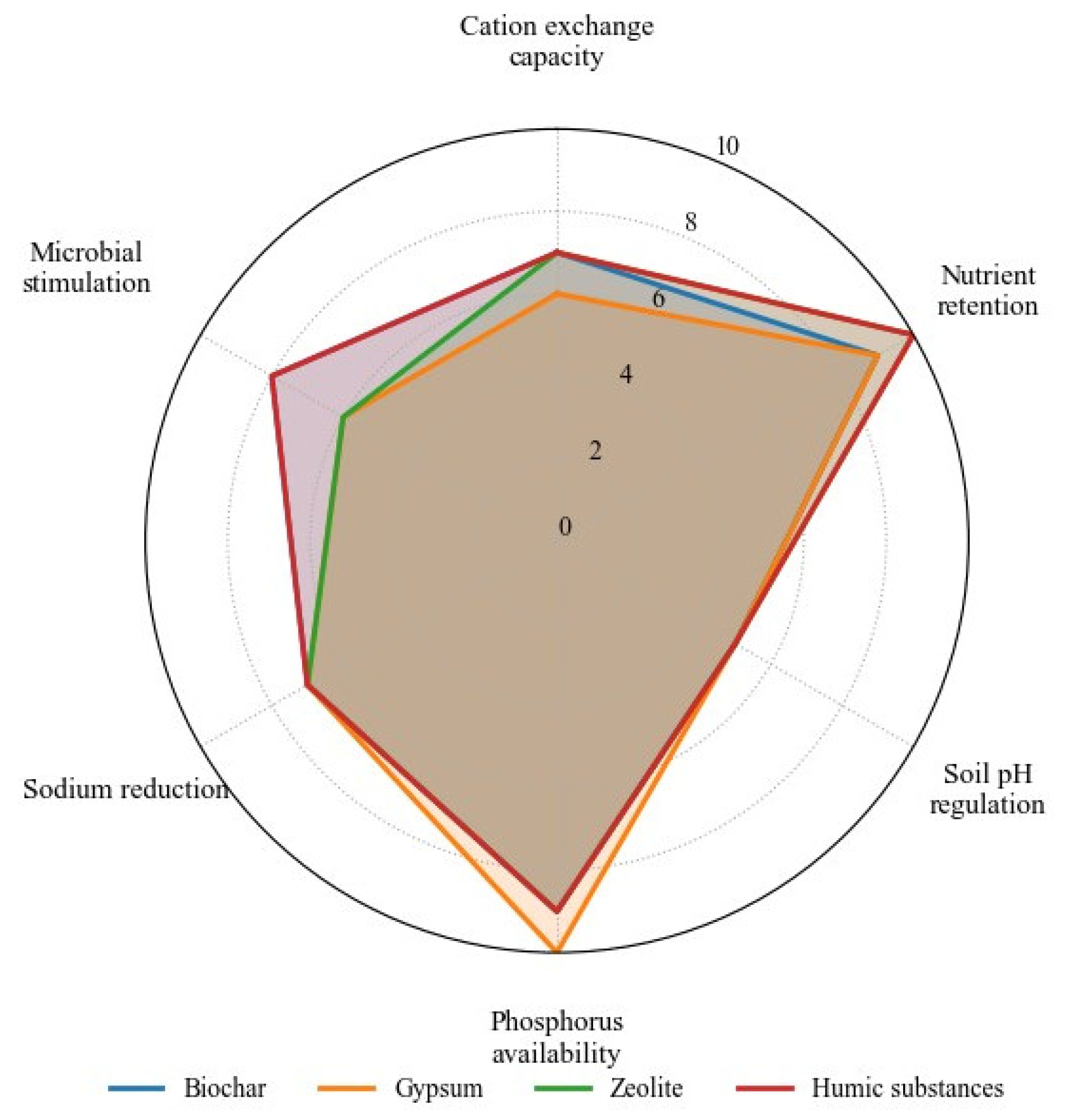
Meanwhile, mineral amendments such as gypsum and zeolites are also critical in improving the structure of soil by enhancing aggregate stability, thereby improving permeability [85]. When used to remediate sodic and saline–sodic soils, gypsum promotes ion exchange, thereby increasing soil aggregation, hydraulic conductivity, and water infiltration [69]. Meanwhile, the solid phase in soil amendments, such as the dissolution of gypsum, provides Ca2+ and SO42− ions, lowering the ESP, which improves soil permeability, aggregation, and ultimately the soil health [63,85]. This reaction contributes significantly to P unavailability in alkaline–saline soils due to the insolubility of calcium–phosphate compounds formed as a result of the reaction [54]. The application enhances the solubility of P which is absorbed easily by plants and also enhances the availability of N by reducing the loss of ammonia and the amplification of nitrate retention, which plays an important role in improving saline regions [93]. The resulting amendments, as illustrated in Figure 5, affect the significant chemical characteristics of P availability, Na reduction, microbial activity, soil pH regulation, nutrient retention, and CEC that are all essential in the restoration of soil chemistry under saline conditions.
Furthermore, humic substances increase soil structure significantly by enhancing the formation of stable aggregates, reducing moisture loss, and enhancing permeability [96]. Humic acids, a key component of humic substances, are highly reactive and essential for aggregating soil particles, particularly in the presence of Mg2+ and Ca2+ ions, leading to stable macroaggregates that remain intact in saline and sodic soils [97]. These substances enhance drainage and soil aeration, especially in the sodic, clay-rich soils [57]. In addition to enhancing soil porosity, they also facilitate the control of the soil pH, which helps in the maintenance of soil quality in arid zones [98]. They also enhance the aggregation and stability of the soil indirectly by promoting exopolysaccharides, natural molecules that aid soil particle adhesion and salinity tolerance, by encouraging microbial activity [98].

5.2. Combined Effect of Amendments on Salinity

When implemented separately or in combination, these amendments are fundamental in restoring the chemical balance in soil and in perpetuating sustainable practices in land management [34]. Previous studies indicate that by the combined application of these amendments with organic products like compost and bio-fertile soil amendments, soil buffering capacity, microbial activity, and carbon sequestration can be enhanced, resulting in a sustainable soil ecosystem [99]. Recent studies demonstrate that the application of biochar together with humic acids provides significant benefits to salt-affected soils through decreased oxidative stress, better ionic balances, and a promotion of the plant’s antioxidant system activation [23]. Biochar porosity increases soil moisture stability and nutrient retention, while humic acids have chelating abilities regulating the release and availability of nutrients in line with plant requirements [95]. This two-pronged effect leads to the improved regulation of stomata, improving transpiration and water use efficiency in plants subjected to saline conditions [23]. Similarly, Ref. [100] found that biochar applied in combination with fulvic acid in the Hetao Irrigation Region of Inner Mongolia produced a higher soil quality and crop yield than biochar alone.
Integrating biochar, humic substances, and mineral ameliorants is crucial for reducing salinization and improving nutrient cycling, with efficacy determined by dosage, application time, and method [79]. As humic substances can alter the chemical profile of saline and stressed soils to a large extent by improving nutrient availability, balancing soil pH, and controlling the interaction between ions [86]. When H+ ions dissociate from the carboxyl and phenolic functional groups in humic substances, they create negatively charged areas that enhance the soil’s retention of important macronutrients and micronutrients [101]. Increased CEC improves nutrient bioavailability under saline conditions, where high Na levels typically cause deficiencies [102]. Research demonstrates that humic acids limit Na+ uptake by plant roots while promoting the absorption of essential cations like Ca2+ and Mg2+, which helps alleviate osmotic stress and restore ionic equilibrium [103]. This process protects plant cellular structures by increasing osmolyte synthesis (proline and glycine betaine) and developing antioxidant defenses (ascorbic acid, glutathione, and phytochelatins), enhancing the plant’s ability to respond to oxidative stress caused by salinity [104]. Humic substances are capable of enhancing organic matter breakdown and nutrient cycling by influencing the rate of enzyme action and microbial respiration, therefore increasing soil biological activity and productivity [98]. They are crucial in nitrogen mineralization and P solubilization, which is important in the soil health in saline conditions. Although biochar, mineral amendments, and humic substances each enhance soil chemistry to a degree, integrating their applications can further advance soil remediation by facilitating more effective ion exchange, which fosters vegetation growth and soil fertility [105]. These amendments interact with each other to reduce soil salt concentration, either through the leaching of salts or by increasing soil water content. This improves the physical (soil structure and porosity), chemical (enhanced nutrient availability and reduced salinity), and biological (improved microbial activity and root development) aspects of soil [106]. Humic substances, especially humic acids, aid the plant in enduring salinity through sustaining osmotic balance, lessening the harmfulness of Na+ toxicity, and enhancing the effect of nutrient uptake [16]. A primary mechanism involves restricting Na+ translocation from root to shoot (occurs in certain species of mangrove), thereby preventing ionic toxicity in aerial tissues while encouraging root retention of excess salts [107]. Biochar, when co-applied, complements these effects by improving soil porosity, increasing water-holding capacity that would cause the dilution of the saline solution, and promoting deeper root development [108]. The concept is worth noting, especially when there is a shallow sandy horizon over a saline clay [105]. The effective development of roots may not work so well in saline subsoil cases [109]. These attributes can mitigate the water imbalance that is usually attributed to saline soils whereby the high levels of salt within the soils limit the uptake of water because of osmotic stress [18]. The combination of biochar and humic substances also enhances the retention of essential macronutrients such as Ca2+, Mg2+, and K+ while reducing sodium saturation at cation exchange sites [110]. Their functional groups, especially the carboxyl (-COOH) and hydroxyl (-OH) groups, promote chelation and enhanced nutrient bioavailability, which is vital under salinity conditions where nutrient availability is regularly lower relative to ion dynamics and competition [105].
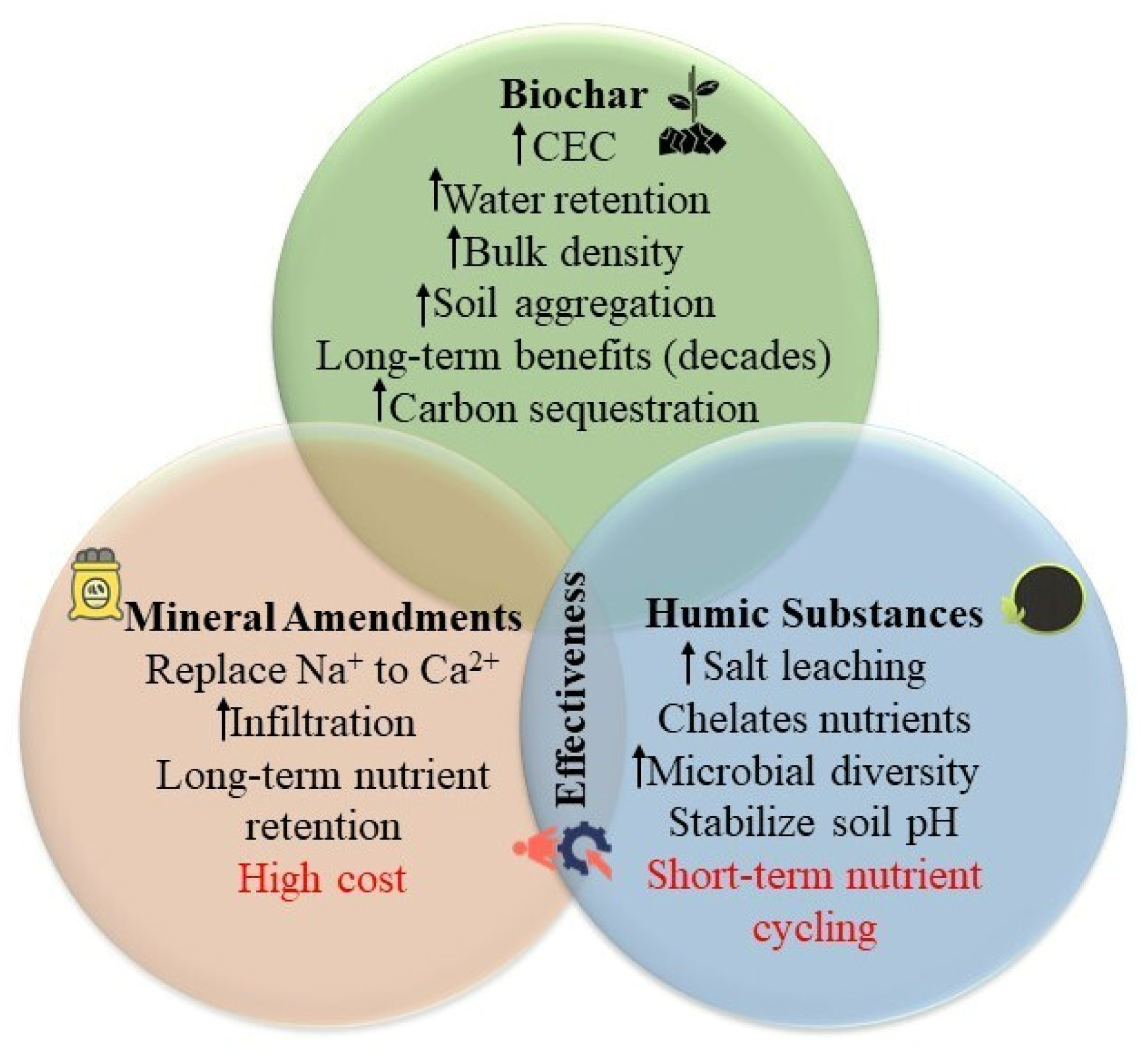
Furthermore, gypsum combined with organic additions such as compost improves nutrient cycling, increases soil organic carbon (SOC), and activates microbial biomass, all enhancing the sustainable improvement of soil fertility [14]. These enhancements to soil structures inhibit compaction, reduce the bulk density of the soil, and enhance aeration, thus creating a more hospitable environment to root formation and growth [96]. In addition, the use of gypsum has been demonstrated to reduce the EC of the soil, increase salt removal by leaching, as well as decrease the surface-crusting effects of saline soils [111]. Similarly, porous zeolites with a large surface area can be used as materials that help to retain moisture and are especially useful in regions prone to drought [26]. The ability of zeolites to bind the Na+ ions to their crystal lattice decreases the Na+ level in the soil solution, which decreases the problem of sodicity stress and increases the ability of the soil to retain moisture [112]. In addition to their functions in nutrient retention and lowering Na levels, zeolites boost P availability by holding onto NH4+ ions, which enhances the break down of organic matter, particularly when the C:N ratio is high, thereby facilitating the release of P in forms that plants can absorb [113]. The amendments are synergistic as they enhance the soil structure and increase its nutrient-holding capacity, as well as surging microbial action (Figure 6).
The integrated use of these amendments does not only cope with the primary effects of salinity, but also enhances efficiency in water consumption, nutrient cycling, and microbial activities [105]. This strategy restores ionic and osmotic balance and relieves the water–nutrient stress that forms a key constraint in salt-affected areas, owing to the stabilization of the soil aggregates’ improved CEC and also to the facilitation of moisture retention [113]. A summary of recent studies on the combined utilization of biochar, mineral amendments, and humic substances to manage salinity and factors associated with this stress is provided in Table 2. It provides an overview of data regarding the areas of study and forms of amendments, quantity of applications, periods of time, results, limitations, and crop reactions. This offers valuable information about the practical efficiency of amendment procedures integrated to regulate salt-affected soils.
The incorporation of such soil conditioners into management strategies contributes to the long-term reclamation of saline–sodic soils and promotes sustainable crop yield and increased soil stability [29]. Research to improve upon and extend these practices is needed in the future with an emphasis on determining the optimal application rates and tracking the long-term effects on microbial community structure and function. Additionally, research should assess the cost of using these amendments in relation to soil prices and their viability across various soils and climatic regions. Acquiring such knowledge is important in the development of sustainable soil management strategies that can increase resilience levels and the production of crops, and address the challenge of ensuring global food security in salt-affected ecosystems. Recent research suggests that an augmentation of biochar and humic substances with gypsum leads to a more stable soil, lower leaching loss, and high efficiency in P and N utilization [105]. In future, research needs to focus on tailoring application approaches to environmental conditions, the most efficient quantities of amendments, and the long-term interactions of these amendments to enable sustainable soil health in farming systems influenced by salt.

6. Amended Saline Soils: Geochemical Transformations

Clay particle dispersion and water stagnation in saline–sodic soils as a result of excessive Na+ induces soil structure damage [83]. Biochar reverses this by providing cation exchange sites using its oxygen-manifested functional groups (-COOH and -OH) so that Ca2+ and Mg2+ are preferentially retained compared with Na+ [122]. Furthermore, biochar contains alkaline minerals such as calcium carbonate (CaCO3) and magnesium oxide (MgO), which can stabilize soil pH and facilitate the dissolution of native calcite, to release Ca2+ ions into the soil [123]. This helps displace exchangeable Na and enhances soil structure [123]. Acid-modified biochar has displayed a reduction in ESP by 20.95 and a rise in CEC by 11.49, illustrating its potential to nullify soil geochemical balance [114]. This adjustment effectively realigns ionic reactions, impacting nutrient mobility and water cycling [30]. In addition to its impact on the physical and chemical properties of soil, biochar has significantly increased the biological activity of soil (microbially mediated processes) which is important in nutrient cycling [46]. Aeration and moisture conditions were favorable to allow microbial activity indicated by growth in enzymes such as dehydrogenase and cellulase, which are considered important indicators of oxidative metabolism and carbon cycling [124]. Such improvements in enzymes help in the decomposition of organic matter and the stabilization of SOC [125]. Biochar also stimulates nitrogen cycling by enhancing urease activity, particularly when co-applied with gypsum, which helps buffer ionic toxicity and support NH4+ retention [46]. Likewise, P availability is enhanced through an enhancement in phosphatase activity under biochar–humic blends, promoting P mineralization in saline conditions [126]. In addition, it affects the solubility of nutrients through the modulation of pH [93]. Although the use of high-temperature, alkaline biochar in the soil may increase pH, low-temperature or acidic biochar have the potential to reduce the pH in soil by 0.7159 units, driving calcite dissolution and the sequent release of Ca2+ ions [127]. Furthermore, biochar enhances redox potential (Eh) by acting as an electron shuttle, benefiting microbial respiration [123]. It also upregulates oxidative stress enzymes like catalase and superoxide dismutase, mitigating reactive oxygen species (ROS) and improving microbial resilience [128].
Biochar can play a role in general ionic rebalancing and redox stabilization when used in combination with calcium sulfate (CaSO4), vermicompost, or microbial inoculants [111]. Ca2+ released from CaSO4 displaces exchangeable Na+, decreasing ESP by 14.6%, while bicarbonate precipitates as CaCO3, reducing soil pH from 9.6 to 7.4 [109]. These geochemical shifts are paralleled by increased microbial biomass and enzymatic activity, particularly those associated with carbon and N transformations, including dehydrogenase and nitrate reductases [30]. Improved redox conditions stimulate enzymes like peroxidase and polyphenol oxidase, which break down lignin, accelerate organic matter decomposition, and enhance the release of nutrients in the soil [3]. Another geochemical influence is the enhancement of SOC stability. Biochar contributes directly to SOC and also reduces its decomposition by physically protecting organic matter within soil aggregates and chemically bonding with mineral surfaces [40]. In biochar-treated saline soils, the accumulation of microbial necromass contributing as much as 32% of total SOC plays a key role in boosting long-term carbon storage [87]. Nutrient cycling is enhanced as biochar increases P and K availability, both by supplying nutrients and preventing their fixation in salty environments [127]. Furthermore, biochar use has been found to elevate available P by 39.9% and K by 37.7%, tackling typical nutrient shortages in salt-impacted soils [87]. These interrelated geochemical shifts, such as ion balance restoration, shifts in redox potential, and alterations in microbial communities, work together to enhance soil fertility and lessen the effects of salinity [18]. However, the study emphasizes the need for field-level validation to determine the long-term persistence of these benefits, especially in deeper soil layers that are not directly treated with biochar. Moreover, conducting comprehensive life cycle assessments is essential to evaluate the environmental and economic sustainability of applying biochar at scale for reclaiming saline soils.
Meanwhile, gypsum reclaims sodic soils through three interconnected geochemical processes. First, its dissolution releases Ca2+ and SO42− ions into the soil solution [9].
The liberated Ca2+ drives cation exchange, displacing Na+ from clay surface and improving structure (Equation (3) [9]).
2Clay–Na+ + Ca2+ → Clay–Ca2+ + 2Na+
Simultaneously, the released SO42− can keep the levels of critical important electrolytes sufficient so as to avoid the dispersion of the clays via improved ionic strength. This electrolyte effect sustains hydraulic conductivity even under leaching conditions (Equation (4) [9]).
CaCO3 + H2O + CO2 → Ca2+ + 2HCO3
The combined sources of Ca2+ contribute to the stabilization of soil structure through enhanced flocculation. While limestone raises soil pH and superphosphate lowers it, together they help maintain a neutral pH range (6.5–7.5), which is important for minimizing the risk of metal mobilization [10]. Over time, the gradual dissolution of gypsum ensures a continuous release of Ca2+ for sustained Na+ displacement, while the downward migration of SO42− enhances the remediation of subsoil sodicity [129]. This dual process, involving the immediate surface exchange of cations and delayed delivery to lower horizons, makes gypsum highly effective in arid conditions [116]. It prevents re-sodification after reclamation and supports long-term soil fertility [130]. As sodicity decreases, associated microbial stress is alleviated, enabling the recovery of enzymatic systems sensitive to ionic imbalances, notably dehydrogenase and urease [131]. In calcareous soils, the co-dissolution of native CaCO3 also enhances pH buffering and thus supports the stability of enzymatic functions associated with N and P cycling [113]. Field evaluations consistently demonstrate gypsum’s superiority over more soluble amendments in maintaining hydraulic conductivity and enhancing crop yields across multiple growing seasons [10]. In arid environments, artificial zeolite (AZ) effectively mitigates sodicity through targeted Na+-Ca2+ exchange reactions [132]. This exchange process is promoted by the material’s high CEC and selective Na+ removal, primarily through cation exchange (not adsorption), owing to its optimal pore size. As a result, AZ can reduce the ESP by 40–60%, even under limited leaching conditions [77]. The gradual release of Ca2+ from AZ’s aluminosilicate framework stabilizes soil aggregates, increasing mean weight diameter by 20–35% in smectite soils, while reducing surface seal formation by 50–70% via the modulation of surface charge. This leads to a 2.5-fold increase in saturated hydraulic conductivity (Ks) [132]. During episodic rainfall, AZ enhances microaggregate cohesion, reducing sediment concentration in runoff by 30–50%. It also decreases runoff salinity by up to 60%, mainly through Na+ retention within its porous matrix [75]. This same porosity also improves soil moisture retention, promoting microbial colonization and activity [133]. These favorable microhabitats, in turn, support the enhanced activity of nutrient-cycling enzymes, particularly phosphatase and urease, which are critical for P mineralization and N transformation [133]. These enzymatic enhancements are especially notable when AZ is co-applied with organic compost, where synergistic interactions further enhance nutrient turnover and microbial efficiency [75]. In dryland systems, the evaporation-driven cycling of Ca2+ ions occur as water evaporates, causing Ca to be released and circulated in the soil. This process enhances the effectiveness of AZ by improving soil structure and nutrient availability, which supports better plant growth and soil stability [26]. Meanwhile, its wind-stable particle size (100–300 μm) helps reduce particulate matter emissions by 45%, contributing to improved air quality in dryland systems [132]. Field applications in arid soils have demonstrated an optimal performance at 5–10% AZ application by weight, with an up to 25% improvement in calcium retention when combined with compost—demonstrating AZ’s dual role in sodicity remediation and erosion control under water-limited conditions [133]. Meanwhile, humic acid mitigates salinity stress through a combination of geochemical and biological pathways [119]. In calcareous and saline–sodic soils, humic acid improves micronutrient bioavailability, modifies cation exchange dynamics, and enhances redox buffering capacity [134]. Its -COOH and -OH functional groups chelate metal ions such as Zn2+, Fe3+, and Cu2+, preventing their precipitation as hydroxides or carbonates [135]. The formation of Zn-HA complexes is particularly stable, with a log K (equilibrium constant) value ranging from 4.2 to 5.8 at pH 7.5–8.5, promoting micronutrient availability under alkaline conditions [135]. Simultaneously, humic acid facilitates Na+ displacement through Ca2+–humate complexes, facilitating aggregate flocculation and the structural repair of sodic soils [107]. Humic acid also induces rhizosphere acidification, reducing pH by 0.1–0.3 units at rates of 100 kg ha−1, and this action increases the solubility of Fe and Mn [135]. This humic acid-mediated acidification effect is attributed to its ability to increase proline accumulation [136]. Proline helps with pH buffering and osmotic balance in the cell, with a relative increase of 7.55% under saline conditions [136]. Humic acids also help microbes in the reduction of Fe3+ and Mn4+ oxides through their quinone groups, and this facilitates redox processes in anaerobic and salt-affected soils [137]. These redox reactions help to lower reactive oxygen species levels and activate the antioxidant enzymes catalase, peroxidase, and superoxide dismutase (SOD), contributing to better microbial stability and performance in a saline environment [138]. Beyond its role in redox balance and structural enhancement, humic acid also supports nutrient cycling [21]. The increase in phosphatase and oxidoreductase levels after humic acid application indicates improved P availability and microbial respiration [119]. This is particularly beneficial in saline soils with ionic imbalances and micronutrient deficiencies [21]. It also helps in soil aggregation and lowering ESP by linking clay particles through Ca2+ and Mg2+ ions. Its ability to occupy binding sites on soil colloids also helps mitigate Na toxicity [139]. Additionally, humic acids can complex with Al3+ and Cu2+ ions under certain conditions, helping regulate soil pH and reduce metal mobility. This promotes biochemical stability in soils affected by salinity or acidity [119]. These activities highlight the role of humic acids in ion balance homeostasis, redox regulation, and enzyme activity, turning it into an effective amendment for enhancing soil resilience, microorganism efficiency, and nutrient uptake in saline-impaired soils [66]. It is even more effective when used with mineral amendments like gypsum or zeolite, as the combination significantly improves soil attributes and crop yields in saline environments [140]. These minerals provide important divalent cations, add to the displacement effect of Na, and contribute to the chelating effects of humic acids [141].
Fulvic acids play a key role in shaping the geochemical behavior of saline soils by influencing metal ion binding, speciation, and mobility [142]. These processes are governed by pH-dependent and competitive interaction mechanisms [137]. As a low-molecular-weight fraction of soil organic matter, fulvic acid is rich in oxygen-containing functional groups notably carboxyl and phenolic moieties that confer a high complexation capacity, particularly with metal ions [140]. Fulvic acid is particularly relevant to regulating the ion exchange and metal speciation of soil solution in a saline soil environment [143]. It has a tendency to form stable inner-sphere complexes with toxic metals such as lead (Pb2+), hence, immobilizing the toxic metal and restricting spreading to plants and the microbial community [137]. Metal adsorption is highly dependent on pH with higher adsorptions being caused above pH 4.5. This is due to the protonation of functional groups, which reduces the availability of binding sites [144]. Fulvic acids bind to Ca2+ ions, in most cases, more weakly than to heavy metals and are characterized by gated outer-sphere interactions that are easily affected by ionic strength changes [143]. In the case of saline soils with high amounts of either Na+ or K+, the electrical double layer around the fulvic acid layer shrinks in size, impairing its capacity to hold Ca2+ and the migration of calcium ions in the soil solution [145]. The equilibration between Ca2+ and other divalent cations over the binding sites is also considerably eminent in influencing the geochemical phenomena of saline soils [146]. Given the central role of Ca2+ in aggregate flocculation and soil structural integrity, these interactions have far-reaching implications for soil physical stability and nutrient accessibility [147]. Although these amendments effectively alter geochemical processes in saline soils, gaps remain in understanding their long-term geochemical stability, particularly in subsurface horizons. The coupled effects on ion exchange, pH buffering, and micronutrient mobility under field conditions are still poorly quantified [9]. Future research should emphasize depth-specific geochemical monitoring, as the effectiveness of such approaches depends on the source of salinity. In cases where salinity originates from a saline subsoil, deep rooting may not be an effective solution. Additionally, research should focus on the interactive effects of combined amendments to better predict soil behavior and optimize amendment strategies under variable salinity regimes.

7. Practical Considerations and Long-Term Viability and Sustainability

Soil amendments for saline soil remediation should be critically evaluated using a multi-factor approach. This approach should consider agronomic effectiveness, economic profitability, energy intensity, and ultimate long-term viability and sustainability. Although the ability of these amendments to improve soil structure, nutrient retention, and crop yield in saline conditions has been proven by several field studies, their implementation in practice depends on their site-specific long-term behavior, optimization at the site, and the perception of cost benefits [148]. The long-term use and performance of these amendments largely remain dependent on their chemical properties, their contact with native soil minerals, and factors related to climate (temperature, precipitation, irrigation systems, etc.) [136]. This knowledge can be essential in optimizing the use of amendments to ensure the long-term recovery of soil and its productivity. Specifically, biochar is characterized by long-term stability in soils, and its effects remain over many decades or centuries because of its recalcitrant carbon structure [149]. Experimental investigations have indicated that the largest impacts of applying biochar on enhancing soil moisture, nutrient status, and enhanced structural stability typically occur within the first 3–6 years [150]. These effects are primarily due to biochar’s direct physical properties, including its high surface area and porosity, which immediately affect water retention and nutrient-holding capacity [58]. However, the full range of biochar’s benefits may take decades or even centuries to be fully realized [106]. These longer-term benefits are linked to more complex and slower processes, such as the gradual transformation of biochar into stable organic matter through microbial and chemical processes, as well as the accumulation of soil organic carbon over extended periods [149]. It suggests that intermittent treatment should be reapplied to sustain and accumulate the advantage of the original treatment during several intervals [65]. In comparison, humic substances, especially humic acids and fulvic acids, deteriorate more quickly, and their impact typically lasts between several months and a couple of years. Consequently, they have to be utilized at a higher frequency to continue with their positive effects on soil aggregation, microbial activity, and nutrient availability [86]. Depending on their solubility and interactions with other soil components, mineral amendments like gypsum and zeolites affect the management of soil salinity and nutrient retention [19]. Moderate solubility enables gypsum to provide Ca2+ ions that replace Na+ ions in the soil, which enhances soil structure and water drainage in saline–sodic soil in arid environments [54]. Over a longer time scale, the effectiveness of gypsum might decline due to it leaching out of the soil profile, hence it requires frequent reapplication [118]. On the contrary, zeolites are long-term cation exchangers that continuously release valuable nutrients and they primarily exchange cations such as Na+ ions, mitigating the sodic soils conditions [151].
Biochar is characterized by a high initial cost of production and its long-term impacts on porosity and water retention as well as nutrient cycling and carbon sequestration [152]. It directly contributes to building up stable soil carbon over time [65]. When derived from renewable agricultural residues, biochar contributes to circular bio-economies and offsets its energy-intensive production through lasting soil improvements [65]. Optimized application rates (e.g., 8 t ha−1) have demonstrated strong economic returns, with IRRs exceeding 85%, and favorable benefit–cost ratios [83]. In addition to economics, its polyaromatic structure makes it less susceptible to microbial degradation and its stable carbon content varies between 40 and 76% depending on pyrolysis conditions [150]. In contrast, humic substances offer a more cost-effective and energy-efficient alternative. However, they require repeated applications due to their dynamic behavior in variable environments [105]. Their persistence and chelating functionality are closely tied to soil type, moisture regime, and ionic composition [146]. Their chemical and molecular heterogeneity, as well as their affinity to bind polyvalent cations, make them structurally and chemically stable. This increases their long-term operational input [153]. The recent developments in synthetic humic substances provide an unprecedented chance to optimize carbon stabilization in soil aggregates and to increase its permanence [95].
In sodic soils, gypsum is an effective amendment as its dissolution releases Ca2+ ions, displacing exchangeable Na+ ions from soil colloids and promoting clay particle flocculation. However, gypsum use poses environmental challenges, including the impact of mining and transportation, and the risk of excess Ca2+ in fine-textured soils [80].
Such challenges show the necessity to apply them carefully and in a site-specific manner to prevent long-term problems such as soil compaction and chemical imbalances. Although their initial costs are higher than those of its alternative, zeolites serve as durable geochemical stabilizers because they have great proportions of cation exchange ability, a stable structure, and micro-porosity. They are also effective in storing ammonium and potassium and cutting nutrient losses, which makes them contribute to the decreased use of fertilizers and long-term soil fertility [76]. Zeolite efficiency requires accurate application, making their wrong application interrupt nutrient proportions [77].
These amendments differ considerably in relation to their energy use and footprint. While biochar production is energy-intensive, it consumes renewable biomass, whereas gypsum and zeolites are non-renewable minerals contributing to increased transportation emissions [72]. Combined amendment approaches are recognized as a sustainable solution, one that seeks to attain the maximum synergistic effect via the combination of various substances [107]. Biochar combined with gypsum, humic substances, or zeolites increases nutrient availability and fosters beneficial microorganisms in soil. This improves soil structure and reduces ionic stress [153]. Combinations of amendments can be tailored to individual soil types, salinity, and crop traits, optimizing resource use with fewer inputs required and in a way that successfully rehabilitates saline soils [56]. These holistic solutions can significantly reduce greenhouse gas emissions, particularly nitrous oxide (N2O), by enhancing nitrogen retention and controlling microbial activity [90]. Studies show that biochar amendments can reduce N2O emissions by 30–50%, depending on biochar properties and soil conditions. This reduction is mainly due to decreased denitrification and promoted nitrification inhibition in soils [40]. A complete assessment of the lifespan of these amendments must look at sustainability parameters like the sequestering of carbon, the frequency of their application, economic feasibility, and potential environmental impacts. To assist farmers to embrace these practices, specific policy interventions, local policies, and powerful systems of knowledge exchange are imperative. Of all the measures, biochar has the potential to offer long-term effects in terms of agronomical, environmental, and ecological benefits. As a consequence, it is the focus of sustainable systems for saline soil management [154]. A holistic assessment of agronomic results, economic practicability, energy input, and long-term sustainability is essential when applying soil amendments like biochar, humic substances, gypsum, and zeolites for saline soil reclamation [155]. Field experiments have demonstrated the value of biochar in improving soil structure, nutrient retention, and crop yields in saline soils. However, the best application approach in these conditions depends on site-specific optimization and a cost/benefit analysis [148].

8. Conclusions

Soil salinization, compounded by nutrient imbalances and water stress, poses a critical threat to agricultural sustainability, particularly in arid and semi-arid ecosystems. This review has addressed key research gaps by systematically evaluating the effectiveness, mechanisms, and long-term sustainability of various soil amendments in mitigating salinity and restoring soil functionality. A particular emphasis was placed on how these amendments alter geochemical processes, improve soil physical properties, enhance nutrient availability, and support microbial resilience under saline conditions. First, we elucidated the distinct and complementary roles of organic (biochar, humic substances) and inorganic (gypsum) amendments in displacing Na+ ions, improving CEC, regulating pH, and enhancing water and nutrient dynamics. Second, we highlighted mechanistic pathways, ion exchange, mineral dissolution, chelation, and redox regulation, through which these amendments modulate soil chemistry and biology to alleviate osmotic and ionic stress. Third, we demonstrated that integrating biochar with humic acids or gypsum yields better outcomes than individual treatments, enhancing soil structure stabilization, nutrient cycling, and crop performance. This review highlighted persistent challenges, including the lack of long-term field validation of amendment effects, the insufficient understanding of geochemical transformations, and limited guidance on optimizing amendments based on site-specific salinity and soil texture. By consolidating findings across various agroecological contexts, this study provides a conceptual framework for the selection and integration of soil amendments tailored to specific salinity stressors and co-occurring nutrient deficiencies. This review also presents emerging insights into geochemical transformations induced by these amendments, such as enhanced mineral weathering and enzyme activity, which collectively support sustainable soil rehabilitation. It lays a scientific foundation for developing integrated, site-adapted soil management strategies that reconcile agricultural productivity with environmental sustainability. Future research should prioritize multi-seasonal, field-scale experiments, and the development of decision support tools to guide practitioners in deploying amendment technologies effectively. By doing so, we can move toward holistic and resilient soil restoration practices that support global food security in the face of increasing salinization and climate variability.
(1)
Despite growing evidence supporting the use of soil amendments in saline soil remediation, several key challenges continue to limit their optimization and scalability. One major issue is the site-specific variability in amendment performance, influenced by soil texture, salinity type, climate, and water regime. There is still limited knowledge on the long-term geochemical impacts, i.e., redox reactions, ion exchange actions, and solubility of nutrients, particularly in evolving climatic conditions. Future investigations should concentrate on exploring the enduring geochemical consequences of soil amendments under diverse climatic conditions. Moreover, approaches should be adapted to specific regional soil properties and climatic variables to enhance scalability and efficacy.
(2)
The persistence and functionality of amendments also vary significantly. Biochar has long-term stability, although its performance varies with the feedstock and pyrolysis conditions. Meanwhile, humic substances break down fast, necessitating re-application and an increase in cost. Also, there is a possibility of zeolites attaining an ion saturation point and gypsum can cause the subsequent adsorption of calcium, which also requires a monitoring framework and optimization of the dosage. Future research should focus on refining application rates. Furthermore, context-specific strategies must be devised to account for feedstock variations, pyrolysis conditions, and ion saturation thresholds.
(3)
Combined applications are often more beneficial than single treatments in improving soil health and nutrient dynamics, as they promote synergistic interactions that enhance nutrient availability and microbial activity (e.g., biochar can improve the retention of nutrients added through compost, while gypsum can help mobilize Ca and improve soil structure when combined with organic matter [99]). Few studies investigate the geochemical mechanisms driving these interactions. Current models still fail to fully capture the combined effects of ionic rebalancing and pH regulation essential to long-term soil recovery. Future studies should explore the geochemical mechanisms of combined applications to clarify their impact on soil health.
(4)
On the practical side, cost, accessibility, and energy use remain significant barriers in resource-limited areas. In addition, quality control, especially for biochar- and gypsum-induced imbalances, requires stronger regulatory standards. Future initiatives should aim to mitigate costs and enhance accessibility, particularly in resource-deficient areas. Moreover, stringent regulatory frameworks are essential to ensure quality control, particularly concerning biochar- and gypsum-induced imbalances.
Tackling these challenges is essential to harness the full potential of integrated amendment strategies for reversing soil salinity, restoring geochemical balance, and supporting climate-resilient agriculture.

Supplementary Materials

The following supporting information can be downloaded at: https://www.mdpi.com/article/10.3390/agronomy16020222/s1, Table S1. Assigning values of each soil property for soil amendments [156,157,158,159,160,161,162,163,164,165,166,167]. Table S2: Costs of amendments [168,169,170,171,172,173,174]. Table S3: Distribution of publications on salinization and arid environments by year (Web of Science: https://www.webofscience.com). Figure S1: Trends in research publications on soil salinization and arid land (1999–2025).

Author Contributions

A.B.: Writing—original draft, Investigation, Visualization, Data curation. K.Z.: Writing—review and editing, Visualization, Conceptualization. F.A.: Writing—review and editing. A.A.: Writing—reviewing and editing. J.M.: Writing—review and editing, Supervision, Funding acquisition, Conceptualization. All authors have read and agreed to the published version of the manuscript.

Funding

This work was supported by Key Research and Development Program of Xinjiang Uygur Autonomous Region (Grant Number; 2023B02002), Tianshan Talent Training Program (Grant Number; 2023TSYCCX0080), and ANSO Scholarship for Young Talents.

Data Availability Statement

Not applicable.

Conflicts of Interest

The authors declare that they have no known competing financial interests or personal relationships that could have appeared to influence the work reported in this paper.

References

  1. Eswar, D.; Karuppusamy, R.; Chellamuthu, S. Drivers of Soil Salinity and Their Correlation with Climate Change. Curr. Opin. Environ. Sustain. 2021, 50, 310–318. [Google Scholar] [CrossRef]
  2. Shokri, N.; Hassani, A.; Sahimi, M. Multi-Scale Soil Salinization Dynamics from Global to Pore Scale: A Review. Rev. Geophys. 2024, 62, e2023RG000804. [Google Scholar] [CrossRef]
  3. Heidari, A.; Samiei-Fard, R. Geochemical Characteristics of Saline Soils Formed during the Recent Retreat of the Caspian Sea. CATENA 2024, 243, 108208. [Google Scholar] [CrossRef]
  4. Kang, J.; Peng, Y.; Xu, W. Crop Root Responses to Drought Stress: Molecular Mechanisms, Nutrient Regulations, and Interactions with Microorganisms in the Rhizosphere. Int. J. Mol. Sci. 2022, 23, 9310. [Google Scholar] [CrossRef]
  5. FAO. Global Status of Salt-Affected Soils; Food and Agriculture Organization of the United Nations: Rome, Italy, 2024; ISBN 978-92-5-139307-9. [Google Scholar]
  6. Batlle-Sales, J. Salt-Affected Soils: A Sustainability Challenge in a Changing World. Ital. J. Agron. 2023, 18, 2188. [Google Scholar] [CrossRef]
  7. Shahane, A.A.; Shivay, Y.S. Soil Health and Its Improvement Through Novel Agronomic and Innovative Approaches. Front. Agron. 2021, 3, 680456. [Google Scholar] [CrossRef]
  8. Okur, B.; Örçen, N. Soil Salinization and Climate Change. In Climate Change and Soil Interactions; Elsevier: Amsterdam, The Netherlands, 2020; pp. 331–350. ISBN 978-0-12-818032-7. [Google Scholar]
  9. Abdennour, M.A.; Douaoui, A.; Barrena, J.; Pulido, M.; Bradaï, A.; Bennacer, A.; Piccini, C.; Alfonso-Torreño, A. Geochemical Characterization of the Salinity of Irrigated Soils in Arid Regions (Biskra, SE Algeria). Acta Geochim. 2021, 40, 234–250. [Google Scholar] [CrossRef]
  10. Osman, K.T. Saline and Sodic Soils. In Management of Soil Problems; Springer International Publishing: Cham, Switzerland, 2018; pp. 255–298. ISBN 978-3-319-75525-0. [Google Scholar]
  11. Srivastava, R.K.; Purohit, S.; Alam, E.; Islam, M.K. Advancements in Soil Management: Optimizing Crop Production through Interdisciplinary Approaches. J. Agric. Food Res. 2024, 18, 101528. [Google Scholar] [CrossRef]
  12. Bhaduri, D.; Sihi, D.; Bhowmik, A.; Verma, B.C.; Munda, S.; Dari, B. A Review on Effective Soil Health Bio-Indicators for Ecosystem Restoration and Sustainability. Front. Microbiol. 2022, 13, 938481. [Google Scholar] [CrossRef]
  13. Feng, Z.; Miao, Q.; Shi, H.; Li, X.; Yan, J.; Gonçalves, J.M.; Dai, L.; Feng, W. Irrigation Scheduling in Sand-Layered Farmland: Evaluation of Water and Salinity Dynamics in the Soil by SALTMED-1D Model under Mulched Maize Production in Hetao Irrigation District, China. Eur. J. Agron. 2024, 157, 127177. [Google Scholar] [CrossRef]
  14. Bello, S.K.; Alayafi, A.H.; AL-Solaimani, S.G.; Abo-Elyousr, K.A.M. Mitigating Soil Salinity Stress with Gypsum and Bio-Organic Amendments: A Review. Agronomy 2021, 11, 1735. [Google Scholar] [CrossRef]
  15. Elmeknassi, M.; Elghali, A.; De Carvalho, H.W.P.; Laamrani, A.; Benzaazoua, M. A Review of Organic and Inorganic Amendments to Treat Saline-Sodic Soils: Emphasis on Waste Valorization for a Circular Economy Approach. Sci. Total Environ. 2024, 921, 171087. [Google Scholar] [CrossRef]
  16. Zabed Hossain, M.; Md Anawar, H.; Chaudhary, D.R. Climate Change and Legumes: Stress Mitigation for Sustainability and Food Security, 1st ed.; CRC Press: Boca Raton, FL, USA, 2023; ISBN 978-1-00-321488-5. [Google Scholar]
  17. Yang, C.; Liu, J.; Lu, S. Pyrolysis Temperature Affects Pore Characteristics of Rice Straw and Canola Stalk Biochars and Biochar-Amended Soils. Geoderma 2021, 397, 115097. [Google Scholar] [CrossRef]
  18. Tang, K.H.D. Biochar Amendments for Soil Restoration: Impacts on Nutrient Dynamics and Microbial Activity. Environments 2025, 12, 425. [Google Scholar] [CrossRef]
  19. Acharya, B.S.; Dodla, S.; Wang, J.J.; Pavuluri, K.; Darapuneni, M.; Dattamudi, S.; Maharjan, B.; Kharel, G. Biochar Impacts on Soil Water Dynamics: Knowns, Unknowns, and Research Directions. Biochar 2024, 6, 34. [Google Scholar] [CrossRef]
  20. Wang, L.; Ok, Y.S.; Tsang, D.C.W.; Alessi, D.S.; Rinklebe, J.; Mašek, O.; Bolan, N.S.; Hou, D. Biochar Composites: Emerging Trends, Field Successes and Sustainability Implications. Soil Use Manag. 2022, 38, 14–38. [Google Scholar] [CrossRef]
  21. Li, T.; Cui, L.; Filipović, V.; Tang, C.; Lai, Y.; Wehr, B.; Song, X.; Chapman, S.; Liu, H.; Dalal, R.C.; et al. From Soil Health to Agricultural Productivity: The Critical Role of Soil Constraint Management. CATENA 2025, 250, 108776. [Google Scholar] [CrossRef]
  22. Gao, Z.-W.; Ding, J.; Ali, B.; Nawaz, M.; Hassan, M.U.; Ali, A.; Rasheed, A.; Khan, M.N.; Ozdemir, F.A.; Iqbal, R.; et al. Putting Biochar in Action: A Black Gold for Efficient Mitigation of Salinity Stress in Plants. Review and Future Directions. ACS Omega 2024, 9, 31237–31253. [Google Scholar] [CrossRef]
  23. Malik, Z.; Malik, N.; Noor, I.; Kamran, M.; Parveen, A.; Ali, M.; Sabir, F.; Elansary, H.O.; El-Abedin, T.K.Z.; Mahmoud, E.A.; et al. Combined Effect of Rice-Straw Biochar and Humic Acid on Growth, Antioxidative Capacity, and Ion Uptake in Maize (Zea mays L.) Grown Under Saline Soil Conditions. J. Plant Growth Regul. 2023, 42, 3211–3228. [Google Scholar] [CrossRef]
  24. Leogrande, R.; Vitti, C. Use of Organic Amendments to Reclaim Saline and Sodic Soils: A Review. Arid Land Res. Manag. 2019, 33, 1–21. [Google Scholar] [CrossRef]
  25. Cairo-Cairo, P.; Diaz-Martin, B. Fertility and Mineralogy of an Aridisol Soil under Agroecological Management. Commun. Soil Sci. Plant Anal. 2019, 50, 1710–1721. [Google Scholar] [CrossRef]
  26. Javaid, A.; Munir, N.; Abideen, Z.; Siddiqui, Z.S.; Yong, J.W.H. The Role of Natural and Synthetic Zeolites as Soil Amendments for Mitigating the Negative Impacts of Abiotic Stresses to Improve Agricultural Resilience. Plant Stress 2024, 14, 100627. [Google Scholar] [CrossRef]
  27. Adhikari, S.; Timms, W.; Mahmud, M.A.P. Optimising Water Holding Capacity and Hydrophobicity of Biochar for Soil Amendment—A Review. Sci. Total Environ. 2022, 851, 158043. [Google Scholar] [CrossRef] [PubMed]
  28. Shahbazi, F.; Shahbazi, S.; Nadimi, M.; Paliwal, J. Losses in Agricultural Produce: A Review of Causes and Solutions, with a Specific Focus on Grain Crops. J. Stored Prod. Res. 2025, 111, 102547. [Google Scholar] [CrossRef]
  29. Diacono, M.; Montemurro, F. Long-Term Effects of Organic Amendments on Soil Fertility. In Sustainable Agriculture Volume 2; Lichtfouse, E., Hamelin, M., Navarrete, M., Debaeke, P., Eds.; Springer: Dordrecht, The Netherlands, 2011; pp. 761–786. ISBN 978-94-007-0393-3. [Google Scholar]
  30. Zhang, G.; Bai, J.; Zhai, Y.; Jia, J.; Zhao, Q.; Wang, W.; Hu, X. Microbial Diversity and Functions in Saline Soils: A Review from a Biogeochemical Perspective. J. Adv. Res. 2024, 59, 129–140. [Google Scholar] [CrossRef]
  31. Yan, S.; Jiang, H.; Li, J.; Yan, C.; Ma, C.; Zhang, Z.; Gong, Z. Effect of Short-Term Organic Matter Returns on Soil Organic Carbon Fractions, Phosphorus Fractions and Microbial Community in Cold Region of China. Agronomy 2023, 13, 2805. [Google Scholar] [CrossRef]
  32. Yu, Y.; Li, X.; Zhao, C.; Zheng, N.; Jia, H.; Yao, H. Soil Salinity Changes the Temperature Sensitivity of Soil Carbon Dioxide and Nitrous Oxide Emissions. CATENA 2020, 195, 104912. [Google Scholar] [CrossRef]
  33. Li, J.; Pu, L.; Han, M.; Zhu, M.; Zhang, R.; Xiang, Y. Soil Salinization Research in China: Advances and Prospects. J. Geogr. Sci. 2014, 24, 943–960. [Google Scholar] [CrossRef]
  34. Ondrasek, G.; Rengel, Z. Environmental Salinization Processes: Detection, Implications & Solutions. Sci. Total Environ. 2021, 754, 142432. [Google Scholar] [CrossRef]
  35. Delgado, A.; Gómez, J.A. The Soil: Physical, Chemical, and Biological Properties. In Principles of Agronomy for Sustainable Agriculture; Villalobos, F.J., Fereres, E., Eds.; Springer International Publishing: Cham, Switzerland, 2024; pp. 15–30. ISBN 978-3-031-69149-2. [Google Scholar]
  36. Hopmans, J.; Qureshi, A.S.; Kisekka, I.; Munns, R.; Grattan, S.; Rengasamy, P.; Ben-Gal, A.; Assouline, S.; Javaux, M.; Minhas, P.; et al. Critical Knowledge Gaps and Research Priorities in Global Soil Salinity. In Advances in Agronomy; Elsevier: Amsterdam, The Netherlands, 2021; Volume 169, pp. 1–191. ISBN 978-0-12-824590-3. [Google Scholar]
  37. Khondoker, M.; Mandal, S.; Gurav, R.; Hwang, S. Freshwater Shortage, Salinity Increase, and Global Food Production: A Need for Sustainable Irrigation Water Desalination—A Scoping Review. Earth 2023, 4, 223–240. [Google Scholar] [CrossRef]
  38. Xu, G.; Zhang, Y.; Sun, J.; Shao, H. Negative Interactive Effects between Biochar and Phosphorus Fertilization on Phosphorus Availability and Plant Yield in Saline Sodic Soil. Sci. Total Environ. 2016, 568, 910–915. [Google Scholar] [CrossRef] [PubMed]
  39. Haj-Amor, Z.; Araya, T.; Kim, D.-G.; Bouri, S.; Lee, J.; Ghiloufi, W.; Yang, Y.; Kang, H.; Jhariya, M.K.; Banerjee, A.; et al. Soil Salinity and Its Associated Effects on Soil Microorganisms, Greenhouse Gas Emissions, Crop Yield, Biodiversity and Desertification: A Review. Sci. Total Environ. 2022, 843, 156946. [Google Scholar] [CrossRef] [PubMed]
  40. Li, S.; Wang, S.; Fan, M.; Wu, Y.; Shangguan, Z. Interactions between Biochar and Nitrogen Impact Soil Carbon Mineralization and the Microbial Community. Soil Tillage Res. 2020, 196, 104437. [Google Scholar] [CrossRef]
  41. Berhe, A.A.; Barnes, R.T.; Six, J.; Marín-Spiotta, E. Role of Soil Erosion in Biogeochemical Cycling of Essential Elements: Carbon, Nitrogen, and Phosphorus. Annu. Rev. Earth Planet. Sci. 2018, 46, 521–548. [Google Scholar] [CrossRef]
  42. Jobbágy, E.G.; Tóth, T.; Nosetto, M.D.; Earman, S. On the Fundamental Causes of High Environmental Alkalinity (pH ≥ 9): An Assessment of Its Drivers and Global Distribution. Land Degrad. Dev. 2017, 28, 1973–1981. [Google Scholar] [CrossRef]
  43. Liu, Z.; Li, J.; Zhang, Y.; Gong, H.; Hou, R.; Sun, Z.; Ouyang, Z. Soil Microbes from Saline–Alkali Farmland Can Form Carbonate Precipitates. Agronomy 2023, 13, 372. [Google Scholar] [CrossRef]
  44. Li, Y.; Li, W.; Jiang, L.; Li, E.; Yang, X.; Yang, J. Salinity Affects Microbial Function Genes Related to Nutrient Cycling in Arid Regions. Front. Microbiol. 2024, 15, 1407760. [Google Scholar] [CrossRef]
  45. Gantayat, R.R.; Elumalai, V. Salinity-Induced Changes in Heavy Metal Behavior and Mobility in Semi-Arid Coastal Aquifers: A Comprehensive Review. Water 2024, 16, 1052. [Google Scholar] [CrossRef]
  46. Zhou, J.-M. The Relationship between Soil pH and Geochemical Components. Environ. Earth Sci. 2024, 83, 402. [Google Scholar] [CrossRef]
  47. Kaushal, S.S.; Likens, G.E.; Mayer, P.M.; Shatkay, R.R.; Shelton, S.A.; Grant, S.B.; Utz, R.M.; Yaculak, A.M.; Maas, C.M.; Reimer, J.E.; et al. The Anthropogenic Salt Cycle. Nat. Rev. Earth Environ. 2023, 4, 770–784. [Google Scholar] [CrossRef]
  48. Litalien, A.; Zeeb, B. Curing the Earth: A Review of Anthropogenic Soil Salinization and Plant-Based Strategies for Sustainable Mitigation. Sci. Total Environ. 2020, 698, 134235. [Google Scholar] [CrossRef] [PubMed]
  49. Ahmed, M.; Hasanuzzaman, M.; Raza, M.A.; Malik, A.; Ahmad, S. Plant Nutrients for Crop Growth, Development and Stress Tolerance. In Sustainable Agriculture in the Era of Climate Change; Roychowdhury, R., Choudhury, S., Hasanuzzaman, M., Srivastava, S., Eds.; Springer International Publishing: Cham, Switzerland, 2020; pp. 43–92. ISBN 978-3-030-45668-9. [Google Scholar]
  50. Thangavelu, R.M.; Da Silva, W.L.; Zuverza-Mena, N.; Dimkpa, C.O.; White, J.C. Nano-Sized Metal Oxide Fertilizers for Sustainable Agriculture: Balancing Benefits, Risks, and Risk Management Strategies. Nanoscale 2024, 16, 19998–20026. [Google Scholar] [CrossRef] [PubMed]
  51. Toor, M.D.; Ur Rehman, M.; Abid, J.; Nath, D.; Ullah, I.; Basit, A.; Ud Din, M.M.; Mohamed, H.I. Microbial Ecosystems as Guardians of Food Security and Water Resources in the Era of Climate Change. Water Air Soil Pollut. 2024, 235, 741. [Google Scholar] [CrossRef]
  52. Uphoff, N.T.; Thies, J. (Eds.) Biological Approaches to Regenerative Soil Systems, 2nd ed.; CRC Press: Boca Raton, FL, USA, 2024; ISBN 978-1-00-309371-8. [Google Scholar]
  53. Da Costa, M.V.; De Medeiros, J.F.; Da Silva, E.F.; Da Costa Ferreira, A.K.; De Morais Cavalcante Neitzke, P.R.; Da Paz Rodrigues, K.K.R.; Da Silva Sá, F.V.; De Almeida Ferreira, E.; De Freitas, D.F.; Dos Santos, L.A.V.; et al. Comparative Analysis of Marine and Agricultural Gypsum as Nutrient Sources: Feasibility of Marine Gypsum as a Substitute for Acid Sandy Soils and Sodic Soil Recovery. Environ. Sci. Pollut. Res. 2025, 32, 5800–5822. [Google Scholar] [CrossRef] [PubMed]
  54. Shruthi; Prakash, N.B.; Dhumgond, P.; Goiba, P.K.; Laxmanarayanan, M. The Benefits of Gypsum for Sustainable Management and Utilization of Acid Soils. Plant Soil 2024, 504, 5–28. [Google Scholar] [CrossRef]
  55. Sun, Y.; Xiong, X.; He, M.; Xu, Z.; Hou, D.; Zhang, W.; Ok, Y.S.; Rinklebe, J.; Wang, L.; Tsang, D.C.W. Roles of Biochar-Derived Dissolved Organic Matter in Soil Amendment and Environmental Remediation: A Critical Review. Chem. Eng. J. 2021, 424, 130387. [Google Scholar] [CrossRef]
  56. Lehmann, J.; Bossio, D.A.; Kögel-Knabner, I.; Rillig, M.C. The Concept and Future Prospects of Soil Health. Nat. Rev. Earth Environ. 2020, 1, 544–553. [Google Scholar] [CrossRef]
  57. Farooqi, Z.U.R.; Qadir, A.A.; Alserae, H.; Raza, A.; Mohy-Ud-Din, W. Organic Amendment–Mediated Reclamation and Build-up of Soil Microbial Diversity in Salt-Affected Soils: Fostering Soil Biota for Shaping Rhizosphere to Enhance Soil Health and Crop Productivity. Environ. Sci. Pollut. Res. 2023, 30, 109889–109920. [Google Scholar] [CrossRef]
  58. Chen, Y.; Camps-Arbestain, M.; Shen, Q.; Singh, B.; Cayuela, M.L. The Long-Term Role of Organic Amendments in Building Soil Nutrient Fertility: A Meta-Analysis and Review. Nutr. Cycl. Agroecosyst. 2018, 111, 103–125. [Google Scholar] [CrossRef]
  59. Mishra, A.K.; Das, R.; George Kerry, R.; Biswal, B.; Sinha, T.; Sharma, S.; Arora, P.; Kumar, M. Promising Management Strategies to Improve Crop Sustainability and to Amend Soil Salinity. Front. Environ. Sci. 2023, 10, 962581. [Google Scholar] [CrossRef]
  60. Jatav, H.S.; Minkina, T.; Singh, S.K.; Singh, B.; Rajput, V.D. Environmental Nexus for Resource Management, 1st ed.; CRC Press: Boca Raton, FL, USA, 2024; ISBN 978-1-00-335816-9. [Google Scholar]
  61. Ning, S.; Zhou, B.; Wang, Q.; Tao, W. Evaluation of Irrigation Water Salinity and Leaching Fraction on the Water Productivity for Crops. Int. J. Agric. Biol. Eng. 2020, 13, 170–177. [Google Scholar] [CrossRef]
  62. Urra, J.; Alkorta, I.; Garbisu, C. Potential Benefits and Risks for Soil Health Derived from the Use of Organic Amendments in Agriculture. Agronomy 2019, 9, 542. [Google Scholar] [CrossRef]
  63. Tang, H.; Du, L.; Xia, C.; Luo, J. Bridging Gaps and Seeding Futures: A Synthesis of Soil Salinization and the Role of Plant-Soil Interactions under Climate Change. iScience 2024, 27, 110804. [Google Scholar] [CrossRef] [PubMed]
  64. Ali, S.; Rizwan, M.; Qayyum, M.F.; Ok, Y.S.; Ibrahim, M.; Riaz, M.; Arif, M.S.; Hafeez, F.; Al-Wabel, M.I.; Shahzad, A.N. Biochar Soil Amendment on Alleviation of Drought and Salt Stress in Plants: A Critical Review. Environ. Sci. Pollut. Res. 2017, 24, 12700–12712. [Google Scholar] [CrossRef] [PubMed]
  65. Jin, F.; Piao, J.; Miao, S.; Che, W.; Li, X.; Li, X.; Shiraiwa, T.; Tanaka, T.; Taniyoshi, K.; Hua, S.; et al. Long-Term Effects of Biochar One-off Application on Soil Physicochemical Properties, Salt Concentration, Nutrient Availability, Enzyme Activity, and Rice Yield of Highly Saline-Alkali Paddy Soils: Based on a 6-Year Field Experiment. Biochar 2024, 6, 40. [Google Scholar] [CrossRef]
  66. Ampong, K.; Thilakaranthna, M.S.; Gorim, L.Y. Understanding the Role of Humic Acids on Crop Performance and Soil Health. Front. Agron. 2022, 4, 848621. [Google Scholar] [CrossRef]
  67. Yang, F.; Tang, C.; Antonietti, M. Natural and Artificial Humic Substances to Manage Minerals, Ions, Water, and Soil Microorganisms. Chem. Soc. Rev. 2021, 50, 6221–6239. [Google Scholar] [CrossRef]
  68. Ram, L.C.; Masto, R.E. Fly Ash for Soil Amelioration: A Review on the Influence of Ash Blending with Inorganic and Organic Amendments. Earth-Sci. Rev. 2014, 128, 52–74. [Google Scholar] [CrossRef]
  69. Abdul Qadir, A.; Murtaza, G.; Zia-ur-Rehman, M.; Waraich, E.A. Application of Gypsum or Sulfuric Acid Improves Physiological Traits and Nutritional Status of Rice in Calcareous Saline-Sodic Soils. J. Soil Sci. Plant Nutr. 2022, 22, 1846–1858. [Google Scholar] [CrossRef]
  70. Ahmed, K.; Qadir, G.; Jami, A.-R.; Nawaz, M.Q.; Rehim, A.; Jabran, K.; Hussain, M. Gypsum and Farm Manure Application with Chiseling Improve Soil Properties and Performance of Fodder Beet under Saline-Sodic Conditions. Int. J. Agric. Biol. 2015, 17, 1225–1230. [Google Scholar] [CrossRef]
  71. Sahab, S.; Suhani, I.; Srivastava, V.; Chauhan, P.S.; Singh, R.P.; Prasad, V. Potential Risk Assessment of Soil Salinity to Agroecosystem Sustainability: Current Status and Management Strategies. Sci. Total Environ. 2021, 764, 144164. [Google Scholar] [CrossRef] [PubMed]
  72. Naz, M.; Ghani, M.I.; Atif, M.J.; Raza, M.A.; Bouzroud, S.; Afzal, M.R.; Riaz, M.; Ali, M.; Tariq, M.; Fan, X. Sodium and Abiotic Stress Tolerance in Plants. In Beneficial Chemical Elements of Plants; Pandey, S., Tripathi, D.K., Singh, V.P., Sharma, S., Chauhan, D.K., Eds.; Wiley: Hoboken, NJ, USA, 2023; pp. 307–330. ISBN 978-1-119-68880-8. [Google Scholar]
  73. Rahimi, E.; Nazari, F.; Javadi, T.; Samadi, S.; Teixeira Da Silva, J.A. Potassium-Enriched Clinoptilolite Zeolite Mitigates the Adverse Impacts of Salinity Stress in Perennial Ryegrass (Lolium perenne L.) by Increasing Silicon Absorption and Improving the K/Na Ratio. J. Environ. Manag. 2021, 285, 112142. [Google Scholar] [CrossRef] [PubMed]
  74. Li, Y.; Du, T.; Chen, C.; Jia, H.; Sun, J.; Fang, X.; Wang, Y.; Na, H. Copper Nanoparticles Encapsulated in Zeolite 13X for Highly Selective Hydrogenation of CO2 to Methanol. J. Environ. Chem. Eng. 2024, 12, 111856. [Google Scholar] [CrossRef]
  75. Nakhli, S.A.A.; Delkash, M.; Bakhshayesh, B.E.; Kazemian, H. Application of Zeolites for Sustainable Agriculture: A Review on Water and Nutrient Retention. Water Air Soil Pollut. 2017, 228, 464. [Google Scholar] [CrossRef]
  76. Cataldo, E.; Salvi, L.; Paoli, F.; Fucile, M.; Masciandaro, G.; Manzi, D.; Masini, C.M.; Mattii, G.B. Application of Zeolites in Agriculture and Other Potential Uses: A Review. Agronomy 2021, 11, 1547. [Google Scholar] [CrossRef]
  77. Mondal, M.; Biswas, B.; Garai, S.; Sarkar, S.; Banerjee, H.; Brahmachari, K.; Bandyopadhyay, P.K.; Maitra, S.; Brestic, M.; Skalicky, M.; et al. Zeolites Enhance Soil Health, Crop Productivity and Environmental Safety. Agronomy 2021, 11, 448. [Google Scholar] [CrossRef]
  78. Wu, L.; Zhang, S.; Ma, R.; Chen, M.; Wei, W.; Ding, X. Carbon Sequestration under Different Organic Amendments in Saline-Alkaline Soils. CATENA 2021, 196, 104882. [Google Scholar] [CrossRef]
  79. Mi, J.; Gregorich, E.G.; Xu, S.; McLaughlin, N.B.; Ma, B.; Liu, J. Effect of Bentonite Amendment on Soil Hydraulic Parameters and Millet Crop Performance in a Semi-Arid Region. Field Crops Res. 2017, 212, 107–114. [Google Scholar] [CrossRef]
  80. Richardson, J.B. Basalt Rock Dust Amendment on Soil Health Properties and Inorganic Nutrients—Laboratory and Field Study at Two Organic Farm Soils in New England, USA. Agriculture 2024, 15, 52. [Google Scholar] [CrossRef]
  81. Duri, L.G.; Caporale, A.G.; Rouphael, Y.; Vingiani, S.; Palladino, M.; De Pascale, S.; Adamo, P. The Potential for Lunar and Martian Regolith Simulants to Sustain Plant Growth: A Multidisciplinary Overview. Front. Astron. Space Sci. 2022, 8, 747821. [Google Scholar] [CrossRef]
  82. Li, L.; Zhang, Y.-J.; Novak, A.; Yang, Y.; Wang, J. Role of Biochar in Improving Sandy Soil Water Retention and Resilience to Drought. Water 2021, 13, 407. [Google Scholar] [CrossRef]
  83. Wang, X.; Ding, J.; Han, L.; Tan, J.; Ge, X.; Nan, Q. Biochar Addition Reduces Salinity in Salt-Affected Soils with No Impact on Soil pH: A Meta-Analysis. Geoderma 2024, 443, 116845. [Google Scholar] [CrossRef]
  84. Green, H.; Larsen, P.; Koci, J.; Edwards, W.; Nelson, P.N. Long-Term Effects of Gypsum on the Chemistry of Sodic Soils. Soil Tillage Res. 2023, 233, 105780. [Google Scholar] [CrossRef]
  85. Garbowski, T.; Bar-Michalczyk, D.; Charazińska, S.; Grabowska-Polanowska, B.; Kowalczyk, A.; Lochyński, P. An Overview of Natural Soil Amendments in Agriculture. Soil Tillage Res. 2023, 225, 105462. [Google Scholar] [CrossRef]
  86. Singh, S.; Luthra, N.; Mandal, S.; Kushwaha, D.P.; Pathak, S.O.; Datta, D.; Sharma, R.; Pramanick, B. Distinct Behavior of Biochar Modulating Biogeochemistry of Salt-Affected and Acidic Soil: A Review. J. Soil Sci. Plant Nutr. 2023, 23, 2981–2997. [Google Scholar] [CrossRef]
  87. Yuan, Y.; Liu, Q.; Zheng, H.; Li, M.; Liu, Y.; Wang, X.; Peng, Y.; Luo, X.; Li, F.; Li, X.; et al. Biochar as a Sustainable Tool for Improving the Health of Salt-Affected Soils. Soil Environ. Health 2023, 1, 100033. [Google Scholar] [CrossRef]
  88. Li, X.; Zhang, C.; Huo, Z. Optimizing Irrigation and Drainage by Considering Agricultural Hydrological Process in Arid Farmland with Shallow Groundwater. J. Hydrol. 2020, 585, 124785. [Google Scholar] [CrossRef]
  89. Naorem, A.; Jayaraman, S.; Dang, Y.P.; Dalal, R.C.; Sinha, N.K.; Rao, C.S.; Patra, A.K. Soil Constraints in an Arid Environment—Challenges, Prospects, and Implications. Agronomy 2023, 13, 220. [Google Scholar] [CrossRef]
  90. Wu, J.; Wang, T.; Wang, J.; Zhang, Y.; Pan, W.-P. A Novel Modified Method for the Efficient Removal of Pb and Cd from Wastewater by Biochar: Enhanced the Ion Exchange and Precipitation Capacity. Sci. Total Environ. 2021, 754, 142150. [Google Scholar] [CrossRef]
  91. Iqbal, J.; Kiran, S.; Hussain, S.; Iqbal, R.K.; Ghafoor, U.; Younis, U.; Zarei, T.; Naz, M.; Germi, S.G.; Danish, S.; et al. Acidified Biochar Confers Improvement in Quality and Yield Attributes of Sufaid Chaunsa Mango in Saline Soil. Horticulturae 2021, 7, 418. [Google Scholar] [CrossRef]
  92. Singh Yadav, S.P.; Bhandari, S.; Bhatta, D.; Poudel, A.; Bhattarai, S.; Yadav, P.; Ghimire, N.; Paudel, P.; Paudel, P.; Shrestha, J.; et al. Biochar Application: A Sustainable Approach to Improve Soil Health. J. Agric. Food Res. 2023, 11, 100498. [Google Scholar] [CrossRef]
  93. Bilias, F.; Kalderis, D.; Richardson, C.; Barbayiannis, N.; Gasparatos, D. Biochar Application as a Soil Potassium Management Strategy: A Review. Sci. Total Environ. 2023, 858, 159782. [Google Scholar] [CrossRef] [PubMed]
  94. Hossain, A.; Krupnik, T.J.; Timsina, J.; Mahboob, M.G.; Chaki, A.K.; Farooq, M.; Bhatt, R.; Fahad, S.; Hasanuzzaman, M. Agricultural Land Degradation: Processes and Problems Undermining Future Food Security. In Environment, Climate, Plant and Vegetation Growth; Fahad, S., Hasanuzzaman, M., Alam, M., Ullah, H., Saeed, M., Ali Khan, I., Adnan, M., Eds.; Springer International Publishing: Cham, Switzerland, 2020; pp. 17–61. ISBN 978-3-030-49731-6. [Google Scholar]
  95. Antonangelo, J.A.; Sun, X.; Eufrade-Junior, H.D.J. Biochar Impact on Soil Health and Tree-Based Crops: A Review. Biochar 2025, 7, 51. [Google Scholar] [CrossRef]
  96. Martins Filho, A.P.; Medeiros, E.V.D.; Lima, J.R.S.; Costa, D.P.D.; Duda, G.P.; Silva, J.S.A.D.; Oliveira, J.B.D.; Antonino, A.C.D.; Menezes, R.S.C.; Hammecker, C. Impact of Coffee Biochar on Carbon, Microbial Biomass and Enzyme Activities of a Sandy Soil Cultivated with Bean. An. Acad. Bras. Ciênc. 2021, 93, e20200096. [Google Scholar] [CrossRef]
  97. Almeida, T.A.B.; Montenegro, A.A.D.A.; Mackay, R.; Montenegro, S.M.G.L.; Coelho, V.H.R.; De Carvalho, A.A.; Da Silva, T.G.F. Hydrogeological Trends in an Alluvial Valley in the Brazilian Semiarid: Impacts of Observed Climate Variables Change and Exploitation on Groundwater Availability and Salinity. J. Hydrol. Reg. Stud. 2024, 53, 101784. [Google Scholar] [CrossRef]
  98. Jindo, K.; Olivares, F.L.; Malcher, D.J.D.P.; Sánchez-Monedero, M.A.; Kempenaar, C.; Canellas, L.P. From Lab to Field: Role of Humic Substances Under Open-Field and Greenhouse Conditions as Biostimulant and Biocontrol Agent. Front. Plant Sci. 2020, 11, 426. [Google Scholar] [CrossRef]
  99. Tiwari, J.; Ramanathan, A.; Bauddh, K.; Korstad, J. Humic Substances: Structure, Function and Benefits for Agroecosystems—A Review. Pedosphere 2023, 33, 237–249. [Google Scholar] [CrossRef]
  100. Mawof, A.; Prasher, S.; Bayen, S.; Nzediegwu, C. Effects of Biochar and Biochar-Compost Mix as Soil Amendments on Soil Quality and Yield of Potatoes Irrigated with Wastewater. J. Soil Sci. Plant Nutr. 2021, 21, 2600–2612. [Google Scholar] [CrossRef]
  101. Sun, Y.; Wang, X.; Yao, R.; Xie, W. Increasing Sunflower Productivity by Mitigating Soil Salt Stress through Biochar-Based Amendments. Arch. Agron. Soil Sci. 2024, 70, 1–16. [Google Scholar] [CrossRef]
  102. Vijay, V.; Shreedhar, S.; Adlak, K.; Payyanad, S.; Sreedharan, V.; Gopi, G.; Sophia Van Der Voort, T.; Malarvizhi, P.; Yi, S.; Gebert, J.; et al. Review of Large-Scale Biochar Field-Trials for Soil Amendment and the Observed Influences on Crop Yield Variations. Front. Energy Res. 2021, 9, 710766. [Google Scholar] [CrossRef]
  103. Sharma, U.C.; Datta, M.; Sharma, V. Chemistry, Microbiology, and Behaviour of Acid Soils. In Soil Acidity; Progress in Soil Science; Springer Nature: Cham, Switzerland, 2025; pp. 121–322. ISBN 978-3-031-76356-4. [Google Scholar]
  104. Chhabra, R. Nutrient Management in Salt-Affected Soils. In Salt-Affected Soils and Marginal Waters; Springer International Publishing: Cham, Switzerland, 2021; pp. 349–429. ISBN 978-3-030-78434-8. [Google Scholar]
  105. Amerian, M.; Palangi, A.; Gohari, G.; Ntatsi, G. Humic Acid and Grafting as Sustainable Agronomic Practices for Increased Growth and Secondary Metabolism in Cucumber Subjected to Salt Stress. Sci. Rep. 2024, 14, 15883. [Google Scholar] [CrossRef]
  106. Kulikova, N.A.; Perminova, I.V. Interactions between Humic Substances and Microorganisms and Their Implications for Nature-like Bioremediation Technologies. Molecules 2021, 26, 2706. [Google Scholar] [CrossRef] [PubMed]
  107. Rahim, H.U.; Allevato, E.; Vaccari, F.P.; Stazi, S.R. Biochar Aged or Combined with Humic Substances: Fabrication and Implications for Sustainable Agriculture and Environment—A Review. J. Soils Sediments 2024, 24, 139–162. [Google Scholar] [CrossRef]
  108. Zhang, Y.; Yang, J.; Yao, R.; Wang, X.; Xie, W. Short-Term Effects of Biochar and Gypsum on Soil Hydraulic Properties and Sodicity in a Saline-Alkali Soil. Pedosphere 2020, 30, 694–702. [Google Scholar] [CrossRef]
  109. Bano, S.; Ahmed, M.Z.; Abideen, Z.; Qasim, M.; Gul, B.; Khan, N.U. Humic Acid Overcomes Salinity Barriers and Stimulates Growth of Urochondra setulosa by Altering Ion-Flux and Photochemistry. Acta Physiol. Plant. 2022, 44, 39. [Google Scholar] [CrossRef]
  110. Singh, A. Soil Salinity: A Global Threat to Sustainable Development. Soil Use Manag. 2022, 38, 39–67. [Google Scholar] [CrossRef]
  111. Xing, J.; Li, X.; Li, Z.; Wang, X.; Hou, N.; Li, D. Remediation of Soda-Saline-Alkali Soil through Soil Amendments: Microbially Mediated Carbon and Nitrogen Cycles and Remediation Mechanisms. Sci. Total Environ. 2024, 924, 171641. [Google Scholar] [CrossRef]
  112. Domingues, R.R.; Sánchez-Monedero, M.A.; Spokas, K.A.; Melo, L.C.A.; Trugilho, P.F.; Valenciano, M.N.; Silva, C.A. Enhancing Cation Exchange Capacity of Weathered Soils Using Biochar: Feedstock, Pyrolysis Conditions and Addition Rate. Agronomy 2020, 10, 824. [Google Scholar] [CrossRef]
  113. Wijitkosum, S. Applying Rice Husk Biochar to Revitalise Saline Sodic Soil in Khorat Plateau Area—A Case Study for Food Security Purposes. In Biochar Applications in Agriculture and Environment Management; Singh, J.S., Singh, C., Eds.; Springer International Publishing: Cham, Switzerland, 2020; pp. 1–31. ISBN 978-3-030-40996-8. [Google Scholar]
  114. Nakachew, K.; Gelaye, Y.; Ali, S.; Gebeyehu, T.; Eskezia, A. Exploring the Application of Zeolite Technology in Ethiopia: A Path to Sustainable Agriculture Development. J. Plant Nutr. Soil Sci. 2025, 188, 17–30. [Google Scholar] [CrossRef]
  115. Tzanakakis, V.A.; Monokrousos, N.; Chatzistathis, T. Effects of Clinoptilolite Zeolite and Vermiculite on Nitrification and Nitrogen and Phosphorus Acquiring Enzymes in a Nitrogen Applied Agricultural Soil. J. Soil Sci. Plant Nutr. 2021, 21, 2791–2802. [Google Scholar] [CrossRef]
  116. Saleem, K.; Asghar, M.A.; Raza, A.; Javed, H.H.; Farooq, T.H.; Ahmad, M.A.; Rahman, A.; Ullah, A.; Song, B.; Du, J.; et al. Biochar-Mediated Control of Metabolites and Other Physiological Responses in Water-Stressed Leptocohloa fusca. Metabolites 2023, 13, 511. [Google Scholar] [CrossRef]
  117. Chi, C.M.; Zhao, C.W.; Sun, X.J.; Wang, Z.C. Reclamation of Saline-Sodic Soil Properties and Improvement of Rice (Oriza sativa L.) Growth and Yield Using Desulfurized Gypsum in the West of Songnen Plain, Northeast China. Geoderma 2012, 187–188, 24–30. [Google Scholar] [CrossRef]
  118. Onopriienko, D.M.; Makarova, T.K.; Tkachuk, A.V.; Hapich, H.V.; Roubík, H. The Influence of Phosphogypsum on the Salt Composition of Salinated Soil. Land Reclam. Water Manag. 2023, 102–113. [Google Scholar] [CrossRef]
  119. Rajabi, A.M.; Ardakani, S.B. Effects of Natural-Zeolite Additive on Mechanical and Physicochemical Properties of Clayey Soils. J. Mater. Civ. Eng. 2020, 32, 04020306. [Google Scholar] [CrossRef]
  120. Huang, R. The Effect of Humic Acid on the Desalinization of Coastal Clayey Saline Soil. Water Supply 2022, 22, 7242–7255. [Google Scholar] [CrossRef]
  121. Khaled, H.; Fawy, H.A. Effect of Different Levels of Humic Acids on the Nutrient Content, Plant Growth, and Soil Properties under Conditions of Salinity. Soil Water Res. 2011, 6, 21–29. [Google Scholar] [CrossRef]
  122. Sun, Y.; Yang, J.; Yao, R.; Chen, X.; Wang, X. Biochar and Fulvic Acid Amendments Mitigate Negative Effects of Coastal Saline Soil and Improve Crop Yields in a Three Year Field Trial. Sci. Rep. 2020, 10, 8946. [Google Scholar] [CrossRef] [PubMed]
  123. Kim, Y.-J.; Choo, B.-K.; Cho, J.-Y. Effect of Gypsum and Rice Straw Compost Application on Improvements of Soil Quality during Desalination of Reclaimed Coastal Tideland Soils: Ten Years of Long-Term Experiments. CATENA 2017, 156, 131–138. [Google Scholar] [CrossRef]
  124. Tomczyk, A.; Sokołowska, Z.; Boguta, P. Biochar Physicochemical Properties: Pyrolysis Temperature and Feedstock Kind Effects. Rev. Environ. Sci. Bio/Technol. 2020, 19, 191–215. [Google Scholar] [CrossRef]
  125. Rinklebe, J.; Shaheen, S.M.; El-Naggar, A.; Wang, H.; Du Laing, G.; Alessi, D.S.; Sik Ok, Y. Redox-Induced Mobilization of Ag, Sb, Sn, and Tl in the Dissolved, Colloidal and Solid Phase of a Biochar-Treated and Un-Treated Mining Soil. Environ. Int. 2020, 140, 105754. [Google Scholar] [CrossRef]
  126. Jeschke, P.; Starikov, E.B. (Eds.) Agricultural Biocatalysis: Enzymes in Agriculture and Industry; Jenny Stanford Series on Biocatalysis; Jenny Stanford Publishing: Singapore, 2023; ISBN 978-1-00-331310-6. [Google Scholar]
  127. Abdeen, S.A. Biochar, Bentonite and Potassium Humate Effects on Saline Soil Properties and Nitrogen Loss. Annu. Res. Rev. Biol. 2020, 35, 45–55. [Google Scholar] [CrossRef]
  128. Yang, L.; Wu, Y.; Wang, Y.; An, W.; Jin, J.; Sun, K.; Wang, X. Effects of Biochar Addition on the Abundance, Speciation, Availability, and Leaching Loss of Soil Phosphorus. Sci. Total Environ. 2021, 758, 143657. [Google Scholar] [CrossRef]
  129. Padhye, L.P.; Srivastava, P.; Jasemizad, T.; Bolan, S.; Hou, D.; Shaheen, S.M.; Rinklebe, J.; O’Connor, D.; Lamb, D.; Wang, H.; et al. Contaminant Containment for Sustainable Remediation of Persistent Contaminants in Soil and Groundwater. J. Hazard. Mater. 2023, 455, 131575. [Google Scholar] [CrossRef] [PubMed]
  130. Cox, K.H.; Jacinthe, P.-A. Phosphorus Mobility in Gypsum-Amended Soils in Relation to Soil Type and Timing of P Fertilizer Application. Water Air Soil Pollut. 2023, 234, 368. [Google Scholar] [CrossRef]
  131. Escudero, A.; Palacio, S.; Maestre, F.T.; Luzuriaga, A.L. Plant Life on Gypsum: A Review of Its Multiple Facets. Biol. Rev. 2015, 90, 1–18. [Google Scholar] [CrossRef] [PubMed]
  132. Singh, K. Microbial and Enzyme Activities of Saline and Sodic Soils. Land Degrad. Dev. 2016, 27, 706–718. [Google Scholar] [CrossRef]
  133. Moritani, S.; Yamamoto, T.; Andry, H.; Inoue, M.; Yuya, A.; Kaneuchi, T. Effectiveness of Artificial Zeolite Amendment in Improving the Physicochemical Properties of Saline-Sodic Soils Characterised by Different Clay Mineralogies. Soil Res. 2010, 48, 470–479. [Google Scholar] [CrossRef]
  134. Ferretti, G.; Di Giuseppe, D.; Faccini, B.; Coltorti, M. Mitigation of Sodium Risk in a Sandy Agricultural Soil by the Use of Natural Zeolites. Environ. Monit. Assess. 2018, 190, 646. [Google Scholar] [CrossRef]
  135. Kaya, C.; Şenbayram, M.; Akram, N.A.; Ashraf, M.; Alyemeni, M.N.; Ahmad, P. Sulfur-Enriched Leonardite and Humic Acid Soil Amendments Enhance Tolerance to Drought and Phosphorus Deficiency Stress in Maize (Zea mays L.). Sci. Rep. 2020, 10, 6432. [Google Scholar] [CrossRef]
  136. De Melo, B.A.G.; Motta, F.L.; Santana, M.H.A. Humic Acids: Structural Properties and Multiple Functionalities for Novel Technological Developments. Mater. Sci. Eng. C 2016, 62, 967–974. [Google Scholar] [CrossRef]
  137. Lodygin, E.; Shamrikova, E.; Kubik, O.; Chebotarev, N.; Abakumov, E. The Role of Organic and Mineral Fertilization in Maintaining Fertility and Productivity of Cryolithozone Soils. Agronomy 2023, 13, 1384. [Google Scholar] [CrossRef]
  138. Kremer, C.; Díaz, J.; Seguel, O.; Tapia, Y. Preliminary Use of a Fulvic Acid, as a Strategy to Improve Water Use in Saline Soils: Preliminary Use of a Fulvic Acid, as a Strategy to Improve Water Use in Saline Soils. Rev. FCA UNCuyo 2021, 53, 164–175. [Google Scholar] [CrossRef]
  139. He, H.; Van Breusegem, F.; Mhamdi, A. Redox-Dependent Control of Nuclear Transcription in Plants. J. Exp. Bot. 2018, 69, 3359–3372. [Google Scholar] [CrossRef] [PubMed]
  140. Boguta, P.; D’Orazio, V.; Sokołowska, Z.; Senesi, N. Effects of Selected Chemical and Physicochemical Properties of Humic Acids from Peat Soils on Their Interaction Mechanisms with Copper Ions at Various pHs. J. Geochem. Explor. 2016, 168, 119–126. [Google Scholar] [CrossRef]
  141. Al-Jubouri, E.A.K.; Al-Taweel, L.S.J. Effect of Zeolite, Urea and Humic Acid on Biomass Nitrogen in Soil. IOP Conf. Ser. Earth Environ. Sci. 2023, 1215, 012029. [Google Scholar] [CrossRef]
  142. Boguta, P.; D’Orazio, V.; Senesi, N.; Sokołowska, Z.; Szewczuk-Karpisz, K. Insight into the Interaction Mechanism of Iron Ions with Soil Humic Acids. The Effect of the pH and Chemical Properties of Humic Acids. J. Environ. Manag. 2019, 245, 367–374. [Google Scholar] [CrossRef]
  143. Alsudays, I.M.; Alshammary, F.H.; Alabdallah, N.M.; Alatawi, A.; Alotaibi, M.M.; Alwutayd, K.M.; Alharbi, M.M.; Alghanem, S.M.S.; Alzuaibr, F.M.; Gharib, H.S.; et al. Applications of Humic and Fulvic Acid under Saline Soil Conditions to Improve Growth and Yield in Barley. BMC Plant Biol. 2024, 24, 191. [Google Scholar] [CrossRef]
  144. Guo, L.; He, X.; Hong, Z.; Xu, R.-K. Effect of the Interaction of Fulvic Acid with Pb(II) on the Distribution of Pb(II) between Solid and Liquid Phases of Four Minerals. Environ. Sci. Pollut. Res. 2022, 29, 68680–68691. [Google Scholar] [CrossRef] [PubMed]
  145. Ruiz, I.; Sanz-Sánchez, M.J. Effects of Historical Land-Use Change in the Mediterranean Environment. Sci. Total Environ. 2020, 732, 139315. [Google Scholar] [CrossRef]
  146. Zhang, Y.; Zhu, C.; Liu, F.; Yuan, Y.; Wu, H.; Li, A. Effects of Ionic Strength on Removal of Toxic Pollutants from Aqueous Media with Multifarious Adsorbents: A Review. Sci. Total Environ. 2019, 646, 265–279. [Google Scholar] [CrossRef]
  147. Moro, D.; Pellegrini, E.; Contin, M.; Zuccaccia, D.; Khakbaz, A.; De Nobili, M. The Potential Role of Humic Substances in the Amelioration of Saline Soils and Its Affecting Factors. Sustainability 2025, 17, 8621. [Google Scholar] [CrossRef]
  148. Sun, Y.; Yang, J.; Yao, R.; Chen, X. Biochar and Fulvic Acid to Activate Soil Fertility for Achieving Agro-Ecology Benefits in a Newly Reclaimed Coastal Wetland of China. Emir. J. Food Agric. 2019, 31, 459–469. [Google Scholar] [CrossRef]
  149. Kavvadias, V.; Le Guyader, E.; El Mazlouzi, M.; Gommeaux, M.; Boumaraf, B.; Moussa, M.; Lamine, H.; Sbih, M.; Zoghlami, I.R.; Guimeur, K.; et al. Using Date Palm Residues to Improve Soil Properties: The Case of Compost and Biochar. Soil Syst. 2024, 8, 69. [Google Scholar] [CrossRef]
  150. Barbosa, T.A.; Gomes Filho, R.R.; Wisniewski, A.; Mašek, O. Biochar Physical Degradation: Long-Term Effects as Soil Amendments. Biomass Bioenergy 2025, 203, 108284. [Google Scholar] [CrossRef]
  151. Wallace. Handbook of Soil Conditioners: Substaces That Enhance the Physical Properties of Soil, 1st ed.; Wallace, A., Terry, R.E., Eds.; CRC Press: Boca Raton, FL, USA, 2020; ISBN 978-1-00-306468-8. [Google Scholar]
  152. Kukowska, S.; Szewczuk-Karpisz, K. Biochar and Zeolite Uses in Improving Immobilization of Nutrients and Pollutants in Soils. Sep. Purif. Rev. 2025, 54, 354–377. [Google Scholar] [CrossRef]
  153. Amoah-Antwi, C.; Kwiatkowska-Malina, J.; Szara, E.; Thornton, S.; Fenton, O.; Malina, G. Efficacy of Woodchip Biochar and Brown Coal Waste as Stable Sorbents for Abatement of Bioavailable Cadmium, Lead and Zinc in Soil. Water Air Soil Pollut. 2020, 231, 515. [Google Scholar] [CrossRef]
  154. Rezapour, S.; Nouri, A.; Asadzadeh, F.; Barin, M.; Erpul, G.; Jagadamma, S.; Qin, R. Combining Chemical and Organic Treatments Enhances Remediation Performance and Soil Health in Saline-Sodic Soils. Commun. Earth Environ. 2023, 4, 285. [Google Scholar] [CrossRef]
  155. Campion, L.; Bekchanova, M.; Malina, R.; Kuppens, T. The Costs and Benefits of Biochar Production and Use: A Systematic Review. J. Clean. Prod. 2023, 408, 137138. [Google Scholar] [CrossRef]
  156. Razzaghi, F.; Obour, P.B.; Arthur, E. Does biochar improve soil water retention? A meta-analysis. Geoderma 2020, 361, 114055. [Google Scholar] [CrossRef]
  157. Wei, B.; Peng, Y.; Lin, L.; Zhang, D.; Ma, L.; Jiang, L.; Li, Y.; He, T.; Wang, Z. Drivers of biochar-mediated improvement of soil water retention capacity based on soil texture: A meta-analysis. Geoderma 2023, 437, 116591. [Google Scholar] [CrossRef]
  158. Islam, M.U.; Jiang, F.; Guo, Z.; Peng, X. Does Biochar Application Improve Soil Aggregation? A Meta-Analysis. Soil Tillage Res. 2021, 209, 104926. [Google Scholar] [CrossRef]
  159. Blanco-Canqui, H. Does Biochar Application Alleviate Soil Compaction? Review and Data Synthesis. Geoderma 2021, 404, 115317. [Google Scholar] [CrossRef]
  160. Outbakat, M.B.; El Mejahed, K.; El Gharous, M.; El Omari, K.; Beniaich, A. Effect of Phosphogypsum on Soil Physical Properties in Moroccan Salt-Affected Soils. Sustainability 2022, 14, 13087. [Google Scholar] [CrossRef]
  161. Abbas, A.; Ahmad, A.; Shahid, M. Role of gypsum in conserving soil moisture and improving soil physical properties. Water 2023, 15, 1011. [Google Scholar] [CrossRef]
  162. Munera-Echeverri, J.L.; Martinsen, V.; Strand, L.T.; Zivanovic, V.; Cornelissen, G.; Mulder, J. Cation Exchange Capacity of Biochar: An Urgent Method Modification. Sci. Total Environ. 2018, 642, 190–197. [Google Scholar] [CrossRef]
  163. Javaid, M.M.; Khan, M.J.; Hussain, S. Natural and synthetic zeolites as soil amendments for nutrient retention: A comprehensive review. Environ. Sustain. Indic. 2024, 20, 100334. [Google Scholar]
  164. Xu, W.; Xu, H.; Delgado-Baquerizo, M.; Gundale, M.J.; Zou, X.; Ruan, H. Global Meta-Analysis Reveals Positive Effects of Biochar on Soil Microbial Diversity. Geoderma 2023, 436, 116528. [Google Scholar] [CrossRef]
  165. Glaser, B.; Wiedner, K.; Seelig, S.; Schmidt, H.P.; Gerber, H. Biochar organic fertilizers from natural resources as substitute for mineral fertilizers. Agron. Sustain. Dev. 2015, 35, 667–678. [Google Scholar] [CrossRef]
  166. Hasana, H.; Beyene, S.; Kifilu, A.; Kidanu, S. Effect of Phosphogypsum Amendment on Chemical Properties of Sodic Soils at Different Incubation Periods. Appl. Environ. Soil Sci. 2022, 2022, 1–11. [Google Scholar] [CrossRef]
  167. Lumactud, R.A.; Gorim, L.Y.; Thilakarathna, M.S. Impacts of Humic-Based Products on the Microbial Community Structure and Functions toward Sustainable Agriculture. Front. Sustain. Food Syst. 2022, 6, 977121. [Google Scholar] [CrossRef]
  168. Available online: https://extension.usu.edu/crops/research/biochar-impacts-on-crop-yield-and-soil-water-availability (accessed on 11 January 2026).
  169. Chen, X.; Liu, L.; Yang, Q.; Xu, H.; Shen, G.; Chen, Q. Optimizing Biochar Application Rates to Improve Soil Properties and Crop Growth in Saline–Alkali Soil. Sustainability 2024, 16, 2523. [Google Scholar] [CrossRef]
  170. Available online: https://www.nrcs.usda.gov/sites/default/files/2024-10/Amending-Soil-Properties-with-Gypsum-Products-%28333%29-%28ac%29-Standard-Document.pdf (accessed on 11 January 2026).
  171. Aiad, M.A.; Amer, M.M.; Khalifa, T.H.H.; Shabana, M.M.A.; Zoghdan, M.G.; Shaker, E.M.; Eid, M.S.M.; Ammar, K.A.; Al-Dhumri, S.A.; Kheir, A.M.S. Combined Application of Compost, Zeolite and a Raised Bed Planting Method Alleviate Salinity Stress and Improve Cereal Crop Productivity in Arid Regions. Agronomy 2021, 11, 2495. [Google Scholar] [CrossRef]
  172. Available online: https://www.kisorganics.com/products/humic-acid-concentrate (accessed on 11 January 2026).
  173. Muhammad, S.; Shaukat, M.; Yasin, M.; Mahmood, A.; Javaid, M.M.; Al-Sadoon, M.K.; Głowacka, A.; Ahmed, M.A. Compost and humic acid amendments are a practicable solution to rehabilitate weak arid soil for higher winter field pea production. Sci. Rep. 2023, 13, 17519. [Google Scholar] [CrossRef]
  174. Guo, Y.; Liu, H.; Gong, P.; Li, P.; Tian, R.; Zhang, Y.; Xu, Y.; Xue, B. Preliminary Studies on How to Reduce the Effects of Salinity. Agronomy 2022, 12, 3006. [Google Scholar] [CrossRef]
Figure 1. Annual publication trends (1990–2025) on soil amendments and salinity management (source: Web of Science, https://www.webofscience.com). Keywords: soil salinity; long-term sustainability; arid land; soil amendments; geochemical dynamics.
Agronomy 16 00222 g001
Figure 2. Drivers of soil salinity.
Agronomy 16 00222 g002
Figure 3. Different types of soil amendments with distinguished benefits and limitations upon application.
Agronomy 16 00222 g003
Figure 4. Comparative effect of biochar, gypsum, zeolites, and humic substances on soil physical properties in salt-affected and water–nutrient-imbalanced soil.
Agronomy 16 00222 g004
Figure 5. Comparative analysis of biochar, gypsum, zeolites, and humic substances’ soil chemical properties in salt-affected and water–nutrient-imbalanced soil.
Agronomy 16 00222 g005
Figure 6. Effectiveness of biochar, mineral amendments, and humic substances in soil salinization and co-stress remediation.
Agronomy 16 00222 g006
Table 1. Classification of salt affected soils based on soil physicochemical properties [36].
Soil ClassificationEC, (dSm−1)SAR (mol/L)ESP (%)pHWater Infiltration (mm/h)CEC (cmol(c)/kg)RSC (meq/L)
Non-Saline, Non-Alkaline<4<13<15<8.5HighHigh (15–30)<1.25 (non-sodic, safe for irrigation)
Saline Soil≥4<13<15<8.5Low to ModerateModerate–Low (5–15)<1.25 (non-sodic)
Sodic Soil<4≥13≥15≥8.5Very LowVery Low (>5)>1.25 (sodic, problematic)
Saline–Sodic Soil≥4≥13≥15≥8.5Extremely LowVery Low (>5)>1.25 (sodic and saline, problematic)
EC: electrical conductivity. SAR: sodium adsorption ratio. ESP: exchangeable sodium percentage. CEC: cation exchange capacity.
Table 2. Summary of recent studies on the application of biochar, mineral amendments, and humic substances, including study locations, amendment types, application rates, duration, key findings, limitations, and crop responses in salt-affected and water–nutrient-imbalanced regions.
LocationAmendmentApplication RateCropDurationKey FindingsLimitationsReferences
ChinaBiochar1.5–4.5% by weightRice6 years soil nutrient status, organic matter, and enzyme activities in semi-arid regionLimited data on long-term effects[64]
ChinaBiochar0, 20.25 t ha−1, 40.50 t ha−1, and 60.75 t ha−1Rice6 years soil nutrient status, organic matter, enzyme activities
soil ion toxicity and osmotic stress
rice yield in saline alkali paddy soil
Limited data on long-term influence[65]
DenmarkBiochar5% (w/w)WheatOne season nutrient uptake
wheat growth, physiology, and yield
Field studies needed to confirm long-term residual effects[114]
ChinaBiocharVarious application ratesWheatMeta-analysis (1980–2022) soil EC and increased CEC
no effect on pH
Effectiveness varies with soil salinity levels and biochar feedstock[83]
AustraliaGypsum24.1 t ha−1Wheat26 years exchangeable Na+
exchangeable Ca+
ESP in dry tropic region
Reduction in Na+ was less than expected [84]
ChinaDe-sulfurized (process to remove sulfur impurities) gypsum 0%, 100%, 200% gypsum requirementRiceOne growing season soil aggregation infiltration rate
soil salinity, sodicity, and pH
Needs long-term monitoring for sustainability[115]
UkrainePhospho-gypsum1.4, 3, and 6 t ha−1Spring barleyMulti-year (2010–2021) soil salinity
water permeability
toxic salts in semi-arid region
Long-term irrigation with low-quality water still poses risks of degradation[116]
UkrainePhospho-gypsum6 t ha−1Barley, wheat, corn3 years sulfate and chloride ions
anion–cation balance
Effectiveness depends on proper irrigation and application timing[116]
IranNatural zeolite0.06 kg−1m2Radish50 days soil quality
salinity effects
crop yield
Limited to greenhouse trials, needs field-scale validation.[117]
ChinaHumic acid0.149 g kg−1 (optimal rate)Wheat2016–2019 soil water retention
salinity
wheat yield in coastal agricultural land
Effectiveness varies with soil conditions; long-term impact not assessed[118]
EgyptHumic acid0, 2, and 4 g kg−1 (solid humus); 0, 0.1, and 0.2% (liquid humic acids)Rice2 monthshumic acids N uptake, while foliar application P, K, Mg, Na, and Zn uptakeInteraction effects of salt and foliar humic acid treatment were not significant.[119]
PakistanBiochar + humic acidBiochar 1% (w/w), humic acid: 0.15% (w/w)Maize40 days Na+ accumulation
K+ accumulation
K+/Na+ ratio in semi-arid region
One application rate may not represent optimal rates for all conditions[23]
ChinaBiochar+
gypsum
Biochar 1% (w/w), gypsum 0.4% (w/w)WheatShort term soil saturated hydraulic conductivityShort incubation period limits long-term conclusions[106]
ChinaBiochar and fulvic acidBiochar: 7.5, 15, 30 t ha−1; Fulvic acid: 1.5 t ha−1Maize-Barley3 years soil salinity in coastal saline soils pH increased up to 9.0, affecting soil alkalinity[120]
South KoreaGypsum and rice strawGypsum + rice straw compost: 50 t ha−1 10 years soil quality
salinity and sodicity in coastal region
Not specified, focused on soil properties[121]
Na+: sodium ions. Ca2+: calcium ions. K+: potassium ions. t/ha: tons per hectare. w/w: weight/weight. : Increase : decrease.
Disclaimer/Publisher’s Note: The statements, opinions and data contained in all publications are solely those of the individual author(s) and contributor(s) and not of MDPI and/or the editor(s). MDPI and/or the editor(s) disclaim responsibility for any injury to people or property resulting from any ideas, methods, instructions or products referred to in the content.