Article

Raised Seedbed Cultivation with Annual Rice–Spring Crop Utilization Enhances Crop Yields and Reshapes Methane Functional Microbiome Assembly and Interaction Networks

1
College of Resources and Environment, Southwest University, Chongqing 400715, China
2
Institute of Maize and Characteristic Crops, Chongqing Academy of Agricultural Sciences, Chongqing 401329, China
3
Research Center for Agricultural Non-Point Source Pollution Control in the Three Gorges Reservoir Area of Chongqing, Chongqing 400716, China
*
Authors to whom correspondence should be addressed.
These authors contributed equally to this work.
Agronomy 2026, 16(2), 223; https://doi.org/10.3390/agronomy16020223 (registering DOI)
Submission received: 8 December 2025 / Revised: 6 January 2026 / Accepted: 12 January 2026 / Published: 16 January 2026
(This article belongs to the Section Agricultural Biosystem and Biological Engineering)

Abstract

Tillage and crop rotation alter soil environments, thereby influencing both crop yields and methane-cycling microbiomes, yet their combined effects on microbial diversity, assembly, and interaction networks remain unclear. Using a two-factor field experiment, we assessed the impacts of raised seedbed vs. flat cultivation and rice–oilseed rape vs. rice–faba bean rotations on crop productivity and the ecology of methanogen (mcrA) and methanotroph (pmoA) communities. Raised seedbed cultivation significantly increased yields: rice yields were 7.6–9.6% higher in 2020 and 4.7–5.8% higher in 2021 than under flat cultivation (p < 0.05). Faba bean and oilseed rape yields were also improved. Flat rice–bean plots developed more reduced conditions and higher organic matter, with a higher NCM goodness-of-fit for methanogens (R2 = 0.466), indicating patterns more consistent with neutral (stochastic) assembly, whereas the lower fit for methanotrophs (R2 = 0.269) suggests weaker neutrality and stronger environmental filtering, accompanied by reduced richness and network complexity. In contrast, raised seedbed rice–oilseed rape plots improved redox potential and nutrient availability, sustaining both mcrA and pmoA diversity and fostering synergistic interactions, thereby enhancing community stability and indicating a potential for methane-cycle regulation. Overall, raised seedbed cultivation combined with legume rotation offers yield benefits and ecological advantages, providing a sustainable pathway for paddy management with potentially lower greenhouse gas risks.

1. Introduction

Paddy soils, as typical periodically flooded ecosystems, are characterized by complex redox conditions, within which soil microorganisms play pivotal ecological roles [1]. Agricultural management practices, particularly tillage and crop rotation, are critical external factors influencing crop yield, soil nutrients, microenvironments, and microbial communities [2]. Compared with flat tillage, raised seedbed cultivation improves aeration and redistributes water, thereby markedly altering soil redox states and microbial habitats [3,4]. Previous studies have shown that raised seedbed cultivation can not only enhance rice yield and nitrogen use efficiency but also reduce methane emissions [5,6]. Likewise, crop rotation strongly affects soil nutrients and microbial communities: systems such as rice–bean and rice–oilseed rape rotations shape microbial assemblages by modifying crop residue inputs, rhizosphere nitrogen cycling, and nutrient release [7,8]. Specifically, legume rotations increase phosphorus availability and nitrogen use efficiency via rhizosphere nitrogen fixation and phosphatase secretion, thereby improving rice yield [9], while oilseed rape rotations enhance organic matter inputs, leading to higher rice yield and microbial biomass [10].
Soil microorganisms are the core drivers of biogeochemical cycling and ecosystem functioning; they are strongly influenced by agricultural management and provide direct feedback to soil productivity [11]. Among them, the mcrA gene encodes methyl coenzyme M reductase and serves as a functional marker for methanogens, reflecting methane production potential, whereas the pmoA gene encodes particulate methane monooxygenase, the key rate-limiting enzyme for methane oxidation, whose abundance and community composition indicate the regulatory state of methane oxidation activity [12,13]. The community structure and diversity of methanogens and methanotrophs are key biological drivers of methane fluxes and carbon cycling in paddy ecosystems [14]. Thus, elucidating the regulatory effects of tillage and crop rotation on these functional groups is critical for understanding the maintenance of paddy soil ecosystem functions. Recent studies further suggest that ecosystem multifunctionality is closely associated with the diversity and traits of specific microbial clusters rather than with the entire community evenly [15]. This indicates that keystone taxa within microbial networks play a disproportionate role in sustaining soil multifunctionality [16,17]. However, how tillage and rotation jointly regulate the ecological processes of functional microbial groups—particularly along the key “redox–functional microbes–enzyme activity” chain—remains poorly understood. Clarifying the ecological regulation of methane-cycling microorganisms is essential for understanding the stability and functionality of paddy soil systems [18].
In this study, a three-year field experiment with a factorial design of raised seedbed vs. flat cultivation and rice–bean vs. rice–oilseed rape rotations was conducted. Soil physicochemical properties, enzyme activities, and redox dynamics were monitored, while high-throughput sequencing was used to characterize the community structure, α-diversity, and assembly processes of methanogenic (mcrA) and methanotrophic (pmoA) functional groups. Neutral modeling and co-occurrence network analyses were further applied to disentangle the ecological mechanisms underlying microbial responses. This study extends previous tillage/rotation research by integrating soil redox dynamics with neutral community modeling and co-occurrence network analysis for methane-cycling functional groups (mcrA and pmoA), enabling inference beyond abundance-only patterns toward assembly and interaction mechanisms. The following testable hypotheses are proposed:
H1. 
Raised seedbed cultivation increases redox potential and shifts communities toward lower mcrA and higher pmoA.
H2. 
Rotation type significantly modulates these responses via differences in residue inputs and rhizosphere nutrient processes.
H3. 
Stronger redox contrasts under raised seedbed cultivation increase deterministic assembly (weaker fit to neutral expectations).
H4. 
Co-occurrence networks differ between management regimes, including changes in connectivity and keystone taxa.
The objectives were to (1) quantify tillage–rotation effects on community structure and α-diversity; (2) identify key soil factors, enzyme activities, and redox dynamics associated with these shifts; and (3) compare assembly processes and network structure across regimes. These results are expected to advance understanding of microbial ecological processes in paddy soils and provide a microbiological perspective for optimizing agricultural management and regulating carbon cycling.

2. Materials and Methods

2.1. Study Area and Experimental Materials

The experiment was conducted at the Yuxi Crop Experimental Station in Yongchuan District, Chongqing, China (29°11′ N, 105°50′ E), at an elevation of 372 m. The site has a subtropical monsoon humid climate, with a mean annual temperature of 17.7 °C, mean annual precipitation of 1015.0 mm, total annual sunshine duration of 1218.7 h, and a frost-free period of 317 days. The soil is classified as purple soil derived from Jurassic Shaximiao Formation mudstone and shale. The tested crop varieties included “Chuanhuayou 320,” a major rice cultivar recommended in Chongqing; “Qingyou No. 3,” a nationally recommended oilseed rape variety; and “Yucan No. 2,” a local faba bean variety. The basic physicochemical properties of the 0–20 cm topsoil were as follows: pH 5.9, soil organic matter 22.62 g kg−1, total nitrogen 1.45 g kg−1, alkali-hydrolyzable nitrogen 126.61 mg kg−1, available phosphorus 17.13 mg kg−1, and available potassium 98.42 mg kg−1.

2.2. Experimental Design and Field Management

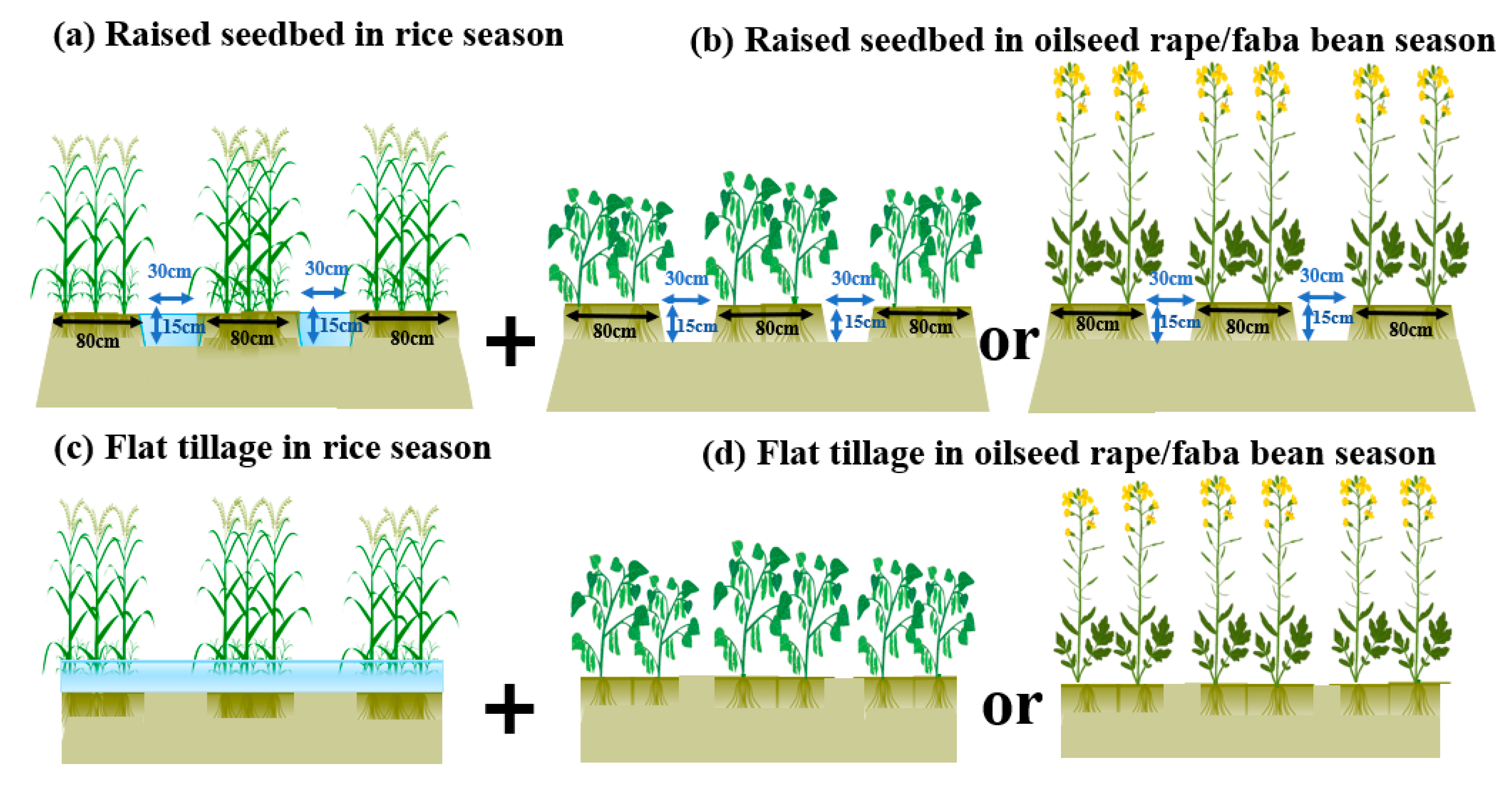
The field experiment was established on 12 May 2019, and continued for three years, with two tillage practices (raised seedbed and flat) combined with two rotation systems (rice-oilseed rape and rice-faba bean). Four treatments were established: R1 = raised seedbed with rice–oilseed rape, R2 = raised seedbed with rice–faba bean, F1 = flat tillage with rice–oilseed rape, and F2 = flat tillage with rice–faba bean. Each treatment had three replicates (12 plots in total), with a plot size of 6.9 × 6 m (41.4 m2). The field experiment was conducted using a randomized complete block design with three replicates. The experiment followed a double-cropping system each year. Rice was sown on 11 May and harvested on 20 August. Winter crops were sown on 3 October; oilseed rape was harvested on 30 April, and faba bean was harvested on 20 April (varied by 1–2 days among years). Both rice and winter crops were hill-planted on raised beds. For rice, three rows were established on each bed using a wide–narrow row configuration: the narrow within-bed row spacing was 30 cm, and the wide spacing between adjacent beds was 55 cm. Hills were spaced 16 cm within rows, with three seedlings retained per hill. For the winter crops (oilseed rape and faba bean), two rows were planted on each bed using a wide–narrow row configuration: the narrow within-bed row spacing was 50 cm, and the wide spacing between adjacent beds was 65 cm. Hills were spaced 30 cm within rows, with two seedlings retained per hill. Raised seedbed and flat cultivation layouts are illustrated in Figure 1. Each bed–furrow unit comprised an 80 cm raised bed and a 30 cm furrow (110 cm in total), with furrows accounting for ~27% of the field surface (30/110). The spring crops (oilseed rape and faba bean) were managed under no-tillage. After the spring crop harvest, beds were mechanically maintained to consolidate the raised seedbed structure for the subsequent rice season.
Plots were separated by plastic film to prevent lateral movement of water and fertilizers, with independent irrigation and drainage. Fertilizer application followed the Fertilization Guidelines for Major Crops in China. Rates were as follows: rice (150 kg N·hm−2, 90 kg P2O5·hm−2, 75 kg K2O·hm−2), oilseed rape (180, 90, 90 kg·hm−2), and faba bean (45, 45, 45 kg·hm−2). For rice, 60% of N was applied as basal fertilizer and 40% as topdressing at the jointing stage, while P and K were applied as basal. For oilseed rape and faba bean, all fertilizers were applied as basal.

2.3. Soil Sampling and Analysis of Nutrients and Enzyme Activities

After the three-year field experiment, soil samples (0–20 cm plow layer) were collected from each plot using the five-point sampling method (three replicate plots per treatment; one composite sample per plot), homogenized, air-dried, and sieved through 1 mm and 0.25 mm meshes for nutrient analysis. Thus, each variable was measured on three independent plot replicates per treatment (n = 3). Soil organic matter (SOM) was determined by the potassium dichromate volumetric method. Total nitrogen (TN) was measured by the Kjeldahl digestion–distillation method (Hanon K1100 automatic Kjeldahl nitrogen analyzer, Shanghai, China) after H2SO4–H2O2 digestion. Available potassium (AK) was extracted with ammonium acetate and analyzed using a flame photometer (Chongqing Drawell Instrument Co., Ltd., Chongqing, China). Available phosphorus (AP) was determined by the molybdenum–antimony colorimetric method with 0.5 mol L−1 NaHCO3 extraction and UV spectrophotometry. Ammonium nitrogen (NH4+–N) was measured by the indophenol blue colorimetric method, and nitrate nitrogen (NO3–N) by the phenol disulfonic acid method with UV spectrophotometry (Chongqing Drawell Instrument Co., Ltd., Chongqing, China).
Fresh soil samples were used for enzyme activity assays. Sucrase (SU) activity was determined by the phosphomolybdic acid colorimetric method, urease (UR) activity by the indophenol blue method, catalase (CAT) activity by the potassium iodide or colorimetric method, and acid phosphatase (ACP) activity by the p-nitrophenol colorimetric method.

2.4. Measurement of Soil Reducing Substances and Redox Potential

Total reducing substances (TRS) and active reducing substances (ARS) were extracted with aluminum sulfate. TRS were determined by potassium dichromate titration, whereas ARS were measured by potassium permanganate titration. Ferrous iron (Fe2+) content was determined using the o-phenanthroline colorimetric method, and reducible manganese (Mn2+) was analyzed by redox titration. Soil redox potential (Eh) was measured at a 10 cm depth using a PHB-06 pH/mV meter (Shanghai Leici, Shanghai, China). At each sampling event, Eh was recorded at more than 10 spatial points per treatment (across the replicate plots) at the same depth, and the mean value was calculated.

2.5. Microbial-Community Analysis

After the three-year field experiment, soil samples from the 0–20 cm plow layer were collected, and total DNA was extracted from 0.5 g of soil using the PowerSoil DNA Isolation Kit (Qiagen, Germantown, MD, USA). The mcrA and pmoA genes, representing methanogenic archaea and methanotrophic bacteria, respectively, were amplified using specific primers (Table 1). PCR products were purified, quantified, and pooled at equimolar concentrations, and then subjected to high-throughput sequencing on the Illumina MiSeq platform (Majorbio Bio-Pharm Technology Co., Ltd., Shanghai, China). Raw sequences were merged and processed using QIIME (https://qiime2.org/ (accessed on 20 May 2025)) and the UPARSE pipeline to remove low-quality reads. The remaining high-quality sequences were clustered into operational taxonomic units (OTUs) at a 97% similarity threshold using UPARSE.

2.6. Statistical Modelling and Analysis

Data are presented as the mean ± standard deviation (n = 3); graphics were generated using Origin 9.0 (Northampton, MA, USA). One-way ANOVA, two-way ANOVA (tillage, rotation, and their interaction), and independent-samples t-tests were performed using IBM SPSS 19.1 (Armonk, NY, USA), and p < 0.05 was considered to indicate a significant difference. Principal coordinate analysis (PCoA) was applied to determine the β-diversities of the microbial community based on Bray–Curtis distances between samples. Co-occurrence network analyses of the mrcA and pmoA communities were performed separately using MENA (http://ieg4.rccc.ou.edu/MENA/ (accessed on 20 May 2025)) and Gephi v0.10.1 (https://gephi.org/ (accessed on 20 May 2025)). Redundancy analysis (RDA) was performed by Canoco 5.0. Additionally, a Spearman’s correlation analysis was performed to identify correlations between environmental factors and methanotrophic communities in the Corrplot package. The neutral community model (NCM) was applied to the mcrA and pmoA amplicon datasets to compare assembly tendencies within methane-cycling functional groups. The model was fitted using the relationship between OTU occurrence frequency and mean relative abundance; R2 indicates goodness of fit (stochastic contribution) and Nm represents the estimated migration rate [21]. Given that the field experiment included three plot replicates per treatment, the neutral-model and network analyses are used here as complementary, pattern-oriented tools to compare management regimes, and their results are interpreted cautiously alongside the soil and community-level statistical analyses.

3. Results and Discussion

3.1. Effects of Tillage Practices and Rotation Systems on Crop Yield and Soil Physicochemical Properties

Both rotation systems and tillage practices had significant effects on rice and spring crop yields (Table 2). For rice, raised seedbed cultivation significantly increased yields compared with flat tillage under the same rotation system. The two-way ANOVA further indicated a consistently significant main effect of tillage across the three years (p < 0.01), whereas the rotation effect was year-dependent (2019: ns; 2020: p < 0.01; 2021: p < 0.05) and the tillage × rotation interaction was not significant in any year (ns). In the rice–faba bean rotation, yields under raised seedbed cultivation were 7.6% and 4.7% higher than those under flat tillage in 2020 and 2021, respectively, while in the rice–oilseed rape rotation, the increases were 9.6% and 5.8% (p < 0.05). For oilseed rape, raised seedbed cultivation enhanced yields by 16.3% in 2020 and by 9.5% in 2021 compared with flat tillage. For faba bean, raised seedbed cultivation resulted in significantly higher yields, with increases of 16.8% in 2020 and 13.7% in 2021 (p < 0.05). These results are consistent with previous studies showing that raised seedbed cultivation promotes root growth, enhances root activity, and ultimately improves crop yields [22,23]. Similar yield benefits of raised-bed/ridge systems have also been reported in other rice-growing regions such as Americas, largely attributable to improved root-zone aeration and nutrient-use efficiency under periodically waterlogged conditions [24].
Under the same tillage practice, rice yields were generally higher in rice–faba bean rotations than in rice–oilseed rape rotations. For example, under raised seedbed cultivation in 2020, rice yield in the rice–faba bean rotation was about 3.8% higher than that in the rice–oilseed rape rotation (p < 0.05), which is consistent with earlier findings [25]. This yield advantage may be attributed to the release of phosphatase from legume roots, which promotes the hydrolysis of organic phosphorus into plant-available forms, thereby improving nutrient supply and enhancing rice productivity [26,27].
As shown in Table 3, soil pH was significantly higher in rice–faba bean rotations than in rice–oilseed rape rotations under both raised seedbed and flat cultivation, with increases of 3.7% and 7.7%, respectively (p < 0.05). Consistent with these patterns, the two-way ANOVA indicated significant main effects of both tillage and rotation on soil pH (both p < 0.01), as well as a significant tillage × rotation interaction (p < 0.01). This may be attributed to the lower nitrogen fertilizer demand in rice–faba bean systems, which reduces excessive N input and the associated acidification effect, thereby maintaining soil pH at a higher level [28]. The complementary roles of different crop root systems in resource acquisition may also explain the greater accumulation of SOM in rice–faba bean rotations. Legumes enhance nutrient availability through biological N fixation and root exudates, while rice fibrous roots promote the turnover and redistribution of surface organic matter. The coupling of these processes not only improves nutrient supply but also enhances SOM accumulation [27,28,29]. In line with this, SOM was significantly affected by both tillage and rotation (both p < 0.001), and their interaction was also significant (p < 0.001). TN content was highest in raised seedbed cultivation with rice–oilseed rape (R1), being 6.5% higher than raised seedbed cultivation with rice–faba bean (R2) (p < 0.05). The two-way ANOVA showed significant main effects of tillage (p < 0.01) and rotation (p < 0.001) on TN, whereas the tillage × rotation interaction was not significant (ns). Although faba beans possess root nodules for biological N fixation, their fertilizer application rate is lower than that of oilseed rape, and most of the fixed N is used for their own growth demand, leading to slightly lower TN levels in rice–faba bean systems compared with rice–oilseed rape systems. This is consistent with previous studies indicating that the contribution of legumes to soil N pools via biological fixation requires long-term accumulation in rotation cycles [30].
In both rotation systems, AP, AK, NH4+–N, and NO3–N contents were significantly higher under raised seedbed cultivation than under flat tillage, with increases of 25.6–35.4%, 6.1–14.9%, 13.2–27.5%, and 6.3–6.7%, respectively (p < 0.05). These patterns were supported by the two-way ANOVA, which detected significant main effects of both tillage and rotation on AP, AK, NH4+–N and NO3–N (p < 0.01). Notably, the tillage × rotation interaction was significant for AK (p < 0.01) but not for AP, NH4+–N or NO3–N (ns). This indicates that raised seedbed cultivation helps reduce nutrient losses. Previous studies have shown that raised seedbed cultivation promotes the enrichment of crop residues and nutrients within raised seedbeds, reduces nutrient leaching risk, and thereby improves nutrient retention and utilization efficiency, rapidly establishing distinct soil N pools and turnover rates [31,32].

3.2. Effects of Different Tillage Practices and Rotation Systems on Soil Redox Potential, Active Reducing Substances, and Enzyme Activities

Tillage practices and rotation systems significantly affected soil redox status and the contents of active reducing substances (Table 4). The two-way ANOVA showed significant main effects of tillage on Eh, TRS, and ARS (p < 0.01) and on Fe2+ and Mn2+ (p < 0.05), whereas the rotation main effect was significant for TRS, ARS, Fe2+ and Mn2+ (p < 0.01) but not for Eh (ns). Moreover, the tillage × rotation interaction was significant for TRS and Fe2+ (p < 0.05) but not for ARS, Mn2+ or Eh (ns). Soil Eh was significantly higher under raised seedbed cultivation than under flat tillage (p < 0.05), indicating that raised seedbed cultivation improves soil aeration [33]. The TRS and the ARS were highest under flat tillage with rice–faba bean (F2), being 6.5% and 10.1% higher, respectively, than under raised seedbed cultivation with rice–faba bean (R2) (p < 0.05). Similarly, Fe2+ and Mn2+ contents showed the same trend, with increases of 9.5% and 2.3% (p < 0.05), suggesting that flat tillage favors the accumulation of reduced Fe and Mn, whereas raised seedbed cultivation suppresses the reductive dissolution of Fe/Mn (hydr)oxides in soil [34,35]. This pattern is consistent with observations in paddy systems from Japan where raised micro-topography enhances oxygen diffusion and tends to reduce the buildup of reduced solutes and metals [36,37].
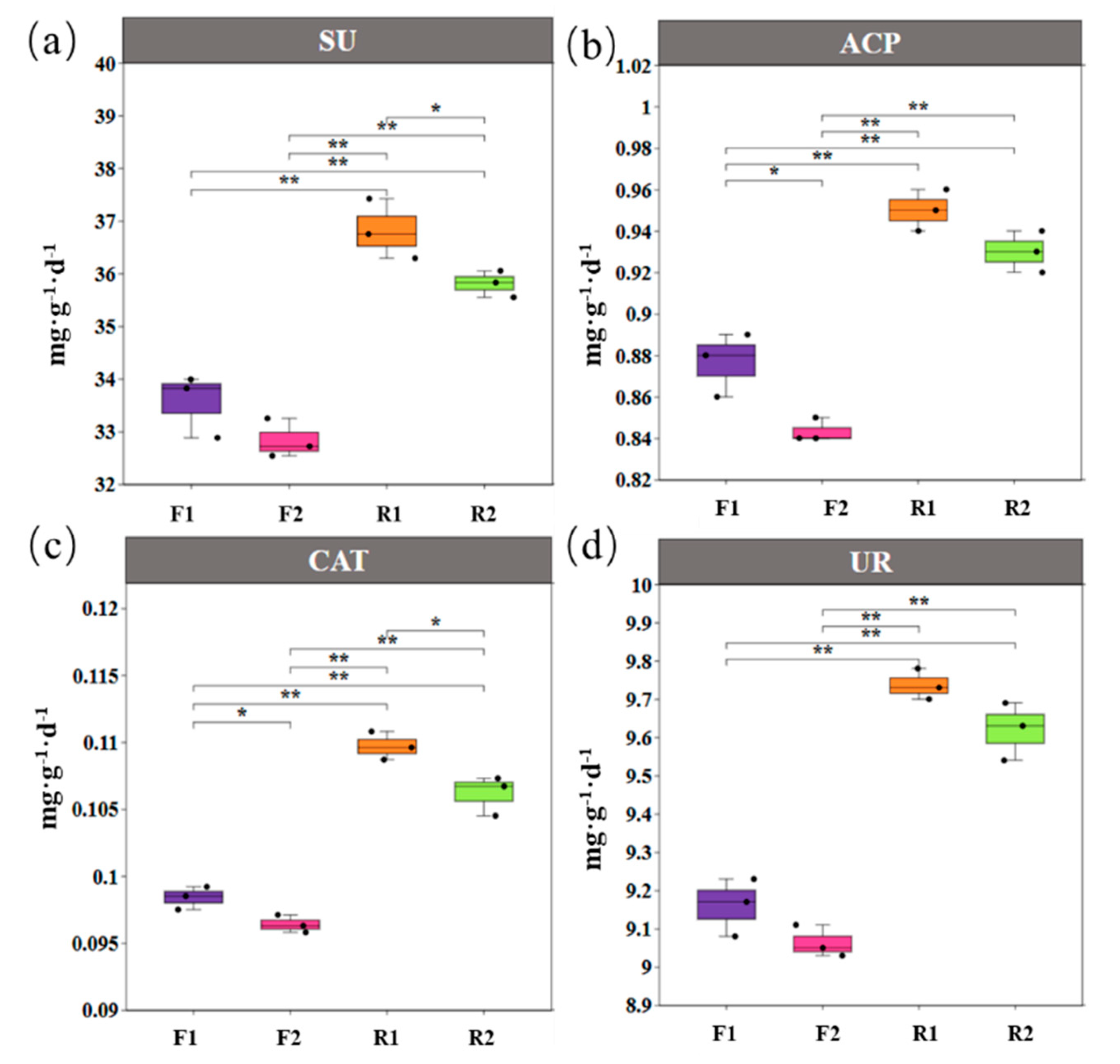
In terms of enzyme activities (Figure 2), sucrase, urease, and acid phosphatase activities were highest under raised seedbed cultivation with rice–oilseed rape (R1), and significantly higher than those under all flat tillage treatments (p < 0.05). Consistent with these patterns, the two-way ANOVA showed a significant main effect of tillage on all four enzymes (p < 0.01; Table 5), whereas the tillage × rotation interaction was not significant (ns), indicating that the stimulatory effect of raised seedbed tillage on enzyme activities was broadly consistent across rotation systems. Rotation also exerted a significant main effect on enzyme activities (SU and UR: p < 0.05; ACP and CAT: p < 0.01), which is in line with the generally higher enzyme activities observed in the rice–oilseed rape rotation than in the rice–faba bean rotation under the same tillage practice (Figure 2). These differences may be attributed to the stimulation of carbohydrate- and nutrient-degrading enzyme activities by the accumulation of crop residues and other organic substrates under raised seedbed cultivation [31,38], as well as the higher N fertilization in oilseed rape that promoted enzymes related to N mineralization [39]. Catalase activity was also significantly higher under raised seedbed cultivation than under flat tillage (p < 0.05), demonstrating that raised seedbed cultivation helps maintain favorable redox conditions in paddy soils [40].

3.3. Effects of Different Tillage Practices and Rotation Systems on the Diversity of Methanogenic and Methanotrophic Functional Communities in Paddy Soils

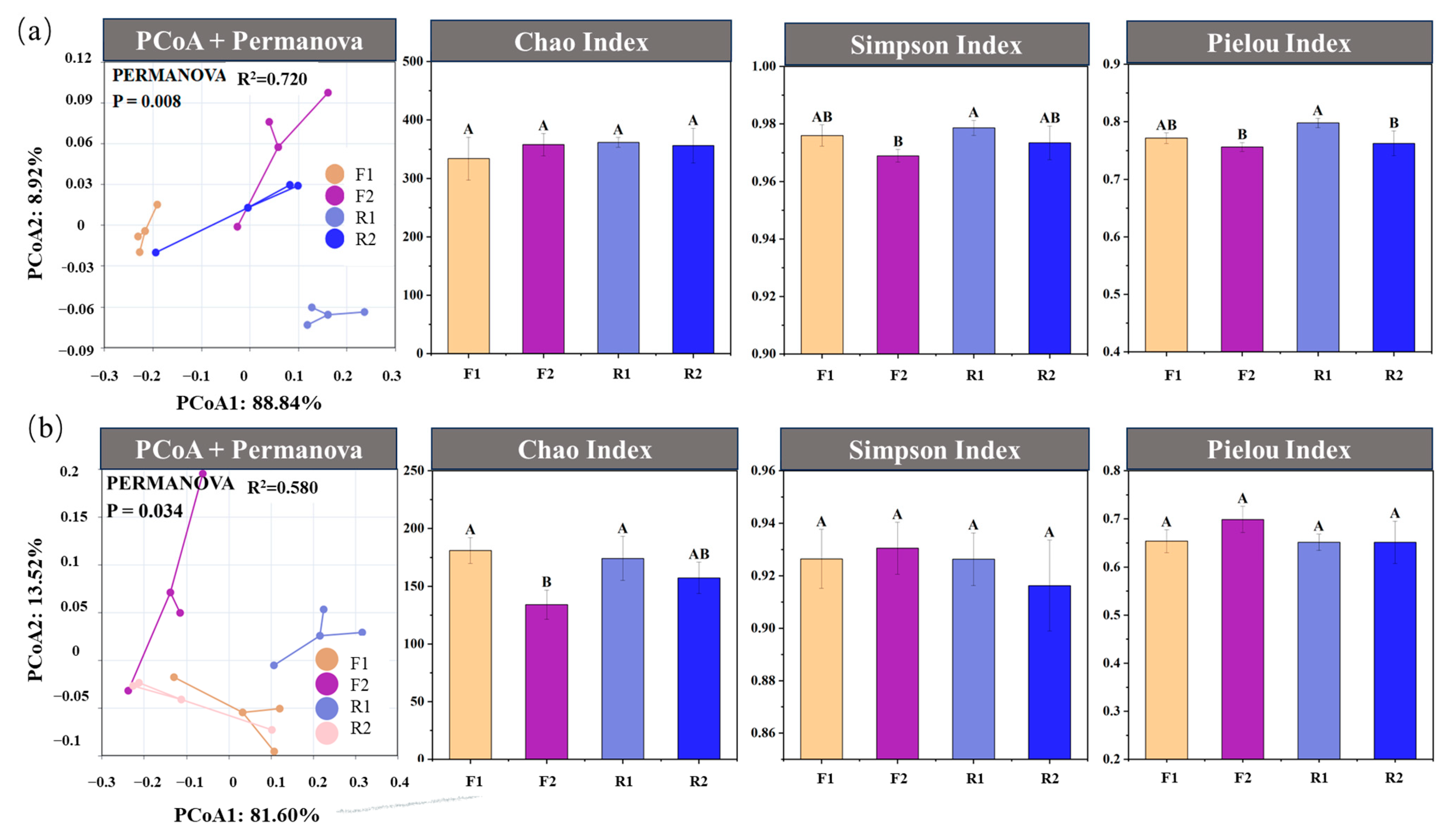
PERMANOVA analysis of the mcrA community revealed significant differences among treatments (R2 = 0.720, p = 0.008) (Figure 3a), indicating that tillage practices and rotation systems significantly altered methanogenic community composition. The Chao index showed no significant differences among treatments, suggesting stable species richness; however, the Simpson index and Pielou’s evenness index were significantly lower under flat tillage with rice–faba bean (F2) than in other treatments (p < 0.05). This indicates reduced community evenness, with increased dominance of certain taxa and a shift toward dominance by specialized groups. This may be explained by the reduced redox potential under F2, which creates a stronger anaerobic and reducing environment favorable to the growth and metabolism of methanogens. Moreover, the relatively higher SOM in this treatment selectively promoted methanogens with stronger environmental adaptability or substrate utilization ability, resulting in decreased evenness and a community structure skewed toward functionally dominant taxa [41,42]. Similar redox-mediated trade-offs between methanogenesis and methane oxidation have been reported in paddy soils from Southwest China, supporting the wider relevance of this mechanism [43].
PERMANOVA analysis of the pmoA community also revealed significant differences among treatments (R2 = 0.580, p = 0.034) (Figure 3b), and PCoA indicated that the community structure under flat tillage with rice–faba bean (F2) differed most markedly from other treatments. The Chao index under F2 was significantly lower than in other treatments, indicating reduced species richness of methanotrophs. This may be due to the more reducing conditions in flat tillage, where decreased dissolved oxygen and limited O2 diffusion suppress the metabolism and growth of methanotrophs, particularly aerobic methane oxidizers that depend on oxygen as the terminal electron acceptor [44]. In addition, long-term reducing conditions may lead to the accumulation of sulfides (H2S) and Fe2+, which further weaken methane oxidation and inhibit sensitive pmoA lineages, thereby reducing diversity and reshaping community structure [45]. Meanwhile, the competitive advantage of methanogens in substrate utilization is strengthened under reducing conditions, enabling them to occupy a more prominent functional role and disrupting the ecological balance between methane production and oxidation [42].
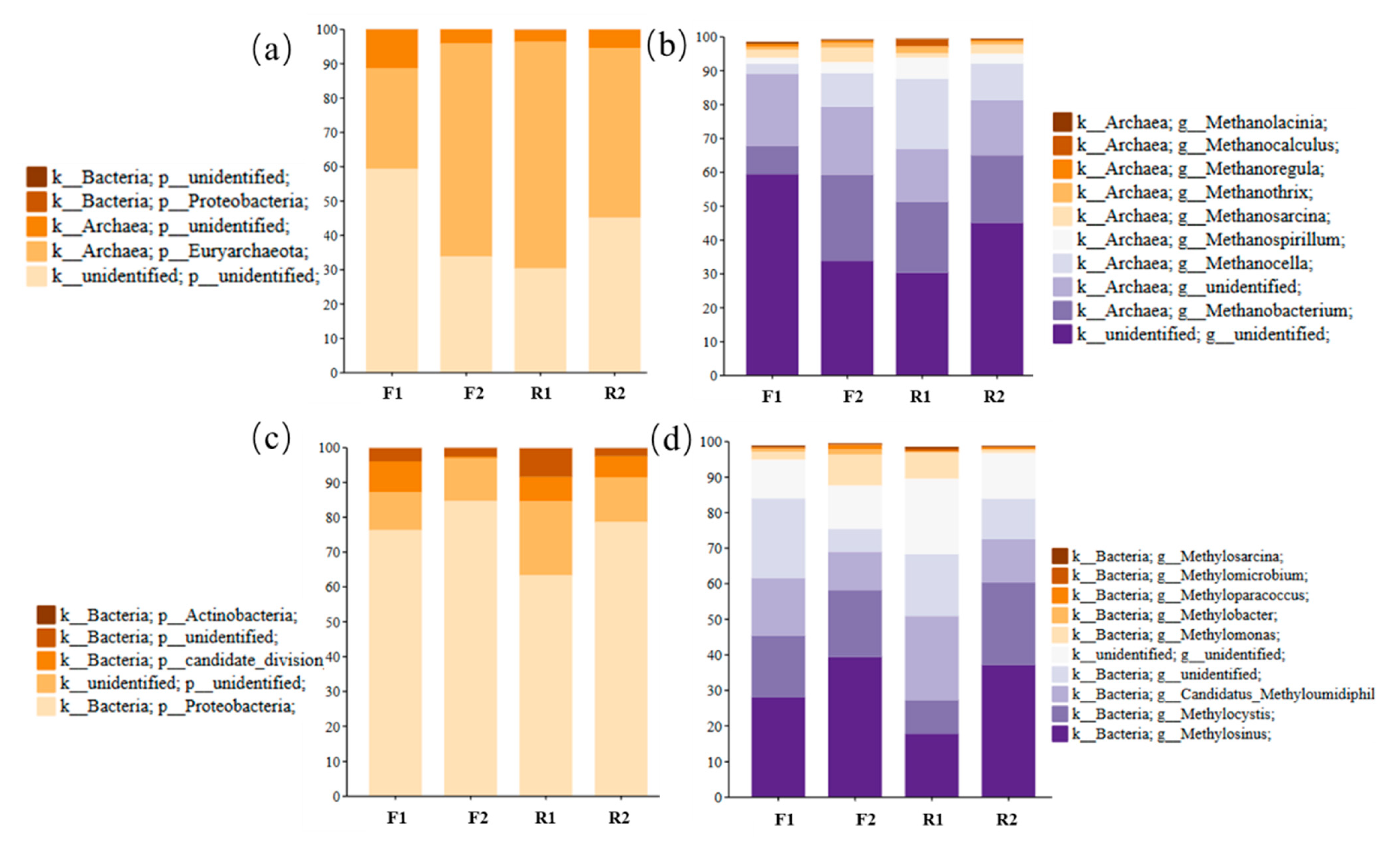
At the genus level, the methanogenic community was dominated by Methanobacterium, Methanocella, and Methanospirillum (Figure 4a,b), all belonging to hydrogenotrophic methanogens that utilize H2 or CO2 as their primary substrates for methane production, and classified within the phylum Euryarchaeota [46]. Under F2 treatment, the relative abundance of Methanobacterium reached 25.46%, indicating its high sensitivity to legume residue accumulation and reduced redox conditions, and its efficiency in utilizing hydrogen to reduce CO2 for methane generation [47]. Methanocella was another dominant genus, accounting for 20.75% in R1treatment, whereas its abundance in F1 was only 2.93%, representing a decline of more than 85%.
For methanotrophs, the dominant genera included Methylosinus, Methylocystis, Candidatus Methyloumidiphilus, and Methylomonas, which are all aerobic methane oxidizers [48] (Figure 4c,d). Specifically, Candidatus Methyloumidiphilus reached 23.68% in R1, and Methylocystis accounted for 23.19% in R2, both showing a promotional effect of raised seedbed cultivation. In contrast, Methylosinus dominated in F2, reaching 39.32%. Together with the α- and β-diversity analyses, these results indicate that F2 significantly reduced community evenness and reinforced the dominance of methanogenic taxa in the mcrA community while simultaneously reducing species richness in the pmoA community. This suggests that under low-oxygen and high-SOM conditions, this treatment promoted methanogen proliferation but suppressed the ecological niche expansion of methanotrophs, thereby potentially shifting methane-cycling processes toward stronger production relative to oxidation [42].

3.4. Neutral Community Assembly and Functional Network Differentiation of Methane-Cycling Microbes

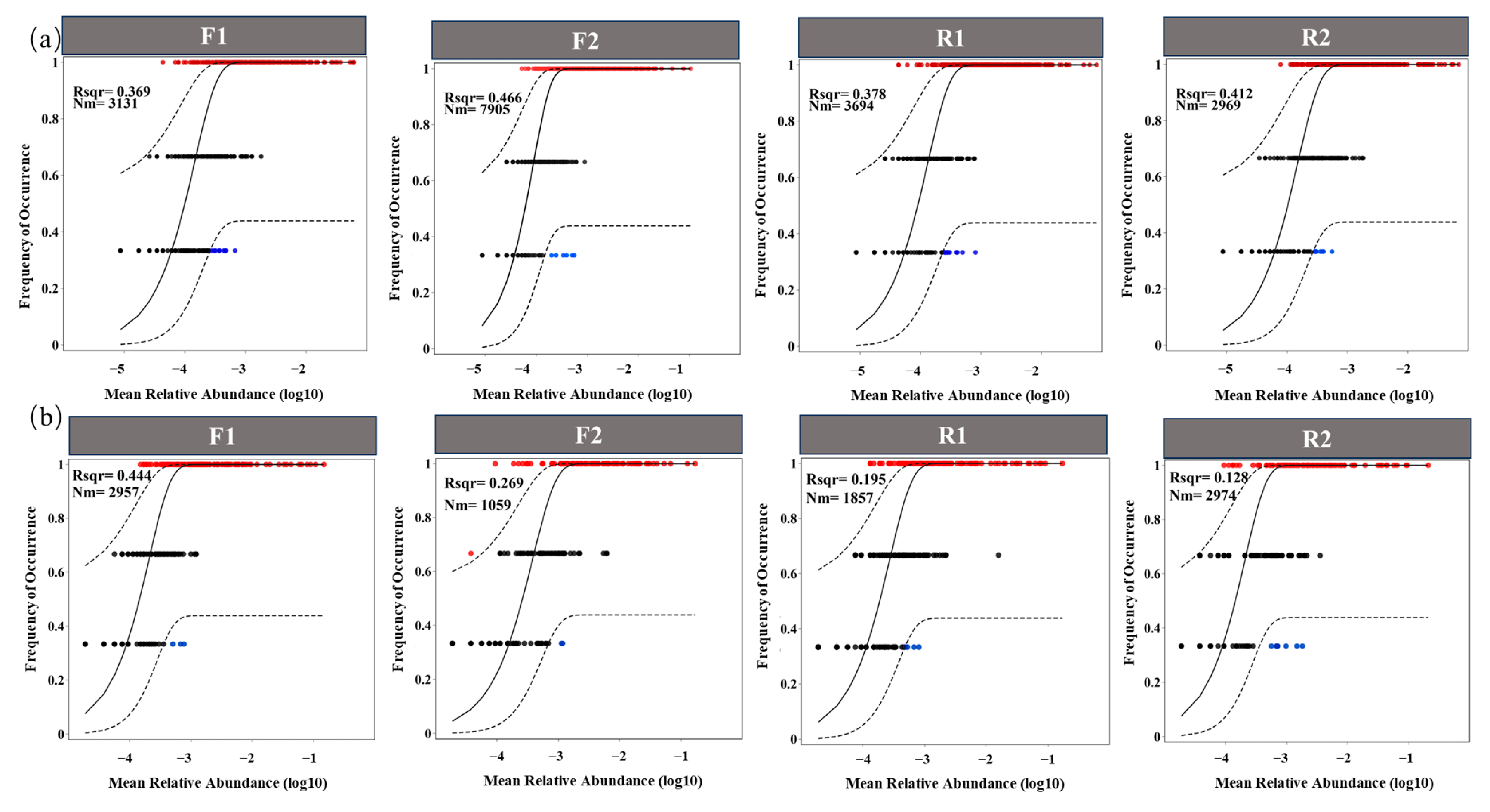
Based on the neutral community model, we systematically analyzed the effects of different tillage practices and rotation systems on the assembly processes of mcrA-based methanogenic communities (Figure 5a) and pmoA-based methanotrophic communities (Figure 5b). Previous studies have suggested that under low environmental stress, stochastic processes contribute more to community assembly, whereas under extreme conditions, deterministic processes account for a greater proportion [49,50]. The R2 values of methanogenic (mcrA) communities across treatments ranged from 0.369 to 0.466, indicating relatively high model fits and suggesting that their community structures were mainly regulated by stochastic dispersal and ecological drift. This is consistent with previous findings [51]. Methanogens, as obligate anaerobes, possess unique membrane structures and highly stable protein systems, making them more strongly influenced by diffusion limitation and other neutral processes [52,53]. Among treatments, flat tillage with rice–faba bean (F2, R2 = 0.466, Nm = 7905) exhibited the highest fit and migration rate, indicating a stronger influence of the species pool. By contrast, flat tillage with rice–oilseed rape (F1, R2 = 0.369, Nm = 3131) showed the lowest values, suggesting that rice–faba bean rotations enhanced the role of neutral processes relative to rice–oilseed rape rotations. This may be due to the nitrogen-fixing capacity of legumes, which promotes sustained organic matter input and provides additional carbon sources, thereby weakening environmental filtering and reducing homogeneous selection [7,53].
For methanotrophic (pmoA) communities, R2 values ranged from 0.128 to 0.444, with generally lower fits and Nm values than those of methanogens, reflecting narrower ecological niches. This may be because pmoA communities are dominated by aerobic bacteria, whose distributions are more strongly controlled by redox potential, moisture, and organic matter [54]. The highest model fit was observed in flat tillage with rice–oilseed rape (F1, R2 = 0.444, Nm = 2957), indicating that its community structure was still partly driven by stochastic processes such as immigration and drift. This is likely due to the relatively uniform redox state of flooded flat-paddy soils, where weakened environmental filtering allowed neutral processes to play a stronger role. In contrast, raised seedbed cultivation with rice–faba bean (R2, R2 = 0.128, Nm = 2974) exhibited the lowest fit, suggesting that its methanotrophic community structure was almost entirely controlled by environmental filtering. This may be attributed to the heterogeneous redox gradients formed in raised seedbed, where channels are more reduced while raised seedbeds are relatively dry and oxidative, leading to strong environmental selection that suppressed stochastic dispersal and drift [55]. We infer that under flat tillage, the stochastic assembly of methane-related microbial communities contributes to maintaining community dynamism and adaptability [56]. However, for methanotrophs, raised seedbed cultivation alters environmental factors to select for taxa better adapted to specific conditions, which may enhance methane oxidation potential and thereby reduce methane emissions (based on proxy indicators) [57,58].Because mcrA/pmoA amplicons represent functional-group subsets and may be affected by primer bias and gene copy-number variation, NCM outputs are interpreted as supportive, exploratory evidence rather than definitive inference for the whole microbiome.
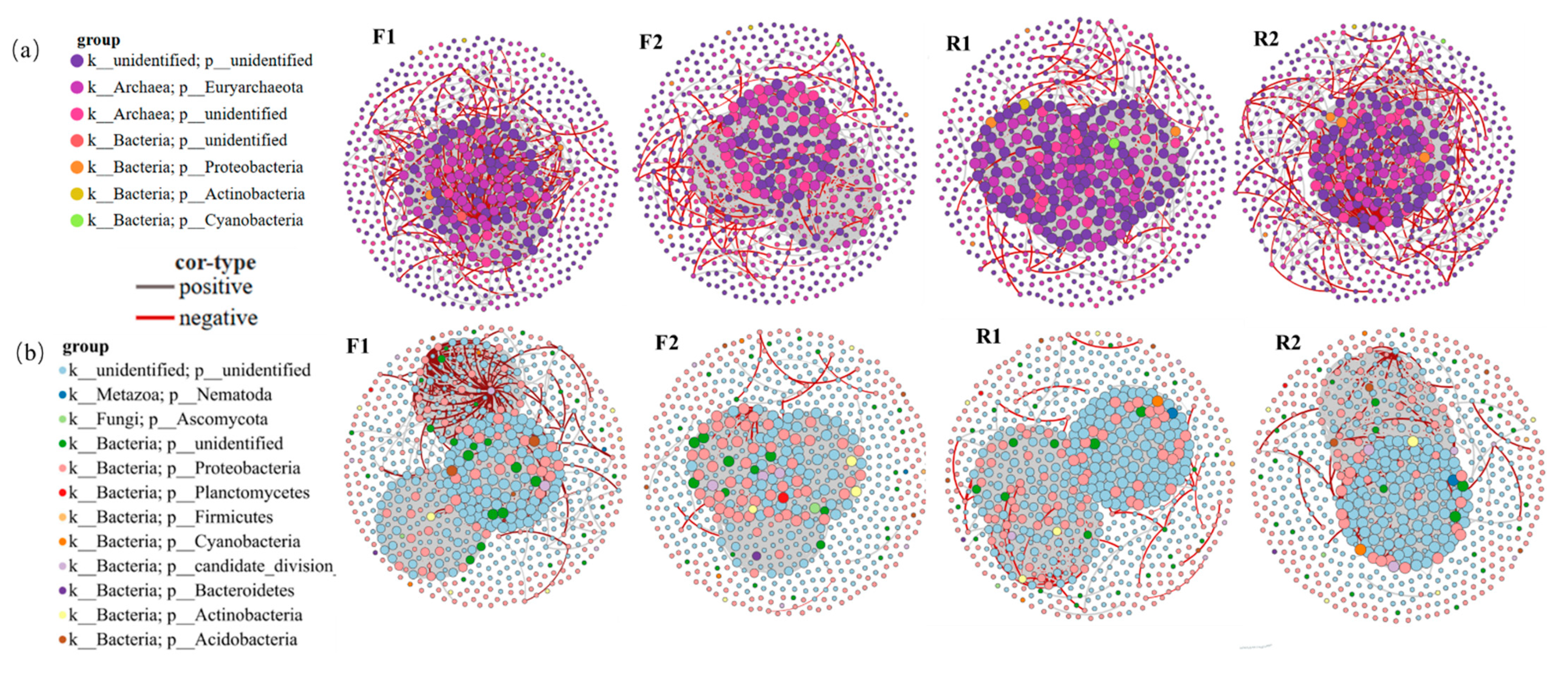
Exploring the interactions among coexisting microbial taxa in complex communities through network analysis helps to elucidate the functional roles and assembly processes of microbial groups within basic ecological and life-history strategies [59]. The networks showed that, except for the pmoA network under R2 treatment, all others had modularity values greater than 0.4, indicating significant modular features of microbial community structures (Table 6). According to previous studies, modularity exceeding 0.4 is generally considered biologically meaningful, reflecting the presence of relatively independent functional modules within the community [60].
The mcrA networks were primarily composed of methanogenic archaea belonging to the phylum Euryarchaeota (Figure 6a). The numbers of nodes in R1 and R2 networks were higher by 14.4% and 20.1%, respectively, than under flat tillage (Table 6). Moreover, the R1 treatment exhibited the highest average degree, number of edges, proportion of positive correlations, and network density, which were 152.1%, 188.1%, 19.1%, and 100.0% higher, respectively, than those of the F1 treatment (Table 6). These results suggest that raised seedbed cultivation was associated with denser correlation-based associations among methanogens in the rice–oilseed rape system, leading to more complex community structures and greater resource niche differentiation, potentially reflecting stronger co-occurrence structure and niche differentiation inferred from abundance co-variation. Such network features may improve substrate utilization efficiency and thereby increase methanogenic potential, although actual methane emissions ultimately depend on the balance between methanogenesis and methane oxidation [42].
The pmoA networks exhibited more diverse node compositions. In addition to typical methanotrophic taxa within the Proteobacteria, a few sequences from other phyla, such as Cyanobacteria, Actinobacteria, and Bacteroidetes, were also detected (Figure 6b). From the overall network structure, positive correlations accounted for more than 85% across all treatments. Relative to their raised seedbed counterparts (R1 and R2), the flat tillage treatments (F1 and F2) reduced node numbers by 9.77% and 25.21%, respectively, whereas average degree was 24.38% and 48.36% higher in the raised seedbed treatments (Table 6). In particular, F2 limited the diversity and network scale of aerobic methanotrophs due to decreased redox potential. By contrast, R1 improved soil aeration, was associated with larger network size and higher connectivity of methanotroph-associated taxa, suggesting a more complex association structure; these patterns may be consistent with greater community stability/functional redundancy [57]. A limitation is that each treatment had three plot replicates, which is standard for long-term field trials but may reduce statistical power for higher-order microbial analyses. Therefore, the co-occurrence networks and neutral-model outputs are interpreted as supporting, exploratory evidence of interaction structure and assembly tendencies rather than definitive quantitative estimates.

3.5. Soil Physicochemical Drivers of Methanogenic and Methanotrophic Community Structures Under Tillage–Rotation Systems

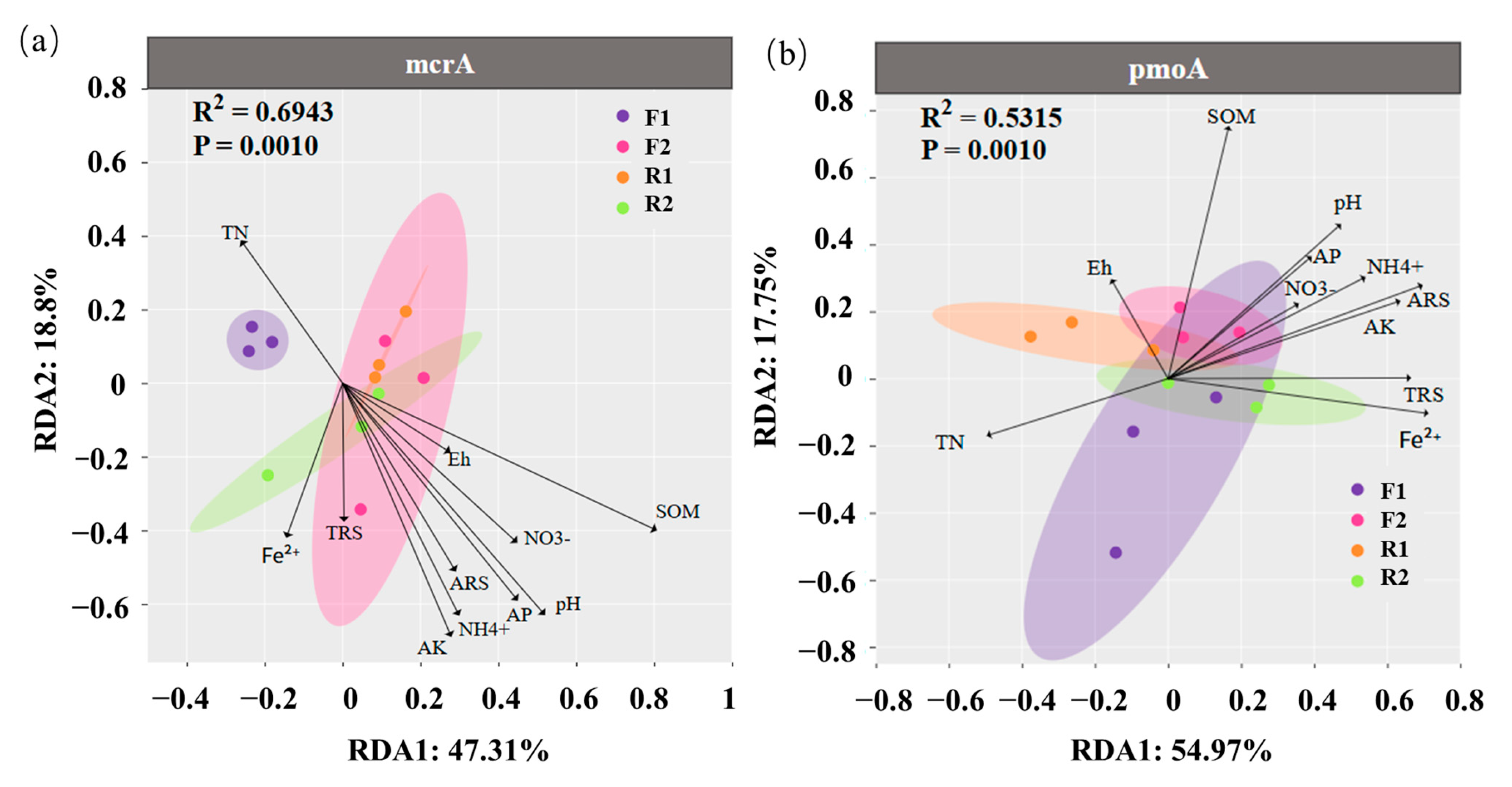
Redundancy analysis (RDA) analysis revealed that soil physicochemical factors significantly influenced the community structures of methanogens (mcrA) and methanotrophs (pmoA) (p = 0.001). Environmental variables explained 66.11% of the variation in the mcrA community and 75.72% in the pmoA community (Figure 7a,b). The mcrA community was mainly driven by soil redox potential (Eh), TN, ARS, and TRS, indicating that methanogens are highly sensitive to soil reductive conditions and nitrogen availability (Figure 7a). In particular, the enrichment of ARS suggested that hydrogenotrophic methanogenesis may play a dominant role [61]. In contrast, the pmoA community structure was primarily influenced by SOM, pH, NH4+–N, NO3–N, and Eh, which is consistent with previous studies (Figure 7b) [62]. The directions of SOM and pH vectors corresponded well with sample distribution, implying that methanotrophic communities were highly responsive to differences in organic matter availability and soil acidity–alkalinity under raised seedbed versus flat cultivation [63]. Furthermore, the distribution patterns of treatments indicated that mcrA communities were more dispersed across all treatments except flat tillage with rice–faba bean, whereas pmoA communities were relatively aggregated except under raised seedbed cultivation with rice–oilseed rape. These results corroborate the neutral model findings, suggesting that methanogen assembly is primarily governed by stochastic processes, while methanotroph community structure is mainly controlled by environmental filtering.
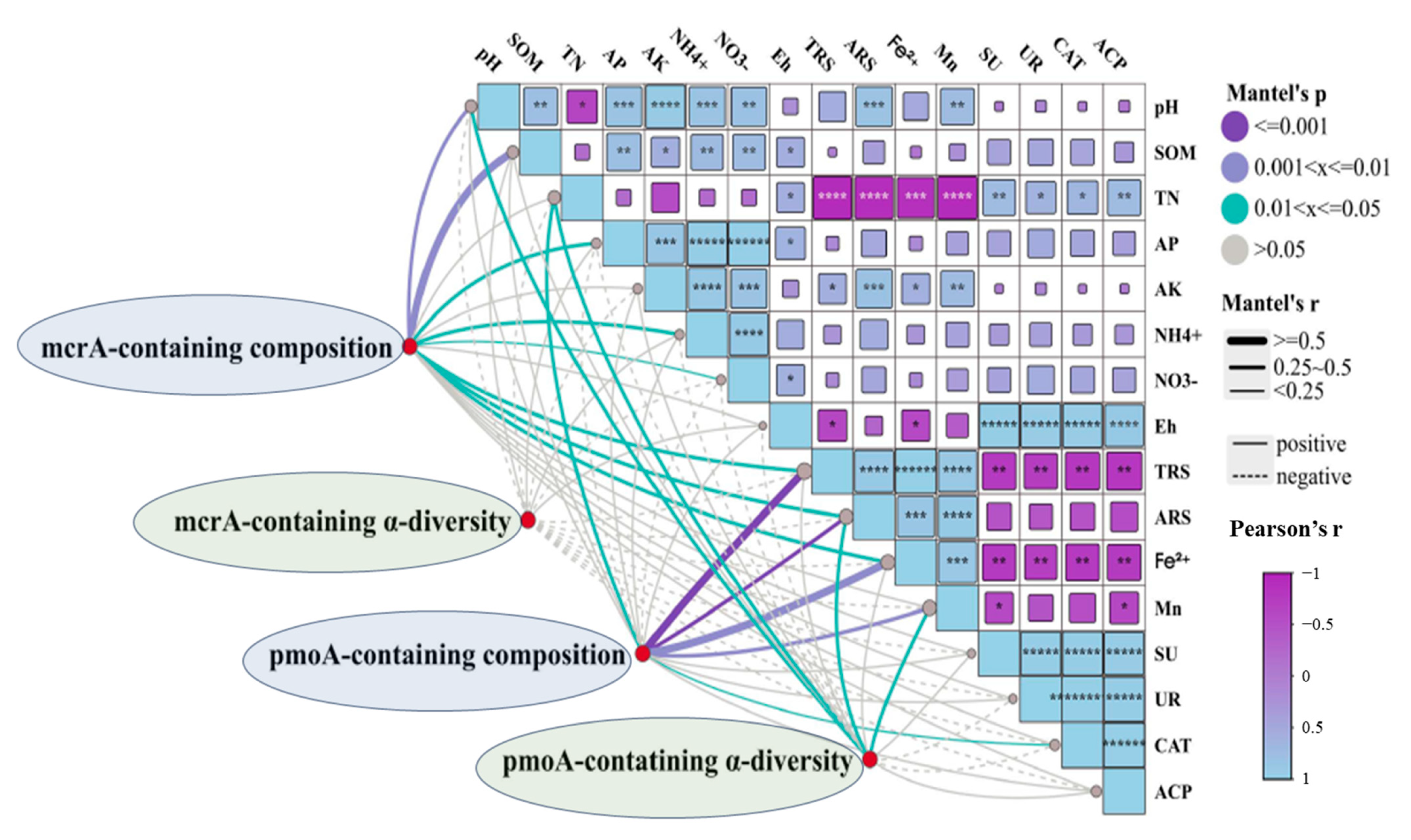
Mantel test results indicated that both the community structure and α-diversity of the mcrA and pmoA functional groups were significantly regulated by multiple soil physicochemical factors (Figure 8). Pearson correlation analysis further revealed that soil Eh was highly negatively correlated with TRS and Fe2+, suggesting that these indicators can serve as proxies of low-oxygen and reductive environments [64]. Meanwhile, Fe2+ and TRS were also negatively correlated with CAT, ACP, SU, and UR, indicating that redox conditions exert a regulatory effect on soil enzyme activities. In particular, the mcrA community structure was positively correlated with pH, SOM, AP, NH4+, Fe2+, ARS, and TRS, suggesting that nutrient-rich conditions under reductive environments favored the dominance of methanogens. This is consistent with the significant enrichment of Methanobacterium observed under the flat tillage rice–faba bean treatment (F2) [65]. In contrast, mcrA α-diversity showed no significant associations with soil factors, implying a relatively stable diversity pattern, with changes mainly occurring at the structural level.
For the pmoA community, its structure was jointly and positively regulated by CAT, TN, ARS, Fe2+, and Mn, while its α-diversity was significantly correlated with pH, TN, ARS, and Mn. These results suggest that methanotrophs are not only influenced by reductive environments but are also sensitive to oxidative stress and nitrogen availability [66] (Figure 8). Notably, raised seedbed cultivation may indirectly affect catalase activity by modifying soil redox conditions: higher oxygen fluxes and ROS accumulation in raised seedbeds could induce CAT expression, thereby alleviating oxidative stress during methane oxidation. This mechanism may benefit the survival and metabolism of methanotrophs, suggesting that oxidative stress responses indirectly shape the community structure of the pmoA functional group and reflect its high adaptability to microenvironmental redox changes [67,68].

4. Conclusions

Tillage practices and crop rotation systems significantly shaped methane-cycling functional communities in paddy soils by altering soil nutrients, redox conditions, and enzyme activities. In addition, raised seedbed cultivation consistently increased rice and spring-crop yields relative to flat tillage and improved soil fertility, as reflected by higher available nutrient contents and enhanced soil enzyme activities. Flat tillage with rice–faba bean (F2) enhanced neutral assembly and the dominance of specific methanogenic taxa but markedly reduced the diversity and network complexity of methanotrophs, suggesting a potential imbalance favoring methanogenesis over methane oxidation. In contrast, raised seedbed cultivation with rice–oilseed rape (R1) favored the maintenance of oxidative soil conditions and promoted cooperative interactions among functional microbes, improving community stability and functional redundancy. This management practice thus represents a strategy that may promote methane oxidation potential while enhancing crop productivity. Future research should directly quantify CH4 (and other GHG) fluxes and evaluate how water regime and residue management modulate these outcomes across soil types and regions.

Author Contributions

X.Y.: investigation, visualization, methodology, and data curation. X.C.: investigation, formal analysis, data curation, and writing—original draft. L.Y.: conceptualization, writing—review and editing, formal analysis. X.Z.: methodology. L.W.: formal analysis. Z.W.: conceptualization, methodology and resources. W.D.: Validation. M.G.: resources, funding acquisition, and supervision. All authors have read and agreed to the published version of the manuscript.

Funding

This work was supported by the Major Core Technology Tackling Project of Chongqing Academy of Agricultural Sciences (KYLX20240500046), Chongqing Graduate Research and Innovation Funding Project (CYS23202), and the National Natural Science Foundation of China (42307036 and 42177019).

Data Availability Statement

The original contributions presented in the study are included in the article, and the data supporting the reported results are available in the public repository under the BioProject accession number PRJNA1396998 (F1F2R1R2 Raw sequence reads, TaxID: 410658). Further inquiries can be directed to the corresponding author.

Conflicts of Interest

The authors declare no conflicts of interest. The funders had no role in the design of the study; in the collection, analyses, or interpretation of data; in the writing of the manuscript; or in the decision to publish the results.

References

  1. Liu, W.; Graham, E.B.; Zhong, L.; Zhang, J.; Li, W.; Li, Z.; Lin, X.; Feng, Y. Dynamic Microbial Assembly Processes Correspond to Soil Fertility in Sustainable Paddy Agroecosystems. Funct. Ecol. 2020, 34, 1244–1256. [Google Scholar] [CrossRef]
  2. Sainju, U.M.; Lenssen, A.W.; Allen, B.L.; Stevens, W.B.; Jabro, J.D. Soil Total Carbon and Crop Yield Affected by Crop Rotation and Cultural Practice. Agron. J. 2017, 109, 388–396. [Google Scholar] [CrossRef]
  3. Liu, Z.; Gu, H.; Liang, A.; Li, L.; Yao, Q.; Xu, Y.; Liu, J.; Jin, J.; Liu, X.; Wang, G. Conservation Tillage Regulates the Assembly, Network Structure and Ecological Function of the Soil Bacterial Community in Black Soils. Plant Soil 2022, 472, 207–223. [Google Scholar] [CrossRef]
  4. Ren, B.; Dong, S.; Liu, P.; Zhao, B.; Zhang, J. Ridge Tillage Improves Plant Growth and Grain Yield of Waterlogged Summer Maize. Agric. Water Manag. 2016, 177, 392–399. [Google Scholar] [CrossRef]
  5. Qin, C.; Wright, A.L.; Ma, L.; He, X.; Xie, D.; Jiang, X. Improving Nitrogen-use Efficiency by Using Ridge Tillage in Rice Paddy Soils. Soil Use Manag. 2022, 38, 528–536. [Google Scholar] [CrossRef]
  6. Tan, S.; Chen, B.; Zheng, H.; Xu, F.; Xu, H.; Wei, J.; Huang, H.; Tang, J. Effects of Cultivation Techniques on CH4 Emissions, Net Ecosystem Production, and Rice Yield in a Paddy Ecosystem. Atmos. Pollut. Res. 2019, 10, 274–282. [Google Scholar] [CrossRef]
  7. Bai, N.; Lv, W.; Chu, X.; Fan, H.; Li, S.; Zheng, X.; Zhang, J.; Zhang, H.; Zhang, H. Comparison of Soil Microbial Community and Physicochemical Properties between Rice–Fallow and Rice–Bean (Green Manure) Rotation. Soil Sci. Soc. Amer. J. 2022, 86, 593–603. [Google Scholar] [CrossRef]
  8. Jiang, M.; Xu, P.; Wu, L.; Zhao, J.; Wu, H.; Lin, S.; Yang, T.; Tu, J.; Hu, R. Methane Emission, Methanogenic and Methanotrophic Communities during Rice-Growing Seasons Differ in Diversified Rice Rotation Systems. Sci. Total Environ. 2022, 842, 156781. [Google Scholar] [CrossRef]
  9. Xia, M.; Ma, X.; Liu, J.; Wu, M.; Li, Z.; Liu, M. Potential Effect of Key Soil Bacterial Taxa on the Increase of Rice Yield under Milk Vetch Rotation. Front. Microbiol. 2023, 14, 1150505. [Google Scholar] [CrossRef]
  10. Lu, S.; Lepo, J.E.; Song, H.; Guan, C.; Zhang, Z. Increased Rice Yield in Long-Term Crop Rotation Regimes through Improved Soil Structure, Rhizosphere Microbial Communities, and Nutrient Bioavailability in Paddy Soil. Biol. Fertil. Soils 2018, 54, 909–923. [Google Scholar] [CrossRef]
  11. Gao, C.; Bezemer, T.M.; de Vries, F.T.; van Bodegom, P.M. Trade-Offs in Soil Microbial Functions and Soil Health in Agroecosystems. Trends Ecol. Evol. 2024, 39, 895–903. [Google Scholar] [CrossRef]
  12. Nwokolo, N.L.; Enebe, M.C. Methane Production and Oxidation—A Review on the pmoA and mcrA Gene Abundances for Understanding the Functional Potentials of Agricultural Soils. Pedosphere 2025, 35, 161–181. [Google Scholar] [CrossRef]
  13. Qin, T.; Liu, Y.; Hu, R.; Yang, K.; Zheng, B.; Li, J.; Liu, Z.; Li, P.; Ma, T.; Xiong, K.; et al. Reduction of Soil Methane Emissions from Croplands with 20–40 Years of Cultivation Mediated by Methane-Metabolizing Microorganisms. J. Clean. Prod. 2024, 435, 140489. [Google Scholar] [CrossRef]
  14. Kong, D.; Li, S.; Jin, Y.; Wu, S.; Chen, J.; Hu, T.; Wang, H.; Liu, S.; Zou, J. Linking Methane Emissions to Methanogenic and Methanotrophic Communities under Different Fertilization Strategies in Rice Paddies. Geoderma 2019, 347, 233–243. [Google Scholar] [CrossRef]
  15. Wang, Y.; Chen, P.; Wang, F.; Han, W.; Qiao, M.; Dong, W.; Hu, C.; Zhu, D.; Chu, H.; Zhu, Y. The Ecological Clusters of Soil Organisms Drive the Ecosystem Multifunctionality under Long-Term Fertilization. Environ. Int. 2022, 161, 107133. [Google Scholar] [CrossRef]
  16. Wang, B.; Meng, Y.; Deng, S.; Zhou, X.; Wang, S.; Wu, Y.; Wu, L.; Bai, Y.; Chen, D. Biodiversity of Soil Biota and Plants Stabilises Ecosystem Multifunctionality with Increasing Number of Global Change Factors. J. Ecol. 2025, 113, 1699–1711. [Google Scholar] [CrossRef]
  17. Wu, H.; Cui, H.; Fu, C.; Li, R.; Qi, F.; Liu, Z.; Yang, G.; Xiao, K.; Qiao, M. Unveiling the Crucial Role of Soil Microorganisms in Carbon Cycling: A Review. Sci. Total Environ. 2024, 909, 168627. [Google Scholar] [CrossRef]
  18. Liu, J.; Yang, L.; Adams, J.M.; Zhang, L.; Wang, J.; Wei, R.; Zhou, C. Divergent Biotic-Abiotic Mechanisms of Soil Organic Carbon Storage between Bulk and Rhizosphere Soils of Rice Paddies in the Yangtze River Delta. J. Environ. Manag. 2025, 389, 126179. [Google Scholar] [CrossRef]
  19. Hales, B.A.; Edwards, C.; Ritchie, D.A.; Hall, G.; Pickup, R.W.; Saunders, J.R. Isolation and Identification of Methanogen-Specific DNA from Blanket Bog Peat by PCR Amplification and Sequence Analysis. Appl. Environ. Microbiol. 1996, 62, 668–675. [Google Scholar] [CrossRef]
  20. Holmes, A.J.; Costello, A.; Lidstrom, M.E.; Murrell, J.C. Evidence That Participate Methane Monooxygenase and Ammonia Monooxygenase May Be Evolutionarily Related. FEMS Microbiol. Lett. 1995, 132, 203–208. [Google Scholar] [CrossRef]
  21. Sloan, W.T.; Lunn, M.; Woodcock, S.; Head, I.M.; Nee, S.; Curtis, T.P. Quantifying the Roles of Immigration and Chance in Shaping Prokaryote Community Structure. Environ. Microbiol. 2006, 8, 732–740. [Google Scholar] [CrossRef]
  22. Vinther, F.P.; Dahlmann Hansen, L. Effects of Ridging on Crop Performance and Symbiotic N2 Fixation of Fababean (Vicia faba L.). Soil Use Manag. 2006, 21, 205–211. [Google Scholar] [CrossRef]
  23. Zhang, W.; Li, L.; Liu, B.; Liu, J.; Chen, F.; Ni, J.; Wei, C.; Zhong, S. Effect of Ridge Tillage with Rice-Rape Rotation on the Root System and Yield of Crops. Plant Soil 2025, 510, 291–304. [Google Scholar] [CrossRef]
  24. Karki, S.; Adviento-Borbe, M.A.A.; Massey, J.H.; Reba, M.L. Assessing Seasonal Methane and Nitrous Oxide Emissions from Furrow-Irrigated Rice with Cover Crops. Agriculture 2021, 11, 261. [Google Scholar] [CrossRef]
  25. Ingver, A.; Tamm, Ü.; Tamm, I.; Tamm, S.; Tupits, I.; Bender, A.; Koppel, R.; Narits, L.; Koppel, M. Leguminous Pre-Crops Improved Quality of Organic Winter and Spring Cereals. Biol. Agric. Hortic. 2019, 35, 46–60. [Google Scholar] [CrossRef]
  26. Kvakić, M.; Pellerin, S.; Ciais, P.; Achat, D.L.; Augusto, L.; Denoroy, P.; Gerber, J.S.; Goll, D.; Mollier, A.; Mueller, N.D.; et al. Quantifying the Limitation to World Cereal Production Due to Soil Phosphorus Status. Global Biogeochem. Cycles 2018, 32, 143–157. [Google Scholar] [CrossRef]
  27. Tang, X.; Zhang, C.; Yu, Y.; Shen, J.; van Der Werf, W.; Zhang, F. Intercropping Legumes and Cereals Increases Phosphorus Use Efficiency; a Meta-Analysis. Plant Soil 2021, 460, 89–104. [Google Scholar] [CrossRef]
  28. Wang, S.; Guo, S.; Zhai, L.; Hua, L.; Khoshnevisan, B.; Wang, H.; Liu, H. Comprehensive Effects of Integrated Management on Reducing Nitrogen and Phosphorus Loss under Legume-Rice Rotations. J. Clean. Prod. 2022, 361, 132031. [Google Scholar] [CrossRef]
  29. Athmann, M.; Sondermann, J.; Kautz, T.; Köpke, U. Comparing Macropore Exploration by Faba Bean, Wheat, Barley and Oilseed Rape Roots Using in Situ Endoscopy. J. Soil Sci. Plant Nutr. 2019, 19, 689–700. [Google Scholar] [CrossRef]
  30. Sainju, U.M.; Lenssen, A.W.; Allen, B.L.; Stevens, W.B.; Jabro, J.D. Soil Residual Nitrogen under Various Crop Rotations and Cultural Practices. J. Plant Nutr. Soil Sci. 2017, 180, 187–198. [Google Scholar] [CrossRef]
  31. Kane, D.A.; Snapp, S.S.; Davis, A.S. Ridge Tillage Concentrates Potentially Mineralizable Soil Nitrogen, Facilitating Maize Nitrogen Uptake. Soil Sci. Soc. Am. J. 2015, 79, 81–88. [Google Scholar] [CrossRef]
  32. Li, B.; Chen, X.; Shi, X.; Liu, J.; Wei, Y.; Xiong, F. Effects of Ridge Tillage and Straw Mulching on Cultivation the Fresh Faba Beans. Agron. J. 2021, 11, 1054. [Google Scholar] [CrossRef]
  33. Zhang, T.; Jiku, M.A.S.; Li, L.; Ren, Y.; Li, L.; Zeng, X.; Colinet, G.; Sun, Y.; Huo, L.; Su, S. Soil Ridging Combined with Biochar or Calcium-Magnesium-Phosphorus Fertilizer Application: Enhanced Interaction with Ca, Fe and Mn in New Soil Habitat Reduces Uptake of As and Cd in Rice. Environ. Pollut. 2023, 332, 121968. [Google Scholar] [CrossRef] [PubMed]
  34. Aeppli, M.; Vranic, S.; Kaegi, R.; Kretzschmar, R.; Brown, A.R.; Voegelin, A.; Hofstetter, T.B.; Sander, M. Decreases in Iron Oxide Reducibility during Microbial Reductive Dissolution and Transformation of Ferrihydrite. Environ. Sci. Technol. 2019, 53, 8736–8746. [Google Scholar] [CrossRef]
  35. Pan, Z.; Wu, C.; Xing, Y.; Man, Y.; Jiang, T.; Ustiatik, R.; Niazi, N.K.; Wang, J.; Feng, X. Mitigating Methylmercury in Rice through Ridge Tillage: A Sustainable Solution for Mercury-Polluted Paddy Fields in Populated Regions. Environ. Pollut. 2025, 375, 126347. [Google Scholar] [CrossRef]
  36. Tsunemitsu, Y.; Yamaji, N.; Ma, J.F.; Kato, S.; Iwasaki, K.; Ueno, D. Rice Reduces Mn Uptake in Response to Mn Stress. Plant Signal. Behav. 2018, 13, e1422466. [Google Scholar] [CrossRef]
  37. Minamikawa, K.; Sakai, N. The Effect of Water Management Based on Soil Redox Potential on Methane Emission from Two Kinds of Paddy Soils in Japan. Agric. Ecosyst. Environ. 2005, 107, 397–407. [Google Scholar] [CrossRef]
  38. Huang, C.; Yang, W.; Chen, Y.; Han, X.; Khan, S.; Gao, Z.; Yang, Z. Ridge-furrow and Film-mulching Sowing Practices Enhance Enzyme Activity and Alter Fungi Communities. Agron. J. 2020, 112, 4775–4787. [Google Scholar] [CrossRef]
  39. Zhang, J.; Li, Y.; Yuan, J.; Wang, L.; Wei, G.; Liang, Z. Optimizing Maize Production and Soil Microbiome Structure through Reduced Chemical Nitrogen Supplemented with Organic Fertilizer. Plants 2025, 14, 2275. [Google Scholar] [CrossRef]
  40. Ren, B.; Hu, J.; Liu, P.; Zhao, B.; Zhang, J. Responses of Nitrogen Efficiency and Antioxidant System of Summer Maize to Waterlogging Stress under Different Tillage. PeerJ 2021, 9, e11834. [Google Scholar] [CrossRef]
  41. Guermazi-Toumi, S.; Chouari, R.; Sghir, A. Molecular Analysis of Methanogen Populations and Their Interactions within Anaerobic Sludge Digesters. Environ. Technol. 2019, 40, 2864–2879. [Google Scholar] [CrossRef]
  42. Wang, L.; Ge, J.; Feng, L.; Liu, Y.; Li, Y.; Wang, J.; Xiao, X.; Zhang, Z. The Synergism between Methanogens and Methanotrophs and the Nature of Their Contributions to the Seasonal Variation of Methane Fluxes in a Wetland: The Case of Dajiuhu Subalpine Peatland. Adv. Atmos. Sci. 2022, 39, 1375–1385. [Google Scholar] [CrossRef]
  43. Shu, C.; Liu, B.; Li, Y.; Chen, Q.; Li, L.; Shi, Y.; Xie, H.; Wang, Z.; Liao, Q.; Cheng, Q.; et al. Returning Low C/N Crop Straw to the Paddy Field Can Achieve the Dual Benefits of Reduced Methane Emissions and Enhanced Yield Stability. Agric. Ecosyst. Environ. 2025, 393, 109857. [Google Scholar] [CrossRef]
  44. Roy Chowdhury, T.; Mitsch, W.J.; Dick, R.P. Seasonal Methanotrophy across a Hydrological Gradient in a Freshwater Wetland. Ecol. Eng. 2014, 72, 116–124. [Google Scholar] [CrossRef]
  45. Schmitz, R.A.; Peeters, S.H.; Mohammadi, S.S.; Berben, T.; van Erven, T.; Iosif, C.A.; van Alen, T.; Versantvoort, W.; Jetten, M.S.M.; Op den Camp, H.J.M.; et al. Simultaneous Sulfide and Methane Oxidation by an Extremophile. Nat. Commun. 2023, 14, 2974. [Google Scholar] [CrossRef]
  46. Cai, M.; Yin, X.; Tang, X.; Zhang, C.; Zheng, Q.; Li, M. Metatranscriptomics Reveals Different Features of Methanogenic Archaea among Global Vegetated Coastal Ecosystems. Sci. Total Environ. 2022, 802, 149848. [Google Scholar] [CrossRef] [PubMed]
  47. Conrad, R.; Klose, M. Dynamics of the Methanogenic Archaeal Community in Anoxic Rice Soil upon Addition of Straw. Eur. J. Soil Sci. 2006, 57, 476–484. [Google Scholar] [CrossRef]
  48. Cui, J.; Zhao, J.; Wang, Z.; Cao, W.; Zhang, S.; Liu, J.; Bao, Z. Diversity of Active Root-Associated Methanotrophs of Three Emergent Plants in a Eutrophic Wetland in Northern China. AMB Express 2020, 10, 48. [Google Scholar] [CrossRef]
  49. Sengupta, A.; Stegen, J.C.; Meira Neto, A.A.; Wang, Y.; Neilson, J.W.; Tatarin, T.; Hunt, E.; Dontsova, K.; Chorover, J.; Troch, P.A.; et al. Assessing Microbial Community Patterns during Incipient Soil Formation from Basalt. J. Geophys. Res.- Biogeosci. 2019, 124, 941–958. [Google Scholar] [CrossRef]
  50. Tripathi, B.M.; Stegen, J.C.; Kim, M.; Dong, K.; Adams, J.M.; Lee, Y.K. Soil pH Mediates the Balance between Stochastic and Deterministic Assembly of Bacteria. ISME J. 2018, 12, 1072–1083. [Google Scholar] [CrossRef]
  51. Li, X.; Ye, F.; Xiang, H.; Hong, Y.; Wu, J.; Deng, M.; Wang, Y. Stochastic Processes Drive the Diversity and Composition of Methanogenic Community in a Natural Mangrove Ecosystem. Mar. Environ. Res. 2024, 195, 106373. [Google Scholar] [CrossRef] [PubMed]
  52. Jiao, S.; Lu, Y. Abundant Fungi Adapt to Broader Environmental Gradients than Rare Fungi in Agricultural Fields. Global Change Biol. 2020, 26, 4506–4520. [Google Scholar] [CrossRef] [PubMed]
  53. Ni, L.; Wu, J.; Dang, H.; Duarte, C.M.; Feng, K.; Deng, Y.; Zheng, D.; Zhang, D. Stand Age-Related Effects of Mangrove on Archaeal Methanogenesis in Sediments: Community Assembly and Co-Occurrence Patterns. Sci. Total Environ. 2024, 954, 176596. [Google Scholar] [CrossRef] [PubMed]
  54. Li, J.; Arif, M.; Li, C. Rare Methanotrophs Adapt to Broader Environmental Gradients than Abundant Methanotrophs in the Riparian Zone of the Three Gorges Reservoir. Land Degrad. Dev. 2024, 35, 249–263. [Google Scholar] [CrossRef]
  55. Ding, C.; Liu, Y.; Dumont, M.G.; Pan, H.; Zhao, K.; Li, Y.; Zhang, Q.; Luo, Y.; Jiao, S.; Di, H.; et al. Mean Annual Precipitation Modulates the Assembly of High-Affinity Methanotroph Communities and Methane Oxidation Activity across Grasslands. Agric. Ecosyst. Environ. 2024, 360, 108796. [Google Scholar] [CrossRef]
  56. Ayala-Ortiz, C.; Freire-Zapata, V.; Tfaily, M.M. Stochastic Assembly and Metabolic Network Reorganization Drive Microbial Resilience in Arid Soils. Commun. Earth Environ. 2025, 6, 647. [Google Scholar] [CrossRef]
  57. Cao, W.; Zhao, J.; Cai, Y.; Mo, Y.; Ma, J.; Zhang, G.; Jiang, X.; Jia, Z. Ridge with No-Tillage Facilitates Microbial N2 Fixation Associated with Methane Oxidation in Rice Soil. Sci. Total Environ. 2024, 923, 171172. [Google Scholar] [CrossRef]
  58. Wang, P.; Pang, S.; Xu, M.; Liu, W.; Zhang, Z.; Ji, B.; Zhang, X. Disturbances Consistently Restrain the Role of Random Migration in Grassland Soil Microbial Community Assembly. Global Ecol. Conserv. 2021, 26, e01452. [Google Scholar] [CrossRef]
  59. Li, D.; Ni, H.; Jiao, S.; Lu, Y.; Zhou, J.; Sun, B.; Liang, Y. Coexistence Patterns of Soil Methanogens Are Closely Tied to Methane Generation and Community Assembly in Rice Paddies. Microbiome 2021, 9, 20. [Google Scholar] [CrossRef]
  60. Zhou, L.; Wang, Z.; Li, P.; Sa, R.; Wang, Z.; Wang, N.; Xie, Y.; Yang, X. Microbial Inoculation Influences Bacterial and Autotrophic Community Assembly in Cow Dung–Cotton Straw Composting to Promote Carbon Sequestration and Humification. Environ. Technol. Innov. 2025, 39, 104290. [Google Scholar] [CrossRef]
  61. Wu, D.; Zhao, C.; Bai, H.; Feng, F.; Sui, X.; Sun, G. Characteristics and Metabolic Patterns of Soil Methanogenic Archaea Communities in the High-latitude Natural Forested Wetlands of China. Ecol. Evol. 2021, 11, 10396–10408. [Google Scholar] [CrossRef]
  62. Ji, W.; Ren, L.; Zhou, Z.; Yang, J.; Yang, Z.; Zhang, N.; Sun, J.; Chen, K.; Chai, W. Characteristics of Methanotrophic Communities and Their Physicochemical Driving Mechanisms in Estuarine and Nearshore Wetlands of Qinghai Lake. iScience 2025, 28, 113040. [Google Scholar] [CrossRef]
  63. Yuan, Z.; Zhou, Y.; Zou, L.; Chen, Z.; Gustave, W.; Duan, D.; Kappler, A.; Tang, X.; Xu, J. pH Dependence of Arsenic Speciation in Paddy Soils: The Role of Distinct Methanotrophs. Environ. Pollut. 2023, 318, 120880. [Google Scholar] [CrossRef] [PubMed]
  64. Husson, O. Redox Potential (Eh) and pH as Drivers of Soil/Plant/Microorganism Systems: A Transdisciplinary Overview Pointing to Integrative Opportunities for Agronomy. Plant Soil 2013, 362, 389–417. [Google Scholar] [CrossRef]
  65. Wen, X.; Yang, S.; Horn, F.; Winkel, M.; Wagner, D.; Liebner, S. Global Biogeographic Analysis of Methanogenic Archaea Identifies Community-Shaping Environmental Factors of Natural Environments. Front. Microbiol. 2017, 8, 1339. [Google Scholar] [CrossRef] [PubMed]
  66. Shukla, P.N.; Pandey, K.D.; Mishra, V.K. Environmental Determinants of Soil Methane Oxidation and Methanotrophs. Crit. Rev. Environ. Sci. Technol. 2013, 43, 1945–2011. [Google Scholar] [CrossRef]
  67. Guerrero-Cruz, S.; Cremers, G.; van Alen, T.A.; Op den Camp, H.J.M.; Jetten, M.S.M.; Rasigraf, O.; Vaksmaa, A. Response of the Anaerobic Methanotroph “Candidatus Methanoperedens Nitroreducens” to Oxygen Stress. Appl. Environ. Microbiol. 2018, 84, e01832-18. [Google Scholar] [CrossRef]
  68. Mohanty, S.R.; Kollah, B.; Sharma, V.K.; Singh, A.B.; Singh, M.; Rao, A.S. Methane Oxidation and Methane Driven Redox Process during Sequential Reduction of a Flooded Soil Ecosystem. Ann. Microbiol. 2014, 64, 65–74. [Google Scholar] [CrossRef]
Figure 1. Schematic diagram of tillage and rotation systems.
Agronomy 16 00223 g001
Figure 2. Effects of different tillage practices and rotation systems on soil enzyme activities: (a) sucrase (SU), (b) acid phosphatase (ACP), (c) catalase (CAT), and (d) urease (UR). Note: R1 = raised seedbed cultivation with rice–oilseed rape; R2 = raised seedbed cultivation with rice–faba bean; F1 = flat tillage with rice–oilseed rape; F2 = flat tillage with rice–faba bean; * p < 0.05; ** p < 0.01; The dots indicate individual replicate values (n = 3; horizontally jittered for visualization).
Agronomy 16 00223 g002
Figure 3. Effects of different tillage practices and rotation systems on the β-diversity and α-diversity indices of methanogenic (mcrA) (a) and methanotrophic (pmoA) (b) communities. Note: R1 = raised seedbed cultivation with rice–oilseed rape; R2 = raised seedbed cultivation with rice–faba bean; F1 = flat tillage with rice–oilseed rape; F2 = flat tillage with rice–faba bean; Different uppercase letters above bars indicate significant differences among treatments (p < 0.05). Error bars represent the standard deviation (n = 3).
Agronomy 16 00223 g003
Figure 4. Community composition of methanogenic communities based on the mcrA gene at the phylum (a) and genus (b) levels, and methanotrophic communities based on the pmoA gene at the phylum (c) and genus (d) levels under different treatments. Note: R1 = raised seedbed cultivation with rice–oilseed rape; R2 = raised seedbed cultivation with rice–faba bean; F1 = flat tillage with rice–oilseed rape; F2 = flat tillage with rice–faba bean.
Agronomy 16 00223 g004
Figure 5. Neutral community model (NCM) analysis of methanogenic (mcrA) (a) and methanotrophic (pmoA) (b) communities under different tillage and rotation treatments. Note: R1 = raised seedbed cultivation with rice–oilseed rape; R2 = raised seedbed cultivation with rice–faba bean; F1 = flat tillage with rice–oilseed rape; F2 = flat tillage with rice–faba bean. Note: The solid line shows the model fit and the dashed lines indicate the 95% confidence interval; red/blue/black points represent observations above/below/within the predicted range.
Agronomy 16 00223 g005
Figure 6. Co-occurrence network analysis of methanogenic (mcrA) (a) and methanotrophic (pmoA) (b) communities under different tillage and rotation treatments. Note: R1 = raised seedbed cultivation with rice–oilseed rape; R2 = raised seedbed cultivation with rice–faba bean; F1 = flat tillage with rice–oilseed rape; F2 = flat tillage with rice–faba bean; Node colors represent different taxonomic groups, and edges indicate positive (black) or negative (red) correlations.
Agronomy 16 00223 g006
Figure 7. Redundancy analysis (RDA) of soil physicochemical factors shaping the community structures of (a) methanogens (mcrA) and (b) methanotrophs (pmoA) under different tillage and rotation treatments.
Agronomy 16 00223 g007
Figure 8. Mantel and correlation analyses between soil physicochemical factors and methanogenic (mcrA) and methanotrophic (pmoA) communities. Note: ****** p < 0.000001; ***** p < 0.00001; **** p < 0.0001; *** p < 0.001; ** p < 0.01; * p < 0.05.
Agronomy 16 00223 g008
Table 1. Functional gene targets and PCR amplification conditions for soil microbial communities.
GenesPrimersSequencesSizes
(bq)
Reference
mcrAME1GCMATGCARATHGGWATGTC760[19]
ME2TCATKGCRTAGTTDGGRTAGT
pmoAPmoA-A189FGGNGACTGGGACTTCTGG493[20]
PmoA-A682FGAASGCGAGAAGAASGC
Table 2. Effects of different rotation systems and tillage practices on crop yields (t·hm−2).
Treatment2019 Crop Yield2020 Crop Yield 2021 Crop Yield
RiceOilseed RapeFaba BeanRiceOilseed RapeFaba BeanRiceOilseed RapeFaba Bean
R17.55 ± 0.09 a2.35 ± 0.17 a9.46 ± 0.03 a2.42 ± 0.07 a7.48 ± 0.06 a2.43 ± 0.13 a
R27.55 ± 0.09 a2.98 ± 0.12 a9.11 ± 0.05 b2.85 ± 0.11 a7.33 ± 0.08 b2.82 ± 0.11 a
F17.11 ± 0.05 b2.15 ± 0.14 a8.63 ± 0.09 c2.08 ± 0.08 a7.07 ± 0.05 c2.22 ± 0.09 b
F27.11 ± 0.05 b2.55 ± 0.06 b8.47 ± 0.07 d2.44 ± 0.07 b7.00 ± 0.06 b2.48 ± 0.09 b
Two-way ANOVA
Tillage******
Rotationns***
Tillage × Rotationnsnsns
Note: R1 = raised seedbed cultivation with rice–oilseed rape; R2 = raised seedbed cultivation with rice–faba bean; F1 = flat tillage with rice–oilseed rape; F2 = flat tillage with rice–faba bean; (Mean values ± SD, n = 3, different lowercase letters within the same column indicate significant differences among treatments at p < 0.05).Two-way ANOVA was applied to rice yield (tillage, rotation, and tillage × rotation). ns, not significant; * p < 0.05; ** p < 0.01; ‘—’ indicates not applicable.
Table 3. Effects of different tillage practices and rotation systems on soil pH, organic matter, and nutrient contents.
TreatmentpHSOM
(g·kg−1)
TN
(g·kg−1)
AP
(mg·kg−1)
AK
(mg·kg−1)
NH4+-N
(mg·kg−1)
NO3-N
(mg·kg−1)
R15.4 ± 0.03 b19.23 ± 0.20 a0.99 ± 0.05 a60.42 ± 0.35 b62.47 ± 0.81 c38.34 ± 0.54 b10.78 ± 0.24 b
R25.6 ± 0.05 a19.21 ± 0.32 a0.93 ± 0.08 b74.42 ± 0.83 a95.36 ± 1.86 a41.14 ± 0.88 a11.53 ± 0.48 a
F15.2 ± 0.03 c17.05 ± 0.24 b0.95 ± 0.07 b48.09 ± 0.39 c58.89 ± 1.38 d37.84 ± 0.62 c10.14 ± 0.31 c
F25.6 ± 0.05 a19.17 ± 0.22 a0.87 ± 0.03 c61.42 ± 0.35 b83.02 ± 1.73 b40.04 ± 0.58 b10.81 ± 0.45 b
Two-way ANOVA
Tillage**************
Rotation**************
Tillage × Rotation****nsns**nsns
Note: R1 = raised seedbed cultivation with rice–oilseed rape; R2 = raised seedbed cultivation with rice–faba bean; F1 = flat tillage with rice–oilseed rape; F2 = flat tillage with rice–faba bean; SOM–soil organic matter; TN–total nitrogen; AP–available phosphorus; AK–available potassium; NH4+-N–ammonium nitrogen; NO3-N–nitrate nitrogen; (Mean values ± SD, n = 3, different lowercase letters within the same column indicate significant differences among treatments at p < 0.05). Two-way ANOVA was applied to rice yield (tillage, rotation, and tillage × rotation). ns, not significant; ** p < 0.01.
Table 4. Effects of different tillage practices and rotation systems on soil redox potential and active reducing substances.
TreatmentEh
(mV)
TRS
(cmol·kg−1)
ARS
(cmol·kg−1)
Fe2+
(cmol·kg−1)
Mn2+
(mg·L−1)
R144.33 ± 3.21 a4.81 ± 0.05 d0.91 ± 0.03 d0.30 ± 0.01 d154.97 ± 1.43 c
R243.0 ± 3.61 a5.41 ± 0.03 b1.29 ± 0.08 b0.42 ± 0.01 b166.07 ± 2.23 a
F114.67 ± 4.16 b5.30 ± 0.04 c1.01 ± 0.02 c0.40 ± 0.01 c160.17 ± 1.38 b
F215.0 ± 2.00 b5.76 ± 0.02 a1.42 ± 0.04 a0.46 ± 0.01 a169.91 ± 2.72 a
Two-way ANOVA
Tillage********
Rotationns********
Tillage × Rotationns*ns*ns
Note: R1 = raised seedbed cultivation with rice–oilseed rape; R2 = raised seedbed cultivation with rice–faba bean; F1 = flat tillage with rice–oilseed rape; F2 = flat tillage with rice–faba bean; Eh–redox potential; TRS–total reducing substances; ARS–Active reducing substances; (Mean values ± SD, n = 3, different lowercase letters within the same column indicate significant differences among treatments at p < 0.05). Two-way ANOVA was applied to rice yield (tillage, rotation, and tillage × rotation). ns, not significant; * p < 0.05; ** p < 0.01.
Table 5. Two-way ANOVA results for soil enzyme activities (SU, ACP, CAT, UR).
TreatmentSU
(mg·g−1·d−1)
ACP
(mg·g−1·d−1)
CAT
(mg·g−1·d−1)
UR
(mg·g−1·d−1)
Tillage********
Rotation******
Tillage × Rotationnsnsnsns
Note: Two-way ANOVA was applied to rice yield (tillage, rotation, and tillage × rotation). ns, not significant; * p < 0.05; ** p < 0.01.
Table 6. Topological properties of co-occurrence networks of methane-cycling functional genes (mcrA and pmoA) under different tillage and rotation treatments.
Functional GeneTreatmentNumber of NodesNumber of EdgesPositive (%)Negative (%)Average DegreeNetwork DensityAverage Clustering CoefficientModularity
mcrAF1298243274.825.216.30.060.980.72
F2299419186.513.528.00.100.970.43
R1341700789.110.941.10.120.980.67
R2359402472.627.422.40.060.960.67
pmoAF1277764690.39.755.20.201.000.50
F2172324196.53.537.70.221.000.62
R130711,19597.52.573.00.241.000.52
R2230839289.210.873.00.321.000.32
Note: R1 = raised seedbed cultivation with rice–oilseed rape; R2 = raised seedbed cultivation with rice–faba bean; F1 = flat tillage with rice–oilseed rape; F2 = flat tillage with rice–faba bean.
Disclaimer/Publisher’s Note: The statements, opinions and data contained in all publications are solely those of the individual author(s) and contributor(s) and not of MDPI and/or the editor(s). MDPI and/or the editor(s) disclaim responsibility for any injury to people or property resulting from any ideas, methods, instructions or products referred to in the content.