The Consociation of Sage and Grapevine Modifies Grape Leaf Metabolism and Reduces Downy Mildew Infection
 , , ,
, , ,  ,
,  ,
,  and
and
Abstract
1. Introduction
2. Materials and Methods
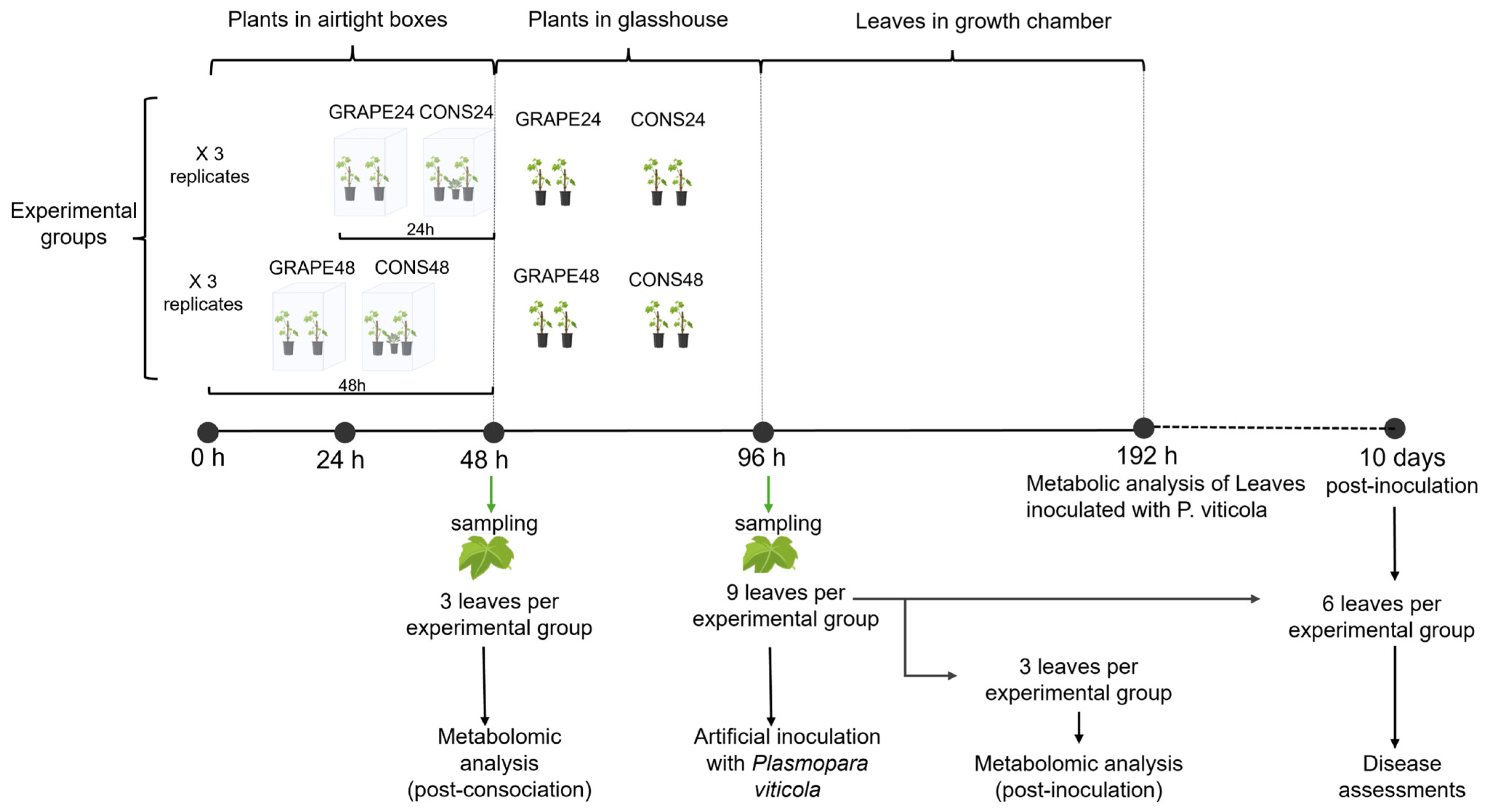
2.1. Plant Material and Experimental Design
2.2. Metabolomic Analysis
2.3. Inoculation of P. viticola and Disease Assessment
2.4. Statistical Analysis
3. Results
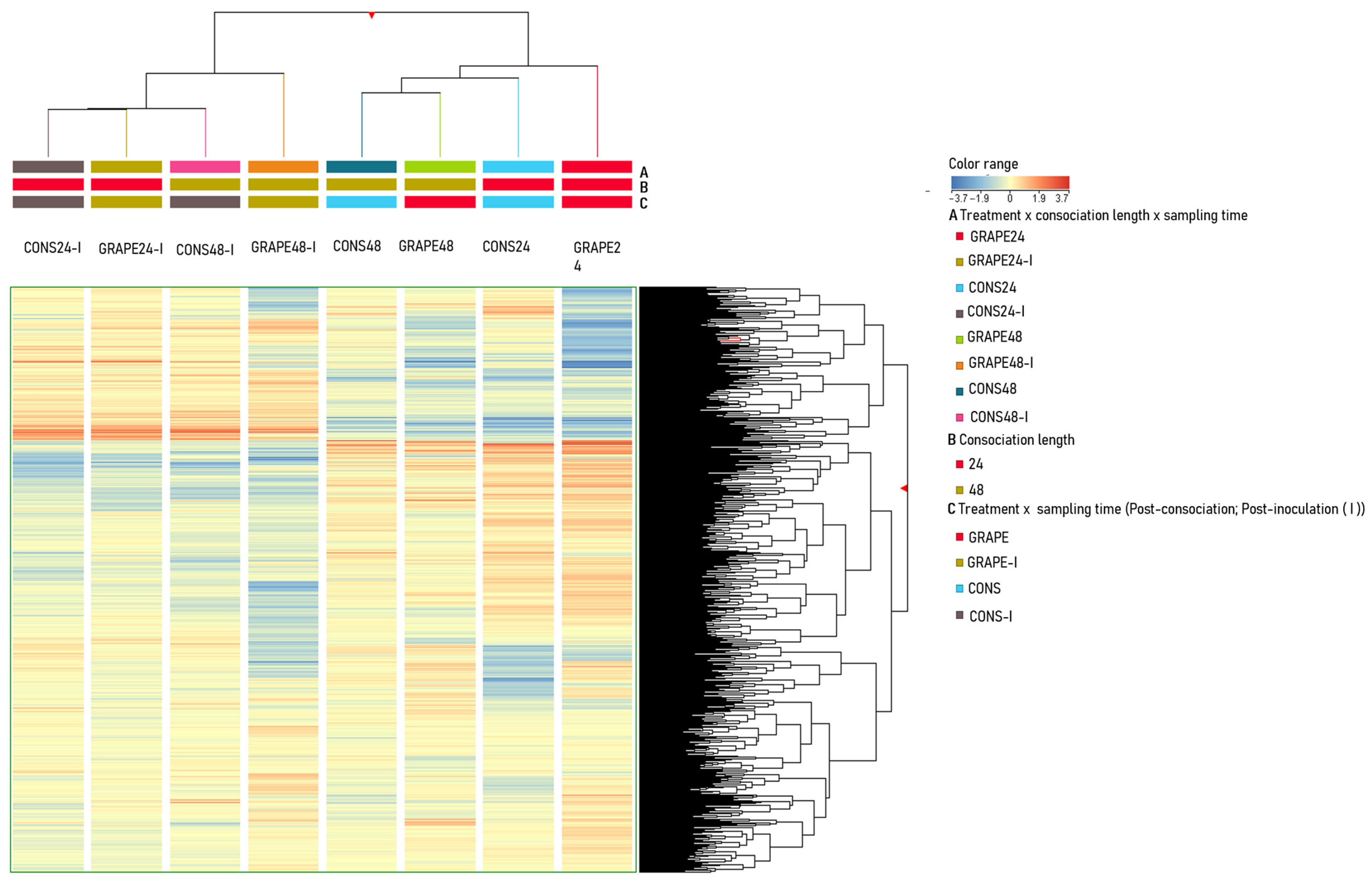
3.1. Comprehensive Analysis of Metabolic Profiles
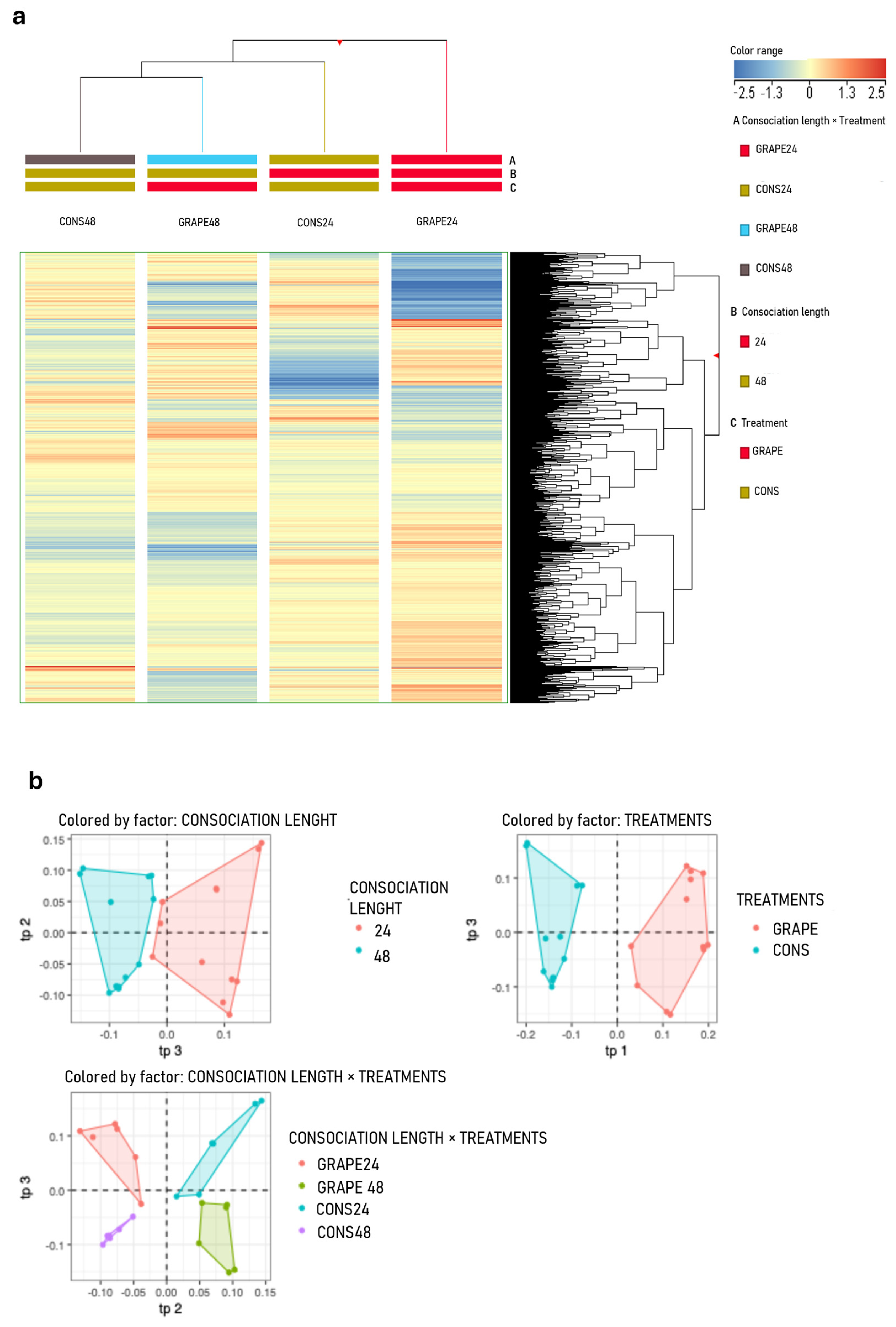
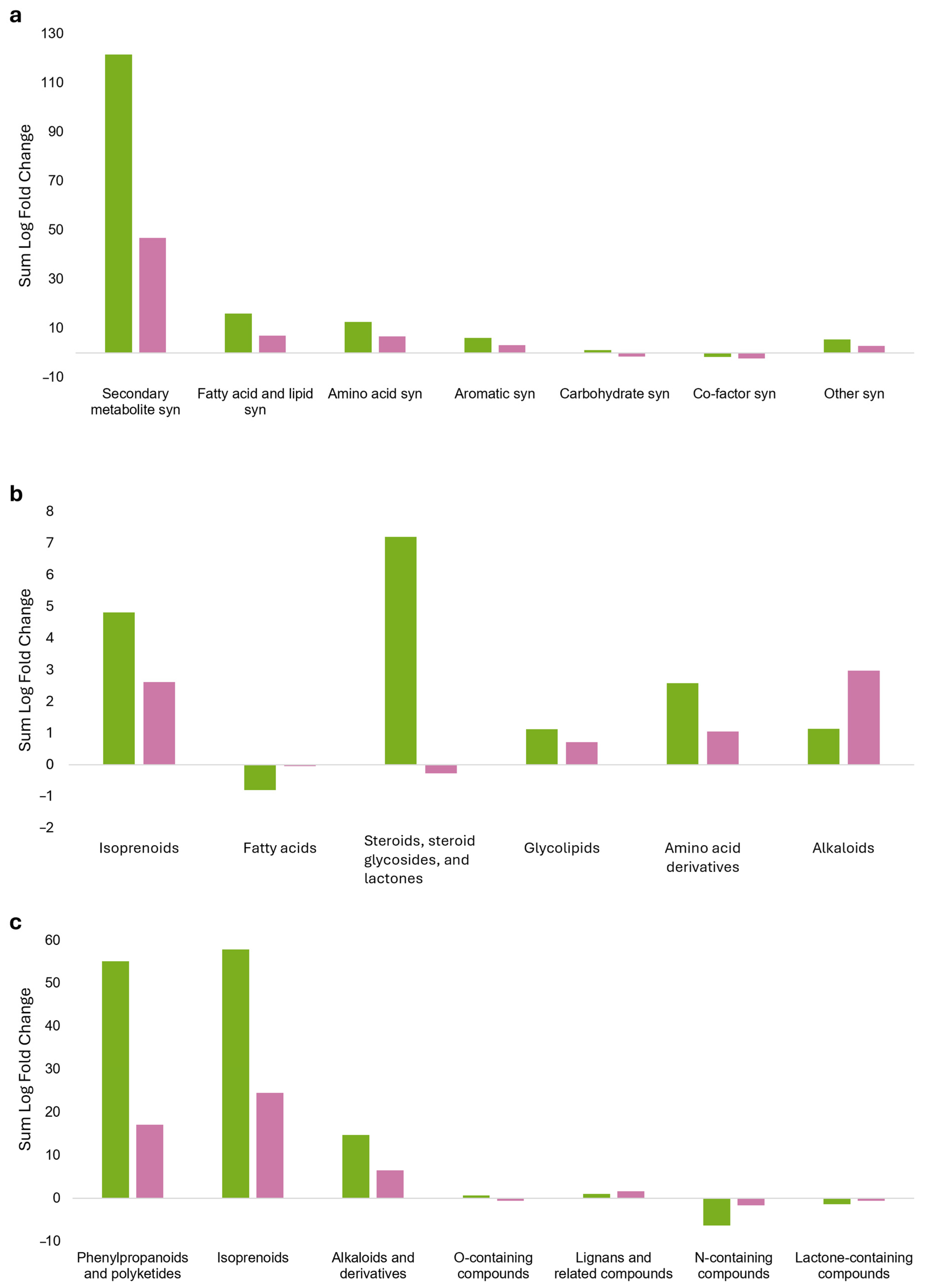
3.2. Post-Consociation Analysis
3.3. Metabolomics Change Post-Inoculation
3.4. Disease Assessments
4. Discussion
4.1. Main Metabolic Changes in Consociated Grapevine Leaves
4.2. Downy Mildew in Consociated Grapevine Leaves
5. Conclusions
Supplementary Materials
Author Contributions
Funding
Data Availability Statement
Acknowledgments
Conflicts of Interest
References
- Eurostat. Vineyards in the EU—Statistics. European Union. 2022. Available online: https://ec.europa.eu/eurostat/statistics-explained/index.php?title=Vineyards_in_the_EU_-_statistics (accessed on 1 March 2025).
- Straffelini, E.; Wang, W.; Tarolli, P. European Vineyards and Their Cultural Landscapes Exposed to Record Drought and Heat. Agric. Syst. 2024, 219, 104034. [Google Scholar] [CrossRef] [Scilit]
- Rusch, A.; Beaumelle, L.; Giffard, B.; Alonso Ugaglia, A. Harnessing Biodiversity and Ecosystem Services to Safeguard Multifunctional Vineyard Landscapes in a Global Change Context. In The Future of Agricultural Landscapes, Part III; Bohan, D.A., Dumbrell, A.J., Vanbergen, A.J., Eds.; Academic Press: Cambridge, MA, USA, 2021; Volume 65, pp. 305–335. ISBN 0065-2504. [Google Scholar] [CrossRef] [Scilit]
- Winter, S.; Bauer, T.; Strauss, P.; Kratschmer, S.; Daniela, P.; Blanca, P.; Gema, L.; José, G.; Muriel, G.; Johann, G.; et al. Effects of Vegetation Management Intensity on Biodiversity and Ecosystem Services in Vineyards: A Meta-Analysis. J. Appl. Ecol. 2018, 55, 2484–2495. [Google Scholar] [CrossRef] [Scilit]
- Liu, E.; Gold, K.M.; Combs, D.; Cadle-Davidson, L.; Jiang, Y. Deep Semantic Segmentation for the Quantification of Grape Foliar Diseases in the Vineyard. Front. Plant Sci. 2022, 13, 978761. [Google Scholar] [CrossRef] [Scilit]
- Bois, B.; Zito, S.; Calonnec, A. Climate vs Grapevine Pests and Diseases Worldwide: The First Results of a Global Survey. OENO One 2017, 51, 133–139. [Google Scholar] [CrossRef] [Scilit]
- Toffolatti, S.L.; Lecchi, B.; Maddalena, G.; Marcianò, D.; Stuknytė, M.; Arioli, S.; Mora, D.; Bianco, P.A.; Borsa, P.; Coatti, M.; et al. The Management of Grapevine Downy Mildew: From Anti—Resistance Strategies to Innovative Approaches for Fungicide Resistance Monitoring. J. Plant Dis. Prot. 2024, 131, 1225–1232. [Google Scholar] [CrossRef] [Scilit]
- Carvalho, F.P. Pesticides, Environment, and Food Safety. Food Energy Secur. 2017, 6, 48–60. [Google Scholar] [CrossRef] [Scilit]
- Steiner, M.; Falquet, L.; Fragnière, L.; Brown, A.; Bacher, S. Effects of Pesticides on Soil Bacterial, Fungal and Protist Communities, Soil Functions and Grape Quality in Vineyards. Ecol. Solut. Evid. 2024, 5, e12327. [Google Scholar] [CrossRef] [Scilit]
- Giraud, F.; Molitor, D.; Evers, M.; Bleunven, D. Fungicide Sensitivity Profiles of the Plasmopara Viticola Populations in the Luxembourg Grape-Growing Region. J. Plant Pathol. 2013, 1, 55–66. [Google Scholar]
- Teysseire, R.; Barron, E.; Baldi, I.; Bedos, C.; Chazeaubeny, A.; Le Menach, K.; Roudil, A.; Budzinski, H.; Delva, F. Pesticide Exposure of Residents Living in Wine Regions: Protocol and First Results of the Pestiprev Study. Int. J. Environ. Res. Public Health 2023, 20, 3882. [Google Scholar] [CrossRef] [Scilit]
- Silva, V.; Gai, L.; Harkes, P.; Tan, G.; Ritsema, C.J.; Alcon, F.; Contreras, J.; Abrantes, N.; Campos, I.; Baldi, I.; et al. Pesticide Residues with Hazard Classifications Relevant to Non-Target Species Including Humans Are Omnipresent in the Environment and Farmer Residences. Environ. Int. J. 2023, 181, 108280. [Google Scholar] [CrossRef] [Scilit]
- Nadalini, S.; Puopolo, G. Biological Control of Plasmopara viticola: Where Are We Now? In Plant and Soil Microbiome, Biocontrol Agents for Improved Agriculture; Kumar, A., Santoyo, G., Singh, J., Eds.; Academic Press: Cambridge, MA, USA, 2024; pp. 67–100. [Google Scholar] [CrossRef] [Scilit]
- Caffi, T.; Rossi, V. Fungicide Models Are Key Components of Multiple Modelling Approaches for Decision-Making in Crop Protection. Phytopathol. Mediterr. 2018, 57, 153–169. [Google Scholar] [CrossRef] [Scilit]
- Gil, E.; Llorens, J.; Landers, A.; Llop, J.; Giralt, L. Field Validation of Dosaviña, a Decision Support System to Determine the Optimal Volume Rate for Pesticide Application in Vineyards. Eur. J. Agron. 2011, 35, 33–46. [Google Scholar] [CrossRef] [Scilit]
- Sun, Z.-B.; Song, H.-J.; Liu, Y.-Q.; Ren, Q.; Wang, Q.-Y.; Li, X.-F.; Pan, H.-X.; Huang, X.-Q. The Potential of Microorganisms for the Control of Grape Downy Mildew—A Review. J. Fungi 2024, 10, 702. [Google Scholar] [CrossRef] [Scilit]
- Qiao, W.; Kang, X.; Ma, X.; Ran, L.; Zhen, Z. New Strain of Bacillus Amyloliquefaciens G1 as a Potential Downy Mildew Biocontrol Agent for Grape. Agronomy 2024, 14, 1532. [Google Scholar] [CrossRef] [Scilit]
- Raveau, R.; Ilbert, C.; Marie-claire, H.; Palavioux, K.; Anthony, P.; Marzari, T.; Valls-fonayet, J.; Adrian, M.; Fermaud, M. Broad-Spectrum Efficacy and Modes of Action of Two Bacillus Strains against Grapevine Black Rot and Downy Mildew. J. Fungi 2024, 10, 471. [Google Scholar] [CrossRef] [Scilit]
- Delaunois, B.; Farace, G.; Jeandet, P.; Clément, C.; Baillieul, F.; Dorey, S.; Cordelier, S. Elicitors as Alternative Strategy to Pesticides in Grapevine? Current Knowledge on Their Mode of Action from Controlled Conditions to Vineyard. Environ. Sci. Pollut. Res. Int. 2014, 21, 4837–4846. [Google Scholar] [CrossRef] [Scilit] [PubMed]
- Wilkinson, S.W.; Magerøy, M.H.; López Sánchez, A.; Smith, L.M.; Furci, L.; Cotton, T.E.A.; Krokene, P.; Ton, J. Surviving in a Hostile World: Plant Strategies to Resist Pests and Diseases. Annu. Rev. Phytopathol. 2019, 57, 505–529. [Google Scholar] [CrossRef] [Scilit] [PubMed]
- Vallad, G.E.; Goodman, R.M. Systemic Acquired Resistance and Induced Systemic Resistance in Conventional Agriculture. Crop Sci. 2004, 44, 1920–1934. [Google Scholar] [CrossRef] [Scilit]
- Rekanović, E.; Potočnik, I.; Stepanović, M.; Milijašević, S. Field Efficacy of Fluopicolide and Fosetyl-Al Fungicide Combination (Profiler ®) for Control of Plasmopara in Grapevine. Pestic. Fitomed. 2008, 23, 183–187. [Google Scholar] [CrossRef] [Scilit]
- Romanazzi, G.; Mancini, V.; Feliziani, E.; Servili, A.; Endeshaw, S.; Neri, D. Impact of Alternative Fungicides on Grape Downy Mildew Control and Vine Growth and Development. Plant Dis. 2016, 100, 739–748. [Google Scholar] [CrossRef] [Scilit]
- Héloir, M.-C.; Li Kim Khiook, I.; Lemaître-Guillier, C.; Clément, G.; Jacquens, L.; Bernaud, E.; Trouvelot, S.; Adrian, M. Assessment of the Impact of PS3-Induced Resistance to Downy Mildew on Grapevine Physiology. Plant Physiol. Biochem. 2018, 133, 134–141. [Google Scholar] [CrossRef] [Scilit]
- Taibi, O.; Salotti, I.; Rossi, V. Plant Resistance Inducers Affect Multiple Epidemiological Components of Plasmopara viticola on Grapevine Leaves. Plants 2023, 12, 2938. [Google Scholar] [CrossRef] [Scilit]
- Aziz, A.; Poinssot, B.; Daire, X.; Adrian, M.; Bézier, A.; Lambert, B.; Joubert, J.-M.; Pugin, A. Laminarin Elicits Defense Responses in Grapevine and Induces Protection against Botrytis cinerea and Plasmopara viticola. Mol. Plant. Microbe Interact. 2003, 16, 1118–1128. [Google Scholar] [CrossRef] [Scilit]
- Aziz, A.; Trotel-Aziz, P.; Conreux, A.; Dhuicq, L.; Jeandet, P.; Couderchet, M. Chitosan Induces Phytoalexin Synthesis, Chitinase and β-1, 3-Glucanase Activities, and Resistance of Grapevine to Fungal Pathogens. In Macromolecules and Secondary Metabolites of Grapevine and Wine; Jeandet, P., Clément, C., Conreux, A., Eds.; Intercept: New York, NY, USA, 2007; pp. 83–88. [Google Scholar]
- Garde-Cerdán, T.; Mancini, V.; Carrasco-Quiroz, M.; Servili, A.; Gutiérrez-Gamboa, G.; Foglia, R.; Pérez-Álvarez, E.P.; Romanazzi, G. Chitosan and Laminarin as Alternatives to Copper for Plasmopara Viticola Control: Effect on Grape Amino Acid. J. Agric. Food Chem. 2017, 65, 7379–7386. [Google Scholar] [CrossRef] [Scilit]
- Pujos, P.; Martin, A.; Farabullini, F.; Pizzi, M. RomeoTM, cerevisane-based biofungicide against the main diseases of grapes and of other crops: General description. In Proceedings of the Atti, Giornate Fitopatologiche, Chianciano Terme, Siena, Italy, 18–21 March 2014; Volume 2, pp. 51–56. [Google Scholar]
- Perazzolli, M.; Dagostin, S.; Ferrari, A.; Elad, Y.; Pertot, I. Induction of Systemic Resistance against Plasmopara viticola in Grapevine by Trichoderma harzianum T39 and Benzothiadiazole. Biol. Control 2008, 47, 228–234. [Google Scholar] [CrossRef] [Scilit]
- Taibi, O.; Fedele, G.; Salotti, I.; Rossi, V. Infection Risk-Based Application of Plant Resistance Inducers for the Control of Downy and Powdery Mildews in Vineyards. Agronomy 2023, 13, 2959. [Google Scholar] [CrossRef] [Scilit]
- Fandino, A.C.A.; Vigneron, N.; Alfonso, E.; Burdet, J.P.; Remolif, E.; Cattani, A.M.; Sadki, T.S.; Cluzet, S.; Fonayet, J.V.; Pétriacq, P.; et al. Priming Grapevines with Oregano Essential Oil Vapour Results in a Metabolomic Shift Eliciting Resistance against Downy Mildew. BMC Plant Biol. 2024, 24, 1180. [Google Scholar] [CrossRef] [Scilit] [PubMed]
- Avesani, S.; Lazazzara, V.; Robatscher, P.; Oberhuber, M.; Perazzolli, M. Current Plant Biology Volatile Linalool Activates Grapevine Resistance against Downy Mildew with Changes in the Leaf Metabolome. Curr. Plant Biol. 2023, 35–36, 100298. [Google Scholar] [CrossRef] [Scilit]
- Adebesin, F.; Widhalm, J.R.; Boachon, B.; Lefèvre, F.; Pierman, B.; Lynch, J.H.; Alam, I.; Junqueira, B.; Benke, R.; Ray, S.; et al. Emission of Volatile Organic Compounds from Petunia Flowers Is Facilitated by an ABC Transporter. Science 2017, 356, 1386–1388. [Google Scholar] [CrossRef] [Scilit]
- Widhalm, J.R.; Jaini, R.; Morgan, J.A.; Dudareva, N. Rethinking How Volatiles Are Released from Plant Cells. Trends Plant Sci. 2015, 20, 545–550. [Google Scholar] [CrossRef] [Scilit]
- Pichersky, E.; Noel, J.P.; Dudareva, N. Biosynthesis of Plant Volatiles: Nature’s Diversity and Ingenuity. Science 2006, 311, 808–811. [Google Scholar] [CrossRef] [Scilit] [PubMed]
- Dudareva, N.; Negre, F.; Nagegowda, D.A.; Orlova, I.; Dudareva, N.; Negre, F.; Nagegowda, D.A.; Orlova, I.; Dudareva, N.; Negre, F.; et al. Plant Volatiles: Recent Advances and Future Perspectives Crit. Rev. Plant Sci. 2006, 25, 417–440. [Google Scholar] [CrossRef] [Scilit]
- Dudareva, N.; Klempien, A.; Muhlemann, K.; Kaplan, I. Tansley Biosynthesis, Function and Metabolic Engineering of Plant Volatile Organic Compounds. New Phythologist 2013, 198, 16–32. [Google Scholar] [CrossRef] [Scilit] [PubMed]
- Brilli, F.; Baccelli, I. Exploiting Plant Volatile Organic Compounds (VOCs) in Agriculture to Improve Sustainable Defense Strategies and Productivity of Crops. Front. Plant Sci. 2019, 10, 264. [Google Scholar] [CrossRef] [Scilit]
- Heil, M.; Silva Bueno, J.C. Within-Plant Signaling by Volatiles Leads to Induction and Priming of an Indirect Plant Defense in Nature. Proc. Natl. Acad. Sci. USA 2007, 104, 5467–5472. [Google Scholar] [CrossRef] [Scilit]
- Baldwin, I.T.; Halitschke, R.; Paschold, A.; von Dahl, C.C.; Preston, C.A. Volatile Signaling in Plant-Plant Interactions: “Talking Trees” in the Genomics Era. Science 2006, 311, 812–815. [Google Scholar] [CrossRef] [Scilit] [PubMed]
- Heil, M. Herbivore-Induced Plant Volatiles: Targets, Perception and Unanswered Questions. New Phythologist 2014, 204, 297–306. [Google Scholar] [CrossRef] [Scilit]
- Lazazzara, V.; Buesc, C.; Parich, A.; Pertot, I.; Schuhmacher, R.; Perazzolli, M. Downy Mildew Symptoms on Grapevines Can Be Reduced by Volatile Organic Compounds of Resistant Genotypes. Sci. Rep. 2018, 8, 1618. [Google Scholar] [CrossRef] [Scilit]
- Quintana-Rodriguez, E.; Morales-Vargas, A.T.; Molina-Torres, J.; Adame-Alvarez, R.M.; Acosta-Gallegos, J.A.; Heil, M.; Norte, K.L. Plant Volatiles Cause Direct, Induced and Associational Resistance in Common Bean to the Fungal Pathogen Colletotrichum lindemuthianum. J. Ecol. 2015, 103, 250–260. [Google Scholar] [CrossRef] [Scilit]
- Matsui, K. A Portion of Plant Airborne Communication Is Endorsed by Uptake and Metabolism of Volatile Organic Compounds. Curr. Opin. Plant Biol. 2016, 32, 24–30. [Google Scholar] [CrossRef] [Scilit]
- Mofikoya, A.O. Foliar Behaviour of Biogenic Semi-Volatiles: Potential Applications in Sustainable Pest Management. Arthropod. Plant. Interact. 2019, 13, 193–212. [Google Scholar] [CrossRef] [Scilit]
- Camacho-Coronel, X.; Molina-torres, J.; Heil, M. Sequestration of Exogenous Volatiles by Plant Cuticular Waxes as a Mechanism of Passive Associational Resistance: A Proof of Concept. Front. Plant Sci. 2020, 11, 121. [Google Scholar] [CrossRef] [Scilit]
- Horstmann, M.; Mclachlan, M.S. Atmospheric Deposition of Semivolatile Organic Compounds to Two Forest Canopies. Atmos. Environ. 1998, 32, 1799–1809. [Google Scholar] [CrossRef] [Scilit]
- Yadav, A.; Khare, P. Journal of Hazardous Materials Advances The Role of Volatile Organic Compound Emissions from Aromatic Crops in the Management of Bioaerosols at Agricultural Sites: An Overview. J. Hazard. Mater. Adv. 2025, 17, 100574. [Google Scholar] [CrossRef] [Scilit]
- Ricciardi, V.; Marcianò, D.; Sargolzaei, M.; Maddalena, G.; Maghradze, D.; Tirelli, A.; Casati, P.; Bianco, P.A.; Failla, O.; Fracassetti, D.; et al. From Plant Resistance Response to the Discovery of Antimicrobial Compounds: The Role of Volatile Organic Compounds (VOCs) in Grapevine Downy Mildew Infection. Plant Physiol. Biochem. 2021, 160, 294–305. [Google Scholar] [CrossRef] [Scilit]
- Štambuk, P.; Šikuten, I.; Preiner, D.; Maleti, E.; Konti, J.K. Croatian Native Grapevine Varieties ’ VOCs Responses upon Plasmopara viticola Inoculation. Plants 2023, 12, 404. [Google Scholar] [CrossRef] [Scilit]
- Chitarrini, G.; Soini, E.; Riccadonna, S.; Franceschi, P.; Zulini, L.; Masuero, D.; Vecchione, A.; Stefanini, M.; Di Gaspero, G.; Mattivi, F.; et al. Identification of Biomarkers for Defense Response to Plasmopara viticola in a Resistant Grape Variety. Front. Plant Sci. 2017, 8, 1524. [Google Scholar] [CrossRef] [Scilit] [PubMed]
- Chitarrini, G.; Riccadonna, S.; Zulini, L.; Vecchione, A.; Stefanini, M.; Larger, S.; Pindo, M.; Cestaro, A.; Franceschi, P.; Magris, G.; et al. Two—Omics Data Revealed Commonalities and Differences between Rpv12—And Rpv3—Mediated Resistance in Grapevine. Sci. Rep. 2020, 10, 12193. [Google Scholar] [CrossRef] [Scilit] [PubMed]
- Algarra Alarcon, A.; Lazazzara, V.; Cappellin, L.; Bianchedi, P.L.; Schuhmacher, R.; Wohlfahrt, G. Emission of Volatile Sesquiterpenes and Monoterpenes in Grapevine Genotypes Following Plasmopara viticola Inoculation in Vitro. J. Mass Spectrom. 2015, 50, 1013–1022. [Google Scholar] [CrossRef] [Scilit] [PubMed]
- Greff, B.; Sáhó, A.; Lakatos, E.; Varga, L. Biocontrol Activity of Aromatic and Medicinal Plants and Their Bioactive Components against Soil-Borne Pathogens. Plants 2023, 12, 706. [Google Scholar] [CrossRef] [Scilit]
- Himanen, S.J.; Blande, J.D.; Klemola, T.; Pulkkinen, J.; Heijari, J.; Holopainen, J.K. Birch (Betula Spp.) Leaves Adsorb and Re-Release Volatiles Specific to Neighbouring Plants—A Mechanism for Associational Herbivore Resistance? New Phytol. 2010, 186, 722–732. [Google Scholar] [CrossRef] [Scilit]
- Bamberger, I.; Hörtnagl, L.; Ruuskanen, T.M.; Schnitzhofer, R.; Müller, M.; Graus, M.; Karl, T.; Wohlfahrt, G.; Hansel, A. Deposition Fluxes of Terpenes over Grassland. J. Geophys. Res. Atmos. JGR 2011, 116, D14305. [Google Scholar] [CrossRef] [Scilit]
- Alagmir, A.N.M. Pharmacognostical Botany: Classification of Medicinal and Aromatic Plants (MAPs), Botanical Taxonomy, Morphology, and Anatomy of Drug Plants. In Therapeutic Use of Medicinal Plants and Their Extracts; Springer: Berlin/Heidelberg, Germany, 2017; Volume 1. [Google Scholar] [CrossRef] [Scilit]
- Rienth, M.; Crovadore, J.; Ghaffari, S.; Lefort, F. Oregano Essential Oil Vapour Prevents Plasmopara viticola Infection in Grapevine (Vitis vinifera) and Primes Plant Immunity Mechanisms. PLoS ONE 2019, 14, e0222854. [Google Scholar] [CrossRef] [Scilit]
- Carvalho, M.G.; Bortolotto, O.C.; Ventura, M.U. Aromatic Plants Affect the Selection of Host Tomato Plants by Bemisia tabaci Biotype B. Entomol. Exp. Appl. 2017, 162, 86–92. [Google Scholar] [CrossRef] [Scilit]
- Togni, P.H.B.; Venzon, M.; Muniz, C.A.; Martins, E.F.; Pallini, A.; Sujii, E.R. Mechanisms Underlying the Innate Attraction of an Aphidophagous Coccinellid to Coriander Plants: Implications for Conservation Biological Control. Biol. Control 2016, 92, 77–84. [Google Scholar] [CrossRef] [Scilit]
- Szczech, M.; Kowalska, B.; Wurm, F.R.; Ptaszek, M.; Løvschall, K.B.; Velasquez, S.T.R. The Effects of Tomato Intercropping with Medicinal Aromatic Plants Combined with Trichoderma Applications in Organic Cultivation. Agronomy 2024, 14, 2572. [Google Scholar] [CrossRef] [Scilit]
- Sweellum, T.A.; Naguib, D.M. Tomato Potato Onion Intercropping Induces Tomato Resistance against Soil Borne Pathogen, Fusarium oxysporum through Improvement Soil Enzymatic Status, and the Metabolic Status of Tomato Root and Shoot. J. Plant Dis. Prot. 2023, 130, 245–261. [Google Scholar] [CrossRef] [Scilit]
- Deng, W.; Du, F.; Yang, R.; Yao, H.; Yang, M.; Mei, X.; Ye, C.; Li, S. Volatile Organic Compounds of Hoary Stock Are Responsible for Suppressing Downy Mildew of Grape in an Intercropping System. Phytopathol. Res. 2025, 7, 4. [Google Scholar] [CrossRef] [Scilit]
- Vigneron, N.; Grimplet, J.; Remolif, E.; Rienth, M. Unravelling Molecular Mechanisms Involved in Resistance Priming against Downy Mildew (Plasmopara viticola) in Grapevine (Vitis vinifera L.). Sci. Rep. 2023, 13, 14664. [Google Scholar] [CrossRef] [Scilit]
- Dagostin, S.; Formolo, T.; Giovannini, O.; Pertot, I.; Schmitt, A. Salvia officinalis Extract Can Protect Grapevine against Plasmopara viticola. Plant Dis. 2010, 94, 575–580. [Google Scholar] [CrossRef] [Scilit]
- Kennelly, M.M.; Gadoury, D.M.; Wilcox, W.F.; Magarey, P.A.; Seem, R.C. Primary Infection, Lesion Productivity, and Survival of Sporangia in the Grapevine Downy Mildew Pathogen Plasmopara viticola. Phytopathology 2007, 97, 512–522. [Google Scholar] [CrossRef] [Scilit] [PubMed]
- Steimetz, E.; Trouvelot, S.; Gindro, K.; Bordier, A.; Poinssot, B.; Adrian, M.; Daire, X. Physiological and Molecular Plant Pathology In Fl Uence of Leaf Age on Induced Resistance in Grapevine against Plasmopara viticola. Physiol. Mol. Plant Pathol. 2012, 79, 89–96. [Google Scholar] [CrossRef] [Scilit]
- Zhang, L.; Vaccari, F.; Ardenti, F.; Fiorini, A.; Tabaglio, V.; Puglisi, E.; Trevisan, M.; Lucini, L. The Dosage- and Size-Dependent Effects of Micro- and Nanoplastics in Lettuce Roots and Leaves at the Growth, Photosynthetic, and Metabolomics Levels. Plant Physiol. Biochem. 2024, 208, 108531. [Google Scholar] [CrossRef] [Scilit]
- Bouaicha, O.; Tiziani, R.; Maver, M.; Lucini, L.; Miras-Moreno, B.; Zhang, L.; Trevisan, M.; Cesco, S.; Borruso, L.; Mimmo, T. Plant Species-Specific Impact of Polyethylene Microspheres on Seedling Growth and the Metabolome. Sci. Total Environ. 2022, 840, 156678. [Google Scholar] [CrossRef] [Scilit]
- EPPO European and Mediterranean Plant Protection Organization. Guidelines for the Efficacy Evaluation of Fungicides: Plasmopara viticola. EPPO Bull. 2001, 31, 313–317. [Google Scholar] [CrossRef] [Scilit]
- Tsugawa, H.; Cajka, T.; Kind, T.; Ma, Y.; Higgins, B.; Ikeda, K.; Kanazawa, M.; VanderGheynst, J.; Fiehn, O.; Arita, M. MS-DIAL: Data-Independent MS/MS Deconvolution for Comprehensive Metabolome Analysis. Nat. Methods 2015, 12, 523–526. [Google Scholar] [CrossRef] [Scilit] [PubMed]
- Lee, S.; Hwang, S.; Seo, M.; Shin, K.B.; Kim, K.H.; Park, G.W.; Kim, J.Y.; Yoo, J.S.; No, K.T. BMDMS-NP: A Comprehensive ESI-MS/MS Spectral Library of Natural Compounds. Phytochemistry 2020, 177, 112427. [Google Scholar] [CrossRef] [Scilit]
- Salek, R.M.; Steinbeck, C.; Viant, M.R.; Goodacre, R.; Dunn, W.B. The Role of Reporting Standards for Metabolite Annotation and Identification in Metabolomic Studies. Gigascience 2013, 2, 2013–2047. [Google Scholar] [CrossRef] [Scilit]
- Dittrich, F.; Iserloh, T.; Treseler, C.-H.; Hüppi, R.; Ogan, S.; Seeger, M.; Thiele-Bruhn, S. Crop Diversification in Viticulture with Aromatic Plants: Effects of Intercropping on Grapevine Productivity in a Steep-Slope Vineyard in the Mosel Area, Germany. Agriculture 2021, 11, 95. [Google Scholar] [CrossRef] [Scilit]
- Mota-segantini, D.; Lombini, A.; Rodríguez-Declet, A.; De Giorgio, R.; D’onofrio, C.; Rombolà, A.D. Effects of Intercropping Medicinal and Aromatic Plants (MAPs) on Grapevine Cv. Sangiovese Berry Volatile Compounds. Agroecol. Sustain. Food Syst. 2022, 46, 452–462. [Google Scholar] [CrossRef] [Scilit]
- Dittrich, F.; Liu, B.; Tebbe, C.C. Diversifying Grapevines with Aromatic Plants Changes the Soil Habitat, Microbial Community Composition and Functions Toward More Efficient Substrate Use and Nutrient Allocation. J. Sustain. Agric. Environ. 2025, 4, e70071. [Google Scholar] [CrossRef] [Scilit]
- Voyard, A.; Ciuraru, R.; Lafouge, F.; Decuq, C.; Fortineau, A.; Loubet, B.; Staudt, M.; Rees, F. Emissions of Volatile Organic Compounds from Aboveground and Belowground Parts of Rapeseed (Brassica napus L.) and Tomato (Solanum lycopersicum L.). Sci. Total Environ. 2024, 955, 177081. [Google Scholar] [CrossRef] [Scilit]
- Perez-Matas, E.; Garcia-Perez, P.; Bonfill, M.; Lucini, L.; Hidalgo-Martinez, D.; Palazon, J. Impact of Elicitation on Plant Antioxidants Production in Taxus Cell Cultures. Antioxidants 2023, 12, 887. [Google Scholar] [CrossRef] [Scilit] [PubMed]
- Ramirez-Estrada, K.; Vidal-Limon, H.; Hidalgo, D.; Moyano, E.; Golenioswki, M.; Cusidó, R.M.; Palazon, J. Elicitation, an Effective Strategy for the Biotechnological Production of Bioactive High-Added Value Compounds in Plant Cell Factories. Molecules 2016, 21, 182. [Google Scholar] [CrossRef] [Scilit]
- Zhao, J.; Davis, L.C.; Verpoorte, R. Elicitor Signal Transduction Leading to Production of Plant Secondary Metabolites. Biotechnol. Adv. 2005, 23, 283–333. [Google Scholar] [CrossRef] [Scilit]
- Pichersky, E.; Raguso, R.A. Why Do Plants Produce so Many Terpenoid Compounds? New Phythologist 2018, 220, 692–702. [Google Scholar] [CrossRef] [Scilit]
- Aljbory, Z.; Chen, M.-S. Indirect Plant Defense against Insect Herbivores: A Review. Insect Sci. 2018, 25, 2–23. [Google Scholar] [CrossRef] [Scilit]
- Toffolatti, S.L.; Maddalena, G.; Passera, A.; Casati, P.; Bianco, P.A.; Quaglino, F. Chapetr 16—Role of Terpenes in Plant Defense to Biotic Stress. In Biocontrol Agents and Secondary Metabolites; Jogaiah, S., Ed.; Woodhead Publishing: Cambridge, UK, 2021; pp. 401–417. [Google Scholar] [CrossRef] [Scilit]
- Pensec, F.; Szakiel, A.; Pa, C.; Grabarczyk, M.; Bertsch, C.; Fischer, M.J.C.; Chong, J. Characterization of Triterpenoid Profiles and Triterpene Synthase Expression in the Leaves of Eight Vitis vinifera Cultivars Grown in the Upper Rhine Valley. J. Plant Res. 2016, 129, 499–512. [Google Scholar] [CrossRef] [Scilit]
- Szakiel, A.; Pączkowski, C.; Henry, M. Influence of Environmental Abiotic Factors on the Content of Saponins in Plants. Phytochem. Rev. 2011, 10, 471–491. [Google Scholar] [CrossRef] [Scilit]
- Burdziej, A. Effect of Selected Elicitors on Grapevine (Vitis vinifera) Primary and Secondary Metabolism: Focus on Stilbenes and Triterpenoids. Ph.D. Thesis, University of Bordeaux, Bordeaux, France, the University of Warsaw, Warsaw, Poland, 2023. [Google Scholar]
- Lucini, L.; Baccolo, G.; Rouphael, Y.; Colla, G.; Bavaresco, L.; Trevisan, M. Chitosan Treatment Elicited Defence Mechanisms, Pentacyclic Triterpenoids and Stilbene Accumulation in Grape (Vitis vinifera L.) Bunches. Phytochemistry 2018, 156, 1–8. [Google Scholar] [CrossRef] [Scilit] [PubMed]
- Batovska, D.I.; Todorova, I.T.; Parushev, S.P.; Nedelcheva, D.V.; Bankova, V.S.; Popov, S.S.; Ivanova, I.I.; Batovski, S.A. Biomarkers for the Prediction of the Resistance and Susceptibility of Grapevine Leaves to Downy Mildew. J. Plant Physiol. 2009, 166, 781–785. [Google Scholar] [CrossRef] [Scilit] [PubMed]
- Toffolatti, S.L.; De Lorenzis, G.; Costa, A.; Maddalena, G.; Passera, A.; Bonza, M.C.; Pindo, M.; Stefani, E.; Cestaro, A.; Casati, P.; et al. Unique Resistance Traits against Downy Mildew from the Center of Origin of Grapevine (Vitis vinifera). Sci. Rep. 2018, 8, 12523. [Google Scholar] [CrossRef] [Scilit]
- Rosenkranz, M.; Chen, Y.; Zhu, P.; Vlot, A.C. Volatile Terpenes—Mediators of Plant-to-Plant Communication. Plant J. 2021, 108, 617–631. [Google Scholar] [CrossRef] [Scilit] [PubMed]
- Lemaitre-Guillier, C.; Chartier, A.; Dufresne, C.; Douillet, A.; Cluzet, S.; Valls, J.; Aveline, N.; Daire, X.; Adrian, M. Elicitor-Induced VOC Emission by Grapevine Leaves: Characterisation in the Vineyard. Molecules 2022, 27, 6028. [Google Scholar] [CrossRef] [Scilit]
- Hou, L.; Yuan, X.; Li, S.; Li, Y.; Li, Z.; Li, J. Genome-Wide Identification of CYP72A Gene Family and Expression Patterns Related to Jasmonic Acid Treatment and Steroidal Saponin Accumulation in Dioscorea zingiberensis. Int. J. Mol. Sci. 2021, 22, 10953. [Google Scholar] [CrossRef] [Scilit] [PubMed]
- Shaikh, S.; Shriram, V.; Khare, T.; Kumar, V. Biotic Elicitors Enhance Diosgenin Production in Helicteres isora L. Suspension Cultures via up-Regulation of CAS and HMGR Genes. Physiol. Mol. Biol. Plants 2020, 26, 593–604. [Google Scholar] [CrossRef] [Scilit]
- Li, Y.; Yang, H.; Li, Z.; Li, S.; Li, J. Advances in the Biosynthesis and Molecular Evolution of Steroidal Saponins in Plants. Int. J. Mol. Sci. 2023, 24, 2620. [Google Scholar] [CrossRef] [Scilit]
- Ujváry, I. Chapter 3—Pest Control Agents from Natural Products. In Hayes’ Handbook of Pesticide Toxicology, 3rd ed.; Krieger, R., Ed.; Academic Press: San Diego, CA, USA, 2010; pp. 119–229. ISBN 978-01-2374367-1. [Google Scholar]
- Viterbo, A.; Staples, R.C.; Yagen, B.; Mayer, A.M. Selective Mode of Action of Cucurbitacin in the Inhibition of Laccase Formation In Botrytis cinerea. Phytochemistry 1994, 35, 1137–1142. [Google Scholar] [CrossRef] [Scilit]
- Laureano, G.; Cavaco, A.R.; Matos, A.R.; Figueiredo, A. Fatty Acid Desaturases: Uncovering Their Involvement in Grapevine Defence against Downy Mildew. Int. J. Mol. Sci. 2021, 22, 5473. [Google Scholar] [CrossRef] [Scilit]
- Braidot, E.; Zancani, M.; Petrussa, E.; Peresson, C.; Bertolini, A.; Patui, S.; Macrì, F.; Vianello, A. Transport and Accumulation of Flavonoids in Grapevine (Vitis vinifera L.). Plant Signal. Behav. 2008, 3, 626–632. [Google Scholar] [CrossRef] [Scilit]
- Shomali, A.; Das, S.; Arif, N.; Sarraf, M.; Zahra, N.; Yadav, V.; Aliniaeifard, S.; Chauhan, D.K.; Hasanuzzaman, M. Diverse Physiological Roles of Flavonoids in Plant Environmental Stress Responses and Tolerance. Plants 2022, 11, 3158. [Google Scholar] [CrossRef] [Scilit]
- Wang, L.; Chen, M.; Lam, P.Y.; Andreote, F.D.; Dai, L.; Wei, Z. Multifaceted Roles of Flavonoids Mediating Plant—Microbe Interactions. Microbiome 2022, 10, 233. [Google Scholar] [CrossRef] [Scilit] [PubMed]
- Dong, N.-Q.; Lin, H.-X. Contribution of Phenylpropanoid Metabolism to Plant Development and Plant—Environment Interactions. J. Integr. Plant Biol. 2021, 63, 180–209. [Google Scholar] [CrossRef] [Scilit] [PubMed]
- Le Roy, J.; Huss, B.; Creach, A.; Hawkins, S.; Neutelings, G. Glycosylation Is a Major Regulator of Phenylpropanoid Availability and Biological Activity in Plants. Front. Plant Sci. 2016, 7, 735. [Google Scholar] [CrossRef] [Scilit]
- Kai, K.; Shimizu, B.; Mizutani, M.; Watanabe, K.; Sakata, K. Accumulation of Coumarins in Arabidopsis thaliana. Phytochemistry 2006, 67, 379–386. [Google Scholar] [CrossRef] [Scilit] [PubMed]
- Čulina, P.; Cvitković, D.; Pfeifer, D.; Zorić, Z.; Repajić, M.; Elez Garofulić, I.; Balbino, S.; Pedisić, S. Phenolic Profile and Antioxidant Capacity of Selected Medicinal and Aromatic Plants: Diversity upon Plant Species and Extraction Technique. Processes 2021, 9, 2207. [Google Scholar] [CrossRef] [Scilit]
- Ali, K.; Maltese, F.; Figueiredo, A.; Rex, M.; Fortes, A.M.; Zyprian, E.; Pais, M.S.; Verpoorte, R.; Choi, Y.H. Alterations in Grapevine Leaf Metabolism upon Inoculation with Plasmopara viticola in Different Time-Points. Plant Sci. 2012, 191–192, 100–107. [Google Scholar] [CrossRef] [Scilit]
- Muñoz-Hoyos, L.; Stam, R. Metabolomics in Plant Pathogen Defense: From Single Molecules to Large-Scale Analysis. Phytopathology 2023, 113, 760–770. [Google Scholar] [CrossRef] [Scilit]
- Santra, H.K.; Banerjee, D. Natural Products as Fungicide and Their Role in Crop Protection. Nat. Bioact. Prod. Sustain. Agric. 2020, 12, 131–219. [Google Scholar] [CrossRef] [Scilit]
- Agati, G.; Brunetti, C.; Fini, A.; Gori, A.; Guidi, L.; Landi, M.; Sebastiani, F.; Tattini, M. Are Flavonoids Effective Antioxidants in Plants? Twenty Years of Our Investigation. Antioxidants 2020, 9, 1098. [Google Scholar] [CrossRef] [Scilit]
- Agati, G.; Azzarello, E.; Pollastri, S.; Tattini, M. Flavonoids as Antioxidants in Plants: Location and Functional Significance. Plant Sci. 2012, 196, 67–76. [Google Scholar] [CrossRef] [Scilit]
- Agati, G.; Cerovic, Z.G.; Marta, A.D.; Di Stefano, V.; Pinelli, P.; Traversi, M.L.; Orlandini, S. Optically-Assessed Preformed Flavonoids and Susceptibility of Grapevine to Plasmopara viticola under Different Light Regimes. Funct. Plant Biol. 2008, 35, 77–84. [Google Scholar] [CrossRef] [Scilit]
- Di Ferdinando, M.; Brunetti, C.; Fini, A.; Tattini, M. Flavonoids as Antioxidants in Plants Under Abiotic Stresses. In Abiotic Stress Responses in Plants: Metabolism, Productivity and Sustainability; Ahmad, P., Prasad, M.N.V., Eds.; Springer: New York, NY, USA, 2012; pp. 159–179. ISBN 978-1-4614-0634-1. [Google Scholar]
- Viret, O.; Spring, J.; Gindro, K. Stilbenes: Biomarkers of Grapevine Resistance to Fungal Diseases. OENO One 2018, 51, 235–240. [Google Scholar] [CrossRef] [Scilit]
- Cooper, A.; Ton, J. Immune Priming in Plants: From the Onset to Transgenerational Maintenance. Essays Biochem. 2022, 66, 635–646. [Google Scholar] [CrossRef] [Scilit]
- Avesani, S.; Lazazzara, V.; Buti, M.; Oberhuber, M.; Robatscher, P.; Perazzolli, M. Volatile 2-Phenylethanol and β-Cyclocitral Trigger Related Transcriptional and Metabolic Changes in Grapevine Leaves Against Downy Mildew. Physiol. Plant. 2025, 177, e70412. [Google Scholar] [CrossRef] [Scilit]
- Heil, M.; Karban, R. Explaining Evolution of Plant Communication by Airborne Signals. Trends Ecol. Evol. 2010, 25, 137–144. [Google Scholar] [CrossRef] [Scilit]
- Mofikoya, A.O.; Yli-Pirilä, P.; Kivimäenpää, M.; Blande, J.D.; Virtanen, A.; Holopainen, J.K. Deposition of α-Pinene Oxidation Products on Plant Surfaces Affects Plant VOC Emission and Herbivore Feeding and Oviposition. Environ. Pollut. 2020, 263, 114437. [Google Scholar] [CrossRef] [Scilit]
- Mofikoya, A.O.; Kim, T.H.; Abd El-Raheem, A.M.; Blande, J.D.; Kivimäenpää, M.; Holopainen, J.K. Passive Adsorption of Volatile Monoterpene in Pest Control: Aided by Proximity and Disrupted by Ozone. J. Agric. Food Chem. 2017, 65, 9579–9586. [Google Scholar] [CrossRef] [Scilit]
- Craft, J.D.; Satyal, P.; Setzer, W.N. The Chemotaxonomy of Common Sage (Salvia officinalis) Based on the Volatile Constituents. Medicines 2017, 4, 47. [Google Scholar] [CrossRef] [Scilit]
- Longaray Delamare, A.P.; Moschen-Pistorello, I.T.; Artico, L.; Atti-Serafini, L.; Echeverrigaray, S. Antibacterial Activity of the Essential Oils of Salvia officinalis L. and Salvia triloba L. Cultivated in South Brazil. Food Chem. 2007, 100, 603–608. [Google Scholar] [CrossRef] [Scilit]
- Marino, M.; Bersani, C.; Comi, G. Impedance Measurements to Study the Antimicrobial Activity of Essential Oils from Lamiaceae and Compositae. Int. J. Food Microbiol. 2001, 67, 187–195. [Google Scholar] [CrossRef] [Scilit]
- Laborda, R.; Manzano, I.; Gamón, M.; Gavidia, I.; Pérez-Bermúdez, P.; Boluda, R. Effects of Rosmarinus officinalis and Salvia officinalis Essential Oils on Tetranychus urticae Koch (Acari: Tetranychidae). Ind. Crops Prod. 2013, 48, 106–110. [Google Scholar] [CrossRef] [Scilit]
- Hayouni, E.A.; Chraief, I.; Abedrabba, M.; Bouix, M.; Leveau, J.-Y.; Mohammed, H.; Hamdi, M. Tunisian Salvia officinalis L. and Schinus molle L. Essential Oils: Their Chemical Compositions and Their Preservative Effects against Salmonella Inoculated in Minced Beef Meat. Int. J. Food Microbiol. 2008, 125, 242–251. [Google Scholar] [CrossRef] [Scilit]
- Ben Khedher, M.R.; Ben Khedher, S.; Chaieb, I.; Tounsi, S.; Hammami, M. Chemical Composition and Biological Activities of Salvia officinalis Essential Oil from Tunisia. EXCLI J. 2017, 16, 160–173. [Google Scholar] [CrossRef] [Scilit]
- Romdhane, M.; Abderrabba, M.; Fellah, S. Extraction et Etude des Huiles Essentielles de La Salvia Officinalis L. Cueillie Dans Deux Regions Differentes de la Tunisie. J. Soc. Alger. Chim. 2006, 16, 193–202. [Google Scholar]
- Tao, H.; Lauterbach, L.; Bian, G.; Chen, R.; Hou, A.; Mori, T.; Cheng, S.; Hu, B.; Lu, L.; Mu, X.; et al. Discovery of Non-Squalene Triterpenes. Nature 2022, 606, 414–419. [Google Scholar] [CrossRef] [Scilit]
- Lazazzara, V.; Vicelli, B.; Bueschl, C.; Parich, A.; Pertot, I.; Schuhmacher, R.; Perazzolli, M. Trichoderma Spp. Volatile Organic Compounds Protect Grapevine Plants by Activating Defense-Related Processes against Downy Mildew. Physiol. Plant. 2021, 172, 1950–1965. [Google Scholar] [CrossRef] [Scilit]
- Rodríguez-Declet, A.; Castro-Marín, A.; Moretti Conti, L.; Lombini, A.; Chinnici, F.; Rombolà, A.D. Characterization of VOCs Emitted by Foliage of Grapevine Cv. Isabella for Prospecting Innovative Cropping Systems. Agronomy 2022, 12, 272. [Google Scholar] [CrossRef] [Scilit]



Disclaimer/Publisher’s Note: The statements, opinions and data contained in all publications are solely those of the individual author(s) and contributor(s) and not of MDPI and/or the editor(s). MDPI and/or the editor(s) disclaim responsibility for any injury to people or property resulting from any ideas, methods, instructions or products referred to in the content. |
© 2026 by the authors. Licensee MDPI, Basel, Switzerland. This article is an open access article distributed under the terms and conditions of the Creative Commons Attribution (CC BY) license.
Share and Cite
Fittipaldi Broussard, M.; Campana, C.; Ferrari, V.; Ragnoli, I.; Zhang, L.; Lucini, L.; Rossi, V.; Caffi, T.; Fedele, G. The Consociation of Sage and Grapevine Modifies Grape Leaf Metabolism and Reduces Downy Mildew Infection. Agronomy 2026, 16, 201. https://doi.org/10.3390/agronomy16020201
Fittipaldi Broussard M, Campana C, Ferrari V, Ragnoli I, Zhang L, Lucini L, Rossi V, Caffi T, Fedele G. The Consociation of Sage and Grapevine Modifies Grape Leaf Metabolism and Reduces Downy Mildew Infection. Agronomy. 2026; 16(2):201. https://doi.org/10.3390/agronomy16020201
Chicago/Turabian StyleFittipaldi Broussard, Monica, Carlo Campana, Veronica Ferrari, Ilaria Ragnoli, Leilei Zhang, Luigi Lucini, Vittorio Rossi, Tito Caffi, and Giorgia Fedele. 2026. "The Consociation of Sage and Grapevine Modifies Grape Leaf Metabolism and Reduces Downy Mildew Infection" Agronomy 16, no. 2: 201. https://doi.org/10.3390/agronomy16020201
APA StyleFittipaldi Broussard, M., Campana, C., Ferrari, V., Ragnoli, I., Zhang, L., Lucini, L., Rossi, V., Caffi, T., & Fedele, G. (2026). The Consociation of Sage and Grapevine Modifies Grape Leaf Metabolism and Reduces Downy Mildew Infection. Agronomy, 16(2), 201. https://doi.org/10.3390/agronomy16020201