Article

Fungicide Preharvest Application Strategies and Their Effects on Crop Yield, Quality, and Sprouting of Dried Onion Bulbs

by
Ana Avilés-Quezada
1,2,
Martín Fuentes-López
3,
Alberto Guirao
4,
Ander Solana-Guilabert
4,
Huertas M. Díaz-Mula
4,
Juan M. Valverde
4,
María E. García-Pastor
4,* and
Domingo Martínez-Romero
4,*
1
Facultad de Ciencias Agronómicas y Veterinarias, Universidad Autónoma de Santo Domingo (UASD), Ciudad Universitaria, Avenida Alma Máter, 1355, Santo Domingo 10105, Dominican Republic
2
Instituto Dominicano de Investigaciones Agropecuaria y Forestales (IDIAF), Calle Rafael Augusto Sánchez, #89, Ensanche Evaristo Morales, Santo Domingo 10147, Dominican Republic
3
Department of Food Technology, EPSO, University Miguel Hernández, Ctra. Beniel km. 3.2, 03312 Orihuela, Alicante, Spain
4
Instituto de Investigación e Innovación Agroalimentaria y Agroambiental (CIAGRO), University Miguel Hernández, Ctra. Beniel km. 3.2, 03312 Orihuela, Alicante, Spain
*
Authors to whom correspondence should be addressed.
Agronomy 2025, 15(11), 2616; https://doi.org/10.3390/agronomy15112616
Submission received: 19 October 2025 / Revised: 12 November 2025 / Accepted: 13 November 2025 / Published: 14 November 2025

Abstract

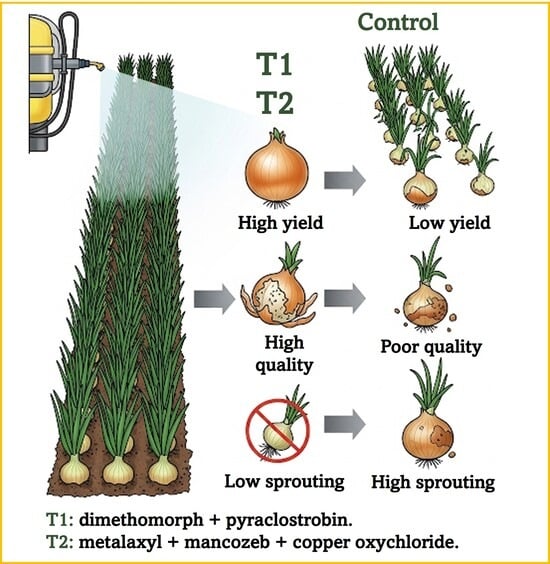
Postharvest losses in onion (Allium cepa L.) bulbs constitute a major economic challenge globally, primarily driven by fungal pathogens and premature sprouting during long-term storage. Addressing these issues with effective preharvest strategies is critical for market stability and supply chain integrity. This study evaluated the effects of two preharvest fungicide strategies, i.e., T1 (dimethomorph + pyraclostrobin) and T2 (metalaxyl + mancozeb + copper oxychloride), on the crop yield, postharvest quality, and sprouting behavior of dried onion bulbs. Both treatments significantly reduced the incidence of foliar disease in the field and improved the crop yield of commercial bulbs compared to the control in two consecutive seasons. T1 achieved the highest yield (~76 and 88 t ha−1 in ‘Mata Hari’ and ’Recas’ onions). During storage at 20 °C for 84 days, in the ‘Mata Hari’ cultivar, the T1 bulbs exhibited the lowest weight loss and respiration rate, the lowest sprouting incidence (1%), and superior firmness retention and higher total soluble solids. In contrast, control bulbs exhibited accelerated weight loss and tissue degradation, with up to 95% sprouting. Pyruvic acid content, an indicator of pungency, was highest in T1 bulbs and increased significantly in sprouted controls, likely due to internal enzymatic activation and tissue senescence. The fungicides indirectly delayed dormancy release by delaying sprouting and internal stem axis formation. Overall, T1 was the most effective strategy for preserving onion quality during storage without using synthetic sprout inhibitors. These findings support the integration of specific fungicide programs into preharvest management to improve onion storability, reduce postharvest losses, and maintain commercial value in intermediate-dormancy dried onion cultivars, such as ‘Mata Hari’.

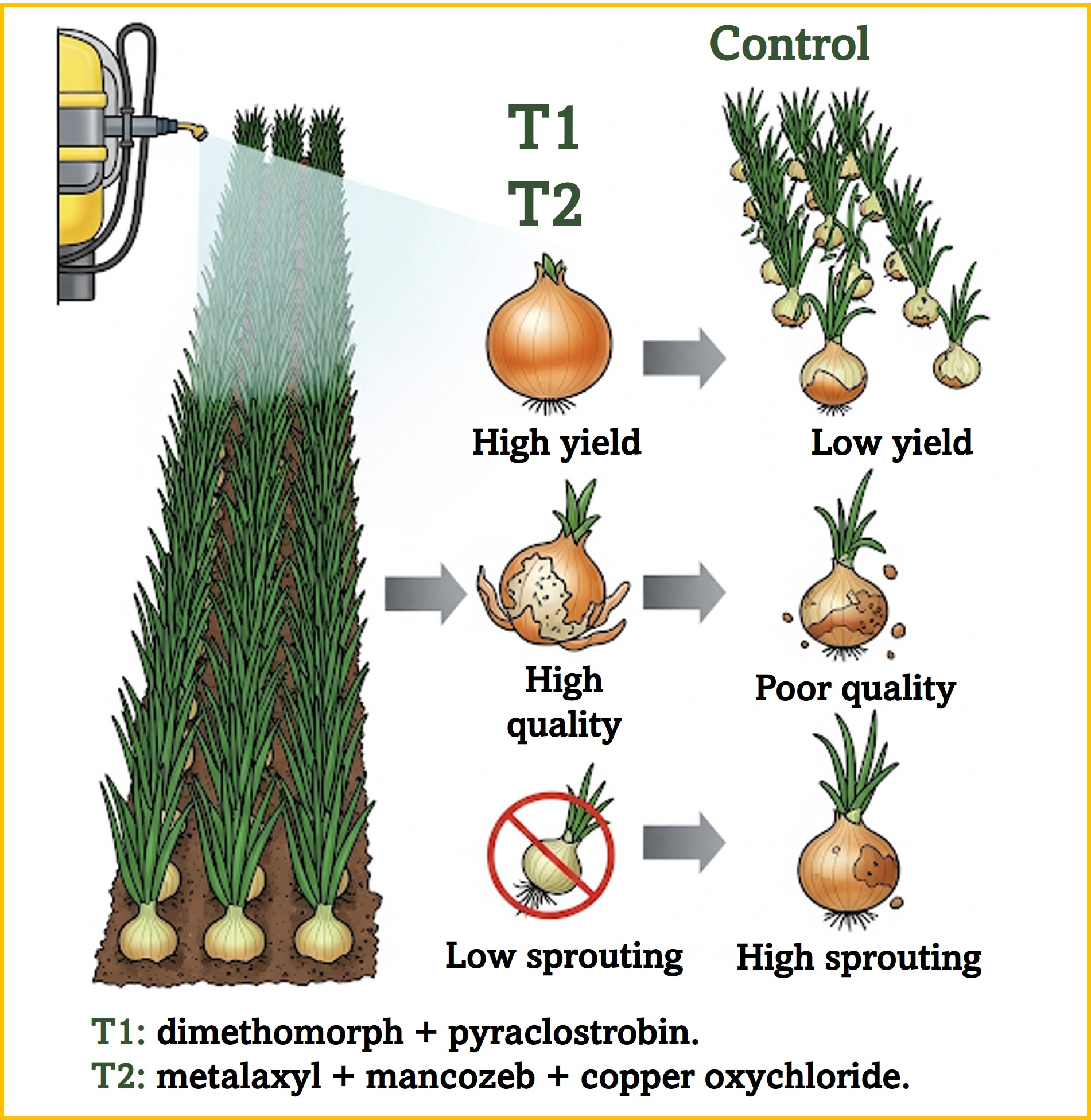
Graphical Abstract

1. Introduction

The onion (Allium cepa L.) is one of the most important horticultural crops worldwide, and is consumed fresh, cured or as green onions. It is valued for both its culinary uses and its health benefits. Onions play a significant role in cuisines across the globe due to their consistent demand and their use as a fundamental ingredient in various dishes [1]. Furthermore, this crop has a significant impact on the global agricultural economy. According to FAOSTAT [2], global onion production reached 111.27 million tons in 2023, with the crop being cultivated across 139 countries. The top three producers were India (30.21 million tons), China (24.86 million tons), and Egypt (3.80 million tons), accounting for 53% of the total. From a nutritional standpoint, onions are low in calories (40 kcal 100 g−1) but rich in essential nutrients, including vitamins C and B6, potassium, manganese and fiber, the latter of which aids digestion [1]. They also contain antioxidant compounds, primarily flavonoids, with quercetin being the most abundant. Quercetin is known for its health-promoting properties [3]. Various factors can influence onion crop yield and production, including nutrient deficiencies, climatic conditions, irrigation efficiency and, most importantly, disease control during cultivation. Common phytopathogens affecting onions include Peronospora destructor, Botrytis allii, Stemphylium vesicarium, Fusarium spp. and Alternaria porri, among others [4]. Once cured, onions have a long storage life, typically lasting between six and nine months at 0 °C (32 °F) and 60–70% relative humidity (RH), depending on the cultivar [5]. However, onions are often stored and marketed at temperatures ranging from 10 to 20 °C, which can lead to a break in dormancy and promote bulb sprouting [6].
Strobilurins are naturally occurring molecules synthesized by certain fungi in the Basidiomycota group, such as Oudemansiella mucida (Schrad. ex Fr.) Höhn. and Strobilurus tenacellus (Pers. ex Fr.) Singer. These fungi decompose wood from various tree species. Strobilurins inhibit mitochondrial respiration by specifically binding to the Qo site of cytochrome b, thereby disrupting energy production in target pathogens [7]. Among the strobilurins, pyraclostrobin (FRAC MOA Code 11) is a non-systemic fungicide with the highest fungicidal activity of its class [8]. Due to its broad-spectrum action, it is effective against Ascomycetes, Basidiomycetes, Deuteromycetes, and Oomycetes, providing preventive and curative control of diseases [7]. One fungicidal preparation is an emulsifiable concentrate (EC) containing a combination of two active ingredients: dimethomorph at a concentration of 72 g L−1 and pyraclostrobin at 40 g L−1. Dimethomorph (FRAC MOA Code 40) is a systemic fungicide that exhibits preventive, curative, and antisporulant properties specifically against Oomycete pathogens [8]. It disrupts all stages of cell membrane formation, making it highly effective. The combined action of these two active ingredients results in a broad-spectrum fungicide that is particularly effective against downy mildew (Peronospora destructor) in onions [9,10].
Studies have shown that pyraclostrobin controls fungal pathogens and provides additional benefits beyond disease protection. For instance, it has been observed to increase biomass accumulation and yield in soybean plants [11,12], as well as to mitigate abiotic stress during cultivation. In tomato crops subjected to saline stress, treatments with pyraclostrobin resulted in higher yields than untreated plants [13]. In addition, this fungicide has been reported to extend postharvest storage life and enhance the visual quality of cauliflower (Brassica oleracea var. botrytis), particularly the Flamenco and Verona cultivars [14]. This beneficial effect has also been confirmed for the combined formulation of dimethomorph + pyraclostrobin, which significantly improved the yield and quality of cherry tomatoes (Solanum lycopersicum var. cerasiforme) [15]. Peronospora destructor is an oomycete for which dimethomorph has specific and robust activity. Dimethomorph therefore provides targeted control of the oomycete component of the foliar disease complex in onion. Furthermore, pyraclostrobin (a strobilurin QoI fungicide) was chosen because strobilurins not only offer broad foliar-disease control but have well-documented “plant-health” effects [16].
Previous studies have mainly focused on disease suppression and yield improvement, while the relationship between fungicide mode of action, application timing, and the physiological mechanisms governing sprouting during storage remains poorly understood. In addition, Chope and Terry [17] suggested that increasing the preharvest abscisic acid (ABA) concentration may be a useful strategy to delay sprouting in onion bulbs during storage. In this context, it has been demonstrated that strobilurin fungicides can alter the plant hormonal balance by decreasing ethylene and increasing ABA levels in several crops, including wheat [18,19]. Such hormonal shifts are directly relevant to dormancy maintenance and sprouting regulation. While the efficacy of the selected fungicides against common field diseases is well-documented [11,12,13,14,15,16,17,18,19], a significant research gap remains regarding the optimal preharvest application strategies needed to effectively control postharvest disorders such as neck rot and sprouting. Specifically, comprehensive data is lacking on the long-term impact of varying preharvest treatment timings and concentrations on bulb quality, physiological dormancy, and overall storage stability.
Based on this knowledge gap, this study aimed to determine the effect of various preharvest fungicide application strategies on onion yield, postharvest quality, and sprouting incidence. Therefore, the impact of a preharvest fungicide strategy (T1: dimethomorph + pyraclostrobin) on the yield of two types of onion (‘Recas’ and ‘Mata Hari’) over two consecutive seasons and at two different locations was studied. Secondly, the study also examined the effect of two treatments (T1: dimethomorph + pyraclostrobin; T2: metalaxyl + mancozeb + copper oxychloride) on crop yield, the quality and postharvest sprouting of ‘Mata Hari’ onion bulbs, which are particularly susceptible to downy mildew (Peronospora destructor). Given the global economic and nutritional importance of onions, improving their disease management, postharvest storage, and overall marketability is crucial for sustainable production.

2. Materials and Methods

2.1. Plant Material and Experimental Design

The Spanish yellow type ‘Recas’ is a prominent long-day onion (Allium cepa L.) cultivar characterized by its spherical, large-sized bulbs encased in multiple layers of a dark yellow to coppery, firm dry skin. Classified as a late-maturing cultivar (approximately 120 relative days to maturity), it is valued for its very long storage potential due to the firmness of its bulbs and the excellent resistance of its skin to handling. The cultivar exhibits a high percentage of single centers and is a reliable choice for regions where the production cycle requires an extended postharvest conservation period [20]. On the other hand, ‘Mata Hari’ is a red, globe-shaped onion (Allium cepa L.) cultivar, which is widely cultivated in temperate regions due to its optimal balance between yield and shelf-life. This cultivar has been shown to be well adapted to both spring sowing and summer harvesting. The cultivar exhibits moderate tolerance to common fungal diseases such as downy mildew and Fusarium [5] and low susceptibility to bolting, enabling optimal harvests even in hot conditions. In the first season (2019), the ‘Recas’ onions were cultivated on a commercial farm in La Roda, Spain (39°14′2.162″ N, 2°18′48.952″ W). The following season, in 2020, the ‘Mata Hari’ onion cultivar was cultivated on a commercial plot located in Pulpí (Almería, Spain; 37°24′42″ N, 1°43′48″ W). The ‘Recas’ and ‘Mata Hari’ onions were planted on 27 March 2019 and 7 November 2020, respectively, on raised beds measuring 1.6 m in width and 50 m in length. Each bed contained eight rows of onions, with a spacing of 0.18 m between rows and 0.1 m between plants within rows.
As shown in Table 1 and Table 2, each treatment—T1 (dimethomorph and pyraclostrobin), T2 (metalaxyl, mancozeb, and copper oxychloride), and the control (no fungicides)—was applied in duplicate on an alternating basis. The field experiment was arranged in a randomized block design with two replicated plots per treatment. Each experimental plot consisted of one raised bed section of 1.6 m in width and 50 m in length (≈80 m2 per replicate). Fungicide applications were performed preventively starting at the onset of the rapid bulb growth stage and continued until preharvest. Fungicide applications were carried out using a tractor-mounted boom sprayer delivering 1000 L ha−1 of spray solution. Dimethomorph + pyraclostrobin (T1) and metalaxyl + mancozeb + copper oxychloride (T2) were applied at the label-recommended field rates. Plots were separated by untreated buffer rows to avoid spray drift.
The application of the fungicide treatments was cultivar-specific: T1 (dimethomorph and pyraclostrobin) was applied to both the highly sensitive ‘Mata Hari’ cultivar and the ‘Recas’ cultivar, while T2 (metalaxyl, mancozeb, and copper oxychloride) was tested exclusively on the ‘Mata Hari’ cultivar, given its documented high susceptibility to downy mildew incidence. This differential testing strategy, accurately reflected in Table 1 and Table 2, allowed for a comprehensive assessment of the most effective compounds against the primary pathogen in the most vulnerable variety, while confirming T1’s efficacy across both studied cultivars. The selection of these two onion cultivars was based on the fact that ‘Recas’ onions are characterized by a crop cycle from April to September, which is a summer crop with a dry climate, temperatures of 39 °C in the plantation and an average relative humidity (RH) that never exceeds 70%, always hovering around 50%, as it is not influenced by the coast or sea conditions. Consequently, in this type of onion, the incidence of downy mildew (Peronospora destructor) is minimal. Consequently, the same experiment was carried out the following year, selecting a cultivar that was more susceptible to the aforementioned fungal infection, and the ‘Mata Hari’ cultivar was selected for this purpose. In contrast to ‘Recas’ onions, the ‘Mata Hari’ cultivar of red onions has a crop cycle from November to July, characterized by a humid climate and influenced by sea or coastal conditions.
Dimethomorph was included for its specific activity against oomycetes such as Peronospora destructor (the primary pathogen affecting bulb development in our trials), while pyraclostrobin was selected as a representative strobilurin (QoI) because of its broad foliar efficacy and reported bioregulatory effects that can increase crop vigor and influence postharvest physiology [16,18,19]. The combination therefore aims to provide targeted disease control plus potential plant-health benefits that may affect dormancy and storage behavior.
The commencement of treatments was scheduled for 29 May (Table 1) and 15 April (Table 2) for ‘Recas’ and ‘Mata Hari’ onions, coinciding with climatic conditions conducive to the proliferation of Peronospora destructor and the initiation of bulb enlargement. From this period onwards, minimum temperatures consistently exceeded 10 °C, while maximum temperatures approached 25 °C. In the case of the ‘Mata Hari’ cultivar, relative humidity levels frequently attained 100% due to the farm’s coastal proximity during the early morning hours, thereby promoting leaf condensation. This phenomenon can be attributed to the proximity to the sea, which resulted in condensation on the leaves. In these conditions, T1 and T2 fungicide treatments were administered weekly, in accordance with the active substances and dosages specified in both Table 1 and Table 2. For treatment T1, a formulation containing 7.2% dimethomorph and 4.0% pyraclostrobin was used, in the form of an emulsion concentrate (EC). For treatment T2, the formulation used was mancozeb 64% + metalaxyl 8%, in the form of a water-dispersible powder (WP). All treatments were applied in accordance with the manufacturer’s recommendations, including dosage and number of applications for both seasons (2019 and 2020).
All preharvest fungicide applications complied with EU Good Agricultural Practice prior to 2020. The preharvest intervals (PHI) applied were: 14 days for dimethomorph, 7 days for pyraclostrobin, metalaxyl, and mancozeb, and 0 days for copper oxychloride. According to EU legislation in force before 2020, the maximum residue levels (MRLs) for onion bulbs were as follows: 0.6 mg kg−1 for dimethomorph, 0.8 mg kg−1 for pyraclostrobin, 0.01 mg kg−1 (default LOQ) for metalaxyl, 0.5 mg kg−1 for mancozeb (as dithiocarbamates), and 4 mg kg−1 for copper. Although residue analysis was not performed, the dosages and application timings used were specifically chosen to remain within these legal limits and ensure consumer safety. The harvesting process for ‘Recas’ and ‘Mata Hari’ onions was conducted on the 19th of September 2019 and 4th of June 2020, respectively, a date on which approximately 60% of the plants exhibited signs of neck bending. This harvest stage (≈60% neck bending) is the standard physiological maturity index for onions, indicating completed bulb development and the onset of natural neck desiccation. The onions were harvested using a mechanical harvester and subsequently arranged in rows. The estimated production of marketable onions, mainly in terms of diameter greater than 30 mm (tons ha−1) and production distribution by bulb size grades (%) was measured in both types of bulb onions However, as the most susceptible onion cultivar is tested in the second year (2020), the ‘Mata Hari’ onion cultivar was used to conduct the postharvest trial. Therefore, the bulbs were cured in the field under natural, ambient Mediterranean summer conditions, in line with standard commercial practice in Spain. Bulbs were left in windrows exposed to natural ventilation, with daytime temperatures typically ranging from 25 to 32 °C and low to moderate relative humidity, for five days in La Roda and six days in Pulpí, allowing progressive neck desiccation and outer scale drying prior to storage. Subsequent to harvest, three 2 m2 areas were marked per bed and treatment (6 areas and 100 plant/area), with the objective of assessing the following parameters: weight of uncured plants, neck diameter, and total plant length. Thus, for the ‘Mata Hari’ cultivar, the impact of treatments T1 and T2 on crop yield, quality, sprouting and the incidence of downy mildew in dried onion was determined.
Subsequently, the plants were returned to their designated areas. Furthermore, 50 onions per treatment from ‘Mata Hari’ cultivar were taken to the laboratory to analyze respiration rate, firmness, internal color, and soluble solids. The analytical procedures are described in detail in the following sections. Subsequent to the conclusion of the curing process, a second weighing of all plants from the designated areas was conducted to ascertain the extent of weight loss during the curing process (%). The stems and roots were then trimmed in order to ascertain the relative yield of bulbs as a percentage of the total weight of the plant. Furthermore, the diameter of the cured bulbs was recorded. In addition, 40 bulbs per marked area (i.e., 240 bulbs per treatment) were selected and transported to the CIAGRO-UMH laboratory, which is located in Orihuela (Alicante, Spain). In the laboratory, bulbs exhibiting defects in shape or size, as well as those with visible damage, were discarded to ensure homogeneous replicates and maintain a minimum quality standard. From the remaining samples, 21 replicates of five uniform bulbs per treatment were selected after mixing bulbs harvested from all field plots within each treatment. Quality parameters, including respiration rate, weight loss, firmness, internal color, total soluble solids (TSS), presence of stem axis in bulb center, sprouting incidence, and pungency, were evaluated in three replicates per treatment at different time points: immediately after curing (Day 0), and after 14, 28, 42, 56, 70, and 84 days. Bulbs were stored under controlled postharvest conditions for 84 days at 20 °C and 70% relative humidity (RH) in the dark, under natural ventilation, to simulate typical commercial storage conditions for intermediate-dormancy onion cultivars. The present study employed those storage conditions for the purpose of assessing the efficacy of the preharvest treatments (T1, T2, and Control) in delaying sprouting and other postharvest deterioration processes in the bulbs.

2.2. Assessment of Downy Mildew Incidence and Severity at Harvest

Before harvest, an evaluation of the downy mildew (Peronospora destructor) presence was conducted in each experimental block. A visual inspection of all plots was performed to detect symptoms and signs of the disease. Within each block, the number of symptomatic plants was recorded and compared to the total plant population, which was estimated by counting plants in a representative row and extrapolating across the block. The incidence of disease was calculated as the number of symptomatic plants divided by the total number of plants per block, multiplied by 100. Thus, the incidence of disease was expressed as a percentage (%) of infected plants.

2.3. Crop Yield

The individual weight (g) of the freshly harvested plants, the cured plants, and the bulbs (with roots and shoots removed after curing) from the six marked zones was recorded using a battery-operated digital scale (KERN PCD-300-3, Balingen, Germany). The weight loss after curing was calculated, as well as the bulb-to-plant ratio after curing and the average bulb weight after curing. The length of plants harvested at the earliest stage possible was manually measured using a standard measuring tape. The diameter of the neck of onions in the fresh state, as well as the equatorial diameter of cured bulbs, were measured using a digital caliper (Mitutoyo ABS AOS Digital Caliper, Elgoibar, Spain). Onions with a diameter smaller than 30 mm were considered non-commercial, while the remaining bulbs were classified into four commercial categories: A (30–50 mm), B (51–70 mm), C (71–90 mm), and D (>91 mm) [21].

2.4. Respiration Rate of the Bulb

The respiration rate of the bulbs was evaluated using a closed static system. For each treatment, three replicates were prepared, with each replicate consisting of five onion bulbs placed inside airtight 5 L plastic containers. The bulbs were then incubated at ambient temperature for one hour. Subsequent to the incubation period, a 1 mL headspace gas sample was collected from each container using a gas-tight syringe and analyzed for CO2 concentration via gas chromatography. The analysis was conducted using a Shimadzu GC-14B chromatograph (Shimadzu, Tokyo, Japan) equipped with a thermal conductivity detector (TCD) and a 2 m × 1/8″ stainless steel column packed with CHROMOSORB 102 (80/100 mesh). The analysis was conducted and validated following the protocol described by Valverde et al. [22]. The respiration rate was expressed in milligrams of carbon dioxide (CO2) per kilogram of fresh weight (FW) per hour (mg CO2 kg−1 h−1). The results were reported as the mean ± standard error (SE) of the three replicates (n = 3) of five bulbs.

2.5. Evaluation of Weight Loss, Firmness, Internal Color, and Total Soluble Solids

To monitor weight loss during storage, each bulb was weighed at day 0 and at each subsequent sampling point. The percentage weight loss was calculated using the following formula (Equation (1)):
Weight loss (%) = (W0 − Wt)/W0 × 100
In this equation, W0 denotes the initial weight of the subject and Wt represents the weight recorded at the time of measurement. The values were presented as the mean ± SE from three replicates (n = 3). The firmness of the bulbs was determined by means of a TX-XT2i Texture Analyser (Stable Microsystems, Godalming, UK) equipped with a flat cylindrical probe (10 cm diameter). The probe was utilized to compress the equatorial region of each bulb to 5% of its original height. Firmness was calculated as the force-to-deformation ratio (N mm−1). Each replicate comprises five bulbs, and the results were reported as the mean ± SE (n = 3). The change in internal color was quantified by calculating the total color difference (ΔE) (Equation (2)) based on the CIELAB color parameters (L*, a*, b*) measured with a CR-200 colorimeter (Konica Minolta, Tokyo, Japan). For each replicate (n = 3), five bulbs were selected, and three readings were taken from the central flesh region of each bulb. The ΔE value was computed as follows:
ΔE = √(((L2 − L1)2 + (a2 − a1)2 + (b2 − b1)2))
Subscripts 1 and 2 refer to the initial (at harvest) and final time points of the storage period, respectively. The total soluble solids (TSS) were measured in juice extracted from five bulbs per replicate (n = 3) using a muslin cloth. Two drops of juice were analyzed at 20 °C using a digital refractometer (Atago PR-101, Atago Co. Ltd., Tokyo, Japan), according to Valverde et al. [22]. The TSS values were expressed as °Brix of juice and reported as the mean ± SE.

2.6. Determination of the Pungency of Onion Bulbs

The pungency of the samples was determined by colorimetric quantification of the amount of pyruvic acid released upon tissue disruption. The 2,4-dinitrophenylhydrazine (DNPH) method was used for this purpose, following the protocols described by Anthon and Barrett [23]. A DNPH solution (0.125 g L−1 in 2 M HCl) and a pyruvic acid standard curve (0–0.4 mM) were prepared from sodium pyruvate. Pyruvic acid concentration was determined up to day 42 of storage. Measurements beyond this point were not included because excessive sprouting and tissue deterioration in the control group interfered with the reliability of the DNPH assay, which could lead to erratic colorimetric readings and compromised extraction reproducibility. Samples (five onion quarters per replicate) were separated into two fractions: untreated (with active alliinase) and thermally inactivated (internal blank) by microwave heating. Following homogenization with cold distilled water (1:1, w/w), the samples were filtered and, optionally, subjected to centrifugation. A portion of the diluted juice was mixed with DNPH and subsequently subjected to incubation at 37 °C for a period of 10 min to form a hydrazone complex. The addition of 0.6 millimoles of NaOH resulted in the cessation of the reaction. The reddish color that was produced was measured spectrophotometrically at a wavelength of 515 nm. The standard curve was constructed using pyruvate standards that were processed in parallel. The pyruvic acid concentration in terms of µmol mL−1 was calculated by linear interpolation, with the value of the inactivated blank subtracted. The ultimate outcomes were expressed as the total pyruvate content, which serves as a quantitative metric for onion pungency [23].

2.7. Sprouting and Internal Stem Axis Formation at the Center of the Bulb

The process of sprouting was evaluated by determining the percentage of bulbs exhibiting visible emergence of the stem axis. The presence of internal stem axis formation was assessed on an individual basis in each bulb using a development index based on the intensity of green coloration in the central tissue of the bulb. To quantify this internal greening, a 4-point hedonic scale was employed, where 0 = Absence of the caulinar stem; 1 = Emergence of the yellow-white stem apex at the center of the bulb; 2 = Moderate formation of the yellowish-green caulinar stem; and 3 = Complete development of the caulinar stem and green caulinar stem at the center of the bulb. This greening index was the parameter used to quantify internal greening reported in the results section. This 4-point hedonic scale for the development of the internal stem axis was developed specifically for this study, as no standardized visual scoring system for the internal sprouting of onion bulbs could be found in the literature.

2.8. Statistical Analysis

The statistical approach was adapted to the experimental design of each season (2019 and 2020), since the number of treatments and variables evaluated differed between years. In 2019, a single preharvest fungicide treatment (T1) was applied and compared with a non-treated control. Therefore, production and bulb size data were analyzed using a Student’s t-test for independent samples (n = 6 field replicates per treatment). Results are expressed as mean ± standard error (SE). In 2020, three treatments were evaluated (T1, T2, and Control). For variables measured only at harvest (total yield, bulb size distribution, and field decay incidence), a one-way analysis of variance (ANOVA) was applied, considering “treatment” as the main factor. When significant differences were detected at p < 0.05, means were separated using Tukey’s HSD post hoc test. For variables measured during storage (respiration rate, weight loss, firmness, internal color, total soluble solids, pyruvic acid content, sprouting incidence, and neck elongation index), a two-way ANOVA was performed considering treatment (T; T1, T2, Control), storage time (S), and their interaction (T × S) as fixed factors. Each treatment × time combination was replicated three times (n = 3), and each replicate consisted of five bulbs. Results are expressed as mean ± SE. All analyses were performed using IBM SPSS Statistics software, version 21.0 (IBM Corp., Armonk, NY, USA).

3. Results

3.1. Effect of Fungicide Treatments on Disease Control, Plant Growth and Crop Yield

The results of this study demonstrated a significant impact of preharvest treatments on the morphological and quality parameters of onions before and after curing (Table 3). In the control group, leaf bending at the neck reached 80%, whereas both T1 and T2 treatments resulted in only 60% of the stems being bent. The fresh weight of the plants prior to the curing process was significantly higher in T1 (208.85 ± 15.07 g) and T2 (219.11 ± 10.33 g) in comparison to the control (158.51 ± 6.42 g), with T2 demonstrating the highest value. The diameter of the neck prior to the curing process was 1.47 ± 0.06 cm in the control group and 1.49 ± 0.07 cm in T1; these values did not differ significantly. In contrast, T2 exhibited a larger neck diameter (1.66 ± 0.07 cm). The total length of the plants, excluding their roots, was measured prior to the curing process. The mean values for the control group (74.75 ± 1.81 cm) were lower than those for T1 (83.70 ± 1.56 cm) and T2 (81.75 ± 2.02 cm). However, there was no significant difference between the treated groups.
After the curing process, the bulb diameter was found to be greater in both T1 (7.19 ± 0.27 cm) and T2 (7.33 ± 0.14 cm) than in the control (6.43 ± 0.10 cm). As shown in Table 3, plant weight loss during the curing process was found to be considerably lower in the control group (9.11 ± 0.60%) relative to the T1 (22.31 ± 2.15%) and T2 (19.45 ± 0.87%) groups. The bulb-to-plant ratio was highest in the control group (93.33 ± 0.58%), while T1 (89.33 ± 0.63%) and T2 (88.53 ± 0.48%) registered lower ratios. Finally, the mean bulb weight after curing was greatest in T2 (153.19 ± 4.61 g), followed by T1 (145.41 ± 4.88 g), and lowest in the control (134.69 ± 4.24 g).
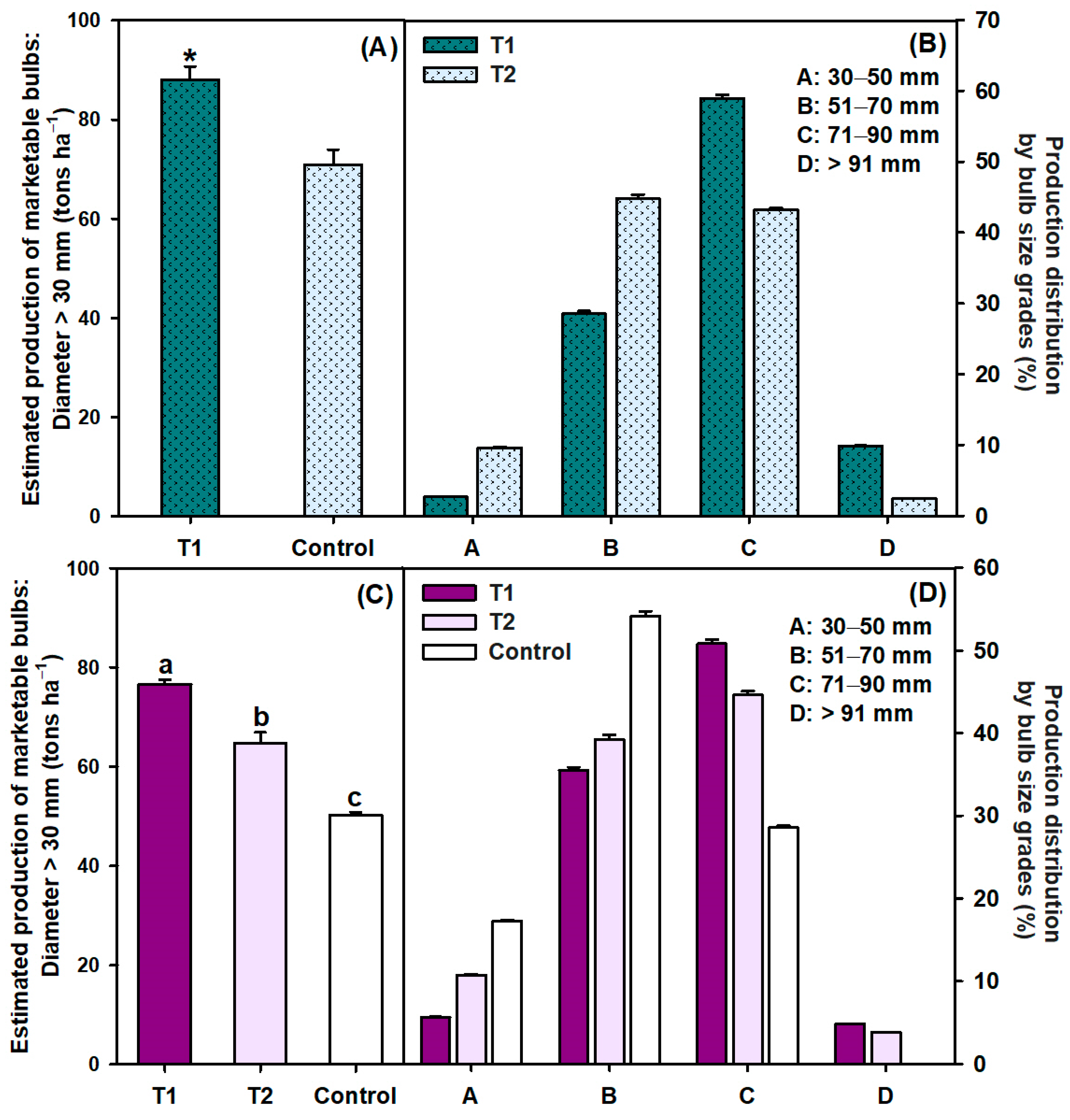
The experimental results demonstrate a distinct influence of the tested treatments (T1 and T2) on both onion cultivars across different years (2019 and 2020 seasons). For the ‘Recas’ onions in 2019 (Figure 1A), the T1 treatment significantly (p < 0.05) increased the estimated production of marketable bulbs (diameter > 30 mm) to 88.08 tons ha−1 compared with 70.92 tons ha−1 obtained in control plants. As can be observed in Figure 1B, this yield boost was primarily driven by a greater proportion of bulbs falling into the C size grade (71–90 mm) compared to the control, which showed a more even distribution across B and C grades. Conversely, the results for the ‘Mata Hari’ cultivar in 2020 (Figure 1C) indicate that both T1 and T2 treatments significantly (p < 0.05) improved marketable crop yield compared to the control (50 tons ha−1), with T1 leading the highest production (approximately 77 tons ha−1) and outperforming T2 with ≈ 65 tons ha−1. Furthermore, all three conditions (T1, T2, and control) showed a similar trend in size distribution (Figure 1D), with the majority of the production concentrated in the B (51–70 mm) and C (71–90 mm) grades, although T1 and T2 slightly shifted the distribution towards the larger C grade compared to the control. The control group produced 17.29% of bulbs with a diameter of 30–50 mm, compared to 5.65% in T1 and 10.77% in T2 (p < 0.05). In the mid-size range (51–70 mm), control bulbs represented 54.14%, while T1 and T2 yielded 35.48% and 39.23%, respectively. Regarding larger calibers (71–90 mm), only 28.57% of control bulbs reached this size, whereas 50.81% in T1 and 44.62% in T2 were in this range (p < 0.05). Notably, none of the control bulbs exceeded 90 mm in diameter, while both T1 and T2 produced a small fraction of oversized bulbs (4.84% and 3.85%, respectively) (Figure 1D).

3.2. Effect of Preharvest Fungicide Treatments on Postharvest Bulb Physiology and Quality

3.2.1. Effects of Fungicide Treatments on Respiration Rate and Weight Losses During Postharvest Storage

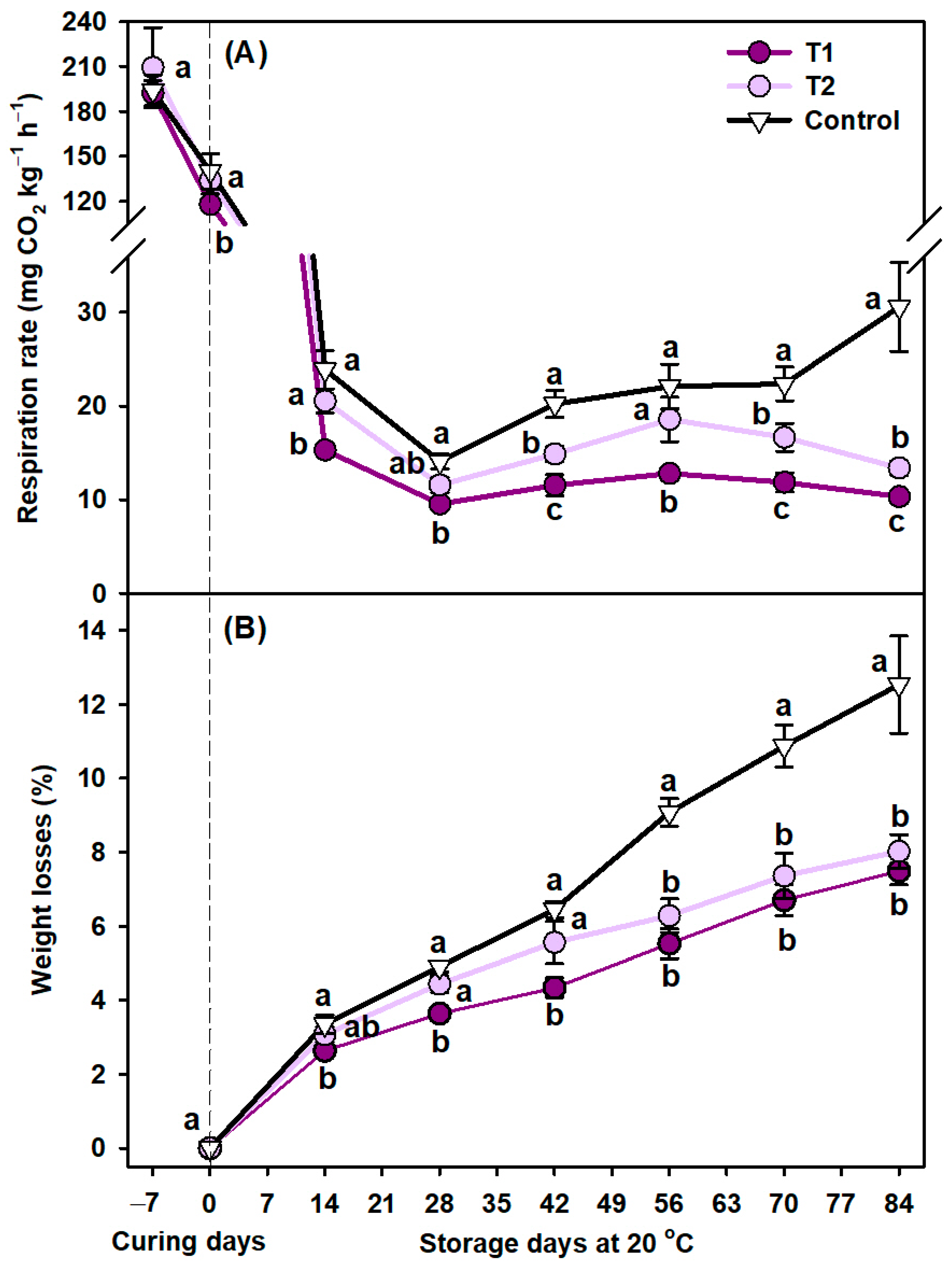
The T1 and T2 treatments significantly influenced the respiration rate of onions throughout the postharvest period, with all samples exhibiting a steady decline from harvest to 84 days of storage at 20 °C (Figure 2A). ANOVA across time points confirmed significant treatment effects on CO2 emission (T1 < T2 < Control; p < 0.05 at each evaluation), indicating that preharvest protection translated into consistently reduced postharvest respiration. At pre-curing harvest (Day—7), the respiration rates exhibited no significant disparities across the various treatments: 192.14 ± 8.41 mg CO2 kg−1 h−1 in T1, 209.31 ± 26.57 in T2, and 193.83 ± 10.57 in the control. By the conclusion of the curing process (0 days), T1 had decreased to 117.99 ± 3.52, while T2 (133.90 ± 8.94) and the control (139.97 ± 11.81) remained higher. Subsequent to the initiation of storage, the three treatments continued to diverge. After 14 days, T1 registered the lowest rate at 15.28 ± 0.70, compared to 20.53 ± 1.28 in T2 and 23.88 ± 2.05 in the control. At the 28-day stage, a further decrease was observed in T1 to 9.54 ± 0.53, T2 to 11.58 ± 0.78, and control to 14.07 ± 0.82. This ranking was sustained throughout the postharvest storage phase until the conclusion of the experiment. In each case, T1 exhibited the lowest respiration rate, T2 intermediate, and the control the highest (p < 0.05). Conversely, weight losses in bulbs during postharvest storage at 20 °C (Figure 2B) increased progressively in all samples, reaching 7.49 ± 0.37% in T1, 8.02 ± 0.45% in T2, and 12.54 ± 1.32% in control by day 84. During the storage period, T1 consistently exhibited the lowest rate of weight losses, T2 exhibited intermediate values, and the control exhibited the highest rates of losses, with significant differences among treatments emerging from day 28 onwards (p < 0.05).

3.2.2. Effects of Fungicide Treatments on Firmness, Internal Color and Total Soluble Solids During Postharvest Storage

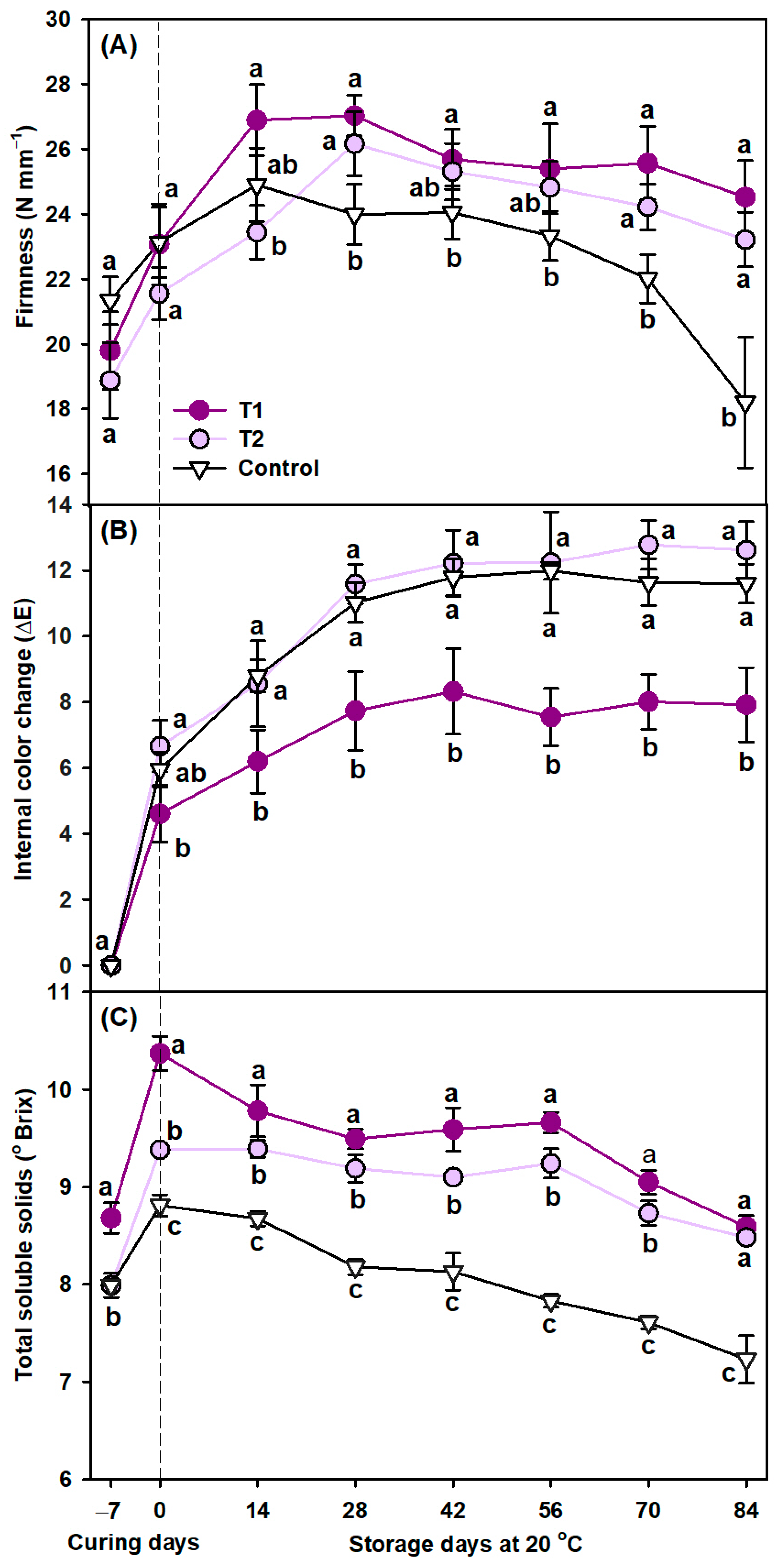
The impact of preharvest treatments on bulb firmness during postharvest storage at 20 °C is illustrated in Figure 3A. Firmness increased from harvest (after -7 days) through day 28, after which it gradually declined in all samples. At harvest and day 0 (the end of the curing process), no significant differences in firmness were observed among the various treatments (T1: 19.79 ± 1.19; T2: 18.88 ± 1.16; control: 21.33 ± 0.74 N mm−1). As of day 14, T1-treated bulbs consistently exhibited the highest levels of firmness, while the control group exhibited the lowest levels. At day 84, the firmness levels were as follows: 24.52 ± 1.13 N mm−1 for T1, 23.21 ± 0.84 N mm−1 for T2, and 18.20 ± 2.01 N mm−1 for the control. Both T1 and T2 exceeded the control level (p < 0.05).
The internal color change in onion bulbs was altered by the treatment during postharvest storage at 20 °C (Figure 3B). No instance of internal greening was observed in any of the samples at harvest or at the commencement of the curing stage (score 0). From the initiation of storage (Day 0) onwards, an increase in internal color change was observed in every group, with T1 consistently exhibiting the lowest greening scores and T2 the highest. On day 0, T1 recorded 4.60 ± 0.86 versus 6.66 ± 0.78 in T2 and 5.95 ± 0.53 in the control. This pattern persisted throughout the storage period: by day 14, T1 remained lower (6.20 ± 0.96) than both T2 (8.50 ± 1.31) and the control group (8.79 ± 0.49), with no significant difference between T2 and the control group (p > 0.05). From day 28 through day 84, T1 values (7.54–8.32) persisted in being significantly lower than those of T2 (11.58–12.77) and the control group (11.02–11.70), which did not differ significantly from each other. Consequently, T1 significantly reduced the internal color change in comparison to both T2 and the control throughout the 84-day storage period (p < 0.05).
The total soluble solids (TSS) content of onion bulbs was influenced by treatments and postharvest storage at 20 °C (Figure 3C). Initially (–7 days, harvest), T1-treated bulbs exhibited 8.68 ± 0.16 °Brix, while both T2 and control bulbs registered 7.99 ± 0.12 °Brix. By the conclusion of the field curing process (Day 0), a significant increase in TSS was observed in all groups (p < 0.05), with values reaching 10.37 ± 0.18 °Brix in T1, 9.38 ± 0.01 °Brix in T2, and 8.81 ± 0.11 °Brix in the control. Subsequent to this, a gradual decline in TSS was observed in every treatment group. On the fourteenth day, the values were 9.78 ± 0.27 °Brix for T1, 9.39 ± 0.09 °Brix for T2, and 8.68 ± 0.07 °Brix for the control group (all differences vs. control, p < 0.05). This ranking (T1 > T2 > control) was observed to be consistent on days 28, 42, 56, and 70, with TSS in T1 demonstrating consistent superiority and control demonstrating consistent inferiority (p < 0.05 at each time point).

3.2.3. Effects of Fungicide Treatments on Sprouting Incidence and Dormancy Maintenance During Postharvest Storage

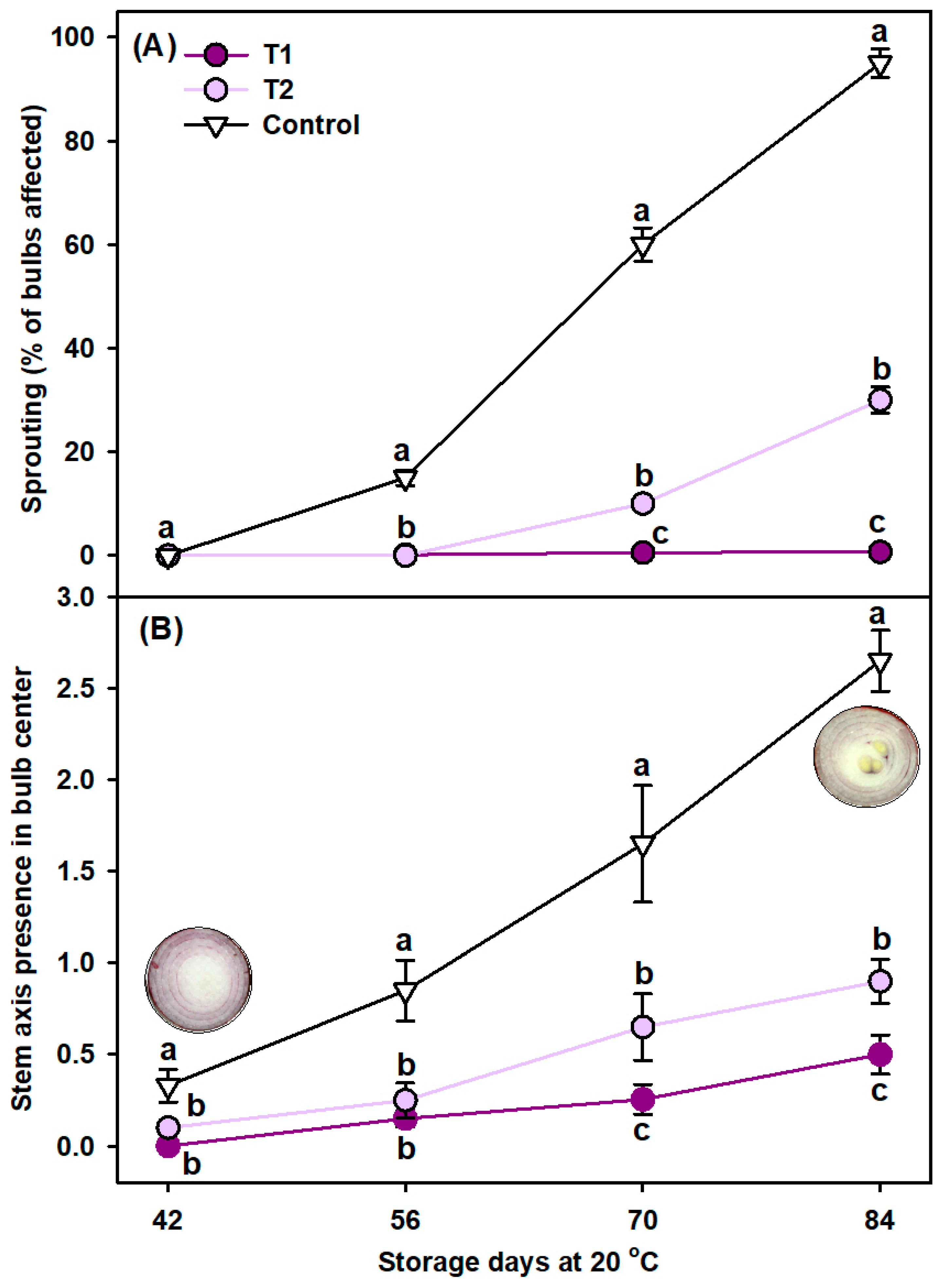
Preharvest treatments significantly affected both texternal sprouting incidence and internal stem axis development in onion bulbs stored at 20 °C, as shown in Figure 4. No signs of sprouting or internal caulinar tissue were detected in any treatment up to day 28.
From day 42 onward, both parameters progressively increased, especially in the control group. By day 84, visible sprouting (Figure 4A) reached 95% in control bulbs, 30% in T2, and only 0.7% in T1 (p < 0.05). Internal stem axis development (internal greening) differed significantly among treatments (p < 0.05). T1 maintained the lowest greening scores throughout storage (Figure 4B), showing significantly reduced internal greening compared to both T2 and control. From day 42 onward, T1 consistently demonstrated the lowest levels of both sprouting and internal axis development, while control bulbs exhibited significantly faster dormancy break (p < 0.05).

3.2.4. Effects of Fungicide Treatments on Pungency and Pyruvic Acid Content During Postharvest Storage

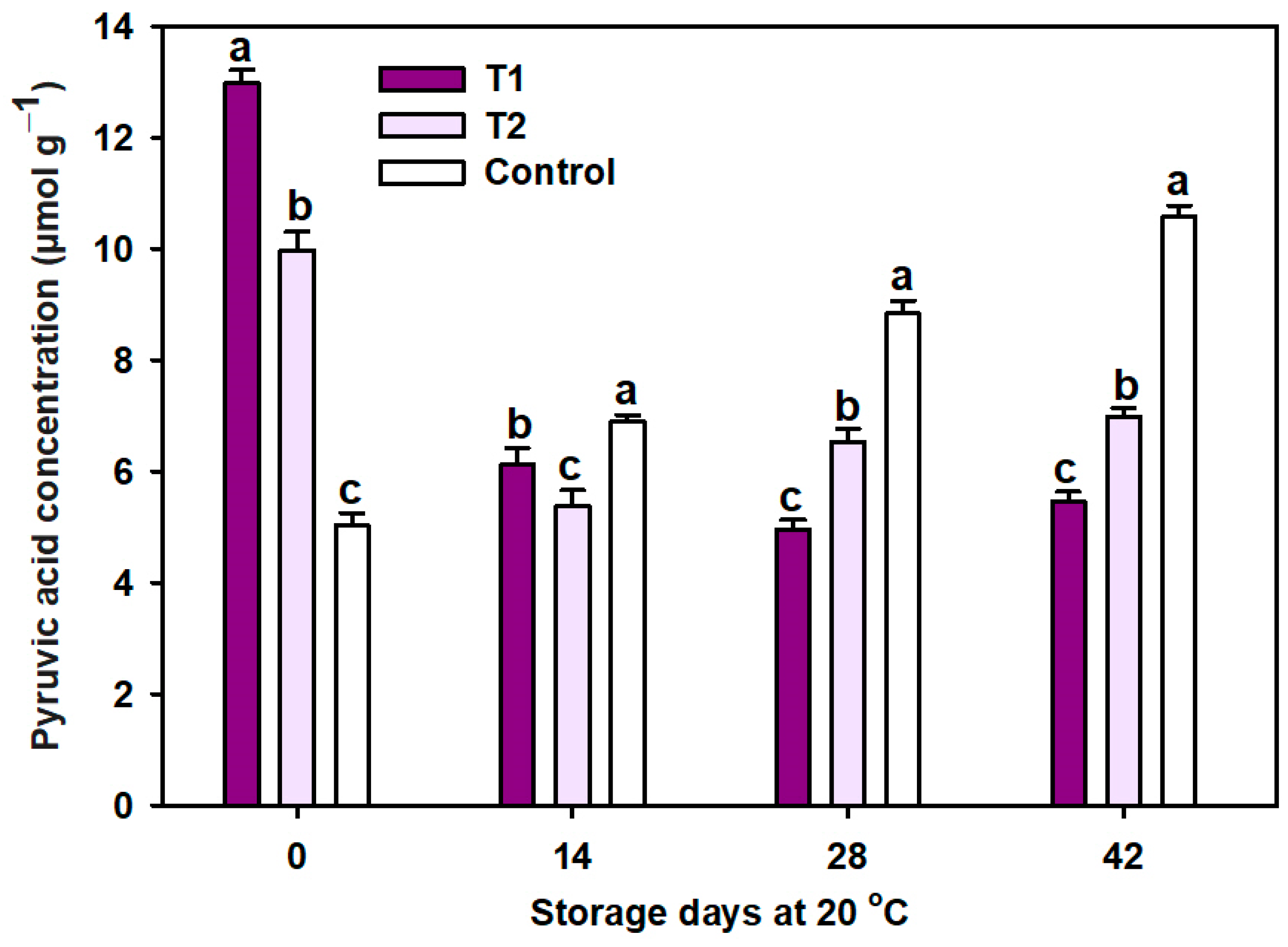
The concentration of pyruvic acid in onion bulbs varied significantly (p < 0.05) from the end of the curing to day 42 of storage at 20 °C (Figure 5).
At the commencement of the storage period (i.e., day 0), the highest pyruvic acid content was observed in treatment T1 (12.99 ± 0.22 µmol g−1), followed by treatment T2 (9.98 ± 0.33 µmol g−1). These values were significantly higher than the control (5.03 ± 0.22 µmol g−1). Following a 14-day storage period, a decline in pyruvic acid levels was observed in all treatment groups. The control exhibited the highest concentration (6.90 ± 0.10 µmol g−1), which was significantly higher than the levels observed in treatments T1 (6.12 ± 0.30 µmol g−1) and T2 (5.39 ± 0.28 µmol g−1). On days 28 and 42, the control group showed a persistent increase in pyruvic acid concentration, maintaining a significantly higher level compared to the other treatments. T2 yielded intermediate values, while treatment T1 consistently exhibited the lowest levels. On the day 42, the control group attained the maximum concentration (10.58 ± 0.20 µmol g−1), significantly higher than the concentrations observed in T2 (6.99 ± 0.14 µmol g−1) and T1 (5.46 ± 0.18 µmol g−1). The results demonstrate that the treatments applied had a significant effect on pyruvic acid concentration during storage: the control treatment showed a progressive escalation in pungency, whereas T1 exhibited a consistent and continuous decrease.

4. Discussion

4.1. Effect of Fungicide Treatments on Disease Control, Plant Growth and Crop Yield

Preharvest fungicide treatments had a significant impact on the control of foliar diseases, as well as on plant growth, bulb production, and yield of both ‘Recas’ and ‘Mata Hari’ onions. Both treatments effectively reduce foliar disease incidence in the field. Treatment T1 (dimethomorph + pyraclostrobin) resulted in the production of larger bulbs and significantly higher commercial yields compared to the control in both types of onions, while T2 (metalaxyl + mancozeb + copper oxychloride) yielded intermediate results in ‘Mata Hari’ cultivar. In this cultivar, the estimated production of marketable bulbs (>30 mm) exhibited a statistically significant increase from approximately 50 kg ha−1 in the control to ≈65 kg ha−1 with T2 and ≈76 kg ha−1 with T1. This yield increase highlights the efficacy of both fungicides in controlling foliar fungal diseases, especially downy mildew (Peronospora destructor), thereby promoting healthier foliage and enhanced bulb development [24]. Pyraclostrobin, the QoI component in T1, is recognized for its broad-spectrum efficacy and non-antifungal physiological benefits, leading to enhanced vigor, larger bulbs, and superior yields compared to untreated plants. Pyraclostrobin’s efficacy is supported by studies in related crops, where its field application in garlic also demonstrated increased efficacy and retention when combined with an adjuvant [25]. This yield enhancement is paralleled by results from other inputs: systemic biological products (e.g., Pseudomonas fluorescens and Trichoderma spp.) increased average onion yield by 44.7% over two seasons and lowered fungal incidence significantly [26]. Similarly, foliar application of zinc (Zn) and plant growth regulators (PGRs), such as gibberellic acid (GA3) and naphthalene acetic acid (NAA), significantly enhanced onion yield parameters, specifically bulb diameter (up to 7.08 cm) and weight [27].
Onion bulbs derived from diseased plants exhibited higher respiration rates during storage, likely due to increased metabolic activity associated with pathogen-induced stress. Downy mildew (Peronospora destructor) infections disrupt cellular structures, stimulate oxidative stress and trigger defense responses (e.g., salicylic acid (SA) and jasmonic acid (JA) pathways), all of which increase the energetic demand [28]. Additionally, fungal metabolism and host–pathogen interactions contribute to CO2 evolution. In contrast, fungicide-treated plants (T1 and T2) had healthier foliage and entered dormancy with reduced physiological stress, resulting in lower respiration rates. These differences reflect a direct link between preharvest phytosanitary status and postharvest metabolic stability.
Onion downy mildew causes substantial yield losses, potentially reaching 60–75% without chemical intervention [29,30]. Systemic fungicides like metalaxyl-M + mancozeb are highly effective, reducing disease severity and increasing bulb yields (e.g., 41 kg ha−1 compared to less than 30 kg ha−1) [30,31]. Our study corroborates this, showing T2 significantly enhanced yield. Beyond antifungal action, certain fungicides, notably strobilurins (like pyraclostrobin in T1), offer direct physiological benefits. These benefits—including extended foliage lifespan, enhanced net photosynthesis, and improved carbon assimilation—increase photosynthate availability to the bulb [30]. For instance, pyraclostrobin applications have increased photosynthetic rates, leading to 7–8% higher soybean yields [31]. Similar combinations in onions improve growth parameters and average yield [29]. T1-treated onions exhibited increased plant vigor (greater height and fresh weight) and larger bulbs, leading to significantly higher yields than untreated plants. T1 (pyraclostrobin + dimethomorph) demonstrated the greatest efficacy in phytosanitary protection and yield enhancement, followed by T2 (metalaxyl-M + mancozeb), consistent with their modes of action. T1 provided complementary systemic and preventive action plus the additional physiological benefits of the strobilurin component (pyraclostrobin), while T2 primarily delivered effective downy mildew control without these effects. Untreated onions showed accelerated defoliation and diminished bulb growth, resulting in the lowest yield. These findings emphasize the vital role of fungicide protection in achieving optimal onion yield [29]. In conclusion, both T1 and T2 effectively reduced foliar disease and increased yield, with T1 providing superior agronomic benefits. However, the repeated use of fungicides carries an inherent risk of promoting resistance development in fungal pathogens. Therefore, large-scale implementation must be accompanied by integrated disease management practices, including rotation of active ingredients and adherence to resistance management guidelines.

4.2. Effect of Preharvest Fungicide Treatments on Postharvest Bulb Physiology and Quality

4.2.1. Effects of Fungicide Treatments on Respiration Rate and Weight Losses During Postharvest Storage

While all onion bulbs showed a progressive decrease in CO2 emission during storage (20 °C, 84 days), indicative of dormancy onset, preharvest treatments caused significant postharvest differences. T1 bulbs consistently exhibited the lowest respiration rate, followed by T2, whereas control bulbs maintained the highest rate at each evaluation. This difference is largely attributed to the pyraclostrobin (a strobilurin) in T1. Strobilurins partially inhibit plant mitochondrial respiration by disrupting the electron transport chain [32]. Pyraclostrobin applications are known to significantly reduce leaf respiration rates (e.g., 76% decrease in soybean one day post-treatment) [31]. We hypothesize that T1-treated onions similarly exhibited reduced basal respiration at harvest due to this physiological effect. Furthermore, pyraclostrobin modulates stress responses, reduces ethylene synthesis, and enhances antioxidant production [31,33], leading to decreased maintenance respiration and lower reserve consumption. Conversely, control bulbs likely had higher respiration rates due to increased physiological stress and potentially active latent infections.
Downy mildew infection significantly increases onion respiration rates due to pathogen metabolism and host defense activation, leading to accelerated consumption of stored carbohydrates and reserves. This elevated metabolism causes increased weight loss, reduced total soluble solids, and prematurely breaks dormancy, accelerating sprouting [29,30,31,32]. This finding aligns with the physiological context that views sprouting as a state achieved after dormancy breakage, characterized by increased respiration and consumption of reserves for sprout growth [34]. Effective preharvest fungicide treatments, such as T1, mitigate these disturbances by reducing basal respiration and modulating stress. Our findings align with previous research, showing that such strategies reduce respiration rates in stored bulbs [35]. T1, containing the strobilurin pyraclostrobin, maintained low aerobic metabolism, likely due to pyraclostrobin’s known effect of moderating postharvest respiration and reducing stress [31,33]. T2 showed intermediate respiration rates. However, by protecting foliage and limiting initial infections, T2 ensured bulbs entered storage in optimal condition, minimizing stress and defense-related metabolic activity, which fungal infections typically increase. Therefore, the reduced respiration observed in T1 and T2 bulbs is beneficial, resulting in slower consumption of reserves, which enhances weight retention and potentially extends shelf-life [29,30,31,32].
As anticipated, all treatments showed a progressive increase in bulb weight loss (WL) during storage, primarily due to evapotranspiration and respiration. However, T1 onions exhibited the least WL, followed by T2, with the control group showing the highest accumulated WL. This reduced WL in T1 and T2 is partially attributed to their lower respiration rates and decreased transpiration and tissue dehydration, likely due to enhanced integrity of the protective outer layers. Preharvest fungicide applications are known to improve bulb health, resulting in well-cured, disease-free necks, thereby reducing water loss pathways. These findings are corroborated by studies demonstrating that preharvest treatments mitigate postharvest WL [36]. For instance, T1’s ≈ 7.5% WL after three months at 20 °C is consistent with substantial WL reduction observed with fungicide treatments. Despite lacking sprout inhibitors, effective foliar disease control coupled with proper curing reduces storage WL [37]. Control onions likely had wetter, more damaged tissues due to premature foliage collapse from mildew, leading to increased water loss. Conversely, bulbs from the T1 and T2 treatments, with healthier foliage, likely entered curing with drier necks. Furthermore, elevated microbial activity in storage, potentially from latent mildew, Botrytis, or Aspergillus, can cause tissue degradation, direct material loss, and dehydration in affected areas.

4.2.2. Effects of Fungicide Treatments on Firmness, Internal Color, and Total Soluble Solids During Postharvest Storage

T1 onions maintained significantly higher firmness throughout storage compared to control bulbs, with T2 exhibiting intermediate firmness. This enhanced firmness retention in T1 correlates with reduced dehydration and the absence of internal sprouts, both critical for preserving bulb structure. Conversely, control tissues softened due to increased water loss, cellular collapse, and degradation from sprouting or incipient rot. The literature indicates that maintaining hydration and preventing internal degradation are crucial for onion firmness [38]. Although uniform curing was applied, the firmness disparities reflect divergent physiological states: T1 bulbs remained dormant and healthy, thus preserving firmness, while control bulbs showed sprouting, leading to tissue softening and reduced solid content [39]. In summary, preharvest treatments reduced postharvest respiration rates compared with the control, as demonstrated by our direct CO2 measurements (Figure 2A): for example, at day 14 T1 registered 15.28 ± 0.70 mg CO2 kg−1 h−1 versus 23.88 ± 2.05 in the control (p < 0.05), and this ranking (T1 < T2 < Control) persisted throughout storage. This lower metabolic activity, together with reduced disease incidence, contributed to lower weight loss and better firmness retention [38].
Regarding onion bulb color, research reveals that various preharvest and postharvest strategies significantly impact both internal and external attributes. We specifically investigated the internal color change (ΔE) and internal greening of ‘Mata Hari’ onion bulbs, demonstrating that fungicide treatment T1 (dimethomorph + pyraclostrobin) significantly reduced internal greening (p < 0.05), as supported by the post hoc analysis (Figure 4B) and the overall magnitude of color change over 84 days of storage. While no initial greening was observed, all groups showed increased color change during storage, with T1 proving most effective in its mitigation. Complementary studies demonstrate that combined applications of salicylic acid/cycocel or azoxystrobin/cycocel effectively retain superior color [35]. Further research indicates that high curing temperatures negatively affect red skin color by reducing anthocyanin content, although curing generally enhances appearance [40]. Irradiation and ozone treatments are also effective in delaying unwanted color changes [40]. Collectively, these findings highlight that color preservation in stored onions is a complex and multifactorial process. In contrast to postharvest techniques, which act directly on stored bulbs to limit enzymatic browning, pigment loss and microbial growth, such as γ-irradiation that reduces sprouting/rotting and preserves appearance [41], and gaseous/aqueous ozone that lowers decay while maintaining quality [42,43], our preharvest fungicide approach preserves color indirectly by reducing field infections and physiological stress before curing and storage. Thus, dimethomorph + pyraclostrobin supports color stability via healthier tissues, whereas irradiation/ozone rely on postharvest physical/oxidative control mechanisms.
Initially, the total soluble solids (TSS) content was consistent across all ‘Mata Hari’ onion treatments (9–13%). However, storage revealed disparities: untreated control onions showed decreased measurable TSS due to carbohydrate consumption caused by sprouting and high respiration. Conversely, T1 bulbs maintained higher sugar content throughout storage due to prolonged dormancy and a decelerated metabolic rate. Consequently, treated bulbs finished storage with marginally higher TSS than controls. Existing literature confirms that preharvest management significantly influences soluble solids: sprouting or stress deplete internal sugars, reducing TSS [36]. Practices that delay sprouting tend to maintain higher TSS. For example, preharvest MH + carbendazim treatments enhanced quality and maintained elevated TSS (over 17%) in sprout-inhibited onions, contrasting significantly with controls due to carbohydrate utilization and deterioration [36]. Kleman et al. [44] corroborates this mechanism: monosaccharides (fructose and glucose) increase sharply, peaking concurrently with the onset of internal sprouting due to fructan hydrolysis, then the subsequently declined sugars are consumed for sprout growth.

4.2.3. Effects of Fungicide Treatments on Sprouting Incidence and Dormancy Maintenance During Postharvest Storage

Sprouting was a key differentiating factor during storage in ‘Mata Hari’, a cultivar with moderate and relatively short dormancy (3–4 months). In the present study (20 °C), control bulbs showed early internal scale discoloration and visible caulinar axis development from day 42, reaching ~20% sprouting by day 56 and >90% by day 84, with sprouts of 1–3 cm emerging through the neck, thereby causing a clear loss of commercial quality. In contrast, fungicide treatments significantly reduced sprouting. T2 showed delayed sprouting (~30% by day 84), whereas T1 maintained almost complete sprout suppression (~1% by day 84). Visually, control bulbs exhibited unsealed necks and reactivated growth, while treated bulbs remained firm and compact. These differences can be partially explained by the effects of fungicide application on crop health and curing. Proper neck desiccation is essential for maintaining dormancy, whereas diseased or thick neck tissues retain moisture and accelerate sprouting [37]. In this study, T1 and T2 plots presented lower foliar disease incidence, which likely favored uniform neck closure and reduced physiological stress at harvest. Bulbs from stressed control plants likely entered storage with weakened dormancy, consistent with the earlier sprouting observed, as previously reported under mildew pressure [45]. Maleic hydrazide (MH) is widely used to extend onion dormancy, although its use is restricted in several European regions due to regulatory and residue constraints. While T1 and T2 did not match MH-level suppression, they significantly delayed sprouting under storage at 20 °C, thereby underscoring the importance of preharvest plant health management in maintaining natural dormancy.
A physiological mechanism may also contribute to these effects. Strobilurin fungicides have been reported to modulate hormonal signaling, including maintaining or increasing abscisic acid (ABA) levels and reducing ethylene biosynthesis, which delays senescence [18,19]. In onion, dormancy release is closely associated with declines in ABA during storage [17]. Thus, maintenance of higher ABA levels could plausibly contribute to the delayed sprouting observed in T1. However, because ABA and ethylene were not measured in this study, this remains a supported hypothesis rather than demonstrated evidence. While preharvest fungicide application strategies are not inherently sustainable, they represent a valuable tool within integrated onion germination management. When applied according to good agricultural practices, residues are kept within legal maximum residue limits (MRLs), and targeted applications help minimize environmental impact. Although fungicides are not specifically designed to suppress germination, their role in maintaining bulb health indirectly delays dormancy breaking. Furthermore, their dual function of reducing both field diseases and postharvest deterioration makes them cost-effective when incorporated into broader disease management programs. In regions where the use of synthetic inhibitors such as maleic hydrazide is restricted or not recommended, preharvest fungicide application strategies can serve as a complementary approach to extend shelf life and mitigate germination.

4.2.4. Effects of Fungicide Treatments on Pungency and Pyruvic Acid Content During Postharvest Storage

Pyruvic acid, a key indicator of onion pungency formed by alliinase-catalyzed ACSO hydrolysis upon tissue disruption [46], was significantly impacted by preharvest fungicide treatments. T1 (dimethomorph + pyraclostrobin) resulted in the highest pyruvic acid content post-storage, followed by T2, with control bulbs showing significantly lower values. All groups fell within the medium-high pungency range (5–7 µmol g−1 moderately pungent, >7 µmol g−1 highly pungent) [47]. This pattern suggests fungicides, particularly T1, may preserve or stimulate greater accumulation of pungency precursor compounds. One hypothesis suggests strobilurins (pyraclostrobin) could modify sulfur metabolism or reduce postharvest oxidative stress, maintaining enzyme integrity. Pyruvic acid and ACSO levels are known to be sensitive to cultivation, storage, and bulb health [48]. Studies confirm that pyruvate levels are sensitive to sulfur fertilization, and optimally stored varieties retain higher ACSO [48]. Pungency correlates with soluble solids/sugar content, reinforcing that physiologically active or deteriorating bulbs tend to lose pungency [49]. Similarly, the application of biologicals resulted in higher pyruvic acid content overall (4.0 µmol·g−1 average) [26], while the Zn/PGR strategy significantly enhanced sugar content/TSS but had no significant effect on pyruvic acid [27].
During postharvest storage at 20 °C, untreated control onion bulbs exhibited a significant increase in pyruvic acid content (pungency index), particularly late in storage. This rise temporally coincides with dormancy termination and sprouting onset, as studies show pyruvic acid levels remain consistent initially, then increase with rooting and further after sprouting [50]. For example, after ≈5 months and ≈80% sprouting, pyruvic acid concentrations were 83% higher than at harvest [50]. Conversely, inhibiting sprouting via chemical treatments or cold storage prevented this level of pyruvic acid increase, indicating a direct correlation between sprouting activity and pungency compound accumulation. This suggests the increased sprouting in control groups was accompanied by elevated pyruvic acid, a phenomenon absent or reduced when sprouting was delayed.
Onions store S-alkyl-L-cysteine sulfoxides (ACSOs), such as trans-(+)-S-(1-propenyl)-L-cysteine sulfoxide, as key flavor and pungency precursors, compartmentalized away from the enzyme alliinase [51]. Cellular disruption triggers alliinase to rapidly hydrolyze ACSOs, producing pyruvic acid, ammonia, and volatile sulfur compounds [51]. During extended storage and dormancy break, internal tissue degradation and dehydration impair cell compartmentalization, enabling enzymatic interaction. This internal deterioration initiates or liberates alliinase activity, generating endogenous pyruvic acid. Indeed, increased pyruvate late in storage correlates with tissue dehydration and dormancy loss [41]. Furthermore, bulbs may continue to synthesize flavor precursors during storage; increased sulfur precursor levels and alliinase-generated pyruvate have been observed in stored bulbs [51]. In summary, the activation of the alliinase—precursor pathway within the bulb—via internal cell damage, continuous precursor synthesis, or both—directly contributes to increased pyruvic acid content during storage.
Onion sprouting signals a metabolic shift from dormancy, mobilizing the parent bulb’s nutritional reserves for sprout and root growth. This intensely alters carbohydrate metabolism: sucrose sharply decreases, reflecting its utilization for growth [50]. It is hypothesized that accumulation/degradation of certain sugars triggers internal sprouting. Stored organosulfur compounds may also be affected, potentially serving as nutrient sources (e.g., releasing ammonia after alliinase activity) [52]. This metabolic restart reduces residual tissue sugar content. Concurrently, fresh weight loss from transpiration and respiration leads to a rapid reduction in water and dry matter, thereby concentrating remaining compounds. Consequently, elevated pyruvic acid levels may partly stem from augmented concentrations of precursors/products in these drier, smaller bulbs late in storage. In summary, sprouting involves intense reserve catabolism (confirmed by rapid sugar depletion), concurrently increasing pungency through sulfur precursor release, enhanced enzymatic activity, or metabolite concentration due to reduced bulb mass.
Onions undergo a postharvest dormancy period where the apical meristem is inactive, characterized by reduced basal metabolism, high abscisic acid (ABA) levels, and conserved reserves. As dormancy breaks, ABA levels decline, concurrent with an increase in growth signals like gibberellins [53]. Chope et al. [53] observed significant ABA decreases coinciding with storability loss and preceding visible sprouting. Bulbs enter the sprouting phase with concomitant biochemical changes; flavor and quality compounds vary even before external signs appear [53,54]. During active growth, the bulb undergoes comprehensive metabolic reprogramming, accelerating respiration, consuming sugars, and altering hormonal and chemical profiles, consequently affecting levels of sulfur precursors, sugars, and other metabolites. Treatments that extend dormancy, such as cold storage (≈0–4 °C), controlled atmosphere, or maleic hydrazide (MH) application, delay or reduce numerous postharvest changes in onions [46,52]. Refrigeration, for instance, can gradually increase pungency, possibly through continued precursor accumulation, while suppressing sprouting. Conversely, elevated temperatures accelerate dormancy break, deplete reserves, and reduce pungency at the end of storage. Preharvest MH application inhibits meristematic cell division, delaying sprouting and reducing storage losses. MH-treated bulbs also show diminished pyruvic acid increases during storage compared to untreated bulbs. This evidence supports the hypothesis that increased pungency is part of the physiological syndrome associated with sprouting [52].
Increased pyruvic acid in control onions during storage directly correlates with early sprouting and associated physiological changes. Pyruvic acid accumulation is chemically explained by alliinase activation and subsequent sulfur precursor hydrolysis. Sprouting also favors reserve mobilization and the release of pungent compounds. Consequently, dormant bulbs maintained stable/decreasing pyruvic acid, while sprouted bulbs showed a significant increase in pyruvate and pungency. Downy mildew infestation profoundly impacts postharvest physiology, primarily by inducing elevated respiration rates in infected bulbs due to pathogen metabolism and host defense activation [29,31]. This heightened metabolic activity accelerates the consumption of reserves, leading to greater weight loss, reduced firmness, and decreased total soluble solids (TSS) [36]. Crucially, physiological stress from mildew precipitates earlier dormancy breakage and increased sprouting incidence [38], which subsequently causes a late-stage increase in pungency due to tissue degradation and alliinase activation [48,50].

5. Conclusions

The findings of this study translate directly into implementable agronomic practice for dried onion production. Specifically, the preharvest fungicide program utilizing dimethomorph + pyraclostrobin (T1), applied from the onset of rapid bulb growth until close to harvest, proves to be a highly efficacious strategy. This protocol not only resulted in a significant increase in marketable field yield but, critically, provided enhanced postharvest quality and storability, evidenced by the lowest observed sprouting incidence and superior maintenance of bulb firmness. Consequently, this established treatment offers a viable and readily applicable tool for commercial growers seeking to minimize storage losses and secure an alternative to synthetic sprout inhibitors.
From a commercial perspective, the implementation of effective preharvest antifungal strategies is vital for optimizing both field yield and storage quality. This management strategy improved postharvest quality (greater firmness, lower internal greening, and delayed sprouting), which are factors closely associated with reduced storage losses. It should be noted, however, that direct postharvest loss measurements (e.g., decay, discard rate) were not quantified in this study. Therefore, the reduction in postharvest losses should be interpreted as a potential outcome linked to improved bulb physiological integrity rather than a directly measured loss parameter. Following a thorough review of the options available, it was determined that the T1 strategy would be the most effective preharvest treatment for ‘Mata Hari’. This approach yielded the highest possible yield, while also ensuring superior postharvest quality and suppressed sprouting. T2 offered intermediate benefits, while the unprotected control group demonstrated inferior field performance and accelerated deterioration in storage. This is especially relevant given the regulatory restrictions on maleic hydrazide in several European regions, positioning the dimethomorph + pyraclostrobin combination as a practical alternative for dormancy management. However, the present findings apply specifically to the cultivar ‘Mata Hari’, which is known to have a relatively short natural dormancy period. Dormancy characteristics and postharvest behavior vary considerably among onion cultivars, mainly due to genetic differences in carbohydrate reserves, neck tissue development and responsiveness to sprouting cues. Therefore, further validation in additional cultivars is required before generalizing the suitability of this fungicide program to broader production systems. These findings provide a robust scientific foundation for recommending suitable field fungicide applications as a pivotal component of onion postharvest management to ensure profitability and maintain product quality for consumers.

Author Contributions

Conceptualization, M.F.-L. and D.M.-R.; methodology, H.M.D.-M. and J.M.V.; software, M.E.G.-P.; validation, M.E.G.-P. and D.M.-R.; formal analysis, A.A.-Q., A.G. and A.S.-G.; investigation, A.A.-Q., A.G. and A.S.-G.; resources, J.M.V.; data curation, M.E.G.-P. and D.M.-R.; writing—original draft preparation, A.A.-Q., M.E.G.-P. and D.M.-R.; writing—review and editing, M.E.G.-P. and D.M.-R.; project administration, D.M.-R.; funding acquisition, D.M.-R. All authors have read and agreed to the published version of the manuscript.

Funding

This research received no external funding.

Data Availability Statement

The original contributions presented in this study are included in the article. Further inquiries can be directed to the corresponding author.

Acknowledgments

The authors thank BioRender (BioRender.com) (Toronto, ON, Canada) for providing some of the pictures used in the graphical abstract.

Conflicts of Interest

The authors declare no conflicts of interest.

References

  1. Stoica, F.; Rațu, R.N.; Veleșcu, I.D.; Stănciuc, N.; Râpeanu, G. A comprehensive review on bioactive compounds, health benefits, and potential food applications of onion (Allium cepa L.) skin waste. Trends Food Sci. Technol. 2023, 141, 104173. [Google Scholar] [CrossRef]
  2. Faostat. Food and Agriculture Organization of the United Nations. 2025. Available online: https://www.fao.org/faostat/en/#data/QCL (accessed on 10 January 2025).
  3. Nemeth, K.; Piskula, M.K. Food content, processing, absorption and metabolism of onion flavonoids. Crit. Rev. Food Sci. Nutr. 2007, 47, 397–409. [Google Scholar] [CrossRef] [PubMed]
  4. Mishra, R.K.; Jaiswal, R.K.; Kumar, D.; Saabale, P.R.; Singh, A. Management of major diseases and insect pests of onion and garlic: A comprehensive review. J. Plant Breed. Crop Sci. 2014, 6, 160–170. [Google Scholar] [CrossRef]
  5. Suslow, T. Onion, Dry. Recommendations for Maintaining Postharvest Quality. Produce Facts in English. UC Davis—Postharvest Technology Center, University of California, Davis, 2012. Available online: https://postharvest.ucdavis.edu/produce-facts-sheets/onions-dry (accessed on 15 January 2025).
  6. Sharma, K.; Lee, Y.R. Effect of different storage temperature on chemical composition of onion (Allium cepa L.) and its enzymes. J. Food Sci. Technol. 2016, 53, 1620–1632. [Google Scholar] [CrossRef]
  7. Bartlett, D.W.; Clough, J.M.; Godwin, J.R.; Hall, A.A.; Hamer, M.; Parr-Dobrzanski, B. The strobilurin fungicides. Pest. Manag. Sci. 2002, 58, 649–662. [Google Scholar] [CrossRef]
  8. FRAC. Fungicide Resistance Action Committee: FRAC Code List. 2024. Available online: https://www.frac.info/media/kufnaceb/frac-code-list-2024.pdf (accessed on 12 January 2025).
  9. Abdurezake, M.; Asefa, G. Evaluation of fungicides against downy mildew (Peronospora Destructor Berk) of onion (Allium Cepa) in Bale zone, south eastern Ethiopia. Asian J. Agric. Hortic. Res. 2022, 9, 161–168. [Google Scholar] [CrossRef]
  10. Donati, G.; Pradolesi, G.; Bartolini, D.; Melandri, M. Results of two-year field trials in Emilia-Romagna region on the effectiveness of dimethomorph+ pyraclostrobin against downy mildew on onion (Peronospora destructor). ATTI Giornate Fitopatol. 2010, 2, 397–400. Available online: https://www.cabidigitallibrary.org/doi/full/10.5555/20163365841 (accessed on 20 January 2025).
  11. Kanungo, M.; Joshi, J. Impact of pyraclostrobin (F-500) on crop plants. Plant Sci. Today 2014, 1, 174–178. [Google Scholar] [CrossRef]
  12. Mahoney, K.J.; Vyn, R.J.; Gillard, C.L. The effect of pyraclostrobin on soybean plant health, yield, and profitability in Ontario. Can. J. Plant Sci. 2015, 95, 285–292. [Google Scholar] [CrossRef]
  13. Boari, F.; Cantore, V.; Di Venere, D.; Sergio, L.; Candido, V.; Schiattone, M.I. Pyraclostrobin can mitigate salinity stress in tomato crop. Agric. Water Manag. 2019, 222, 254–264. [Google Scholar] [CrossRef]
  14. Monteiro, G.C.; da Silva, M.B.; Rodrigues, L.F.; Gomez-Gomez, H.A.; Borges, C.V.; Minatel, I.O.; Lima, G.P. Pre-harvest application of fungicides influences the post-harvest quality of cauliflower (Brassica oleracea var. botrytis L.). Aust. J. Crop Sci. 2019, 13, 1288–1296. [Google Scholar] [CrossRef]
  15. Cantore, V.; Lechkar, O.; Karabulut, E.; Sellami, M.H.; Albrizio, R.; Boari, F.; Stellacci, A.M.; Todorovic, M. Combined effect of deficit irrigation and strobilurin application on yield, fruit quality and water use efficiency of “cherry” tomato (Solanum lycopersicum L.). Agric. Water Manag. 2016, 167, 53–61. [Google Scholar] [CrossRef]
  16. Degani, O.; Kalman, B. Assessment of commercial fungicides against onion (Allium cepa) basal rot disease caused by Fusarium oxysporum f. sp. cepae and Fusarium acutatum. J. Fungi 2021, 7, 235. [Google Scholar] [CrossRef]
  17. Chope, G.A.; Terry, L.A. The role of abscisic acid and ethylene in onion bulb dormancy and sprout suppression. Stewart Postharvest Rev. 2008, 4, 1–7. [Google Scholar] [CrossRef]
  18. Grossmann, K.; Kwiatkowski, J.; Caspar, G. Regulation of phytohormone levels, leaf senescence and transpiration by the strobilurin kresoxim-methyl in wheat (Triticum aestivum). J. Plant Physiol. 1999, 154, 805–808. [Google Scholar] [CrossRef]
  19. Van Dingenen, J.; Antoniou, C.; Filippou, P.; Pollier, J.; Gonzalez, N.; Dhondt, S.; Goossens, A.; Fotopoulos, V.; Inzé, D. Strobilurins as growth-promoting compounds: How Stroby regulates Arabidopsis leaf growth. Plant Cell Environ. 2017, 40, 1748–1760. [Google Scholar] [CrossRef]
  20. De Corato Sementi. Vegetable and Herb Seeds. Conventional Seeds, Onion Yellow, RECAS. Available online: https://decoratosementi.com/catalog/conventional-seeds/onion-yellow/recas/ (accessed on 4 October 2025).
  21. Asociación Española Cosecheros Exportadores de Cebollas (ACEC). Calibrado Cebollas. Available online: https://www.acec.info/es/cebolla/calibrado (accessed on 23 July 2025).
  22. Valverde, J.M.; Valero, D.; Martínez-Romero, D.; Guillén, F.; Castillo, S.; Serrano, M. Novel edible coating based on aloe vera gel to maintain table grape quality and safety. J. Agric. Food Chem. 2005, 53, 7807–7813. [Google Scholar] [CrossRef] [PubMed]
  23. Anthon, G.E.; Barrett, D.M. Modified method for the determination of pyruvic acid with dinitrophenylhydrazine in the assessment of onion pungency. J. Sci. Food Agric. 2003, 83, 1210–1213. [Google Scholar] [CrossRef]
  24. Maude, R.B. Onion diseases. In The Epidemiology of Plant Diseases, 2nd ed.; Cooke, B., Jones, D., Kaye, B., Eds.; Springer: Dordrecht, The Netherlands, 2006; pp. 491–520. [Google Scholar]
  25. Parlakidis, P.; Adamidis, G.; Alexoudis, C.; Pythoglou, P.; Papadopoulos, S.; Vryzas, Z. Adjuvant effects on pyraclostrobin and boscalid residues, systemic movement, and dietary risk in garlic under field conditions. Agriculture 2023, 13, 1636. [Google Scholar] [CrossRef]
  26. Gutiérrez-Benicio, G.M.; Aguirre-Mancilla, C.L.; Arreola-Tostado, J.M.; Aguado-Santacruz, G.A. Growth, health, quality, and production of onions (Allium cepa L.) inoculated with systemic biological products. Microorganisms 2025, 13, 797. [Google Scholar] [CrossRef]
  27. Israr, U.K.; Muhammad, S.J.; Mehwish, K.; Qudrat, U.K. Foliar application of zinc sulphate alone and in combination with Gibberellic Acid (GA3) and Naphthalene Acetic acid (NAA) on the growth, yield and quality of onion. Plant Sci. Today 2025, 12, 1–7. Available online: https://horizonepublishing.com/journals/index.php/PST/article/view/8550 (accessed on 10 January 2025). [CrossRef]
  28. Alkan, N.; Fortes, A.M. Insights into molecular and metabolic events associated with fruit response to post-harvest fungal pathogens. Front. Plant Sci. 2015, 6, 889. [Google Scholar] [CrossRef]
  29. Kamel, S.M.; Ismail, A.M.; Omara, R.I.; Ahmed, M. Influence of humate substances and fungicides on the control of onion downy mildew. Egypt. J. Phytopathol. 2017, 45, 31–44. [Google Scholar] [CrossRef]
  30. Araújo, E.R.; Resende, R.S.; Alves, D.P.; Higashikawa, F.S. Field efficacy of fungicides to control downy mildew of onion. Eur. J. Plant. Pathol. 2020, 156, 305–309. [Google Scholar] [CrossRef]
  31. Fagan, E.B.; Dourado Neto, D.; Vivian, R.; Franco, R.B.; Yeda, M.P.; Massignam, L.F.; De Oliveira, R.F.; Martins, K.V. Effect of pyraclostrobin application on the photosynthesis rate, respiration, nitrate reductase activity and productivity of soybean crop. Bragantia 2010, 69, 771–777. [Google Scholar] [CrossRef]
  32. Amaro, A.C.E.; Baron, D.; Ono, E.O.; Rodrigues, J.D. Physiological effects of strobilurin and carboxamides on plants: An overview. Acta Physiol. Plant. 2020, 42, 1–10. [Google Scholar] [CrossRef]
  33. Venancio, W.S.; Rodrigues, M.A.T.; Begliomini, E.; de Souza, N.L. Physiological effects of strobilurin fungicides on plants. Publ. UEPG Ci. Exatas Terra Ci. Agr. Eng. Ponta Grossa 2003, 9, 59–68. [Google Scholar]
  34. Samota, M.K.; Selvan, S.S.; Choudhary, P.; Nath, A.; Ahlawat, A. Mechanisms behind the post harvest sprouting of onions (Allium cepa) and future implications of prevention strategies. J. Stored Prod. Res. 2025, 111, 102518. [Google Scholar] [CrossRef]
  35. Kolhar, A.H.; Jagadeesh, S.L.; Vijaymahantesh, S.M.; Mahesh, Y.S.; Hadimani, H.P. Studies on effect of foliar application of salicylic acid, azoxystrobin and cycocel on physiological loss in weight and quality traits of onion cv. Arka Kalyan. Int. J. Chem. Stud. 2018, 6, 988–993. [Google Scholar]
  36. Anbukkarasi, V. Studies on pre and Post-Harvest Treatments for Extending Shelf Life in Onion (Allium cepa L. var aggregatum don.) cv. Co (On) 5. Ph.D. Thesis, Department of Vegetable Crops, Tamil Nadu Agricultural University, Coimbatore, India, 2010. [Google Scholar]
  37. Anbukkarasi, V.; Paramaguru, P.; Pugalendhi, L.; Ragupathi, N.; Jeyakumar, P. Studies on pre and post-harvest treatments for extending shelf life in onion—A review. Agric. Rev. 2013, 34, 256–268. [Google Scholar] [CrossRef]
  38. Abdelgawad, K.F.; Shehata, S.A.; El-Metwally, I.M.; El-Desoki, E.R.; El-Rokiek, K.G.; Elkhawaga, F.A. Efficacy of pre-harvest weed control treatments on onion bulb storability. Sci. Rep. 2025, 15, 6766. [Google Scholar] [CrossRef] [PubMed]
  39. Kukanoor, L.K.; Basavaraja, N.; Rokhade, A.K. Influence of curing methods on storability of onion. J. Asian Hort. 2006, 2, 277–281. [Google Scholar]
  40. Survilienė, E.; Valiuškaitė, A.; Raudonis, L. The effect of fungicides on the development of downy mildew of onions. Zemdirb. Agric. 2008, 95, 171–179. [Google Scholar]
  41. Sharma, P.; Sharma, S.R.; Dhall, R.K.; Mittal, T.C. Effect of γ-radiation on post-harvest storage life and quality of onion bulb under ambient condition. J. Food Sci. Technol. 2020, 57, 2534–2544. [Google Scholar] [CrossRef] [PubMed]
  42. Lim, J.; Song, J.-S.; Eom, S.; Yoon, J.W.; Ji, S.-H.; Kim, S.B.; Ryu, S. The effect of gaseous ozone generated by surface dielectric barrier discharge on the decay and quality of stored onion bulbs. Agronomy 2021, 11, 1058. [Google Scholar] [CrossRef]
  43. Aslam, R.; Alam, M.S.; Pandiselvam, R. Aqueous ozone sanitization system for fresh produce: Design, development, and optimization of process parameters for minimally processed onion. Ozone Sci. Eng. 2021, 44, 3–16. [Google Scholar] [CrossRef]
  44. Kleman, I.; Rosberg, A.K.; Mogren, L. Sugar content and dry matter are key factors predicting sprouting of yellow bulb onions regardless of treatment with maleic hydrazide. Acta Agric. Scand. Sect. B Soil Plant Sci. 2024, 74, 2366171. [Google Scholar] [CrossRef]
  45. Kiran, P.R.; Aradwad, P.; TV, A.K.; Nayana, N.P.; CS, R.; Sahoo, M.; Urhe, S.B.; Yadav, R.; Kar, A.; Mani, I. A comprehensive review on recent advances in postharvest treatment, storage, and quality evaluation of onion (Allium cepa): Current status, and challenges. Future Postharvest Food 2024, 1, 124–157. [Google Scholar] [CrossRef]
  46. Abayomi, L.A.; Terry, L.A. Implications of spatial and temporal changes in concentration of pyruvate and glucose in onion (Allium cepa L.) bulbs during controlled atmosphere storage. J. Sci. Food Agric. 2009, 89, 683–687. [Google Scholar] [CrossRef]
  47. NOL (National Onion Labs). Analytical Services. 2019. Available online: http://www.onionlabs.com/analytical-services (accessed on 12 March 2025).
  48. Pöhnl, T.; Minor, N.; Carle, R.; Schweiggert, R. Accumulation of carbohydrates and pungent principles in characteristic seed and set grown onion varieties (Allium cepa L.). J. Appl. Bot. Food Qual. 2019, 92, 267–273. [Google Scholar] [CrossRef]
  49. Dhumal, K.; Datir, S.; Pandey, R. Assessment of bulb pungency level in different Indian cultivars of onion (Allium cepa L.). Food Chem. 2007, 100, 1328–1330. [Google Scholar] [CrossRef]
  50. Lee, E.J.; Jeon, J.K.; Suh, J.K. Pyruvic acid and sugar contents during storage duration in onion (Allium cepa L.). J. Bio-Environ. Con. 2010, 19, 377–381. [Google Scholar]
  51. Bacon, J.R.; Moates, G.K.; Ng, A.; Rhodes, M.J.C.; Smith, A.C.; Waldron, K.W. Quantitative analysis of flavour precursors and pyruvate levels in different tissues and cultivars of onion (Allium cepa). Food Chem. 1999, 64, 257–261. [Google Scholar] [CrossRef]
  52. Sharma, K.; Lee, Y.R.; Park, S.W.; Nile, S.H. Importance of growth hormones and temperature for physiological regulation of dormancy and sprouting in onions. Food Rev. Int. 2016, 32, 233–255. [Google Scholar] [CrossRef]
  53. Chope, G.A.; Terry, L.A.; White, P.J. Effect of controlled atmosphere storage on abscisic acid concentration and the onset of sprouting in onion bulbs. Postharvest Biol. Technol. 2006, 39, 272–282. [Google Scholar] [CrossRef]
  54. Crowther, T.; Collin, H.A.; Smith, B.; Tomsett, A.B.; O’Connor, D.; Gomes, M.G. Assessment of the flavour of fresh uncooked onions by taste-panels and analysis of flavour precursors, pyruvate and sugars. J. Sci. Food Agric. 2005, 85, 112–120. [Google Scholar] [CrossRef]
Figure 1. Estimated marketable yield (in tons per hectare) in ‘Recas’ ((A); 2019 season) and ‘Mata Hari’ ((C); 2020 season) onion plants for treatments T1, T2, and control. T1 represents the preharvest fungicide strategy of dimethomorph + pyraclostrobin, while T2 represents the strategy of metalaxyl + mancozeb + copper oxychloride. Data are presented as the mean ± SE. The asterisk symbol (*) or different letters indicate statistically significant differences between the various treatments, with a p-value of less than 0.05 being considered significant. The distribution of commercial bulb size classes (%) (A: 30–50 mm, B: 51–70 mm, C: 71–90 mm, D: >91 mm) in ‘Recas’ ((B); 2019 season) and ‘Mata Hari’ ((D); 2020 season) onion plants for treatments T1, T2, and the control. T1 represents the preharvest fungicide strategy of dimethomorph + pyraclostrobin, while T2 represents the strategy of metalaxyl + mancozeb + copper oxychloride. Data are presented as the mean ± standard error (SE). Different letters indicate statistically significant differences among treatments according to Tukey’s HSD test (p < 0.05).
Agronomy 15 02616 g001
Figure 2. The respiration rate (mg CO2 kg−1 h−1) of ‘Mata Hari’ onion bulbs was measured at harvest (Day—7), after curing (Day 0) and during storage (A). Postharvest weight losses (%) were recorded during storage at 20 °C for a period of up to 84 days (B). The results obtained from the treatments T1, T2, and control are presented, extending up to 84 days following the postharvest period. T1 represents the preharvest fungicide strategy of dimethomorph + pyraclostrobin, while T2 represents the strategy of metalaxyl + mancozeb + copper oxychloride. Data are presented as the mean ± standard error (SE). Different letters indicate significant differences among the treatments for each time point, with a p-value of less than 0.05.
Agronomy 15 02616 g002
Figure 3. Firmness (N mm−1) (A), internal color change (∆E) (B) and total soluble solids content (° Brix) (C) of ‘Mata Hari’ onions. The measurements were taken from harvest (day—7) through to the end of curing (day 0) and during storage at 20 °C until day 84. The results obtained from the treatments T1, T2, and control are presented, extending up to 84 days following the postharvest period. T1 represents the preharvest fungicide strategy of dimethomorph + pyraclostrobin, while T2 represents the strategy of metalaxyl + mancozeb + copper oxychloride. Data are presented as the mean ± standard error (SE). Different letters indicate significant differences among the treatments for each time point, with a p-value of less than 0.05.
Agronomy 15 02616 g003
Figure 4. The incidence of sprouting was determined as the percentage (%) of ‘Mata Hari’ bulbs showing sprout emergence (A). The presence of a visible stem axis in the central area of onion bulbs was evaluated with a hedonic scale used to quantify the internal greening, ranging from 0 to 3 points of affected ‘Mata Hari’ bulbs (B). The results obtained from the treatments T1, T2, and control are presented, extending up to 84 days following the postharvest period. T1 represents the preharvest fungicide strategy of dimethomorph + pyraclostrobin, while T2 represents the strategy of metalaxyl + mancozeb + copper oxychloride. Data are presented as the mean ± standard error (SE). Different letters indicate significant differences among the treatments for each time point, with a p-value < 0.05.
Agronomy 15 02616 g004
Figure 5. The concentration of pyruvic acid (µmol g−1 in FW basis) in ‘Mata Hari’ onion bulbs. The measurement was taken after the curing process (Day 0) and during the storage period at 20 °C. The results obtained from the treatments T1, T2, and control are presented, extending up to 42 days following the postharvest period. T1 represents the preharvest fungicide strategy of dimethomorph + pyraclostrobin, while T2 represents the strategy of metalaxyl + mancozeb + copper oxychloride. Data are presented as the mean ± standard error (SE). Different letters indicate significant differences among the treatments for each time point, with a p-value of less than 0.05.
Agronomy 15 02616 g005
Table 1. Fungicide application schedule, crop development stages, active ingredients and application rates for ‘Recas’ bulb onions in 2019 season 1,2.
Week N°.
Date (2019)
Physiological StageT1
(Active Substances Dose –ha−1)
22
29-May
Onset of bulb enlargementDimethomorph (180 g ai ha−1)
Pyraclostrobin (100 g ai ha−1)
25
20-June
Bulb in active developmentDimethomorph (180 g ai ha−1)
Pyraclostrobin (100 g ai ha−1)
29
19-July
Late active bulb developmentDimethomorph (180 g ai ha−1)
Pyraclostrobin (100 g ai ha−1)
32
10-Agost
Maximum bulb development
and reduced leaf growth
Dimethomorph (180 g ai ha−1)
Pyraclostrobin (100 g ai ha−1)
35
28-Agost
End of development and
start of leaf bending
Dimethomorph (180 g ai ha−1)
Pyraclostrobin (100 g ai ha−1)
38
19-September
Over 60% leaf bending,
field lifting and start of curing
39
24-September
End of field curing
1 The week number (N°) indicates the number of weeks during the growing cycle of the onion. 2 The doses are expressed in grams of active ingredient (ai) per hectare (g ai ha−1).
Table 2. Fungicide application schedule, crop development stages, active ingredients and application rates for ‘Mata Hari’ bulb onions in 2020 season 1,2.
Week N°.
Date (2020)
Physiological StageT1
(Active Substances Dose –
ha−1)
T2
(Active Substances Dose –ha−1)
16
15-April
Onset of bulb enlargementDimethomorph (180 g ai ha−1)
Pyraclostrobin (100 g ai ha−1)
Metalaxyl (200 g ai ha−1)
Mancozeb (1600 g ai ha−1)
Copper oxychloride (1600 g ai ha−1)
17
22-April
Bulb in active developmentDimethomorph (180 g ai ha−1)
Pyraclostrobin (100 g ai ha−1)
Metalaxyl (200 g ha−1)
Mancozeb (1600 g ai ha−1)
Copper oxychloride (1600 g ai ha−1)
18
29-April
Late active bulb developmentDimethomorph (180 g ai ha−1)
Pyraclostrobin (100 g ai ha−1)
Metalaxyl (200 g ai ha−1)
Mancozeb (1600 g ai ha−1)
Copper oxychloride (1600 g ai ha−1)
19
6-May
Maximum bulb development
and reduced leaf growth
Dimethomorph (180 g ai ha−1)
Pyraclostrobin (100 g ai ha−1)
Copper oxychloride (1600 g ai ha−1)
21
20-May
End of development and
start of leaf bending
Dimethomorph (180 g ai ha−1)
Pyraclostrobin (100 g ai ha−1)
Copper oxychloride (1600 g ai ha−1)
23
4-June
Over 60% leaf bending,
field lifting and start of curing
24
10-June
End of field curing
1 The week number (N°) indicates the number of weeks during the growing cycle of the onion. 2 The doses are expressed in grams of active ingredient (ai) per hectare (g ai ha−1).
Table 3. Effects of preharvest treatments on the morphological traits and weight loss of ‘Mata Hari’ onion plants before and after field curing in the 2020 season 1.
TreatmentDiseased Leaves Incidence (%)Leaf Bending at Neck Height (%)Plant Weight Before Curing (g)Neck Diameter Before Curing (cm)Plant Length Without Roots Before Curing (cm)Bulb Diameter After Curing (cm)Plant Weight Loss After Curing (%)Bulb/Plant Ratio After Curing (%)Mean Bulb Weight After Curing (g)
T118.2360219.11 ± 10.33 a1.66 ± 0.07 a81.75 ± 2.02 a7.33 ± 0.14 a19.45 ± 0.87 a88.53 ± 0.48 b153.19 ± 4.61 a
T219.9760208.85 ± 15.07 a1.49 ± 0.07 b83.70 ± 1.56 a7.19 ± 0.27 a22.31 ± 2.15 a89.33 ± 0.63 b145.41 ± 4.88 b
Control92.1880158.51 ± 6.42 b1.47 ± 0.06 b74.75 ± 1.81 b6.43 ± 0.10 b9.11 ± 0.60 b93.33 ± 0.58 b134.69 ± 4.24 c
1 The values were expressed as the mean ± standard error (SE). Statistically significant differences (p < 0.05) are indicated by different letters within the same column for each parameter tested. T1 represents the preharvest fungicide strategy of dimethomorph + pyraclostrobin, while T2 represents the strategy of metalaxyl + mancozeb + copper oxychloride.
Disclaimer/Publisher’s Note: The statements, opinions and data contained in all publications are solely those of the individual author(s) and contributor(s) and not of MDPI and/or the editor(s). MDPI and/or the editor(s) disclaim responsibility for any injury to people or property resulting from any ideas, methods, instructions or products referred to in the content.