Quinoa Whole Plant: A Promising Nutrient-Rich Alternative Forage in the U.S. Midwest

 ,
,
Abstract
1. Introduction
2. Materials and Methods
2.1. Plant Materials
2.2. Field Location, Experimental Design, Planting, and Field Management
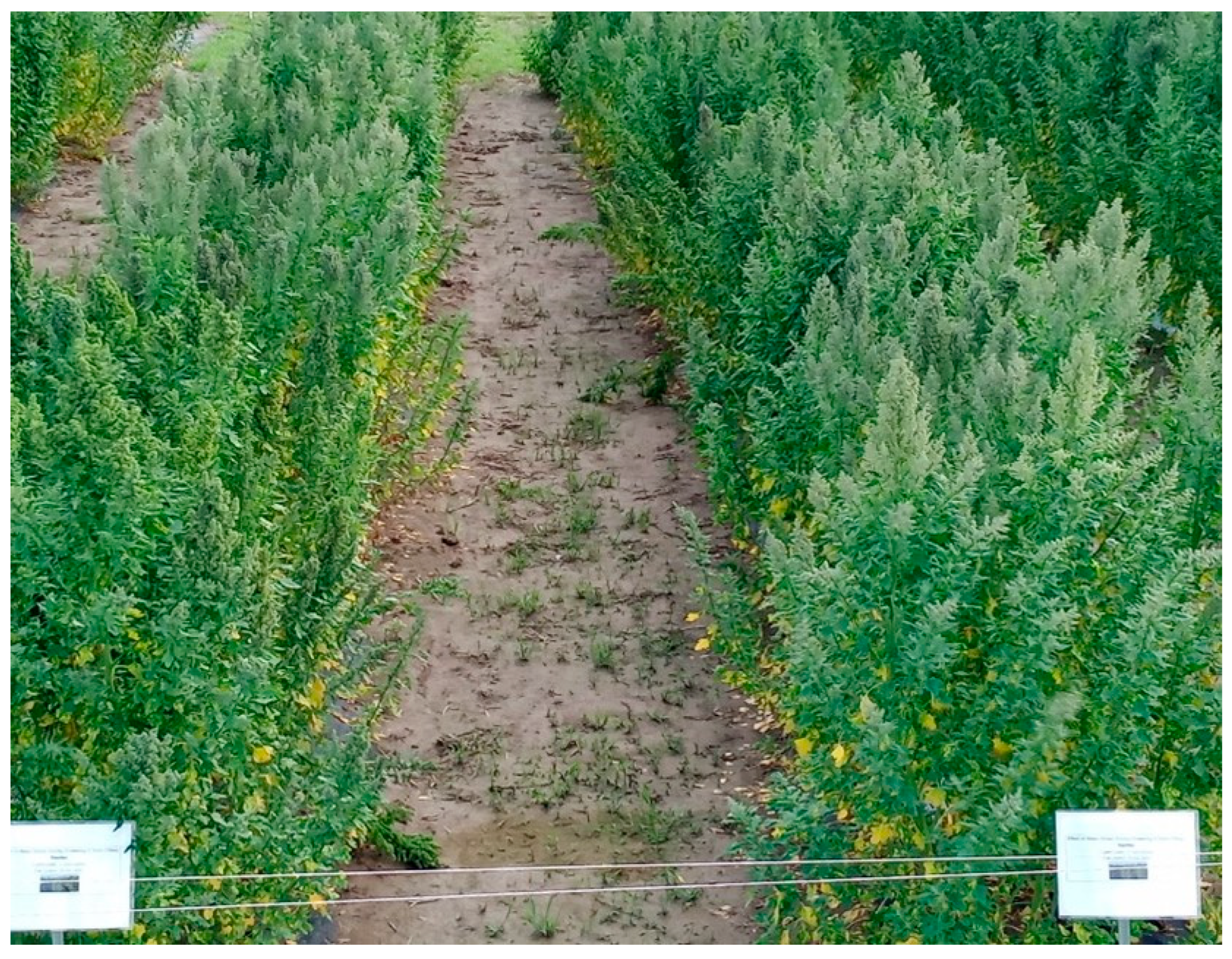
2.3. Data Collection—Agronomical Traits, Sample Collection, and Climate Data
2.4. Nutritional and Forage Quality Analysis
2.5. Statistical Analysis
3. Results
3.1. Weather and Agronomic Traits
3.2. Proximate Components
3.3. Forage Quality Traits
3.4. Amino Acids
3.5. Minerals
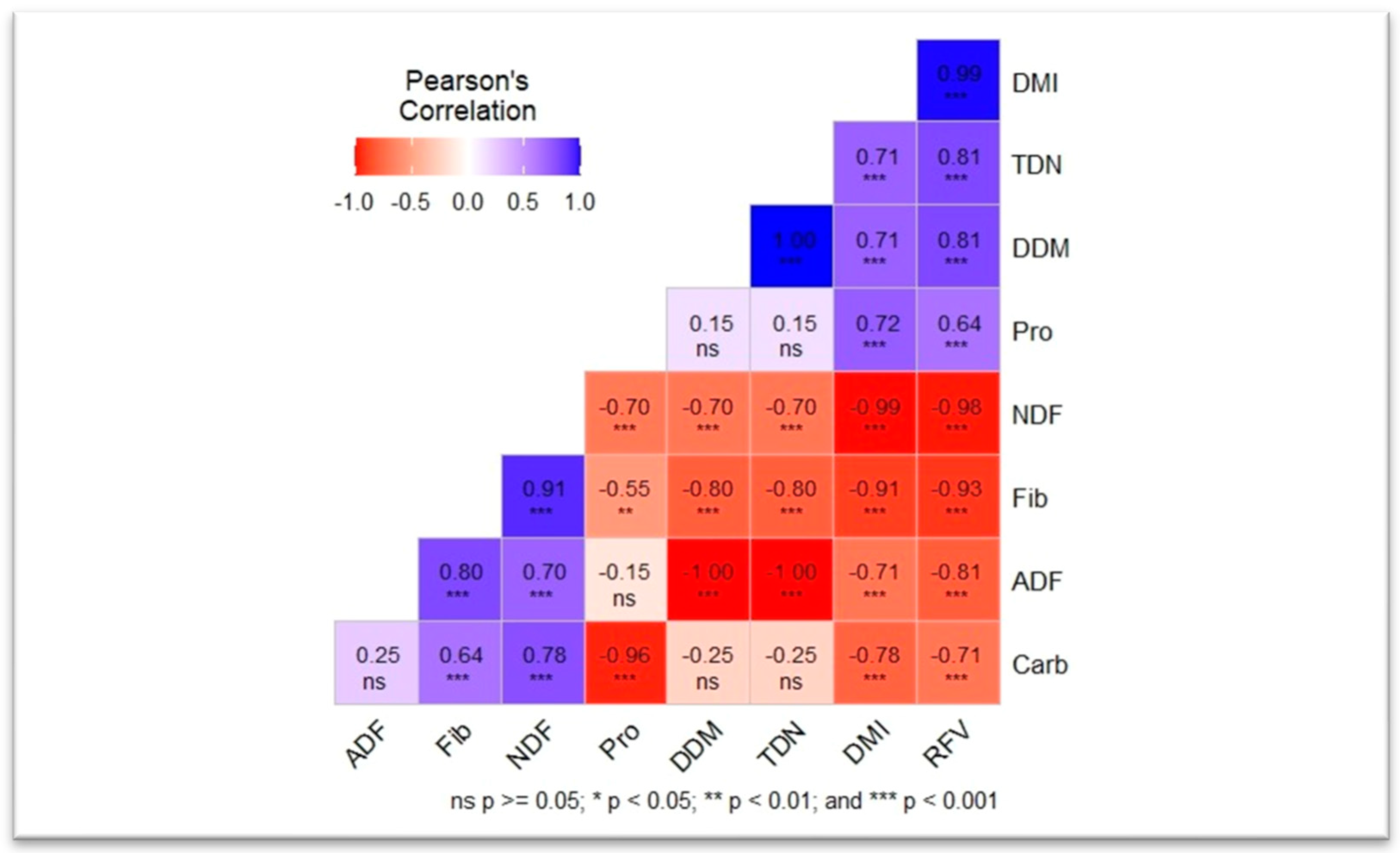
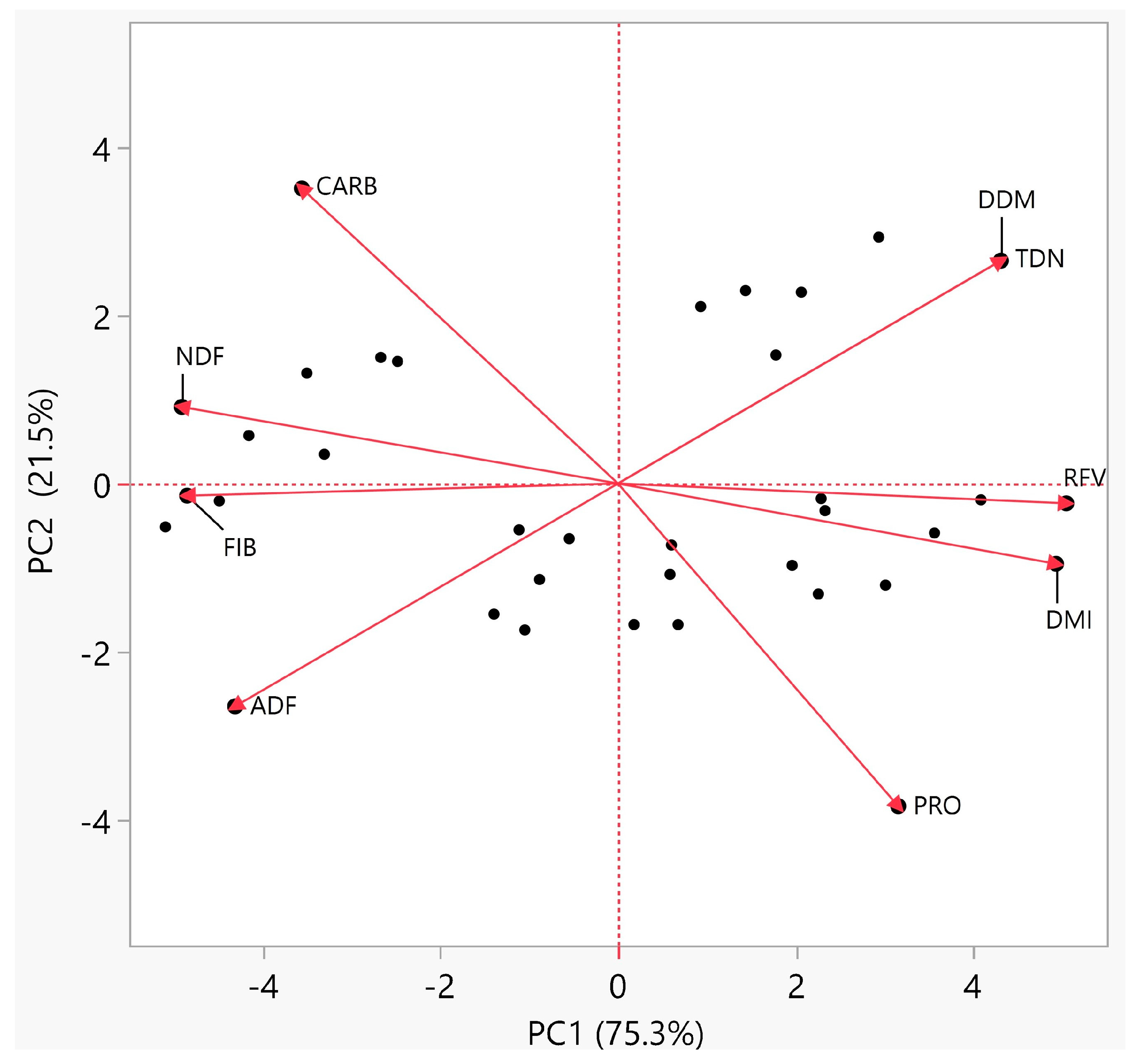
3.6. Trait Correlation and Principal Component Analysis (PCA)
4. Discussion
4.1. Weather and Agronomic Traits
4.2. Proximate Components
4.3. Forage Quality Traits
4.4. Amino Acids
4.5. Minerals
4.6. Trait Correlation
4.7. Principal Component Analysis (PCA)
5. Conclusions
Supplementary Materials
Author Contributions
Funding
Data Availability Statement
Acknowledgments
Conflicts of Interest
Abbreviations
| FW | fresh weight |
| DW/DM | dry weight/dry matter |
| CP | crude protein |
| CF | crude fiber |
| EE | ether extract |
| AA | amino acid |
| NDF | neutral detergent fiber |
| ADF | acid detergent fiber |
| DDM | digestible dry matter |
| DMI | dry matter intake |
| RFV | relative food value |
| TDN | total digestible nutrient |
References
- Ariom, T.; Dimon, E.; Nambeye, E.; Diouf, N.S.; Adelusi, O.O.; Boudalia, S. Climate-smart agriculture in African Countries: A review on strategies and impacts on smallholder farmers. Sustainability 2022, 14, 11370. [Google Scholar] [CrossRef]
- Boudalia, S.; Smeti, S.; Dawit, M.; Senbeta, E.K.; Gueroui, Y.; Dotas, V.; Bousbia, A.; Symeon, G.K. Alternative approaches to feeding small ruminants and their potential benefits. Animals 2024, 14, 904. [Google Scholar] [CrossRef]
- Climate Watch. Greenhouse Gas (GHG) Emissions. 2024. Available online: https://www.climatewatchdata.org/ghg-emissions (accessed on 12 June 2025).
- FAOSTAT. 2024. Available online: https://www.fao.org/faostat/en/#home (accessed on 12 June 2025).
- IPCC (Intergovernmental Panel on Climate Change). Climate Change Report 2021—The Physical Science Basis: Working Group 1 Contribution to the Sixth Assessment Report of the IPCC; Cambridge University Press: Cambridge, UK, 2021. [Google Scholar]
- Statista. Total U.S. Hay Production from 2001 to 2024. 2025. Available online: https://www.statista.com/statistics/194277/total-us-hay-production-from-2000/?srsltid=AfmBOoo3CVTBzaLpZGxuQpHFbKWwFfg69WkFpKSGVsqnKBoAdacXKiZk (accessed on 10 June 2025).
- Statista. Total U.S. Hay Production Value from 2000 to 2024. 2025. Available online: https://www.statista.com/statistics/194279/total-us-hay-production-value-from-2000/?srsltid=AfmBOoowpa_0dwwBZ8p5_DFkdf-iBc5QI20O5MFkqjRq_zV74G5u4kUZ2025 (accessed on 10 June 2025).
- Agrilife Today. Hay Supply Near 50-Year Low, Prices Are Near Record High; Texas Crop Weather Report; Texas A&M Agrilife’s Digital Magazine and Newsroom: Houston, TX, USA, 2023. [Google Scholar]
- Angeli, V.; Silva, P.M.; Massuela, D.C.; Khan, M.W.; Hamar, A.; Khajehei, F.; Graeff-Hönninger, S.; Piatti, C. Quinoa (Chenopodium quinoa Willd.): An overview of the potentials of the “golden grain” and socio-economic and environmental aspects of its cultivation and marketization. Foods 2020, 9, 216. [Google Scholar] [CrossRef] [PubMed]
- Ebeid, H.M.; Kholif, A.E.; El-Bordeny, N.; Chrenkova, M.; Mlynekova, Z.; Hansen, H.H. Nutritive value of quinoa (Chenopodium quinoa) as a feed for ruminants: In sacco degradability and in vitro gas production. Environ. Sci. Pollut. Res. 2022, 29, 35241–35252. [Google Scholar] [CrossRef] [PubMed]
- Kakabouki, I.; Bilalis, D.; Karkanis, A.; Zervas, G.; Tsiplakou, E.; Hela, D. Effects of fertilization and tillage system on growth and crude protein content of quinoa (Chenopodium quinoa Willd.): An alternative forage crop. Emir. J. Food Agric. 2014, 26, 18. [Google Scholar] [CrossRef]
- Bazile, D.; Baudron, F. The dynamics of the global expansion of quinoa growing in view of its high biodiversity. In State of the Art Report of Quinoa in the World in 2013; Bazile, D., Bertero, H.D., Nieto, C., Eds.; FAO and CIRAD: Rome, Italy, 2015; pp. 42–55. Available online: https://fao.org/3/a-i4042e.pdf (accessed on 25 March 2025).
- Bazile, D.; Pulvento, C.; Verniau, A.; Al-Nusairi, M.S.; Ba, D.; Breidy, J.; Hassan, L.; Mohammed, M.I.; Mambetov, O.; Otambekova, M.; et al. Worldwide evaluations of quinoa: Preliminary results from post international year of quinoa, FAO projects in nine countries. Front. Plant Sci. 2016, 7, 850. [Google Scholar] [CrossRef]
- Jacobsen, S.E. The scope for adaptation of quinoa in northern latitudes of Europe. J. Agron. Crop Sci. 2017, 203, 603–613. [Google Scholar] [CrossRef]
- Walters, H.; Carpenter-Boggs, L.; Desta, K.; Yan, L.; Matanguihan, J.; Murphy, K. Effect of irrigation, intercrop, and cultivar on agronomic and nutritional characteristics of quinoa. Agroeco. Sust. Food Syst. 2016, 40, 783–803. [Google Scholar] [CrossRef]
- Van Schooten, H.; Van Pinxterhuis, J. Quinoa as an alternative forage crop in organic dairy farming. In Optimal Forage Systems for Animal Production and the Environment, Proceedings of the 12th Symposium of the European Grassland Federation, Pleven, Bulgaria, 26–28 May 2003; Grassland Science in Europe: Pleven, Bulgaria, 2003; pp. 445–448. [Google Scholar]
- Oscar, B.T.; German, D.M.M.; Jose, L.R.O.; Abel-Munoz, O. Forage evaluation of 18 varieties of quinoa (Chenopodium quinoa Willd.) in Montecillo, Mexico. Rev. Fac. Agron. 1995, 12, 71–79. [Google Scholar]
- Papastylianou, P.; Kakabouki, I.; Tsiplakou, E.; Travlos, I.; Bilalis, D.; Hela, D.; Chachalis, D.; Anogiatis, G.; Zervas, G. Effect of fertilization on yield and quality of biomass of quinoa (Chenopodium quinoa Willd.) and green amaranth (Amaranthus retroflexus L.). Bull. Univ. Agric. Sci. Vet. Med. Cluj-Napoca Hortic. 2014, 71, 288–292. [Google Scholar] [CrossRef]
- Ruiz, T.M.; Bernal, E.; Staples, C.R.; Sollenbereger, L.E.; Gallaher, R.N. Effect of dietary neutral detergent fiber concentration and forage source on performance of lactating cows. J. Dairy Sci. 1995, 78, 305. [Google Scholar] [CrossRef]
- Abarghuei, M.J.; Boostani, A. Investigating the use of Chenopodium quinoa to improve rumen biofermentability and reduction of methane and carbon dioxide production. Vet. Anim. Sci. 2025, 27, 100433. [Google Scholar] [CrossRef] [PubMed]
- Asher, A.; Galili, S.; Whitney, T.; Rubinovich, L. The potential of quinoa (Chenopodium quinoa) cultivation in Israel as a dual-purpose crop for grain production and livestock feed. Sci. Hort. 2020, 272, 109534. [Google Scholar] [CrossRef]
- Ferreira, J.F.; Cornacchione, M.V.; Liu, X.; Suarez, D.L. Nutrient composition, Forage Parameters, and Antioxidant capacity of alfalfa (Medicago sativa L.) in response to saline irrigation water. Agriculture 2015, 3, 577–597. [Google Scholar] [CrossRef]
- Kaya, E.; Aydemir, K. Determining the forage yield, quality and nutritional element contents of quinoa cultivars and correlation analysis on these parameters. Pak. J. Agril. Sci. 2020, 57, 311–317. [Google Scholar]
- Rubinovich, L.; Dagan, R.; Lugasi, Y.; Galili, S.; Asher, A. The potential of young vegetative quinoa (Chenopodium quinoa) as a new sustainable protein-rich winter leafy crop under Mediterranean climate. PLoS ONE 2023, 18, e0290000. [Google Scholar] [CrossRef]
- Shah, S.S.; Shi, L.; Li, Z.; Ren, G.; Zhou, B.; Qin, P. Yield, agronomic and forage quality traits of different quinoa (Chenopodium quinoa Willd.) genotypes in northeast China. Agronomy 2020, 10, 1908. [Google Scholar] [CrossRef]
- Zhang, X.; Liu, Y.; Kong, F.; Wang, W.; Li, S. Comparison of nutritional components, ruminal degradation characteristics and feed value from different cultivars of alfalfa Hay. Animals 2023, 13, 734. [Google Scholar] [CrossRef]
- Pathan, S.; Ndunguru, G.; Clark, K.; Ayele, A. Yield and nutritional responses of quinoa (Chenopodium quinoa Willd.) genotypes to irrigated, rainfed, and droughts tress environments. Front. Sust. Food Syst. 2023, 7, 1242187. [Google Scholar] [CrossRef]
- Pathan, S.; Ndunguru, G.; Ayele, A.G. Comparison of the nutritional composition of quinoa (Chenopodium quinoa Willd.) inflorescences, green leaves, and grains. Crops 2024, 4, 72–81. [Google Scholar] [CrossRef]
- AOAC. Association of Official Analytical Chemists. Official Methods of Analysis, 18th ed.; AOAC International: Gaithersburg, MD, USA, 2006. [Google Scholar]
- AOAC. Association of Official Analytical Chemists. Official Methods of Analysis, 18th ed.; Method 2002.04; AOAC International: Gaithersburg, MD, USA, 2002. [Google Scholar]
- Saha, U.; Sonon, L.S.; Hancock, D.W.; Hill, N.S.; Stewart, L.; Heusner, G.L.; Kissel, D.E. Common Terms Used in Animal Feeding and Nutrition; The University of Georgia, College of Agriculture and Environmental Sciences: Athens, GA, USA, 2010; pp. 1–19. [Google Scholar]
- SAS. SAS Software, Version 9.3; SAS: Cary, NC, USA, 2011. [Google Scholar]
- Atumo, T.; Kauffman, R.; Talore, D.; Abera, M.; Tesfaye, T.; Tunkala, B.; Zeleke, M.; Kalsa, G. Adaptability, forage yield and nutritional quality of alfalfa (Medicago sativa L.) genotypes. Sustain. Environ. 2021, 7, 1895475. [Google Scholar] [CrossRef]
- Salama, R.; Yacout, M.H.; Elgzar, M.I.T.; Awad, A.A. Nutritional evaluation of quinoa (Chenopodium quinoa Willd) crop as unconventional forage resource in feeding ruminants. Egypt. J. Nutr. Feed. 2021, 24, 77–84. [Google Scholar] [CrossRef]
- Blume, L.; Hoischen-Taubner, S.; Sundrum, A. Alfalfa-a regional protein source for all farm animals. Landbauforschung 2021, 71, 1–13. [Google Scholar] [CrossRef]
- Horvat, D.; Viljevac Vuletić, M.; Andrić, L.; Baličević, R.; Kovačević Babić, M.; Tucak, M. Characterization of Forage Quality, Phenolic Profiles, and Antioxidant Activity in Alfalfa (Medicago sativa L.). Plants 2022, 11, 2735. [Google Scholar] [CrossRef]
- McDonald, P.; Greenhalgh, J.F.D.; Morgan, C.; Edwards, R.; Sinclair, L.; Wilkinson, R. Animal Nutrition; Pearson Education: London, UK, 2021. [Google Scholar]
- Pecka-Kiełb, E.; Króliczewska, B.; Król, B.; Słupczyńska, M.; Sowiński, J.; Zachwieja, A.; Kaszuba, J.; Zigo, F. The effect of selective quinoa varieties (Chenopodium quinoa willd.) on in vitro rumen fermentation and methane production. J. Appl. Anim. Res. 2025, 53, 2467119. [Google Scholar] [CrossRef]
- Marković, J.; Babić, S.; Terzić, D.; Zornić, V.; Vasić, T.; Milenković, J.; Kostić, I. Carbohydrate content of alfalfa harvest at different development stage in the spring growth. In Proceedings of the 11th International Symposium—Modern Trends in Livestock Production, Belgrade, Serbia, 11–13 October 2017; Institute for Animal Husbandry: Belgrade, Serbia, 2017; pp. 706–712. [Google Scholar]
- Çarpıcı, E.B.; Erol, S.; Aşık, B.B.; Arslan, Ö. Influences of sowing date and harvest stage on dry matter yield and forage quality of quinoa (Chenopodium quinoa Willd.). Turk. J. Field Crops 2023, 28, 26–36. [Google Scholar] [CrossRef]
- Suwignyo, B.; Mustika, A.; Kustantinah Yusiati, L.M.; Suhartanto, B. Effect of drying method on physical-chemical characteristics and amino acid content of tropical alfalfa (Medicago sativa L.) hay for poultry feed. Am. J. Anim. Vet. Sci. 2020, 15, 118–122. [Google Scholar] [CrossRef]
- Keskin, B.; Temel, S.; Tohumcu, S. Determination of forage yield performance of different Chenopodium quinoa cultivars in saline conditions. Zemdirb.-Agric. 2023, 110, 149–156. [Google Scholar] [CrossRef]
- Fang, D.; Hua, S.; Chen, H.; Ji, Z.; Wang, D.; Wang, W.; Shao, T.; Dong, Z. Producing high-quality and safe whole-plant quinoa silage through selecting variety and harvest time. BMC Plant Biol. 2025, 25, 333. [Google Scholar] [CrossRef]
- Buxton, D.R. Quality related characteristics of forages as influenced by plant environment and agronomic factors. Anim. Feed. Sci. Technol. 1996, 40, 109–119. [Google Scholar]
- Üke, Ö.; Kale, H.; Kaplan, M.; Kamalak, A. Effects of maturity stages on hay yield and quality, gas and methane production of quinoa (Chenopodium quinoa Willd.). CABI Database. 2017. Available online: https://www.cabidigitallibrary.org (accessed on 11 March 2025).
- Baskota, S.; Islam, A. Evaluation of Forage Nutritive Value of Quinoa Cultivars. In LREC Long Reports Field Days Bulletin-19; University of Wyoming: Laramie, WY, USA, 2017. [Google Scholar]
- Basbag, M.; Sayar, M.S.; Cacan, E. The effect of different cutting times on the macro mineral content of alfalfa (Medicago sativa L.) genotypes. J. Agric. Food Environ. Sci. 2023, 77, 20–28. [Google Scholar] [CrossRef]
- NRC. National Research Council. Nutrient Requirements of Dairy Cattle, 7th ed.; National Academy Press: Washington, DC, USA, 2001. [Google Scholar]
- Bhargava, A.; Shukla, S.; Ohri, D. Short communication. Mineral composition in foliage of some cultivated and wild species of Chenopodium. Span. J. Agric. Res. 2010, 8, 371–376. [Google Scholar] [CrossRef]
- Freer, M.; Dove, H.; Nolan, J.V. Application. In Nutrient Requirements of Domesticated Ruminants; CSIRO Publishing: Melbourne, Australia, 2007. [Google Scholar] [CrossRef]
- Márquez-Madrid, M.; Gutiérrez-Bañuelos, H.; Bañuelos-Valenzuela, R.; Muro-Reyes, A.; David Valdez-Cepeda, R. Macro-mineral concentrations in soil and forage in three grassland sites at Zacatecas. Rev. Mex. Cienc. Pecu. 2017, 8, 437–443. [Google Scholar] [CrossRef]
- Çaçan, E.; Kokten, K.; Kaplan, M. Determination of yield and quality characteristics of some alfalfa (Medicago sativa L.) cultivars in the East Anatolia Region of Turkey and correlation analysis between these properties. Appl. Ecol. Environ. Res. 2018, 16, 1185–1198. [Google Scholar] [CrossRef]



| Month | 2023 Temperature (°C) | Temperature °C 2024 | Rainfall (cm) | RH (%) | ||||||
|---|---|---|---|---|---|---|---|---|---|---|
| Maximum | Minimum | Mean | Maximum | Minimum | Mean | 2023 | 2024 | 2023 | 2024 | |
| June | 36.20 | 7.70 | 23.06 | 36.50 | 11.10 | 24.55 | 2.72 | 10.54 | 91.53 | 90.32 |
| July | 39.80 | 13.00 | 26.01 | 35.00 | 14.00 | 24.27 | 6.65 | 18.59 | 86.48 | 93.19 |
| Aug (first 7 days) | 31.20 | 20.70 | 24.87 | 35.60 | 18.70 | 26.77 | 17.45 Σ 26.82 | 0.00 Σ 29.13 | 90.83 89.61 | 93.57 92.36 |
| Variables 1 | Quinoa Lines | Year | SEM | |||||
|---|---|---|---|---|---|---|---|---|
| PI614885 | PI614887 | PI614927 | PI698769 | Mean | 2023 | 2024 | ||
| Height (cm) | 150.58 a | 153.67 a | 153.96 a | 128.01 b | 146.55 | 152.18 a | 139.06 b | 2.08 |
| FW/plant (g) | 71.22 a | 59.53 ab | 70.22 a | 50.87 b | 62.96 | 65.92 | 59.02 | 2.87 |
| DW/plant (g) | 14.58 | 11.94 | 14.94 | 11.53 | 13.25 | 11.27 b | 15.88 a | 0.64 |
| FW to DW ratio | 21.36 ab | 20.33 b | 21.36 ab | 22.93 a | 21.49 | 17.25 b | 27.16 a | 0.32 |
| Variables 1 (% DM) | Quinoa Lines | Year | SEM | Published Results (Range) | ||||||
|---|---|---|---|---|---|---|---|---|---|---|
| PI614885 | PI614887 | PI614927 | PI698769 | Mean | 2023 | 2024 | Quinoa 2 | Alfalfa 3 | ||
| CP | 15.80 | 17.02 | 16.61 | 15.48 | 16.23 | 18.92 a | 12.64 b | 0.36 | 15.4–26.0 | 15.3–24.7 |
| CF | 22.09 ab | 23.40 a | 20.60 b | 22.25 ab | 22.08 | 21.05 b | 23.50 a | 0.43 | 11.6–18.4 | 25.3–35.7 |
| Ash | 16.19 | 16.79 | 17.22 | 16.33 | 16.33 | 17.43 a | 15.58 b | 0.23 | 9.07–14.9 | 8.6 |
| EE | 3.38 | 2.90 | 3.43 | 3.47 | 3.29 | 3.08 b | 3.56 a | 0.10 | 2.2–3.4 | 1.4–2.1 |
| Carb | 58.39 | 57.19 | 56.47 | 57.68 | 57.43 | 53.09 b | 63.22 a | 0.52 | 54.6–62.2 | 67.9–74.4 |
| NDF | 33.68 ab | 35.76 a | 32.25 b | 34.70 ab | 34.10 | 31.95 b | 36.96 a | 0.56 | 32.7–46.4 | 36.7–43.8 |
| ADF | 25.11 ab | 26.26 a | 23.44 b | 25.25 ab | 25.01 | 25.14 | 24.86 | 0.45 | 21.4–29.1 | 22.5–33.0 |
| DDM | 69.34 ab | 68.44 b | 70.65 a | 69.23 ab | 69.42 | 69.32 | 69.55 | 0.35 | 66.3–72.2 | 63.2–71.4 |
| DMI | 3.60 | 3.42 | 3.74 | 3.49 | 3.56 | 3.77 a | 3.28 b | 0.06 | 2.6–3.7 | 2.7–3.3 |
| RFV | 193.99 | 181.77 | 205.04 | 187.58 | 192.10 | 202.92 a | 177.65 b | 4.00 | 138.2–207.8 | 134.3–182.7 |
| TDN | 70.27 ab | 69.46 b | 71.43 a | 70.17 ab | 70.33 | 70.24 | 70.45 | 0.31 | 60.6–67.2 | 57.6–65.5 |
| Ca | 1.26 | 1.31 | 1.22 | 1.23 | 1.26 | 1.35 a | 1.13 b | 0.04 | 1.0–1.1 | 1.3–1.6 |
| P | 0.47 | 0.48 | 0.47 | 0.47 | 0.47 | 0.45 | 0.50 | 0.01 | 0.3 | 0.3–0.4 |
| Fe (mg/kg) | 69.26 | 69.60 | 99.60 | 94.70 | 75.80 | 79.15 | 71.34 | 0.47 | 100.0 | 104.0 |
| Variables 1 (% DM) | Quinoa Lines | Year | SEM | Published Results (Range) | ||||||
|---|---|---|---|---|---|---|---|---|---|---|
| PI614885 | PI614887 | PI614927 | PI698769 | Mean | 2023 | 2024 | Quinoa 2 | Alfalfa 3 | ||
| Histidine | 0.31 | 0.34 | 0.34 | 0.34 | 0.33 | 0.41 a | 0.24 b | 0.005 | 0.23 | 0.31 |
| Isoleucine | 0.68 | 0.75 | 0.74 | 0.74 | 0.73 | 0.92 a | 0.48 b | 0.013 | 0.55 | 0.88 |
| Leucine | 1.06 | 1.17 | 1.17 | 1.16 | 1.14 | 1.43 a | 0.74 b | 0.001 | 1.01 | 1.13 |
| Lysine | 0.92 | 0.99 | 0.99 | 1.00 | 0.98 | 1.18 a | 0.70 b | 0.016 | 0.51 | 0.54 |
| Methionine | 0.24 | 0.26 | 0.26 | 0.26 | 0.25 | 0.32 a | 0.17 b | 0.005 | 0.22 | 0.07 |
| Phenylalanine | 0.73 | 0.80 | 0.81 | 0.79 | 0.78 | 0.97 a | 0.53 b | 0.015 | 0.65 | 0.88 |
| Threonine | 0.57 | 0.63 | 0.6 | 0.62 | 0.61 | 0.74 a | 0.43 b | 0.011 | 0.63 | 0.71 |
| Tryptophan | 0.19 b | 0.22 ab | 0.23 a | 0.22 ab | 0.21 | 0.28 a | 0.12 b | 0.006 | 0.06 | - |
| Valine | 0.77 | 0.85 | 0.74 | 0.84 | 0.83 | 1.03 a | 0.56 b | 0.015 | 0.64 | 1.03 |
Disclaimer/Publisher’s Note: The statements, opinions and data contained in all publications are solely those of the individual author(s) and contributor(s) and not of MDPI and/or the editor(s). MDPI and/or the editor(s) disclaim responsibility for any injury to people or property resulting from any ideas, methods, instructions or products referred to in the content. |
© 2025 by the authors. Licensee MDPI, Basel, Switzerland. This article is an open access article distributed under the terms and conditions of the Creative Commons Attribution (CC BY) license (https://creativecommons.org/licenses/by/4.0/).
Share and Cite
Pathan, S.; Ndunguru, G.; Patra, A.K.; Ayele, A.; Johora, F.T.; Arifuzzaman, M. Quinoa Whole Plant: A Promising Nutrient-Rich Alternative Forage in the U.S. Midwest. Agronomy 2025, 15, 2618. https://doi.org/10.3390/agronomy15112618
Pathan S, Ndunguru G, Patra AK, Ayele A, Johora FT, Arifuzzaman M. Quinoa Whole Plant: A Promising Nutrient-Rich Alternative Forage in the U.S. Midwest. Agronomy. 2025; 15(11):2618. https://doi.org/10.3390/agronomy15112618
Chicago/Turabian StylePathan, Safiullah, Grato Ndunguru, Amlan K. Patra, Addissu Ayele, Fatema Tuj Johora, and Muhammad Arifuzzaman. 2025. "Quinoa Whole Plant: A Promising Nutrient-Rich Alternative Forage in the U.S. Midwest" Agronomy 15, no. 11: 2618. https://doi.org/10.3390/agronomy15112618
APA StylePathan, S., Ndunguru, G., Patra, A. K., Ayele, A., Johora, F. T., & Arifuzzaman, M. (2025). Quinoa Whole Plant: A Promising Nutrient-Rich Alternative Forage in the U.S. Midwest. Agronomy, 15(11), 2618. https://doi.org/10.3390/agronomy15112618