


Abstract
This study was undertaken to identify oat (Avena sativa L.) varieties optimal for cultivation in the Jiuquan region, China, in 2021. A selection of 27 domestic and international oat varieties were analyzed, considering ten key agronomic traits, including plant height, stem diameter, spike length, leaf width, and yield. Employing methods such as cluster analysis, principal component analysis, and grey correlation degree, a comprehensive evaluation was conducted. The principal component analysis distilled the ten indicators to three core components. The most influential factors in the first principal component were plant height, ear length, and hay yield, while leaf length and leaf area index were the highest contributors to the second component. The stem-to-leaf ratio emerged as the principal indicator in the third component. The cluster analysis resulted in the classification of the 27 oat varieties into 3 categories. Following a comprehensive evaluation through the grey correlation degree and principal component analysis methodologies, we found that the oat varieties Sweety 1, Fuyan 1, Dingyan 2, Baler, Quebec, and Longyan 2 received the highest scores. These varieties, hence, appear to be the most suitable for cultivation and promotion in the Jiuquan region. This study thus provides invaluable insights into oat cultivation practices, offering guidance for farmers, agricultural policymakers, and future research in the field.
1. Introduction
Oats (Avena sativa L.) serve as an annual forage grass and are greatly valued for their nutrient-rich grain, robust adaptability, high yield, and large market demand [1]. Primary use of oats was for animal feeding, whereas today, oat grains have become a part of the human diet [2]. They represent a potential crop for diverse terrains including dry land, barren land, alkaline soil [3], and cultivated land, enhancing the ecological function of farmland and grassland while improving farmers’ income [4]. In China, the primary oat producing regions encompass provinces such as Jilin, Inner Mongolia, Shanxi, Hebei, and Gansu [5].
Situated in the Hexi Corridor at the western edge of Gansu Province, Jiuquan, a renowned Gobi oasis, possesses exceptional ecological function and geographical advantages [6,7]. It covers a vast land area of 194 billion ha−1, or 42.92% of the province’s total area. Of this, 2.2 million acres of arable land abound with agricultural wasteland resources [8]. The region is replete with light, heat, and water resources and is optimally suited for large-scale mechanized farming [9]. These attributes underpin Jiuquan’s role as a major grain base and principal forage producing region in Gansu [10,11]. In recent years, the region has focused on diversifying its agricultural output, integrating grain, cash, and feed crops into an efficient planting system [12,13,14].
Nevertheless, there is a noticeable lack of high-quality oat varieties in Jiuquan, which contributes to a decline in yield and quality [12]. As oat varieties differ greatly in their adaptability to varying environments, there is a pressing need for comparative variety experiments to select those oats that promise high yield and quality in Jiuquan’s unique ecological context [11,13].
Significant research has been conducted on oat botanical traits, yield cultivation measures, sowing and cutting periods, mixed sowing Taik niques, silage Taik niques, and stress resistance [14,15,16,17,18,19]. Introduction experiments across various Chinese regions have highlighted the significant differences in agronomic traits and quality performance among oat varieties under differing ecological conditions [20,21,22]. Such findings underline the necessity for comprehensive evaluations of oat varieties for different environments [23,24,25,26,27].
To identify the most suitable feed oat varieties for cultivation in the Jiuquan area, we gathered 27 domestic and international oat varieties for evaluation. Ten indices for each variety, including plant height, stem diameter, tillers, ear length, leaf length, leaf width, leaf area index, fresh grass yield, dry grass yield, and stem-to-leaf ratio were measured. This data were then analyzed using cluster analysis, grey correlation degree, and principal component analysis to provide a theoretical basis for variety introduction and promotion.
2. Materials and Methods
2.1. Research Area Description
The study was conducted at the research base of Jiuquan Agricultural Science Research Institute (39°75′ N latitude, 98°51′ E longitude), situated 1453 m above sea level. This region, a temperate arid irrigated agricultural area, experiences an average annual sunshine duration of 3174 h, an average annual temperature of 7.5 °C, an average daily temperature range of 14.4 °C, and an annual accumulated temperature of 4902.9 °C. The average annual precipitation is a mere 85.3 mm, while the average annual water surface evaporation is 2261.3 mm. The frost-free period extends over 150 days. The test site soil is classified as irrigated desert soil, with a pH of 7.8, alkali-hydrolyzable nitrogen at 32.6 mg·kg−1, organic matter content at 15.1 g·kg−1, available potassium at 116 mg·kg−1, and available phosphorus at 27.2 mg·kg−1. The site was previously used to cultivate corn (Zea mays).
2.2. Test Materials
We sourced 27 oat varieties both domestically and internationally, encompassing 13 domestic varieties and 14 foreign varieties. Table 1 lists the tested varieties and their origins.

Table 1.
The sources of 27 oat varieties.
2.3. Experimental Design
We adopted a randomized block design with three replications. Row spacing was set at 20 cm, with a community area of 3 m × 5 m (15 m2). Sowing occurred on 25 March 2021, in conjunction with soil preparation and application of 300 kg ha−1 diammonium phosphate compound fertilizer. Manual trenching was used for drilling at a depth of 3–5 cm, and a seeding rate of 150 kg ha−1 was maintained. Field management followed standard practices post-emergence. Throughout the growth period, we performed irrigation five times and applied 225 kg ha−1 of urea during the jointing period. When each variety’s growth period reached the filling stage, from 22 June to 15 July, we gradually cut and tested for yield.
2.4. Measurement Indicators and Methods
2.4.1. Observation of Reproductive Period
We observed the emergence, tillering, jointing, booting, flowering, filling, and maturity periods, as well as the total duration of the growth period (from emergence to maturity). The recording standard was set based on the date when 50% of the observation indicators for each growth period were achieved.
2.4.2. Determination of Agronomic Traits
Before cutting, we randomly selected ten plants situated 0.5 m from each plot edge. Using a ruler, we measured natural height, leaf length, and leaf width, while a Vernier scale was used for stem diameter. The number of tillers and leaves were counted, and we took the middle part excluding 0.5 m on all sides of the plot. A stubble length of 5 cm was maintained during complete cutting, and the fresh weight was measured. We took a 1 kg sample for leaf, stem, and ear separation, blanched it at 105 °C for 30 min, dried it at 65 °C to constant weight, weighed it separately, calculated the stem-to-leaf ratio, and converted it into dry matter yield.
2.5. Data Analysis
2.5.1. Grey Correlation Analysis and Cluster Analysis
In line with the grey correlation theory [4,25], we considered the plant height, stem diameter, ear length, leaf number, leaf length, leaf width, leaf area index, fresh grass yield, dry grass yield per 1/15 ha, and stem-to-leaf ratio of the 27 varieties as a whole for comprehensive evaluation and ranking.
For cluster analysis, we employed the method outlined by TongY. [26].
2.5.2. Principal Component Analysis
The method of principal component comprehensive evaluation was in accordance with [24]. We utilized SPSS 23 statistical software to standardize the data using operational description statistics and subjected the standardized data to dimensional reduction for principal component analysis. The principal components were arranged in an extraction table according to the eigenvalues from largest to smallest, and based on the eigenvalues λ where the number of principal components was greater than 1. The principal component coefficient was calculated as the square root of the load vector of each variable factor divided by the eigenvalues of each independent component, ti = ai/λ I (i = 1,2). We computed the comprehensive score for each variety, as depicted in the following formula:
where Wi denotes the variance contribution rate, and Fi represents the sum of the eigenvectors corresponding to the eigenvalues.
Using the factor load vector ai and the principal components’ characteristic roots λi, the principal component coefficient was calculated. From the functional expressions of the first three principal components are:
First Principal Component Score
F1 = 0.833ZX1 + 0.771ZX2 + 0.841ZX3 − 0.644ZX4 − 0.108ZX5 + 0.742ZX6 − 0.065ZX7 + 0.717ZX8 + 0.811ZX9 + 0.077ZX10
Second Principal Component Score
F2 = 0.314ZX1 + 0.290ZX2 + 0.242ZX3 + 0.704ZX4 + 0.972ZX5 − 0.091X6 + 0.735ZX7 + 0.059ZX8 − 0.067ZX9 − 0.051ZX10
Third Principal Component Score
F3 = −0.110X1 − 0.056ZX2 − 0.278ZX3 − 0.055ZX4 − 0.076ZX5 − 0.238ZX6 + 0.314ZX7 + 0.492ZX8 + 0.131ZX9 + 0.834ZX1
3. Results
3.1. Performance of the Reproductive Period
Various oat varieties emerged 24 to 28 days post-sowing (Table 2). Varieties such as Jiayan and Longyan 2 sprouted first on 18 April, followed by Taik, Magnum, Monica, Qingyan 1, and Qinghai 444 four days later, on 22 April. The reproductive period varied between 89 and 110 days, with Charm having the longest at 110 days, and Taik and Mondragon being the earliest to mature with the shortest reproductive period of 89 days. The early maturing varieties include Taik, Magnum, Souris, and Qinghai 444, each having a growth period of ≤ 90 days. The medium maturing varieties, which include Monica, Baiyan 2, Qingyan 1, Qingyan 2, Meida, and Qiangshou, have a growth period of ≤96 days, and the remaining 17 varieties fall under the late-maturing category.
Table 2.
Growth period of different oat varieties.
3.2. Evaluation of Main Agronomic Traits
Sweety 1 and Dingyan 2 stood out with the tallest plant height, ranging from 153 to 158 cm. Varieties with the longest spike length, between 30 and 40 cm, included Fuyan 1, Sweety 1, Dingyan 2, Baler, and Haymaker. Contrarily, Taik, Mondragon, Monica, and Leader showcased the shortest spike length, falling between 13–14 cm. The leaf area index varied among the 27 oat varieties, with Monica exhibiting the lowest and Baiyan 2 the highest, as detailed in Table 3. Longyan 3 boasted the highest fresh grass yield of 98,883 kg ha−1, whereas Taik and Magnum yielded the least fresh grass, ranging from 42,000 to 15,000 kg ha−1. The highest hay yield was recorded by Dingyan 2 at 22,452.9 kg ha−1, and Taik reported the lowest at 9622.8 kg ha−1. As the protein content in leaves is significantly higher than stems and enhances palatability, the stem-to-leaf ratio is a crucial quality indicator for oats. According to the table, Souris and Sweety 1 displayed the lowest stem-to-leaf ratios of 1.82 and 1.93, respectively. In contrast, Magnum and Forge plus had the highest ratios of 3.84 and 3.81, respectively, indicating a relatively larger stem proportion.
Table 3.
The properties of different oat varieties.
3.3. Cluster Analysis of 27 Oat Varieties
Utilizing the average values of 10 parameters—plant height, stem diameter, tiller number, ear length, leaf length, leaf width, leaf area index, fresh grass yield, dry grass yield, and stem-to-leaf ratio—we constructed a dendrogram (Figure 1) using square Euclidean distance clustering and intergroup average linkage in the SPSS 23 system. The results, at 5 Euclidean distances, classified the oats into four distinct groups. Group one included Qingyan 1 and Qinghai 444, all originated from Qinhai province, China, group two encompassed Taik and Mondragon, group three consisted of 11 varieties including Souris, Dingyan 2, Quebec, Monica, Haymaker, Longyan 1, Meida, Baiyan 2, Qingyan 2, Leader, and Fuyan 2, and group four comprised 12 varieties—Longyan 3, Dingyou 8, Sweety 1, Qiangshou, Baler, Dingyan Dingyan 1, Bianfeng, Jiayan, Titan, Longyan 2, Forge plus, and Fuyan 1.
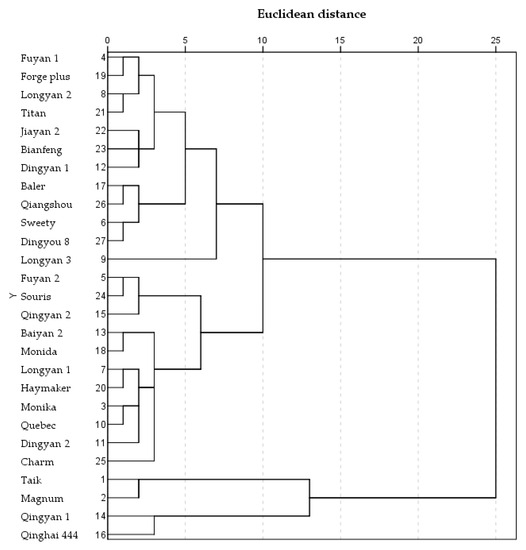
Figure 1.
Dendrogram of agronomic characters by cluster analysis for 27 oat varieties.
Following cluster categorization into four groups, statistical analysis and multiple comparisons revealed that the first group’s plant height, spike length, leaf area index, fresh grass yield, and dry grass yield were significantly lower than those in other groups (p < 0.05). However, their stem-to-leaf ratio was significantly higher. The fourth group’s plant height was significantly higher than other groups (p < 0.05). The second group’s average leaf width was notably higher than the other three groups, and their stem-to-leaf ratio was significantly lower (p < 0.05).
3.4. Principal Component Analysis
When assessing a variety’s production performance, relying on a single attribute for evaluation is not feasible. Through dimensionality reduction, it is possible to extract a few principal components that encapsulate most of the information from the original variables. This approach allows us to gauge the importance and component of each trait in a given variety, offering a more scientific method for selecting oat varieties [28].
From Table 4 and Table 5, the principal component analysis results of the tested oat varieties’ agronomic traits reveal that the first principal component contributes 41.54%, the second contributes 22.41%, and the third 12.11%. The cumulative contribution of the first three principal components is 76.06%, which can essentially determine the agronomic traits of the oat variety. The major contributors to the first principal component are plant height, spike length, and hay yield. Leaf length and leaf area index significantly contribute to the second principal component, and stem-to-leaf ratio to the third. Thus, plant height, spike length, hay yield, leaf length, leaf area index, and stem-to-leaf ratio mainly determine the agronomic traits of introduced oat varieties under spring sowing conditions.
Table 4.
Principal component matrix.
Table 5.
Variance interpretation.
Using formula (1), the comprehensive score was calculated. The comprehensive score ranking is shown in Table 6, with principal component contribution rates W1, W2, and W3 at 41.539%, 22.408%, and 12.108%, respectively. There are significant differences in the comprehensive ranking of each tested variety. The top five varieties in the comprehensive ranking are Sweety 1, Fuyan 1, Beile, Dingyan 2, and Longyan 2, while the last five are Tek, Magnum, Leader, Qingyan 2, and Qinghai 444.
Table 6.
Score sand ranking of the principal component from different varieties.
3.5. Comprehensive Evaluation of Grey Correlation Degree
Grey correlation analysis is a method that offers a comprehensive description and quantification of various factors’ effects and has been widely utilized in recent agricultural research. As a variety assessment method, it provides a comprehensive and objective evaluation of multiple traits, avoiding the pitfalls of single-sided or few-trait assessments. This study employed the grey correlation analysis method to evaluate the plant height, spike length, leaf number, stem thickness, leaf length, leaf width, leaf area index, fresh grass yield, dry grass yield, and stem-to-leaf ratio of 27 oat varieties. This was done to avoid only evaluating single indicators while neglecting others.
Contrary to the equal weight correlation degree, the weighted correlation degree assigns certain weight to each index, effectively controlling the influence of local correlation points’ correlation coefficient value on the overall grey correlation ranking, resulting in more reasonable outcomes. Thus, this study used the weighted correlation degree and equal weight correlation degree combined method to comprehensively evaluate the top five oat varieties. These are Sweety 1, Quebec, Bianfeng, Fuyan 1, and Jiayan (Table 7), which are derived from Canada, Gansu China, Canada, Gansu China, Canada, respectively, all suitable for widespread cultivation in the Hexi Corridor area. The lowest-ranked varieties are Taik, Mondragon, Souris, Qingyan No.1, and Qingyin 444.
Table 7.
Grey correlation degree and ranking of 27 oat varieties.
4. Discussion
The purpose of our study was to provide an in-depth assessment of various oat varieties under identical field management conditions. We measured the environmental adaptability in our experimental area, noting the growth period of forage as a critical evaluation metric [27]. The results revealed interesting variations between oat varieties, potentially offering new insights for future agricultural strategies and improvements in yield optimization.
Of note, the Taik and Magnum oat varieties demonstrated the shortest growth period, spanning only 89 days. Conversely, the Haymaker and Charm varieties displayed a longer growth period, extending to 107 and 110 days, respectively. This difference in growth periods is indicative of the adaptability of the Charm variety to the region’s environment, thus challenging preconceived notions about yield optimization and environmental adaptability. Our findings echo Xu’s [29] research on different oat varieties in alpine pastoral areas, where he found inconsistent growth periods attributed primarily to the distinct genetic traits and environmental conditions of each variety. This opens the door for further investigation into how the manipulation of these genetic traits might affect oat yield optimization in different geographical areas.
Our study also investigated oat forage yield variations across different cultivation regions. It was observed that the yield significantly differed among regions, mirroring the findings by Jiang [30], who demonstrated an average oat hay yield range of 10,740 kg to 16,690.5 kg per ha across 22 different oat varieties in the Huanghuai region. In comparison, our research findings displayed hay yields per ha ranging from 9622.8 kg to 2952.9 kg. The results are a testament to the complexity of oat forage yield optimization, considering the wide yield variations across different regions. Plant height and tiller number emerged as critical indicators reflecting grass yield [31], offering potential areas for targeted interventions to improve oat forage yield.
To offer a robust analysis, our study utilized Grey Correlation Analysis, an evaluation method that quantifies the effects of various factors [32]. The method provided a comprehensive evaluation of ten indicators across 27 oat varieties, offering a holistic perspective that avoids the limitations of a one-sided assessment based on a single trait or few traits. Based on the weighted correlation degree, the top-performing oat varieties suitable for the Hexi Corridor were identified as Sweety 1, Quebec, Bianfeng, Fuyan 1, and Jiayan. These findings contribute significantly to our understanding of the most suitable oat varieties for different regions, opening up opportunities for yield optimization.
Nonetheless, it is worth noting that a discrepancy was observed when comparing the results from the Grey Correlation Analysis and the Principal Component Analysis. This discrepancy may be attributed to the different standardization methods employed by the two analytical Taik niques, underscoring the importance of considering methodological variations in interpreting findings. Despite this variation, both methods consistently ranked the Sweety 1 variety as the top performer, emphasizing its superior traits in the context of our study.
Although our study presents critical insights into oat forage yield optimization, it is important to consider the limitations. As all varieties were evaluated under the same management conditions and in the same experimental area, the results may not be generalizable to all environments. Future research should consider different geographical locations and climates to provide a more comprehensive understanding of the growth and yield of different oat varieties.
This study highlights the critical role of genetic characteristics, environmental conditions, and the choice of analytical methods in understanding the environmental adaptability and yield of different oat varieties. By doing so, it paves the way for future targeted interventions aimed at improving oat forage yield, potentially impacting agricultural practices and policies. As we look to the future, we are reminded of the broader implications of our work and how it contributes to the wider discourse on sustainable agriculture and food security.
5. Conclusions
Oat cultivation is of immense global significance, and the challenge of selecting optimal varieties for specific regions is a common concern across different ecological and geographical landscapes. This study identified key agronomic traits influencing the growth and yield of 27 oat varieties in the Jiuquan area. The most influential attributes were plant height, spike length, and hay yield. Leaf length and leaf area index were significant contributors to the second principal component, while the stem-to-leaf ratio was the primary indicator in the third component. Six varieties, Tianyan 1, Fuyan 1, Dingyan 2, Baylor, Quebec, and Longyan 2, were found to be the most suitable for promotion and cultivation in the region. The findings provide valuable insights for oat cultivation, but the specific conditions of the Jiuquan area should be considered when applying these results elsewhere.
Author Contributions
Conceptualization, G.W. and Y.L. (Yuan Li); methodology, G.W.; software, G.W., H.Z., Y.W. and Y.L. (Yuqing Liang); validation, G.W., Y.L. (Yuan Li), H.X. and X.G.; formal analysis, G.W., Y.L. (Yuqing Liang), X.Z. and Q.Y.; investigation, G.W., H.X. and X.G.; resources, G.W. and X.G.; data curation, G.W.; writing—original draft preparation, G.W.; writing—review and editing, G.W., H.Z., Q.Y. and Y.W.; visualization, G.W.; supervision, H.X.; project administration, Z.C. and R.Z.; funding acquisition, Y.L. (Yuan Li). All authors have read and agreed to the published version of the manuscript.
Funding
Natural Science Foundation of Gansu Province: 22JR5RA455, and Key Technology Integration and Demonstration for Improving Quality and Efficiency of High-Quality Forage Grass in Arid Regions of Huan County (2022YFD1602102).
Data Availability Statement
The data presented in this study are available on request from the corresponding author.
Conflicts of Interest
The authors declare no conflict of interest.
References
- Chai, J.; Zhao, G.; Hu, K.; Ren, C.; Man, Y. Effect of Eco-environment in Different Planting Areas on Oat Nutritive Value and Hay Production. Acta Agrestia Sin. 2010, 18, 421–425+476. [Google Scholar]
- Pokhrel, K.; Kouřimská, L.; Pazderů, K.; Capouchova, I.; Božik, M. Lipid content and fatty acid profile of various European and Canadian hulled and naked oat genotypes. J. Cereal Sci. 2022, 108, 103580. [Google Scholar] [CrossRef]
- Zhu, G.L.; Xu, Z.R.; Xu, Y.M.; Lu, H.T.; Ji, Z.Y.; Zhou, G.S. Different Types of Fertilizers Enhanced Salt Resistance of Oat and Associated Physiological Mechanisms in Saline Soils. Agronomy 2022, 12, 317. [Google Scholar] [CrossRef]
- Wang, Y.; Yang, Z.; Liu, J.; Li, F.; Yu, L.; Yuan, T.; Liang, X.; Zhou, W. Comprehensive evaluation of production performance and nutritional quality of 21 oat varieties in northwest of Hebei province. Acta Agrestia Sin. 2020, 28, 1311–1318. [Google Scholar]
- Nan, M.; Zhao, G.; Li, J.; Chai, J. Correlation analysis and synthesize evaluation of yield and quality introduced oat varieties in the semi-arid of northwest. Acta Agresita Sin. 2018, 26, 125–133. [Google Scholar]
- Wang, Z.; Shi, P.; Zhang, X.; Yao, L.; Tong, H. Grid-scale-based ecological security assessment and ecological restoration: A case study of Suzhou district, Jiuquan. J. Nat. Resour. 2022, 37, 2736–2749. [Google Scholar]
- Fu, S. The Analysis on Cultivated Land and Basic Farmland Protection of Jiuquan City. Master’s Thesis, Lanzhou University, Lanzhou, China, 2010. [Google Scholar]
- Sun, Z. The Study on the Animal Husbandry Development on Jiuquan Oasis. Master’s Thesis, Northwest Normal University, Lanzhou, China, 2004. [Google Scholar]
- Yang, S. Study on the Main Production Mode Opitimization of Grassland Stockbreeding in Hexi Corridor. Master’s Thesis, Gansu Agricultural University, Lanzhou, China, 2010. [Google Scholar]
- Xie, P. Research on Spatial and Temporal Evolution of Soil Carbon Sequestration of Oasis Farmland Ecosystem in Hexi. Ph.D. Thesis, Gansu Agricultural University, Lanzhou, China, 2009. [Google Scholar]
- Li, K.; Xu, Y. Study on Adjustment of Agricultural Planting Structures in China for Adapting to Climate Chang. J. Agric. Sci. Taik Nology 2017, 19, 8–17. [Google Scholar]
- Jevtić, R.; Župunski, V.; Grčak, M.; Živančev, D.; Knežević, D. Cereal–pea intercropping reveals variability in the relationships among yield, quality parameters, and obligate pathogens infection in wheat, rye, oat, and triticale, in a temperate environment. Plants 2023, 12, 2067. [Google Scholar] [CrossRef] [PubMed]
- Qin, J.; Gao, M. A study on three-dimension structure in irrigated area in Hexi area. Syst. Sci. Compr. Stud. Agric. 2003, 4, 315–318. [Google Scholar]
- Lou, C.; Wang, B.; Li, D.; Zhu, X.; Qi, S.L.; Wang, C. Comparison of production performance and nutritional value of 16 oat varieties in Yellow River Beach area. Pratacultural Sci. 2019, 36, 1843–1851. [Google Scholar]
- Zhang, H.B.; Liu, C.T.; Mao, L.P.; Li, Y.; Shen, Y.Y. Divergent response of hay and grain yield of oat: Effects of environmental factors and sowing rate. J. Sci. Food Agric. 2023, 103, 233–242. [Google Scholar] [CrossRef] [PubMed]
- Zhou, Q.; Yan, H.; Liang, G.; Jia, Z.; Liu, W.; Tian, L.; Chen, Y.; Chen, S. Analysis of the forage and grain productivity of oat cultivars. Acta Prataculturae Sin. 2015, 24, 120–130. [Google Scholar]
- Podolska, G.; Nita, Z. Effect of sowing rates and nitrogen fertilization on grain yield and chemical composition of naked short-shoot oat (STH 5630). Fragm. Agron. 2009, 26, 100–107. [Google Scholar]
- Zhang, Y.; Chen, Z.; Zhang, X.; Song, S.; Yang, Z. Influence of moving time on yield and quality of spring and autumn sow oat hay. Acta Prataculturae Sin. 2016, 25, 124–135. [Google Scholar]
- Du, X. Effect of Mixture and Interlacing Drill Modes on Forage Yield and Quality of Oat and Alfalfa in Guanzhong Region. Master’s Thesis, Northwestern Agricultural and Forestry University, Xianyang, China, 2011. [Google Scholar]
- Wang, S. Effects of Adding Lactic Acid Bacteria on Ferment Quality and Microbial Diversity of Greet Wheat and Oat in Tibetan. Master’s Thesis, Nanjing Agricultural University, Nanjing, China, 2016. [Google Scholar]
- Zhao, W.; Wang, Y.; Li, L.; Wang, X. Reproductive and stress resistance characteristics of wild oat and its allelopathic effects on common wheat. Chin. J. Ecol. Agric. 2017, 25, 1684–1692. [Google Scholar]
- Shi, J.; Xue, Y.; Guo, W.; Yu, S.; Lu, W.; Yu, L. Evaluation of forage yield and nutritional value of introduced oat germplasm resources. J. Triticeae Crops 2019, 39, 1063–1071. [Google Scholar]
- Ju, Z.; Zhao, G.; Chai, J.; Jia, Z.; Liang, G. Comprehensive evaluation of nutritional values and silage fermentation quality in central Gansu. ACTA Prataculturae Sin. 2019, 28, 77–86. [Google Scholar]
- Zhou, Q.; Duo, J.D.Z.; Tu, D.Q.P.; Liu, Y.; Yi, X. Genetic diversity analysis of the main agronomic traits and nutritional in 18 oat cultivars introduced to Lhasa. Pratacultural Sci. 2020, 37, 550–558. [Google Scholar]
- Zhou, Q. Grey relational grade evaluation of 19 oat varieties introduced in Ali of Tibet. Crops 2021, 37, 26–31. [Google Scholar]
- Tong, Y.; Yu, X.; Xu, C.L.; Wang, P.; Song, J.; Li, Z.; Li, Y. Effect of sowing date forage yield and quality of seven oat varieties in Tianzhu alpine region. Acta Agrestia Sin. 2021, 29, 1094–1106. [Google Scholar]
- Sun, J.; Dong, K.; Kuai, X.; Xue, Z.; Gao, Y. Comparison of productivity and feeding value of introduced oat varieties in the agro-pasture ectome of northern Shanxi. Acta Prataculturae Sin. 2017, 26, 222–230. [Google Scholar]
- Wu, H.; Qu, Z.; Liu, Z.; Laba, D.Z.; Tongsang, C.M.; Qu, N.; Nima, Z.; Ma, Y. Comparative study on production performance of oat varieties based on principal component analysis. Acta Agrestia Sin. 2021, 29, 1967–1973. [Google Scholar]
- Xu, C. A studying on growth characteristics of different cultivars of oat (Avena sativa) in alpine region. Acta Prataculturae Sin. 2012, 21, 280–285. [Google Scholar]
- Jiang, H.; Bai, S.; Wu, B.; Song, J.; Wang, G. A multivariate evaluation of agronomic straits and forage quality of 22 oat varieties in the Huang-Huai-Hai area of China. Acta Prataculturae Sin. 2021, 30, 140–149. [Google Scholar]
- Dong, S.; Pu, X.; Ma, J.; Shi, Z. Productive Evaluation on Different Oat (Avena sativa) Varieties in Alpine Region of Tianzhu. Acta Agrestia Sin. 2001, 9, 44–49. [Google Scholar]
- Wang, L. Comparative study on production performance of different oat in Xining Area. Qinghai Anim. Pastor. Mag. 2000, 2, 17–19. [Google Scholar]
Disclaimer/Publisher’s Note: The statements, opinions and data contained in all publications are solely those of the individual author(s) and contributor(s) and not of MDPI and/or the editor(s). MDPI and/or the editor(s) disclaim responsibility for any injury to people or property resulting from any ideas, methods, instructions or products referred to in the content. |
© 2023 by the authors. Licensee MDPI, Basel, Switzerland. This article is an open access article distributed under the terms and conditions of the Creative Commons Attribution (CC BY) license (https://creativecommons.org/licenses/by/4.0/).