Abstract
Water is considered the most important natural resource utilized on managed amenity grasslands, and water conservation is an integral part of an overall program in environmental stewardship and best management practices. Measuring and monitoring the soil water content of turfgrass root zones has become an important and routinely accepted practice of golf courses and sports pitches. In recent years, portable hand-held soil moisture meters or sensors have become commercially available and affordable, and therefore have become a valuable and often relied-upon tool for the turfgrass industry practitioner. To maximize or optimize the time and resources needed to measure the root zone volumetric water content of a turf site, a field experiment was conducted to determine the minimum number of soil moisture readings needed per 93 m2 of a sand-based root zone. Of note, 93 m2 is equivalent to 1000 ft2, which is the common form of area measurement utilized by the turfgrass industry in the USA. The standard error of the mean calculated from sampling data revealed that three to four measurements per 93 m2 were the minimum number required. Soil moisture meters should be utilized in a structured, purposeful, and site-specific manner along with traditional soil moisture evaluation methods of diligent scouting for visual signs of turfgrass wilt and drought stress, as well as examining soil root zone cores, to support prudent irrigation water management practices. Knowledge of the soil moisture status will support best practices for water conservation and environmental stewardship while optimizing turfgrass quality, function, and performance.
1. Introduction
At professionally managed and maintained turfgrass sites, soil or root zone moisture (i.e., volumetric water content; VWC), also known as water fraction volume, is measured using various commercially available hand-held devices [1]. The main purpose of measuring VWC is to assess the soil water status to ultimately determine irrigation needs of the turf [2]. Other reasons to monitor VWC include optimizing the timing and coordinated efforts of cultural management practices (i.e., aeration, cultivation, mowing, fertilizing, etc.), determining the potential threat of abiotic stresses (i.e., saturated root zone conditions during high air temperature periods that favor plant pathogenic fungi activity), evaluating surface grooming and conditioning practices to improve ball roll (for putting greens) and bounce and footing (for sports fields), and maintaining the overall aesthetic quality and function of the turfgrass community.
The turfgrass industry typically utilizes the term “soil moisture meters” to describe devices used to measure soil root zone “moisture” or volumetric water content. When these soil moisture meters are employed properly and effectively, they can provide insight about environmental conditions that predispose a managed turfgrass ecosystem to abiotic and biotic stresses and potential problems associated with non-optimum root zone water content [3]. A soil moisture meter offers the turfgrass practitioner a tool to identify environmental conditions that occurring before those stress symptoms are visible to the human eye [1]. Thus, monitoring and measuring soil moisture can provide further insight otherwise not possible from traditional methods of visual scouting for turfgrass problems such as wilt and other signs of drought stress, visual inspection of the soil for the formation of “black layer”, and visually evaluating a turf site for other signs of abiotic and biotic stresses developing due to non-optimum root zone water content [4].
An additional benefit of proper soil moisture monitoring is improved communication between staff managing turfgrass sites and the players or stakeholders enjoying those turf surfaces [1]. Objectively, turfgrass managers can present valid information that justifies the cultural practices needed and the regulations imposed upon those turf sites [4]. Water is fundamentally the most important natural resource utilized in turfgrass management operations, and it is the industry’s obligation to use it most effectively and wisely [3]. Representative monitoring with sensors facilitates an excellent opportunity for the improved and efficient use of water within a turfgrass management program, regardless of location in the world or demands on the turf site [2]. Sensor-based or sensor-guided irrigation practices has been shown to decrease water use, and/or utilize water more effectively and efficiently, in intensively management turfgrass ecosystems [5]. Thus, monitoring VWC has become a heavily relied-upon and sustainable best management practice for the turfgrass industry [6,7,8,9,10].
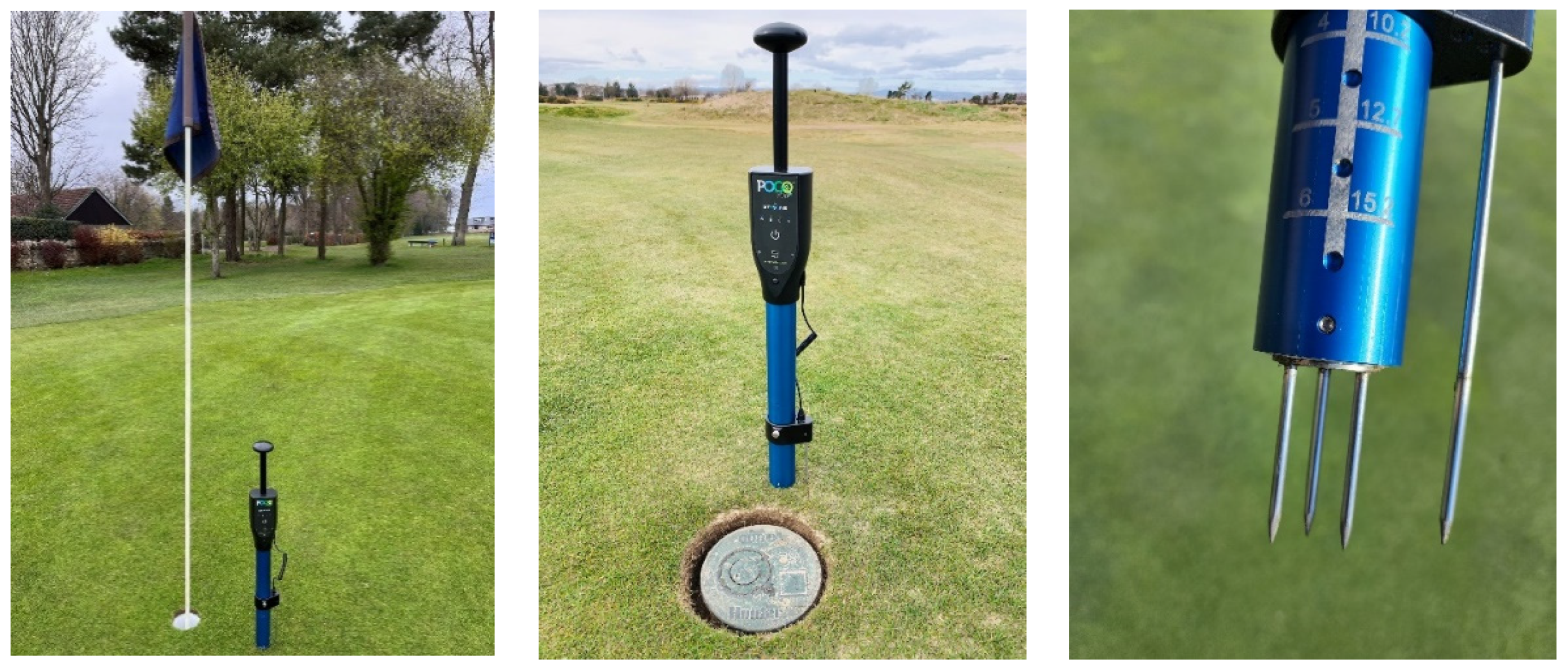
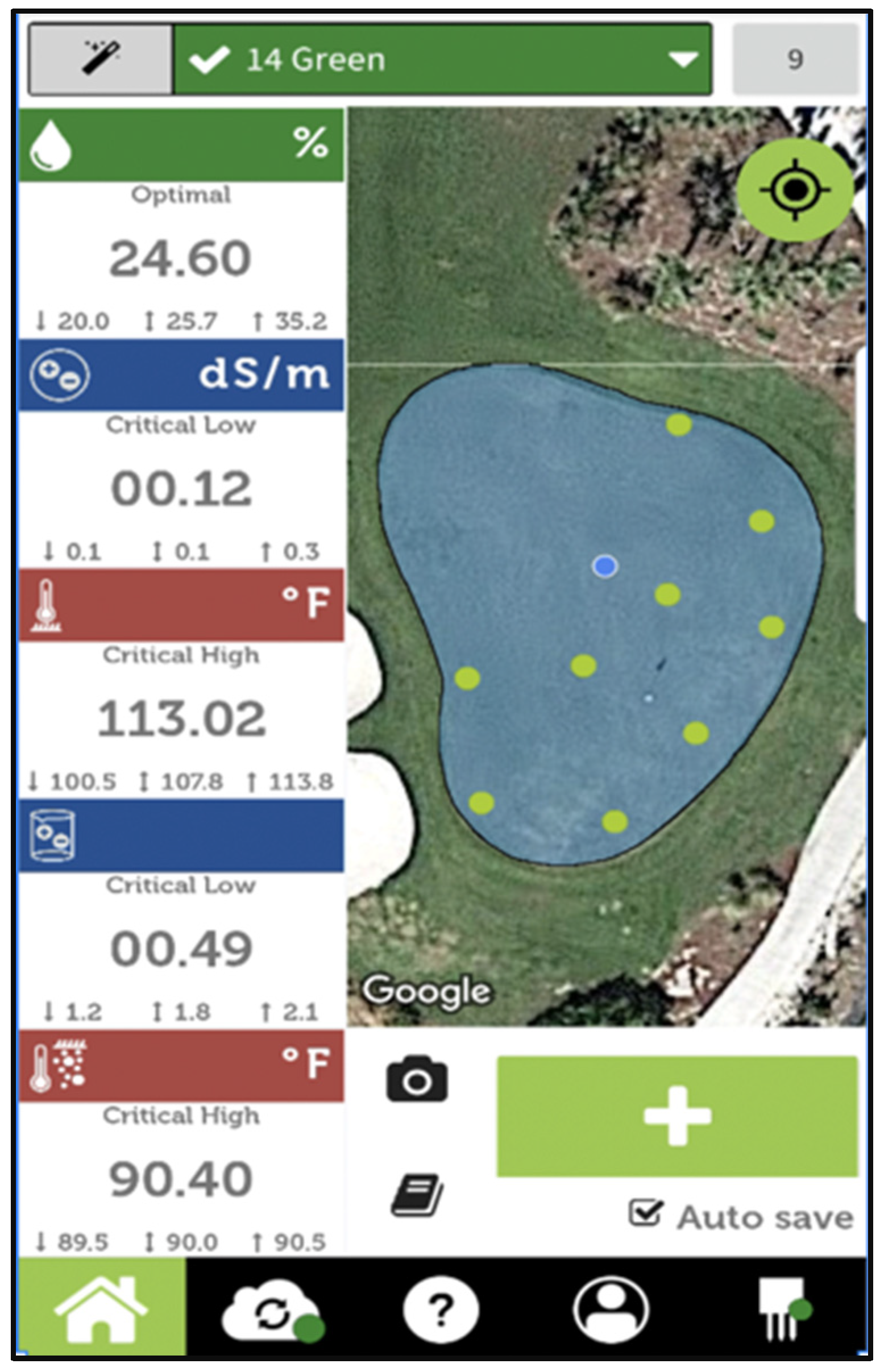
The POGO TurfPro (Stevens Water Monitoring Systems, Inc.; Portland, OR, USA) is a portable device that has become a popular monitoring platform in the turfgrass industry, and is used to monitor and measure root zone VWC and also soil temperature and soil electrical conductivity (Figure 1). The POGO was developed from the patented HydraProbe II sensor, which measures the water fraction volume based on coaxial impedance dielectric permittivity technology requiring no calibration in turfgrass systems [11]. The unique processes of this sensor make it an ideal choice for managed amenity turfgrass sites given the many changing dynamics that occur in turf systems from soil texture and structural alterations, soil microbiology, plant species, soil electrical conductivity alterations from irrigation water, fertilization practices, and weather conditions and local climate, soil compaction from routine maintenance practices, and the influence from play or use [3]. The POGO also is equipped with precision global position satellite technology to compile and analyze data spatially across a defined area (i.e., putting green, fairway, football pitch, etc.). The POGO interface utilizes a smartphone or tablet application for monitoring, measuring, and analyzing, and presenting data (Figure 2).
Figure 1.
The POGO TurfPro (Stevens Water Monitoring Systems; Portland, OR, USA) is a portable device equipped with 5.6 cm metal rods that measures soil volumetric water content to the 5.71 cm depth. The extended metal rod at right side of device measures soil temperature.
Figure 2.
The POGO TurfPro (Stevens Water Monitoring Systems; Portland, OR, USA) utilizes a bluetooth-linked mobile application (TurfPro Mobile) for data collection and analysis. This is an example of a data collection and analysis output from green #14 on a golf course. The image indicates the perimeter of the site (i.e., putting green), the location of all nine sampling sites withing that putting green, soil moisture (percent volumetric water content), soil electrical conductivity (dS·m−1), surface temperature (as °C or °F), salinity concentration index (dS·m−1), and root zone temperature (as °C or °F).
Turfgrass management practitioners and professionals (i.e., golf course superintendents/course care managers, sports turf/pitch managers, and grounds/lawncare managers) can spend a great deal of employee time and labor resources measuring root zone VMC at their respective sites (i.e., putting greens, fairways, pitches, lawns and landscapes). The number of VWC measurements needed for a single turf site or field, however, has not been determined. For example, how many VWC measurements are needed on a single putting green or fairway or pitch to provide an accurate assessment and determination of the VWC for the entire putting green or fairway or pitch? Therefore, the objective of this study was to determine the minimum or optimum number of POGO-based VWC measurements needed to obtain an accurate or representative root zone VWC value of a turf site with a sand root zone.
2. Materials and Methods
2.1. Study Site
This study was located at the Center for the Agricultural Sciences and a Sustainable Environment, at the Berks Campus of the Pennsylvania State University, in Reading, PA (USA). The turf was a mature stand of creeping bentgrass (Agrostis stolonifera L. ‘PennTrio’) maintained on a 10 cm coarse sand-capped root zone over native clay loam soil. Physical analysis of the sand layer revealed 90.3, 7.9, and 1.7% sand, silt, and clay content, respectively (Table 1). Within the sand fraction, 92.9% measured as coarse to very coarse (Table 1). The sand layer pH was 7.1, with 0.3% organic matter as determined by percent lost on ignition method. The site was maintained as a typical golf course fairway in the Mid-Atlantic USA region, and mowed two to three times per week as needed with a reel mower at a 12 mm height-of-cut with clippings not removed.
Table 1.
Physical analysis of the sand root zone at the study site (1).
2.2. Experimental Design
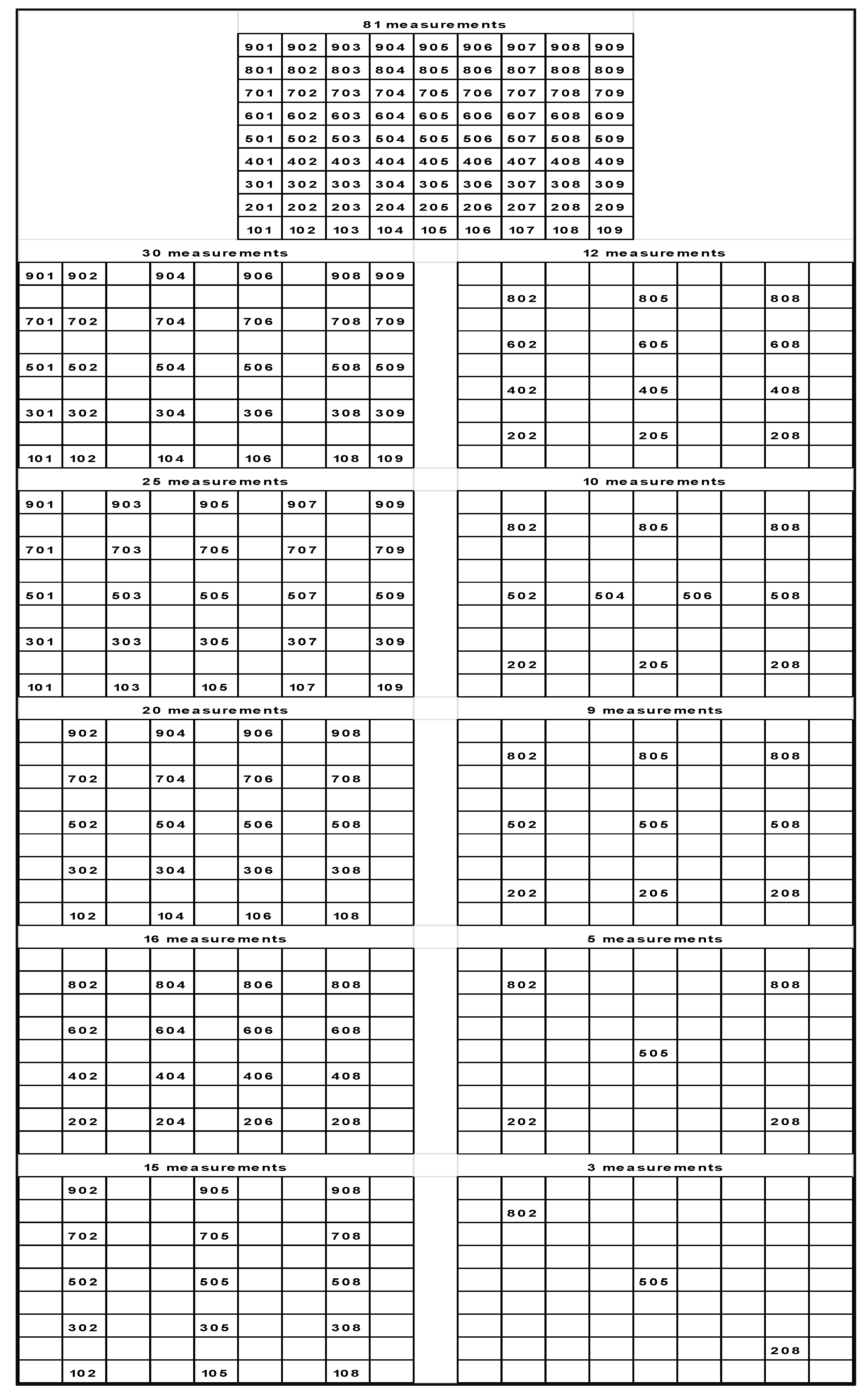
Individual test plots measured 2.1 m × 2.1 m and arranged in a square grid pattern of 9 plots × 9 plots, for a total of 81 plots that occupied a total area of 368.7 m2 (Figure 3). Root zone VWC at the 5.71 cm depth was measured using the POGO TurfPro that is equipped with 5.6 cm length metal rods of the HydraProbe II sensor (Figure 1).
Figure 3.
At the study site, 81 plots were identified by individual plot numbers, with plots shown (in bold) where rootzone volumetric water content was measured. Individual plot size was 2.1 m × 2.1 m and arranged in a square grid pattern of 9 plots × 9 plots, for a total of 81 plots that measured 368.7 m2.
One in-ground pop-up irrigation sprinkler is located on each outer corner of the 21.5 × 21.5 m (464.5 m2) area which contained the study site. Each sprinkler distributes irrigation water at a 90-degree arc. Although the study site has an irrigation system calibrated to deliver a uniform distribution of water when needed, a natural precipitation event occurred on 30 October 2021 that measured 11.0 mm of rain. Therefore, the study site’s root zone was considered as uniformly wetted prior to VWC sampling. All VWC sampling was conducted on 2 November 2021, at approximately 0700 to 1100 a.m. One root zone VWC measurement was obtained per plot, for 81 total measurements for each site (Figure 3). This was repeated five more times, for a total of six separate or replicated VWC measurements per plot (n = 6). The VWC readings were recorded as a percent and entered onto a spreadsheet for data analysis.
2.3. Data Analysis
All data were extracted to represent eleven sample sizes, consisting of 81, 30, 25, 20, 16, 15, 12, 10, 9, 5, and 3 VWC measurements for the 368.7 m2 test site area (Figure 2). The data for each sampling size were compiled and the mean, standard deviation, standard error, and coefficient of variation were calculated as follows:
where xi equals the i-th variable, and n equals the number of variables in the data set;
where xi represents each individual data point, represents the mean of the data set, and n represents the total number of data points in the data set;
where σ equals standard deviation and n equals number of samples; and
where σ equals standard deviation and represents the mean of the data set.
mean = ∑ [xi/n]
All data representing each category of mean, standard deviation, standard error, and coefficient of variation were subjected to analysis of variance, and the eleven sampling size data sets compared using Fisher’s protected least significance difference test at p ≤ 0.05 [12].
3. Results and Discussions
3.1. Mean
The mean volumetric water content for all 11 sampling “categories” (i.e., 3 to 81 sampling points in the 368.7 m2 area) reveals a range of 23.8 to 27.8% from 3 through 81 samples, respectively (Table 2). Utilizing results from the 81 sampling number (i.e., the most sampling points reflects the best accuracy and representation of volumetric water content of that site), no statistical differences (p ≤ 0.05) were detected when comparing the mean from 81 samples (27.8%) through 9 samples (27.2%) (Table 2). The means from 3 samples (23.8%) or 5 samples (24.1%), however, were statistically lower versus the mean from 81 samples (27.8%) (Table 2).
Table 2.
Statistical analysis of VWC (volumetric water content) sampling data from the study site (1).
3.2. Standard Deviation
The standard deviation of the mean revealed a range of 10.01 to 7.03 from 3 through 81 samples, respectively (Table 2). No statistical differences (p ≤ 0.05) were detected when comparing the standard deviation from 5 (9.49) through 81 samples (7.03) (Table 2). Only the standard deviation from 3 samples (10.01) was statistically higher versus 81 samples (7.03) (Table 2).
3.3. Standard Error
The standard error of the mean revealed a range of 5.77 to 0.78 from 3 through 81 samples, respectively (Table 2). No statistical differences (p ≤ 0.05) were detected when comparing the standard error from 81 samples (0.78) through 15 samples (1.82) (Table 2). The standard error from 3 samples (5.77) to 12 samples (2.18) were statistically higher versus 81 samples (0.78) (Table 2).
3.4. Coefficient of Variation
The coefficient of variation of the mean revealed a range of 42.1 to 25.0% from 3 through 81 samples, respectively (Table 2). No statistical differences (p ≤ 0.05) were detected when comparing the coefficient of variation from 81 samples (25.0%) through 9 samples (30.2%) (Table 2). The coefficient of variation from 3 samples (42.1%) to 5 samples (35.6%) were statistically higher versus 81 samples (25.0%) (Table 2).
3.5. Further Discussion
Mean percent soil VWC data revealed that a range of 9 to 30 measurements or samples provided a VWC mean that was statistically similar to 81 samples (Table 2). Data for the standard deviation of the mean, as well as percent coefficient of variation, did not provide any further separation among the sampling numbers, as no clear or distinct statistical differences were detected among nearly all sampling levels (Table 2).
In this field experiment, the standard error represents an estimate of the variability among the many VWC measurements obtained within the 368.7 m2 turf area. The standard error was lowest from the 81 measurements or samples (Table 2). The standard error can be decreased by increasing the sample size (i.e., the maximum 81 VWC measurements with the 368.7 m2 turf area). However, taking 81 measurements within a 368.7 m2 turf area would be too time consuming in practice. A total of 15 measurements was the minimum number that resulted in a standard error statistically similar with 81 measurements (Table 2). Therefore, 15 would be considered the minimum or optimum number of VWC measurements required per 368.7 m2 turf area, or three to four measurements per 93 m2 (i.e., 93 m2 is equivalent to 1000 ft2 which is the common form of area measurement utilized by the turfgrass industry in the USA).
Further research is warranted that considers monitoring VWC within the irrigation water delivery patterns of in-ground pop-up sprinklers. In the reality of intensively maintained turfgrass sites, VWC data within a specific coverage area of an irrigation sprinkler may be more valuable than VWC data from a larger area or zone of turf [1,4,5,13]. For example, for turfgrass practitioners, this could perhaps translate to 50 to 60 VWC sampling points on one hectare of a golf course fairway that corresponds with 15 to 20 irrigation sprinklers installed on that fairway. Additionally, for turfgrass practitioners, measuring VWC may warrant a more site-specific or structured approach in which certain zones or “hot spots” (i.e., sites with a historical record or repeated expression of abiotic stress, or sites subjected to heavy traffic, or sites that are sloped or demonstrate irrigation inefficiency, etc.) are monitored more intensively [2,3,5,6,7,13].
4. Conclusions
In conclusion, based on the calculated standard error of the mean of POGO-obtained VWC data from the sand-capped root zone within the parameters of this field study, a minimum of 15 VWC samples are required per 368.7 m2 managed turf area, or more specifically, three to four VWC samples per 93 m2 (~1000 ft2 area as utilized in the USA) to optimize VWC monitoring of turfgrass sand-based root zones.
Author Contributions
Conceptualization, C.M., S.M., C.P., M.M. and M.F.; methodology, C.M., M.M. and M.F.; data curation, C.M. and M.F.; writing—original draft preparation, C.M. All authors have read and agreed to the published version of the manuscript.
Funding
This research received no external funding.
Data Availability Statement
Not applicable.
Acknowledgments
Stevens Water Monitoring Systems (Portland, OR, USA) for in-kind donation of the POGO TurfPro for use with this research.
Conflicts of Interest
The authors declare no conflict of interest.
References
- Moeller, A. Identify soil moisture status more accurately then ever before! USGA Green Sect. Rec. 2012, 59, 1–5. [Google Scholar]
- Throssell, C.S.; Lyman, G.T.; Johnson, M.E.; Stacey, G.A.; Brown, C.D. Golf course environmental profile measures water use, source, cost, quality, management and conservation strategies. Appl. Turfgrass Sci. 2009, 6, 1–16. [Google Scholar] [CrossRef] [Green Version]
- Turgeon, A.J. Turfgrass Management, 7th ed.; Pearson Education: Upper Saddle River, NJ, USA, 2005. [Google Scholar]
- Karcher, D.; Richardson, M.; O’Brien, D. What the Tech? Moisture Meters for Greater Efficiency, Healthier Turf. Golf Course Managemen. 2019. Available online: https://www.gcmonline.com/tags/moisture-meters-golf (accessed on 15 May 2022).
- Harivandi, A.; Brown, P.; Kenna, M. Golf’s use of water: Solutions for a more sustainable game. USGA Turfgrass Environ. Res. Online 2012, 11, 1–70. [Google Scholar]
- Gelernter, W.D.; Stowell, L.J.; Johnson, M.E.; Brown, C.D.; Beditz, J.F. Documenting trends in water use and conservation practices on U.S. golf courses. Crop Forage Turfgrass Manag. 2015, 1, 1–10. [Google Scholar] [CrossRef] [Green Version]
- Grabow, G.L.; Ghali, I.E.; Huffman, R.L.; Miller, G.L.; Bowman, D.; Vasanth, A. Water application efficiency and adequacy of ET-based and soil moisture-based irrigation controllers for turfgrass irrigation. J. Irrig. Drain. 2013, 139, 113–123. [Google Scholar] [CrossRef]
- Haley, M.B.; Dukes, M.D. Validation of landscape irrigation reduction with soil moisture sensor irrigation controllers. J. Irrig. Drain. 2012, 138, 135–144. [Google Scholar] [CrossRef]
- Pathan, S.M.; Barton, L.; Colmer, T.D. Evaluation of a soil moisture sensor to reduce water and nutrient leaching in turfgrass (Cynodon dactylon cv. Wintergreen). Aust. J. Exp. Agric. 2007, 47, 215–222. [Google Scholar] [CrossRef]
- Roberson, T.L.; Badzmierowski, M.J.; Stewart, R.D.; Ervin, E.H.; Askew, S.D.; McCall, D.S. Improving soil moisture assessment of turfgrass systems utilizing field radiometry. Agronomy 2021, 11, 1960. [Google Scholar] [CrossRef]
- Burns, T.; Adams, J.; Berg, A. Laboratory calibration of the Hydra Probe soil moisture sensor: Comparison of infiltration wet-up vs. dry-down. Vadose Zone J. 2015, 13, 1–10. [Google Scholar]
- Mead, R.; Curnow, R.N.; Hasted, A.M. Statistical Methods in Agriculture and Experimental Biology; Chapman and Hall/CRC Press: Boca Raton, FL, USA, 2003. [Google Scholar]
- Lawrence, P.G.; Roper, W.; Morris, T.; Guillard, K. Guiding soil sampling strategies using classical and spatial statistics: A review. Agron. J. 2020, 112, 493–510. [Google Scholar] [CrossRef] [Green Version]
Publisher’s Note: MDPI stays neutral with regard to jurisdictional claims in published maps and institutional affiliations. |
© 2022 by the authors. Licensee MDPI, Basel, Switzerland. This article is an open access article distributed under the terms and conditions of the Creative Commons Attribution (CC BY) license (https://creativecommons.org/licenses/by/4.0/).