Recent Advances in Thermoplastic Starch (TPS) and Biodegradable Polyester Blends: A Review of Compatibilization Strategies and Bioactive Functionalities


Abstract
1. Introduction
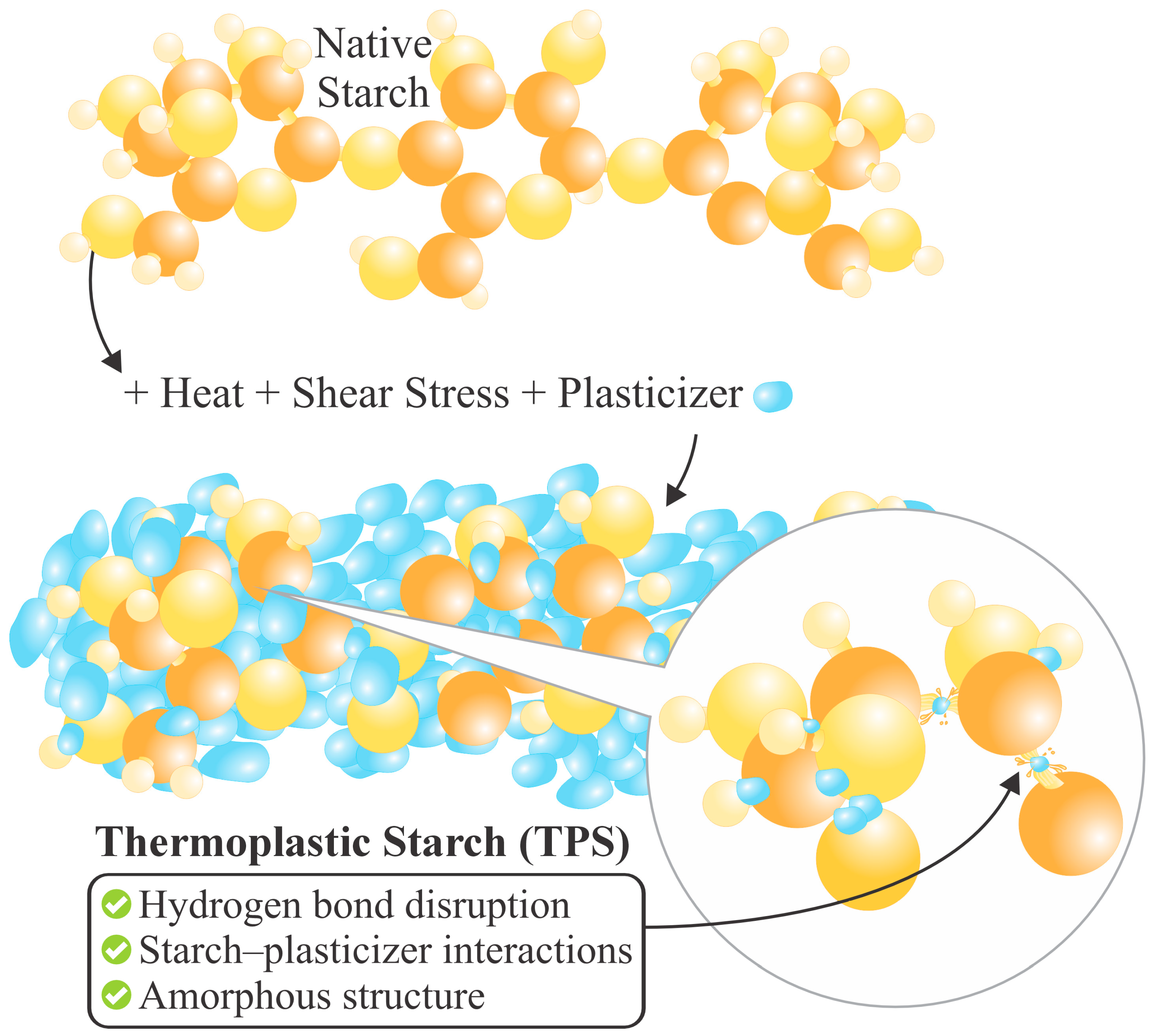
2. Thermoplastic Starch and Biodegradable Polyesters: Molecular Features, Sources, and Processing Approaches
2.1. Application Constraints and Processing Challenges
2.2. Functional Advantages and Potential Applications
3. Morphological Limitations and Performance Constraints in Non-Compatibilized TPS and Biodegradable Polyester Blends
4. Compatibilization and Reinforcement of TPS/Biopolyester Blends for Enhanced Properties
4.1. Compatibilization Using Conventional Agents and Functional Additives
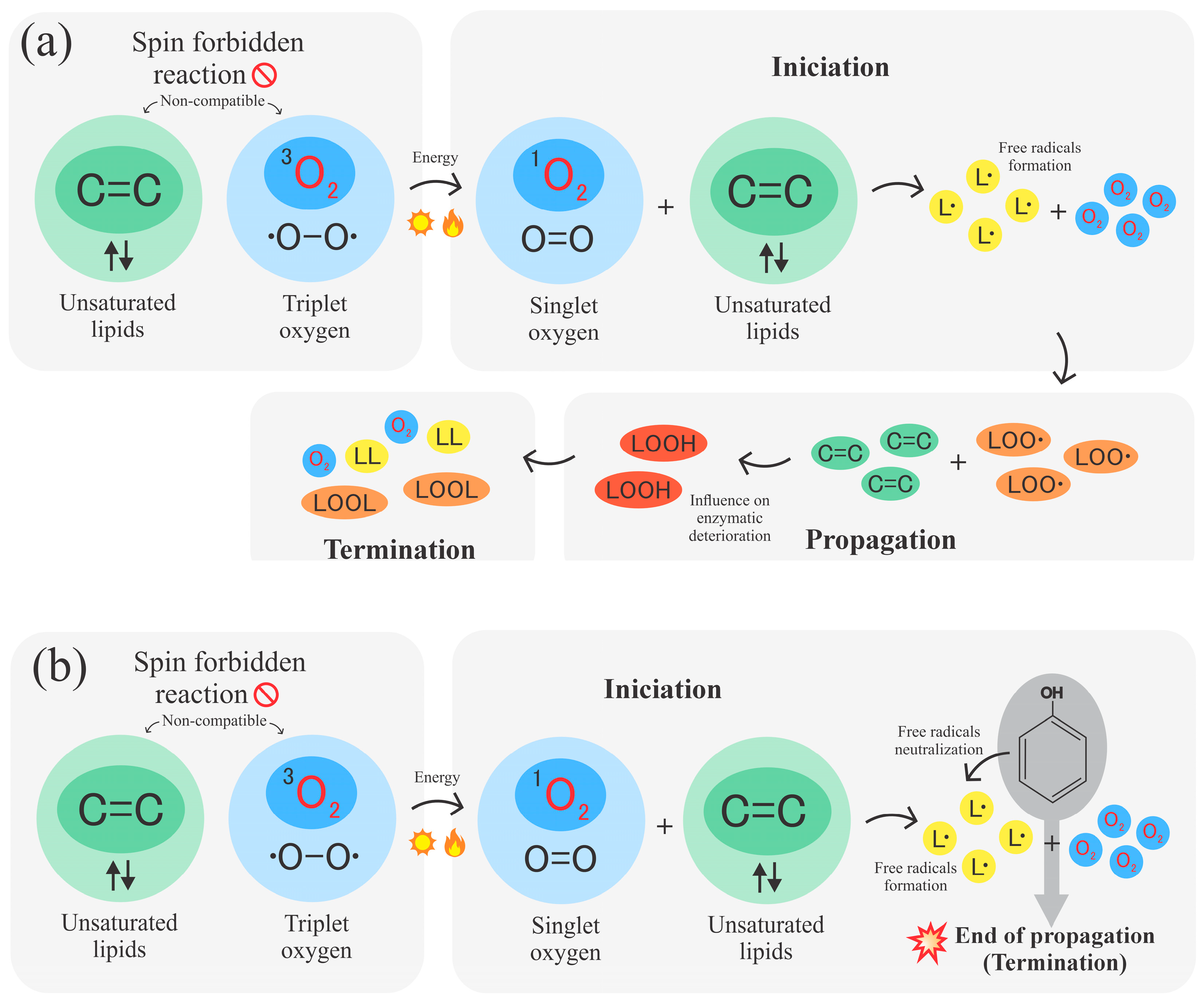
4.2. Phenolic and Oily Compounds as Natural Compatibilizers
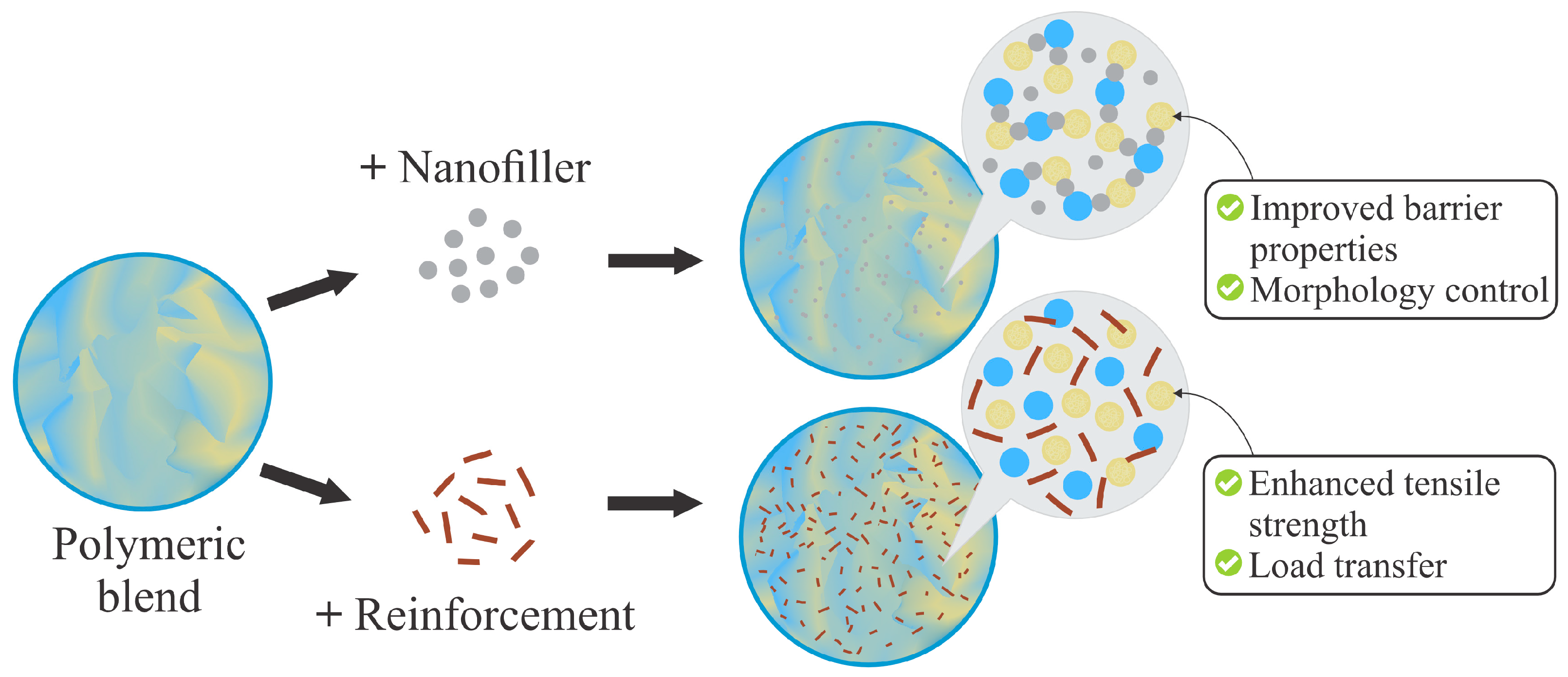
4.3. Compatibilization and Property Enhancement Using Nanofillers and Natural Reinforcements
5. Future Perspectives
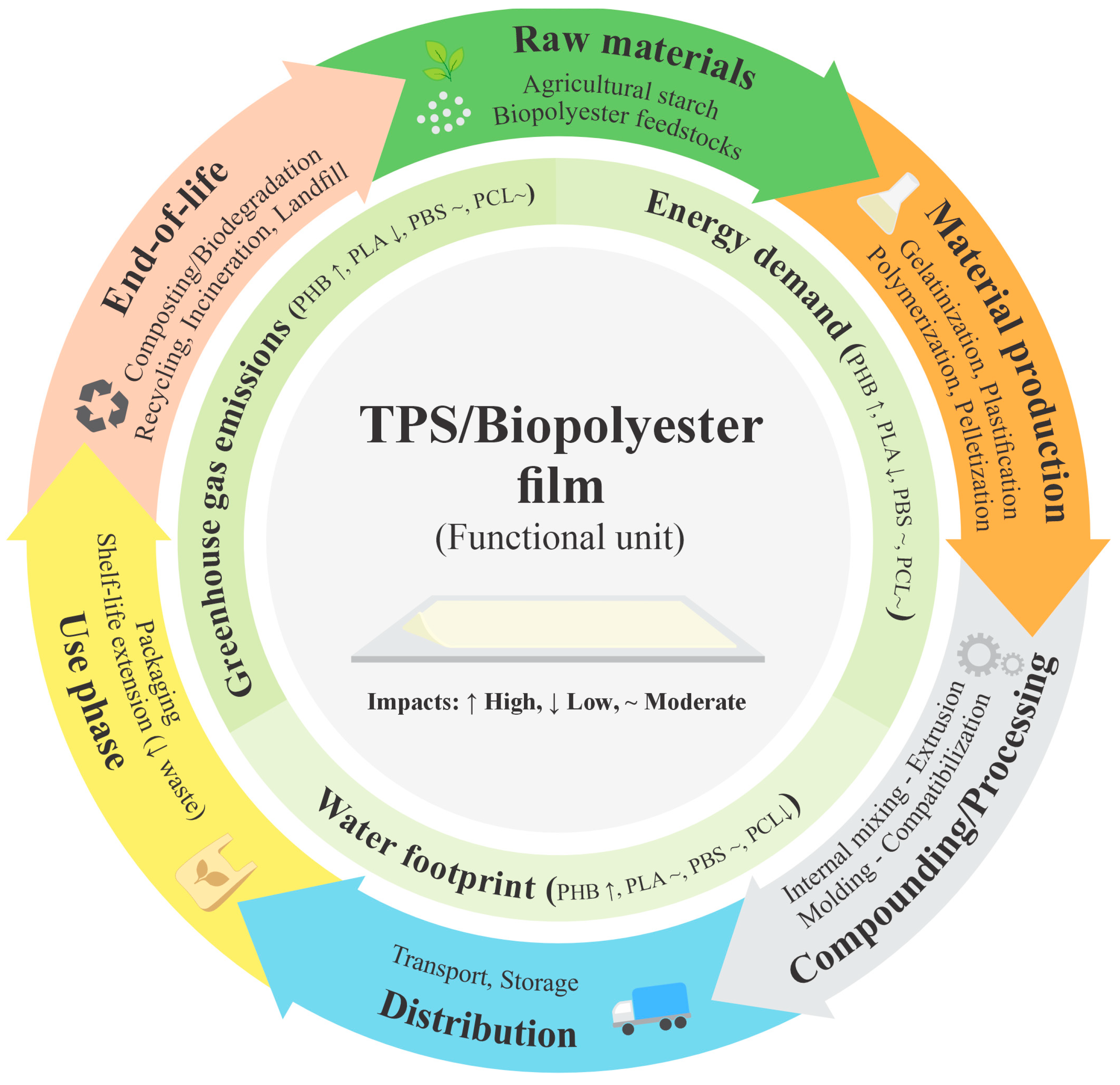
Life Cycle Assessment (LCA) Considerations for TPS/Polyester Blends
6. Conclusions
Author Contributions
Funding
Institutional Review Board Statement
Data Availability Statement
Acknowledgments
Conflicts of Interest
References
- Rosa, D.S.; Guedes, C.G.F.; Carvalho, C.L. Processing and Thermal, Mechanical and Morphological Characterization of Post-Consumer Polyolefins/Thermoplastic Starch Blends. J. Mater. Sci. 2007, 42, 551–557. [Google Scholar] [CrossRef] [Scilit]
- Horton, A.A. Plastic Pollution: When Do We Know Enough? J. Hazard. Mater. 2022, 422, 126885. [Google Scholar] [CrossRef] [Scilit]
- Wang, P.; Xiong, Z.Y.; Fei, P.; Cai, J.; Walayat, N.; Xiong, H. An Approach for Compatibilization of the Starch with Poly(Lactic Acid) and Ethylene-Vinyl Acetate-Glycidyl-Methacrylate. Int. J. Biol. Macromol. 2020, 161, 44–58. [Google Scholar] [CrossRef] [Scilit]
- Zhang, Y.; Rempel, C.; Liu, Q. Thermoplastic Starch Processing and Characteristics-A Review. Crit. Rev. Food Sci. Nutr. 2014, 54, 1353–1370. [Google Scholar] [CrossRef] [Scilit]
- Nafchi, A.M.; Moradpour, M.; Saeidi, M.; Alias, A.K. Thermoplastic Starches: Properties, Challenges, and Prospects. Starch-Starke 2013, 65, 61–72. [Google Scholar] [CrossRef] [Scilit]
- Rhodes, C.J. Plastic Pollution and Potential Solutions. Sci. Prog. 2018, 101, 207–260. [Google Scholar] [CrossRef] [Scilit]
- Tavanaie, M.A.; Ghahari, A.H. A Study on Melt Recycling of Bio-Based Polypropylene/Thermoplastic Starch Compound. J. Appl. Polym. Sci. 2021, 138, 51282. [Google Scholar] [CrossRef] [Scilit]
- Ghasemlou, M.; Barrow, C.J.; Adhikari, B. The Future of Bioplastics in Food Packaging: An Industrial Perspective. Food Packag. Shelf Life 2024, 43, 101279. [Google Scholar] [CrossRef] [Scilit]
- Landrigan, P.J.; Raps, H.; Cropper, M.; Bald, C.; Brunner, M.; Canonizado, E.M.; Charles, D.; Chiles, T.C.; Donohue, M.J.; Enck, J.; et al. The Minderoo-Monaco Commission on Plastics and Human Health. Ann. Glob. Health 2023, 89, 23. [Google Scholar] [CrossRef] [Scilit] [PubMed]
- Geppner, L.; Hellner, J.; Henjakovic, M. Effects of Micro- and Nanoplastics on Blood Cells in Vitro and Cardiovascular Parameters in Vivo, Considering Their Presence in the Human Bloodstream and Potential Impact on Blood Pressure. Environ. Res. 2025, 273, 121254. [Google Scholar] [CrossRef] [Scilit]
- Meng, W.; Sun, H.; Su, G. Plastic Packaging-Associated Chemicals and Their Hazards—An Overview of Reviews. Chemosphere 2023, 331, 138795. [Google Scholar] [CrossRef] [Scilit]
- Sheriff, S.S.; Yusuf, A.A.; Akiyode, O.O.; Hallie, E.F.; Odoma, S.; Yambasu, R.A.; Thompson-Williams, K.; Asumana, C.; Gono, S.Z.; Kamara, M.A. A Comprehensive Review on Exposure to Toxins and Health Risks from Plastic Waste: Challenges, Mitigation Measures, and Policy Interventions. Waste Manag. Bull. 2025, 3, 100204. [Google Scholar] [CrossRef] [Scilit]
- Carmona, V.B.; Corrêa, A.C.; Marconcini, J.M.; Mattoso, L.H.C. Properties of a Biodegradable Ternary Blend of Thermoplastic Starch (TPS), Poly(ε-Caprolactone) (PCL) and Poly(Lactic Acid) (PLA). J. Polym. Environ. 2015, 23, 83–89. [Google Scholar] [CrossRef] [Scilit]
- Obasi, H.C.; Igwe, I.O. Effects of Native Cassava Starch and Compatibilizer on Biodegradable and Tensile Properties of Polypropylene. Am. J. Eng. Res. 2014, 3, 96–104. [Google Scholar]
- Martinez Villadiego, K.; Arias Tapia, M.J.; Useche, J.; Escobar Macías, D. Thermoplastic Starch (TPS)/Polylactic Acid (PLA) Blending Methodologies: A Review. J. Polym. Environ. 2021, 30, 75–91. [Google Scholar] [CrossRef] [Scilit]
- Martinez Villadiego, K.; Arias Tapia, M.J.; Useche, J.; Ledesma, Y.; Leyton, A. Thermal and Morphological Characterization of Native and Plasticized Starches of Sweet Potato (Ipomoea batatas) and Diamante Yam (Dioscorea rotundata). J. Polym. Environ. 2020, 29, 871–880. [Google Scholar] [CrossRef] [Scilit]
- Bercini Martins, A.; Campomares Santana, R.M. Effect of Carboxylic Acids as Compatibilizer Agent on Mechanical Properties of Thermoplastic Starch and Polypropylene Blends. Carbohydr. Polym. 2016, 135, 79–85. [Google Scholar] [CrossRef] [Scilit] [PubMed]
- Shi, R.; Liu, Q.; Ding, T.; Han, Y.; Zhang, L.; Chen, D.; Tian, W. Ageing of Soft Thermoplastic Starch with High Glycerol Content. J. Appl. Polym. Sci. 2007, 103, 574–586. [Google Scholar] [CrossRef] [Scilit]
- Woźniak-Braszak, A.; Knitter, M.; Markiewicz, E.; Ingram, W.F.; Spontak, R.J. Effect of Composition on the Molecular Dynamics of Biodegradable Isotactic Polypropylene/Thermoplastic Starch Blends. ACS Sustain. Chem. Eng. 2019, 7, 16050–16059. [Google Scholar] [CrossRef] [Scilit]
- Jiugao, Y.; Ning, W.; Xiaofei, M. The Effects of Citric Acid on the Properties of Thermoplastic Starch Plasticized by Glycerol. Starch-Starke 2005, 57, 494–504. [Google Scholar] [CrossRef] [Scilit]
- Bercini Martins, A.; Capomares Santana, R.M. Structure-Properties Correlation in PP/Thermoplastic Starch Blends Containing Sustainable Compatibilizer Agent. Mater. Res. Express 2019, 6, 095336. [Google Scholar] [CrossRef] [Scilit]
- Obasi, H.C.; Igwe, I.O.; Ogbobe, O.; Madufor, I.C.; Egeolu, F.C. Analysis of the Mechanical and Degradation Performances of Selected Starch/Polypropylene Blends. J. Basic. Appl. Res. Int. 2015, 7, 42–52. [Google Scholar]
- Narváez-Gómez, G.; Figueroa-Flórez, J.; Salcedo-Mendoza, J.; Pérez-Cervera, C.; Andrade-Pizarro, R. Development and Characterization of Dual-Modified Yam (Dioscorea rotundata) Starch-Based Films. Heliyon 2021, 7, e06644. [Google Scholar] [CrossRef] [Scilit] [PubMed]
- Zhu, F. Isolation, Composition, Structure, Properties, Modifications, and Uses of Yam Starch. Compr. Rev. Food Sci. Food Saf. 2015, 14, 357–386. [Google Scholar] [CrossRef] [Scilit]
- Zhang, Y.-M.; Chen, M.; Sun, L.; Wang, Y.; Yin, J.; Liu, J.; Sun, X.-Q.; Hang, Y.-Y. Genome-Wide Identification and Evolutionary Analysis of NBS-LRR Genes From Dioscorea Rotundata. Front. Genet. 2020, 11, 484. [Google Scholar] [CrossRef] [Scilit]
- Taguet, A.; Huneault, M.A.; Favis, B.D. Interface/Morphology Relationships in Polymer Blends with Thermoplastic Starch. Polymer 2009, 50, 5733–5743. [Google Scholar] [CrossRef] [Scilit]
- Liu, Z.Q.; Yi, X.S.; Feng, Y. Effects of Glycerin and Glycerol Monostearate on Performance of Thermoplastic Starch. J. Mater. Sci. 2001, 36, 1809–1815. [Google Scholar] [CrossRef] [Scilit]
- Vithu, P.; Dash, S.K.; Rayaguru, K. Post-Harvest Processing and Utilization of Sweet Potato: A Review. Food Rev. Int. 2019, 35, 726–762. [Google Scholar] [CrossRef] [Scilit]
- Tesfaye, T.; Johakimu, J.K.; Chavan, R.B.; Sithole, B.; Ramjugernath, D. Valorisation of Mango Seed via Extraction of Starch: Preliminary Techno-Economic Analysis. Clean. Technol. Environ. Policy 2017, 20, 81–94. [Google Scholar] [CrossRef] [Scilit]
- Robyt, J.F. Starch: Structure, Properties, Chemistry, and Enzymology. In Glycoscience; Fraser-Reid, B., Tatsuta, K., Thiem, J., Eds.; Springer: Berlin, Heidelberg, 2008; pp. 1437–1472. ISBN 978-3-540-30429-6. [Google Scholar]
- Nguyen, T.K.; That, N.T.T.; Nguyen, N.T.; Nguyen, H.T. Development of Starch-Based Bioplastic from Jackfruit Seed. Adv. Polym. Technol. 2022, 2022, 6547461. [Google Scholar] [CrossRef] [Scilit]
- Ruhul Amin, M.; Anannya, F.R.; Mahmud, M.A.; Raian, S. Esterification of Starch in Search of a Biodegradable Thermoplastic Material. J. Polym. Res. 2020, 27, 3. [Google Scholar] [CrossRef] [Scilit]
- He, H.-J.; Li, G.; Obadi, M.; Ou, X. An Overview on the Dry Heat Treatment (DHT) for Starch Modification: Current Progress and Prospective Applications. Curr. Res. Food Sci. 2025, 10, 101007. [Google Scholar] [CrossRef] [Scilit]
- Gerezgiher, A.G.; Szabó, T. Crosslinking of Starch Using Citric Acid. J. Phys. Conf. Ser. 2022, 2315, 012036. [Google Scholar] [CrossRef] [Scilit]
- Garrido-Miranda, K.A.; Rivas, B.L.; Pérez -Rivera, M.A.; Sanfuentes, E.A.; Peña-Farfal, C. Antioxidant and Antifungal Effects of Eugenol Incorporated in Bionanocomposites of Poly(3-Hydroxybutyrate)-Thermoplastic Starch. LWT 2018, 98, 260–267. [Google Scholar] [CrossRef] [Scilit]
- Prambauer, M.; Wendeler, C.; Weitzenböck, J.; Burgstaller, C. Biodegradable Geotextiles—An Overview of Existing and Potential Materials. Geotext. Geomembr. 2019, 47, 48–59. [Google Scholar] [CrossRef] [Scilit]
- Olkhov, A.A.; Kucherenko, E.L.; Zernova, Y.N.; Markin, V.S.; Kosenko, R.Y.; Filatova, A.G.; Vetcher, A.A.; Iordanskii, A.L. Production Methods and Biomedical Applications of Materials Based on Poly-3-Hydroxybutyrate and Its Compositions. Inorg. Mater. Appl. Res. 2024, 15, 1064–1076. [Google Scholar] [CrossRef] [Scilit]
- Gupta, S.; Nadda, A.K.; Gupta, A.; Singh, J.; Mulla, S.I.; Sharma, S. Transforming Wastes into High Value-Added Products: An Introduction. In Biopolymers: Recent Updates, Challenges and Opportunities; Nadda, A.K., Sharma, S., Bhat, R., Eds.; Springer International Publishing: Cham, Switzerland, 2022; pp. 1–18. ISBN 978-3-030-98392-5. [Google Scholar]
- Vinayak, A.; Sharma, S.; Singh, G.B. Biopolymers from Industrial Waste. In Biopolymers: Recent Updates, Challenges and Opportunities; Nadda, A.K., Sharma, S., Bhat, R., Eds.; Springer International Publishing: Cham, Switzerland, 2022; pp. 129–149. ISBN 978-3-030-98392-5. [Google Scholar]
- Kumawat, T.K.; Kumawat, V.; Sharma, S.; Sharma, V.; Pandit, A.; Kandwani, N.; Biyani, M. Sustainable Green Methods for the Extraction of Biopolymers; Springer International Publishing: Cham, Switzerland, 2022; pp. 73–110. [Google Scholar] [CrossRef] [Scilit]
- Umesh, M.; Sankar, S.A.; Thazeem, B. Fruit Waste as Sustainable Resources for Polyhydroxyalkanoate (PHA) Production. In Bioplastics for Sustainable Development; Kuddus, M., Roohi, Eds.; Springer: Singapore, 2021; pp. 205–229. ISBN 978-981-16-1823-9. [Google Scholar]
- Swetha, T.A.; Bora, A.; Mohanrasu, K.; Balaji, P.; Raja, R.; Ponnuchamy, K.; Muthusamy, G.; Arun, A. A Comprehensive Review on Polylactic Acid (PLA)—Synthesis, Processing and Application in Food Packaging. Int. J. Biol. Macromol. 2023, 234, 123715. [Google Scholar] [CrossRef] [Scilit] [PubMed]
- Rahimkhoei, V.; Padervand, M.; Hedayat, M.; Seidi, F.; Dawi, E.A.; Akbari, A. Biomedical Applications of Electrospun Polycaprolactone-Based Carbohydrate Polymers: A Review. Int. J. Biol. Macromol. 2023, 253, 126642. [Google Scholar] [CrossRef] [Scilit]
- Ju, J.; Deng, Y.; Li, C.J.; Li, M. Antibacterial Activity of Essential Oil in Food System. In Essential Oils; Springer International Publishing: Cham, Switzerland, 2022; pp. 23–41. [Google Scholar]
- do Nascimento, L.D.; da Costa, K.S.; Cascaes, M.M.; de Aguiar Andrade, E.H. Encapsulation of Essential Oils by Spray-Drying: Antimicrobial Activity, and Applications in Food Preservation. In Essential Oils; Springer International Publishing: Cham, Switzerland, 2022; pp. 101–121. [Google Scholar]
- Rech, C.R.; Brabes, K.C.S.; Silva, B.E.B.; Martines, M.A.U.; Silveira, T.F.S.; Alberton, J.; Amadeu, C.A.A.; Caon, T.; Arruda, E.J.; Martelli, S.M. Antimicrobial and Physical–Mechanical Properties of Polyhydroxybutyrate Edible Films Containing Essential Oil Mixtures. J. Polym. Environ. 2021, 29, 1202–1211. [Google Scholar] [CrossRef] [Scilit]
- Rocha-Guzmán, N.E.; Gallegos-Infante, J.A.; González-Laredo, R.F.; Ramos-Gómez, M.; Rodríguez-Muñoz, M.E.; Reynoso-Camacho, R.; Rocha-Uribe, A.; Roque-Rosales, M.R. Antioxidant Effect of Oregano (Lippia berlandieri v. Shauer) Essential Oil and Mother Liquors. Food Chem. 2007, 102, 330–335. [Google Scholar] [CrossRef] [Scilit]
- Zhang, Y.; Rempel, C.; McLaren, D. Thermoplastic Starch. In Innovations in Food Packaging: Second Edition; Academic Press: Cambridge, MA, USA, 2014; pp. 391–412. ISBN 9780123946010. [Google Scholar]
- Somwanshi, S.B.; Dolas, R.T.; Wagh, V.D.; Kotade, K.B. Pharmaceutically Used Plasticizers: A Review. Eur. J. Biomed. Pharm. Sci. 2016, 3, 277–285. [Google Scholar]
- Kaseem, M.; Hamad, K.; Deri, F. Rheological and Mechanical Properties of Polypropylene/Thermoplastic Starch Blend. Polym. Bull. 2011, 68, 1079–1091. [Google Scholar] [CrossRef] [Scilit]
- Kaseem, M.; Hamad, K.; Deri, F. Thermoplastic Starch Blends: A Review of Recent Works. Polym. Sci. Ser. A 2012, 54, 165–176. [Google Scholar] [CrossRef] [Scilit]
- Byun, Y.; Zhang, Y.; Geng, X. Plasticization and Polymer Morphology. In Innovations in Food Packaging: Second Edition; Elsevier Ltd.: Amsterdam, The Netherlands, 2013; pp. 87–108. ISBN 9780123946010. [Google Scholar]
- Kaur, L.; Singh, J.; Singh, N. Effect of Glycerol Monostearate on the Physico-Chemical, Thermal, Rheological and Noodle Making Properties of Corn and Potato Starches. Food Hydrocoll. 2005, 5, 839–849. [Google Scholar] [CrossRef] [Scilit]
- Schmitt, H.; Guidez, A.; Prashantha, K.; Soulestin, J.; Lacrampe, M.F.; Krawczak, P. Studies on the Effect of Storage Time and Plasticizers on the Structural Variations in Thermoplastic Starch. Carbohydr. Polym. 2015, 115, 364–372. [Google Scholar] [CrossRef] [Scilit]
- Stepto, R.F.T. Understanding the Processing of Thermoplastic Starch. Macromol. Symp. 2006, 245–246, 571–577. [Google Scholar] [CrossRef] [Scilit]
- Surendren, A.; Mohanty, A.K.; Liu, Q.; Misra, M. A Review of Biodegradable Thermoplastic Starches, Their Blends and Composites: Recent Developments and Opportunities for Single-Use Plastic Packaging Alternatives. Green Chem. 2022, 24, 8606–8636. [Google Scholar] [CrossRef] [Scilit]
- Kumar, D.P.; Nair, A.S.; Balakrishnan, P.; Gopi, S. Biopolymers from Renewable Sources. In Handbook of Biopolymers; Springer Nature: Singapore, 2023; pp. 27–56. [Google Scholar]
- Khosravi-Darani, K.; Bucci, D.Z.; Massoud, R. Microbial-Derived Biodegradable Polymers as Food Packaging Tool. In Biodegradable Polymer-Based Food Packaging; Springer Nature: Singapore, 2022; pp. 81–114. [Google Scholar]
- Stoica, M. Biodegradable Nanomaterials for Drink Packaging. In Nanotechnology in the Beverage Industry; Elsevier: Amsterdam, The Netherlands, 2020; pp. 609–632. [Google Scholar]
- Khosravi-Darani, K.; Yazdian, F. Polyhydroxyalkanoates (PHAs) in Food Packaging. In Biodegradable Polymer-Based Food Packaging; Springer Nature: Singapore, 2022; pp. 115–122. [Google Scholar]
- Sindhu, R.; Binod, P.; Pandey, A. Microbial Poly-3-Hydroxybutyrate and Related Copolymers. In Industrial Biorefineries & White Biotechnology; Elsevier: Amsterdam, The Netherlands, 2015; pp. 575–605. [Google Scholar]
- Gupta, S.; Ghosal, A.; Goswami, A.; Kumar Nadda, A.; Sharma, S.; Gupta, S.; Goswami, A.; Sharma, S.; Ghosal, A.; Nadda, A.K. The Scope of Biopolymers in Food Industry; Springer International Publishing: Cham, Switzerland, 2022; pp. 173–198. [Google Scholar] [CrossRef] [Scilit]
- Anjana; Raturi, G.; Shree, S.; Sharma, A.; Panesar, P.S.; Goswami, S. Recent Approaches for Enhanced Production of Microbial Polyhydroxybutyrate: Preparation of Biocomposites and Applications. Int. J. Biol. Macromol. 2021, 182, 1650–1669. [Google Scholar] [CrossRef] [Scilit]
- Ma, Y.; Li, L.; Wang, Y. Development of PLA-PHB-based Biodegradable Active Packaging and Its Application to Salmon. Packag. Technol. Sci. 2018, 31, 739–746. [Google Scholar] [CrossRef] [Scilit]
- Crupano, W.; Adrover-Monserrat, B.; Llumà, J.; Jerez-Mesa, R.; Travieso-Rodriguez, J.A. Investigating Mechanical Properties of 3D Printed Polylactic Acid/Poly-3-Hydroxybutyrate Composites. Compressive and Fatigue Performance. Heliyon 2024, 10, e38066. [Google Scholar] [CrossRef] [Scilit]
- Pirsa, S.; Sani, I.K.; Mirtalebi, S.S. Nano-Biocomposite Based Color Sensors: Investigation of Structure, Function, and Applications in Intelligent Food Packaging. Food Packag. Shelf Life 2022, 31, 100789. [Google Scholar] [CrossRef] [Scilit]
- Clarkson, C.M.; El Awad Azrak, S.M.; Schueneman, G.T.; Snyder, J.F.; Youngblood, J.P. Crystallization Kinetics and Morphology of Small Concentrations of Cellulose Nanofibrils (CNFs) and Cellulose Nanocrystals (CNCs) Melt-Compounded into Poly(Lactic Acid) (PLA) with Plasticizer. Polymer 2020, 187, 122101. [Google Scholar] [CrossRef] [Scilit]
- Moreno-Bohorquez, E.; Arias-Tapia, M.J.; Martínez-Villadiego, K.; Rhenals-Julio, J.D.; Jaramillo, A.F. Effect of Starch Variety and Environmental Conditions on the Aerobic Biodegradation of Citric Acid-Compatibilized Thermoplastic Starch/Polylactic Acid Blends. Polymers 2025, 17, 1295. [Google Scholar] [CrossRef] [Scilit]
- Aliotta, L.; Seggiani, M.; Lazzeri, A.; Gigante, V.; Cinelli, P. A Brief Review of Poly (Butylene Succinate) (PBS) and Its Main Copolymers: Synthesis, Blends, Composites, Biodegradability, and Applications. Polymers 2022, 14, 844. [Google Scholar] [CrossRef] [Scilit]
- Choudhury, M.R.; Debnath, K. Green Composites: Introductory Overview; Springer International Publishing: Cham, Switzerland, 2021; pp. 1–20. [Google Scholar]
- Klapiszewski, Ł.; Grząbka-Zasadzińska, A.; Borysiak, S.; Jesionowski, T. Preparation and Characterization of Polypropylene Composites Reinforced by Functional ZnO/Lignin Hybrid Materials. Polym. Test. 2019, 79, 106058. [Google Scholar] [CrossRef] [Scilit]
- Barletta, M.; Genovesi, A.; Desole, M.P.; Gisario, A. Melt Processing of Biodegradable Poly(Butylene Succinate) (PBS)—A Critical Review. Clean. Technol. Environ. Policy 2025, 27, 683–725. [Google Scholar] [CrossRef] [Scilit]
- Safari, M.; Pérez-Camargo, R.A.; Ballester-Bayarri, L.; Liu, G.; Mugica, A.; Zubitur, M.; Wang, D.; Müller, A.J. Biodegradable Binary Blends of Poly (Butylene Succinate) or Poly (ε-Caprolactone) with Poly (Butylene Succinate-Ran-ε-Caprolactone)Copolymers: Crystallization Behavior. Polymer 2022, 256, 125206. [Google Scholar] [CrossRef] [Scilit]
- Samir, A.; Ashour, F.H.; Hakim, A.A.A.; Bassyouni, M. Recent Advances in Biodegradable Polymers for Sustainable Applications. Npj Mater. Degrad. 2022, 6, 68. [Google Scholar] [CrossRef] [Scilit]
- Hammache, Y.; Serier, A.; Chaoui, S. The Effect of Thermoplastic Starch on the Properties of Polypropylene/High Density Polyethylene Blend Reinforced by Nano-Clay. Mater. Res. Express 2020, 7, 025308. [Google Scholar] [CrossRef] [Scilit]
- Lee, Y.-M.; Kim, K.-W.; Yang, J.-Y.; Kim, B.-J. Enhanced Crystallization of Sustainable Polylactic Acid Composites Incorporating Recycled Industrial Cement. Polymers 2024, 16, 1666. [Google Scholar] [CrossRef] [Scilit]
- Zhao, X.; Yu, J.; Liang, X.; Huang, Z.; Li, J.; Peng, S. Crystallization Behaviors Regulations and Mechanical Performances Enhancement Approaches of Polylactic Acid (PLA) Biodegradable Materials Modified by Organic Nucleating Agents. Int. J. Biol. Macromol. 2023, 233, 123581. [Google Scholar] [CrossRef] [Scilit]
- Wu, Y.; Gao, X.; Wu, J.; Zhou, T.; Nguyen, T.T.; Wang, Y. Biodegradable Polylactic Acid and Its Composites: Characteristics, Processing, and Sustainable Applications in Sports. Polymers 2023, 15, 3096. [Google Scholar] [CrossRef] [Scilit] [PubMed]
- Garcia-Garcia, D.; Quiles-Carrillo, L.; Balart, R.; Torres-Giner, S.; Arrieta, M.P. Innovative Solutions and Challenges to Increase the Use of Poly(3-Hydroxybutyrate) in Food Packaging and Disposables. Eur. Polym. J. 2022, 178, 111505. [Google Scholar] [CrossRef] [Scilit]
- Amrutha, S.R.; Rejimon, P.K.; Suja, N.R.; Mart, A. Thermal Properties of Biopolymers. In Handbook of Biopolymers; Springer Nature: Singapore, 2023; pp. 1–28. [Google Scholar]
- Ribba, L.; Lorenzo, M.C.; Tupa, M.; Melaj, M.; Eisenberg, P.; Goyanes, S. Processing and Properties of Starch-Based Thermoplastic Matrix for Green Composites; Springer Nature: Singapore, 2021; pp. 63–133. [Google Scholar]
- Sakurai, T.; Nagakura, H.; Gondo, S.; Nojima, S. Crystallization of Poly(ɛ-Caprolactone) Blocks Confined in Crystallized Lamellar Morphology of Poly(ɛ-Caprolactone)-Block-Polyethylene Copolymers: Effects of Polyethylene Crystallinity and Confinement Size. Polym. J. 2013, 45, 436–443. [Google Scholar] [CrossRef] [Scilit]
- Briassoulis, D.; Tserotas, P.; Athanasoulia, I.-G. Alternative Optimization Routes for Improving the Performance of Poly(3-Hydroxybutyrate) (PHB) Based Plastics. J. Clean. Prod. 2021, 318, 128555. [Google Scholar] [CrossRef] [Scilit]
- Kato, S.; Ueda, T.; Aoshima, T.; Kosaka, N.; Nitta, S. BioPBSTM (Polybutylene Succinate); Springer: Cham, Switzerland, 2023; pp. 269–304. [Google Scholar]
- Labet, M.; Thielemans, W. Synthesis of Polycaprolactone: A Review. Chem. Soc. Rev. 2009, 38, 3484. [Google Scholar] [CrossRef] [Scilit]
- Greene, J.P. Microstructures of Polymers. In Automotive Plastics and Composites; Elsevier: Amsterdam, The Netherlands, 2021; pp. 27–37. [Google Scholar]
- Yi, X.; Tong, J.; Zhang, X.; Zhu, J.; Liu, X.; Xian, G.; Li, Y.; Ding, F.; Rudd, C.; Liu, X.; et al. Biopolymers and Biocomposites. In Revolutionizing Aircraft Materials and Processes; Springer International Publishing: Cham, Switzerland, 2020; pp. 231–275. [Google Scholar]
- Freeland, B.; McCarthy, E.; Balakrishnan, R.; Fahy, S.; Boland, A.; Rochfort, K.D.; Dabros, M.; Marti, R.; Kelleher, S.M.; Gaughran, J. A Review of Polylactic Acid as a Replacement Material for Single-Use Laboratory Components. Materials 2022, 15, 2989. [Google Scholar] [CrossRef] [Scilit]
- Nath, D.; Misra, M.; Al-Daoud, F.; Mohanty, A.K. Studies on Poly(Butylene Succinate) and Poly(Butylene Succinate-Co-Adipate)-Based Biodegradable Plastics for Sustainable Flexible Packaging and Agricultural Applications: A Comprehensive Review. RSC Sustain. 2025, 3, 1267–1302. [Google Scholar] [CrossRef] [Scilit]
- Bhadran, A.; Shah, T.; Babanyinah, G.K.; Polara, H.; Taslimy, S.; Biewer, M.C.; Stefan, M.C. Recent Advances in Polycaprolactones for Anticancer Drug Delivery. Pharmaceutics 2023, 15, 1977. [Google Scholar] [CrossRef] [Scilit]
- Folino, A.; Karageorgiou, A.; Calabrò, P.S.; Komilis, D. Biodegradation of Wasted Bioplastics in Natural and Industrial Environments: A Review. Sustainability 2020, 12, 6030. [Google Scholar] [CrossRef] [Scilit]
- Lai, S.-M.; Don, T.-M.; Huang, Y.-C. Preparation and Properties of Biodegradable Thermoplastic Starch/Poly(Hydroxy Butyrate) Blends. J. Appl. Polym. Sci. 2006, 100, 2371–2379. [Google Scholar] [CrossRef] [Scilit]
- George, N.; Venugopal, B. Gas Barrier Properties of Biopolymers. In Handbook of Biopolymers; Springer Nature: Singapore, 2023; pp. 297–321. [Google Scholar]
- Paul, V.; Tripathi, A.D.; Maurya, K.K.; Pankaj; Dinesh; Rai, C. Introduction: Scope and Importance of Biodegradable Polymers. In Biodegradable Polymer-Based Food Packaging; Springer Nature: Singapore, 2022; pp. 1–11. [Google Scholar]
- McKeen, L.W. Renewable Resource, Sustainable and Biodegradable Polymers. In The Effect of UV Light and Weather on Plastics and Elastomers; Elsevier: Amsterdam, The Netherlands, 2019; pp. 425–438. [Google Scholar]
- Cecchi, T. Assessment of the Safety of BioBased Products. In Biobased Products from Food Sector Waste; Springer International Publishing: Cham, Switzerland, 2021; pp. 343–363. [Google Scholar]
- Cherian, R.M.; Kargarzadeh, H.; Rosli, N.A.; Jose, C.; Thomas, S. Tuning the Hydrophilic/Hydrophobic Behavior of Biopolymers. In Handbook of Biopolymers; Springer Nature: Singapore, 2023; pp. 367–401. [Google Scholar]
- Nagaraju, D.H.; Budagumpi, S.; Yhobu, Z. Biopolymer-Based Composites. In Handbook of Biopolymers; Springer Nature: Singapore, 2023; pp. 491–522. [Google Scholar]
- Darie-Niță, R.; Râpă, M.; Sivertsvik, M.; Rosnes, J.; Popa, E.; Dumitriu, R.; Marincaș, O.; Matei, E.; Predescu, C.; Vasile, C. PLA-Based Materials Containing Bio-Plasticizers and Chitosan Modified with Rosehip Seed Oil for Ecological Packaging. Polymers 2021, 13, 1610. [Google Scholar] [CrossRef] [Scilit]
- Meng, Z.; He, J.; Cai, Z.; Wang, F.; Zhang, J.; Wang, L.; Ling, R.; Li, D. Design and Additive Manufacturing of Flexible Polycaprolactone Scaffolds with Highly-Tunable Mechanical Properties for Soft Tissue Engineering. Mater. Des. 2020, 189, 108508. [Google Scholar] [CrossRef] [Scilit]
- Oliveira, C.F.d.P.; Fidalgo, N.N.; Valera, T.S.; Demarquette, N.R. Blends Polypropylene/Starch Thermoplastic; Associação Brasileira de Polímeros: São Carlos, Brazil, 2014. [Google Scholar]
- Pérez, M.A.; Rivas, B.L.Q.; Rodríguez-Llamazares, S. Polypropylene/Starch Blends: Study of Thermal and Morphological Properties. J. Chil. Chem. Soc. 2013, 58, 1643–1646. [Google Scholar] [CrossRef] [Scilit]
- Noivoil, N.; Yoksan, R. Oligo(Lactic Acid)-Grafted Starch: A Compatibilizer for Poly(Lactic Acid)/Thermoplastic Starch Blend. Int. J. Biol. Macromol. 2020, 160, 506–517. [Google Scholar] [CrossRef] [Scilit] [PubMed]
- Ibrahim, N.; Wahab, M.K.A.; Uylan, D.N.; Ismail, H. Physical and Degradation Properties of Polylactic Acid and Thermoplastic Starch Blends—Effect of Citric Acid Treatment on Starch Structures. Bioresources 2017, 12, 3076–3087. [Google Scholar] [CrossRef] [Scilit]
- Al-Mulla, A.; Alfadhel, K.; Qambar, G.; Shaban, H. Rheological Study of Recycled Polypropylene–Starch Blends. Polym. Bull. 2013, 70, 2599–2618. [Google Scholar] [CrossRef] [Scilit]
- Muniyasamy, S.; Ofosu, O.; John, M.J.; Anandjiwala, R.D. Mineralization of Poly(Lactic Acid) (PLA), Poly(3-Hydroxybutyrate-Co-Valerate) (PHBV) and PLA/PHBV Blend in Compost and Soil Environments. J. Renew. Mater. 2016, 4, 133–145. [Google Scholar] [CrossRef] [Scilit]
- Maiti, S.; Ray, D.; Mitra, D. Role of Crosslinker on the Biodegradation Behavior of Starch/Polyvinylalcohol Blend Films. J. Polym. Environ. 2012, 20, 749–759. [Google Scholar] [CrossRef] [Scilit]
- Wang, Y.; Zhong, Y.; Shi, Q.; Guo, S. Study of the Preparation and Properties of TPS/PBSA/PLA Biodegradable Composites. J. Compos. Sci. 2021, 5, 48. [Google Scholar] [CrossRef] [Scilit]
- Liu, S.; Tang, S.; Lu, Y.; Su, T.; Wang, Z. Preparation of Esterified Starches with Different Amylose Content and Their Blending with Polybutylene Succinate. Int. J. Mol. Sci. 2024, 25, 6301. [Google Scholar] [CrossRef] [Scilit]
- Martínez-Villadiego, K.; Arias-Tapia, M.J.; Jaramillo, A.F. Improving Thermal Stability of Starches Native Cross-Linked with Citric Acid as a Compatibilizer for Thermoplastic Starch/Polylactic Acid Blends. Polym. Bull. 2024, 81, 13253–13274. [Google Scholar] [CrossRef] [Scilit]
- Garrido-Miranda, K.A.; Rivas, B.L.; Pérez-Rivera, M.; Fernández-Blázquez, J.P.; Monclús, M.; Peña-Farfal, C. Mechanical and morphological properties of poly(3-hydroxybutyrate)-thermoplastic starch/clay/eugenol bionanocomposites. J. Chil. Chem. Soc. 2020, 65, 4992–4997. [Google Scholar] [CrossRef] [Scilit]
- Thiré, R.M.S.M.; Ribeiro, T.A.A.; Andrade, C.T. Effect of Starch Addition on Compression-molded Poly(3-hydroxybutyrate)/Starch Blends. J. Appl. Polym. Sci. 2006, 100, 4338–4347. [Google Scholar] [CrossRef] [Scilit]
- Katanyoota, P.; Jariyasakoolroj, P.; Sane, A. Property Enhancement of Polylactic Acid/Thermoplastic Starch Blend Using Zeolite 5A Incorporation and Biaxial Stretching Process. Agric. Nat. Resour. 2023, 57, 191–200. [Google Scholar] [CrossRef] [Scilit]
- Huneault, M.A.; Li, H. Morphology and Properties of Compatibilized Polylactide/Thermoplastic Starch Blends. Polymer 2007, 48, 270–280. [Google Scholar] [CrossRef] [Scilit]
- Akrami, M.; Ghasemi, I.; Azizi, H.; Karrabi, M.; Seyedabadi, M. A New Approach in Compatibilization of the Poly(Lactic Acid)/Thermoplastic Starch (PLA/TPS) Blends. Carbohydr. Polym. 2016, 144, 254–262. [Google Scholar] [CrossRef] [Scilit]
- Vanovčanová, Z.; Alexy, P.; Feranc, J.; Plavec, R.; Bočkaj, J.; Kaliňáková, L.; Tomanová, K.; Perďochová, D.; Šariský, D.; Gálisová, I. Effect of PHB on the Properties of Biodegradable PLA Blends. Chem. Pap. 2016, 70, 1408–1415. [Google Scholar] [CrossRef] [Scilit]
- Li, J.; Luo, X.; Lin, X.; Zhou, Y. Comparative Study on the Blends of PBS/Thermoplastic Starch Prepared from Waxy and Normal Corn Starches. Starch-Starke 2013, 65, 831–839. [Google Scholar] [CrossRef] [Scilit]
- Mina Hernandez, J.H. Effect of the Incorporation of Polycaprolactone (PCL) on the Retrogradation of Binary Blends with Cassava Thermoplastic Starch (TPS). Polymers 2020, 13, 38. [Google Scholar] [CrossRef] [Scilit]
- Estrada-Monje, A.; Alonso-Romero, S.; Zitzumbo-Guzmán, R.; Estrada-Moreno, I.A.; Zaragoza-Contreras, E.A. Thermoplastic Starch-Based Blends with Improved Thermal and Thermomechanical Properties. Polymers 2021, 13, 4263. [Google Scholar] [CrossRef] [Scilit]
- Guigo, N.; Sbirrazzuoli, N. Thermal Analysis of Biobased Polymers and Composites; Elsevier: Amsterdam, The Netherlands, 2018; pp. 399–429. [Google Scholar]
- Narancic, T.; Verstichel, S.; Reddy Chaganti, S.; Morales-Gamez, L.; Kenny, S.T.; De Wilde, B.; Babu Padamati, R.; O’Connor, K.E. Biodegradable Plastic Blends Create New Possibilities for End-of-Life Management of Plastics but They Are Not a Panacea for Plastic Pollution. Environ. Sci. Technol. 2018, 52, 10441–10452. [Google Scholar] [CrossRef] [Scilit]
- Barron, A.; Sparks, T.D. Commercial Marine-Degradable Polymers for Flexible Packaging. iScience 2020, 23, 101353. [Google Scholar] [CrossRef] [Scilit]
- Goyal, C.; Rai, S.; Tripathi, A.D.; Rai, D.C. Microbial Biopolymers and Enzymes Involved in the Biosynthesis of PHAs. In Biodegradable Polymer-Based Food Packaging; Springer Nature: Singapore, 2022; pp. 155–178. [Google Scholar]
- Don, T.-M.; Chung, C.-Y.; Lai, S.-M.; Chiu, H.-J. Preparation and Properties of Blends from Poly(3-Hydroxybutyrate) with Poly(Vinyl Acetate)-Modified Starch. Polym. Eng. Sci. 2010, 50, 709–718. [Google Scholar] [CrossRef] [Scilit]
- Yamaguchi, A.; Arai, S.; Arai, N. Design Strategy for Blends of Biodegradable Polyester and Thermoplastic Starch Based on a Molecular Dynamics Study of the Phase-Separated Interface. Carbohydr. Polym. 2024, 333, 122005. [Google Scholar] [CrossRef] [Scilit] [PubMed]
- Ramachandran, A.A.; Reghunadhan, A.; Maria, H.J.; Thomas, S. Role of Functional Polymers in the Compatibilization of Polymer Blends. In Reactive and Functional Polymers Volume Two; Springer International Publishing: Cham, Switzerland, 2020; pp. 5–21. [Google Scholar]
- Liao, H.-T.; Wu, C.-S. Performance of an Acrylic-Acid-Grafted Poly(3-Hydroxybutyric Acid)/Starch Bio-Blend: Characterization and Physical Properties. Des. Monomers Polym. 2007, 10, 1–18. [Google Scholar] [CrossRef] [Scilit]
- Florez, J.P.; Fazeli, M.; Simão, R.A. Preparation and Characterization of Thermoplastic Starch Composite Reinforced by Plasma-Treated Poly (Hydroxybutyrate) PHB. Int. J. Biol. Macromol. 2019, 123, 609–621. [Google Scholar] [CrossRef] [Scilit]
- Trinh, B.M.; Tadele, D.T.; Mekonnen, T.H. Robust and High Barrier Thermoplastic Starch—PLA Blend Films Using Starch-Graft-Poly(Lactic Acid) as a Compatibilizer. Mater. Adv. 2022, 3, 6208–6221. [Google Scholar] [CrossRef] [Scilit]
- Jozinović, A.; Kovač, M.; Ocelić Bulatović, V.; Kučić Grgić, D.; Miloloža, M.; Šubarić, D.; Ačkar, Đ. Biopolymeric Blends of Thermoplastic Starch and Polylactide as Sustainable Packaging Materials. Polymers 2024, 16, 1268. [Google Scholar] [CrossRef] [Scilit] [PubMed]
- Collazo-Bigliardi, S.; Ortega-Toro, R.; Chiralt, A. Using Grafted Poly(ε-Caprolactone) for the Compatibilization of Thermoplastic Starch-Polylactic Acid Blends. React. Funct. Polym. 2019, 142, 25–35. [Google Scholar] [CrossRef] [Scilit]
- Zeng, J.-B.; Jiao, L.; Li, Y.-D.; Srinivasan, M.; Li, T.; Wang, Y.-Z. Bio-Based Blends of Starch and Poly(Butylene Succinate) with Improved Miscibility, Mechanical Properties, and Reduced Water Absorption. Carbohydr. Polym. 2011, 83, 762–768. [Google Scholar] [CrossRef] [Scilit]
- Beluci, N.d.C.L.; Santos, J.d.; de Carvalho, F.A.; Yamashita, F. Reactive Biodegradable Extruded Blends of Thermoplastic Starch and Polyesters. Carbohydr. Polym. Technol. Appl. 2023, 5, 100274. [Google Scholar] [CrossRef] [Scilit]
- Duc, V.M.; Giang, N.C. Morphology and Properties of Polybutylene Succinic and Cassava Starch Blend: Effect of Esterification Catalysts on Graft Copolymer Formation. Vietnam. J. Chem. 2021, 59, 90–97. [Google Scholar] [CrossRef] [Scilit]
- Thajai, N.; Rachtanapun, P.; Thanakkasaranee, S.; Punyodom, W.; Worajittiphon, P.; Phimolsiripol, Y.; Leksawasdi, N.; Ross, S.; Jantrawut, P.; Jantanasakulwong, K. Reactive Blending of Modified Thermoplastic Starch Chlorhexidine Gluconate and Poly(Butylene Succinate) Blending with Epoxy Compatibilizer. Polymers 2023, 15, 3487. [Google Scholar] [CrossRef] [Scilit]
- Menossi, M.; Salcedo, F.; Rivilli, N.; Nicolini, A.T.; Alvarez, V.A.; Ludueña, L.N. Biodegradable Mulch Films Based on Starch/Poly (Lactic Acid)/Poly (ε-Caprolactone) Ternary Blends. J. Polym. Environ. 2023, 31, 2114–2137. [Google Scholar] [CrossRef] [Scilit]
- Li, M.-N.; Xie, Y.; Chen, H.-Q.; Zhang, B. Effects of Heat-Moisture Treatment after Citric Acid Esterification on Structural Properties and Digestibility of Wheat Starch, A- and B-Type Starch Granules. Food Chem. 2019, 272, 523–529. [Google Scholar] [CrossRef] [Scilit]
- Miskeen, S.; Hong, J.S.; Choi, H.-D.; Kim, J.-Y. Fabrication of Citric Acid-Modified Starch Nanoparticles to Improve Their Thermal Stability and Hydrophobicity. Carbohydr. Polym. 2021, 253, 117242. [Google Scholar] [CrossRef] [Scilit] [PubMed]
- Yang, J.; Ching, Y.C.; Chuah, C.H.; Nguyen, D.H.; Liou, N.-S. Synthesis and Characterization of Starch/Fiber-Based Bioplastic Composites Modified by Citric Acid-Epoxidized Palm Oil Oligomer with Reactive Blending. Ind. Crops Prod. 2021, 170, 113797. [Google Scholar] [CrossRef] [Scilit]
- Lv, X.; Guo, C.; Ma, Y.; Liu, B. Effect of Citric Acid Esterification on the Structure and Physicochemical Properties of Tigernut Starch. Int. J. Biol. Macromol. 2022, 222, 2833–2842. [Google Scholar] [CrossRef] [Scilit]
- Itkor, P.; Singh, A.K.; Lee, M.; Boonsiriwit, A.; Lee, Y.S. Effects of Starch–Citric Acid Cross-Linking on the Fibrous Composites Using Waste Paper Pulp Material for Eco-Friendly Packaging. Biomass Convers. Biorefin 2024, 14, 14693–14705. [Google Scholar] [CrossRef] [Scilit]
- Gong, J.; Xu, W.; Zhang, C.; Zhu, Q.; Qin, X.; Zhang, H.; Liu, G. Effects of Esterification and Enzymatic Modification on the Properties of Wheat Starch and Dough. Food Hydrocoll. 2025, 158, 110509. [Google Scholar] [CrossRef] [Scilit]
- He, X.; Zhang, F.; Li, C.; Ding, W.; Jin, Y.; Tang, L.; Huang, R. Effect of Starch Plasticization on Morphological, Mechanical, Crystalline, Thermal, and Optical Behavior of Poly(Butylene Adipate-Co-Terephthalate)/Thermoplastic Starch Composite Films. Polymers 2024, 16, 326. [Google Scholar] [CrossRef] [Scilit] [PubMed]
- Ojogbo, E.; Blanchard, R.; Mekonnen, T. Hydrophobic and Melt Processable Starch-Laurate Esters: Synthesis, Structure–Property Correlations. J. Polym. Sci. A Polym. Chem. 2018, 56, 2611–2622. [Google Scholar] [CrossRef] [Scilit]
- Boetje, L.; Lan, X.; Silvianti, F.; van Dijken, J.; Polhuis, M.; Loos, K. A More Efficient Synthesis and Properties of Saturated and Unsaturated Starch Esters. Carbohydr. Polym. 2022, 292, 119649. [Google Scholar] [CrossRef] [Scilit]
- Zhang, K.; Cheng, F.; Zhang, K.; Hu, J.; Xu, C.; Lin, Y.; Zhou, M.; Zhu, P. Synthesis of Long-Chain Fatty Acid Starch Esters in Aqueous Medium and Its Characterization. Eur. Polym. J. 2019, 119, 136–147. [Google Scholar] [CrossRef] [Scilit]
- Li, J.; Zhou, M.; Cheng, F.; Lin, Y.; Hu, J.; Zhu, P. Characterization and Properties of Long-Chain Fatty Acid Starch Esters Prepared with Regenerated Starch by Dry Method. Starch-Starke 2019, 71, 1900143. [Google Scholar] [CrossRef] [Scilit]
- Lozano, K.P.C.; Mendes, J.F.; Ferreira, L.F.; Martins, M.A.; Mendoza, J.S.; Mendes, R.F. Hydrophobic Bio-Composites of Stearic Acid Starch Esters and Micro Fibrillated Cellulose Processed by Extrusion. Ind. Crops Prod. 2024, 221, 119313. [Google Scholar] [CrossRef] [Scilit]
- Lin, Z.; Cheng, H.; He, K.; McClements, D.J.; Jin, Z.; Xu, Z.; Meng, M.; Peng, X.; Chen, L. Recent Progress in the Hydrophobic Modification of Starch-Based Films. Food Hydrocoll. 2024, 151, 109860. [Google Scholar] [CrossRef] [Scilit]
- Pack, E.C.; Lee, K.Y.; Jung, J.S.; Jang, D.Y.; Kim, H.S.; Koo, Y.J.; Lee, H.G.; Kim, Y.S.; Lim, K.M.; Lee, S.H.; et al. Determination of the Migration of Plastic Additives and Non-Intentionally Added Substances into Food Simulants and the Assessment of Health Risks from Convenience Food Packaging. Food Packag. Shelf Life 2021, 30, 100736. [Google Scholar] [CrossRef] [Scilit]
- Gupta, R.K.; Pipliya, S.; Karunanithi, S.; Eswaran, U.G.M.; Kumar, S.; Mandliya, S.; Srivastav, P.P.; Suthar, T.; Shaikh, A.M.; Harsányi, E.; et al. Migration of Chemical Compounds from Packaging Materials into Packaged Foods: Interaction, Mechanism, Assessment, and Regulations. Foods 2024, 13, 3125. [Google Scholar] [CrossRef] [Scilit]
- Cardoso, L.G.; Pereira Santos, J.C.; Camilloto, G.P.; Miranda, A.L.; Druzian, J.I.; Guimarães, A.G. Development of Active Films Poly (Butylene Adipate Co-Terephthalate)—PBAT Incorporated with Oregano Essential Oil and Application in Fish Fillet Preservation. Ind. Crops Prod. 2017, 108, 388–397. [Google Scholar] [CrossRef] [Scilit]
- Zhang, W.; Azizi-Lalabadi, M.; Jafarzadeh, S.; Jafari, S.M. Starch-Gelatin Blend Films: A Promising Approach for High-Performance Degradable Food Packaging. Carbohydr. Polym. 2023, 320, 121266. [Google Scholar] [CrossRef] [Scilit]
- Rangaraj, V.M.; Rambabu, K.; Banat, F.; Mittal, V. Natural Antioxidants-Based Edible Active Food Packaging: An Overview of Current Advancements. Food Biosci. 2021, 43, 101251. [Google Scholar] [CrossRef] [Scilit]
- Kant, R.; Kumar, A. Review on Essential Oil Extraction from Aromatic and Medicinal Plants: Techniques, Performance and Economic Analysis. Sustain. Chem. Pharm. 2022, 30, 100829. [Google Scholar] [CrossRef] [Scilit]
- Asgher, M.; Qamar, S.A.; Bilal, M.; Iqbal, H.M.N. Bio-Based Active Food Packaging Materials: Sustainable Alternative to Conventional Petrochemical-Based Packaging Materials. Food Res. Int. 2020, 137, 109625. [Google Scholar] [CrossRef] [Scilit] [PubMed]
- Liu, Y.; Zhao, A.; Zheng, Y.; Zhu, X.; Hu, Y.; Qu, X. Scented Solutions: Harnessing Lavender Essential Oil Liposomes for Enhanced Plywood Performance. Sustain. Chem. Pharm. 2024, 42, 101826. [Google Scholar] [CrossRef] [Scilit]
- Gonçalves, S.; Castro, J.; Almeida, A.; Monteiro, M.; Rodrigues, T.; Fernandes, R.; Matos, R.S. A Systematic Review of the Therapeutic Properties of Lemon Essential Oil. Adv. Integr. Med. 2024, 12, 100433. [Google Scholar] [CrossRef] [Scilit]
- Ziani, I.; Bouakline, H.; Bouknana, S.; Bentouhami, N.E.; Sher, F.; Ansar, S.; Fauconnier, M.-L.; Bnouham, M.; El Bachiri, A. Sustainable Management of Rosemary Wastewater and Essential Oil in Agri-Environmental Bioprocessing. Food Biosci. 2024, 62, 105263. [Google Scholar] [CrossRef] [Scilit]
- Jabbar, M.; Baboo, I.; Majeed, H.; Farooq, Z.; Palangi, V. Characterization and antibacterial application of peppermint essential oil nanoemulsions in broiler. Poult. Sci. 2024, 103, 104432. [Google Scholar] [CrossRef] [Scilit]
- Chauhan, R.; Vishvamitera, S.; Dhiman, D.; Sharma, S.K.; Kumar, R.; Kumar, D.; Singh, S. Growth, Essential Oil Yield and Biological Activities of Curcuma Caesia in Response to Sowing Time and Planting Geometry in the Non-Traditional Area of Western Himalayas. Sci. Hortic. 2024, 338, 113740. [Google Scholar] [CrossRef] [Scilit]
- Khaiper, M.; Poonia, P.K.; Redhu, I.; Verma, P.; Sheokand, R.N.; Nasir, M.; Tiwari, A.; Kumar, V. Chemical Composition, Antifungal and Antioxidant Properties of Seasonal Variation in Eucalyptus Tereticornis Leaves of Essential Oil. Ind. Crops Prod. 2024, 222, 119669. [Google Scholar] [CrossRef] [Scilit]
- Ye, H.; Zhou, X.; Mao, S.; Fan, X.; Xu, Y.; Lu, C. Sustained-Release Composite Films Incorporated with Cinnamon Essential Oil: Characterization, Release Kinetics and Application for Cherry Tomato Preservation. J. Food Eng. 2025, 388, 112356. [Google Scholar] [CrossRef] [Scilit]
- Ricci, A.; Rodolfi, M.; Cirlini, M.; Ganino, T.; Bernini, V.; Lazzi, C. Fermentation of Orange Pomace: Impact on Essential Oil Composition and Antimicrobial Activity. Food Biosci. 2024, 61, 104677. [Google Scholar] [CrossRef] [Scilit]
- Monteiro, J.; Scotti-Campos, P.; Pais, I.; Figueiredo, A.C.; Viegas, D.; Reboredo, F. Elemental Composition, Total Fatty Acids, Soluble Sugar Content and Essential Oils of Flowers and Leaves of Moringa Oleifera Cultivated in Southern Portugal. Heliyon 2022, 8, e12647. [Google Scholar] [CrossRef] [Scilit]
- Martín-Cabrejas, I.; Goicoechea-Oses, E. Effect of Garlic Essential Oil on Sunflower Oil Oxidative Stability during Accelerated Storage Studied by FTIR Spectroscopy. Food Biosci. 2024, 62, 105012. [Google Scholar] [CrossRef] [Scilit]
- Haro-González, J.N.; Barbosa-Nuñez, J.A.; Castillo-Herrera, G.A.; Estarrón-Espinosa, M.; Herrera-Rodríguez, S.E.; Espinosa-Andrews, H.; Álvarez, Á.H.; Martínez-Velázquez, M. Clove Essential Oil and Its Major Component, Eugenol: A Comparative Study of Their in Vitro Antioxidant and Anticancer Properties. Nat. Prod. Res. 2024, 39, 5395–5402. [Google Scholar] [CrossRef] [Scilit]
- Wang, J.; Li, L.; Li, Y.; Song, Q.; Hu, Y.; Wang, Q.; Lu, S. Characterization of Thyme Essential Oil Microcapsules and Potato Starch/Pectin Composite Films and Their Impact on the Quality of Chilled Mutton. Food Chem. 2025, 464, 141692. [Google Scholar] [CrossRef] [Scilit]
- Cherif, M.; Rodrigues, N.; Veloso, A.C.A.; Zaghdoudi, K.; Pereira, J.A.; Peres, A.M. Kinetic-Thermodynamic Study of the Oxidative Stability of Arbequina Olive Oils Flavored with Lemon Verbena Essential Oil. LWT 2021, 140, 110711. [Google Scholar] [CrossRef] [Scilit]
- Kumar, A.; Thakur, R.; Gautam, R.D.; Chauhan, R.; Kumar, D.; Kumar, A.; Singh, S.; Singh, S. Multi-Environment Evaluation of Clary Sage (Salvia sclarea L.) Selections for Yield and Essential Oil Traits under Western Himalayan Conditions. J. Appl. Res. Med. Aromat. Plants 2024, 43, 100579. [Google Scholar] [CrossRef] [Scilit]
- Pant, Y.; Srivastava, S.; Lal, R.K.; Mishra, A.; Bawitlung, L.; Bhatt, D.; Gupta, P.; Yadav, S.; Bawankule, D.U.; Tyagi, V.; et al. Chemical Composition of γ-Irradiated German Chamomile (Matricaria recutita L.) Flower Essential Oils, Acetylcholinesterase Inhibitory Activity and Effects on Growth Inhibition of Staphylococcus Aureus and Candida Albicans. Biocatal. Agric. Biotechnol. 2024, 61, 103391. [Google Scholar] [CrossRef] [Scilit]
- de Souza Alves, M.; de Medeiros, E.A.D.P.; Pereira, C.d.S.B.; Cardoso, C.M.; Pontes, E.G.; dos Santos, A.M.; de Souza, M.A.A. Some Aspects Concerning Citronella Grass Essential Oil and the Agroecological Approach to Protecting Stored Cowpea Beans. J. Nat. Pestic. Res. 2024, 9, 100084. [Google Scholar] [CrossRef] [Scilit]
- Chen, Q.; Zhang, P.; You, N.; Xu, Y.; Zhang, Y.; Luan, P.; Lin, B.; Wang, Z.; Zhang, L. Preparation and Characterization of Corn Starch-Based Antimicrobial Indicator Films Containing Purple Corncob Anthocyanin and Tangerine Peel Essential Oil for Monitoring Pork Freshness. Int. J. Biol. Macromol. 2023, 251, 126320. [Google Scholar] [CrossRef] [Scilit]
- Avila-Sosa, R.; Ochoa-Velasco, C.E.; Navarro-Cruz, A.R.; Palou, E.; López-Malo, A. Combinational Approaches for Antimicrobial Packaging: Chitosan and Oregano Oil. In Antimicrobial Food Packaging; Academic Press: Cambridge, MA, USA, 2016; pp. 581–588. [Google Scholar] [CrossRef] [Scilit]
- Manaa, A.O.; Baghdadi, H.H.; El-Nikhely, N.A.; Heikal, L.A.; El-Hosseiny, L.S. Oregano Oil-Nanoemulsions: Formulation and Evaluation of Antibacterial and Anticancer Potentials. J. Drug Deliv. Sci. Technol. 2022, 78, 103978. [Google Scholar] [CrossRef] [Scilit]
- Garcia-Garcia, D.; Fenollar, O.; Fombuena, V.; Lopez-Martinez, J.; Balart, R. Improvement of Mechanical Ductile Properties of Poly(3-Hydroxybutyrate) by Using Vegetable Oil Derivatives. Macromol. Mater. Eng. 2016, 302, 1600330. [Google Scholar] [CrossRef] [Scilit]
- Garcia-Garcia, D.; Ferri, J.M.; Montanes, N.; Lopez-Martinez, J.; Balart, R. Plasticization Effects of Epoxidized Vegetable Oils on Mechanical Properties of Poly(3-hydroxybutyrate). Polym. Int. 2016, 65, 1157–1164. [Google Scholar] [CrossRef] [Scilit]
- Hosoda, N.; Tsujimoto, T.; Uyama, H. Plant Oil-Based Green Composite Using Porous Poly(3-Hydroxybutyrate). Polym. J. 2014, 46, 301–306. [Google Scholar] [CrossRef] [Scilit]
- Albuquerque, R.M.; Meira, H.M.; Silva, I.D.; Silva, C.J.G.; Almeida, F.C.G.; Amorim, J.D.; Vinhas, G.M.; Costa, A.F.S.; Sarubbo, L.A. Production of a Bacterial Cellulose/Poly(3-Hydroxybutyrate) Blend Activated with Clove Essential Oil for Food Packaging. Polym. Polym. Compos. 2021, 29, 259–270. [Google Scholar] [CrossRef] [Scilit]
- Rech, C.R.; da Silva Brabes, K.C.; Bagnara e Silva, B.E.; Bittencourt, P.R.S.; Koschevic, M.T.; da Silveira, T.F.S.; Martines, M.A.U.; Caon, T.; Martelli, S.M. Biodegradation of Eugenol-Loaded Polyhydroxybutyrate Films in Different Soil Types. Case Stud. Chem. Environ. Eng. 2020, 2, 100014. [Google Scholar] [CrossRef] [Scilit]
- Wang, H.-H.; Zhou, S.-J.; Xiong, S.-J.; Liu, Q.; Tian, H.; Yu, S.; Yuan, T.-Q. High-Performance Thermoplastic Starch/Poly(Butylene Adipate-Co-Terephthalate) Blends through Synergistic Plasticization of Epoxidized Soybean Oil and Glycerol. Int. J. Biol. Macromol. 2023, 242, 124716. [Google Scholar] [CrossRef] [Scilit]
- Gong, K.; Lu, Y.; Portela, A.; Farshbaf Taghinezhad, S.; Lawlor, D.; Connolly, S.; Hu, M.; Chen, Y.; Collins, M.N. A Comparative Study on the Compatibilization of Thermoplastic Starch/Polybutylene Succinate Blends by Chain Extender and Epoxidized Linseed Oil. Macromol. 2025, 5, 24. [Google Scholar] [CrossRef] [Scilit]
- Volpe, V.; De Feo, G.; De Marco, I.; Pantani, R. Use of Sunflower Seed Fried Oil as an Ecofriendly Plasticizer for Starch and Application of This Thermoplastic Starch as a Filler for PLA. Ind. Crops Prod. 2018, 122, 545–552. [Google Scholar] [CrossRef] [Scilit]
- Kerosenewala, J.; Vaidya, P.; Ozarkar, V.; Shirapure, Y.; More, A.P. Eugenol: Extraction, Properties and Its Applications on Incorporation with Polymers and Resins—A Review. Polym. Bull. 2023, 80, 7047–7099. [Google Scholar] [CrossRef] [Scilit]
- Pateiro, M.; Barba, F.J.; Domínguez, R.; Sant’Ana, A.S.; Mousavi Khaneghah, A.; Gavahian, M.; Gómez, B.; Lorenzo, J.M. Essential Oils as Natural Additives to Prevent Oxidation Reactions in Meat and Meat Products: A Review. Food Res. Int. 2018, 113, 156–166. [Google Scholar] [CrossRef] [Scilit]
- Richardson, T.; Korycka-Dahl, M. Lipid Oxidation. In Developments in Dairy Chemistry—2; Springer: Dordrecht, The Netherlands, 1983; pp. 241–363. [Google Scholar]
- Min, D.B.; Lee, H.-O. Chemistry of Lipid Oxidation. In Flavor Chemistry; Springer: Boston, MA, USA, 1999; pp. 175–187. [Google Scholar]
- Yanishlieva-Maslarova, N.V. Inhibiting Oxidation. In Antioxidants in Food; Woodhead Publishing Limited: Cambridge, UK, 2001; pp. 22–70. [Google Scholar] [CrossRef]
- Morales, M.T.; Przybylski, R. Olive Oil Oxidation. In Handbook of Olive Oil; Springer: Boston, MA, USA, 2000; pp. 459–490. [Google Scholar]
- Zeb, A. Chemistry of Phenolic Antioxidants. In Phenolic Antioxidants in Foods: Chemistry, Biochemistry and Analysis; Springer International Publishing: Cham, Switzerland, 2021; pp. 25–87. [Google Scholar]
- Caillol, S. The Future of Cardanol as Small Giant for Biobased Aromatic Polymers and Additives. Eur. Polym. J. 2023, 193, 112096. [Google Scholar] [CrossRef] [Scilit]
- Caillol, S. Cardanol: A Promising Building Block for Biobased Polymers and Additives. Curr. Opin. Green. Sustain. Chem. 2018, 14, 26–32. [Google Scholar] [CrossRef] [Scilit]
- De Lima, S.G.; Feitosa, C.M.; Cito, A.M.G.L.; Moita Neto, J.M.; Lopes, J.A.D.; Leite, A.S.; Brito, M.C.; Dantas, S.M.M.; Melo Cavalcante, A.A.C. Effects of Immature Cashew Nut-Shell Liquid (Anacardium occidentale) against Oxidative Damage in Saccharomyces Cerevisiae and Inhibition of Acetylcholinesterase Activity. Genet. Mol. Res. 2008, 7, 806–818. [Google Scholar] [CrossRef] [Scilit] [PubMed]
- Zeb, A. Concept of Antioxidants in Foods. In Phenolic Antioxidants in Foods: Chemistry, Biochemistry and Analysis; Springer International Publishing: Cham, Switzerland, 2021; pp. 3–23. [Google Scholar]
- Zeb, A. Phenolic Antioxidants in Herbs and Spices. In Phenolic Antioxidants in Foods: Chemistry, Biochemistry and Analysis; Springer International Publishing: Cham, Switzerland, 2021; pp. 225–238. [Google Scholar]
- Cox-Georgian, D.; Ramadoss, N.; Dona, C.; Basu, C. Therapeutic and Medicinal Uses of Terpenes. In Medicinal Plants; Springer International Publishing: Cham, Switzerland, 2019; pp. 333–359. [Google Scholar]
- El Omari, N.; Charfi, S.; Elmenyiy, N.; El Hachlafi, N.; Balahbib, A.; Chamkhi, I.; Bouyahya, A. Essential Oils for Combating Antimicrobial Resistance: Mechanism Insights and Clinical Uses. In Antimicrobial Resistance; Springer Nature: Singapore, 2022; pp. 323–355. [Google Scholar]
- Maran, S.; Yeo, W.W.Y.; Lim, S.-H.E.; Lai, K.-S. Plant Secondary Metabolites for Tackling Antimicrobial Resistance: A Pharmacological Perspective. In Antimicrobial Resistance; Springer Nature: Singapore, 2022; pp. 153–173. [Google Scholar]
- Soetjipto, H.; Aminu, N.R. Positive and Negative Impacts of the Use of Essential Oils in Food. In Essential Oils; Springer International Publishing: Cham, Switzerland, 2022; pp. 191–217. [Google Scholar]
- Mohamed, A.; El Galiou, O.; Zantar, S.; Arakrak, A.; Laglaoui, A.; Zerrouk, M.H. Edible Films and Coatings: Major Challenges and Potential Applications in Food Packaging. A Review. In Food Packaging: The Smarter Way; Springer Nature: Singapore, 2022; pp. 187–224. [Google Scholar]
- Gandova, V.; Lazarov, A.; Fidan, H.; Dimov, M.; Stankov, S.; Denev, P.; Ercisli, S.; Stoyanova, A.; Gulen, H.; Assouguem, A.; et al. Physicochemical and Biological Properties of Carvacrol. Open Chem. 2023, 21, 20220319. [Google Scholar] [CrossRef] [Scilit]
- Rojtman, E.; Denis, M.; Sirvent, C.; Lapinte, V.; Caillol, S.; Briou, B. Polyols from Cashew Nut Shell Liquid (CNSL): Corner-Stone Building Blocks for Cutting-Edge Bio-Based Additives and Polymers. Polym. Chem. 2024, 15, 4375–4415. [Google Scholar] [CrossRef] [Scilit]
- Chen, Y.; Li, N.; Guo, X.; Huang, H.; Garcia-Oliveira, P.; Sun, J.; Zhang, J.; Prieto, M.A.; Guo, Z.; Liu, C. The Nutritional and Bio-active Constituents, Functional Activities, and Industrial Applications of Cashew (Anacardium occidentale): A Review. Food Front. 2023, 4, 1606–1621. [Google Scholar] [CrossRef] [Scilit]
- Nair, K.P.P. Cashew Nut (Anacardium occidentale L.). In The Agronomy and Economy of Important Tree Crops of the Developing World; Elsevier: Amsterdam, The Netherlands, 2010; pp. 21–66. [Google Scholar]
- Yuliana, M.; Nguyen-Thi, B.T.; Faika, S.; Huynh, L.H.; Soetaredjo, F.E.; Ju, Y.-H. Separation and Purification of Cardol, Cardanol and Anacardic Acid from Cashew (Anacardium occidentale L.) Nut-Shell Liquid Using a Simple Two-Step Column Chromatography. J. Taiwan. Inst. Chem. Eng. 2014, 45, 2187–2193. [Google Scholar] [CrossRef] [Scilit]
- Wu, H.; Li, Q.; Yu, H.; Gu, M.; Wang, Y.; Xu, C.; Liao, Z. Comprehensive Utilization of Hainan Cashew Nut Shell: Process Optimization of Cashew Nut Shell Liquid Extraction and Cardanol Refinement by Catalytic Transfer Hydrogenation. Ind. Crops Prod. 2023, 203, 117168. [Google Scholar] [CrossRef] [Scilit]
- Cruz Reina, L.J.; López, G.-D.; Durán-Aranguren, D.D.; Quiroga, I.; Carazzone, C.; Sierra, R. Compressed Fluids and Soxhlet Extraction for the Valorization of Compounds from Colombian Cashew (Anacardium occidentale) Nut Shells Aimed at a Cosmetic Application. J. Supercrit. Fluids 2023, 192, 105808. [Google Scholar] [CrossRef] [Scilit]
- Salehi, B.; Gültekin-Özgüven, M.; Kırkın, C.; Özçelik, B.; Morais-Braga, M.F.B.; Carneiro, J.N.P.; Bezerra, C.F.; Silva, T.G.d.; Coutinho, H.D.M.; Amina, B.; et al. Anacardium Plants: Chemical, Nutritional Composition and Biotechnological Applications. Biomolecules 2019, 9, 465. [Google Scholar] [CrossRef] [Scilit] [PubMed]
- Veeramanoharan, A.; Kim, S.-C. A Comprehensive Review on Sustainable Surfactants from CNSL: Chemistry, Key Applications and Research Perspectives. RSC Adv. 2024, 14, 25429–25471. [Google Scholar] [CrossRef] [Scilit]
- Krist, S. Cashew Oil. In Vegetable Fats and Oils; Springer International Publishing: Cham, Switzerland, 2020; pp. 191–196. [Google Scholar]
- Kyei, S.K.; Eke, W.I.; Nagre, R.D.; Mensah, I.; Akaranta, O. A Comprehensive Review on Waste Valorization of Cashew Nutshell Liquid: Sustainable Development and Industrial Applications. Clean. Waste Syst. 2023, 6, 100116. [Google Scholar] [CrossRef] [Scilit]
- Atta, O.M.; Manan, S.; Shahzad, A.; Ul-Islam, M.; Ullah, M.W.; Yang, G. Biobased Materials for Active Food Packaging: A Review. Food Hydrocoll. 2022, 125, 107419. [Google Scholar] [CrossRef] [Scilit]
- Adjoumane, M.M.A.; Edja, A.F.; Doe-Mensah, J.; Boa, D.; Driscoll, M. Effect of Cardanol-Based Plasticizers on Thermoplastic Cassava (Manihot esculenta) Starch Properties. Ind. Crops Prod. 2023, 203, 117145. [Google Scholar] [CrossRef] [Scilit]
- Caicho-Caranqui, J.; Taipe, L.A.; Mena, K.A.; Ponce, S.; Mora, J.R.; Negrete-Bolagay, D.; Zamora-Mendoza, L.; Guerrero, V.H.; Ponton Bravo, P.I.; Pasquel, D.; et al. Towards Sustainable Bioplasticizers from Biomass to Polymers Applications: A Review. Sustain. Mater. Technol. 2025, 43, e01194. [Google Scholar] [CrossRef] [Scilit]
- Vallin, A.; Ferretti, F.; Campaner, P.; Monticelli, O.; Pellis, A. Environmentally Friendly Synthesis of Cardanol-Based Polyesters and Their Application as Poly(Lactic Acid) Additives. ACS Sustain. Chem. Eng. 2023, 11, 9654–9661. [Google Scholar] [CrossRef] [Scilit]
- Yang, Y.; Tang, Z.; Xiong, Z.; Zhu, J. Preparation and Characterization of Thermoplastic Starches and Their Blends with Poly(Lactic Acid). Int. J. Biol. Macromol. 2015, 77, 273–279. [Google Scholar] [CrossRef] [Scilit]
- Fayyazbakhsh, A.; Koutný, M.; Kalendová, A.; Šašinková, D.; Julinová, M.; Kadlečková, M. Selected Simple Natural Antimicrobial Terpenoids as Additives to Control Biodegradation of Polyhydroxy Butyrate. Int. J. Mol. Sci. 2022, 23, 14079. [Google Scholar] [CrossRef] [Scilit] [PubMed]
- Roy, S.; Ghosh, T.; Zhang, W.; Rhim, J.-W. Recent Progress in PBAT-Based Films and Food Packaging Applications: A Mini-Review. Food Chem. 2024, 437, 137822. [Google Scholar] [CrossRef] [Scilit]
- Das, S.; Chaudhari, A.K.; Dwivedy, A.K.; Upadhyay, N.; Singh, V.K.; Singh, A.; Dubey, N.K. Nanoencapsulation Technology: Boon to Food Packaging Industries; Springer International Publishing: Cham, Switzerland, 2020; pp. 17–40. [Google Scholar]
- Sivakanthan, S.; Rajendran, S.; Gamage, A.; Madhujith, T.; Mani, S. Antioxidant and Antimicrobial Applications of Biopolymers: A Review. Food Res. Int. 2020, 136, 109327. [Google Scholar] [CrossRef] [Scilit]
- Campos-Requena, V.H.; Rivas, B.L.; Pérez, M.A.; Figueroa, C.R.; Figueroa, N.E.; Sanfuentes, E.A. Thermoplastic Starch/Clay Nanocomposites Loaded with Essential Oil Constituents as Packaging for Strawberries—In Vivo Antimicrobial Synergy over Botrytis Cinerea. Postharvest Biol. Technol. 2017, 129, 29–36. [Google Scholar] [CrossRef] [Scilit]
- Stoleru, E.; Irimia, A.; Butnaru, E. Bio-Based Bioplastics in Active Food Packaging. In Bioplastics for Sustainable Development; Springer: Singapore, 2021; pp. 347–379. [Google Scholar]
- Kusuma, H.S.; Sabita, A.; Putri, N.A.; Azliza, N.; Illiyanasafa, N.; Darmokoesoemo, H.; Amenaghawon, A.N.; Kurniawan, T.A. Waste to Wealth: Polyhydroxyalkanoates (PHA) Production from Food Waste for a Sustainable Packaging Paradigm. Food Chem. Mol. Sci. 2024, 9, 100225. [Google Scholar] [CrossRef] [Scilit]
- Belhassen, R.; Méndez, J.A.; Boufi, S.; López, J.P.; Puig, J.; Pèlach, A.; Mutjé, P. Preparation and Properties of Biocomposites Based on Jute Fibers and Blend of Plasticized Starch and Poly(Β-hydroxybutyrate). J. Appl. Polym. Sci. 2009, 114, 313–321. [Google Scholar] [CrossRef] [Scilit]
- Garrido-Miranda, K.A.; Rivas, B.L.; Pérez, M.A. Poly(3-hydroxybutyrate)–Thermoplastic Starch–Organoclay Bionanocomposites: Surface Properties. J. Appl. Polym. Sci. 2017, 134, 45217. [Google Scholar] [CrossRef] [Scilit]
- Serra-Parareda, F.; Delgado-Aguilar, M.; Espinach, F.X.; Mutjé, P.; Boufi, S.; Tarrés, Q. Sustainable Plastic Composites by Polylactic Acid-Starch Blends and Bleached Kraft Hardwood Fibers. Compos. B Eng. 2022, 238, 109901. [Google Scholar] [CrossRef] [Scilit]
- Chotiprayon, P.; Chaisawad, B.; Yoksan, R. Thermoplastic Cassava Starch/Poly(Lactic Acid) Blend Reinforced with Coir Fibres. Int. J. Biol. Macromol. 2020, 156, 960–968. [Google Scholar] [CrossRef] [Scilit]
- Ayana, B.; Suin, S.; Khatua, B.B. Highly Exfoliated Eco-Friendly Thermoplastic Starch (TPS)/Poly (Lactic Acid)(PLA)/Clay Nanocomposites Using Unmodified Nanoclay. Carbohydr. Polym. 2014, 110, 430–439. [Google Scholar] [CrossRef] [Scilit]
- Boonprasith, P.; Wootthikanokkhan, J.; Nimitsiriwat, N. Mechanical, Thermal, and Barrier Properties of Nanocomposites Based on Poly(Butylene Succinate)/Thermoplastic Starch Blends Containing Different Types of Clay. J. Appl. Polym. Sci. 2013, 130, 1114–1123. [Google Scholar] [CrossRef] [Scilit]
- Mochane, M.J.; Magagula, S.I.; Sefadi, J.S.; Mokhena, T.C. A Review on Green Composites Based on Natural Fiber-Reinforced Polybutylene Succinate (PBS). Polymers 2021, 13, 1200. [Google Scholar] [CrossRef] [Scilit]
- Campos, A.; Teodoro, K.B.R.; Teixeira, E.M.; Corrêa, A.C.; Marconcini, J.M.; Wood, D.F.; Williams, T.G.; Mattoso, L.H.C. Properties of Thermoplastic Starch and TPS/Polycaprolactone Blend Reinforced with Sisal Whiskers Using Extrusion Processing. Polym. Eng. Sci. 2013, 53, 800–808. [Google Scholar] [CrossRef] [Scilit]
- Nian, L.; Wang, M.; Sun, X.; Zeng, Y.; Xie, Y.; Cheng, S.; Cao, C. Biodegradable Active Packaging: Components, Preparation, and Applications in the Preservation of Postharvest Perishable Fruits and Vegetables. Crit. Rev. Food Sci. Nutr. 2024, 64, 2304–2339. [Google Scholar] [CrossRef] [Scilit] [PubMed]
- Abang, S.; Wong, F.; Sarbatly, R.; Sariau, J.; Baini, R.; Besar, N.A. Bioplastic Classifications and Innovations in Antibacterial, Antifungal, and Antioxidant Applications. J. Bioresour. Bioprod. 2023, 8, 361–387. [Google Scholar] [CrossRef] [Scilit]
- Abhiram, Y.; Das, A.; Sharma, K.K. Green Composites for Structural and Non-Structural Applications: A Review. Mater. Today Proc. 2021, 44, 2658–2664. [Google Scholar] [CrossRef] [Scilit]
- Hlaváčiková, S.; Omaníková, L.; Horváth, V.; Alexy, P.; Jančovičová, V.; Baco, A.; Mikolajová, M.; Fogašová, M.; Tomanová, K.; Feranc, J.; et al. The Possibility of Using the Regranulate of a Biodegradable Polymer Blend Based on Polylactic Acid and Polyhydroxybutyrate in FDM 3D Printing Technology. Results Mater. 2024, 21, 100511. [Google Scholar] [CrossRef] [Scilit]
- Chong, W.J.; Shen, S.; Li, Y.; Trinchi, A.; Pejak Simunec, D.; Kyratzis, I.L.; Sola, A.; Wen, C. Biodegradable PLA-ZnO Nanocomposite Biomaterials with Antibacterial Properties, Tissue Engineering Viability, and Enhanced Biocompatibility. Smart Mater. Manuf. 2023, 1, 100004. [Google Scholar] [CrossRef] [Scilit]
- Bumbudsanpharoke, N.; Harnkarnsujarit, N.; Chongcharoenyanon, B.; Kwon, S.; Ko, S. Enhanced Properties of PBAT/TPS Biopolymer Blend with CuO Nanoparticles for Promising Active Packaging. Food Packag. Shelf Life 2023, 37, 101072. [Google Scholar] [CrossRef] [Scilit]
- Forfora, N.; Azuaje, I.; Kanipe, T.; Gonzalez, J.A.; Lendewig, M.; Urdaneta, I.; Venditti, R.; Gonzalez, R.; Argyropoulos, D. Are Starch-Based Materials More Eco-Friendly than Fossil-Based? A Critical Assessment. Clean. Environ. Syst. 2024, 13, 100177. [Google Scholar] [CrossRef] [Scilit]
- Broeren, M.L.M.; Kuling, L.; Worrell, E.; Shen, L. Environmental Impact Assessment of Six Starch Plastics Focusing on Wastewater-Derived Starch and Additives. Resour. Conserv. Recycl. 2017, 127, 246–255. [Google Scholar] [CrossRef] [Scilit]
- Atiwesh, G.; Mikhael, A.; Parrish, C.C.; Banoub, J.; Le, T.-A.T. Environmental Impact of Bioplastic Use: A Review. Heliyon 2021, 7, e07918. [Google Scholar] [CrossRef] [Scilit] [PubMed]
- Baniasadi, H.; Äkräs, L.; Madani, Z.; Silvenius, F.; Fazeli, M.; Lipponen, S.; Vapaavuori, J.; Seppälä, J. Development and Characterization of Polylactic Acid/Starch Biocomposites—From Melt Blending to Preliminary Life Cycle Assessment. Int. J. Biol. Macromol. 2024, 279, 135173. [Google Scholar] [CrossRef] [Scilit]
- Naranjo Vaseco, J.M. Design and Analysis of the Polyhydroxybutyrate (PHB) Production from Agroindustrial Wastes in Colombia; Universidad Nacional de Colombia: Manizales, Colombia, 2014. [Google Scholar]
- Ferraz, C.A.; Pastorinho, M.R.; Palmeira-de-Oliveira, A.; Sousa, A.C.A. Ecotoxicity of Plant Extracts and Essential Oils: A Review. Environ. Pollut. 2022, 292, 118319. [Google Scholar] [CrossRef] [Scilit] [PubMed]



| Polymer | PHB 1 | PLA 2 | PBS 3 | PCL 4 | References |
|---|---|---|---|---|---|
| Crystallization Temperature (°C) | 110 | 110–130 | 75–83 | <45 | [79,80,81,82] |
| Melting Temperature (°C) | 160–180 | 175 | 115 | 55–65 | [70,74,80,83,84,85,86] |
| Glass Transition Temperature (°C) | 2–5 | 60 | −22 | −65 | [70,74,80,83,84,86] |
| Elongation at Break (%) | 4 | 3 | 210 | 20–1000 | [70,84,85,87,88] |
| Young Modulus (GPa) | 2–4 | 3.4 | 0.3–0.5 | 0.21–0.44 | [81,83,85,87,88] |
| Tensile Stress (MPa) | 40 | 60 | 36 | 4–785 | [74,84,85,87,88] |
| Density (g/cm3) | 1.2 | 1.2–1.3 | 1.2 | 1.0–1.2 | [70,74,84,85,88] |
| Biodegradable | Si | Si | Si | Si | [74,80,84,85,86] |
| Blend | Processing Method | Composition (wt%) | Response | References | |||||
|---|---|---|---|---|---|---|---|---|---|
| TPS | Polyester | Other | MP 1 | TP 2 | DP 3 | SP 4 | |||
| TPS/PHB | Internal Mixing | 99 | 1 | - | ↑ | ↑ | ↑ | - | [92] |
| 97 | 3 | - | ↑ | ↑ | ↑ | - | |||
| 95 | 5 | - | ↑ | ↑ | ↑ | - | |||
| 93 | 7 | - | ↑ | ↑ | ↑ | - | |||
| Compression Molding | 10 | 90 | - | ↓ | ↑ | - | ↓ | [112] | |
| 20 | 80 | - | ↓ | ↑ | - | ↓ | |||
| 30 | 70 | - | ↓ | ↓ | - | ↓ | |||
| 40 | 60 | - | ↓ | ↑ | - | ↓ | |||
| 50 | 50 | - | ↓ | ↑ | - | ↓ | |||
| TPS/PLA | Extrusion | 40.6 | 59.4 | - | ↓ | - | ↑ | ↓ | [113] |
| 27 | 73 | - | ↓ | - | ↓ | ↓ | [114] | ||
| 43 | 57 | - | ↓ | - | ↓ | ↓ | |||
| 60 | 40 | - | ↓ | - | ↑ | ↓ | |||
| Internal Mixing | 30 | 70 | - | ↓ | ↑ | ↑ | ↓ | [115] | |
| PLA/TPS/PHB | Extrusion | 50 | 5 | 45 | ↓ | ↑ | - | - | [116] |
| 50 | 10 | 40 | ↑ | ↑ | - | - | |||
| 50 | 15 | 35 | ↑ | ↑ | - | - | |||
| 50 | 20 | 30 | ↑ | ↑ | - | - | |||
| TPS/PBS | Extrusion | 80 | 20 | - | ↓ | ↑ | ↑ | ↓ | [117] |
| 60 | 40 | - | ↓ | ↑ | ↑ | ↓ | |||
| 40 | 60 | - | ↑ | ↑ | ↑ | ↓ | |||
| 20 | 80 | - | ↑ | ↑ | ↑ | ↑ | |||
| 80 5 | 20 | - | ↓ | ↑ | ↑ | ↓ | |||
| 60 5 | 40 | - | ↑ | ↑ | ↑ | ↑ | |||
| 40 5 | 60 | - | ↑ | ↑ | ↑ | ↑ | |||
| 20 5 | 80 | - | ↑ | ↑ | ↑ | ↑ | |||
| TPS/PCL | Extrusion | 40 | 60 | - | ↑ | ↑ | ↓ | ↓ | [118] |
| 50 | 50 | - | ↑ | ↑ | ↓ | ↓ | |||
| 60 | 40 | - | ↓ | ↓ | ↑ | ↓ | |||
| 80 | 20 | - | ↓ | ↑ | ↑ | ↓ | [119] | ||
| 80 | 20 | - | ↑ | ↑ | ↑ | ↓ | |||
| Blend | Compatibilizer | Type | wt% * | Effect on the Blend | Enhanced Properties | References |
|---|---|---|---|---|---|---|
| TPS/PHB | PHB-g-AA (acrylic acid graft) | Functionalized copolymer | Up to 50 | Ester–starch bond formation, enhanced interfacial adhesion, lower viscosity. | Mechanical, Processability, Water resistance. | [127] |
| PVAc (starch graft) | Modified starch | 10–50 | Compatibility and thermal stability improvement. | Tenacity, Thermal, Miscibility. | [124] | |
| Plasma (Aire/SF6) | Surface treatment | 10–30 | Surface rugosity increase, compatibility improvement. | Mechanical, Interfacial adhesion. | [128] | |
| TPS/PLA | Starch-graft-PLA | Grafted copolymer | 2.5–5 | Morphology improvement (enhanced dispersion, reduction in PLA spherulites). | Barrier (O2), Thermal, Mechanical, Transparency. | [129] |
| CA | Plasticizer/Crosslinker | 5 | Partial starch esterification, improved PLA-TPS adhesion. | Thermal, Mechanical, Biodegradability, Barrier. | [130] | |
| Zeolite 5A + Biaxial stretching | Physical inorganic filler | 1 | Reduction in dispersed phase of higher crystallinity and chain orientation. | Mechanical (↑100%), Barrier (O2 ↑90%, H2O ↑65%). | [113] | |
| PCL-g-MA | Grafted copolymer | 2.5–5 | Improvement in interfacial adhesion, reduction in phase separation, morphology control. | Barrier (O2), Mechanical, Transparency. | [131] | |
| TPS/PBS | RPBS (PBS + NCO) | Grafted copolymer | 10 | Improvement in interfacial compatibility and adhesion, reduction in water absorption. | Mechanical, Hydrophobicity, Morphology, Water absorption. | [132] |
| CA | Crosslinker | 0.1 | Decrease in interfacial tension, increase in crystallinity and opacity. | Mechanical, Morphology, Cost, Biodegradability. | [133] | |
| Maleic anhydride/Tartaric acid | Reactive compatibilizer | 1.2–4 | Formation of grafted copolymers, improved interfacial adhesion. | Mechanical, Morphology, Structural. | [134] | |
| Epoxy resin–CHG | Reactive compatibilizer | 0.5–5 | Reaction between epoxy and amino groups, interfacial adhesion, cohesion and morphology. | Mechanical, Thermal, Hydrophobicity. | [135] |
| Citric Acid | Stearic Acid | References | |
|---|---|---|---|
| Reaction type | Crosslinking/Esterification | Esterification | [139,140,146,148] |
| Degree of substitution | From 0.1 to 0.3 | Up to ~0.3 (dry), or ~0.07 (acuous) | [140,143,146,147] |
| Crystallinity | Decreases | Decreases strongly | [140,148] |
| Hydrophobicity increase | Moderate | High | [138,140,146,149] |
| Thermal stability | Enhanced | Enhanced | [139,148] |
| Mechanical properties | Increases tensile stress | Decreases flexibility, increases stiffness | [139,148] |
| Emulsion stabilization | Effective | Moderate–Low | [140,149] |
| Compatibility with biopolyesters | Improves blends phase dispersion | High interfacial compatibility due to hydrophobicity | [143,146] |
| Oil Type | Methods | Oil Content * | Blank | Response | References |
|---|---|---|---|---|---|
| Maleinized linseed/Epoxidized fatty acid ester | Extrusion | 5–20% | PHB | The oils improved elongation, tensile strength, toughness, and decomposition point. A decrease in Tm was obtained. | [176] |
| Maleinized lindseed/Maleinized soybean | Extrusion/Injection molding | 5–20% | PHB | Linseed oil was more effective than soybean oil at improving mechanical properties. Both oils were able to increase the decomposition point of PHB. | [79,177] |
| Epoxidized soybean | Catalysis | - | Porous PHB | The oil improved the toughness and stiffness, while maintaining the porosity of the PHB. Transparency was not compromised. | [178] |
| Citronella/Cinnamon | Casting | 30% | PHB | Showed effectiveness in all microorganisms of the analysis. Provided greater flexibility to PHB. | [46] |
| Melaleuca/Cinnamon | Casting | 30% | PHB | It was able to inhibit all microorganisms tested. Increased flexibility. | [46] |
| Melaleuca/Citronella | Casting | 30% | PHB | There was no evidence of anti-microbial activity. The blends with PHB had low UV radiation transmission. | [46] |
| Cinnamaldehyde | Casting | 5% | PLA/PHB | Improved mechanical and active properties were evidenced. The proliferation of microorganisms in a piece of salmon was inhibited. | [64] |
| Clove | Immersion | - | PHB/BC | Reduced growth of microorganisms by 65%. Improved thermal properties and degradation temperature. | [179] |
| Eugenol | Casting | 20–40% | PHB | Increase in crystallinity, antimicrobial activity, reduction in mechanical properties. | [180] |
| Eugenol | Extrusion | 2.5–3.5% | PHB/TPS/OMMT | Increase in melting temperature and reduction in elastic modulus. Antioxidant and antimicrobial activity. | [35] |
| Epoxidized soybean | Extrusion | 10–20% | TPS/PBAT | Improved elongation at break (>600%). Preservation of thermal and barrier properties with increased compatibility. | [181] |
| Epoxidized linseed | Extrusion | 1 phr | TPS/PBAT | Increased elongation at break (~94%), improved chain mobility; useful as a plasticizer and compatibilizer. | [182] |
| Sunflower (fried) | Extrusion | 5–10% | TPS/PBS | Reduction in the melting temperature of TPS. Improved homogeneity and thermal stability. Useful as a low-cost sustainable additive. | [183] |
Disclaimer/Publisher’s Note: The statements, opinions and data contained in all publications are solely those of the individual author(s) and contributor(s) and not of MDPI and/or the editor(s). MDPI and/or the editor(s) disclaim responsibility for any injury to people or property resulting from any ideas, methods, instructions or products referred to in the content. |
© 2026 by the authors. Licensee MDPI, Basel, Switzerland. This article is an open access article distributed under the terms and conditions of the Creative Commons Attribution (CC BY) license.
Share and Cite
Moreno-Bohorquez, E.; Arias-Tapia, M.J.; Jaramillo, A.F. Recent Advances in Thermoplastic Starch (TPS) and Biodegradable Polyester Blends: A Review of Compatibilization Strategies and Bioactive Functionalities. Polymers 2026, 18, 289. https://doi.org/10.3390/polym18020289
Moreno-Bohorquez E, Arias-Tapia MJ, Jaramillo AF. Recent Advances in Thermoplastic Starch (TPS) and Biodegradable Polyester Blends: A Review of Compatibilization Strategies and Bioactive Functionalities. Polymers. 2026; 18(2):289. https://doi.org/10.3390/polym18020289
Chicago/Turabian StyleMoreno-Bohorquez, Elizabeth, Mary Judith Arias-Tapia, and Andrés F. Jaramillo. 2026. "Recent Advances in Thermoplastic Starch (TPS) and Biodegradable Polyester Blends: A Review of Compatibilization Strategies and Bioactive Functionalities" Polymers 18, no. 2: 289. https://doi.org/10.3390/polym18020289
APA StyleMoreno-Bohorquez, E., Arias-Tapia, M. J., & Jaramillo, A. F. (2026). Recent Advances in Thermoplastic Starch (TPS) and Biodegradable Polyester Blends: A Review of Compatibilization Strategies and Bioactive Functionalities. Polymers, 18(2), 289. https://doi.org/10.3390/polym18020289